Regolith Simulants
A regolith simulant is a terrestrial material manufactured to stand in for lunar or Martian soil during hardware testing. No simulant reproduces the target material on every axis at once, so a simulant is selected against the property that dominates the test: particle size distribution and density for mobility and excavation, mineralogy and evolved gas for resource extraction, particle shape and fines content for abrasion and seals [1]. Lunar mare simulants MLS-1 and JSC-1 were developed in the late 1980s, MLS-1 approximating an Apollo 11 high-titanium basalt milled from a coarse-grained gabbro and JSC-1 approximating an Apollo 14 low-titanium basalt obtained from a glassy volcanic ash. Both stocks are exhausted [2]. The root and derivative scheme now used defines a root simulant as a compositional end member, low-titanium mare basalt or high-calcium highland anorthosite, from which derivatives are made by addition of ilmenite, agglutinate glass or nanophase iron.
Simulants are ground-test artifacts only: none has flown as a reference material, and every flight system that touched regolith was qualified on simulant beds and then met a different soil. The families in use are lunar mare and highland simulants, Martian simulants, geotechnical-only stand-ins such as quarry waste and blended silica sands, dust-sized fractions for adhesion and abrasion, and, more recently, asteroid regolith and cobble simulants scored with an extension of the lunar fidelity scheme [20]. The reference for what a lunar simulant is measured against is the Apollo and Luna dataset compiled in the Lunar Sourcebook, which recommends 46 degrees friction angle and 0.95 kPa cohesion for one soil class and states that nearly all of it comes from nine sites within a narrow latitude band [18]. NASA’s user guide states that there is no single best simulant and that none reproduces every aspect of lunar regolith [19].
Fidelity accounting
Section titled “Fidelity accounting”The Figures of Merit method scores a simulant against a reference regolith by taking the scaled L1 norm of the difference between two property vectors, subtracted from unity, so that 1 is a perfect match and 0 is no match [3]. Six figures are computed: general composition, which bins particles into minerals, glasses, lithic fragments, agglutinates and other; mineral composition; particle size distribution; particle aspect ratio; particle angularity; and density, the last taken as a vector of minimum bulk density, maximum bulk density and specific gravity. Where distributional data on shape are not available, the aspect ratio and angularity figures fall back to the difference of the two ensemble means [3]. A separate open database now consolidates lunar regolith and simulant physical and geotechnical properties from mission reports and laboratory work into a single machine-readable compilation [12].
Four limits are common to every highland simulant characterized to date [4]:
- Grain size within particles. Crystal sizes in the terrestrial feedstocks used for highland simulants (Stillwater, Greenland, Shawmere) are millimeter scale, not micron scale, so simulants cannot reproduce lunar liberation behavior during comminution or beneficiation.
- Texture. Agglutinates, shattered particles, and complex 20 micron grain structures common in lunar samples are not reproduced [4].
- Minor mineralogy. Simulants carry quartz and pyrite at abundances that are too high, and lack maskelynite and armalcolite entirely.
- Space weathering. Nanophase and microphase iron cannot be produced in useful quantity, which caps the spectroscopic accuracy of a simulant and puts its maturity index far from lunar values. JSC-1A was measured to be very different from lunar samples in maturity [4].
Lunar simulants
Section titled “Lunar simulants”| Simulant | Source material and producer | Target |
|---|---|---|
| JSC-1, JSC-1A | Glassy basaltic volcanic ash, Merriam Crater, San Francisco Volcanic Field, Arizona [5] | Apollo 14 low-Ti mare basalt [2] |
| MLS-1 | Milled holocrystalline coarse-grained gabbro [2] | Apollo 11 high-Ti mare basalt [2] |
| BP-1 | Silt-sized washing waste from an aggregate quarry on the Black Point basalt flow, San Francisco Volcanic Field, Arizona [5] | Geotechnical only; not a compositional simulant [5] |
| NUW-LHT-5M | 17.6 wt% norite and 37.7 wt% anorthosite from the Stillwater Complex, 4.7 wt% olivine, and 40 wt% An100 vesicular glass made for the purpose by Washington Mills [4] | Apollo 16 highland regolith [4] |
| GRC-1, GRC-3, GRC-3b | Blended commercial silica sands, Covia [7] | Geotechnical only; well-graded silty sand, USCS class SM [7] |
| LHS-1, LMS-1 | Exolith Laboratory, University of Central Florida [6] | Lunar highlands and lunar mare [6] |
| LHS-1D, LMS-1D | Dust-sized fractions of the above | Lunar dust fraction |
| LHS-1-25A | LHS-1 with 25 wt% sintered anorthosite-iron agglutinates | Agglutinate-bearing mature regolith |
BP-1 is made from an alkaline continental basalt with a TiO2 content of 2.2 to 2.3 wt% and a high Fe:Mg ratio [5]. The alkali content is too high for compositional work, though the Fe:Mg ratio is mare-like; its geotechnical properties resemble NU-LHT-2M and Chenobi [5]. Three metric tonnes of NUW-LHT-5M were purchased by NASA MSFC and NASA JSC for engineering use before the characterization report was published [4].
Mars simulants
Section titled “Mars simulants”| Simulant | Source material | Notes |
|---|---|---|
| JSC Mars-1, Mars-1A | Weathered volcanic ash from a late Pleistocene cinder cone on the flank of Mauna Kea, Hawaii, spectrally matched to the bright martian dust [8] | Loses 7.8 wt% at 100 C and 21.1 wt% at 600 C, far more than martian soil [8] |
| MMS (Mojave Mars Simulant) | Crushed Saddleback Basalt from an early Miocene outcrop in the western Mojave Desert near Boron, California, sourced by JPL [8] | Loses about 1 wt% water below 450 C, against 2.0 plus or minus 1.3 wt% at Rocknest [8] |
| JSC-RN (JSC-Rocknest) | 65 wt% MMS dust and 35 wt% sub-2 mm MMS, plus sodium perchlorate, ferric sulfate, pyrite, goethite, granular ferric oxides and forsterite [8] | Matched to Curiosity SAM, CheMin and APXS data for the Rocknest sand shadow; 1 to 3 wt% water evolved below 450 C, matching the flight measurement [8] |
| MGS-1, MGS-1C, MGS-1S, JEZ-1 | Exolith Laboratory, University of Central Florida [6] | Global, hydrated-clay, polyhydrated-sulfate and Jezero variants [6] |
The Rocknest deposit itself contains roughly 35 wt% X-ray amorphous material and a crystalline assemblage of plagioclase feldspar, olivine and pyroxene, with 42.97 wt% SiO2 by APXS [8]. Approximately 800 kg of JSC-RN was produced by the USGS and shipped in 21 five-gallon buckets; thirteen were randomly sampled for evolved gas analysis and all 21 were subsampled for X-ray fluorescence to verify homogeneity. JSC Mars-1 carries far more water than any martian soil measured in situ, which is why it is unsuitable for ISRU water extraction testing.
Particle shape
Section titled “Particle shape”Shape parameters measured on a common apparatus across eleven simulants [6]:
| Simulant | Aspect ratio | Sphericity | Convexity | Perimeter, um | Equivalent circular diameter, um |
|---|---|---|---|---|---|
| LHS-1 | 0.655 | 0.561 | 2.089 | 128.51 | 25.63 |
| LHS-1D | 0.684 | 0.657 | 0.814 | 52.18 | 13.09 |
| LHS-1-25A | 0.665 | 0.608 | 0.997 | 72.01 | 16.37 |
| LMS-1 | 0.652 | 0.554 | 1.088 | 90.92 | 21.21 |
| LMS-1D | 0.669 | 0.591 | 0.764 | 75.95 | 18.16 |
| JSC-1A | 0.655 | 0.545 | 1.705 | 87.53 | 19.10 |
| BP-1 | 0.654 | 0.528 | 1.304 | 134.31 | 27.56 |
| MGS-1 | 0.647 | 0.538 | 1.462 | 122.47 | 23.40 |
| MGS-1S | 0.665 | 0.585 | 0.941 | 79.68 | 17.96 |
| MGS-1C | 0.674 | 0.582 | 0.934 | 78.72 | 18.08 |
| Glass beads, 1 mm (control) | 0.960 | 0.858 | 0.981 | 3607.17 | 1.035e6 |
Reported aspect ratios for Apollo 12 soil run 0.725 to 0.855, and 0.551 to 0.744 for combined Apollo and Luna samples, so the simulants sit inside the returned-sample range on this parameter while remaining more spherical than lunar material is known to be at the fine end [6]. Martian regolith is subrounded to very rounded and equant, the consequence of impact generation followed by aeolian rounding, whereas basalt-derived simulants are angular because they are produced by fragmentation [11].
Particle size distribution
Section titled “Particle size distribution”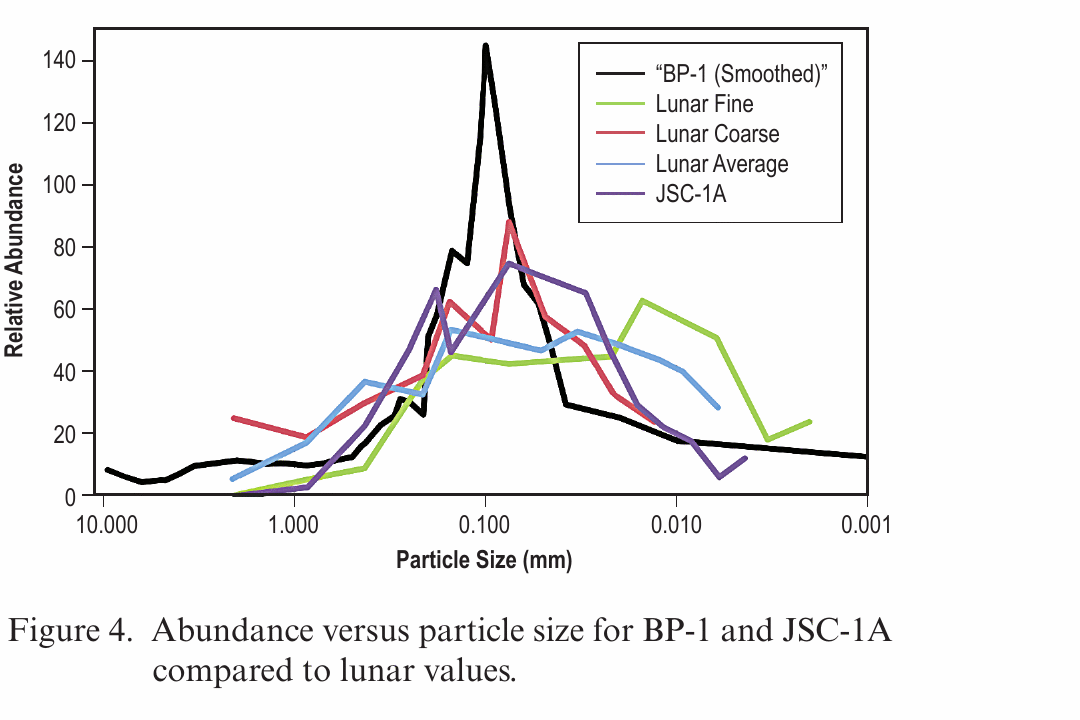
Source: [5]. Public domain (NASA).
Laser-diffraction distributions measured on a common instrument [6]:
| Simulant | Mean size, um | D10, um | D50, um | D90, um |
|---|---|---|---|---|
| LHS-1 | 92 | 124.73 | 293.48 | 405.91 |
| LHS-1D | 30 | 18.27 | 32.96 | 37.46 |
| LHS-1-25A | 65 | 58.84 | 141.14 | 275.71 |
| LMS-1 | 90 | 53.91 | 116.50 | 277.21 |
| LMS-1D | 35 | 84.53 | 211.50 | 428.69 |
| JSC-1A | 164 | 57.06 | 225.94 | 343.05 |
| BP-1 | 198 | 92.10 | 228.91 | 319.80 |
| MGS-1 | 90 | 109.06 | 232.36 | 384.08 |
| MGS-1S | 119 | 72.05 | 145.09 | 213.36 |
| MGS-1C | 25 | 73.83 | 190.86 | 342.97 |
| JEZ-1 | 68 | 120.30 | 269.56 | 512.48 |
None of these simulants contains material coarser than 2 mm, by design [6]. GRC-3b and its variants are classified as well-graded silty sand under the Unified Soil Classification System, with a particle size distribution unchanged between the base material and the dust-suppressed variant [7].
Strength and density
Section titled “Strength and density”Values below are quoted at comparable bulk density, since cohesion and friction angle in granular material are both functions of density rather than fixed material constants [7], and the same dependence holds across the Exolith lunar and Martian simulants [6].
| Material | Minimum density, kg/m3 | Maximum density, kg/m3 | Cohesion, kPa | Internal friction angle |
|---|---|---|---|---|
| Lunar regolith (reference) | 870 | 1930 | 0.1 to 1 | 30 to 50 deg |
| GRC-3b, literature | 1520 | 1939 | 0 | 47.8 deg at 1839 kg/m3 |
| GRC-3b, current batches | 1581 | 1972 | 0 | 33.4 deg at 1792 kg/m3 |
| GRC-3b-DST | 1352 | 1971 | 11.5 | 35.5 deg at 1816 kg/m3 |
The 14 degree spread between the literature friction angle for GRC-3b and the value measured on current production batches at similar relative density is batch variation in a nominally unchanged product [6]. Apollo relative density at depths to 20 cm runs 60 to 80 percent, and is itself a derived quantity computed from specific gravity and the minimum and maximum index densities rather than a direct measurement.
GRC-3b-DST was produced by adding a dust-suppressing additive at 0.7 wt% to the GRC-3b formulation, 22 tonnes of it, to cut respirable silica [7]. The additive raised cohesion from zero to between 5 and 11 kPa and lowered the minimum density from 1581 to 1352 kg/m3, which widens the range of achievable soil states towards the lunar minimum of 870 kg/m3 without reaching it. Respirable silica exposure during bed preparation measured 9.1 to 12 ug/m3 against the OSHA permissible exposure limit of 50 ug/m3 over an eight hour day [7].
Cohesion rises exponentially with bulk density in every simulant measured. Over 1.32 to 1.97 g/cm3 the coarse lunar simulants span 0.185 to 1.672 kPa; the dust fractions span 0.116 to 1.289 kPa over 0.80 to 1.30 g/cm3; the Martian simulants span 0.179 to 1.406 kPa over 1.03 to 1.86 g/cm3 [6]. Internal friction angle across all samples and densities ranges from about 15 to 65 degrees, and does not vary monotonically with density: MGS-1C peaks near 29 degrees at 1.14 g/cm3 then falls to 25 degrees at 1.35 g/cm3, while MGS-1S rises from 34 degrees at 1.31 g/cm3 to near 53 degrees at 1.83 g/cm3. Adding 25 wt% agglutinates to LHS-1 raised cohesion at any given density through particle interlocking but cut the maximum achievable density from 1.80 to 1.75 g/cm3, and so reduced the attainable cohesion range by about 10 percent [6].
Apparatus, stress range and preparation state
Section titled “Apparatus, stress range and preparation state”A cohesion figure quoted for a named simulant is a property of the apparatus and the stress range as much as of the material. LHS-1 is reported at 0.311 kPa from an ASTM D3080 direct shear fit over normal loads of 0.098 to 0.67 kPa at bulk density 1.32 g/cm3 [4], and at 11.0 kPa in a compilation of values taken at approximately 90 percent relative density with the fit made over normal stresses of 25 and 50 kPa [16]. Cohesion in a Mohr-Coulomb fit is the intercept extrapolated from the normal stresses actually applied, so a fit over hundreds of pascals and a fit over tens of kilopascals do not return the same quantity for the same material. JSC-1A separates by a factor of 112 the same way: 0.1 to 2.5 kPa in the prior literature at density and method unstated [4], against 8.9 plus or minus 0.1 kPa in direct shear at 25 and 50 kPa normal stress and 11.2 plus or minus 0.1 kPa in unconsolidated undrained triaxial at 30, 60 and 90 kPa confinement, both on a worked sample at 90 percent relative density [16].
Preparation density is the second condition. Published triaxial values for JSC-1A run 41.87 degrees at 24.6 percent relative density, 46.48 degrees at 54.7 percent and 56.70 degrees at 84.6 percent, and BP-1 is quoted at 51.0 degrees at 85 percent relative density against 39.0 degrees with zero cohesion at 50 percent [16].
Apparatus type alone produced a 19 degree spread when four methods were run on one soil during the Apollo Lunar Roving Vehicle wheel program at the Waterways Experiment Station [17]. Crushed Napa basalt at 0.9 percent moisture and 29 percent relative density gave a friction angle of 38.5 degrees by vacuum triaxial at 0.85 psi normal stress, 34.0 degrees by in situ plate shear at 1.06 psi, 29.0 degrees by bevameter ring shear and 19.8 degrees by Cohron sheargraph, with apparent cohesion on that same soil of 0.03 psi by trenching, 0.14 psi by bevameter ring shear and 0.32 psi by sheargraph [17]. The same vacuum triaxial series returns 38.5 degrees at 0.85 psi and 37.0 degrees at 1.65 psi, so the angle is not constant within one apparatus at one density either.
Absorbed atmospheric water is a first-order error term in any test run at ambient conditions. LHS-1D holding roughly 0.4 wt% absorbed water differed in cohesion by about 15 percent from the same sample baked at 140 C for 24 hours [6]. Vacuum conditioning of a simulant bed for polar testing is therefore part of the test setup rather than an incidental step [13].
Characterization data and fidelity scores
Section titled “Characterization data and fidelity scores”Composition and gradation data for the eleven Exolith Lab simulants (lunar, Martian and asteroid) are published as a data sheet that explicitly provides no comparison with planetary regolith and warns that particle size distribution and composition vary from batch to batch [21]. The NASA user guide scores fourteen commercial and NASA lunar simulants against Apollo and Luna reference data and carries the Carrier-derived shear strength reference, 42 degrees and 0.52 kPa at 0 to 15 cm depth [19]. The scores collapse each property to one number through a scale factor chosen by judgment, and the mineralogy score is the weak axis: JSC-1A scores 0.35 and OB-1 0.28 on mineralogy [20]. A test that depends on mineralogy therefore does not transfer from those simulants, while a test governed by particle size does.
For Mars rover testbeds, direct shear and pressure-sinkage tests of the three ExoMars testbed simulants (a nepheline dust analogue and two sands) found that the densities achievable did not reach the specified range and that cohesion and friction angle missed the specification, with the dust analogue’s compacted cohesion above its target [22]. The test set was therefore not the specified soil, and the paper reports it as such.
Bed preparation, compaction and abrasion
Section titled “Bed preparation, compaction and abrasion”Bed state is controlled by procedure. For plasma plume interaction tests in a 15 ft vacuum chamber, undried BP-1 erupts below about 2 Torr during pump down regardless of compaction, an eruption invalidates any characterization made before pump down, and baked simulant stays usable for 2 hours in open air or about a month sealed with desiccant [23]. Vibration compaction raised shear strength only slightly and increased scatter and segregation, and the most repeatable bed was snowed in from a scoop without compaction [23]. A vibratory plate end effector reached about 80 percent relative density in BP-1 and LHS-1, and LHS-1 compacted in vacuum and in ambient air to comparable core densities, 1.69 and 1.74 g/cm3 for raster passes [24].
Abrasion testing uses a dry variant of ASTM B611 three-body wear. Against JSC-1A-F and NU-LHT-2M, the simulants wore soft aluminum and PMMA comparably to silica sand while hardened 1045 steel resisted all of them, and the unsieved simulant outwore its sub-25 micron fraction, so the coarse tail does the cutting [25]. The study is a pilot in ambient air with no standardized method.
Adhesion, flight-hardware qualification and in situ inversion
Section titled “Adhesion, flight-hardware qualification and in situ inversion”Adhesion of lunar dust is a force-budget problem that simulants cannot settle: no direct lift-off force measurement for real lunar dust exists, the one work function figure is for JSC-1 contacted with metals in air, and lunar vacuum is argued to raise effective surface energy by up to two orders of magnitude over terrestrial values [26]. Wind-blown dust physics for Mars rests on models extrapolated from terrestrial wind-tunnel data, so simulant-based dust lofting results carry the same extrapolation [29].
Qualification of excavation hardware on simulant is the dominant flown-program use. The ISRU Pilot Excavator TRL 5 campaign qualified a common actuator through characterization, thermal, accelerated-life and dirty-vacuum tests at 1 g, and arm actuator life testing passed 1,402,223 input revolutions against a 337,000 revolution requirement [28]. The authors argue lunar gravity is less severe but do not demonstrate it [28].
The inverse approach measures the real soil from the vehicle. The VIPER mobility system was to infer cohesion, friction angle and bearing strength from wheel torque and sinkage sensors on south polar regolith; the paper presents only slope versus slip data for a surrogate in loose GRC-1 simulant, and the program was canceled before any lunar data were taken [27].
Behavior under vacuum
Section titled “Behavior under vacuum”Gas trapped in pore structures and water adsorbed on particle surfaces are released when a simulant bed is pumped down, and the release can be violent enough to loosen and weaken the bed, changing its consolidation state before the test begins. In Vacuum Facility 13 at NASA GRC, a chamber 3.66 m tall and 1.5 m in inner diameter, a one tonne bed of GRC-3 or LHT-3M 0.64 m deep and 0.914 m square showed disruptions that could be suppressed by reducing pump rate, with no disruptions observed below 2.5 torr regardless of rate [9]. Reaching 1e-5 torr took a full week because of slow outgassing [9]. The NASA GRC Lunar Dust Adhesion Bell Jar treats a simulant straight from the bottle as not lunar dust: it stirs during pumpdown to prevent dust explosions, bakes out at 200 C at 1e-6 torr, thermally cycles to about -150 C, and plasma-treats the surfaces to mimic solar wind implantation, and its authors state that 1/6 g and energetic particle radiation are not simulated [30].
Electrostatic behavior
Section titled “Electrostatic behavior”Terrestrial atmosphere provides a charge dissipation path that neither the lunar surface nor the Martian surface provides, so tribocharging measurements made in air are not transferable. Charging of JSC Mars-1 against Teflon and fiberglass cylinders has been measured in a 10 mbar CO2 atmosphere using an aerodynamic electrometer with the dust driven onto the insulator by an impeller fan, alongside the mineral constituents Ottawa sand, Fe2O3, Al2O3 and MgO tested separately [10]. Because simulants do not reproduce lunar nanophase iron or agglutinate texture [4], charge transfer measured on a simulant bed is a bound on the flight case rather than a prediction of it.
Flight surprises traced to simulant fidelity
Section titled “Flight surprises traced to simulant fidelity”InSight HP3 mole. The mole was required to reach 3 m depth in the representative simulants MMS below 2 mm and WF-34 quartz sand, and to execute at least 20,000 strokes; the flight unit met both requirements and life tests on flight-equivalent units exceeded 60,000 strokes with no loss of hammer force [11]. The design relied on hull friction from cohesionless soil to balance hammer recoil. Sharp-edged, high friction angle Syar sand had been dropped from the test set earlier in development because no Mars data supported it as representative, and a redesign for high self-cohesion and high friction angle materials was judged beyond the available schedule and budget. The mole reached about 40 cm [11]. Slope stability analysis of the resulting pit walls gave a duricrust cohesion of 5.8 kPa at an assumed 30 degree friction angle, and penetration resistance implied 4 to 25 kPa for friction angles of 30 to 40 degrees, against Martian sand cohesion of 1 kPa or less. The landing site conditions fall on the 4 m zero-active-pressure isoline, against a verified test domain bounded near 0.5 m [11].
Terrestrial gravity compensation. The same analysis establishes that a terrestrial test bed should use soil of higher cohesion than the target body to compensate for Earth gravity when reproducing the active soil pressure regime a penetrator sees. For MMS sand tested on Earth, the zero-active-pressure layer thickness matches that of mildly cohesive sand on Mars, which is why MMS was an acceptable analogue for the insertion phase and not for the phase that followed [11].
Phoenix icy soil delivery. On the first two attempts to deliver an icy-soil sample to the Thermal and Evolved Gas Analyzer, the sample congealed in the scoop and stuck to it during the dump, most likely because sunlight fell directly on the material. A third sample, scraped off the surface so that it carried less ice, did not congeal and was delivered successfully [15].
Apollo Lunar Roving Vehicle. Dust thrown by the wheels was controlled by fenders, and where a rear fender extension was knocked off, on Apollo 16 and 17, dust covered the crew and the equipment [14]. Dust deposited on the rover radiators could not be brushed off and insulated them: on Apollo 15 the rover batteries ran 68 to 78 F above their expected temperatures [14].
What is not established
Section titled “What is not established”- No simulant matches lunar or Martian regolith on grain interior structure, minor mineralogy, agglutinate texture or space weathering, so tests sensitive to these have no validated surrogate [4].
- Cohesion and friction angle depend on apparatus, stress range, density and moisture, and no source here separates these effects from material differences on one soil across laboratories [16][17].
- Direct shear fits on simulants span normal stresses below 0.68 kPa; extrapolation to wheel or excavation loads is not supported, and vacuum, reduced gravity and charging were not tested [6].
- Fidelity scores use judgment-based scale factors [19][20], and the reference lunar data come from a small number of equatorial sites [18].
- Reduced-gravity effects on bed behavior are argued, not measured, in the qualification records cited [11][28]. Parabolic flight tests that put soil and wheel in lunar gravity found that equal-cone-index simulant preparation and reduced-weight testing at 1 g both overstate mobility, which bounds what a 1 g simulant bed predicts [31].
References
- McLemore, C. A., Fikes, J. C. and Howell, J. T. (2007). 2007 Lunar Regolith Simulant Workshop Overview, 20080013346. ntrs.nasa.gov/citations/20080013346
BibTeX
@misc{mclemore20072007, title = {2007 Lunar Regolith Simulant Workshop Overview}, author = {McLemore, Carole A. and Fikes, John C. and Howell, Joe T.}, howpublished = {Presentation at the Lunar Regolith Simulant Workshop}, number = {20080013346}, address = {Huntsville, Alabama}, year = {2007}, url = {https://ntrs.nasa.gov/citations/20080013346}, abstract = {The National Aeronautics and Space Administration (NASA) vision has as a cornerstone, the establishment of an Outpost on the Moon. This Lunar Outpost will eventually provide the necessary planning, technology development, and training for a manned mission to Mars in the future. As part of the overall activity, NASA is conducting Earth-based research and advancing technologies to a Technology Readiness Level (TRL) 6 maturity under the Exploration Technology Development Program that will be incorporated into the Constellation Project as well as other projects. All aspects of the Lunar environment, including the Lunar regolith and its properties, are important in understanding the long-term impacts to hardware, scientific instruments, and humans prior to returning to the Moon and living on the Moon. With the goal of reducing risk to humans and hardware and increasing mission success on the Lunar surface, it is vital that terrestrial investigations including both development and verification testing have access to Lunar-like environments. The Marshall Space Flight Center (MSFC) is supporting this endeavor by developing, characterizing, and producing Lunar simulants in addition to analyzing existing simulants for appropriate applications. A Lunar Regolith Simulant Workshop was conducted by MSFC in Huntsville, Alabama, in October 2007. The purpose of the Workshop was to bring together simulant developers, simulant users, and program and project managers from ETDP and Constellation with the goals of understanding users' simulant needs and their applications. A status of current simulant developments such as the JSC-1A (Mare Type Simulant) and the NASA/U.S. Geological Survey Lunar Highlands-Type Pilot Simulant (NU-LHT-1M) was provided. The method for evaluating simulants, performed via Figures of Merit (FoMs) algorithms, was presented and a demonstration was provided. The four FoM properties currently being assessed are: size, shape, density, and composition. Some of the Workshop findings include: simulant developers must understand simulant users' needs and applications; higher fidelity simulants are needed and needed in larger quantities now; simulants must be characterized to allow "apples-to-apples" comparison of test results; simulant users should confer with simulant experts to assist them in the selection of simulants; safety precautions should be taken in the handling and use of simulants; shipping, storing, and preparation of simulants have important implications; and most importantly, close communications among the simulant community must be maintained and will be continued via telecoms, meetings, and an annual Lunar Regolith Simulant Workshop.} } - Sibille, L., Carpenter, P., Schlagheck, R. and French, R. A. (2006). Lunar Regolith Simulant Materials: Recommendations for Standardization, Production, and Usage
. NASA Marshall Space Flight Center, NASA/TP-2006-214605. Source
BibTeX
@techreport{sibille2006development, title = {Lunar Regolith Simulant Materials: Recommendations for Standardization, Production, and Usage}, author = {Sibille, Laurent and Carpenter, Paul and Schlagheck, R. and French, R. A.}, number = {NASA/TP-2006-214605}, institution = {NASA Marshall Space Flight Center}, type = {NASA Technical Publication}, year = {2006}, url = {https://ntrs.nasa.gov/citations/20060051776}, abstract = {Experience gained during the Apollo program demonstrated the need for extensive testing of surface systems in relevant environments, including regolith materials similar to those encountered on the lunar surface. As NASA embarks on a return to the Moon, it is clear that the current lunar sample inventory is not only insufficient to support lunar surface technology and system development, but its scientific value is too great to be consumed by destructive studies. Every effort must be made to utilize standard simulant materials, which will allow developers to reduce the cost, development, and operational risks to surface systems. The Lunar Regolith Simulant Materials Workshop held in Huntsville, AL, on January 24 26, 2005, identified the need for widely accepted standard reference lunar simulant materials to perform research and development of technologies required for lunar operations. The workshop also established a need for a common, traceable, and repeatable process regarding the standardization, characterization, and distribution of lunar simulants. This document presents recommendations for the standardization, production and usage of lunar regolith simulant materials.} } - Hoelzer, H. D., Fourroux, K. A., Rickman, D. L. and Schrader, C. M. (2011). Figures of Merit Software: Description, User's Guide, Installation Notes, Versions Description, and License Agreement
. NASA Marshall Space Flight Center, NASA/TM-2011-216464. Source
BibTeX
@techreport{hoelzer2011figures, title = {Figures of Merit Software: Description, User's Guide, Installation Notes, Versions Description, and License Agreement}, author = {Hoelzer, H. D. and Fourroux, K. A. and Rickman, Douglas L. and Schrader, C. M.}, number = {NASA/TM-2011-216464}, institution = {NASA Marshall Space Flight Center}, type = {NASA Technical Memorandum}, year = {2011}, url = {https://ntrs.nasa.gov/citations/20110012037}, abstract = {Figures of Merit (FoMs) and the FoM software provide a method for quantitatively evaluating the quality of a regolith simulant by comparing the simulant to a reference material. FoMs may be used for comparing a simulant to actual regolith material, specification by stating the value a simulant s FoMs must attain to be suitable for a given application and comparing simulants from different vendors or production runs. FoMs may even be used to compare different simulants to each other. A single FoM is conceptually an algorithm that computes a single number for quantifying the similarity or difference of a single characteristic of a simulant material and a reference material and provides a clear measure of how well a simulant and reference material match or compare. FoMs have been constructed to lie between zero and 1, with zero indicating a poor or no match and 1 indicating a perfect match. FoMs are defined for modal composition, particle size distribution, particle shape distribution, (aspect ratio and angularity), and density. This TM covers the mathematics, use, installation, and licensing for the existing FoM code in detail.} } - Rickman, D. L., Archer, P. D., Kovtun, R. N., Barmatz, M., Creedon, M., Dotson, B., Donaldson Hanna, K., Long-fox, J. M., Millwater, C., Effinger, M. R., Hutcheon, R. M., Kim, Y.-R., Partridge, A., Whittington, A., Shulman, H. and Wilkerson, R. P. (2024). Characterization of NUW-LHT-5m, A Lunar Highland Simulant
. NASA, 20240007991. Source
BibTeX
@techreport{rickman2024characterization, title = {Characterization of NUW-LHT-5m, A Lunar Highland Simulant}, author = {Rickman, Douglas L. and Archer, Paul Douglas and Kovtun, Rostislav Nikolayevich and Barmatz, Martin and Creedon, Matthew and Dotson, Brandon and Donaldson Hanna, Kerri and Long-fox, Jared Michael and Millwater, Catherine and Effinger, Michael R. and Hutcheon, Ronald M. and Kim, Yong-Rak and Partridge, Austin and Whittington, Alan and Shulman, Holly and Wilkerson, Ryan P.}, number = {20240007991}, institution = {NASA}, year = {2024}, url = {https://ntrs.nasa.gov/citations/20240007991}, abstract = {A new simulant of the lunar highlands regolith, NUW-LHT-5M, was designed by NASA and manufactured by Washington Mills. The simulant was based on Apollo 16 data and is a member of the NU-LHT-series. NASA’s Marshall Space Flight Center and Johnson Space Center have already purchased 3 metric tons of the simulant for advanced engineering work. In support of engineering uses of the simulant, we provided measurements of the simulant including: mineral abundance and composition, liberation, X-ray fluorescence (XRF), ferrous iron, carbon, sulfur, 60 element inductively coupled plasma (ICP), loss on ignition, particle size, both 2D and 3D particle shape, specific surface area, shear, cohesion, internal friction, helium pycnometry, minimum index density, tap density, magnetic susceptibility, cryogenic and high temperature permittivity, visible and near-infrared (VNIR) and middle infra-red spectroscopy (MIR), differential scanning calorimetry (DSC), viscosity, thermal diffusivity, thermal conductivity, thermal gravimetric analysis (TGA), evolved gas analysis (EGA), and spark sintering. For the crystalline components the design of the simulant called for two rocks from the Stillwater Complex, Montana: 17.6 wt% norite, 37.7% anorthosite, and 4.7 wt% olivine from an unspecified commercial source. The other 40% of the simulant was a high calcium (An100), vesicular glass that Washington Mills made specifically for the simulant. Fabrication and quality control processes for both the glass and the simulant are described. Importantly, most of the graphs and tables presented herein provide values for both the new simulant and data for the older NASA mare simulant, JSC-1A. Finally, we discussed the current limitations of NUW-LT-5M and most other lunar regolith simulants to replicate the lunar material.} } - Stoeser, D. B., Rickman, D. L. and Wilson, S. A. (2010). Preliminary Geological Findings on the BP-1 Simulant
. NASA, NASA/TM-2010-216444. Source
BibTeX
@techreport{stoeser2010preliminary, title = {Preliminary Geological Findings on the BP-1 Simulant}, author = {Stoeser, D. B. and Rickman, Douglas L. and Wilson, Sharon A.}, number = {NASA/TM-2010-216444}, institution = {NASA}, year = {2010}, url = {https://ntrs.nasa.gov/citations/20100036344}, abstract = {A waste material from an aggregate producing quarry has been used to make an inexpensive lunar simulant called BP-1. The feedstock is the Black Point lava flow in northern Arizona. Although this is part of the San Francisco volcanic field, which is also the source of the JSC-1 series feedstock, BP-1 and JSC-1 are distinct. Chemically, the Black Point flow is an amygdaloidal nepheline-bearing basalt. The amygdules are filled with secondary minerals containing opaline silica, calcium carbonate, and ferric iron minerals. X-ray diffraction (XRD) detected approximately 3% quartz, which is in line with tests done by the Kennedy Space Center Industrial Hygiene Office. Users of this material should use appropriate protective equipment. XRD also showed the presence of significant halite and some bassanite. Both are interpreted to be evaporative residues due to recycling of wash water at the quarry. The size distribution of BP-1 may be superior to some other simulants for some applications.} } - Dotson, B., Sanchez Valencia, D., Millwater, C., Easter, P. B., Long-Fox, J., Britt, D. and Metzger, P. (2024). Cohesion and Shear Strength of Compacted Lunar and Martian Regolith Simulants
. Icarus. Source
BibTeX
@article{dotson2024cohesion, title = {Cohesion and Shear Strength of Compacted Lunar and Martian Regolith Simulants}, author = {Dotson, Brandon and Sanchez Valencia, D. and Millwater, C. and Easter, Parks B. and Long-Fox, J. and Britt, D. and Metzger, P.}, journal = {Icarus}, volume = {411}, pages = {115943}, year = {2024}, doi = {10.1016/j.icarus.2024.115943} } - Gerdts, S., Moreland, S. and Marteau, E. (2025). GRC-3b-DST, a Geotechnical Simulant for Cohesive Mars and Moon Mobility and Excavation Testing With Reduced Respirable Silica
. NASA, NASA/TM-20250006761. Source
BibTeX
@techreport{gerdts2025grc, title = {GRC-3b-DST, a Geotechnical Simulant for Cohesive Mars and Moon Mobility and Excavation Testing With Reduced Respirable Silica}, author = {Gerdts, Stephen and Moreland, Scott and Marteau, Eloise}, number = {NASA/TM-20250006761}, institution = {NASA}, year = {2025}, doi = {10.64631/puln8817}, abstract = {This study presents the development and evaluation of a modified version of the GRC-3b lunar soil simulant designed to address both geotechnical performance and operator safety in terrestrial mobility and excavation testing. While GRC-3b is widely used due to its cost-effectiveness and similarity to extraterrestrial regolith, its fine silica content poses significant health risks during handling. To mitigate this, a dust-suppressing additive was introduced, producing GRC-3b-DST. The modified simulant maintained the original particle size distribution and classification as a well-graded silty sand but exhibited increased cohesion and a lower minimum density, enhancing its ability to replicate compacted regolith conditions. Laboratory testing, including modified Proctor compaction, simple shear tests, and cone penetrometer correlations, confirmed that the geotechnical properties of GRC-3b-DST are consistent and predictable, making it suitable for high-fidelity terrain simulations. Safety testing using OSHA-compliant air sampling showed respirable silica concentrations remained well below permissible exposure limits during soil preparation, indicating a significant reduction in airborne hazards. These findings suggest that GRC-3b-DST offers a safer, more versatile alternative for use in large-scale test environments where repeatable geomechanical properties and minimized health risks are essential.} } - Clark, J. V., Archer, P. D., Gruener, J. E., Ming, D. W., Tu, V. M., Niles, P. B. and Mertzman, S. A. (2020). JSC-Rocknest: A large-scale Mojave Mars Simulant (MMS) based soil simulant for in-situ resource utilization water-extraction studies
. Icarus. Source
BibTeX
@article{clark2020jsc, title = {JSC-Rocknest: A large-scale Mojave Mars Simulant (MMS) based soil simulant for in-situ resource utilization water-extraction studies}, author = {Clark, J. V. and Archer, P. D. and Gruener, John E. and Ming, D. W. and Tu, V. M. and Niles, P. B. and Mertzman, S. A.}, journal = {Icarus}, volume = {351}, pages = {113936}, year = {2020}, doi = {10.1016/j.icarus.2020.113936}, abstract = {The Johnson Space Center-Rocknest (JSC-RN) simulant was developed in response to a need by NASA's Advanced Exploration Systems (AES) In-Situ Resource Utilization (ISRU) project for a simulant to be used in component and system testing for water extraction from Mars regolith. JSC-RN was designed to be chemically and mineralogically similar to material from the aeolian sand shadow named Rocknest in Gale Crater, particularly the 1–3 wt% low temperature (<450 °C) water release as measured by the Sample Analysis at Mars (SAM) instrument on the Curiosity rover. Sodium perchlorate, goethite, pyrite, ferric sulfate, regular and high capacity granular ferric oxide, and forsterite were added to a Mojave Mars Simulant (MMS) base in order to match the mineralogy, evolved gases, and elemental chemistry of Rocknest. Mineral and rock components were sent to the United States Geological Survey (USGS) in Denver for mixing. Approximately 800 kg of JSC-RN were sent back to NASA in 5 gal buckets, which were subsampled and characterized. All samples of the USGS-produced simulants had similar evolved gas profiles as a small prototype batch of JSC-RN made in JSC laboratories, with the exception of HCl, and were similar in terms of mineralogy and total chemistry. Also, all JSC-RN subsamples were homogenous and had similar mineralogy, total chemistry, and low-temperature evolved gas profiles as the Rocknest aeolian sand shadow examined with Curiosity's instrument suite on Mars. In particular, the low temperature water releases were similar and the amount of water evolved from JSC-RN at <450 °C was similar to the water content of Rocknest based on SAM water peak integrations. Overall, JSC-RN is ideally suited for ISRU studies of water extraction of global martian soil due to its excellent agreement with measured properties of martian soils and its proven feasibility for large-scale production.} } - Kleinhenz, J. E. and Wilkinson, R. A. (2012). ISRU Soil Mechanics Vacuum Facility: Soil Bin Preparation and Simulant Strength Characterization
. AIAA Aerospace Sciences Meeting including The New Horizons Forum and Aerospace Exposition, 20120002766. Source
BibTeX
@inproceedings{kleinhenz2012isru, title = {ISRU Soil Mechanics Vacuum Facility: Soil Bin Preparation and Simulant Strength Characterization}, author = {Kleinhenz, Julie E. and Wilkinson, R. Allen}, booktitle = {AIAA Aerospace Sciences Meeting including The New Horizons Forum and Aerospace Exposition}, number = {20120002766}, institution = {NASA Glenn Research Center}, year = {2012}, doi = {10.2514/6.2012-359}, abstract = {Testing in relevant environments is key to exploration mission hardware development. This is true on both the component level (in early development) and system level (in late development stages). During ISRU missions the hardware will interface with the soil (digging, roving, etc) in a vacuum environment. A relevant test environment will therefore involve a vacuum chamber with a controlled, conditioned simulant bed. However, in earth-based granular media, such as lunar soil simulant, gases trapped within the material pore structures and water adsorbed to all particle surfaces will release when exposed to vacuum. Early vacuum testing has shown that this gas release can occur violently, which loosens and weakens the simulant, altering the consolidation state. The Vacuum Facility #13, a mid-size chamber (3.66m tall, 1.5m inner diameter) at the NASA Glenn Research Center has been modified to create a soil mechanics test facility. A 0.64m deep by 0.914m square metric ton bed of lunar simulant was placed under vacuum using a variety of pumping techniques. Both GRC-3 and LHT-3M simulant types have been used. An electric cone penetrometer was used to measure simulant strength properties at vacuum including: cohesion, friction angle, bulk density and shear modulus. Simulant disruptions, caused by off gassing, affected the strength properties, but could be mitigated by reducing pump rate. No disruptions were observed at pressures below 2.5Torr, regardless of the pump rate. However, slow off gassing of the soil lead to long test times, a full week, to reach 10-5Torr. This work highlights the need for robotic machine-simulant hardware and operations in vacuum to expeditiously perform (sub-)systems tests.} } - Mantovani, J. G. (2001). A Study of the Electrostatic Interaction Between Insulators and Martian/Lunar Soil Simulants
. NASA Kennedy Space Center, 20020050541. Source
BibTeX
@techreport{mantovani2001study, title = {A Study of the Electrostatic Interaction Between Insulators and Martian/Lunar Soil Simulants}, author = {Mantovani, James G.}, number = {20020050541}, institution = {NASA Kennedy Space Center}, year = {2001}, url = {https://ntrs.nasa.gov/citations/20020050541}, abstract = {Using our previous experience with the Mars Environmental Compatibility Assessment (MECA) electrometer, we have designed a new type of aerodynamic electrometer. The goal of the research was to measure the buildup of electrostatic surface charge on a stationary cylindrical insulator after windborne granular particles have collided with the insulator surface in a simulated dust storm. The experiments are performed inside a vacuum chamber. This allows the atmospheric composition and pressure to be controlled in order to simulate the atmospheric conditions near the equator on the Martian surface. An impeller fan was used to propel the dust particles at a cylindrically shaped insulator under low vacuum conditions. We tested the new electrometer in a 10 mbar CO2 atmosphere by exposing two types of cylindrical insulators, Teflon (1.9 cm diameter) and Fiberglass (2.5 cm diameter), to a variety of windborne granular particulate materials. The granular materials tested were JSC Mars-1 simulant, which is a mixture of coarse and fine (<5microns diameter) particle sizes, and some of the major mineral constituents of the Martian soil. The minerals included Ottawa sand (SiO2), iron oxide (Fe2O3), aluminum oxide (Al2O3) and magnesium oxide (MgO). We also constructed a MECA-like electrometer that contained an insulator capped planar electrode for measuring the amount of electrostatic charge produced by rubbing an insulator surface over Martian and lunar soil simulants. The results of this study indicate that it is possible to detect triboelectric charging of insulator surfaces by windborne Martian soil simulant, and by individual mineral constituents of the soil simulant. We have also found that Teflon and Fiberglass insulator surfaces respond in different ways by developing opposite polarity surface charge, which decays at different rates after the particle impacts cease.} } - Spohn, T., Hudson, T. L., Witte, L., Wippermann, T., Wisniewski, L., Kedziora, B., Vrettos, C., Lorenz, R. D., Golombek, M., Lichtenheldt, R., Grott, M., Knollenberg, J., Krause, C., Fantinati, C., Krueger, T. and Grygorczuk, J. (2022). The InSight-HP3 Mole on Mars: Lessons Learned from Attempts to Penetrate to Depth in the Martian Soil
. Advances in Space Research, 8. Source
BibTeX
@article{spohn2022insight, title = {The InSight-HP3 Mole on Mars: Lessons Learned from Attempts to Penetrate to Depth in the Martian Soil}, author = {Spohn, Tilman and Hudson, Troy L. and Witte, Lars and Wippermann, Torben and Wisniewski, Lukasz and Kedziora, Bartosz and Vrettos, Christos and Lorenz, Ralph D. and Golombek, Matthew and Lichtenheldt, Roy and Grott, Matthias and Knollenberg, Joerg and Krause, Christian and Fantinati, Cinzia and Krueger, Torsten and Grygorczuk, Jerzy}, journal = {Advances in Space Research}, volume = {69}, number = {8}, pages = {3140--3163}, year = {2022}, doi = {10.1016/j.asr.2022.02.009}, abstract = {The NASA InSight lander mission to Mars payload includes the Heat Flow and Physical Properties Package HP3 to measure the surface heat flow. The package was designed to use a small penetrator - nicknamed the mole - to implement a vertical string of temperature sensors in the soil to a depth of 5 m. The mole itself is equipped with sensors to measure a thermal conductivity-depth profile as it proceeds to depth. The heat flow is calculated from the product of the temperature gradient and the thermal conductivity. To avoid the perturbation caused by annual surface temperature variations, the measurements need to be taken at a depth between 3 m and 5 m. The mole is designed to penetrate cohesionless soil similar in rheology to quartz sand which is expected to provide a good analogue material for Martian sand. The sand would provide friction to the buried mole hull to balance the remaining recoil of the mole hammer mechanism that drives the mole forward. Unfortunately, the mole did not penetrate more than 40 cm, roughly a mole length. The failure to penetrate deeper is largely due to a cohesive duricrust of a few tens of centimeter thickness that failed to provide the required friction. Although a suppressor mass and spring as part of the mole hammer mechanism absorb much of the recoil, the available mass did not allow designing a system that fully eliminated the recoil. The mole penetrated to 40 cm depth benefiting from friction provided by springs in the support structure from which it was deployed and from friction and direct support provided by the InSight Instrument Deployment Arm. In addition, the Martian soil provided unexpected levels of penetration resistance that would have motivated designing a more powerful mole. The low weight of the mole support structure was not sufficient to guide the mole penetrating vertically. Roughly doubling the overall mass of the instrument package would have allowed to design a more robust system with little or no recoil, more energy of the mole hammer mechanism and a more massive support structure. In addition, to cope with duricrust a mechanism to support the mole to a depth of about two mole lengths should be considered.} } - Gasteiner, L. and Murdoch, N. (2026). An Open Database of Lunar Regolith and Simulants Properties
. arXiv preprint arXiv:2602.03829. Source
BibTeX
@article{gasteiner2026open, title = {An Open Database of Lunar Regolith and Simulants Properties}, author = {Gasteiner, Léonie and Murdoch, Naomi}, journal = {arXiv preprint arXiv:2602.03829}, year = {2026}, doi = {10.1002/nag.70432}, abstract = {ABSTRACT Lunar regolith, the layer of unconsolidated material covering the Moon's surface, is central to the science and technology developed for the Moon, notably related to in‐situ science investigations, resource utilization, surface infrastructure, and mobility systems. However, data on lunar soil properties remain fragmented across decades of mission reports, often in formats that are difficult to access or interpret. We present a newly compiled database of lunar regolith physical and geotechnical properties, including data collected by direct in‐situ measurements from crewed missions, estimates inferred from surface interactions on the Moon and using remote sensing, as well as laboratory analyses of samples returned to Earth. The data collected include, among others, the angle of internal friction and cohesion (both Mohr‐Coulomb model parameters), bulk density, and static bearing capacity, extracted from Luna and Apollo‐era historical mission documentation all the way to contemporary Lunar programs. The dataset specifies the type and location of the tests from which each value was obtained. Our database also includes parameters for some lunar regolith simulants, providing a direct link between mission data and laboratory studies. In addition to centralizing this information, we developed a user interface that facilitates data retrieval, filtering, and visualization. This interface enables users to generate customized plots for comparative analysis. Developed in an open‐science perspective, it is designed to evolve in response to the community's needs. The database and its associated tools significantly enhance the accessibility and usability of lunar regolith and simulants data for scientific and engineering research.} } - Kleinhenz, J. (2014). Lunar Polar Environmental Testing: Regolith Simulant Conditioning
. Symposium on Space Resource Utilization, 20140012567. Source
BibTeX
@inproceedings{kleinhenz2014lunar, title = {Lunar Polar Environmental Testing: Regolith Simulant Conditioning}, author = {Kleinhenz, Julie}, booktitle = {Symposium on Space Resource Utilization}, number = {20140012567}, institution = {NASA}, year = {2014}, doi = {10.2514/6.2014-0689}, abstract = {As ISRU system development approaches flight fidelity, there is a need to test hardware in relevant environments. Extensive laboratory and field testing have involved relevant soil (lunar regolith simulants), but the current design iterations necessitate relevant pressure and temperature conditions. Including significant quantities of lunar regolith simulant in a thermal vacuum chamber poses unique challenges. These include facility operational challenges (dust tolerant hardware) and difficulty maintaining a pre-prepared soil state during pump down (consolidation state, moisture retention).For ISRU purposes, the regolith at the lunar poles will be of most interest due to the elevated water content. To test at polar conditions, the regolith simulant must be doped with water to an appropriate percentage and then chilled to cryogenic temperatures while exposed to vacuum conditions. A 1m tall, 28cm diameter bin of simulant was developed for testing these simulant preparation and drilling operations. The bin itself was wrapped with liquid nitrogen cooling loops (100K) so that the simulant bed reached an average temperature of 140K at vacuum. Post-test sampling was used to determine desiccation of the bed due to vacuum exposure. Depth dependent moisture data is presented from frozen and thawed soil samples.Following simulant only evacuation tests, drill hardware was incorporated into the vacuum chamber to test auguring techniques in the frozen soil at thermal vacuum conditions. The focus of this testing was to produce cuttings piles for a newly developed spectrometer to evaluate. This instrument, which is part of the RESOLVE program science hardware, detects water signatures from surface regolith. The drill performance, behavior of simulant during drilling, and characteristics of the cuttings piles will be offered.} } - Gaier, J. R. (2005). The Effects of Lunar Dust on EVA Systems During the Apollo Missions
. NASA Glenn Research Center, NASA/TM-2005-213610, 20050160460. Source
BibTeX
@techreport{gaier2005effects, title = {The Effects of Lunar Dust on EVA Systems During the Apollo Missions}, author = {Gaier, James R.}, number = {NASA/TM-2005-213610, 20050160460}, institution = {NASA Glenn Research Center}, year = {2005}, url = {https://ntrs.nasa.gov/citations/20050160460}, abstract = {Mission documents from the six Apollo missions that landed on the lunar surface have been studied in order to catalog the effects of lunar dust on Extra-Vehicular Activity (EVA) systems, primarily the Apollo surface space suit. It was found that the effects could be sorted into nine categories: vision obscuration, false instrument readings, dust coating and contamination, loss of traction, clogging of mechanisms, abrasion, thermal control problems, seal failures, and inhalation and irritation. Although simple dust mitigation measures were sufficient to mitigate some of the problems (i.e., loss of traction) it was found that these measures were ineffective to mitigate many of the more serious problems (i.e., clogging, abrasion, diminished heat rejection). The severity of the dust problems were consistently underestimated by ground tests, indicating a need to develop better simulation facilities and procedures.} } - Bonitz, R., Shiraishi, L., Robinson, M., Carsten, J., Volpe, R., Trebi-Ollennu, A., Arvidson, R. E., Chu, P. C., Wilson, J. J. and Davis, K. R. (2009). The Phoenix Mars Lander Robotic Arm
. IEEE Aerospace Conference. Source
BibTeX
@inproceedings{bonitz2009phoenix, title = {The Phoenix Mars Lander Robotic Arm}, author = {Bonitz, Robert and Shiraishi, Lori and Robinson, Matthew and Carsten, Joseph and Volpe, Richard and Trebi-Ollennu, Ashitey and Arvidson, Raymond E. and Chu, P. C. and Wilson, J. J. and Davis, K. R.}, booktitle = {IEEE Aerospace Conference}, pages = {1-12}, organization = {Jet Propulsion Laboratory, California Institute of Technology}, address = {Big Sky, Montana}, year = {2009}, doi = {10.1109/aero.2009.4839306}, abstract = {The Phoenix Mars Lander Robotic Arm (RA) has operated for 149 sols since the Lander touched down on the north polar region of Mars on May 25, 2008. During its mission it has dug numerous trenches in the Martian regolith, acquired samples of Martian dry and icy soil, and delivered them to the Thermal Evolved Gas Analyzer (TEGA) and the Microscopy, Electrochemistry, and Conductivity Analyzer (MECA). The RA inserted the Thermal and Electrical Conductivity Probe (TECP) into the Martian regolith and positioned it at various heights above the surface for relative humidity measurements. The RA was used to point the Robotic Arm Camera to take images of the surface, trenches, samples within the scoop, and other objects of scientific interest within its workspace. Data from the RA sensors during trenching, scraping, and trench cave-in experiments have been used to infer mechanical properties of the Martian soil. This paper describes the design and operations of the RA as a critical component of the Phoenix Mars Lander necessary to achieve the scientific goals of the mission.} } - Jehn, M., Just, G. H., Sargeant, H. M., Long-Fox, J. and Britt, D. T. (2025). Implications of Lunar Simulant Geotechnical Properties on Testbed Experimentation and Engineering Analysis
. Space and Planetary Resources. Source
BibTeX
@article{jehn2025implications, title = {Implications of Lunar Simulant Geotechnical Properties on Testbed Experimentation and Engineering Analysis}, author = {Jehn, Marcus and Just, Gabriele H. and Sargeant, Hannah M. and Long-Fox, Jared and Britt, Daniel T.}, journal = {Space and Planetary Resources}, volume = {1}, pages = {5}, year = {2025}, doi = {10.1007/s44461-025-00002-7}, abstract = {Understanding the mechanical behavior of lunar regolith simulants is crucial for progressing engineering analysis in surface infrastructure design and testbed evaluation. This study provides a detailed geotechnical characterization of the Colorado School of Mines Lunar Highlands Type-Testbed simulants, including a new highland-type lunar simulant integrated into the Mines Lunar Surface Simulator testbed. It includes the determination of key geotechnical properties such as particle size distribution, density, compressibility, cohesion, friction angle, and particle shape, using standardized ASTM testing procedures. Key findings show that while particle size distribution similarities exist among the simulants and actual lunar regolith, there are significant differences in density-dependent mechanical behaviors such as shear strength, compressibility, and deformation responses. These results emphasize the complexity of simulant fidelity and its impact on testbed experiments when simulating mid-Technology Readiness Level environments. Additionally, we emphasize the importance of density-specific testing for evaluating both geotechnical properties and simulant performance. This work presents the first comprehensive publication of the full geotechnical profile of Colorado School of Mines highland simulants and highlights the importance of using multiple parameters beyond just particle size distribution to evaluate simulant fidelity. Future research will concentrate on characterizing testbed variability and assessing properties across different density states to improve the application of lunar simulants in engineering analysis and testbed experimentation.} } - Green, A. J. and Melzer, K.-J. (1971). Performance of Boeing LRV wheels in a lunar soil simulant. Report 1: Effect of wheel design and soil
. U.S. Army Engineer Waterways Experiment Station, Technical Report M-71-10, Report 1. Source
BibTeX
@techreport{green1971performance, title = {Performance of Boeing LRV wheels in a lunar soil simulant. Report 1: Effect of wheel design and soil}, author = {Green, Andrew J. and Melzer, Klaus-Jurgen}, number = {Technical Report M-71-10, Report 1}, institution = {U.S. Army Engineer Waterways Experiment Station}, year = {1971}, url = {https://erdc-library.erdc.dren.mil/handle/11681/29961} } - Heiken, G. H., Vaniman, D. T. and French, B. M. (1991). Lunar Sourcebook: A User's Guide to the Moon
. Endeavour. Source
BibTeX
@book{heiken1991lunar, title = {Lunar Sourcebook: A User's Guide to the Moon}, author = {Heiken, Grant H. and Vaniman, David T. and French, Bevan M.}, journal = {Endeavour}, volume = {16}, pages = {96}, publisher = {Cambridge University Press}, year = {1991}, doi = {10.1016/0160-9327(92)90014-g} } - Slabic, A., Gruener, J. E., Kovtun, R. N., Rickman, D. L., Sibille, L., Oravec, H. A., Edmunson, J. and Keprta, S. (2024). Lunar Regolith Simulant User's Guide, Revision A
. NASA, NASA/TM-20240011783. Source
BibTeX
@techreport{slabic2024lunar, title = {Lunar Regolith Simulant User's Guide, Revision A}, author = {Slabic, Ane and Gruener, John E. and Kovtun, Rostislav N. and Rickman, Douglas L. and Sibille, Laurent and Oravec, Heather A. and Edmunson, Jennifer and Keprta, Sean}, number = {NASA/TM-20240011783}, institution = {NASA}, year = {2024}, url = {https://ntrs.nasa.gov/citations/20240011783}, abstract = {This guide is titled Lunar Regolith Simulant User's Guide, Rev A, and two points need to be made about the title. First, is the use of the term "regolith". During the Apollo Program, the term "soil" was used for taking a sample of the loose material on the surface, and then cataloging that sample in the lunar curation database as a "soil sample". By the 1980s, the term "regolith" gained favor by lunar scientists. In the Lunar Sourcebook (Heiken et al., 1991), regolith is defined as "a general term for the layer or mantle of fragmental and unconsolidated rock material, whether residual or transported and of highly varied character, that nearly everywhere forms the surface of the land and overlies or covers bedrock". Regolith is a terrestrial term that seems to go back to 1897, according to a recent paper by Huggett (2023). Huggett summed up his paper by writing, "soil and regolith are one in the same". "Regolith" will mostly be used throughout this guide, as it tends to separate in one's mind the unique nature of the Moon's surface when compared to the inherent bias humans have in their mind when they hear and use the word "soil". When referring to Apollo samples, "soil" is used for historical context and in some places the simple term "lunar simulant" is also used. Secondly, Rev A is used in the title because NASA released its first Lunar Regolith Simulant User's Guide in 2010, near the end of NASA's Constellation Program (Schrader et al., 2010). This guide follows in the pattern of that first guide and will be updated on a periodic basis as new simulants are created, characterized and used, and as new information emerges about the Moon's regolith due to new lunar exploration missions, both robotic and human.} } - Metzger, P. T., Britt, D. T., Covey, S., Schultz, C., Cannon, K. M., Grossman, K. D., Mantovani, J. G. and Mueller, R. P. (2019). Measuring the fidelity of asteroid regolith and cobble simulants
. Icarus. Source
BibTeX
@article{metzger2019measuring, title = {Measuring the fidelity of asteroid regolith and cobble simulants}, author = {Metzger, Philip T. and Britt, Daniel T. and Covey, Stephen and Schultz, Cody and Cannon, Kevin M. and Grossman, Kevin D. and Mantovani, James G. and Mueller, Robert P.}, journal = {Icarus}, volume = {321}, pages = {632--646}, year = {2019}, doi = {10.1016/j.icarus.2018.12.019} } - Long-Fox, J. M. and Britt, D. T. (2023). Characterization of Planetary Regolith Simulants for the Research and Development of Space Resource Technologies
. Frontiers in Space Technologies. Source
BibTeX
@article{longfox2023characterization, title = {Characterization of Planetary Regolith Simulants for the Research and Development of Space Resource Technologies}, author = {Long-Fox, Jared M. and Britt, Daniel T.}, journal = {Frontiers in Space Technologies}, volume = {4}, pages = {1255535}, year = {2023}, doi = {10.3389/frspt.2023.1255535}, abstract = {Human planetary exploration and colonization efforts are reliant on the ability to safely interact with planetary surfaces and to leverage local regolith as a resource. The high-cost and risk-intensive nature of establishing planetary infrastructure and resource utilization facilities necessitates risk reduction through laboratory-based research and development of space resource acquisition, processing, and extraction technologies using appropriate, well-characterized, mineral-based regolith simulants. Such simulants enable the planetary exploration and resource utilization communities to test large-scale technologies and methodologies for a relatively low cost as an alternative to scarce and expensive returned samples. The fidelity of a regolith simulant for any application is, in part, determined by the mineralogical composition and particle size distribution. The importance of composition is well established for in situ resource utilization studies sensitive to geochemical properties but tends to be ignored in studies concerned with physical properties. Neglecting to consider mineralogy reduces the fidelity of a simulant since each mineral species has its own unique grain density, preferred grain geometry, and intergranular forces, all of which affect the physical properties of the simulant (e.g., shear strength, bearing strength, bulk density, thermal and electrical properties, magnetic properties). Traditionally, regolith simulants have been limited in quantity and availability; Exolith Lab remedies these problems by designing simulants in a constrained maximization approach to fidelity relative to cost, material availability, and safety. Exolith Lab simulants are designed to approximate the mineralogy and particle size ranges of the planetary regolith being simulated, with composition constrained by remote sensing observations and/or returned sample analyses. With facilities and equipment capable of high-volume simulant production, Exolith Lab offers standard simulants in bulk that are readily available for purchase and shipment. This work reviews the production methods, equipment, and materials used to create Exolith Lab simulants, provides compositional data, particle size data, and applications for each standard lunar, Martian, and asteroid simulant that Exolith Lab offers.} } - Brunskill, C., Patel, N., Gouache, T. P., Scott, G. P., Saaj, C. M., Matthews, M. and Cui, L. (2011). Characterisation of Martian Soil Simulants for the ExoMars Rover Testbed
. Journal of Terramechanics, 6. Source
BibTeX
@article{brunskill2011characterisation, title = {Characterisation of {Martian} Soil Simulants for the {ExoMars} Rover Testbed}, author = {Brunskill, Christopher and Patel, Nildeep and Gouache, Thibault P. and Scott, Gregory P. and Saaj, Chakravarthini M. and Matthews, Marcus and Cui, Lei}, journal = {Journal of Terramechanics}, volume = {48}, number = {6}, pages = {419--438}, year = {2011}, doi = {10.1016/j.jterra.2011.10.001} } - Mantovani, J., Langton, A., Kemmerer, B., Atkins, A. and Batcheldor, D. (2022). Regolith Simulant Preparation and Geotechnical Characterization for Plume Surface Interaction Testing
. NASA, 20220013110. Source
BibTeX
@techreport{mantovani2022regolith, title = {Regolith Simulant Preparation and Geotechnical Characterization for Plume Surface Interaction Testing}, author = {Mantovani, James and Langton, Austin and Kemmerer, Beverly and Atkins, Austin and Batcheldor, Daniel}, number = {20220013110}, institution = {NASA}, year = {2022}, url = {https://ntrs.nasa.gov/citations/20220013110}, abstract = {Descent engine plumes interact with the lunar surface and accelerate regolith particles to potentially high velocities. These ejecta create risks to surface assets that have yet to be fully assessed. To better understand these risks, plume surface interactions can be simulated on the ground by firing a test engine plume into a bin of lunar regolith simulant under vacuum conditions. The dynamics of the resultant ejecta can then be recorded. In this technical memorandum we discuss the processes used in preparing a 150 kg bin of lunar regolith simulant for plume surface interaction ground tests under vacuum conditions for the NASA STMD Plume Surface Interaction project. We present our approach to mitigating regolith simulant eruptions during pump-down, the methods used to fill and reset the regolith simulant bin for each test, and the techniques used to characterize the consistency of regolith simulant geotechnical properties before each new firing. The challenges of preparing a regolith simulant test bin below an ambient pressure of one atmosphere, particularly on the large scale, could largely be overcome with a system that could fill the test bin with simulant inside the chamber and under vacuum conditions.} } - Bell, E. A., Kemmerer, B. W., Gelino, N. J., Sibille, L., Holmgren, G. M., Flowers, P. F. and Rao-Aourpally, V. (2025). Vibratory Plate Compaction of BP-1 and LHS-1 Utilizing the Planetary Automated Compaction Tool (PACT)
. NASA, 20250005172. Source
BibTeX
@techreport{bell2025vibratory, title = {Vibratory Plate Compaction of BP-1 and LHS-1 Utilizing the Planetary Automated Compaction Tool (PACT)}, author = {Bell, E. A. and Kemmerer, B. W. and Gelino, Nathan J. and Sibille, Laurent and Holmgren, G. M. and Flowers, P. F. and Rao-Aourpally, V.}, number = {20250005172}, institution = {NASA}, year = {2025}, url = {https://ntrs.nasa.gov/citations/20250005172}, abstract = {The Multifunctional End Effector for Regolith Construction, Acquisition, and Transfer (MEERCAT) is a robotic arm end effector developed by the Swamp Works Granular Mechanics and Regolith Operations (GMRO) lab [1]. This system has several capabilities including excavation, trenching, regolith size screening, compaction, and geotechnical property measurement. The NASA Tipping Point Project, Mason, led by Redwire Space, in partnership with the Swamp Works GMRO lab, has continued development and refinement of the PACT system’s compaction capabilities, specifically, under the new moniker Planetary Automated Compaction Tool (PACT). A test campaign in ambient laboratory conditions was conducted using Black Point-1 (BP-1) and Lunar Highlands-1 (LHS-1) simulants in the GMRO’s Big Bin test facility utilizing the Excavation Test Stand (ETS) 2-axis gantry. Along with this work a correlation curve was developed to estimate bulk surface compaction based on surface pocket penetrometer readings of penetration force into simulant. The tests revealed the PACT system to be capable of achieving 80% relative density (%RD) in BP-1 and LHS-1 using a dual-mass excentric mass motor. Testing showed that the Spot compaction method was more capable of compaction at depth (below 51 mm) than the Raster method. Several other conclusions were made including that higher static compaction pressure improved compaction at depth, and that longer surface contact times provided diminishing returns on compaction performance. A correlation between the ambient testing in LHS-1 performed as part of this test campaign and previous work performed in-vacuum conditions using LHS-1 is also shown over a test sample set.} } - Kobrick, R. L., Budinski, K. G., Street, K. W. J. and Klaus, D. M. (2010). Three-Body Abrasion Testing Using Lunar Dust Simulants to Evaluate Surface System Materials
. International Conference on Environmental Systems, NASA/TM-2010-216781. Source
BibTeX
@inproceedings{kobrick2010three, title = {Three-Body Abrasion Testing Using Lunar Dust Simulants to Evaluate Surface System Materials}, author = {Kobrick, Ryan L. and Budinski, Kenneth G. and Street, Kenneth W., Jr. and Klaus, David M.}, booktitle = {International Conference on Environmental Systems}, number = {NASA/TM-2010-216781}, institution = {NASA}, year = {2010}, doi = {10.2514/6.2010-6077}, abstract = {Numerous unexpected operational issues relating to the abrasive nature of lunar dust, such as scratched visors and spacesuit pressure seal leaks, were encountered during the Apollo missions. To avoid reoccurrence of these unexpected detrimental equipment problems on future missions to the Moon, a series of two- and three-body abrasion tests were developed and conducted in order to begin rigorously characterizing the effect of lunar dust abrasiveness on candidate surface system materials. Two-body scratch tests were initially performed to examine fundamental interactions of a single particle on a flat surface. These simple and robust tests were used to establish standardized measurement techniques for quantifying controlled volumetric wear. Subsequent efforts described in the paper involved three-body abrasion testing designed to be more representative of actual lunar interactions. For these tests, a new tribotester was developed to expose samples to a variety of industrial abrasives and lunar simulants. The work discussed in this paper describes the three-body hardware setup consisting of a rotating rubber wheel that applies a load on a specimen as a loose abrasive is fed into the system. The test methodology is based on ASTM International (ASTM) B611, except it does not mix water with the abrasive. All tests were run under identical conditions. Abraded material specimens included poly(methyl methacrylate) (PMMA), hardened 1045 steel, 6061-T6 aluminum (Al) and 1018 steel. Abrasives included lunar mare simulant JSC-1A-F (nominal size distribution), sieved JSC-1A-F (μm particle diameter), lunar highland simulant NU-LHT-2M, alumina (average diameter of 50 μm used per ASTM G76), and silica (50/70 mesh used per ASTM G65). The measured mass loss from each specimen was converted using standard densities to determine total wear volume in cm3. Abrasion was dominated by the alumina and the simulants were only similar to the silica (i.e., sand) on the softer materials of aluminum and PMMA. The nominal JSC-1A-F consistently showed more abrasion wear than the sieved version of the simulant. The lunar dust displayed abrasivity to all of the test materials, which are likely to be used in lunar landing equipment. Based on this test experience and pilot results obtained, recommendations are made for systematic abrasion testing of candidate materials intended for use in lunar exploration systems and in other environments with similar dust challenges.} } - Walton, O. R. (2007). Adhesion of Lunar Dust
. NASA Glenn Research Center, NASA/TM-2007-214430, 20070020448. Source
BibTeX
@techreport{walton2007adhesion, title = {Adhesion of Lunar Dust}, author = {Walton, Otis R.}, number = {NASA/TM-2007-214430, 20070020448}, institution = {NASA Glenn Research Center}, year = {2007}, url = {https://ntrs.nasa.gov/citations/20070020448}, abstract = {This paper reviews the physical characteristics of lunar dust and the effects of various fundamental forces acting on dust particles on surfaces in a lunar environment. There are transport forces and adhesion forces after contact. Mechanical forces (i.e., from rover wheels, astronaut boots and rocket engine blast) and static electric effects (from UV photo-ionization and/or tribo-electric charging) are likely to be the major contributors to the transport of dust particles. If fine regolith particles are deposited on a surface, then surface energy-related (e.g., van der Walls) adhesion forces and static-electric-image forces are likely to be the strongest contributors to adhesion. Some measurement techniques are offered to quantify the strength of adhesion forces. And finally some dust removal techniques are discussed.} } - Rezich, E., Bickel, V. T., Francis, P. L., Rogg, A., Tardy, A., Creager, C., Oravec, H. A., Schepelmann, A., Ennico-Smith, K., Deutsch, A. and Hirabayashi, M. (2025). Investigating the Geotechnical Properties of the Lunar South Pole with NASA VIPER's Mobility System
. The Planetary Science Journal, 7. Source
BibTeX
@article{rezich2025investigating, title = {Investigating the Geotechnical Properties of the Lunar South Pole with NASA VIPER's Mobility System}, author = {Rezich, Erin and Bickel, Valentin T. and Francis, Parker L. and Rogg, Arno and Tardy, Antoine and Creager, Colin and Oravec, Heather A. and Schepelmann, Alexander and Ennico-Smith, Kimberly and Deutsch, Ariel and Hirabayashi, Masatoshi}, journal = {The Planetary Science Journal}, volume = {6}, number = {7}, pages = {169}, year = {2025}, doi = {10.3847/psj/add13f}, abstract = {Abstract The NASA Volatiles Investigating Polar Exploration Rover (VIPER) is capable of assessing the geotechnical properties of the lunar south pole’s terrain, specifically as they pertain to terramechanics or the wheel–terrain interaction, combining the rover’s mobility system and science payloads. This paper focuses on one key aspect of VIPER’s mission: the quantitative evaluation of geotechnical parameters via tractive performance by analyzing wheel and wheel–regolith interaction dynamics. As VIPER navigates the largely uncharted terrain of the Moon’s south pole, sophisticated onboard instrumentation will monitor and record detailed interactions between the rover’s wheels, chassis, and the lunar surface. These measurements will capture critical data such as wheel slip and sinkage, offering insights into the mechanical behavior of the soil under actual lunar conditions. The findings from VIPER are expected to provide a foundational understanding of the lunar south pole’s regolith mechanics, directly informing the design and navigation strategies of future lunar missions, including the deployment of more advanced rovers and crewed vehicles. By integrating lunar surface observations with the rover’s kinematic model and understood terrestrial mobility performance, the study aims to enhance predictive accuracy regarding rover tractive performance over sloped, level, and potentially volatile-rich terrain. Ground truth geotechnical assessments and proceeding mobility characterization work will serve as a cornerstone for verifying and improving both terrestrial test approaches and simulation models that underpin mission planning and risk management for subsequent explorations.} } - Schuler, J. M., Smith, J. D., Nick, A. J., Buckles, B. C., Dyas, J. E., Ortega, V. V., Cloud, J. M., Dokos, A. G., Zhang, E. L., Wang, J. J., Baron, M. A., Muller, T. J., Clark, C. J. and Howe, M. W. (2024). ISRU Pilot Excavator (IPEx) Technology Readiness Level 5 Design Overview
. AIAA AVIATION Forum and ASCEND, 20240008162. Source
BibTeX
@inproceedings{schuler2024isru, title = {ISRU Pilot Excavator (IPEx) Technology Readiness Level 5 Design Overview}, author = {Schuler, Jason M. and Smith, Jonathan D. and Nick, Andrew J. and Buckles, Bradley C. and Dyas, Jeffrey E. and Ortega, Victoria V. and Cloud, Joseph M. and Dokos, Adam G. and Zhang, Elizabeth L. and Wang, Jerry J. and Baron, Michael A. and Muller, Thomas J. and Clark, Casey J. and Howe, Musashi W.}, booktitle = {AIAA AVIATION Forum and ASCEND}, number = {20240008162}, institution = {NASA}, year = {2024}, doi = {10.2514/6.2024-4890}, abstract = {This paper details the mechanical and mechatronic design of the Technology Readiness Level (TRL)-5 In-Situ Resource Utilization (ISRU) Pilot Excavator (IPEx). IPEx is a robotic excavator designed for a technology demonstration of regolith mining in the lunar south pole region. The novel design uses pairs of counter-acting excavation tools called bucket drums, that dig at the same time in opposing directions to reduce the reaction force needed, thereby enabling mining with a small, low-mass, robotic system. IPEx builds on the prior work of the Regolith Advanced Surface Systems Operations Robot (RASSOR), which is the TRL-4 implementation of this concept. The TRL-5 IPEx subsystems that are discussed in this paper include: Regolith Delivery Subsystem (RDS), Mobility Subsystem (MS), Cameras and Dust Mitigation Subsystem (CDMS), and Thermal Control Subsystem (TCS). Each subsystem is described in detail with rationale for design selections. Dust tolerance is a key feature for IPEx, and this paper details a thermal control system with an actuated radiator cover and phase change material as well as camera modules with removable electrodynamic dust shields (EDS). Additional components such as actuators, wheels, and bucket drums are discussed in detail. Due to their complexity, the avionics and software subsystems will be discussed in a separate publication.} } - Kok, J. F., Parteli, E. J. R., Michaels, T. I. and Karam, D. B. (2012). The Physics of Wind-Blown Sand and Dust
. Reports on Progress in Physics, 10. Source
BibTeX
@article{kok2012physics, title = {The Physics of Wind-Blown Sand and Dust}, author = {Kok, Jasper F. and Parteli, Eric J. R. and Michaels, Timothy I. and Karam, Diana Bou}, journal = {Reports on Progress in Physics}, volume = {75}, number = {10}, pages = {106901}, year = {2012}, doi = {10.1088/0034-4885/75/10/106901}, abstract = {The transport of sand and dust by wind is a potent erosional force, creates sand dunes and ripples, and loads the atmosphere with suspended dust aerosols. This paper presents an extensive review of the physics of wind-blown sand and dust on Earth and Mars. Specifically, we review the physics of aeolian saltation, the formation and development of sand dunes and ripples, the physics of dust aerosol emission, the weather phenomena that trigger dust storms, and the lifting of dust by dust devils and other small-scale vortices. We also discuss the physics of wind-blown sand and dune formation on Venus and Titan.} } - Gaier, J. R. and Sechkar, E. A. (2007). Lunar Simulation in the Lunar Dust Adhesion Bell Jar
. AIAA Aerospace Sciences Meeting, NASA/TM-2007-214704. Source
BibTeX
@inproceedings{gaier2007lunar, title = {Lunar Simulation in the Lunar Dust Adhesion Bell Jar}, author = {Gaier, James R. and Sechkar, Edward A.}, booktitle = {AIAA Aerospace Sciences Meeting}, number = {NASA/TM-2007-214704}, institution = {NASA}, year = {2007}, doi = {10.2514/6.2007-963}, abstract = {The Lunar Dust Adhesion Bell Jar has been assembled at the NASA Glenn Research Center to provide a high fidelity lunar simulation facility to test the interactions of lunar dust and lunar dust simulant with candidate aerospace materials and coatings. It has a sophisticated design which enables it to treat dust in a way that will remove adsorbed gases and create a chemically reactive surface. It can simulate the vacuum, thermal, and radiation environments of the Moon, including proximate areas of illuminated heat and extremely cold shadow. It is expected to be a valuable tool in the development of dust repellant and cleaning technologies for lunar surface systems.} } - Daca, A. (2023). Predicting Planetary Rover Mobility in Reduced Gravity Using 1-g Experiments
. Unpublished. Source
BibTeX
@phdthesis{daca2023predicting,
  title = {Predicting Planetary Rover Mobility in Reduced Gravity Using 1-g Experiments},
  author = {Daca, Adriana},
  journal = {Unpublished},
  school = {Concordia University},
  address = {Montreal, Quebec, Canada},
  type = {PhD thesis},
  month = {February},
  year = {2023},
  doi = {10.13140/rg.2.2.12718.28485},
  abstract = {Traversing granular regolith, especially in reduced gravity environments, remains a potential challenge for wheeled rovers. Mitigating hazards for planetary rovers requires testing in representative environments, but direct Earth-based testing fails to account for the effect of reduced gravity on the soil itself. Here, experimental apparatus and techniques for reduced-gravity flight testing are used to systematically evaluate three existing Earth-based testing methods and develop guidelines for their use and interpretation: (i) reduced-weight testing, (ii) matching soil testing instrument response through soil simulant design, and (iii) granular scaling laws (GSL). \nExperimentation campaigns flying reduced-gravity parabolas, with soil and wheel both in lunar-g, have shown reductions in net traction of 20% or more and increases in sinkage of up to 40% compared to Earth-based testing methods (i) and (ii). Scaled-wheel testing, according to GSL (method iii) has shown better agreement with reduced-g tests (less than 10% error) and also tends to err on the side of conservative predictions. \nLimitations of GSL are investigated including a recently proposed cohesion constraint (that the wheel radius ratio must be the inverse of the gravity ratio) and the effects of wheel size and aspect ratio on GSL’s accuracy. It was found that the cohesion constraint can most likely be ignored for mildly cohesive soils such as lunar regolith. Limits on wheel sizes and aspect ratio variation are also proposed. \nThe application of GSL to planetary rover testing is demonstrated through two studies undertaken in collaboration with NASA’s Jet Propulsion Laboratory. One study compares wheel designs for a skid-steer lunar rover in single-wheel tests scaled by GSL, demonstrating that diagonal grousers improve turning performance without requiring larger wheels. The second study involves application of GSL to the design of two reconfigurable test platforms for evaluating steep-terrain mobility performance. \nAnother aspect of rover mobility testing—normal force control in single-wheel testbeds—is also investigated. An improved method for single-wheel testing, using a 4-bar mechanism, essentially eliminates normal force oscillations from frictional vertical sliders. \nFinally, guidelines for conducting and interpreting 1-g mobility tests for lunar rovers are presented, and potential avenues for future research are outlined.}
}