MMX Rover (IDEFIX)
Program pages DLR: Martian Moons eXploration rover IDEFIX
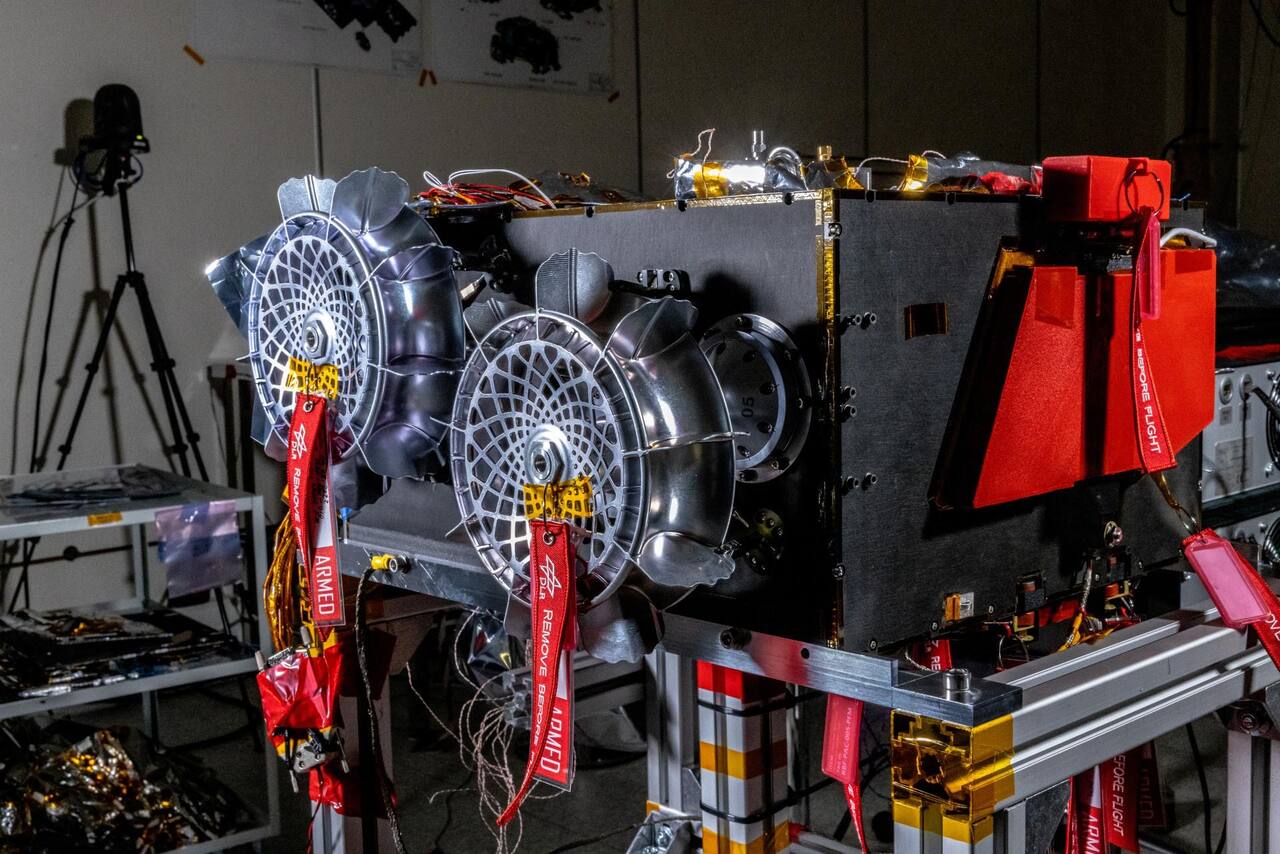 DLR, from [1]. CC BY 3.0.
Overview
Section titled “Overview”IDEFIX is a four-wheeled rover built by DLR and CNES to be delivered to Phobos by the JAXA Martian Moons eXploration spacecraft. It is released during an MMX landing rehearsal from about 40 m altitude, falls to the surface, probably bounces several times, and then uprights itself with an autonomous sequence of leg deployments before deploying its solar generator [1]. The whole Separation, Landing, Uprighting and Deployment sequence begins before separation and runs autonomously; the landing point is known only to an uncertainty ellipse of up to 100 m until the first post-uprighting image is compared against orbiter terrain models [5].
Specifications
Section titled “Specifications”| Parameter | Value |
|---|---|
| Rover flight segment mass, including units on the spacecraft | 27.5 kg |
| Rover mass | 23.47 kg |
| Scientific payload mass | 2.44 kg |
| Locomotion subsystem mass | 4.52 kg |
| Solar generator mass | 3.76 kg |
| Battery mass | 1.43 kg |
| Nominal driving velocity | 1 mm/s |
| Weight on Phobos | about 0.1 N |
Source: [1].
Mission profile
Section titled “Mission profile”| Parameter | Value | Source |
|---|---|---|
| Carrier | JAXA Martian Moons eXploration spacecraft | |
| Target | Phobos | |
| Release altitude | about 40 m, during an MMX landing rehearsal | |
| Landing point knowledge before the first post-uprighting image | uncertainty ellipse of up to 100 m | [5] |
| Traverse requirement | 100 m | |
| Nominal surface operation | at least 100 Earth days; three months on the DLR program page | [35] |
| Launch | 2026, H-3 from Tanegashima Space Center | [35] |
| Landing on Phobos | early 2029 | [35] |
| Sample return to Earth | 2031 | [35] |
| Integration status | final work and tests at the CNES site in Toulouse; carbon structure delivered to CNES in November 2022 | [35] |
Unless marked, the values above are from [1].
Design space and flight precedent
Section titled “Design space and flight precedent”A rover on Phobos has to move and measure where weight is almost zero and grain cohesion is not. Surface gravity is 0.003 to 0.007 m/s2 [10], a landing can leave a vehicle bouncing for minutes, and the regolith it will load is characterized by a reference model rather than a measurement [2]. Four families of approach to touching a small body have flown or been tested, and a fifth, wheeled driving, has not flown.
Hopping and tumbling is the only mobility flown on a small body so far. MINERVA-II Rover 1A and 1B, about 1.15 kg each, hop by spinning up and stopping a flywheel inside a disc 18 cm across [18]. They were released at 50 m altitude over Ryugu on 21 September 2018 and observed autonomously; their hop distance could not be measured, because they carry no means to determine velocity in ballistic flight [18]. MASCOT, 9.8 kg with about 3 kg of instruments, used one eccentric arm on a 25 mm brushless motor for both uprighting and hopping [11]. Its pre-landing paper states that the parabolic flight validation failed on its own terms, because 25 s of microgravity was too short [11]. On Ryugu it separated at 41 m, fell for 5 min 51 s, first touched at 17.0 cm/s, bounced four more times over 18.64 m, and then worked for 17 h 14 min across four measurement points [12]. The derived coefficient of restitution was about 0.29 [12], and the separation mechanism released it at 4.94 +/- 1.7 cm/s (3 sigma) in drop tower tests [13]. After landing, the lander’s position and attitude at each measurement point were reconstructed from stereo images [14]. IDEFIX inherits the same unguided-fall and self-uprighting problem, but replaces the single arm with legs and wheels.
Passive landing gear with anchoring was flown by Philae on comet 67P. Both hold-down systems failed, the harpoons did not fire and the cold gas thruster did not work, so the lander bounced from 15:34 to 17:31 UTC [22]. At the first touchdown the speed was 1.01 m/s and the damper stroked 42.6 mm, and 50 to 80 percent of the 49.5 J impact energy went into the soil [22]. The second touchdown site was later located in a crevice between boulders, where the lander cut into primitive ice and bounded its compressive strength below 12 Pa [24]. The ground test of the landing gear used a robot-suspended offload rig at DLR, whose authors state that comet soil cannot be reproduced there [26]. A mission-level review is in [23].
Touch and go avoids the problem by not staying. OSIRIS-REx TAGSAM was qualified on the ground and on parabolic flights, which the authors call reduced acceleration because each parabola lasts only 16 to 18 s [29]. At Bennu the sampler contacted at 10 cm/s, reached 5.95 to 6.91 cm depth, and met 10 to 15 N of resistance, from which discrete element modeling gave a near-subsurface bulk density of 440 to 600 kg/m3 [27]. The force laws used for such contacts were extended to this regime by simulation, with validation only in terrestrial beds [28]. MMX itself lands and collects rather than touching and going, because Phobos gravity is more than 50 times that of Ryugu [2].
Penetrating instruments have returned the strongest surprises. MUPUS on Philae hammered for 3.5 hours without penetrating beyond 27 mm, bounding resistance above 4 MPa [25]. The InSight mole reached 37 cm against a 3 to 5 m requirement, because a cohesive duricrust supplied no hull friction [34].
Wheeled driving at milligravity has not flown. The Moon was the lowest-gravity body a wheeled rover had driven on before IDEFIX [10], and the design basis is simulation with the first drives on Phobos as the validation [10].
| Approach | Example | Body | Status | Source |
|---|---|---|---|---|
| Flywheel hopping | MINERVA-II 1A, 1B | Ryugu | Flown 2018 | [18] |
| Eccentric arm uprighting and hopping | MASCOT | Ryugu | Flown 2018 | [12] |
| Landing gear and anchors | Philae | 67P | Flown 2014, anchors failed | [22] |
| Touch and go sampling | OSIRIS-REx TAGSAM | Bennu | Flown | [27] |
| Legged, wheeled, self-uprighting | IDEFIX | Phobos | In development | [1] |
What testing on Earth can and cannot do
Section titled “What testing on Earth can and cannot do”Ground and parabolic experiments change character with gravity. In impact experiments on simulated regolith across Shuttle, suborbital and aircraft platforms, the projectile embeds at 1e-2 g and rebounds in microgravity, with quartz sand and lunar or Mars simulants rather than asteroid material as targets [31]. The IDEFIX locomotion team concludes that ground experiments at milli-g are essentially impossible, so simulation is the design tool and the mission is the validation [10]. Discrete element predictions of MASCOT’s first contact used assumed bulk density and grain size [20], and the 270-run study at 19 cm/s found bounce behavior sensitive to friction, bed depth and orientation [21]; both were pre-landing predictions with no physical validation at MASCOT scale.
What the Ryugu and Bennu results say about the target is mixed. MASCam found rocks and boulders with essentially no fine dust at the landing site, against the pre-encounter expectation of a regolith cover [32]. MARA measured a boulder thermal inertia of 282 J/m2/K/s^0.5 [16], revised to 256 after a shape model and reflected-light correction [17], and a later review settles on porosity near 0.50 [15]. An orbital check found the landing area’s thermal inertia of 180 against a global 225 +/- 45, so the rock was representative [19]. Itokawa grains measured by nanoindentation give grain-scale moduli but say nothing about bulk strength [33]. For Phobos, two mineralogical simulants, PCA-1 and PGI-1, add composition and geotechnical data to the UTPS family [30].
Operating environment
Section titled “Operating environment”| Quantity | Value |
|---|---|
| Dimensions | 26.06 x 22.80 x 18.28 km |
| Mean radius | 10.993 km |
| Mass | 1.065e16 +/- 0.015e16 kg |
| Mean bulk density | 1.860 +/- 0.013 g/cm3 |
| Surface gravity | 0.0030 to 0.0068 m/s2 |
| Escape velocity | 11.39 m/s |
| Rotation period | 7 h 39 min 19.47 s |
| Equatorial rotation velocity | 2.97 m/s |
| Orbital semi-major axis | 9375 km, 2.76 Mars radii |
| Orbital eccentricity | 0.015 |
| Geometric albedo | 0.071 |
| Infrared emissivity | 0.98 |
| Thermal inertia | 20 to 70 J/m2/K/s^0.5 |
| Surface temperature | 60 to 330 K within 60 degrees of the equator |
| Surface slopes | 0 to 40 degrees, mostly below 40 with many below 10 |
Rows with no marker are from [2].
Regolith particle size is inferred rather than measured. Estimated average particle diameter is below 2 mm, and below 1 mm if thermal inertia is 55 J/m2/K/s^0.5, with surface porosity of 30 to 60 percent and most probably above 53 percent [2]. Fine material below about 300 micrometer may be depleted. The internal friction angle of the particles is estimated at 30 to 50 degrees [2]. A three-layer regolith model is used for design: micrometer-sized fluffy dust from 0 to 3 cm, high-porosity debris from 10 cm to 3 m, and denser regolith below about 10 m. The mission assumes a particle size range of 30 micrometer to 10 cm for wheel interaction analysis [3], against boulders of 2 to 85 m seen from flyby imaging.
The gravity regime is the design problem. At 0.003 to 0.007 m/s2 the rover weighs about 0.1 N, so available traction is correspondingly tiny [1]. Phobos gravity is roughly 1/2000 of Earth’s, 1/750 of Mars’ and 1/250 of the Moon’s, and the Moon is the lowest-gravity body a wheeled rover had driven on before IDEFIX [10]. Scaling free-fall time by the square root of the gravity ratio gives a factor of about 50 between Earth and Phobos, so a rover moving at the roughly 5 cm/s typical of Yutu-2 or Perseverance corresponds to about 50 times slower motion at Phobos gravity [10]. Cohesion between grains exceeds their weight over the relevant particle size range at this acceleration, because van der Waals forces between regolith grains dominate over particle weight, electrostatic forces and solar radiation pressure at asteroid-surface gravity levels [8]. This scaling argument treats terrestrial experiments on cohesive powders as relevant analogues for asteroid surfaces rather than as inapplicable 1-g artifacts [8]. The bulk cohesive strength of a regolith of this grain size is of order tens of pascals [9], which is the same order as the loads a wheel can apply. The same weak inter-grain forces that give a rubble-pile asteroid a small but finite tensile strength are the ones a wheeled rover must overcome to move through the regolith rather than compact or shear it in place [9]. Proposed techniques to measure that strength rely on cratering theory, and have been applied to the Hayabusa2 cratering experiment as a worked example of what an impact or excavation event on a rubble pile can reveal about its regolith [9].
Simulant
Section titled “Simulant”The UTPS family is the Phobos simulant used for testing [2].
| Simulant | Poured bulk density | Poured porosity | Angle of repose | Tapped density | Tapped porosity |
|---|---|---|---|---|---|
| UTPS-S1 | 0.82 g/cm3 | 68.7 percent | 55.1 degrees | 1.51 g/cm3 | 42.4 percent |
| UTPS-S2 | 1.33 g/cm3 | 53.5 percent | 48.4 degrees | 1.44 g/cm3 | 49.7 percent |
| UTPS-S3 | 1.67 g/cm3 | 41 percent | 47.1 degrees | 1.85 g/cm3 | 34.6 percent |
All values from [2]. The Tagish Lake based variant UTPS-TB has a grain density of 2.8 to 3.0 g/cm3, a bulk density of 1.68 +/- 0.03 g/cm3 and a microporosity of 40.8 +/- 1.0 percent. A factor of two in poured bulk density across three simulants of the same family is the measure of how loosely the target is constrained.
Reduced-gravity penetrometry into Phobos simulant on parabolic flight gives the complementary data: penetration at 3 to 35 mm/s, 42 mm of penetration at 3 mm/s, Froude numbers of 0.18 to 1.8, and the finding that cohesive material returns reaction forces of nearly the same magnitude as at 1 g [6]. Penetrometer tip shape matters at these scales: flat tips give reaction forces that differ from conical and hemispherical tips of the same diameter, which is why the parabolic-flight campaign compared several tip geometries rather than assuming a single design generalizes [6]. Sampler penetration modeling at the Phobos value of 5.7e-3 m/s2 uses friction angles of 20, 42 and 60 degrees against cohesion of 0, 0.5 and 1 kPa [7].
Mobility
Section titled “Mobility”The locomotion subsystem comprises four individually actuated wheels of about 200 mm diameter, each mounted on an individually actuated leg 275 mm long, giving skid steering [1]. The sequence for unfolding, standing up, driving, aligning and lowering the rover was designed specifically for Phobos rather than adapted from a planetary rover [3]. It has four modes [1]:
| Mode | Function |
|---|---|
| Driving | Four wheels differentially driven with legs stationary, for straight lines, curves and point turns |
| Alignment | Legs and wheels moved to change chassis height and orientation with minimal change in position, for aiming instruments or pointing the array at the Sun |
| Uprighting | Leg angles adjusted while wheels rotate in coordination so the wheels keep rolling on the surface |
| Passthrough | Manual commanding of each wheel and leg individually |
Source: [1].
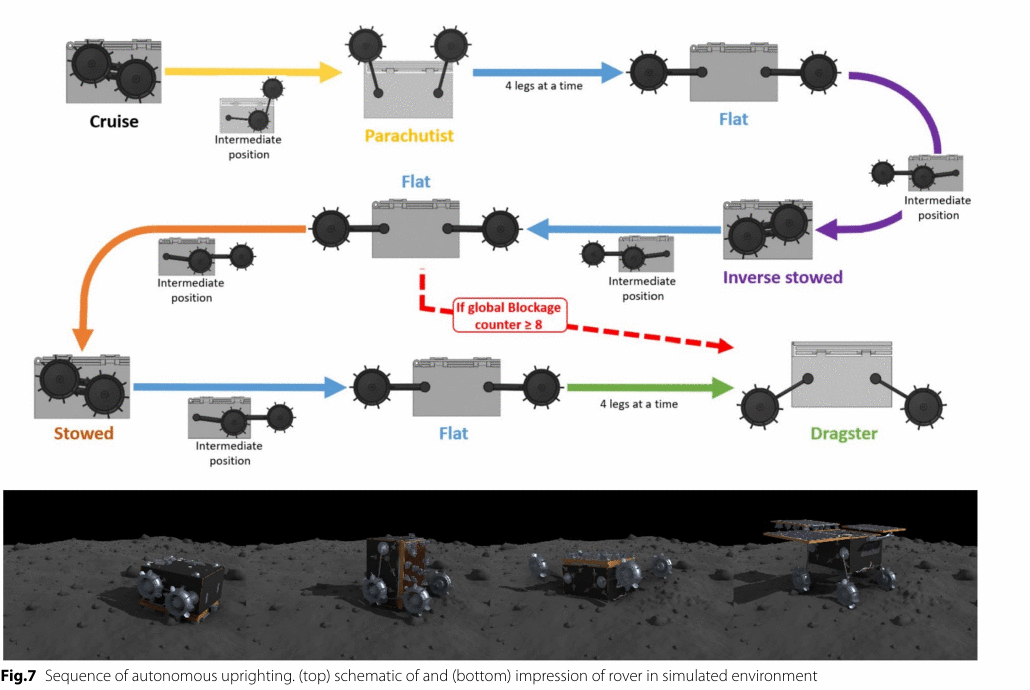
The open-loop uprighting sequence, frame by frame: the legs unfold and refold repeatedly, each repetition having a high probability of rotating the rover from whatever face it came to rest on onto its belly. No sensor determines the starting orientation, which is why the sequence is identical from every attitude. Source: [1]. CC BY 4.0.
Uprighting is a universal open-loop sequence of repeated leg unfolding and refolding, each repetition having a high probability of rotating the rover from any face onto its belly [1]. It requires no sensor to determine the rover’s current orientation. The rover’s final attitude after the bounces cannot be predicted, and the WheelCams are activated during the uprighting sequence rather than after it [3], [5].
The nominal 1 mm/s driving velocity is not a mechanism limit [1]. The locomotion system can go faster; the cap exists because at Phobos gravity an abrupt stop risks toppling the rover about its front axis [1]. Reduced-gravity penetrometry gives the reason the wheel loads cannot simply be scaled down with gravity: in cohesive material the reaction force is nearly the same magnitude as at 1 g [6]. Entrapment is handled by using the individually actuated legs and wheels to shift weight distribution and lift single wheels out of the regolith, and particularly soft regolith is crossed by inching rather than driving [1].
Wheel sinkage is the quantity the WheelCams exist to measure. Sinkage has a static component from compaction under load and a dynamic component from shearing as the wheel rotates, and its extent is set directly by the shear strength and cohesion of the surface material [3]. Greater sinkage increases the wheel-regolith contact area and is read together with slip ratio, defined so that 0 is perfect rolling and 1 is a wheel spinning in place with no forward motion, as an indicator of trafficability [3]. Wheel motor current, which rises with resistance to motion, is a secondary indicator of the same sinkage and slip behavior. The planned analysis fits sinkage and slip against a Bekker-family terramechanics model, of which the Reece-Wong variant is one candidate because it accounts for the dynamic slip-sinkage behavior expected on Phobos, to back out the regolith’s shear strength and stiffness [3].
Landing dynamics are instrumented. Four three-axis ADXL356 MEMS accelerometers log the impact and bounce sequence to internal memory, with an abridged version relayed in real time to the ascending mothership to confirm a successful landing [1]. Two Silicon Sensing CRM200 gyroscopes give roll and pitch rates during descent and detect excessive roll or pitch while driving. Together with spacecraft imagery these reconstruct the landing and bouncing trajectory and constrain the mechanical properties of the landing site.
Power and thermal
Section titled “Power and thermal”The solar generator has four panels, three deployable and one fixed to the top panel, with a total area of 0.36 m2, feeding one rechargeable battery through a power control and distribution unit [1]. An umbilical from the MMX spacecraft supplies power and communication lines during the cruise, and heats the rover. At a geometric albedo of 0.071 the surface returns very little light to the array, so the available flux is essentially direct solar [2].
Operations are power critical. After an energy-consuming activity such as driving, several Phobos days are needed for recharging, where one Phobos day is 7.65 h [1]. An attitude control sub-unit called SKA reorients the rover around Phobos noon to point the cells at the Sun, which forces locomotion activities into the Phobos morning.
Thermal design is insulation rather than active control: the internal module is inside multilayer insulation and every thermal leak between the units, the chassis and the environment has to be minimized to keep heater power down [1]. Operating modes on the surface are chosen to hold instruments and electronics within thermal limits and minimize heating power. Thermal and power requirements constrain the landing site latitude. The limits themselves are instrument-specific: the miniRAD electronics box is qualified only from -45 to +60 C while its sensor head runs from -140 to +50 C, so the two sit in different thermal zones [4].
Communications
Section titled “Communications”Communication after separation is via an S-band radio to the MMX spacecraft; there is no direct Earth link [1].
| Link | Rate |
|---|---|
| Telecommand | 32 kbit/s |
| Telemetry | 64 kbit/s or 512 kbit/s |
Rates are from [1]. During the descent itself only a compressed subset of data reaches the spacecraft before it loses contact with the rover [5]. The operational cadence is one Earth-to-spacecraft pass per Earth day and two spacecraft-to-rover contacts per Earth day, and because all commanding and telemetry relay through the mothership, a ground loop that depends on the full downlink of a previously executed activity takes at least 2 Earth days [1].
Payload
Section titled “Payload”| Instrument | Mass | Key parameters | Additional source |
|---|---|---|---|
| NavCams (stereo pair) | 0.4 kg | 122 degree diagonal field of view, 1 mrad angular resolution, 400 to 800 nm, focal length about 7.9 mm, 68 mm stereo baseline, depth of field 35 cm to infinity | [5] |
| WheelCams | 0.22 kg | 2048 x 2048 pixels at 5.5 um pitch, 32.5 degree field, about 100 um per pixel at 30 cm, depth of field +/- 5 cm, white and 590 / 720 / 880 nm LEDs | [3] |
| RAX (Raman spectrometer) | 1.51 kg | 532 nm laser at 20 mW, 50 um spot, 535 to 680 nm, Raman shift 90 to 4000 cm-1 at about 10 cm-1 resolution, 80 mm autofocus working range | |
| miniRAD (radiometer) | 0.34 kg | Six channels over 4.7 to 100 um, 32 degree FWHM field, 25 to 150 cm observation distance | [4] |
Mass and key parameters are from [1] throughout.
miniRAD splits into a 96 g sensor head, 209 g of electronics and a 27 g calibration target [4]. Its channel set is a 4.7 to 6.2 um short-wave channel, narrow bandpasses at 8.2, 8.9 and 9.5 um of 0.5 um width, and long-wave channels at 14 to 25 um and 15 to 100 um. Calibration covers 100 to 330 K, with a temperature uncertainty of 1 K above 270 K rising to 5 K on the long-wave channels at 100 K, and a noise-equivalent temperature difference of 6 mK at 270 K on the bandpasses and 40 mK at 100 K on the long-pass channels [4]. Sampling is 0.06 Hz in science and calibration mode and 1 Hz in fast science mode. Power draw is 0.45 W standby, 0.55 W diagnostic, 1.0 to 1.4 W science and 4.0 W calibration [4]. Sensor head operating range is -140 to +50 C, electronics -45 to +60 C, and the calibration target -155 to +60 C.
RAX is placed on the underside of the rover looking down at the ground [1]. Above 18 C it triggers thermal heat switches. miniRAD carries heritage from the Rosetta MUPUS thermal mapper [35], and its purpose extends beyond rover science: the regolith properties the rover characterizes are meant to reduce the risk of the MMX mothership’s own landing and sampling, since the rover is the only source of direct surface-response measurements before those operations take place [35].
The thermal measurement is sensitive to a very thin layer. The diurnal thermal skin depth is close to 5 mm in regolith and of order a few centimeters in boulders, so miniRAD can detect a dust layer of 50 micrometer on regolith and 500 micrometer on a boulder [4]. Its main objective is Phobos’ nighttime surface brightness temperature, from which thermal inertia is derived; secondary objectives are the slope of thermal-infrared emissivity, the location of the Christiansen feature, and surface roughness [4].
The NavCams support digital terrain models at about 1 mm ground sampling over the first meter with an accuracy of a few millimeters at 1 m, which is also how the rover is localized by comparison against the orbiter’s high-resolution terrain models [5].
Beyond localization, the NavCam science goals are framed as open questions rather than confirmed results: whether space weathering on Phobos runs Lunar-like or Tagish-Lake-like, the origin of Phobos’ color dichotomy, whether exogenous material is present on the surface, and whether dust is being transported or levitated across it [5]. The color dichotomy appears concentrated around Stickney crater, which is taken as a hint of a genetic link between the crater and the dichotomy rather than as an explanation of it [5].
Autonomy and ground operations
Section titled “Autonomy and ground operations”Driving is commanded day by day from the ground within the MMX planning cycle [1]. Two experimental autonomous navigation systems are being developed in parallel, one by DLR and one by CNES, intended to extend the driving range beyond what daily manual commanding reaches [1], [5]. Autonomous guidance uses the navigation camera stereo pair [5].
Commissioning of the locomotion system is treated as a distinct mission phase, because the mechanical behavior of natural regolith at Phobos gravity is uncertain and wheel-soil traction must be extremely small at a rover weight near 0.1 N [1]. The total distance the rover will actually cover is stated as difficult to estimate; 100 m is the engineering requirement, not a prediction.
The first drives are planned as a validation exercise in their own right: every assumption, tool and method used to design the locomotion system was checked only against experiments and simulations on Earth, with limited knowledge of regolith behavior, so the early on-surface drives are meant to confirm, validate and adapt the design basis rather than simply execute it [10]. That framing follows from the entrapment risk in soft soil at even gentle slopes, which the design team identified as the leading hazard of driving on Phobos before the rover was built [10].
Trafficability in a blocky terrain is an open concern for both landing and driving, which is part of why the wheel-facing cameras are carried at all [3]. Basic driving actions, forward, backward, skid steering and point turns, are deliberately tested early in the surface mission so that a robust set of proven commands exists before more complex behavior such as inching is attempted [10].
Spacecraft activities constrain the rover. During MMX sampling and landing the spacecraft has limited ability to communicate with the rover, so the rover is placed in a safe configuration performing no critical operations and guaranteed not to become power critical for several days without contact [1]. Landing, sampling and especially departure eject substantial surface material, so the rover will if possible move away from the spacecraft landing site to keep dust off its solar cells, and the landing site selection and separation maneuver are designed to limit that exposure.
Radiation
Section titled “Radiation”No rover-specific radiation design data is held. Phobos has no atmosphere or magnetic field of its own, so the surface and cruise environments are the unshielded interplanetary and Mars-orbit fields.
Technologies developed
Section titled “Technologies developed”IDEFIX is the first attempt at wheeled locomotion on a body in the milligravity regime, and the sensorless uprighting sequence is the direct design consequence of a landing whose final attitude cannot be predicted or measured [1]. The accelerometer and gyroscope record of the landing and bounce is intended as a measurement of the surface, not only as engineering telemetry, which places it in the same category as the OSIRIS-REx contact record as a source of in-situ small body geotechnical data [27]. The wheel sinkage and slip record is the second such product, and is the first direct measurement of wheel-regolith interaction at milligravity rather than an inference from a simulant test at 1 g [3]. Everything the design was sized against on the Phobos side, particle size, porosity and friction angle, is at present inferred from thermal inertia and simulant work rather than measured [2].
What is not established
Section titled “What is not established”No Phobos surface result exists: IDEFIX has not flown, and every performance figure for its instruments is a design, bench or predicted value [4]. The regolith reference model spans one to two orders of magnitude in each entry, rests on expert judgment, and the authors call bearing capacity and friction estimates unreliable because granular behavior at low gravity is poorly understood [2]. The simulants are validated for composition and spectra, not for mechanical response at Phobos gravity [2], [30]. Ground testing cannot reproduce milli-g wheel loads [10], and the parabolic-flight penetrometry that does exist is a database with preliminary results [6]. Thermal inertia on small bodies is derived through model chains, and the published values for one Ryugu boulder moved from 282 to 256 between analyses [16], [17]. The total distance IDEFIX will cover, the performance of the two experimental autonomous navigation systems, and the rover’s radiation environment have no published basis beyond the 100 m requirement [1].
References
- Ulamec, S., Michel, P., Murdoch, N., Vernazza, P., Grott, M., Knollenberg, J., Schröder, S., Hübers, H.-W., Cho, Y., Prieto-Ballesteros, O., Biele, J., Tardivel, S., Buse, F., Miyamoto, H., Krause, C., May, D., Delmas, C., Baroukh, J., Mary, S. and Grebenstein, M. (2025). Science operations of IDEFIX, the MMX Phobos rover
. Progress in Earth and Planetary Science, 97. Source
BibTeX
@article{ulamec2025science, title = {Science operations of IDEFIX, the MMX Phobos rover}, author = {Ulamec, Stephan and Michel, Patrick and Murdoch, Naomi and Vernazza, Pierre and Grott, Matthias and Knollenberg, J. and Schröder, S. and Hübers, H.-W. and Cho, Yuichiro and Prieto-Ballesteros, Olga and Biele, Jens and Tardivel, Simon and Buse, F. and Miyamoto, Hideaki and Krause, Christian and May, D. and Delmas, C. and Baroukh, Julien and Mary, S. and Grebenstein, M.}, journal = {Progress in Earth and Planetary Science}, volume = {12}, number = {97}, year = {2025}, doi = {10.1186/s40645-025-00771-x}, abstract = {Abstract IDEFIX, a rover to be delivered to the martian moon Phobos, is part of the Martian Moons eXploration (MMX) mission by the Japan Aerospace Exploration Agency, JAXA. MMX will explore both moons of Mars remotely but will also land on Phobos and collect samples from its surface and return them back to Earth. The IDEFIX rover will be released from the main spacecraft during its landing rehearsal at an altitude of about 40 m. It will fall to the surface, probably bounce several times and upright itself after having come to rest by applying an autonomous sequence of the deployment of its locomotion system. This sequence is followed by deployment of the solar generator and recharging of the batteries. After commissioning, on-Phobos operations are planned for at least 100 (Earth-) days. Sequences of science operations (instrument measurements), driving, battery charging and communications with Earth (via the main spacecraft) will alternate in a way to maximize scientific return and fulfill technical demonstration goals. IDEFIX accommodates a payload of four scientific instruments: a Raman spectrometer (RAX), a stereo pair of cameras looking forwards (NavCams; also used for navigation), a radiometer (miniRAD), and two cameras looking at the wheel-surface interface (WheelCams). MMX will be launched in autumn 2026, the Rover delivery to Phobos is currently planned for late 2028, before the first touch down of the spacecraft and sample collection. The Rover is a contribution by the Centre National d’Etudes Spatiales (CNES) and the German Aerospace Center (DLR) with additional contributions from INTA (Spain) and JAXA (Japan).} } - Miyamoto, H., Niihara, T., Wada, K., Ogawa, K., Senshu, H., Michel, P., Kikuchi, H., Hemmi, R., Nakamura, T., Nakamura, A. M., Hirata, N., Sasaki, S., Asphaug, E., Britt, D. T., Abell, P. A., Ballouz, R.-L., Banouin, O. S., Baresi, N., Barucci, M. A., Biele, J., Grott, M., Hino, H., Hong, P. K., Imada, T., Kameda, S., Kobayashi, M., Libourel, G., Mogi, K., Murdoch, N., Nishio, Y., Okamoto, S., Ota, Y., Otsuki, M., Otto, K. A., Sakatani, N., Shimizu, Y., Takemura, T., Terada, N., Tsukamoto, M., Usui, T. and Willner, K. (2021). Surface environment of Phobos and Phobos simulant UTPS
. Earth, Planets and Space, 214. Source
BibTeX
@article{miyamoto2021surface, title = {Surface environment of Phobos and Phobos simulant UTPS}, author = {Miyamoto, Hideaki and Niihara, Takafumi and Wada, Koji and Ogawa, Kazunori and Senshu, Hiroki and Michel, Patrick and Kikuchi, Hiroshi and Hemmi, Ryodo and Nakamura, Tomoki and Nakamura, Akiko M. and Hirata, Naoyuki and Sasaki, Sho and Asphaug, Erik and Britt, Daniel T. and Abell, Paul A. and Ballouz, Ronald-Louis and Banouin, Olivier S. and Baresi, Nicola and Barucci, Maria A. and Biele, Jens and Grott, Matthias and Hino, Hideitsu and Hong, Peng K. and Imada, Takane and Kameda, Shingo and Kobayashi, Makito and Libourel, Guy and Mogi, Katsuro and Murdoch, Naomi and Nishio, Yuki and Okamoto, Shogo and Ota, Yuichiro and Otsuki, Masatsugu and Otto, Katharina A. and Sakatani, Naoya and Shimizu, Yuta and Takemura, Tomohiro and Terada, Naoki and Tsukamoto, Masafumi and Usui, Tomohiro and Willner, Konrad}, journal = {Earth, Planets and Space}, volume = {73}, number = {214}, year = {2021}, doi = {10.1186/s40623-021-01406-3}, abstract = {Abstract The Martian Moons eXploration (MMX) mission will study the Martian moons Phobos and Deimos, Mars, and their environments. The mission scenario includes both landing on the surface of Phobos to collect samples and deploying a small rover for in situ observations. Engineering safeties and scientific planning for these operations require appropriate evaluations of the surface environment of Phobos. Thus, the mission team organized the Landing Operation Working Team (LOWT) and Surface Science and Geology Sub-Science Team (SSG-SST), whose view of the Phobos environment is summarized in this paper. While orbital and large-scale characteristics of Phobos are relatively well known, characteristics of the surface regolith, including the particle size-distributions, the packing density, and the mechanical properties, are difficult to constrain. Therefore, we developed several types of simulated soil materials (simulant), such as UTPS-TB (University of Tokyo Phobos Simulant, Tagish Lake based), UTPS-IB (Impact-hypothesis based), and UTPS-S (Simpler version) for engineering and scientific evaluation experiments.} } - Murdoch, N., Lalucaa, V., Sunday, C., Tardivel, S., Bertrand, J., Théret, N., Vivet, D., Amsili, A., Robin, C., Delton, P., Duchene, A., Douaglin, Q., Maillard, A., Virmontois, C., Vernazza, P., Jorda, L., Groussin, O., Miyamoto, H., Vincent, J.-B., Flahaut, J., Biele, J., Barnouin, O., Hartzell, C., Buse, F., Barthelmes, S., Ulamec, S., Michel, P. and Baroukh, J. (2025). The WheelCams on the IDEFIX rover
. Progress in Earth and Planetary Science, 54. Source
BibTeX
@article{murdoch2025wheelcams, title = {The WheelCams on the IDEFIX rover}, author = {Murdoch, Naomi and Lalucaa, Valérian and Sunday, Cecily and Tardivel, Simon and Bertrand, Jean and Théret, Nicolas and Vivet, Damien and Amsili, Alice and Robin, Colas and Delton, Panos and Duchene, Alexia and Douaglin, Quentin and Maillard, Antoine and Virmontois, Cedric and Vernazza, Pierre and Jorda, Laurent and Groussin, Olivier and Miyamoto, Hideaki and Vincent, Jean-Baptiste and Flahaut, Jessica and Biele, Jens and Barnouin, Olivier and Hartzell, Christine and Buse, Fabien and Barthelmes, Stefan and Ulamec, Stephan and Michel, Patrick and Baroukh, Julien}, journal = {Progress in Earth and Planetary Science}, volume = {12}, number = {54}, pages = {54--54}, year = {2025}, doi = {10.1186/s40645-025-00725-3}, abstract = {Abstract IDEFIX, the Martian Moons eXploration (MMX) mission Phobos rover, will be the first of its kind to attempt wheeled-locomotion on a low-gravity surface. The IDEFIX WheelCams, two cameras placed on the underside of the rover looking at the rover wheels, provide a unique opportunity to study the surface properties of Phobos, regolith behaviour on small-bodies and rover mobility in low-gravity. The information gained about Phobos’ surface will be of high importance to the landing and sampling operations of the main MMX spacecraft, in addition to being valuable for understanding the surface processes and geological history of Phobos. Here we introduce the WheelCam science objectives, the instrument and the characterisation activities. We also discuss the on-going preparations linked to the analysis and interpretation of the WheelCam images on the surface of Phobos.} } - Knollenberg, J., Grott, M., Hamm, M., Ihring, A., Ziese, R. and Biele, J. (2025). The miniRAD instrument for the MMX IDEFIX rover
. Progress in Earth and Planetary Science, 53. Source
BibTeX
@article{knollenberg2025minirad, title = {The miniRAD instrument for the MMX IDEFIX rover}, author = {Knollenberg, J. and Grott, Matthias and Hamm, Maximilian and Ihring, A. and Ziese, R. and Biele, Jens}, journal = {Progress in Earth and Planetary Science}, volume = {12}, number = {53}, year = {2025}, doi = {10.1186/s40645-025-00717-3}, abstract = {Abstract The miniRAD radiometer is one of the payloads of the Idefix rover on the MMX mission to Phobos. It is a multispectral instrument which measures the infrared radiative flux in six wavelength channels between 4.7 and 100 µm using single-element thermopile detectors. MiniRAD is equipped with optical filters, one centered at 5.5 µm, three narrow bandpass filters at 8.3 µm, 8.9 µm, and 9.5 µm and two longpass filters with cut-ons at 14–15 µm. One of the longpass filters made from boron nitride (BN) is especially optimized for very low flux, being sensitive in the very long wavelength region even beyond 50 µm. The main measurement objective of the miniRAD instrument is the determination of Phobos’ surface brightness temperature during nighttime, from which the thermal inertia of the surface can be derived. Secondary objectives are to provide constraints on the slope of the emissivity in the thermal infrared, the location of the Christiansen feature, and the surface roughness of Phobos. MiniRAD has been calibrated radiometrically under relevant environmental conditions using a cavity blackbody over the full expected range of object temperatures from 100 to 330 K. The predicted uncertainty of the brightness temperature is < 1 K at dayside temperatures > 270 K for all channels, while the BN filter uncertainty is < 5 K at the lowest calibration temperature of 100 K.} } - Vernazza, P., Jorda, L., Tardivel, S., Baroukh, J., Groussin, O., Pimorin, C., Poulain, A., Chabaud, P.-Y., Robert, E., Bertrand, J., Lalucaa, V., Remetean, E., Théret, N., Virmontois, C., Murdoch, N., Le Mouélic, S., Beck, P., Rüsch, O., Flahaut, J., Charnoz, S., Lasue, J., Barucci, M.-A., Doressoundiram, A., Michel, P. and Ulamec, S. (2025). Surface science on Phobos with the navigation cameras of the MMX IDEFIX rover
. Progress in Earth and Planetary Science, 46. Source
BibTeX
@article{vernazza2025surface, title = {Surface science on Phobos with the navigation cameras of the MMX IDEFIX rover}, author = {Vernazza, Pierre and Jorda, Laurent and Tardivel, Simon and Baroukh, Julien and Groussin, Olivier and Pimorin, Celia and Poulain, Axel and Chabaud, Pierre-Yves and Robert, Emilie and Bertrand, Jean and Lalucaa, Valerian and Remetean, Emile and Théret, Nicolas and Virmontois, Cedric and Murdoch, Naomi and Le Mouélic, Stéphane and Beck, Pierre and Rüsch, Ottaviano and Flahaut, Jessica and Charnoz, Sebastien and Lasue, Jeremie and Barucci, Maria-Antonietta and Doressoundiram, Alain and Michel, Patrick and Ulamec, Stephan}, journal = {Progress in Earth and Planetary Science}, volume = {12}, number = {46}, year = {2025}, doi = {10.1186/s40645-025-00708-4}, abstract = {Abstract A CNES/DLR rover called IDEFIX will be deployed on the surface of Phobos in late 2028 or early 2029 as part of JAXA’s Martian Moons eXploration (MMX) mission. The goal of the rover is to travel across the surface of Phobos for at least 100 days, with autonomous guidance provided by the navigation cameras (a stereo pair). By taking stereoscopic images of the area around IDEFIX up to the horizon (resolution of a few millimeters at 1 m), the navigation cameras aim to provide answers to a number of scientific questions, such as the origin of the color dichotomy, the nature of space weathering processes, and the extent of dust transport and exogenous contamination on Phobos. Here we present the IDEFIX navigation cameras, including their ground calibrations, and the science questions they are intended to address. We also present the architecture of the data processing pipeline being developed at the Laboratoire d’Astrophysique de Marseille to address the science objectives of the navigation cameras.} } - Smyth-Moore, A., Borg, J., Soria-Salinas, Á., Murdoch, N., Kato, H., Miyamoto, H., Usui, T., Kaufmann, E., Granvik, M. and Hagermann, A. (2025). Microgravity penetrometry flight campaign in support of MMX sampler science exploitation
. Progress in Earth and Planetary Science, 38. Source
BibTeX
@article{smythmoore2025microgravity, title = {Microgravity penetrometry flight campaign in support of MMX sampler science exploitation}, author = {Smyth-Moore, Alexander and Borg, Johan and Soria-Salinas, Álvaro and Murdoch, Naomi and Kato, Hiroki and Miyamoto, Hideaki and Usui, Tomohiro and Kaufmann, Erika and Granvik, Mikael and Hagermann, Axel}, journal = {Progress in Earth and Planetary Science}, volume = {12}, number = {38}, year = {2025}, doi = {10.1186/s40645-025-00704-8}, abstract = {Abstract Characterising the mechanical properties of minor bodies is essential for understanding their origin and evolution. Past missions such as Hayabusa2 have landed on asteroids to sample and discover what these bodies are made of. However, there has been conflicting evidence and reports into the physical properties of the granular surface material of these bodies. With future missions such as Japan Aerospace eXploration Agency’s Martian Moons eXploration mission landing on Phobos, the understanding and identification of these physical properties is crucial to maximising the scientific output from these missions. Penetrometry, the determination of the reaction force that an object experiences as it penetrates a surface, can help to understand the essential properties of regolith, such as grain size, porosity and cohesion. Results of penetrometry experiments are largely analysed based on empirical models, which presents us with a challenge if we want to apply them to understand granular materials on asteroid surfaces because gravity cannot be eliminated in the laboratory. Hence, it is essential to verify penetrometry as a method and validate penetrometry instrument designs in microgravity. For this purpose, we conducted a microgravity experiment onboard a parabolic flight campaign. Our experiment tested the use of penetrometry in asteroid-analogue environments by investigating samples with varying properties, such as grain size distribution and shape, and then compared to 1 g experiments to understand the role microgravity plays. The experiment provided a substantial database for future analysis. This paper will focus on the design of the experiment and the parabolic flight campaign in which the experiments were conducted. The design decisions and the variables adjusted during the experiment will be discussed, evaluating how these influenced the campaign and its outcomes. We will also provide a snapshot of preliminary results of the data captured during this experiment. For example, we show the effect of cohesion on penetrometer reaction force, with more cohesive materials providing larger reaction forces nearly of the same magnitude of their 1 g counterparts. We also show that penetrometer tip shapes provide different reaction forces and that flat tips provide the largest reaction force compared to the others. The influence of penetration velocity will be investigated further with the aid of theoretical models. Early indications from the results seen so far are promising for future analyses and will provide key information for the analysis of penetrometry data on future missions.} } - Schäfer, C. M., Scherrer, S., Buchwald, R., Maindl, T. I., Speith, R. and Kley, W. (2017). Numerical simulations of regolith sampling processes
. Planetary and Space Science. Source
BibTeX
@article{schafer2017numerical, title = {Numerical simulations of regolith sampling processes}, author = {Schäfer, Christoph M. and Scherrer, Samuel and Buchwald, Robert and Maindl, Thomas I. and Speith, Roland and Kley, Wilhelm}, journal = {Planetary and Space Science}, volume = {141}, pages = {35--44}, year = {2017}, doi = {10.1016/j.pss.2017.04.015} } - Scheeres, D. J., Hartzell, C. M., Sánchez, P. and Swift, M. (2010). Scaling forces to asteroid surfaces: The role of cohesion
. Icarus. Source
BibTeX
@article{scheeres2010scaling, title = {Scaling forces to asteroid surfaces: The role of cohesion}, author = {Scheeres, Daniel J. and Hartzell, C. M. and Sánchez, Paul and Swift, M.}, journal = {Icarus}, volume = {210}, pages = {968--984}, year = {2010}, doi = {10.1016/j.icarus.2010.07.009} } - Scheeres, D. J. and Sánchez, P. (2018). Implications of cohesive strength in asteroid interiors and surfaces and its measurement
. Progress in Earth and Planetary Science, 25. Source
BibTeX
@article{scheeres2018implications, title = {Implications of cohesive strength in asteroid interiors and surfaces and its measurement}, author = {Scheeres, Daniel J. and Sánchez, Paul}, journal = {Progress in Earth and Planetary Science}, volume = {5}, number = {25}, year = {2018}, doi = {10.1186/s40645-018-0182-9}, abstract = {Recent observations and theory have indicated that rubble pile asteroids may have a small, but finite, level of tensile strength, allowing them to spin above their spin deformation limit as defined in Holsapple (Icarus 205:430–442, 2010). In Sánchez and Scheeres (Meteorit Planet Sci 49:788–811, 2014), a theory for how such strength could be present in rubble pile asteroids was presented, relying on weak van der Waals forces between fine particulate material in asteroid regolith and in their interiors. The implications of this theory are evaluated and related to the surface strength of regolith and global strength of a rubble pile body. Proposed techniques to measure the strength of regolith using cratering theory are reviewed, as are constraints placed on the global strength of rubble pile asteroids from astronomical observations. Specific examples applied to the Hayabusa2 cratering experiment at its target asteroid are given.} } - Buse, F., Barthelmes, S., Chalon, M., Langofer, V., Bertleff, W., Lichtenheldt, R., Skibbe, J., Bihler, M., Holderried, R., Reill, J., Vodermayer, B., Stubbig, L., Bertrand, J., Tardivel, S., Vernazza, P., Murdoch, N., Ulamec, S. and Michel, P. (2021). Wheeled Locomotion in Milli-Gravity: A Technology Experiment for the MMX Rover
. International Astronautical Congress, IAC-21,A3,4A,8,x64275. Source
BibTeX
@inproceedings{buse2021wheeled, title = {Wheeled Locomotion in Milli-Gravity: A Technology Experiment for the {MMX} Rover}, author = {Buse, Fabian and Barthelmes, Stefan and Chalon, Maxime and Langofer, Viktor and Bertleff, Wieland and Lichtenheldt, Roy and Skibbe, Juliane and Bihler, Markus and Holderried, Roman and Reill, Josef and Vodermayer, Bernhard and Stubbig, Leon and Bertrand, Jean and Tardivel, Simon and Vernazza, Pierre and Murdoch, Naomi and Ulamec, Stephan and Michel, Patrick}, booktitle = {International Astronautical Congress}, number = {IAC-21,A3,4A,8,x64275}, address = {Dubai, United Arab Emirates}, year = {2021}, url = {https://elib.dlr.de/144876/} } - Ho, T.-M., Baturkin, V., Grimm, C., Grundmann, J. T., Hobbie, C., Ksenik, E., Lange, C., Sasaki, K., Schlotterer, M., Talapina, M., Termtanasombat, N., Wejmo, E., Witte, L., Wrasmann, M., Wübbels, G., Rößler, J., Ziach, C., Findlay, R., Biele, J., Krause, C., Ulamec, S., Lange, M., Mierheim, O., Lichtenheldt, R., Maier, M., Reill, J., Sedlmayr, H.-J., Bousquet, P., Bellion, A., Bompis, O., Cenac-Morthe, C., Deleuze, M., Fredon, S., Jurado, E., Canalias, E., Jaumann, R., Bibring, J.-P., Glassmeier, K. H., Hercik, D., Grott, M., Celotti, L., Cordero, F., Hendrikse, J. and Okada, T. (2017). MASCOT: The Mobile Asteroid Surface Scout Onboard the Hayabusa2 Mission
. Space Science Reviews, 1-4. Source
BibTeX
@article{ho2017mascot, title = {{MASCOT}: The Mobile Asteroid Surface Scout Onboard the {Hayabusa2} Mission}, author = {Ho, Tra-Mi and Baturkin, Volodymyr and Grimm, Christian and Grundmann, Jan Thimo and Hobbie, Catherin and Ksenik, Eugen and Lange, Caroline and Sasaki, Kaname and Schlotterer, Markus and Talapina, Maria and Termtanasombat, Nawarat and Wejmo, Elisabet and Witte, Lars and Wrasmann, Michael and Wübbels, Guido and Rößler, Johannes and Ziach, Christian and Findlay, Ross and Biele, Jens and Krause, Christian and Ulamec, Stephan and Lange, Michael and Mierheim, Olaf and Lichtenheldt, Roy and Maier, Maximilian and Reill, Josef and Sedlmayr, Hans-Jürgen and Bousquet, Pierre and Bellion, Anthony and Bompis, Olivier and Cenac-Morthe, Celine and Deleuze, Muriel and Fredon, Stephane and Jurado, Eric and Canalias, Elisabet and Jaumann, Ralf and Bibring, Jean-Pierre and Glassmeier, Karl Heinz and Hercik, David and Grott, Matthias and Celotti, Luca and Cordero, Federico and Hendrikse, Jeffrey and Okada, Tatsuaki}, journal = {Space Science Reviews}, volume = {208}, number = {1-4}, pages = {339--374}, year = {2017}, doi = {10.1007/s11214-016-0251-6} } - Ho, T.-M., Jaumann, R., Bibring, J.-P., Grott, M., Glaßmeier, K.-H., Moussi, A., Krause, C., Auster, U., Baturkin, V., Biele, J., Cordero, F., Cozzoni, B., Dudal, C., Fantinati, C., Grimm, C., Grundmann, J.-T., Hamm, M., Herčik, D., Kayal, K., Knollenberg, J., Küchemann, O., Ksenik, E., Lange, C., Lange, M., Lorda, L., Maibaum, M., Mimasu, Y., Cenac-Morthe, C., Okada, T., Otto, K., Pilorget, C., Reill, J., Saiki, T., Sasaki, K., Schlotterer, M., Schmitz, N., Schröder, S., Termtanasombat, N., Toth, N., Tsuda, Y., Ulamec, S., Wolff, F., Yoshimitsu, T. and Ziach, C. (2021). The MASCOT Lander Aboard Hayabusa2: The In-Situ Exploration of NEA (162173) Ryugu
. Planetary and Space Science. Source
BibTeX
@article{ho2021mascot, title = {The {MASCOT} Lander Aboard {Hayabusa2}: The In-Situ Exploration of {NEA} (162173) {Ryugu}}, author = {Ho, Tra-Mi and Jaumann, Ralf and Bibring, Jean-Pierre and Grott, Matthias and Glaßmeier, Karl-Heinz and Moussi, Aurelie and Krause, Christian and Auster, Ulrich and Baturkin, Volodymyr and Biele, Jens and Cordero, Federico and Cozzoni, Barbara and Dudal, Clement and Fantinati, Cinzia and Grimm, Christian and Grundmann, Jan-Thimo and Hamm, Maximilian and Herčik, David and Kayal, Kağan and Knollenberg, Jörg and Küchemann, Oliver and Ksenik, Eugen and Lange, Caroline and Lange, Michael and Lorda, Laurence and Maibaum, Michael and Mimasu, Yuya and Cenac-Morthe, Celine and Okada, Tatsuaki and Otto, Katharina and Pilorget, Cedric and Reill, Josef and Saiki, Takanao and Sasaki, Kaname and Schlotterer, Markus and Schmitz, Nicole and Schröder, Stefan and Termtanasombat, Nawarat and Toth, Nortbert and Tsuda, Yuichi and Ulamec, Stephan and Wolff, Friederike and Yoshimitsu, Tetsuo and Ziach, Christan}, journal = {Planetary and Space Science}, volume = {200}, pages = {105200}, year = {2021}, doi = {10.1016/j.pss.2021.105200} } - Grimm, C. D., Lange, C., Lange, M., Mierheim, O., Sasaki, K., Meyer, M., Kroth, W., Ulamec, S. and Ho, T.-M. (2020). The MASCOT Separation Mechanism: A Reliable, Low-Mass Deployment System for Nano-Spacecraft
. CEAS Space Journal, 3. Source
BibTeX
@article{grimm2020mascot, title = {The {MASCOT} Separation Mechanism: A Reliable, Low-Mass Deployment System for Nano-Spacecraft}, author = {Grimm, Christian D. and Lange, Caroline and Lange, Michael and Mierheim, Olaf and Sasaki, Kaname and Meyer, Michael and Kroth, Wolfgang and Ulamec, Stephan and Ho, Tra-Mi}, journal = {CEAS Space Journal}, volume = {12}, number = {3}, pages = {343--365}, year = {2020}, doi = {10.1007/s12567-020-00302-y}, abstract = {Abstract The Mobile Asteroid Surface Scout (MASCOT), an Asteroid Lander carried by the Hayabusa2 spacecraft, successfully landed on the Near-Earth Asteroid (162173) Ryugu on October 03, 2018. Thereby accomplishing the first-ever landing of a European spacecraft on the surface of this type of celestial body. MASCOT was a prototype design of a new class of nano-size surface science packages for the exploration of small solar system bodies. The very low gravity (thus, very low escape velocity) of the target body required the design of a miniaturized deployment mechanism with a relatively small, well-reproducible separation velocity. In addition, the mechanism also had to safely restrain the lander to the mother spacecraft during the launch and its 3.5-year cruise phase. In this paper, we describe in detail the design, numerical analysis and test of this newly developed separation mechanism. Furthermore, we compare the mechanism to other existing deployment systems and verify its performance with two independent analysis methods using actual flight data taken during the ultimate flight activation event, which initiated the successful delivery and surface operation of the MASCOT asteroid lander.} } - Scholten, F., Preusker, F., Elgner, S., Matz, K.-D., Jaumann, R., Hamm, M., Schröder, S. E., Koncz, A., Schmitz, N., Trauthan, F., Grott, M., Biele, J., Ho, T.-M., Kameda, S. and Sugita, S. (2019). The Hayabusa2 lander MASCOT on the surface of asteroid (162173) Ryugu - Stereo-photogrammetric analysis of MASCam image data
. Astronomy & Astrophysics. Source
BibTeX
@article{scholten2019hayabusa2, title = {The Hayabusa2 lander MASCOT on the surface of asteroid (162173) Ryugu - Stereo-photogrammetric analysis of MASCam image data}, author = {Scholten, Frank and Preusker, Frank and Elgner, S. and Matz, K.-D. and Jaumann, Ralf and Hamm, Maximilian and Schröder, Stefan E. and Koncz, A. and Schmitz, Nicole and Trauthan, F. and Grott, Matthias and Biele, Jens and Ho, Tra-Mi and Kameda, Shingo and Sugita, Seiji}, journal = {Astronomy & Astrophysics}, volume = {632}, pages = {L5}, publisher = {EDP Sciences}, year = {2019}, doi = {10.1051/0004-6361/201936760}, abstract = {After its release and a descent and bouncing phase, the Hayabusa2 lander MASCOT came to a final rest and MASCOT’s camera MASCam acquired a set of images of the surface of Ryugu. With MASCam’s instantaneous field of view of about 1 mrad, the images provide pixel scales from 0.2 to 0.5 mm pixel −1 in the foreground and up to 1 cm pixel −1 for surface parts in the background. Using a stereo-photogrammetric analysis of the MASCam images taken from slightly different positions due to commanded and unintentional movements of the MASCOT lander, we were able to determine the orientation for the different measurement positions. Furthermore, we derived a 3D surface model of MASCOT’s vicinity. Although the conditions for 3D stereo processing were poor due to very small stereo angles, the derived 3D model has about 0.5 cm accuracy in the foreground at 20 cm distance and about 1.5 cm at a distance of 40–50 cm.} } - Otto, K., Ho, T.-M., Ulamec, S., Bibring, J.-P., Biele, J., Grott, M., Hamm, M., Hercik, D., Jaumann, R., Sato, M., Schröder, S. E., Tanaka, S., Auster, U., Kitazato, K., Knollenberg, J., Moussi, A., Nakamura, T., Okada, T., Pilorget, C., Schmitz, N., Sugita, S., Wada, K. and Yabuta, H. (2023). MASCOT's in situ analysis of asteroid Ryugu in the context of regolith samples and remote sensing data returned by Hayabusa2
. Earth, Planets and Space. Source
BibTeX
@article{otto2023mascot, title = {MASCOT's in situ analysis of asteroid Ryugu in the context of regolith samples and remote sensing data returned by Hayabusa2}, author = {Otto, Katharina and Ho, Tra-Mi and Ulamec, Stephan and Bibring, Jean-Pierre and Biele, Jens and Grott, Matthias and Hamm, Maximilian and Hercik, David and Jaumann, Ralf and Sato, Masahiko and Schröder, Stefan E. and Tanaka, Satoshi and Auster, Ulrich and Kitazato, Kohei and Knollenberg, Jörg and Moussi, Aurelie and Nakamura, Tomoki and Okada, Tatsuaki and Pilorget, Cedric and Schmitz, Nicole and Sugita, Seiji and Wada, Koji and Yabuta, Hikaru}, journal = {Earth, Planets and Space}, volume = {75}, pages = {51}, year = {2023}, doi = {10.1186/s40623-023-01805-8}, abstract = {Abstract The Hayabusa2 mission provided a unique data set of asteroid Ryugu that covers a wide range of spatial scale from the orbiter remote sensing instruments to the returned samples. The MASCOT lander that was delivered onto the surface of Ryugu aimed to provide context for these data sets by producing in situ data collected by a camera (MasCam), a radiometer (MARA), a magnetometer (MasMag) and a spectrometer (MicrOmega). In this work, we evaluate the success of MASCOT as an integrated lander to bridge the gap between orbiter and returned sample analysis. We find that MASCOT’s measurements and derivatives thereof, including the rock morphology, colour in the visible wavelengths, possible meteorite analogue, density, and porosity of the rock at the landing site are in good agreement with those of the orbiter and the returned samples. However, it also provides information on the spatial scale (sub-millimetres to centimetres) at which some physical properties such as the thermal inertia and reflectance undergo scale-dependent changes. Some of the in situ observations such as the presence of clast/inclusions in rocks and the absence of fine particles at the landing site was uniquely identified by MASCOT. Thus, we conclude that the delivery of an in situ instrument like MASCOT provides a valuable data set that complements and provides context for remote sensing and returned sample analyses. Graphical Abstract} } - Grott, M., Knollenberg, J., Hamm, M., Ogawa, K., Jaumann, R., Otto, K. A., Delbo, M., Michel, P., Biele, J., Neumann, W., Knapmeyer, M., Kührt, E., Senshu, H., Okada, T., Helbert, J., Maturilli, A., Müller, N., Hagermann, A., Sakatani, N., Tanaka, S., Arai, T., Mottola, S., Tachibana, S., Pelivan, I., Drube, L., Vincent, J.-B., Yano, H., Pilorget, C., Matz, K. D., Schmitz, N., Koncz, A., Schröder, S. E., Trauthan, F., Schlotterer, M., Krause, C., Ho, T.-M. and Moussi-Soffys, A. (2019). Low Thermal Conductivity Boulder with High Porosity Identified on C-Type Asteroid (162173) Ryugu
. Nature Astronomy, 11. Source
BibTeX
@article{grott2019low, title = {Low Thermal Conductivity Boulder with High Porosity Identified on {C}-Type Asteroid (162173) {Ryugu}}, author = {Grott, Matthias and Knollenberg, J. and Hamm, Maximilian and Ogawa, Kazunori and Jaumann, Ralf and Otto, Katharina A. and Delbo, Marco and Michel, Patrick and Biele, Jens and Neumann, W. and Knapmeyer, Martin and Kührt, Ekkehard and Senshu, Hiroki and Okada, Tatsuaki and Helbert, J. and Maturilli, Alessandro and Müller, Nils and Hagermann, Axel and Sakatani, Naoya and Tanaka, Satoshi and Arai, Takehiko and Mottola, Stefano and Tachibana, S. and Pelivan, I. and Drube, L. and Vincent, Jean-Baptiste and Yano, Hajime and Pilorget, C. and Matz, K. D. and Schmitz, Nicole and Koncz, A. and Schröder, Stefan E. and Trauthan, F. and Schlotterer, Markus and Krause, Christian and Ho, Tra-Mi and Moussi-Soffys, Aurelie}, journal = {Nature Astronomy}, volume = {3}, number = {11}, pages = {971--976}, year = {2019}, doi = {10.1038/s41550-019-0832-x} } - Hamm, M., Grott, M., Senshu, H., Knollenberg, J., de Wiljes, J., Hamilton, V. E., Scholten, F., Matz, K. D., Bates, H., Maturilli, A., Shimaki, Y., Sakatani, N., Neumann, W., Okada, T., Preusker, F., Elgner, S., Helbert, J., Kührt, E., Ho, T.-M., Tanaka, S., Jaumann, R. and Sugita, S. (2022). Mid-infrared emissivity of partially dehydrated asteroid (162173) Ryugu shows strong signs of aqueous alteration
. Nature Communications. Source
BibTeX
@article{hamm2022mid, title = {Mid-infrared emissivity of partially dehydrated asteroid (162173) Ryugu shows strong signs of aqueous alteration}, author = {Hamm, Maximilian and Grott, Matthias and Senshu, Hiroki and Knollenberg, J. and de Wiljes, J. and Hamilton, Victoria E. and Scholten, Frank and Matz, K. D. and Bates, H. and Maturilli, Alessandro and Shimaki, Yuri and Sakatani, Naoya and Neumann, W. and Okada, Tatsuaki and Preusker, Frank and Elgner, S. and Helbert, J. and Kührt, Ekkehard and Ho, Tra-Mi and Tanaka, Satoshi and Jaumann, Ralf and Sugita, Seiji}, journal = {Nature Communications}, volume = {13}, pages = {364}, year = {2022}, doi = {10.1038/s41467-022-28051-y}, abstract = {Abstract The near-Earth asteroid (162173) Ryugu, the target of Hayabusa2 space mission, was observed via both orbiter and the lander instruments. The infrared radiometer on the MASCOT lander (MARA) is the only instrument providing spectrally resolved mid-infrared (MIR) data, which is crucial for establishing a link between the asteroid material and meteorites found on Earth. Earlier studies revealed that the single boulder investigated by the lander belongs to the most common type found on Ryugu. Here we show the spectral variation of Ryugu’s emissivity using the complete set of in-situ MIR data and compare it to those of various carbonaceous chondritic meteorites, revealing similarities to the most aqueously altered ones, as well as to asteroid (101955) Bennu. The results show that Ryugu experienced strong aqueous alteration prior to any dehydration.} } - Yoshimitsu, T. and Kubota, T. (2020). Engineering Challenges and Results by MINERVA-II Asteroid Surface Rovers
. Journal of the Robotics Society of Japan, 8. Source
BibTeX
@article{yoshimitsu2020engineering, title = {Engineering Challenges and Results by MINERVA-II Asteroid Surface Rovers}, author = {Yoshimitsu, Tetsuo and Kubota, Takashi}, journal = {Journal of the Robotics Society of Japan}, volume = {38}, number = {8}, pages = {754--761}, year = {2020}, doi = {10.7210/jrsj.38.754}, abstract = {Hayabusa2 is a Japanese asteroid explorer which aims to get some fragments from the C-type asteroid ``Ryugu'' and bring them back to the Earth. It was launched in December 2014 and arrived at the target asteroid at the end of June 2018 after 3.5 years' interplanetary cruise using an Ion engine propulsion system. The authors developed two tiny twin rovers for Hayabusa2 spacecraft. The objectives of the rovers were performing two technical experiments on the asteroid surface. They had hopping capability fitted for the microgravity environment of small planetary bodies, which was to be evaluated on the asteroid surface. The rovers had full autonomy to move to as many different places as possible and make some observations such as taking images and directly measuring the surface properties. The fully autonomous capability was to be demonstrated on the asteroid surface. The rovers were deployed onto the Northern hemisphere of the target asteroid on 04:06, 21 September 2018 (UTC) at the altitude of approximately 50 meters above the surface. Both rovers made autonomous surface explorations by hopping as planned, which were evidenced by the status and image data transmitted from the rovers. This was the World first surface mobile exploration on small planetary body in our Solar System attained by unmanned robot, as well as the first surface mobile exploration on extraterrestrial body in our country. This paper describes the technical aspects of MINERVA-II rovers, followed by some actual behaviors of the rovers on the asteroid surface which illustlated the great achievments of the two technical challenges by the rovers.} } - Schröder, S., Sakatani, N., Honda, R., Tatsumi, E., Yokota, Y., Domingue, D., Cho, Y., Kameda, S., Kitazato, K., Kouyama, T., Matsuoka, M., Miura, A., Morota, T., Okada, T., Sawada, H., Senshu, H., Shimaki, Y., Sugita, S., Tanaka, S., Yabuta, H., Yamada, M., Grott, M., Hamm, M., Ho, T.-M., Jaumann, R., Mottola, S., Otto, K., Schmitz, N. and Scholten, F. (2022). Characterization of the MASCOT landing area by Hayabusa2
. Astronomy & Astrophysics. Source
BibTeX
@article{schroder2022characterization, title = {Characterization of the MASCOT landing area by Hayabusa2}, author = {Schröder, Stefan and Sakatani, Naoya and Honda, Rie and Tatsumi, Eri and Yokota, Yasuhiro and Domingue, Deborah and Cho, Yuichiro and Kameda, Shingo and Kitazato, Kohei and Kouyama, Toru and Matsuoka, Moe and Miura, Akira and Morota, Tomokatsu and Okada, Tatsuaki and Sawada, Hirotaka and Senshu, Hiroki and Shimaki, Yuri and Sugita, Seiji and Tanaka, Satoshi and Yabuta, Hikaru and Yamada, Manabu and Grott, Matthias and Hamm, Maximilian and Ho, Tra-Mi and Jaumann, Ralf and Mottola, Stefano and Otto, Katharina and Schmitz, Nicole and Scholten, Frank}, journal = {Astronomy & Astrophysics}, volume = {666}, pages = {A164}, year = {2022}, doi = {10.1051/0004-6361/202244059}, abstract = {Context. After landing on C-type asteroid Ryugu, MASCOT imaged brightly colored, submillimeter-sized inclusions in a small rock. Hayabusa2 successfully returned a sample of small particles from the surface of Ryugu, but none of these appear to harbor such inclusions. The samples are considered representative of Ryugu. Aims. To understand the apparent discrepancy between MASCOT observations and Ryugu samples, we assess whether the MASCOT landing site, and the rock by implication, is perhaps atypical for Ryugu. Methods. We analyzed observations of the MASCOT landing area acquired by three instruments on board Hayabusa2: a camera (ONC), a near-infrared spectrometer (NIRS3), and a thermal infrared imager. We compared the landing area properties thus retrieved with those of the average Ryugu surface. Results. We selected several areas and landforms in the landing area for analysis: a small crater, a collection of smooth rocks, and the landing site itself. The crater is relatively blue and the rocks are relatively red. The spectral and thermophysical properties of the landing site are very close to those of the average Ryugu surface. The spectral properties of the MASCOT rock are probably close to average, but its thermal inertia may be somewhat higher. Conclusions. The MASCOT rock can also be considered representative of Ryugu. Some of the submillimeter-sized particles in the returned samples stand out because of their atypical spectral properties. Such particles may be present as inclusions in the MASCOT rock.} } - Maurel, C., Michel, P., Biele, J., Ballouz, R.-L. and Thuillet, F. (2018). Numerical simulations of the contact between the lander MASCOT and a regolith-covered surface
. Advances in Space Research, 8. Source
BibTeX
@article{maurel2018numerical, title = {Numerical simulations of the contact between the lander MASCOT and a regolith-covered surface}, author = {Maurel, Clara and Michel, Patrick and Biele, Jens and Ballouz, Ronald-Louis and Thuillet, Florian}, journal = {Advances in Space Research}, volume = {62}, number = {8}, pages = {2099-2124}, publisher = {Elsevier BV}, year = {2018}, doi = {10.1016/j.asr.2017.05.029} } - Thuillet, F., Michel, P., Maurel, C., Ballouz, R.-L., Zhang, Y., Richardson, D. C., Biele, J., Tatsumi, E. and Sugita, S. (2018). Numerical modeling of lander interaction with a low-gravity asteroid regolith surface
. Astronomy & Astrophysics. Source
BibTeX
@article{thuillet2018numerical, title = {Numerical modeling of lander interaction with a low-gravity asteroid regolith surface}, author = {Thuillet, Florian and Michel, Patrick and Maurel, Clara and Ballouz, Ronald-Louis and Zhang, Yun and Richardson, Derek C. and Biele, Jens and Tatsumi, Eri and Sugita, Seiji}, journal = {Astronomy & Astrophysics}, volume = {615}, pages = {A41}, publisher = {EDP Sciences}, year = {2018}, doi = {10.1051/0004-6361/201832779}, abstract = {Context. Landing on the surface of small bodies is particularly challenging, as the physical properties of the surface material are not well known and the mechanical response of this material in a low-gravity environment is not well understood. Aims. In order to improve our understanding of low-speed impact processes on granular media and their outcome in low-gravity environments, we consider the landing of the package MASCOT, to be released by the JAXA asteroid sample return mission Hayabusa2 on (162173) Ryugu in October 2018. Beyond addressing the theoretical aspects of the mechanical response of granular media in low gravity, this study also supports both engineering and scientific teams of Hayabusa2 in the search for the lander and in the determination of Ryugu’s surface properties. Methods. A campaign of hundreds of numerical simulations using the soft-sphere discrete element method implemented in the N -body code pkdgrav were performed to study the interaction between the lander and the low-gravity surface of the asteroid made of a granular medium representing the regolith. Assuming a broad range of regolith properties, and the lander’s trajectory and motion, we analyzed the outcomes of the landing (distance traveled by the lander, penetration depth, and shape of the traces left in the regolith surface) to determine the influence of the many parameters defining the properties of MASCOT and of the grains, and the ingoing motion of the lander. Results. We identify well-marked trends for the fate of the lander and the traces left in the granular material. Distances traveled by the lander are greater and penetrations are shallower for gravel-like media than for less frictional material. A similar trend is found for grazing impacts as opposed to vertical ones. Different regolith properties also generate different traces on the ground after the impact.} } - Biele, J., Ulamec, S., Maibaum, M., Roll, R., Witte, L., Jurado, E., Muñoz, P., Arnold, W., Auster, H.-U., Casas, C., Faber, C., Fantinati, C., Finke, F., Fischer, H.-H., Geurts, K., Güttler, C., Heinisch, P., Herique, A., Hviid, S., Kargl, G., Knapmeyer, M., Knollenberg, J., Kofman, W., Kömle, N., Kührt, E., Lommatsch, V., Mottola, S., Pardo de Santayana, R., Remetean, E., Scholten, F., Seidensticker, K. J., Sierks, H. and Spohn, T. (2015). The Landing(s) of Philae and Inferences about Comet Surface Mechanical Properties
. Science, 6247. Source
BibTeX
@article{biele2015landings, title = {The Landing(s) of {Philae} and Inferences about Comet Surface Mechanical Properties}, author = {Biele, Jens and Ulamec, Stephan and Maibaum, Michael and Roll, Reinhard and Witte, Lars and Jurado, Eric and Muñoz, Pablo and Arnold, Walter and Auster, Hans-Ulrich and Casas, Carlos and Faber, Claudia and Fantinati, Cinzia and Finke, Felix and Fischer, Hans-Herbert and Geurts, Koen and Güttler, Carsten and Heinisch, Philip and Herique, Alain and Hviid, Stubbe and Kargl, Günter and Knapmeyer, Martin and Knollenberg, Jörg and Kofman, Wlodek and Kömle, Norbert and Kührt, Ekkehard and Lommatsch, Valentina and Mottola, Stefano and Pardo de Santayana, Ramon and Remetean, Emile and Scholten, Frank and Seidensticker, Klaus J. and Sierks, Holger and Spohn, Tilman}, journal = {Science}, volume = {349}, number = {6247}, pages = {aaa9816}, year = {2015}, doi = {10.1126/science.aaa9816}, abstract = {The Philae lander, part of the Rosetta mission to investigate comet 67P/Churyumov-Gerasimenko, was delivered to the cometary surface in November 2014. Here we report the precise circumstances of the multiple landings of Philae, including the bouncing trajectory and rebound parameters, based on engineering data in conjunction with operational instrument data. These data also provide information on the mechanical properties (strength and layering) of the comet surface. The first touchdown site, Agilkia, appears to have a granular soft surface (with a compressive strength of 1 kilopascal) at least ~20 cm thick, possibly on top of a more rigid layer. The final landing site, Abydos, has a hard surface.} } - Boehnhardt, H., Bibring, J.-P., Apathy, I., Auster, H.-U., Ercoli Finzi, A., Goesmann, F., Klingelhöfer, G., Knapmeyer, M., Kofman, W., Krüger, H., Mottola, S., Schmidt, W., Seidensticker, K. J., Spohn, T. and Wright, I. P. (2017). The Philae lander mission and science overview
. Philosophical Transactions of the Royal Society A. Source
BibTeX
@article{boehnhardt2017philae, title = {The Philae lander mission and science overview}, author = {Boehnhardt, H. and Bibring, Jean-Pierre and Apathy, I. and Auster, Hans-Ulrich and Ercoli Finzi, A. and Goesmann, Fred and Klingelhöfer, G. and Knapmeyer, Martin and Kofman, Wlodek and Krüger, H. and Mottola, Stefano and Schmidt, Walter and Seidensticker, Klaus J. and Spohn, Tilman and Wright, Ian P.}, journal = {Philosophical Transactions of the Royal Society A}, volume = {375}, pages = {20160248}, year = {2017}, doi = {10.1098/rsta.2016.0248}, abstract = {The Philae lander accomplished the first soft landing and the first scientific experiments of a human-made spacecraft on the surface of a comet. Planned, expected and unexpected activities and events happened during the descent, the touch-downs, the hopping across and the stay and operations on the surface. The key results were obtained during 12–14 November 2014, at 3 AU from the Sun, during the 63 h long period of the descent and of the first science sequence on the surface. Thereafter, Philae went into hibernation, waking up again in late April 2015 with subsequent communication periods with Earth (via the orbiter), too short to enable new scientific activities. The science return of the mission comes from eight of the 10 instruments on-board and focuses on morphological, thermal, mechanical and electrical properties of the surface as well as on the surface composition. It allows a first characterization of the local environment of the touch-down and landing sites. Unique conclusions on the organics in the cometary material, the nucleus interior, the comet formation and evolution became available through measurements of the Philae lander in the context of the Rosetta mission. This article is part of the themed issue ‘Cometary science after Rosetta’.} } - O'Rourke, L., Heinisch, P., Blum, J., Fornasier, S., Filacchione, G., Van Hoang, H., Ciarniello, M., Raponi, A., Gundlach, B., Blasco, R. A., Grieger, B., Glassmeier, K.-H., Küppers, M., Rotundi, A., Groussin, O., Bockelée-Morvan, D., Auster, H.-U., Oklay, N., Paar, G., Perucha, M. D. P. C., Kovacs, G., Jorda, L., Vincent, J.-B., Capaccioni, F., Biver, N., Parker, J. W., Tubiana, C. and Sierks, H. (2020). The Philae Lander Reveals Low-Strength Primitive Ice inside Cometary Boulders
. Nature, 7831. Source
BibTeX
@article{orourke2020philae, title = {The {Philae} Lander Reveals Low-Strength Primitive Ice inside Cometary Boulders}, author = {O'Rourke, Laurence and Heinisch, Philip and Blum, Jürgen and Fornasier, Sonia and Filacchione, Gianrico and Van Hoang, Hong and Ciarniello, Mauro and Raponi, Andrea and Gundlach, Bastian and Blasco, Rafael Andrés and Grieger, Björn and Glassmeier, Karl-Heinz and Küppers, Michael and Rotundi, Alessandra and Groussin, Olivier and Bockelée-Morvan, Dominique and Auster, Hans-Ulrich and Oklay, Nilda and Paar, Gerhard and Perucha, Maria del Pilar Caballo and Kovacs, Gabor and Jorda, Laurent and Vincent, Jean-Baptiste and Capaccioni, Fabrizio and Biver, Nicolas and Parker, Joel Wm. and Tubiana, Cecilia and Sierks, Holger}, journal = {Nature}, volume = {586}, number = {7831}, pages = {697--701}, year = {2020}, doi = {10.1038/s41586-020-2834-3} } - Spohn, T., Knollenberg, J., Ball, A. J., Banaszkiewicz, M., Benkhoff, J., Grott, M., Grygorczuk, J., Hüttig, C., Hagermann, A., Kargl, G., Kaufmann, E., Kömle, N., Kührt, E., Kossacki, K. J., Marczewski, W., Pelivan, I., Schrödter, R. and Seiferlin, K. (2015). Thermal and Mechanical Properties of the Near-Surface Layers of Comet 67P/Churyumov-Gerasimenko
. Science, 6247. Source
BibTeX
@article{spohn2015thermal, title = {Thermal and Mechanical Properties of the Near-Surface Layers of Comet {67P/Churyumov-Gerasimenko}}, author = {Spohn, Tilman and Knollenberg, J. and Ball, Andrew J. and Banaszkiewicz, Marek and Benkhoff, J. and Grott, Matthias and Grygorczuk, Jerzy and Hüttig, C. and Hagermann, Axel and Kargl, Günter and Kaufmann, Erika and Kömle, Norbert and Kührt, Ekkehard and Kossacki, Konrad J. and Marczewski, W. and Pelivan, I. and Schrödter, R. and Seiferlin, K.}, journal = {Science}, volume = {349}, number = {6247}, pages = {aab0464}, year = {2015}, doi = {10.1126/science.aab0464}, abstract = {Thermal and mechanical material properties determine comet evolution and even solar system formation because comets are considered remnant volatile-rich planetesimals. Using data from the Multipurpose Sensors for Surface and Sub-Surface Science (MUPUS) instrument package gathered at the Philae landing site Abydos on comet 67P/Churyumov-Gerasimenko, we found the diurnal temperature to vary between 90 and 130 K. The surface emissivity was 0.97, and the local thermal inertia was 85 ± 35 J m −2 K −1 s -1/2 . The MUPUS thermal probe did not fully penetrate the near-surface layers, suggesting a local resistance of the ground to penetration of >4 megapascals, equivalent to >2 megapascal uniaxial compressive strength. A sintered near-surface microporous dust-ice layer with a porosity of 30 to 65% is consistent with the data.} } - Schröder, S., Biele, J., Block, J., Roll, R., Ulamec, S. and Witte, L. (2013). Philae Landing Test at the Landing and Mobility Test Facility (LAMA)
. International Astronautical Congress, IAC-13, A3, 4, 3. Source
BibTeX
@inproceedings{schroder2013philae, title = {Philae Landing Test at the Landing and Mobility Test Facility (LAMA)}, author = {Schröder, Silvio and Biele, Jens and Block, Joachim and Roll, Reinhard and Ulamec, Stephan and Witte, Lars}, booktitle = {International Astronautical Congress, IAC-13, A3, 4, 3}, address = {Beijing}, year = {2013}, url = {https://elib.dlr.de/103154/} } - Walsh, K. J., Ballouz, R.-L., Jawin, E. R., Avdellidou, C., Barnouin, O. S., Bennett, C. A., Bierhaus, E. B., Bos, B. J., Cambioni, S., Connolly, J. H. C., Delbo, M., DellaGiustina, D. N., DeMartini, J., Emery, J. P., Golish, D. R., Haas, P. C., Hergenrother, C. W., Ma, H., Michel, P., Nolan, M. C., Olds, R., Rozitis, B., Richardson, D. C., Rizk, B., Ryan, A. J., Sánchez, P., Scheeres, D. J., Schwartz, S. R., Selznick, S. H., Zhang, Y. and Lauretta, D. S. (2022). Near-zero cohesion and loose packing of Bennu's near subsurface revealed by spacecraft contact
. Science Advances, 27. Source
BibTeX
@article{walsh2022near, title = {Near-zero cohesion and loose packing of Bennu's near subsurface revealed by spacecraft contact}, author = {Walsh, Kevin J. and Ballouz, Ronald-Louis and Jawin, Erica R. and Avdellidou, Chrysa and Barnouin, Olivier S. and Bennett, Carina A. and Bierhaus, Edward B. and Bos, Brent J. and Cambioni, Saverio and Connolly, Jr., Harold C. and Delbo, Marco and DellaGiustina, Daniella N. and DeMartini, Joseph and Emery, Joshua P. and Golish, Dathon R. and Haas, Patrick C. and Hergenrother, Carl W. and Ma, Huikang and Michel, Patrick and Nolan, Michael C. and Olds, Ryan and Rozitis, Benjamin and Richardson, Derek C. and Rizk, Bashar and Ryan, Andrew J. and Sánchez, Paul and Scheeres, Daniel J. and Schwartz, Stephen R. and Selznick, Sanford H. and Zhang, Yun and Lauretta, Dante S.}, journal = {Science Advances}, volume = {8}, number = {27}, pages = {eabm6229}, year = {2022}, doi = {10.1126/sciadv.abm6229}, abstract = {When the OSIRIS-REx spacecraft pressed its sample collection mechanism into the surface of Bennu, it provided a direct test of the poorly understood near-subsurface physical properties of rubble-pile asteroids, which consist of rock fragments at rest in microgravity. Here, we find that the forces measured by the spacecraft are best modeled as a granular bed with near-zero cohesion that is half as dense as the bulk asteroid. The low gravity of a small rubble-pile asteroid such as Bennu effectively weakens its near subsurface by not compressing the upper layers, thereby minimizing the influence of interparticle cohesion on surface geology. The underdensity and weak near subsurface should be global properties of Bennu and not localized to the contact point.} } - Ballouz, R.-L., Walsh, K. J., Sánchez, P., Holsapple, K., Michel, P., Scheeres, D. J., Zhang, Y., Richardson, D. C., Barnouin, O. S., Nolan, M. C., Bierhaus, E. B., Connolly, J. H., Schwartz, S. R., Çelik, O., Baba, M. and Lauretta, D. S. (2021). Modified granular impact force laws for the OSIRIS-REx touchdown on the surface of asteroid (101955) Bennu
. Monthly Notices of the Royal Astronomical Society. Source
BibTeX
@article{ballouz2021modified, title = {Modified granular impact force laws for the OSIRIS-REx touchdown on the surface of asteroid (101955) Bennu}, author = {Ballouz, Ronald-Louis and Walsh, Kevin J. and Sánchez, P. and Holsapple, K.A. and Michel, Patrick and Scheeres, Daniel J. and Zhang, Y. and Richardson, Derek C. and Barnouin, Olivier S. and Nolan, Michael C. and Bierhaus, Edward B. and Connolly, Jr., H.C. and Schwartz, Stephen R. and Çelik, O. and Baba, M. and Lauretta, Dante S.}, journal = {Monthly Notices of the Royal Astronomical Society}, volume = {507}, pages = {5087--5105}, year = {2021}, doi = {10.1002/essoar.10507246.1}, abstract = {ABSTRACT The OSIRIS-REx mission collected a sample from the surface of the asteroid (101955) Bennu in 2020 October. Here, we study the impact of the OSIRIS-REx Touch-and-Go Sampling Acquisition Mechanism (TAGSAM) interacting with the surface of an asteroid in the framework of granular physics. Traditional approaches to estimating the penetration depth of a projectile into a granular medium include force laws and scaling relationships formulated from laboratory experiments in terrestrial-gravity conditions. However, it is unclear that these formulations extend to the OSIRIS-REx scenario of a 1300-kg spacecraft interacting with regolith in a microgravity environment. We studied the TAGSAM interaction with Bennu through numerical simulations using two collisional codes, pkdgrav and gdc-i. We validated their accuracy by reproducing the results of laboratory impact experiments in terrestrial gravity. We then performed TAGSAM penetration simulations varying the following geotechnical properties of the regolith: packing fraction (P), bulk density, inter-particle cohesion (σc), and angle of friction (ϕ). We find that the outcome of a spacecraft-regolith impact has a non-linear dependence on packing fraction. Closely packed regolith (P ≳ 0.6) can effectively resist the penetration of TAGSAM if ϕ ≳ 28° and/or σc ≳ 50 Pa. For loosely packed regolith (P ≲ 0.5), the penetration depth is governed by a drag force that scales with impact velocity to the 4/3 power, consistent with energy conservation. We discuss the importance of low-speed impact studies for predicting and interpreting spacecraft–surface interactions. We show that these low-energy events also provide a framework for interpreting the burial depths of large boulders in asteroidal regolith.} } - Bierhaus, E. B., Clark, B. C., Harris, J. W., Payne, K. S., Dubisher, R. D., Wurts, D. W., Hund, R. A., Kuhns, R. M., Linn, T. M., Wood, J. L., May, A. J., Dworkin, J. P., Beshore, E., Lauretta, D. S. and the OSIRIS-REx Team. (2018). The OSIRIS-REx Spacecraft and the Touch-and-Go Sample Acquisition Mechanism (TAGSAM)
. Space Science Reviews, 7. Source
BibTeX
@article{bierhaus2018osiris, title = {The {OSIRIS-REx} Spacecraft and the Touch-and-Go Sample Acquisition Mechanism ({TAGSAM})}, author = {Bierhaus, Edward B. and Clark, Benton C. and Harris, J. W. and Payne, K. S. and Dubisher, R. D. and Wurts, D. W. and Hund, R. A. and Kuhns, R. M. and Linn, T. M. and Wood, J. L. and May, A. J. and Dworkin, Jason P. and Beshore, E. and Lauretta, Dante S. and {the OSIRIS-REx Team}}, journal = {Space Science Reviews}, volume = {214}, number = {7}, pages = {107}, year = {2018}, doi = {10.1007/s11214-018-0521-6}, abstract = {The Origins, Spectral-Interpretation, Resource-Identification, Security and Regolith-Explorer (OSIRIS-REx) spacecraft supports all aspects of the mission science objectives, from extensive remote sensing at the asteroid Bennu, to sample collection and return to Earth. In general, the success of planetary missions requires the collection, return, and analysis of data, which in turn depends on the successful operation of instruments and the host spacecraft. In the case of OSIRIS-REx, a sample-return mission, the spacecraft must also support the acquisition, safe stowage, and return of the sample. The target asteroid is Bennu, a B-class near-Earth asteroid roughly 500 m diameter. The Lockheed Martin-designed and developed OSIRIS-REx spacecraft draws significant heritage from previous missions and features the Touch-and-Go-Sample-Acquisition-Mechanism, or TAGSAM, to collect sample from the surface of Bennu. Lockheed Martin developed TAGSAM as a novel, simple way to collect samples on planetary bodies. During short contact with the asteroid surface, TAGSAM releases curation-grade nitrogen gas, mobilizing the surface regolith into a collection chamber. The contact surface of TAGSAM includes “contact pads”, which are present to collect surface grains that have been subject to space weathering. Extensive 1-g laboratory testing, “reduced-gravity” testing (via parabolic flights on an airplane), and analysis demonstrate that TAGSAM will collect asteroid material in nominal conditions, and a variety of off-nominal conditions, such as the presence of large obstacles under the TAGSAM sampling head, or failure in the sampling gas firing. TAGSAM, and the spacecraft support of the instruments, are central to the success of the mission.} } - Landsman, Z. A., Schultz, C. D., Britt, D. T., Peppin, M., Kobrick, R. L., Metzger, P. T. and Orlovskaya, N. (2021). Phobos regolith simulants PGI-1 and PCA-1
. Advances in Space Research, 10. Source
BibTeX
@article{landsman2021phobos, title = {Phobos regolith simulants PGI-1 and PCA-1}, author = {Landsman, Zoe A. and Schultz, Cody D. and Britt, Daniel T. and Peppin, Makayla and Kobrick, Ryan L. and Metzger, Philip T. and Orlovskaya, Nina}, journal = {Advances in Space Research}, volume = {67}, number = {10}, pages = {3308-3327}, publisher = {Elsevier BV}, year = {2021}, doi = {10.1016/j.asr.2021.01.024} } - Brisset, J., Colwell, J., Dove, A., Abukhalil, S., Cox, C. and Mohammed, N. (2018). Regolith behavior under asteroid-level gravity conditions: low-velocity impact experiments
. Progress in Earth and Planetary Science, 73. Source
BibTeX
@article{brisset2018regolith, title = {Regolith behavior under asteroid-level gravity conditions: low-velocity impact experiments}, author = {Brisset, Julie and Colwell, Joshua and Dove, Adrienne and Abukhalil, Sumayya and Cox, Christopher and Mohammed, Nadia}, journal = {Progress in Earth and Planetary Science}, volume = {5}, number = {73}, year = {2018}, doi = {10.1186/s40645-018-0222-5}, abstract = {The dusty regolith covering the surfaces of asteroids and planetary satellites differs in size, shape, and composition from terrestrial soil particles and is subject to environmental conditions very different from those found on Earth. This regolith evolves in a low ambient pressure and low-gravity environment. Its response to low-velocity impacts, such as those that may accompany human and robotic exploration activities, may be completely different than what is encountered on Earth. Experimental studies of the response of planetary regolith in the relevant environmental conditions are thus necessary to facilitate future Solar System exploration activities.We combined the results and provided new data analysis elements for a series of impact experiments into simulated planetary regolith in low-gravity conditions using two experimental setups and a range of microgravity platforms. The Physics of Regolith Impacts in Microgravity Experiment (PRIME) flew on several parabolic aircraft flights, enabling the recording of impacts into granular materials at speeds of ∼ 4–230 cm/s. The COLLisions Into Dust Experiment (COLLIDE) is conceptually close to the PRIME setup. It flew on the Space Shuttle in 1998 and 2001 and more recently on the Blue Origin New Shepard rocket, recording impacts into simulated regolith at speeds between 1 and 120 cm/s.Results of these experimental campaigns found that there is a significant change in the regolith behavior with the gravity environment. In a 10 −2g environment (with g being the gravity acceleration at the surface of the Earth), only embedding of the impactor was observed and ejecta production was produced for most impacts at > 20 cm/s. Once at microgravity levels (<10−4g), the lowest impact energies also produced impactor rebound. In these microgravity conditions, ejecta started to be produced for impacts at > 10 cm/s. The measured ejecta speeds were somewhat lower than the ones measured at reduced-gravity levels, but the ejected masses were higher. In general, the mean ejecta velocity shows a power-law dependence on the impact energy with an index of ∼ 0.5. When projectile rebound occurred, we observed that its coefficients of restitution on the bed of regolith simulant decrease by a factor of 10 with increasing impact speeds from ∼ 5 up to 100 cm/s. We could also observe an increased cohesion between the JSC-1 grains compared to the quartz sand targets.} } - Jaumann, R., Schmitz, N., Ho, T.-M., Schröder, S. E., Otto, K. A., Stephan, K., Elgner, S., Krohn, K., Preusker, F., Scholten, F., Biele, J., Ulamec, S., Krause, C., Sugita, S., Matz, K.-D., Roatsch, T., Parekh, R., Mottola, S., Grott, M., Michel, P., Trauthan, F., Koncz, A., Michaelis, H., Lange, C., Grundmann, J. T., Maibaum, M., Sasaki, K., Wolff, F., Reill, J., Moussi-Soffys, A., Lorda, L., Neumann, W., Vincent, J.-B., Wagner, R. S., Bibring, J.-P., Kameda, S., Yano, H., Watanabe, S., Yoshikawa, M., Tsuda, Y., Okada, T., Yoshimitsu, T., Mimasu, Y., Saiki, T., Yabuta, H., Rauer, H., Honda, R., Morota, T., Yokota, Y. and Kouyama, T. (2019). Images from the Surface of Asteroid Ryugu Show Rocks Similar to Carbonaceous Chondrite Meteorites
. Science, 6455. Source
BibTeX
@article{jaumann2019images, title = {Images from the Surface of Asteroid {Ryugu} Show Rocks Similar to Carbonaceous Chondrite Meteorites}, author = {Jaumann, Ralf and Schmitz, Nicole and Ho, Tra-Mi and Schröder, Stefan E. and Otto, Katharina A. and Stephan, K. and Elgner, S. and Krohn, K. and Preusker, Frank and Scholten, Frank and Biele, Jens and Ulamec, Stephan and Krause, Christian and Sugita, Seiji and Matz, K.-D. and Roatsch, T. and Parekh, Rutu and Mottola, Stefano and Grott, Matthias and Michel, Patrick and Trauthan, F. and Koncz, A. and Michaelis, H. and Lange, Caroline and Grundmann, J. T. and Maibaum, Michael and Sasaki, Kaname and Wolff, Friederike and Reill, Josef and Moussi-Soffys, Aurelie and Lorda, Laurence and Neumann, W. and Vincent, Jean-Baptiste and Wagner, Raymond S. and Bibring, Jean-Pierre and Kameda, Shingo and Yano, Hajime and Watanabe, Seiichiro and Yoshikawa, Makoto and Tsuda, Yuichi and Okada, Tatsuaki and Yoshimitsu, Tetsuo and Mimasu, Yuya and Saiki, Takanao and Yabuta, Hikaru and Rauer, Heike and Honda, Rie and Morota, Tomokatsu and Yokota, Yasuhiro and Kouyama, Toru}, journal = {Science}, volume = {365}, number = {6455}, pages = {817--820}, year = {2019}, doi = {10.1126/science.aaw8627}, abstract = {Landing on the surface of Ryugu In October 2018, the Hayabusa2 spacecraft dropped the Mobile Asteroid Surface Scout (MASCOT) lander onto the surface of the asteroid (162173) Ryugu. Jaumann et al. analyzed images taken by the MASCOT camera during its descent and when resting on the surface. Colored light-emitting diodes were used to illuminate the lander's surroundings at night and produce color images. Ryugu's surface is dominated by two types of rock, but there is no evidence for fine-grained dust. Millimeter-sized inclusions in the rocks are similar to those present in carbonaceous chondrite meteorites. MASCOT operated for 17 hours on the surface before its nonrechargeable batteries ran out. Science , this issue p. 817} } - Tanbakouei, S., Trigo-Rodríguez, J. M., Sort, J., Michel, P., Blum, J., Nakamura, T. and Williams, I. (2019). Mechanical properties of particles from the surface of asteroid 25143 Itokawa
. Astronomy & Astrophysics. Source
BibTeX
@article{tanbakouei2019mechanical, title = {Mechanical properties of particles from the surface of asteroid 25143 Itokawa}, author = {Tanbakouei, Safoura and Trigo-Rodríguez, Josep M. and Sort, Jordi and Michel, Patrick and Blum, Jürgen and Nakamura, Tomoki and Williams, Iwan}, journal = {Astronomy & Astrophysics}, volume = {629}, pages = {A119}, year = {2019}, doi = {10.1051/0004-6361/201935380}, abstract = {Aims. Asteroids have been exposed to impacts since their formation, and as a consequence their surfaces are covered by small particles, pebbles, and boulders. The Japanese JAXA/ISAS Hayabusa mission collected micron-sized particles from the regolith of asteroid 25143 Itokawa. The study in terrestrial laboratories of these particles provides a scientific opportunity as their physical properties can be compared with those characteristic of chondritic meteorites that are often considered proxies of the building materials of potentially hazardous asteroids (PHAs). Methods. Here we present the results from a study of the mechanical properties of three of these particles using a precise technique called nanoindentation. The derived results are compared with those obtained via a methodology similar to that used for the Chelyabinsk meteorite. Results. The reduced Young’s modulus values obtained for the Itokawa samples are higher than those measured for the Chelyabinsk chondrite, so these specific particles of asteroid regolith are more compacted than the minerals forming the particular LL chondrite associated with PHAs. This might be a natural consequence of particles surviving long exposure times on the surface of a (near-Earth asteroid) NEA. The Double Asteroid Redirection Test (DART) mission plans to excavate a crater in the surface of the (65803) Didymos satellite. Our results suggest that excavating a crater with a kinetic impactor in an area of significant fine-grained regolith will increase the momentum transfer. As this will facilitate the release of particles carrying target mass in the opposite direction to the movement of the projectile, there is no need to grind up the target during the mechanical excavation phase.} } - Spohn, T., Hudson, T. L., Witte, L., Wippermann, T., Wisniewski, L., Kedziora, B., Vrettos, C., Lorenz, R. D., Golombek, M., Lichtenheldt, R., Grott, M., Knollenberg, J., Krause, C., Fantinati, C., Krueger, T. and Grygorczuk, J. (2022). The InSight-HP3 Mole on Mars: Lessons Learned from Attempts to Penetrate to Depth in the Martian Soil
. Advances in Space Research, 8. Source
BibTeX
@article{spohn2022insight, title = {The InSight-HP3 Mole on Mars: Lessons Learned from Attempts to Penetrate to Depth in the Martian Soil}, author = {Spohn, Tilman and Hudson, Troy L. and Witte, Lars and Wippermann, Torben and Wisniewski, Lukasz and Kedziora, Bartosz and Vrettos, Christos and Lorenz, Ralph D. and Golombek, Matthew and Lichtenheldt, Roy and Grott, Matthias and Knollenberg, Joerg and Krause, Christian and Fantinati, Cinzia and Krueger, Torsten and Grygorczuk, Jerzy}, journal = {Advances in Space Research}, volume = {69}, number = {8}, pages = {3140--3163}, year = {2022}, doi = {10.1016/j.asr.2022.02.009}, abstract = {The NASA InSight lander mission to Mars payload includes the Heat Flow and Physical Properties Package HP3 to measure the surface heat flow. The package was designed to use a small penetrator - nicknamed the mole - to implement a vertical string of temperature sensors in the soil to a depth of 5 m. The mole itself is equipped with sensors to measure a thermal conductivity-depth profile as it proceeds to depth. The heat flow is calculated from the product of the temperature gradient and the thermal conductivity. To avoid the perturbation caused by annual surface temperature variations, the measurements need to be taken at a depth between 3 m and 5 m. The mole is designed to penetrate cohesionless soil similar in rheology to quartz sand which is expected to provide a good analogue material for Martian sand. The sand would provide friction to the buried mole hull to balance the remaining recoil of the mole hammer mechanism that drives the mole forward. Unfortunately, the mole did not penetrate more than 40 cm, roughly a mole length. The failure to penetrate deeper is largely due to a cohesive duricrust of a few tens of centimeter thickness that failed to provide the required friction. Although a suppressor mass and spring as part of the mole hammer mechanism absorb much of the recoil, the available mass did not allow designing a system that fully eliminated the recoil. The mole penetrated to 40 cm depth benefiting from friction provided by springs in the support structure from which it was deployed and from friction and direct support provided by the InSight Instrument Deployment Arm. In addition, the Martian soil provided unexpected levels of penetration resistance that would have motivated designing a more powerful mole. The low weight of the mole support structure was not sufficient to guide the mole penetrating vertically. Roughly doubling the overall mass of the instrument package would have allowed to design a more robust system with little or no recoil, more energy of the mole hammer mechanism and a more massive support structure. In addition, to cope with duricrust a mechanism to support the mole to a depth of about two mole lengths should be considered.} } - Michel, P., Ulamec, S., Böttger, U., Grott, M., Murdoch, N., Vernazza, P., Sunday, C., Zhang, Y., Valette, R., Castellani, R., Biele, J., Tardivel, S., Groussin, O., Jorda, L. and Knollenberg, J. (2022). The MMX rover: performing in situ surface investigations on Phobos
. Earth, Planets and Space, 2. Source
BibTeX
@article{michel2022mmx,
  title = {The {MMX} rover: performing in situ surface investigations on {Phobos}},
  author = {Michel, Patrick and Ulamec, Stephan and Böttger, Ute and Grott, Matthias and Murdoch, Naomi and Vernazza, Pierre and Sunday, Cecily and Zhang, Yun and Valette, Rudy and Castellani, Romain and Biele, Jens and Tardivel, Simon and Groussin, Olivier and Jorda, Laurent and Knollenberg, Jörg},
  journal = {Earth, Planets and Space},
  volume = {74},
  number = {2},
  pages = {2},
  year = {2022},
  doi = {10.1186/s40623-021-01464-7},
  abstract = {Abstract The Japanese MMX sample return mission to Phobos by JAXA will carry a rover developed by CNES and DLR that will be deployed on Phobos to perform in situ analysis of the Martian moon’s surface properties. Past images of the surface of Phobos show that it is covered by a layer of regolith. However, the mechanical and compositional properties of this regolith are poorly constrained. In particular, from current remote images, very little is known regarding the particle sizes, their chemical composition, the packing density of the regolith as well as other parameters such as friction and cohesion that influence surface dynamics. Understanding the properties and dynamics of the regolith in the low-gravity environment of Phobos is important to trace back its history and surface evolution. Moreover, this information is also important to support the interpretation of data obtained by instruments onboard the main MMX spacecraft, and to minimize the risks involved in the spacecraft sampling operations. The instruments onboard the Rover are a Raman spectrometer (RAX), an infrared radiometer (miniRad), two forward-looking cameras for navigation and science purposes (NavCams), and two cameras observing the interactions of regolith and the rover wheels (WheelCams). The Rover will be deployed before the MMX spacecraft samples Phobos’ surface and will be the first rover to drive on the surface of a Martian moon and in a very low gravity environment. Graphic Abstract}
}
Further reading
- (2026). DLR: Martian Moons eXploration rover IDEFIX. dlr.de/en/research-and-transfer/projects-and-missions/mmx