Lunar PlanetVac
Program pages NASA: Lander to Test Vacuum Cleaner on Moon for Sample Collection
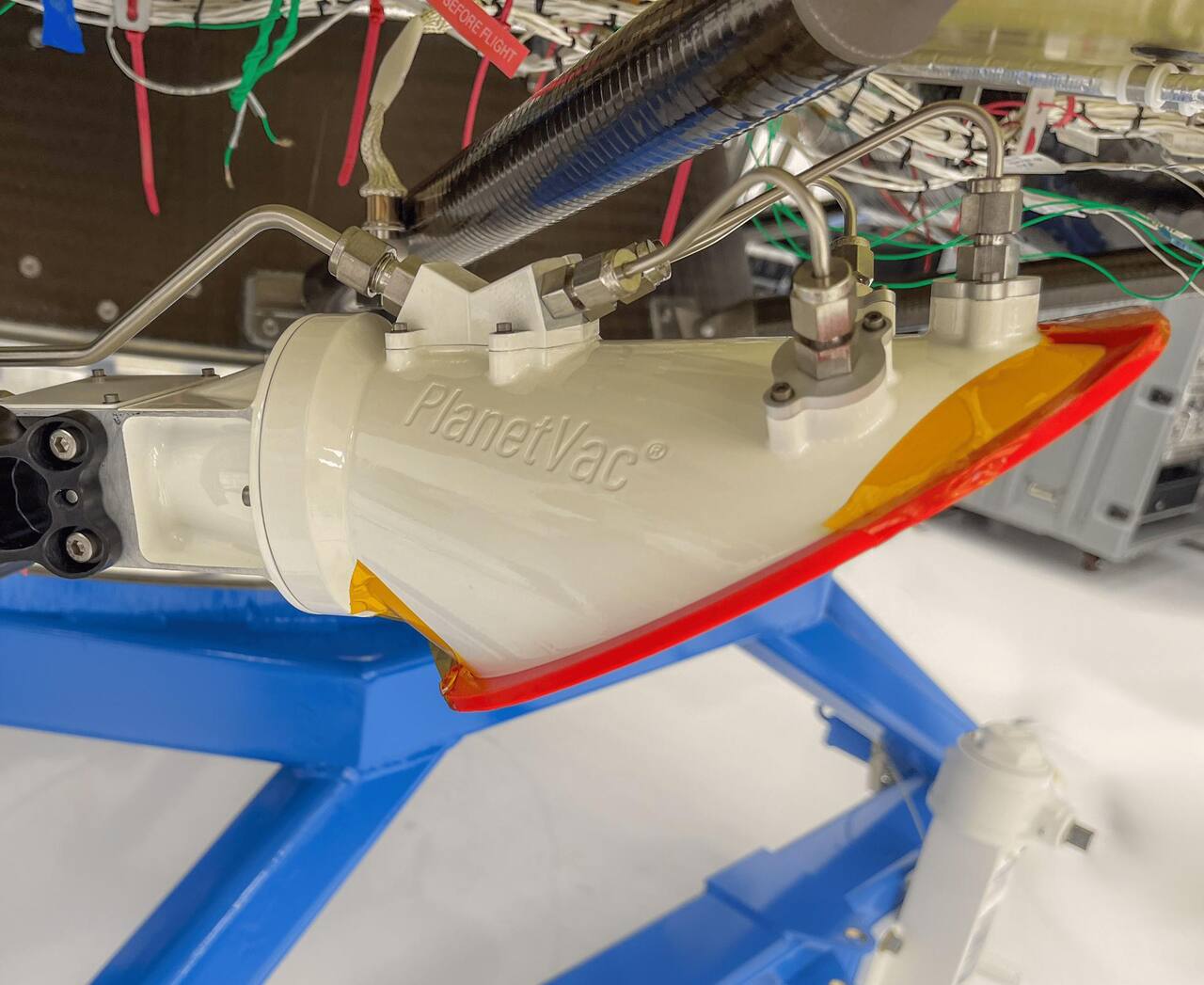 NASA/Firefly Aerospace. Public domain (NASA / US government work).
The problem
Section titled “The problem”A sampler on the Moon has to move cohesive, abrasive, electrostatically charged regolith from the ground to an instrument or a container, in vacuum, at one sixth of Earth’s gravity, and survive the lunar day and night. Scoops, drills and bucket drums all apply force to the soil through a moving part that an arm or vehicle must position. Delivery, not acquisition, has been the recurring failure: the builders of PlanetVac point to the Venera landers, which missed science goals because sample delivery failed, and to Phoenix, where part of the instrument suite went unused [4].
The soil sets the design range. The Lunar Sourcebook gives an in situ bulk density of 1.50 g/cm3 averaged over the top 15 cm [37], and the Apollo soil mechanics team reports surface density below 1.0 g/cm3 in places, with cohesion and friction given as loci of pairs satisfying one measured resistance, not as separate values [7]. The 2005 simulant workshop quotes 0.1 to 1 kPa cohesion and 30 to 50 degrees friction angle for Apollo regolith [38]. All of these rest on near-equatorial Apollo and Luna sites [37].
Low gravity changes how that soil behaves. In parabolic flight at one sixth g, JSC-1A simulant in an hourglass hopper flowed very slowly and in some runs stopped, and the PlanetVac authors expect real soil in hard vacuum to be worse, an expectation and not a measurement [4]. In a drop tower the same simulant jammed a 60 degree hopper at 0.19 G and stayed clogged, where it ran to completion at 1.0 G [17]. An ISS centrifuge held 0.063 to 2.0 g for hours and found bulk density falling as gravity falls [27]. Settled packing in the ZARM drop tower grew looser by 19.6 percent for fine basalt at 250 mm/s2 [15].
What has flown
Section titled “What has flown”Lunar PlanetVac, built by Honeybee Robotics, flew on Firefly’s Blue Ghost Mission 1, launched 15 January 2025 and landed in Mare Crisium on 2 March 2025 [13], with NASA confirming the host mission [9]. The system is a sampling head, transfer tubes and a capture system, with gas supplied from a standalone canister [4]. The head rode on a Firefly Sample Access Arm released after touchdown, with the transfer tube running to a collection system on the temperature-controlled mid-deck [13]. On 3 March the single acquisition took about 5 seconds and collected about 6.5 cc against a 1 cc requirement, then separated the sample about 1 mm in a second gas burst [13]. A separate abstract by the same team quotes 13 g, including 5 g of rocklets about 2 mm across, and the two figures are not reconciled [12]. The hood was not flush with the surface, so the result cannot be attributed to a known standoff [13].
LISTER, a gas-driven drill and heat flow probe, flew on the same lander. It reached 0.98 m against a 2 m threshold, and its heat flow of 13 to 14 mW/m2 is preliminary [8]. Its pre-flight qualification was a 1 g chamber campaign in simulant [23].
Luna 16 in 1970 drilled to 35 cm and returned 101 g [11]. Chang’e-6 returned 1935.3 g from the far side in 2024, which CNSA described as more viscous with clumps [36]. A single scooped sample had a bulk density of 0.983 g/cm3 [32]. The Chang’e-6 scooping used a binocular point cloud and a pose estimate by registration, with a 3.8 mm scooping depth error measured on an Earth testbed, not on the Moon [31].
On Mars, the Phoenix arm executed 53 dig sequences, met indurated ice between about 2 and 10 cm and delivered 18 samples to instruments [2]. Soft and hard ice in two trenches was read as possible evidence of transient brine, a hedged inference [10]. Surveyor 1 soil estimates gave cohesion from 150 to 15,000 Pa, two orders of magnitude [6].
Gas sampling has flown at an asteroid. OSIRIS-REx’s TAGSAM fires nitrogen through a brimmed head and retreats, and qualification showed collection rising by a factor of 4 to 5 under reduced acceleration relative to 1 g, with collection above the requirement at contact times down to 0.5 s [1]. For site selection, collection showed no loss through the first 14 degrees of tilt and the head could ingest particles to about 2 cm [28].
What is being tried now
Section titled “What is being tried now”Pneumatic acquisition and delivery
Section titled “Pneumatic acquisition and delivery”The efficiency argument for gas is a lifting ratio of 5500:1 by mass in one reported excavation system, taken from the literature and not re-tested [5]. A pneumatic line can route around obstacles, so the head goes where sampling is best and the instrument where analysis is best, with quantity needs from 50 micrograms into a GCMS cup to 10 cc into a mass spectrometer cup [4]. The flown status is one lunar acquisition [13]; pneumatic transfer into a sealed return container has not been shown. A Ceres sample return study sets 100 g or more returned, a proposal with nothing built [3].
Drilling
Section titled “Drilling”Drilling gives depth at a cost in weight on bit and power. The TRIDENT rotary-percussive drill is 26.5 kg with a 25.4 mm bit and 1 m reach [20]. The PRIME-1 activation exercised mechanisms with the drill buried in landing ejecta, and no lunar drilling was performed [20]. Ground work includes a cryogenic vacuum test at 1.6e-6 Torr and -178 C where a mass spectrometer distinguished water-doped layers [21], Antarctic field drilling in which telemetry alone located an ice-rock transition near 62 cm [22], and Devon Island and Bishop Tuff tests where the drill bound in low-permeability targets [29]. A petroleum engineering survey lists vacuum, thermal cycling, dust in seals and bit wear as recurring problems, without a wear measurement [6]. These are ground tests.
Excavation
Section titled “Excavation”IPEx is designed for up to 30 kg per cycle and 5000 to 10000 kg over its mission, with campaigns reported as in progress [25]. A 3D-printed bucket drum excavator reached 777.54 kg/h continuous in silica sand at 1 g, not simulant [26]. A review of thirteen excavation systems tabulated capability from the literature [5]. None has excavated on the Moon.
Feed assistance
Section titled “Feed assistance”Vertical vibration kept a highlands simulant flowing in vacuum hoppers over 60 lunar-gravity parabolas, 480 experiments, but the paper is an unreviewed preprint with a hardware-developer author [14]. It is a ground and parabolic result.
Autonomous sampling on analog terrain
Section titled “Autonomous sampling on analog terrain”JPL ran 58 tests over three weeks on the Matanuska Glacier for the Europa Lander concept, with no placement accuracy or sample mass reported [30].
Reduced gravity measurement
Section titled “Reduced gravity measurement”Magnetic levitation cone tests put the 150 mm average resistance at 1/6 g lower than at 1 g by 29.1 percent at 40 percent relative density and 8.8 percent at 76 percent, using a 40 percent magnetite simulant [16]. A parabolic campaign for the MMX sampler measured 10 to 40 N penetrometer force in a cohesive Phobos simulant and under 1 N in 2 mm glass beads [19]. A drop tower shear cell for strength at partial gravity is an instrument description with no reduced gravity strength data yet [18]. Wheel tests on two Falcon 20 parabolic campaigns found cone index gradient about 4 times higher at 1 g than in lunar gravity at equal density [39]. Direct shear tests gave cohesion of 0.185 to 1.672 kPa for lunar simulants, in air at 1 g [35].
Dust and wear
Section titled “Dust and wear”VIPER’s mobility uses a 42-layer outer barrier and graded seals, qualified at ambient pressure only [24]. Lunar simulants produced more wear than Martian ones on a PTFE lip seal in air, with friction coefficients between 0.2 and 0.4 [33]. A pneumatic head has no seal to wear.
The numbers
Section titled “The numbers”| Parameter | Value | Source |
|---|---|---|
| Acquisition time | about 5 s | [13] |
| Volume collected | about 6.5 cc, requirement 1 cc | [13] |
| Mass collected | 13 g | [12] |
| Size separation | about 1 mm | [13] |
| Working gas | standalone canister | [4] |
| LISTER depth | 0.98 m | [8] |
| Luna 16 | 35 cm, 101 g | [11] |
| Chang’e-6 return | 1935.3 g | [36] |
| TAGSAM reduced acceleration factor | 4 to 5 | [1] |
| TRIDENT mass | 26.5 kg | [20] |
| Lunar simulant cohesion | 0.185 to 1.672 kPa | [35] |
| Regolith bulk density | 1.50 g/cm3 | [37] |
Mass, gas quantity and pressure, power draw, temperature limits and dimensions of Lunar PlanetVac are not published.
What is not established
Section titled “What is not established”Nominal performance: there is one acquisition from an uncommanded position, and the builders’ technology readiness level 9 rests on that event [12]. Particle size analysis, dust coupon results and the hood geometry investigation were in progress when the volume was reported [13]. Gravity scaling of gas collection comes from TAGSAM parabolic flights, not lunar data [1]. Parabolic flights last tens of seconds and low-density simulants match particle weight but not inertia [1]. Drilling, excavation and feed-assist results are ground tests except LISTER [8]. Behavior in polar regolith is not constrained by anything cited here [37].
References
Section titled “References”References
- Bierhaus, E. B., Clark, B. C., Harris, J. W., Payne, K. S., Dubisher, R. D., Wurts, D. W., Hund, R. A., Kuhns, R. M., Linn, T. M., Wood, J. L., May, A. J., Dworkin, J. P., Beshore, E., Lauretta, D. S. and the OSIRIS-REx Team. (2018). The OSIRIS-REx Spacecraft and the Touch-and-Go Sample Acquisition Mechanism (TAGSAM)
. Space Science Reviews, 7. Source
BibTeX
@article{bierhaus2018osiris, title = {The {OSIRIS-REx} Spacecraft and the Touch-and-Go Sample Acquisition Mechanism ({TAGSAM})}, author = {Bierhaus, Edward B. and Clark, Benton C. and Harris, J. W. and Payne, K. S. and Dubisher, R. D. and Wurts, D. W. and Hund, R. A. and Kuhns, R. M. and Linn, T. M. and Wood, J. L. and May, A. J. and Dworkin, Jason P. and Beshore, E. and Lauretta, Dante S. and {the OSIRIS-REx Team}}, journal = {Space Science Reviews}, volume = {214}, number = {7}, pages = {107}, year = {2018}, doi = {10.1007/s11214-018-0521-6}, abstract = {The Origins, Spectral-Interpretation, Resource-Identification, Security and Regolith-Explorer (OSIRIS-REx) spacecraft supports all aspects of the mission science objectives, from extensive remote sensing at the asteroid Bennu, to sample collection and return to Earth. In general, the success of planetary missions requires the collection, return, and analysis of data, which in turn depends on the successful operation of instruments and the host spacecraft. In the case of OSIRIS-REx, a sample-return mission, the spacecraft must also support the acquisition, safe stowage, and return of the sample. The target asteroid is Bennu, a B-class near-Earth asteroid roughly 500 m diameter. The Lockheed Martin-designed and developed OSIRIS-REx spacecraft draws significant heritage from previous missions and features the Touch-and-Go-Sample-Acquisition-Mechanism, or TAGSAM, to collect sample from the surface of Bennu. Lockheed Martin developed TAGSAM as a novel, simple way to collect samples on planetary bodies. During short contact with the asteroid surface, TAGSAM releases curation-grade nitrogen gas, mobilizing the surface regolith into a collection chamber. The contact surface of TAGSAM includes “contact pads”, which are present to collect surface grains that have been subject to space weathering. Extensive 1-g laboratory testing, “reduced-gravity” testing (via parabolic flights on an airplane), and analysis demonstrate that TAGSAM will collect asteroid material in nominal conditions, and a variety of off-nominal conditions, such as the presence of large obstacles under the TAGSAM sampling head, or failure in the sampling gas firing. TAGSAM, and the spacecraft support of the instruments, are central to the success of the mission.} } - Bonitz, R., Shiraishi, L., Robinson, M., Carsten, J., Volpe, R., Trebi-Ollennu, A., Arvidson, R. E., Chu, P. C., Wilson, J. J. and Davis, K. R. (2009). The Phoenix Mars Lander Robotic Arm
. IEEE Aerospace Conference. Source
BibTeX
@inproceedings{bonitz2009phoenix, title = {The Phoenix Mars Lander Robotic Arm}, author = {Bonitz, Robert and Shiraishi, Lori and Robinson, Matthew and Carsten, Joseph and Volpe, Richard and Trebi-Ollennu, Ashitey and Arvidson, Raymond E. and Chu, P. C. and Wilson, J. J. and Davis, K. R.}, booktitle = {IEEE Aerospace Conference}, pages = {1-12}, organization = {Jet Propulsion Laboratory, California Institute of Technology}, address = {Big Sky, Montana}, year = {2009}, doi = {10.1109/aero.2009.4839306}, abstract = {The Phoenix Mars Lander Robotic Arm (RA) has operated for 149 sols since the Lander touched down on the north polar region of Mars on May 25, 2008. During its mission it has dug numerous trenches in the Martian regolith, acquired samples of Martian dry and icy soil, and delivered them to the Thermal Evolved Gas Analyzer (TEGA) and the Microscopy, Electrochemistry, and Conductivity Analyzer (MECA). The RA inserted the Thermal and Electrical Conductivity Probe (TECP) into the Martian regolith and positioned it at various heights above the surface for relative humidity measurements. The RA was used to point the Robotic Arm Camera to take images of the surface, trenches, samples within the scoop, and other objects of scientific interest within its workspace. Data from the RA sensors during trenching, scraping, and trench cave-in experiments have been used to infer mechanical properties of the Martian soil. This paper describes the design and operations of the RA as a critical component of the Phoenix Mars Lander necessary to achieve the scientific goals of the mission.} } - Brophy, J. R., Castillo-Rogez, J. and Casillas, R. P. (2021). Assessing Ceres' Past and Current Habitability
. IEEE Aerospace Conference. Source
BibTeX
@inproceedings{brophy2021assessing, title = {Assessing Ceres' Past and Current Habitability}, author = {Brophy, John R and Castillo-Rogez, Julie and Casillas, Raul Polit}, booktitle = {IEEE Aerospace Conference}, volume = {320}, pages = {1-15}, publisher = {IEEE}, year = {2021}, doi = {10.1109/aero53065.2022.9843248}, abstract = {Dwarf planet Ceres is a compelling target as an evolved ocean world with, at least, regional brine reservoirs and potentially ongoing geological activity. Situated in the Main Belt of asteroids, Ceres is the most water-rich body in the inner solar system (in relative abundance) and is accessible enough for a sample return with the resources of a typical medium-class (New Frontiers) NASA mission. NASA's Dawn mission at Ceres revealed the presence of liquid, brine-driven activity, organic matter, and a rich salt chemistry. With this evidence, the overarching goals of the mission concept presented herein are to quantify Ceres' current habitability potential and origin. A sample return from young evaporite deposits in Occator crater offers greater science return than an in situ exploration mission by enabling high-resolution analysis of (1) organic matter expected from terrestrial and chondritic analogs that are trapped in salt minerals and (2) isotopes of refractory elements for a similar cost and less science risk. The sample return concept would be executed with a single flight system due to Ceres' relative proximity to Earth and low gravity. Solar electric propulsion was identified as the most cost-effective approach for getting to Ceres and back. De-orbiting, landing, and takeoff are performed with a throttleable monopropellant hydrazine system. The solar arrays are stowed prior to landing and takeoff. Sample acquisition builds on the pneumatic system designed by Honeybee Robotics. The sample return mission concept relies on the availability of key technologies: an enhanced landing vision system leveraging investments from Mars 2020; retractable/redeployable solar arrays, which have been demonstrated on the International Space Station but not at Ceres' gravity; and an emerging design from upcoming missions for sample transfer from the pneumatic sampling system to the sample return capsule. Return of a sample of mass$\sim 100\mathrm{g}$from Ceres, maintained at$\leq-20^{\circ}\mathbf{C}$, is without precedent for any currently advocated Ocean World mission, enabling a vast range of experimental techniques back on Earth with sensitivities and accuracies far beyond those feasible with in situ instruments. A sample of this size also enables analyses to benefit from techniques that will become available in the future.} } - Fitzgerald, Z., Zacny, K., Mueller, R., Morrison, P., McCormick, M., Wang, A., Thompson, L., Jung, H., Hernandez, J., Leucht, K. and Dupuis, M. A. (2022). PlanetVac: Sample Acquisition and Delivery System for Instruments and Sample Return
. Lunar and Planetary Science Conference, 2586. Source
BibTeX
@inproceedings{fitzgerald2022planetvac, title = {PlanetVac: Sample Acquisition and Delivery System for Instruments and Sample Return}, author = {Fitzgerald, Z. and Zacny, K. and Mueller, R. and Morrison, P. and McCormick, M. and Wang, A. and Thompson, Lucy and Jung, H. and Hernandez, J. and Leucht, K. and Dupuis, Michael A.}, booktitle = {Lunar and Planetary Science Conference}, number = {2586}, year = {2022}, url = {https://www.hou.usra.edu/meetings/lpsc2022/pdf/2586.pdf} } - Just, G. H., Smith, K., Joy, K. H. and Roy, M. (2020). Parametric review of existing regolith excavation techniques for lunar In Situ Resource Utilisation (ISRU) and recommendations for future excavation experiments
. Robotica. Source
BibTeX
@article{just2020parametric, title = {Parametric review of existing regolith excavation techniques for lunar In Situ Resource Utilisation (ISRU) and recommendations for future excavation experiments}, author = {Just, Gabriele H. and Smith, K. and Joy, Katherine H. and Roy, M.J.}, journal = {Robotica}, volume = {180}, pages = {104746}, publisher = {Elsevier BV}, year = {2020}, doi = {10.1016/j.pss.2019.104746}, abstract = {A high-level overview of current research in the area of lunar regolith excavation and handling for In Situ Resource Utilisation (ISRU) is presented. Thirteen processes are grouped into discrete and continuous excavators. A further differentiation is made between systems with and without connection to a mobility platform – referred to as complete and partial systems. For each group, a set of representative performance parameters has been identified and compared, while special characteristics or limitations are highlighted. The present work identifies a need for high detail research into the development of reliable and efficient excavation systems, due to the high importance of regolith excavation and handling to ISRU. A need for more standardised information and recording of specific data during supporting experimental studies is made apparent. In order to enable easier categorisation, comparison, and evaluation of future concepts, a set of key performance parameters requiring consideration during experimental campaigns is described and the importance of their inclusion underlined.} } - Knez, D. and Khalilidermani, M. (2021). A Review of Different Aspects of Off-Earth Drilling
. Energies, 21. Source
BibTeX
@article{knez2021review, title = {A Review of Different Aspects of Off-Earth Drilling}, author = {Knez, Dariusz and Khalilidermani, Mitra}, journal = {Energies}, volume = {14}, number = {21}, pages = {7351}, publisher = {MDPI AG}, year = {2021}, doi = {10.3390/en14217351}, abstract = {Off-Earth drilling may be assumed as the second phase of space exploration to discover the unrevealed subsurface on the planetary bodies. It accelerates future space objectives such as in-situ propellant production, mineral exploitation, and space tourism. Owing to the rampant progress in modern technology, the new drill tools mounted on the sophisticated robots are capable to drill the planetary regolith dispersed on the celestial objects; however, formidable obstacles such as microgravity, vacuum condition, and temperature fluctuation as well as the weight limitation, lack of real-time drilling analysis, and remote robot-operator communication impose pressing restrictions on the quick development of space drilling tools. In this study, research on the past and present aspects of off-Earth drilling has been implemented to illuminate the horizon of this technology in the near-term future. The context encompasses a detailed description of the limitations, applications and mechanisms of the different drilling techniques adopted for planetary bodies. A particular emphasis is put on the hydraulic power systems which have not been satisfactorily deployed in off-Earth drilling yet. The research strives to glance over the pivotal aspects of off-Earth drilling to contribute to the future drilling programs planned by the national and private space agencies.} } - Mitchell, J. K., Houston, W. N., Scott, R. F., Costes, N. C., Carrier, W. D. and Bromwell, L. G. (1972). Mechanical properties of lunar soil: Density, porosity, cohesion, and angle of internal friction
. Lunar Science Conference. Source
BibTeX
@inproceedings{mitchell1972mechanical, title = {Mechanical properties of lunar soil: Density, porosity, cohesion, and angle of internal friction}, author = {Mitchell, James K. and Houston, William N. and Scott, Ronald F. and Costes, Nicholas C. and Carrier, W. D. and Bromwell, L. G.}, booktitle = {Lunar Science Conference}, volume = {3}, pages = {3235--3253}, publisher = {The M.I.T. Press}, year = {1972}, url = {https://articles.adsabs.harvard.edu/pdf/1972LPSC....3.3235M} } - Nagihara, S., Zacny, K., Ngo, P., Sanasarian, L., Misra, R., Grott, M., Knollenberg, J., Smrekar, S., Siegler, M. and Neal, C. (2026). LISTER Deployment on Blue Ghost Mission One to Mare Crisium of the Moon
. Lunar and Planetary Science Conference, 1351. Source
BibTeX
@inproceedings{nagihara2026lister, title = {LISTER Deployment on Blue Ghost Mission One to Mare Crisium of the Moon}, author = {Nagihara, S. and Zacny, K. and Ngo, P. and Sanasarian, L. and Misra, R. and Grott, Matthias and Knollenberg, J. and Smrekar, Susan and Siegler, M. and Neal, C.}, booktitle = {Lunar and Planetary Science Conference}, number = {1351}, year = {2026}, url = {https://www.hou.usra.edu/meetings/lpsc2026/pdf/1351.pdf} } - (2026). NASA: Lander to Test Vacuum Cleaner on Moon for Sample Collection. nasa.gov/missions/artemis/clps/nasa-lander-to-test-vacuum-cleaner-on-...
BibTeX
@misc{nasalander, title = {NASA: Lander to Test Vacuum Cleaner on Moon for Sample Collection}, organization = {nasa.gov}, year = {2026}, url = {https://www.nasa.gov/missions/artemis/clps/nasa-lander-to-test-vacuum-cleaner-on-moon-for-sample-collection/} } - Rennó, N. O., Bos, B. J., Catling, D. C., Clark, B. C., Drube, L., Fisher, D., Goetz, W. and Hviid, S. F. (2009). Possible physical and thermodynamical evidence for liquid water at the Phoenix landing site
. Journal of Geophysical Research: Atmospheres. Source
BibTeX
@article{renno2009possible, title = {Possible physical and thermodynamical evidence for liquid water at the Phoenix landing site}, author = {Rennó, N. O. and Bos, Brent J. and Catling, David C. and Clark, B. C. and Drube, Line and Fisher, David and Goetz, W. and Hviid, S. F.}, journal = {Journal of Geophysical Research: Atmospheres}, volume = {114}, year = {2009}, doi = {10.1029/2009je003362}, abstract = {The objective of the Phoenix mission is to determine if Mars' polar region can support life. Since liquid water is a basic ingredient for life, as we know it, an important goal of the mission is to determine if liquid water exists at the landing site. It is believed that a layer of Martian soil preserves ice by forming a barrier against high temperatures and sublimation, but that exposed ice sublimates without the formation of the liquid phase. Here we show possible independent physical and thermodynamical evidence that besides ice, liquid saline water exists in areas disturbed by the Phoenix Lander. Moreover, we show that the thermodynamics of freeze‐thaw cycles can lead to the formation of saline solutions with freezing temperatures lower than current summer ground temperatures on the Phoenix landing site on Mars' Arctic. Thus, we hypothesize that liquid saline water might occur where ground ice exists near the Martian surface. The ideas and results presented in this article provide significant new insights into the behavior of water on Mars.} } - Siddiqi, A. A. (2018). Beyond Earth: A Chronicle of Deep Space Exploration, 1958-2016
. NASA, NASA SP-2018-4041. Source
BibTeX
@book{siddiqi2018beyond, title = {Beyond Earth: A Chronicle of Deep Space Exploration, 1958-2016}, author = {Siddiqi, Asif A.}, number = {NASA SP-2018-4041}, publisher = {NASA}, year = {2018}, url = {https://www.nasa.gov/wp-content/uploads/2018/09/beyond-earth-tagged.pdf} } - Zacny, K., Fitzgerald, Z., Jung, H., Wang, A., Carrington, K., Misra, R., Alattas, M., King, I., Hernandez, J., Bailey, J., Ng, P., Vendiola, V., Mueller, R. and Wohl, C. (2025). Lunar PlanetVac on Blue Ghost Successfully Demonstrated Pneumatic Regolith Mining, Transport, and Sorting
. Annual Meeting of the Lunar Exploration Analysis Group, 5018. Source
BibTeX
@inproceedings{zacny2025lunarplanetvac, title = {Lunar PlanetVac on Blue Ghost Successfully Demonstrated Pneumatic Regolith Mining, Transport, and Sorting}, author = {Zacny, K. and Fitzgerald, Z. and Jung, H. and Wang, A. and Carrington, K. and Misra, R. and Alattas, M. and King, Isabel and Hernandez, J. and Bailey, J. and Ng, Phil and Vendiola, V. and Mueller, R. and Wohl, C.}, booktitle = {Annual Meeting of the Lunar Exploration Analysis Group}, number = {5018}, year = {2025}, url = {https://www.hou.usra.edu/meetings/leag2025/pdf/5018.pdf} } - Zacny, K., Fitzgerald, Z., Vendiola, V., Jung, H., Wang, A., Carrington, K., Misra, R., Indyk, S., Mueller, R., Wohl, C. and Banks, M. E. (2026). PlanetVac Sample Acquisition and Delivery Demonstration on Blue Ghost Lander
. Lunar and Planetary Science Conference, 1139. Source
BibTeX
@inproceedings{zacny2026planetvac, title = {PlanetVac Sample Acquisition and Delivery Demonstration on Blue Ghost Lander}, author = {Zacny, K. and Fitzgerald, Z. and Vendiola, V. and Jung, H. and Wang, A. and Carrington, K. and Misra, R. and Indyk, S. and Mueller, R. and Wohl, C. and Banks, Maria E.}, booktitle = {Lunar and Planetary Science Conference}, number = {1139}, year = {2026}, url = {https://www.hou.usra.edu/meetings/lpsc2026/pdf/1139.pdf} } - Stepanova, A., Dreyer, C. and Garvey, R. (2026). Vibration-Assisted Granular Flow Under Simulated Lunar Conditions: Parabolic Flight Validation of a Lunar Regolith Feed System
. Research Square preprint. Source
BibTeX
@article{stepanova2026vibration, title = {Vibration-Assisted Granular Flow Under Simulated Lunar Conditions: Parabolic Flight Validation of a Lunar Regolith Feed System}, author = {Stepanova, Anastasia and Dreyer, Christopher and Garvey, Ryan}, journal = {Research Square preprint}, year = {2026}, doi = {10.21203/rs.3.rs-9034538/v1}, abstract = {Abstract Reliable transport of granular materials through hoppers presents significant challenges in reduced-gravity environments due to diminished driving forces and increased susceptibility to flow blockages. This study reports results from parabolic flight experiments evaluating whether vertical vibration can maintain continuous regolith flow under simulated lunar gravity and vacuum conditions. Eight parallel feed assemblies were tested inside vacuum chambers, spanning four outlet geometries ranging in diameter from 11 to 45 mm and hopper angles from 46.5° to 90°. Vibration was applied at frequencies of between 43 and 65 Hz with displacement amplitudes from 0.2 to 0.8 mm. Across 60 reduced-gravity parabolas comprising 480 individual experiments, continuous material discharge was observed whenever vibration was active, regardless of outlet geometry. When vibration was disabled, all configurations exhibited flow termination within seconds. Reactivating vibration promptly restored flow without manual intervention. A rotary pocket feeder at each hopper outlet provided proportional flow rate control, yielding mass flow rates of 0.3 to 1.0 g/s with a lunar highlands regolith geotechnical simulant. These results demonstrate that vertical vibration effectively prevents flow blockages in reduced gravity, establishing validated design parameters for regolith handling systems intended for lunar surface operations.} } - Keulen, M., Giese, T., Joeris, K. and Kollmer, J. (2026). Experiments on Settling of Granular and Cohesive Material in Low Gravity
. The Planetary Science Journal, 8. Source
BibTeX
@article{keulen2026experiments, title = {Experiments on Settling of Granular and Cohesive Material in Low Gravity}, author = {Keulen, Matthias and Giese, Timo and Joeris, Kolja and Kollmer, Jonathan}, journal = {The Planetary Science Journal}, volume = {7}, number = {8}, pages = {203}, publisher = {American Astronomical Society}, year = {2026}, doi = {10.3847/psj/ae8fd7}, abstract = {Abstract The regolith of rocky bodies, such as planets or asteroids, generally settles under gravity conditions different from those of Earth. The behavior of granular material is not easily scalable for different gravities. To predict these highly complex systems where cohesive interparticle forces can be comparable to gravitational forces, we need simulations and experiments. We did experiments on the settling of three different granular samples in varying reduced gravities and examined their packing densities. We used a high-precision linear stage to artificially induce reduced gravities inside the zero- g environment provided by the ZARM drop tower and observe the settling of our samples. The three samples were fine basalt with particle diameters of 1–200 μ m, coarse basalt of 2–5 mm, and glass beads of 750–1000 μ m. The artificial gravities were 150, 250, 500, 750, and 1000 mm s −2 and therefore ranged from large asteroid gravity to almost moon gravity. We saw the granular samples have higher volumes in lower gravities and therefore lower packing densities; we also saw the fine basalt be the most sensitive to changes in gravity, up to +19.6% in volume for 250 mm s −2 , followed by the coarse basalt particles, up to +12.2% for 150 mm s −2 , with the glass bead packing density being the least sensitive to changes in gravity, up to +4.25% for 250 mm s −2 . With these experiments we show change in volume is not solely dependent on particle size but also roughness and uniformity, and we provide real-life experimental data to validate theoretical works and highlight the role of cohesive forces in low-gravity environments.} } - Chen, J., Li, R. and Fu, S. (2026). Influence of Low Gravity on the Penetration Resistance of Lunar Regolith
. npj Microgravity. Source
BibTeX
@article{chen2026influence, title = {Influence of Low Gravity on the Penetration Resistance of Lunar Regolith}, author = {Chen, Jun and Li, Ruilin and Fu, Shigen}, journal = {npj Microgravity}, volume = {12}, pages = {7}, year = {2026}, doi = {10.1038/s41526-026-00562-8}, abstract = {Abstract Lunar surface operations conducted by the United States and the Soviet Union confirmed that penetration resistance is a key indicator for evaluating the engineering properties of lunar regolith. To quantitatively assess the influence of reduced gravity on penetration resistance, this study employed a newly developed Geotechnical Magnetic-gravity Modeling Test (GMMT) system to perform cone penetration tests under controlled gravitational acceleration levels of 1/6 g, 1 g, and 2 g. The results indicated that the normalized penetration resistance increased as gravity decreased, and this effect was amplified at higher relative densities. To investigate the underlying mechanisms, discrete element method (DEM) simulations were conducted. The findings revealed that, in addition to gravity, in situ factors such as high relative density and irregular particle morphology also significantly enhanced penetration resistance by strengthening interparticle contact and friction. These non-gravitational effects partially offset the expected reduction in resistance under lower gravity, leading to a smaller-than-anticipated decline. This study provides new insights into the gravity-dependent penetration behavior of lunar regolith.} } - Madden, I. P., Muruganandam, S., Missaoui, A., Gries, O., Kollmer, J., D'Angelo, O. and Sinha-Ray, S. (2025). Behaviors of Lunar Regolith Simulants Under Varying Gravitational Conditions
. npj Microgravity. Source
BibTeX
@article{madden2025behaviors, title = {Behaviors of Lunar Regolith Simulants Under Varying Gravitational Conditions}, author = {Madden, Ian P. and Muruganandam, Sathyashri and Missaoui, Amine and Gries, Oliver and Kollmer, Jonathan and D'Angelo, Olfa and Sinha-Ray, Suman}, journal = {npj Microgravity}, volume = {11}, pages = {88}, year = {2025}, doi = {10.1038/s41526-025-00501-z}, abstract = {Abstract Understanding the behavior of regolith in varying gravity conditions, is critical for space exploration and future missions. In this work, the gravity-driven hopper flow of lunar regolith simulant in different gravitational accelerations (terrestrial, lunar) is first observed experimentally. Numerical simulations (DEM) are then developed to understand the role which cohesive interparticle forces play in such gravity-driven flow, using the theoretical framework of granular Bond number. Qualitative comparison between a terrestrial experiment and numerical simulation validated this framework. Following that, we numerically studied the dynamic behavior under varying gravitational conditions (from terrestrial to lunar to asteroid gravitational accelerations). We find that this behavior is extremely sensitive to the interplay of the gravity conditions and the attractive/cohesive forces among particles. The numerical and experimental results show that the complex interaction of these forces can drastically change the dynamics of the material producing effects relevant for variable gravity applications.} } - Duffey, C., Lea, M. and Brisset, J. (2025). Measuring regolith strength in reduced gravity environments in the laboratory
. Review of Scientific Instruments. Source
BibTeX
@article{duffey2025measuring, title = {Measuring regolith strength in reduced gravity environments in the laboratory}, author = {Duffey, C. and Lea, M. and Brisset, Julie}, journal = {Review of Scientific Instruments}, volume = {96}, year = {2025}, doi = {10.1063/5.0249495}, abstract = {This paper presents the design and development of a Shear and Compression Cell (SCC) for measuring the mechanical properties of granular materials in low-gravity environments. This research is motivated by the increasing interest in planetary exploration missions that involve surface interactions, such as those to asteroids and moons. The SCC is designed to measure key mechanical properties, including Young’s modulus, angle of internal friction, bulk cohesion, and tensile strength, under both reduced gravity and microgravity conditions. Using a drop tower with interchangeable configurations, we can simulate the gravitational environments of celestial bodies such as the Moon and Titan. The SCC, coupled with the drop tower, provides a valuable tool for understanding the behavior of regolith materials and their implications for future space exploration missions.} } - Smyth-Moore, A., Borg, J., Soria-Salinas, Á., Murdoch, N., Kato, H., Miyamoto, H., Usui, T., Kaufmann, E., Granvik, M. and Hagermann, A. (2025). Microgravity penetrometry flight campaign in support of MMX sampler science exploitation
. Progress in Earth and Planetary Science, 38. Source
BibTeX
@article{smythmoore2025microgravity, title = {Microgravity penetrometry flight campaign in support of MMX sampler science exploitation}, author = {Smyth-Moore, Alexander and Borg, Johan and Soria-Salinas, Álvaro and Murdoch, Naomi and Kato, Hiroki and Miyamoto, Hideaki and Usui, Tomohiro and Kaufmann, Erika and Granvik, Mikael and Hagermann, Axel}, journal = {Progress in Earth and Planetary Science}, volume = {12}, number = {38}, year = {2025}, doi = {10.1186/s40645-025-00704-8}, abstract = {Abstract Characterising the mechanical properties of minor bodies is essential for understanding their origin and evolution. Past missions such as Hayabusa2 have landed on asteroids to sample and discover what these bodies are made of. However, there has been conflicting evidence and reports into the physical properties of the granular surface material of these bodies. With future missions such as Japan Aerospace eXploration Agency’s Martian Moons eXploration mission landing on Phobos, the understanding and identification of these physical properties is crucial to maximising the scientific output from these missions. Penetrometry, the determination of the reaction force that an object experiences as it penetrates a surface, can help to understand the essential properties of regolith, such as grain size, porosity and cohesion. Results of penetrometry experiments are largely analysed based on empirical models, which presents us with a challenge if we want to apply them to understand granular materials on asteroid surfaces because gravity cannot be eliminated in the laboratory. Hence, it is essential to verify penetrometry as a method and validate penetrometry instrument designs in microgravity. For this purpose, we conducted a microgravity experiment onboard a parabolic flight campaign. Our experiment tested the use of penetrometry in asteroid-analogue environments by investigating samples with varying properties, such as grain size distribution and shape, and then compared to 1 g experiments to understand the role microgravity plays. The experiment provided a substantial database for future analysis. This paper will focus on the design of the experiment and the parabolic flight campaign in which the experiments were conducted. The design decisions and the variables adjusted during the experiment will be discussed, evaluating how these influenced the campaign and its outcomes. We will also provide a snapshot of preliminary results of the data captured during this experiment. For example, we show the effect of cohesion on penetrometer reaction force, with more cohesive materials providing larger reaction forces nearly of the same magnitude of their 1 g counterparts. We also show that penetrometer tip shapes provide different reaction forces and that flat tips provide the largest reaction force compared to the others. The influence of penetration velocity will be investigated further with the aid of theoretical models. Early indications from the results seen so far are promising for future analyses and will provide key information for the analysis of penetrometry data on future missions.} } - Zacny, K., Chu, P., Vendiola, V., Paulsen, G., Creekmore, J., Goldman, J., Kleinhenz, J., Smith, J. and Colaprete, A. (2025). TRIDENT Ice Mining Drill for Lunar Volatile Prospecting for PRIME-1 and VIPER Missions
. The Planetary Science Journal, 12. Source
BibTeX
@article{zacny2025trident, title = {{TRIDENT} Ice Mining Drill for Lunar Volatile Prospecting for {PRIME-1} and {VIPER} Missions}, author = {Zacny, Kris and Chu, Philip and Vendiola, Vincent and Paulsen, Gale and Creekmore, Justin and Goldman, Jason and Kleinhenz, Julie and Smith, James and Colaprete, Anthony}, journal = {The Planetary Science Journal}, volume = {6}, number = {12}, pages = {297}, year = {2025}, doi = {10.3847/psj/ae0b51}, abstract = {Abstract The Regolith and Ice Drill for Exploration of New Terrains (TRIDENT) is a 1 m class drill developed for capturing regolith and ice during the Volatiles Investigating Polar Exploration Rover (VIPER) and the Polar Resources Ice Mining Experiment (PRIME-1) lander missions to the south pole of the Moon. The drill employs decoupled rotation and percussion mechanisms to allow for three modes: rotation, percussion, and rotation–percussion, depending on operational goals and the material strength. TRIDENT can be operated in such a way that it can characterize subsurface material and deliver cuttings to the surface for characterization by other instruments. TRIDENT includes a drill-bit-integrated temperature sensor and an auger-integrated heater with a colocated temperature sensor 35 cm above the bit for thermal conductivity measurement. The heater can also be used in cases of ice adherence (freezing in) and to enhance the sublimation of ice from the cuttings pile. TRIDENT collects and delivers subsurface regolith onto the surface using a “bite” sampling approach: cuttings are captured in the auger flutes, the auger is retracted after drilling a 10 cm bite, and then 10 cm worth of cuttings are deposited onto the surface, forming a cuttings cone. This regolith cone is then analyzed by instruments Mass Spectrometer Observing Lunar Operations (MSOLO) and NIRVSS on the VIPER and MSOLO on the PRIME-1 missions. The drilling activity creates a seismic signal that can be detected on any associated inertial measurement unit that is turned on during the activity, which enables seismic science. TRIDENT represents two decades of technology development for planetary applications and could be deployed on any future missions to other solar system bodies. TRIDENT on the PRIME-1 mission has been successfully deployed in horizontal orientation (this orientation was due to the lander being in an off nominal landing orientation). All actuators, sensors, and heaters worked as designed. Even though the drill did not penetrate regolith, it was covered in regolith that fell onto the drill during the landing operation. VIPER is scheduled to launch to the Moon at the end of 2027 on Blue Origin’s Mk1 lander.} } - Ayala, R. A., Crabtree, M. A., Hancock, M. L., Jarnot, A., Captain, J. E., Kleinhenz, J., Rezich, E., Zacny, K., Vendiola, V., Mank, Z., Wright, K. C., Winfield, J. L., Orlando, T., Jones, B., Metzger, P. and Quinn, J. W. (2025). Mass Spectrometry Monitoring of Drilling Operations in Water-Doped Lunar Simulant under Cryogenic Conditions
. Advances in Space Research, 20250007225. Source
BibTeX
@techreport{ayala2025mass, title = {Mass Spectrometry Monitoring of Drilling Operations in Water-Doped Lunar Simulant under Cryogenic Conditions}, author = {Ayala, Roberto Aguilar and Crabtree, Morgan A and Hancock, Matthew L and Jarnot, Alexander and Captain, Janine E and Kleinhenz, Julie and Rezich, Erin and Zacny, Kris and Vendiola, Vincent and Mank, Zack and Wright, Kenneth C and Winfield, Jamie L and Orlando, Thomas and Jones, Brant and Metzger, Philip and Quinn, Jacqueline W}, volume = {77}, number = {20250007225}, pages = {7982-7994}, institution = {Advances in Space Research}, year = {2025}, doi = {10.1016/j.asr.2026.02.047}, abstract = {The utilization of analytical instruments for the detection and quantification of volatiles on the Moon is crucial for the development of in situ resource utilization technology. A test campaign under cryogenic conditions aimed to simulate the cold lunar environment of permanently shadowed regions (PSRs). The test campaign was performed in a Thermal Vacuum Chamber (TVAC) equipped with a bin of regolith simulant doped at three increasing water concentrations delineated at specific depths (Dry, 2.5, and 5 wt%, respectively). The average operating pressure of the chamber was 1.6×10 -6 Torr with an average regolith temperature of -178°C. Four holes were drilled into the regolith simulant bin using The Regolith and Ice Drill for Exploring New Terrain (TRIDENT) drill. The resulting cuttings-piles and their volatile activity were monitored via the Mass Spectrometer observing lunar operations (MSolo) instrument to determine the extent to which a mass spectrometer can monitor the release of volatiles during drilling activities in lunar-like environments. The results of this campaign helped to plan for the operation and subsequent data interpretation of the Polar Resources Ice Mining Experiment-1 (PRIME-1) mission on the Moon.} } - Boelter, S., Brown, G., Stucky, T., Temesgen, E., Mai, R., Weber, L., Gini, M., Bergman, D., Fortuin, C., Glass, B. and Wilhelm, M. (2026). TRIDENT Drill Performance and Subsurface Fault and Anomaly Detection in Antarctic Environments
. Annals of Glaciology. Source
BibTeX
@article{boelter2026trident, title = {TRIDENT Drill Performance and Subsurface Fault and Anomaly Detection in Antarctic Environments}, author = {Boelter, Sarah and Brown, Greta and Stucky, Thomas and Temesgen, Ebasa and Mai, Rene and Weber, Lucas and Gini, Maria and Bergman, Dean and Fortuin, Carter and Glass, Brian and Wilhelm, Marybeth}, journal = {Annals of Glaciology}, year = {2026}, url = {https://ntrs.nasa.gov/citations/20260007172}, abstract = {The Regolith and Ice Drill for Exploring New Terrain (TRIDENT), a 1-meter rotary percussive drill developed by Honeybee Robotics, is designed for extraterrestrial subsurface exploration. Because extraterrestrial drilling cannot rely on prior subsurface characterization or direct human operation, adaptive state estimation and anomaly detection are necessary for reliable autonomous drilling. We evaluate TRIDENT’s drilling performance in planetary analog environments during fieldwork in Schirmacher Oasis and Lake Untersee, Antarctica, including cold-desert permafrost terrain, glacially smoothed rock, ice-covered surfaces, subsurface frozen boundary layers, and ice-rock transitions representative of planetary subsurfaces. This paper investigates subsurface fault and anomaly detection methods for planetary drilling with minimal prior training data while further characterizing TRIDENT’s operational performance across representative analog terrains.} } - Ngo, P., Sanigepalli, V., Zasadzien, M., Castle, C., Wang, A., Heidt, N., Shmavonian, A., Chow, P., Dearing, S., Becerra, J., McCormick, M., Thomas, L., Morrison, P., Zacny, K. and Nagihara, S. (2022). Engineering and Test Development of Heat Flow Probe and Pneumatic Drill for Lunar Lander Mission to Mare Crisium
. Lunar and Planetary Science Conference, 2587. Source
BibTeX
@inproceedings{ngo2022pneumatic, title = {Engineering and Test Development of Heat Flow Probe and Pneumatic Drill for Lunar Lander Mission to Mare Crisium}, author = {Ngo, P. and Sanigepalli, V. and Zasadzien, M. and Castle, C. and Wang, A. and Heidt, N. and Shmavonian, A. and Chow, Paul and Dearing, S. and Becerra, J. and McCormick, M. and Thomas, L. and Morrison, P. and Zacny, K. and Nagihara, S.}, booktitle = {Lunar and Planetary Science Conference}, number = {2587}, year = {2022}, url = {https://www.hou.usra.edu/meetings/lpsc2022/pdf/2587.pdf} } - McBryan, E., Francis, P. and Sobey, A. (2025). Dust Mitigation for the VIPER Mobility System
. International Conference on Environmental Systems, 20250005201. Source
BibTeX
@inproceedings{mcbryan2025dust, title = {Dust Mitigation for the VIPER Mobility System}, author = {McBryan, Emily and Francis, Parker and Sobey, Alexander}, booktitle = {International Conference on Environmental Systems}, number = {20250005201}, institution = {NASA}, year = {2025}, doi = {10.32865/2346/108814}, abstract = {NASA’s Volatiles Investigating Polar Exploration Rover (VIPER) is built to prospect, provide ground truth measurements, and build regional maps of the volatiles at the lunar South Pole that were previously detected by Lunar Reconnaissance Orbiter (LRO), Lunar Crater Observation and Sensing Satellite (LCROSS), and Chandrayaan-1. The rover’s mobility system, responsible for navigating the moon’s partially defined terrain, is the part of VIPER that is most exposed to the lunar surface environment. To ensure it can survive the thermal extremes and lunar regolith, the VIPER project utilized resources across NASA centers to create and evaluate a multi-functional environmental protection strategy. The project’s approach combined thermal insulation with dust protection in a flexible barrier across dynamic actuated joints to serve as the first defense between the hardware and the environment. Additionally, the VIPER project integrated a selection of seals (labyrinth, Nomex felt, and spring-energized PTFE) with individual mechanisms to further mitigate dust infiltration and abrasion risk to the bearings, motors, and sensors. In stages, the project performed extensive testing through a matrix of simulated environmental parameters to evaluate performance margins from the component level to the integrated mobility system. This paper addresses the project’s lessons learned, with an emphasis on systems integration and how this work can affect future long-duration lunar surface systems, such as crewed unpressurized rovers and in-situ resource utilization robotics.} } - Schuler, J. M., Smith, J. D., Nick, A. J., Buckles, B. C., Dyas, J. E., Ortega, V. V., Cloud, J. M., Dokos, A. G., Zhang, E. L., Wang, J. J., Baron, M. A., Muller, T. J., Clark, C. J. and Howe, M. W. (2024). ISRU Pilot Excavator (IPEx) Technology Readiness Level 5 Design Overview
. AIAA AVIATION Forum and ASCEND, 20240008162. Source
BibTeX
@inproceedings{schuler2024isru, title = {ISRU Pilot Excavator (IPEx) Technology Readiness Level 5 Design Overview}, author = {Schuler, Jason M. and Smith, Jonathan D. and Nick, Andrew J. and Buckles, Bradley C. and Dyas, Jeffrey E. and Ortega, Victoria V. and Cloud, Joseph M. and Dokos, Adam G. and Zhang, Elizabeth L. and Wang, Jerry J. and Baron, Michael A. and Muller, Thomas J. and Clark, Casey J. and Howe, Musashi W.}, booktitle = {AIAA AVIATION Forum and ASCEND}, number = {20240008162}, institution = {NASA}, year = {2024}, doi = {10.2514/6.2024-4890}, abstract = {This paper details the mechanical and mechatronic design of the Technology Readiness Level (TRL)-5 In-Situ Resource Utilization (ISRU) Pilot Excavator (IPEx). IPEx is a robotic excavator designed for a technology demonstration of regolith mining in the lunar south pole region. The novel design uses pairs of counter-acting excavation tools called bucket drums, that dig at the same time in opposing directions to reduce the reaction force needed, thereby enabling mining with a small, low-mass, robotic system. IPEx builds on the prior work of the Regolith Advanced Surface Systems Operations Robot (RASSOR), which is the TRL-4 implementation of this concept. The TRL-5 IPEx subsystems that are discussed in this paper include: Regolith Delivery Subsystem (RDS), Mobility Subsystem (MS), Cameras and Dust Mitigation Subsystem (CDMS), and Thermal Control Subsystem (TCS). Each subsystem is described in detail with rationale for design selections. Dust tolerance is a key feature for IPEx, and this paper details a thermal control system with an actuated radiator cover and phase change material as well as camera modules with removable electrodynamic dust shields (EDS). Additional components such as actuators, wheels, and bucket drums are discussed in detail. Due to their complexity, the avionics and software subsystems will be discussed in a separate publication.} } - Giel, S., Hurrell, J., Santra, S., Mishra, A., Uno, K. and Yoshida, K. (2025). Design and Development of a Modular Bucket Drum Excavator for Lunar ISRU
. International Conference on Space Robotics. Source
BibTeX
@inproceedings{giel2025design, title = {Design and Development of a Modular Bucket Drum Excavator for Lunar ISRU}, author = {Giel, Simon and Hurrell, James and Santra, Shreya and Mishra, Ashutosh and Uno, Kentaro and Yoshida, Kazuya}, booktitle = {International Conference on Space Robotics}, pages = {505-510}, year = {2025}, doi = {10.1109/isparo66239.2025.11437320}, abstract = {In-Situ Resource Utilization (ISRU) is one of the key technologies for enabling sustainable access to the Moon. The ability to excavate lunar regolith is the first step in making lunar resources accessible and usable. This work presents the development of a bucket drum for the modular robotic system MoonBot, as part of the Japanese Moonshot program. A 3D-printed prototype made of PLA was manufactured to evaluate its efficiency through a series of sandbox tests. The resulting tool weighs 4.8 kg and has a volume of 14.06 L. It is capable of continuous excavation at a rate of $777.54 \mathrm{~kg} / \mathrm{h}$ with a normalized energy consumption of $0.022 \mathrm{~Wh} / \mathrm{kg}$. In batch operation, the excavation rate is $172.02 \mathrm{~kg} / \mathrm{h}$ with a normalized energy consumption of 0.86 Wh per kilogram of excavated material. The obtained results demonstrate the successful implementation of the concept. A key advantage of the developed tool is its compatibility with the modular MoonBot robotic platform, which enables flexible and efficient mission planning. Further improvements may include the integration of sensors and an autonomous control system to enhance the excavation process.} } - Ozaki, S., Ishigami, G., Otsuki, M., Miyamoto, H., Wada, K., Watanabe, Y., Nishino, T., Kojima, H., Soda, K., Nakao, Y., Sutoh, M. and Maeda, T. (2023). Granular Flow Experiment Using an Artificial Gravity Generator at the International Space Station
. npj Microgravity. Source
BibTeX
@article{kuroda2023granular, title = {Granular Flow Experiment Using an Artificial Gravity Generator at the {International Space Station}}, author = {Ozaki, Shingo and Ishigami, Genya and Otsuki, Masatsugu and Miyamoto, Hideaki and Wada, Koji and Watanabe, Y. and Nishino, T. and Kojima, Hirohisa and Soda, K. and Nakao, Y. and Sutoh, Masataku and Maeda, Takao}, journal = {npj Microgravity}, volume = {9}, pages = {61}, year = {2023}, doi = {10.1038/s41526-023-00308-w}, abstract = {Abstract Studying the gravity-dependent characteristics of regolith, fine-grained granular media covering extra-terrestrial bodies is essential for the reliable design and analysis of landers and rovers for space exploration. In this study, we propose an experimental approach to examine a granular flow under stable artificial gravity conditions for a long duration generated by a centrifuge at the International Space Station. We also perform a discrete element simulation of the granular flow in both artificial and natural gravity environments. The simulation results verify that the granular flows in artificial and natural gravity are consistent. Further, regression analysis of the experimental results reveals that the mass flow rate of granular flow quantitatively follows a well-known physics-based law with some deviations under low-gravity conditions, implying that the bulk density of the granular media decreases with gravity. This insight also indicates that the bulk density considered in simulation studies of space probes under low-gravity conditions needs to be tuned for their reliable design and analysis.} } - Walsh, K. J., Bierhaus, E. B., Lauretta, D. S., Nolan, M. C., Ballouz, R.-L., Bennett, C. A., Jawin, E. R., Barnouin, O. S., Berry, K., Burke, K. N., Brodbeck, B., Burns, R., Clark, B. C., Clark, B. E., Cambioni, S., Connolly, J. H. C., Daly, M. G., Delbo, M., DellaGiustina, D. N., Dworkin, J. P., Enos, H. L., Emery, J. P., Gay, P., Golish, D. R., Hamilton, V. E., Hoover, R., Lujan, M., McCoy, T., Mink, R. G., Moreau, M. C., Nolau, J., Padilla, J., Pajola, M., Polit, A. T., Robbins, S. J., Ryan, A. J., Selznick, S. H., Stewart, S. and Wolner, C. W. (2022). Assessing the Sampleability of Bennu's Surface for the OSIRIS-REx Asteroid Sample Return Mission
. Space Science Reviews, 20. Source
BibTeX
@article{walsh2022assessing, title = {Assessing the Sampleability of Bennu's Surface for the OSIRIS-REx Asteroid Sample Return Mission}, author = {Walsh, Kevin J. and Bierhaus, Edward B. and Lauretta, Dante S. and Nolan, Michael C. and Ballouz, Ronald-Louis and Bennett, Carina A. and Jawin, Erica R. and Barnouin, Olivier S. and Berry, Kevin and Burke, Keara N. and Brodbeck, Bella and Burns, Rich and Clark, Benton C. and Clark, Beth E. and Cambioni, Saverio and Connolly, Jr., Harold C. and Daly, Michael G. and Delbo, Marco and DellaGiustina, Daniella N. and Dworkin, Jason P. and Enos, Heather L. and Emery, Josh P. and Gay, Pamela and Golish, Dathon R. and Hamilton, Victoria E. and Hoover, Rachel and Lujan, Michael and McCoy, Timothy and Mink, Ronald G. and Moreau, Michael C. and Nolau, Jennifer and Padilla, Jacob and Pajola, Maurizio and Polit, Anjani T. and Robbins, Stuart J. and Ryan, Andrew J. and Selznick, Sanford H. and Stewart, Stephanie and Wolner, Catherine W.V.}, journal = {Space Science Reviews}, volume = {218}, number = {20}, pages = {20--20}, year = {2022}, doi = {10.1007/s11214-022-00887-2}, abstract = {Abstract NASA’s first asteroid sample return mission, OSIRIS-REx, collected a sample from the surface of near-Earth asteroid Bennu in October 2020 and will deliver it to Earth in September 2023. Selecting a sample collection site on Bennu’s surface was challenging due to the surprising lack of large ponded deposits of regolith particles exclusively fine enough ( $\leq2~\text{cm}$ ≤ 2 cm diameter) to be ingested by the spacecraft’s Touch-and-Go Sample Acquisition Mechanism (TAGSAM). Here we describe the Sampleability Map of Bennu, which was constructed to aid in the selection of candidate sampling sites and to estimate the probability of collecting sufficient sample. “Sampleability” is a numeric score that expresses the compatibility of a given area’s surface properties with the sampling mechanism. The algorithm that determines sampleability is a best fit functional form to an extensive suite of laboratory testing outcomes tracking the TAGSAM performance as a function of four observable properties of the target asteroid. The algorithm and testing were designed to measure and subsequently predict TAGSAM collection amounts as a function of the minimum particle size, maximum particle size, particle size frequency distribution, and the tilt of the TAGSAM head off the surface. The sampleability algorithm operated at two general scales, consistent with the resolution and coverage of data collected during the mission. The first scale was global and evaluated nearly the full surface. Due to Bennu’s unexpected boulder coverage and lack of ponded regolith deposits, the global sampleability efforts relied heavily on additional strategies to find and characterize regions of interest based on quantifying and avoiding areas heavily covered by material too large to be collected. The second scale was site-specific and used higher-resolution data to predict collected mass at a given contact location. The rigorous sampleability assessments gave the mission confidence to select the best possible sample collection site and directly enabled successful collection of hundreds of grams of material.} } - Glass, B., Stoker, C., Battah, H., Boelter, S., Fortuin, C., King, I., Stevenson, T. and Stucky, T. (2024). TRIDENT Drill Validation at Mars and Lunar Analog Field Sites
. Lunar and Planetary Science Conference. Source
BibTeX
@inproceedings{glass2024trident, title = {{TRIDENT} Drill Validation at Mars and Lunar Analog Field Sites}, author = {Glass, Brian and Stoker, Carol and Battah, Hussein and Boelter, S. and Fortuin, C. and King, I. and Stevenson, T. and Stucky, T.}, booktitle = {Lunar and Planetary Science Conference}, year = {2024}, url = {https://ntrs.nasa.gov/citations/20240000585}, abstract = {Drilling on Earth is typically a human-intensive activity. Drilling on other planets is further complicated by the lack of prior local field surveys of their target area, hence blindly drilling into uncertain target rocks. Field conditions on the Moon or Mars are also different than for shallow drilling on Earth: lower temperatures and pressures, less power available, low masses (hence less weight-on-bit). Given the cost of transport from Earth, no drilling muds or working fluids are likely to be available to carry away cuttings. And impact-gardened regolith and dust vary mechanically and texturally from most terrestrial soils. The Regolith and Ice Drill for Exploration of New Terrains (TRIDENT) is a rotary-percussive 1m-class drill from Honeybee Robotics. It is low-power (rotary and percussive actuators are 200 W each) and lightweight (<20 kg) with the maximum weight on bit limited to 200 N. TRIDENT has been manifested for the Volatiles Investigating Polar Exploration Rover (VIPER) and PRIME-1 lunar south pole missions in 2024, has previously been field tested at a hot, dry analog site in the Atacama Desert, and in lunar conditions in thermal vacuum chamber tests. TRIDENT was also part of the 2019 Icebreaker Mars Discovery proposal, as well as in the Mars Life Explorer concept. During ARADS tests, drill control and fault recovery automation software enabled hands-off operations of a rover-mounted TRIDENT drill. TRIDENT Drill Analog Site Validation: Past TRIDENT tests in thermal vacuum (TVAC) chambers targeted containers of manufactured lunar simulants with added volatiles. 2022 TRIDENT ambient testing at NASA Ames drilled into cemented lunar simulant materials. Low cuttings-permeability led to cuttings buildup, and drill choking and binding was observed. The Atacama analog site in ARADS had desiccated unconsolidated sediments that did not challenge the TRIDENT design. However, lunar polar regolith is expected to be diverse and heterogeneous with varying clast sizes, with abundant impactites and perhaps subsurface ice deposits. Neither the simulants nor Atacama testing had completely covered the TRIDENT-targeted field characteristics, motivating further analog tests prior to the planned lunar missions. To gain more insight into the behavior of the TRIDENT hardware in diverse impactites and subsurface ice, and to verify the software automation in that environment, in August 2023 TRIDENT was brought to Haughton Crater, a field analog site in the Canadian Arctic. In September 2023 the same drill was brought to the Bishop Tuff in southern California to verify whether drilling binding behaviors previously seen in lunar simulant testing would be observed in naturally occurring fine-grained massive layers. The ~22 Ma Haughton Crater impact structure is located at 75 ̊22’ N, 89 ̊41’ W, on northwestern Devon Island, Nunavut, Canada. Numerous deposits of pale-grey crater-fill polymictic impact-melt breccia are found within the crater with a typical thickness reaching ~125 m or greater and covering ~60 km<sup>-2</sup>. An approximately 600m-thick permafrost layer is also present with ice typically found within 0.5-0.6m of the surface. The volcanic tableland north of Bishop, CA exposes densely welded tuff laid down during the eruption that created the Long Valley Caldera at approximately 0.76 Ma. Extensional faults and the Owens River gorge expose cross-sections across the plateau. The area is viewed as an analog site for Mars features believed to be of pyroclastic origin. Results: Haughton Crater.Drilling tests were conducted 8-13 August 2023 at a previously undisturbed area separated 5-10 m from past years’ Drill Hill test sites (75.4208, -089.7613). In six days, TRIDENT drilled 8 holes to nearly 1 m depth each, totaling 7.80 m. The active layer/ice boundary was at ~67 cm depth, with a total of approximately 2.4 m drilled into ice or ice-cemented impact breccia. During drilling, five drill fault states were observed and successfully recovered. Holes 23-1, 4 and 7 were drilled under manual control, using Honeybee’s Thorax user interface. Holes 23-5, 6, and 8 were drilled with the Ames IBexec automated drilling control software. TRIDENT was observed to have little difficulty in the thawed uncemented impact breccia above the active layer boundary, but required percussion to make slower headway in the ice-cemented breccia. In Hole 23-7 (Fig.1), drilling slowed down in a massive unit just above the active-layer boundary (perhaps a large rock extending into the ice-cementation?), with only 7cm progress made in 27 minutes of high auger torque and constant percussion, leading to a choking fault and then a binding fault. A similar pattern had been observed in TRIDENT Rio Tinto test data from 2017 [6] as well as in the 2022laboratory tests.Bishop Tuff.A team from NASA Ames and the US Geological Survey deployed the same TRIDENT drill to Bishop Sites 1B and 1C (37.4203, -118.4289; 37.4265, -118.4215) on 13-16 September 2023, on the Bishop Tuff plateau. A third drill site was used 17-18 September 2023(37.4598, -118.3667) in an abandoned pumice mine. Four holes (totaling 2.5m depth) were drilled into the fine-grained, meters-thick tuff units at Sites 1B and 1C, and a further two boreholes (totaling 1.98m depth) were made at the pumice site. Drill behavior in the tuff below 10 cm depth was similar to that seen at 65-74 cm depth in Haughton Hole 23-7 (Fig. 1) and that seen in the 2022 lab simulant drilling. Drill safety torque limits were exceeded multiple times resulting in drill stops downhole. These freezes then required external added torques (with a pipe wrench) to resume rotation, to unstick the drill for withdrawal. To prevent this choking and binding behavior we found that more-frequent cuttings removal was necessary, e.g., reducing the “drill bite” size from the nominal 10 cm to 2 cm per bite --bringing the auger up to the surface more frequently, as seen in Bishop Site 1C Hole 2 (Fig.2). This permitted slow progress without drill binding and without external interventions. Conversely, TRIDENT drilling in the more porous pumice target material showed no cuttings buildup issue, and single bites as large as 40 cm were demonstrated. Discussion: We observed that TRIDENT easily penetrated unconsolidated heterogeneous soils (both above the active layer boundary at Haughton and previously in the Atacama). Cemented or consolidated targets that were cuttings-permeable (icy impact breccia, pumice) required more energy applied and percussion. However, in non-cuttings-permeable targets (welded microporous tuff, cemented simulants, boulder) TRIDENT was observed to be prone to excessive cuttings accumulation leading to choking/binding faults and stalling. The wedge cutting bit, used by TRIDENT in field tests and in its flight versions, pulverizes the target rock and creates fine cuttings that ideally are transported up the auger spirals for removal. In porous, fractured or vesicular target materials (such as at the Bishop pumice site) a significant portion of the cuttings are pushed aside, but for non-fractured, microporous targets the cuttings remain in the borehole and accumulate. Rock powder is relatively incompressible as a working fluid at only 100-200N downward force (TRIDENT limits) and hence eventual drilling progress slows or stops. Our recommended strategy for improving TRIDENT cuttings removal in massive target units with low cuttings-permeability is to reduce TRIDENT bite sizes when encountering these units, from 10cm to as little as 1-2cm, to effectively bail the accumulating cuttings. This approach was demonstrated to reduce choking and allowed slow progress to continue in cuttings-impermeable microporous target units (viz. the Bishop tuff in our September 2023 tests or cemented simulants in 2022 ambient tests). } } - Bowkett, J. J., Chien, S. A., Marchetti, C. Y., Nash, J., Moreno, D. P., Basich, C. F., Gildner, M. L., Kim, D. I., Russino, J. A., Wang, D., de la Croix, J.-P., Lim, G., Wagner, C. T., Shiraishi, L. R., Twu, P. Y., Georgiev, N. Z., Emanuel, B. J., Cameron, M. E., Iwashita, Y., Hand, K. P., Phillips, C. B., Tepsuporn, S. P., Mauceri, C. R., Tan-Wang, G. H., Reeves, G. E. and Backes, P. G. (2025). Autonomous Surface Sampling for the Europa Lander Mission Concept
. Science Robotics. Source
BibTeX
@article{bowkett2025autonomous, title = {Autonomous Surface Sampling for the Europa Lander Mission Concept}, author = {Bowkett, J. J. and Chien, S. A. and Marchetti, C. Y. and Nash, Jeremy and Moreno, D. P. and Basich, C. F. and Gildner, M. L. and Kim, David Inkyu and Russino, Joseph A. and Wang, D. and de la Croix, Jean-Pierre and Lim, Grace and Wagner, C. T. and Shiraishi, Lori R. and Twu, P. Y. and Georgiev, Nikola Zlatkov and Emanuel, B. J. and Cameron, M. E. and Iwashita, Yumi and Hand, Kevin P. and Phillips, Cynthia B. and Tepsuporn, S. P. and Mauceri, C. R. and Tan-Wang, G. H. and Reeves, Glenn E. and Backes, P. G.}, journal = {Science Robotics}, publisher = {JPL Open Repository}, year = {2025}, doi = {10.48577/jpl.9kw4mm} } - Chen, C., Jia, X., Zhang, G., Zheng, Y., Deng, X. and Qu, Y. (2025). Vision-based sampling implementation in the Chang'e-6 lunar farside sample return mission
. Light: Advanced Manufacturing, 10. Source
BibTeX
@article{chen2025vision, title = {Vision-based sampling implementation in the Chang'e-6 lunar farside sample return mission}, author = {Chen, Congjia and Jia, Xiaoyu and Zhang, Gao and Zheng, Yanhong and Deng, Xiangjin and Qu, Yufu}, journal = {Light: Advanced Manufacturing}, volume = {6}, number = {10}, pages = {1}, year = {2025}, doi = {10.37188/lam.2025.010}, abstract = {Lunar sample return missions are crucial for researching the composition and origin of the Moon. In recent decades, several lunar sample return missions have been conducted, yielding abundant and valuable lunar samples. As the latest development in lunar sample returns, the Chang’e-6 mission aimed to implement lunar farside sampling. The shorter time available for sampling requires higher sampling efficiency. In this study, the main factors in the sampling site selection and sampling process are introduced and a vision-based sampling implementation is designed for the Chang’e-6 mission to significantly simplify manual operation while maintaining high sampling quality. By sufficiently leveraging the point cloud data reconstructed from the binocular camera images, autonomous terrain analysis and sample point selection are achieved. A 6D pose estimation pipeline based on point cloud registration provides a robust method for sampler pose measurement, replacing the previous manual fine-tuning process and achieving better accuracy. Owing to the well-analyzed sample points and accurate fine-tuning, the proposed approach demonstrates high accuracy in controlling the scooping depth, while significantly reducing the time cost of the sampling implementation, effectively supporting the Chang’e-6 lunar sample mission.} } - Li, C., Hu, H., Yang, M.-F., Liu, J., Zhou, Q., Ren, X., Liu, B., Liu, D., Zeng, X., Zuo, W., Zhang, G., Zhang, H., Yang, S., Wang, Q., Deng, X., Gao, X., Su, Y., Wen, W. and Ouyang, Z. (2024). Nature of the lunar far-side samples returned by the Chang'E-6 mission
. National Science Review, 11. Source
BibTeX
@article{li2024nature, title = {Nature of the lunar far-side samples returned by the {Chang'E-6} mission}, author = {Li, Chunlai and Hu, Hao and Yang, Meng-Fei and Liu, Jianjun and Zhou, Qin and Ren, Xin and Liu, Bin and Liu, Dawei and Zeng, Xingguo and Zuo, Wei and Zhang, Guangliang and Zhang, Hongbo and Yang, Saihong and Wang, Qiong and Deng, Xiangjin and Gao, Xingye and Su, Yan and Wen, Weibin and Ouyang, Ziyuan}, journal = {National Science Review}, volume = {11}, number = {11}, pages = {nwae328}, year = {2024}, doi = {10.1093/nsr/nwae328}, abstract = {ABSTRACT The Chang'E-6 (CE-6) mission successfully achieved return of the first samples from the far side of the Moon. The sampling site of CE-6 is located in the South Pole-Aitken (SPA) basin—the largest, deepest and oldest impact basin on the Moon. The 1935.3 g of CE-6 lunar samples exhibit distinct characteristics compared with previous lunar samples. This study analyses the physical, mineralogical, petrographic and geochemical properties of CE-6 lunar scooped samples. The CE-6 soil has a significantly lower bulk density (0.983 g/cm3) and true density (3.035 g/cm3) than the Chang'E-5 (CE-5) samples. The grain size of the CE-6 soil exhibits a bimodal distribution, indicating a mixture of different compositions. Mineralogically, the CE-6 soil consists of 32.6% plagioclase (anorthite and bytownite), 19.7% augite, 10% pigeonite and 3.6% orthopyroxene, and with low content of olivine (0.5%) but high content of amorphous glass (29.4%). Geochemically, the bulk composition of CE-6 soil is rich in Al2O3 (14%) and CaO (12%) but low in FeO (17%), and trace elements of CE-6 soil such as K (∼630 ppm), U (0.26 ppm), Th (0.92 ppm) and rare-earth elements are significantly lower than those of the lunar soils within the Procellarum KREEP Terrane. The local basalts are characterized by low-Ti (TiO2, 5.08%), low-Al (Al2O3 9.85%) and low-K (∼830 ppm), features suggesting that the CE-6 soil is a mixture of local basalts and non-basaltic ejecta. The returned CE-6 sample contains diverse lithic fragments, including local mare basalt, breccia, agglutinate, glasses and leucocrate. These local mare basalts document the volcanic history of the lunar far side, while the non-basaltic fragments may offer critical insights into the lunar highland crust, SPA impact melts and potentially the deep lunar mantle, making these samples highly significant for scientific research.} } - Kalácska, G., Barkó, G., Shegawu, H., Kalácska, Á., Zsidai, L., Keresztes, R. and Károly, Z. (2024). The Abrasive Effect of Moon and Mars Regolith Simulants on Stainless Steel Rotating Shaft and Polytetrafluoroethylene Sealing Material Pairs
. Materials, 17. Source
BibTeX
@article{kalacska2024abrasive, title = {The Abrasive Effect of Moon and Mars Regolith Simulants on Stainless Steel Rotating Shaft and Polytetrafluoroethylene Sealing Material Pairs}, author = {Kalácska, Gábor and Barkó, György and Shegawu, Hailemariam and Kalácska, Ádám and Zsidai, László and Keresztes, Róbert and Károly, Zoltán}, journal = {Materials}, volume = {17}, number = {17}, pages = {4240}, publisher = {MDPI AG}, year = {2024}, doi = {10.3390/ma17174240}, abstract = {For space missions to either the Moon or Mars, protecting mechanical moving parts from the abrasive effects of prevailing surface dust is crucial. This paper compares the abrasive effects of two lunar and two Martian simulant regoliths using special pin-on-disc tests on a stainless steel/polytetrafluoroethylene (PTFE) sealing material pair. Due to the regolith particles entering the contact zone, a three-body abrasion mechanism took place. We found that friction coefficients stabilised between 0.2 and 0.4 for all simulants. Wear curves, surface roughness measurements, and microscopic images all suggest a significantly lower abrasion effect of the Martian regoliths than that of the lunar ones. It applies not only to steel surfaces but also to the PTFE pins. The dominant abrasive micro-mechanism of the disc surface is micro-ploughing in the case of all tests, while the transformation of the counterface is mixed. The surface of pin material is plastically transformed through micro-ploughing, while the material is removed through micro-cutting due to the slide over hard soil particles.} } - Dotson, B., Sanchez Valencia, D., Millwater, C., Easter, P. B., Long-Fox, J., Britt, D. and Metzger, P. (2024). Cohesion and Shear Strength of Compacted Lunar and Martian Regolith Simulants
. Icarus. Source
BibTeX
@article{dotson2024cohesion, title = {Cohesion and Shear Strength of Compacted Lunar and Martian Regolith Simulants}, author = {Dotson, Brandon and Sanchez Valencia, D. and Millwater, C. and Easter, Parks B. and Long-Fox, J. and Britt, D. and Metzger, P.}, journal = {Icarus}, volume = {411}, pages = {115943}, year = {2024}, doi = {10.1016/j.icarus.2024.115943} } - (2026). CNSA: Chang'e-6 collects 1935.3 grams of samples from the moon's far side. cnsa.gov.cn/english/n6465652/n6465653/c10573149/content.html
BibTeX
@misc{cnsachange2, title = {CNSA: Chang'e-6 collects 1935.3 grams of samples from the moon's far side}, organization = {cnsa.gov.cn}, year = {2026}, url = {https://www.cnsa.gov.cn/english/n6465652/n6465653/c10573149/content.html} } - Heiken, G. H., Vaniman, D. T. and French, B. M. (1991). Lunar Sourcebook: A User's Guide to the Moon
. Endeavour. Source
BibTeX
@book{heiken1991lunar, title = {Lunar Sourcebook: A User's Guide to the Moon}, author = {Heiken, Grant H. and Vaniman, David T. and French, Bevan M.}, journal = {Endeavour}, volume = {16}, pages = {96}, publisher = {Cambridge University Press}, year = {1991}, doi = {10.1016/0160-9327(92)90014-g} } - Sibille, L., Carpenter, P., Schlagheck, R. and French, R. A. (2006). Lunar Regolith Simulant Materials: Recommendations for Standardization, Production, and Usage
. NASA Marshall Space Flight Center, NASA/TP-2006-214605. Source
BibTeX
@techreport{sibille2006development, title = {Lunar Regolith Simulant Materials: Recommendations for Standardization, Production, and Usage}, author = {Sibille, Laurent and Carpenter, Paul and Schlagheck, R. and French, R. A.}, number = {NASA/TP-2006-214605}, institution = {NASA Marshall Space Flight Center}, type = {NASA Technical Publication}, year = {2006}, url = {https://ntrs.nasa.gov/citations/20060051776}, abstract = {Experience gained during the Apollo program demonstrated the need for extensive testing of surface systems in relevant environments, including regolith materials similar to those encountered on the lunar surface. As NASA embarks on a return to the Moon, it is clear that the current lunar sample inventory is not only insufficient to support lunar surface technology and system development, but its scientific value is too great to be consumed by destructive studies. Every effort must be made to utilize standard simulant materials, which will allow developers to reduce the cost, development, and operational risks to surface systems. The Lunar Regolith Simulant Materials Workshop held in Huntsville, AL, on January 24 26, 2005, identified the need for widely accepted standard reference lunar simulant materials to perform research and development of technologies required for lunar operations. The workshop also established a need for a common, traceable, and repeatable process regarding the standardization, characterization, and distribution of lunar simulants. This document presents recommendations for the standardization, production and usage of lunar regolith simulant materials.} } - Daca, A. (2023). Predicting Planetary Rover Mobility in Reduced Gravity Using 1-g Experiments
. Unpublished. Source
BibTeX
@phdthesis{daca2023predicting,
  title = {Predicting Planetary Rover Mobility in Reduced Gravity Using 1-g Experiments},
  author = {Daca, Adriana},
  journal = {Unpublished},
  school = {Concordia University},
  address = {Montreal, Quebec, Canada},
  type = {PhD thesis},
  month = {February},
  year = {2023},
  doi = {10.13140/rg.2.2.12718.28485},
  abstract = {Traversing granular regolith, especially in reduced gravity environments, remains a potential challenge for wheeled rovers. Mitigating hazards for planetary rovers requires testing in representative environments, but direct Earth-based testing fails to account for the effect of reduced gravity on the soil itself. Here, experimental apparatus and techniques for reduced-gravity flight testing are used to systematically evaluate three existing Earth-based testing methods and develop guidelines for their use and interpretation: (i) reduced-weight testing, (ii) matching soil testing instrument response through soil simulant design, and (iii) granular scaling laws (GSL). \nExperimentation campaigns flying reduced-gravity parabolas, with soil and wheel both in lunar-g, have shown reductions in net traction of 20% or more and increases in sinkage of up to 40% compared to Earth-based testing methods (i) and (ii). Scaled-wheel testing, according to GSL (method iii) has shown better agreement with reduced-g tests (less than 10% error) and also tends to err on the side of conservative predictions. \nLimitations of GSL are investigated including a recently proposed cohesion constraint (that the wheel radius ratio must be the inverse of the gravity ratio) and the effects of wheel size and aspect ratio on GSL’s accuracy. It was found that the cohesion constraint can most likely be ignored for mildly cohesive soils such as lunar regolith. Limits on wheel sizes and aspect ratio variation are also proposed. \nThe application of GSL to planetary rover testing is demonstrated through two studies undertaken in collaboration with NASA’s Jet Propulsion Laboratory. One study compares wheel designs for a skid-steer lunar rover in single-wheel tests scaled by GSL, demonstrating that diagonal grousers improve turning performance without requiring larger wheels. The second study involves application of GSL to the design of two reconfigurable test platforms for evaluating steep-terrain mobility performance. \nAnother aspect of rover mobility testing—normal force control in single-wheel testbeds—is also investigated. An improved method for single-wheel testing, using a 4-bar mechanism, essentially eliminates normal force oscillations from frictional vertical sliders. \nFinally, guidelines for conducting and interpreting 1-g mobility tests for lunar rovers are presented, and potential avenues for future research are outlined.}
}
Further reading
- Quinn, J., Captain, J., Eichenbaum, A., Aguilar-Ayala, R., Kleinhenz, J. E., Zacny, K. A., Chu, P. and Vendiola, V. (2023). Polar Resources Ice Mining Experiment-1 (PRIME-1) NASA’s First Polar Drilling and Volatiles Detection Mission. ntrs.nasa.gov/citations/20230007582