Outer Planets and Ocean Worlds Environment
Beyond the asteroid belt, solar flux and communication rates fall as the inverse square of heliocentric distance, round-trip light time runs to hours, and the two accessible surfaces are a giant planet entry corridor and Titan, a 1.35 m/s2 body [1] under a dense cold nitrogen atmosphere lit at roughly a thousandth of Earth daylight. What follows sets out the available solar flux and communication geometry, the giant planet entry regime as measured by the only probe that has flown it, the Titan atmosphere and surface as measured by the only lander that has reached it, and the reference atmosphere models design work is run against.
Energy and communication geometry
Section titled “Energy and communication geometry”Solar flux falls as the inverse square of heliocentric distance. At Titan the combined effect is larger than distance alone: about 100 times less flux than at Earth from the heliocentric distance, and about 10 times less again through the haze, giving a surface illumination roughly 1000 times below Earth daylight and comparable to about 1000 times full moonlight, concentrated in red and near infrared [1]. Photovoltaics are not a practical primary source for a Titan surface vehicle.
Communication cost scales with distance. Missions using a high gain antenna require empirically about 5 mJ per bit per astronomical unit to acquire and send science data to Earth [1]. The dependence is linear rather than inverse square because antenna aperture has historically grown with distance. The Huygens relay failure and its recovery from the ground illustrate the other consequence: at Saturn range, a probe transmitting through a relay has no margin to spare, and the Doppler Wind Experiment was recovered only because Earth-based radio telescopes could detect the probe directly [14].
Round trip light time is hours, so fault response cannot be supervised from Earth. A Titan surface vehicle experiences a solar day of 384 h, 16 Earth days, and from Titan the Earth is always within 6 degrees of the Sun, so any operation requiring a real-time link is confined to local daytime [1].
The Cassini-Huygens review of Titan’s atmosphere and climate is the consolidated source for lander environment inputs. Every number in it is a citation of another study, only one Huygens landing site was sampled in situ, and the model-derived values (boundary layer, saltation threshold) are not in-situ data [24].
| Property | Surface value | Source |
|---|---|---|
| Diameter | 5150 km | [1] |
| Surface gravity | 1.35 m/s2, 1/7 Earth | [1] |
| Distance from Saturn | 1.2e6 km, 20 Saturn radii | [1] |
| Rotation and orbital period | 15.945 days | [1] |
| Solar day | 384 h | [1] |
| Surface pressure | 1.47 bar | [1] |
| Surface temperature | 94 K | [1] |
| Surface density | 5.4 kg/m3, 4 times Earth sea level air | [1] |
| Composition | 95 percent N2, 5 percent CH4, 0.1 percent H2, trace organics | [1] |
| Methane mole fraction near the surface | 4.5 +/- 0.5 percent | [6] |
| Speed of sound | 195 m/s against 340 m/s on Earth | [1] |
| Viscosity | 6e-6 Pa s, about 3 times lower than Earth air | [1] |
| Obliquity to the Sun | 26 degrees | [1] |
| Pressure scale height | about 40 km against about 10 km on Earth and Mars | [2] |
| Visibility near the surface | about 10 km | [1] |
Four times the density in one seventh the gravity with three times lower viscosity is the whole aerial mobility argument. An airfoil of a given size and speed operates at several times the Reynolds number it would on Earth, so a 1 m rotor behaves like a much larger terrestrial one and a wind turbine blade section is an appropriate choice [1]. Flight power for a given mass is about 40 times lower than on Earth. The low speed of sound is the limit at the other end: tip Mach number constrains rotor size and speed. Multirotors in this regime remain susceptible to vortex ring state, which is entered when descent rate approaches the rotor wake speed and which is avoided by capping vertical descent rate or keeping forward speed up [12].
Winds and turbulence
Section titled “Winds and turbulence”Near-surface winds are predicted by global circulation models at 1 to 2 m/s maximum [1], and the Huygens measurements agree: below 2 m/s in the lowest kilometer and generally below 1 m/s [5]. Surface wind from parachute tracking was 0.3 +/- 0.1 to 0.4 +/- 0.1 m/s, with an upper limit of 0.25 m/s within 1 m of the ground derived from probe cooling [4].
Shear rather than mean wind is the design driver. The strongest large-scale shear Huygens encountered was about 5 m/s per km [5]. The engineering specification the probe was designed against gives a 95th percentile wind gradient by altitude:
| Altitude | 95th percentile gradient | Altitude | 95th percentile gradient |
|---|---|---|---|
| below 10 km | 3.1 m/s per km | 80 km | 7.3 m/s per km |
| 20 km | 4.6 m/s per km | 90 km | 6.2 m/s per km |
| 30 km | 5.6 m/s per km | 100 km | 5.6 m/s per km |
| 40 km | 6.3 m/s per km | 120 km | 5.1 m/s per km |
| 50 km | 7.1 m/s per km | 140 km | 4.8 m/s per km |
| 60 km | 9.2 m/s per km | 160 km | 4.5 m/s per km |
| 70 km | 9.1 m/s per km |
All values from [5]. Measured shear in the lowest 2 km was 1 m/s per km, with a possible near-surface value around 10 m/s per km, and the shear regime changes at about 0.3 km and about 3 km. A specification of this shape, an envelope rather than a profile, is how both wind and density uncertainty are carried into Titan design analysis, because the measurement uncertainty is comparable to the real variability [2].
Mean winds through the descent fell only slightly, from 4.9 m/s at 4 km to 4.5 m/s at the surface [5], against a design envelope that had to accommodate an order of magnitude more shear at altitude.
The boundary layer is shallow. The planetary boundary layer top sits at 300 m, the diurnal layer is about 1 km deep and the seasonal layer a few times thicker [5]. A rotorcraft operating below 1 km therefore spends its whole flight inside the convective layer, which is where the profiling flight profiles are defined [1]. Turbulent fluctuations in the lowest 4 km are about 0.2 m/s: the standard deviation of Doppler wind differences over 3 s intervals is 0.21 m/s, and the tilt sensor standard deviation of 2.5 degrees implies a characteristic fluctuation near 0.1 m/s [5]. Turbulent dissipation rate at about 500 m is 16 cm2/s3 and the convective velocity scale is 0.15 m/s. A first-order autoregression with coefficient 0.96 reproduces the observed wind time series.
Surface mechanics, measured once
Section titled “Surface mechanics, measured once”Huygens is the only measurement of a Titan surface. It arrived under parachute at 4.5 m/s vertical with about 1 m/s horizontal [4]; the Surface Science Package records a vertical impact velocity of 4.60 m/s [6].
| Quantity | Value | Source |
|---|---|---|
| Penetration depth | 12 cm | [4] |
| Inferred hole radius | 53 cm | [4] |
| Bounce duration | 0.4 s | [4] |
| Post-bounce speed | 0.8 +/- 0.1 m/s horizontal, 0.56 m/s vertical | [4] |
| Slide distance and duration | 30 to 40 cm over about 1.2 s | [4] |
| Coefficient of friction | 0.4 +/- 0.1 | [4] |
| Bearing strength | about 50 N/cm2 (500 kPa) | [4] |
| Penetrometer trench | 1.5 cm wide, 2 to 3 cm deep | [4] |
| Fluffy surface layer | 7 mm thick | [4] |
| Obstacle encountered | a 1 to 2 cm pebble | [4] |
| Probe pitch at rest | -3.1 +/- 0.5 degrees | [4] |
| Inferred local surface slope | 2.3 +/- 0.4 degrees | [4] |
| Inferred surface radius of curvature | 6.5 m | [4] |
The probe wobbled with a period of about 2.0 s, against a free wobble period of 2.2 s, for five complete cycles with a damping time constant of 1.5 s, and motion remained detectable for 10 s after impact, on material described as fine-grained, damp and relatively soft, behaving like damp sand [4]. A bearing strength of 500 kPa over a fluffy 7 mm layer is a surface a landed vehicle can stand on but not one that resists a point load without sinking through the top centimeter.
Titan entry
Section titled “Titan entry”Huygens remains the only Titan entry and is therefore the validation case for every model that follows: entry interface was at 1270 km altitude, three parachutes were deployed in sequence, pilot, main and stabilizer, and descent to the surface for a Dragonfly-class vehicle takes about 2.5 hours [7]. The current practice is to re-fly the Huygens trajectory in a six degree of freedom multi-body simulation against the atmosphere model a new mission intends to use, and to reconcile the differences [7], [8].
Giant planet entry
Section titled “Giant planet entry”Only one probe has entered a giant planet atmosphere. The Galileo probe entered Jupiter on 7 December 1995 [9].
| Quantity | Value | Source |
|---|---|---|
| Entry velocity | 47.4 km/s | [9] |
| Entry flight path angle | 84 +/- 1 degrees | [9] |
| Angle of attack | 10 degrees | [9] |
| Spin rate | 10.5 rpm | [9] |
| Peak heating rate | about 30 kW/cm2 | [9] |
| Total heat load | about 300 kJ/cm2 | [9] |
| Peak deceleration | 250 g | [9] |
| Velocity at 450 km altitude | 47.406 km/s | [9] |
| Velocity at 50 km altitude | 0.833 km/s | [9] |
| Time between those two points | 111.02 s | [9] |
The thermal protection system is the part of that record with no substitute. The forebody nose cap was chopped-molded carbon phenolic, the frustum tape-wrapped carbon phenolic, and the aft heat shield phenolic nylon [9]. Forebody thickness ran from 14.6 cm at the centreline down to 5.1 cm at the front of the frustum, over a 22.2 cm nose radius and a 44.86 degree cone half angle. Measured recession was 4.45 +/- 0.25 cm at the nose, fell to a minimum of 2.74 +/- 0.15 cm at mid-frustum, then rose again toward the base, with a maximum recession rate of 0.4 cm/s [9]. Probe mass fell from 337 +/- 4.0 kg at entry to 248.1 +/- 8.7 kg, of which 79.0 +/- 4.0 kg was forebody ablation, 1.5 +/- 0.5 kg pyrolysis and 8.4 +/- 4.2 kg aft shield loss. The mid-frustum minimum contradicted the design prediction, which is why the experiment exists.
The atmosphere the probe was designed against was not the atmosphere it met. Nominal entry assumed 89 percent H2 and 11 percent He for a molecular weight of 2.22; the measured helium mole fraction was 13.6 +/- 0.3 percent for a molecular weight of 2.35 [9]. The measured He/H ratio of 7.85e-2 +/- 0.16e-2 remains the anchor for every giant planet entry analysis that follows [10].
| Jupiter profile at the probe site | Pressure | Temperature | Source |
|---|---|---|---|
| 450 km | 7.21e-8 bar | 527.8 K | [9] |
| 250 km | 1.60e-5 bar | 163.2 K | [9] |
| 100 km | 7.00e-3 bar | 160.6 K | [9] |
| 50 km | 7.51e-2 bar | 112.4 K | [9] |
Equilibrium cloud decks sit at 0.7 bar for ammonia ice, 2.2 bar for ammonium hydrosulfide and 5 bar for water ice and droplets [11]. The probe descended into a 5 micrometer hot spot and found water still increasing at 22 bar, with nitrogen and sulfur about 3 times solar at about 10 bar. Juno microwave radiometry of the equatorial zone later gave water at 2.5e3 ppm, 2.7 +/- 1.7 times protosolar, and ammonia at 351 ppm, 2.76 +/- 0.46 times solar [11]. A single entry site does not characterize the planet.
Elemental ratios measured by the probe are the reference set for any future entry payload: He/H 7.85e-2 +/- 0.16e-2, C/H 1.19e-3 +/- 0.29e-3, N/H 3.32e-4 +/- 1.27e-4, O/H 2.45e-4 +/- 0.80e-4, S/H 4.45e-5 +/- 1.05e-5 and Ar/H 9.10e-6 +/- 1.80e-6 [10]. For Saturn only He/H at 6.75e-2 +/- 1.25e-2 and C/H at 2.65e-3 +/- 0.10e-3 are available, from remote sensing.
Reference atmosphere models
Section titled “Reference atmosphere models”Design work runs against the Global Reference Atmospheric Model suite. Each body has its own model, sharing a common software core with the others while keeping body-specific atmosphere data, and each returns mean density, temperature and pressure along a user-defined path selected by time, latitude and longitude [3]. These are engineering models, not forecasts. Their value is dispersion: Monte Carlo perturbation profiles for guidance, navigation and control development and for thermal systems analysis [2].
Titan-GRAM and Neptune-GRAM represent both real variability and the large measurement uncertainty at these bodies inside a single minimum-average-maximum density envelope, with one input parameter selecting where in that envelope a run falls, from -1 to +1 [2]. Titan profiles come from Yelle et al. 1997 and Neptune from Cruikshank 1995.
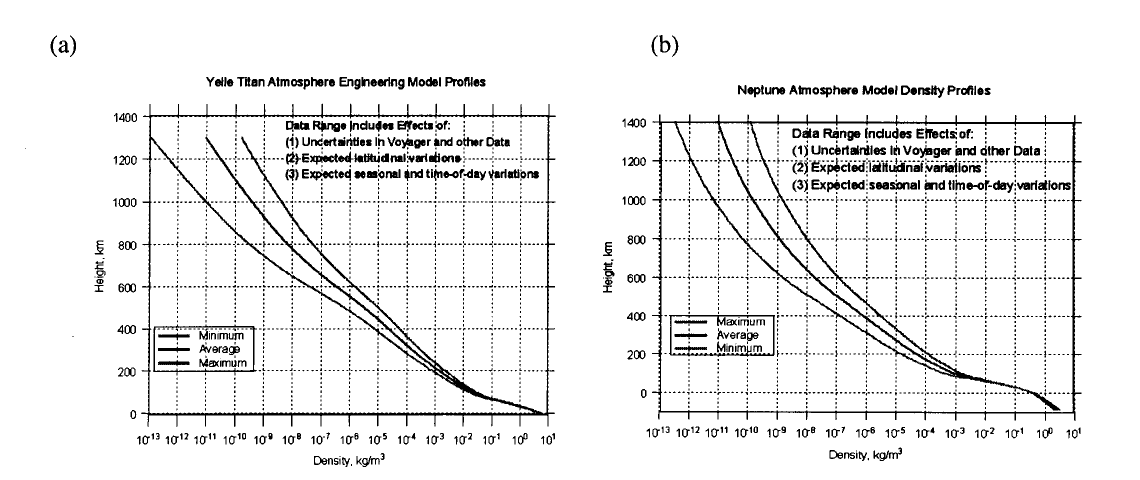
Source: [2]. Public domain (NASA).
| Model | Data source | Known gaps | Source |
|---|---|---|---|
| Uranus-GRAM | NASA Ames Uranus Atmospheric Model, built on Voyager 2 radio science, IRIS and UVS data from the 24 January 1986 flyby | The winds on Uranus are unknown, so the model carries no wind data | [18] |
| Jupiter-GRAM | Galileo probe Atmospheric Structure Instrument data, after Seiff et al. | No wind model, no perturbation model and no constituent gas model | [3] |
| Titan-GRAM | Yelle et al. 1997 | Envelope only | [2], [15] |
| Neptune-GRAM | Cruikshank 1995 | Envelope only | [2], [16] |
The suite has been rearchitected into a common software core, with ephemeris calculations moved to the NAIF SPICE toolkit, built against CSPICE version N0066 [3]. The rearchitecture is a code change rather than a new atmosphere: Neptune-GRAM was first released in September 2004, and the 2020 C++ version carries the same atmosphere data as the 2004 Fortran version, with the changes confined to input parameter names, SPICE ephemeris and output file formats [16]. The Titan-GRAM user guide is the reference for its inputs and outputs [15].
Radiation
Section titled “Radiation”The design environment away from a planetary magnetosphere is the interplanetary galactic cosmic ray field, taken from the Badhwar-O’Neill model with solar modulation derived from time-delayed sunspot number [17]. Inside the Jovian magnetosphere the trapped electron environment dominates instead.
The pre-flyby design specification, NASA SP-8069 of 1971, adopted a peak trapped electron flux of 2e7 cm-2 s-1 at L = 2 with an uncertainty factor of three, and a characteristic relativistic electron energy of 6.2 MeV, also with a factor of three [19]. Every value in it was inferred from Earth-based radio observations, and the document itself is superseded by in-situ measurement; it records what a design specification asserted before any spacecraft had reached Jupiter, not a current value.
Charging is the second effect. NASA-HDBK-4002B gives representative equilibrium surface potentials without sunlight of -130 V in the Jupiter plasma sheet and -2500 V in the outer magnetosphere, computed with a simple design tool and not measured [21]. Its internal charging criterion, an electron flux below 0.1 pA/cm2 sustained over any 10 hour period, derives from CRRES-era experience, and the handbook notes that thin-walled modern spacecraft have been recommended a limit ten times lower [21].
Ocean worlds
Section titled “Ocean worlds”Europa and Enceladus have no landed measurement of any kind. Reaching a subsurface ocean requires penetrating kilometers of ice inside the Jovian trapped radiation environment, under planetary protection requirements that no viable terrestrial organism be carried. No such mission has been approved and no engineering environment specification comparable to Titan-GRAM exists for either body.
The Europa Lander concept study is the most detailed statement of what that absence costs. Only 36 percent of Europa is mapped at 1 km per pixel, a few areas are better than 50 m per pixel, and stereo elevation models reach only several hundred meters per pixel, against about 6 m per pixel needed for terrain relative localization and better than 1 m per pixel for landing [20]. The terrain specification is therefore treated as a contract, not an observation. The concept proposes a solid rocket deorbit burn nulling about 1950 m/s to about 100 m/s [20], lidar hazard detection and divert within a 3 s allocation [20], and a SkyCrane delivery at about 0.5 m/s touchdown [20]. Predicted total dose is about 1.7 Mrad behind 100 mil aluminum and 150 krad or less inside a radiation vault, most of it arriving late in the mission [20]. This is a concept marked pre-decisional: nothing in it has been built, tested or flown, and every figure is a requirement, allocation or model output.
The community roadmap ranks Enceladus, Titan and Europa as the highest priority confirmed ocean worlds and Triton as the highest priority candidate, and calls for Earth-based research and analysis before missions are planned [22]. NASA’s technology programs for these bodies, 2013 to 2021, fund seismometers, imagers, spectrometers, organic analyzers, drills, melt probes, through-ice communications, radiation-hard electronics and surface autonomy; the paper that surveys them lists awards and describes proposed work, not results [23]. Its one performance figure is over 7 Mrad total ionizing dose for 4H-SiC JFET integrated circuits, with no destructive single-event susceptibility. Two autonomy testbeds, OceanWATERS (software) and OWLAT (a lander deck with a seven degree of freedom manipulator, a six degree of freedom Stewart platform and a force-torque sensor), exist on the ground and neither has flown.
Titan is the only outer solar system surface for which in-situ mechanical, thermal and wind data have been returned, and that data set is a single descent and a single landing [4], [5], [13].
References
- Lorenz, R. D., Turtle, E. P., Barnes, J. W., Trainer, M. G., Adams, D. S., Hibbard, K. E., Sheldon, C. Z., Zacny, K., Peplowski, P. N., Lawrence, D. J., Ravine, M. A., McGee, T. G., Sotzen, K. S., MacKenzie, S. M., Langelaan, J. W., Schmitz, S., Wolfarth, L. S. and Bedini, P. D. (2018). Dragonfly: A Rotorcraft Lander Concept for Scientific Exploration at Titan
. Johns Hopkins APL Technical Digest, 3. Source
BibTeX
@article{lorenz2018dragonfly, title = {Dragonfly: A Rotorcraft Lander Concept for Scientific Exploration at Titan}, author = {Lorenz, Ralph D. and Turtle, Elizabeth P. and Barnes, Jason W. and Trainer, Melissa G. and Adams, Douglas S. and Hibbard, Kenneth E. and Sheldon, Colin Z. and Zacny, Kris and Peplowski, Patrick N. and Lawrence, David J. and Ravine, Michael A. and McGee, Timothy G. and Sotzen, Kristin S. and MacKenzie, Shannon M. and Langelaan, Jack W. and Schmitz, Sven and Wolfarth, Larry S. and Bedini, Peter D.}, journal = {Johns Hopkins APL Technical Digest}, volume = {34}, number = {3}, pages = {374--387}, year = {2018}, url = {https://dragonfly.jhuapl.edu/News-and-Resources/docs/34_03-Lorenz.pdf} } - Justus, C. G., Duvall, A. and Keller, V. W. (2003). Engineering-Level Model Atmospheres for Titan and Neptune
. AIAA/ASME/SAE/ASEE Joint Propulsion Conference & Exhibit, 20030066242. Source
BibTeX
@inproceedings{justus2003engineering, title = {Engineering-Level Model Atmospheres for Titan and Neptune}, author = {Justus, C. G. and Duvall, Aleta and Keller, Vernon W.}, booktitle = {AIAA/ASME/SAE/ASEE Joint Propulsion Conference & Exhibit}, number = {20030066242}, institution = {NASA Marshall Space Flight Center}, year = {2003}, doi = {10.2514/6.2003-4803}, abstract = {Engineering-level atmospheric models for Titan and Neptune have been developed for use in NASA s systems analysis studies of aerocapture applications in missions to the outer planets. Analogous to highly successful Global Reference Atmospheric Models for Earth (GRAM, Justus et al., 2000) and Mars (Mars-GRAM, Justus and Johnson, 2001, Justus et al., 2002) the new models are called Titan-GRAM and Neptune-GRAM. Like GRAM and Mars-GRAM, an important feature of Titan-GRAM and Neptune-GRAM is their ability to simulate quasi-random perturbations for Monte- Carlo analyses in developing guidance, navigation and control algorithms, and for thermal systems design.} } - Justh, H. L., Dwyer Cianciolo, A. M. and Hoffman, J. (2021). Jupiter Global Reference Atmospheric Model (Jupiter-GRAM): User Guide
. NASA Marshall Space Flight Center, NASA/TM-20210022058. Source
BibTeX
@techreport{justh2021jupiter, title = {Jupiter Global Reference Atmospheric Model (Jupiter-GRAM): User Guide}, author = {Justh, Hilary L. and Dwyer Cianciolo, Alicia M. and Hoffman, James}, number = {NASA/TM-20210022058}, institution = {NASA Marshall Space Flight Center}, year = {2021}, url = {https://ntrs.nasa.gov/citations/20210022058}, abstract = {This Technical Memorandum (TM) presents the Jupiter Global Reference Atmospheric Model (Jupiter-GRAM) and the updated features of the GRAMs. Jupiter-GRAM is an engineering-oriented atmospheric model that estimates mean values of atmospheric properties for Jupiter. This TM summarizes the atmospheric data model in Jupiter-GRAM and provides a guide for the user to obtain, set up, and run the code in various configurations. Additional details regarding the Jupiter-GRAM input and output files and how to interpret Jupiter-GRAM results are also provided.} } - Schröder, S. E., Karkoschka, E. and Lorenz, R. D. (2012). Bouncing on Titan: Motion of the Huygens Probe in the Seconds After Landing
. Planetary and Space Science, 1. Source
BibTeX
@article{schroder2012bouncing, title = {Bouncing on Titan: Motion of the Huygens Probe in the Seconds After Landing}, author = {Schröder, Stefan E. and Karkoschka, Erich and Lorenz, Ralph D.}, journal = {Planetary and Space Science}, volume = {73}, number = {1}, pages = {327--340}, year = {2012}, doi = {10.1016/j.pss.2012.08.007} } - Lorenz, R. D. (2017). Wind Shear and Turbulence on Titan: Huygens Analysis
. Icarus. Source
BibTeX
@article{lorenz2017wind, title = {Wind Shear and Turbulence on Titan: Huygens Analysis}, author = {Lorenz, Ralph D.}, journal = {Icarus}, volume = {295}, pages = {119--124}, year = {2017}, doi = {10.1016/j.icarus.2017.06.010} } - Schröder, S. E. and Keller, H. U. (2008). The Reflectance Spectrum of Titan's Surface at the Huygens Landing Site Determined by the Descent Imager/Spectral Radiometer
. Planetary and Space Science. Source
BibTeX
@article{schroder2008reflectance, title = {The Reflectance Spectrum of Titan's Surface at the Huygens Landing Site Determined by the Descent Imager/Spectral Radiometer}, author = {Schröder, Stefan E. and Keller, Horst Uwe}, journal = {Planetary and Space Science}, volume = {56}, pages = {1246--1256}, year = {2008}, doi = {10.1016/j.pss.2007.10.011} } - Robb, C., Pensado, A. R., Winski, R. G., Williams, J. W. and Manwell, M. (2026). Huygens Probe Entry, Descent, and Landing Dynamics Assessment Using a Multi-Body Parachute Model
. AIAA SCITECH Forum. Source
BibTeX
@inproceedings{robb2026huygens, title = {Huygens Probe Entry, Descent, and Landing Dynamics Assessment Using a Multi-Body Parachute Model}, author = {Robb, Caleb and Pensado, Alejandro R. and Winski, Richard G. and Williams, James W. and Manwell, Michael}, booktitle = {AIAA SCITECH Forum}, year = {2026}, doi = {10.2514/6.2026-1956}, abstract = {The Dragonfly project is a New Frontiers Program mission that is slated to launch in 2028 and deliver a rotorcraft to Titan, Saturn’s largest moon. With the launch date approaching, there is an increased focus on the validation and verification of models that are used by the trajectory simulations. One of the models that contributes the most to the uncertainty of the entry, descent, and landing simulation is the atmosphere. Since Huygens is the only mission that has collected in-situ measurements during a descent, a current plan for the validation of the atmosphere model centers around reconciling that flight data with the current atmosphere model used by the Dragonfly flight mechanics team. To complete this, a 6 degree-of-freedom, multi-body simulation has been created using the Program to Optimize Simulated Trajectories 2 (POST2), the prime simulation tool for Dragonfly Entry and Descent, to predict the dynamics of Huygens using the reconciled models. The dynamics predicted by the simulation are then compared to flight data where possible and the previous analysis that was published by the authors last year. Current results show agreement to the available flight data, with an emphasis placed on the metrics that were flagged in the last analysis. The reconciliation is set to continue as areas of concern will be reported and inspected by the model developer.} } - Pensado, A. R., Robb, C., Winski, R., Williams, J., Belair, M. W. and Lorenz, R. D. (2025). Assessing Huygens Probe Entry, Descent, and Landing at Titan Simulation using Dragonfly Atmosphere Model
. AIAA SCITECH Forum. Source
BibTeX
@inproceedings{pensado2025assessing, title = {Assessing Huygens Probe Entry, Descent, and Landing at Titan Simulation using Dragonfly Atmosphere Model}, author = {Pensado, Alejandro R. and Robb, Caleb and Winski, Richard and Williams, James and Belair, Michael W. and Lorenz, Ralph D.}, booktitle = {AIAA SCITECH Forum}, year = {2025}, doi = {10.2514/6.2025-2238}, abstract = {Dragonfly is a New Frontiers Program mission that will deliver a rotorcraft to Saturn’s moon, Titan. This mission follows Huygens as the previous mission that successfully landed a vehicle on Titan. A flight mechanics simulation of Dragonfly’s Entry, Descent, and Landing sequence has been developed using the Program to Optimize Simulated Trajectories II. The simulation incorporates several subsystem models, including aerodynamics, gravity, and mass properties, to fully capture the multi-body six degree of freedom dynamics. Among all the subsystem models that inform the Entry, Descent, and Landing dynamics, the atmosphere model of Titan is a critical component. The atmosphere model characterizes the density, temperature, pressure, and winds that the entry vehicle experiences during the descent. This impacts several aspects of the descent such as the peak heating, aerodynamics, parachute release conditions, the dynamics of the vehicle and parachutes, and the landing ellipse. In the course of developing Dragonfly, an updated model of the Titan atmosphere has been created corresponding to Dragonfly’s arrival in the mid-2030s, approximately one Titan year after the Huygens mission successfully landed a probe on Titan. This work leverages previous work done to investigate Huygens EDL sequence to assess the atmosphere model developed for Dragonfly. This is done by utilizing the updated Titan atmosphere model, the Dragonfly atmosphere model, within the Huygens POST2-based flight simulation with the goal of characterizing the differences between the atmospheric models and assessing how the Dragonfly atmosphere model impacts Huygens entry dynamics.} } - Milos, F. S. (1997). Galileo Probe Heat Shield Ablation Experiment
. Journal of Spacecraft and Rockets, 6. Source
BibTeX
@article{milos1997galileo, title = {Galileo Probe Heat Shield Ablation Experiment}, author = {Milos, Frank S.}, journal = {Journal of Spacecraft and Rockets}, volume = {34}, number = {6}, pages = {705--713}, year = {1997}, doi = {10.2514/2.3293}, abstract = {Covers advancements in spacecraft and tactical and strategic missile systems, including subsystem design and application, mission design and analysis, materials and structures, developments in space sciences, space processing and manufacturing, space operations, and applications of space technologies to other fields.} } - Mousis, O., Atkinson, D. H., Ambrosi, R., Atreya, S., Banfield, D., Barabash, S., Blanc, M., Cavalié, T., Coustenis, A., Deleuil, M., Durry, G., Ferri, F., Fletcher, L., Fouchet, T., Guillot, T., Hartogh, P., Hofstadter, M., Hueso, R., Lebreton, J.-P., Mandt, K. E., Rannou, P., Rauer, H., Renard, J.-B., Sánchez-Lavega, A., Sayanagi, K., Simon, A., Spilker, T., Venkatapathy, E., Waite, J. H. and Wurz, P. (2019). In Situ Exploration of the Giant Planets
. arXiv preprint. Source
BibTeX
@article{mousis2019situ, title = {In Situ Exploration of the Giant Planets}, author = {Mousis, Olivier and Atkinson, David H. and Ambrosi, Richard and Atreya, Sushil and Banfield, Don and Barabash, Stas and Blanc, Michel and Cavalié, Thibault and Coustenis, Athena and Deleuil, Magali and Durry, Georges and Ferri, Francesca and Fletcher, Leigh and Fouchet, Thierry and Guillot, Tristan and Hartogh, Paul and Hofstadter, Mark and Hueso, Ricardo and Lebreton, Jean-Pierre and Mandt, Kathleen E. and Rannou, Pascal and Rauer, Heike and Renard, Jean-Baptiste and Sánchez-Lavega, Agustin and Sayanagi, Kunio and Simon, Amy and Spilker, Thomas and Venkatapathy, Ethiraj and Waite, J. Hunter and Wurz, Peter}, journal = {arXiv preprint}, volume = {1908.00917}, year = {2019}, doi = {10.48550/arxiv.1908.00917} } - Li, C., Ingersoll, A., Bolton, S., Levin, S., Janssen, M., Atreya, S., Lunine, J., Steffes, P., Brown, S., Guillot, T., Allison, M., Arballo, J., Bellotti, A., Adumitroaie, V., Gulkis, S., Hodges, A., Li, L., Misra, S., Orton, G., Oyafuso, F., Santos-Costa, D., Waite, H. and Zhang, Z. (2020). The water abundance in Jupiter's equatorial zone
. Nature Astronomy. Source
BibTeX
@article{li2020water, title = {The water abundance in Jupiter's equatorial zone}, author = {Li, Cheng and Ingersoll, Andrew and Bolton, Scott and Levin, Steven and Janssen, Michael and Atreya, Sushil and Lunine, Jonathan and Steffes, Paul and Brown, Shannon and Guillot, Tristan and Allison, Michael and Arballo, John and Bellotti, Amadeo and Adumitroaie, Virgil and Gulkis, Samuel and Hodges, Amoree and Li, Liming and Misra, Sidharth and Orton, Glenn and Oyafuso, Fabiano and Santos-Costa, Daniel and Waite, Hunter and Zhang, Zhimeng}, journal = {Nature Astronomy}, volume = {4}, pages = {609--616}, year = {2020}, doi = {10.1038/s41550-020-1009-3} } - Marshall, M. A., Tang, E., Cornelius, J. K., Ruiz, F. and Schmitz, S. (2024). Performance of the Dragonfly Lander's Coaxial Rotor in Vortex Ring State
. AIAA SCITECH Forum. Source
BibTeX
@inproceedings{marshall2024performance, title = {Performance of the Dragonfly Lander's Coaxial Rotor in Vortex Ring State}, author = {Marshall, Michael A. and Tang, Ellande and Cornelius, Jason K. and Ruiz, Felipe and Schmitz, Sven}, booktitle = {AIAA SCITECH Forum}, year = {2024}, doi = {10.2514/6.2024-0247}, abstract = {Dragonfly is a NASA New Frontiers mission with the goal of flying an autonomous relocatable rotorcraft lander to explore the surface of Saturn’s moon Titan in the mid-2030s. The Dragonfly lander is an RPM-controlled multirotor with four coaxial rotor pairs, each with two counter-rotating two-bladed fixed-pitch rotors. To support the lander’s development, the Dragonfly Team conducted a wind tunnel test campaign in September 2022 in the Transonic Dynamics Tunnel (TDT) at NASA’s Langley Research Center. Due to Dragonfly's concept of operations, especially its transition to powered flight after atmospheric entry, Dragonfly must transition through and operate near a potentially hazardous flight regime called Vortex Ring State (VRS). For this reason, achieving safe flight on Titan requires an investigation of Dragonfly's VRS regime. To that end, this paper uses TDT measurements in a Titan-surrogate environment (R-134a) and computational fluid dynamics to study the performance of a flight-like coaxial rotor system in VRS. The analysis suggests that Dragonfly's coaxial rotor system is potentially more robust to the onset of VRS than an isolated single rotor with the same design, i.e., VRS initiates at a higher descent rate, and that some of the characteristics of the subsequent VRS are different. Consequently, these results have important implications for the design and operation of Dragonfly, along with other eVTOL aircraft destined for both terrestrial and extraterrestrial applications.} } - Barnes, J. W., Turtle, E. P., Trainer, M. G., Lorenz, R. D., MacKenzie, S. M., Brinckerhoff, W. B., Cable, M. L., Ernst, C. M., Freissinet, C., Hand, K. P., Hayes, A. G., Hörst, S. M., Johnson, J. R., Karkoschka, E., Lawrence, D. J., Le Gall, A., Lora, J. M., McKay, C. P., Miller, R. S., Murchie, S. L., Neish, C. D., Newman, C. E., Núñez, J., Panning, M. P., Parsons, A. M., Peplowski, P. N., Quick, L. C., Radebaugh, J., Rafkin, S. C. R., Shiraishi, H., Soderblom, J. M., Sotzen, K. S., Stickle, A. M., Stofan, E. R., Szopa, C., Tokano, T., Wagner, T., Wilson, C., Yingst, R. A., Zacny, K. and Stähler, S. C. (2021). Science Goals and Objectives for the Dragonfly Titan Rotorcraft Relocatable Lander
. The Planetary Science Journal, 4. Source
BibTeX
@article{barnes2021science, title = {Science Goals and Objectives for the Dragonfly Titan Rotorcraft Relocatable Lander}, author = {Barnes, Jason W. and Turtle, Elizabeth P. and Trainer, Melissa G. and Lorenz, Ralph D. and MacKenzie, Shannon M. and Brinckerhoff, William B. and Cable, Morgan L. and Ernst, Carolyn M. and Freissinet, Caroline and Hand, Kevin P. and Hayes, Alexander G. and Hörst, Sarah M. and Johnson, Jeffrey R. and Karkoschka, Erich and Lawrence, David J. and Le Gall, Alice and Lora, Juan M. and McKay, Christopher P. and Miller, Richard S. and Murchie, Scott L. and Neish, Catherine D. and Newman, Claire E. and Núñez, Jorge and Panning, Mark P. and Parsons, Ann M. and Peplowski, Patrick N. and Quick, Lynnae C. and Radebaugh, Jani and Rafkin, Scot C. R. and Shiraishi, Hiroaki and Soderblom, Jason M. and Sotzen, Kristin S. and Stickle, Angela M. and Stofan, Ellen R. and Szopa, Cyril and Tokano, Tetsuya and Wagner, Thomas and Wilson, Colin and Yingst, R. Aileen and Zacny, Kris and Stähler, Simon C.}, journal = {The Planetary Science Journal}, volume = {2}, number = {4}, pages = {130}, year = {2021}, doi = {10.3847/psj/abfdcf}, abstract = {Abstract NASA’s Dragonfly mission will send a rotorcraft lander to the surface of Titan in the mid-2030s. Dragonfly's science themes include investigation of Titan’s prebiotic chemistry, habitability, and potential chemical biosignatures from both water-based “life as we know it” (as might occur in the interior mantle ocean, potential cryovolcanic flows, and/or impact melt deposits) and potential “life, but not as we know it” that might use liquid hydrocarbons as a solvent (within Titan’s lakes, seas, and/or aquifers). Consideration of both of these solvents simultaneously led to our initial landing site in Titan’s equatorial dunes and interdunes to sample organic sediments and water ice, respectively. Ultimately, Dragonfly's traverse target is the 80 km diameter Selk Crater, at 7° N, where we seek previously liquid water that has mixed with surface organics. Our science goals include determining how far prebiotic chemistry has progressed on Titan and what molecules and elements might be available for such chemistry. We will also determine the role of Titan’s tropical deserts in the global methane cycle. We will investigate the processes and processing rates that modify Titan’s surface geology and constrain how and where organics and liquid water can mix on and within Titan. Importantly, we will search for chemical biosignatures indicative of past or extant biological processes. As such, Dragonfly, along with Perseverance, is the first NASA mission to explicitly incorporate the search for signs of life into its mission goals since the Viking landers in 1976.} } - Sarkissian, J. M. (2012). Dishing up the Data: A Decade of Space Missions
. arXiv preprint. Source
BibTeX
@article{sarkissian2012dishing, title = {Dishing up the Data: A Decade of Space Missions}, author = {Sarkissian, John M.}, journal = {arXiv preprint}, year = {2012}, url = {https://arxiv.org/abs/1210.0980} } - Justh, H. L. and Hoffman, J. (2020). Titan Global Reference Atmospheric Model (Titan-GRAM): User Guide
. NASA Marshall Space Flight Center. Source
BibTeX
@techreport{nasa2020titan, title = {Titan Global Reference Atmospheric Model (Titan-GRAM): User Guide}, author = {Justh, Hilary L. and Hoffman, J.}, institution = {NASA Marshall Space Flight Center}, year = {2020}, url = {https://ntrs.nasa.gov/citations/20205006805}, abstract = {This Technical Memorandum summarizes the atmospheric data model in Titan-GRAM and provides a guide for the user to obtain, set up, and run the code in various configurations. Section 2 describes the input atmospheric data files and how they are used in Titan-GRAM. Section 3 explains the process to obtain the Titan-GRAM code and data files and how to set up and run the program. Appendices A through E provide additional details regarding the Titan-GRAM input and output files. Appendix F provides a history of Titan-GRAM revisions.} } - Justh, H. L. and Hoffman, J. (2020). Neptune Global Reference Atmospheric Model (Neptune-GRAM): User Guide
. NASA Marshall Space Flight Center, NASA/TM-20205001193. Source
BibTeX
@techreport{justh2020neptune, title = {Neptune Global Reference Atmospheric Model (Neptune-GRAM): User Guide}, author = {Justh, Hilary L. and Hoffman, J.}, number = {NASA/TM-20205001193}, institution = {NASA Marshall Space Flight Center}, year = {2020}, url = {https://ntrs.nasa.gov/citations/20205001193}, abstract = {This Technical Memorandum (TM) presents the Neptune Global Reference Atmospheric Model (Neptune-GRAM) and its updated features. Neptune-GRAM is an engineering-oriented atmospheric model that estimates mean values and statistical variations of atmospheric properties for Neptune. This TM summarizes the atmospheric data model in Neptune-GRAM and provides a guide for the user to obtain, set up, and run the code in various configurations. Additional details regarding the Neptune-GRAM input and output files and how to interpret Neptune-GRAM results are also provided.} } - O'Neill, P. M., Golge, S. and Slaba, T. C. (2015). Badhwar-O'Neill 2014 Galactic Cosmic Ray Flux Model Description
. NASA. Source
BibTeX
@techreport{nasa2014implementing, title = {Badhwar-O'Neill 2014 Galactic Cosmic Ray Flux Model Description}, author = {O'Neill, P. M. and Golge, S. and Slaba, T. C.}, institution = {NASA}, year = {2015}, url = {https://ntrs.nasa.gov/citations/20150003026}, abstract = {For the analysis of radiation risks to astronauts and planning exploratory space missions, accurate energy spectrum of galactic cosmic radiation (GCR) is necessary. Characterization of the ionizing radiation environment is challenging because the interplanetary plasma and radiation fields are modulated by solar disturbances and the radiation doses received by astronauts in interplanetary space are likewise influenced. A model of the Badhwar‐O'Neill 2011 (BO11) GCR environment, which is represented by GCR deceleration potential theta, has been derived by utilizing all of the GCR measurements from balloons, satellites, and the newer NASA Advanced Composition Explorer (ACE). In the BO11 model, the solar modulation level is derived from the mean international sunspot numbers with time‐delay, which has been calibrated with actual flight instrument measurements to produce better GCR flux data fit during solar minima. GCR fluxes provided by the BO11 model were compared with various spacecraft measurements at 1 AU, and further comparisons were made for the tissue equivalent proportional counters measurements at low Earth orbits using the high‐charge and energy transport (HZETRN) code and various GCR models. For the comparison of the absorbed dose and dose equivalent calculations with the measurements by Radiation Assessment Detector (RAD) at Gale crater on Mars, the intensities and energies of GCR entering the heliosphere were calculated by using the BO11 model, which accounts for time‐dependent attenuation of the local interstellar spectrum of each element. The BO11 model, which has emphasized for the last 24 solar minima, showed in relatively good agreement with the RAD data for the first 200 sols, but it was resulted in to be less well during near the solar maximum of solar cycle 24 due to subtleties in the changing heliospheric conditions. By performing the error analysis of the BO11 model and the optimization in reducing overall uncertainty, the resultant BO13 model corrects the fit at solar maxima as well as being accurate at solar minima. The BO13 model is implemented to the NASA Space Cancer Risk model for the assessment of radiation risks. Overall cumulative probability distribution of solar modulation parameters represents the percentile rank of the average interplanetary GCR environment, and the probabilistic radiation risks can be assessed for various levels of GCR environment to support mission design and operational planning for future manned space exploration missions.} } - Justh, H. L., Dwyer Cianciolo, A. M. and Hoffman, J. (2021). Uranus Global Reference Atmospheric Model (Uranus-GRAM): User Guide
. NASA Marshall Space Flight Center, NASA/TM-20210017250. Source
BibTeX
@techreport{justh2021uranus, title = {Uranus Global Reference Atmospheric Model (Uranus-GRAM): User Guide}, author = {Justh, Hilary L. and Dwyer Cianciolo, Alicia M. and Hoffman, James}, number = {NASA/TM-20210017250}, institution = {NASA Marshall Space Flight Center}, year = {2021}, url = {https://ntrs.nasa.gov/citations/20210017250}, abstract = {This Technical Memorandum (TM) presents the Uranus Global Reference Atmospheric Model (Uranus-GRAM) and the updated features of the GRAMs. Uranus-GRAM is an engineering-oriented atmospheric model that estimates mean values and statistical variations of atmospheric properties for Uranus. This TM summarizes the atmospheric data model in Uranus-GRAM and provides a guide for the user to obtain, set up, and run the code in various configurations. Additional details regarding the Uranus-GRAM input and output files and how to interpret Uranus-GRAM results are also provided.} } - Divine, N. (1971). The Planet Jupiter (1970)
. National Aeronautics and Space Administration, NASA SP-8069. Source
BibTeX
@techreport{divine1971planet, title = {The Planet Jupiter (1970)}, author = {Divine, Neil}, number = {NASA SP-8069}, institution = {National Aeronautics and Space Administration}, type = {NASA Space Vehicle Design Criteria (Environment) monograph}, year = {1971}, url = {https://ntrs.nasa.gov/citations/19720010259}, abstract = {Data obtained through 1970, some materials published during the first half of 1971, and conclusions of the Jupiter Radiation Belt Workshop held in July 1971 are presented. All the information on Jupiter was derived from data obtained at angular and spectral resolutions possible with Earth-based instrumentation or with sensors on aircraft, rockets, and balloons. The observations were made primarily in the visible, near visible, infrared, and radio portions of the electromagnetic spectrum. The information was assessed for the potential effects of the Jovian environment on spacecraft performance. The assessment was done independently for the three types of missions under consideration and formulated for overall spacecraft as well as for subsystem design.} } - Skulsky, E. D., San Martin, A. M., Kipp, D. M., Zimmer, A. K., Singh, G., Serricchio, F., Trawny, N., Katakes, A., Greco, M. and Frick, A. (2017). Landing on Europa: Challenges, Technologies, and a Strategy
. IEEE Aerospace Conference. Source
BibTeX
@inproceedings{skulsky2017landing, title = {Landing on Europa: Challenges, Technologies, and a Strategy}, author = {Skulsky, E. David and San Martin, A. Miguel and Kipp, Devin M. and Zimmer, Aline K. and Singh, Gurkirpal and Serricchio, Fred and Trawny, Nikolas and Katakes, Anup and Greco, Martin and Frick, Andreas}, booktitle = {IEEE Aerospace Conference}, publisher = {JPL Open Repository}, year = {2017}, url = {https://dataverse.jpl.nasa.gov/dataset.xhtml?persistentId=hdl:2014/47541} } - NASA. (2022). NASA-HDBK-4002B: Mitigating In-Space Charging Effects, A Guideline
. NASA Office of the Chief Engineer. Source
BibTeX
@techreport{nasa2022charging, title = {NASA-HDBK-4002B: Mitigating In-Space Charging Effects, A Guideline}, author = {{NASA}}, institution = {NASA Office of the Chief Engineer}, year = {2022}, url = {https://standards.nasa.gov/standard/nasa/nasa-hdbk-4002} } - Hendrix, A. R., Hurford, T. A., Barge, L. M., Bland, M. T., Bowman, J. S., Brinckerhoff, W., Buratti, B. J., Cable, M. L., Castillo-Rogez, J., Collins, G. C., Diniega, S., German, C. R., Hayes, A. G., Hoehler, T., Hosseini, S., Howett, C. J., McEwen, A. S., Neish, C. D., Neveu, M., Nordheim, T. A., Patterson, G. W., Patthoff, D. A., Phillips, C., Rhoden, A., Schmidt, B. E., Singer, K. N., Soderblom, J. M. and Vance, S. D. (2019). The NASA Roadmap to Ocean Worlds
. Astrobiology. Source
BibTeX
@article{hendrix2019nasa, title = {The NASA Roadmap to Ocean Worlds}, author = {Hendrix, Amanda R. and Hurford, Terry A. and Barge, Laura M. and Bland, Michael T. and Bowman, Jeff S. and Brinckerhoff, William and Buratti, Bonnie J. and Cable, Morgan L. and Castillo-Rogez, Julie and Collins, Geoffrey C. and Diniega, Serina and German, Christopher R. and Hayes, Alexander G. and Hoehler, Tori and Hosseini, Sona and Howett, Carly J.A. and McEwen, Alfred S. and Neish, Catherine D. and Neveu, Marc and Nordheim, Tom A. and Patterson, G. Wesley and Patthoff, D. Alex and Phillips, Cynthia and Rhoden, Alyssa and Schmidt, Britney E. and Singer, Kelsi N. and Soderblom, Jason M. and Vance, Steven D.}, journal = {Astrobiology}, volume = {19}, pages = {1-27}, year = {2019}, doi = {10.1089/ast.2018.1955}, abstract = {In this article, we summarize the work of the NASA Outer Planets Assessment Group (OPAG) Roadmaps to Ocean Worlds (ROW) group. The aim of this group is to assemble the scientific framework that will guide the exploration of ocean worlds, and to identify and prioritize science objectives for ocean worlds over the next several decades. The overarching goal of an Ocean Worlds exploration program as defined by ROW is to “identify ocean worlds, characterize their oceans, evaluate their habitability, search for life, and ultimately understand any life we find.” The ROW team supports the creation of an exploration program that studies the full spectrum of ocean worlds, that is, not just the exploration of known ocean worlds such as Europa but candidate ocean worlds such as Triton as well. The ROW team finds that the confirmed ocean worlds Enceladus, Titan, and Europa are the highest priority bodies to target in the near term to address ROW goals. Triton is the highest priority candidate ocean world to target in the near term. A major finding of this study is that, to map out a coherent Ocean Worlds Program, significant input is required from studies here on Earth; rigorous Research and Analysis studies are called for to enable some future ocean worlds missions to be thoughtfully planned and undertaken. A second finding is that progress needs to be made in the area of collaborations between Earth ocean scientists and extraterrestrial ocean scientists.} } - Mercer, C. R., Stephan, R. A., Voytek, M. A., Niebur, C., Paganini, L., Schulte, M. D., Nguyen, Q.-V., Dalal, K. M. and Nayar, H. D. (2022). NASA Science Technology Development Programs for Ocean Worlds Exploration
. ASCE Earth and Space Conference. Source
BibTeX
@inproceedings{mercer2022nasa, title = {NASA Science Technology Development Programs for Ocean Worlds Exploration}, author = {Mercer, Carolyn R. and Stephan, Ryan A. and Voytek, Mary A. and Niebur, Curt and Paganini, Lucas and Schulte, Mitchell D. and Nguyen, Quang-Viet and Dalal, K. Michael and Nayar, Hari D}, booktitle = {ASCE Earth and Space Conference}, pages = {308-320}, publisher = {American Society of Civil Engineers}, year = {2022}, doi = {10.1061/9780784484470.029}, abstract = {The exploration of ocean worlds such as Europa and Enceladus supports NASA’s goal to search for life and potentially habitable regions elsewhere in the universe, and further promises to help us understand the origins, evolution, and limits of life on Earth. Over the past several years, NASA’s Planetary Science Division has funded several technology development programs to enable future surface and subsurface missions to ocean worlds. These programs include Instrument Concepts for Europa Exploration (ICEE), Concepts for Ocean worlds Life Detection Technology (COLDTech), Scientific Exploration Subsurface Access Mechanism for Europa (SESAME), Applied Information Systems Research: Autonomous Robotics Research for Ocean Worlds (AISR:ARROW), and Astrodynamics in Support of Icy Worlds Missions. Tasks selected under these programs include the development of scientific instruments including seismometers, imagers, spectrometers, and organic analyzers, and platform technologies including drills, melt probes, through-ice communications, radiation-hard electronics, and autonomy for surface operations. This paper describes the objectives of each of these programs and provides a summary of the work that has been completed or is underway in each.} } - Hörst, S. M. (2017). Titan's atmosphere and climate
. Journal of Geophysical Research: Planets. Source
BibTeX
@article{horst2017titan,
  title = {Titan's atmosphere and climate},
  author = {Hörst, S. M.},
  journal = {Journal of Geophysical Research: Planets},
  volume = {122},
  pages = {432--482},
  year = {2017},
  doi = {10.1002/2016je005240},
  abstract = {Abstract Titan is the only moon with a substantial atmosphere, the only other thick N2 atmosphere besides Earth's, the site of extraordinarily complex atmospheric chemistry that far surpasses any other solar system atmosphere, and the only other solar system body with stable liquid currently on its surface. The connection between Titan's surface and atmosphere is also unique in our solar system; atmospheric chemistry produces materials that are deposited on the surface and subsequently altered by surface‐atmosphere interactions such as aeolian and fluvial processes resulting in the formation of extensive dune fields and expansive lakes and seas. Titan's atmosphere is favorable for organic haze formation, which combined with the presence of some oxygen‐bearing molecules indicates that Titan's atmosphere may produce molecules of prebiotic interest. The combination of organics and liquid, in the form of water in a subsurface ocean and methane/ethane in the surface lakes and seas, means that Titan may be the ideal place in the solar system to test ideas about habitability, prebiotic chemistry, and the ubiquity and diversity of life in the universe. The Cassini‐Huygens mission to the Saturn system has provided a wealth of new information allowing for study of Titan as a complex system. Here I review our current understanding of Titan's atmosphere and climate forged from the powerful combination of Earth‐based observations, remote sensing and in situ spacecraft measurements, laboratory experiments, and models. I conclude with some of our remaining unanswered questions as the incredible era of exploration with Cassini‐Huygens comes to an end.}
}