ELSA-d
Program pages Astroscale: ELSA-d Mission
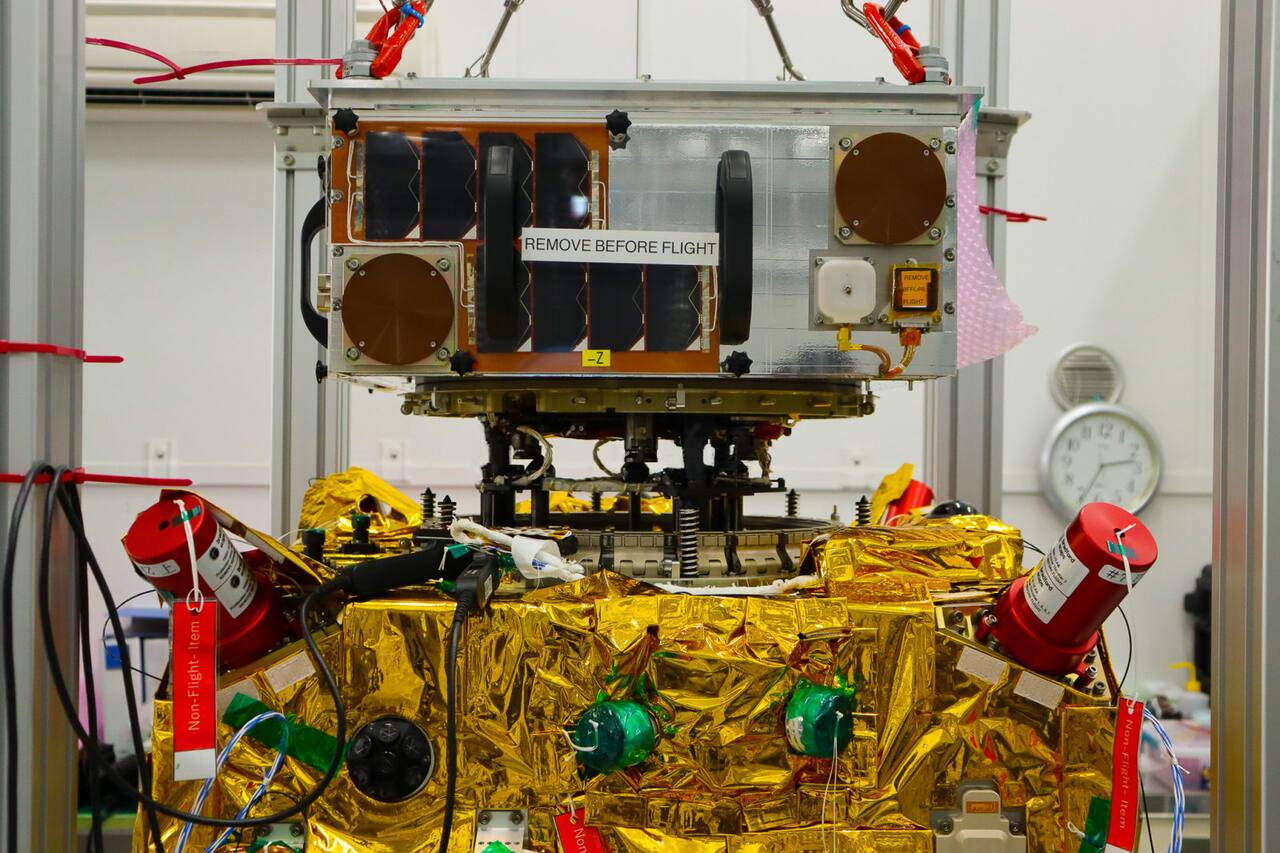 Astroscale.
The problem
Section titled “The problem”Capturing a defunct satellite requires a servicer to find it, close on it and hold it while neither object can be tuned for the job. In low Earth orbit the client is far away at first, may tumble, and offers no data link. Active debris removal studies split the chaser into far and short range rendezvous, a mechanical interface, de-tumbling and de-orbit, each with its own maturity [15]. A review of debris removal mechanics divides removal into contactless methods (lasers, ion beam shepherd, drag sails, tethers) and contact methods (nets, harpoons, tentacles, robotic arms, adhesives) [17].
What has flown
Section titled “What has flown”ELSA-d was a two-spacecraft demonstration: a servicer of about 175 kg with rendezvous sensors and a ferromagnetic capture mechanism, and a client of about 17 kg with a ferromagnetic docking plate carrying a fiducial pattern, launched mated on 22 March 2021 into a 550 km, 97.5 degree orbit [1]. No communication passes between servicer and client, so approach relies on the servicer sensors alone. Magnetic capture is reversible, unlike the net and harpoon of RemoveDEBRIS [1]. Astroscale calls it the first commercial demonstration of core debris docking and removal technologies [13].
Three demonstrations were defined before launch [1]. The first, capture of a stable client, covers release, sensor checkout, approach through holding points using the fiducial pattern, capture, a mated maneuver and re-release. The second commands a natural tumble and captures it. The third adds fly-around inspection, a client search, an induced client-lost scenario and recapture. Human operators were required in the loop for final approach, capture, departure and any first-time maneuver [1].
On 25 August 2021 the mechanical lock was released, the magnetic system alone held the client, and the client was separated for the first time and recaptured; the period also served to calibrate the rendezvous sensors [2]. In the autonomous demonstration begun 25 January 2022 the servicer held 30 m from the client for more than seven hours on autonomous relative station-keeping driven by the low power radio sensor, after which anomalous spacecraft conditions led the team not to attempt capture [3]. Trade press reports that four of the eight 1 N thrusters were lost [11]. With four thrusters the servicer returned from about 1,700 km to about 159 m on 7 April 2022, executing the handover from ground-based to onboard relative navigation, which the chief technology officer said had not been planned for that point of the mission [11].
At mission end Astroscale listed autonomous guidance, navigation and control, closed-loop control on onboard sensors, navigation from 1,600 km to within 160 m and over two years of operations [4]. A controlled de-orbit on the remaining thrusters in January 2024 left the servicer at about 500 km with predicted re-entry in about 3.5 years, and the client predicted to decay within five years [4].
Earlier flights set the context. The ARGON experiment took the PRISMA servicer Mango to the passive, noncooperative Tango in April 2012, from 30 km to a 3 km hold point in about four days, with image processing and maneuver planning on the ground [14]. In geostationary orbit the Mission Extension Vehicle has flown commercially against clients without retroreflectors, using a visible camera detecting its client beyond 30 km, a long wave infrared camera effective beyond 10 km and a scanning lidar giving a 6-DOF solution from 60 m to 2 m [10].
What is being tried now
Section titled “What is being tried now”Unprepared-client rendezvous in flight. ADRAS-J targets a 2009 H-IIA upper stage with no GPS receiver, which a pre-launch briefing named as the key difference from ELSA-d [12]. Astroscale reports fly-around observations at about 50 m on 15 and 16 July 2024 of a stage about 11 m long and about 3 tons [7], and an approach to roughly 15 m on 11 December 2024 that ended in an autonomous abort on a relative attitude anomaly before capture initiation [6]. The mission page lists launch on 18 February 2024 and deorbit on 25 March 2026 [8]. Imagery from the July fly-around has been used for monocular surface reconstruction of the stage, giving qualitative meshes with no ground truth model [9].
Capture designed but not flown. ADRIOS ClearSpace-1, re-baselined on the PROBA-1 satellite (94 kg, no appendages), is a ladder of reversible steps from a switch point 30 km behind the client through angles-only far range navigation, with one rehearsal and three capture attempts budgeted; launch is expected at the end of 2028 [5]. Its close-proximity chain, with go decision points for keep-out-zone entry and capture, was validated in simulation against attitude, position and pose-initialization criteria, with no flight data [21].
Servicing with arms. Restore-L, a NASA refueling mission for Landsat 7 in a 705 km polar orbit with a 7-DOF servicing arm, was planned for 2020 launch; the source is a May 2016 status statement by project staff with no measured performance [18]. A 2024 survey of space manipulators for on-orbit servicing covers mission history, arm specifications, ground test facilities, sensing and control, all compiled from other sources [16].
Relative pose from vision and lidar. A survey divides pose determination into cooperative targets (markers, retroreflectors) and uncooperative known or unknown targets, reporting each author’s accuracy under differing laboratory, simulation and flight conditions with no common benchmark [19]. ELSA-d’s fiducial plate belongs to the cooperative branch [1]; the Mission Extension Vehicle and ADRAS-J belong to the uncooperative one [10], [6]. Recent work is ground-tested only. A recursive fiducial marker for rendezvous and docking was benchmarked on printed mockups against a dark backdrop [23]. Fusing event and RGB cameras for satellite pose estimation was tested on scaled 3D printed mockups at 0.3 to 1.2 m under a single lamp [24]. Neural radiance field reconstruction of an uncooperative target handles illumination variation and was evaluated on imagery of one TANGO/PRISMA mockup in a hardware-in-the-loop testbed [25].
Ground facilities for rendezvous. DLR’s EPOS 2.0 uses two six-axis robots, one on a 25 m rail, to reproduce relative 6-DOF motion from 25 m to contact, with a verified accuracy of 1.56 mm and 0.2 degrees at 3 sigma [20]. DLR’s chain of far-range angles-only processing and mid and close-range pose estimation was verified there and in the ARGON flight [20], [14].
Magnetic and electromagnetic docking. Learned coil force models for fuel-free electromagnetic docking were shown in simulation and on an air-track and air-bearing testbed, with no flight or microgravity data [22].
The numbers
Section titled “The numbers”| Parameter | Servicer | Client | Source |
|---|---|---|---|
| Mass | about 175 kg | about 17 kg | [1], [11] |
| Propulsion | eight 1 N thrusters | none stated | [11] |
| Rendezvous sensors | two visible cameras, blue illuminator, laser range finders, low power ranging radio | fiducial-patterned docking plate | [1] |
| Capture interface | ferromagnetic capture mechanism | ferromagnetic docking plate | [1], [13] |
| Ground segment | 16 ground stations giving 20 to 30 minute contacts | commanded from the ground only | [1] |
| Event | Date | Status | Source |
|---|---|---|---|
| Launch, mated | 2021-03-22 | flown | [13] |
| Mechanical lock released, client separated and recaptured magnetically | 2021-08-25 | flown | [2] |
| Autonomous capture demonstration: release, 30 m hold for more than 7 hours | 2022-01-25 | flown, capture not attempted | [3] |
| Thruster anomaly; four of eight thrusters lost | 2022-01 | anomaly | [11] |
| Closest approach after the anomaly, about 159 m, absolute to relative navigation handover | 2022-04-07 | flown | [11] |
| Controlled de-orbit on remaining thrusters | 2024-01 | flown | [4] |
| Tumbling-client capture and the diagnosis and search demonstration | not flown | not flown | [4], [3] |
Dimensions, power, thermal design, onboard processor, link budget and magnetic holding force are not given in the sources held.
What is not established
Section titled “What is not established”No capture of a tumbling client was flown, so ELSA-d does not show that magnetic capture works against tumble [4], [3]. Autonomous capture was not attempted in the January 2022 run, and the only capture on record is the August 2021 recapture, for which no separation distance, approach rate or holding force is published [2]. The cause of the thruster loss is not given in the operator releases or the press account [4], [11]. The 30 m hold, the 159 m approach and the disposal figures come from operator statements without telemetry or error bounds [11], [3]. The launch, mission and capture figures come from Astroscale announcements, which are operator statements [13]. ADRAS-J has not captured a client, and ClearSpace-1 has not flown [6], [5]. Restore-L status is as of 2016 [18]. The review sources [15], [16], [17], [19] report other authors’ figures under unlike conditions, and the vision pose results [23], [24], [25] are laboratory results only.
References
- Fujii, G., Iizuka, S., Belle, C. and Muktoyuk, M. (2021). The World's First Commercial Debris Removal Demonstration Mission
. Annual Small Satellite Conference, SSC21-II-09. Source
BibTeX
@inproceedings{fujii2021world, title = {The World's First Commercial Debris Removal Demonstration Mission}, author = {Fujii, Gene and Iizuka, Seita and Belle, Carolyn and Muktoyuk, Mark}, booktitle = {Annual Small Satellite Conference}, number = {SSC21-II-09}, year = {2021}, url = {https://digitalcommons.usu.edu/smallsat/2021/all2021/145/} } - Astroscale. (2021). Astroscale's ELSA-d Successfully Demonstrates Repeated Magnetic Capture. astroscale.com/en/news/astroscales-elsa-d-successfully-demonstrates-r...
BibTeX
@misc{astroscale2021astroscale, title = {Astroscale's ELSA-d Successfully Demonstrates Repeated Magnetic Capture}, author = {{Astroscale}}, year = {2021}, url = {https://www.astroscale.com/en/news/astroscales-elsa-d-successfully-demonstrates-repeated-magnetic-capture} } - Astroscale. (2022). Astroscale's ELSA-d Mission Successfully Completes Complex Rendezvous Operation. astroscale.com/en/news/astroscales-elsa-d-mission-successfully-comple...
BibTeX
@misc{astroscale2022astroscale, title = {Astroscale's ELSA-d Mission Successfully Completes Complex Rendezvous Operation}, author = {{Astroscale}}, year = {2022}, url = {https://www.astroscale.com/en/news/astroscales-elsa-d-mission-successfully-completes-complex-rendezvous-operation} } - Astroscale. (2024). Astroscale's ELSA-d Finalizes De-Orbit Operations Marking Successful Mission Conclusion. astroscale.com/en/news/astroscales-elsa-d-finalizes-de-orbit-operatio...
BibTeX
@misc{astroscale2024astroscalec, title = {Astroscale's ELSA-d Finalizes De-Orbit Operations Marking Successful Mission Conclusion}, author = {{Astroscale}}, year = {2024}, url = {https://www.astroscale.com/en/news/astroscales-elsa-d-finalizes-de-orbit-operations-marking-successful-mission-conclusion} } - Woicke, S., Jipp, J., Steimle, C., Pokrupa, N. and Metrailler, L. (2025). ADRIOS ClearSpace-1: In orbit demonstration of the removal of a non-cooperative spacecraft
. European Conference on Space Debris. Source
BibTeX
@inproceedings{woicke2025adrios, title = {ADRIOS ClearSpace-1: In orbit demonstration of the removal of a non-cooperative spacecraft}, author = {Woicke, Svenja and Jipp, Jimmy and Steimle, Christian and Pokrupa, Nils and Metrailler, Lionel}, booktitle = {European Conference on Space Debris}, organization = {ESA Space Debris Office}, year = {2025}, url = {https://conference.sdo.esoc.esa.int/proceedings/sdc9/paper/104} } - Astroscale. (2024). Astroscale's ADRAS-J Achieves Historic 15-Meter Approach to Space Debris. astroscale.com/en/news/astroscales-adras-j-achieves-historic-15-meter...
BibTeX
@misc{astroscale2024astroscale, title = {Astroscale's ADRAS-J Achieves Historic 15-Meter Approach to Space Debris}, author = {{Astroscale}}, year = {2024}, url = {https://www.astroscale.com/en/news/astroscales-adras-j-achieves-historic-15-meter-approach-to-space-debris} } - Astroscale. (2024). Astroscale's ADRAS-J Continues to Make History: Successfully Demonstrates Fly-Around Observations of Space Debris. astroscale.com/en/news/astroscales-adras-j-continues-to-make-history-...
BibTeX
@misc{astroscale2024astroscaleb, title = {Astroscale's ADRAS-J Continues to Make History: Successfully Demonstrates Fly-Around Observations of Space Debris}, author = {{Astroscale}}, year = {2024}, url = {https://www.astroscale.com/en/news/astroscales-adras-j-continues-to-make-history-successfully-demonstrates-fly-around-observations-of-space-debris} } - (2026). Astroscale: ADRAS-J Mission. astroscale.com/en/missions/adras-j
BibTeX
@misc{astroscaleadras, title = {Astroscale: ADRAS-J Mission}, organization = {astroscale.com}, year = {2026}, url = {https://www.astroscale.com/en/missions/adras-j} } - Gopu, B. P. R., Quinn, P., Nehma, G. M., Tiwari, M., Ueckermann, M., Hinckley, D. and McKenna, C. (2026). From Images2Mesh: A 3D Surface Reconstruction Pipeline for Non-Cooperative Space Objects
. arXiv preprint arXiv:2605.00147. Source
BibTeX
@article{gopu2026images, title = {From Images2Mesh: A 3D Surface Reconstruction Pipeline for Non-Cooperative Space Objects}, author = {Gopu, Bala Prenith Reddy and Quinn, Patrick and Nehma, George M. and Tiwari, Madhur and Ueckermann, Matt and Hinckley, David and McKenna, Christopher}, journal = {arXiv preprint arXiv:2605.00147}, year = {2026}, doi = {10.48550/arxiv.2605.00147}, abstract = {On-orbit inspection imagery is crucial as it enables characterization of non-cooperative resident space objects, providing the geometry and structural condition essential for active debris removal and on-orbit servicing mission planning. However, most existing neural implicit surface reconstruction methods have been confined to synthetic or hardware-in-the-loop data with known camera poses and controlled illumination. In this work, we present a pipeline for neural implicit surface reconstruction of non-cooperative space objects from monocular inspection imagery. We demonstrate it on publicly released ISS inspection footage from the STS-119 mission and publicly released on-orbit inspection footage of an H-IIA rocket upper stage. We find that segmentation-based background removal is essential for successful camera pose estimation from real on-orbit footage, where background variation between frames caused direct processing to fail entirely. We further incorporate photometric correction of per-frame exposure variations and analyze its behavior across datasets, finding that performance in shadowed regions varies with the illumination characteristics of the input footage.} } - Pyrak, M. and Anderson, J. (2021). Performance of Northrop Grumman's Mission Extension Vehicle (MEV) RPO Imagers at GEO
. Autonomous Systems: Sensors, Processing and Security for Ground, Air, Sea and Space Vehicles and Infrastructure. Source
BibTeX
@inproceedings{pyrak2021performance, title = {Performance of Northrop Grumman's Mission Extension Vehicle (MEV) RPO Imagers at GEO}, author = {Pyrak, Michael and Anderson, Joe}, booktitle = {Autonomous Systems: Sensors, Processing and Security for Ground, Air, Sea and Space Vehicles and Infrastructure}, pages = {28}, year = {2021}, doi = {10.1117/12.2631524}, abstract = {This paper will describe and illustrate the real-life performance of the Rendezvous and Proximity Operations (RPO) sensors used by Space Logistics LLC’s Mission Extension Vehicles (MEV) built by Northrop Grumman. MEV-1 launched in 2019 and performed rendezvous, proximity operations, and docking (RPOD) with the Intelsat 901 satellite in the GEO graveyard orbit approximately 300km above GEO in February of 2020. MEV-2 launched in 2020 and performed a similar RPOD sequence with the Intelsat 10-02 satellite directly in geostationary orbit in February and March of 2021. These vehicles use three dissimilar sensing phenomenologies to provide all required relative navigational data to enable the above RPOD capabilities. These include visible spectrum imagers (narrow and wide field of view), long wave infrared (LWIR) imagers (narrow and wide field of view), and active scanning LIDAR. This paper will explore the performance of each of these sensors during these real-life missions at GEO and potential implications for future Space Situational Awareness capabilities.} } - Rainbow, J. (2022). Astroscale Debris-Removal Demo Makes Close Approach Despite Thruster Issues. spacenews.com/astroscale-debris-removal-demo-makes-close-approach-des...
BibTeX
@misc{spacenews2022astroscale, title = {{Astroscale} Debris-Removal Demo Makes Close Approach Despite Thruster Issues}, author = {Rainbow, Jason}, organization = {SpaceNews}, year = {2022}, url = {https://spacenews.com/astroscale-debris-removal-demo-makes-close-approach-despite-thruster-issues/} } - Via Satellite. (2023). Astroscale Hopes ADRAS-J Mission Will Lay the Groundwork for Commercial Debris Removal. satellitetoday.com/sustainability/2023/09/28/astroscale-hopes-adras-j...
BibTeX
@misc{via2023astroscale, title = {Astroscale Hopes ADRAS-J Mission Will Lay the Groundwork for Commercial Debris Removal}, author = {{Via Satellite}}, year = {2023}, url = {https://www.satellitetoday.com/sustainability/2023/09/28/astroscale-hopes-adras-j-mission-will-lay-the-groundwork-for-commercial-debris-removal/} } - (2026). Astroscale: ELSA-d Mission. astroscale.com/en/missions/elsa-d
BibTeX
@misc{astroscaleelsa,
  title = {Astroscale: ELSA-d Mission},
  organization = {astroscale.com},
  year = {2026},
  url = {https://www.astroscale.com/en/missions/elsa-d}
}