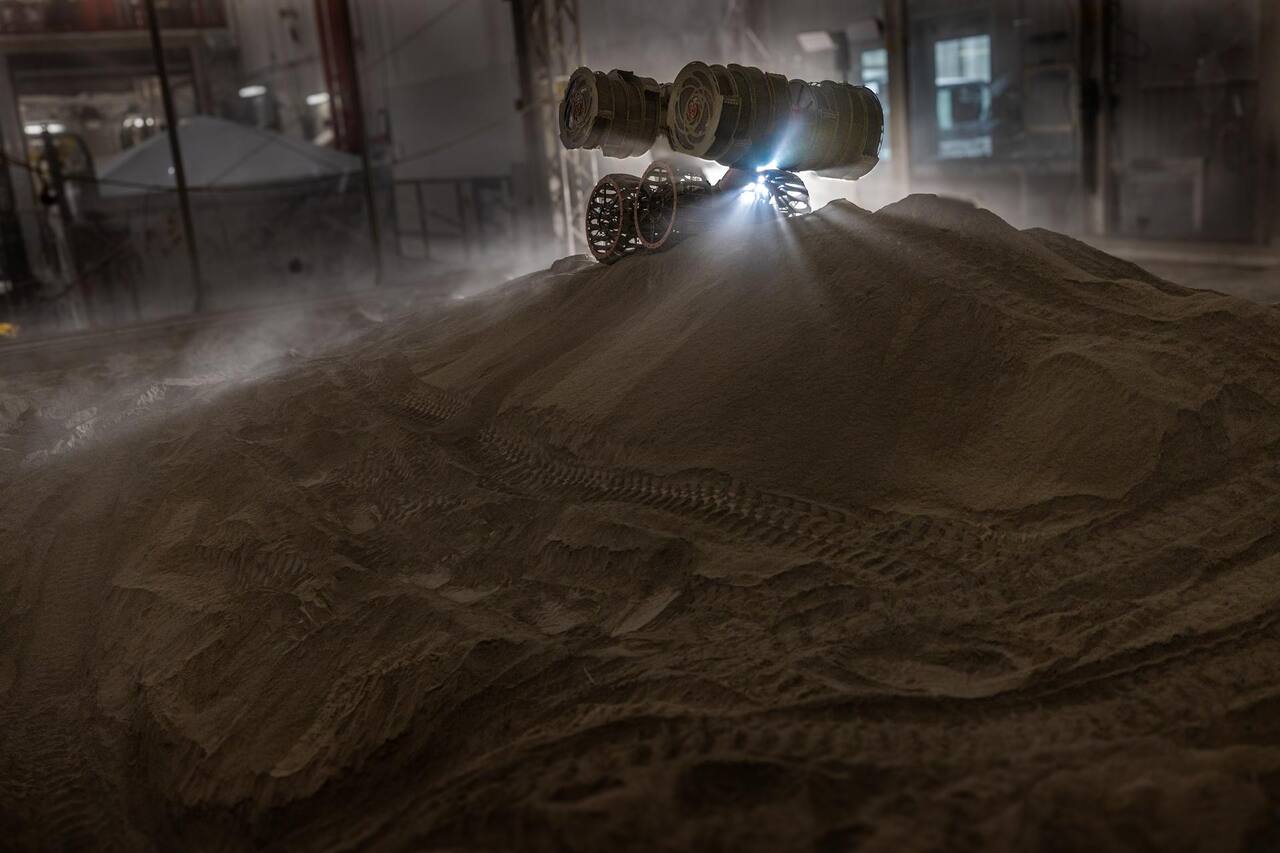
 NASA/Frank Michaux. Public domain (NASA / US government work).
Overview
Section titled “Overview”A lunar excavator has to dig soil that is dense below the surface, in one sixth gravity, from a chassis light enough to launch [8]. Relative density is about 65 percent in the top 15 cm and above 90 percent below 30 cm [5], while the weight available to react a cut is a sixth of its terrestrial value. Every approach below trades some mix of mass, consumables and traction against that constraint. None has operated on the Moon; the evidence for all of them is laboratory, simulant and analog-field testing [8][6].
RASSOR is a regolith excavator developed at NASA KSC as a technology demonstrator for low-mass excavation in reduced gravity. Kennedy conceived the counter-rotating bucket drum method in 2011 and demonstrated a prototype at that year’s NASA Lunabotics Mining Competition [8]. The approach carries forward into the ISRU Pilot Excavator, a 30 kg-class machine intended to excavate and transport 10,000 kg of lunar regolith on the surface [1]. The method is protected as US patent 9,027,265, “Zero horizontal reaction force excavator”, granted 12 May 2015 [2].
Specifications
Section titled “Specifications”| Parameter | RASSOR 2.0 |
|---|---|
| System mass | 66 kg, half of RASSOR 1.0 |
| Regolith payload | 80 kg, double RASSOR 1.0 |
| Excavation throughput | 2.7 t/day minimum, single unit |
| Mass per unit rate | 0.38 kg per kg/h |
| Power per unit rate | 4 W per kg/h |
| Bus voltage | 48 VDC |
| Average driving velocity | 27 cm/s |
| Maximum driving velocity | 56.5 cm/s |
| Actuator count | 10 |
RASSOR 3.0 is intended to reach TRL 5, and thermal control in vacuum and a battery able to survive extreme temperature excursions are the identified remaining problems [2].
The NASA technology transfer page for the machine adds four properties the conference papers do not state: drum rotation is about 20 revolutions per minute during excavation, the chassis is symmetrical so that the machine continues to operate after overturning, the arms fold to reduce launch volume, and control is wireless with onboard transmitting cameras [13]. That page lists space construction alongside in-situ resource utilization, regolith and water ice mining, and terrestrial mining in hazardous locations as intended applications, which is the basis for classifying the machine as construction rather than as a drill.
A KSC Granular Mechanics and Regolith Operations Laboratory presentation describes RASSOR as a dual bucket drum excavator prototype that is to develop into the smaller ISRU Pilot Excavator for Artemis, with excavated regolith usable as building material and dug ice as a water resource [12]. The NASA technology transfer listing for the patented method is the public record of the machine’s licensing status [13].
No flight has been assigned [13].
Excavation mechanics in low gravity
Section titled “Excavation mechanics in low gravity”Terrestrial excavators oppose digging reaction with weight transmitted to the ground through wheels or tracks, so machine mass scales with excavation force. A mobility platform must therefore either be massive enough to overcome the reduced-gravity weight effect or reduce the digging forces themselves, and since space missions are mass constrained the second is the cheaper route [8]. Launch cost is of order 8800 EUR per kilogram depending on the vehicle [7]. A shovel or drill on a light chassis in one sixth gravity pushes the machine away from the surface rather than cutting.
The material is not weak. In-situ lunar soil relative density is about 65 percent in the top 15 cm and exceeds 90 percent below 30 cm, against 65 to 75 percent as the practical limit of terrestrial field compaction with heavy equipment [5]. Regolith bulk density ranges from 1500 kg/m3 in highland samples to 1640 kg/m3 in mare samples [4]. Shear strength rises with relative density, so digging forces remain substantial where weight does not.
Force reduction has been attempted several ways. Pneumatic mining achieved 8000 g of regolith excavated per gram of transport gas, at the cost of a consumable [8]. Percussive excavation fluidizes dry regolith ahead of the tool edge by separating interlocking grains: a 30 inch bucket driven at impact energies of 13.6 to 30.5 J and 0 to 700 blows per minute reduced the average maximum excavation load by up to about 50 percent, against about 70 percent reported for a much smaller Honeybee Robotics scoop at 2.5 J and 1000 blows per minute [6], and work by Kennedy with Honeybee Robotics and Berkeley reported reductions as large as 90 percent in simulant. Shallow-angle scraping plates, bucket chains, bucket ladders and bucket wheels take many small cuts and require a separate hauling stage.
Lockheed Martin stacked several bucket wheels into a bucket drum in 2008 and 2009, which also served as the container for excavated material; field testing at Mauna Kea showed the drum effective but still reliant on traction for excavation and mobility [8]. Counter-rotation removes that dependency by canceling the horizontal reaction rather than reducing it.
Families of excavation method
Section titled “Families of excavation method”Five families recur in the reviews [8]. Scraping and shallow-angle plates take thin cuts and need a separate haul stage. Continuous bucket chains, ladders and wheels also take many small cuts and carry material away at a steady rate, at the cost of more moving parts exposed to abrasive dust. Pneumatic mining uses gas as the transport medium and consumes it. Percussive tools reduce the load on the cut and still depend on the chassis for reaction [6]. Bucket drums combine digging and carrying in one container and, in the counter-rotating arrangement used here, cancel the horizontal reaction instead of reducing it [8]. A review of thirteen excavation systems, four discrete and nine continuous, found that none reported a consistent parameter set, and proposed excavation capability, cut depth, system mass, power, traverse speed and simulant as the common six [14]. Most of the systems it tabulates sit below TRL 4, and the RASSOR figures it quotes come from 1 g tests with 5/6 gravity offload, not lunar gravity [14]. An earlier NASA ISRU status report sized excavation against a 1 percent oxygen yield and a 1 MT per year oxygen target, with scoop and bin tests in simulant rather than vacuum or one sixth gravity [16]. Pilot-scale ISRU planning treats excavation rate as the quantity to be delivered to a processing plant, so the figure of merit is mass per unit rate and power per unit rate as well as cut force [9][13].
Approach
Section titled “Approach”RASSOR carries a bucket drum on each end of two opposed articulated arms. Bucket drums are hollow cylinders with scoops staggered around the perimeter; regolith enters through the scoops, slides down an internal baffle system that prevents it falling back out, is transported inside the drum, and is discharged by reversing rotation so the material slides back out through the same openings [1]. The drums on opposite arms dig simultaneously in opposing directions, so the horizontal excavation reactions cancel and the net force transmitted to the chassis approaches zero. Excavation force is reacted internally through the structure rather than externally through traction. Bucket drums were developed by Lockheed Martin in 2008 and have been used on robotic excavator prototypes since [8]. Counter-rotation cancels the horizontal components while the vertical components remain small, so the system is not primarily reliant on weight or traction [7]. Mirroring the two drum sets across the chassis also cancels the axial forces, and placing the scoops at the outboard edges pushes overflow material clear of the vehicle instead of piling it in front.
RASSOR’s drum is the large size in the Kennedy scaling series.
| Drum | Diameter | Width | Scoop width | Scoop height | Mean fill per drum |
|---|---|---|---|---|---|
| Small | 237.5 mm | 206 mm | 51.6 mm | 26.4 mm | 3.80 kg |
| Medium | 295.1 mm | 254 mm | 63.5 mm | 34.5 mm | 7.30 kg |
| Large (RASSOR) | 437.1 mm | 358 mm | 90.4 mm | 47.8 mm | 24.98 kg |
Values from gantry testing in BP-1 simulant [1]. A four-drum machine using the large drum holds 99.94 kg.
Each drum is divided into four sections carrying two scoops each, giving eight buckets per drum [2]. Construction is aluminum sides, carbon fiber scoops and baffles, and stainless steel cutting teeth [1].
The drum design envelope was published in March 2020 as the NASA RASSOR Bucket Drum Design Challenge on GrabCAD, which drew approximately 350 entries against a requirement to maximize regolith extraction and retention while remaining free of obstructions during loading and unloading [7]. The stated limits were 175 mm maximum total scoop width engaged at any instant, 5 kg maximum drum mass, 450 mm maximum drum diameter, 360 mm maximum drum length, and 17.6 liters minimum captured volume. The fourth-placed entry, a single 3D-printable part combining an outer double helix, a 180 degree spiral tunnel behind each of two scoops, and an inner double helix, massed 4.93 kg at a fill ratio of about 75 percent [7].
Scoop geometry sets dig depth and flow rate into the drum, and scoop height sets the effective internal diameter and hence total capacity [1]. Digging at the full scoop depth lets regolith bridge across the opening and reduces the mass collected per rotation; several hundred hours of RASSOR 2.0 testing established that limiting cut depth to at most 50 percent of the scoop opening collects more regolith per rotation. Gantry tests [1] at cut depths of 10 mm and 40 percent of scoop height, linear cut speeds of 10 and 30 mm/s, and a drum tangential velocity fixed at 8.5 times the linear cut speed to hold cut pitch constant, showed horizontal excavation force per unit drum width rising with both cut speed and cut depth, and mechanical excavation energy per kilogram collected falling with increasing cut speed, increasing drum size, and decreasing cut depth. Lateral force was negligible throughout, and the vertical force once the drum was fully engaged equalled the weight of the captured regolith.
The arms raise, lower and rotate the chassis over the drums, so the vehicle can right itself if overturned, and can fold into a Z configuration with the chassis vertical, one set of drums and wheels on the ground and the other reaching out from the top of the chassis.
Mobility
Section titled “Mobility”Apollo and Lunokhod experience puts the acceptable ground contact pressure of a wheeled vehicle at 7 to 10 kPa [5]. The Lunar Roving Vehicle slipped 2 to 3 percent on the surface and climbed slopes of 19 to 23 degrees before slip near 20 percent limited drawbar pull, and Lunokhod 2 sank more than 20 cm in soft soil inside crater walls [5]. Soil on slopes and fresh crater rims is looser, at 56 to 61 percent relative density against 66 percent on intercrater ground [8]. Those are the conditions a 66 kg machine with four wheels has to meet, and only the Apollo and Lunokhod vehicles have met them.
RASSOR 1.5 used tracks, and metallic link tracks in Black Point 1 basalt simulant required many design iterations to become reliable [2]. Because the counter-rotating drums cancel horizontal excavation force, a large drawbar pull is not required, which reopened the running gear choice. Free driving, drawbar and tilt table testing in BP-1 at 1 g compared metallic link tracks against 13 inch wheels in four and six wheel configurations and 17 inch wheels in a four wheel configuration [2]. On the 25 degree tilt table the 17 inch four wheel configuration succeeded in three attempts of three, where tracks and both 13 inch configurations each succeeded once in three. The 17 inch wheels drove comparably to tracks with slightly lower drawbar pull and fewer failure modes, and were selected [2]. The derivative Pilot Excavator did not carry the RASSOR wheel forward: its wheel started instead from a modified VIPER wheel with removable grousers, cleat surfaces and spokes, and side rings chamfered to act as a ski during skid steer turns [9].
Average driving velocity is 27 cm/s and maximum velocity 56.5 cm/s [2]. Moving the bucket drums shifts the vehicle center of mass, which produces distinct driving modes used deliberately for operational versatility.
Extraction from soft ground uses the arms. If RASSOR becomes stuck, the drums are lowered until vehicle weight is shared between wheels and drums, reducing ground pressure enough to continue driving; loaded drums add weight where it is needed.
Power and energy
Section titled “Power and energy”RASSOR 2.0 runs on a battery at a 48 VDC bus [2]. Actuator power draw measurements from the component test campaign sized total battery capacity; the capacity itself is not published. Motors matched to the required torque and speed lost continuous torque near rated speed at 48 V [2]. A bus above 100 V would have held continuous torque flat across the speed range but required a custom battery or series batteries, which schedule and funding did not permit. The adopted solution kept the 48 V bus and selected a motor winding holding continuous torque constant across the speed range at the cost of a higher maximum rated speed, with PI loop tuning recovering low-speed performance [2].
The operating concept assumes a 24 hour cycle of 16 hours mining and 8 hours recharging; at 27 cm/s average velocity, an 80 kg payload and a mining site 100 m from the lander, that yields about 35 mining trips per day and 1,000,000 kg of regolith per Earth-year, the quantity required to produce 10,000 kg of oxygen per year at an assumed 1 percent yield [2].
Thermal
Section titled “Thermal”The surface swings between 374 K and 92 K over a lunar day, and the swing damps to within 3 K at about 30 cm depth [5]. The only polar figure in the lunar reference literature, about 40 K in permanently shadowed craters, is an estimate and not a measurement [8].
RASSOR 2.0 is a laboratory prototype with no vacuum thermal control [2]. Radiating heat to space during the lunar day and conserving internal heat at night are named as the principal enhancements required for RASSOR 3.0, together with sourcing a battery that survives extreme temperature events [2]. Lunar surface temperature at 45 degrees latitude ranges from a mean 350 K at local noon to a mean 89 K before sunrise [4].
Compute and avionics
Section titled “Compute and avionics”The onboard computer is an RTD CMX32MVD1860HR-2048 PC/104 form factor single board computer. Ten actuators are driven by Elmo Motion Control G-Sol WHI20/100 controllers, which read their feedback sensors directly and close proportional-integral loops for position and velocity, and the bucket drum and arm controllers run a dual loop of position over velocity [2]. Every actuator carries a US Digital EM1 optical quadrature incremental encoder at 10,000 counts per revolution plus three factory-fitted Hall effect sensors on the Parker Bayside motor for commutation, and the four bucket drum actuators and two shoulder actuators additionally carry Netzer DS-70 single turn absolute encoders at 19 bit resolution, read over SSI, with the actuator parameters below.
| Actuator | Max torque | Continuous torque | Speed | Mass |
|---|---|---|---|---|
| Shoulder | 644 N m | 236 N m | ~16 / ~10 rpm | 3.58 kg |
| Bucket drum | 191 N m | 93 N m | ~25 / ~18 rpm | 1.30 kg |
| Drive | 191 N m | 93 N m | ~25 / ~18 rpm | 1.17 kg |
All actuators use a 161:1 reduction [2], and the shoulder actuator is built around a Parker K089050 frameless motor with an SHG 32-160 harmonic drive component set and carries a safety brake so a loaded arm can be held without powering the motor.
System-level sensing is an Xsens MTI-30-2A5G4-O inertial measurement unit, forward and aft stereo camera pairs, and forward and aft hazard cameras, all cameras Axis Communications P1224-E network units [2]. On the gantry test stand used to characterize the drums, force and torque were logged at 1 kHz through an NI-9237 C series module while motor feedback was oversampled to align with it, the lower motor rate set by the CAN bus interface [1].
Autonomy
Section titled “Autonomy”Software is built on ROS and split between the vehicle and a driver station. The onboard side talks to motor controllers, sensors and cameras and publishes health and status.
Situational awareness comes from the stereo cameras fused with the IMU and actuator feedback, and the autonomy does not depend on high-accuracy sensing. Hazard cameras are used for inspection rather than navigation: quantifying wheel sinkage, tank-steer surcharge and wheel slip, and observing dig depth and regolith bridging as material enters the drum scoops [2].
The reference concept of operations is fully autonomous. RASSOR uses its arms to lower itself off the lander deck, avoiding a separate deployment mechanism, then drives to a mining site assumed to be 100 m away [2]. On the first traverse it drives slowly, surveying with stereo and hazard cameras and building a hazard map held onboard. Subsequent traverses use that stored map with low-fidelity stereo vision to recognize landmarks, including its own previous wheel tracks, and run faster. At the site the drums are lowered and excavation proceeds while driving slowly forward, with software controlling depth of cut and balancing excavation force between the two drum sets. Depth of cut is bounded by the bridging limit: cutting deeper than about 50 percent of the scoop opening lets regolith bridge the opening and reduces mass collected per rotation [1], while horizontal excavation force per unit drum width rises with both cut depth and cut speed. Slot trenching is possible because the drums extend beyond the wheelbase: the machine cuts a trench then drives into it to reach regolith deeper than 1.0 m, where higher water concentrations are expected. Torque sensing at the shoulder actuator determines when the drums are full, triggering return to the lander and discharge over a receiving hopper. Autonomous operation has been exercised in ROS and Gazebo simulation [2], and a digital twin of the derivative IPEx has been used for autonomy development [11]. Drum load is also estimable without torque sensing: a free-spinning drum current model fitted to motor current reached about 7.4 percent mean percentage error on hardware [3].
Communications
Section titled “Communications”The link between vehicle and driver station is wireless, using a Ubiquiti Networks PicoStation M2HP 2.4 GHz radio [2]. This is terrestrial test equipment; no flight communications architecture is defined at this technology readiness level. The driver station pulls camera streams over IP from the vehicle.
Modes of operation
Section titled “Modes of operation”| Side | Mode | Behavior |
|---|---|---|
| Vehicle | Autonomous | Executes the concept of operations from onboard sensing, publishing health and status to the ground |
| Vehicle | Tele-operation | Waits for and executes streamed commands |
| Driver station | Supervisor | Accepts health, status and camera streams while the vehicle runs autonomously |
| Driver station | Tele-operation | Full command authority over the vehicle |
Semi-autonomous behaviors can be invoked from within tele-operation. In Auto Dig the onboard computer drives straight at a commanded speed while balancing torque between the two bucket drums, so the operator sets speed and the vehicle maintains the force balance [2]. Force balance between the drum sets is what keeps the net horizontal reaction near zero [7].
Ground operations
Section titled “Ground operations”Ground control is a single driver station, a Microsoft Surface Pro 3 with an Intel Core i7 and 512 GB of storage [2]. RASSOR is a laboratory and analog-field prototype operated by its engineering team at NASA KSC. No planning cycle, shift structure or flight operations tooling is defined.
Technologies developed
Section titled “Technologies developed”The counter-rotating bucket drum architecture, patented as a zero horizontal reaction force excavator [2], is carried forward by the ISRU Pilot Excavator, whose 30 kg-class design was sized against the Kennedy drum scaling dataset; that dataset concluded the small and medium drums collect enough regolith at the required rate for the IPEx concept of operations [1]. IPEx is being built to a TRL 6 flight-ready state for a notional technology demonstration mission that would excavate up to 10,000 kg of regolith at 42 kg/h and cover 70 km in the lunar south pole region over 11 days [9].
The IPEx autonomy test site at KSC, a 39.6 by 21.3 m light-tight tent with stadium lights standing in for the low-elevation polar sun, hosted a five-day continuous TRL 5 demonstration in August 2024: 334 excavation and unload cycles, 58.1 km of driving and 35 automated docking and recharge sequences over 77 hours 46 minutes of wall clock [10]. Pocket penetrometer surveys afterward showed dig sites compacted by up to 11 times a 0.5 kg/cm2 baseline and dump sites loosened by a factor of 2.5, in a 1 g analog in air with no vacuum or thermal environment [10].
Onboard mass inferencing estimates how much regolith is in the drums during operation, which a closed-loop ISRU process needs in order to deliver a defined feedstock rate. Three approaches were formulated and two tested on hardware. An arm raise model infers mass from the electrical power integrated over an arm raise. A free-spinning drum current model infers it from motor current with the drum turning unloaded; on hardware it gave a mean percentage error of about 7.4 percent once two outliers were dropped, falling to about 2.6 percent for masses above 20 kg [3], and a neural network augmentation of the same model was integrated into an advanced robotic system. An excavation drum current model, inferring mass from current during digging, gave preliminary R squared of 0.76 [3]. Named next steps are building models from lunar or simulated low-gravity excavation data and exploring online and transfer learning, since a model fitted at 1 g in simulant cannot be assumed to transfer to one sixth gravity.
The successor IPEx actuators went through a four-test campaign in the KSC Small Space Environment Dynamometer covering the mobility, excavation and shoulder units. All three passed at least one mission’s worth of concept-of-operations revolutions under 2 to 3 sigma loads [15]. The campaign deleted the resolver after the first generation proved unnecessary and noisy, removed Teflon seals after significant wear while keeping felt seals that excluded regolith well, and redesigned the motor rotor bearings from deep groove to angular contact with wider separation after accelerated-life testing shifted them axially against their preload springs and drove the motor into current limit. The empirical current-torque-speed-temperature model it produced is intended for flight use to infer output torque, estimate collected regolith mass and set dig depth for the Autodig routine [15].
The actuator design is transferable in its own right: rotary units combining a frame-size-constrained motor, a 161:1 harmonic reduction, dual incremental and 19 bit absolute encoding, and in the shoulder case a holding brake, packaged so that ten fit inside a 66 kg vehicle [2].
What is being tried now
Section titled “What is being tried now”Bucket drum work continues on three fronts, all ground-tested and none flown. The IPEx program has tested wheel designs for its 70 km traverse on a RASSOR 2.0 chassis fitted with 30.5 cm reconfigurable wheels: 83 tests of ten cleat and grouser configurations showed that taller, squarer grousers slip less and draw more power, and shorter, rounder grousers do the reverse [19]. A vacuum-chamber flow experiment ran six instrumented drums with straight and diverging spiral baffles against glass beads and three simulants, to test whether reduced gravity degrades unloading through bridging, jamming or slow flow [18]. Outside NASA, the University of Tokyo MoonBot program built a 4.8 kg, 14.06 L 3D-printed bucket drum with eight buckets in opposed pairs, and measured 777.54 kg/h continuous excavation at 0.022 Wh/kg in Tohoku Silica Sand at 1 g, with no regolith simulant, vacuum or thermal testing [17]. Its authors compare it with RASSOR 2.0 and argue for a standard drum volume definition [17].
Learned control for the same hardware has been tried in simulation only. The Intelligent Capabilities Enhanced RASSOR project trained a deep Q-learning trenching controller for RASSOR 2.0 in a game-physics model and reported 3.80 plus or minus 1.47 cm3 of excavated volume per watt against 2.18 plus or minus 0.89 for a simulated reimplementation of the existing PID auto dig routine, at 155 percent more battery use; both baselines were run inside the same simplified soil model and not on the robot [20]. For mission operations, dynamic movement primitives with a bounded obstacle term kept a simulated RASSOR 2.0 derivative on its circular lander pattern with zero collisions over 110 rock distributions, at 44.11 m of path against a 43.45 m nominal circle [21].
Two ground results bear on the choice of excavation family. Gravity-offloaded tests at 1/6 g in GRC-1 sand showed a 300 kg bucket-wheel excavator collecting 0.5 kg/s while a discrete scraper of the same weight stalled, and cautioned against extrapolating 1 g results to reduced gravity [22]. A conventional 21.6 cm bucket in GRC-3B at 10 cm depth reached 157 N horizontal force at a 10 degree rake angle and 208 N at 30 degrees, the plain-bucket baseline against which drum forces are read [23].
Other routes to the same requirement are tabulated in the comparative review of thirteen systems [14]. The 2008 NASA ISRU project paper treats excavation as a feed stage for oxygen production and lists the concepts under study then [16]. Actuator qualification for the flight-intent design is covered above [15].
What is not established
Section titled “What is not established”No RASSOR variant has operated in vacuum, in one sixth gravity or on the Moon, and no flight is assigned [13]. Performance data come from BP-1 simulant at 1 g [1]. Lunar soil is more compressible than crushed-basalt simulant at equal void ratio, and agglutinates that crush under shear are absent from simulant, so simulant forces and fill ratios do not transfer directly [5]. Lunar geotechnical data come from six Apollo and three Luna sites within about 27 degrees of the equator and are dry; no measurement exists of polar regolith strength or of regolith with ice, which is the intended mining target [5][9]. The relative density values are conversions, not direct measurements [5]. Mass inferencing models were fitted at 1 g and the effect of reduced gravity on them is untested [3]. The 35 trips per day and 1,000,000 kg per year figures follow from an assumed 16 hour mining cycle, a 100 m haul and a 1 percent oxygen yield, not from a duration test [2]. Thermal control and a battery for the lunar night are unresolved [2][9].
References
- Schuler, J., Nick, A., Leucht, K., Langton, A. and Smith, D. (2022). ISRU Pilot Excavator: Bucket Drum Scaling Experimental Results
. ASCE Earth and Space Conference, 20210025846. Source
BibTeX
@inproceedings{schuler2022isru, title = {ISRU Pilot Excavator: Bucket Drum Scaling Experimental Results}, author = {Schuler, Jason and Nick, Andrew and Leucht, Kurt and Langton, Austin and Smith, Drew}, booktitle = {ASCE Earth and Space Conference}, number = {20210025846}, pages = {394-407}, institution = {NASA}, year = {2022}, doi = {10.1061/9780784484470.037}, abstract = {NASA’s Space Technology Mission Directorate (STMD) is funding the development of a robotic excavator called the “ISRU Pilot Excavator” (IPEx) which will be a technology demonstration of excavating and transporting 10 metric tons of lunar regolith on the surface of the Moon with a 30 kg-class robotic excavator. IPEx will be the next generation of robotic excavators to use bucket drums as excavation tools. This is an evolution of the regolith advanced surface systems operations robot (RASSOR) developed at NASA’s Kennedy Space Center (KSC). Bucket drums are hollow cylinders with regularly spaced scoops around the perimeter. The drums rotate in one direction to collect regolith with the scoops. The regolith slides down an internal baffling system inside the drum which prevents the regolith from falling back out of the scoops. The captured regolith can then be transported while held in the drum and then deposited by rotating the drum in the opposite direction allowing the regolith to slide back down the baffling and out of the excavation scoops. Bucket drums were developed by Lockheed Martin in 2008 and used on multiple robotic excavator prototypes ever since. However, the forces on a bucket drum and considerations for scaling have not been measured in detail. Bucket drums are challenging to model using classical blade\bucket equations because of their unique geometry. Therefore, this experiment was performed to measure the forces on three bucket drums of the same geometry at different scales. Small: 9.4” (239 mm) dia. × 8.1” (206 mm) width, medium: 11.6” (294 mm) dia. × 10” (254 mm) width, and large: 17” (432 mm) dia. × 14.1” (358 mm) width. The test stand consisted of an actuated gantry with controlled motion in the vertical (Z) and horizontal (X) axes and a single rotation axis (R). The bucket drums were individually mounted to the rotary axis of the test stand and translated across a prepared bed of Black Point 1 (BP-1) lunar regolith simulant at a specified linear speed and cutting depth. The test stand was outfitted with a torque sensor in line with the rotation of the drum (R) and a 3 axis (X, Y, and Z) load cell. In addition to the three sizes of bucket drums the linear excavation speed and cutting depth were test variables. The results of these experiments show the relationship between the three scales of bucket drums for factors such as: excavation force, torque due to regolith rotation inside the drum, excavation energy, time to fill, etc. and will be discussed in detail in this paper. This fundamental data will be used in the design of IPEx and can inform the design of future bucket drum excavators.} } - Mueller, R. P., Smith, J. D., Schuler, J. M., Nick, A. J., Gelino, N. J., Leucht, K. W., Townsend, I. I. and Dokos, A. G. (2016). Design of an Excavation Robot: Regolith Advanced Surface Systems Operations Robot (RASSOR) 2.0
. ASCE Earth and Space Conference, 20210011366. Source
BibTeX
@inproceedings{mueller2016design, title = {Design of an Excavation Robot: Regolith Advanced Surface Systems Operations Robot (RASSOR) 2.0}, author = {Mueller, Robert P. and Smith, Jonathan D. and Schuler, Jason M. and Nick, Andrew J. and Gelino, Nathan J. and Leucht, Kurt W. and Townsend, Ivan I. and Dokos, Adam G.}, booktitle = {ASCE Earth and Space Conference}, number = {20210011366}, pages = {163-174}, institution = {NASA}, year = {2016}, doi = {10.1061/9780784479971.018}, abstract = {To continue on a sustainable and flexible path, NASA needs to address the challenge of collecting and moving large amounts of regolith at the destination. Acquiring the water resources on Mars will require mining significant quantities of regolith, and this is not possible with the state-of-the-art low mass excavation systems. Low gravity environments (Mars = 3/8G) and launch mass restrictions limit the traction and the resulting reaction force of the vehicle, making current terrestrial techniques impractical. This project addressed this challenge by developing a completely new technology that can mine large quantities of regolith on Mars. Recent measurements by the “Curiosity” rover on Mars have found that the regolith contains ~2% water by weight globally, ~4% in Jezero Crater (Human Architecture Team’s reference landing site), and much more at the poles. RASSOR 2.0 is a planetary excavator, which has a mass of 66 kg, with a 0.38 kg vehicle mass per kilogram, per hour of excavation rate and power usage of 4 W per kg of regolith excavation rate. A single RASSOR 2.0 can excavate a minimum of 2.7 metric tons of regolith per day. This is accomplished by using counteracting excavation forces on two opposing digging implements called bucket drums and an autonomous mining control system. This work has addressed several major research areas outlined in the NASA Technology Area (TA) 04 Robotics and Autonomous Systems and TA 07 Human Destination Systems roadmaps. This project started at Technology Readiness Level (TRL) 4 as a low fidelity “proof of concept” prototype which has successfully demonstrated basic regolith simulant excavation functionality in a lab-scale gravity off load test. The foundational technology described here was awarded US patent number: US 9027265 for a “Zero horizontal reaction force excavator” on May 12, 2015.} } - Janmohamed, N. A., Cloud, J. M., Leucht, K. W., Bell, E. A., Buckles, B. C. and DuPuis, M. A. (2021). Mass Inferencing Model Creation and Deployment to the RASSOR Lunar Excavation Robot
. ASCEND. Source
BibTeX
@inproceedings{janmohamed2021mass, title = {Mass Inferencing Model Creation and Deployment to the RASSOR Lunar Excavation Robot}, author = {Janmohamed, Nashir A. and Cloud, Joseph M. and Leucht, Kurt W. and Bell, Evan A. and Buckles, Bradley C. and DuPuis, Michael A.}, booktitle = {ASCEND}, publisher = {American Institute of Aeronautics and Astronautics}, year = {2021}, doi = {10.2514/6.2021-4216}, abstract = {View Video Presentation: https://doi.org/10.2514/6.2021-4216.vid The Regolith Advanced Surface Systems Operations Robot (RASSOR) Excavator is a mobile robotic bucket-drum excavator platform with a unique space regolith excavation capability. The Intelligent Capabilities Enhanced RASSOR research project developed functionality for estimating the quantity of regolith mass ingested during RASSOR operation, enhancing RASSOR’s ability to successfully complete In-Situ Resource Utilization (ISRU) missions. To teleoperate or run autonomously, it is crucial for the amount of regolith mass ingested to be available as a system state for efficient operation. For example, during autonomous operation, RASSOR should navigate and move to a processing plant to offload the collected regolith when the drums are full; without knowledge of the total mass in the drums, this type of high-level planning is not possible. Three distinct modeling approaches were employed in developing a mass inferencing approach that could work on RASSOR, none of which require modification to the hardware. All take in system states, such as arm/drum motor positions, velocities, currents, voltages, and robot pose, and output a mass prediction for each set of the robot’s bucket drums. The developed models run in real-time, outputting predictions for the front drum mass, rear drum mass, timestamp of the last prediction, and total drum mass (sum of front and rear) in RASSOR’s drums. Models deployed to the hardware have low error (<7.5% mean error over the mass range, and <2.6% mean error when drums are more than half full) when making predictions in real-time. Our modeling approach can be adapted to use lunar excavation data to create models that are reflective of RASSOR’s dynamics when operating on the lunar surface. The results of this work are promising and show that models can be developed to accurately estimate excavated regolith mass.} } - NASA. (2020). Cross-Program Design Specification for Natural Environments (DSNE), Revision G
. NASA Marshall Space Flight Center. Source
BibTeX
@techreport{nasa2020cross, title = {Cross-Program Design Specification for Natural Environments (DSNE), Revision G}, author = {{NASA}}, institution = {NASA Marshall Space Flight Center}, year = {2020}, url = {https://ntrs.nasa.gov/citations/20200000867}, abstract = {The DSNE completes environment-related specifications for architecture, system-level, and lower-tier documents by specifying the ranges of environmental conditions that must be accounted for by NASA ESD Programs. To assure clarity and consistency, and to prevent requirements documents from becoming cluttered with extensive amounts of technical material, natural environment specifications have been compiled into this document. The intent is to keep a unified specification for natural environments that each Program calls out for appropriate application.} } - Heiken, G. H., Vaniman, D. T. and French, B. M. (1991). Lunar Sourcebook: A User's Guide to the Moon
. Endeavour. Source
BibTeX
@book{heiken1991lunar, title = {Lunar Sourcebook: A User's Guide to the Moon}, author = {Heiken, Grant H. and Vaniman, David T. and French, Bevan M.}, journal = {Endeavour}, volume = {16}, pages = {96}, publisher = {Cambridge University Press}, year = {1991}, doi = {10.1016/0160-9327(92)90014-g} } - Mueller, R., Smith, J. D., Schuler, J., Nick, A. and Lippitt, T. (2013). Reducing Extra-Terrestrial Excavation Forces with Percussion
. IEEE Aerospace Conference, 20120017917. Source
BibTeX
@inproceedings{mueller2013reducing, title = {Reducing Extra-Terrestrial Excavation Forces with Percussion}, author = {Mueller, Robert and Smith, Jonathan Drew and Schuler, Jason and Nick, Andrew and Lippitt, Thomas}, booktitle = {IEEE Aerospace Conference}, number = {20120017917}, pages = {1-11}, institution = {NASA Kennedy Space Center}, year = {2013}, doi = {10.1109/aero.2013.6497139}, abstract = {High launch costs and mission requirements drive the need for low mass excavators with mobility platforms, which in turn have little traction and excavation reaction capacity in low gravity environments. This presents the need for precursor and long term future missions with low mass robotic mining technology to perform In-Situ Resource Utilization (ISRU) tasks. This paper discusses a series of experiments that investigate the effectiveness of a percussive digging device to reduce excavation loads and thereby the mass of the excavator itself. A percussive mechanism and 30" wide pivoting bucket were attached to a test stand simulating a basic backhoe with a percussion direction tangent to the direction of movement. Impact energies from 13.6J to 30.5J and frequencies from 0 to 700 beats per minute (BPM) were investigated. A reduction in excavation force of as much as 50% was achieved in this experimental investigation.} } - Weißenböck, S. and Fimbinger, E. (2021). Our Contribution to the NASA RASSOR Bucket Drum Design Challenge
. BHM Berg- und Hüttenmännische Monatshefte, 2. Source
BibTeX
@article{weissenbock2021our, title = {Our Contribution to the NASA RASSOR Bucket Drum Design Challenge}, author = {Weißenböck, Stephan and Fimbinger, Eric}, journal = {BHM Berg- und Hüttenmännische Monatshefte}, volume = {166}, number = {2}, pages = {104--111}, year = {2021}, doi = {10.1007/s00501-021-01085-3}, abstract = {Abstract NASA’s Artemis program aims to return humans to the Moon sustainably and efficiently by using new and improved technology, which is based on the concept of generating products with local materials, a practice called In Situ Resource Utilization (ISRU). Regolith excavation is the fundamental step in the ISRU chain to produce local commodities, such as propellants and breathing air, and to pursue construction operations. NASA is currently working on the Regolith Advanced Surface Systems Operations Robot (RASSOR), the key technology to enable extraterrestrial mining. The robot uses counterrotating bucket drums that capture regolith and keep it from falling out. NASA reached out to the public via GrabCAD to improve the robot’s design and chose five concepts, which will be tested and further improved. A team of three students from the University of Leoben (Dominik Höber, Andreas Taschner, and Stephan Weißenböck) took part in the challenge set by NASA and shared their ideas and concepts. They used this opportunity to implement their acquired knowledge from their studies and were also supported by a researcher from the Chair of Mining Engineering of the University of Leoben—Eric Fimbinger. The final design consists of three significant elements that were fused to increase efficiency: An outer helix, a spiral tunnel, and an inner helix. These three important components make up the concept which impressed the jury and reached fourth place out of approx. 350 entries. Due to the success of the project as well as the aroused interest amongst the students, further research projects were initialised as follow-ups, dealing with the topic of extraterrestrial mining. One is a research and development study covered by two master’s theses about excavation and conveying concepts on the Moon (see the article by Höber, Taschner and Fimbinger in this issue). The other one is in the form of a bachelor’s thesis to compare and analyse chosen concepts from the design challenge in a numerical simulation environment with equal conditions to allow virtual testing of those chosen designs.} } - Mueller, R. P. and van Susante, P. J. (2012). A Review of Extra-Terrestrial Mining Robot Concepts
. ASCE Earth and Space Conference, 20120008777. Source
BibTeX
@inproceedings{mueller2012review, title = {A Review of Extra-Terrestrial Mining Robot Concepts}, author = {Mueller, Robert P. and van Susante, Paul J.}, booktitle = {ASCE Earth and Space Conference}, number = {20120008777}, pages = {295-314}, institution = {NASA}, year = {2012}, doi = {10.1061/9780784412190.034}, abstract = {Outer space contains a vast amount of resources that offer virtually unlimited wealth to the humans that can access and use them for commercial purposes. One of the key technologies for harvesting these resources is robotic mining of regolith, minerals, ices and metals. The harsh environment and vast distances create challenges that are handled best by robotic machines working in collaboration with human explorers. Humans will benefit from the resources that will be mined by robots. They will visit outposts and mining camps as required for exploration, commerce and scientific research, but a continuous presence is most likely to be provided by robotic mining machines that are remotely controlled by humans. There have been a variety of extra-terrestrial robotic mining concepts proposed over the last 40 years and this paper will attempt to summarize and review concepts in the public domain (government, industry and academia) to serve as an informational resource for future mining robot developers and operators. The challenges associated with these concepts will be discussed and feasibility will be assessed. Future needs associated with commercial efforts will also be investigated.} } - Schuler, J. M., Smith, J. D., Nick, A. J., Buckles, B. C., Dyas, J. E., Ortega, V. V., Cloud, J. M., Dokos, A. G., Zhang, E. L., Wang, J. J., Baron, M. A., Muller, T. J., Clark, C. J. and Howe, M. W. (2024). ISRU Pilot Excavator (IPEx) Technology Readiness Level 5 Design Overview
. AIAA AVIATION Forum and ASCEND, 20240008162. Source
BibTeX
@inproceedings{schuler2024isru, title = {ISRU Pilot Excavator (IPEx) Technology Readiness Level 5 Design Overview}, author = {Schuler, Jason M. and Smith, Jonathan D. and Nick, Andrew J. and Buckles, Bradley C. and Dyas, Jeffrey E. and Ortega, Victoria V. and Cloud, Joseph M. and Dokos, Adam G. and Zhang, Elizabeth L. and Wang, Jerry J. and Baron, Michael A. and Muller, Thomas J. and Clark, Casey J. and Howe, Musashi W.}, booktitle = {AIAA AVIATION Forum and ASCEND}, number = {20240008162}, institution = {NASA}, year = {2024}, doi = {10.2514/6.2024-4890}, abstract = {This paper details the mechanical and mechatronic design of the Technology Readiness Level (TRL)-5 In-Situ Resource Utilization (ISRU) Pilot Excavator (IPEx). IPEx is a robotic excavator designed for a technology demonstration of regolith mining in the lunar south pole region. The novel design uses pairs of counter-acting excavation tools called bucket drums, that dig at the same time in opposing directions to reduce the reaction force needed, thereby enabling mining with a small, low-mass, robotic system. IPEx builds on the prior work of the Regolith Advanced Surface Systems Operations Robot (RASSOR), which is the TRL-4 implementation of this concept. The TRL-5 IPEx subsystems that are discussed in this paper include: Regolith Delivery Subsystem (RDS), Mobility Subsystem (MS), Cameras and Dust Mitigation Subsystem (CDMS), and Thermal Control Subsystem (TCS). Each subsystem is described in detail with rationale for design selections. Dust tolerance is a key feature for IPEx, and this paper details a thermal control system with an actuated radiator cover and phase change material as well as camera modules with removable electrodynamic dust shields (EDS). Additional components such as actuators, wheels, and bucket drums are discussed in detail. Due to their complexity, the avionics and software subsystems will be discussed in a separate publication.} } - Cloud, J. M., Nick, A. J., Buckles, B. C., Dixon, K. L., Muller, T. J., Ortega, V. V., Smith, J. D., Clark, C. J., Dyas, J. E., Zhang, E. L., Leucht, K. W., Mueller, R. P. and Schuler, J. M. (2025). The IPEx Autonomy Test-Site: Terrestrial Testing of Autonomous Excavation in Lunar South Pole Conditions
. ASCE Earth and Space Conference, 20250000128. Source
BibTeX
@inproceedings{cloud2025ipex, title = {The IPEx Autonomy Test-Site: Terrestrial Testing of Autonomous Excavation in Lunar South Pole Conditions}, author = {Cloud, Joseph M. and Nick, Andrew J. and Buckles, Bradley C. and Dixon, Kyle L. and Muller, Thomas J. and Ortega, Victoria V. and Smith, Jonathan D. and Clark, Casey J. and Dyas, Jeffrey E. and Zhang, Elizabeth L. and Leucht, Kurt W. and Mueller, Robert P. and Schuler, Jason M.}, booktitle = {ASCE Earth and Space Conference}, number = {20250000128}, pages = {1-14}, institution = {NASA}, year = {2025}, doi = {10.1109/aero63441.2025.11068688}, abstract = {NASA's Artemis program aims to send humans to the lunar south pole (LSP), requiring in-situ resource utilization (ISRU) technologies like the ISRU Pilot Excavator (IPEx) to perform site preparation and resource extraction. The LSP is a uniquely challenging environment, characterized by low solar angles and long shadows that disrupt vision-based autonomy. To approximate these conditions, we developed the IPEx autonomy test-site, a 21.3×33.5 m enclosed area for testing excavation technologies under simulated LSP conditions. The test-site is equipped with granular material, scattered rocks, and a full-scale lander model. Strategically placed high-power lights replicate the low solar angles, while a motion capture system offers ground truth robot poses. Additional site awareness cameras provide complete coverage of the test area for monitoring. The test-site has been utilized to evaluate performance of both autonomous navigation and excavation tasks. Finally, we discuss initial results obtained from test runs, calculations compared against a digital simulation, features of the terrain that mimic the visual properties of lunar regolith, and challenges observed.} } - Mueller, R. P., Schuler, J. M. and Reiners, E. (2024). NASA In-Situ Resource Utilization (ISRU) Pilot Excavator (IPEx) Digital Twin Autonomy Challenge for Universities, 20240011319. ntrs.nasa.gov/citations/20240011319
BibTeX
@misc{mueller2024nasa, title = {{NASA} In-Situ Resource Utilization ({ISRU}) Pilot Excavator ({IPEx}) Digital Twin Autonomy Challenge for Universities}, author = {Mueller, Robert P. and Schuler, Jason M. and Reiners, Eric}, howpublished = {Presentation at the NASA Kennedy Space Center}, number = {20240011319}, year = {2024}, url = {https://ntrs.nasa.gov/citations/20240011319}, abstract = {The Lunar Autonomy Challenge is a competition for university students to develop algorithms to autonomously control systems in a realistic lunar environment.} } - Ortega, V. (2021). Mini RASSOR and Pilot Excavator, 20210018482. ntrs.nasa.gov/citations/20210018482
BibTeX
@misc{ortega2021mini, title = {{Mini RASSOR} and Pilot Excavator}, author = {Ortega, Victoria}, howpublished = {Presentation at the NASA Kennedy Space Center, Granular Mechanics and Regolith Operations Laboratory}, number = {20210018482}, year = {2021}, url = {https://ntrs.nasa.gov/citations/20210018482}, abstract = {RASSOR (Regolith Advanced Surface Systems Operational Robot) is a dual bucket drum excavator prototype that is designed to dig regolith (moon dirt). Will develop into a smaller excavator named the ISRU Pilot Excavator that will go to the moon to support the Artemis mission. Regolith gathering by Pilot Excavator can be used as building material while dug up ice can be used as a water resource.} } - (2026). NASA T2 Portal: Regolith Advanced Surface Systems Operations Robot (RASSOR) Excavator. technology.nasa.gov/patent/KSC-TOPS-7
BibTeX
@misc{nasat2portalregolith,
  title = {NASA T2 Portal: Regolith Advanced Surface Systems Operations Robot (RASSOR) Excavator},
  organization = {technology.nasa.gov},
  year = {2026},
  url = {https://technology.nasa.gov/patent/KSC-TOPS-7}
}