InSight HP3 Mole
Program pages NASA: InSight
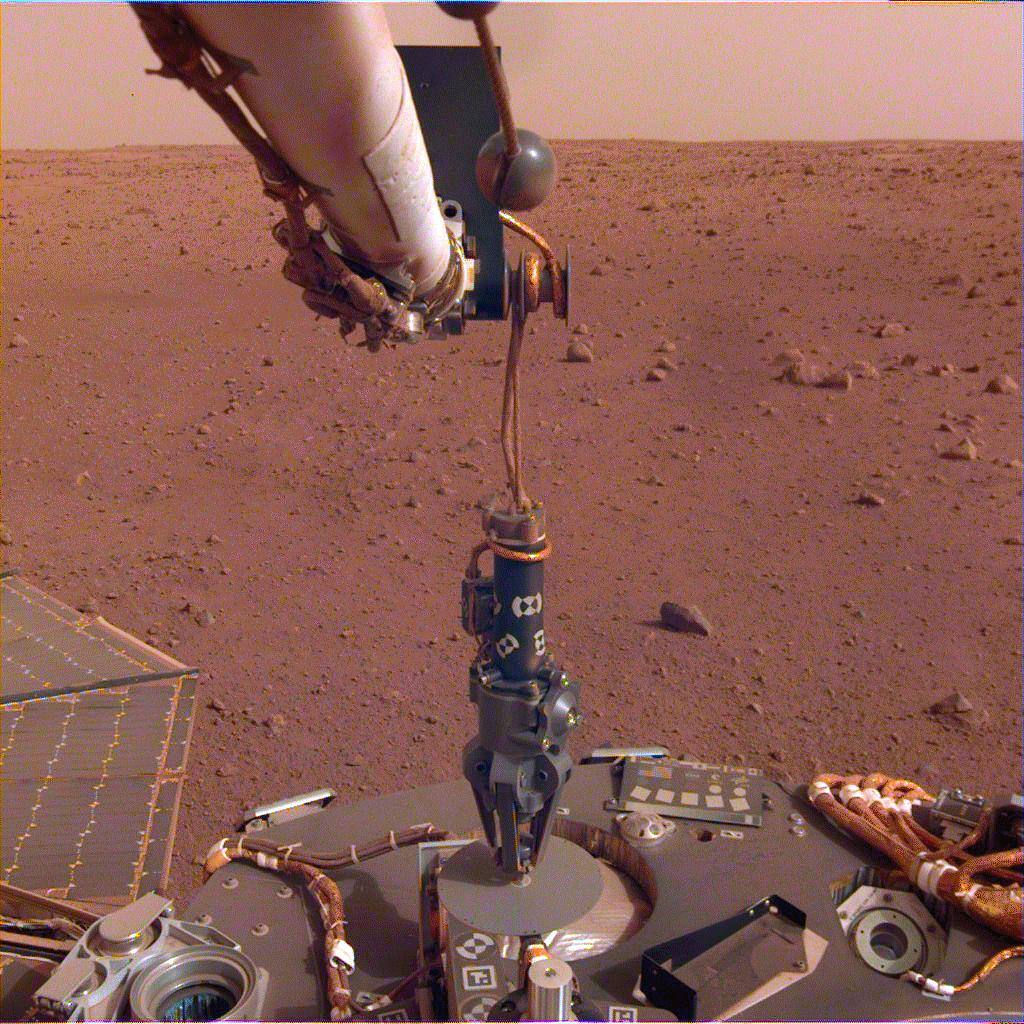 NASA/JPL-Caltech. Public domain (NASA / US government work).
Overview
Section titled “Overview”The Heat Flow and Physical Properties Package on the InSight lander was to measure the heat flowing out of the Martian interior, which requires the product of a temperature gradient and a thermal conductivity, both measured below the depth reached by the annual surface temperature wave. Seasonal ground temperature at low latitude varies by about 20 K in its daily mean over the year, and the diurnal wave is larger still [5], so the measurement has to sit beneath both. That set the target depth at 3 to 5 m [1]. Rather than drill, HP3 used a self-hammering penetrator, the mole, which carried a string of temperature sensors on a trailing tether and thermal sensors in its own hull to measure conductivity as it descended.
The mole began hammering on sol 92, 1 March 2019, and stopped for the last time on sol 754, 9 January 2021, having reached about 40 cm, roughly one mole length, instead of the required 3 m [1]. The mechanism functioned as designed throughout; what failed was an assumption about the ground on which the mechanism depended.
Specifications
Section titled “Specifications”| Parameter | Value |
|---|---|
| Length, diameter, mass | 40 cm, 2.7 cm, 0.85 kg |
| Drive spring energy | 0.7 J per stroke |
| Hammer mass | 0.11 kg |
| Suppressor mass | 0.46 kg |
| Hammer to suppressor mass ratio | 1:4.2 |
| Hammer to casing mass ratio | 1:2.5 |
| Forward strike force, healthy stroke | 1180 to 1350 N |
| Stroke cycle | 3.7 s |
| Design penetration depth | 3 to 5 m |
Values from [8].
Mission profile
Section titled “Mission profile”| Parameter | Value | Source |
|---|---|---|
| Host | InSight lander, launched 5 May 2018, landed 26 November 2018 | [6] |
| Landing site | Elysium Planitia, 4.502 N, 135.623 E, elevation -2613 m | [16] |
| Entry, descent and landing | Unguided ballistic entry, 99 percent footprint 115 to 130 km along track by 25 to 28 km cross track | [6] |
| Targeting | Six trajectory correction maneuvers between launch and landing, designed against a surface latitude and longitude | [33] |
| HP3 deployment on the surface | 12 February 2019 | |
| First hammering | sol 92, 1 March 2019 | [1] |
| Last hammering | sol 754, 9 January 2021 | |
| Depth reached | about 40 cm, roughly one mole length | |
| Deploying arm | InSight robotic arm, 4 DOF, 1.8 m, refurbished from Mars Surveyor 2001 | [7] |
| InSight mission end | 15 December 2022 |
Mechanism
Section titled “Mechanism”Inside the casing, a motor drives a cylindrical cam that compresses the drive spring [8]. Releasing the spring accelerates the hammer into an anvil at the tip, transferring momentum forward; the same release accelerates the suppressor, consisting of the motor, gearbox and driveshaft, backwards against a low-rate brake spring, which then returns it forward to deliver a second, smaller strike to the casing. The whole device is a mechanical diode: it converts symmetric internal impulses into preferentially forward motion.
Because it needs no reaction structure of its own, a mole is attractive for a small lander: it requires neither the mass of a drill rig nor a downforce path back to the spacecraft, and it dissipates little heat, which matters when the measurement being made is a thermal gradient [1]. The regolith it must penetrate has a thermal conductivity of 14 to 64 mW/m/K depending on layer [2], so parasitic heat from the penetrator would perturb the gradient it is there to measure.
The three-mass architecture, hammer, suppressor, and outer hull, was carried through coupled multi-body and soil simulation models used both to size the mechanism before flight and, after two fault incidents on ground units in 2015 and 2017, to diagnose what had gone wrong in the hardware from its behavior alone [8]. The same simulation lineage is why the design could state a specific recoil budget rather than an order-of-magnitude estimate.
The physics of the failure
Section titled “The physics of the failure”A mechanical diode is not perfect. The suppressor mass moving backwards against the brake spring transfers a residual recoil force to the casing, and something outside the mole must resist it or the mole simply reverses out of its own hole. The design assumed that resistance would come from Coulomb friction between the soil and the cylindrical hull, integrated over the buried length [1]. That force is small: 5.4 N nominally on Mars, rising to 6.9 N in the unfavorable case where the mole strikes a hard surface that returns stroke energy elastically and fully compresses the brake spring.
Two conditions therefore have to hold. First, the soil must deform plastically under the forward stroke, which requires enough collapsible pore space around the tip for material to compact or flow into [1]; the InSight regolith has a bulk density near 1211 kg/m3 against a grain density near 3200, implying about 63 percent porosity, so pore space was not the limitation [2]. Second, the soil must close onto the hull behind the tip and grip it. Both fail in a cohesive material. Cohesion allows an open cavity to stand: the lateral earth pressure acting on the hull decreases as cohesion and internal friction angle increase. A soil strong enough to hold its own walls open therefore exerts almost no normal stress on the mole, and with no normal stress there is no friction, and with no friction there is nothing to react the recoil against. The mole hammers, moves forward on the strike, and comes back on the rebound.
The mole was designed for cohesionless soil with the rheology of quartz sand, which had been taken as the analog for Martian regolith [1]. Semi-empirical granular penetration models of the Bekker and Janosi-Hanamoto family, and the pile-driving formulations derived from them, take the normal stress the medium exerts on the penetrator as an input rather than predicting it [3], [4]. The InSight site instead has a cohesive duricrust of a few tens of centimeters beneath a thin unconsolidated layer, with a cohesion of 4 to 25 kPa inferred from the mole’s own penetration resistance and 5.8 kPa from slope stability of the pit walls, against 1 kPa or less for Martian sand [2]. When the support structure was lifted away on sol 227, the mole was found sitting in an open pit about 7 cm deep with steep, self-supporting walls, which is the direct visual confirmation that the soil was not in contact with the hull.
The mole reached 40 cm at all only because friction springs inside the tube of its support structure had been provided to react recoil during initial entry, before enough hull was buried for soil friction to take over [1]. Those springs did the job soil was supposed to do; when the mole left the support structure, the reaction force went with it.
Two further findings compounded the primary one. Penetration resistance was much higher than expected, so a more energetic hammer would have been warranted independently: 0.5 to 1.2 MPa in the duricrust and 5.3 MPa in a more resistant layer below about 30 cm [2]. And the support structure was too light to keep the mole vertical, so the mole tilted progressively, reaching 29 to 32 degrees from vertical by the end [1].
Recovery attempts
Section titled “Recovery attempts”The Anomaly Response Team used the lander’s instrument deployment arm and its scoop to supply the missing reaction force externally, in four successive strategies over nearly two years [9].
Pinning pressed the edge of the scoop against the side of the mole hull to load it directly. Testing with the flight-spare arm in the JPL testbed established a maximum achievable preload of about 40 N [1]. Two pinning campaigns followed, from sol 291 and from sol 346, and both produced real downward motion, at rates up to about 0.3 mm per stroke. Both had to be abandoned for the same reason: keeping the scoop edge on the hull risked a sideswipe that would sever the delicate science tether, and each attempt to retreat to a safer geometry, pushing the scoop flat on the adjacent regolith rather than on the mole, removed the direct preload and with it the progress.
Every strategy was rehearsed first on a matched ground testbed, STL-3, filled with crushed garnet, before being commanded on Mars, with arm force telemetry from Mars sols compared directly against load-cell-calibrated testbed runs at the same poses [9]. That same push-force telemetry, from sol 240 and sol 250, gave an independent cohesion estimate of 3 to 14.5 kPa and a friction angle of 30 to 34 degrees by slope-stability analysis of the pit the arm was pushing against, consistent with the cohesion inferred from the mole’s own penetration resistance [9]. In the testbed, the arm’s own force limits, 80 N average and 40 to 80 N in the safe range near the mole, set what any strategy could apply in the first place; the flight arm’s measured scoop forces during the campaign, of order 55 to 77 N depending on extension, sat inside that envelope [10].
The back cap push placed the scoop directly over the mole’s aft end so that the preload acted along the penetration axis, replacing the 5.4 N of hull friction the soil failed to supply [1], [2], and the scoop physically blocked the rebound vector. It had been deferred because the arm’s positioning precision, the small irregular back cap and the tether all made it hazardous. Twelve hammering sessions over about eight months, totaling 1280 strokes, brought the back cap from 7 cm above the original surface to about 2 cm below it, at which point the scoop could go no deeper without widening the pit, for which resources did not exist [2]. During several of these sessions the mole made no downward progress and regolith grains sitting in the scoop were observed to begin jumping between successive images, which is direct evidence that the mole was bouncing against the scoop rather than advancing, and would have extracted itself had the scoop not been there.
Backfilling was the last strategy: scrapes on sols 673 and 700 and tamps on sols 686 and 734 pushed unconsolidated surface material into the pit and compacted it, with the explicit aim of putting soil back into contact with the hull so that friction, rather than the arm, could react the recoil [9]. Backfill material was the low-cohesion surface layer rather than the duricrust, whose 4 to 25 kPa cohesion is what allowed the pit to stand open in the first place [2]. A chop on sol 420 had earlier broken a piece of consolidated material into the pit, and a scrape on sol 598 nearly buried the mole.
The Free Mole Test on sol 754 applied maximum preload to the regolith above the mole and commanded 500 strokes, a deliberately large number so that the result would be unambiguous [9]. At a nominal 0.25 mm of progress per stroke in the qualification sands, 500 strokes corresponds to roughly 12 cm of expected penetration [2]. There was no downward motion, tilt wandered between 32 and 29.5 degrees, and grains on the scoop again moved erratically, indicating the mole was still rebounding. The campaign ended.
Power, thermal, and communications
Section titled “Power, thermal, and communications”The mole draws power from and returns data through the InSight lander bus; it has no independent power, radio, or computer. Its own sensors are what make it an instrument as well as a mechanism: resistance-foil temperature sensors in the hull for a conductivity measurement by transient heating, a tiltmeter for attitude, and temperature sensors along the trailing science tether for the gradient measurement [1], [2]. The tether is the system’s most fragile element and it constrained every recovery maneuver, because the scoop could not be permitted to load it in shear.
The hammer mechanism itself proved reliable. It executed about 12,000 strokes on Mars with no evidence of degradation, against a requirement of 20,000, and identical units exceeded 60,000 strokes in regolith simulant on Earth without measurable loss of hammer force [8].
Each hammering session, and every arm reposition around it, ran through collision checking that was new flight software for InSight’s arm, since no prior JPL lander arm had needed to plan contact-rich motion this close to a deployed instrument and its tether [11].
Modes of operation
Section titled “Modes of operation”Operation is a commanded hammering session of a specified stroke count or duration, followed by imaging and tilt readout to determine what happened, since the mole has no odometry. Depth was inferred from the length of science tether remaining above ground and from digital elevation models of the pit [1]. The first session on sol 92 was commanded for a 70 cm tip depth or four hours, whichever came first, and returned 3881 successful strokes without reaching depth; a second session of 4720 strokes followed. After the anomaly, sessions were short, tens to a few hundred strokes, each preceded by arm positioning and preload application and followed by reassessment.
Ground operations
Section titled “Ground operations”HP3 was provided by DLR, with the penetrator developed with Astronika in Warsaw, and operated jointly with JPL, which owns the lander and its arm [1], [2]. The anomaly response ran from 2019 to January 2021 and its structure is the notable part: because no direct sensing of the mole’s state below ground existed, each cycle was image-driven, comparing tilt, visible tether length, and pit morphology between hammering sessions to infer what the subsurface was doing. Soil parameters were recovered from the interactions themselves. Scoop pushes into the surface and the chop that broke off a piece of duricrust yielded a cohesion estimate of 5.8 kPa, and applying cone penetration theory to the measured penetration resistance gave 4 to 25 kPa depending on the assumed internal friction angle [2]. Elastic moduli derived from seismic velocities, 4.32 MPa shear, 9.84 MPa bulk, and 11.30 MPa Young’s, were consistent with those cohesions through empirical correlations from terrestrial soil mechanics [2].
Late in the campaign the ground segment was also constrained by the lander itself: dust accumulation on the solar arrays and the approach of aphelion made power and thermal margin the limiting factor on how much hammering could be attempted at all, which is why the sol 754 test was designed to be decisive rather than incremental [1]. The arm itself kept working well outside its qualification envelope through this period, operating with joint motors unheated below -90 C against a -60 C qualification floor [10].
The hammering the mole did produce was also used for a purpose it was never designed for: each burst of strokes is a repeatable, known-location seismic source, and a pre-landing analysis had already worked out how to invert SEIS’s recording of it for near-surface P- and S-wave velocity and layer thickness, stacking many strokes and correcting for the mismatch between the hammer’s frequency content and SEIS’s sampling [12].
Results
Section titled “Results”The heat flow measurement was not made. What HP3 produced instead is a soil mechanics and thermophysical profile of the top half meter at the landing site, derived from a mechanism failing in a well-instrumented way [2]. The model is a 1 cm unconsolidated sand and dust layer, about 20 cm of duricrust, about 10 cm of unconsolidated sand, and below that a layer more resistant to penetration, possibly impact debris. Thermal conductivity rises from 14 mW/m/K in the surface sand and dust to 34 mW/m/K through the duricrust and the sand beneath it, then to 64 mW/m/K in the sand and gravel layer below [2].
One active-heating conductivity measurement was made at the shallow, stalled depth the mole did reach: a 2 W, 24-hour heating run at 0.37 m gave 0.039 +/- 0.002 W/m/K, implying a soil density of 1211 kg/m3 and 63 percent porosity, consistent independently with the bulk density backed out of the mole’s own penetration behavior [13]. The measurement also bounds grain-to-grain cementation: even 0.02 volume percent of cement as necks between grains would have doubled the conductivity, which was not observed, so any cementation at this site is a grain coating rather than a bond [13].
Alternatives and prior knowledge
Section titled “Alternatives and prior knowledge”The mole sits in a larger set of subsurface access methods, and the cited record separates what has flown from what has not.
Flown: rotary-percussive drills that take their reaction from the arm and the vehicle instead of the ground. The Mars Science Laboratory drill applies 120 N weight on bit and percussion at 1800 blows per minute with 0.05 to 0.8 J per blow; the cited design record was written before landing and carries no flight data [28]. The drill later suffered a feed mechanism stall on sol 1536 whose cause was never established, and the eighteen-month remote diagnosis is the nearest precedent for the HP3 anomaly response [32]. A JPL reaction-force study for a Mars Sample Return corer modeled what a rotary-friction, rotary-percussive or ultrasonic tool would transmit into the holding arm; it is simulation only, with no hardware test [21]. A trade study of lander sampling concepts for the 2003 and 2005 sample return missions included explosive penetrators and found that the ranking changes with the requirements; those missions were canceled and its parameters are estimates [20].
Laboratory or field demonstrations only: the piezoelectric wireline Auto-Gopher, whose first version pulled 32 cores from a roughly 40 MPa gypsum quarry at terrestrial pressure and temperature [30]; the Honeybee DAME and MARTE autonomous drills run at Haughton Crater and Rio Tinto, one campaign each [27]; and the JPL Cryobot melt probe, which melted 5 m of terrestrial ice in 11.2 hours at ambient pressure and whose Mars and Europa rates are model extrapolations [19]. The Icebreaker concept, a 1.2 m rotary-percussive auger for ice-cemented ground, is a proposal whose drill figures are taken from other references [29]. For lunar heat flow, a pneumatic excavation stem carrying a 3 mm diameter needle probe reached 0.6 m in 22 s on 8 g of helium in a chamber, but the chamber could not go below 2 Torr [17]. A review of off-Earth drilling tabulates cohesion and friction angle by mission and records no bit wear data [26].
The design assumption that failed is a statement about soil strength, and the sources for it before landing were indirect. Martian cohesion and friction angle at Gusev and Meridiani were derived from rover wheel trenching and scuffing telemetry, not from direct shear tests [15]. Lunar penetration resistance was extrapolated from terrestrial simulant tests to lunar gravity [23]. Direct shear tests on thirteen lunar and Martian simulants show cohesion rising exponentially with bulk density, at normal stresses below 0.68 kPa in terrestrial gravity [22]. A cohesive geotechnical simulant, GRC-3b-DST, reaches 11.5 kPa ultimate cohesion at 81 percent relative density against 0 kPa for its parent, which brings the simulant range near the 4 to 25 kPa measured at Homestead Hollow [31], [2]. The OSIRIS-REx sampler contact on Bennu serves as an in situ penetrometer at a very different end of the range: 5.95 to 6.91 cm of penetration at 10 to 15 N of resisting force, with density and cohesion model-derived [25].
For the thermal side, the standard needle-probe reduction overestimates conductivity by 100 to 150 percent below about 100 Pa in JSC-1A simulant, and a replacement reduction was proposed [18]. Contact probes disrupt porous aggregates whose strength is a few hundred to a few thousand pascal, which is why a contactless laser method was fitted for such samples [24]. The HP3 0.039 W/m/K result at 0.37 m is consistent with that class of low-conductivity porous material, but it was measured in situ on Mars at its own pressure.
Technologies developed
Section titled “Technologies developed”The lessons the team drew are explicit and transferable [1]. A self-hammering penetrator is only mass-efficient if the ground supplies the recoil reaction; where it may not, the mass saved by omitting a reaction structure has to be spent somewhere else. Concretely: more system mass would have permitted a hammer mechanism with little or no residual recoil, a more energetic stroke to handle the observed penetration resistance, and a support structure heavy enough to keep the penetrator vertical and to resist being lifted by the rebound. And a mole intended for a site that may have duricrust needs a mechanism to support it to a depth of roughly two mole lengths, rather than one, before it is on its own.
The result generalizes to any reactionless or low-reaction surface mechanism. Its performance is a function of a soil property, here the normal stress the soil exerts on a buried cylinder, that cannot be measured from orbit and is not constrained by landing site selection: orbital thermal inertia at this site showed no duricrust signature at all [1]. Predictive models of wheel and penetrator interaction with granular media take that stress state as an input, and even the more accurate of them, resistive force theory and continuum plasticity, are validated against measured forces rather than against independently measured soil state [3]. Where such a mechanism is flown, either the uncertainty is closed by an in situ measurement before commitment, or the design has to work across the full range including the case where the soil grips nothing at all.
The recovery campaign itself only existed because the arm it depended on carried capability InSight had not planned to use: the scoop that ultimately pinned and pushed the mole was flight heritage from Mars Surveyor 2001 with no assigned role in the nominal HP3 timeline. A later survey of post-launch adaptation across eight planetary missions cites this as a case where carried-over hardware margin, not a contingency the mission had designed for, was what let ground teams respond to a failure mode nobody had modeled [14].
What is not established
Section titled “What is not established”The heat flow of the Elysium Planitia site was not measured; no temperature profile below 40 cm exists [1], [2]. The internal friction angle of the duricrust is unknown, so cohesion is bounded at 4 to 25 kPa, and the 5.8 kPa scoop estimate is one measurement at one spot [2]. Seismic moduli carry large uncertainties, for example 9.84 +/- 6.54 MPa for bulk modulus, and the layering below 40 cm is inference from penetration resistance [2]. The correlation of shear modulus to cohesion uses terrestrial empirical relations not shown to hold for Martian duricrust [2]. Whether a mole with lower recoil or a heavier support structure would have penetrated this site is a design argument [1], not a test result. Whether duricrust of this kind is common on Mars is not settled by one site, and orbital thermal inertia did not indicate it here [1].
References
- Spohn, T., Hudson, T. L., Witte, L., Wippermann, T., Wisniewski, L., Kedziora, B., Vrettos, C., Lorenz, R. D., Golombek, M., Lichtenheldt, R., Grott, M., Knollenberg, J., Krause, C., Fantinati, C., Krueger, T. and Grygorczuk, J. (2022). The InSight-HP3 Mole on Mars: Lessons Learned from Attempts to Penetrate to Depth in the Martian Soil
. Advances in Space Research, 8. Source
BibTeX
@article{spohn2022insight, title = {The InSight-HP3 Mole on Mars: Lessons Learned from Attempts to Penetrate to Depth in the Martian Soil}, author = {Spohn, Tilman and Hudson, Troy L. and Witte, Lars and Wippermann, Torben and Wisniewski, Lukasz and Kedziora, Bartosz and Vrettos, Christos and Lorenz, Ralph D. and Golombek, Matthew and Lichtenheldt, Roy and Grott, Matthias and Knollenberg, Joerg and Krause, Christian and Fantinati, Cinzia and Krueger, Torsten and Grygorczuk, Jerzy}, journal = {Advances in Space Research}, volume = {69}, number = {8}, pages = {3140--3163}, year = {2022}, doi = {10.1016/j.asr.2022.02.009}, abstract = {The NASA InSight lander mission to Mars payload includes the Heat Flow and Physical Properties Package HP3 to measure the surface heat flow. The package was designed to use a small penetrator - nicknamed the mole - to implement a vertical string of temperature sensors in the soil to a depth of 5 m. The mole itself is equipped with sensors to measure a thermal conductivity-depth profile as it proceeds to depth. The heat flow is calculated from the product of the temperature gradient and the thermal conductivity. To avoid the perturbation caused by annual surface temperature variations, the measurements need to be taken at a depth between 3 m and 5 m. The mole is designed to penetrate cohesionless soil similar in rheology to quartz sand which is expected to provide a good analogue material for Martian sand. The sand would provide friction to the buried mole hull to balance the remaining recoil of the mole hammer mechanism that drives the mole forward. Unfortunately, the mole did not penetrate more than 40 cm, roughly a mole length. The failure to penetrate deeper is largely due to a cohesive duricrust of a few tens of centimeter thickness that failed to provide the required friction. Although a suppressor mass and spring as part of the mole hammer mechanism absorb much of the recoil, the available mass did not allow designing a system that fully eliminated the recoil. The mole penetrated to 40 cm depth benefiting from friction provided by springs in the support structure from which it was deployed and from friction and direct support provided by the InSight Instrument Deployment Arm. In addition, the Martian soil provided unexpected levels of penetration resistance that would have motivated designing a more powerful mole. The low weight of the mole support structure was not sufficient to guide the mole penetrating vertically. Roughly doubling the overall mass of the instrument package would have allowed to design a more robust system with little or no recoil, more energy of the mole hammer mechanism and a more massive support structure. In addition, to cope with duricrust a mechanism to support the mole to a depth of about two mole lengths should be considered.} } - Spohn, T., Hudson, T. L., Marteau, E., Golombek, M., Grott, M., Wippermann, T., Ali, K. S., Schmelzbach, C., Kedar, S., Hurst, K., Trebi-Ollennu, A., Krause, C. and Kroemer, O. (2022). The InSight HP3 Penetrator (Mole) on Mars: Soil Properties Derived From the Penetration Attempts and Related Activities
. Space Science Reviews. Source
BibTeX
@article{spohn2022insightb, title = {The InSight HP3 Penetrator (Mole) on Mars: Soil Properties Derived From the Penetration Attempts and Related Activities}, author = {Spohn, Tilman and Hudson, Troy L. and Marteau, Elodie and Golombek, Matthew and Grott, Matthias and Wippermann, Torben and Ali, Khaled S. and Schmelzbach, Cedric and Kedar, Sharon and Hurst, Kenneth and Trebi-Ollennu, Ashitey and Krause, Christian and Kroemer, Olaf}, journal = {Space Science Reviews}, volume = {218}, pages = {72}, year = {2022}, doi = {10.1007/s11214-022-00941-z}, abstract = {Abstract The NASA InSight Lander on Mars includes the Heat Flow and Physical Properties Package HP 3 to measure the surface heat flow of the planet. The package uses temperature sensors that would have been brought to the target depth of 3–5 m by a small penetrator, nicknamed the mole. The mole requiring friction on its hull to balance remaining recoil from its hammer mechanism did not penetrate to the targeted depth. Instead, by precessing about a point midway along its hull, it carved a 7 cm deep and 5–6 cm wide pit and reached a depth of initially 31 cm. The root cause of the failure – as was determined through an extensive, almost two years long campaign – was a lack of friction in an unexpectedly thick cohesive duricrust. During the campaign – described in detail in this paper – the mole penetrated further aided by friction applied using the scoop at the end of the robotic Instrument Deployment Arm and by direct support by the latter. The mole tip finally reached a depth of about 37 cm, bringing the mole back-end 1–2 cm below the surface. It reversed its downward motion twice during attempts to provide friction through pressure on the regolith instead of directly with the scoop to the mole hull. The penetration record of the mole was used to infer mechanical soil parameters such as the penetration resistance of the duricrust of 0.3–0.7 MPa and a penetration resistance of a deeper layer ( $>30~\text{cm}$ > 30 cm depth) of $4.9\pm0.4~\text{MPa}$ 4.9 ± 0.4 MPa . Using the mole’s thermal sensors, thermal conductivity and diffusivity were measured. Applying cone penetration theory, the resistance of the duricrust was used to estimate a cohesion of the latter of 2–15 kPa depending on the internal friction angle of the duricrust. Pushing the scoop with its blade into the surface and chopping off a piece of duricrust provided another estimate of the cohesion of 5.8 kPa. The hammerings of the mole were recorded by the seismometer SEIS and the signals were used to derive P-wave and S-wave velocities representative of the topmost tens of cm of the regolith. Together with the density provided by a thermal conductivity and diffusivity measurement using the mole’s thermal sensors, the elastic moduli were calculated from the seismic velocities. Using empirical correlations from terrestrial soil studies between the shear modulus and cohesion, the previous cohesion estimates were found to be consistent with the elastic moduli. The combined data were used to derive a model of the regolith that has an about 20 cm thick duricrust underneath a 1 cm thick unconsolidated layer of sand mixed with dust and above another 10 cm of unconsolidated sand. Underneath the latter, a layer more resistant to penetration and possibly containing debris from a small impact crater is inferred. The thermal conductivity increases from 14 mW/m K to 34 mW/m K through the 1 cm sand/dust layer, keeps the latter value in the duricrust and the sand layer underneath and then increases to 64 mW/m K in the sand/gravel layer below.} } - Agarwal, S., Senatore, C., Zhang, T., Kingsbury, M., Iagnemma, K., Goldman, D. I. and Kamrin, K. (2019). Modeling of the Interaction of Rigid Wheels with Dry Granular Media
. Journal of Terramechanics. Source
BibTeX
@article{agarwal2019modeling, title = {Modeling of the Interaction of Rigid Wheels with Dry Granular Media}, author = {Agarwal, Shashank and Senatore, Carmine and Zhang, Tingnan and Kingsbury, Mark and Iagnemma, Karl and Goldman, Daniel I. and Kamrin, Ken}, journal = {Journal of Terramechanics}, volume = {85}, pages = {1--14}, year = {2019}, doi = {10.1016/j.jterra.2019.06.001} } - Ishigami, G., Kewlani, G. and Iagnemma, K. (2009). Predictable Mobility: A Statistical Approach for Planetary Surface Exploration Rovers in Deformable Terrain
. IEEE Robotics & Automation Magazine, 4. Source
BibTeX
@article{ishigami2009predictable, title = {Predictable Mobility: A Statistical Approach for Planetary Surface Exploration Rovers in Deformable Terrain}, author = {Ishigami, Genya and Kewlani, Gaurav and Iagnemma, Karl}, journal = {IEEE Robotics & Automation Magazine}, volume = {16}, number = {4}, pages = {61--70}, year = {2009}, doi = {10.1109/mra.2009.934823}, abstract = {In this article, a statistical mobility prediction for planetary surface exploration rovers has been described. This method explicitly considers uncertainty of the terrain physical parameters via SRSM and employs models of both vehicle dynamics and wheel-terrain interaction mechanics. The simulation results of mobility prediction using three different techniques, SMC, LHSMC, and SRSM, confirms that SRSM significantly improves the computational efficiency compared with those conventional methods. The usefulness and validity of the proposed method has been confirmed through experimental studies of the slope traversal scenario in two different terrains. The results show that the predicted motion path with confidence ellipses can be used as a probabilistic reachability metric of the rover position. Also, for the slope-traversal case, terrain parameter uncertainty has a larger influence on the lateral motion of the rover than on longitudinal motion. Future directions of this study will apply the proposed technique to the path-planning problem. Here, confidence ellipses will be used to define collision-free areas, which will provide useful criteria for generating safe trajectories.} } - Martínez, G. M., Newman, C. N., De Vicente-Retortillo, A., Fischer, E., Renno, N. O., Richardson, M. I., Fairén, A. G., Genzer, M., Guzewich, S. D., Haberle, R. M., Harri, A.-M., Kemppinen, O., Lemmon, M. T., Smith, M. D., de la Torre-Juárez, M. and Vasavada, A. R. (2017). The Modern Near-Surface Martian Climate: A Review of In-situ Meteorological Data from Viking to Curiosity
. Space Science Reviews. Source
BibTeX
@article{martinez2017modern, title = {The Modern Near-Surface Martian Climate: A Review of In-situ Meteorological Data from Viking to Curiosity}, author = {Martínez, G. M. and Newman, C. N. and De Vicente-Retortillo, A. and Fischer, Erik and Renno, N. O. and Richardson, Mark I. and Fairén, A. G. and Genzer, Maria and Guzewich, Scott D. and Haberle, R. M. and Harri, Ari-Matti and Kemppinen, Osku and Lemmon, Mark T. and Smith, Michael D. and de la Torre-Juárez, M. and Vasavada, Ashwin R.}, journal = {Space Science Reviews}, volume = {212}, pages = {295--338}, year = {2017}, doi = {10.1007/s11214-017-0360-x}, abstract = {We analyze the complete set of in-situ meteorological data obtained from the Viking landers in the 1970s to today’s Curiosity rover to review our understanding of the modern near-surface climate of Mars, with focus on the dust, CO 2 and H 2 O cycles and their impact on the radiative and thermodynamic conditions near the surface. In particular, we provide values of the highest confidence possible for atmospheric opacity, atmospheric pressure, near-surface air temperature, ground temperature, near-surface wind speed and direction, and near-surface air relative humidity and water vapor content. Then, we study the diurnal, seasonal and interannual variability of these quantities over a span of more than twenty Martian years. Finally, we propose measurements to improve our understanding of the Martian dust and H 2 O cycles, and discuss the potential for liquid water formation under Mars’ present day conditions and its implications for future Mars missions. Understanding the modern Martian climate is important to determine if Mars could have the conditions to support life and to prepare for future human exploration.} } - Abilleira, F., Halsell, A., Fujii, K., Gustafson, E., Helfrich, C., Lau, E., Lee, J., Mottinger, N., Seubert, J., Sklyanskiy, E., Wallace, M. and Williams, J. (2016). Final Mission and Navigation Design for the 2016 Mars InSight Mission
. Space Flight Mechanics Meeting. Source
BibTeX
@inproceedings{abilleira2016final, title = {Final Mission and Navigation Design for the 2016 Mars InSight Mission}, author = {Abilleira, Fernando and Halsell, Allen and Fujii, Ken and Gustafson, Eric and Helfrich, Clifford and Lau, Eunice and Lee, Julim and Mottinger, Neil and Seubert, Jill and Sklyanskiy, Evgeniy and Wallace, Mark and Williams, Jessica}, booktitle = {Space Flight Mechanics Meeting}, publisher = {JPL Open Repository}, year = {2016}, url = {https://dataverse.jpl.nasa.gov/dataset.xhtml?persistentId=hdl:2014/45996} } - Trebi-Ollennu, A., Ali, K., Sorice, C., Bailey, P., Kim, W., Khan, O., Lim, G., Udomkesmalee, N., Mishra, P., Abarca, H., Deen, R. G., Myint, S., Maki, J. and Yen, J. (2021). Robotics Instrument Deployment System Surface Operations for the InSight Mars Lander
. JPL Open Repository. Source
BibTeX
@inproceedings{trebiollennu2021robotics, title = {Robotics Instrument Deployment System Surface Operations for the InSight Mars Lander}, author = {Trebi-Ollennu, Ashitey and Ali, Khaled and Sorice, Cristina and Bailey, Philip and Kim, Won and Khan, Omair and Lim, Grace and Udomkesmalee, Nythi and Mishra, Pranay and Abarca, Hallie and Deen, Robert G. and Myint, Steven and Maki, Justin and Yen, Jeng}, publisher = {JPL Open Repository}, year = {2021}, url = {https://dataverse.jpl.nasa.gov/dataset.xhtml?persistentId=hdl:2014/54769} } - Krömer, O., Scharringhausen, M., Fittock, M., Tsakyridis, G., Wippermann, T., Witte, L., Grott, M. and Knollenberg, J. (2019). Design details of the HP3 mole onboard the InSight mission
. Acta Astronautica. Source
BibTeX
@article{kromer2019design, title = {Design details of the HP3 mole onboard the InSight mission}, author = {Krömer, Olaf and Scharringhausen, Marco and Fittock, Mark and Tsakyridis, Georgios and Wippermann, Torben and Witte, Lars and Grott, Matthias and Knollenberg, J.}, journal = {Acta Astronautica}, volume = {164}, pages = {152-167}, year = {2019}, doi = {10.1016/j.actaastro.2019.06.031} } - Sorice, C., Ali, K. S., Trebi-Ollennu, A., Mishra, P., Lim, G., Bailey, P., Hudson, T. L., Marteau, E. and Kim, J. (2021). InSight Robotic Arm Testing Activities for HP3 Mole Anomaly Recovery on Mars
. LDEF Post-Retrieval Symposium. Source
BibTeX
@inproceedings{sorice2021insight, title = {InSight Robotic Arm Testing Activities for HP3 Mole Anomaly Recovery on Mars}, author = {Sorice, Cristina and Ali, Khaled S. and Trebi-Ollennu, Ashitey and Mishra, Pranay and Lim, Grace and Bailey, Philip and Hudson, Troy Lee and Marteau, Eloise and Kim, Junggon}, booktitle = {LDEF Post-Retrieval Symposium}, pages = {1-19}, publisher = {IEEE}, year = {2021}, doi = {10.1109/aero50100.2021.9438334} } - Golombek, M., Hudson, T., Bailey, P., Balabanska, N., Marteau, E., Charalambous, C., Baker, M., Lemmon, M., White, B. R., Lorenz, R. D., Spohn, T., Maki, J., Kallemeyn, P., Garvin, J. B., Newman, C., Hurst, K., Murdoch, N., Williams, N., Banerdt, W. B., Lognonné, P., Delage, P., Lapeyre, R., Gaudin, E., Yana, C., Verdier, N., Panning, M. P., Trebi-Ollennu, A., Ali, K., Mittelholz, A., Johnson, C. S., Langlais, B., Warner, N., Grant, J., Daubar, I. J., Ansan, V., Vrettos, C., Spiga, A., Banfield, D., Gomez, A. R., Mishra, P., Dotson, R., Krause, C., Sainton, G. and Gabsi, T. (2023). Results from InSight Robotic Arm Activities
. Space Science Reviews. Source
BibTeX
@article{golombek2023results, title = {Results from InSight Robotic Arm Activities}, author = {Golombek, M. and Hudson, T. and Bailey, Philip and Balabanska, Nadya and Marteau, E. and Charalambous, C. and Baker, Michael and Lemmon, M. and White, Bruce R. and Lorenz, Ralph D. and Spohn, Tilman and Maki, J. and Kallemeyn, P. and Garvin, James B. and Newman, C. and Hurst, Kenneth and Murdoch, Naomi and Williams, N. and Banerdt, W. Bruce and Lognonné, P. and Delage, P. and Lapeyre, R. and Gaudin, E. and Yana, Charles and Verdier, N. and Panning, Mark P. and Trebi-Ollennu, Ashitey and Ali, K. and Mittelholz, A. and Johnson, Christopher S. and Langlais, B. and Warner, N. and Grant, J. and Daubar, Ingrid J. and Ansan, Veronique and Vrettos, Christos and Spiga, Aymeric and Banfield, Don and Gomez, Annabel R. and Mishra, Pranay and Dotson, Ryan and Krause, Christian and Sainton, G. and Gabsi, T.}, journal = {Space Science Reviews}, publisher = {JPL Open Repository}, year = {2023}, doi = {10.48577/jpl.87kgn1} } - Ali, K. S. (2021). InSight Mars Lander Instrument Deployment Arm Flight Software
. IEEE Aerospace Conference. Source
BibTeX
@inproceedings{ali2021insight, title = {InSight Mars Lander Instrument Deployment Arm Flight Software}, author = {Ali, Khaled S.}, booktitle = {IEEE Aerospace Conference}, pages = {1-11}, address = {Big Sky, Montana}, year = {2021}, doi = {10.1109/aero50100.2021.9438296}, abstract = {The Interior Exploration using Seismic Investigations, Geodesy and Heat Transport (InSight) lander landed on Mars on November 26, 2018 and continues to investigate the internal structure of the planet two years later. The Instrument Deployment Arm (IDA), a robotic arm on the lander, was used to deploy the science instrument payloads from the lander deck to the surface of Mars and to take images of the lander and the surrounding environment. This was the first precision deployment and release by a robotic arm on another planet. After deploying the instruments, the IDA has been used for instrument commissioning, scientific data gathering, and to assist with troubleshooting one of the science instruments. This paper provides a high-level summary of the flight software that controls the IDA. The paper provides an overview of the IDA software interfaces, task structure, command handling strategy, motion specification, motion planning, motor control, grapple control, fault protection, and telemetry.} } - Kedar, S., Andrade, J. E., Banerdt, W. B., Delage, P., Golombek, M. P., Grott, M., Hudson, T. L. and Kiely, A. (2017). Analysis of Regolith Properties Using Seismic Signals Generated by InSight's HP3 Penetrator
. Space Science Reviews. Source
BibTeX
@article{kedar2017analysis, title = {Analysis of Regolith Properties Using Seismic Signals Generated by InSight's HP3 Penetrator}, author = {Kedar, S. and Andrade, Jose E. and Banerdt, W. B. and Delage, Pierre and Golombek, M. P. and Grott, Matthias and Hudson, T. L. and Kiely, Aaron}, journal = {Space Science Reviews}, volume = {211}, pages = {315-337}, year = {2017}, doi = {10.1007/s11214-017-0391-3} } - Grott, M., Spohn, T., Knollenberg, J., Krause, C., Hudson, T. L., Piqueux, S., Müller, N., Golombek, M., Vrettos, C., Marteau, E., Nagihara, S., Morgan, P., Murphy, J. P., Siegler, M., King, S. D., Smrekar, S. E. and Banerdt, W. B. (2021). Thermal Conductivity of the Martian Regolith at the InSight Landing site from HP3 Active Heating Experiments
. Root. Source
BibTeX
@inproceedings{grott2021thermal, title = {Thermal Conductivity of the Martian Regolith at the InSight Landing site from HP3 Active Heating Experiments}, author = {Grott, Matthias and Spohn, Tilman and Knollenberg, J. and Krause, Christian and Hudson, T. L. and Piqueux, Sylvain and Müller, N. and Golombek, M. and Vrettos, Christos and Marteau, E. and Nagihara, S. and Morgan, P. and Murphy, J. P. and Siegler, M. and King, S. D. and Smrekar, S. E. and Banerdt, W. Bruce}, journal = {Root}, publisher = {JPL Open Repository}, year = {2021}, doi = {10.48577/jpl.kklqrr}, abstract = {The heat flow and physical properties package (HP3) of the InSight Mars mission is an instrument package designed to determine the martian planetary heat flow. To this end, the package was designed to emplace sensors into the martian regolith and measure the regolith thermal conductivity as well as the geothermal gradient in the 0-5 m depth range. After emplacing the probe to a tip depth of 0.37 m, a rst reliable measurement of the average regolith thermal conductivity in the 0.03 to 0.37 m depth range was performed. Using the HP3 mole as a modied line heat source, we determined a regolith thermal conductivity of 0.039 0.002 W m1 K1, consistent with the results of orbital and in-situ thermal inertia measurements. This low thermal conductivity implies that 85 to 95% of all particles are smaller than 125-160 m and suggests that any cement contributing to soil cohesion cannot significantly increase grain-to-grain contact areas by forming cementing necks, but could be distributed in the form of grain coatings instead. Regolith densities compatible with the measurements are 1211+149-113 kg m3, indicating regolith porosities of 61 %.} } - Ono, M., Rieber, R., Freeman, T., Choukroun, M., Ingham, M. D., Gentgen, C., Murrow, D. and Selva, D. (2026). Is Simplicity Golden? A Survey of Post-Launch Adaptation in Planetary Missions
. Icarus. Source
BibTeX
@article{ono2026simplicity, title = {Is Simplicity Golden? A Survey of Post-Launch Adaptation in Planetary Missions}, author = {Ono, Masahiro and Rieber, Richard and Freeman, Tony and Choukroun, Mathieu and Ingham, Michel D. and Gentgen, Chloe and Murrow, David and Selva, Daniel}, journal = {Icarus}, publisher = {JPL Open Repository}, year = {2026}, doi = {10.1109/aero66936.2026.11520146}, abstract = {The conventional wisdom in space systems engineering holds that simplicity is golden: systems should minimize complexity while meeting requirements. A simpler system is typically considered more robust and less prone to risk because it can be tested thoroughly and has fewer points of failure. While the core philosophy of this principle remains valid, we argue that the reality is more nuanced—particularly for planetary exploration missions, which face substantially greater uncertainties than Earth-orbiting missions. We investigated 10 past and ongoing missions that encountered unexpected situations and either successfully or unsuccessfully adapted to them: Galileo, Hayabusa, EPOXI, Deep Space 1, Juno, SMAP, OSIRIS-Rex, InSight, Mars 2020 Rover (Perseverance), and Ingenuity. Our study draws on a series of interviews with experts directly involved in these missions, as well as a review of relevant literature. We found that it is often departures from design minimalism—such as functional redundancy in sensing and actuation, subsystem interconnections, and onboard software flexibility—that enabled, or could have enabled, missions to adapt to anomalies and surprises. From these observations, we distilled five design principles for future planetary missions to enhance adaptability while keeping overall system complexity under control. Finally, we propose a concept of software-defined space systems (SSDSs), which is built upon the proposed design principles and can dynamically adapt physical behaviors in remote planetary environments.} } - Sullivan, R., Anderson, R., Biesiadecki, J., Bond, T. and Stewart, H. (2011). Cohesions, friction angles, and other physical properties of Martian regolith from Mars Exploration Rover wheel trenches and wheel scuffs
. Journal of Geophysical Research. Source
BibTeX
@article{sullivan2011cohesions, title = {Cohesions, friction angles, and other physical properties of Martian regolith from Mars Exploration Rover wheel trenches and wheel scuffs}, author = {Sullivan, R. and Anderson, R. and Biesiadecki, J. and Bond, T. and Stewart, H.}, journal = {Journal of Geophysical Research}, volume = {116}, pages = {E02006}, publisher = {American Geophysical Union (AGU)}, year = {2011}, doi = {10.1029/2010je003625}, abstract = {[1] The Mars Exploration Rovers Spirit and Opportunity investigated the physical properties of Martian regolith in 7 wheel trenches and 20 wheel scuffs distributed along traverses at Gusev crater and Meridiani Planum. Specialized wheel-trenching sequences allowed analysis of wheel motor and suspension telemetry to determine regolith friction angle ϕ and cohesion c at trench sites. Friction angles were 30°–37°, and cohesions were 0–2 kPa. Simpler wheel-scuff maneuvers were analyzed for cohesion by assuming the range of ϕ determined from trenches; cohesions in wheel-scuffed regoliths were from 0 to 11 kPa. Regolith ϕ and c can be related to regolith origins. Grain sorting, compaction, shape, size, and angularity influence ϕ. Impact cratering and aeolian processes have affected grain angularity and sorting of Martian regolith at both Mars Exploration Rover (MER) landing sites and contend in opposing ways to determine grain characteristics in the regolith. Friction angles are consistent with dry, rigid, nonplaty grains with particle size frequencies dominated by very fine sand (as seen by the Microscopic Imager or MI) with at least some grain rounding (unresolved by MI), reflecting physical weathering from aeolian saltation. Friction angle results from MER trenches therefore indicate that regolith states are between fully mature aeolian materials and impact debris. MI and color Pancam views show trench tailings and trench floors are redder, brighter, and have more intermixed extremely fine (unresolved) grains than regolith closer to the surface disturbed and exposed only by rolling tracks.} } - Golombek, M., Williams, N., Warner, N. H., Parker, T., Williams, M. G., Daubar, I., Calef, F., Grant, J., Bailey, P., Abarca, H., Deen, R., Ruoff, N., Maki, J., McEwen, A. S., Baugh, N., Block, K., Tamppari, L. K., Call, J., Ladewig, J., Stoltz, A., Weems, W. A., Mora-Sotomayor, L., Torres, J., Johnson, M., Kennedy, T. and Sklyanskiy, E. (2020). Location and Setting of the Mars InSight Lander, Instruments, and Landing Site
. Planetary and Space Science, 10. Source
BibTeX
@article{golombek2020location, title = {Location and Setting of the Mars InSight Lander, Instruments, and Landing Site}, author = {Golombek, M. and Williams, N. and Warner, N. H. and Parker, T. and Williams, M. G. and Daubar, I. and Calef, F. and Grant, J. and Bailey, Philip and Abarca, Hallie and Deen, R. and Ruoff, N. and Maki, J. and McEwen, Alfred S. and Baugh, N. and Block, K. and Tamppari, Leslie K. and Call, J. and Ladewig, J. and Stoltz, A. and Weems, W. A. and Mora-Sotomayor, Luis and Torres, Josefina and Johnson, M. and Kennedy, Thomas and Sklyanskiy, Evgeniy}, journal = {Planetary and Space Science}, volume = {7}, number = {10}, pages = {e2020EA001248}, publisher = {American Geophysical Union (AGU)}, year = {2020}, doi = {10.1029/2020ea001248}, abstract = {Abstract Knowing precisely where a spacecraft lands on Mars is important for understanding the regional and local context, setting, and the offset between the inertial and cartographic frames. For the InSight spacecraft, the payload of geophysical and environmental sensors also particularly benefits from knowing exactly where the instruments are located. A ~30 cm/pixel image acquired from orbit after landing clearly resolves the lander and the large circular solar panels. This image was carefully georeferenced to a hierarchically generated and coregistered set of decreasing resolution orthoimages and digital elevation models to the established positive east, planetocentric coordinate system. The lander is located at 4.502384°N, 135.623447°E at an elevation of −2,613.426 m with respect to the geoid in Elysium Planitia. Instrument locations (and the magnetometer orientation) are derived by transforming from Instrument Deployment Arm, spacecraft mechanical, and site frames into the cartographic frame. A viewshed created from 1.5 m above the lander and the high‐resolution orbital digital elevation model shows the lander is on a shallow regional slope down to the east that reveals crater rims on the east horizon ~400 m and 2.4 km away. A slope up to the north limits the horizon to about 50 m away where three rocks and an eolian bedform are visible on the rim of a degraded crater rim. Azimuths to rocks and craters identified in both surface panoramas and high‐resolution orbital images reveal that north in the site frame and the cartographic frame are the same (within 1°).} } - Nagihara, S., Zacny, K., Hedlund, M. and Taylor, P. T. (2012). Development of a Compact, Deep-Penetrating Heat Flow Instrument for Lunar Landers: In-Situ Thermal Conductivity System
. NASA, 20120013638. Source
BibTeX
@techreport{nagihara2012development, title = {Development of a Compact, Deep-Penetrating Heat Flow Instrument for Lunar Landers: In-Situ Thermal Conductivity System}, author = {Nagihara, S. and Zacny, K. and Hedlund, M. and Taylor, P. T.}, number = {20120013638}, institution = {NASA}, year = {2012}, url = {https://ntrs.nasa.gov/citations/20120013638}, abstract = {Geothermal heat flow is obtained as a product of the geothermal gradient and the thermal conductivity of the vertical soil/rock/regolith interval penetrated by the instrument. Heat flow measurements are a high priority for the geophysical network missions to the Moon recommended by the latest Decadal Survey and previously the International Lunar Network. One of the difficulties associated with lunar heat flow measurement on a robotic mission is that it requires excavation of a relatively deep (approx 3 m) hole in order to avoid the long-term temporal changes in lunar surface thermal environment affecting the subsurface temperature measurements. Such changes may be due to the 18.6-year-cylcle lunar precession, or may be initiated by presence of the lander itself. Therefore, a key science requirement for heat flow instruments for future lunar missions is to penetrate 3 m into the regolith and to measure both thermal gradient and thermal conductivity. Engineering requirements are that the instrument itself has minimal impact on the subsurface thermal regime and that it must be a low-mass and low-power system like any other science instrumentation on planetary landers. It would be very difficult to meet the engineering requirements, if the instrument utilizes a long (> 3 m) probe driven into the ground by a rotary or percussive drill. Here we report progress in our efforts to develop a new, compact lunar heat flow instrumentation that meets all of these science and engineering requirements.} } - Nagihara, S., Hedlund, M., Zacny, K. and Taylor, P. T. (2013). Improved Data Reduction Algorithm for the Needle Probe Method Applied to In-Situ Thermal Conductivity Measurements of Lunar and Planetary Regoliths
. Planetary and Space Science, 20140010297. Source
BibTeX
@article{nagihara2013improved, title = {Improved Data Reduction Algorithm for the Needle Probe Method Applied to In-Situ Thermal Conductivity Measurements of Lunar and Planetary Regoliths}, author = {Nagihara, S. and Hedlund, M. and Zacny, K. and Taylor, P. T.}, journal = {Planetary and Space Science}, volume = {92}, number = {20140010297}, pages = {49-56}, institution = {NASA}, year = {2013}, doi = {10.1016/j.pss.2013.12.012}, abstract = {The needle probe method (also known as the' hot wire' or 'line heat source' method) is widely used for in-situ thermal conductivity measurements on soils and marine sediments on the earth. Variants of this method have also been used (or planned) for measuring regolith on the surfaces of extra-terrestrial bodies (e.g., the Moon, Mars, and comets). In the near-vacuum condition on the lunar and planetary surfaces, the measurement method used on the earth cannot be simply duplicated, because thermal conductivity of the regolith can be approximately 2 orders of magnitude lower. In addition, the planetary probes have much greater diameters, due to engineering requirements associated with the robotic deployment on extra-terrestrial bodies. All of these factors contribute to the planetary probes requiring much longer time of measurement, several tens of (if not over a hundred) hours, while a conventional terrestrial needle probe needs only 1 to 2 minutes. The long measurement time complicates the surface operation logistics of the lander. It also negatively affects accuracy of the thermal conductivity measurement, because the cumulative heat loss along the probe is no longer negligible. The present study improves the data reduction algorithm of the needle probe method by shortening the measurement time on planetary surfaces by an order of magnitude. The main difference between the new scheme and the conventional one is that the former uses the exact mathematical solution to the thermal model on which the needle probe measurement theory is based, while the latter uses an approximate solution that is valid only for large times. The present study demonstrates the benefit of the new data reduction technique by applying it to data from a series of needle probe experiments carried out in a vacuum chamber on JSC-1A lunar regolith stimulant. The use of the exact solution has some disadvantage, however, in requiring three additional parameters, but two of them (the diameter and the volumetric heat capacity of the probe) can be measured and the other (the volumetric heat capacity of the regolith/stimulant) may be estimated from the surface geologic observation and temperature measurements. Therefore, overall, the new data reduction scheme would make in-situ thermal conductivity measurement more practical on planetary missions.} } - Zimmerman, W. F., Bonitz, R. and Feldman, J. (2001). Cryobot: an ice penetrating robotic vehicle for Mars and Europa
. IEEE Aerospace Conference. Source
BibTeX
@inproceedings{zimmerman2001cryobot, title = {Cryobot: an ice penetrating robotic vehicle for Mars and Europa}, author = {Zimmerman, W. F. and Bonitz, R. and Feldman, Jason}, booktitle = {IEEE Aerospace Conference}, volume = {1}, pages = {1/311-1/323}, publisher = {IEEE}, year = {2001}, doi = {10.1109/aero.2001.931722}, abstract = {NASA's desire to study and characterize the solar system will be done by in-situ robotic systems in the near term. Specific interest is focused towards finding water on Mars and understanding both the climatic and depositional history of the planet. In the case of Europa, scientists desire to unravel the mysteries surrounding the thick ice crust, its chemical properties, and subsurface ocean properties. For both Mars and Europa, the major scientific interest is whether there are signs of past or extant life in either the Mars polar ice, or the sub-ice ocean of Europa. The best way to explore either of these environments is a cryobot mole vehicle, which carries a suite of instruments suitable for sampling and analyzing the ice or ocean environments. JPL is currently developing a unique robotic vehicle, which utilizes gravity, and both passive and active heating systems to drive ice to a melt state, in order to facilitate mobility. This paper describes the science driven requirements for such a vehicle, a description of the cryobot design, and results of recent performance tests in both clean and dust laden ice. Although a radioisotope power system for a flight version of the cryobot is currently baselined, no decision on the final design of the flight cryobot will be made until the environmental review process is complete. Any use of the cryobot for Mars or Europa will conform to all environmental and planetary protection requirements.} } - McConnell, J. (2000). A Trade Study and Metric for Penetration and Sampling Devices for Possible Use on the NASA 2003 and 2005 Mars Sample Return Missions
. ASCE, Space and Robotic. Source
BibTeX
@inproceedings{mcconnell2000trade, title = {A Trade Study and Metric for Penetration and Sampling Devices for Possible Use on the NASA 2003 and 2005 Mars Sample Return Missions}, author = {McConnell, J.}, booktitle = {ASCE, Space and Robotic}, publisher = {JPL Open Repository}, year = {2000}, url = {https://dataverse.jpl.nasa.gov/dataset.xhtml?persistentId=hdl:2014/18035} } - Chang, Z., Sherrit, S., Badescu, M., Bao, X., Bar-Cohen, Y. and Backes, P. (2006). Reaction force of percussive corer, rotary-friction corer, and rotary-percussive corer
. Smart Structures and Materials : Industrial and Commercial Applications of Smart Structures Technologies. Source
BibTeX
@inproceedings{chang2006reaction, title = {Reaction force of percussive corer, rotary-friction corer, and rotary-percussive corer}, author = {Chang, Zensheu and Sherrit, Stewart and Badescu, Mircea and Bao, Xiaoqi and Bar-Cohen, Yoseph and Backes, Paul}, booktitle = {Smart Structures and Materials : Industrial and Commercial Applications of Smart Structures Technologies}, series = {SPIE Proceedings}, volume = {6171}, pages = {617106}, publisher = {SPIE}, year = {2006}, doi = {10.1117/12.658075}, abstract = {Future NASA exploration missions will increasingly require sampling, in-situ analysis and possibly the return of material to Earth for laboratory analysis. To address these objectives, effective and optimized drilling techniques are needed. This requires developing comprehensive tools to be able to determine analytically what takes place during the operation and what are the control parameters that can be enhanced. In this study, three types of coring techniques were studied and were identified as potential candidates for operation from a possible future Mars Sample Return (MSR) mission rover. These techniques include percussive, rotary-friction, and rotary-percussive coring. Theoretical models were developed to predict the dynamic reaction forces transmitted from these three types of corers to the robotic arms that hold them. The predicted reaction forces will then be used in a dynamic simulation environment to simulate a representative corer tool to obtain a best estimate of a tool that can be operated from a small rover. The predicted dynamic reaction forces will be presented in this paper.} } - Dotson, B., Sanchez Valencia, D., Millwater, C., Easter, P. B., Long-Fox, J., Britt, D. and Metzger, P. (2024). Cohesion and Shear Strength of Compacted Lunar and Martian Regolith Simulants
. Icarus. Source
BibTeX
@article{dotson2024cohesion, title = {Cohesion and Shear Strength of Compacted Lunar and Martian Regolith Simulants}, author = {Dotson, Brandon and Sanchez Valencia, D. and Millwater, C. and Easter, Parks B. and Long-Fox, J. and Britt, D. and Metzger, P.}, journal = {Icarus}, volume = {411}, pages = {115943}, year = {2024}, doi = {10.1016/j.icarus.2024.115943} } - Houston, W. N. and Namiq, L. (1971). Penetration resistance of lunar soils
. Journal of Terramechanics, 1. Source
BibTeX
@article{houston1971penetration, title = {Penetration resistance of lunar soils}, author = {Houston, William N. and Namiq, L.I.}, journal = {Journal of Terramechanics}, volume = {8}, number = {1}, pages = {59-69}, publisher = {Elsevier BV}, year = {1971}, doi = {10.1016/0022-4898(71)90071-1} } - Krause, M., Blum, J., Skorov, Y. and Trieloff, M. (2011). Thermal conductivity measurements of porous dust aggregates: I. Technique, model and first results
. Icarus, 1. Source
BibTeX
@article{krause2011thermal, title = {Thermal conductivity measurements of porous dust aggregates: I. Technique, model and first results}, author = {Krause, M. and Blum, J. and Skorov, Yu.V. and Trieloff, M.}, journal = {Icarus}, volume = {214}, number = {1}, pages = {286-296}, publisher = {Elsevier BV}, year = {2011}, doi = {10.1016/j.icarus.2011.04.024} } - Walsh, K. J., Ballouz, R.-L., Jawin, E. R., Avdellidou, C., Barnouin, O. S., Bennett, C. A., Bierhaus, E. B., Bos, B. J., Cambioni, S., Connolly, J. H. C., Delbo, M., DellaGiustina, D. N., DeMartini, J., Emery, J. P., Golish, D. R., Haas, P. C., Hergenrother, C. W., Ma, H., Michel, P., Nolan, M. C., Olds, R., Rozitis, B., Richardson, D. C., Rizk, B., Ryan, A. J., Sánchez, P., Scheeres, D. J., Schwartz, S. R., Selznick, S. H., Zhang, Y. and Lauretta, D. S. (2022). Near-zero cohesion and loose packing of Bennu's near subsurface revealed by spacecraft contact
. Science Advances, 27. Source
BibTeX
@article{walsh2022near, title = {Near-zero cohesion and loose packing of Bennu's near subsurface revealed by spacecraft contact}, author = {Walsh, Kevin J. and Ballouz, Ronald-Louis and Jawin, Erica R. and Avdellidou, Chrysa and Barnouin, Olivier S. and Bennett, Carina A. and Bierhaus, Edward B. and Bos, Brent J. and Cambioni, Saverio and Connolly, Jr., Harold C. and Delbo, Marco and DellaGiustina, Daniella N. and DeMartini, Joseph and Emery, Joshua P. and Golish, Dathon R. and Haas, Patrick C. and Hergenrother, Carl W. and Ma, Huikang and Michel, Patrick and Nolan, Michael C. and Olds, Ryan and Rozitis, Benjamin and Richardson, Derek C. and Rizk, Bashar and Ryan, Andrew J. and Sánchez, Paul and Scheeres, Daniel J. and Schwartz, Stephen R. and Selznick, Sanford H. and Zhang, Yun and Lauretta, Dante S.}, journal = {Science Advances}, volume = {8}, number = {27}, pages = {eabm6229}, year = {2022}, doi = {10.1126/sciadv.abm6229}, abstract = {When the OSIRIS-REx spacecraft pressed its sample collection mechanism into the surface of Bennu, it provided a direct test of the poorly understood near-subsurface physical properties of rubble-pile asteroids, which consist of rock fragments at rest in microgravity. Here, we find that the forces measured by the spacecraft are best modeled as a granular bed with near-zero cohesion that is half as dense as the bulk asteroid. The low gravity of a small rubble-pile asteroid such as Bennu effectively weakens its near subsurface by not compressing the upper layers, thereby minimizing the influence of interparticle cohesion on surface geology. The underdensity and weak near subsurface should be global properties of Bennu and not localized to the contact point.} } - Knez, D. and Khalilidermani, M. (2021). A Review of Different Aspects of Off-Earth Drilling
. Energies, 21. Source
BibTeX
@article{knez2021review, title = {A Review of Different Aspects of Off-Earth Drilling}, author = {Knez, Dariusz and Khalilidermani, Mitra}, journal = {Energies}, volume = {14}, number = {21}, pages = {7351}, publisher = {MDPI AG}, year = {2021}, doi = {10.3390/en14217351}, abstract = {Off-Earth drilling may be assumed as the second phase of space exploration to discover the unrevealed subsurface on the planetary bodies. It accelerates future space objectives such as in-situ propellant production, mineral exploitation, and space tourism. Owing to the rampant progress in modern technology, the new drill tools mounted on the sophisticated robots are capable to drill the planetary regolith dispersed on the celestial objects; however, formidable obstacles such as microgravity, vacuum condition, and temperature fluctuation as well as the weight limitation, lack of real-time drilling analysis, and remote robot-operator communication impose pressing restrictions on the quick development of space drilling tools. In this study, research on the past and present aspects of off-Earth drilling has been implemented to illuminate the horizon of this technology in the near-term future. The context encompasses a detailed description of the limitations, applications and mechanisms of the different drilling techniques adopted for planetary bodies. A particular emphasis is put on the hydraulic power systems which have not been satisfactorily deployed in off-Earth drilling yet. The research strives to glance over the pivotal aspects of off-Earth drilling to contribute to the future drilling programs planned by the national and private space agencies.} } - Paulsen, G., Zacny, K., Chu, P., Mumm, E., Davis, K., Frader-Thompson, S., Petrich, K., Glaser, D., Bartlett, P., Cannon, H. and Glass, B. (2006). Robotic Drill Systems for Planetary Exploration
. SpaceOps Conference. Source
BibTeX
@inproceedings{paulsen2006robotic, title = {Robotic Drill Systems for Planetary Exploration}, author = {Paulsen, Gale and Zacny, Kris and Chu, Phil and Mumm, Erik and Davis, Kiel and Frader-Thompson, Seth and Petrich, Kyle and Glaser, David and Bartlett, Paul and Cannon, Howard and Glass, Brian}, booktitle = {SpaceOps Conference}, publisher = {American Institute of Aeronautics and Astronautics}, year = {2006}, doi = {10.2514/6.2006-7512} } - Okon, A. B. (2010). Mars Science Laboratory Drill
. Aerospace Mechanisms Symposium. Source
BibTeX
@inproceedings{okon2010mars, title = {Mars Science Laboratory Drill}, author = {Okon, Avi B.}, booktitle = {Aerospace Mechanisms Symposium}, address = {Cocoa Beach, Florida}, year = {2010}, url = {https://ntrs.nasa.gov/citations/20100021931}, abstract = {The Drill for the Mars Science Laboratory mission is a rotary-percussive sample acquisition device with an emphasis on toughness and robustness to handle the harsh environment on Mars. The unique challenges associated with autonomous drilling from a mobile robot are addressed. A highly compressed development schedule dictated a modular design architecture that satisfies the functional and load requirements while allowing independent development and testing of the Drill subassemblies. The Drill consists of four actuated mechanisms: a spindle that rotates the bit, a chuck that releases and engages bits, a novel voice-coil-based percussion mechanism that hammers the bit, and a linear translation mechanism. The Drill has three passive mechanisms: a replaceable bit assembly that acquires and collects sample, a contact sensor / stabilizer mechanism, and, lastly a flex harness service loop. This paper describes the various mechanisms that makeup the Drill and discusses the solutions to their unique design and development challenges.} } - McKay, C. P., Stoker, C. R., Glass, B. J., Davé, A. I., Davila, A. F., Heldmann, J. L., Marinova, M. M., Fairen, A. G., Quinn, R. C., Zacny, K. A., Paulsen, G., Smith, P. H., Parro, V., Andersen, D. T., Hecht, M. H., Lacelle, D. and Pollard, W. H. (2013). The Icebreaker Life Mission to Mars: A Search for Biomolecular Evidence for Life
. Astrobiology, 4. Source
BibTeX
@article{mckay2013icebreaker, title = {The {Icebreaker} {Life} {Mission} to {Mars}: A Search for Biomolecular Evidence for Life}, author = {McKay, Christopher P. and Stoker, Carol R. and Glass, Brian J. and Davé, Arwen I. and Davila, Alfonso F. and Heldmann, Jennifer L. and Marinova, Margarita M. and Fairen, Alberto G. and Quinn, Richard C. and Zacny, Kris A. and Paulsen, Gale and Smith, Peter H. and Parro, Victor and Andersen, Dale T. and Hecht, Michael H. and Lacelle, Denis and Pollard, Wayne H.}, journal = {Astrobiology}, volume = {13}, number = {4}, pages = {334--353}, year = {2013}, doi = {10.1089/ast.2012.0878}, abstract = {The search for evidence of life on Mars is the primary motivation for the exploration of that planet. The results from previous missions, and the Phoenix mission in particular, indicate that the ice-cemented ground in the north polar plains is likely to be the most recently habitable place that is currently known on Mars. The near-surface ice likely provided adequate water activity during periods of high obliquity, ∼5 Myr ago. Carbon dioxide and nitrogen are present in the atmosphere, and nitrates may be present in the soil. Perchlorate in the soil together with iron in basaltic rock provides a possible energy source for life. Furthermore, the presence of organics must once again be considered, as the results of the Viking GCMS are now suspect given the discovery of the thermally reactive perchlorate. Ground ice may provide a way to preserve organic molecules for extended periods of time, especially organic biomarkers. The Mars Icebreaker Life mission focuses on the following science goals: (1) Search for specific biomolecules that would be conclusive evidence of life. (2) Perform a general search for organic molecules in the ground ice. (3) Determine the processes of ground ice formation and the role of liquid water. (4) Understand the mechanical properties of the martian polar ice-cemented soil. (5) Assess the recent habitability of the environment with respect to required elements to support life, energy sources, and possible toxic elements. (6) Compare the elemental composition of the northern plains with midlatitude sites. The Icebreaker Life payload has been designed around the Phoenix spacecraft and is targeted to a site near the Phoenix landing site. However, the Icebreaker payload could be supported on other Mars landing systems. Preliminary studies of the SpaceX Dragon lander show that it could support the Icebreaker payload for a landing either at the Phoenix site or at midlatitudes. Duplicate samples could be cached as a target for possible return by a Mars Sample Return mission. If the samples were shown to contain organic biomarkers, interest in returning them to Earth would be high. Key Words: In situ measurement—Life detection—Mars—Planetary protection—Special region. Astrobiology 13, 334–353.} } - Badescu, M., Ressa, A., Jae Lee, H., Bar-Cohen, Y., Sherrit, S., Zacny, K., Paulsen, G. L., Beegle, L. and Bao, X. (2013). Auto-Gopher : a wireline deep sampler driven by piezoelectric percussive actuator and EM rotary motor
. Sensors and Smart Structures Technologies for Civil, Mechanical, and Aerospace Systems. Source
BibTeX
@inproceedings{badescu2013auto, title = {Auto-Gopher : a wireline deep sampler driven by piezoelectric percussive actuator and EM rotary motor}, author = {Badescu, Mircea and Ressa, Aaron and Jae Lee, Hyeong and Bar-Cohen, Yoseph and Sherrit, Stewart and Zacny, Kris and Paulsen, Gale L. and Beegle, Luther and Bao, Xiaoqi}, booktitle = {Sensors and Smart Structures Technologies for Civil, Mechanical, and Aerospace Systems}, series = {SPIE Proceedings}, volume = {8692}, pages = {86922S}, publisher = {SPIE}, year = {2013}, doi = {10.1117/12.2010319}, abstract = {The ability to penetrate subsurfaces and perform sample acquisition at depth of meters may be critical for future NASA in-situ exploration missions to bodies in the solar system, including Mars and Europa. A corer/sampler was developed with the goal of enabling acquisition of samples from depths of several meters where if used on Mars would be beyond the oxidized and sterilized zone. For this purpose, we developed a rotary-hammering coring drill, called Auto-Gopher, which employs a piezoelectric actuated percussive mechanism for breaking formations and an electric motor that rotates the bit to remove the powdered cuttings. This sampler is a wireline mechanism that can be fed into and retrieved from the drilled hole using a winch and a cable. It includes an inchworm anchoring mechanism allowing the drill advancement and weight on bit control without twisting the reeling and power cables. The penetration rate is being optimized by simultaneously activating the percussive and rotary motions of the Auto-Gopher. The percussive mechanism is based on the Ultrasonic/Sonic Drill/Corer (USDC) mechanism that is driven by piezoelectric stack and that was demonstrated to require low axial preload. The design and fabrication of this device were presented in previous publications. This paper presents the results of laboratory and field tests and lessons learned from this development.} } - Gerdts, S., Moreland, S. and Marteau, E. (2025). GRC-3b-DST, a Geotechnical Simulant for Cohesive Mars and Moon Mobility and Excavation Testing With Reduced Respirable Silica
. NASA, NASA/TM-20250006761. Source
BibTeX
@techreport{gerdts2025grc, title = {GRC-3b-DST, a Geotechnical Simulant for Cohesive Mars and Moon Mobility and Excavation Testing With Reduced Respirable Silica}, author = {Gerdts, Stephen and Moreland, Scott and Marteau, Eloise}, number = {NASA/TM-20250006761}, institution = {NASA}, year = {2025}, doi = {10.64631/puln8817}, abstract = {This study presents the development and evaluation of a modified version of the GRC-3b lunar soil simulant designed to address both geotechnical performance and operator safety in terrestrial mobility and excavation testing. While GRC-3b is widely used due to its cost-effectiveness and similarity to extraterrestrial regolith, its fine silica content poses significant health risks during handling. To mitigate this, a dust-suppressing additive was introduced, producing GRC-3b-DST. The modified simulant maintained the original particle size distribution and classification as a well-graded silty sand but exhibited increased cohesion and a lower minimum density, enhancing its ability to replicate compacted regolith conditions. Laboratory testing, including modified Proctor compaction, simple shear tests, and cone penetrometer correlations, confirmed that the geotechnical properties of GRC-3b-DST are consistent and predictable, making it suitable for high-fidelity terrain simulations. Safety testing using OSHA-compliant air sampling showed respirable silica concentrations remained well below permissible exposure limits during soil preparation, indicating a significant reduction in airborne hazards. These findings suggest that GRC-3b-DST offers a safer, more versatile alternative for use in large-scale test environments where repeatable geomechanical properties and minimized health risks are essential.} } - Kinnett, R., Green, T., Klein, D. and Lin, M. R. (2022). Remote Diagnosis and Operational Response to an In-Flight Failure of the Drill Feed Mechanism Onboard the Mars Science Laboratory Rover
. Aerospace Mechanisms Symposium. Source
BibTeX
@inproceedings{kinnett2022remote, title = {Remote Diagnosis and Operational Response to an In-Flight Failure of the Drill Feed Mechanism Onboard the Mars Science Laboratory Rover}, author = {Kinnett, Ryan and Green, Thomas and Klein, Douglas and Lin, Megan Richardson}, booktitle = {Aerospace Mechanisms Symposium}, publisher = {JPL Open Repository}, year = {2022}, url = {https://dataverse.jpl.nasa.gov/dataset.xhtml?persistentId=hdl:2014/56163} } - Chung, M.-K., Hahn, Y., Halsell, C. A., McCandless, S. E., Sklyanskiy, E. and Wallace, M. (2019). Maneuver design overview of the 2018 InSight Mars lander mission
. IEEE Aerospace Conference. Source
BibTeX
@inproceedings{chung2019maneuver,
  title = {Maneuver design overview of the 2018 InSight Mars lander mission},
  author = {Chung, Min-Kun and Hahn, Yungsun and Halsell, C. Allen and McCandless, Sarah Elizabeth and Sklyanskiy, Evgeniy and Wallace, Mark},
  booktitle = {IEEE Aerospace Conference},
  publisher = {JPL Open Repository},
  year = {2019},
  url = {https://dataverse.jpl.nasa.gov/dataset.xhtml?persistentId=hdl:2014/49256}
}