ClearSpace-1
Program pages ESA: ClearSpace-1 ClearSpace: ClearSpace-1
 ClearSpace SA.
The problem
Section titled “The problem”ClearSpace-1 is a servicer spacecraft being developed under the Active Debris Removal and In-Orbit Servicing cornerstone of the European Space Agency’s Space Safety Programme. It is to rendezvous with, capture and de-orbit an existing non-cooperative and unprepared object in low Earth orbit. OHB System AG and ClearSpace SA develop it for ESA. The platform comes from OHB Sweden on the InnoSat product line; the payload, comprising the capture system and the rendezvous and proximity operations guidance, navigation and control, comes from ClearSpace [1].
The task is hard for three reasons that the environment sets. The client carries no docking fixture, no reflectors and no communication link, so capture has to be designed around its shape and its unknown rotation [1], [11]. Orbital rendezvous at meters of range leaves little room for error, and CNES identified non-cooperative tumbling-target rendezvous and capture as the functions of an active debris removal chaser that had not been demonstrated [14]. Any contact can create new debris, which is the outcome the mission exists to prevent.
What has flown
Section titled “What has flown”No debris removal by capture has flown as of the sources held here, ClearSpace-1 included. The flown precedents cover pieces of the task.
ELSA-d, magnetic docking plate. ELSA-d uses a reversible magnetic plate read by a fiducial-pattern camera, closes no communication link to the client during capture, and commits to a five-year deorbit rather than the twenty-five-year guideline [7]. It requires a plate fitted to the client before launch, so it serves prepared objects only.
ADRAS-J, proximity operations without capture. ADRAS-J launched on an Electron on 18 February 2024 and approached an unprepared H-2A upper stage about 11 m long, 4 m in diameter and roughly 3 t. It carries twelve 1 N ammonium dinitramide thrusters and no capture mechanism [8]. On 11 December 2024 it closed from 50 m to roughly 15 m below the payload attach fitting, and an onboard collision avoidance abort, triggered by an unexpected relative attitude anomaly of the upper stage, ended the approach before the planned capture initiation point [16].
PRISMA, angles-only rendezvous. PRISMA flew angles-only far-range rendezvous to a passive, noncooperative client in April 2012: ground-in-the-loop processing took the pair from 30 km to a 3 km hold point in about four days, with a 24 h planning delay and no onboard autonomy [15].
What is being tried now
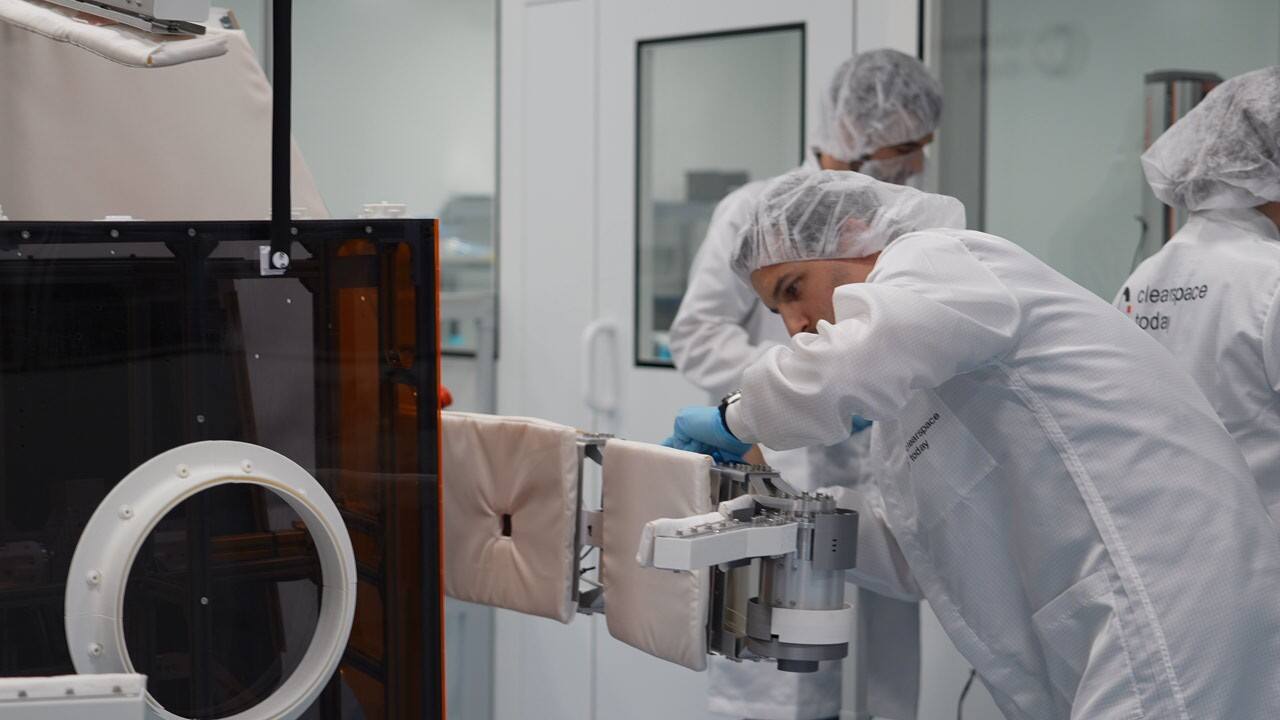
Section titled “What is being tried now”The capture system is four multi-degree-of-freedom robotic arms that enclose the client and secure it to the servicer with enough force to hold it through later stack maneuvers without damage [1], [11]. ClearSpace describes the product line behind it as a claw capture system with an agile robotic arm and end effector, contact dynamic simulation for on-orbit multi-body interaction, and embedded control for fully autonomous capture [12]. Enclosing the client, rather than grappling a fixture, matches a client with no cooperative interface.
Other capture families have been proposed or tested, none flown for debris removal:
- Nets, simulated only. A tether-net closing on target libraries that include Envisat, a Zenit-2 second stage and a scaled asteroid is nearly complete about 26 s after contact in multibody simulation, with no flight validation [5]. ClearSpace-1 instead uses a motion-synchronized approach and a multi-second phalange closure. A 2025 MuJoCo simulation of an active soft net with a thruster-equipped satellite at each corner captures Envisat in up to 100 percent of 200 static starts at 5 m, and success falls to 93.5 percent when the start moves to 10 m; it models no tether, plume impingement or real mesh [17].
- Dry adhesives, laboratory. Gecko-inspired microstructured adhesives reach adhesion above 1100 mN per square centimeter, measured on glass, which is not a representative debris surface [5].
- Soft grippers, laboratory. Tendon-actuated grippers layered as a TPU core, silicone structure, PTFE/PETG thermal shell and aerogel blanket double their grip force near -180 degrees C and halve it near 200 degrees C on the bench, with cumulative drift of 35 percent cold and 18 percent hot after thermal cycling [10].
- Surveys. A 2016 review sorts debris into four non-cooperativeness categories, maps robotic arm, net, harpoon, gripper, tentacle and contactless methods to them, and states that no debris had been removed as of 2015 [13]. A tutorial review covers ISS manipulator specifications from the SSRMS to Robonaut and argues that free-flyer manipulator control and the servicing demonstrators from ETS-VII to Orbital Express make space robotics mature enough for debris removal [6]. NASA’s 2025 assessment places debris removal inside the wider in-space servicing, assembly and manufacturing field [9].
Work on the guidance and estimation problems that a capture mission shares is at simulation stage:
- Multi-servicer docking with a tumbling target, simulated only. A decentralized six-degree-of-freedom model predictive controller for three servicers shows position error converging in about 20 to 25 s in a single 40 s MATLAB scenario, with no disturbances, sensor noise or Monte Carlo runs [18].
- Inertia identification, simulated only. An augmented unscented Kalman filter estimates relative pose and trace-normalized inertia of an Envisat-geometry target from rendered camera and LiDAR measurements. It recovers normalized inertia only, not absolute mass or inertia [19].
- Forced versus natural-motion proximity trajectories, simulated only. Forced circumnavigation is generally cheaper in delta-v than Clohessy-Wiltshire natural motion once maneuvers exceed 500 km, in a two-body model without J2 or drag [20].
Program history
Section titled “Program history”The program was contracted in 2019 with ClearSpace SA, a start-up from a team at the Ecole Polytechnique Federale de Lausanne [4]. Space19+ ministers had approved the service contract in late November 2019 [4]. The first target was the VESPA Vega secondary payload adapter of about 100 kg, left in an orbit of roughly 800 by 660 km by the second Vega flight in 2013. The servicer was to commission at 500 km and be raised from there, with launch planned for 2025 [4]. ESA and eight member states mandated the mission in 2020 to remove an ESA-owned derelict object [12].
The target was changed to PROBA-1 after a technical and programmatic review with ESA in April 2024, following a collision between VESPA and untraceable debris in 2023 [3]. OHB SE now leads the consortium and provides the bus, system integration and launch, while ClearSpace keeps close-proximity and capture operations [3], [11]. The new client is well characterized and ESA-owned. ESA still classes it as unprepared and uncooperative for mission purposes [11].
Specifications
Section titled “Specifications”Properties of the machine. Flight-specific figures are under Mission profile.
| Parameter | Value |
|---|---|
| Capture system | 4 multi-degree-of-freedom robotic arms |
| Capture method | arms enclose the client without contact, then close onto it |
| Client tumble rate the GNC is designed for | up to 3 deg/s |
| Platform | OHB Sweden InnoSat, COTS components |
| Platform attitude sensors and actuators | magnetorquers, gyros, star trackers, magnetometers, sun sensors, reaction wheels |
| Propulsion | full chemical system, 6 degree-of-freedom capable |
| Thruster layout | provides force-free torque and torque-free force |
| Propellant load | about 90 kg |
| Solar array | 6 body-fixed panels of about 1 m2 each, hexagonal layout, no drive mechanism |
| Rendezvous sensors | narrow-angle camera, ranging device, wide-angle camera |
| Downlink | S-band for housekeeping and selected images, X-band for rendezvous data |
| Spacecraft mass | under 1 t |
Source: [1].
The guidance, navigation and control function is split between platform and payload. The platform performs classical attitude and orbit control and orbital maneuvers; the payload performs the rendezvous and proximity operations GNC. Payload units are integrated on three dedicated panels so the payload can be integrated and tested independently of the platform before mating.
The solar array configuration is a consequence of two constraints acting together. A solar array drive mechanism does not demise on re-entry, so it was excluded, leaving body-fixed panels in plane with the bottom plate; and the payload sensors must point at the client while the client is well illuminated, which puts the arrays opposite the payload deck and means they are frequently off sun [1]. The array is therefore larger than a sun-pointing design would need. The equivalent constraint on the earlier VESPA baseline was handled in the close-proximity operations design by scheduling illumination-dependent phases against the go/no-go decision points [2].
The numbers
Section titled “The numbers”| Parameter | Value | Source |
|---|---|---|
| Client | PROBA-1 | |
| Client mass at launch | 94 kg | 95 kg in [11] |
| Client dimensions | 0.6 by 0.6 by 0.8 m | also given in [11] |
| Client launch date | 2001-10-22 | |
| Client orbit, predicted semi-major axis at encounter | 6900 to 6925 km | |
| Client orbit, predicted eccentricity | 0.0049 to 0.0058 | |
| Client orbit, inclination | 98 degrees | |
| Planned launch | 2028 | 2029 in [11] |
| Mission duration | 1 year | |
| Post-mission decay | uncontrolled, within 5 years | |
| Total mission delta-v | almost 300 m/s | |
| Capture rehearsals and attempts budgeted | 1 rehearsal, 3 attempts, 1 collision avoidance maneuver per attempt | |
| Launch vehicle class | European microlauncher, direct transfer to the client orbit |
Rows with no marker are from [1].
PROBA-1 was still operational in 2024, making it ESA’s longest-running operational satellite against a two-year design life, and it will be deactivated before capture regardless of its condition [1]. ESA classes it as unprepared and uncooperative for the purposes of this mission [11]. Its suitability as a client rests on being close to symmetric with no complex appendages, solar panels on five of six faces giving good reflectivity, and no propulsion system and therefore no residual propellant [1]. Its orbit at the time of the encounter is not known today because the propagation depends on solar activity over the intervening years, so a range of client orbits was computed for minimum and maximum solar activity [1].
The earlier VESPA baseline was the subject of a published close-proximity operations design and validation study, which covers client phasing, far rendezvous, close rendezvous and capture, and which defines the keep-out zone, the approach zone, the approach corridor and the go/no-go criteria used to assess passive safety [2]. That work notes that the full mission includes station keeping strategies and co-rotation capture strategies for high-angular-rate targets that the published simplification omits.
Concept of operations
Section titled “Concept of operations”Phasing ends with the servicer 30 km behind the client at the switch point, where control passes from the platform absolute navigation to the payload relative navigation, and three relative navigation regimes follow [1].
| Regime | Range | Sensing |
|---|---|---|
| Far range | 30 km to a few hundred meters | angles-only, narrow-angle optical camera |
| Mid range | a few hundred meters to 50 to 100 m | narrow-angle camera plus ranging device |
| Close range | from the initial proximity point to capture | wide-angle camera, pose estimation, continuous 6 degree-of-freedom control |
The far-range closing uses a passively safe impulsive guidance strategy on angles-only navigation in the visible spectrum. The PRISMA flight result is under What has flown. Fly-around orbits are established with the same guidance concept, augmented with range measurements to reduce the error in the relative navigation, and the client is observed and characterized during them.
Proximity maneuvering runs through waypoints, rehearsed incrementally, always returning to a sufficiently safe point: the formation keeping point, about 150 m along track and held on mid-range navigation [1]. The switch to close-range navigation cannot be made there, so the servicer hops to the initial proximity point, where the wide-angle camera initializes close-range navigation; after a go from ground it moves to the final approach point using motion synchronization to account for client rotation [1]. That sequence must run with the client illuminated and with ground contact, because ground supervises the approach and gives the final go. That ground-supervised concept is a design choice, not the only one: ELSA-d’s demonstrations instead ran with humans in the loop only for final approach, capture, departure and any first-time maneuver, over 16 ground stations seamed into 20 to 30 minute contacts [7]. Waypoint sequencing of this kind is what the published close-proximity operations method formalizes as approach-zone and keep-out-zone decision points [2].
The VESPA-baseline study sizes those zones and the margins the GNC holds against them [2]. The approach zone is a 1 km sphere around the client that may be entered only on a continuous, reliable onboard relative position estimate, separating the far-rendezvous closing from the client-phasing fly-around; entry is a ground-commanded go, verified by Monte Carlo runs in which no client-phasing trajectory entered it unintentionally. The keep-out zone is a 6 m sphere sized as the worst-case sum of servicer and client circumscribing radii plus a 50 percent margin, inside which the servicer holds the approach corridor under continuous 6-degree-of-freedom closed-loop control; entry is again a ground-commanded go, with the final go for capture autonomous [2]. Inside the keep-out zone the close rendezvous forced-motion guidance keeps an 80 percent control-authority margin over its nominal force and torque profile to absorb sloshing, flexible-appendage response, thruster misalignment and solar pressure, and exceeding that authority is itself an abort trigger [2].
A full rehearsal of the entire sequence without capture, including verification that the collision avoidance maneuver is correctly computed and triggered without firing the thrusters, is flown before the capture attempt; the servicer then returns to the formation keeping point and captures in the next proximity slot [1].
Capture
Section titled “Capture”At motion synchronization the servicer reaches a point at which the client is inside the volume of the opened arms. When the proximity trigger fires, the GNC switches off and the capture system starts closing its phalanges; the arms enclose the client without touching it, then contact it as they continue to close, and finally secure it against relative motion. The capture system has four functions: start closing at the right time, enclose the client without touching it so it cannot escape, absorb the contact loads without damaging client or servicer, and secure the client so its motion does not disturb the servicer attitude control. PROBA-1 can be captured from either of two opposite directions, on the launch adapter ring face or on the opposite face, which gives flexibility against illumination conditions, and the GNC is designed to capture it while it is uncooperative and tumbling at rates up to 3 deg/s. After capture the stack detumbles and the new configuration is characterized, after which the platform attitude control, sized to control the full stack, takes over [1]. Capture runs fully autonomously, with selected images and all housekeeping data downlinked over S-band during it, which is also how ClearSpace describes the capability it is building [12].
The abort corridor that governs this approach runs from keep-out-zone entry to the point of no return only; beyond that point an abort can no longer be triggered, and near it the gentler cancel maneuver is judged unsafe, so a corridor violation in that vicinity escalates straight to an abort. Passive safety by relative eccentricity and inclination vector separation cannot be guaranteed at all this close in, so fault detection, isolation and recovery carries the safety case instead [2].
Safety and design constraints
Section titled “Safety and design constraints”Two requirements dominate the design: re-entry safety and the prohibition on creating further debris, both of them ESA requirements rather than mission choices [1], [11].
Re-entry casualty risk must be below 1e-4 [1]. A controlled re-entry would require DAL A software development standards and a redundancy concept covering everything involved, which does not fit the design-to-cost approach, so an uncontrolled re-entry was selected early and the vehicle is designed to demise. The consequences are direct: tanks do not demise, so the design follows a maximum tank count or propellant mass approach; solar array drive mechanisms do not demise, so body-fixed panels and a more complex concept of operations were adopted; and non-demisable materials are avoided across the design.
Keep-out zone geometry, approach corridor and go/no-go criteria are the formal apparatus by which that prohibition is turned into trajectory constraints [2]. Collision avoidance is the second driver: in naturally stable orbits there is no collision risk, but close approach puts the servicer on trajectories that would collide if not actively controlled, so a collision avoidance maneuver breaks the formation and must move the servicer to a position that is passively safe for at least seven days. Recovering from one requires restarting the whole rendezvous approach, and one maneuver plus the return to a capture attempt takes more than 10 percent of total mission delta-v [1].
ESA states the mission demands highly precise close proximity operations [11]. The named engineering constraints on the servicer are high power draw during capture from running the capture mechanisms and proximity sensors in parallel, the client pointing required for optical observation constraining the orientation relative to the sun, high delta-v demand for nominal maneuvers and collision avoidance provisions, accommodation of a large payload whose capture system geometry sets the size of the spacecraft, and the demise requirement [1]. The uncontrolled decay this mission designs for is a stricter, mission-level choice than the general post-mission disposal norm for debris mitigation, which asks only that an orbit clear the protected region within a set span after passivation [5].
Avionics
Section titled “Avionics”Platform avionics hardware, flight software, fault detection isolation and recovery, and the attitude and orbit control system are InnoSat reuse, with minor additions to the control system for the added complexity of this mission. InnoSat components are commercial off-the-shelf parts selected under a design-to-cost approach. Four InnoSat-based satellites were in orbit at the time of the design review with nine more expected within two years, and the catalog components have flight heritage outside the InnoSat program.
Status
Section titled “Status”The mission passed its system requirements review and entered phase B2 to conclude the preliminary design [1]. Launch is expected in 2028 according to the design paper; the ESA program page gives 2029 [11]. ESA’s 2019 announcement of the contract gave a 2025 launch against the VESPA target [4], so the schedule has moved by three to four years across the target change.
Technologies developed
Section titled “Technologies developed”The mission is intended to produce a versatile capture system able to take objects of several shapes and sizes with minimal modification, which is the condition for active debris removal to work commercially under a design-to-cost approach. The close-proximity operations framework developed around it, covering keep-out zone and approach corridor definition, go/no-go criteria, passive safety assessment and active safety strategies, is published as a contribution towards standardizing non-cooperative rendezvous [2]. That framework was validated by model-in-the-loop Monte Carlo campaigns run across a prototyping simulator and a high-fidelity simulator [2]. ESA lists the mission as its first to remove a piece of space debris from orbit [11], and ClearSpace presents it as the reference mission for its in-orbit servicing line [12].
What is not established
Section titled “What is not established”CNES put the need at about five large objects removed per year to stabilize the environment [14]; that figure is a model output from a 2012 review and predates ClearSpace-1. The same review names non-cooperative tumbling-target rendezvous and capture as the undemonstrated functions [14], and the 2016 survey notes that no debris had been removed by 2015 and that its comparison is qualitative [13]. The PRISMA flight client was a 1 m class object not tumbling, so the angles-only result does not cover a rotating unknown target [15]. The ADRAS-J abort is reported only in an operator release, without telemetry or a cause for the attitude anomaly [16].
One document, the 2025 ESA Space Debris Conference paper by the OHB, ESA and ClearSpace design team, carries most of the engineering content here [1]. No other open publication describes the servicer or its capture system at that level. The close-proximity operations study [2] predates the target change and is written for the VESPA baseline. Mass, power, joint-level arm design, actuator specification, sensor part numbers and thermal ranges are not published anywhere obtained. The ESA and ClearSpace web pages carry no capture force, GNC accuracy, delta-v or chaser mass figures [11], [12], and the launch date has moved from 2025 to 2028 or 2029 [4], [11]. No source held reports a test of the capture system on PROBA-1-like hardware; the design paper points to a planned assembly, integration and test campaign [1].
References
- Woicke, S., Jipp, J., Steimle, C., Pokrupa, N. and Metrailler, L. (2025). ADRIOS ClearSpace-1: In orbit demonstration of the removal of a non-cooperative spacecraft
. European Conference on Space Debris. Source
BibTeX
@inproceedings{woicke2025adrios, title = {ADRIOS ClearSpace-1: In orbit demonstration of the removal of a non-cooperative spacecraft}, author = {Woicke, Svenja and Jipp, Jimmy and Steimle, Christian and Pokrupa, Nils and Metrailler, Lionel}, booktitle = {European Conference on Space Debris}, organization = {ESA Space Debris Office}, year = {2025}, url = {https://conference.sdo.esoc.esa.int/proceedings/sdc9/paper/104} } - Vasconcelos, J., Gaggi, S., Amaral, T., Bakouche, C., Cotuna, A. and Friaças, A. (2025). Close-Proximity Operations Design, Analysis, and Validation for Non-Cooperative Targets with an Application to the ClearSpace-1 Mission
. Aerospace, 1. Source
BibTeX
@article{vasconcelos2025close, title = {Close-Proximity Operations Design, Analysis, and Validation for Non-Cooperative Targets with an Application to the ClearSpace-1 Mission}, author = {Vasconcelos, José and Gaggi, Serena and Amaral, Tiago and Bakouche, Charles and Cotuna, Adina and Friaças, Ana}, journal = {Aerospace}, volume = {12}, number = {1}, pages = {67}, year = {2025}, doi = {10.3390/aerospace12010067}, abstract = {This paper addresses the design, analysis, and validation of safe close-proximity operations around uncooperative targets, with an application to the ClearSpace-1 (CS-1) mission. It is focused on the areas of Guidance, Navigation, and Control (GNC), and Mission Analysis, due to their criticality for the success and safety of this kind of operation. The relevance of the concepts, of the GNC solutions, and their validation is demonstrated for the case study of CS-1, a reference mission for the rendezvous, capture, and de-orbiting of an uncooperative target (i.e., the VESPA payload adapter). It is shown how the design approach can be adopted for the Concept of Operations of CS-1, covering the definition of keep-out zones, corridors, and GO/NO GO criteria, for assessing the passive safety of trajectories, and for the incorporation of active safety strategies. The analysis is adopted for functional chains such as the Navigation and Control, and the combination of a prototyping and a high-fidelity simulator is adopted for directed Model-in-the-Loop Monte-Carlo campaigns. The outcomes are intended to support the industry in the development of Close-Proximity Operations similar to that of CS-1. These can be adopted in a wide variety of missions, including Active Debris Removal and In-Orbit Servicing. In particular, the adopted concepts are a key contribution to the standardization of Close-Proximity Operations for non-cooperative rendezvous missions, and act towards a sustainable and safe commercial application.} } - Weltman, A. (2024). ClearSpace-1 Mission Changes Objective in Response to Space Debris Collision. satellitetoday.com/sustainability/2024/04/24/clearspace-1-mission-cha...
BibTeX
@misc{weltman2024clearspace1, title = {ClearSpace-1 Mission Changes Objective in Response to Space Debris Collision}, author = {Weltman, Abbey}, organization = {Via Satellite}, year = {2024}, url = {https://www.satellitetoday.com/sustainability/2024/04/24/clearspace-1-mission-changes-objective-in-response-to-space-debris-collision/} } - European Space Agency. (2019). ESA commissions world's first space debris removal. esa.int/Space_Safety/Clean_Space/ESA_commissions_world_s_first_space_...
BibTeX
@misc{esa2019commissions, title = {ESA commissions world's first space debris removal}, author = {{European Space Agency}}, year = {2019}, url = {https://www.esa.int/Space_Safety/Clean_Space/ESA_commissions_world_s_first_space_debris_removal} } - Bigdeli, M., Srivastava, R. and Scaraggi, M. (2025). Mechanics of Space Debris Removal: A Review
. Aerospace, 4. Source
BibTeX
@article{bigdeli2025mechanics, title = {Mechanics of Space Debris Removal: A Review}, author = {Bigdeli, Mohammad and Srivastava, Rajat and Scaraggi, Michele}, journal = {Aerospace}, volume = {12}, number = {4}, pages = {277}, year = {2025}, doi = {10.3390/aerospace12040277}, abstract = {The growing population of space debris poses a critical risk to space operations, requiring urgent removal strategies. Numerous scientific investigations have focused on debris capture mechanisms in Earth’s orbits, including contact and contact-less capturing methods. However, the known debris population exhibits a multiscale distribution with broad statistics concerning size, shape, etc., making any general-purpose removal approach challenging. This review examines the mechanics of debris detection, capture, and mitigation, analyzing contact-based and contactless removal techniques. Special focus is given to net capturing methods and their mechanical limitations.We also aim to provide comprehensive discussion, beginning with an overview of current debris statistics followed by detection and removal methods, by analyzing key mechanical parameters relevant to removal. Therefore, we delve into the key parameters essential for the engineering of novel debris removal technologies. Finally, we discuss the preventive measures, regulative frameworks and future research directions.} } - Ellery, A. (2019). Tutorial Review on Space Manipulators for Space Debris Mitigation
. Robotics, 2. Source
BibTeX
@article{ellery2019tutorial, title = {Tutorial Review on Space Manipulators for Space Debris Mitigation}, author = {Ellery, Alex}, journal = {Robotics}, volume = {8}, number = {2}, pages = {34}, year = {2019}, doi = {10.3390/robotics8020034}, abstract = {Space-based manipulators have traditionally been tasked with robotic on-orbit servicing or assembly functions, but active debris removal has become a more urgent application. We present a much-needed tutorial review of many of the robotics aspects of active debris removal informed by activities in on-orbit servicing. We begin with a cursory review of on-orbit servicing manipulators followed by a short review on the space debris problem. Following brief consideration of the time delay problems in teleoperation, the meat of the paper explores the field of space robotics regarding the kinematics, dynamics and control of manipulators mounted onto spacecraft. The core of the issue concerns the spacecraft mounting which reacts in response to the motion of the manipulator. We favour the implementation of spacecraft attitude stabilisation to ease some of the computational issues that will become critical as increasing level of autonomy are implemented. We review issues concerned with physical manipulation and the problem of multiple arm operations. We conclude that space robotics is well-developed and sufficiently mature to tackling tasks such as active debris removal.} } - Fujii, G., Iizuka, S., Belle, C. and Muktoyuk, M. (2021). The World's First Commercial Debris Removal Demonstration Mission
. Annual Small Satellite Conference, SSC21-II-09. Source
BibTeX
@inproceedings{fujii2021world, title = {The World's First Commercial Debris Removal Demonstration Mission}, author = {Fujii, Gene and Iizuka, Seita and Belle, Carolyn and Muktoyuk, Mark}, booktitle = {Annual Small Satellite Conference}, number = {SSC21-II-09}, year = {2021}, url = {https://digitalcommons.usu.edu/smallsat/2021/all2021/145/} } - Krebs, G. D. (2026). ADRAS-J. space.skyrocket.de/doc_sdat/adras-j.htm
BibTeX
@misc{krebsadrasj, title = {ADRAS-J}, author = {Krebs, Gunter D.}, organization = {Gunter's Space Page}, year = {2026}, url = {https://space.skyrocket.de/doc_sdat/adras-j.htm} } - Mulvaney, J., Arney, D., Williams, C., Morel, J., Stockdale, C., Whitlock, C. and Balaji, V. (2025). In-Space Servicing, Assembly, and Manufacturing (ISAM) State of Play, 2025 Edition
. NASA, 20250008988. Source
BibTeX
@techreport{nasa2025space, title = {In-Space Servicing, Assembly, and Manufacturing (ISAM) State of Play, 2025 Edition}, author = {Mulvaney, John and Arney, Dale and Williams, Christina and Morel, Jose and Stockdale, Christopher and Whitlock, Christopher and Balaji, Vishruth}, number = {20250008988}, institution = {NASA}, year = {2025}, url = {https://ntrs.nasa.gov/citations/20250008988}, abstract = {The future of spaceflight will yield increasingly more ambitious missions to support civil, national security, and commercial space sectors. Achieving some of these missions will not be feasible by launching an integrated, fully functioning system on a single launch vehicle. Future science and human exploration missions will require payloads that are larger than any foreseeable launch vehicle fairing, national security missions will require persistent assets that are mobile and resilient, and commercial space missions will require cost-effective ways to update to the latest technology on orbit. In-space Servicing, Assembly, and Manufacturing (ISAM) can vastly expand the performance, availability, and lifetime of space systems compared to the traditional paradigm of launching an asset with no intent to ever interact with it again. ISAM capabilities foster an ecosystem that changes the space operations paradigm, creating the foundation for sustainable exploration and serving as a multiplier for other capabilities like space logistics, power generation, and reusability. Previous achievements in ISAM have enabled ambitious human and robotic space missions. The assembly, operation, and maintenance of NASA’s International Space Station (ISS); servicing missions to the Hubble Space Telescope (HST); and Northrop Grumman’s Mission Extension Vehicle (MEV) demonstrate the dramatic operational missions that can be achieved using ISAM capabilities. Many current and upcoming flight demonstrations are advancing areas that will enable the next generation of civil, national security, and commercial space missions. This document describes the current state of ISAM missions, activities, and technologiesto the best ability of the authors. Compiling and organizing the available ISAM capabilities will help mission designers incorporate ISAM technologies into their concepts, create the starting point for technology development plans and roadmaps, and provide technologists a survey of the field they are developing. This document divides the ISAM capabilities into 11 functional capability areas that describe the functions or activities that can be performed in space using ISAM.} } - Ruiz, F., Arrue, B. and Ollero, A. (2023). Thermally-Resilient Soft Gripper for On-Orbit Operations
. IEEE/RSJ International Conference on Intelligent Robots and Systems. Source
BibTeX
@inproceedings{ruiz2023thermally, title = {Thermally-Resilient Soft Gripper for On-Orbit Operations}, author = {Ruiz, Fernando and Arrue, Begona and Ollero, Anibal}, booktitle = {IEEE/RSJ International Conference on Intelligent Robots and Systems}, pages = {14050-14055}, year = {2023}, doi = {10.1109/iros58592.2024.10801537}, abstract = {Research in soft manipulators has significantly enhanced object grasping capabilities, thanks to their adaptability to various shapes and sizes. Applying this technology to on-orbit servicing, especially during the capture and containment stages of active space debris removal missions, might offer a secure, adaptable, and cost-effective solution compared to the trend of increasing the degrees of freedom and complexity of the manipulator (e.g. ClearSpace, Astroscale). This work aims to conduct an experimental proof of concept, for which challenges such as radiation, vacuum, and microgravity are significant, but the predominant issue is ensuring effective operation in the extreme temperature swings, where flexible materials may exhibit cryogenic crystallization or drastic shifts in their elasticity. This work addresses this challenge through an initial stage of analytical modeling of the thermal dynamics inside the manipulator in orbit; which is then used for the development of a first multi-layered experimental prototype (leveraging the properties of TPU, silicone, PTFE and aerogel) tested with liquid nitrogen and heat guns. The tendon-actuated servo-driven gripper is tested in the laboratory by varying the shape and size of objects during the grasping. The results, based on servomotor force metrics to assess the flexible manipulator’s adaptability and object capture efficiency across temperature changes, affirm the concept’s viability. Forces increase up to 220% in cryogenic conditions and decrease by no more than 50% at high temperatures.} } - (2026). ESA: ClearSpace-1. esa.int/Space_Safety/ClearSpace-1
BibTeX
@misc{esaclearspace, title = {ESA: ClearSpace-1}, organization = {esa.int}, year = {2026}, url = {https://www.esa.int/Space_Safety/ClearSpace-1} } - (2026). ClearSpace: ClearSpace-1. clearspace.today/missions/clearspace-1
BibTeX
@misc{clearspaceclearspace,
  title = {ClearSpace: ClearSpace-1},
  organization = {clearspace.today},
  year = {2026},
  url = {https://clearspace.today/missions/clearspace-1}
}