Mission Extension Vehicle 1
Program pages Northrop Grumman: Mission Extension Vehicle
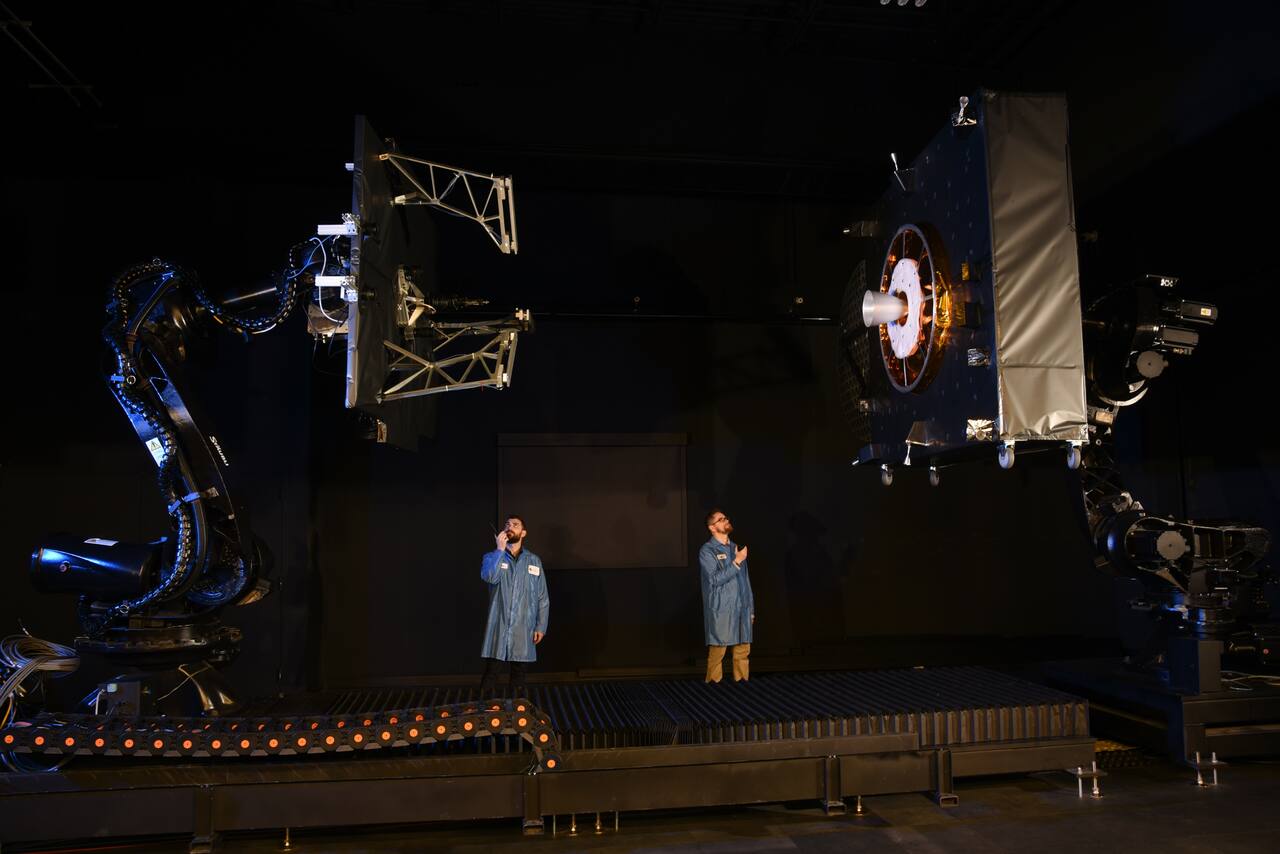 Northrop Grumman / SpaceLogistics.
Overview
Section titled “Overview”A geostationary communications satellite that has burned its station-keeping propellant is otherwise still functional: its transponders, solar arrays and structure can outlast the fuel by years. The Mission Extension Vehicle docks to such a satellite and takes over its station-keeping and pointing, extending service life without repairing or refuelling the client at all. On-orbit servicing of a satellite never designed to be serviced has been a research goal since at least the early 2000s, pursued through free-flying and free-floating manipulator concepts, target motion estimation and non-cooperative capture strategies [10], and MEV-1 is the vehicle that turned that literature into a paying commercial service.
Two things distinguish the vehicle from the research programs that preceded it: a docking system that mates to a client never fitted with a berthing target or grapple fixture, and a rendezvous and proximity operations sensor suite built on Northrop Grumman’s Cygnus heritage, adapted from a resupply mission flown against a cooperative ISS target to one flown against a client carrying no retroreflectors and no relative GPS [1], [6]. SpaceLogistics describes itself as the first and only company to have performed on-orbit servicing of a commercial satellite [8].
Specifications
Section titled “Specifications”| Parameter | Value |
|---|---|
| Client docking interface | liquid apogee engine nozzle and launch adapter ring, present on about 80 percent of GEO satellites |
| Client detection range | more than 50 km |
| Relative position accuracy at docking | centimeter level |
| Visible sensor, 400 to 900 nm | detection beyond 30 km, narrow-field pair |
| Long-wave infrared sensor, 8 to 14 um uncooled microbolometer | detection beyond 10 km, narrow-field pair |
| Scanning lidar, Jena-Optronik RVS3000-3D | tracking beyond 2 km |
| Visible cameras | 6, in three pairs |
| Infrared cameras | 4, in two pairs |
| Radiation hardening | GEO belt, 15 year lidar design life |
| Client function assumed after docking | station-keeping and pointing, client propulsion and attitude control disabled |
Source: [1].
Mission profile
Section titled “Mission profile”| Parameter | Value | Source |
|---|---|---|
| Launch | 2019 | [1] |
| First client | Intelsat IS-901, docked 25 February 2020 in the GEO graveyard, about 300 km above the belt | [1], [3], [8] |
| First service duration | five years, completed April 2025 | [8] |
| Second client | docked May 2025 | [8] |
The program page is more current than the retrieved literature. The papers record the vehicle as operating with its original client as of 2022 [4], whereas the five-year IS-901 service ended in April 2025 and MEV-1 moved to a second client the following month [8]. A second vehicle of the same design, MEV-2, docked with a different Intelsat satellite in 2021 [8]. Both dockings are vendor-reported milestones; nothing in the technical literature independently verifies orbital state, service duration or client health after handover [1], [5].
Docking
Section titled “Docking”Rendezvous is semi-autonomous, and docking uses two features present on approximately 80 percent of all GEO satellites: the zenith-facing liquid apogee engine nozzle and the launch adapter ring surrounding it [1]. After docking, the client’s propulsion and attitude control are disabled entirely and MEV assumes full responsibility for client pointing and orbit management. The service is therefore applicable where a client is still functional but has lost the ability to modify its own orbit [1]. No modification, fixture or cooperation is required of the client, a property the vendor’s own literature calls a simple mechanical docking system compatible with nearly 80 percent of the on-orbit GEO fleet, without stating the assumption about apogee engine geometry that figure depends on [5].
That an unprepared client can be captured at all is itself the outcome of a design choice made before MEV: the alternative pursued by government-funded programs of the same period, DARPA’s Robotic Servicing of Geosynchronous Satellites, aimed instead at a dexterous arm able to grip whatever hardware a client happens to expose, and NASA’s parallel OSAM-1 mission aimed at refuelling a legacy fill-and-drain valve never intended for on-orbit access [6], [7]. MEV’s narrower approach, one interface shared by most of the GEO fleet rather than a general capability, reached an operating commercial vehicle years before either alternative reached flight.
Rendezvous sensors
Section titled “Rendezvous sensors”The suite tracks a client from more than 50 km and holds centimeter-level relative position through docking [1]. The visible complement is six cameras in three pairs: two narrow-field for long-range detection and tracking, two wide-field for close-range navigation and inspection, and a second wide-field pair positioned as docking cameras. The infrared complement is four cameras in two pairs on the same split. Narrow-field optics in both bands are fixed focus and fixed aperture, optimized for long-range resolving, so the approach is flown as a handover from narrow to wide field during the terminal phase. Long-range tracking works with the client resolved only at the sub-pixel level [1].
MEV-1 flew the first operational use of the RVS3000-3D, a scanning lidar designed for a 15 year GEO lifetime [1]. Against its ISS-approach heritage configuration it adds a laser amplification stage and reduces beam divergence, both to maximize return energy from a target carrying no corner-cube retroreflectors. At more than 2 km the raw single-scan point cloud resolves the client’s structure well enough that the centroid of the returns gives a consistent three-degree-of-freedom position solution, and inside 60 m the same instrument switches to a full six-degree-of-freedom solution with model overlay, then produces millimeter-precision structural inspection scans at close hold [1].
The vendor’s successor vehicle, the Mission Robotic Vehicle, has since been proposed as a secondary space domain awareness sensor: idle between the roughly four-week servicing calls it makes a few times a year, its long-range cameras are modeled to detect a 1 square meter object near 600 km and a 3 square meter object near 1800 km from the in-track direction, an aspect angle ground-based sensors cover poorly [2]. That proposal is a model run against a vehicle that had not yet launched; the only on-orbit evidence offered for it is qualitative, unresolved objects visible incidentally in a single MEV-2 frame, not a measured detection or tracking performance [2].
Client environment
Section titled “Client environment”A client has typically been in active GEO service for at least 15 years before an MEV arrives [1], so the surfaces the sensors image and the mechanism grips have accumulated that much thermal cycling, ultraviolet and charged-particle exposure. Sensor development included retrieving a decommissioned bus from the GEO graveyard, setting it up in the laboratory and running full optical characterization against it [1].
Geostationary orbit is also where NASA’s internal, deep-dielectric charging design rule matters most: electrons that penetrate a spacecraft’s shell and discharge directly into a circuit are screened against a threshold of 2e10 electrons per square centimeter accumulated over any 10-hour window, a figure derived from CRRES-era anomaly data and originally paired with 110 mils of grounded aluminum shielding for a geosynchronous orbit [12]. The current revision of that same handbook raises the recommended shielding to 130 mils and notes that more recent in-orbit anomaly studies on thinner-walled spacecraft argue for a flux limit ten times lower than the criterion the handbook itself still retains, a gap the guidance flags without resolving [9]. Two vehicles at different floating surface potentials making first mechanical contact, as MEV does at every docking, is a harder charging problem at GEO than the equivalent contact would be at low Earth orbit, where the plasma is cooler and denser and the resulting potentials are smaller [9].
Successors
Section titled “Successors”The Mission Robotic Vehicle replaces the MEV docking system with a dexterous robotic arm and installs Mission Extension Pods on client satellites, so the servicer does not remain docked for the duration of the service [3]. The arm is credited in the retrieved literature to DARPA-developed robotic manipulators generally [3], while the vendor’s own program page names it specifically as a single seven-degree-of-freedom Flight Robotic Arm System, RAS-1, built by the US Naval Research Laboratory under the DARPA RSGS program and exercised in a ground test campaign the vendor calls Gauntlet, without publishing reach, force or precision figures for it [8]. MRV is designed to rendezvous with dozens of clients over a mission life of more than 10 years, its brief docking sequences separated by long drift phases spent phasing between GEO slots [2]. A pod launches as a commercial rideshare, flies itself to GEO, and once installed gives its host roughly 6 years of extended station-keeping on electric propulsion, according to the vendor [8]. The retrieved literature scheduled MRV for launch in 2024 [3]; the program page instead gives 21 July 2026 from Cape Canaveral on a Falcon 9, with three Mission Extension Pods to follow that summer [8]. The associated Passive Refueling Module is described by the vendor as the first refuelling interface standard approved by the US Space Force [8], a claim with no independent source to check it against.
That schedule slip sits inside a broader pattern in NASA-funded servicing programs of the same period. OSAM-1, the government’s parallel effort to refuel a legacy Landsat 7 valve never built for servicing, ran from a 2015 start as RESTORE-L, forecast at under 750 million dollars with a 2020 launch, to cancellation in 2024 after spending about 1.4 billion dollars against a 2.38 billion dollar estimate at completion and a 70 percent confidence launch date seven to eight years late [7]. The review board that ended it judged refuelling an unprepared legacy valve to be of limited value to a market that now expects future spacecraft to carry purpose built refuelling interfaces instead, the approach MEV’s own docking method and the Passive Refueling Module both represent [5], [8]. The same review traces the industry’s preference for wide-field, near-omnidirectional rendezvous sensing, a requirement MRV’s camera suite reflects, to the 2007 Orbital Express anomaly, in which a corrupted relative navigation filter let two docked vehicles separate unexpectedly by as much as 6 km and operators had to locate them again using ground-based observation [7].
Precedents and comparable systems
Section titled “Precedents and comparable systems”Relative motion for any rendezvous rests on the linearized equations of Clohessy and Wiltshire, which describe a chaser near a target in circular orbit in closed form and underlie later proximity operations guidance [15]. Mechanical capture precedents split by how much the client contributes. The Apollo probe and drogue system was designed for axial closing velocities of 0.1 to 1.0 ft/s at first contact, and crew estimates for Apollo 9 give 0.3 ft/s, though that table is crew judgment, not telemetry [14]. The Orbital Express capture mechanism flew in 2007 with a design envelope of 15 cm axial, plus or minus 5 cm lateral, plus or minus 5 degrees in each angle and 3 cm/s contact velocity, closing on a preload of 11250 N [13]. Both were mated to a client built to receive them, and the Orbital Express passive half was always held inside a station-keeping envelope, so neither bounds capture of an uncooperative client [13], [14].
Commercial debris-removal demonstrators approach the unprepared-client problem from the other side. Astroscale’s ELSA-d released and magnetically recaptured its client on 25 August 2021, a demonstration of capture against a client fitted with a docking plate, and the autonomous capture attempts that followed were abandoned after spacecraft anomalies [17]. ADRAS-J closed to roughly 15 m from an unprepared H-IIA upper stage on 11 December 2024 and aborted autonomously after an unexpected relative attitude anomaly on the target, before reaching the capture initiation point [16]. Both are operator press releases with no accuracy figures. Ground facilities that reproduce this regime, from the Langley rendezvous docking simulator to the ESTEC flat floor with three simulated degrees of freedom, are surveyed in [18]; the survey does not assess which can reproduce contact dynamics.
Related work
Section titled “Related work”The docking accuracy MEV achieves against an uncooperative target is not unique to GEO-scale servicers. Ground and reduced-gravity testing of a small free-flyer docking port built for the SPHERES testbed found that capture requires better than 1 cm of linear and 2 degrees of angular error immediately before contact, with reliable capture only below about 1 cm per second of approach velocity, figures obtained on a flat floor and a parabolic flight campaign rather than in orbit [11]. That a centimeter-class accuracy budget recurs at a very different vehicle scale suggests it is closer to a property of rigid mechanical capture generally than one specific to MEV’s own mechanism. Capture mechanisms that dispense with a prebuilt docking target altogether, such as the Nautilus mechanism flown on the much smaller Starfish Otter tug, represent a further step past both approaches, trading MEV’s reliance on a standard interface for a generalized capacity to grip client hardware that was never designed to be gripped [3].
Approaches under development
Section titled “Approaches under development”None of the following has flown on a commercial GEO servicer; each is placed by its evidence class.
Capture tools for the launch adapter ring. The ring MEV engages is also the target of a ground-tested capture tool from Harbin Institute of Technology: a direct-drive, two-finger prototype of 5.85 kg with an electromagnetic brake, whose capture tolerance, constraint force and constraint torque were checked on an air-bearing target simulator driven by a robot arm [19]. It is a bench result, not a flight article.
Capture and detumble control. A coupled optimal-control scheme for a free-flying manipulator removes contact impact by requiring zero relative velocity at the grapple point and bounds the torque applied through the arm while stopping a tumbling client [20]. It is simulation only and assumes the client’s inertial parameters are known [20]. Visual servoing for manipulator servicing is surveyed for the recognition, approach and contact phases; most reviewed validation is simulation or software-in-the-loop, and the survey reports no numeric performance figures [23]. Flexible and contact-based removal, including nets and harpoons, is reviewed from the contact-mechanics side, with net capture results from simulation and most methods never flown [26].
Debris-removal demonstrators. ADRAS-J held a fixed relative position of about 50 m for fly-around imaging of an unprepared upper stage of roughly 11 m length, 4 m diameter and 3 tons with no servicing provisions, in July 2024 [25], ahead of the 15 m approach reported in [16]. ADRIOS ClearSpace-1 is a design: a ladder of reversible approach steps to a 94 kg PROBA-1 client, with launch expected at the end of 2028 and no measured performance [22].
Mechanical capture hardware. The flown Orbital Express capture system is specified at 6 in axial capture distance, plus or minus 5 degrees angular misalignment and 3 cm/s contact velocity, from a vendor datasheet with no supporting test data [24].
Fleet-level mission design. Minimum-fuel servicing of a sparse GEO constellation, one servicer and five clients 60 degrees apart, finds that third-body effects set the optimal transfer durations while the J22 tesseral term is needed for rendezvous accuracy [21]. This is analysis, and bears on the phasing drifts MRV is designed around [2].
What is not established
Section titled “What is not established”Every performance figure specific to MEV-1’s docking and sensing, the 80 percent GEO fleet compatibility, the 15-year service life, and the docking success record itself, comes from the vehicle’s manufacturer, either as a vendor fact sheet or as a conference paper written by SpaceLogistics engineers; none of it has been independently measured or audited [1], [5], [8]. The manufacturer’s own performance paper gives no navigation accuracy, no covariance and no detection probability as a function of range or phase angle, only thresholds exceeded, and covers only two client vehicles, both large cooperative-geometry comsats in generally favorable illumination [1]. The proposed use of the Mission Robotic Vehicle as a space domain awareness sensor rests on a signature model, not a flight measurement [2]. MRV’s own schedule and arm design are stated differently by the retrieved catalog literature and by the vendor’s current program page, and the more recent of the two has not been checked against an independent source [3], [8]. Everything drawn from NASA’s internal-charging design handbooks describes the general GEO environment MEV operates in, not any measurement made on the vehicle itself, and both handbook editions flag their own central charging criterion as unresolved against more recent anomaly data [9], [12].
References
- Pyrak, M. and Anderson, J. (2021). Performance of Northrop Grumman's Mission Extension Vehicle (MEV) RPO Imagers at GEO
. Autonomous Systems: Sensors, Processing and Security for Ground, Air, Sea and Space Vehicles and Infrastructure. Source
BibTeX
@inproceedings{pyrak2021performance, title = {Performance of Northrop Grumman's Mission Extension Vehicle (MEV) RPO Imagers at GEO}, author = {Pyrak, Michael and Anderson, Joe}, booktitle = {Autonomous Systems: Sensors, Processing and Security for Ground, Air, Sea and Space Vehicles and Infrastructure}, pages = {28}, year = {2021}, doi = {10.1117/12.2631524}, abstract = {This paper will describe and illustrate the real-life performance of the Rendezvous and Proximity Operations (RPO) sensors used by Space Logistics LLC’s Mission Extension Vehicles (MEV) built by Northrop Grumman. MEV-1 launched in 2019 and performed rendezvous, proximity operations, and docking (RPOD) with the Intelsat 901 satellite in the GEO graveyard orbit approximately 300km above GEO in February of 2020. MEV-2 launched in 2020 and performed a similar RPOD sequence with the Intelsat 10-02 satellite directly in geostationary orbit in February and March of 2021. These vehicles use three dissimilar sensing phenomenologies to provide all required relative navigational data to enable the above RPOD capabilities. These include visible spectrum imagers (narrow and wide field of view), long wave infrared (LWIR) imagers (narrow and wide field of view), and active scanning LIDAR. This paper will explore the performance of each of these sensors during these real-life missions at GEO and potential implications for future Space Situational Awareness capabilities.} } - Pyrak, M. and Duden, Q. (2022). Use of a Commercial GEO Servicing Vehicle for Space Domain Awareness Data Collection
. Advanced Maui Optical and Space Surveillance Technologies Conference. Source
BibTeX
@inproceedings{pyrak2022use, title = {Use of a Commercial GEO Servicing Vehicle for Space Domain Awareness Data Collection}, author = {Pyrak, Matt and Duden, Quenten}, booktitle = {Advanced Maui Optical and Space Surveillance Technologies Conference}, year = {2022}, url = {https://amostech.com/TechnicalPapers/2022/Poster/Pyrak.pdf} } - Mulvaney, J., Arney, D., Williams, C., Morel, J., Stockdale, C., Whitlock, C. and Balaji, V. (2025). In-Space Servicing, Assembly, and Manufacturing (ISAM) State of Play, 2025 Edition
. NASA, 20250008988. Source
BibTeX
@techreport{nasa2025space, title = {In-Space Servicing, Assembly, and Manufacturing (ISAM) State of Play, 2025 Edition}, author = {Mulvaney, John and Arney, Dale and Williams, Christina and Morel, Jose and Stockdale, Christopher and Whitlock, Christopher and Balaji, Vishruth}, number = {20250008988}, institution = {NASA}, year = {2025}, url = {https://ntrs.nasa.gov/citations/20250008988}, abstract = {The future of spaceflight will yield increasingly more ambitious missions to support civil, national security, and commercial space sectors. Achieving some of these missions will not be feasible by launching an integrated, fully functioning system on a single launch vehicle. Future science and human exploration missions will require payloads that are larger than any foreseeable launch vehicle fairing, national security missions will require persistent assets that are mobile and resilient, and commercial space missions will require cost-effective ways to update to the latest technology on orbit. In-space Servicing, Assembly, and Manufacturing (ISAM) can vastly expand the performance, availability, and lifetime of space systems compared to the traditional paradigm of launching an asset with no intent to ever interact with it again. ISAM capabilities foster an ecosystem that changes the space operations paradigm, creating the foundation for sustainable exploration and serving as a multiplier for other capabilities like space logistics, power generation, and reusability. Previous achievements in ISAM have enabled ambitious human and robotic space missions. The assembly, operation, and maintenance of NASA’s International Space Station (ISS); servicing missions to the Hubble Space Telescope (HST); and Northrop Grumman’s Mission Extension Vehicle (MEV) demonstrate the dramatic operational missions that can be achieved using ISAM capabilities. Many current and upcoming flight demonstrations are advancing areas that will enable the next generation of civil, national security, and commercial space missions. This document describes the current state of ISAM missions, activities, and technologiesto the best ability of the authors. Compiling and organizing the available ISAM capabilities will help mission designers incorporate ISAM technologies into their concepts, create the starting point for technology development plans and roadmaps, and provide technologists a survey of the field they are developing. This document divides the ISAM capabilities into 11 functional capability areas that describe the functions or activities that can be performed in space using ISAM.} } - Arney, D., Mulvaney, J., Williams, C., Sutherland, R. and Stockdale, C. (2022). In-Space Servicing, Assembly, and Manufacturing (ISAM) State of Play, 2022 Edition
. NASA, 20220010995. Source
BibTeX
@techreport{nasa2022space, title = {In-Space Servicing, Assembly, and Manufacturing (ISAM) State of Play, 2022 Edition}, author = {Arney, Dale and Mulvaney, John and Williams, Christina and Sutherland, Richard and Stockdale, Christopher}, number = {20220010995}, institution = {NASA}, year = {2022}, url = {https://ntrs.nasa.gov/citations/20220010995}, abstract = {The future of spaceflight will yield increasingly more ambitious missions to support civil, national security, and commercial space sectors. Achieving these ambitious missions is not feasible using the traditional paradigm of launching an integrated, fully functioning system on a single launch vehicle. For example, science and human exploration missions will desire payloads that are larger than any foreseeable launch vehicle fairing, national security missions will require persistent assets that are mobile and resilient, and commercial space missions will require cost-effective ways to update to the latest technology on orbit. In-space Servicing, Assembly, and Manufacturing (ISAM) can vastly expand the performance, availability, and lifetime of space systems compared to the traditional paradigm of launching an asset with no intent to ever touch it again. ISAM capabilities foster an ecosystem that changes the space operations paradigm, creating the foundation for sustainable exploration and serving as a multiplier for other capabilities like space logistics, power generation, and reusability. Previous achievements in ISAM have enabled ambitious human and robotic space missions. NASA’s International Space Station (ISS) operations and maintenance, servicing missions of the Hubble Space Telescope (HST), and Northrop Grumman’s Mission Extension Vehicle (MEV) demonstrate the dramatic operational missions that can be achieved using ISAM capabilities. Many current and upcoming flight demonstrations are advancing areas that will enable the next generation of civil, national security, and commercial space missions. This document describes the current state of ISAM missions, capabilities, and developments. Compiling and organizing the available ISAM capabilities will help mission designers incorporate ISAM technologies into their concepts, create the starting point for technology development plans and roadmaps, and provide technologists a survey of the field they are developing. This document divides the ISAM capabilities into 11 capability areas that describe the functions or activities that would be performed in space using ISAM. This version of the ISAM State of Play is part of a continuing journey to encourage the use of ISAM capabilities in space. Compiling and organizing the current state of ISAM provides a simple resource for those working in the ISAM ecosystem to ensure that the advancements being made build upon the investments of the past. The state of play is ever changing as new capabilities are developed, and this document will be periodically updated to ensure that it is relevant to those who need it in the future.} } - SpaceLogistics. (2023). Mission Extension Vehicle (MEV) Fact Sheet. northropgrumman.com/space/space-logistics-services
BibTeX
@misc{northropgrumman2023mev, title = {Mission Extension Vehicle ({MEV}) Fact Sheet}, author = {{SpaceLogistics}}, organization = {Northrop Grumman}, year = {2023}, url = {https://www.northropgrumman.com/space/space-logistics-services} } - Arney, D., Sutherland, R., Mulvaney, J., Steinkoenig, D., Stockdale, C. and Farley, M. (2021). On-orbit Servicing, Assembly, and Manufacturing (OSAM) State of Play, 2021 Edition
. NASA, 20210022660. Source
BibTeX
@techreport{arney2021orbit, title = {On-orbit Servicing, Assembly, and Manufacturing (OSAM) State of Play, 2021 Edition}, author = {Arney, Dale and Sutherland, Richard and Mulvaney, John and Steinkoenig, Devon and Stockdale, Christopher and Farley, Mason}, number = {20210022660}, institution = {NASA}, year = {2021}, url = {https://ntrs.nasa.gov/citations/20210022660}, abstract = {This document compiles and organizes the current state of OSAM missions, capabilities, and developments. Understanding where the set of capabilities currently stand will help mission designers incorporate OSAM technologies into their concepts, create the starting point for technology development plans and roadmaps, and provide technologists a survey of the field they are developing. The authors recognize that this capability is broad and that they are unlikely to have captured everything that has been or is being done in the area on the first attempt. As a result, a new version of the OSAM State of Play will be released periodically (perhaps annually).} } - OSAM-1 Independent Review Board. (2024). Final Report of the OSAM-1 Independent Review Board
. NASA. Source
BibTeX
@techreport{osam2024final, title = {Final Report of the OSAM-1 Independent Review Board}, author = {{OSAM-1 Independent Review Board}}, institution = {NASA}, year = {2024}, url = {https://www.nasa.gov/wp-content/uploads/2023/02/osam-1-irb-final-report-022729-cleared-redacted-20mar2024.pdf} } - (2026). Northrop Grumman: SpaceLogistics. northropgrumman.com/what-we-do/space/space-logistics-services
BibTeX
@misc{northropgrummanspacelogistics, title = {Northrop Grumman: SpaceLogistics}, organization = {northropgrumman.com}, year = {2026}, url = {https://www.northropgrumman.com/what-we-do/space/space-logistics-services} } - NASA. (2022). NASA-HDBK-4002B: Mitigating In-Space Charging Effects, A Guideline
. NASA Office of the Chief Engineer. Source
BibTeX
@techreport{nasa2022charging, title = {NASA-HDBK-4002B: Mitigating In-Space Charging Effects, A Guideline}, author = {{NASA}}, institution = {NASA Office of the Chief Engineer}, year = {2022}, url = {https://standards.nasa.gov/standard/nasa/nasa-hdbk-4002} } - Flores-Abad, A., Ma, O., Pham, K. and Ulrich, S. (2014). A review of space robotics technologies for on-orbit servicing
. Progress in Aerospace Sciences. Source
BibTeX
@article{floresabad2014review, title = {A review of space robotics technologies for on-orbit servicing}, author = {Flores-Abad, Angel and Ma, Ou and Pham, Khanh and Ulrich, Steve}, journal = {Progress in Aerospace Sciences}, volume = {68}, pages = {1-26}, publisher = {Elsevier BV}, year = {2014}, doi = {10.1016/j.paerosci.2014.03.002} } - Miller, D. L. (2015). Development of Resource-Constrained Sensors and Actuators for In-Space Satellite Docking and Servicing. Source
BibTeX
@mastersthesis{miller2015development, title = {Development of Resource-Constrained Sensors and Actuators for In-Space Satellite Docking and Servicing}, author = {Miller, Duncan L.}, school = {Massachusetts Institute of Technology}, type = {S.M. thesis}, year = {2015}, url = {https://dspace.mit.edu/handle/1721.1/98805} } - Whittlesey, A. and Garrett, H. B. (1996). NASA's Technical Handbook for Avoiding On-Orbit ESD Anomalies Due to Internal Charging Effects
. NASA, 20000055759. Source
BibTeX
@techreport{whittlesey1996nasa, title = {NASA's Technical Handbook for Avoiding On-Orbit ESD Anomalies Due to Internal Charging Effects}, author = {Whittlesey, Albert and Garrett, Henry B.}, number = {20000055759}, institution = {NASA}, year = {1996}, url = {https://ntrs.nasa.gov/citations/20000055759}, abstract = {This paper describes NASA-HDBK-4002, "Avoiding Problems Caused by Spacecraft On-Orbit Internal Charging Effects". The handbook includes a description of internal charging and why it is of concern to spacecraft designers. It also suggests how to determine when a project needs to consider internal spacecraft charging, it contains an electron penetration depth chart, rationale for a critical electron flux criterion, a worst-case geosynchronous electron plasma spectrum, general design guidelines, quantitative design guidelines, and a typical materials characteristics list. Appendices include a listing of some environment codes, electron transport codes, a discussion of geostationary electron plasma environments, a brief description of electron beam and other materials tests, and transient susceptibility tests. The handbook will be in the web page, hftp://standards.nasa.gov. A prior document, NASA TP2361 "Design Guidelines for Assessing and controlling Spacecraft Charging Effects", 1984, is in use to describe mitigation techniques for the effects of surface charging of satellites in space plasma environments. HDBK-4002 is meant to complement 2361 and together, the pair of documents describe both cause and mitigation designs for problems caused by energetic space plasmas.} } - Christiansen, S. and Nilson, T. (2008). Docking System Mechanism Utilized on Orbital Express Program
. Aerospace Mechanisms Symposium, NASA Marshall Space Flight Center. Source
BibTeX
@inproceedings{christiansen2008docking, title = {Docking System Mechanism Utilized on Orbital Express Program}, author = {Christiansen, Scott and Nilson, Troy}, booktitle = {Aerospace Mechanisms Symposium, NASA Marshall Space Flight Center}, year = {2008}, url = {https://www.esmats.eu/amspapers/pastpapers/pdfs/2008/christiansen.pdf} } - Langley, R. D. (1972). Apollo Experience Report: The Docking System
. NASA Manned Spacecraft Center, NASA-TN-D-6854. Source
BibTeX
@techreport{langley1972docking, title = {Apollo Experience Report: The Docking System}, author = {Langley, Robert D.}, number = {NASA-TN-D-6854}, institution = {NASA Manned Spacecraft Center}, year = {1972}, url = {https://ntrs.nasa.gov/citations/19720018243} } - Clohessy, W. H. and Wiltshire, R. S. (1960). Terminal Guidance System for Satellite Rendezvous
. Journal of the Aerospace Sciences. Source
BibTeX
@article{clohessy1960terminal, title = {Terminal Guidance System for Satellite Rendezvous}, author = {Clohessy, W. H. and Wiltshire, R. S.}, journal = {Journal of the Aerospace Sciences}, volume = {27}, pages = {653-658}, year = {1960}, doi = {10.2514/8.8704}, abstract = {This paper assumes a requirement for an unmanned multiunit to be assembled in orbit. The requirement to be met is to bring the satellites together so tha t they do not collide but actually rendezvous. The equations of motion of the rendezvous in a relative coordinate system are derived and used to compute a final injection velocity which would effect collision after a time r. The velocity is corrected periodically by a command guidance system and just before impact retrothrust is applied. A terminal infrared homing sj^stem is required to actually accomplish physical contact and joining of the satellites. The first placed in orbit is the satellite and controls all the satellites to be assembled and contains the ccmputer, command guidance equipment, precision orientation equipment, and other features necessary to effect rendezvous. The succeeding satellites contain a propulsion system, a rough at t i tude control system, and a command receiver plus whatever scientific equipment they carry to perform their basic mission. This paper presents the following:} } - Astroscale. (2024). Astroscale's ADRAS-J Achieves Historic 15-Meter Approach to Space Debris. astroscale.com/en/news/astroscales-adras-j-achieves-historic-15-meter...
BibTeX
@misc{astroscale2024astroscale, title = {Astroscale's ADRAS-J Achieves Historic 15-Meter Approach to Space Debris}, author = {{Astroscale}}, year = {2024}, url = {https://www.astroscale.com/en/news/astroscales-adras-j-achieves-historic-15-meter-approach-to-space-debris} } - Astroscale. (2021). Astroscale's ELSA-d Successfully Demonstrates Repeated Magnetic Capture. astroscale.com/en/news/astroscales-elsa-d-successfully-demonstrates-r...
BibTeX
@misc{astroscale2021astroscale, title = {Astroscale's ELSA-d Successfully Demonstrates Repeated Magnetic Capture}, author = {{Astroscale}}, year = {2021}, url = {https://www.astroscale.com/en/news/astroscales-elsa-d-successfully-demonstrates-repeated-magnetic-capture} } - Alizadeh, A. and Zhu, Z. H. (2024). A comprehensive survey of space robotic manipulators for on-orbit servicing
. Frontiers in Robotics and AI. Source
BibTeX
@article{alizadeh2024comprehensive, title = {A comprehensive survey of space robotic manipulators for on-orbit servicing}, author = {Alizadeh, Ali and Zhu, Zheng H.}, journal = {Frontiers in Robotics and AI}, volume = {11}, pages = {1470950}, year = {2024}, doi = {10.3389/frobt.2024.1470950}, abstract = {On-Orbit Servicing (OOS) robots are transforming space exploration by enabling vital maintenance and repair of spacecraft directly in space. However, achieving precise and safe manipulation in microgravity necessitates overcoming significant challenges. This survey delves into four crucial areas essential for successful OOS manipulation: object state estimation, motion planning, and feedback control. Techniques from traditional vision to advanced X-ray and neural network methods are explored for object state estimation. Strategies for fuel-optimized trajectories, docking maneuvers, and collision avoidance are examined in motion planning. The survey also explores control methods for various scenarios, including cooperative manipulation and handling uncertainties, in feedback control. Additionally, this survey examines how Machine learning techniques can further propel OOS robots towards more complex and delicate tasks in space.} } - Sun, Y., Liu, Y., Jin, M., Liu, R. and Liu, H. (2020). A Novel Non-cooperative Target Capture Tool for Defunct Satellite
. IEEE International Conference on Mechatronics and Automation. Source
BibTeX
@inproceedings{sun2020novel, title = {A Novel Non-cooperative Target Capture Tool for Defunct Satellite}, author = {Sun, Yongjun and Liu, Yiwei and Jin, Minghe and Liu, Rongqiang and Liu, Hong}, booktitle = {IEEE International Conference on Mechatronics and Automation}, pages = {689--694}, publisher = {IEEE}, year = {2020}, doi = {10.1109/icma49215.2020.9233784}, abstract = {With the increase of defunct satellites, the orbit resource of the Earth is becoming more and more shortage. As one of the key technologies, the capture of non-cooperative targets has become a research hotspot. Due to its obvious characteristics, easy identification, high strength and high stiffness, the Launch Adapter Ring (LAR) has become a capture object on the defective and tumbling satellite. In this paper, a novel LAR capture tool is developed, and the LAR capture tool is designed, manufactured and tested. In order to improve the probability of grasp, the direct drive was adopted. The main research contents are as follows: overall design of the capture tool, design of electromagnetic brake, analysis of kinematics, and test the prototype.} } - Aghili, F. (2023). Coordination Control of Free-Flyer Manipulators
. arXiv. Source
BibTeX
@article{aghili2023coordination, title = {Coordination Control of Free-Flyer Manipulators}, author = {Aghili, Farhad}, journal = {arXiv}, year = {2023}, doi = {10.48550/arxiv.2303.10812} } - Zhao, S., Gurfil, P. and Zhang, J. (2016). Optimal Servicing of Geostationary Satellites Considering Earth’s Triaxiality and Lunisolar Effects
. Journal of Guidance, Control, and Dynamics. Source
BibTeX
@article{zhao2016optimal, title = {Optimal Servicing of Geostationary Satellites Considering Earth’s Triaxiality and Lunisolar Effects}, author = {Zhao, ShuGe and Gurfil, Pini and Zhang, JingRui}, journal = {Journal of Guidance, Control, and Dynamics}, volume = {39}, pages = {2219-2231}, year = {2016}, doi = {10.2514/1.g001424}, abstract = {The objective of this paper is to find the minimum-fuel transfer needed for servicing client geostationary satellites while considering perturbations that have been neglected in previous studies. The effect of Earth’s triaxiality on the semimajor axis and longitude is derived by the method of averaging and used for designing a two-impulse planar phasing maneuver. The phasing maneuver is then extended to a three-impulse planar maneuver for matching the eccentricity. The inclination variation due to lunisolar perturbations is modeled to determine the maneuver needed for eliminating the normal direction excursion. Then, an optimal servicing model is built with Earth’s triaxiality and lunisolar perturbations included and applied for servicing a sparsely distributed geostationary constellation. The results show that the duration of each rendezvous of the optimized solution is mainly determined by third-body effects. The proposed maneuver strategy with a tesseral-term correction can achieve relatively high accuracy in long-duration orbital transfers under the effects of Earth’s actual gravitational field, lunisolar attraction, and solar radiation pressure.} } - Woicke, S., Jipp, J., Steimle, C., Pokrupa, N. and Metrailler, L. (2025). ADRIOS ClearSpace-1: In orbit demonstration of the removal of a non-cooperative spacecraft
. European Conference on Space Debris. Source
BibTeX
@inproceedings{woicke2025adrios, title = {ADRIOS ClearSpace-1: In orbit demonstration of the removal of a non-cooperative spacecraft}, author = {Woicke, Svenja and Jipp, Jimmy and Steimle, Christian and Pokrupa, Nils and Metrailler, Lionel}, booktitle = {European Conference on Space Debris}, organization = {ESA Space Debris Office}, year = {2025}, url = {https://conference.sdo.esoc.esa.int/proceedings/sdc9/paper/104} } - Amaya-Mejía, L. M., Ghita, M., Dentler, J., Olivares-Mendez, M. and Martinez, C. (2024). Visual Servoing for Robotic On-Orbit Servicing: A Survey
. International Conference on Space Robotics. Source
BibTeX
@inproceedings{amayamejia2024bvisual, title = {Visual Servoing for Robotic On-Orbit Servicing: A Survey}, author = {Amaya-Mejía, Lina María and Ghita, Mohamed and Dentler, Jan and Olivares-Mendez, Miguel and Martinez, Carol}, booktitle = {International Conference on Space Robotics}, year = {2024}, url = {https://arxiv.org/abs/2409.02324v1} } - Sierra Space. (2024). Orbital Express Capture System
. Sierra Space. Source
BibTeX
@techreport{sierra2024spaceflight, title = {{Orbital Express} Capture System}, author = {{Sierra Space}}, institution = {Sierra Space}, type = {Spaceflight Hardware Catalog entry}, year = {2024}, url = {https://www.sierraspace.com/wp-content/uploads/2024/01/SPACECRAFT-SERVICING-TECHNOLOGIES-Orbital-Express-Capture-System.pdf} } - Astroscale. (2024). Astroscale's ADRAS-J Continues to Make History: Successfully Demonstrates Fly-Around Observations of Space Debris. astroscale.com/en/news/astroscales-adras-j-continues-to-make-history-...
BibTeX
@misc{astroscale2024astroscaleb, title = {Astroscale's ADRAS-J Continues to Make History: Successfully Demonstrates Fly-Around Observations of Space Debris}, author = {{Astroscale}}, year = {2024}, url = {https://www.astroscale.com/en/news/astroscales-adras-j-continues-to-make-history-successfully-demonstrates-fly-around-observations-of-space-debris} } - Bigdeli, M., Srivastava, R. and Scaraggi, M. (2025). Mechanics of Space Debris Removal: A Review
. Aerospace, 4. Source
BibTeX
@article{bigdeli2025mechanics,
  title = {Mechanics of Space Debris Removal: A Review},
  author = {Bigdeli, Mohammad and Srivastava, Rajat and Scaraggi, Michele},
  journal = {Aerospace},
  volume = {12},
  number = {4},
  pages = {277},
  year = {2025},
  doi = {10.3390/aerospace12040277},
  abstract = {The growing population of space debris poses a critical risk to space operations, requiring urgent removal strategies. Numerous scientific investigations have focused on debris capture mechanisms in Earth’s orbits, including contact and contact-less capturing methods. However, the known debris population exhibits a multiscale distribution with broad statistics concerning size, shape, etc., making any general-purpose removal approach challenging. This review examines the mechanics of debris detection, capture, and mitigation, analyzing contact-based and contactless removal techniques. Special focus is given to net capturing methods and their mechanical limitations.We also aim to provide comprehensive discussion, beginning with an overview of current debris statistics followed by detection and removal methods, by analyzing key mechanical parameters relevant to removal. Therefore, we delve into the key parameters essential for the engineering of novel debris removal technologies. Finally, we discuss the preventive measures, regulative frameworks and future research directions.}
}