Zhurong
Program pages CNSA: Tianwen-1 mission marks 1st year on Mars
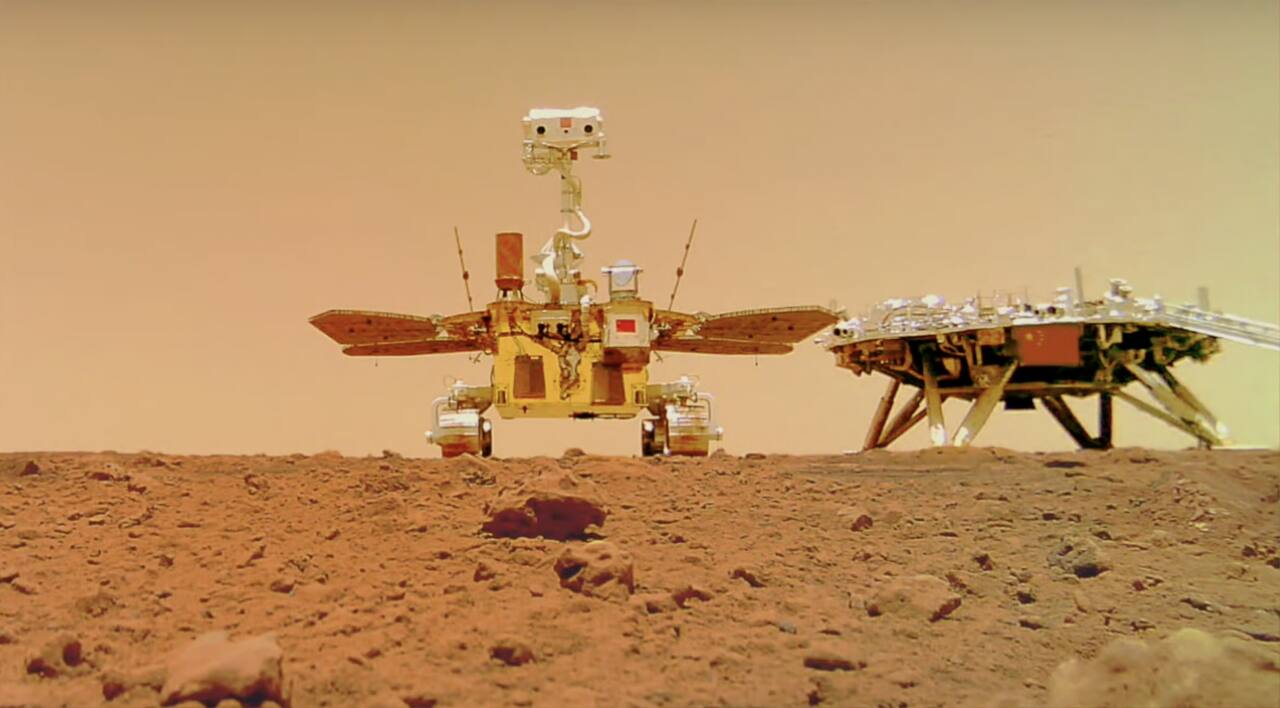 CNSA, via China News Service.
Overview
Section titled “Overview”Zhurong is China’s first Mars rover, delivered to Utopia Planitia by the Tianwen-1 entry module and released onto the surface on 22 May 2021 [1]. Its suspension, unlike the passive rocker-bogie carried by every American Mars rover, is an active suspension that can change its own geometry on command: a main and auxiliary rocker arm linkage with a clutch that, once released, lifts a sunk wheel or contracts the whole chassis rather than relying only on wheel torque to climb out of trouble [1]. The rover had operated 347 Martian days against a 90 day planned life by 5 May 2022 [11] and entered hibernation on 18 May 2022 without waking again [2].
Where the design sits among Mars rovers
Section titled “Where the design sits among Mars rovers”Mars surface rovers fall into a few families by mobility, autonomy and operations. The flown NASA rovers share a passive six-wheel rocker-bogie: Sojourner, the Mars Exploration Rovers, Curiosity and Perseverance [12], [25], [31]. The JPL FIDO rover was the field prototype for the 2003 Mars Exploration Rovers, with a six-wheel rocker-bogie, a mast and a front arm, and was exercised in blind field trials in 1999 and 2000 that reported no quantitative traverse or localization results [18]. Zhurong departs from that lineage in the suspension, not in wheel count. Its power system, thermal design and operating cycle are documented in the sections below from a single mission-design source [1]; the comparison sources are mostly NASA descriptions at design-nominal level [31], [25].
Autonomy is the family where the held record is least balanced. Perseverance has flown Enhanced Autonomous Navigation since 2021, with two-stage path selection, collision checking, wheel-slip bounding-box expansion and FPGA-accelerated stereo, and reached 32.1 km at an average of 92 m/h by sol 1312 [16]. Its onboard planner, Mars 2020 Simple Planner, was deployed on 5 October 2023 [23]. Sojourner was driven from the ground with stereo waypoints and a flying-camera terrain model, with every command sequence built in one ground workstation [27]. Zhurong is recorded as supervised, driving one command load per sol, and no published onboard navigation architecture for it is held in the corpus. Perception limits are documented only for the American system: flight block-matching stereo leaves holes large enough to stop autonomous driving at solar phase angles under 20 degrees and on low-texture terrain, which 16,768 Perseverance NavCam pairs showed and zero-shot deep stereo models were then tested against [28]. Whether Zhurong’s navigation cameras share those conditions is not established.
Specifications
Section titled “Specifications”| Parameter | Value |
|---|---|
| Dimensions | approximately 3.3 x 3.2 x 1.85 m |
| Power source | solar, four deployable panels |
| Suspension | active, main and auxiliary rocker arms with a releasable clutch |
| Payload | six instruments |
Specifications from [1]. Rover mass is not published.
Mission profile
Section titled “Mission profile”| Parameter | Value | Source |
|---|---|---|
| Landing | 15 May 2021, Utopia Planitia | [1] |
| Rover egress from the platform | 22 May 2021 | [1] |
| Planned mission | 90 Martian days, completed 15 August 2021 | [11] |
| Odometer traverse to 5 May 2022 | 1921 m over 347 Martian days | [11] |
| Reconstructed true-path traverse | 2009 m over 206 site operations, 360 sols | [2] |
| Data returned by rover and orbiter to 5 May 2022 | about 940 gigabytes | [11] |
| Relay test with ESA Mars Express | November 2021 | [11] |
| First solar conjunction outage | mid September to late October 2021 | [11] |
| Status | did not wake from hibernation, 18 May 2022 | [1] |
The 88 m gap between the 2009 m of true path reconstructed from site imagery and the 1921 m odometer reading is attributed to forward wheel slip on a generally downslope, southward traverse [2].
Mobility
Section titled “Mobility”The suspension’s clutch, once released, converts a normally passive linkage into a commandable mechanism with four functions: controlled lifting, controlled lowering, wheel lifting, and suspension contraction [1]. That is a deliberate departure from the JPL rocker-bogie lineage, which excludes springs and active joints altogether because an elastic or actuated link raises the normal force on a climbing wheel while unloading the others, exactly wrong for obstacle climbing on a passive chassis [12]. That design was tuned against six or seven modeled obstacle positions, where six wheels climb an axle-high vertical face at a friction coefficient near 0.8 against 0.78 to 1.4 for four wheels depending on which end meets the wall, a fixed-geometry optimum Zhurong’s clutch trades away [12]. Zhurong trades that climbing optimality for a self-extraction capability the passive linkage cannot offer.
| Failure condition | Recovery action |
|---|---|
| Single wheel sunk | lift that wheel |
| All wheels caught | contract the suspension |
| Body in contact with a rock | raise the suspension to clear it |
Recovery actions from [1].
Suspension contraction with sequential wheel lifting produces a walking gait that extracts the vehicle from soft ground by changing which wheels carry load rather than by increasing drawbar pull. That addresses slip-sinkage directly: a wheel that is unloaded and repositioned does not have to develop thrust against soil whose shear strength has already been exceeded, the same failure mode a rigid rocker-bogie has no recourse against beyond driving through it [12]. Terrain along the traverse at Utopia Planitia is flat, covered by reddish soils and dust, with dark-toned material exposed where wheels or wind removed the dust layer [3].
Localization during the traverse combined onboard dead reckoning with cross-site visual matching: dead reckoning against a HiRISE-visible rover track carried an error of 3.11 percent of traverse length, cross-site Affine-SIFT visual localization reduced that to 1.75 percent, and matching site imagery to orbital imagery at four waypoints reduced it further to 0.50 percent [2]. Site digital elevation and orthophoto models were built at 0.02 m grid spacing out to 15 m range, with total stereo measurement error of 0.108 m at that range [2].
Power and energy
Section titled “Power and energy”Solar-powered Mars rovers have flown twice at scale. The MER pre-launch design used a direct energy transfer bus and GaAs triple-junction arrays sized for 300 W at Mars and 140 W on sol 1, which are design figures, not flight measurements [19]. No Zhurong array output or battery figure has been published.
Solar radiation intensity at Mars orbit is approximately 43 percent of that near Earth [1]. Atmospheric dust adds to that deficit: background column optical depth over the aphelion half of the year sits below 1, and dust storm activity recurs seasonally, so array output carries a seasonal floor independent of surface deposition on the panels themselves [7], [8]. Two measures respond to the combined problem. Maximum power point tracking improves conversion efficiency from the cells, and an ultra-thin solar film with an anti-dust coating gives a dust removal efficiency over 86 percent, addressing deposition rather than the seasonal atmospheric floor [1].
A dormancy and wake-up mode covers the range of surface lighting conditions. On the onset of a dust storm the rover powers off to prevent battery drain and remains asleep until generated power and temperature reach their thresholds simultaneously, a coupling that makes the mode a survival state rather than a low-power state [1]. During a global dust storm, column optical depth reaches a global mean near 4 with local values of 5 to 10, so a storm subtracts from generation at the same time as it adds to deposition on the arrays [8]. The dust climatology behind that figure was itself validated against independent measurements from CRISM in orbit and from PanCam and Mini-TES on the ground, which is why it is used as the dust forcing in the Mars Climate Database [8]. The 2018 global storm encircled the northern hemisphere in its first 7 to 10 sols in a data assimilation reanalysis, with winds and dust above 4 km inferred by the model and not observed [22].
Thermal
Section titled “Thermal”Surface temperature below -100 C sets the design case [1]. Measured air temperature at landed Mars sites spans roughly 140 to 300 K depending on season and latitude, with a diurnal range large enough that a surface vehicle crosses most of that span every sol [7]. At Gale crater, the diurnal amplitude of the ground temperature cycle runs on a thermal inertia of roughly 170 to 550 SI units depending on terrain, the same site-dependence that makes any fixed thermal design a compromise across a traverse [7]. The architecture combines active and passive control.
| Element | Function |
|---|---|
| Solar window | collects heat during the day, raises cabin temperature at night |
| Aerogel plus CO2 isolation | passive insulation: reduces conduction, isolates radiative leakage, eliminates in-cabin convection |
| Active heating at night | brings in-cabin equipment to its required ambient temperature |
| Active control on external equipment | navigation and obstacle avoidance cameras, multispectral cameras |
Thermal elements and their functions from [1].
The passive layer is what makes the active budget affordable: with limited active thermal resources, leakage is attacked on all three transfer paths at once rather than compensated by heater power [1]. That approach to the cold is not the only one flown to Mars: the InSight HP3 mole, a hammering probe rather than a thermally isolated cabin, failed to reach its planned depth because the cohesive duricrust at its site gave no lateral soil pressure and therefore no hull friction to react the hammer’s recoil, a soil-mechanical failure mode with no counterpart in Zhurong’s cabin-insulation design [9]. The nuclear-powered Mars 2020 rover takes a third route: a heat rejection system fluid loop and actuator warmup heaters sized from a Holden Crater design environment, with the results at critical design review being model predictions rather than flight or chamber measurements [14].
Communications
Section titled “Communications”Mars surface links are a relay problem. A mission-by-mission survey inventories the radio links of every orbiter and lander and adds ray-tracing simulation over Jezero terrain showing terrain-dominated surface propagation, with no Mars surface radio measurement to validate it [21]. For the NASA fleet the relay network works through manually scheduled overflights, with a planned move to delay-tolerant networking that is an expectation and not a demonstrated capability [30]. Curiosity’s downlink envelope was the constraint on its data management until about sol 2200, when MAVEN and TGO relay support raised it [32]. The Zhurong record is smaller: about 940 gigabytes returned by rover and orbiter together to 5 May 2022 [11].
| Link | Parameter | Value |
|---|---|---|
| X-band direct | Rover-to-Earth visible arc | approximately M04:30 to M16:00 each sol |
| X-band direct | Uplink rate to the omnidirectional antenna | as low as 7.8125 bps |
| UHF relay | Architecture | loop relay mode, two-way, through the Tianwen-1 orbiter |
| UHF relay | Near-Mars arc pass around noon | approximately 10 min |
| UHF relay | Martian night pass | approximately 5 h |
| UHF relay | Near-Mars arc rate | Mbps class |
Link parameters from [1]. The 7.8125 bps direct uplink is a command channel, not a data path, so the relay carries everything of volume: telemetry, images and instrument data, all within the same near-Mars pass. The orbiter’s own magnetometer, MOMAG, continued returning solar wind and interplanetary magnetic field data through the relay period, cataloging two coronal mass ejections and three stream interaction regions at Mars between November and December 2021 in coordination with NASA’s MAVEN [10]. Each event’s magnetic field measurements were compared directly between the two spacecraft rather than merged, since Tianwen-1 orbits Mars while MAVEN samples the solar wind further out, and the two records agree on timing even where local field magnitude differs [10].
Modes of operation
Section titled “Modes of operation”The rover is in standby by default, with computers on and other equipment operating intermittently against a mission cycle template run onboard [1]. Standby rather than sleep is affordable because the passive thermal stack holds cabin temperature without continuous heater draw.
| Interval | Action |
|---|---|
| Martian afternoon, approx 10 h | X-band omnidirectional receiver on, holding a basic uplink channel |
| Martian noon, approx 1 h | UHF receiver on for the near-Mars arc |
| Martian night, approx 5 h | UHF receiver on for the remote arc |
| M11:00 to M15:00 | primary work period, ambient temperature highest and no additional heating needed |
Daily template from [1].
Scheduling the work period against temperature rather than against illumination is a direct consequence of the thermal budget: heating an actuator costs energy the arrays would otherwise deliver to the activity itself.
Ground operations
Section titled “Ground operations”Delayed instructions are uplinked each Martian morning via the orbiter, relayed to the rover by UHF around noon for execution, and telemetry is returned through the orbiter by UHF during the Martian night [1]. The cycle is therefore one command load per sol with a single execution window and a single return window, whereas the NASA rovers relay through the Mars Relay Network, whose orbiter overflights are scheduled manually [30].
Ground testing
Section titled “Ground testing”The landing platform’s hovering and obstacle-avoidance test was completed on 14 November 2019 at a test field in Huailai County, Hebei, simulating Martian gravity, per a Chinese space-industry news item that gives no achieved offload accuracy [26]. No rover-level terramechanics data for Zhurong’s wheels is held. The nearest evidence is from lunar and laboratory wheel studies: a Tohoku single-wheel testbed with a discrete element model reproduced traction and sinkage for a Rashid-1 style grousered wheel, with the lunar gravity results coming from the model alone [24], and tests at speeds up to 1.0 m/s, about a hundred times flown rover speed, found traction speed dependent in a way low-speed testing missed [29]. Neither has flown, and neither describes Zhurong’s wheel.
Payload and instruments
Section titled “Payload and instruments”Six instruments are carried [1]. Four measure the environment rather than the rover’s own state, and the meteorology package is the Chinese counterpart to REMS and MEDA [7].
| Instrument | Measurement | Source |
|---|---|---|
| Navigation camera | surface morphology, driving | |
| Multispectral camera | mineral and rock types, material distribution | |
| Subsurface detection radar | soil structure and stratification, water and ice content | |
| Surface composition detector (MarSCoDe) | LIBS for quantitative chemistry, short-wave infrared spectroscopy for mineralogy | [5] |
| Magnetic field detector | magnetic field intensity, variation, ionospheric current | |
| Meteorological instruments | temperature, pressure, wind speed and direction, sound |
Instrument list from [1] unless noted.
MarSCoDe’s laser is a passively Q-switched 1064 nm unit at 23 mJ per 4.5 ns pulse, firing at 1 to 3 Hz with fixed energy, feeding a 106 mm Ritchey-Chretien telescope that both focuses the beam and collects the plasma emission, pointed by a worm-gear mechanism driven by two stepping motors [5]. Emission is dispersed across three LIBS channels covering 240 to 340, 340 to 540 and 540 to 850 nm, while a short-wave infrared channel covers 850 to 2400 nm [5]. Because the rover is solar powered and cannot keep the spectrometer at a constant temperature, its spectra drift with Martian temperature; the instrument carries an onboard titanium calibration target, and an elastic particle swarm optimization algorithm matches the shifted spectral lines against a standard wavelength set established in a Mars simulation chamber before launch, cutting the residual wavelength error after correction to under 0.006 nm at the ultraviolet channel’s coldest tested point of -40 C [6]. That correction was validated in a Mars simulation environment chamber holding Earth-lab pressure near 1 percent of Earth’s own and temperatures from -40 to 30 C, using standard element lamps for the initial calibration and the onboard target for the temperature-shift correction itself [6].
MarSCoDe measured LIBS and short-wave infrared spectra of six Vastitas Borealis Formation targets, soils, an outcrop and a coherent rock, in the rover’s first 300 sols, and the result reads as a low-alteration mix of igneous minerals with clay-like alteration phases formed under limited or ephemeral water and cold conditions [3]. The magnetometer campaign returned vector measurements at 16 sites along a 1089 m track; the field measured, under 10 nT over most of the track, is far weaker than the roughly 81 nT that downward-continued orbital models had predicted for the site, though InSight measured about 2000 nT at Elysium Planitia, so the discrepancy is a local rather than a universal one [4]. Separating that faint ambient field from the roughly 10,000 nT generated by a permanent magnet inside the rover’s own mast-mounted camera required rotating the mast and the whole rover to isolate sensor-frame, rover-frame and Mars-frame components of the reading [4]. The same discipline applies to sample return: a retrospective assessment of the Perseverance sample caching system against its 0.5 mT limit concluded exposure above 5 Gauss is unlikely, from bounds on two of four actuator types and not a compliance verification [17].
End of mission
Section titled “End of mission”Zhurong entered hibernation on 18 May 2022 and did not re-establish contact [2]. Dust accumulation on the arrays is the assumed cause, against an 86 percent dust removal efficiency demonstrated for the coating and a wake logic requiring both power and temperature thresholds to be met at once [1]. Removal of deposited dust by wind requires a surface shear stress at or above the saltation threshold, which is not a schedulable event, and the storm conditions that would generate that stress are the same conditions that raise column optical depth and cut array output at the same time [8].
The same loss mode ended Opportunity, a solar-powered Mars rover. It was last heard from on sol 5111 (10 June 2018), when the 2018 planet-encircling dust event cut array output below the level needed to communicate; more than 1000 recovery commands were radiated before the search ended on 12 February 2019, and its end state is inferred from thermal and power models rather than observed [13]. For Zhurong the cause is assumed, not published.
Dust protection for moving joints is documented for a lunar vehicle, not a Mars one: the VIPER mobility system used a 42-layer outer barrier over four mobility modules and graded labyrinth, felt and PTFE seals, qualified at ambient pressure with no combined dust, vacuum and thermal test reported [20]. Zhurong’s joint sealing is not described in the held sources.
Across NASA surface missions, 48 major anomalies of four or more consecutive sols of lost progress cost an average of 11 percent of prime mission duration and 6.6 percent over the full mission [15]. That catalog covers American missions only, and no equivalent exists in the corpus for Zhurong.
Technologies developed
Section titled “Technologies developed”The active suspension is the one mobility capability on Mars that no NASA rover has carried. Its value is not obstacle clearance, which a passive rocker-bogie already provides by design [12], but a recovery mode that does not depend on developing more thrust: lifting a sunk wheel, or contracting the whole suspension, changes the load distribution instead of demanding more shear from soil that has already failed. The thermal architecture pairs a passive stack that attacks conduction, radiation and convection simultaneously with a solar window that stores daytime heat for night use, converting part of the survival heating load from an electrical draw into a thermal one. MarSCoDe’s onboard particle-swarm wavelength recalibration is a narrower but transferable lesson: an instrument that cannot be thermally stabilized on a solar-powered platform can still hold calibration by matching against a known target rather than by controlling its own temperature [6].
What is not established
Section titled “What is not established”Rover mass, the exact panel count beyond what is visible in imagery, and a definitive account of the wake failure, dust accumulation versus a hardware fault, remain unpublished. The magnetometer discrepancy between ground and orbital field estimates is attributed to demagnetization at either the scale of the whole Utopia Basin or of the smaller ghost crater the rover landed in, and neither is ruled out [4].
References
- Tian, H., Zhang, T., Jia, Y., Peng, S. and Yan, C. (2021). Zhurong: Features and mission of China's first Mars rover
. The Innovation, 3. Source
BibTeX
@article{tian2021zhurong, title = {Zhurong: Features and mission of China's first Mars rover}, author = {Tian, He and Zhang, Tianyi and Jia, Yang and Peng, Song and Yan, Chuliang}, journal = {The Innovation}, volume = {2}, number = {3}, pages = {100121}, year = {2021}, doi = {10.1016/j.xinn.2021.100121}, abstract = {On May 22, 2021, at 10:40 am (Beijing Time), China’s Zhurong rover successfully reached the Mars surface and began its exploration. China is only the second nation to have conducted a successful soft landing and exploration of the red planet. The Mars probe consists of an orbiter and landing rover. The spacecraft includes an entry module consisting of a back shell, landing platform, and outsole, as well as a rover (Figure 1). Before release, the orbiter, which carries the landing rover, completed the Earth–Mars orbital transfer and an orbit reduction maneuver.} } - Wan, W., Wang, J., Liu, Z., Di, K., Peng, M., Wang, Y., Liu, B., Hu, G., Han, S., Li, X., Yu, T., Li, L. and Liu, C. (2025). Visual Localization and Topographic Mapping for Zhurong Rover in Tianwen-1 Mars Mission
. IEEE Journal of Selected Topics in Applied Earth Observations and Remote Sensing. Source
BibTeX
@article{wan2025visual, title = {Visual Localization and Topographic Mapping for Zhurong Rover in Tianwen-1 Mars Mission}, author = {Wan, Wenhui and Wang, Jia and Liu, Zhaoqin and Di, Kaichang and Peng, Man and Wang, Yexin and Liu, Bin and Hu, Guolin and Han, Shaojin and Li, Xin and Yu, Tianyi and Li, Lichun and Liu, Chuankai}, journal = {IEEE Journal of Selected Topics in Applied Earth Observations and Remote Sensing}, volume = {18}, pages = {6393--6408}, year = {2025}, doi = {10.1109/jstars.2025.3540377}, abstract = {This article presents the methods, results, and applications of visual localization and topographic mapping for the Zhurong rover in China's Tianwen-1 Mars mission. New techniques, namely vignette correction and online camera mast calibration, were developed for the images captured by the rover's navigation and terrain cameras (NaTeCam) to enhance the mapping qualities. During surface operations, photogrammetric techniques were routinely applied at the traveling waypoints. The NaTeCam images were obtained to generate 3-D topographic mapping products at the centimeter level to support obstacle analysis and rover path planning. Cross-site visual localization at adjacent waypoints was conducted to reduce the accumulated position errors in the onboard dead-reckoning result. Visual localization refinement was also employed by matching the digital orthophoto map (DOM) from the rover images and the orbital basemap at waypoints where distinct terrain features were available to further eliminate the localization errors. Compared with the reference rover traverse extracted from a high-resolution imaging science experimental image in which the actual rover track is visible, the accuracies of the rover traverses generated from cross-site visual localization and DOM matching refinement are estimated to be 1.75% and 0.50% of the traverse length. The actual total traverse length is 2009 m, which is 88 m longer than 1921 m from the odometer reading, revealing a forward wheel slipping caused by the downslope trend of the southward traverse. The visual localization and topographic mapping results of the Zhurong rover have greatly supported the surface exploration planning, object approaching, and scientific investigations in the mission.} } - Liu, Y., Wu, X., Zhao, Y.-Y. S., Pan, L., Wang, C., Liu, J., Zhao, Z., Zhou, X., Zhang, C., Wu, Y., Wan, W. and Zou, Y. (2022). Aqueous alteration of the Vastitas Borealis Formation at the Tianwen-1 landing site
. Communications Earth & Environment, 280. Source
BibTeX
@article{liu2022aqueous, title = {Aqueous alteration of the Vastitas Borealis Formation at the Tianwen-1 landing site}, author = {Liu, Y. and Wu, Xiaofeng and Zhao, Y.-Y. S. and Pan, Lu and Wang, C. and Liu, J. and Zhao, Zhiyuan and Zhou, X. and Zhang, Chi and Wu, Y. and Wan, Wenhui and Zou, Yongliao}, journal = {Communications Earth & Environment}, volume = {3}, number = {280}, year = {2022}, doi = {10.1038/s43247-022-00614-3}, abstract = {Abstract The Vastitas Borealis Formation is a Hesperian-aged sedimentary unit that mainly covers the Martian northern plains. Its environment of formation is uncertain but may be related to an ancient Martian ocean, outflow channel deposits, compaction and drainage activities, or subsurface ice-related processes. Here we investigate the geological evolution of the Vastitas Borealis Formation using geochemical and mineralogical data acquired by the Mars Surface Composition Detector on board the Zhurong rover at the Tianwen-1 landing site. We find that the fine-grained soil is very similar to the ubiquitous surface dust at other landing sites on Mars but mixed with calcium-rich and magnesium-poor local materials. These materials are mostly igneous minerals mixed with allophane and imogolite/opal and appear to have a low degree of chemical alteration. We suggest that these deposits likely formed by alteration of extensive volcaniclastic soils in limited or ephemeral water under cold conditions, which largely supports the hypotheses of a frozen ocean and sublimation.} } - Du, A., Ge, Y., Wang, H., Li, H., Zhang, Y., Luo, H., Huang, C., Shan, L., Han, F., Liu, Y., Zou, Y., Wang, C., Pan, Y., Liu, Q., Mitchell, R. N., Jia, Y., Chen, B., Jin, S., Jiang, Y., Zhang, T., Zhu, R., Gubbins, D. and Zhang, K. (2023). Ground magnetic survey on Mars from the Zhurong rover
. Nature. Source
BibTeX
@article{du2023ground, title = {Ground magnetic survey on Mars from the Zhurong rover}, author = {Du, Aimin and Ge, Yasong and Wang, Huapei and Li, Haiying and Zhang, Ying and Luo, Hao and Huang, Can and Shan, Lican and Han, Fei and Liu, Yang and Zou, Yongliao and Wang, Chi and Pan, Yongxin and Liu, Qingsong and Mitchell, Ross N. and Jia, Yang and Chen, Baichao and Jin, Shengyi and Jiang, Yi and Zhang, Tielong and Zhu, Rixiang and Gubbins, David and Zhang, Keke}, journal = {Nature}, volume = {7}, pages = {1037--1047}, year = {2023}, doi = {10.1038/s41550-023-02008-7}, abstract = {Abstract Mars’ magnetic field has been measured at large scale by orbiting spacecraft and at very small scale via Martian meteorites. Here we report on a ground magnetic survey on metre to kilometre scales. The Zhurong rover made vector measurements at 16 sites along a 1,089 m track in the Utopia Basin on Mars. It recorded an extremely weak magnetic field, with an order of the average intensity less than that inferred from orbit, in contrast to the large magnetic field in Elysium Planitia measured by InSight. A spacecraft measurement samples an area with radius comparable to its altitude, while a ground measurement samples an area with radius comparable to the depth of the magnetized body. The weak magnetic field measured by Zhurong indicates no magnetization anomalies for a depth of many kilometres around and below the rover’s traverse. We suggest two possible explanations for the weak magnetic field: the entire Utopia Basin may have remained unmagnetized since its formation about 4 billion years ago or that the 5-km-radius ghost crater where Zhurong landed may have been been demagnetized by impact.} } - Wan, X., Li, C., Wang, H., Xu, W., Jia, J., Xin, Y., Ma, H., Fang, P. and Ling, Z. (2021). Design, Function, and Implementation of China's First LIBS Instrument (MarSCoDe) on the Zhurong Mars Rover
. Atomic Spectroscopy, 6. Source
BibTeX
@article{wan2021design, title = {Design, Function, and Implementation of China's First LIBS Instrument (MarSCoDe) on the Zhurong Mars Rover}, author = {Wan, Xiong and Li, Chenhong and Wang, Hongpeng and Xu, Weiming and Jia, Jianjun and Xin, Yingjian and Ma, Huanzhen and Fang, Peipei and Ling, Zongcheng}, journal = {Atomic Spectroscopy}, volume = {42}, number = {6}, pages = {292--299}, year = {2021}, doi = {10.46770/as.2021.608} } - Wan, X., Yuan, R., Wang, H., Cheng, Y., Jia, J., Shu, R., Xu, W., Li, C., Xin, Y., Ma, H., Fang, P. and Ling, Z. (2021). Elastic Particle Swarm Optimization for MarSCoDe Spectral Calibration on Tianwen-1 Mars Rover
. Journal of Guidance, Control, and Dynamics, 22. Source
BibTeX
@article{wan2021elastic, title = {Elastic Particle Swarm Optimization for MarSCoDe Spectral Calibration on Tianwen-1 Mars Rover}, author = {Wan, Xiong and Yuan, Rujun and Wang, Hongpeng and Cheng, Yulong and Jia, Jianjun and Shu, Rong and Xu, Weiming and Li, Chenhong and Xin, Yingjian and Ma, Huanzhen and Fang, Peipei and Ling, Zongcheng}, journal = {Journal of Guidance, Control, and Dynamics}, volume = {93}, number = {22}, pages = {7970-7977}, publisher = {American Chemical Society (ACS)}, year = {2021}, doi = {10.1021/acs.analchem.1c00832} } - Martínez, G. M., Newman, C. N., De Vicente-Retortillo, A., Fischer, E., Renno, N. O., Richardson, M. I., Fairén, A. G., Genzer, M., Guzewich, S. D., Haberle, R. M., Harri, A.-M., Kemppinen, O., Lemmon, M. T., Smith, M. D., de la Torre-Juárez, M. and Vasavada, A. R. (2017). The Modern Near-Surface Martian Climate: A Review of In-situ Meteorological Data from Viking to Curiosity
. Space Science Reviews. Source
BibTeX
@article{martinez2017modern, title = {The Modern Near-Surface Martian Climate: A Review of In-situ Meteorological Data from Viking to Curiosity}, author = {Martínez, G. M. and Newman, C. N. and De Vicente-Retortillo, A. and Fischer, Erik and Renno, N. O. and Richardson, Mark I. and Fairén, A. G. and Genzer, Maria and Guzewich, Scott D. and Haberle, R. M. and Harri, Ari-Matti and Kemppinen, Osku and Lemmon, Mark T. and Smith, Michael D. and de la Torre-Juárez, M. and Vasavada, Ashwin R.}, journal = {Space Science Reviews}, volume = {212}, pages = {295--338}, year = {2017}, doi = {10.1007/s11214-017-0360-x}, abstract = {We analyze the complete set of in-situ meteorological data obtained from the Viking landers in the 1970s to today’s Curiosity rover to review our understanding of the modern near-surface climate of Mars, with focus on the dust, CO 2 and H 2 O cycles and their impact on the radiative and thermodynamic conditions near the surface. In particular, we provide values of the highest confidence possible for atmospheric opacity, atmospheric pressure, near-surface air temperature, ground temperature, near-surface wind speed and direction, and near-surface air relative humidity and water vapor content. Then, we study the diurnal, seasonal and interannual variability of these quantities over a span of more than twenty Martian years. Finally, we propose measurements to improve our understanding of the Martian dust and H 2 O cycles, and discuss the potential for liquid water formation under Mars’ present day conditions and its implications for future Mars missions. Understanding the modern Martian climate is important to determine if Mars could have the conditions to support life and to prepare for future human exploration.} } - Montabone, L., Forget, F., Millour, E., Wilson, R. J., Lewis, S. R., Cantor, B. A., Kass, D., Kleinböhl, A., Lemmon, M. T., Smith, M. D. and Wolff, M. J. (2015). Eight-year Climatology of Dust Optical Depth on Mars
. Icarus. Source
BibTeX
@article{montabone2015eight, title = {Eight-year Climatology of Dust Optical Depth on Mars}, author = {Montabone, L. and Forget, Francois and Millour, Ehouarn and Wilson, R. J. and Lewis, Stephen R. and Cantor, B. A. and Kass, D. and Kleinböhl, A. and Lemmon, Mark T. and Smith, Michael D. and Wolff, M. J.}, journal = {Icarus}, volume = {251}, pages = {65--95}, year = {2015}, doi = {10.1016/j.icarus.2014.12.034} } - Spohn, T., Hudson, T. L., Witte, L., Wippermann, T., Wisniewski, L., Kedziora, B., Vrettos, C., Lorenz, R. D., Golombek, M., Lichtenheldt, R., Grott, M., Knollenberg, J., Krause, C., Fantinati, C., Krueger, T. and Grygorczuk, J. (2022). The InSight-HP3 Mole on Mars: Lessons Learned from Attempts to Penetrate to Depth in the Martian Soil
. Advances in Space Research, 8. Source
BibTeX
@article{spohn2022insight, title = {The InSight-HP3 Mole on Mars: Lessons Learned from Attempts to Penetrate to Depth in the Martian Soil}, author = {Spohn, Tilman and Hudson, Troy L. and Witte, Lars and Wippermann, Torben and Wisniewski, Lukasz and Kedziora, Bartosz and Vrettos, Christos and Lorenz, Ralph D. and Golombek, Matthew and Lichtenheldt, Roy and Grott, Matthias and Knollenberg, Joerg and Krause, Christian and Fantinati, Cinzia and Krueger, Torsten and Grygorczuk, Jerzy}, journal = {Advances in Space Research}, volume = {69}, number = {8}, pages = {3140--3163}, year = {2022}, doi = {10.1016/j.asr.2022.02.009}, abstract = {The NASA InSight lander mission to Mars payload includes the Heat Flow and Physical Properties Package HP3 to measure the surface heat flow. The package was designed to use a small penetrator - nicknamed the mole - to implement a vertical string of temperature sensors in the soil to a depth of 5 m. The mole itself is equipped with sensors to measure a thermal conductivity-depth profile as it proceeds to depth. The heat flow is calculated from the product of the temperature gradient and the thermal conductivity. To avoid the perturbation caused by annual surface temperature variations, the measurements need to be taken at a depth between 3 m and 5 m. The mole is designed to penetrate cohesionless soil similar in rheology to quartz sand which is expected to provide a good analogue material for Martian sand. The sand would provide friction to the buried mole hull to balance the remaining recoil of the mole hammer mechanism that drives the mole forward. Unfortunately, the mole did not penetrate more than 40 cm, roughly a mole length. The failure to penetrate deeper is largely due to a cohesive duricrust of a few tens of centimeter thickness that failed to provide the required friction. Although a suppressor mass and spring as part of the mole hammer mechanism absorb much of the recoil, the available mass did not allow designing a system that fully eliminated the recoil. The mole penetrated to 40 cm depth benefiting from friction provided by springs in the support structure from which it was deployed and from friction and direct support provided by the InSight Instrument Deployment Arm. In addition, the Martian soil provided unexpected levels of penetration resistance that would have motivated designing a more powerful mole. The low weight of the mole support structure was not sufficient to guide the mole penetrating vertically. Roughly doubling the overall mass of the instrument package would have allowed to design a more robust system with little or no recoil, more energy of the mole hammer mechanism and a more massive support structure. In addition, to cope with duricrust a mechanism to support the mole to a depth of about two mole lengths should be considered.} } - Chi, Y., Shen, C., Cheng, L., Yu, B., Miao, B., Wang, Y., Zhang, T., Zou, Z., Xu, M., Pan, Z., Su, Z., Guo, J., Mao, D., Zhong, Z., Zhang, Z., Liu, J., Wang, C., Wu, Z., Wang, G., Xiao, S., Liu, K., Hao, X., Li, Y., Chen, M. and Du, Y. (2023). Interplanetary Coronal Mass Ejections and Stream Interaction Regions observed by Tianwen-1 and Maven at Mars
. The Astrophysical Journal Supplement Series. Source
BibTeX
@article{chi2023interplanetary, title = {Interplanetary Coronal Mass Ejections and Stream Interaction Regions observed by Tianwen-1 and Maven at Mars}, author = {Chi, Yutian and Shen, Chenglong and Cheng, Long and Yu, Bingkun and Miao, Bin and Wang, Yuming and Zhang, Tielong and Zou, Zhuxuan and Xu, Mengjiao and Pan, Zonghao and Su, Zhenpeng and Guo, Jingnan and Mao, Dongwei and Zhong, Zhihui and Zhang, Zhiyong and Liu, Junyan and Wang, Can and Wu, Zhiyong and Wang, Guoqiang and Xiao, Sudong and Liu, Kai and Hao, Xinjun and Li, Yiren and Chen, Manming and Du, Yang}, journal = {The Astrophysical Journal Supplement Series}, volume = {267}, pages = {3}, year = {2023}, doi = {10.3847/1538-4365/acd191}, abstract = {Abstract The Tianwen-1 spacecraft is China's first Mars exploration mission. The Mars Orbiter Magnetometer (MOMAG) is a scientific instrument on board the Tianwen-1 mission that is designed to study magnetic fields at Mars, including the solar wind to the magnetosheath and the ionosphere. Using the first Tianwen-1/MOMAG data that is publicly available, we present an interplanetary coronal mass ejection (ICME) and stream interaction region (SIR) list based on in situ observations at Mars between 2021 November 16 and 2021 December 31. We compared the magnetic field intensity and vector magnetic field measurements from Tianwen-1/MOMAG and Mars Atmospheric Volatile EvolutioN (MAVEN)/Magnetometer (MAG) during the ICME and SIR interval and found a generally good consistency between them. Due to MAVEN's orbital adjustment since 2019, the Tianwen-1/MOMAG instrument is almost unique in its status as an interplanetary magnetic field monitor currently at Mars. The observations indicate that the MOMAG instrument on Tianwen-1 is performing well and can provide accurate measurements of the vector magnetic field in the near-Mars solar wind space. The multipoint observations combining MOMAG, MINPA, and MEPA on board Tianwen-1 with MAG, SWIA, and STATIC on board MAVEN will help develop systematic studies of the characteristics of ICMEs and SIRs at Mars, and their influences on the Martian atmosphere and ionosphere.} } - (2026). CNSA: Tianwen-1 mission marks 1st year on Mars. cnsa.gov.cn/english/n6465652/n6465653/c6840321/content.html
BibTeX
@misc{cnsatianwen, title = {CNSA: Tianwen-1 mission marks 1st year on Mars}, organization = {cnsa.gov.cn}, year = {2026}, url = {https://www.cnsa.gov.cn/english/n6465652/n6465653/c6840321/content.html} } - Bickler, D. B. (1997). The Mars Rover Mobility System
. JPL Open Repository. Source
BibTeX
@inproceedings{bickler1997mars, title = {The Mars Rover Mobility System}, author = {Bickler, Donald B.}, publisher = {JPL Open Repository}, year = {1997}, url = {https://dataverse.jpl.nasa.gov/dataset.xhtml?persistentId=hdl:2014/18908} } - Callas, J. L., Golombek, M. P. and Fraeman, A. A. (2019). Mars Exploration Rover Opportunity End of Mission Report
. Jet Propulsion Laboratory, California Institute of Technology, JPL Publication 19-10. Source
BibTeX
@techreport{callas2019mars, title = {Mars Exploration Rover Opportunity End of Mission Report}, author = {Callas, John L. and Golombek, Matthew P. and Fraeman, Abigail A.}, number = {JPL Publication 19-10}, publisher = {JPL Open Repository}, institution = {Jet Propulsion Laboratory, California Institute of Technology}, year = {2019}, url = {https://dataverse.jpl.nasa.gov/dataset.xhtml?persistentId=hdl:2014/47103} } - Kempenaar, J. G., Novak, K. S., Redmond, M. J., Farias, E., Singh, K. and Wagner, M. F. (2018). Detailed Surface Thermal Design of the Mars 2020 Rover
. International Conference on Environmental Systems, ICES--53, Albuquerque, New Mexico, 8. Source
BibTeX
@inproceedings{kempenaar2018detailed, title = {Detailed Surface Thermal Design of the Mars 2020 Rover}, author = {Kempenaar, Jason G. and Novak, Keith S. and Redmond, Matthew J. and Farias, Edgardo and Singh, Kaustabh and Wagner, Mark F.}, booktitle = {International Conference on Environmental Systems, ICES--53, Albuquerque, New Mexico, 8}, publisher = {Texas Tech University Libraries}, year = {2018}, url = {https://ttu-ir.tdl.org/items/5feabf52-49c4-4556-b0f9-9099b10bf285} } - Heverly, M. and Bareh, M. (2026). The Impact of Major Anomalies of Robotic Mars Surface Missions on Mission Timeline
. IEEE Aerospace Conference. Source
BibTeX
@inproceedings{heverly2026impact, title = {The Impact of Major Anomalies of Robotic Mars Surface Missions on Mission Timeline}, author = {Heverly, Matt and Bareh, Magdy}, booktitle = {IEEE Aerospace Conference}, publisher = {JPL Open Repository}, year = {2026}, doi = {10.48577/jpl.zlcejq} } - Toupet, O., Ono, M., del Sesto, T., Maimone, M. and McHenry, M. (2026). Enhanced Autonomous Navigation on the Perseverance Mars Rover
. IEEE Transactions on Field Robotics. Source
BibTeX
@article{toupet2026enhanced, title = {Enhanced Autonomous Navigation on the Perseverance Mars Rover}, author = {Toupet, Olivier and Ono, Masahiro and del Sesto, Tyler and Maimone, Mark and McHenry, Michael}, journal = {IEEE Transactions on Field Robotics}, volume = {3}, pages = {83--124}, year = {2026}, doi = {10.1109/tfr.2025.3636366}, abstract = {This paper presentsEnhanced Autonomous Navigation, orENav, the autonomous driving algorithm of NASA’s Mars roverPerseverance. A unique challenge for the autonomous driving ofPerseveranceis to meet strict safety and performance requirements in a highly uncertain environment with only a single-core CPU with extremely limited computing resources. ENav overcame this challenge with a novel two-stage path selection approach that balances the path optimality and computational efficiency, combined with a unique collision checking algorithm that conservatively approximates computationally expensive kinematic settling (Otsu et al., 2020). In addition, ENav provides robustness against slip by expanding the bounding boxes for wheels used by the collision check. These new features, together with FPGA-accelerated vision processing, enabledPerseveranceto autonomously drive on substantially more rock-dense terrains and increased the average daily driving distance by an order of magnitude compared to its predecessors, theCuriosity, Spirit, andOpportunityrovers. Perseverance has set several new records for autonomous driving on Mars, breaking those previously held by the Opportunity rover. As of the 1312th Martian day since landing, or 28 October 2024 on the Earth calendar, ∼90% of the 32.1 km of driving has used ENav to evaluate the terrain. This paper provides detailed documentation of the ENav algorithm, as well as its implementation, testing, deployment, and driving results on Mars.} } - Huang, N. (2026). Magnetic Cleanliness Assessment of the Mars 2020 Perseverance Rover for Sample Paleomagnetism and Implications for Future Mars Sample Return Missions
. Root. doi.org/10.48577/jpl.zdh3gq
BibTeX
@misc{huang2026magnetic, title = {Magnetic Cleanliness Assessment of the Mars 2020 Perseverance Rover for Sample Paleomagnetism and Implications for Future Mars Sample Return Missions}, author = {Huang, Nelson}, journal = {Root}, year = {2026}, doi = {10.48577/jpl.zdh3gq}, abstract = {This paper presents a conservative, post-launch magnetic cleanliness assessment performed to evaluate the magnetic compatibility of the Mars 2020 Perseverance Rover with collected Martian samples and to identify lessons learned that inform the Mars Sample Retrieval Lander and future Mars Sample Return missions. Because magnetic cleanliness requirements were not fully propagated through project-level environmental requirement flowdown during development, a retrospective assessment using bounding assumptions and conservative analytical methods was performed. The primary objective was to estimate the probability of requirement exceedance and potential sample impact rather than to establish compliance through direct verification. The assessment included magnetic material audits, characterization of all magnetic sources, evaluation of integration and test magnetic environments, and development of candidate end-to-end magnetic compatibility test approaches. Independent analyses consistently indicate a low likelihood that the samples were exposed to magnetic fields exceeding the 0.5 mT (5 Gauss) threshold. The methodology and resulting lessons learned provide a practical EMC assessment framework for planetary sample return missions and inform risk-based decisions on whether equivalent magnetic cleanliness requirements warrant full project-level flowdown in future programs.} } - Schenker, P. S., Baumgartner, E. T., Backes, P. G., Aghazarian, H., Dorsky, L. I., Norris, J. S., Huntsberger, T. L., Cheng, Y., Trebi-Ollennu, A. and Garrett, M. S. (2024). FIDO: a Field Integrated Design & Operation rover for Mars surface exploration. dataverse.jpl.nasa.gov/api/access/datafile/38141
BibTeX
@misc{schenker2024fido, title = {FIDO: a Field Integrated Design & Operation rover for Mars surface exploration}, author = {Schenker, P. S. and Baumgartner, E. T. and Backes, P. G. and Aghazarian, H. and Dorsky, L. I. and Norris, J. S. and Huntsberger, T. L. and Cheng, Y. and Trebi-Ollennu, A. and Garrett, M. S.}, year = {2024}, url = {https://dataverse.jpl.nasa.gov/api/access/datafile/38141} } - Ewell, R., Nieraeth, D. and Stefano, S. D. (2024). Mars Exploration Rover (MER) power and pyrotechnic subsystem. dataverse.jpl.nasa.gov/api/access/datafile/18232
BibTeX
@misc{ewell2024mars, title = {Mars Exploration Rover (MER) power and pyrotechnic subsystem}, author = {Ewell, R. and Nieraeth, D. and Stefano, S. Di}, year = {2024}, url = {https://dataverse.jpl.nasa.gov/api/access/datafile/18232} } - McBryan, E., Francis, P. and Sobey, A. (2025). Dust Mitigation for the VIPER Mobility System
. International Conference on Environmental Systems, 20250005201. Source
BibTeX
@inproceedings{mcbryan2025dust, title = {Dust Mitigation for the VIPER Mobility System}, author = {McBryan, Emily and Francis, Parker and Sobey, Alexander}, booktitle = {International Conference on Environmental Systems}, number = {20250005201}, institution = {NASA}, year = {2025}, doi = {10.32865/2346/108814}, abstract = {NASA’s Volatiles Investigating Polar Exploration Rover (VIPER) is built to prospect, provide ground truth measurements, and build regional maps of the volatiles at the lunar South Pole that were previously detected by Lunar Reconnaissance Orbiter (LRO), Lunar Crater Observation and Sensing Satellite (LCROSS), and Chandrayaan-1. The rover’s mobility system, responsible for navigating the moon’s partially defined terrain, is the part of VIPER that is most exposed to the lunar surface environment. To ensure it can survive the thermal extremes and lunar regolith, the VIPER project utilized resources across NASA centers to create and evaluate a multi-functional environmental protection strategy. The project’s approach combined thermal insulation with dust protection in a flexible barrier across dynamic actuated joints to serve as the first defense between the hardware and the environment. Additionally, the VIPER project integrated a selection of seals (labyrinth, Nomex felt, and spring-energized PTFE) with individual mechanisms to further mitigate dust infiltration and abrasion risk to the bearings, motors, and sensors. In stages, the project performed extensive testing through a matrix of simulated environmental parameters to evaluate performance margins from the component level to the integrated mobility system. This paper addresses the project’s lessons learned, with an emphasis on systems integration and how this work can affect future long-duration lunar surface systems, such as crewed unpressurized rovers and in-situ resource utilization robotics.} } - Koktas, E. and Basar, E. (2024). Communications for the Planet Mars: Past, Present, and Future
. IEEE Aerospace and Electronic Systems Magazine, 5. Source
BibTeX
@article{koktas2024communications, title = {Communications for the Planet {Mars}: Past, Present, and Future}, author = {Koktas, Enes and Basar, Ertugrul}, journal = {IEEE Aerospace and Electronic Systems Magazine}, volume = {39}, number = {5}, pages = {216--258}, year = {2024}, doi = {10.1109/maes.2024.3396117}, abstract = {Space exploration has been on the rise since the 1960s and Mars plays a significant role in the history of space exploration. As the amount of data collected from science instruments around and on Mars increased, the need for fast and reliable communication between Earth and space probes has emerged. However, communicating over deep space has always been a big challenge due to the propagation characteristics of radio waves. Nowadays, the collaboration of private companies like SpaceX with space agencies to make Mars colonization a reality, introduces even more challenges, such as providing high data rate, low-latency, energy-efficient, and mobility-resistant communication infrastructures in the Martian environment. Propagation medium and wireless channel characteristics of Mars should be extensively studied to achieve these goals. This survey article presents a comprehensive overview of the Mars missions and channel modeling studies of the near-Earth, interstellar, and near-planet links. Studies featuring three-dimensional (3d) channel modeling simulations on the Martian surface are reviewed. Novel computer simulations considering various scenarios based on realistic 3D Martian terrains using the Wireless Insite software are presented. Path loss exponent, power delay profile, and root-mean-square delay spread for these scenarios are calculated and tabularized in this study.} } - Gillespie, H. E., Greybush, S. J. and Wilson, R. J. (2020). An Investigation of the Encirclement of Mars by Dust in the 2018 Global Dust Storm Using EMARS
. Journal of Geophysical Research: Planets. Source
BibTeX
@article{gillespie2020investigation, title = {An Investigation of the Encirclement of Mars by Dust in the 2018 Global Dust Storm Using EMARS}, author = {Gillespie, H. E. and Greybush, Steven J. and Wilson, R. J.}, journal = {Journal of Geophysical Research: Planets}, volume = {125}, year = {2020}, doi = {10.1029/2019je006106}, abstract = {Abstract Determining how global dust storms originate and develop is one of the major challenges of Martian meteorology. We model the 2018 global dust storm using the Ensemble Mars Atmosphere Reanalysis System (EMARS), combining satellite observations with a Mars global climate model via data assimilation. A reanalysis is a valuable data set for this investigation because it is anchored to the real Martian atmosphere by temperature and dust observations, and the model provides full 4D coverage of wind fields, which are not directly observed and are key to assessing advection. Dust was observed to encircle the northern hemisphere early on in the storm's development. This encirclement could be caused by either the formation of new lifting centers along the path of observed encirclement or the advection of dust from active lifting center(s) elsewhere. Results from EMARS, including particle advection from inferred EMARS winds, provide evidence that the aforementioned dust encircling Mars's northern hemisphere may come from the initial lifting center of the storm, near Chryse Planitia. We propose that dust from the initial lifting center of the storm was entrained into the Martian Hadley circulation, with the assistance of the thermal tides, and then entrained into the northern hemisphere westerly jet.} } - Chien, S. (2025). Mars 2020 Simple Planner: Trusted Autonomy on Mars
. Root. doi.org/10.48577/jpl.rdbggx
BibTeX
@misc{chien2025mars, title = {Mars 2020 Simple Planner: Trusted Autonomy on Mars}, author = {Chien, Steve}, journal = {Root}, year = {2025}, doi = {10.48577/jpl.rdbggx}, abstract = {No abstract available.} } - Hurrell, J., Takehana, K., Tanaka, T., Uno, K., Busoud, A. K. and Yoshida, K. (2025). Traction Performance Evaluation for a Rashid-1 Rover Wheel
. Space Science Reviews, 3. Source
BibTeX
@article{hurrell2025traction, title = {Traction Performance Evaluation for a Rashid-1 Rover Wheel}, author = {Hurrell, James and Takehana, Keisuke and Tanaka, Tomomi and Uno, Kentaro and Busoud, Amna Khalifa and Yoshida, Kazuya}, journal = {Space Science Reviews}, volume = {221}, number = {3}, pages = {37}, year = {2025}, doi = {10.1007/s11214-025-01164-8}, abstract = {Abstract Single-wheel experiments and discrete element method simulations of a micro-rover wheel modelled on the Rashid-1 rover designed for the Emirates lunar mission. The interaction of the wheel with Toyoura sand and FJS-1 lunar regolith simulant is studied. Slip conditions, traction coefficient and grouser pitch for single-wheel experiments are measured for a range of fixed slip values at the expected rover load of 24.5 N. The angle of repose is used to calibrate the simulation parameters with measured soil parameters. Single-wheel simulations are verified by comparison to experimental results. Lunar simulations can predict lunar gravity performance. Toyoura and FJS-1 results for traction coefficient and dynamic sinkage at 24.5 N in the 0–50% slip range show good agreement between experiment and simulation. 4.1 N lunar gravity matches the 24.5 N Earth gravity results for traction coefficient and tractive efficiency. There is a 1–2 mm difference in total sinkage. Tractive force and resistive torque reduce by 1/6 from Earth to lunar gravity for the same mass. The grouser pitch is unchanged with gravity variation. The angle of repose can independently determine parameters for use in single-wheel simulations. Experimental results validate the models for Toyoura sand and FJS-1. Wheel performance regarding traction coefficient and tractive efficiency under lunar gravity matches that under Earth gravity. Traction performance in tractive force and resistive torque is reduced by the ratio of Earth to lunar gravity, 1/6, for the same mass.} } - (2024). NASA: Mars Exploration Rovers. science.nasa.gov/mission/mars-exploration-rovers-spirit-and-opportunity
BibTeX
@misc{nasamars, title = {NASA: Mars Exploration Rovers}, organization = {science.nasa.gov}, year = {2024}, url = {https://science.nasa.gov/mission/mars-exploration-rovers-spirit-and-opportunity/} } - (2019). Hovering and Obstacle Avoidance Test of the Lander for China's First Mars Exploration Mission Completed. spacechina.com/n25/n2014789/n2014804/c2783609/content.html
BibTeX
@misc{anon2019hovering, title = {Hovering and Obstacle Avoidance Test of the Lander for China's First Mars Exploration Mission Completed}, organization = {China Aerospace Science and Technology Corporation}, year = {2019}, url = {https://www.spacechina.com/n25/n2014789/n2014804/c2783609/content.html} } - Cooper, B. (2024). Driving on the Surface of Mars Using the Rover Control Workstation. dataverse.jpl.nasa.gov/api/access/datafile/26127
BibTeX
@misc{cooper2024driving, title = {Driving on the Surface of Mars Using the Rover Control Workstation}, author = {Cooper, B.}, year = {2024}, url = {https://dataverse.jpl.nasa.gov/api/access/datafile/26127} } - Liu, Y., Rothrock, B., Swan, R. M., Ono, H., Scherer, S. and Ono, M. (2026). Interplanetary Generalization and Adaptation of Deep Stereo on Mars
. IEEE Aerospace Conference. Source
BibTeX
@inproceedings{liu2026interplanetary, title = {Interplanetary Generalization and Adaptation of Deep Stereo on Mars}, author = {Liu, Yifei and Rothrock, Brandon and Swan, R. Michael and Ono, Hosei and Scherer, Sebastian and Ono, Masahiro}, booktitle = {IEEE Aerospace Conference}, publisher = {JPL Open Repository}, year = {2026}, doi = {10.48577/jpl.6btrp7}, abstract = {Stereo vision is critical for the autonomous operation ofthe Curiosity and Perseverance rovers on Mars. These rovers employa classical stereo algorithm based on block-matching to estimatedepth from a pair of navigation cameras, which is used to build a3D map of the terrain. The choice of this algorithm was motivatedprimarily by the computational constraints of radiation-hardenedflight hardware and heritage from previous Mars rover missions.However, recent data from Perseverance have revealed cases wherestereo perception was significantly degraded, leading to multipleinstances where autonomous navigation was no longer possible.This work analyzes the Flight Stereo performance of Perseveranceand identifies several contributing factors that lead to degradedperformance, primarily featureless terrain and imaging at low solarphase angle. Using a dataset curated from the navigation camerasover the entire Mars 2020 mission to date, we provide an empiricalanalysis of stereo performance under these conditions and evaluateadvanced learning-based methods that mitigate these failures.Representative deep stereo approaches, including cost-volume anditerative optimization methods, transformer-based architectures, andfoundation models, show strong zero-shot performance on real Marsimagery. We further present a domain adaptation strategy thatleverages foundation models as pseudo ground truth, showing itsclose alignment with Flight Stereo while providing dense disparityestimates. Finally, we analyze computational trade-offs to assessthe feasibility of deploying these algorithms on emerging spacequalifiedhardware. We hope these results will inform designconsiderations for stereo vision systems in future rover missions andcontribute toward more robust vision-based autonomous navigation.} } - Takehana, R., Kenny, S., Sawa, K., Hurrell, C., Uno, K., Santra, N. and Yoshida, K. (2025). Grouser Wheel High-Speed Traction Performance: DEM Simulation and Experimental Result
. Journal of Terramechanics. Source
BibTeX
@article{takehana2025grouser, title = {Grouser Wheel High-Speed Traction Performance: {DEM} Simulation and Experimental Result}, author = {Takehana, Ryosuke and Kenny, Sean and Sawa, Kento and Hurrell, Callum and Uno, Kentaro and Santra, Nishant and Yoshida, Kazuya}, journal = {Journal of Terramechanics}, volume = {120}, pages = {101084}, year = {2025}, doi = {10.1016/j.jterra.2025.101084}, abstract = {This study focuses on the locomotion characteristics of a high-speed lunar exploration rover. We conduct single-wheel tests under high-speed conditions and provide detailed results from force measurements from both approaches (experiment and simulation). Three types of wheels are prepared: no grouser, low grouser, and high grouser, and their traction performance is compared. The testbed allows speeds of 1 m/s, which is about a hundred times faster than conventional exploration speeds. We also have developed a Discrete Element Method (DEM) simulator to reproduce the same behavior of the experimental testbed. We calculated traction coefficient and traction efficiency for variable slip ratios, and these are evaluated as traction performance. Both results of the experiment and simulation revealed a trend where traction performance decreases as driving velocity increases. Each performance exhibited substantial dependence on not only the slip ratio but also the magnitude of the wheel circumference velocity. Additionally, we confirmed the effectiveness of grouser wheels even at high speeds by evaluating different height of wheels. Finally, A detailed comparison of the experimental results and simulations suggested that more accurate matching could be achieved by optimizing the contact parameters between the wheel and the particles.} } - Kazz, G. J., Burleigh, S., Cheung, K.-M. and Shah, B. (2016). Evolution of the Mars Relay Network end-to-end information system in the Mars Human Era (2030-2040)
. SpaceOps Conference. Source
BibTeX
@inproceedings{kazznodateevolution, title = {Evolution of the Mars Relay Network end-to-end information system in the Mars Human Era (2030-2040)}, author = {Kazz, Greg J. and Burleigh, Scott and Cheung, Kar-ming and Shah, Biren}, booktitle = {SpaceOps Conference}, year = {2016}, doi = {10.2514/6.2016-2420}, abstract = {In order to help the reader understand this evolution from the current to the future MRN state in the Mars human era, we will provide a description of the current communication infrastructure supporting Mars mission users, and how we envision it to change in order to meet the needs and challenges of supporting both human and robotic communication by 2030-2040. This includes the introduction of new data types like audio and video, and new in-situ relay services for communications and navigation services.} } - NASA Science. (2021). Mars 2020 Perseverance Rover: Rover Components. science.nasa.gov/mission/mars-2020-perseverance/rover-components
BibTeX
@misc{nasa2021mars, title = {Mars 2020 Perseverance Rover: Rover Components}, author = {{NASA Science}}, year = {2021}, url = {https://science.nasa.gov/mission/mars-2020-perseverance/rover-components/} } - Adisoetjahya, J. (2024). The Myth of the Data-Constrained Mission: Ten Years of Data Management Onboard the Curiosity Rover
. IEEE Aerospace Conference. Source
BibTeX
@inproceedings{adisoetjahya2024myth,
  title = {The Myth of the Data-Constrained Mission: Ten Years of Data Management Onboard the Curiosity Rover},
  author = {Adisoetjahya, Jennifer},
  booktitle = {IEEE Aerospace Conference},
  pages = {1-16},
  year = {2024},
  doi = {10.1109/aero58975.2024.10521196},
  abstract = {Eleven years have passed since the Mars Science Laboratory (MSL) Curiosity rover touched down on the surface of Mars in August 2012. The mission has returned considerable science despite the serious constraints placed on operations by limitations in hardware, software, and the punishing radiation and weather on the surface of Mars. In fact, the main constraints for mission planning are power, plan complexity, and how much data can be returned; and these constraints affect the scope of operations for the Curiosity rover and result in conservative operations and data handling.Behind the data is the data management subsystem, tasked with assessing the health and safety of the rover’s onboard storage, including its non-volatile memory partitions, and commanding onboard maintenance activities including retransmission and reprioritization of data products. This team tracks partition mount times; data product creation, downlink, and deletion; completeness of received data within a downlink; the amount of unused space within a downlink; and other data-product related metrics. They also enforce flight rules about file system utilization so as not to run into undesirable autonomous behavior or slow mount times. Understanding these trends helps to improve ground assessment of onboard functionality, and process improvement leads to more efficient and lossless data transfer from Mars.Retrospective analysis of data management metrics showed that data constraints had lifted mid-mission. While downlink data volume was indeed constrained in early mission (to sol 2043), in mid-mission (sol 2230–3950) only 76% of the available downlink envelopes was fully utilized. File system utilization was 60% in early mission, and just 20% in mid-mission of the guidelines-allowable. Overall, mission volume exceeded 3,279 GB down-linked from Mars, equivalent to the content of more than 1000 Marvel movies at 1080p resolution.This paper presents highlights from over ten years of data collection on the Curiosity mission and presents evidence to dispel the myth that the Mars mission is still data-constrained. The paper then presents suggestions to current and future missions with similar resources, with the aim to bring back more science.}
}
Further reading
- (2026). NASA NSSDCA: Tianwen-1. nssdc.gsfc.nasa.gov/nmc/spacecraft/display.action