 NASA. Public domain (NASA / US government work).
Overview
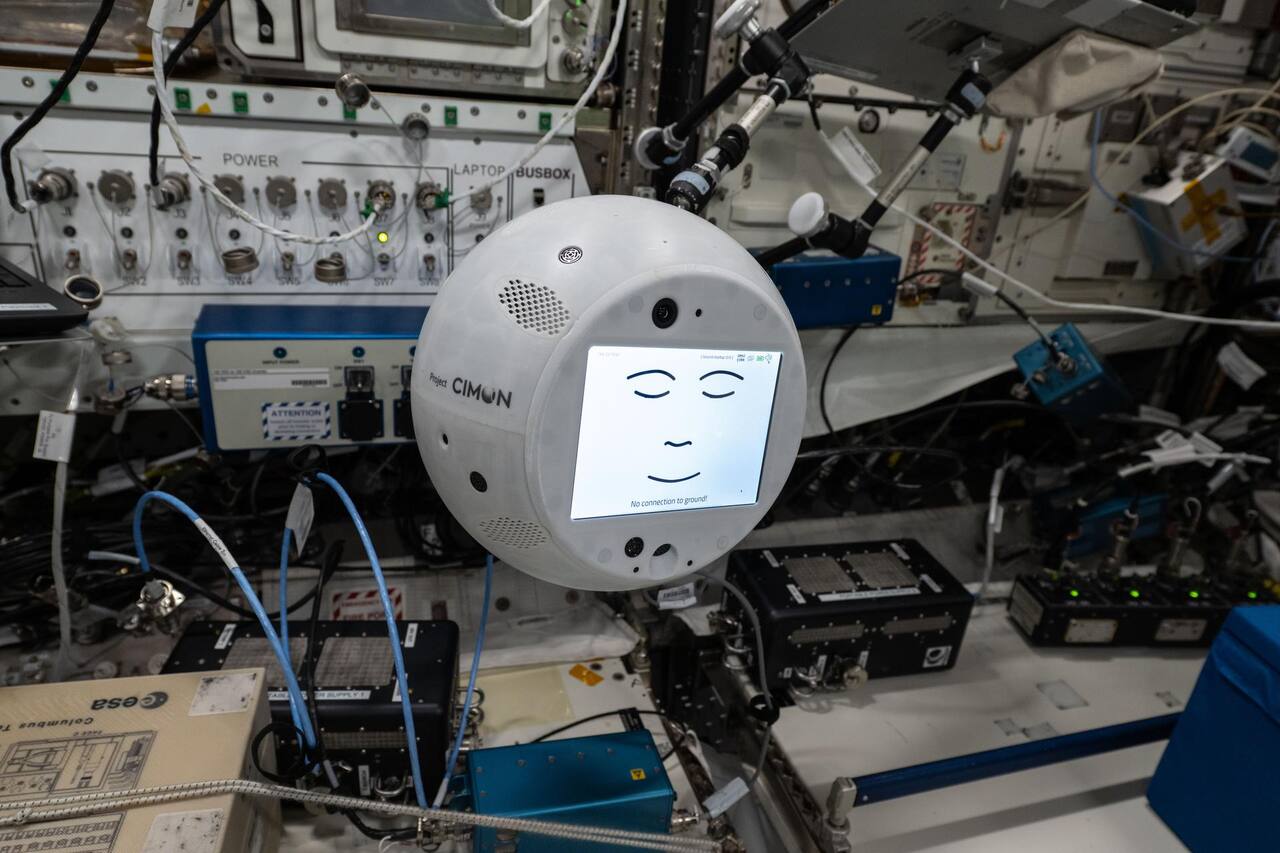
Section titled “Overview”CIMON, the Crew Interactive MObile companioN, is a free-flying artificial intelligence crew assistant operated in the European Columbus module of the International Space Station. The project was commissioned by the German Space Agency at DLR to explore human-robot interaction on long-duration missions, and the hardware was developed by Airbus [1]. Working in confined and extreme environments over a long mission is a risk to crew performance and wellbeing, and CIMON is the technology demonstrator aimed at that risk [2]. Its purpose is to reduce astronaut workload and stress, give hands-free access to procedures and data, and serve as a research subject for human-AI teaming [1]. Unlike the task-oriented free-flyers alongside it on the station, its core function is to interact, converse and demonstrate a form of emotional intelligence. In operation it acts as a database, a computer and a camera, showing the equipment required for a task on its screen, presenting directions for conducting experiments, searching for objects and taking inventory [2].
CIMON-2, Int-Ball2 and Astrobee are the intra-vehicular free-flyers currently resident on the station [2].
Specifications
Section titled “Specifications”| Parameter | CIMON-1 | CIMON-2 |
|---|---|---|
| Shape and size | 32 cm sphere | 32 cm sphere |
| Mass | approx. 5 kg | approx. 5 kg |
| Mobility | 12 propelling fans, about 120 mN maximum in x | same |
| Navigation | stereo camera VSLAM with IMU fusion | same |
| Imaging | 1280 x 1024 at 25 fps | same |
| Processor | Pokini F WIFI (AMD A4-6700T), two units | same |
| Software | Ubuntu with ROS | same |
| Power | Li-ion, crew replaceable, or wired input | same |
| Endurance on batteries | 2 h | 3 h |
| Data communication | wired connection, WLAN, Bluetooth | same |
| Payload interface | 2 x USB, Bluetooth | same |
| Ground operations | ground station remote connection plus AI server | same |
Source: [1].
Mission profile
Section titled “Mission profile”| Parameter | Value | Source |
|---|---|---|
| Host | International Space Station, Columbus module | [1] |
| CIMON-1 on orbit | 2 July 2018 to 27 August 2019 | [6] |
| CIMON-2 launch | 5 December 2019, 18:29 CET, SpaceX CRS-19 from Cape Canaveral | [5], [6] |
| CIMON-2 planned duration | up to three years aboard the station | [5], [6] |
| Users and science subjects since 2018 | more than five nations | [1] |
CIMON-1 was developed by about 50 people over two years from August 2016, and CIMON-2 by 20 people in under a year [6]. Astrobee’s 2015 charter paper names Smart SPHERES and the Personal Satellite Assistant as its direct heritage [21]. Astrobee, by comparison, traces its own project start to the Human Exploration Telerobotics 2 project in October 2014 and reached its first ISS launch in 2019, a span that included a full propulsion redesign away from cold-gas thrusters [12], [16]. Airbus in Friedrichshafen and Bremen built the hardware, and the DLR Space Administration funded and oversaw the project with German Federal Ministry for Economic Affairs and Energy money, IBM supplied the artificial intelligence, Ludwig Maximilian University Munich was the scientific partner and Biotesc at the University of Lucerne provided ground support [6].
Mobility
Section titled “Mobility”CIMON moves and rotates in all directions on internal battery-powered fans, which provide both attitude control and translation within the module [1]. It has no external moving parts and the body is largely produced by 3D printing [4]. Published fan counts conflict: the program summary text gives 14 internal fans [1] while its own comparison table gives 12; the review of intra-vehicular free-flyers records 14 on CIMON and 12 on CIMON-2 [2]; DLR states twelve [4]. Thrust is deliberately limited to between 0.03 and 0.12 N across the three axes for safety [2], with a maximum of about 120 mN in the x direction [1]. The spherical form is the choice made across intra-vehicular free-flyers to limit the consequences of a collision with crew or cargo [2].
Astrobee took a different route to the same safety goal with a cube body: each of its two propulsion modules feeds a plenum from one centrifugal impeller and doles thrust out through six flapper-controlled nozzles per module, a design chosen specifically to keep exhaust velocity low, around 11 m/s against the roughly 250 m/s of the SPHERES cold-gas thrusters it replaced, so that a worst-case collision along the longest straight run in the ISS interior stays within what an impact-absorbing foam shell and a hardware speed cutoff can contain [8], [9]. CIMON instead limits thrust magnitude directly at the fan level and forgoes a shell, trading Astrobee’s soft-body collision margin for a smaller, unpadded sphere.
Power and energy
Section titled “Power and energy”CIMON runs on lithium-ion batteries that the crew replaces, and it can also take a wired power input [1]. Endurance is 2 hours on CIMON-1 and 3 hours on CIMON-2, an increase of about 30 percent in the battery-powered autonomy [2], [6]. There is no docking station: CIMON requires crew for setup, unlike Astrobee and Int-Ball2, which reach a dock by themselves [1]. The Astrobee team made batteries available to the CIMON project in orbit until CIMON received its own items, which is the argument the joint operations teams make for a common pool of batteries, chargers, navigation markers and onboard computing across free-flyer projects. No battery capacity in watt-hours is published. The shift from consumables to rechargeable batteries across intra-vehicular free-flyers dates from the AERCam, Personal Satellite Assistant and SPHERES projects, and autonomous recharging is listed as one of the capabilities essential for any free-flyer tasked with maintaining an orbiting station [2].
Thermal
Section titled “Thermal”No thermal control design is published. CIMON carries temperature sensors [1] and operates in the pressurized cabin. All of these free-flyers use the existing infrastructure of the ISS for power supply, heat rejection and communications rather than providing their own, and none of the published Astrobee, CIMON or Int-Ball2 design and operations material describes a dedicated radiator or active heat rejection system distinct from the cabin environment [2], [12].
Compute and avionics
Section titled “Compute and avionics”Onboard computing is two units of Pokini F WIFI single-board computers built around an AMD A4-6700T, running Ubuntu with ROS, backed by an AI server on the ground [1]. The split is architectural rather than incidental: onboard software handles autonomous navigation and flight control by visual odometry and motion planning, while the language understanding runs on Earth. Both Astrobee and Int-Ball2 place their vision loop on a separate processor or core for the same reason, and time-critical modules such as propulsion take the highest priority across all of these designs [2].
Int-Ball2, the other station free-flyer to add a docking station after CIMON’s launch, runs a single Nvidia Jetson TX2 under Ubuntu with ROS Melodic and Gazebo, with guest software isolated in Docker containers uplinked and started from the ground rather than run over a live ground-to-robot link, and its own visual SLAM cannot run at the same time as direct access to the raw navigation camera feed [10]. Its first on-orbit docking demonstration, flown 17 October 2023, closed autonomously on the magnetic docking station with no crew action, a capability CIMON does not have [11]. That is a narrower but self-contained onboard stack; CIMON keeps its own vision and motion loop onboard but sends every spoken exchange to Earth, so the two designs split the same problem, onboard perception versus onboard cognition, in opposite directions.
Autonomy
Section titled “Autonomy”The artificial intelligence is IBM’s Watson platform running on Earth servers. Spoken commands are transmitted to the ground, processed by Watson, and the responses sent back to the robot [1]. CIMON is not self-learning; its knowledge base must be pre-loaded and trained by human operators. The cloud-dependent architecture was chosen for demonstration purposes and contrasts with systems designed for onboard autonomy. The consequence is operational: a continuous link is a core constraint on when CIMON can be used.
That constraint is the reason CIMON appears in the case for offline assistants. It is cited as an intelligent personal assistant limited by predefined, inflexible responses drawn from specific structured data sources, rule-based and requiring constant online connectivity [3]. One-way Mars communication delay reaches 24 minutes, which removes the ground-processing option entirely for a deep-space equivalent.
The other station free-flyers keep their autonomy loop onboard rather than splitting it across the link. Int-Ball2 flew a Proximal Policy Optimization-based docking controller derived from simulation training, reaching 97.2 percent stable docking against a 65.6 percent baseline once propeller drag-torque and spin-polarity effects were modeled in training, all without a continuous ground channel in the loop [13]. Astrobee similarly flew a reinforcement-learned attitude and translation controller trained in simulation and tested on a ground air-bearing table before being commanded to fly it on orbit [14]. Both demonstrate that the onboard compute on an ISS free-flyer is sufficient to host a learned control policy; CIMON’s architecture puts that same class of compute budget into hosting a spoken-language interface instead, and pays for it with the continuous link.
Navigation is vision-based. A dual 3D camera collects depth information and the relations between features to build a map with SLAM algorithms [2], fused with the IMU [1]. Directional microphones localize the sound source so the robot turns toward the speaker, and the front camera then establishes and maintains eye contact [2]. Ultrasound sensors handle collision avoidance [2], [4]. CIMON uses its own visual fiducials as an absolute localization reference, independent of the marker sets used by Astrobee and Int-Ball2 [1]. The nearest published localization record on the station is Astrobee’s: an extended Kalman filter fusing a 62.5 Hz IMU with sparse map landmarks, AR tags and handrail detections at roughly 2 to 5 Hz, which reached position errors of about 5 cm on a slow circle and 16.5 cm on a fast combined motion in ground tests, and used one map for three months in a busy lab [23]. No equivalent accuracy figure is published for CIMON’s stereo VSLAM.
Communications
Section titled “Communications”CIMON has a wired connection, station WLAN and Bluetooth [1], the widest link set of the three current intra-vehicular free-flyers [2]. Because the language model runs on the ground, the WLAN path carries the interaction loop rather than telemetry alone, and the requirement for a continuous link is treated by the operations teams as the defining CIMON constraint [1]. The quality of that link inside the station is not uniform: Astrobee flight surveys in 2022 found that the free-space inverse-square path-loss model does not hold inside the US Lab, Node 2 and the JEM, with lateral position relative to the module centerline and hatch crossings dominating received signal strength [22]. The survey used an uncalibrated radio and antenna, so only relative differences are reliable [22]. A conversation that depends on the cloud therefore depends on where in the module CIMON is.
Payload and instruments
Section titled “Payload and instruments”The sensor set is a crew camera, an infrared camera, an IMU, ultrasonic sensors and temperature sensors [1]. The optical suite as described by the program comprises stereo cameras for 3D vision and navigation, an infrared camera, two side cameras supporting augmented reality tasks and a high-resolution camera for documenting experiments. The manufacturer’s description of CIMON-2 lists a stereo camera for orientation, a high-resolution camera for facial recognition and two lateral cameras for photo and video documentation [6]; DLR describes two cameras for facial recognition plus five others for orientation and video documentation [5]. Imaging is 1280 x 1024 at 25 fps [1], against Int-Ball2’s 1920 x 1080 at 30 fps and 4056 x 3040 at 15 fps. The eyes on the front face are two of the cameras and are used for facial recognition [5].
The Astrobee program reached a comparable milestone on its own imaging suite: its perching arm and docking station were each commissioned and flying operational sessions within the first two years, versus CIMON’s absence of a dock across both flight units, which the joint review attributes to CIMON’s spherical shell leaving no surface area for a perching or docking mechanism without redesign [12].
The audio system uses multiple microphones to perform directional sound source localization, which is what lets the robot turn and face the astronaut who is speaking [1]. CIMON-2 carries eight directional microphones plus one additional directional microphone dedicated to speech recognition [6], [5], and a loudspeaker for speech and music [4], along with cameras and software for facial recognition, orientation and video documentation. Int-Ball2 carries a comparable stereo navigation camera plus a 4K imaging camera reaching 4056 x 3040 pixels at 15 fps [11], and its docking station specification gives the kind of external envelope figure, 169 x 169 x 92 mm, that CIMON has no equivalent to since it has no dock [11].
Two USB ports and Bluetooth are available as a payload interface [1], and the laser pointer and USB ports are hardware that has not yet been activated in flight.
Modes of operation
Section titled “Modes of operation”The crew interface is an LCD monitor showing an animated face that conveys operational status, a speaker, status LEDs, a laser pointer, on-off and microphone-mute buttons, and IMU-based physical contact detection [1]. The animated face is the status display, and the design intent is a more natural interaction than a text readout. CIMON acts as a database, a computer and a camera in the crew’s workflow rather than as a manipulator: of the free-flyers on the ISS only Astrobee carries an arm, and that is a perching arm [2]. Astrobee’s arm is used to grip station handrails for a stable extended vantage point rather than to manipulate objects, so none of the three current intra-vehicular free-flyers performs cargo or equipment handling [15].
Crew privacy is handled in hardware: CIMON provides a mechanical offline button [1]. Int-Ball2 indicates data acquisition with LEDs and Astrobee uses a set of visual cues, and in all three cases the crew are informed before any activity so they know video may be downlinked.
CIMON-2 can analyze emotion in language and show empathy when interacting with the crew [6], a capability none of the task-oriented survey and docking free-flyers on the station attempt [12], [11]. Teleoperation from the ground remains the fallback for fault detection and recovery on every intra-vehicular free-flyer regardless of the autonomy level reached [2]. Stewart et al. demonstrated the opposite direction is also possible: a reinforcement-learned controller trained entirely on the ground was uplinked and flown on Astrobee without further tuning, showing that at least some autonomy functions can migrate onboard after terrestrial training [14].
Ground operations
Section titled “Ground operations”CIMON is operated over a ground station remote connection working alongside the AI server [1]. Ground verification used software simulations, ground model testing, an Elegant Bread-Board and hardware-in-the-loop simulation. Some performance variances are found only on orbit, which is why every one of these programs pairs simulation with hardware test articles. Building a prototype before the official design review accelerated development, which the joint operations teams list as a lesson common to all three ISS free-flyer programs. Early alignment with the Human Safety board supported a smooth development phase and control of all hazards.
The station’s free-flyer lineage runs through an earlier telerobotic demonstrator that none of the three current vehicles directly descends from in hardware. Smart SPHERES, a SPHERES satellite carrying a smartphone as its computer and camera, flew an inventory and wall survey on the ISS in December 2012 under ground teleoperation, and its documented failures, cold-gas propellant exhaustion partway through two of five survey runs, a ceiling impact that broke the position estimate, and blurred imagery from an asymmetric payload upsetting the spherical body assumption, are cited by both the Astrobee and CIMON programs as the requirement basis for a purpose-built free-flyer rather than an augmented station-keeping satellite [7].
Anomaly resolution across these programs runs tiered: reproduce the fault on identical ground hardware, attempt remote recovery by power cycle or software patch, then crew replacement of hardware on orbit, then down-mass for ground repair [1]. CIMON took the replacement route, substituting an upgraded robot rather than repairing the flown one, as the Int-Ball project also did; Astrobee’s Honey was instead returned to the ground for repair, flew again, then logged its single hardware problem in a corrupted SD card during its six years of operations [12]. Ground support for CIMON operations is provided by Biotesc at the University of Lucerne [6].
Earlier free-flyers and what carried over
Section titled “Earlier free-flyers and what carried over”CIMON is the third generation of free-flying robots built for crewed spacecraft, and each earlier family fixed a design choice it inherits. The SPHERES thesis characterized a cold-gas, battery-powered free-flying satellite in laboratory and KC-135 testing: about 10 minutes of continuous station keeping per propellant tank and at least 90 minutes of battery power, with translation authority not demonstrated against KC-135 turbulence [17]. Those limits are the reason the later station vehicles moved to fans and rechargeable batteries. The external inspection line began with AERCam Sprint, a 35 lb, 14 in vehicle flown on Shuttle mission STS-87, followed by Mini AERCam, a 7.5 in, roughly 10 lb sphere with twelve cold-gas thrusters, built as a ground technology demonstration and not flown [18]. Its autonomy layer used a rule-based command sequencer and a loss-of-communications response that sequences safe and all-stop commands, tested on an air-bearing table and in a hardware-in-the-loop simulation [19]. CIMON takes the sphere form and the supervised-autonomy posture from this line but moves the free-flyer inside the pressurized module and makes dialog its function. Robonaut, a 43-degree-of-freedom humanoid, took the opposite premise: the robot adapts to existing crew worksites and interfaces instead of the worksite being redesigned for the robot [20].
Close-proximity inspection autonomy for free-flyers has been studied further in simulation only: a 2025 architecture for a 12-thruster inspector near Lunar Gateway geometry found that linger mode costs about five times the translational impulse of flyby over a 41.32 m path, with perfect localization assumed and no hardware test [24]. It informs the CIMON successor question of onboard autonomy but has not flown.
Technologies developed
Section titled “Technologies developed”CIMON established that a verbal and visual interface is a usable additional tool for daily work in a crewed exploration environment, and most users gave positive feedback [1]. It was built to reduce crew workload and emotional stress, and it is the free-flyer whose declared product is the interaction itself rather than a camera view or an algorithm testbed [2]. Users and science subjects from more than five nations have interacted with the system since 2018, performing different and comparable tasks, which is the basis on which precise system requirements for a successor can be identified [1]. Astrobee’s Guest Science program is the scale comparison: over 2 terabytes of data delivered to 17 unique investigators across 22 projects through May 2025, run mostly without crew time on console [12].
The program’s own stated limitation is the constraint imposed by its setup and its dependencies on external services, which traces to the 2016 mission goal of fielding an early-available technology demonstrator [1]. The stated next step is a hardware update increasing autonomy and availability, including a docking station and permanent deployment, together with on-premises AI services based on large language models and agentic AI. Offline assistants built from knowledge graphs, retrieval-augmented generation and language models are being designed for exactly that case, to run without a link to Earth [3].
Software interoperability turned out to be the transferable result. In 2025 CIMON and Int-Ball2 exchanged data in real time in the ICHIBAN activity, which was possible because both run ROS as their middleware [1]. Modular software architecture on ROS was adopted independently by Astrobee, CIMON and Int-Ball2, and the joint teams identify shared middleware as the route to sharing sensory and computational resources between free-flyers in a resource-constrained environment.
Set against Astrobee’s operations record, CIMON’s crew-setup requirement is the visible cost of forgoing a dock: across six years on orbit Astrobee’s three units and docking station logged well over 165 real-time operations and more than 90 Guest Science sessions with the great majority of console time needing no crew present at all [12], a session cadence a manually-deployed, ground-dependent assistant cannot match. NASA’s own program materials describe the same docking and autonomous-recharge capability as the baseline expectation for a station free-flyer [15], which is the capability CIMON’s stated next-generation hardware update is intended to add.
What is not established
Section titled “What is not established”No performance measurement of either CIMON unit is published in the held sources. The manufacturer’s statement that CIMON-2 autonomy rose by around 30 percent over CIMON-1 carries no definition, baseline or unit [6]. Navigation accuracy, translation and rotation rates, station-keeping error, collision-avoidance standoff distance and speech recognition rate in ISS acoustic noise are not reported [6]. The 32 cm diameter and the fan count are design statements from the project page [4], and fan counts differ between sources [1], [2], [4]. Voice-commanded navigation to Biolab is reported as a single successful flight, so no reliability figure follows [6]. The CIMON-2 launch release gives component counts without specifications and its only operational data point, the 90-minute session, belongs to CIMON-1 [5]. The empathy and stress-reduction goals are stated aims; no study, sample or outcome is reported [6]. The offline assistant architecture that would replace the cloud link is a proposal with no implementation, experiment or quantitative result, and has not been tested on station hardware or with crew [3]. No battery capacity, thermal design or mass breakdown is published.
References
Section titled “References”References
- Yamaguchi, S. P., Mora Vargas, A., Eisenberg, T., Rogon, C., Yamamoto, T., Inoue, S., Kössl, C., Coltin, B., Smith, T. and Benavides, J. V. (2025). Free-Flying Crew Cooperative Robots on the ISS: A Joint Review of Astrobee, CIMON, and Int-Ball Operations
. International Conference on Space Robotics. Source
BibTeX
@inproceedings{yamaguchi2026free, title = {Free-Flying Crew Cooperative Robots on the ISS: A Joint Review of Astrobee, CIMON, and Int-Ball Operations}, author = {Yamaguchi, Seiko Piotr and Mora Vargas, Andres and Eisenberg, Till and Rogon, Christian and Yamamoto, Tatsuya and Inoue, Shona and Kössl, Christoph and Coltin, Brian and Smith, Trey and Benavides, Jose V.}, booktitle = {International Conference on Space Robotics}, pages = {402-409}, year = {2025}, doi = {10.1109/isparo66239.2025.11436992}, abstract = {Intra-vehicular free-flying robots are anticipated to support various work in human spaceflight while working side-by-side with astronauts. Such example of robots includes NASA’s Astrobee, DLR’s CIMON, and JAXA’s Int-Ball, which are deployed on the International Space Station. This paper presents the first joint analyses of these robot’s shared experiences, co-authored by their development and operation team members. Despite the different origins and design philosophies, the development and operations of these platforms encountered various convergences. Hence, this paper presents a detailed overview of these robots, presenting their objectives, design, and onboard operations. Hence, joint lessons learned across the lifecycle are presented, from design to on-orbit operations. These lessons learned are anticipated to serve for future development and research as design recommendations.} } - Turchetti, F., Ekal, M., Lii, N. Y. and Roa, M. A. (2024). Analysis of Intra-Vehicular Robotic Free-Flyers and Their Manipulation Capabilities
. International Astronautical Congress, IAC-24-A2.5.10. Source
BibTeX
@inproceedings{turchetti2024analysis, title = {Analysis of Intra-Vehicular Robotic Free-Flyers and Their Manipulation Capabilities}, author = {Turchetti, Federico and Ekal, Monica and Lii, Neal Y. and Roa, Maximo A.}, booktitle = {International Astronautical Congress}, number = {IAC-24-A2.5.10}, year = {2024}, url = {https://elib.dlr.de/208576/} } - Bensch, O., Bensch, L., Nilsson, T., Saling, F., Sadri, W. M., Hartmann, C., Hecking, T. and Kutz, J. N. (2024). Towards a Reliable Offline Personal AI Assistant for Long Duration Spaceflight
. International Astronautical Congress, IAC-24-B3.7.12. Source
BibTeX
@inproceedings{bensch2024reliable, title = {Towards a Reliable Offline Personal AI Assistant for Long Duration Spaceflight}, author = {Bensch, Oliver and Bensch, Leonie and Nilsson, Tommy and Saling, Florian and Sadri, Wafa M. and Hartmann, Carsten and Hecking, Tobias and Kutz, J. Nathan}, booktitle = {International Astronautical Congress}, number = {IAC-24-B3.7.12}, pages = {336-346}, year = {2024}, doi = {10.52202/078364-0039} } - (2026). DLR: CIMON, the intelligent astronaut assistant. dlr.de/en/research-and-transfer/projects-and-missions/horizons/cimon
BibTeX
@misc{dlrcimon, title = {DLR: CIMON, the intelligent astronaut assistant}, organization = {dlr.de}, year = {2026}, url = {https://www.dlr.de/en/research-and-transfer/projects-and-missions/horizons/cimon} } - (2026). DLR: CIMON-2 is on its way to the ISS. dlr.de/en/latest/news/2019/04/20191205_cimon2-on-its-way-to-the-iss
BibTeX
@misc{dlrcimon2, title = {DLR: CIMON-2 is on its way to the ISS}, organization = {dlr.de}, year = {2026}, url = {https://www.dlr.de/en/latest/news/2019/04/20191205_cimon2-on-its-way-to-the-iss} } - (2021). Airbus: CIMON-2 makes its successful debut on the ISS. airbus.com/en/newsroom/press-releases/2020-04-cimon-2-makes-its-succe...
BibTeX
@misc{airbuscimon, title = {Airbus: CIMON-2 makes its successful debut on the ISS}, organization = {airbus.com}, year = {2021}, url = {https://www.airbus.com/en/newsroom/press-releases/2020-04-cimon-2-makes-its-successful-debut-on-the-iss} } - Fong, T., Micire, M., Morse, T., Park, E., Provencher, C., To, V., Wheeler, D. W., Mittman, D., Torres, R. J. and Smith, E. (2013). Smart SPHERES: a Telerobotic Free-Flyer for Intravehicular Activities in Space
. AIAA SPACE Conference. Source
BibTeX
@inproceedings{fong2013smart, title = {Smart SPHERES: a Telerobotic Free-Flyer for Intravehicular Activities in Space}, author = {Fong, Terrence and Micire, Mark and Morse, Ted and Park, Eric and Provencher, Chris and To, Vinh and Wheeler, D. W. and Mittman, David and Torres, R. Jay and Smith, Ernest}, booktitle = {AIAA SPACE Conference}, publisher = {American Institute of Aeronautics and Astronautics}, address = {San Diego, California}, year = {2013}, doi = {10.2514/6.2013-5338}, abstract = {Smart SPHERES is a prototype free-flying space robot based on the SPHERES platform. Smart SPHERES can be remotely operated by astronauts inside a spacecraft, or by mission controllers on the ground. We developed Smart SPHERES to perform a variety of intravehicular activities (IVA), such as operations inside the International Space Station (ISS). These IVA tasks include environmental monitoring surveys (radiation, sound levels, etc.), inventory, and mobile camera work. In this paper, we first discuss the motivation for free-flying space robots. We then describe the development of the Smart SPHERES prototype, including avionics, software, and data communications. Finally, we present results of initial flight tests on-board the ISS.} } - Bualat, M. G., Smith, T., Fong, T. W., Smith, E. E. and Wheeler, D. W. (2018). Astrobee: A New Tool for ISS Operations
. SpaceOps Conference. Source
BibTeX
@inproceedings{bualat2018astrobee, title = {Astrobee: A New Tool for ISS Operations}, author = {Bualat, Maria G. and Smith, Trey and Fong, Terrence W. and Smith, Ernest E. and Wheeler, D. W.}, booktitle = {SpaceOps Conference}, address = {Marseille, France}, year = {2018}, doi = {10.2514/6.2018-2517}, abstract = {The Astrobee} } - Daley, E. (2020). Astrobee Free-Flyer Nozzle Mechanism Summary
. Aerospace Mechanisms Symposium, 20200010325. Source
BibTeX
@inproceedings{daley2020astrobee, title = {Astrobee Free-Flyer Nozzle Mechanism Summary}, author = {Daley, Earl}, booktitle = {Aerospace Mechanisms Symposium}, number = {20200010325}, institution = {NASA}, address = {Houston, TX}, year = {2020}, url = {https://ntrs.nasa.gov/citations/20200010325}, abstract = {The paper summary details the function, design, and lessons learned during the development of the Astrobee Free-Flyer nozzle. The Astrobee Free-Flyer is a free flying robot used aboard the International Space Station (ISS).} } - Japan Aerospace Exploration Agency. (2024). Int-Ball2 Technology Demonstration User Programing Platform User's Manual
. JAXA Human Spaceflight Technology Center, JMX-2024020. Source
BibTeX
@techreport{jaxa2024intball2, title = {Int-Ball2 Technology Demonstration User Programing Platform User's Manual}, author = {{Japan Aerospace Exploration Agency}}, number = {JMX-2024020}, institution = {JAXA Human Spaceflight Technology Center}, year = {2024}, url = {https://github.com/jaxa/int-ball2_simulator} } - Hirano, D., Mitani, S., Watanabe, K., Nishishita, T., Yamamoto, T. and Yamaguchi, S. P. (2025). Int-Ball2: On-Orbit Demonstration of Autonomous Intravehicular Flight and Docking for Image Capturing and Recharging
. IEEE Robotics & Automation Magazine, 3. Source
BibTeX
@article{hirano2025intball2, title = {{Int-Ball2}: On-Orbit Demonstration of Autonomous Intravehicular Flight and Docking for Image Capturing and Recharging}, author = {Hirano, Daichi and Mitani, Shinji and Watanabe, Keisuke and Nishishita, Taisei and Yamamoto, Tatsuya and Yamaguchi, Seiko P.}, journal = {IEEE Robotics & Automation Magazine}, volume = {32}, number = {3}, pages = {76--87}, year = {2025}, doi = {10.1109/mra.2024.3505776}, abstract = {This article presents the system architecture and the orbital demonstration results of the Int-Ball2, a free-flying camera robot developed by the Japan Aerospace Exploration Agency (JAXA). The purpose of the Int-Ball2 project is to assist astronauts and reduce their workload in the International Space Station (ISS). This robot is an upgrade from the first Int-Ball, enhancing the propulsion subsystem for greater maneuverability and adding a new docking station (DS) for autonomous battery recharging. This study performed comprehensive ground tests for autonomous maneuvering and docking, employing a combination of a fully software-based simulator, a hardware-in-the-loop (HIL) simulator, and a planar air-bearing facility. After a successful launch to the ISS, the Int-Ball2 demonstrated its ability to work in microgravity without relying on astronaut support. The results obtained from ground and orbital tests underscored the effectiveness of our system design and ground verification approach. Further, we present key technologies essential for the Int-Ball2’s successful implementation on board the ISS. We expect the insights from this project to be invaluable to future missions involving free-flying robots in microgravity.} } - Alexandrov, O., Barlow, J., Benavides, J., Bualat, M., Carlino, R., Coltin, B., Cortez, J., Daley, E., Feller, J., Flückiger, L., Fong, T., Fusco, J., Garcia Ruiz, R., Hamilton, K., Kanis, S., Katterhagen, A., Kim, Y., Love, J. F., McIntyre, M., McLachlan, B., Mora Vargas, A., Moratto, Z., Moreira, M., Morse, T., Orosco, H., Park, I.-W., Provencher, C., Sanchez, H., Sharif, K., Smith, E., Smith, T., Soussan, R., Symington, A., Talavera, R. O., To, V., Wheeler, D. and Yoo, J. (2026). Astrobee: Free-Flying Robots for the International Space Station
. IEEE Transactions on Field Robotics. Source
BibTeX
@article{alexandrov2026astrobee, title = {Astrobee: Free-Flying Robots for the International Space Station}, author = {Alexandrov, Oleg and Barlow, Jonathan and Benavides, Jose and Bualat, Maria and Carlino, Roberto and Coltin, Brian and Cortez, Jose and Daley, Earl and Feller, Jeffrey and Flückiger, Lorenzo and Fong, Terrence and Fusco, Jesse and Garcia Ruiz, Ruben and Hamilton, Kathryn and Kanis, Simeon and Katterhagen, Aric and Kim, Yunkyung and Love, John F. and McIntyre, Michael and McLachlan, Blair and Mora Vargas, Andres and Moratto, Zack and Moreira, Marina and Morse, Theodore and Orosco, Henry and Park, In-Won and Provencher, Christopher and Sanchez, Hugo and Sharif, Khaled and Smith, Ernest and Smith, Trey and Soussan, Ryan and Symington, Andrew and Talavera, Rafael Omar and To, Vinh and Wheeler, DW and Yoo, Jongwoon}, journal = {IEEE Transactions on Field Robotics}, year = {2026}, url = {https://ntrs.nasa.gov/citations/20260001396}, abstract = {The Astrobees are free-flying robots that operate inside the International Space Station (ISS) and were launched to the ISS in 2019. Since then they have successfully performed hundreds of activities in space supporting almost two dozen separate research projects. The robots were designed to overcome multiple challenges unique to the ISS environment, including safety, upgradeability and maintainability, limited mass and computation, and unique localization challenges from lack of gravity and a constantly changing environment. This article provides an overview of Astrobee, from hardware and software design to deployment results and activities.} } - Arora, A., El-Hariry, M. and Olivares-Mendez, M. (2025). Reinforcement Learning Based 6-DoF Maneuvers for Microgravity Intravehicular Docking: A Simulation Study with Int-Ball2 in ISS-JEM
. arXiv. Source
BibTeX
@article{arora2025reinforcement, title = {Reinforcement Learning Based 6-DoF Maneuvers for Microgravity Intravehicular Docking: A Simulation Study with Int-Ball2 in ISS-JEM}, author = {Arora, Aman and El-Hariry, Matteo and Olivares-Mendez, Miguel}, journal = {arXiv}, year = {2025}, doi = {10.48550/arxiv.2512.13514}, abstract = {Autonomous free-flyers play a critical role in intravehicular tasks aboard the International Space Station (ISS), where their precise docking under sensing noise, small actuation mismatches, and environmental variability remains a nontrivial challenge. This work presents a reinforcement learning (RL) framework for six-degree-of-freedom (6-DoF) docking of JAXA's Int-Ball2 robot inside a high-fidelity Isaac Sim model of the Japanese Experiment Module (JEM). Using Proximal Policy Optimization (PPO), we train and evaluate controllers under domain-randomized dynamics and bounded observation noise, while explicitly modeling propeller drag-torque effects and polarity structure. This enables a controlled study of how Int-Ball2's propulsion physics influence RL-based docking performance in constrained microgravity interiors. The learned policy achieves stable and reliable docking across varied conditions and lays the groundwork for future extensions pertaining to Int-Ball2 in collision-aware navigation, safe RL, propulsion-accurate sim-to-real transfer, and vision-based end-to-end docking.} } - Stewart, K. H., Chapin, S., Leontie, R. and Henshaw, C. G. (2025). Crossing the Sim2Real Gap Between Simulation and Ground Testing to Space Deployment of Autonomous Free-flyer Control
. arXiv. Source
BibTeX
@article{stewart2025crossing, title = {Crossing the Sim2Real Gap Between Simulation and Ground Testing to Space Deployment of Autonomous Free-flyer Control}, author = {Stewart, K. H. and Chapin, Samantha and Leontie, Roxana and Henshaw, Carl Glen}, journal = {arXiv}, year = {2025}, doi = {10.1109/isparo66239.2025.11436888}, abstract = {Reinforcement learning (RL) offers transformative potential for robotic control in space. We present the first on-orbit demonstration of RL-based autonomous control of a free-flying robot, the NASA Astrobee, aboard the International Space Station (ISS). Using NVIDIA's Omniverse physics simulator and curriculum learning, we trained a deep neural network to replace Astrobee's standard attitude and translation control, enabling it to navigate in microgravity. Our results validate a novel training pipeline that bridges the simulation-to-reality (Sim2Real) gap, utilizing a GPU-accelerated, scientific-grade simulation environment for efficient Monte Carlo RL training. This successful deployment demonstrates the feasibility of training RL policies terrestrially and transferring them to space-based applications. This paves the way for future work in In-Space Servicing, Assembly, and Manufacturing (ISAM), enabling rapid on-orbit adaptation to dynamic mission requirements.} } - (2023). NASA: Astrobee. nasa.gov/astrobee
BibTeX
@misc{nasaastrobee, title = {NASA: Astrobee}, organization = {nasa.gov}, year = {2023}, url = {https://www.nasa.gov/astrobee} } - Smith, T., Barlow, J., Bualat, M., Fong, T., Provencher, C., Sanchez, H. and Smith, E. (2016). Astrobee: A New Platform for Free-Flying Robotics on the International Space Station
. International Symposium on Artificial Intelligence, Robotics and Automation in Space. Source
BibTeX
@inproceedings{smith2016astrobee, title = {Astrobee: A New Platform for Free-Flying Robotics on the International Space Station}, author = {Smith, Trey and Barlow, Jonathan and Bualat, Maria and Fong, Terrence and Provencher, Christopher and Sanchez, Hugo and Smith, Ernest}, booktitle = {International Symposium on Artificial Intelligence, Robotics and Automation in Space}, address = {Beijing, China}, year = {2016}, url = {https://ntrs.nasa.gov/citations/20160007769}, abstract = {The Astrobees are next-generation free-flying robots that will operate in the interior of the International Space Station (ISS). Their primary purpose is to provide a flexible platform for research on zero-g freeflying robotics, with the ability to carry a wide variety of future research payloads and guest science software. They will also serve utility functions: as free-flying cameras to record video of astronaut activities, and as mobile sensor platforms to conduct surveys of the ISS. The Astrobee system includes two robots, a docking station, and a ground data system (GDS). It is developed by the Human Exploration Telerobotics 2 (HET-2) Project, which began in Oct. 2014, and will deliver the Astrobees for launch to ISS in 2017. This paper covers selected aspects of the Astrobee design, focusing on capabilities relevant to potential users of the platform.} } - Saenz-Otero, A. (2000). The SPHERES Satellite Formation Flight Testbed: Design and Initial Control. Source
BibTeX
@mastersthesis{saenzotero2000spheres, title = {The SPHERES Satellite Formation Flight Testbed: Design and Initial Control}, author = {Saenz-Otero, Alvar}, school = {Massachusetts Institute of Technology}, type = {M.Eng. thesis}, year = {2000}, url = {https://dspace.mit.edu/handle/1721.1/86730} } - Fredrickson, S. E., Abbott, L. W., Duran, S., Jochim, J. D., Studak, J. W., Wagenknecht, J. D. and Williams, N. M. (2003). Mini AERCam: Development of a Free-Flying Nanosatellite Inspection Robot
. Space. Source
BibTeX
@inproceedings{fredrickson2003mini, title = {Mini {AERCam}: Development of a Free-Flying Nanosatellite Inspection Robot}, author = {Fredrickson, Steven E. and Abbott, Larry W. and Duran, Steve and Jochim, J. David and Studak, J. William and Wagenknecht, Jennifer D. and Williams, Nichole M.}, booktitle = {Space}, volume = {5088}, pages = {97-111}, publisher = {SPIE}, year = {2003}, doi = {10.1117/12.498108}, abstract = {The Engineering Directorate of NASA Johnson Space Center has developed a nanosatellite-class free-flyer intended for future external inspection and remote viewing of human spaceflight activities, including International Space Station (ISS) operations. The Miniature Autonomous Extravehicular Robotic Camera (Mini AERCam) technology demonstration unit has been integrated into the approximate form and function of a flight system. The spherical Mini AERCam free flyer is 7.5 inches in diameter and weighs approximately 10 pounds, yet it incorporates significant additional capabilities compared to the 35 pound, 14 inch AERCam Sprint that flew as a Shuttle flight experiment in 1997. Mini AERCam hosts a full suite of miniaturized avionics, instrumentation, communications, navigation, imaging, power, and propulsion subsystems, including two digital video cameras and a high resolution still image camera. The vehicle is designed for either remotely piloted operations or supervised autonomous operations including automatic stationkeeping and point-to-point maneuvering. Free-flyer testing has been conducted on an air-bearing table and in a six degree-of-freedom closed-loop orbital simulation. The orbital simulation models the three-dimensional dynamics of the free-flyer in proximity to the ISS, and produces corresponding God's eye views and simulated free-flyer camera views. A high-fidelity simulation is achieved by directly interfacing to free-flyer thruster driver signals, emulating the MEMS gyro responses in hardware, and using the "truth" state to drive a GPS signal generator connected to the free-flyer GPS receiver.} } - Fredrickson, S., Duran, S., Braun, A., Straube, T. and Mitchell, J. (2006). AERCam Autonomy: Intelligent Software Architecture for Robotic Free Flying Nanosatellite Inspection Vehicles
. Space. Source
BibTeX
@inproceedings{fredrickson2006aercam, title = {AERCam Autonomy: Intelligent Software Architecture for Robotic Free Flying Nanosatellite Inspection Vehicles}, author = {Fredrickson, Steven and Duran, Steve and Braun, Angela and Straube, Timothy and Mitchell, Jennifer}, booktitle = {Space}, year = {2006}, doi = {10.2514/6.2006-7392}, abstract = {The NASA Johnson Space Center has developed a nanosatellite-class Free Flyer intended for future external inspection and remote viewing of human spacecraft.The Miniature Autonomous Extravehicular Robotic Camera (Mini AERCam) technology demonstration unit has been integrated into the approximate form and function of a flight system.The spherical Mini AERCam Free Flyer is 7.5 inches in diameter and weighs approximately 10 pounds, yet it incorporates significant additional capabilities compared to the 35-pound, 14inch diameter AERCam Sprint that flew as a Shuttle flight experiment in 1997.Mini AERCam hosts a full suite of miniaturized avionics, instrumentation, communications, navigation, power, propulsion, and imaging subsystems, including digital video cameras and a high resolution still image camera.The vehicle is designed for either remotely piloted operations or supervised autonomous operations, including automatic stationkeeping, pointto-point maneuvering, and waypoint tracking.The Mini AERCam Free Flyer is accompanied by a sophisticated control station for command and control, as well as a docking system for automated deployment, docking, and recharge at a parent spacecraft.Free Flyer functional testing has been conducted successfully on both an airbearing table and in a six-degree-of-freedom closed-loop orbital simulation with avionics hardware in the loop.Mini AERCam aims to provide beneficial on-orbit views that cannot be obtained from fixed cameras, cameras on robotic manipulators, or cameras carried by crewmembers during extravehicular activities (EVA's).On Shuttle or International Space Station (ISS), for example, Mini AERCam could support external robotic operations by supplying orthogonal views to the intravehicular activity (IVA) robotic operator, supply views of EVA operations to IVA and/or ground crews monitoring the EVA, and carry out independent visual inspections of areas of interest around the spacecraft.To enable these future benefits with minimal impact on IVA operators and ground controllers, the Mini AERCam system architecture incorporates intelligent systems attributes that support various autonomous capabilities.1) A robust command sequencer enables task-level command scripting.Command scripting is employed for operations such as automatic inspection scans over a region of interest, and operator-hands-off automated docking.2) A system manager built on the same expert-system software as the command sequencer provides detection and smartresponse capability for potential system-level anomalies, like loss of communications between the Free Flyer and control station.3) An AERCam dynamics manager provides nominal and off-nominal management of guidance, navigation, and control (GN&C) functions.It is employed for safe trajectory monitoring, contingency maneuvering, and related roles.This paper will describe these architectural components of Mini AERCam autonomy, as well as the interaction of these elements with a human operator during supervised autonomous control.} } - Ambrose, R. O. and Diftler, M. A. (2001). Robonaut: A Robotic Astronaut Assistant
. International Symposium on Artificial Intelligence, Robotics and Automation in Space, 20100033240. Source
BibTeX
@inproceedings{ambrose2001robonaut, title = {Robonaut: A Robotic Astronaut Assistant}, author = {Ambrose, Robert O. and Diftler, Myron A.}, booktitle = {International Symposium on Artificial Intelligence, Robotics and Automation in Space}, number = {20100033240}, institution = {NASA}, address = {Montreal}, year = {2001}, url = {https://ntrs.nasa.gov/citations/20100033240}, abstract = {NASA's latest anthropomorphic robot, Robonaut, has reached a milestone in its capability. This highly dexterous robot, designed to assist astronauts in space, is now performing complex tasks at the Johnson Space Center that could previously only be carried out by humans. With 43 degrees of freedom, Robonaut is the first humanoid built for space and incorporates technology advances in dexterous hands, modular manipulators, lightweight materials, and telepresence control systems. Robonaut is human size, has a three degree of freedom (DOF) articulated waist, and two, seven DOF arms, giving it an impressive work space for interacting with its environment. Its two, five fingered hands allow manipulation of a wide range of tools. A pan/tilt head with multiple stereo camera systems provides data for both teleoperators and computer vision systems.} } - Bualat, M., Barlow, J., Fong, T., Provencher, C., Smith, T. and Zuniga, A. (2015). Astrobee: Developing a Free Flying Robot for the International Space Station
. AIAA SPACE Conference, 20150018250. Source
BibTeX
@inproceedings{bualat2015astrobee, title = {Astrobee: Developing a Free Flying Robot for the International Space Station}, author = {Bualat, Maria and Barlow, Jonathan and Fong, Terrence and Provencher, Christopher and Smith, Trey and Zuniga, Allison}, booktitle = {AIAA SPACE Conference}, number = {20150018250}, institution = {NASA}, year = {2015}, doi = {10.2514/6.2015-4643}, abstract = {Astronaut time will always be in short supply, consumables (e.g., oxygen) will always be limited, and some work will not be feasible, or productive, for astronauts to do manually. Free flyers offer significant potential to perform a great variety of tasks, include routine, repetitive or simple but long-duration work, such as conducting environment surveys, taking sensor readings or monitoring crew activities. The "Astrobee" project is developing a new free flying robot system suitable for performing Intravehicular Activity (IVA) work on the International Space Station (ISS). This paper will describe the Astrobee project objectives, initial design, concept of operations, and key challenges.\n\n\n} } - Yang, E., Hwu, S. U., Lansdowne, C., Boster, J. P. and deSilva, K. (2024). Wi-Fi Signal Survey of the International Space Station by Autonomous Free-Flying Robot
. IEEE International Conference on Wireless for Space and Extreme Environments, 20240014199. Source
BibTeX
@inproceedings{yang2024wi, title = {Wi-Fi Signal Survey of the International Space Station by Autonomous Free-Flying Robot}, author = {Yang, Everest and Hwu, Shian U. and Lansdowne, Chatwin and Boster, John P. and deSilva, Kanishka}, booktitle = {IEEE International Conference on Wireless for Space and Extreme Environments}, number = {20240014199}, pages = {238-243}, institution = {NASA}, year = {2024}, doi = {10.1109/wisee61249.2024.10850420}, abstract = {This paper analyzes Wi-Fi signal propagation inside pressurized modules of the International Space Station (ISS). Various flight datasets were collected by the Astrobee fleet of autonomous free-flying robots developed by the NASA Ames Research Center (ARC). The enclosed module spaces of the ISS pose unique challenges for Wi-Fi signal propagation, and understanding these challenges is crucial for optimizing connectivity in such environments. The survey data presented are valuable for optimizing wireless access point (WAP) locations and conditions. A computational method is developed to analyze the wireless communication system, RF coverage, and module compositions. The method is both rigorous and practical for assessing the ISS wireless system performance. The computational tools in this paper serve as a complementary approach to direct, on-orbit measurements, which is a complicated and expensive task. In some operational scenarios, ground measurements may be intractable due to the size of the spacecraft. Results from this research will aid future space missions and commercial spacecraft, providing insights into optimal WAP placements and robust wireless communication systems.} } - Coltin, B., Fusco, J., Moratto, Z., Alexandrov, O. and Nakamura, R. (2016). Localization from Visual Landmarks on a Free-Flying Robot
. IEEE/RSJ International Conference on Intelligent Robots and Systems. Source
BibTeX
@inproceedings{coltin2016localization, title = {Localization from Visual Landmarks on a Free-Flying Robot}, author = {Coltin, Brian and Fusco, Jesse and Moratto, Zack and Alexandrov, Oleg and Nakamura, Robert}, booktitle = {IEEE/RSJ International Conference on Intelligent Robots and Systems}, pages = {4377-4382}, address = {Daejeon, Korea}, year = {2016}, doi = {10.1109/iros.2016.7759644}, abstract = {We present the localization approach for Astrobee, a new free-flying robot designed to navigate autonomously on the International Space Station (ISS). Astrobee will accommodate a variety of payloads and enable guest scientists to run experiments in zero-g, as well as assist astronauts and ground controllers. Astrobee will replace the SPHERES robots which currently operate on the ISS, whose use of fixed ultrasonic beacons for localization limits them to work in a 2 meter cube. Astrobee localizes with monocular vision and an IMU, without any environmental modifications. Visual features detected on a pre-built map, optical flow information, and IMU readings are all integrated into an extended Kalman filter (EKF) to estimate the robot pose. We introduce several modifications to the filter to make it more robust to noise, and extensively evaluate the localization algorithm.} } - Albee, K., Sternberg, D. C., Hansson, A., Schwartz, D., Majumdar, R. and Jia-Richards, O. (2025). Architecting Autonomy for Safe Microgravity Free-Flyer Inspection
. IEEE Aerospace Conference. Source
BibTeX
@inproceedings{albee2025architecting,
  title = {Architecting Autonomy for Safe Microgravity Free-Flyer Inspection},
  author = {Albee, Keenan and Sternberg, David C. and Hansson, Alexander and Schwartz, David and Majumdar, Ritwik and Jia-Richards, Oliver},
  booktitle = {IEEE Aerospace Conference},
  publisher = {JPL Open Repository},
  year = {2025},
  doi = {10.48577/jpl.esh2bl}
}