Iris
Program pages Iris Lunar Rover
 Carnegie Mellon University.
Overview
Section titled “Overview”A university that wants to fly a lunar rover cannot buy mass, power or bandwidth in the quantities a national space agency can. Every gram of chassis, every watt of heater power and every bit of downlink has to be justified against a payload that, in Iris’s case, is two cameras. Iris is the Carnegie Mellon answer to that constraint: a 2.2 kg nanorover in a shoebox-sized carbon fiber chassis running a custom single board computer [1], built as a technology and mobility demonstration rather than a science mission, and to do it on a commercial lander’s terms rather than a flagship’s.
It shares its origin with Astrobotic’s CubeRover product line, which packages the same constraint into a CubeSat-like sizing convention: one U is a 10 cm cube of structure supporting roughly a kilogram of payload, with 2U, 4U and 6U variants sharing one structural, power, thermal, avionics and software design [3]. CubeRover’s own numbers, a 4.6 to 10.6 kg rover mass across those sizes and an advertised delivery cost near 4.5 million dollars per kilogram of payload [2], [3], set the design space Iris’s own mass figure sits inside. Iris was the first flight vehicle out of that CMU effort, ahead of the product line it shares a lineage with.
Iris was carried on Astrobotic’s Peregrine lander, launched 8 January 2024 on the first flight of the Vulcan rocket [5]. A propulsion anomaly prevented the landing, and Iris was operated in cislunar space instead, then destroyed with the lander on controlled re-entry on 18 January 2024. What changed after the anomaly was the mission, not the rover: Iris completed the checkout its designers had planned, only against a lander that could never put it on the ground.
Specifications
Section titled “Specifications”| Parameter | Value | Source |
|---|---|---|
| Mass | 2.2 kg | [1] |
| Chassis | carbon fiber monocoque | [1] |
| Flight computer | single board computer, custom | [1] |
| Flight software | JPL F Prime | [7] |
| Sensors | IMU, two cameras, odometry, UWB module | [6] |
Carnegie Mellon news material gives 2.2 kg [1], and the 2020 preprint written during development describes a four pound rover [6]. No source reconciles the two. Wheel mass, ground clearance and obstacle height are not published in any source held here and are omitted. For scale, Astrobotic’s own CubeRover line runs 4.6 to 10.6 kg across its 2U to 6U sizes [2], so Iris sits below the smallest of Astrobotic’s own commercial products despite drawing on the same CMU heritage.
Mission profile
Section titled “Mission profile”These describe Peregrine Mission One, not the rover.
| Parameter | Value |
|---|---|
| Lander | Astrobotic Peregrine |
| Launch vehicle | United Launch Alliance Vulcan, maiden flight |
| Launch | 8 January 2024, 02:18 ET, Cape Canaveral |
| Anomaly | oxidizer tank rupture after PCV2 actuation |
| Mission duration | 10 days 14 hours |
| Peregrine distance traveled | more than 860,000 km (535,000 miles) |
| End of mission | controlled re-entry 18 January 2024, 16:04 ET, South Pacific |
Figures from [5].
Peregrine activated its avionics and power management system at 03:16 ET on 8 January 2024 and established communications through the Deep Space Network [5]. During propulsion commissioning, actuating the oxidizer-side pressure control valve PCV2 let helium flow uncontrollably into the oxidizer tank, which over-pressurized and ruptured, and the tank leaked oxidizer for the rest of the mission. With landing impossible, mission priorities were changed to collecting propulsion data for the investigation, powering and communicating with payloads, and raising subsystem technology readiness levels. Nine of the twenty payloads were designed to communicate with the lander and all nine returned data; the other eleven were passive. On 13 January, in consultation with NASA, Astrobotic decided to end the mission to avoid a debris event in cislunar space [5].
Two-way communication with Iris was established and telemetry returned; the rover survived launch loads and the space environment [1]. Peregrine re-entered with Iris still attached [5].
Mobility
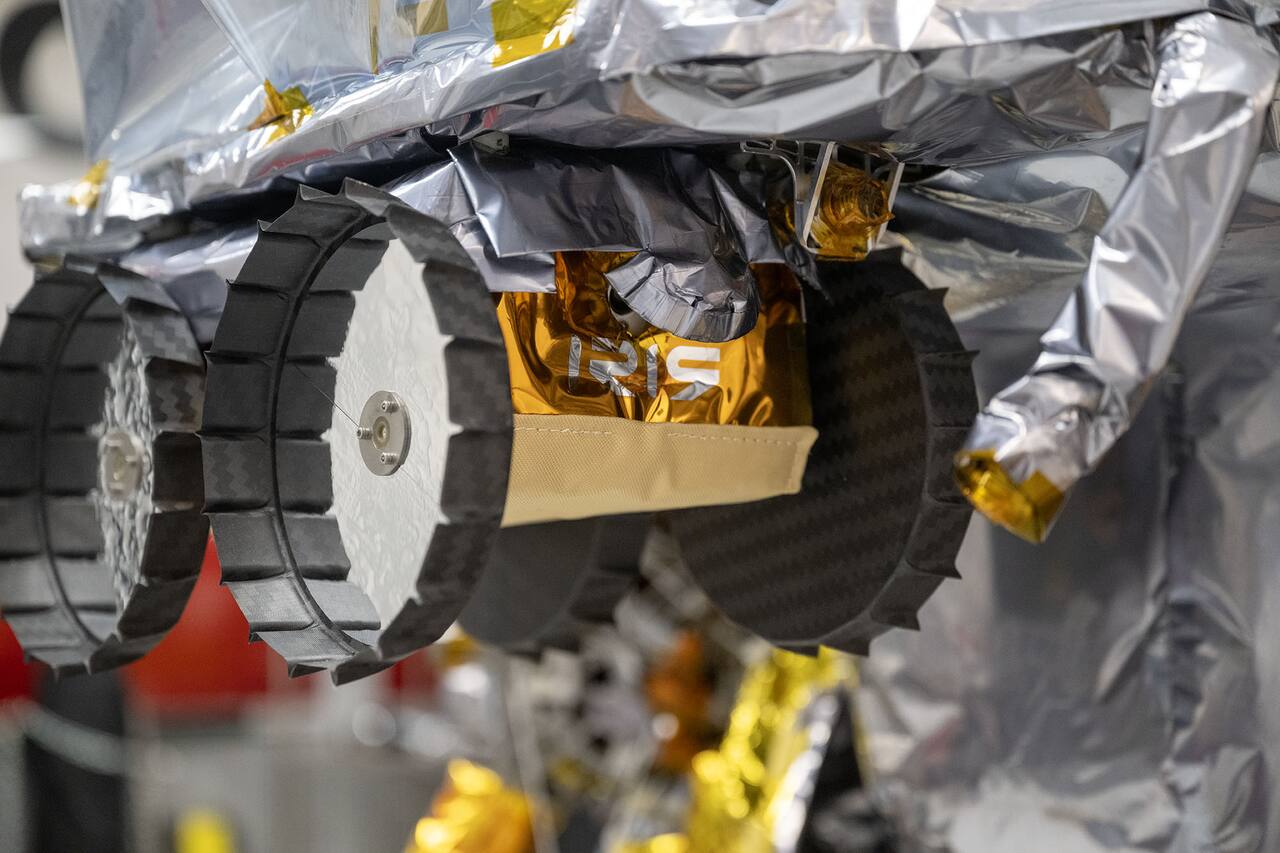
Section titled “Mobility”Iris is a wheeled rover carried bolted to the lander deck; because Peregrine never landed, none of its wheels ever turned on the Moon [5]. Published photographs show carbon fiber wheels in a bottlecap form, a flat disc face with a cylindrical rim carrying molded grousers, rather than a spoked or compliant metal wheel. Wheel mass, ground clearance and obstacle performance for Iris itself are not published.
CubeRover’s published mobility figures for the related product line, a 30 degree slope and a nearly 15 cm obstacle capability with independently actuated per-wheel drives and a top speed near 10 cm/s [4], describe a larger vehicle and are not a claim made for Iris itself. Ground testing of that product line, more than 150 traction and slope tests across eleven wheel sets in a 120 ton lunar regolith simulant bin at Kennedy Space Center, found that some wheel sets climbed 30 degree slopes while others turned successfully in deep simulant, and that the same rover crossed simulant dunes and drove into and out of a dug trench [9], [10]; those are per-wheel-set best cases in Earth gravity, not a demonstrated product capability, and nothing comparable has been run on Iris’s own wheels.
Power and energy
Section titled “Power and energy”Custom power management electronics were flown, but power source, generation and battery capacity for Iris are not published. Iris was a short-duration surface mission and no night survival capability is claimed.
Thermal
Section titled “Thermal”The chassis carries multi-layer insulation over the carbon fiber monocoque [1]; no temperature limits or heater powers for Iris itself are published. Carnegie Mellon reports that the rover endured extreme temperatures and high radiation levels during the ten day flight with primary systems performing normally [1]. The sister CMU nanorover MoonRanger, built on the same low size, weight and power philosophy but targeting a permanently shadowed lunar polar site, was modeled to need at least 9.5 W of lander-supplied heater power just to survive dark cislunar transit and to hold a surface operating band of about -10 to 35 C [8]; no equivalent figures exist for Iris, but the comparison shows what a lunar nanorover’s thermal margins look like when they are published.
Compute and avionics
Section titled “Compute and avionics”A single board computer, custom built, is the flight computer; power management is also custom. Flight software is an implementation of JPL’s F Prime framework, an open source component and port architecture with active, passive and queued component kinds, that by 2018 had already flown on the ISS RapidScat instrument and the ASTERIA CubeSat and was in development for Lunar Flashlight, NEA Scout and the Mars Helicopter [7]. Choosing an existing flight-proven framework rather than writing one is itself a low-resource-team decision. Processor part, memory and radiation tolerance approach for Iris are not published.
Autonomy
Section titled “Autonomy”Iris was designed to be driven from the ground. The published architecture puts localization off the vehicle: onboard localization relative to the lander uses an ultra-wideband module, and the SLAM and visual-inertial odometry computation runs on the ground rather than onboard, because using RF for both communication and state estimation saves mass and power the rover does not have [6]. The onboard sensor suite is an IMU, two cameras and odometry sensors, plus the UWB module. This is the opposite choice from the onboard navigation JPL has flown on its own deep-space missions, where a dedicated processor computes position and guidance onboard because round-trip communication delay makes real-time ground control impossible [12]; a nanorover’s mass and power budget instead pushes that computation to the ground whenever a short-range link to a lander allows it.
The ground-side perception pipeline proposed for the mission is object-level SLAM that optimizes the pose and shape of the lander jointly with the rover camera trajectory, using the known lander location as a prior, with a semantic segmentation front end fine-tuned from DilatedResnet-101 and UperNet-101 trained on ADE20K to produce the lander mask [6]. A video frame interpolation stage synthesizes intermediate images between camera samples, using a depth-aware flow projection layer, to compensate for the low frame rate the link allows. This pipeline was proposed during development; no result shows it running on flight data, since Iris never had the chance to be deployed independently of the lander.
Communications
Section titled “Communications”Iris has no direct-to-Earth link. It communicates through the lander, and the same ultra-wideband link that localizes the rover relative to the lander is the data path, with the lander acting as the way station [6]. The related CubeRover product line instead budgets a wired RS-422 and 802.11n wireless interface at 10 kbps per kilogram of rover mass for its lander link [2], a different point in the same design space of getting data off a mass-constrained rover through its host lander rather than direct to Earth.
Payload and instruments
Section titled “Payload and instruments”Iris carries no science instruments. The two cameras, plus the IMU, odometry sensors and UWB module, are the payload [6]; no stated science objective for the imagery is published.
Modes of operation
Section titled “Modes of operation”No mode set beyond stowed, deployed and driving is published, and none beyond stowed was exercised, since Peregrine never landed [5].
Ground operations
Section titled “Ground operations”Operated by a student mission control team at Carnegie Mellon [1]. Three hundred students across seven Carnegie Mellon colleges worked on Iris, with about thirty in Florida for launch. When the landing became impossible, the team continued operating the rover from a rented house near the launch site for the remainder of the ten day flight. The scale of that effort is not unusual for a CMU flight nanorover: the university’s other lunar nanorover project, MoonRanger, reports more than 150 students, staff and faculty across its life, and a mid-program migration of its flight software from ROS to NASA’s core Flight System driven by an avionics change [11], the kind of program-level churn a student-staffed effort has to absorb that a professional flight program budgets around from the start.
Technologies developed
Section titled “Technologies developed”The result that outlived the vehicle is the carbon fiber structure: a chassis and wheels built from carbon fiber that survived launch and the space environment [1]. It also fed directly into Astrobotic’s CubeRover product line, which now sells the same low size, weight, power and cost approach as a commercial mobility service on later CLPS landers [2], [3], [4].
Context: nanorovers and small lunar rovers
Section titled “Context: nanorovers and small lunar rovers”The nanorover idea predates Iris by decades. JPL’s 1997 technology survey listed nanorovers beside long-range rovers, sample retrieval and aerobots as a thrust area [13]. A 1998 paper described the MUSES-C nanorover prototype alongside the Sojourner performance data and the shared planetary and urban military miniature robot work [14]. That prototype had four independently actuated wheels on independently posable struts plus a pitchable body, and a 1999 position paper proposed discovering its self-righting behaviors by genetic programming against a dynamics simulator rather than designing them by hand [15]. These were ground prototypes and proposals, not flown vehicles.
Of the small rovers aimed at the Moon since, Iris is the one that left Earth and was operated. MoonRanger, the other CMU nanorover, passed NASA’s Key Decision Point review with Astrobotic as prime, CMU as subcontractor and NASA Ames as partner, carrying a neutron spectrometer to search for water [16]. Its project logs report a custom Wi-Fi board that transmitted and received at 160 m with a 30 percent drop from peak short-range performance [17], and a power switching board with twenty switching groups built on automotive grade smart switches [18]. Lunar Outpost’s MAPP rover on Intuitive Machines IM-2 shared Iris’s outcome in one respect: the lander came to rest on its side in a crater, MAPP was never deployed, and it was operated in transit and on the surface from its stowed position [19]. The Canadian Space Agency reports a Canadian Lunar Rover and a much larger Lunar Utility Vehicle as its two rover programs [20]. JPL’s TULIPS tethered power system proposes 1 kW at 1.5 kV over a 1 km tether with fiber Ethernet for CLPS-class rovers, a route to power and bandwidth that a battery-only nanorover does not have; it has been demonstrated on Earth, not on the Moon [21].
On flight software, F Prime on Ingenuity ran as three separate deployments on three processors joined by a hub pattern, which shows the framework Iris used scaling beyond a single computer [22].
Context: wheels, soil and thermal environment
Section titled “Context: wheels, soil and thermal environment”Iris’s wheels never touched regolith, so the relevant evidence comes from other programs. The ISRU Pilot Excavator wheel trade ran ten cleat and grouser configurations through 83 tests on RASSOR 2.0 in the Kennedy Space Center regolith test bed, measuring slip against motion capture [23]. The IPEx TRL-5 design record uses one common actuator design for wheel, arm and bucket drum roles [24], and its predecessor RASSOR 2.0 is a 66 kg vehicle whose counter-rotating drums cancel horizontal reaction force [25]. These are excavators on Earth, tested in simulant, and bound Iris’s wheels only as a reference for method.
Lunar Terrain Vehicle wheel thermal modeling at the south pole used a 140 km elevation model and a 150 hour eclipse node to set wheel temperatures [26]. VIPER was to measure wheel normal force and sinkage directly and invert them to soil properties [27]; the rover was not flown. The Lunar Sourcebook gives the geotechnical, electrical and thermal surface properties a lunar machine is designed against [28], and the 2023 to 2032 planetary decadal survey sets the technology priorities, including autonomy and extreme environments, that small commercial landers now serve [29].
What is not established
Section titled “What is not established”Iris’s mass is reported as 2.2 kg by Carnegie Mellon and as four pounds (about 1.8 kg) in the 2020 development preprint, and no source reconciles the two [1], [6]. Wheel mass, ground clearance and obstacle performance for Iris itself are not published. Power source, generation and battery capacity are unpublished, as are processor part, memory and radiation tolerance approach for the flight computer. No thermal limits or heater power figures for Iris itself have been published; the MoonRanger figures given for comparison describe a different vehicle on a different mission profile [8] and do not stand in for Iris’s own numbers. A deployment concept study and a mission control practices retrospective for Iris are listed only as titles on the project’s own publications page, with no fulltext available to check what they say [30]. Because Peregrine never landed, nothing about Iris’s actual surface mobility, wheel-terrain interaction or ground autonomy performance was ever demonstrated, only what was validated aboard the lander and in ground testing beforehand.
References
- (2024). Carnegie Mellon University: CMU's Iris Rover, A Heartbeat in Space, A Legacy on Earth. cmu.edu/news/stories/archives/2024/january/cmus-iris-rover-a-heartbea...
BibTeX
@misc{carnegiemellonuniversitycmus, title = {Carnegie Mellon University: CMU's Iris Rover, A Heartbeat in Space, A Legacy on Earth}, organization = {cmu.edu}, year = {2024}, url = {https://www.cmu.edu/news/stories/archives/2024/january/cmus-iris-rover-a-heartbeat-in-space-a-legacy-on-earth} } - Astrobotic Technology. (2023). CubeRover Surface Mobility: Elevate Your Mission Capabilities. nasa-techshowcase.seti.org/wp-content/uploads/2023/01/Astrobotic-Cube...
BibTeX
@misc{astrobotic2023cuberover, title = {CubeRover Surface Mobility: Elevate Your Mission Capabilities}, author = {{Astrobotic Technology}}, howpublished = {Presentation}, year = {2023}, url = {https://nasa-techshowcase.seti.org/wp-content/uploads/2023/01/Astrobotic-CubeRover.pdf} } - Horchler, A. D., Provenzano, M., Corpa de la Fuente, C., Arbuckle, T., Zimo, J., Quinn, K., Oikawa, T., Whitaker, T. and Kirkman, B. (2021). CubeRover for Mobility as a Service. lsic.jhuapl.edu/uploadedDocs/posters/444-Poster%20PDF_34-Provenzano.pdf
BibTeX
@misc{horchler2021cuberover, title = {{CubeRover} for Mobility as a Service}, author = {Horchler, Andrew D. and Provenzano, Michael and Corpa de la Fuente, Cedric and Arbuckle, Troy and Zimo, Joseph and Quinn, Kerry and Oikawa, Takuto and Whitaker, Taylor and Kirkman, Brandon}, howpublished = {Presentation at the Astrobotic Technology, Inc.}, type = {Lunar Surface Innovation Consortium poster}, year = {2021}, url = {https://lsic.jhuapl.edu/uploadedDocs/posters/444-Poster%20PDF_34-Provenzano.pdf} } - (2021). Astrobotic: CubeRover. astrobotic.com/lunar-delivery/rovers/cuberover
BibTeX
@misc{astroboticcuberover, title = {Astrobotic: CubeRover}, organization = {astrobotic.com}, year = {2021}, url = {https://www.astrobotic.com/lunar-delivery/rovers/cuberover/} } - Astrobotic Technology. (2024). Peregrine Mission 1 Post-Mission Report
. Astrobotic Technology. Source
BibTeX
@techreport{astrobotic2024peregrine, title = {Peregrine Mission 1 Post-Mission Report}, author = {{Astrobotic Technology}}, institution = {Astrobotic Technology}, month = {August}, year = {2024}, url = {https://www.astrobotic.com/wp-content/uploads/2024/08/PM1_Post-Mission-Report_2024-1.pdf} } - de Curtó i Díaz, J. and Duvall, R. A. (2020). Vulcan Centaur: towards end-to-end real-time perception in lunar rovers
. arXiv. Source
BibTeX
@article{decurtoidiaz2020vulcan, title = {Vulcan Centaur: towards end-to-end real-time perception in lunar rovers}, author = {de Curtó i Díaz, J. and Duvall, R. A.}, journal = {arXiv}, year = {2020}, doi = {10.48550/arxiv.2011.15104}, abstract = {We introduce a new real-time pipeline for Simultaneous Localization and Mapping (SLAM) and Visual Inertial Odometry (VIO) in the context of planetary rovers. We leverage prior information of the location of the lander to propose an object-level SLAM approach that optimizes pose and shape of the lander together with camera trajectories of the rover. As a further refinement step, we propose to use techniques of interpolation between adjacent temporal samples; videlicet synthesizing non-existing images to improve the overall accuracy of the system. The experiments are conducted in the context of the Iris Lunar Rover, a nano-rover that will be deployed in lunar terrain in 2021 as the flagship of Carnegie Mellon, being the first unmanned rover of America to be on the Moon.} } - Bocchino, R. L. J., Canham, T. K., Watney, G. J., Reder, L. J. and Levison, J. W. (2018). F Prime: An Open-Source Framework for Small-Scale Flight Software Systems
. JPL Open Repository. Source
BibTeX
@inproceedings{bocchino2018prime, title = {F Prime: An Open-Source Framework for Small-Scale Flight Software Systems}, author = {Bocchino, Robert L. Jr. and Canham, Timothy K. and Watney, Garth J. and Reder, Leonard J. and Levison, Jeffrey W.}, booktitle = {JPL Open Repository}, year = {2018}, url = {https://dataverse.jpl.nasa.gov/dataset.xhtml?persistentId=hdl:2014/48425} } - Fisch, P. R. M., Bitanga, J. M. and Whittaker, W. L. (2020). Thermal Modeling and Design of a Micro-Rover for Lunar Polar Exploration
. International Symposium on Artificial Intelligence, Robotics and Automation in Space. Source
BibTeX
@inproceedings{fisch2020thermal, title = {Thermal Modeling and Design of a Micro-Rover for Lunar Polar Exploration}, author = {Fisch, Paulo R. M. and Bitanga, Jasmine M. and Whittaker, William L.}, booktitle = {International Symposium on Artificial Intelligence, Robotics and Automation in Space}, year = {2020}, url = {https://www.hou.usra.edu/meetings/isairas2020fullpapers/pdf/5058.pdf} } - (2020). Astrobotic: CubeRover Completes Successful Mobility Testing. astrobotic.com/astrobotics-cuberover-completes-successful-mobility-te...
BibTeX
@misc{astroboticcuberover2, title = {Astrobotic: CubeRover Completes Successful Mobility Testing}, organization = {astrobotic.com}, year = {2020}, url = {https://www.astrobotic.com/astrobotics-cuberover-completes-successful-mobility-testing/} } - (2020). NASA: Commercial CubeRover Test Shows How NASA Investments Mature Space Tech. nasa.gov/missions/artemis/clps/commercial-cuberover-test-shows-how-na...
BibTeX
@misc{nasacommercial, title = {NASA: Commercial CubeRover Test Shows How NASA Investments Mature Space Tech}, organization = {nasa.gov}, year = {2020}, url = {https://www.nasa.gov/missions/artemis/clps/commercial-cuberover-test-shows-how-nasa-investments-mature-space-tech/} } - (2021). Carnegie Mellon Robotics Institute: MoonRanger. labs.ri.cmu.edu/moonranger
BibTeX
@misc{carnegiemellonroboticsinstitutemoonranger, title = {Carnegie Mellon Robotics Institute: MoonRanger}, organization = {labs.ri.cmu.edu}, year = {2021}, url = {https://labs.ri.cmu.edu/moonranger/} } - Weisbin, C. R., Lavery, D. and Rodriguez, G. (1997). Robotics Technology for Planetary Missions into the 21st Century, 2014/21995. Source
BibTeX
@techreport{weisbin1997a, title = {Robotics Technology for Planetary Missions into the 21st Century}, author = {Weisbin, C. R. and Lavery, D. and Rodriguez, G.}, number = {2014/21995}, year = {1997}, url = {https://dataverse.jpl.nasa.gov/api/access/datafile/27713} } - Weisbin, C., Blitch, J., Lavery, D., Krotrov, E., Shoemaker, C., Matthies, L. and Rodriguez, G. (1998). Miniature Robots for Space and Military Mission. dataverse.jpl.nasa.gov/dataset.xhtml
BibTeX
@misc{weisbin1998miniature, title = {Miniature Robots for Space and Military Mission}, author = {Weisbin, C. and Blitch, J. and Lavery, D. and Krotrov, E. and Shoemaker, C. and Matthies, L. and Rodriguez, G.}, year = {1998}, url = {https://dataverse.jpl.nasa.gov/dataset.xhtml?persistentId=hdl:hdl:2014/20544} } - Tunstel, E. (1999). Evolution of Autonomous Self-Righting Behaviors for Articulated Nanorovers
. International Symposium on AI. Source
BibTeX
@inproceedings{tunstel1999evolution, title = {Evolution of Autonomous Self-Righting Behaviors for Articulated Nanorovers}, author = {Tunstel, E.}, booktitle = {International Symposium on AI}, publisher = {JPL Open Repository}, year = {1999}, url = {https://dataverse.jpl.nasa.gov/dataset.xhtml?persistentId=hdl:2014/17585} } - (2021). Astrobotic: Astrobotic's MoonRanger Moves into Final Production. astrobotic.com/astrobotics-moonranger-moves-into-final-production
BibTeX
@misc{astroboticastrobotics, title = {Astrobotic: Astrobotic's MoonRanger Moves into Final Production}, organization = {astrobotic.com}, year = {2021}, url = {https://www.astrobotic.com/astrobotics-moonranger-moves-into-final-production/} } - (2022). MoonRanger project log: Testing MoonRanger's Wireless Communication. labs.ri.cmu.edu/moonranger/testing-moonrangers-wireless-communication
BibTeX
@misc{moonrangerprojectlogtesting, title = {MoonRanger project log: Testing MoonRanger's Wireless Communication}, organization = {labs.ri.cmu.edu}, year = {2022}, url = {https://labs.ri.cmu.edu/moonranger/testing-moonrangers-wireless-communication/} } - (2022). MoonRanger project log: Power Switching PCB. labs.ri.cmu.edu/moonranger/power-switching-pcb
BibTeX
@misc{moonrangerprojectlogpower, title = {MoonRanger project log: Power Switching PCB}, organization = {labs.ri.cmu.edu}, year = {2022}, url = {https://labs.ri.cmu.edu/moonranger/power-switching-pcb/} } - (2025). Lunar Outpost: Lunar Voyage 1 Update. lunaroutpost.com/post/lunar-voyage-1-update
BibTeX
@misc{lunaroutpostlunar, title = {Lunar Outpost: Lunar Voyage 1 Update}, organization = {lunaroutpost.com}, year = {2025}, url = {https://www.lunaroutpost.com/post/lunar-voyage-1-update} } - Morisset, C.-E., Haltigin, T., Hill, P., Picard, M., Lamarche, T., Hamilton, D., Moroso, F., Sevigny, J., Podwalski, K. and Saint-Jacques, D. (2026). Updates on Canada's Rover Development for the Lunar South Pole
. Ices in the Solar System, 4019. Source
BibTeX
@inproceedings{csa2026updates, title = {Updates on Canada's Rover Development for the Lunar South Pole}, author = {Morisset, C.-E. and Haltigin, Timothy and Hill, P. and Picard, M. and Lamarche, T. and Hamilton, D. and Moroso, F. and Sevigny, J. and Podwalski, K. and Saint-Jacques, D.}, booktitle = {Ices in the Solar System}, number = {4019}, year = {2026}, url = {https://www.hou.usra.edu/meetings/ices2026/pdf/4019.pdf} } - Barchowsky, A. (2026). Tethered Power Systems for 1 kW-Class Landers and Rovers
. Root. doi.org/10.48577/jpl.d3xvgk
BibTeX
@misc{barchowsky2026tethered, title = {Tethered Power Systems for 1 kW-Class Landers and Rovers}, author = {Barchowsky, Ansel}, journal = {Root}, year = {2026}, doi = {10.48577/jpl.d3xvgk}, abstract = {No abstract available.} } - Canham, T. K. (2022). The Mars Ingenuity Helicopter - A Victory for Open-Source Software
. IEEE Aerospace Conference. Source
BibTeX
@inproceedings{canham2022mars, title = {The Mars Ingenuity Helicopter - A Victory for Open-Source Software}, author = {Canham, Timothy K}, booktitle = {IEEE Aerospace Conference}, pages = {01-11}, publisher = {IEEE}, year = {2022}, doi = {10.1109/aero53065.2022.9843438} } - Zhang, L., Schuler, J., Dokos, A., Xu, Y., Bell, E. and Muller, T. (2024). ISRU Pilot Excavator Wheel Testing in Lunar Regolith Simulant
. ASCE Earth and Space Conference, 20240001016. Source
BibTeX
@inproceedings{zhang2024isru, title = {ISRU Pilot Excavator Wheel Testing in Lunar Regolith Simulant}, author = {Zhang, Liz and Schuler, Jason and Dokos, Adam and Xu, Yinan and Bell, Evan and Muller, Thomas}, booktitle = {ASCE Earth and Space Conference}, number = {20240001016}, pages = {173-187}, institution = {NASA}, year = {2024}, doi = {10.1061/9780784485736.016}, abstract = {The ISRU Pilot Excavator (IPEx), is a robotic excavator funded by NASA’s Space Technology Mission Directorate (STMD). The Concept of Operations for IPEx involves the robot driving on the lunar surface up to 70 km at a speed of up to 30 cm/s. As such, it is critical to the mission’s success to optimize the design of the wheels for performance in lunar conditions, specifically in lunar regolith. To achieve this, an array of tests was completed to observe the effects of various wheel design choices on the driving performance of the wheels in lunar regolith simulant. In order to facilitate testing, we designed a 12 in. dia. configurable wheel to allow for interchangeability between various wheel formations. Two types of wheel parts were designed to be swapped: cleats, which form the tread of the wheel; and grousers, which protrude from the treads. The test variables that we considered were as follows: square versus round wheel shape, solid versus perforated cleats, cleat spacing, grouser height, and grouser spacing. By combining different settings of each of these test variables, 10 discrete wheel designs were created and tested. The configurable test wheels were mounted on the Regolith Advanced Surface Systems Operations Robot (RASSOR) developed at NASA’s Kennedy Space Center. In our experiments, the robot was driven at a controlled speed across a prepared surface of BP-1 lunar regolith simulant. Four types of tests were conducted: circle driving, straight driving, slope driving, and drawbar pull. The driving tests were chosen to mimic a variety of conditions in which IPEx may be expected to operate, and the drawbar pull test was chosen to provide a standard of comparison with existing wheel design literature. The circle and straight driving tests were each performed at different levels: for the circle driving test, the robot was driven at a constant linear speed and three different angular speeds, while for the straight driving test, the robot was driven at three different linear speeds. The data collected from these tests included the power usage from each of the wheels, measurements of the tread patterns left in the regolith surface, and the amount of slip the wheels experienced, which was calculated using data from an OptiTrack motion capture system. From the results of these experiments, we found that certain test variables were more significant than others in determining performance for each type of test, and no single wheel design clearly outperformed the others in all areas. The details of our findings will be discussed further in this paper. These data will be utilized to inform the design of the wheels for IPEx and can provide a basis for the design of wheels for future lunar terrain vehicles.} } - Schuler, J. M., Smith, J. D., Nick, A. J., Buckles, B. C., Dyas, J. E., Ortega, V. V., Cloud, J. M., Dokos, A. G., Zhang, E. L., Wang, J. J., Baron, M. A., Muller, T. J., Clark, C. J. and Howe, M. W. (2024). ISRU Pilot Excavator (IPEx) Technology Readiness Level 5 Design Overview
. AIAA AVIATION Forum and ASCEND, 20240008162. Source
BibTeX
@inproceedings{schuler2024isru, title = {ISRU Pilot Excavator (IPEx) Technology Readiness Level 5 Design Overview}, author = {Schuler, Jason M. and Smith, Jonathan D. and Nick, Andrew J. and Buckles, Bradley C. and Dyas, Jeffrey E. and Ortega, Victoria V. and Cloud, Joseph M. and Dokos, Adam G. and Zhang, Elizabeth L. and Wang, Jerry J. and Baron, Michael A. and Muller, Thomas J. and Clark, Casey J. and Howe, Musashi W.}, booktitle = {AIAA AVIATION Forum and ASCEND}, number = {20240008162}, institution = {NASA}, year = {2024}, doi = {10.2514/6.2024-4890}, abstract = {This paper details the mechanical and mechatronic design of the Technology Readiness Level (TRL)-5 In-Situ Resource Utilization (ISRU) Pilot Excavator (IPEx). IPEx is a robotic excavator designed for a technology demonstration of regolith mining in the lunar south pole region. The novel design uses pairs of counter-acting excavation tools called bucket drums, that dig at the same time in opposing directions to reduce the reaction force needed, thereby enabling mining with a small, low-mass, robotic system. IPEx builds on the prior work of the Regolith Advanced Surface Systems Operations Robot (RASSOR), which is the TRL-4 implementation of this concept. The TRL-5 IPEx subsystems that are discussed in this paper include: Regolith Delivery Subsystem (RDS), Mobility Subsystem (MS), Cameras and Dust Mitigation Subsystem (CDMS), and Thermal Control Subsystem (TCS). Each subsystem is described in detail with rationale for design selections. Dust tolerance is a key feature for IPEx, and this paper details a thermal control system with an actuated radiator cover and phase change material as well as camera modules with removable electrodynamic dust shields (EDS). Additional components such as actuators, wheels, and bucket drums are discussed in detail. Due to their complexity, the avionics and software subsystems will be discussed in a separate publication.} } - Mueller, R. P., Smith, J. D., Schuler, J. M., Nick, A. J., Gelino, N. J., Leucht, K. W., Townsend, I. I. and Dokos, A. G. (2016). Design of an Excavation Robot: Regolith Advanced Surface Systems Operations Robot (RASSOR) 2.0
. ASCE Earth and Space Conference, 20210011366. Source
BibTeX
@inproceedings{mueller2016design, title = {Design of an Excavation Robot: Regolith Advanced Surface Systems Operations Robot (RASSOR) 2.0}, author = {Mueller, Robert P. and Smith, Jonathan D. and Schuler, Jason M. and Nick, Andrew J. and Gelino, Nathan J. and Leucht, Kurt W. and Townsend, Ivan I. and Dokos, Adam G.}, booktitle = {ASCE Earth and Space Conference}, number = {20210011366}, pages = {163-174}, institution = {NASA}, year = {2016}, doi = {10.1061/9780784479971.018}, abstract = {To continue on a sustainable and flexible path, NASA needs to address the challenge of collecting and moving large amounts of regolith at the destination. Acquiring the water resources on Mars will require mining significant quantities of regolith, and this is not possible with the state-of-the-art low mass excavation systems. Low gravity environments (Mars = 3/8G) and launch mass restrictions limit the traction and the resulting reaction force of the vehicle, making current terrestrial techniques impractical. This project addressed this challenge by developing a completely new technology that can mine large quantities of regolith on Mars. Recent measurements by the “Curiosity” rover on Mars have found that the regolith contains ~2% water by weight globally, ~4% in Jezero Crater (Human Architecture Team’s reference landing site), and much more at the poles. RASSOR 2.0 is a planetary excavator, which has a mass of 66 kg, with a 0.38 kg vehicle mass per kilogram, per hour of excavation rate and power usage of 4 W per kg of regolith excavation rate. A single RASSOR 2.0 can excavate a minimum of 2.7 metric tons of regolith per day. This is accomplished by using counteracting excavation forces on two opposing digging implements called bucket drums and an autonomous mining control system. This work has addressed several major research areas outlined in the NASA Technology Area (TA) 04 Robotics and Autonomous Systems and TA 07 Human Destination Systems roadmaps. This project started at Technology Readiness Level (TRL) 4 as a low fidelity “proof of concept” prototype which has successfully demonstrated basic regolith simulant excavation functionality in a lab-scale gravity off load test. The foundational technology described here was awarded US patent number: US 9027265 for a “Zero horizontal reaction force excavator” on May 12, 2015.} } - Birmingham, W. (2024). Thermal Sensitivity Study of Lunar Terrain Vehicle Wheels
. Thermal and Fluids Analysis Workshop. Source
BibTeX
@inproceedings{birmingham2024thermal, title = {Thermal Sensitivity Study of Lunar Terrain Vehicle Wheels}, author = {Birmingham, William}, booktitle = {Thermal and Fluids Analysis Workshop}, organization = {Jacobs Space Exploration Group / NASA Marshall Space Flight Center}, year = {2024}, url = {https://ntrs.nasa.gov/citations/20240006096}, abstract = {Since the early development of lunar vehicles for the Apollo program, designing a wheel capable of functioning in the harsh equatorial lunar environment was identified as a uniquely difficult engineering challenge. The Lunar Terrain Vehicle (LTV) must contend with many of the same challenges encountered during the Apollo missions, but with the addition of colder, more complex thermal environments at the lunar south pole and longer Artemis mission timelines. A full thermal assessment of LTV wheels should capture these and other details to assess heat leak through the wheels and extreme hot and cold temperatures. The goals of this study are to provide bounding lunar south pole thermal environments; to define sensitivity to interactions between the wheel and the lunar surface in different operation modes, such as parked and traversing; and to identify thermal performance concerns related to the use of shape memory alloys.} } - Rezich, E., Bickel, V. T., Francis, P. L., Rogg, A., Tardy, A., Creager, C., Oravec, H. A., Schepelmann, A., Ennico-Smith, K., Deutsch, A. and Hirabayashi, M. (2025). Investigating the Geotechnical Properties of the Lunar South Pole with NASA VIPER's Mobility System
. The Planetary Science Journal, 7. Source
BibTeX
@article{rezich2025investigating, title = {Investigating the Geotechnical Properties of the Lunar South Pole with NASA VIPER's Mobility System}, author = {Rezich, Erin and Bickel, Valentin T. and Francis, Parker L. and Rogg, Arno and Tardy, Antoine and Creager, Colin and Oravec, Heather A. and Schepelmann, Alexander and Ennico-Smith, Kimberly and Deutsch, Ariel and Hirabayashi, Masatoshi}, journal = {The Planetary Science Journal}, volume = {6}, number = {7}, pages = {169}, year = {2025}, doi = {10.3847/psj/add13f}, abstract = {Abstract The NASA Volatiles Investigating Polar Exploration Rover (VIPER) is capable of assessing the geotechnical properties of the lunar south pole’s terrain, specifically as they pertain to terramechanics or the wheel–terrain interaction, combining the rover’s mobility system and science payloads. This paper focuses on one key aspect of VIPER’s mission: the quantitative evaluation of geotechnical parameters via tractive performance by analyzing wheel and wheel–regolith interaction dynamics. As VIPER navigates the largely uncharted terrain of the Moon’s south pole, sophisticated onboard instrumentation will monitor and record detailed interactions between the rover’s wheels, chassis, and the lunar surface. These measurements will capture critical data such as wheel slip and sinkage, offering insights into the mechanical behavior of the soil under actual lunar conditions. The findings from VIPER are expected to provide a foundational understanding of the lunar south pole’s regolith mechanics, directly informing the design and navigation strategies of future lunar missions, including the deployment of more advanced rovers and crewed vehicles. By integrating lunar surface observations with the rover’s kinematic model and understood terrestrial mobility performance, the study aims to enhance predictive accuracy regarding rover tractive performance over sloped, level, and potentially volatile-rich terrain. Ground truth geotechnical assessments and proceeding mobility characterization work will serve as a cornerstone for verifying and improving both terrestrial test approaches and simulation models that underpin mission planning and risk management for subsequent explorations.} } - Heiken, G. H., Vaniman, D. T. and French, B. M. (1991). Lunar Sourcebook: A User's Guide to the Moon
. Endeavour. Source
BibTeX
@book{heiken1991lunar, title = {Lunar Sourcebook: A User's Guide to the Moon}, author = {Heiken, Grant H. and Vaniman, David T. and French, Bevan M.}, journal = {Endeavour}, volume = {16}, pages = {96}, publisher = {Cambridge University Press}, year = {1991}, doi = {10.1016/0160-9327(92)90014-g} } - National Academies of Sciences, E. M. C. O. T. P. S. &. A. D. S. (2022). Origins, Worlds, and Life: A Decadal Strategy for Planetary Science and Astrobiology 2023-2032
. The National Academies Press, Washington, DC. Source
BibTeX
@techreport{nasem2022origins, title = {Origins, Worlds, and Life: A Decadal Strategy for Planetary Science and Astrobiology 2023-2032}, author = {{National Academies of Sciences, Engineering, Medicine, Committee on the Planetary Science & Astrobiology Decadal Survey}}, institution = {The National Academies Press, Washington, DC}, year = {2022}, doi = {10.17226/26522} } - (2026). Iris Lunar Rover. irislunarrover.space
BibTeX
@misc{irislunarroveriris,
  title = {Iris Lunar Rover},
  organization = {irislunarrover.space},
  year = {2026},
  url = {https://irislunarrover.space/}
}