 ispace, inc.
Overview
Section titled “Overview”A rover of about 5 kg [1] has to do three things on the Moon: survive the lander’s descent and deployment, drive on regolith it can barely push through, and get through a lunar day on a body-mounted panel and a small battery. At that mass the mobility, thermal and communications budgets are set mostly by what the host lander provides, so the rover’s fate follows the lander’s.
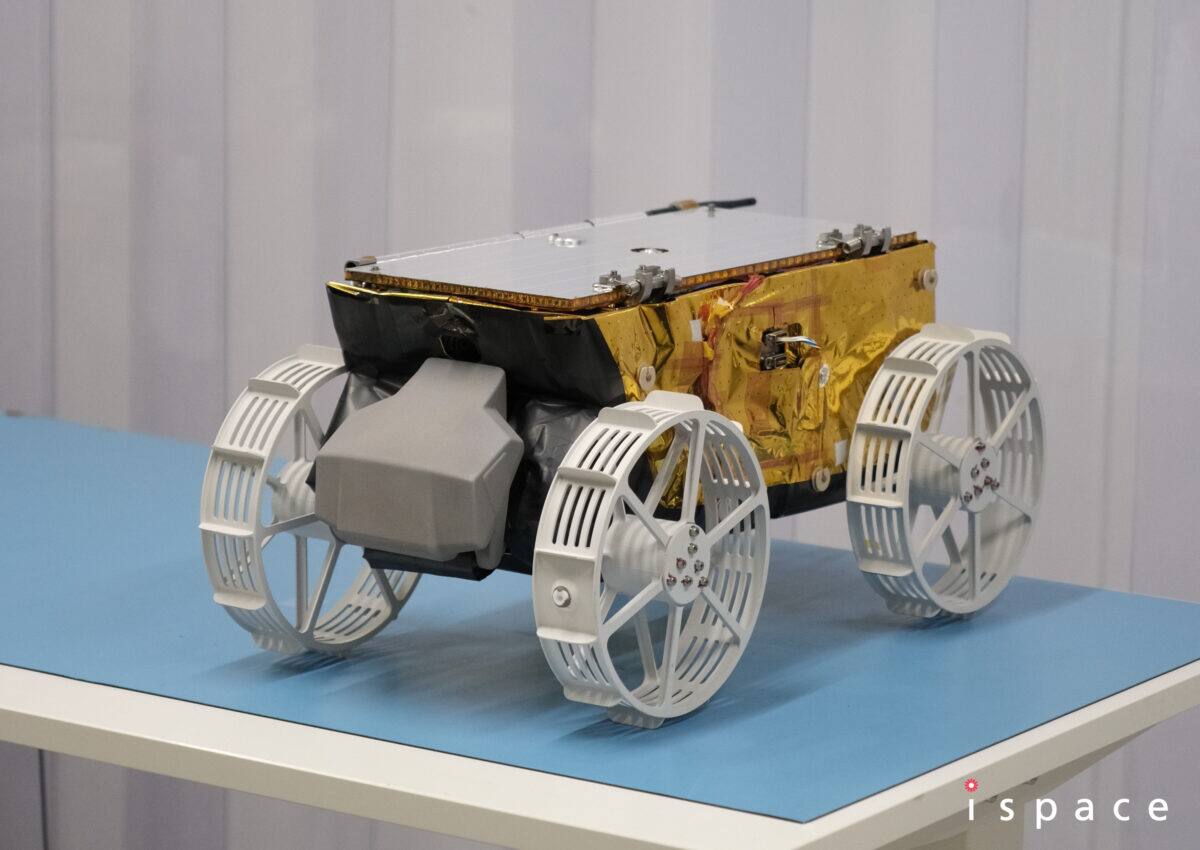
TENACIOUS is a four-wheeled lunar micro rover designed, manufactured and assembled by ispace-EUROPE in Luxembourg, carried on the ispace RESILIENCE lander as the surface element of HAKUTO-R Mission 2 [1], [2]. Development was co-funded by the Luxembourg Space Agency through a European Space Agency contract under the national LuxIMPULSE program [2]. Its task was to drive around the landing site, image it, and scoop lunar regolith whose ownership would then transfer to NASA [3].
RESILIENCE launched 15 January 2025 and made a hard landing at Mare Frigoris on 5 June 2025 [1], [4]. TENACIOUS was never deployed.
No peer-reviewed or conference publication on this vehicle was located. Every vehicle number below comes from ispace material [1], [2]. Mission figures come from ispace and from reporting of the ispace failure investigation [4], [5].
Specifications
Section titled “Specifications”| Parameter | Value | Source |
|---|---|---|
| Mass | approximately 5 kg | manufacturer [1], [2] |
| Length | 54 cm | manufacturer [2] |
| Width | 31.5 cm | manufacturer [1], [2] |
| Height | 26 cm | |
| Payload capacity | maximum 1 kg | manufacturer [1] |
| Structure | carbon fiber reinforced plastic frame | manufacturer [2] |
| Wheels | four, profiled for stable travel on regolith | |
| Camera | forward-mounted HD camera | |
| Sampling | shovel for surface regolith | |
| Command and data path | via the lander to mission control |
The CFRP frame is specified against launch and transit vibration rather than against surface loads [1]. Drive speed, slope limit, obstacle height, power, battery capacity, thermal limits, processor and radio parameters are not published.
Where the design sits among lunar micro rovers
Section titled “Where the design sits among lunar micro rovers”Small lunar surface vehicles have converged on a few families, and TENACIOUS belongs to the conventional one. What has reached the Moon is narrow.
- Hopping and single-wheel rovers. JAXA’s LEV-1 separated from the SLIM lander during its final free fall on 20 January 2024 and performed the first hopping locomotion by a robot on the lunar surface, six hops with the direction chosen onboard from camera imagery [10]. A companion article by the LEV system lead records seven attitude-heading-hop cycles and a LEV-2 that located and photographed SLIM [11]. Both rovers were released by the lander rather than lowered from it [12]. This is flown evidence for ultra-small rovers, and its mobility is the opposite of TENACIOUS’s wheeled drive.
- Wheeled micro rovers on landers that failed. Rashid-1 flew on HAKUTO-R Mission 1 and never operated [6]. Its landing-site study used orbital slope and rock statistics only, with no ground truth [22]. Its two CASPEX cameras were calibrated before launch and returned no lunar image [21]. Of the wheeled micro rovers in this family, none has driven on the Moon, TENACIOUS included.
- Impact-tolerant micro rovers. The Dymon YAOKI is 15 by 15 by 10 cm and weighs 498 g, and the supplier states it withstands 100 G so that it can be dropped or tumbled into lunar caves [14]. The rating is a supplier claim with no stated test standard.
- Planned and studied wheeled rovers. The Canadian Lunar Rover Mission was first described as a 30 kg micro rover with an instrument set later replaced [24], and its status after preliminary design review gives a mass and six instruments but no mobility figure [23]. The European Moon Rover System Pre-Phase A study sets out a modular rover for four candidate missions, with only a terrestrial prototype field-tested [35]. Endurance-A is a concept for a long-range South Pole-Aitken traverse and sample return rover, and its figures are study values [34].
- Coverage planning for micro rovers. A myopic three-dimensional coverage planner fusing orbital elevation data with onboard LiDAR was validated in simulation on an Apollo 14 elevation model and in outdoor tests on a terrestrial rover [25]. It is not flown.
Mission profile
Section titled “Mission profile”These describe the lander mission rather than the rover.
| Parameter | Value | Source |
|---|---|---|
| Lander | ispace RESILIENCE | [1] |
| Lander payload capacity | up to 30 kg | [1] |
| Launch | 15 January 2025, Florida, Falcon 9 | [1] |
| Transit | low-energy trajectory, about five months | [4] |
| Landing attempt | 5 June 2025, Mare Frigoris | [1], [4] |
| Success milestones achieved | 8 of 10 | [1] |
| Impact velocity | 42 m/s | [5] |
Descent proceeded from about 100 km to 20 km altitude with the main engine firing as planned, and telemetry was lost less than two minutes before the scheduled touchdown [4]. The failure investigation attributed the hard landing to the laser range finder, which was slow to return valid distance measurements, so the lander did not decelerate to the required landing speed and struck the surface at 42 m/s [5]. Installation error was considered and judged unlikely, since no anomaly appeared in testing or in the earlier descent phases, which left in-flight performance deterioration of the range finder as the leading explanation [5]. The mission achieved 8 of its 10 declared success milestones, missing only the landing itself and post-landing system stability [1].
RESILIENCE was ispace’s second lunar landing attempt. Both ended in an altitude sensing failure, by different mechanisms. Mission 1 flew its deceleration profile correctly to under 1 m/s vertical speed while its filter rejected a correct altimeter reading as faulty after a crater rim crossing made the sensed altitude jump, so the lander coasted on a stale zero-altitude estimate until it ran out of propellant about 5 km up and fell, and its payloads, including the UAE’s Rashid rover, were never operated [6]. Mission 2’s failure was a laser range finder slow to return valid readings during descent, so the two failures share an outcome and a sensing modality, not a cause [5].
Other commercial landers show the same dependence of a small payload on touchdown attitude. Intuitive Machines’ IM-2 touched down on 6 March 2025 about 250 m from its intended site, on its side inside a crater near the south pole, and was declared over the next day [29]. The Blue Ghost Mission 1 lander at Mare Crisium, in contrast, ran the Lunar PlanetVac pneumatic sampler through a five-second acquisition sequence [28].
Landing precision and the SLIM comparison
Section titled “Landing precision and the SLIM comparison”SLIM is a separate Japanese lander with no ispace involvement. Its flight record gives fourteen vision-based navigation fixes from lunar orbit through the vertical descent and a 3.4 m position error at the first 50 m hover image, so precision landing was evaluated as 10 m or better against a 100 m requirement [8]. One of its two main engines lost most of its thrust during the descent, and the cause is not diagnosed in that record [8]. The vision-based navigation and 50 m obstacle detection were validated by Monte Carlo and hardware-in-the-loop work before the single flight [9]. The mass reduction side of the project used a propellant tank that doubles as primary structure, thin film solar cells bonded to it, and crushable porous metal legs for a deliberate two-step tip-over landing [7].
These are one flight each, so they do not establish a distribution. They do show the contrast with RESILIENCE: SLIM landed with a navigation chain that measured against terrain features, and ispace’s two losses were both traced to altitude measurement. TENACIOUS never reached a surface on which its own design choices could be tested.
Sampling and the regolith contract
Section titled “Sampling and the regolith contract”The regolith scoop exists to execute a contract rather than a science investigation. NASA selected four companies to collect lunar material and transfer ownership to the agency: Lunar Outpost at $1, ispace Japan at $5,000, ispace Europe at $5,000, and Masten Space Systems at $15,000, totaling $25,001 [3]. Payment is 10 percent on award, 10 percent on launch, and 80 percent on successful completion. Ownership transfers in place on the surface after the company sends imagery of the collection and data identifying its location, with no return to Earth.
TENACIOUS carried a shovel to gather surface material and the forward HD camera to photograph it [2]. The rover never needed to return or store a sample: the contract is satisfied by collecting, imaging and locating it.
Other sampling approaches in the corpus work differently. PlanetVac acquires regolith pneumatically with no arm or scoop and has flown once, at one site, from a head position the team could not control [28]. Neither approach is demonstrated on a micro rover.
Mobility
Section titled “Mobility”Four wheels, rigid, with no suspension in the published configuration [1], [2]. The wheels are described only as shaped so that the rover traverses regolith stably, and the flight model photograph shows rigid spoked rims with slotted circumferential grousers. Speed, slope limit and obstacle capability are not published, and no mobility test results have been released for TENACIOUS itself.
Grouser wheels of this class have been studied on Earth by several groups, and the results bound what to expect. A single-wheel testbed and discrete element model of a Rashid-1 style 100 mm radius grousered wheel found that traction coefficient and tractive efficiency at the flight load in 1 g sand changed little when the validated model was extrapolated to lunar gravity, while tractive force and resistive torque both dropped by about a sixth [15]. Every lunar gravity number there is model output, not measurement. A bench comparison of a 200 mm Rashid flight-design wheel in standard sand and FJS-1 simulant covered slip ratios to 50 percent, but it reduced load rather than gravity [16]. At translational speeds up to 1.0 m/s, about a hundred times flown rover speeds, traction depended strongly on speed, in a way low speed testing had missed [17].
Turning is the other limit for small skid-steer vehicles. Single-wheel tests in GRC-1 simulant found that wider (60 mm) and larger diameter (200 mm) wheels turned best and that diagonal grousers reduced point-turn sinkage [18], and lug alignment at 45 degrees reduced slip in a single-wheel crawler rig [19]. A variable grouser-height wheel, 0 to 17.5 mm, was evaluated in 750 testbed trials across gravel and sand, with the limit that wheel geometry and load were fixed [20]. LEV-1’s octagonal grouser was chosen with a resistive force theory model and then confirmed by operation on the Moon [13]. A Chrono-based continuum representation model reproduced single-wheel force curves for a 137 kg Yutu-class model, as a simulation only [36]. None of these results were measured on TENACIOUS or its wheels.
Astrobotic’s CubeRover line is the nearest American product class. It ran over 150 mobility tests with eleven wheel sets in a 120 ton regolith simulant bin at NASA Kennedy in December 2020, with some sets climbing 30 degree slopes [30], [33]. The vendor’s sheet lists 4.6, 8 and 10.6 kg rover masses for the 2U, 4U and 6U sizes, an offered specification rather than a demonstrated result [31], [32]. No CubeRover has driven on the Moon.
Power and energy
Section titled “Power and energy”A body-mounted solar panel closes the top of the chassis, visible in the photograph above. Generation capacity, battery capacity and night survival are not published. The mission was planned inside a single lunar day, which ended at the landing attempt [1], [4]. A battery developed for the CADRE lunar rovers, a Li-ion cell selected for wide-temperature operation and qualified by vibration and thermal vacuum, shows what a rover of this scale requires, though it is a different vehicle [27].
Thermal
Section titled “Thermal”The chassis is wrapped in multi-layer insulation over the CFRP frame [2]. No temperature limits, radiator area or heater strategy have been published. Lunar dust is the main uncertainty for a vehicle that must also keep a body-mounted panel clean: solar absorptivity can rise by as much as 50 percent at only 12 percent area coverage [26]. That analysis targets the Lunar Terrain Vehicle and is not a TENACIOUS result. The YAOKI supplier reports replacing an aluminum body with cyanate ester CFRP, as TENACIOUS’s frame is also CFRP, with a stated mass saving of about 30 percent [14].
Compute and avionics
Section titled “Compute and avionics”No processor, memory or radiation tolerance information is published.
Autonomy
Section titled “Autonomy”None is claimed. Commands and data pass between mission control and the rover through the lander [2], which makes the vehicle a teleoperated one working inside lander communication range. LEV-1, by comparison, chose hop direction onboard [10].
Communications
Section titled “Communications”Through the lander only [2]. Band, data rate and range are not published. LEV-1 transmitted directly to Earth on S band [10].
Payload and instruments
Section titled “Payload and instruments”The forward HD camera is the only instrument named [2], alongside the regolith shovel [3]. Rover payload capacity is a maximum of 1 kg [1] against a 5 kg vehicle, so a hosted payload can be a fifth of the rover mass.
Ground operations
Section titled “Ground operations”Operated from ispace mission control through the lander [2]. No planning cycle, tooling or operations concept has been published.
Technologies developed
Section titled “Technologies developed”The vehicle is the first European designed, manufactured and assembled lunar rover to fly [1], [2]. Because it was never deployed, no operational result exists. What the program established outside the hardware is a contractual path: a NASA contract that transfers ownership of collected material in place on the lunar surface [3].
What is not established
Section titled “What is not established”No independent test report, flight anomaly log or peer-reviewed publication on TENACIOUS has been located; every published vehicle number comes from ispace and ispace-EUROPE’s own mission material [1], [2]. Mass budget, drive speed, slope and obstacle limits, power generation and storage capacity, thermal survival range, processor, radiation tolerance, and communications band and data rate are all unpublished. No mobility, thermal vacuum or vibration test result for the flight unit has been released, and because the rover never deployed, none can now be generated by the mission. The regolith transfer contract that motivated the shovel and camera has not been executed by any of the four awardees in the sources held [3], [6]. The Mission 2 failure account rests on press reporting of an ispace statement, and the underlying ispace technical release is not held [5].
References
- (2025). ispace: HAKUTO-R Mission 2. ispace-inc.com/mission-2
BibTeX
@misc{ispacehakuto, title = {ispace: HAKUTO-R Mission 2}, organization = {ispace-inc.com}, year = {2025}, url = {https://www.ispace-inc.com/mission-2/} } - (2024). ispace-EUROPE announces Completion of First European Designed, Manufactured, and Assembled Lunar Micro Rover. ispace-inc.com/2024/07/25/ispace-europe-announces-completion-of-first...
BibTeX
@misc{ispaceeuropeannouncescompletionoffirsteuropeandesignedmanufacturedandassembledlunarmicrorovertenacious, title = {ispace-EUROPE announces Completion of First European Designed, Manufactured, and Assembled Lunar Micro Rover}, organization = {ispace-inc.com}, year = {2024}, url = {https://www.ispace-inc.com/2024/07/25/ispace-europe-announces-completion-of-first-european-designed-manufactured-and-assembled-lunar-micro-rover/} } - (2026). NASA: Selects Companies to Collect Lunar Resources for Artemis Demonstrations. nasa.gov/news-release/nasa-selects-companies-to-collect-lunar-resourc...
BibTeX
@misc{nasaselects, title = {NASA: Selects Companies to Collect Lunar Resources for Artemis Demonstrations}, organization = {nasa.gov}, year = {2026}, url = {https://www.nasa.gov/news-release/nasa-selects-companies-to-collect-lunar-resources-for-artemis-demonstrations} } - (2025). Universe Today: ispace's Resilience Lander Proves the Moon is Still a Tough Customer. universetoday.com/articles/ispaces-resilience-lander-proves-the-moon-...
BibTeX
@misc{universetodayispaces, title = {Universe Today: ispace's Resilience Lander Proves the Moon is Still a Tough Customer}, organization = {universetoday.com}, year = {2025}, url = {https://www.universetoday.com/articles/ispaces-resilience-lander-proves-the-moon-is-still-a-tough-customer} } - (2025). Universe Today: HAKUTO-R Mission 2's Crash was Caused by its Laser Range Finder. universetoday.com/articles/hakuto-r-mission-2s-crash-was-caused-by-it...
BibTeX
@misc{universetodayhakuto, title = {Universe Today: HAKUTO-R Mission 2's Crash was Caused by its Laser Range Finder}, organization = {universetoday.com}, year = {2025}, url = {https://www.universetoday.com/articles/hakuto-r-mission-2s-crash-was-caused-by-its-laser-range-finder} } - ispace, I. (2023). ispace Announces Results of the HAKUTO-R Mission 1 Lunar Landing. ispace-inc.com/news-en
BibTeX
@misc{ispace2023results, title = {ispace Announces Results of the HAKUTO-R Mission 1 Lunar Landing}, author = {{ispace, inc.}}, organization = {ispace-inc.com}, year = {2023}, url = {https://ispace-inc.com/news-en/?p=4691} } - Sakai, S., Kushiki, K., Fukuda, S. and Sawai, S. (2026). Overview of the Small Lunar Lander SLIM and Its Lunar Landing Results
. IEEJ Journal of Industry Applications. Source
BibTeX
@article{sakai2026overview, title = {Overview of the Small Lunar Lander SLIM and Its Lunar Landing Results}, author = {Sakai, Shinichiro and Kushiki, Kenichi and Fukuda, Seisuke and Sawai, Shujiro}, journal = {IEEJ Journal of Industry Applications}, volume = {15}, pages = {839-848}, year = {2026}, doi = {10.1541/ieejjia.20250916}, abstract = {The Smart Lander for Investigating Moon (SLIM), which was developed by the Japan Aerospace Exploration Agency (JAXA) and launched in September 2023, successfully landed on the Moon on January 20, 2024. Postlanding evaluation confirmed that its precision landing performance was better than 10 m, making it the world's first lunar lander to achieve high-precision landing. Furthermore, the mass at landing was approximately 200 kg, making it one of the lightest landers ever to succeed in a lunar landing. This lightweightness was the result of the development and application of various new technologies for weight reduction. These technologies are expected to be applied to the weight reduction of future lunar and planetary probes, thereby contributing to more frequent lunar and planetary exploration missions. This review article aims to provide an overview of SLIM's achievements by citing or referring to previously published papers.} } - Sakai, S., Kushiki, K., Sawai, S., Fukuda, S., Miyazawa, Y., Ishida, T., Kariya, K., Ito, T., Ueda, S., Yokota, K., Kawano, T., Ohtake, M., Saiki, K., Nakauchi, Y., Michigami, K., Furukawa, K., Akizuki, Y., Kanaya, S., Kinjo, T., Goto, K., Sawada, K., Sugimoto, Y., Takeuchi, H., Tomiki, A., Toyota, H., Nagata, T., Nakatsuka, J., Maki, K., Mizuno, T., Shiratori, H., Nishino, M. N., Usami, N., Kikuchi, J., Hamori, H., Hirasawa, R., Shibasaki, Y. and Saito, H. (2025). Moon landing results of SLIM: A smart lander for investigating the Moon
. Acta Astronautica. Source
BibTeX
@article{sakai2025moon, title = {Moon landing results of SLIM: A smart lander for investigating the Moon}, author = {Sakai, Shinichiro and Kushiki, Kenichi and Sawai, Shujiro and Fukuda, Seisuke and Miyazawa, Yu and Ishida, Takayuki and Kariya, Kazuki and Ito, Takahiro and Ueda, Satoshi and Yokota, Kentaro and Kawano, Taro and Ohtake, Makiko and Saiki, Kazuto and Nakauchi, Yusuke and Michigami, Keisuke and Furukawa, Katsumi and Akizuki, Yuki and Kanaya, Shusaku and Kinjo, Tomihiro and Goto, Kenta and Sawada, Kenichiro and Sugimoto, Yoshihide and Takeuchi, Hiroshi and Tomiki, Atsushi and Toyota, Hiroyuki and Nagata, Taiichi and Nakatsuka, Junichi and Maki, Kenichiro and Mizuno, Takahide and Shiratori, Hirohide and Nishino, Masaki N. and Usami, Naoto and Kikuchi, Junji and Hamori, Hitoshi and Hirasawa, Ryo and Shibasaki, Yusuke and Saito, Hiroaki}, journal = {Acta Astronautica}, volume = {235}, pages = {47--54}, publisher = {Elsevier BV}, year = {2025}, doi = {10.1016/j.actaastro.2025.05.047}, abstract = {The Smart Lander for Investigating the Moon (SLIM), with a dry mass of about 200 kg, was launched by the H-IIA vehicle on September 7, 2023, and made a precision lunar landing on January 19, 2024 (Coordinated Universal Time). The landing precision was evaluated to be within ∼10 m at an altitude of approximately 50m from the Moon surface, far exceeding the target landing accuracy of 100 m and realizing the world’s first pinpoint landing, although a trouble occurred just before landing and one of the two main engines lost thrust. The two micro/nano rovers of the SLIM separated immediately before landing and successfully captured SLIM images in fully autonomous operation mode. The operation team also obtained spectroscopic observations of rocks from scientific instruments onboard the SLIM, which are expected to provide clues on the origin of the Moon. Although not designed to endure the harsh temperatures of the lunar day and night, the lander operated after three lunar nights, gathering various engineering data. This paper reports the results of the lunar landing operations of SLIM.} } - Ishida, T., Fukuda, S., Kariya, K., Kamata, H., Takadama, K., Kojima, H., Sawai, S. and Sakai, S. (2025). Vision-based navigation and obstacle detection flight results in SLIM lunar landing
. Acta Astronautica. Source
BibTeX
@article{ishida2025vision, title = {Vision-based navigation and obstacle detection flight results in SLIM lunar landing}, author = {Ishida, Takayuki and Fukuda, Seisuke and Kariya, Kazuki and Kamata, Hiroyuki and Takadama, Keiki and Kojima, Hirohisa and Sawai, Shujiro and Sakai, Shinichiro}, journal = {Acta Astronautica}, volume = {226}, pages = {772-781}, publisher = {Elsevier BV}, year = {2025}, doi = {10.1016/j.actaastro.2024.11.002}, abstract = {On January 20, 2024, Smart Lander for Investigating Moon (SLIM) landed on the Moon. Vision-Based Navigation (VBN) was used to estimate the position of the spacecraft accurately and autonomously during the descent phase, and it was successfully used in each of the seven regions. Obstacle detection was also performed 50 m above the lunar surface, successfully identifying safe points within the field of view of the navigation camera. As a result, SLIM was the first mission to realize pinpoint lunar landing technology with 100 m accuracy. This paper details the VBN operational concept and developed components, as well as the flight results of VBN in SLIM’s lunar landing operations. • SLIM successfully landed on the Moon, achieving the first pinpoint landing. • Vision-based navigation provided precise position information to the probe. • Obstacle detection successfully identified a safer site within the field of view. • The landing accuracy 50 m above the lunar surface was 3 to 4 m.} } - Yoshimitsu, T. (2024). LEV-1, the Ultra-Small Lunar Surface Exploration Rover Aboard SLIM: Flight Results. jaxa.jp/projects/files/youtube/ml_slim_lev1_lev2/jaxa_doc02_20240125.pdf
BibTeX
@misc{yoshimitsu2024lev1, title = {{LEV-1}, the Ultra-Small Lunar Surface Exploration Rover Aboard {SLIM}: Flight Results}, author = {Yoshimitsu, Tetsuo}, howpublished = {Presentation at the Japan Aerospace Exploration Agency, Institute of Space and Astronautical Science}, year = {2024}, url = {https://www.jaxa.jp/projects/files/youtube/ml_slim_lev1_lev2/jaxa_doc02_20240125.pdf} } - Otsuki, M. (2024). The companionable micro lunar exploration rovers LEV-1 and LEV-2
. ISAS News, 518. isas.jaxa.jp/feature/slim/slim_09.html
BibTeX
@misc{otsuki2024companionable, title = {The companionable micro lunar exploration rovers LEV-1 and LEV-2}, author = {Otsuki, Masatsugu}, journal = {ISAS News}, number = {518}, organization = {isas.jaxa.jp}, year = {2024}, url = {https://www.isas.jaxa.jp/feature/slim/slim_09.html} } - (2026). ISAS: The micro lunar exploration rovers LEV-1 and LEV-2. isas.jaxa.jp/feature/slim/slim_09.html
BibTeX
@misc{isasmicro, title = {ISAS: The micro lunar exploration rovers LEV-1 and LEV-2}, organization = {isas.jaxa.jp}, year = {2026}, url = {https://www.isas.jaxa.jp/feature/slim/slim_09.html} } - Otsuki, M., Yoshikawa, K., Maeda, T., Usami, N. and Yoshimitsu, T. (2025). Design of Wheel Grouser Geometry With Reduced Sinkage for LEV-1 Lunar Rover
. IEEE Robotics and Automation Letters, 6. Source
BibTeX
@article{otsuki2025design, title = {Design of Wheel Grouser Geometry With Reduced Sinkage for LEV-1 Lunar Rover}, author = {Otsuki, Masatsugu and Yoshikawa, Kent and Maeda, Takao and Usami, Naoto and Yoshimitsu, Tetsuo}, journal = {IEEE Robotics and Automation Letters}, volume = {10}, number = {6}, pages = {5633-5640}, publisher = {Institute of Electrical and Electronics Engineers (IEEE)}, year = {2025}, doi = {10.1109/lra.2025.3561571} } - (2026). Mitsubishi Chemical Group: The lunar rover YAOKI's exterior, crafted almost entirely by the Group. mcgc.com/english/kaiteki_solution_center/oursolution/10.html
BibTeX
@misc{mitsubishichemicalgrouplunar, title = {Mitsubishi Chemical Group: The lunar rover YAOKI's exterior, crafted almost entirely by the Group}, organization = {mcgc.com}, year = {2026}, url = {https://www.mcgc.com/english/kaiteki_solution_center/oursolution/10.html} } - Hurrell, J., Takehana, K., Tanaka, T., Uno, K., Busoud, A. K. and Yoshida, K. (2025). Traction Performance Evaluation for a Rashid-1 Rover Wheel
. Space Science Reviews, 3. Source
BibTeX
@article{hurrell2025traction, title = {Traction Performance Evaluation for a Rashid-1 Rover Wheel}, author = {Hurrell, James and Takehana, Keisuke and Tanaka, Tomomi and Uno, Kentaro and Busoud, Amna Khalifa and Yoshida, Kazuya}, journal = {Space Science Reviews}, volume = {221}, number = {3}, pages = {37}, year = {2025}, doi = {10.1007/s11214-025-01164-8}, abstract = {Abstract Single-wheel experiments and discrete element method simulations of a micro-rover wheel modelled on the Rashid-1 rover designed for the Emirates lunar mission. The interaction of the wheel with Toyoura sand and FJS-1 lunar regolith simulant is studied. Slip conditions, traction coefficient and grouser pitch for single-wheel experiments are measured for a range of fixed slip values at the expected rover load of 24.5 N. The angle of repose is used to calibrate the simulation parameters with measured soil parameters. Single-wheel simulations are verified by comparison to experimental results. Lunar simulations can predict lunar gravity performance. Toyoura and FJS-1 results for traction coefficient and dynamic sinkage at 24.5 N in the 0–50% slip range show good agreement between experiment and simulation. 4.1 N lunar gravity matches the 24.5 N Earth gravity results for traction coefficient and tractive efficiency. There is a 1–2 mm difference in total sinkage. Tractive force and resistive torque reduce by 1/6 from Earth to lunar gravity for the same mass. The grouser pitch is unchanged with gravity variation. The angle of repose can independently determine parameters for use in single-wheel simulations. Experimental results validate the models for Toyoura sand and FJS-1. Wheel performance regarding traction coefficient and tractive efficiency under lunar gravity matches that under Earth gravity. Traction performance in tractive force and resistive torque is reduced by the ratio of Earth to lunar gravity, 1/6, for the same mass.} } - Takehana, K., Kizaki, S., Tanaka, T., Uno, K. and Yoshida, K. (2025). Comparison of lunar rover wheel performance in soils with different cohesive properties
. Icarus. Source
BibTeX
@article{takehana2025comparison, title = {Comparison of lunar rover wheel performance in soils with different cohesive properties}, author = {Takehana, Keisuke and Kizaki, Shino and Tanaka, Tomomi and Uno, Kentaro and Yoshida, Kazuya}, journal = {Icarus}, volume = {117}, pages = {101011}, publisher = {Elsevier BV}, year = {2025}, doi = {10.1016/j.jterra.2024.101011} } - Takehana, R., Kenny, S., Sawa, K., Hurrell, C., Uno, K., Santra, N. and Yoshida, K. (2025). Grouser Wheel High-Speed Traction Performance: DEM Simulation and Experimental Result
. Journal of Terramechanics. Source
BibTeX
@article{takehana2025grouser, title = {Grouser Wheel High-Speed Traction Performance: {DEM} Simulation and Experimental Result}, author = {Takehana, Ryosuke and Kenny, Sean and Sawa, Kento and Hurrell, Callum and Uno, Kentaro and Santra, Nishant and Yoshida, Kazuya}, journal = {Journal of Terramechanics}, volume = {120}, pages = {101084}, year = {2025}, doi = {10.1016/j.jterra.2025.101084}, abstract = {This study focuses on the locomotion characteristics of a high-speed lunar exploration rover. We conduct single-wheel tests under high-speed conditions and provide detailed results from force measurements from both approaches (experiment and simulation). Three types of wheels are prepared: no grouser, low grouser, and high grouser, and their traction performance is compared. The testbed allows speeds of 1 m/s, which is about a hundred times faster than conventional exploration speeds. We also have developed a Discrete Element Method (DEM) simulator to reproduce the same behavior of the experimental testbed. We calculated traction coefficient and traction efficiency for variable slip ratios, and these are evaluated as traction performance. Both results of the experiment and simulation revealed a trend where traction performance decreases as driving velocity increases. Each performance exhibited substantial dependence on not only the slip ratio but also the magnitude of the wheel circumference velocity. Additionally, we confirmed the effectiveness of grouser wheels even at high speeds by evaluating different height of wheels. Finally, A detailed comparison of the experimental results and simulations suggested that more accurate matching could be achieved by optimizing the contact parameters between the wheel and the particles.} } - Daca, A., Skonieczny, K. and Moreland, S. (2022). Diagonal grousers improve turning performance in skid-steer rovers
. Root. Source
BibTeX
@inproceedings{daca2022diagonal, title = {Diagonal grousers improve turning performance in skid-steer rovers}, author = {Daca, Adriana and Skonieczny, Krzysztof and Moreland, Scott}, journal = {Root}, publisher = {JPL Open Repository}, year = {2022}, doi = {10.48577/jpl.surpxs}, abstract = {Skid steering is a popular choice for planetary rover missions due to its simplicity, low cost, and low mass compared to explicit steering systems. Skid steer rovers’ wheels do not turn explicitly; vehicle turning is achieved by driving the left and right wheels at different velocities. To achieve a turn, the wheels must inherently experience a high amount of slip, which can lead to high sinkage. Furthermore, previous work has shown that sinkage can increase in reduced gravity environments. This work focuses on wheel design changes to reduce sinkage for a potential future lunar rover. The rover in question employs skid-steering, and prototype testing revealed significant sinkage during point turns (i.e. turn-in-place maneuvers). This was identified as a major issue since high sinkage leads to increased entrapment risk, decreased ground clearance, and increased power consumption. To investigate risk mitigation opportunities, seven additively manufactured wheels were tested in a single-wheel testbed capable of mimicking skid-steer maneuvers by setting a representative slip angle. To represent lunar gravity performance, the tests followed Granular Scaling Laws (a scaling method employing dimensionless numbers, recently validated against parabolic flight experiments and shown to predict wheel performance in lunar gravity with < 10% error). The seven wheel designs can be summarized as (1) current baseline: rigid 150 mm diameter, 30 mm wide wheel with 27x 8mm grousers, (2) wheel 1 with closed sides, (3) wheel 1 with closed sides and ‘side grousers’, (4) wheel 1 but 200 mm in diameter, (5) wheel 1 but 60 mm wide, (6) wheel 1 with 45 degree angled grousers, and (7) wheel 1 with a rounded profile. The metrics for turning performance evaluation were sinkage and tangent turning force coefficient. It was found that increasing the wheel size (width and/or diameter) had a positive effect on turning performance, but these changes would require mass/volume increases in an already mass/volume constrained application. Diagonal grousers also enhanced turning performance, and do not require mass or volume increases. While some of the other designs decreased sinkage, they had detrimental effects on the tangent turning force coefficient, and required an increase in mass and/or volume. Additional drawbar pull tests revealed that straight-driving performance was not significantly affected by the angled grousers. Next, the diagonal grouser wheel design will be tested on a full four-wheeled rover prototype to confirm these findings and determine if slope-climbing ability and obstacle-climbing ability are negatively impacted by this design.} } - Maeda, K. and Tsujita, K. (2025). A study on the alignment angle of the lugs for the lunar rover’s crawler mechanism and its mobility performance
. Mechanical Engineering Journal. Source
BibTeX
@article{maeda2025study, title = {A study on the alignment angle of the lugs for the lunar rover’s crawler mechanism and its mobility performance}, author = {Maeda, Kazuki and Tsujita, Katsuyoshi}, journal = {Mechanical Engineering Journal}, volume = {12}, pages = {25-00294-25-00294}, publisher = {Japan Society of Mechanical Engineers}, year = {2025}, doi = {10.1299/mej.25-00294}, abstract = {Currently, the environment for human habitation on the Moon and technologies for mining lunar resources are being actively researched. Space rovers are necessary for this purpose. On a planet like the Moon, the ground is soft and covered with sand. When a spacecraft travels on such terrain, it is prone to the “stuck phenomenon,” in which the wheels spin around and the vehicle becomes unable to travel. There is a need for an explorer that is less prone to getting stuck; in other words, one with high traveling performance. However, the conditions for improving mobility performance are not clearly defined. They depend on the shape and physical properties of the terrain. To pursue the conditions that enhance traveling performance, this study first focused on “lug”, one of the key conditions that improve travel performance. Lugs have the function of pushing out sand to generate a reaction force. This improves traveling performance. Commonly, lugs are installed perpendicular to the wheels and crawlers. Therefore, we examined the relationship between mobility performance and the alignment angle of the lugs. In this study, we conducted running experiments on crawlers with different lug attachment angles. The crawlers were single-wheeled and were assumed to run in a straight line. To evaluate the running performance of each crawler, we used the slip ratio. We investigated the adequate lug’s alignment condition for each crawler’s running performance. We discussed the results from the perspective of machining studies on how the lugs enter and exit the sand. We also employed PIV (Particle Image Velocimetry) analysis to investigate the effect of the lugs on the sand during operation.} } - Griffo, V. and Nakka, Y. K. (2026). Terrain-Adaptive Grouser Wheel for Optimal Planetary Exploration: Design and Experimental Investigation. arxiv.org/abs/2605.24311v1
BibTeX
@misc{griffo2026terrain, title = {Terrain-Adaptive Grouser Wheel for Optimal Planetary Exploration: Design and Experimental Investigation}, author = {Griffo, Vincent and Nakka, Yashwanth Kumar}, year = {2026}, url = {https://arxiv.org/abs/2605.24311v1} } - Théret, N., Cucchetti, E., Robert, E., Virmontois, C., Millancourt, C., Douaglin, Q., Amsili, A. and Belloir, J.-M. (2024). Enhanced Image Processing for the CASPEX Cameras Onboard the Rashid-1 Rover
. Space Science Reviews. Source
BibTeX
@article{theret2024enhanced, title = {Enhanced Image Processing for the {CASPEX} Cameras Onboard the {Rashid-1} Rover}, author = {Théret, Nicolas and Cucchetti, Edoardo and Robert, Emilie and Virmontois, Cédric and Millancourt, Charles and Douaglin, Quentin and Amsili, Alice and Belloir, Jean-Marc}, journal = {Space Science Reviews}, volume = {220}, pages = {70}, year = {2024}, doi = {10.1007/s11214-024-01091-0} } - Flahaut, J., Els, S., Joulaud, M., Wöhler, C., Breton, S., Füri, E., Almaeeni, S. and Almarzooqi, H. (2024). Candidate Landing Sites for the Emirates Lunar Mission (ELM) Rashid-1 Rover
. Space Science Reviews. Source
BibTeX
@article{flahaut2024candidate, title = {Candidate Landing Sites for the {Emirates Lunar Mission} ({ELM}) {Rashid-1} Rover}, author = {Flahaut, Jessica and Els, Sebastian and Joulaud, Marine and Wöhler, C. and Breton, Sylvain and Füri, Evelyn and Almaeeni, Sara and Almarzooqi, Hamad}, journal = {Space Science Reviews}, volume = {220}, pages = {58}, year = {2024}, doi = {10.1007/s11214-024-01086-x} } - Osinski, G. R., Cloutis, E. A., Lemelin, M., Edmundson, P., Morisset, C.-E., Picard, M., Lamarche, T., Greenhagen, B. T., Smith, M. B., Tornabene, L. L., Cahill, J. T. S., Colaprete, T., Cunje, A., Daly, M., Donaldson Hanna, K., Elder, C. M., Flemming, R., Hackett, J., Hardgrove, C., Herd, C. D. K., Lees, D., Lim, D., MacEwan, S. J., Mirmalek, Z., Neish, C. D., Newman, J., Preston, L., Siegler, M., Sirek, A. and Williams, D. (2025). The Canadian Lunar Rover Mission to the South Polar Region of the Moon: A Status Report
. Lunar and Planetary Science Conference, 2221. Source
BibTeX
@inproceedings{osinski2025canadian, title = {The Canadian Lunar Rover Mission to the South Polar Region of the Moon: A Status Report}, author = {Osinski, G. R. and Cloutis, Edward A. and Lemelin, Myriam and Edmundson, P. and Morisset, C.-E. and Picard, M. and Lamarche, T. and Greenhagen, Benjamin T. and Smith, M. B. and Tornabene, L. L. and Cahill, Joshua T. S. and Colaprete, Tony and Cunje, A. and Daly, M. and Donaldson Hanna, K. and Elder, Catherine M. and Flemming, R. and Hackett, J. and Hardgrove, Craig and Herd, Chris D. K. and Lees, David and Lim, D. and MacEwan, S. J. and Mirmalek, Zara and Neish, Catherine D. and Newman, J. and Preston, L. and Siegler, M. and Sirek, A. and Williams, D.}, booktitle = {Lunar and Planetary Science Conference}, number = {2221}, year = {2025}, url = {https://www.hou.usra.edu/meetings/lpsc2025/pdf/2221.pdf} } - Osinski, G. R., Edmundson, P., Hackett, J., Newman, J., Visscher, P., Cloutis, E. A., Lemelin, M., Morisset, C.-E., Picard, M., Greenhagen, B. T., Cahill, J. T. S., MacEwan, S. J. and Smith, M. B. (2023). The Canadian Lunar Rover Mission (LRM): A Micro-Rover Mission to the South Pole of the Moon
. Lunar and Planetary Science Conference, 2487. Source
BibTeX
@inproceedings{osinski2023canadian, title = {The Canadian Lunar Rover Mission (LRM): A Micro-Rover Mission to the South Pole of the Moon}, author = {Osinski, G. R. and Edmundson, P. and Hackett, J. and Newman, J. and Visscher, P. and Cloutis, Edward A. and Lemelin, Myriam and Morisset, C.-E. and Picard, M. and Greenhagen, Benjamin T. and Cahill, Joshua T. S. and MacEwan, S. J. and Smith, M. B.}, booktitle = {Lunar and Planetary Science Conference}, number = {2487}, year = {2023}, url = {https://www.hou.usra.edu/meetings/lpsc2023/pdf/2487.pdf} } - Santra, S., Uno, K., Kudo, G. and Yoshida, K. (2024). Risk-Aware Coverage Path Planning for Lunar Micro-Rovers Leveraging Global and Local Environmental Data
. International Conference on Space Robotics. Source
BibTeX
@inproceedings{santra2024risk, title = {Risk-Aware Coverage Path Planning for Lunar Micro-Rovers Leveraging Global and Local Environmental Data}, author = {Santra, Shreya and Uno, Kentaro and Kudo, Gen and Yoshida, Kazuya}, booktitle = {International Conference on Space Robotics}, pages = {42-47}, year = {2024}, doi = {10.1109/isparo60631.2024.10687663}, abstract = {This paper presents a novel 3D myopic coverage path planning algorithm for lunar micro-rovers that can explore unknown environments with limited sensing and computational capabilities. The algorithm expands upon traditional non-graph path planning methods to accommodate the complexities of lunar terrain, utilizing global data with local topographic features into motion cost calculations. The algorithm also integrates localization and mapping to update the rover’s pose and map the environment. The resulting environment map’s accuracy is evaluated and tested in a 3D simulator. Outdoor field tests were conducted to validate the algorithm’s efficacy in sim-to-real scenarios. The results showed that the algorithm could achieve high coverage with low energy consumption and computational cost, while incrementally exploring the terrain and avoiding obstacles. This study contributes to the advancement of path planning methodologies for space exploration, paving the way for efficient, scalable and autonomous exploration of lunar environments by small rovers.} } - Howard, A. Z. and Stewart, S. (2024). Thermal Impact of Lunar Dust on Rovers
. Thermal and Fluids Analysis Workshop, 20240009829. Source
BibTeX
@inproceedings{howard2024thermal, title = {Thermal Impact of Lunar Dust on Rovers}, author = {Howard, Abby Zinecker and Stewart, Sarah}, booktitle = {Thermal and Fluids Analysis Workshop}, number = {20240009829}, institution = {NASA}, address = {Cleveland, Ohio}, year = {2024}, url = {https://ntrs.nasa.gov/citations/20240009829}, abstract = {Experience and ground tests have shown that lunar dust coverage can severely degrade thermal system performance, and with the push to go back to the Moon for longer than a few days, lunar dust is being recognized as a significant technical challenge. The Lunar Terrain Vehicle (LTV) and Pressurized Rover (PR) will be operating on the lunar surface for long durations and roving at high speeds with interaction with astronauts and other robotics, which will cause dust to transfer to the vehicle, potentially to critical thermal surfaces. Dust coverage results in a change of overall optical properties, increased resistance to heat rejection due to the insulating effect of a dust layer, and even abrasion to thermal surfaces and soft goods. This paper provides an overview of what is currently known and unknown about what will happen to thermal surfaces exposed to dust on the Lunar South Pole, some dust mitigation options and testing guidance, and what resources can be used to help overcome this problem. } } - Jones, J.-P. (2023). Wide Temperature Battery Development for CADRE Lunar Rovers
. Root. doi.org/10.48577/jpl.v8pkhk
BibTeX
@misc{jones2023wide, title = {Wide Temperature Battery Development for CADRE Lunar Rovers}, author = {Jones, John-Paul}, journal = {Root}, year = {2023}, doi = {10.48577/jpl.v8pkhk}, abstract = {No abstract available.} } - Zacny, K., Fitzgerald, Z., Vendiola, V., Jung, H., Wang, A., Carrington, K., Misra, R., Indyk, S., Mueller, R., Wohl, C. and Banks, M. E. (2026). PlanetVac Sample Acquisition and Delivery Demonstration on Blue Ghost Lander
. Lunar and Planetary Science Conference, 1139. Source
BibTeX
@inproceedings{zacny2026planetvac, title = {PlanetVac Sample Acquisition and Delivery Demonstration on Blue Ghost Lander}, author = {Zacny, K. and Fitzgerald, Z. and Vendiola, V. and Jung, H. and Wang, A. and Carrington, K. and Misra, R. and Indyk, S. and Mueller, R. and Wohl, C. and Banks, Maria E.}, booktitle = {Lunar and Planetary Science Conference}, number = {1139}, year = {2026}, url = {https://www.hou.usra.edu/meetings/lpsc2026/pdf/1139.pdf} } - (2026). Spaceflight Now: Intuitive Machines' IM-2 Moon mission ends with lander on its side. spaceflightnow.com/2025/03/07/intuitive-machines-im-2-mission-ends-wi...
BibTeX
@misc{spaceflightnowintuitive, title = {Spaceflight Now: Intuitive Machines' IM-2 Moon mission ends with lander on its side}, organization = {spaceflightnow.com}, year = {2026}, url = {https://spaceflightnow.com/2025/03/07/intuitive-machines-im-2-mission-ends-with-lander-on-its-side-on-the-moon/} } - (2020). Astrobotic: CubeRover Completes Successful Mobility Testing. astrobotic.com/astrobotics-cuberover-completes-successful-mobility-te...
BibTeX
@misc{astroboticcuberover2, title = {Astrobotic: CubeRover Completes Successful Mobility Testing}, organization = {astrobotic.com}, year = {2020}, url = {https://www.astrobotic.com/astrobotics-cuberover-completes-successful-mobility-testing/} } - Astrobotic Technology. (2023). CubeRover Surface Mobility: Elevate Your Mission Capabilities. nasa-techshowcase.seti.org/wp-content/uploads/2023/01/Astrobotic-Cube...
BibTeX
@misc{astrobotic2023cuberover, title = {CubeRover Surface Mobility: Elevate Your Mission Capabilities}, author = {{Astrobotic Technology}}, howpublished = {Presentation}, year = {2023}, url = {https://nasa-techshowcase.seti.org/wp-content/uploads/2023/01/Astrobotic-CubeRover.pdf} } - Horchler, A. D., Provenzano, M., Corpa de la Fuente, C., Arbuckle, T., Zimo, J., Quinn, K., Oikawa, T., Whitaker, T. and Kirkman, B. (2021). CubeRover for Mobility as a Service. lsic.jhuapl.edu/uploadedDocs/posters/444-Poster%20PDF_34-Provenzano.pdf
BibTeX
@misc{horchler2021cuberover, title = {{CubeRover} for Mobility as a Service}, author = {Horchler, Andrew D. and Provenzano, Michael and Corpa de la Fuente, Cedric and Arbuckle, Troy and Zimo, Joseph and Quinn, Kerry and Oikawa, Takuto and Whitaker, Taylor and Kirkman, Brandon}, howpublished = {Presentation at the Astrobotic Technology, Inc.}, type = {Lunar Surface Innovation Consortium poster}, year = {2021}, url = {https://lsic.jhuapl.edu/uploadedDocs/posters/444-Poster%20PDF_34-Provenzano.pdf} } - (2020). NASA: Commercial CubeRover Test Shows How NASA Investments Mature Space Tech. nasa.gov/missions/artemis/clps/commercial-cuberover-test-shows-how-na...
BibTeX
@misc{nasacommercial, title = {NASA: Commercial CubeRover Test Shows How NASA Investments Mature Space Tech}, organization = {nasa.gov}, year = {2020}, url = {https://www.nasa.gov/missions/artemis/clps/commercial-cuberover-test-shows-how-nasa-investments-mature-space-tech/} } - Keane, J. (2022). Endurance: Lunar South Pole-Aitken Basin Traverse and Sample Return Rover
. Root. doi.org/10.48577/jpl.nt0iwg
BibTeX
@misc{keane2022endurance, title = {Endurance: Lunar South Pole-Aitken Basin Traverse and Sample Return Rover}, author = {Keane, James}, journal = {Root}, year = {2022}, doi = {10.48577/jpl.nt0iwg}, abstract = {No abstract available.} } - Luna, C., Barrientos-Díez, J., Esquer, M., Guerra, A. and López-Seoane, M. (2023). Modularity for lunar exploration: European Moon Rover System Pre-Phase A Design and Field Test Campaign Results. arxiv.org/pdf/2311.03098
BibTeX
@misc{luna2023modularity, title = {Modularity for lunar exploration: European Moon Rover System Pre-Phase A Design and Field Test Campaign Results}, author = {Luna, Cristina and Barrientos-Díez, Jorge and Esquer, Manuel and Guerra, Alba and López-Seoane, Marina}, year = {2023}, url = {https://arxiv.org/pdf/2311.03098} } - Zhou, L., Zhang, Y., Shi, J., Hu, W. and Negrut, D. (2025). An analysis of the Yutu lunar rover's mobility performance using a multibody dynamics framework and a physics-based terramechanics model
. Research Square preprint. Source
BibTeX
@article{zhou2025analysis,
  title = {An analysis of the Yutu lunar rover's mobility performance using a multibody dynamics framework and a physics-based terramechanics model},
  author = {Zhou, Lebin and Zhang, Yuemin and Shi, Junwei and Hu, Wei and Negrut, Dan},
  journal = {Research Square preprint},
  year = {2025},
  doi = {10.21203/rs.3.rs-6489552/v1},
  abstract = {Abstract The interaction between wheels and soil has a significant impact on the dynamics of extraterrestrial vehicles in terrame-chanics applications. With very few exceptions, the mobility analysis of extraterrestrial rovers has been carried out using empirical terramechanics models originally established for military vehicle mobility analysis. This contribution employs a physics-based terramechanics model, the so called continuum representation model (CRM), which employs partial differential equations solved using the smoothed particle hydrodynamics (SPH) method. The resulting terramechanics model displays the speed of the simpler empirical models, yet produces results comparable in fidelity to those generated by the computationally costly discrete element method (DEM). We demonstrate the versatility of the CRM approach by simulating the single-wheel system of the Yutu lunar rover. Simulations were conducted to comparatively analyze the effects of particle size, slip control policy, and soil parameters on wheel performance. The accuracy of the single-wheel CRM results was assessed using “ground truth” DEM results. Subsequently, to gain a system-level understanding of the performance of the Yutu rover, the vehicle was modeled as a multibody system, and mobility simulations were run on de-formable CRM terrain. The performance of the full rover, as captured in tractive force, wheel torque, wheel sinkage, and traction vs. slope tests, was examined under various test conditions. Finally, we examine how various wheel features, e.g., its radius and grouser width/height/count, affect the mobility performance of the rover. All simulations were conducted using an open-source, publicly available simulator called Chrono. The scripts and models used to generate the results presented in this paper are available upon request to support reproducibility studies and further research.}
}