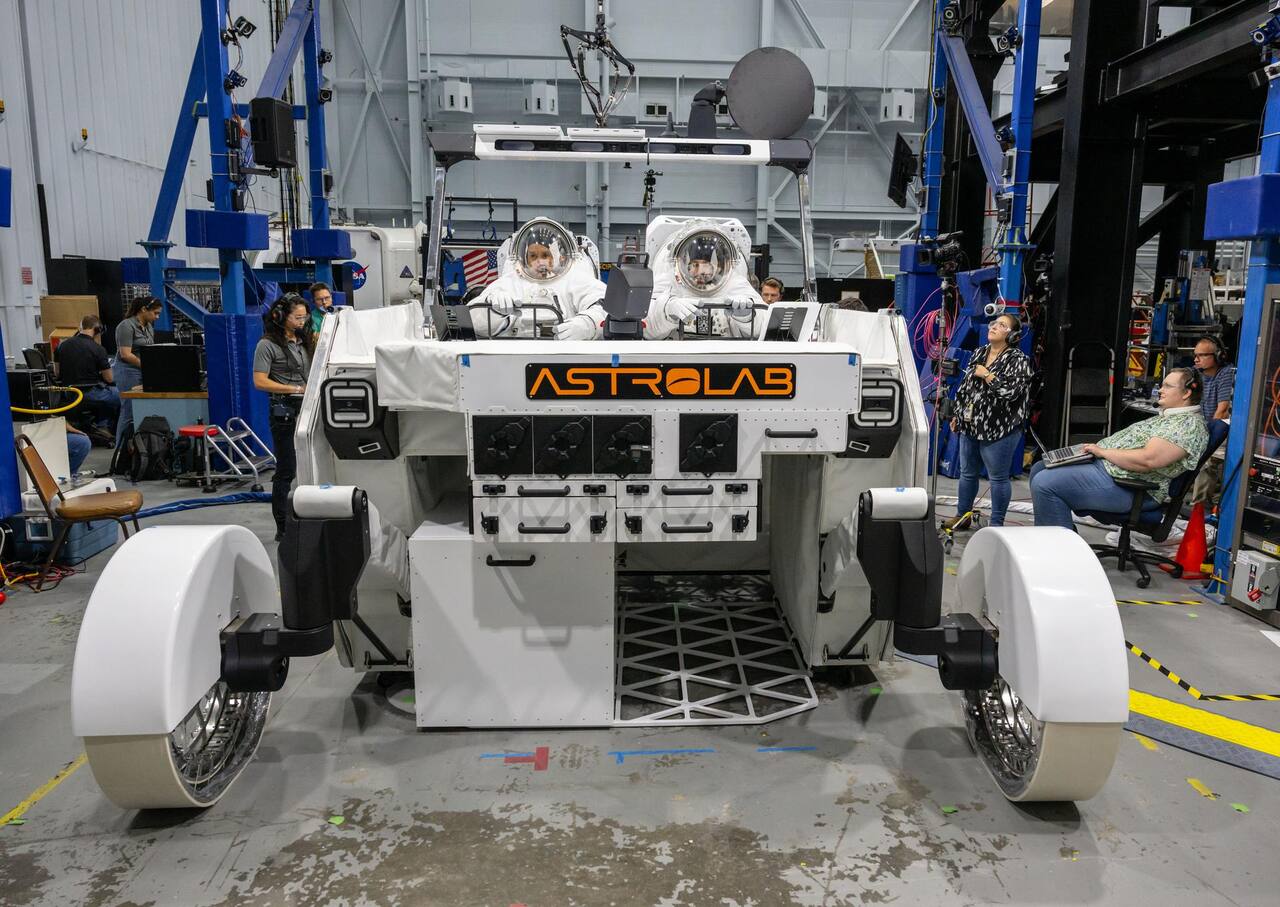
 NASA/James Blair. Public domain (NASA / US government work).
Overview
Section titled “Overview”FLEX, Flexible Logistics and Exploration, is an unpressurized four-wheeled lunar rover built by Venturi Astrolab of Hawthorne, California. It carries two suited crew, accepts modular payloads at multiple quick-disconnect interfaces, and can be driven by an onboard crew, teleoperated from Earth, or run under supervised autonomy [27]. A full-scale terrestrial prototype was built and field tested before the flight design was frozen. The flight configuration selected by NASA in May 2026 is designated CLV-1 and is derived from the FLEX architecture [28].
Astrolab is the prime. Venturi Space supplies the wheels, batteries and battery management system; Axiom Space, Interlune and Odyssey Space Research are named team members [28]. NASA’s own 2025 survey of in-space servicing, assembly and manufacturing capability lists FLEX among the vehicles built to carry science and logistics payloads on the lunar surface, an independent confirmation of the payload-carrying architecture from outside the vendor’s own materials [6].
Almost every vehicle figure below comes from manufacturer documentation [27], [28], [29], [31] rather than a reviewed publication, and the source column says which. The NASA papers cited [1], [2], [3] describe the government reference LTV design or the LTV requirement set, not the Astrolab vehicle.
Specifications
Section titled “Specifications”| Parameter | Value | Source |
|---|---|---|
| Crew | 2 suited astronauts | manufacturer [27] |
| Maximum vehicle mass, CLV-1 | 950 kg | manufacturer [28] |
| Stowed envelope | 2.0 x 2.3 x 2.2 m | |
| Deployed envelope | 4.0 x 2.3 x 2.6 m to antenna top | |
| Top speed, level ground | 10 km/h | |
| Wheel diameter | 930 mm | manufacturer [29] |
| Wheel life specification | at least 1000 km | |
| Wheel temperature specification | -240 to +130 degrees C | |
| Cargo delivery capacity | 1600 kg, 3 cubic meters | manufacturer [27] |
| Solar array area | 3 square meters | manufacturer [27] |
| Robotic arm | 6 DOF | manufacturer [27] |
| Night survival | yes, by heated battery enclosure | manufacturer [31] |
No reviewed publication gives a full mass, power or payload breakdown for FLEX. The manufacturer’s own product materials are themselves sparse: beyond the figures above, Astrolab states no payload mass limit, power budget or structural load figure for the vehicle’s payload interfaces [27].
Design space and flight record
Section titled “Design space and flight record”A south pole rover has to carry two suited crew and cargo over regolith whose polar strength has not been measured, keep its batteries above their minimum operating temperature through nights of at least 85 hours, and fit a CLPS-class lander [3]. Four families of approach address this, and they differ in what has flown.
Crew-driven wheeled vehicles are the only class with a flight record on the Moon. The Apollo 15 LRV drove 27.9 km in 3 h 8 min at a 9.2 km/h average and used about 52 A-h of 242 A-h, or 1.87 A-h/km against a preflight prediction of 3.67 [17]. Energy was reconstructed from later readings because the battery 2 ammeter was dead for the mission [17]. The pre-mission prediction program overpredicted energy with a median deviation of about 30 percent, and no direct lunar measurement of slip, drawbar pull or sinkage exists [4]. The LRV navigation system, a directional gyro with four wheel odometers, closed within 200 m on Apollo 15 and with zero error on Apollo 16 and 17 [16]. FLEX inherits this crew-driven role and adds teleoperation and supervised autonomy that no lunar vehicle has used on the surface.
Uncrewed wheeled rovers have also flown. The Lunokhod-1 traverse has been reconstructed from LRO stereo imagery against a 0.5 m per pixel elevation model [22]. Lunokhod met the lunar night with radioisotope heat [13]. The most recent commercial attempt, Lunar Outpost’s MAPP on IM-2, survived landing but was never deployed because the lander came to rest on its side with the rover’s garage wedged beneath it [15]. During transit and on the surface the team received 57,574 data points and sent 268 commands within a 6 Mb total downlink allocation [15]. MAPP’s reported mass is 10 kg and its top speed 10 cm/s, which makes it a different class of vehicle from FLEX [23]. No mobility, navigation or autonomy function of that rover was exercised on the surface [15].
Wheel-on-limb vehicles are the architecture FLEX shares with the ATHLETE line. ATHLETE’s first-generation vehicle has six limbs, a 2.75 m hexagonal frame, roughly 850 kg, and a wheel drive delivering 527 N continuous rim thrust at 10 km/h [10]. The design argument is that a vehicle able to lock its wheels and walk out of soft ground can size wheels for nominal terrain only. Those figures are design targets and scaling estimates, not measurements [10]. FLEX applies limbs to a four-wheel crewed vehicle, and Astrolab quantifies neither limb travel nor load [27].
Dedicated precursors fill the remaining gap. FLIP is the only FLEX-derived hardware with a flight assignment, and it has not flown [32]. VIPER, the NASA south pole rover, was designed to measure wheel normal force with a torque transducer in each suspension joint and sinkage with an encoder pattern on the inboard rim [24]. NASA canceled it in July 2024 before any of those experiments ran [24]. Its test campaign included a 40 km wheel endurance test and slip characterization at the NASA Glenn SLOPE facility, with no results reported [25]. Its Griffin-1 slot went to FLIP [32].
Mission profile
Section titled “Mission profile”The following describe the flight assignments, not the vehicle.
| Parameter | Value | Source |
|---|---|---|
| Contract | Lunar Terrain Vehicle Services, Phase 1 High Achievability Mission task order | [28], [30] |
| Task order value | approximately $219 million | |
| Parent IDIQ | up to $4.6 billion, awarded 2024, 13 years plus 2 | [28] |
| Surface arrival | no earlier than 2028 | [28], [30] |
| Landing site class | lunar south pole | [30] |
| Precursor flight | FLIP on Astrobotic Griffin-1, Nobile region | [31], [32] |
NASA awarded LTVS Phase 1 task orders to Astrolab at approximately $219 million and to Lunar Outpost at approximately $220 million, with delivery to the surface anticipated by 2028 [30]. The stated near-term plan is that over 18 months the providers finalize rover designs, conduct crewed evaluations, and qualify flight units. The NASA release restates CLV-1 as having a mass of about 2000 pounds and the ability to exceed 6 mph on level terrain, consistent with the 950 kg and 10 km/h given by Astrolab [28].
FLIP, the FLEX Lunar Innovation Platform, is a smaller vehicle of approximately 450 kg carrying up to 30 kg of payload, manifested on Astrobotic’s Griffin-1 lander to the Nobile region of the south pole [32]. It flies full-size FLEX batteries, tires, avionics, sensors and software, so its purpose is subsystem qualification for FLEX rather than an independent program [31].
Requirements the vehicle is built against
Section titled “Requirements the vehicle is built against”The LTV requirement set is published in NASA papers even though the Astrolab design against it is not. The 2021 request for information asked for a vehicle that survives an extended lunar night of at least 85 hours and 125 hours if achievable, fits a CLPS-class lander, accommodates a driver and a passenger in EVA suits, carries a total payload mass of at least 800 kg for as much as 20 km without recharging, is available at least 8 hours per Earth day outside night periods, survives south polar and permanently shadowed region temperatures of 50 K, has an operational life of at least ten years, and can be operated remotely [3]. Two numbered system requirements appear in the teleoperation study: LTV-SYS-071 sets 6 km as threshold and 8 km as goal for distance covered in one 24 hour period under remote operation, and LTV-SYS-029 requires no less than 20 km without stopping to recharge [1]. A separate NASA thermal analysis states a required top speed of at least 15 km/h [2], which the manufacturer figure of 10 km/h for CLV-1 does not meet [28]; the two documents describe different design generations and no source reconciles them.
Mobility
Section titled “Mobility”FLEX uses a wheel-on-limb architecture in which each of the four wheels is carried on an articulated limb. Astrolab describes the limbs as leveling the chassis, absorbing impacts at speed, changing ground clearance, and picking up and setting down payloads directly, without a separate lifting mechanism [27]. Astrolab’s own materials give no quantified figures for limb travel, load capacity or actuation, so the architecture is stated here only as description, not as specification.
The wheel is a Venturi Space design, 930 mm in diameter, built from 192 cables acting as spokes, an outer rim carrying springs, and a flexible tread of a material developed for the application [29]. It is specified for at least 1000 km of travel and for surface temperatures between -240 and +130 degrees C on a vehicle traveling at 15 km/h. The wheel was presented publicly in June 2023.
Wheel thermal behavior on a lunar rover is dominated by radiation rather than by contact with the regolith. In the NASA government reference LTV analysis, wheel temperatures over a full summer day at a highly illuminated Connecting Ridge site ranged from 240 K to 420 K against a maximum far-field regolith surface temperature near 114 K, and the temperature profile was insensitive to the assumed wheel-to-regolith conductance because the low conductivity of the regolith itself is the choke point [2]. Peak conducted heat loss was 12 W from a single wheel and 37 W from all four. Sinkage for that reference design was computed at 1.1 cm, against 1.3 cm measured in the Apollo 15 LRV tracks [2]. The exception is a traverse into a permanently shadowed region, where the rolling contact patch continually meets fresh 25 K regolith: over a 2 hour traverse at maximum speed the predicted mean wheel temperature ranged from 264 K at an assumed contact conductance of 0.1 W/K down to near 25 K at 100 W/K, with total energy transfer asymptotic to about 12,000 kJ above 10 W/K [2]. That paper states no test-verified method exists to derive the conductance analytically and that a thermal vacuum measurement against rotation speed, loading and temperature is required. Aluminum 7075 in the reference wheel carcass gains yield strength at cryogenic temperature and loses fracture toughness [2]. The Venturi cable-and-spring wheel is a compliant structure of the class that paper flags as hard to model, because conduction between contacting non-welded strands in vacuum depends on contact pressure and area, and radiating area must be reduced for the gaps. No published measurement of the Venturi wheel against these effects was located.
The only flown baseline for wheeled lunar mobility is the Apollo LRV, and it sits well below FLEX’s stated figures: 2 to 3 percent wheel slip, a cruise speed of 6 to 7 km/h against FLEX’s 10 km/h top speed, a maximum negotiable slope of 19 to 23 degrees, and an energy cost of 35 to 56 watt-hours per km, of which only about 15 percent went into the soil rather than the vehicle and its occupants [18]. The LRV numbers come from six equatorial Apollo sites on a wire-mesh wheel; nothing in that record bears on the higher speed, south polar terrain or cable-and-spring wheel FLEX is specified against.
The governing NASA cross-program environment specification sets lunar regolith ultimate bearing capacity at about 6000 kPa under a 1 m footing and equatorial surface temperature extremes of 391 K at local noon against 96 K before sunrise [5], figures that describe what a lunar surface vehicle is required to be designed against rather than anything measured on FLEX itself. No published source states the Venturi wheel’s contact pressure against that bearing capacity limit.
Soil interaction and test practice
Section titled “Soil interaction and test practice”Wheel performance on the Moon is predicted rather than measured, and the prediction chain has several independent links. The NASA white paper written for the LTV rover simulation takes the Bekker-Wong-Akin equations with constant lunar soil parameters: sinkage exponent 1, cohesive modulus 1400 N/m2, frictional modulus 830000 N/m3, cohesion 170 N/m2 [7]. The paper reports no results and no comparison against a drawbar curve or measured sinkage [7]. Apollo-era surface values are collected in the Lunar Sourcebook, which recommends a friction angle of 49 degrees and cohesion of 1.6 kPa over the top 60 cm and measured a diurnal extreme of 374 K to 92 K at Apollo 15 [18]. Almost every value in that book comes from sites within about 27 degrees of the equator [18].
Ground testing uses GRC-1, a blend of four silica sands matched to the cone index gradient measured by Apollo 15 and 16 astronauts, which lacks lunar cohesion by the authors’ own account [12]. The NASA Glenn drawbar pull procedure defines three GRC-1 terrain conditions at 5.0, 3.5 and 2.5 kPa/mm cone index gradient [11]. The current consolidation of rover mobility test practice states that no NASA standard south pole simulant exists, that cone index gradient may not reproduce lunar strength under lunar gravity, and that no known facility reproduces the dynamics of a vehicle specified to 15 km/h [8]. It also records the LTV requirements of 1300 km per year, 20 degree slopes, 30 cm obstacles and survival through 150 hours of darkness at 61 K [8]. Astrobotic operates a regolith lab with more than 19,000 kg of GRC-1, whose only reported wheel result is an unquantified vendor opinion [21].
Single-wheel and component tests show the range of methods. A 200 mm grouser wheel was run on Toyoura sand and FJS-1 lunar simulant at slip ratios of 0 to 50 percent and vertical loads of 5 to 70 N, at Earth gravity with reduced load standing in for the Moon [9]. The IPEx wheel trade ran 83 tests on 10 cleat and grouser configurations in the KSC regolith bin and found that taller, squarer grousers slip less but draw more power [19]. The same program qualified a common actuator, with an arm actuator surviving 1,402,223 input revolutions against a 337,000 revolution requirement, and reported that wheel dynamic-load analysis disagreed significantly with a rock-strike test [20]. A continuum model of granular terrain in the Chrono simulator has been applied to a 137 kg six-wheel Yutu model, with no comparison against Yutu telemetry [26]. None of these tests uses the Venturi wheel; NASA selected Astrolab to test it at Glenn and Johnson [29].
Power and energy
Section titled “Power and energy”Generation is a deployable solar array of 3 square meters that tops up internal batteries [27]. Battery capacity in watt-hours is not published. Batteries and the battery management system come from Venturi Space [28]. The batteries sit in an enclosure built to hold them inside their operating range across the surface temperature swing, and it is that enclosure that the manufacturer identifies as the enabler of lunar night survival [31].
Battery minimum operating temperature is the sizing parameter for heater power on a vehicle of this class. The NASA thermal design study defines the critical component as the one with the highest minimum operating temperature, states that this is usually the battery, and takes 0 or -10 degrees C as the assumed limit from which worst-case cold heater power follows [3]. Cells qualified to operate colder reduce thermal management mass directly, because both battery size and heater count fall.
Thermal
Section titled “Thermal”Surviving the night is the dominant thermal case. Lunar surface temperature at the south pole reaches 300 K in daylight and 50 K at night, most nights at a given site last about 36 hours, and NASA analysis indicates a vehicle would see at least two extended nights of at least 85 hours per year, extending to 125 hours if stationary [3]. Radioisotope heater units were considered for the reference design and were constrained by Department of Energy material control, by units not being in production, and by CLPS launch licensing that has no precedent for radioisotope payloads.
Three other night-survival approaches appear in the literature, and none has flown on a rover since Lunokhod. The NASA reference concept is fully passive, with multi-layer insulation, dust covers and a nested box in which batteries and electronics warm each other, and it leaves out radioisotope heater units because CLPS licensing for nuclear material is unresolved [3]. A JPL Team-X study of the 2,000 km, four-year Endurance rover compared four radioisotope power options with electric-heater and waste-heat loop architectures; the MMRTG with electric heaters could not close, and the Stirling options are conceptual designs for units that do not exist [14]. A thermal wadi of fused regolith simulated for a 70 kg equatorial rover through a 350 hour night would need a shield emissivity of 0.03, with no hardware built and equatorial conditions only [13]. The LTV requirement of 150 hours of darkness at 61 K [8] is harsher than the 85 to 125 hours in the earlier request [3].
Astrolab publishes no thermal architecture for FLEX beyond the battery enclosure [27], [31].
Compute and avionics
Section titled “Compute and avionics”No processor, flight software framework or avionics architecture has been published for FLEX. FLIP carries flight avionics, sensors and software ahead of FLEX for surface qualification, which is the only stated link between the two vehicles’ avionics [31].
Autonomy
Section titled “Autonomy”The published autonomy level is supervised, driving to operator-selected waypoints with onboard hazard avoidance [27]. Sensors for hazard avoidance are stated to exist but are not enumerated [27].
Teleoperation performance under lunar communication latency has been measured by NASA on a government reference LTV in simulation. Average speed across all operators and terrain scenarios fell monotonically with delay [1]:
| One-way communication delay | Average speed | Time to cover 20 km |
|---|---|---|
| 0 s | 3.24 km/h | 6 h 10 min |
| 4 s | 2.56 km/h | 7 h 49 min |
| 6 s | 2.03 km/h | 9 h 51 min |
| 8 s | 1.76 km/h | 11 h 22 min |
Values from [1]. Operators braked more frequently under latency, and subjective workload rose against the zero-delay case with mental demand, frustration and performance as the contributing factors. Driving strategy was uniform across operators at zero delay and diverged into three distinct strategies at 4 s [1]. Operators received about 30 minutes of familiarization before each run, and the simulation provided an operator-selected rate limiter on the hand controller and a predictive circle. Teleoperated average speeds of 1.76 to 3.24 km/h are a fraction of the 10 km/h vehicle top speed [28], so the binding constraint on remote traverse rate is the operator and the link rather than the drivetrain.
Communications
Section titled “Communications”A gimballing high-gain antenna provides direct-to-Earth communication [27]. Bands, data rates and relay arrangements are not published.
Payload interfaces
Section titled “Payload interfaces”Astrolab states that FLEX takes modular payloads at quick-disconnect interfaces and that the vehicle can dock to a payload robotically, pick it up, carry it and set it down elsewhere, including relocating items too large for one vehicle by having multiple rovers cooperate [27]. No published, reviewed source gives payload mass limits, structural load figures, connector specifications or arm interface loads for these interfaces: the one manufacturer document that specified them in detail is held only as a corrupted file and cannot currently be read, so those figures are not reported here.
Modes of operation
Section titled “Modes of operation”Three driving modes are published: crew driving from the onboard crew station, remote teleoperation from Earth, and supervised autonomous navigation to operator-selected waypoints [27]. The crew station is itself a removable top-deck payload, so the crewed and uncrewed configurations differ by a payload exchange rather than by vehicle build [27]. Survive-the-night is a distinct state in which the vehicle is dormant with the battery enclosure held above its minimum operating temperature [31].
Ground operations
Section titled “Ground operations”No operations concept, control center or planning cycle has been published for FLEX. The NASA teleoperation studies establish the operator-side envelope the ground system has to work within: single-operator remote driving is viable through 8 s of one-way delay with a rate limiter and a predictive circle in the display, at the cost of speed and workload [1]. Crewed evaluations of the vehicle have been run at NASA JSC with suited subjects working the crew station, stowage drawers and payload handling [30].
Technologies developed
Section titled “Technologies developed”One product of the program is separable from the vehicle: the Venturi hyper-deformable wheel, a cable-and-spring compliant wheel specified for 1000 km and for a 370 degree C temperature span, which is a component rather than a vehicle subsystem and is being flown on FLIP ahead of FLEX [29], [31]. Astrolab also markets a payload interface intended to let landers, rovers and payloads from different vendors interoperate, but no reviewed or independently readable source describes its specification, so it is not detailed here.
What is not established
Section titled “What is not established”Almost every quantitative figure for FLEX comes from the manufacturer rather than from a reviewed publication, and the manufacturer’s own materials are themselves sparse: no payload mass limit, structural load, power budget, flight software architecture, processor, or communications data rate has been published for the vehicle [27]. A manufacturer document that specified the payload interfaces, arm interface loads and cargo container envelopes in detail exists but is held only as a corrupted file that cannot currently be read, so none of those figures can be reported until it is refetched and read. The government LTV design and requirement figures cited above describe a NASA reference vehicle and a requirement set, not the Astrolab vehicle, and no source reconciles the two: the LTV wheel thermal paper’s top speed requirement of at least 15 km/h is not met by the 10 km/h CLV-1 figure Astrolab publishes [2], [28]. The soil-interaction chain from simulant to wheel prediction rests on equatorial Apollo data, and no south pole strength measurement exists [8], [18]. FLEX has not flown and CLV-1 has not been built [28]; the closest flown wheeled precedents are the Apollo LRV and Lunokhod, and the one recent commercial rover never left its garage [15], [17], [22]. No test-verified method exists to derive the wheel-to-regolith contact conductance the thermal case depends on, and no published measurement of the Venturi wheel’s own thermal or bearing behavior was located [2].
References
- Litaker, H. L., Li, Z. Q., Beaton, K. H. and Lewis, J. F. (2024). Lunar Terrain Vehicle (LTV) Remote Teleoperation Studies Under Four Lunar Communication Latencies
. IEEE Aerospace Conference, NASA/TM-20240001217. Source
BibTeX
@inproceedings{litaker2024lunar, title = {Lunar Terrain Vehicle (LTV) Remote Teleoperation Studies Under Four Lunar Communication Latencies}, author = {Litaker, Harry L. and Li, Zu Qun and Beaton, Kara H. and Lewis, John F.}, booktitle = {IEEE Aerospace Conference}, number = {NASA/TM-20240001217}, pages = {1-21}, institution = {NASA Johnson Space Center}, year = {2024}, doi = {10.1109/aero63441.2025.11068604}, abstract = {Remotely operating a lunar rover from Earth while subject to an Earth-Moon time delay of multiple seconds could result in a dangerous state where the vehicle is either damaged or lost. Providing the right capabilities to the remote operator to manage inherent communication latencies will be important for remote driving to be successful. NASA conducted two studies to investigate the average speed and number of kilometers per day that an operator on Earth could teleoperate a notional Artemis unpressurized rover with minimal remote operator capabilities under 0, 4, 6 and 8-second communication delay. The primary goal of these studies was to understand if an Artemis Lunar Terrain Vehicle (L TV) could cover 6 kilometers (km) in 24 hours when operated remotely. During the April 2023 evaluation, operators used an in-house simulation of the lunar surface South Pole to teleoperate a NASA government reference LTV. Operators viewed the surrounding terrain via a single, rover mast-mounted, high-resolution camera with pan/tilt/zoom capabilities; continuous communication was provided throughout all testing. Additions in the August 2023 evaluation provided remote operators with an operator-selected rate limiter to enable finer sensitivity in the hand controller and a predictive circle function to better assist operators with predicting the path the vehicle could take. All operators were able to successfully navigate and drive through six different types of terrain and five planned traverse scenarios using natural lighting under all communication delays. Results for average speeds for each communication delay was computed then used to derive the total time needed to cover 6, 8, and 20 km. Generally, remote operators drove slower when subjected to a communication latency. Subjective workload assessments revealed that while operating in a latency the overall workload significantly increased with mental demand, frustration, and performance being the primary contributing factors. Driving strategies in the 0-s delay did not vary significantly among operators; however, in the 4-s delay condition, three different driving strategies were identified. Differences in the 6-s and 8-s latency conditions indicated the operators use of the cruise control to maintain speed was more apparent. Operators started to define more specific parameters in driving strategies for general operations. This consisted of setting the vehicle into a low-speed cruise mode of approximately 1-1.5 kilometers per hour (kph). Operators noticed driving performance of the vehicle seemed to be much harder at slower speeds 0.4-0.8 kph; however, the vehicle was more responsive at speeds of 2.9-3.6 kph. Regardless of communication delay, operators used both the horizontal translation rails and the vehicle fenders as guides to predict a path for the vehicle through heavily concentrated terrain features. Additionally, operators took advantage of the predictive circle indicator on the navigation display and over 95% of the operator's navigation used the mast camera 180-degree panning function for ground truthing in terms of boulders and craters. These studies provided a “first-look” answer to a potential system requirement; however, considerable general knowledge was gained to begin to understand what it will take to make a successful lunar rover teleoperation mission.} } - Birmingham, W. (2024). Thermal Sensitivity Study of Lunar Terrain Vehicle Wheels
. Thermal and Fluids Analysis Workshop. Source
BibTeX
@inproceedings{birmingham2024thermal, title = {Thermal Sensitivity Study of Lunar Terrain Vehicle Wheels}, author = {Birmingham, William}, booktitle = {Thermal and Fluids Analysis Workshop}, organization = {Jacobs Space Exploration Group / NASA Marshall Space Flight Center}, year = {2024}, url = {https://ntrs.nasa.gov/citations/20240006096}, abstract = {Since the early development of lunar vehicles for the Apollo program, designing a wheel capable of functioning in the harsh equatorial lunar environment was identified as a uniquely difficult engineering challenge. The Lunar Terrain Vehicle (LTV) must contend with many of the same challenges encountered during the Apollo missions, but with the addition of colder, more complex thermal environments at the lunar south pole and longer Artemis mission timelines. A full thermal assessment of LTV wheels should capture these and other details to assess heat leak through the wheels and extreme hot and cold temperatures. The goals of this study are to provide bounding lunar south pole thermal environments; to define sensitivity to interactions between the wheel and the lunar surface in different operation modes, such as parked and traversing; and to identify thermal performance concerns related to the use of shape memory alloys.} } - Hernandez, Z. Y., Wilcox, S. and Slusser, T. (2023). Designing a Lunar Terrain Vehicle: Thermal Challenges
. Thermal and Fluids Analysis Workshop. Source
BibTeX
@inproceedings{hernandez2023designing, title = {Designing a Lunar Terrain Vehicle: Thermal Challenges}, author = {Hernandez, Zaida Y. and Wilcox, Samuel and Slusser, Thomas}, booktitle = {Thermal and Fluids Analysis Workshop}, organization = {NASA Johnson Space Center}, year = {2023}, url = {https://ntrs.nasa.gov/citations/20230002802}, abstract = {The Lunar Terrain Vehicle (LTV) is an unpressurized rover that will be used to transport astronauts on the South Pole of the moon under the Artemis Program. The National Aeronautics and Space Administration (NASA) will be partnering with an American industry partner to develop the LTV. This paper discusses the thermal challenges faced when designing a crewed lunar vehicle concept and shares a concept that addresses these constraints. One of the most difficult aspects of the design is surviving the cold lunar night on the South Pole which includes permanently shadowed regions (PSR) that can have an extended lunar night duration of 125 hours. Other challenges are critical component temperature limits and programmatic constraints.} } - Costes, N. C., Farmer, J. E. and George, E. B. (1972). Mobility Performance of the Lunar Roving Vehicle: Terrestrial Studies --- Apollo 15 Results
. Conference of the International, NASA TR R-401, 19730008090. Source
BibTeX
@inproceedings{costes1972mobility, title = {Mobility Performance of the Lunar Roving Vehicle: Terrestrial Studies --- Apollo 15 Results}, author = {Costes, Nicholas C. and Farmer, John E. and George, Edwin B.}, booktitle = {Conference of the International}, number = {NASA TR R-401, 19730008090}, institution = {NASA Marshall Space Flight Center}, address = {Stockholm and Kiruna}, month = {12}, year = {1972}, url = {https://ntrs.nasa.gov/citations/19730008090}, abstract = {The constriants of the Apollo 15 mission dictated that the average and limiting performance capabilities of the first manned lunar roving vehicle be known or estimated within narrow margins. Extensive studies were conducted and are compared with the actual performance of the lunar roving vehicle during the Apollo 15 mission. From this comparison, conclusions are drawn relating to the capabilities and limitation of current terrestrial methodology in predicting the mobility performance of lunar roving vehicles under in-situ environmental conditions, and recommendations are offered concerning the performance of surface vehicles on future missions related to lunar or planetary exploration.} } - NASA. (2020). Cross-Program Design Specification for Natural Environments (DSNE), Revision G
. NASA Marshall Space Flight Center. Source
BibTeX
@techreport{nasa2020cross, title = {Cross-Program Design Specification for Natural Environments (DSNE), Revision G}, author = {{NASA}}, institution = {NASA Marshall Space Flight Center}, year = {2020}, url = {https://ntrs.nasa.gov/citations/20200000867}, abstract = {The DSNE completes environment-related specifications for architecture, system-level, and lower-tier documents by specifying the ranges of environmental conditions that must be accounted for by NASA ESD Programs. To assure clarity and consistency, and to prevent requirements documents from becoming cluttered with extensive amounts of technical material, natural environment specifications have been compiled into this document. The intent is to keep a unified specification for natural environments that each Program calls out for appropriate application.} } - Mulvaney, J., Arney, D., Williams, C., Morel, J., Stockdale, C., Whitlock, C. and Balaji, V. (2025). In-Space Servicing, Assembly, and Manufacturing (ISAM) State of Play, 2025 Edition
. NASA, 20250008988. Source
BibTeX
@techreport{nasa2025space, title = {In-Space Servicing, Assembly, and Manufacturing (ISAM) State of Play, 2025 Edition}, author = {Mulvaney, John and Arney, Dale and Williams, Christina and Morel, Jose and Stockdale, Christopher and Whitlock, Christopher and Balaji, Vishruth}, number = {20250008988}, institution = {NASA}, year = {2025}, url = {https://ntrs.nasa.gov/citations/20250008988}, abstract = {The future of spaceflight will yield increasingly more ambitious missions to support civil, national security, and commercial space sectors. Achieving some of these missions will not be feasible by launching an integrated, fully functioning system on a single launch vehicle. Future science and human exploration missions will require payloads that are larger than any foreseeable launch vehicle fairing, national security missions will require persistent assets that are mobile and resilient, and commercial space missions will require cost-effective ways to update to the latest technology on orbit. In-space Servicing, Assembly, and Manufacturing (ISAM) can vastly expand the performance, availability, and lifetime of space systems compared to the traditional paradigm of launching an asset with no intent to ever interact with it again. ISAM capabilities foster an ecosystem that changes the space operations paradigm, creating the foundation for sustainable exploration and serving as a multiplier for other capabilities like space logistics, power generation, and reusability. Previous achievements in ISAM have enabled ambitious human and robotic space missions. The assembly, operation, and maintenance of NASA’s International Space Station (ISS); servicing missions to the Hubble Space Telescope (HST); and Northrop Grumman’s Mission Extension Vehicle (MEV) demonstrate the dramatic operational missions that can be achieved using ISAM capabilities. Many current and upcoming flight demonstrations are advancing areas that will enable the next generation of civil, national security, and commercial space missions. This document describes the current state of ISAM missions, activities, and technologiesto the best ability of the authors. Compiling and organizing the available ISAM capabilities will help mission designers incorporate ISAM technologies into their concepts, create the starting point for technology development plans and roadmaps, and provide technologists a survey of the field they are developing. This document divides the ISAM capabilities into 11 functional capability areas that describe the functions or activities that can be performed in space using ISAM.} } - Li, Z. Q. and Bingham, L. K. (2022). NASA White Paper: Terramechanics for LTV Modeling and Simulation
. NASA, 20220010732. Source
BibTeX
@techreport{li2022nasa, title = {NASA White Paper: Terramechanics for LTV Modeling and Simulation}, author = {Li, Zu Qun and Bingham, Lee K.}, number = {20220010732}, institution = {NASA}, year = {2022}, url = {https://ntrs.nasa.gov/citations/20220010732}, abstract = {Simulating the interaction between wheel and soil is critical to the overall rover dynamics. This paper presented simple models for wheel soil interaction including the rolling resistances on the wheel due to soil compression and bull- dozing and the maximum tractive force between wheel and soil. Summary of typical lunar soil properties were presented in this paper and the wheel resis- tance model implementation and integration were also discussed. Integrating the wheel resistance model with the rover simulation will improve its dynamics and wheel slip models and enable the capability simulate the situation where wheel got stuck in the soil.} } - Creager, C., Breckenridge, J., Johnson, K., Oravec, H., Moreland, S., Sobey, A. and McBryan, E. (2025). Best Practices for the Testing of Planetary Roving Vehicle Mobility Systems and Tires
. NASA, 20250003470. Source
BibTeX
@techreport{creager2025best, title = {Best Practices for the Testing of Planetary Roving Vehicle Mobility Systems and Tires}, author = {Creager, Colin and Breckenridge, John and Johnson, Kyle and Oravec, Heather and Moreland, Scott and Sobey, Alexander and McBryan, Emily}, number = {20250003470}, institution = {NASA}, year = {2025}, url = {https://ntrs.nasa.gov/citations/20250003470}, abstract = {NASA has an extensive history of conducting mobility testing on planetary tires, rovers, and mobility subsystems. This paper contains a summary of the best practices and lessons learned from past test approaches, as well as from relevant test methodologies external to NASA, with a focus on tires and mobility systems. It is intended to be a resource for future planetary rover developments. This document, which will be released in two phases, serves two objectives: 1) compile the existing knowledge of mobility related testing within NASA; and 2) identify major gaps in mobility related test needs and suggest potential paths forward. This first release of the document (early 2025) captures information based on the authors’ existing knowledge and an abbreviated literature review. A more thorough version will be released in late 2025 and will include more information on test methods external to NASA, as well as additional lessons learned through further investigations. The Lunar Terrain Vehicle (LTV) is used as case study to help identify major test needs; however, this document is intended to be applicable to a wide range of potential missions. Though no current mobility standards exist for the testing of planetary tires and mobility subsystems, future motive is to utilize the information from this whitepaper to guide the development of NASA mobility test standards.} } - Takehana, K., Kizaki, S., Tanaka, T., Uno, K. and Yoshida, K. (2025). Comparison of lunar rover wheel performance in soils with different cohesive properties
. Icarus. Source
BibTeX
@article{takehana2025comparison, title = {Comparison of lunar rover wheel performance in soils with different cohesive properties}, author = {Takehana, Keisuke and Kizaki, Shino and Tanaka, Tomomi and Uno, Kentaro and Yoshida, Kazuya}, journal = {Icarus}, volume = {117}, pages = {101011}, publisher = {Elsevier BV}, year = {2025}, doi = {10.1016/j.jterra.2024.101011} } - Wilcox, B. H. (2007). ATHLETE: A Mobility and Manipulation System for the Moon
. IEEE Aerospace Conference. Source
BibTeX
@inproceedings{wilcox2007mobility, title = {ATHLETE: A Mobility and Manipulation System for the Moon}, author = {Wilcox, Brian H.}, booktitle = {IEEE Aerospace Conference}, pages = {1-10}, year = {2007}, doi = {10.1109/aero.2007.352726}, abstract = {A robotic vehicle called ATHLETE - the all-terrain, hex-limbed, extra-terrestrial explorer is described, along with initial results of field tests of two prototype vehicles. This vehicle concept is capable of efficient rolling mobility on moderate terrain and walking mobility on extreme terrain. Each limb has a quick-disconnect tool adapter so that it can perform general-purpose handling, assembly, maintenance, and servicing tasks using any or all of the limbs.} } - Creager, C., Asnani, V., Oravec, H. and Woodward, A. (2017). Drawbar Pull (DP) Procedures for Off-Road Vehicle Testing
. NASA Glenn Research Center, NASA/TP-2017-219384. Source
BibTeX
@techreport{creager2017drawbar, title = {Drawbar Pull (DP) Procedures for Off-Road Vehicle Testing}, author = {Creager, Colin and Asnani, Vivake and Oravec, Heather and Woodward, Adam}, number = {NASA/TP-2017-219384}, institution = {NASA Glenn Research Center}, year = {2017}, url = {https://ntrs.nasa.gov/citations/20170010706}, abstract = {As NASA strives to explore the surface of the Moon and Mars, there is a continued need for improved tire and vehicle development. When tires or vehicles are being designed for off-road conditions where significant thrust generation is required, such as climbing out of craters on the Moon, it is important to use a standard test method for evaluating their tractive performance. The drawbar pull (DP) test is a way of measuring the net thrust generated by tires or a vehicle with respect to performance metrics such as travel reduction, sinkage, or power efficiency. DP testing may be done using a single tire on a traction rig, or with a set of tires on a vehicle; this report focuses on vehicle DP tests. Though vehicle DP tests have been used for decades, there are no standard procedures that apply to exploration vehicles. This report summarizes previous methods employed, shows the sensitivity of certain test parameters, and provides a body of knowledge for developing standard testing procedures. The focus of this work is on lunar applications, but these test methods can be applied to terrestrial and planetary conditions as well. Section 1.0 of this report discusses the utility of DP testing for off-road vehicle evaluation and the metrics used. Section 2.0 focuses on test-terrain preparation, using the example case of lunar terrain. There is a review of lunar terrain analogs implemented in the past and a discussion on the lunar terrain conditions created at the NASA Glenn Research Center, including methods of evaluating the terrain strength variation and consistency from test to test. Section 3.0 provides details of the vehicle test procedures. These consist of a review of past methods, a comprehensive study on the sensitivity of test parameters, and a summary of the procedures used for DP testing at Glenn.} } - Oravec, H., Zeng, X. and Asnani, V. (2010). Design and characterization of GRC-1: A soil for lunar terramechanics testing in Earth-ambient conditions
. Journal of Terramechanics, 6. Source
BibTeX
@article{oravec2010design, title = {Design and characterization of GRC-1: A soil for lunar terramechanics testing in Earth-ambient conditions}, author = {Oravec, H.A. and Zeng, X. and Asnani, V.M.}, journal = {Journal of Terramechanics}, volume = {47}, number = {6}, pages = {361--377}, publisher = {Elsevier BV}, year = {2010}, doi = {10.1016/j.jterra.2010.04.006} } - Jones, H. L., Thornton, J. P., Balasubramaniam, R., Gokoglu, S. A., Sacksteder, K. R. and Whittaker, W. L. (2011). Enabling Long-Duration Lunar Equatorial Operations With Thermal Wadi Infrastructure
. AIAA Aerospace Sciences Meeting including The New Horizons Forum and Aerospace Exposition, NASA/TM-2011-216994. Source
BibTeX
@inproceedings{jones2011enabling, title = {Enabling Long-Duration Lunar Equatorial Operations With Thermal Wadi Infrastructure}, author = {Jones, Heather L. and Thornton, John P. and Balasubramaniam, Ramaswamy and Gokoglu, Suleyman A. and Sacksteder, Kurt R. and Whittaker, William L.}, booktitle = {AIAA Aerospace Sciences Meeting including The New Horizons Forum and Aerospace Exposition}, number = {NASA/TM-2011-216994}, institution = {NASA Glenn Research Center}, year = {2011}, doi = {10.2514/6.2011-703}, abstract = {Long duration missions on the Moon’s equator must survive lunar nights. With 350 hr of cryogenic temperatures, lunar nights present a challenge to robotic survival. Insulation is imperfect, so it is not possible to passively contain enough heat to stay warm through the night. Components that enable mobility, environmental sensing and solar power generation must be exposed, and they leak heat. Small, lightweight rovers cannot store enough energy to warm components throughout the night without some external source of heat or power. Thermal wadis, however, can act as external heat sources to keep robots warm through the lunar night. Electrical power can also be provided to rovers during the night from batteries stored in the ground beside wadis. Buried batteries can be warmed by the wadi’s heat. Results from analysis of the interaction between a rover and a wadi are presented. A detailed three-dimensional (3D) thermal model and an easily configurable two-dimensional (2D) thermal model are used for analysis.} } - Clark, M., Lee, Y., Hudson, T., Elliott, J., Davis, A., Chodas, M., Guzik, A., Zakrajsek, J. F. and Schmitz, P. (2025). Comparison of Radioisotope Power Systems to Enable the Endurance Mission Concept
. Astrobiology. Source
BibTeX
@inproceedings{clark2025comparison, title = {Comparison of Radioisotope Power Systems to Enable the Endurance Mission Concept}, author = {Clark, Matteo and Lee, Young and Hudson, Troy and Elliott, John and Davis, Alex and Chodas, Mark and Guzik, Allen and Zakrajsek, June F. and Schmitz, Paul}, booktitle = {Astrobiology}, publisher = {JPL Open Repository}, year = {2025}, doi = {10.48577/jpl.8mh4mw}, abstract = {NASA has a long history of using Radioisotope Power System (RPS) technologies to enable space missions. Today, NASA’s RPS Program, working with the Department of Energy, deliver RPS to NASA missions to enable the exploration of cold, dark, dusty, and harsh environments. The RPS Program manages the investments made to develop RPS products to enable future missions. To better understand what technologies could most benefit current and future missions, the RPS Program conducts mission and systems studies. This study was undertaken to understand the impact of different RPS technologies on a lunar surface rover mission concept.The Endurance mission concept is one of the mission concept studies for the 2023-2032 Planetary Science and Astrobiology Decadal Survey. It would be an autonomous, rover mission enabled by the RPS to traverse 2,000 km on the lunar surface collecting and delivering samples to the Artemis basecamp near the south pole. The baseline RPS used in the design concept for the four-year mission is the Next Gen RTG (NGRTG). To gain insight into the power requirements of a lunar rover mission concept, the RPS Program Office and the Jet Propulsion Laboratory’s (JPL’s) Team-X conducted a study comparing the impact of various RPS technology options using the Endurance rover concept as a baseline. The study generated parametric point-designs that analyzed one of two different thermal subsystem designs and, notably for the power system, one of four RPS products: MMRTG, NGRTG, Plutonium Oxide-based Stirling RPS, and an Americium-based variant of Stirling RPS. From the RPS Program’s perspective, the MMRTG is the current state-of-the-art, the NGRTG is a planned next generation product, and both Stirling RPS variants are potential future product offerings. The thermal and mechanical design and configuration were altered to accommodate the RPS; other variables were kept constant throughout the study, facilitating the comparison of different point-designs.This paper provides a summary of the results of the Team-X study for the seven point-design that were evaluated. The metrics for evaluation were the estimated mass of the rover and the estimated mission duration; these metrics were selected to track the viability of rover delivery via a Commercial Lunar Payload Service (CLPS) lander, and in meeting the four-year mission duration requirement. Overall, the results showed that achieving mission closure for the Endurance rover mission is possible with any of the specified power systems and either of the heater architectures (depending on the power system implemented).} } - (2025). Lunar Outpost: Lunar Voyage 1 Update. lunaroutpost.com/post/lunar-voyage-1-update
BibTeX
@misc{lunaroutpostlunar, title = {Lunar Outpost: Lunar Voyage 1 Update}, organization = {lunaroutpost.com}, year = {2025}, url = {https://www.lunaroutpost.com/post/lunar-voyage-1-update} } - Smith, E. C. and Mustin, W. C. (1973). Lunar Roving Vehicle Navigation System Performance Review
. NASA, NASA-TN-. Source
BibTeX
@techreport{anon1973lunar, title = {Lunar Roving Vehicle Navigation System Performance Review}, author = {Smith, Earnest C. and Mustin, William C.}, number = {NASA-TN-}, institution = {NASA}, year = {1973}, url = {https://ntrs.nasa.gov/citations/19740003321}, abstract = {The design and operation of the lunar roving vehicle (LRV) navigation system are briefly described. The basis for the premission LRV navigation error analysis is explained and an example included. The real time mission support operations philosophy is presented. The LRV navigation system operation and accuracy during the lunar missions are evaluated.} } - NASA Manned Spacecraft Center. (1971). Apollo 15 Mission Report
. NASA Manned Spacecraft Center, MSC-05161. Source
BibTeX
@techreport{anon1971apollo, title = {Apollo 15 Mission Report}, author = {{NASA Manned Spacecraft Center}}, number = {MSC-05161}, institution = {NASA Manned Spacecraft Center}, year = {1971}, url = {https://ntrs.nasa.gov/citations/19720021182}, abstract = {A detailed discussion is presented of the Apollo 15 mission, which conducted exploration of the moon over longer periods, greater ranges, and with more instruments of scientific data acquisition than previous missions. The topics include trajectory, lunar surface science, inflight science and photography, command and service module performance, lunar module performance, lunar surface operational equipment, pilot's report, biomedical evaluation, mission support performance, assessment of mission objectives, launch phase summary, anomaly summary, and vehicle and equipment descriptions. The capability of transporting larger payloads and extending time on the moon were demonstrated. The ground-controlled TV camera allowed greater real-time participation by earth-bound personnel. The crew operated more as scientists and relied more on ground support team for systems monitoring. The modified pressure garment and portable life support system provided better mobility and extended EVA time. The lunar roving vehicle and the lunar communications relay unit were also demonstrated.} } - Heiken, G. H., Vaniman, D. T. and French, B. M. (1991). Lunar Sourcebook: A User's Guide to the Moon
. Endeavour. Source
BibTeX
@book{heiken1991lunar, title = {Lunar Sourcebook: A User's Guide to the Moon}, author = {Heiken, Grant H. and Vaniman, David T. and French, Bevan M.}, journal = {Endeavour}, volume = {16}, pages = {96}, publisher = {Cambridge University Press}, year = {1991}, doi = {10.1016/0160-9327(92)90014-g} } - Zhang, L., Schuler, J., Dokos, A., Xu, Y., Bell, E. and Muller, T. (2024). ISRU Pilot Excavator Wheel Testing in Lunar Regolith Simulant
. ASCE Earth and Space Conference, 20240001016. Source
BibTeX
@inproceedings{zhang2024isru, title = {ISRU Pilot Excavator Wheel Testing in Lunar Regolith Simulant}, author = {Zhang, Liz and Schuler, Jason and Dokos, Adam and Xu, Yinan and Bell, Evan and Muller, Thomas}, booktitle = {ASCE Earth and Space Conference}, number = {20240001016}, pages = {173-187}, institution = {NASA}, year = {2024}, doi = {10.1061/9780784485736.016}, abstract = {The ISRU Pilot Excavator (IPEx), is a robotic excavator funded by NASA’s Space Technology Mission Directorate (STMD). The Concept of Operations for IPEx involves the robot driving on the lunar surface up to 70 km at a speed of up to 30 cm/s. As such, it is critical to the mission’s success to optimize the design of the wheels for performance in lunar conditions, specifically in lunar regolith. To achieve this, an array of tests was completed to observe the effects of various wheel design choices on the driving performance of the wheels in lunar regolith simulant. In order to facilitate testing, we designed a 12 in. dia. configurable wheel to allow for interchangeability between various wheel formations. Two types of wheel parts were designed to be swapped: cleats, which form the tread of the wheel; and grousers, which protrude from the treads. The test variables that we considered were as follows: square versus round wheel shape, solid versus perforated cleats, cleat spacing, grouser height, and grouser spacing. By combining different settings of each of these test variables, 10 discrete wheel designs were created and tested. The configurable test wheels were mounted on the Regolith Advanced Surface Systems Operations Robot (RASSOR) developed at NASA’s Kennedy Space Center. In our experiments, the robot was driven at a controlled speed across a prepared surface of BP-1 lunar regolith simulant. Four types of tests were conducted: circle driving, straight driving, slope driving, and drawbar pull. The driving tests were chosen to mimic a variety of conditions in which IPEx may be expected to operate, and the drawbar pull test was chosen to provide a standard of comparison with existing wheel design literature. The circle and straight driving tests were each performed at different levels: for the circle driving test, the robot was driven at a constant linear speed and three different angular speeds, while for the straight driving test, the robot was driven at three different linear speeds. The data collected from these tests included the power usage from each of the wheels, measurements of the tread patterns left in the regolith surface, and the amount of slip the wheels experienced, which was calculated using data from an OptiTrack motion capture system. From the results of these experiments, we found that certain test variables were more significant than others in determining performance for each type of test, and no single wheel design clearly outperformed the others in all areas. The details of our findings will be discussed further in this paper. These data will be utilized to inform the design of the wheels for IPEx and can provide a basis for the design of wheels for future lunar terrain vehicles.} } - Schuler, J. M., Smith, J. D., Nick, A. J., Buckles, B. C., Dyas, J. E., Ortega, V. V., Cloud, J. M., Dokos, A. G., Zhang, E. L., Wang, J. J., Baron, M. A., Muller, T. J., Clark, C. J. and Howe, M. W. (2024). ISRU Pilot Excavator (IPEx) Technology Readiness Level 5 Design Overview
. AIAA AVIATION Forum and ASCEND, 20240008162. Source
BibTeX
@inproceedings{schuler2024isru, title = {ISRU Pilot Excavator (IPEx) Technology Readiness Level 5 Design Overview}, author = {Schuler, Jason M. and Smith, Jonathan D. and Nick, Andrew J. and Buckles, Bradley C. and Dyas, Jeffrey E. and Ortega, Victoria V. and Cloud, Joseph M. and Dokos, Adam G. and Zhang, Elizabeth L. and Wang, Jerry J. and Baron, Michael A. and Muller, Thomas J. and Clark, Casey J. and Howe, Musashi W.}, booktitle = {AIAA AVIATION Forum and ASCEND}, number = {20240008162}, institution = {NASA}, year = {2024}, doi = {10.2514/6.2024-4890}, abstract = {This paper details the mechanical and mechatronic design of the Technology Readiness Level (TRL)-5 In-Situ Resource Utilization (ISRU) Pilot Excavator (IPEx). IPEx is a robotic excavator designed for a technology demonstration of regolith mining in the lunar south pole region. The novel design uses pairs of counter-acting excavation tools called bucket drums, that dig at the same time in opposing directions to reduce the reaction force needed, thereby enabling mining with a small, low-mass, robotic system. IPEx builds on the prior work of the Regolith Advanced Surface Systems Operations Robot (RASSOR), which is the TRL-4 implementation of this concept. The TRL-5 IPEx subsystems that are discussed in this paper include: Regolith Delivery Subsystem (RDS), Mobility Subsystem (MS), Cameras and Dust Mitigation Subsystem (CDMS), and Thermal Control Subsystem (TCS). Each subsystem is described in detail with rationale for design selections. Dust tolerance is a key feature for IPEx, and this paper details a thermal control system with an actuated radiator cover and phase change material as well as camera modules with removable electrodynamic dust shields (EDS). Additional components such as actuators, wheels, and bucket drums are discussed in detail. Due to their complexity, the avionics and software subsystems will be discussed in a separate publication.} } - Astrobotic Technology. (2021). Astrobotic Reveals New Lunar Regolith Lab for Rover Testing. astrobotic.com/astrobotic-reveals-new-lunar-regolith-lab-for-rover-te...
BibTeX
@misc{astrobotic2021reveals, title = {Astrobotic Reveals New Lunar Regolith Lab for Rover Testing}, author = {{Astrobotic Technology}}, organization = {astrobotic.com}, year = {2021}, url = {https://www.astrobotic.com/astrobotic-reveals-new-lunar-regolith-lab-for-rover-testing/} } - Karachevtseva, I., Oberst, J., Scholten, F., Konopikhin, А., Shingareva, K., Cherepanova, E., Gusakova, E., Haase, I., Peters, O., Plescia, J. and Robinson, M. (2013). Cartography of the Lunokhod-1 landing site and traverse from LRO image and stereo-topographic data
. The International Journal of Robotics Research. Source
BibTeX
@article{karachevtseva2013cartography, title = {Cartography of the Lunokhod-1 landing site and traverse from LRO image and stereo-topographic data}, author = {Karachevtseva, I. and Oberst, J. and Scholten, Frank and Konopikhin, А. and Shingareva, K. and Cherepanova, E. and Gusakova, E. and Haase, I. and Peters, O. and Plescia, J. and Robinson, M.}, journal = {The International Journal of Robotics Research}, volume = {85}, pages = {175-187}, publisher = {Elsevier BV}, year = {2013}, doi = {10.1016/j.pss.2013.06.002} } - (2026). MIT Media Lab To The Moon To Stay: Lunar Outpost MAPP rover. tothemoon.mit.edu/lunar-outpost-mapp-rover
BibTeX
@misc{mitmedialabtothemoontostaylunar, title = {MIT Media Lab To The Moon To Stay: Lunar Outpost MAPP rover}, organization = {tothemoon.mit.edu}, year = {2026}, url = {https://www.tothemoon.mit.edu/lunar-outpost-mapp-rover} } - Rezich, E., Bickel, V. T., Francis, P. L., Rogg, A., Tardy, A., Creager, C., Oravec, H. A., Schepelmann, A., Ennico-Smith, K., Deutsch, A. and Hirabayashi, M. (2025). Investigating the Geotechnical Properties of the Lunar South Pole with NASA VIPER's Mobility System
. The Planetary Science Journal, 7. Source
BibTeX
@article{rezich2025investigating, title = {Investigating the Geotechnical Properties of the Lunar South Pole with NASA VIPER's Mobility System}, author = {Rezich, Erin and Bickel, Valentin T. and Francis, Parker L. and Rogg, Arno and Tardy, Antoine and Creager, Colin and Oravec, Heather A. and Schepelmann, Alexander and Ennico-Smith, Kimberly and Deutsch, Ariel and Hirabayashi, Masatoshi}, journal = {The Planetary Science Journal}, volume = {6}, number = {7}, pages = {169}, year = {2025}, doi = {10.3847/psj/add13f}, abstract = {Abstract The NASA Volatiles Investigating Polar Exploration Rover (VIPER) is capable of assessing the geotechnical properties of the lunar south pole’s terrain, specifically as they pertain to terramechanics or the wheel–terrain interaction, combining the rover’s mobility system and science payloads. This paper focuses on one key aspect of VIPER’s mission: the quantitative evaluation of geotechnical parameters via tractive performance by analyzing wheel and wheel–regolith interaction dynamics. As VIPER navigates the largely uncharted terrain of the Moon’s south pole, sophisticated onboard instrumentation will monitor and record detailed interactions between the rover’s wheels, chassis, and the lunar surface. These measurements will capture critical data such as wheel slip and sinkage, offering insights into the mechanical behavior of the soil under actual lunar conditions. The findings from VIPER are expected to provide a foundational understanding of the lunar south pole’s regolith mechanics, directly informing the design and navigation strategies of future lunar missions, including the deployment of more advanced rovers and crewed vehicles. By integrating lunar surface observations with the rover’s kinematic model and understood terrestrial mobility performance, the study aims to enhance predictive accuracy regarding rover tractive performance over sloped, level, and potentially volatile-rich terrain. Ground truth geotechnical assessments and proceeding mobility characterization work will serve as a cornerstone for verifying and improving both terrestrial test approaches and simulation models that underpin mission planning and risk management for subsequent explorations.} } - Andrews, D. (2023). VIPER: Systems Integration Status
. International Astronautical Congress, 20230001799. Source
BibTeX
@inproceedings{andrews2023viper, title = {VIPER: Systems Integration Status}, author = {Andrews, Daniel}, booktitle = {International Astronautical Congress}, number = {20230001799}, institution = {NASA}, address = {Baku}, year = {2023}, url = {https://ntrs.nasa.gov/citations/20230001799}, abstract = {NASA’s Artemis Program plans to return humans to the Moon for an extended stay. To do so will require substantial resources to sustain that continued human presence, including continuous supplies delivered from the Earth. Given the expense and complexity of resource deliveries from Earth, if some resources were indigenously available, substantial logistical savings could be available by “living off the land”, wherever possible. The LCROSS[1] , LRO and other missions have confirmed the presence of resources such as water-ice and other volatiles in lunar polar regions, so the next step is to understand the scientific nature and physical distribution of those candidate resources. Those local volatiles could be processed into propellants and human life-supporting needs, reducing risk of maintaining a permanent human presence on the Moon. The Volatiles Investigating Polar Exploration Resource (VIPER) is a surface mobility scientific platform, designed to spend ~100 days mapping and surveying four different Ice Stability Regions to understand the scientific nature and distribution of water and other volatiles. VIPER will also provide scientific mineralogical context of the lunar regolith, such as the presence of silicon and light metals in lunar regolith, providing a composite picture of resource availability and sustainment. This paper will discuss the latest systems-level integration activities by the VIPER team, following our initial introduction to this mission at IAC2021[2] . The VIPER team successfully passed its Systems Integration Review (SIR) in late-2022, and in early 2023, began system-level surface segment (rover) flight hardware assembly. VIPER is managed within NASA’s Science Mission Directorate (SMD), utilizing the Commercial Lunar Payload Services (CLPS) lunar delivery model with partner, Astrobotic, Inc.} } - Zhou, L., Zhang, Y., Shi, J., Hu, W. and Negrut, D. (2025). An analysis of the Yutu lunar rover's mobility performance using a multibody dynamics framework and a physics-based terramechanics model
. Research Square preprint. Source
BibTeX
@article{zhou2025analysis, title = {An analysis of the Yutu lunar rover's mobility performance using a multibody dynamics framework and a physics-based terramechanics model}, author = {Zhou, Lebin and Zhang, Yuemin and Shi, Junwei and Hu, Wei and Negrut, Dan}, journal = {Research Square preprint}, year = {2025}, doi = {10.21203/rs.3.rs-6489552/v1}, abstract = {Abstract The interaction between wheels and soil has a significant impact on the dynamics of extraterrestrial vehicles in terrame-chanics applications. With very few exceptions, the mobility analysis of extraterrestrial rovers has been carried out using empirical terramechanics models originally established for military vehicle mobility analysis. This contribution employs a physics-based terramechanics model, the so called continuum representation model (CRM), which employs partial differential equations solved using the smoothed particle hydrodynamics (SPH) method. The resulting terramechanics model displays the speed of the simpler empirical models, yet produces results comparable in fidelity to those generated by the computationally costly discrete element method (DEM). We demonstrate the versatility of the CRM approach by simulating the single-wheel system of the Yutu lunar rover. Simulations were conducted to comparatively analyze the effects of particle size, slip control policy, and soil parameters on wheel performance. The accuracy of the single-wheel CRM results was assessed using “ground truth” DEM results. Subsequently, to gain a system-level understanding of the performance of the Yutu rover, the vehicle was modeled as a multibody system, and mobility simulations were run on de-formable CRM terrain. The performance of the full rover, as captured in tractive force, wheel torque, wheel sinkage, and traction vs. slope tests, was examined under various test conditions. Finally, we examine how various wheel features, e.g., its radius and grouser width/height/count, affect the mobility performance of the rover. All simulations were conducted using an open-source, publicly available simulator called Chrono. The scripts and models used to generate the results presented in this paper are available upon request to support reproducibility studies and further research.} } - (2026). Astrolab: FLEX Rover. astrolab.space/flex-rover
BibTeX
@misc{astrolabflex, title = {Astrolab: FLEX Rover}, organization = {astrolab.space}, year = {2026}, url = {https://www.astrolab.space/flex-rover/} } - (2026). Astrolab: NASA Selects Astrolab to Provide Lunar Rover for Artemis. astrolab.space/2026/05/26/nasa-selects-astrolab-to-provide-lunar-rove...
BibTeX
@misc{astrolabnasa, title = {Astrolab: NASA Selects Astrolab to Provide Lunar Rover for Artemis}, organization = {astrolab.space}, year = {2026}, url = {https://www.astrolab.space/2026/05/26/nasa-selects-astrolab-to-provide-lunar-rover-for-artemis-astronauts-return-to-the-moon/} } - (2026). Venturi Space: World premiere, Venturi's hyper-deformable lunar wheel. venturi.space/en/article/world-premiere-venturi-hyper-deformable-luna...
BibTeX
@misc{venturispaceworld, title = {Venturi Space: World premiere, Venturi's hyper-deformable lunar wheel}, organization = {venturi.space}, year = {2026}, url = {https://venturi.space/en/article/world-premiere-venturi-hyper-deformable-lunar-wheel/} } - (2026). NASA: Provides Update on Moon Base Rovers, Landers, Missions. nasa.gov/news-release/nasa-provides-update-on-moon-base-rovers-lander...
BibTeX
@misc{nasaprovides, title = {NASA: Provides Update on Moon Base Rovers, Landers, Missions}, organization = {nasa.gov}, year = {2026}, url = {https://www.nasa.gov/news-release/nasa-provides-update-on-moon-base-rovers-landers-missions/} } - (2026). Astrolab: FLIP Rover. astrolab.space/flip-rover
BibTeX
@misc{astrolabflip, title = {Astrolab: FLIP Rover}, organization = {astrolab.space}, year = {2026}, url = {https://www.astrolab.space/flip-rover/} } - (2025). Astrobotic: Astrolab's FLIP rover joins Astrobotic's Griffin-1 to the Moon. astrobotic.com/astrolabs-flip-rover-joins-astrobotics-griffin-1-to-th...
BibTeX
@misc{astroboticastrolabs,
  title = {Astrobotic: Astrolab's FLIP rover joins Astrobotic's Griffin-1 to the Moon},
  organization = {astrobotic.com},
  year = {2025},
  url = {https://www.astrobotic.com/astrolabs-flip-rover-joins-astrobotics-griffin-1-to-the-moon/}
}