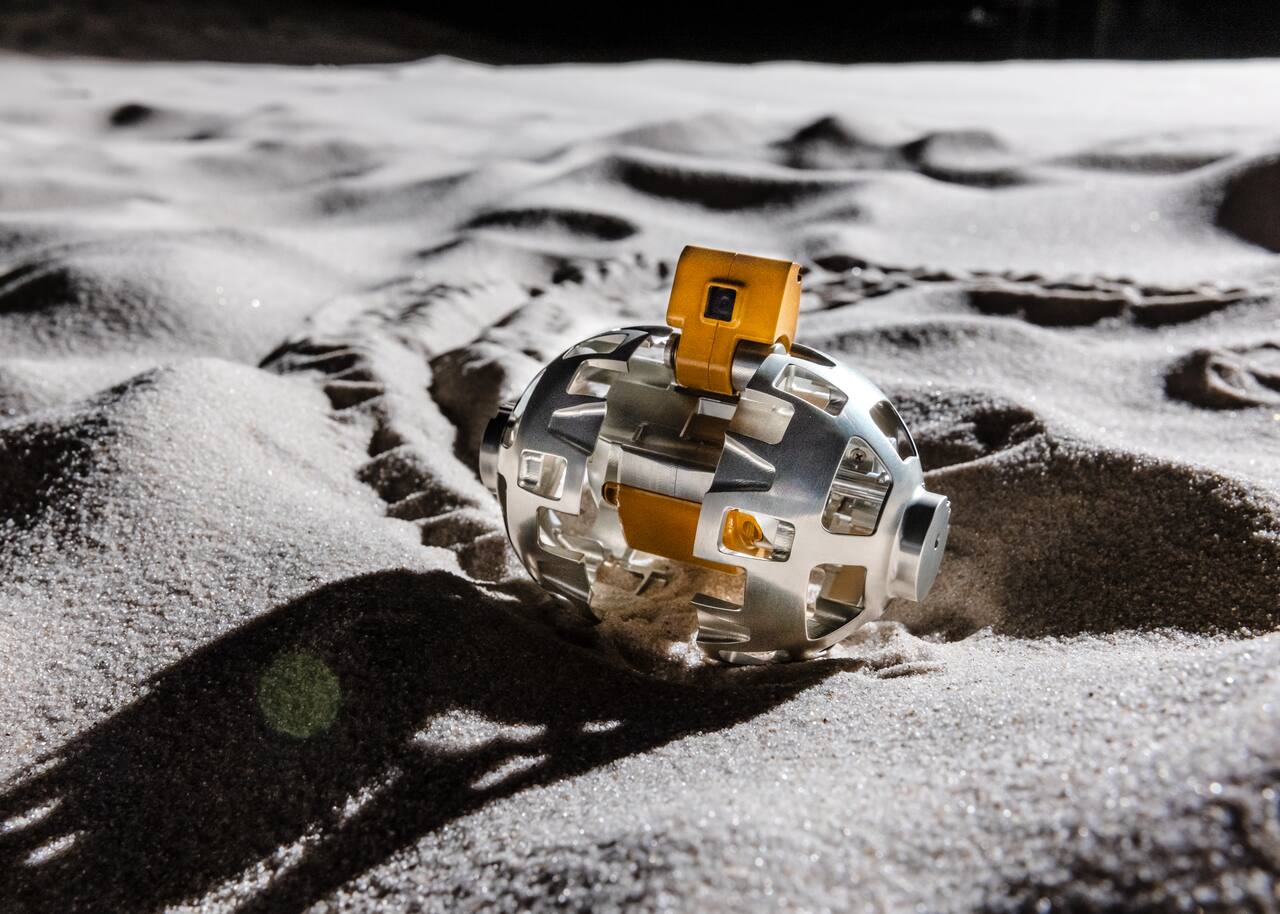
 JAXA / TOMY Company / Sony Group Corporation / Doshisha University.
The problem
Section titled “The problem”A rover carried by a precision lander gets the mass and volume left after legs, propulsion and guidance. SLIM landed by a deliberate two-step tip-over onto a main leg, a leg arrangement studied for stable touchdown in a two-step landing [8]. A vehicle of 80 mm diameter and about 228 g has to survive separation from that lander in free fall, fit a stowage volume with no room for a conventional chassis, drive on regolith with wheels a few centimeters across, and operate with no link to Earth of its own [1], [10].
The ground is loose: the top 15 cm of lunar regolith has a bulk density of about 1.50 g/cm3 [28]. A small wheel has little area to spread load, so sinkage drives the mobility design [1]. Wheel behavior also changes with gravity. In parabolic flight, drawbar pull to weight fell by 20 percent or more in lunar gravity at equal wheel load, so 1 g sand tests do not predict lunar sinkage directly [23].
What has flown
Section titled “What has flown”SORA-Q / LEV-2 (SLIM, 20 January 2024 JST). SORA-Q, formally Lunar Excursion Vehicle 2, was developed by JAXA, TOMY Company, Sony Group Corporation and Doshisha University [6]. TOMY answered the first request for proposals of the JAXA Space Exploration Innovation Hub in 2016 with the aim of an inexpensive insect-like robot built from consumer toy technology; Sony joined in 2019 for control boards and sensors and Doshisha University in 2021 for mechanism design [7]. The flight unit is an 80 mm sphere of about 228 g with two cameras [7], [10]. The ISAS account states that the LEV-M deployer released both rovers at about 00:19:50 JST, at the start of SLIM’s final free fall [9]. SLIM then touched down about 60 m east of its target and rested about 90 degrees from the planned posture after one of its two main engines lost most of its thrust [10]. Precision landing error was evaluated at 10 m or better [10].
On the surface the rover deployed from its sphere, righted itself, drove away from the lander taking images, selected frames onboard and sent them through LEV-1 with no ground command [6]. The first returned image, announced in January 2024, showed that the LEV-1 to LEV-2 link worked, that the transformation had occurred, and that the onboard algorithm had picked a frame with SLIM in view [5]. A rock common to the two returned images gives about 0.13 m of travel and about 180 degrees of rotation between them, and telemetry shows operation for at least about 108 minutes [6]. Anomaly detection and self-recovery functions acted autonomously during communication dropouts [6]. LEV-2’s behavior after release is partly inferred rather than observed [9].
LEV-1 (same mission). The 2.1 kg single-wheel hopper that relays LEV-2’s data hopped on the Moon six times by one JAXA account and seven by another [12], [9]. It transmitted for 1 hour 51 minutes from separation, and its onboard computer exceeded 70 degrees C [12]. JAXA describes the rover results only qualitatively in the peer reviewed landing paper [10].
MINERVA-II rovers (Ryugu, 2018). Each of the two is a disc of about 1.15 kg that hops by spinning and stopping a flywheel on one DC motor [14]. Rover 1A returned 609 images over 113 asteroid days and Rover 1B returned 39 before going silent after 10 days; hop distance could not be measured [14].
MASCOT (Hayabusa2, Ryugu). The 9.66 kg lander left its mothership with a release velocity of 4.94 +/- 1.7 cm/s (3 sigma) predicted for the flight model [16], then bounced and worked for 17 h 14 min [15]. Its hops were commanded from the ground, whereas SORA-Q’s imaging sequence was fully onboard [15], [6].
Surveyor 6 (1967). The one propulsive hop flown on the Moon before 2024 is the reference case for low-cost hopping mobility in a 2019 JPL briefing [17].
What is being tried now
Section titled “What is being tried now”Eccentric wheels and transformable stowage (flown on the Moon, ground tested before). The SORA-Q wheel rotates about a point 12 mm off the center of its hemispherical shell [1]. A motor aligns shaft protrusions with keyholes, a spring pushes the shafts out, and the head and tail stabilizer open passively, irreversibly [1]. Two gaits follow: a crawl averaging 24.4 mm/s and a butterfly motion averaging 21.6 mm/s on flat silica sand. Centric rotation left the rover fully entrenched after 20 wheel revolutions in that sand, while eccentric rotation climbed a 10 degree slope [1]. The tests ran at 1 g with a ground model of the flight design [1]. The flight image pair is the only on-Moon check [6].
Grouser design for light wheels (ground tested, flown on LEV-1). LEV-1’s single wheel used a 90-degree-tilted octagonal grouser selected with a resistive-force-theory model, validated in Tohoku silica sand No.5 and in discrete element simulation, then compared with lunar operation [30]. A separate single-wheel study of a grouser wheel from the Rashid rover design compared Toyoura standard sand with FJS-1 lunar simulant at slip ratios of 0 to 50 percent, on an Earth bench [22].
Predicting reduced-gravity mobility from 1 g tests (ground and parabolic flight). Two parabolic flight campaigns graded Earth-based prediction methods against lunar-gravity wheel data, and the equal cone index gradient method overstated mobility [23]. NASA’s mobility test practice for planetary rovers and tires is a recommendation set with no new measurements [29].
Consumer and commercial electronics (flown on the Moon). The control and image processing run on Sony’s Spresense processor board, a consumer IoT part, and JAXA frames the result as a demonstration of consumer devices in the space environment [5]. The release gives no radiation, thermal or vacuum qualification data [5].
Onboard image selection (flown on the Moon). A score built from the size and position of the detected lander rectangle favors frames showing the whole spacecraft and penalizes frames where it is too large or cut by the image edge; images are sent in descending score order [1]. The detector was tested only against a subscale lander model under a sun simulator [1].
Other hoppers and tumblers (flight pending or none). The Intuitive Machines Micro-Nova, called S. P. Hopper on IM-2, targets permanently shadowed terrain; the held descriptions are pre-flight [19], [18]. YAOKI is a small tumbling rover intended to be dropped into lunar caves [27]. A 1968 study designed a ballistic Lunar Hopping Transporter that was never built [35].
Small-body and polar rovers (in preparation). IDEFIX, the CNES/DLR rover for Phobos, is pre-flight [20], and its separation from the MMX mothership is analyzed in multibody simulation [21]. MoonRanger’s wheel module operated after thermal vacuum and vibration testing [26]. The Canadian Lunar Rover Mission is a planned micro-rover mission to the south polar region [25]. Coverage path planning for lunar micro-rovers fusing orbiter elevation and onboard LiDAR SLAM was simulated on an Apollo 14 elevation model and field tested on the CLOVER rover [24].
Legged and learned locomotion (simulation and bench only). A reaction-wheel bipedal hopper was simulated over seven hops on synthetic cratered terrain [31]. A tethered 3-DOF hopping leg with a custom gearbox hopped on a bench [33]. A reinforcement-learning controller for the Magnecko legged robot was tested in lunar gravity simulated by a constant-force spring offload [32], and a quadruped on granular lunar surface was analyzed in simulation [34]. None has flown.
The numbers
Section titled “The numbers”| Parameter | Value | Source |
|---|---|---|
| Stowed form | sphere, 80 mm diameter | [1], [7] |
| Mass, flight unit | 228 g | [7], [10] |
| Mass, design value in the mobility paper | 250 g | [1] |
| Deployed size | 123 x 136 x 90 mm | [1] |
| Wheel | 78 mm diameter, axis offset 12 mm | [1] |
| Drive | brushed DC motor, gear ratio 256, 109 mNm at the wheel axes | [1] |
| Battery | 6000 mWh, non-rechargeable, no solar cells | [1] |
| Design operating time | at least 2 h at -20 C | [1] |
| Cameras | two, one forward, one aft | [7] |
| Processor | Sony Spresense board | [5] |
| Link | short-range wireless to LEV-1, which relays to Earth | [9] |
| Crawl speed, silica sand, flat | 24.4 mm/s | [1] |
| Butterfly speed, silica sand, flat | 21.6 mm/s | [1] |
| Flight displacement between two images | about 0.13 m | [6] |
| Flight rotation between two images | about 180 degrees | [6] |
| Flight operating time | at least 108 min | [6] |
| Rover | Mass | Surface motion data | Source |
|---|---|---|---|
| SORA-Q | 228 g | 0.13 m and 180 degrees between two images | [10], [6] |
| LEV-1 | 2.1 kg | 6 or 7 hops, no distance published | [12], [9] |
| MINERVA-II 1A/1B | about 1.15 kg | hop distance not measurable | [14] |
| MASCOT | 9.66 kg | ground-commanded hops | [15] |
The battery, torque and operating-time figures are design values from the mobility paper, not flight measurements [1].
What is not established
Section titled “What is not established”The lunar mobility result rests on two images, both partly corrupted by dropouts. It shows that the rover moved but gives no traverse rate, slip, sinkage, obstacle capability or power data [6]. The flight analysis comes from a JAXA release, not from the Science Robotics paper [6]. The mobility paper reports no on-Moon performance and leaves comparison with ground tests to future work [1]. Its ground tests used silica sand at 1 g, one 10 degree slope and one campaign [1]. The two JAXA accounts of LEV-1’s hop count disagree [12], [9]. Spresense radiation and thermal qualification is not reported [5]. No flight thermal data for LEV-2 are published, and the -20 C figure is a ground design point [1]. Wheel performance on lunar gravity and simulants is known from bench and parabolic data on other wheels, not this one [22], [23].
References
- Hirano, D., Inazawa, M., Sutoh, M., Sawada, H., Kawai, Y., Nagata, M., Sakoda, G., Yoneda, Y. and Watanabe, K. (2024). Transformable Nano Rover for Space Exploration
. IEEE Robotics and Automation Letters, 4. Source
BibTeX
@article{hirano2024transformable, title = {Transformable Nano Rover for Space Exploration}, author = {Hirano, Daichi and Inazawa, Mariko and Sutoh, Masataku and Sawada, Hirotaka and Kawai, Yuta and Nagata, Masaharu and Sakoda, Gen and Yoneda, Yousuke and Watanabe, Kimitaka}, journal = {IEEE Robotics and Automation Letters}, volume = {9}, number = {4}, pages = {3139--3146}, year = {2024}, doi = {10.1109/lra.2024.3363529}, abstract = {This letter introduces a novel nano rover designed to transform its shape for efficient movement on lunar surfaces. The rover, resembling a compact ball, has a diameter of roughly 80 mm and a mass around 250 g. Its transformational mechanism allows for compactness during planetary transportation, with enhanced mobility achieved through the use of extendable wheels, a tail stabilizer, and cameras. To traverse soft terrains efficiently, the rover utilizes an eccentric wheel mechanism, offering two distinct movement modes based on wheel synchronization. This mechanism provides a locomotion velocity of 20 mm/s or more on a flat surface. Moreover, it features onboard image processing to detect spacecraft shielded by Multi-Layer Insulation (MLI) films, facilitating autonomous control and selective image transmission. This rover has been deployed in a real space mission, having been mounted on a lunar lander. This letter presents the design specifics of this transformable rover and results from field tests simulating lunar conditions. These tests affirmed the efficacy of the proposed motion mechanism and onboard image processing.} } - JAXA, TOMY Company, Sony Group Corporation and Doshisha University. (2024). Successful image capture and data transmission of the SLIM lander by the transformable lunar robot. jaxa.jp/press/2024/01/20240125-4_j.html
BibTeX
@misc{jaxa2024successful, title = {Successful image capture and data transmission of the SLIM lander by the transformable lunar robot}, author = {{JAXA} and {TOMY Company} and {Sony Group Corporation} and {Doshisha University}}, organization = {jaxa.jp}, year = {2024}, url = {https://www.jaxa.jp/press/2024/01/20240125-4_j.html} } - JAXA, TOMY Company, Sony Group Corporation and Doshisha University. (2026). Lunar demonstration results of the transformable lunar robot LEV-2 published in Science Robotics. jaxa.jp/press/2026/06/20260618-1_j.html
BibTeX
@misc{jaxa2026lunar, title = {Lunar demonstration results of the transformable lunar robot LEV-2 published in Science Robotics}, author = {{JAXA} and {TOMY Company} and {Sony Group Corporation} and {Doshisha University}}, organization = {jaxa.jp}, year = {2026}, url = {https://www.jaxa.jp/press/2026/06/20260618-1_j.html} } - (2026). JAXA Space Exploration Innovation Hub Center: The Transformable nano rover (Lunar Excursion Vehicle 2, SORA-Q). ihub-tansa.jaxa.jp/english/LEV2_en.html
BibTeX
@misc{jaxaihublev2, title = {JAXA Space Exploration Innovation Hub Center: The Transformable nano rover (Lunar Excursion Vehicle 2, SORA-Q)}, organization = {ihub-tansa.jaxa.jp}, year = {2026}, url = {https://www.ihub-tansa.jaxa.jp/english/LEV2_en.html} } - KAWANO, T., MARU, Y., OKUIZUMI, N., SAWAI, S. and NOHMI, M. (2020). Study of Leg Arrangement for Stable Touchdown during Two-Step Landing for SLIM
. Journal of Geophysical Research: Planets, 5. Source
BibTeX
@article{kawano2020study, title = {Study of Leg Arrangement for Stable Touchdown during Two-Step Landing for SLIM}, author = {KAWANO, Taro and MARU, Yusuke and OKUIZUMI, Nobukatsu and SAWAI, Shujiro and NOHMI, Masahiro}, journal = {Journal of Geophysical Research: Planets}, volume = {18}, number = {5}, pages = {222-230}, publisher = {Japan Society for Aeronautical and Space Sciences}, year = {2020}, doi = {10.2322/tastj.18.222} } - Otsuki, M. (2024). The companionable micro lunar exploration rovers LEV-1 and LEV-2
. ISAS News, 518. isas.jaxa.jp/feature/slim/slim_09.html
BibTeX
@misc{otsuki2024companionable, title = {The companionable micro lunar exploration rovers LEV-1 and LEV-2}, author = {Otsuki, Masatsugu}, journal = {ISAS News}, number = {518}, organization = {isas.jaxa.jp}, year = {2024}, url = {https://www.isas.jaxa.jp/feature/slim/slim_09.html} } - Sakai, S., Kushiki, K., Sawai, S., Fukuda, S., Miyazawa, Y., Ishida, T., Kariya, K., Ito, T., Ueda, S., Yokota, K., Kawano, T., Ohtake, M., Saiki, K., Nakauchi, Y., Michigami, K., Furukawa, K., Akizuki, Y., Kanaya, S., Kinjo, T., Goto, K., Sawada, K., Sugimoto, Y., Takeuchi, H., Tomiki, A., Toyota, H., Nagata, T., Nakatsuka, J., Maki, K., Mizuno, T., Shiratori, H., Nishino, M. N., Usami, N., Kikuchi, J., Hamori, H., Hirasawa, R., Shibasaki, Y. and Saito, H. (2025). Moon landing results of SLIM: A smart lander for investigating the Moon
. Acta Astronautica. Source
BibTeX
@article{sakai2025moon, title = {Moon landing results of SLIM: A smart lander for investigating the Moon}, author = {Sakai, Shinichiro and Kushiki, Kenichi and Sawai, Shujiro and Fukuda, Seisuke and Miyazawa, Yu and Ishida, Takayuki and Kariya, Kazuki and Ito, Takahiro and Ueda, Satoshi and Yokota, Kentaro and Kawano, Taro and Ohtake, Makiko and Saiki, Kazuto and Nakauchi, Yusuke and Michigami, Keisuke and Furukawa, Katsumi and Akizuki, Yuki and Kanaya, Shusaku and Kinjo, Tomihiro and Goto, Kenta and Sawada, Kenichiro and Sugimoto, Yoshihide and Takeuchi, Hiroshi and Tomiki, Atsushi and Toyota, Hiroyuki and Nagata, Taiichi and Nakatsuka, Junichi and Maki, Kenichiro and Mizuno, Takahide and Shiratori, Hirohide and Nishino, Masaki N. and Usami, Naoto and Kikuchi, Junji and Hamori, Hitoshi and Hirasawa, Ryo and Shibasaki, Yusuke and Saito, Hiroaki}, journal = {Acta Astronautica}, volume = {235}, pages = {47--54}, publisher = {Elsevier BV}, year = {2025}, doi = {10.1016/j.actaastro.2025.05.047}, abstract = {The Smart Lander for Investigating the Moon (SLIM), with a dry mass of about 200 kg, was launched by the H-IIA vehicle on September 7, 2023, and made a precision lunar landing on January 19, 2024 (Coordinated Universal Time). The landing precision was evaluated to be within ∼10 m at an altitude of approximately 50m from the Moon surface, far exceeding the target landing accuracy of 100 m and realizing the world’s first pinpoint landing, although a trouble occurred just before landing and one of the two main engines lost thrust. The two micro/nano rovers of the SLIM separated immediately before landing and successfully captured SLIM images in fully autonomous operation mode. The operation team also obtained spectroscopic observations of rocks from scientific instruments onboard the SLIM, which are expected to provide clues on the origin of the Moon. Although not designed to endure the harsh temperatures of the lunar day and night, the lander operated after three lunar nights, gathering various engineering data. This paper reports the results of the lunar landing operations of SLIM.} } - Yoshimitsu, T. (2024). LEV-1, the Ultra-Small Lunar Surface Exploration Rover Aboard SLIM: Flight Results. jaxa.jp/projects/files/youtube/ml_slim_lev1_lev2/jaxa_doc02_20240125.pdf
BibTeX
@misc{yoshimitsu2024lev1,
  title = {{LEV-1}, the Ultra-Small Lunar Surface Exploration Rover Aboard {SLIM}: Flight Results},
  author = {Yoshimitsu, Tetsuo},
  howpublished = {Presentation at the Japan Aerospace Exploration Agency, Institute of Space and Astronautical Science},
  year = {2024},
  url = {https://www.jaxa.jp/projects/files/youtube/ml_slim_lev1_lev2/jaxa_doc02_20240125.pdf}
}
Further reading
- (2026). ISAS: The micro lunar exploration rovers LEV-1 and LEV-2. isas.jaxa.jp/feature/slim/slim_09.html
- JAXA. (2024). Results and achievements of the Lunar Excursion Vehicle (LEV-1) on board the Smart Lander for Investigating Moon (SLIM). jaxa.jp/press/2024/01/20240125-2_j.html
- JAXA Institute of Space and Astronautical Science. (2024). Smart Lander for Investigating Moon (SLIM) project review press briefing. isas.jaxa.jp/en/topics/files/SLIM-press-briefing-20241226.pdf
- Sakai, S., Kushiki, K., Fukuda, S. and Sawai, S. (2026). Overview of the Small Lunar Lander SLIM and Its Lunar Landing Results . IEEJ Journal of Industry Applications. Source
- (2026). JAXA Space Exploration Innovation Hub Center: Transformable nano rover LEV-2 (SORA-Q). ihub-tansa.jaxa.jp/english/LEV2_en.html