Ingenuity
Program pages NASA: Ingenuity
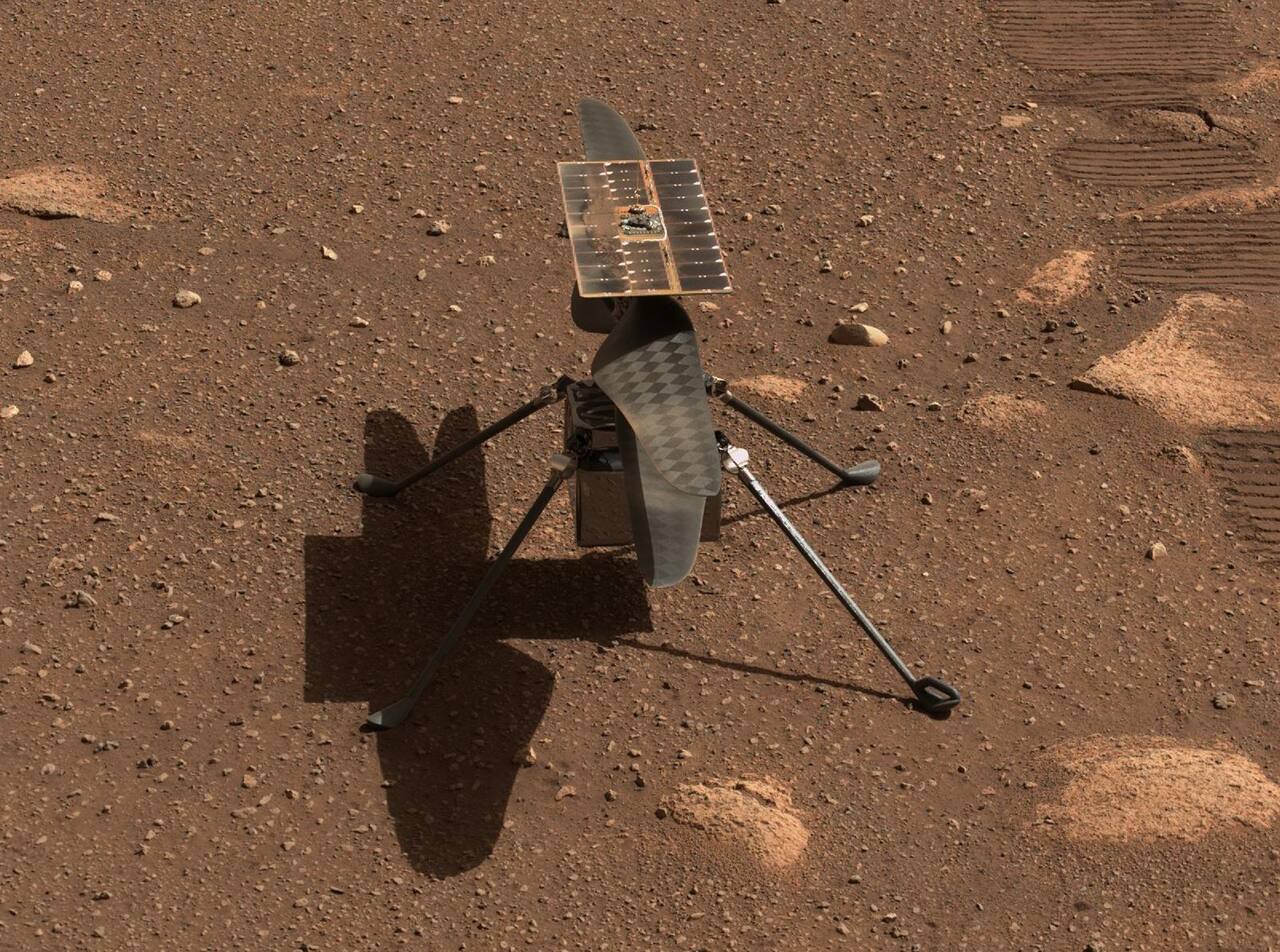 NASA/JPL-Caltech/ASU. Public domain (NASA / US government work).
The problem
Section titled “The problem”A rotorcraft on Mars lifts itself in an atmosphere averaging 0.0137 kg/m3 at flight altitude during Flights 68 and 69 [1]. The speed of sound caps rotor tip speed at a hover Mach number near 0.75 [1]. Light time rules out a pilot, so every flight runs autonomously from an uploaded plan. Mass is limited to the roughly 1.8 kg that a rover can carry on its belly [25]. Each constraint pushes the rotor toward high rpm, low blade Reynolds number and a stiff hub. Blade chord Reynolds numbers of order 1,000 to 10,000 sit far below terrestrial rotorcraft [8]. Aerodynamic damping at Mars density is so low that blade flapping modes are poorly damped, which led to a hingeless rotor stiff enough to move the flapping frequency away from resonant coupling [3]. A stiffer rotor raises hub moments and produces a pitch-heave instability that grows with advance ratio, so the vehicle relies on its feedback controller for stability [1].
What has flown
Section titled “What has flown”Ingenuity performed the first powered, controlled flight on another planet on 19 April 2021, against a design goal of no more than five flights [18]. The pre-flight plan was a 30-sol campaign, with a 90 s endurance and a 5 m/s wind limit as nominal values, not measurements [25]. The program reports 72 flights, 128.8 minutes aloft over 17.0 km, to a maximum altitude of 24.0 m, before operations ended in January 2024 [18]. That page is an outreach summary with rounded figures and no per-flight data, so the totals are not tied to a flight log here [18].
The technology demonstration and the first operations flights, through Flight 13 and 171 sols, are summarized by the project team with software updates, anomalies and performance of flight control, avionics, battery, solar array and thermal systems [3]. Its plotted quantities are given without uncertainty [3]. The flight control architecture those flights exercised was published before any Mars flight, as a split of guidance, navigation, control and mode command, so its figures are design values [22].
Flights 14 through 33 are the first year of open-ended operations alongside Perseverance [4]. Rotor speed was raised from 2537 to 2800 rpm to compensate for summer density loss, above anything tested on Earth, which moved flights from power-limited to motor-thermally-limited [4]. The six swashplate actuators twice failed their pre-flight self-test after dust ingress. On the night after sol 426 the vehicle exhausted its 42 Wh battery, fell below the 15 V load-shed threshold and lost its clock, then spent three nights at ambient Mars night temperature with no detectable hardware degradation [4]. A persistent 9 percent efficiency deficit on the lower rotor motor was not explained; retuning the commutation offset in flight found it already at optimum [4].
Release 8.0 of the flight software, in October 2022, added landing hazard detection and a digital elevation map in the navigation filter for the climb up the Jezero delta [5]. On the Flight 39 outbound leg Ingenuity missed the mid-waypoint by about 3 m, against a prior rule of thumb of up to 10 percent of flight distance, roughly 8 m [5]. The update also dropped landing-site packets silently, so Flight 42 did not divert, and Release 8.1 patched the flight computer.
Flights 68 and 69, in December 2023, were the first dedicated system identification flights of an aerial vehicle on another planet: frequency sweeps in the swashplate cyclic during out-and-back legs at 10 m/s commanded groundspeed in Neretva Vallis [1]. Above about 1 to 1.5 Hz the identified roll control derivative matched the pre-flight model within the Cramer-Rao bounds (8.4 and 8.6 identified against 8.0 and 8.6 modeled) [1]. Below crossover the identified angle-of-attack derivative was 0.96 to 1.52 against 0.15 to 0.45 modeled. The authors attribute this to wind fed back through the stabilizing controller, and the Joint-Input-Output method recovers about half of the discrepancy [1]. Airspeed reached 15 m/s with no instability or sustained control saturation, inferred from control effort because the vehicle carries no airspeed sensor [1].
Attitude telemetry also served as a wind instrument. Inverting the steady tilt into a wind vector gave the first Mars wind profile above 3 m, from seven flights [6]. Directions agree with the MEDA sensor at 1.5 m on Perseverance, but inferred speeds reached nearly 25 m/s on Flight 59 where mesoscale models allowed about 15 m/s [6]. For site context, the Curiosity REMS record at Gale crater shows a diurnal upslope and downslope pattern against which mesoscale models were compared [10].
What is being tried now
Section titled “What is being tried now”Ground testing of the flown design. The JPL Space Simulator (25-foot) is run at Mars density with CO2 at ambient Earth temperature, with an inverted swing-arm stand, optical motion tracking and gravity offload [3]. A full-scale prototype flew tethered there in May 2016 and reached sustained autonomous stable flight [3]. The hover thrust stand in the same chamber correlates RotCFD and CAMRAD II: in the design thrust coefficient band of 0.015 to 0.020 the codes and stand data agree, and outside it RotCFD predicts higher power [4]. No Mars flight data enters that correlation [4]. A proposal to fly a vacuum chamber on Mars-gravity parabolas targeted large attitude excursions and brownout that the cable-offloaded chamber cannot test. It was never built or flown, and its 26-second parabola is a simulation result [2].
Flight control and avionics analysis. A formal-methods analysis translated the published vision, navigation and control pipeline into a real-time dataflow graph with derived per-actor deadlines, using placeholder execution times chosen by the authors, so it illustrates a method and is not the flight schedule [13].
Low-Reynolds-number airfoils and rotors (ground test and computation, not flown). Airfoil studies compared the flown section against cambered and flat plate sections by two-dimensional CFD and free-wake analysis, with no wind tunnel data for the alternatives [8]. Force, pressure-sensitive paint and Schlieren measurements at Re = 20,000 and M = 0.60 in the Tohoku University Mars Wind Tunnel tested the flown CLF5605 section and the ROAMX roamx-0201 section [9]. Measured maximum lift-to-drag for roamx-0201 was about 11.6 at 6 degrees against 26.0 predicted by the optimization CFD, and two nominally identical models disagreed by about 15 percent with no wall corrections [9]. Full-scale ROAMX hover tests were run at Mars density in a vacuum chamber against Ingenuity-replica rotors; the replica blades match geometry but sat in a four-bladed hub at solidity 0.148, and Reynolds and Mach matching was done in air and not CO2 [11]. CAMRAD II sweeps of thrust-weighted solidity from 0.10 to 0.50 and blade count from two to eight recommend a rotor not near the flown one [14]. The tested ROAMX article was four-bladed at 0.167 solidity, not the six-bladed 0.25 optimum, so that optimum is computed and not measured [14]. A wind tunnel study of blade geometry in axial descent and vortex ring state used 152.4 mm rotors in sea-level air and water and supports nothing about Mars directly [15]. CAMRAD II aeroelastic stability predictions for the Ingenuity and Sample Recovery Helicopter rotors were stable at every analyzed density, tip Mach number and collective setting, with the vendor’s blade modal tests as the only experimental input [17].
Electrostatics (analysis only). Rotor charging was modeled for a low-pressure CO2 atmosphere [5]. Under an ambient dust load, charging and dissipation balance at roughly 10 kV/m with no breakdown; in the denser cloud the rotor lifts at takeoff and landing the balance moves to about 50 kV/m and breakdown near the vehicle becomes possible. No measurement enters the analysis, and the tribocharge transfer coefficient is uncertain by more than two orders of magnitude between competing models [5].
Successor vehicles (studies; none built as described). The Mars Science Helicopter study sized coaxial (about 18 kg) and hexacopter (17.7 kg) vehicles with a 2 kg payload folding into a 2.5 m aeroshell, using sizing and comprehensive-analysis tools only [7]. The Sample Recovery Helicopter grew to about 2.5 kg by adding four-wheel ground mobility and a sub-100 g arm able to lift 150 g sample tubes; its rotor trade tests are preliminary and the mission was not implemented as described [16]. Its guidance and navigation adaptation adds takeoff from the lander top deck and map-relative localization to a 35 cm landing-knowledge requirement, as requirements and design targets with no test result [23]. A pre-flight survey of Mars rotorcraft concepts proposed rover-assisted and rotorcraft-only missions, none built [12]. A five-sol joint rover and helicopter operations simulation at Rainbow Basin, California, in November 2023 found the helicopter acquired about 16 Gbit of science data against the rover’s 7 Gbit over a shared 1120 Mbit downlink; the budgets are exercise assumptions and the simulated helicopter is more capable than Ingenuity [24].
The numbers
Section titled “The numbers”| Parameter | Value | Source |
|---|---|---|
| Mass | 1.8 kg | [25] |
| Rotor | two-bladed, counter-rotating coaxial, hingeless, 1.2 m diameter | [1] |
| Rotor speed | 2537 raised to 2800 rpm, hover tip Mach about 0.75 | [4], [1] |
| Battery | 42 Wh | [4] |
| Planned campaign | 30 sols, up to five flights | [25] |
| Mission totals | 72 flights, 128.8 min, 17.0 km | [18] |
| Maximum altitude | 24.0 m | [18] |
| Waypoint miss, Flight 39 outbound leg | about 3 m against about 8 m rule of thumb | [5] |
| Identified roll control derivative, Flights 68 and 69 | 8.4 and 8.6 against 8.0 and 8.6 modeled | [1] |
| Maximum airspeed, inferred | 15 m/s | [1] |
| roamx-0201 maximum lift-to-drag, Re = 20,000 | about 11.6 measured, 26.0 predicted | [9] |
| Mars Science Helicopter concept mass | about 18 kg coaxial, 17.7 kg hexacopter | [7] |
What is not established
Section titled “What is not established”The flight record rests on a program summary without per-flight data [18]. The cause of the lower rotor motor efficiency deficit is unresolved [4]. Low-frequency lateral dynamics are not resolved between disturbance bias and modeling error, and roll damping and speed derivatives were held at modeled values [1]. Hover performance was correlated against ground data only, and forward-flight predictions are code to code [4]. The ROAMX performance gains are ground-test and computed results at Re = 20,000, not flown, and the airfoil data carries an unresolved 15 percent model scatter [9], [11]. The wind speeds from attitude data conflict with models and have not been checked by a second instrument above 1.5 m [6]. Charging breakdown near the rotor is unmeasured [5]. The Release 8.0 paper gives no processor cost for the added navigation capabilities [5].
References
- Aagren, T. S., Ruan, A. W., Malpica, C., Withrow-Maser, S. and Meyn, L. (2025). In-flight System Identification of the Ingenuity Mars Helicopter
. AIAA SCITECH Forum, 20240014856. Source
BibTeX
@inproceedings{aagren2025flight, title = {In-flight System Identification of the Ingenuity Mars Helicopter}, author = {Aagren, Tove S. and Ruan, Allen W. and Malpica, Carlos and Withrow-Maser, Shannah and Meyn, Larry}, booktitle = {AIAA SCITECH Forum}, number = {20240014856}, institution = {NASA}, year = {2025}, doi = {10.2514/6.2025-0007}, abstract = {The 68th and 69th flights of NASA’s Ingenuity Mars Helicopter marked the first dedicated system identification flights of an aerial vehicle on another planet. Chirp signals were injected into the swashplate cyclic controls for both legs of the two out-and-back flights. Frequency responses were computed from the flight data, using both the Direct Method (DM) and the Joint-Input-Output (JIO) approach, for the identification of stability and control derivatives in forward flight conditions. The resulting identified state-space models were compared against existing flight dynamics simulation models, showing excellent correlation in the higher frequency range. External disturbances were seen to introduce a bias in the identified lower frequency responses, which was partially mitigated using the JIO method. These findings will inform future modeling and flight testing efforts of Mars rotorcraft.} } - Afman, J. P., Feron, E. and Walker, M. (2019). A full scale atmospheric flight experimental research environment for the Mars helicopter
. arXiv preprint. Source
BibTeX
@article{afman2019full, title = {A full scale atmospheric flight experimental research environment for the Mars helicopter}, author = {Afman, J. Pablo and Feron, Eric and Walker, Mitchell}, journal = {arXiv preprint}, year = {2019}, url = {https://arxiv.org/abs/1910.09290} } - Balaram, J. (., Canham, T., Duncan, C., Golombek, M., Grip, H. F., Johnson, W., Maki, J., Quon, A., Stern, R. and Zhu, D. (2018). Mars Helicopter Technology Demonstrator
. AIAA Atmospheric Flight Mechanics Conference, AIAA 2018-0023. Source
BibTeX
@inproceedings{balaram2018marshelicopter, title = {Mars Helicopter Technology Demonstrator}, author = {Balaram, J. (Bob) and Canham, Timothy and Duncan, Courtney and Golombek, Matt and Grip, Håvard F. and Johnson, Wayne and Maki, Justin and Quon, Amelia and Stern, Ryan and Zhu, David}, booktitle = {AIAA Atmospheric Flight Mechanics Conference}, number = {AIAA 2018-0023}, publisher = {American Institute of Aeronautics and Astronautics}, address = {Kissimmee, Florida}, year = {2018}, doi = {10.2514/6.2018-0023} } - Dull, C., Wagner, L., Young, L. and Johnson, W. (2022). Hover and Forward Flight Performance Modeling of the Ingenuity Mars Helicopter
. Aeromechanics for Advanced Vertical Flight Technical Meeting, 20210026235. Source
BibTeX
@inproceedings{dull2022hover, title = {Hover and Forward Flight Performance Modeling of the Ingenuity Mars Helicopter}, author = {Dull, Cuyler and Wagner, Lauren and Young, Larry and Johnson, Wayne}, booktitle = {Aeromechanics for Advanced Vertical Flight Technical Meeting}, number = {20210026235}, institution = {NASA}, address = {San Jose, CA}, year = {2022}, url = {https://ntrs.nasa.gov/citations/20210026235}, abstract = {In 2015, NASA’s Jet Propulsion Laboratory partnered with Ames Research Center, Langley Research Center, and AeroVironment to develop Ingenuity, a small coaxial helicopter capable of flying within Mars’ unique atmospheric conditions. Ingenuity was successfully deployed from its protective shroud on the underside of the Mars 2020 Perseverance Rover and has flown 17 flights on Mars as of December 2021. A number of rotorcraft analysis tools were utilized, and a series of experimental tests were performed to ready Ingenuity for its launch with the Perseverance Rover in July 2020. In this paper, RotCFD, a Reynolds-averaged Navier-Stokes flow solver, is used to model Ingenuity in hover and forward flight for the purposes of validating tools to aid in the development of a future generation of Mars rotorcraft. The results from the RotCFD modeling are benchmarked against results from hover performance tests of the Ingenuity prototype in the 25-Foot Space Simulator at the Jet Propulsion Laboratory and are also compared to hover and forward flight predictions made by CAMRAD II, a well-known comprehensive rotorcraft analysis code. Surrogate performance models are trained to obtain a set of trimmed rotor settings for Ingenuity at different forward flight speeds, which are then used as inputs for the RotCFD forward flight simulations. Additionally, a study of the airframe-rotor interaction and a study of the aerodynamics of the individual airframe components of Ingenuity in forward flight are performed. Finally, to better understand performance predictions by RotCFD and CAMRAD II, a study is conducted on how sectional angles of attack in each code vary with radial station and azimuth. } } - Farrell, W. M., McLain, J. L., Marshall, J. R. and Wang, A. (2021). Will the Mars Helicopter Induce Local Martian Atmospheric Breakdown?
. The Planetary Science Journal. Source
BibTeX
@article{farrell2021will, title = {Will the Mars Helicopter Induce Local Martian Atmospheric Breakdown?}, author = {Farrell, W. M. and McLain, J. L. and Marshall, J. R. and Wang, A.}, journal = {The Planetary Science Journal}, volume = {2}, pages = {46}, year = {2021}, doi = {10.3847/psj/abe1c3}, abstract = {Abstract Any rotorcraft on Mars will fly in a low-pressure and dusty environment. It is well known that helicopters on Earth become highly charged due, in part, to triboelectric effects when flying in sandy conditions. We consider the possibility that the Mars Helicopter Scout (MHS), called Ingenuity, flying at Mars as part of the Mars 2020 Perseverance mission, will also become charged due to grain-rotor triboelectric interactions. Given the low Martian atmospheric pressure of ∼5 Torr, the tribocharge on the blade could become intense enough to stimulate gas breakdown near the surface of the rotorcraft. We modeled the grain–blade interaction as a line of current that forms along the blade edge in the region where grain–blade contacts are the greatest. This current then spreads throughout the connected quasi-conductive regions of the rotorcraft. Charge builds up on the craft, and the dissipative pathway to remove charge is back into the atmosphere. We find that for blade tribocharging currents that form in an ambient atmospheric dust load, system current balance and charge dissipation can be accomplished via the nominal atmospheric conductive currents. However, at takeoff and landing, the rotorcraft could be in a rotor-created particulate cloud, leading to local atmospheric electrical breakdown near the rotorcraft. We especially note that the atmospheric currents in the breakdown are not large enough to create any hazard to Ingenuity itself, but Ingenuity operations can be considered a unique experiment that provides a test of the electrical properties of the Martian near-surface atmosphere.} } - Jackson, B., Fenton, L., Brown, T., Munguira, A., Martinez, G., Newman, C., Viúdez-Moreiras, D., Golombek, M., Lorenz, R., Paton, M. D. and Conway, D. (2024). Profiling Near-Surface Winds on Mars Using Attitude Data from Mars 2020 Ingenuity
. The Planetary Science Journal. Source
BibTeX
@article{jackson2024profiling, title = {Profiling Near-Surface Winds on Mars Using Attitude Data from Mars 2020 Ingenuity}, author = {Jackson, Brian and Fenton, Lori and Brown, Travis and Munguira, Asier and Martinez, German and Newman, Claire and Viúdez-Moreiras, Daniel and Golombek, Matthew and Lorenz, Ralph and Paton, Mark D. and Conway, Dylan}, journal = {The Planetary Science Journal}, volume = {6}, pages = {21}, year = {2024}, doi = {10.3847/psj/ad8b41}, abstract = {Abstract We used attitude data from the Mars Ingenuity helicopter with a simple steady-state model to estimate wind speeds and directions at altitudes between 3 and 24 m, the first time winds at such altitudes have been probed on Mars. We compared our estimates to wind data from the meteorology package MEDA on board the Mars 2020 Perseverance rover and to predictions from meteorological models. Wind directions inferred from Ingenuity data agreed with the directions measured by MEDA, when the latter were available, but deviated from model-predicted directions by as much as 180° in some cases. The inferred wind speeds are often much higher than expected. For example, meteorological predictions suggest that Ingenuity should not have seen wind speeds above about 15 m s −1 during its 59th flight, but we inferred speeds reaching nearly 25 m s −1 . For flights during which we have MEDA data to compare to, inferred wind speeds imply friction velocities >1 m s −1 and roughness lengths >10 cm, which seem implausibly large. These results suggest that Ingenuity was probing winds sensitive to aerodynamic conditions hundreds of meters upwind instead of the conditions very near Mars 2020, but they may also reflect a need for updated boundary layer wind models. An improved model for Ingenuity’s aerodynamic response that includes the effects of transient winds may also modify our results. In any case, the work here provides a foundation for exploration of planetary boundary layers using drones and suggests important future avenues for research and development.} } - Johnson, W., Withrow-Maser, S., Young, L., Malpica, C., Koning, W. J. F., Kuang, W., Fehler, M., Tuano, A., Chan, A., Datta, A., Chi, C., Lumba, R., Escobar, D., Balaram, J., Tzanetos, T. and Grip, H. F. (2020). Mars Science Helicopter Conceptual Design
. ASCEND, NASA/TM-2020-220485. Source
BibTeX
@inproceedings{johnson2020mars, title = {Mars Science Helicopter Conceptual Design}, author = {Johnson, Wayne and Withrow-Maser, Shannah and Young, L. and Malpica, Carlos and Koning, Witold J. F. and Kuang, W. and Fehler, M. and Tuano, A. and Chan, Athena and Datta, A. and Chi, C. and Lumba, R. and Escobar, D. and Balaram, J. and Tzanetos, T. and Grip, H. F.}, booktitle = {ASCEND}, number = {NASA/TM-2020-220485}, institution = {NASA Ames Research Center}, year = {2020}, doi = {10.2514/6.2020-4029}, abstract = {Robotic planetary aerial vehicles increase the range of terrain that can be examined, compared to traditional landers and rovers, and have more near-surface capability than orbiters. Aerial mobility is a promising possibility for planetary exploration as it reduces the challenges that difficult obstacles pose to ground vehicles. The first use of a rotorcraft for a planetary mission will be in 2021, when the Ingenuity Mars helicopter technology demonstrator will be deployed via the Perseverance rover. NASA’s Jet Propulsion Laboratory and NASA Ames Research Center are exploring possibilities for a Mars Science Helicopter, a second-generation Mars rotorcraft with the capability of conducting science investigations independently of a lander or rover (although this type of vehicle could also be used to assist rovers or landers in future missions). Two, large rotorcraft configurations are described: a hexacopter and a co-axial helicopter with a payload in the range of two to three kilograms and an overall vehicle mass of approximately twenty kilograms. Additionally, advancements in technology over the course of the study are applied to a rotorcraft of the same size and form as Ingenuity. Initial estimates of weight and performance were based on the capabilities of Ingenuity. Rotorcraft designs for Mars are constrained by the dimensions of the aeroshell and lander for the trip to the planet, constraining maximum rotor dimensions and, hence, overall performance potential. The effects of airfoils designed specifically for the low Reynolds number and high Mach number inherent to operation on Mars were studied. Rotor structural designs were developed that met blade frequency and weight targets, subject to material stress limits. The final designs are representative of the vehicle configurations required for a large range of future missions and will require relatively minor adaptations once science tasks are chosen. These designs will be compared to Ingenuity to demonstrate technology advancements developed during the study.} } - Koning, W. J. F., Romander, E. A. and Johnson, W. (2018). Low Reynolds Number Airfoil Evaluation for the Mars Helicopter Rotor
. American Helicopter Society Annual Forum. Source
BibTeX
@inproceedings{koning2018low, title = {Low Reynolds Number Airfoil Evaluation for the Mars Helicopter Rotor}, author = {Koning, Witold J. F. and Romander, Ethan A. and Johnson, Wayne}, booktitle = {American Helicopter Society Annual Forum}, pages = {1-17}, publisher = {NASA Technical Reports Server}, year = {2018}, doi = {10.4050/f-0074-2018-12679}, abstract = {The present research provides a performance comparison between several low Reynolds number airfoil profiles for the Mars Helicopter. The low density of the Martian atmosphere and the relatively small Mars Helicopter rotor result in very low chord-based Reynolds number flows, Re𝒸 = O(10³ - 10⁴). At low Reynolds numbers, flat and cambered plates can out-perform conventional airfoils, making them of interest for the Mars Helicopter rotor. Performance models are generated for the Mars Helicopter rotor based on a free wake analysis, and the results are compared with Mars Helicopter isolated rotor performance from previous work. A Reynolds-Averaged Navier-Stokes based approach is used to generate the airfoil deck using OVERFLOW. The model is constructed using airfoil data tables (C81 files) that are used by the comprehensive rotor analysis code CAMRADII. Performance results for the Martian atmosphere show improved performance for the cambered plate rotor over conventional airfoils, in terms of thrust for equal power and Figure of Merit for equal blade loading. The cambered flat plate airfoil produces 7% larger maximum rotor thrust versus the Mars Helicopter airfoils, and 5% larger Figure of Merit over the design thrust coefficient range. Larger maximum thrust allows an increase of design blade loading for the same thrust range for control authority, whereas the larger Figure of Merit reduces power requirements.} } - Koning, W. J. F., Perez Perez, N., Cummings, H. V., Nagata, T., Kanzaki, Y., Kasai, M., Miyagi, M., Nonomura, T., Asai, K., Caros, L., Buxton, O. and Vincent, P. (2024). Experimental Results for Mars Rotorcraft Airfoils (roamx-0201 and clf5605) at Low Reynolds Number and Compressible Flow in a Mars Wind Tunnel
. NASA Ames Research Center, NASA/TM-20240004230. Source
BibTeX
@techreport{koning2024experimental, title = {Experimental Results for Mars Rotorcraft Airfoils (roamx-0201 and clf5605) at Low Reynolds Number and Compressible Flow in a Mars Wind Tunnel}, author = {Koning, Witold J. F. and Perez Perez, N. and Cummings, H. V. and Nagata, Taiichi and Kanzaki, Y. and Kasai, M. and Miyagi, M. and Nonomura, T. and Asai, K. and Caros, L. and Buxton, O. and Vincent, P.}, number = {NASA/TM-20240004230}, institution = {NASA Ames Research Center}, year = {2024}, url = {https://ntrs.nasa.gov/citations/20240004230}, abstract = {Experimental results are obtained for a roamx-0201 type airfoil and the clf5605 airfoil at highsubsonic, low Reynolds number conditions using the Tohoku University Mars Wind Tunnel, Japan. The tests are conducted at a Mach number of M = 0.60, and a Reynolds number of Re = 20,000 to reflect representative aerodynamics of a rotor blade for Mars exploration. The angle of attack is varied between α = −2.0 deg and α = 6.0 deg. The roamx-0201 type airfoil is an unconventional airfoil optimized for the chosen tunnel operating conditions using the Evolutionary aLgorithm for Iterative Studies of Aeromechanics (ELISA), developed under the Rotor Optimization for the Advancement of Mars eXploration (ROAMX) project. ELISA is utilized here to optimize aerodynamic airfoil performance using a Genetic Algorithm and two-dimensional high-fidelity CFD simulations, ultimately resulting in a Pareto-optimal airfoil set. The clf5605 airfoil is the outboard airfoil used on the Ingenuity Mars Helicopter and provides a baseline against which the roamx-0201, as well as possible future airfoil profiles for the compressible low Reynolds number regime, can be compared against. Lift and drag data are recorded using a balance, pressure distributions are obtained using Pressure Sensitive Paint (PSP) application, and Schlieren images are obtained to visualize the flowfield. The data is tabulated to aid future research.} } - Newman, C. E., Gómez-Elvira, J., Marin, M., Navarro, S., Torres, J., Richardson, M. I., Battalio, J. M., Guzewich, S. D., Sullivan, R., de la Torre, M., Vasavada, A. R. and Bridges, N. T. (2017). Winds Measured by the Rover Environmental Monitoring Station (REMS) during the Mars Science Laboratory (MSL) Rover's Bagnold Dunes Campaign and Comparison with Numerical Modeling using MarsWRF
. Icarus. Source
BibTeX
@article{newman2017winds, title = {Winds Measured by the Rover Environmental Monitoring Station (REMS) during the Mars Science Laboratory (MSL) Rover's Bagnold Dunes Campaign and Comparison with Numerical Modeling using MarsWRF}, author = {Newman, Claire E. and Gómez-Elvira, Javier and Marin, Mercedes and Navarro, Sara and Torres, Josefina and Richardson, Mark I. and Battalio, J. Michael and Guzewich, Scott D. and Sullivan, Robert and de la Torre, Manuel and Vasavada, Ashwin R. and Bridges, Nathan T.}, journal = {Icarus}, volume = {291}, pages = {203-231}, year = {2017}, doi = {10.1016/j.icarus.2016.12.016} } - Perez Perez, B. N., Cummings, H. V., Koning, W. J. F., Haddad, F. B., Romander, E. A., Johnson, W., Datta, A., Nagata, T., Asai, K., Nonomura, T., Caros Roca, L., Buxton, O. and Vincent, P. (2025). Novel Guidelines and Designs for Airfoils and Helicopter Blades for Mars Applications With Experimental Validation
. AIAA Sci Tech Forum. Source
BibTeX
@inproceedings{perezperez2025novel, title = {Novel Guidelines and Designs for Airfoils and Helicopter Blades for Mars Applications With Experimental Validation}, author = {Perez Perez, B. N. and Cummings, H. V. and Koning, Witold J. F. and Haddad, F. B. and Romander, Ethan A. and Johnson, Wayne and Datta, A. and Nagata, Taiichi and Asai, K. and Nonomura, T. and Caros Roca, L. and Buxton, O. and Vincent, P.}, booktitle = {AIAA Sci Tech Forum}, institution = {NASA Ames Research Center}, address = {Orlando, Florida}, year = {2025}, url = {https://ntrs.nasa.gov/citations/20250010782}, abstract = {The Rotor Optimization for the Advancement of Mars eXploration (ROAMX) project advances the design and validation of airfoils and blades for next-generation Mars rotorcraft. A comprehensive computational modeling and experimental campaign was conducted to address the unique low-density flight environment of Mars. An airfoil and rotor modeling and optimization framework tailored to Mars Reynolds and Mach number regimes was developed and applied to generate a portfolio of candidate geometries. A novel lift-generation mechanism was identified and experimentally validated, broadening the design space for airfoil and rotor performance. Airfoil performance was rigorously assessed through a combination of wind tunnel testing and high-fidelity computational fluid dynamics simulations under Mars representative flow conditions. Airfoil optimization resulted in airfoils that had a 25% increase in coefficient lift to drag ratio at the 75% radial station, compared to the clf5605 baseline airfoil (Ingenuity Mars Helicopter). A structural design methodology for Mars rotor blades was established and the strength of the rotor blades was verified via static pull testing at 110% of the centrifugal force experienced at a tip Mach number of 0.95. Facility enhancements at NASA Ames further expanded Mars rotorcraft testing capabilities, including the development of a state-of-the-art hover stand capable of high-accuracy performance measurements at very low pressure. Collectively, these efforts culminated in the demonstration of optimized rotor performance at Mars flight conditions, providing validated design tools, test infrastructure, and performance data to support future scientific and exploration rotorcraft missions on Mars. The full-scale ROAMX optimized rotor was tested and achieved a 29% increase in peak Figure of Merit, compared to the Ingenuity helicopter rotor, at the design density.} } - Radotich, M., Withrow-Maser, S., deSouza, Z., Gelhar, S. and Gallagher, H. (2021). A Study of Past, Present, and Future Mars Rotorcraft
. Biennial Autonomous VTOL Technical Meeting, 20210000448. Source
BibTeX
@inproceedings{radotich2021study, title = {A Study of Past, Present, and Future Mars Rotorcraft}, author = {Radotich, Michael and Withrow-Maser, Shannah and deSouza, Zarya and Gelhar, Sophie and Gallagher, Henry}, booktitle = {Biennial Autonomous VTOL Technical Meeting}, number = {20210000448}, institution = {NASA}, year = {2021}, url = {https://ntrs.nasa.gov/citations/20210000448}, abstract = {Interest in utilizing rotorcraft to explore Mars is expected to increase following the anticipated successful technical demonstration of the Mars Helicopter, Ingenuity, during the Mars 2020 mission. Previously, science investigations have been limited by either the instrumentation resolution on orbiters or the roughness/accessibility of terrain a rover can traverse. Rotorcraft can enable low-altitude flight over and on-surface exploration at previously inaccessible locations. This paper describes potential mission concepts designed to utilize the unique capabilities of rotorcraft to advance the science performed in extraterrestrial environments. This includes missions tailored for investigating if Mars ever supported life, understanding climate processes and history, determining the evolution of Martian geology, and preparing for human exploration. The Mars rotorcraft mission concepts described in this paper can be divided into two categories: rover-assisted missions and independent (rotorcraft-only) missions. A number of concept vehicles, consistent with these proposed missions, are also discussed.} } - Roumage, G., Azaiez, S., Faure, C. and Louise, S. (2025). The Ingenuity Mars Helicopter Specified and Analyzed with the Real-time Mode-aware Dataflow Model
. arXiv preprint. Source
BibTeX
@article{roumage2025ingenuity, title = {The Ingenuity Mars Helicopter Specified and Analyzed with the Real-time Mode-aware Dataflow Model}, author = {Roumage, Guillaume and Azaiez, Selma and Faure, Cyril and Louise, Stéphane}, journal = {arXiv preprint}, year = {2025}, doi = {10.32388/zn8rvc}, abstract = {Ingenuity is an autonomous Cyber-Pysical System (CPS) that has successfully completed more than 70 flights over Mars between 2021 and 2024. Ensuring the safety of its mission is paramount, as any failure could result in catastrophic economic damage and significant financial losses. Dataflow Models of Computation and Communication (DF MoCCs) serve as a formal framework for specifying and analyzing the timing behavior of such CPSs. In particular, the Real-time Mode-aware Dataflow (RMDF) model is highly suitable to specify and analyze real-time and mode-dependent CPSs like Ingenuity. This paper showcases the application of RMDF for the specification and analysis of Ingenuity. We propose a dataflow specification of Ingenuity, analyze its timing behavior, and provide a feasibility test. Finally, we proposed a plausible explanation of the timing anomaly that occurred during the sixth flight of Ingenuity.} } - Sahragard-Monfared, G., Bowman, J., Koning, W. J. F. and Johnson, W. (2025). Effects of Solidity, Number of Blades, and Chord Distribution on Rotor Performance in a Martian Environment
. Vertical Flight Society Annual Forum and Technology Display. Source
BibTeX
@inproceedings{sahragardmonfared2025effects, title = {Effects of Solidity, Number of Blades, and Chord Distribution on Rotor Performance in a Martian Environment}, author = {Sahragard-Monfared, Gianmarco and Bowman, Joshua and Koning, Witold J. F. and Johnson, Wayne}, booktitle = {Vertical Flight Society Annual Forum and Technology Display}, pages = {1-8}, institution = {NASA Ames Research Center}, year = {2025}, doi = {10.4050/f-0081-2025-0354}, abstract = {Rotor performance in a Martian environment was analyzed with an objective of increasing thrust with minimal impact on efficiency. The Sample Recovery Helicopter (SRH) and Rotorcraft Optimization for the Advancement of Mars Exploration (ROAMX) rotors were studied by varying solidity, blade count, and chord distribution to determine which configuration delivered the most desirable performance. For all configurations, the ROAMX rotor displayed better performance than the SRH rotor. It was observed that increasing solidity reduced the blade loading required to achieve the peak figure of merit, and beyond a solidity ratio of 0.3 the figure of merit was negatively impacted. For both rotors a 6-bladed configuration with a solidity ratio of 0.3 delivered the optimal figure of merit.} } - Veismann, M., Yos, D. and Gharib, M. (2022). Parametric Study of Small-Scale Rotors in Axial Descent
. Physics of Fluids, 3. Source
BibTeX
@article{veismann2022parametric, title = {Parametric Study of Small-Scale Rotors in Axial Descent}, author = {Veismann, Marcel and Yos, Daniel and Gharib, Morteza}, journal = {Physics of Fluids}, volume = {34}, number = {3}, pages = {035124}, year = {2022}, doi = {10.1063/5.0083761}, abstract = {Despite extensive research in multirotor aerodynamics in the recent past, axial descent, specifically the vortex ring state, still poses great challenges for multirotor configurations as this flight stage is typically accompanied by severe losses in rotor thrust and strong thrust fluctuations. This paper presents a parametric study to investigate the influence of relevant geometric parameters of a small-scale rotor blade on the rotor performance in axial descent. Design variables subject to variation were the collective pitch, chord length, taper ratio, number of blades, as well as the tip geometry. Custom rotors for each parameter modification were manufactured and experimentally evaluated in wind tunnel tests with mean thrust recordings and measurements of the thrust fluctuations serving as performance metrics. Results indicated that rotor blades with larger aspect ratio and higher blade loading coefficient are less affected by the adverse aerodynamics in the vortex ring state, experiencing lower thrust losses and vibrational loads. Particle image velocimetry flow visualization confirmed that the aerodynamic losses in the vortex ring state can be attributed to blade vortex interactions. Comparison of the rotor flow structure in hover of all investigated rotor designs suggested that improvements in the descent performance of a rotor stem from a combination of reduced tip vortex strength and increased axial tip vortex convection rate. Using the experimental findings of this study, a predictive model for approximating the maximum extent of mean thrust losses in axial descent for a given blade geometry and hover thrust coefficient could be established.} } - Withrow-Maser, S., Johnson, W., Tzanetos, T., Grip, H., Koning, W., Schatzman, N., Young, L., Chan, A., Ruan, A., Cummings, H., Allan, B., Malpica, C., Meyn, L., Pipenberg, B. and Keennon, M. (2023). Mars Sample Recovery Helicopter: Rotorcraft to Retrieve the First Samples from the Martian Surface
. Vertical Flight Society Annual Forum and Technology Display, 20230005247. Source
BibTeX
@inproceedings{withrowmaser2023mars, title = {Mars Sample Recovery Helicopter: Rotorcraft to Retrieve the First Samples from the Martian Surface}, author = {Withrow-Maser, Shannah and Johnson, Wayne and Tzanetos, Theodore and Grip, Havard and Koning, Witold and Schatzman, Natasha and Young, Larry and Chan, Athena and Ruan, Allen and Cummings, Haley and Allan, Brian and Malpica, Carlos and Meyn, Larry and Pipenberg, Benjamin and Keennon, Matthew}, booktitle = {Vertical Flight Society Annual Forum and Technology Display}, number = {20230005247}, pages = {1-8}, institution = {NASA Ames Research Center and Jet Propulsion Laboratory}, year = {2023}, doi = {10.4050/f-0079-2023-17969}, abstract = {The Mars Sample Return Mission (MSR) will carry the next set of Mars helicopters, Sample Recovery Helicopters (SRHs), to the Martian surface. After successfully demonstrating extraterrestrial flight in 2021, Ingenuity has acted as a} } - Wright, S. J., Sahragard-Monfared, G., Schatzman, N. L., Johnson, W., Ridland, P. and Fillman, M. (2024). Comprehensive Analysis Aeroelastic Stability Predictions for the Mars Sample Recovery Helicopters and Ingenuity
. Decennial VFS Aeromechanics Specialists Conference, 20240000647. Source
BibTeX
@inproceedings{wright2024comprehensive, title = {Comprehensive Analysis Aeroelastic Stability Predictions for the Mars Sample Recovery Helicopters and Ingenuity}, author = {Wright, Stephen J. and Sahragard-Monfared, Gianmarco and Schatzman, Natasha L. and Johnson, Wayne and Ridland, Paulina and Fillman, Michael}, booktitle = {Decennial VFS Aeromechanics Specialists Conference}, number = {20240000647}, pages = {1-19}, institution = {NASA}, year = {2024}, doi = {10.4050/sm-2024-tvf-5074}, abstract = {A rotorcraft comprehensive analysis was used to generate aeroelastic stability predictions for both Ingenuity and the Mars Sample Recovery Helicopters. The analysis was performed multiple times for each rotor system with sequential increases to the level of modeling complexity. Initial cases used an independent blade analysis, trim inflow distribution, no airframe degrees of freedom, and a hover condition (a time-invariant problem). The final model used all blades, dynamic inflow, airframe rigid body degrees of freedom, and a Floquet theory approach to the flutter analysis. The approach of sequentially increasing modeling complexity was employed to ensure the causes of any observed instabilities could be identified. For each case, stability results were determined across a range of air densities, tip Mach numbers, and rotor collective pitch settings. For the Sample Recovery Helicopter, a forward flight condition analysis with the highest level of modeling complexity was also performed. The aeroelastic stability predictions showed both the Ingenuity and Sample Recovery Helicopter rotor systems to be stable for all analyzed conditions. Parameter excursions of structural properties were performed to explore conditions resulting in aeroelastic instabilities.} } - (2024). NASA: Ingenuity. science.nasa.gov/mission/mars-2020-perseverance/ingenuity-mars-helico...
BibTeX
@misc{nasaingenuity,
  title = {NASA: Ingenuity},
  organization = {science.nasa.gov},
  year = {2024},
  url = {https://science.nasa.gov/mission/mars-2020-perseverance/ingenuity-mars-helicopter/}
}