Hayabusa2 Landers
Program pages DLR: MASCOT JAXA: Hayabusa2
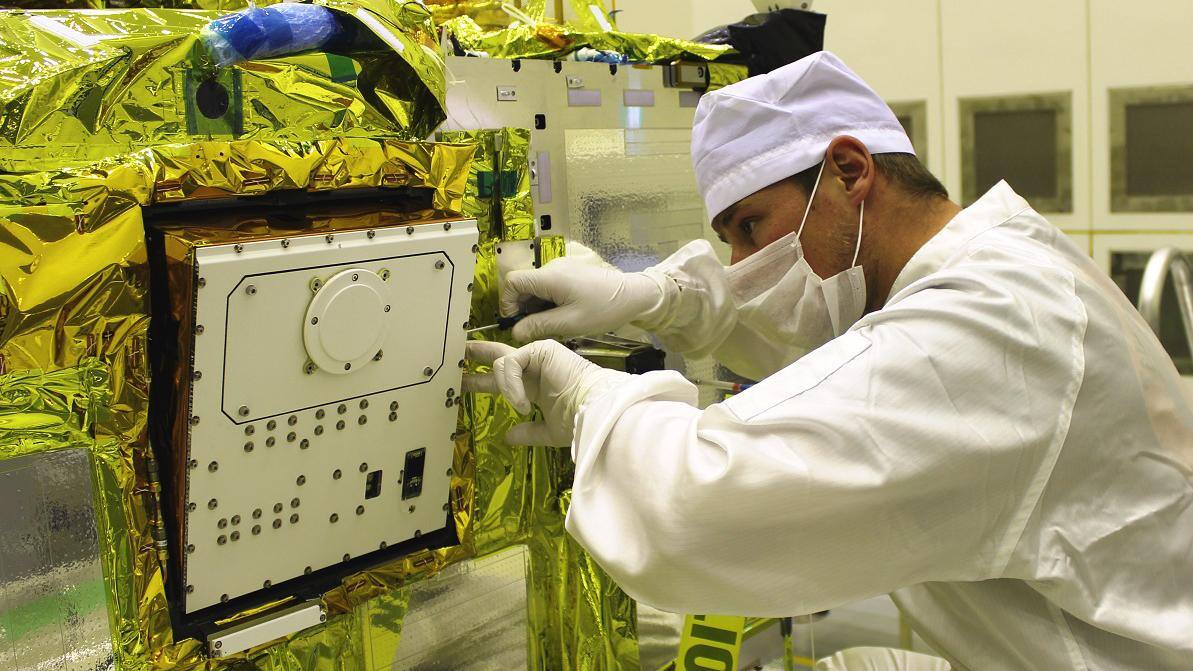 DLR, Creative Commons Attribution license.
The problem
Section titled “The problem”Hayabusa2 released three small surface vehicles at asteroid 162173 Ryugu in 2018: the twin MINERVA-II1 rovers Rover-1A and Rover-1B, built at JAXA/ISAS, and MASCOT, built by DLR with CNES [1][13]. All three are hoppers. MINERVA-II is the program name, successor to the single MINERVA carried by Hayabusa, whose release is dated 12 November 2005 [38]. MINERVA-II1 is the container holding Rover-1A and Rover-1B.
The task is to move and measure on a surface where weight is almost absent. Ryugu is a spinning-top rubble pile with an equatorial radius of 502 +/- 2 m, a bulk density of 1.19 +/- 0.02 g/cm3 and a total porosity above 50 percent [21]. Surface gravity is about 1e-4 m/s2 and escape velocity about 35 cm/s [1]. A vehicle that pushes off too hard does not come back, and one that relies on wheel traction has almost no normal force to work with. The weight of a 1 kg rover at 1e-4 m/s2 is of order 0.1 mN, so the flown vehicles react internally instead [1]. Cohesion between surface grains exceeds grain weight over the size range that dominates asteroid regolith, so regolith behaves more like a cohesive powder than a cohesionless sand [7].
Before arrival the surface was expected to be finer than it is. The pre-encounter consensus put thermal inertia at 150 to 300 J/m2/K/s^0.5 and bulk density at 1100 to 1500 kg/m3, and inferred particle size from a granular conductivity model, with the authors noting that particle size and porosity trade against each other [3]. Hayabusa had already shown on Itokawa a boulder-covered rubble pile with a density of 1.9 +/- 0.13 g/cm3, an appearance the authors called completely unexpected [31]. The MASCOT camera then found rocks from decimeters to tens of meters and essentially no fine dust [15][20]. A hop lands on a boulder field, not a fine deposit, and a landing is a sequence of bounces.
What has flown
Section titled “What has flown”MINERVA-II1 (Rover-1A and 1B), September 2018. Separation was on 21 September 2018 from about 50 m altitude, with the spacecraft translating so its own motion canceled the separation velocity [1]. Each rover is 18 cm in diameter and 7 cm high, at 1151 g and 1129 g, with one motor and flywheel for hopping, 2 W of body-mounted solar power, three electric double layer capacitors in series, a 44 MHz processor with no floating point unit and a 32 kbps link to the spacecraft relay [1]. The friction the hop depends on is uncertain at this gravity, because grain cohesion rather than weight sets the shear response [7]. Hop timing is the only flight measure: the Rover-1A hop of 22 September had a flight time of 1024 +/- 7.5 s from the gyro history, but the authors state that hop distance cannot be measured on these rovers, so the 25 to 50 m range rests on an assumed 6 to 8 cm/s initial speed and an assumed 30 to 45 degree hop angle, and Rover-1B hopped on 23 September, imaged the asteroid six times in flight and returned to the surface 24 minutes later [1]. Rover-1A returned 609 images and communicated for 113 asteroid days, to 26 October 2018; Rover-1B was last heard on 24 September after returning 39 images, and the cause of loss is not established for either rover; the 80 C protection function never triggered, and the highest instrument temperature recorded was 45 C on 16 October 2018 [1].
MASCOT, 3 October 2018. MASCOT is a 9.8 kg lander, 0.275 x 0.290 x 0.195 m, with a CFRP-foam sandwich structure whose face sheets are 0.125 mm thick and four instruments of about 3 kg in total [13]. Release was at about 41 m with a speed of 6.1 and 6.0 +/- 1.5 cm/s in two flight reconstructions, against 4.94 +/- 1.7 cm/s (3 sigma) in drop tower tests [12]. Free fall lasted 5 min 51 s and first contact was at 17.0 cm/s against a shadowed boulder, followed by a slide and four further bounces over 18.64 m horizontal that settled 15 min 37 s after first contact [14]. MASCOT then righted itself, hopped 70 cm, made a 3.6 cm mini-move and an 11.6 cm relocation to reach four measurement points over 17 h 14 min of surface operations [14]. The recorded bounce sequence gives a total coefficient of restitution near 0.29, against 0.6 assumed in pre-landing flight dynamics; the authors call it a rough estimate that assumes constant restitution, a planar surface and a ballistic model [14]. Position and attitude at each measurement point were reconstructed afterward by stereo photogrammetry of camera images, with about 0.5 cm accuracy in the foreground at 20 cm [22].
Hayabusa MINERVA, 2005. The first asteroid-surface rover release preceded both vehicles; the held record dates it 12 November 2005 [38]. Hayabusa had imaged Itokawa as a boulder-covered rubble pile [31].
Philae on the comet, November 2014. Philae was not an asteroid lander but is the other flown low-gravity touchdown [24]. Both hold-down systems failed, the harpoons did not fire and the cold gas thruster did not work, so the lander touched down at 1.01 m/s and rebounded at 0.325 m/s, bouncing from 15:34 to 17:31 UTC [24]. The second touchdown site was a crevice between boulders where the lander cut a 0.246 m deep impression into primitive ice [25]. A review covers the instrument results that survived a truncated first science sequence [26]. A soft granular layer of about 1 kPa strength was inferred at Agilkia from landing gear data, under an assumed homogeneous soil [24].
OSIRIS-REx contact at Bennu, 2020. OSIRIS-REx chose touch-and-go so that no attitude or position has to be held against a surface with negligible gravity [36]. The contact at about 10 cm/s reached 5.95 to 6.91 cm depth under only 10 to 15 N of resisting force, which implies a near-subsurface bulk density of 440 to 600 kg/m3 as a model-derived value [23].
Design choices that converged
Section titled “Design choices that converged”The flown hoppers use a single actuator for several jobs. MINERVA-II1 accelerates a flywheel while the rover rests on the surface: the force between rover and surface is offset from the center of mass, friction converts part of the reaction torque into lateral force, and a larger normal force gives a faster hop. Firing the motor in free flight only changes attitude [1]. MASCOT uses one 25 mm brushless motor with a harmonic drive delivering 3 N m, swinging an arm mounted off the center of mass, and the same mechanism hops and rights the lander, which matters because the instruments face one way [13]. Neither vehicle has attitude control in flight [1][13].
MINERVA-II1 cannot localize itself. The processor cannot evaluate imagery to determine rover state, so state estimation runs on photodiodes and the gyro: a rover at rest has near-zero angular rate and constant photodiode signals, and one in ballistic flight tumbles. Only at rest does the rover fire the motor, image in stereo and measure surface temperature. Onboard screening rejects black, white-out and featureless frames from the luminance histogram, and because software JPEG compression takes 6 to 7 minutes per image the initial configuration sends uncompressed frames [1]. The rovers work in daylight only: capacitors charge after sunrise and the computer stops when the power balance goes negative in the evening.
MASCOT determines orientation on the ground with five optical proximity sensors and six photoelectric cells fused by a histogram filter. Arm trajectories are optimized offline in the TOMATO framework and uploaded as three intensity levels for six possible resting orientations. Bearings use stainless rings, PEEK cages and ceramic balls with MoS2 and Dicronite DL-5 lubrication chosen for a four-year cruise in which the motor moved only at health checks [13]. The separation mechanism weighs under 290 g and ejects the 9.66 kg lander with a two-stage preload release and spring push-off [12].
MASCOT measurements
Section titled “MASCOT measurements”MARA is a six-channel thermal infrared radiometer viewing about 10 to 15 cm2 of one boulder [4][20]. It measured a full day-night cycle on 3 October 2018, with surface temperature from 205 K at night to 302 K at local noon [20]. The first analysis gave a porosity of 28 to 55 percent and a tensile strength of 200 to 280 kPa; emissivity ratios across the narrow bands match the most aqueously altered CI, CM and CR chondrites, and no masking dust layer is present [20][4]. The later work favors porosity near 0.50 +/- 0.02 with a grain density of 2848 +/- 152 kg/m3 [2]. The final analysis gives 46.7 percent, while other analyses of the same data give 0.28 to 0.55, 0.30 to 0.52 and 0.46 to 0.56, so the narrow stated uncertainty is model precision rather than measurement accuracy [4].
MasCam images show brighter smooth boulders and darker cauliflower-textured ones, and no accumulation of fine dust. Night images under LED illumination resolve sub-millimeter bright inclusions in a dark matrix [15]. The returned samples contain none of those inclusions, which prompted the orbital check that found the landing site close to the Ryugu average, with a local thermal inertia of 180 (+65/-40) J/m2/K/s^0.5 against a global 225 +/- 45 [6].
MasMag is a triaxial fluxgate magnetometer of 89 g sensor mass and 180 g electronics, 0.5 W, with a range of +/- 12,000 nT, 2 pT resolution and noise below 15 pT/sqrt(Hz) at 1 Hz [5]. Having no boom, its main design effort was magnetic cleanliness: a reversed magnet in the arm cut its field at the sensor from several thousand nT to 50 to 100 nT, and demagnetizing the battery cut its dipole moment from above 430 mAm2 to about 5 mAm2 [5]. The integrated lander still left a DC bias near 2500 nT that varied with arm position and cryocooler operation. In flight the descent profile showed no magnetic signal above a +/- 1 nT background down to about 10 cm from the surface, so the magnetic result is an upper limit [2].
Surface strength and extended mission
Section titled “Surface strength and extended mission”The Small Carry-on Impactor left a crater of apparent diameter 14.5 m [37], reproduced numerically with a target cohesion near 0.05 Pa and an upper bound near 0.5 Pa [8]. The finite element analysis of the arrival data gave 4 Pa cohesive strength as an inference, not a measurement [21]. The grain-scale view comes from Itokawa particles returned by Hayabusa, whose reduced Young’s modulus is 82 to 111 GPa from three micron-sized particles [32].
Supporting instruments were characterized separately. The optical navigation camera needed multi-band registration across its filter set [9]. The TIR thermal imager was calibrated before launch under atmospheric, not vacuum, conditions, and the paper states the curve must be rebuilt from vacuum data [11]. In-flight camera calibration over 6.5 years found degradation of 10 to 15 percent depending on the method [17]. The extended mission planned a flyby of the roughly 450 m near-Earth asteroid 98943 Torifune on 5 July 2026 at 5.25 km/s, with closest approach of 1 to 10 km [10]. The JAXA project page records that the spacecraft spotted Torifune in June 2026 and completed its final ion engine operation toward it [19]. No lander-specific radiation design data is recorded in held sources for either vehicle.
What is being tried now
Section titled “What is being tried now”Larger hopper-style rovers for Phobos (not flown). The CNES/DLR rover IDEFIX on the JAXA MMX mission is the direct successor. The 2022 plan has it released below 100 m, bouncing to the surface, righting itself and driving on wheels at about 1/2000 g [34]. The 2025 operations concept gives a 23.47 kg rover with 2.44 kg of payload on four individually actuated 200 mm wheels on four 275 mm legs, released at about 40 m and uprighted by a sensorless sequence of repeated leg unfolding; the source states launch in autumn 2026 and Phobos delivery in late 2028, so nothing is measured [39]. A multibody Monte Carlo simulation of the ejection from the mothership covers only the 40 m free phase and models neither gravity nor surface contact [47]. The wheel experiment argues from time scaling: at Phobos gravity of 0.003 to 0.007 m/s2 motions scale with the square root of the gravity ratio, about 50, and every quantity in it is a pre-flight expectation [41]. The NavCams are a 526 g stereo pair with a 6 cm baseline giving 0.6 mm per pixel at 1 m, with no Phobos data yet [40].
Contact sampling and penetrometry (flown at Bennu, ground tests for MMX). Beyond the Bennu result above, the OSIRIS-REx sampler was qualified on the ground and on parabolic flights of 16 to 18 s [36], and modified granular impact force laws were fitted for its touchdown; these contact simulations of a 1300 kg spacecraft at about 10 cm/s show packing fraction as the controlling variable and are validated only against one-gravity impacts [35]. A parabolic flight campaign with eight penetrometers supports the MMX sampler and has not left the laboratory [28].
Contact and bounce simulation (ground and numerical). Pre-landing discrete element studies modeled MASCOT’s touchdown against an assumed granular bed. One ran more than 480 simulations of the first touchdown and another 270 runs at 19 cm/s and 2.5e-4 m/s2, each calibrated to assumed regolith properties and none validated against MASCOT-scale impacts [29][30]. The flight contact was against a boulder [14]. Low-velocity impact experiments into simulated regolith show the response changes with gravity level: at 1e-2 g the projectile embeds, and in microgravity the same impact rebounds [27]. The Ryugu bounce data are the only flight test of a bouncing lander in this gravity range [14].
Single-actuator and spring-leg hoppers (laboratory). A single-actuator hopping rover built at Caltech and JPL was demonstrated only in Earth-gravity laboratory jumps [33]. A JPL and JSC concept uses ATHLETE-derived limbs with spring feet to hop a crewed pressurized cabin on Phobos; it is a simulation study whose own tables contain internal inconsistencies [45]. The Intuitive Machines, ASU and DLR lunar hopper description was written for a different site than the one eventually targeted and reports no flight result [46].
Reaction-wheel and legged jumpers (laboratory and simulation). A 1.25 kg, 0.33 m monopedal jumping and rolling robot uses two reaction wheels and one leg actuator and was tested only on an Earth-gravity bench, on a single prototype, not on granular media or in any low-gravity facility [42]. A 14.5 kg quadruped trained by reinforcement learning reaches 3.1 m vertical and 3.9 m forward jumps in Mars-gravity simulation; only the attitude policy reached hardware, one axis at a time with gravity acting [43]. A lunar-gravity pronking controller on a Unitree A1 was tested on a cable offload rig whose tension fluctuates 0 to 1.2 kg equivalent on a 12.5 kg robot, so effective gravity is not constant [44]. None of these has flown.
The numbers
Section titled “The numbers”| Parameter | MINERVA-II1 Rover-1A / 1B | MASCOT | Source |
|---|---|---|---|
| Body | 18 cm diameter, 7 cm high | 0.275 x 0.290 x 0.195 m | [1], [13] |
| Mass | 1151 g / 1129 g | about 9.8 kg | [1], [13] |
| Mobility | single DC motor driving a flywheel | eccentric arm, 25 mm brushless motor, harmonic drive, 3 N m | [1], [13] |
| Hop speed | about 10 cm/s for a 1 kg rover, from simulation and drop tower test | pre-flight range estimates only; flight hop was 70 cm | [1], [13], [14] |
| Power | solar cells, 2 W maximum | primary battery, about 16 h on the surface planned | [1], [13] |
| Energy storage | 3 electric double layer capacitors in series; computer stops below 4 V | primary battery only | [1], [13] |
| Processor | 44 MHz, no floating point unit, 256 kB program limit | not recorded in held sources | [1] |
| Telemetry | 32 kbps maximum to the spacecraft relay, over 20 km range | not recorded in held sources | [1] |
| Cameras | 4 (Rover-1A), 3 (Rover-1B) | MasCam, with MARA, MicrOmega and MasMag | [1], [16] |
| Mission event | Value | Source |
|---|---|---|
| MINERVA-II1 separation | 21 September 2018, about 50 m altitude | [1] |
| MASCOT separation | about 41 m, 6.1 and 6.0 +/- 1.5 cm/s in flight reconstructions, 4.94 +/- 1.7 cm/s (3 sigma) in drop tower tests | [12] |
| MASCOT free fall | 5 min 51 s, first contact at 17.0 cm/s | [14] |
| MASCOT bounces | four further bounces over 18.64 m horizontal, settled 15 min 37 s after first contact | [14] |
| MASCOT surface operations | 17 h 14 min across four measurement points | [14] |
| Rover-1A communication | 113 asteroid days, to 26 October 2018 | [1] |
| MARA analysis | Thermal inertia, J/m2/K/s^0.5 | Source |
|---|---|---|
| First analysis | 282 (+93/-35) | [20] |
| Data assimilation re-analysis | 295 +/- 18 | [2] |
| Shape model and self-reflection correction | 256 +/- 34 | [2] |
| Final analysis, stated model precision | 256 (+4/-3) | [4] |
What is not established
Section titled “What is not established”- Hop performance on Ryugu is not measured. Neither rover can measure hop distance, so the MINERVA-II1 range is an assumption-based estimate [1], and MASCOT’s flight hop of 70 cm is far short of the pre-landing expectation of up to 220 m, which was an expectation against an assumed surface [14][13].
- The cause of loss of both MINERVA-II1 rovers is not established [1]. A MASCOT rotation after release was not tested in drop tower tests that ran at ambient temperature and pressure [12].
- Mobility models for MASCOT were validated weakly: 25 s parabolic flights were too short to complete a self-righting maneuver, and the factor-of-6 improvement from trajectory optimization is a simulation-to-simulation comparison [13].
- The restitution coefficient of 0.29 and the thermal-inertia-derived porosity are model-dependent [14][4], and MARA viewed one boulder in a 10 to 15 cm2 field [4].
- Surface strength estimates span 0.05 Pa to 4 Pa depending on method [8][21]. Wheeled or anchored mobility has not been tested on any asteroid, and spring-leg, penetrometer and legged-jumper concepts remain laboratory or simulation results [33][28][42][43]. The MMX rover has not flown [34][39].
- The outcome of the Torifune flyby is not in held sources [10][19].
References
- Yoshimitsu, T. and Kubota, T. (2020). Engineering Challenges and Results by MINERVA-II Asteroid Surface Rovers
. Journal of the Robotics Society of Japan, 8. Source
BibTeX
@article{yoshimitsu2020engineering, title = {Engineering Challenges and Results by MINERVA-II Asteroid Surface Rovers}, author = {Yoshimitsu, Tetsuo and Kubota, Takashi}, journal = {Journal of the Robotics Society of Japan}, volume = {38}, number = {8}, pages = {754--761}, year = {2020}, doi = {10.7210/jrsj.38.754}, abstract = {Hayabusa2 is a Japanese asteroid explorer which aims to get some fragments from the C-type asteroid ``Ryugu'' and bring them back to the Earth. It was launched in December 2014 and arrived at the target asteroid at the end of June 2018 after 3.5 years' interplanetary cruise using an Ion engine propulsion system. The authors developed two tiny twin rovers for Hayabusa2 spacecraft. The objectives of the rovers were performing two technical experiments on the asteroid surface. They had hopping capability fitted for the microgravity environment of small planetary bodies, which was to be evaluated on the asteroid surface. The rovers had full autonomy to move to as many different places as possible and make some observations such as taking images and directly measuring the surface properties. The fully autonomous capability was to be demonstrated on the asteroid surface. The rovers were deployed onto the Northern hemisphere of the target asteroid on 04:06, 21 September 2018 (UTC) at the altitude of approximately 50 meters above the surface. Both rovers made autonomous surface explorations by hopping as planned, which were evidenced by the status and image data transmitted from the rovers. This was the World first surface mobile exploration on small planetary body in our Solar System attained by unmanned robot, as well as the first surface mobile exploration on extraterrestrial body in our country. This paper describes the technical aspects of MINERVA-II rovers, followed by some actual behaviors of the rovers on the asteroid surface which illustlated the great achievments of the two technical challenges by the rovers.} } - Otto, K., Ho, T.-M., Ulamec, S., Bibring, J.-P., Biele, J., Grott, M., Hamm, M., Hercik, D., Jaumann, R., Sato, M., Schröder, S. E., Tanaka, S., Auster, U., Kitazato, K., Knollenberg, J., Moussi, A., Nakamura, T., Okada, T., Pilorget, C., Schmitz, N., Sugita, S., Wada, K. and Yabuta, H. (2023). MASCOT's in situ analysis of asteroid Ryugu in the context of regolith samples and remote sensing data returned by Hayabusa2
. Earth, Planets and Space. Source
BibTeX
@article{otto2023mascot, title = {MASCOT's in situ analysis of asteroid Ryugu in the context of regolith samples and remote sensing data returned by Hayabusa2}, author = {Otto, Katharina and Ho, Tra-Mi and Ulamec, Stephan and Bibring, Jean-Pierre and Biele, Jens and Grott, Matthias and Hamm, Maximilian and Hercik, David and Jaumann, Ralf and Sato, Masahiko and Schröder, Stefan E. and Tanaka, Satoshi and Auster, Ulrich and Kitazato, Kohei and Knollenberg, Jörg and Moussi, Aurelie and Nakamura, Tomoki and Okada, Tatsuaki and Pilorget, Cedric and Schmitz, Nicole and Sugita, Seiji and Wada, Koji and Yabuta, Hikaru}, journal = {Earth, Planets and Space}, volume = {75}, pages = {51}, year = {2023}, doi = {10.1186/s40623-023-01805-8}, abstract = {Abstract The Hayabusa2 mission provided a unique data set of asteroid Ryugu that covers a wide range of spatial scale from the orbiter remote sensing instruments to the returned samples. The MASCOT lander that was delivered onto the surface of Ryugu aimed to provide context for these data sets by producing in situ data collected by a camera (MasCam), a radiometer (MARA), a magnetometer (MasMag) and a spectrometer (MicrOmega). In this work, we evaluate the success of MASCOT as an integrated lander to bridge the gap between orbiter and returned sample analysis. We find that MASCOT’s measurements and derivatives thereof, including the rock morphology, colour in the visible wavelengths, possible meteorite analogue, density, and porosity of the rock at the landing site are in good agreement with those of the orbiter and the returned samples. However, it also provides information on the spatial scale (sub-millimetres to centimetres) at which some physical properties such as the thermal inertia and reflectance undergo scale-dependent changes. Some of the in situ observations such as the presence of clast/inclusions in rocks and the absence of fine particles at the landing site was uniquely identified by MASCOT. Thus, we conclude that the delivery of an in situ instrument like MASCOT provides a valuable data set that complements and provides context for remote sensing and returned sample analyses. Graphical Abstract} } - Wada, K., Grott, M., Michel, P., Walsh, K. J., Barucci, A. M., Biele, J., Blum, J., Ernst, C. M., Grundmann, J. T., Gundlach, B., Hagermann, A., Hamm, M., Jutzi, M., Kim, M.-J., Kührt, E., Le Corre, L., Libourel, G., Lichtenheldt, R., Maturilli, A., Messenger, S. R., Michikami, T., Miyamoto, H., Mottola, S., Nakamura, A. M., Müller, T., Nittler, L. R., Ogawa, K., Okada, T., Palomba, E., Sakatani, N., Schröder, S., Senshu, H., Takir, D. and Zolensky, M. E. (2018). Asteroid Ryugu Before the Hayabusa2 Encounter
. arXiv preprint. Source
BibTeX
@article{wada2018asteroid, title = {Asteroid Ryugu Before the Hayabusa2 Encounter}, author = {Wada, Koji and Grott, Matthias and Michel, Patrick and Walsh, Kevin J. and Barucci, Antonella M. and Biele, Jens and Blum, Jürgen and Ernst, Carolyn M. and Grundmann, Jan T. and Gundlach, Bastian and Hagermann, Axel and Hamm, Maximilian and Jutzi, Martin and Kim, Myung-Jin and Kührt, Ekkehard and Le Corre, Lucille and Libourel, Guy and Lichtenheldt, Roy and Maturilli, Alessandro and Messenger, Scott R. and Michikami, Tatsuhiro and Miyamoto, Hideaki and Mottola, Stefano and Nakamura, Akiko M. and Müller, Thomas and Nittler, Larry R. and Ogawa, Kazunori and Okada, Tatsuaki and Palomba, Ernesto and Sakatani, Naoya and Schröder, Stefan and Senshu, Hiroki and Takir, Driss and Zolensky, Michael E.}, journal = {arXiv preprint}, year = {2018}, doi = {10.7892/boris.122706}, abstract = {Asteroid (162173) Ryugu is the target object of Hayabusa2, an asteroid exploration and sample return mission led by Japan Aerospace Exploration Agency (JAXA). Ground-based observations indicate that Ryugu is a C-type near-Earth asteroid with a diameter of less than 1 km, but the knowledge of its detailed properties is very limited prior to Hayabusa2 observation. This paper summarizes our best understanding of the physical and dynamical properties of Ryugu based on ground-based remote sensing and theoretical modeling before the Hayabusa2’s arrival at the asteroid. This information is used to construct a design reference model of the asteroid that is used for the formulation of mission operation plans in advance of asteroid arrival. Particular attention is given to the surface properties of Ryugu that are relevant to sample acquisition. This reference model helps readers to appropriately interpret the data that will be directly obtained by Hayabusa2 and promotes scientific studies not only for Ryugu itself and other small bodies but also for the solar system evolution that small bodies shed light on.} } - Hamm, M., Grott, M., Senshu, H., Knollenberg, J., de Wiljes, J., Hamilton, V. E., Scholten, F., Matz, K. D., Bates, H., Maturilli, A., Shimaki, Y., Sakatani, N., Neumann, W., Okada, T., Preusker, F., Elgner, S., Helbert, J., Kührt, E., Ho, T.-M., Tanaka, S., Jaumann, R. and Sugita, S. (2022). Mid-infrared emissivity of partially dehydrated asteroid (162173) Ryugu shows strong signs of aqueous alteration
. Nature Communications. Source
BibTeX
@article{hamm2022mid, title = {Mid-infrared emissivity of partially dehydrated asteroid (162173) Ryugu shows strong signs of aqueous alteration}, author = {Hamm, Maximilian and Grott, Matthias and Senshu, Hiroki and Knollenberg, J. and de Wiljes, J. and Hamilton, Victoria E. and Scholten, Frank and Matz, K. D. and Bates, H. and Maturilli, Alessandro and Shimaki, Yuri and Sakatani, Naoya and Neumann, W. and Okada, Tatsuaki and Preusker, Frank and Elgner, S. and Helbert, J. and Kührt, Ekkehard and Ho, Tra-Mi and Tanaka, Satoshi and Jaumann, Ralf and Sugita, Seiji}, journal = {Nature Communications}, volume = {13}, pages = {364}, year = {2022}, doi = {10.1038/s41467-022-28051-y}, abstract = {Abstract The near-Earth asteroid (162173) Ryugu, the target of Hayabusa2 space mission, was observed via both orbiter and the lander instruments. The infrared radiometer on the MASCOT lander (MARA) is the only instrument providing spectrally resolved mid-infrared (MIR) data, which is crucial for establishing a link between the asteroid material and meteorites found on Earth. Earlier studies revealed that the single boulder investigated by the lander belongs to the most common type found on Ryugu. Here we show the spectral variation of Ryugu’s emissivity using the complete set of in-situ MIR data and compare it to those of various carbonaceous chondritic meteorites, revealing similarities to the most aqueously altered ones, as well as to asteroid (101955) Bennu. The results show that Ryugu experienced strong aqueous alteration prior to any dehydration.} } - Herčík, D., Auster, H.-U., Blum, J., Fornaçon, K.-H., Fujimoto, M., Gebauer, K., Güttler, C., Hillenmaier, O., Hördt, A., Liebert, E., Matsuoka, A., Nomura, R., Richter, I., Stoll, B., Weiss, B. P. and Glassmeier, K.-H. (2016). The MASCOT Magnetometer
. Space Science Reviews. Source
BibTeX
@article{hercik2016mascot, title = {The MASCOT Magnetometer}, author = {Herčík, David and Auster, Hans-Ulrich and Blum, Jürgen and Fornaçon, Karl-Heinz and Fujimoto, Masaki and Gebauer, Kathrin and Güttler, Carsten and Hillenmaier, Olaf and Hördt, Andreas and Liebert, Evelyn and Matsuoka, Ayako and Nomura, Reiko and Richter, Ingo and Stoll, Bernd and Weiss, Benjamin P. and Glassmeier, Karl-Heinz}, journal = {Space Science Reviews}, volume = {208}, pages = {433--449}, year = {2016}, doi = {10.1007/978-94-024-1538-4_22}, abstract = {The Mobile Asteroid Scout (MASCOT) is a small lander on board the Hayabusa2 mission of the Japan Aerospace Exploration Agency to the asteroid 162173 Ryugu. Among the instruments on MASCOT is a fluxgate magnetometer, the MASCOT Magnetometer (MasMag). The magnetometer is a lightweight ( $\sim280~\mbox{g}$ ) and low power ( $\sim0.5~\mbox{W}$ ) triaxial fluxgate magnetometer. Magnetic field measurements during the landing period and during the surface operational phase shall provide information about any intrinsic magnetic field of the asteroid and its remanent magnetization. This could provide important constraints on planet formation and the thermal and aqueous evolution of primitive asteroids.} } - Schröder, S., Sakatani, N., Honda, R., Tatsumi, E., Yokota, Y., Domingue, D., Cho, Y., Kameda, S., Kitazato, K., Kouyama, T., Matsuoka, M., Miura, A., Morota, T., Okada, T., Sawada, H., Senshu, H., Shimaki, Y., Sugita, S., Tanaka, S., Yabuta, H., Yamada, M., Grott, M., Hamm, M., Ho, T.-M., Jaumann, R., Mottola, S., Otto, K., Schmitz, N. and Scholten, F. (2022). Characterization of the MASCOT landing area by Hayabusa2
. Astronomy & Astrophysics. Source
BibTeX
@article{schroder2022characterization, title = {Characterization of the MASCOT landing area by Hayabusa2}, author = {Schröder, Stefan and Sakatani, Naoya and Honda, Rie and Tatsumi, Eri and Yokota, Yasuhiro and Domingue, Deborah and Cho, Yuichiro and Kameda, Shingo and Kitazato, Kohei and Kouyama, Toru and Matsuoka, Moe and Miura, Akira and Morota, Tomokatsu and Okada, Tatsuaki and Sawada, Hirotaka and Senshu, Hiroki and Shimaki, Yuri and Sugita, Seiji and Tanaka, Satoshi and Yabuta, Hikaru and Yamada, Manabu and Grott, Matthias and Hamm, Maximilian and Ho, Tra-Mi and Jaumann, Ralf and Mottola, Stefano and Otto, Katharina and Schmitz, Nicole and Scholten, Frank}, journal = {Astronomy & Astrophysics}, volume = {666}, pages = {A164}, year = {2022}, doi = {10.1051/0004-6361/202244059}, abstract = {Context. After landing on C-type asteroid Ryugu, MASCOT imaged brightly colored, submillimeter-sized inclusions in a small rock. Hayabusa2 successfully returned a sample of small particles from the surface of Ryugu, but none of these appear to harbor such inclusions. The samples are considered representative of Ryugu. Aims. To understand the apparent discrepancy between MASCOT observations and Ryugu samples, we assess whether the MASCOT landing site, and the rock by implication, is perhaps atypical for Ryugu. Methods. We analyzed observations of the MASCOT landing area acquired by three instruments on board Hayabusa2: a camera (ONC), a near-infrared spectrometer (NIRS3), and a thermal infrared imager. We compared the landing area properties thus retrieved with those of the average Ryugu surface. Results. We selected several areas and landforms in the landing area for analysis: a small crater, a collection of smooth rocks, and the landing site itself. The crater is relatively blue and the rocks are relatively red. The spectral and thermophysical properties of the landing site are very close to those of the average Ryugu surface. The spectral properties of the MASCOT rock are probably close to average, but its thermal inertia may be somewhat higher. Conclusions. The MASCOT rock can also be considered representative of Ryugu. Some of the submillimeter-sized particles in the returned samples stand out because of their atypical spectral properties. Such particles may be present as inclusions in the MASCOT rock.} } - Scheeres, D. J., Hartzell, C. M., Sánchez, P. and Swift, M. (2010). Scaling forces to asteroid surfaces: The role of cohesion
. Icarus. Source
BibTeX
@article{scheeres2010scaling, title = {Scaling forces to asteroid surfaces: The role of cohesion}, author = {Scheeres, Daniel J. and Hartzell, C. M. and Sánchez, Paul and Swift, M.}, journal = {Icarus}, volume = {210}, pages = {968--984}, year = {2010}, doi = {10.1016/j.icarus.2010.07.009} } - Jutzi, M., Raducan, S. D., Zhang, Y., Michel, P. and Arakawa, M. (2022). Constraining surface properties of asteroid (162173) Ryugu from numerical simulations of Hayabusa2 mission impact experiment
. Nature Communications. Source
BibTeX
@article{jutzi2022constraining, title = {Constraining surface properties of asteroid (162173) Ryugu from numerical simulations of Hayabusa2 mission impact experiment}, author = {Jutzi, Martin and Raducan, Sabina D. and Zhang, Yun and Michel, Patrick and Arakawa, Masahiko}, journal = {Nature Communications}, volume = {13}, pages = {7134--7134}, year = {2022}, doi = {10.1038/s41467-022-34540-x}, abstract = {Abstract The Hayabusa2 mission impact experiment on asteroid Ryugu created an unexpectedly large crater. The associated regime of low-gravity, low-strength cratering remained largely unexplored so far, because these impact conditions cannot be re-created in laboratory experiments on Earth. Here we show that the target cohesion may be very low and the impact probably occurred in the transitional cratering regime, between strength and gravity. For such conditions, our numerical simulations are able to reproduce the outcome of the impact on Ryugu, including the effects of boulders originally located near the impact point. Consistent with most recent analysis of Ryugu and Bennu, cratering scaling-laws derived from our results suggest that surfaces of small asteroids must be very young. However, our results also show that the cratering efficiency can be strongly affected by the presence of a very small amount of cohesion. Consequently, the varying ages of different geological surface units on Ryugu may be due to the influence of cohesion.} } - Kouyama, T., Tatsumi, E., Honda, C., Honda, R., Morota, T., Yokota, Y., Kameda, S., Yamada, M., Suzuki, H., Sakatani, N., Hayakawa, M., Cho, Y., Matsuoka, M., Yoshioka, K., Sawada, H. and Sugita, S. (2021). Image registration for multi-band images taken by ONC-T onboard Hayabusa2
. arXiv preprint. Source
BibTeX
@article{kouyama2021image, title = {Image registration for multi-band images taken by ONC-T onboard Hayabusa2}, author = {Kouyama, Toru and Tatsumi, Eri and Honda, Chikatoshi and Honda, Rie and Morota, Tomokatsu and Yokota, Yasuhiro and Kameda, Shingo and Yamada, Manabu and Suzuki, Hidehiko and Sakatani, Naoya and Hayakawa, Masahiko and Cho, Yuichiro and Matsuoka, Moe and Yoshioka, Kazuo and Sawada, Hirotaka and Sugita, Seiji}, journal = {arXiv preprint}, year = {2021}, url = {https://arxiv.org/abs/2112.09404} } - Hirabayashi, M., Hayakawa, M., Mimasu, Y., Hirata, N., Iwaki, T., Kamata, S., Kitazato, K., Kouyama, T., Sakatani, N., Yano, H., Yumoto, K., Fujiwara, M., Shimomura, S., Saiki, T., Takeuchi, H., Tatsumi, E., Tsuda, Y., Yokota, Y., Yoshikawa, M., Tanaka, S. and Hayabusa2 Extended Mission Torifune Flyby Working Group. (2026). Overview of Hayabusa2 extended mission's flyby of Near-Earth Asteroid (98943) Torifune
. The Planetary Science Journal. Source
BibTeX
@article{hirabayashi2026overview, title = {Overview of Hayabusa2 extended mission's flyby of Near-Earth Asteroid (98943) Torifune}, author = {Hirabayashi, Masatoshi and Hayakawa, Masahiko and Mimasu, Yuya and Hirata, Naru and Iwaki, Takuya and Kamata, Shunichi and Kitazato, Kohei and Kouyama, Toru and Sakatani, Naoya and Yano, Hajime and Yumoto, Koki and Fujiwara, Masahiro and Shimomura, Sumito and Saiki, Takanao and Takeuchi, Hiroshi and Tatsumi, Eri and Tsuda, Yuichi and Yokota, Yasuhiro and Yoshikawa, Makoto and Tanaka, Satoshi and {Hayabusa2 Extended Mission Torifune Flyby Working Group}}, journal = {The Planetary Science Journal}, volume = {7}, pages = {121}, year = {2026}, doi = {10.3847/psj/ae5f79}, abstract = {Abstract The Hayabusa2 extended mission, nicknamed Hayabusa2# ( # is pronounced SHARP, which stands for the Small Hazardous Asteroid Reconnaissance Probe), is JAXA’s small body explorer to conduct science and engineering investigations in space. After the successful return to the Earth with the samples from the carbonaceous asteroid (162173) Ryugu on 2020 December 6, Hayabusa2 diverted away from Earth to start its decade-long extended mission. The major scope includes an engineering demonstration of long-term maintenance strategies for spacecraft and operation systems and scientific investigations during various mission phases. Major scientific investigations include spacecraft-based telescopic observations of exoplanets and zodiacal dust observations during the cruise phase, flyby observations of the near-Earth asteroid (98943) Torifune in 2026 July, and rendezvous observations of near-Earth asteroid 1998 KY26 in 2031. This study overviews Hayabusa2#’s flyby and the physical properties of Torifune. Although the flyby operation planning is still ongoing, the mission will attempt to fly by the target at a distance (from the asteroid’s center) of 1–10 km. The flyby speed is planned to be 5.25 km s −1 , while the encounter location is 0.81 au from the Sun. The mission plans to fix the spacecraft’s orientation during the flyby, only allowing for a very limited pointing change to attain higher-resolution imaging. The mission will attempt to obtain science and engineering returns during the flyby. The planned investigations will offer stronger insights into material transport mechanisms in the inner solar system and a demonstration of planetary defense technologies.} } - Arai, T., Nakamura, T., Tanaka, S., Demura, H., Ogawa, Y., Sakatani, N., Horikawa, Y., Senshu, H., Fukuhara, T. and Okada, T. (2017). Thermal Imaging Performance of TIR Onboard the Hayabusa2 Spacecraft
. Space Science Reviews. Source
BibTeX
@article{arai2017thermal, title = {Thermal Imaging Performance of TIR Onboard the Hayabusa2 Spacecraft}, author = {Arai, Takehiko and Nakamura, Tomoki and Tanaka, Satoshi and Demura, Hirohide and Ogawa, Yoshiko and Sakatani, Naoya and Horikawa, Yamato and Senshu, Hiroki and Fukuhara, Tetsuya and Okada, Tatsuaki}, journal = {Space Science Reviews}, volume = {208}, pages = {239-254}, year = {2017}, doi = {10.1007/978-94-024-1538-4_14} } - Grimm, C. D., Lange, C., Lange, M., Mierheim, O., Sasaki, K., Meyer, M., Kroth, W., Ulamec, S. and Ho, T.-M. (2020). The MASCOT Separation Mechanism: A Reliable, Low-Mass Deployment System for Nano-Spacecraft
. CEAS Space Journal, 3. Source
BibTeX
@article{grimm2020mascot, title = {The {MASCOT} Separation Mechanism: A Reliable, Low-Mass Deployment System for Nano-Spacecraft}, author = {Grimm, Christian D. and Lange, Caroline and Lange, Michael and Mierheim, Olaf and Sasaki, Kaname and Meyer, Michael and Kroth, Wolfgang and Ulamec, Stephan and Ho, Tra-Mi}, journal = {CEAS Space Journal}, volume = {12}, number = {3}, pages = {343--365}, year = {2020}, doi = {10.1007/s12567-020-00302-y}, abstract = {Abstract The Mobile Asteroid Surface Scout (MASCOT), an Asteroid Lander carried by the Hayabusa2 spacecraft, successfully landed on the Near-Earth Asteroid (162173) Ryugu on October 03, 2018. Thereby accomplishing the first-ever landing of a European spacecraft on the surface of this type of celestial body. MASCOT was a prototype design of a new class of nano-size surface science packages for the exploration of small solar system bodies. The very low gravity (thus, very low escape velocity) of the target body required the design of a miniaturized deployment mechanism with a relatively small, well-reproducible separation velocity. In addition, the mechanism also had to safely restrain the lander to the mother spacecraft during the launch and its 3.5-year cruise phase. In this paper, we describe in detail the design, numerical analysis and test of this newly developed separation mechanism. Furthermore, we compare the mechanism to other existing deployment systems and verify its performance with two independent analysis methods using actual flight data taken during the ultimate flight activation event, which initiated the successful delivery and surface operation of the MASCOT asteroid lander.} } - Ho, T.-M., Baturkin, V., Grimm, C., Grundmann, J. T., Hobbie, C., Ksenik, E., Lange, C., Sasaki, K., Schlotterer, M., Talapina, M., Termtanasombat, N., Wejmo, E., Witte, L., Wrasmann, M., Wübbels, G., Rößler, J., Ziach, C., Findlay, R., Biele, J., Krause, C., Ulamec, S., Lange, M., Mierheim, O., Lichtenheldt, R., Maier, M., Reill, J., Sedlmayr, H.-J., Bousquet, P., Bellion, A., Bompis, O., Cenac-Morthe, C., Deleuze, M., Fredon, S., Jurado, E., Canalias, E., Jaumann, R., Bibring, J.-P., Glassmeier, K. H., Hercik, D., Grott, M., Celotti, L., Cordero, F., Hendrikse, J. and Okada, T. (2017). MASCOT: The Mobile Asteroid Surface Scout Onboard the Hayabusa2 Mission
. Space Science Reviews, 1-4. Source
BibTeX
@article{ho2017mascot, title = {{MASCOT}: The Mobile Asteroid Surface Scout Onboard the {Hayabusa2} Mission}, author = {Ho, Tra-Mi and Baturkin, Volodymyr and Grimm, Christian and Grundmann, Jan Thimo and Hobbie, Catherin and Ksenik, Eugen and Lange, Caroline and Sasaki, Kaname and Schlotterer, Markus and Talapina, Maria and Termtanasombat, Nawarat and Wejmo, Elisabet and Witte, Lars and Wrasmann, Michael and Wübbels, Guido and Rößler, Johannes and Ziach, Christian and Findlay, Ross and Biele, Jens and Krause, Christian and Ulamec, Stephan and Lange, Michael and Mierheim, Olaf and Lichtenheldt, Roy and Maier, Maximilian and Reill, Josef and Sedlmayr, Hans-Jürgen and Bousquet, Pierre and Bellion, Anthony and Bompis, Olivier and Cenac-Morthe, Celine and Deleuze, Muriel and Fredon, Stephane and Jurado, Eric and Canalias, Elisabet and Jaumann, Ralf and Bibring, Jean-Pierre and Glassmeier, Karl Heinz and Hercik, David and Grott, Matthias and Celotti, Luca and Cordero, Federico and Hendrikse, Jeffrey and Okada, Tatsuaki}, journal = {Space Science Reviews}, volume = {208}, number = {1-4}, pages = {339--374}, year = {2017}, doi = {10.1007/s11214-016-0251-6} } - Ho, T.-M., Jaumann, R., Bibring, J.-P., Grott, M., Glaßmeier, K.-H., Moussi, A., Krause, C., Auster, U., Baturkin, V., Biele, J., Cordero, F., Cozzoni, B., Dudal, C., Fantinati, C., Grimm, C., Grundmann, J.-T., Hamm, M., Herčik, D., Kayal, K., Knollenberg, J., Küchemann, O., Ksenik, E., Lange, C., Lange, M., Lorda, L., Maibaum, M., Mimasu, Y., Cenac-Morthe, C., Okada, T., Otto, K., Pilorget, C., Reill, J., Saiki, T., Sasaki, K., Schlotterer, M., Schmitz, N., Schröder, S., Termtanasombat, N., Toth, N., Tsuda, Y., Ulamec, S., Wolff, F., Yoshimitsu, T. and Ziach, C. (2021). The MASCOT Lander Aboard Hayabusa2: The In-Situ Exploration of NEA (162173) Ryugu
. Planetary and Space Science. Source
BibTeX
@article{ho2021mascot, title = {The {MASCOT} Lander Aboard {Hayabusa2}: The In-Situ Exploration of {NEA} (162173) {Ryugu}}, author = {Ho, Tra-Mi and Jaumann, Ralf and Bibring, Jean-Pierre and Grott, Matthias and Glaßmeier, Karl-Heinz and Moussi, Aurelie and Krause, Christian and Auster, Ulrich and Baturkin, Volodymyr and Biele, Jens and Cordero, Federico and Cozzoni, Barbara and Dudal, Clement and Fantinati, Cinzia and Grimm, Christian and Grundmann, Jan-Thimo and Hamm, Maximilian and Herčik, David and Kayal, Kağan and Knollenberg, Jörg and Küchemann, Oliver and Ksenik, Eugen and Lange, Caroline and Lange, Michael and Lorda, Laurence and Maibaum, Michael and Mimasu, Yuya and Cenac-Morthe, Celine and Okada, Tatsuaki and Otto, Katharina and Pilorget, Cedric and Reill, Josef and Saiki, Takanao and Sasaki, Kaname and Schlotterer, Markus and Schmitz, Nicole and Schröder, Stefan and Termtanasombat, Nawarat and Toth, Nortbert and Tsuda, Yuichi and Ulamec, Stephan and Wolff, Friederike and Yoshimitsu, Tetsuo and Ziach, Christan}, journal = {Planetary and Space Science}, volume = {200}, pages = {105200}, year = {2021}, doi = {10.1016/j.pss.2021.105200} } - Jaumann, R., Schmitz, N., Ho, T.-M., Schröder, S. E., Otto, K. A., Stephan, K., Elgner, S., Krohn, K., Preusker, F., Scholten, F., Biele, J., Ulamec, S., Krause, C., Sugita, S., Matz, K.-D., Roatsch, T., Parekh, R., Mottola, S., Grott, M., Michel, P., Trauthan, F., Koncz, A., Michaelis, H., Lange, C., Grundmann, J. T., Maibaum, M., Sasaki, K., Wolff, F., Reill, J., Moussi-Soffys, A., Lorda, L., Neumann, W., Vincent, J.-B., Wagner, R. S., Bibring, J.-P., Kameda, S., Yano, H., Watanabe, S., Yoshikawa, M., Tsuda, Y., Okada, T., Yoshimitsu, T., Mimasu, Y., Saiki, T., Yabuta, H., Rauer, H., Honda, R., Morota, T., Yokota, Y. and Kouyama, T. (2019). Images from the Surface of Asteroid Ryugu Show Rocks Similar to Carbonaceous Chondrite Meteorites
. Science, 6455. Source
BibTeX
@article{jaumann2019images, title = {Images from the Surface of Asteroid {Ryugu} Show Rocks Similar to Carbonaceous Chondrite Meteorites}, author = {Jaumann, Ralf and Schmitz, Nicole and Ho, Tra-Mi and Schröder, Stefan E. and Otto, Katharina A. and Stephan, K. and Elgner, S. and Krohn, K. and Preusker, Frank and Scholten, Frank and Biele, Jens and Ulamec, Stephan and Krause, Christian and Sugita, Seiji and Matz, K.-D. and Roatsch, T. and Parekh, Rutu and Mottola, Stefano and Grott, Matthias and Michel, Patrick and Trauthan, F. and Koncz, A. and Michaelis, H. and Lange, Caroline and Grundmann, J. T. and Maibaum, Michael and Sasaki, Kaname and Wolff, Friederike and Reill, Josef and Moussi-Soffys, Aurelie and Lorda, Laurence and Neumann, W. and Vincent, Jean-Baptiste and Wagner, Raymond S. and Bibring, Jean-Pierre and Kameda, Shingo and Yano, Hajime and Watanabe, Seiichiro and Yoshikawa, Makoto and Tsuda, Yuichi and Okada, Tatsuaki and Yoshimitsu, Tetsuo and Mimasu, Yuya and Saiki, Takanao and Yabuta, Hikaru and Rauer, Heike and Honda, Rie and Morota, Tomokatsu and Yokota, Yasuhiro and Kouyama, Toru}, journal = {Science}, volume = {365}, number = {6455}, pages = {817--820}, year = {2019}, doi = {10.1126/science.aaw8627}, abstract = {Landing on the surface of Ryugu In October 2018, the Hayabusa2 spacecraft dropped the Mobile Asteroid Surface Scout (MASCOT) lander onto the surface of the asteroid (162173) Ryugu. Jaumann et al. analyzed images taken by the MASCOT camera during its descent and when resting on the surface. Colored light-emitting diodes were used to illuminate the lander's surroundings at night and produce color images. Ryugu's surface is dominated by two types of rock, but there is no evidence for fine-grained dust. Millimeter-sized inclusions in the rocks are similar to those present in carbonaceous chondrite meteorites. MASCOT operated for 17 hours on the surface before its nonrechargeable batteries ran out. Science , this issue p. 817} } - Krause, C., Auster, U., Bibring, J.-P., Biele, J., Cenac, C., Cozzoni, B., Dudal, C., Embacher, D., Fantinati, C., Fischer, H.-H., Glassmeier, K. H., Granena, D., Grott, M., Grundmann, J. T., Hamm, V., Hercik, D., Ho, T.-M., Jaumann, R., Kayal, K., Knollenberg, J., Küchemann, O., Lange, C., Lorda, L., Maibaum, M., May, D., Moussi, A., Okada, T., Reill, J., Saiki, T., Sasaki, K., Schlotterer, M., Schmitz, N., Termtanasombat, N., Tsuda, Y., Ulamec, S., Yoshimitsu, T. and Ziach, C. (2018). MASCOT -- a Mobile Lander on-board Hayabusa2 Spacecraft -- Status and Operational Concept for the Asteroid Ryugu
. SpaceOps Conference. Source
BibTeX
@inproceedings{krause2018mascot, title = {MASCOT -- a Mobile Lander on-board Hayabusa2 Spacecraft -- Status and Operational Concept for the Asteroid Ryugu}, author = {Krause, Christian and Auster, Ulrich and Bibring, Jean-Pierre and Biele, Jens and Cenac, C. and Cozzoni, Barbara and Dudal, Clement and Embacher, D. and Fantinati, Cinzia and Fischer, Hans-Herbert and Glassmeier, K. H. and Granena, D. and Grott, Matthias and Grundmann, J. T. and Hamm, Vincent and Hercik, David and Ho, Tra-Mi and Jaumann, Ralf and Kayal, Kağan and Knollenberg, J. and Küchemann, O. and Lange, Caroline and Lorda, Laurence and Maibaum, Michael and May, D. and Moussi, Aurelie and Okada, Tatsuaki and Reill, Josef and Saiki, Takanao and Sasaki, Kaname and Schlotterer, Markus and Schmitz, Nicole and Termtanasombat, Nawarat and Tsuda, Yuichi and Ulamec, Stephan and Yoshimitsu, Tetsuo and Ziach, C.}, booktitle = {SpaceOps Conference}, year = {2018}, doi = {10.2514/6.2018-2418}, abstract = {MASCOT (‘Mobile Asteroid Surface Scout’) is a 10 kg mobile surface science package on board JAXA’s Hayabusa2 sample return mission, currently on its way to the near-Earth asteroid (162173) Ryugu. The mission was launched in December 2014 from Tanegashima Space Center, Japan. The Hayabusa2 spacecraft will reach the target asteroid in summer 2018. Hayabusa2 will return its samples to Earth in December 2020. After arrival at the target asteroid ‘Ryugu’ a detailed mapping phase will be performed and the landing site of MASCOT will be selected. The deployment of MASCOT to the asteroids surface is planned for the beginning of October 2018. MASCOT has been developed by the German Aerospace Center (DLR) in cooperation with the Centre National d’Etudes Spatiales (CNES). The main objective of MASCOT is to perform in-situ investigations of the asteroid surface and to support the sampling site selection for the mother spacecraft. Mascot is equipped with four scientific instruments a wide angle camera, a hyperspectral infrared microscope, a radiometer and a magnetometer. The camera (MasCam) provides ground truth for the orbital measurements of the Hayabusa2 orbiter instruments and the in-situ MASCOT sensor suite as well as geological context of the samples. The radiometer (MARA) determines the surface brightness temperature, the thermal inertia of the surface material and the spectral slope in infrared. The radiometer field of view is correlated with the wide angle camera field of view. The magnetometer (MasMAG) observes the magnetic field profile during descent and bouncing and determines any global and local magnetization of the asteroid.} } - Yamada, M., Kouyama, T., Yumoto, K., Tatsumi, E., Takaki, N., Yokota, Y., Morota, T., Sakatani, N., Hayakawa, M., Matsuoka, M., Honda, R., Honda, C., Kameda, S., Suzuki, H., Cho, Y., Yoshioka, K., Ogawa, K., Shirai, K., Sawada, H. and Sugita, S. (2023). Inflight calibration of the optical navigation camera for the extended mission phase of Hayabusa2
. Earth, Planets and Space. Source
BibTeX
@article{yamada2023inflight, title = {Inflight calibration of the optical navigation camera for the extended mission phase of Hayabusa2}, author = {Yamada, Manabu and Kouyama, Toru and Yumoto, Koki and Tatsumi, Eri and Takaki, Naofumi and Yokota, Yasuhiro and Morota, Tomokatsu and Sakatani, Naoya and Hayakawa, Masahiko and Matsuoka, Moe and Honda, Rie and Honda, Chikatoshi and Kameda, Shingo and Suzuki, Hidehiko and Cho, Yuichiro and Yoshioka, Kazuo and Ogawa, Kazunori and Shirai, Kei and Sawada, Hirotaka and Sugita, Seiji}, journal = {Earth, Planets and Space}, volume = {75}, pages = {36}, year = {2023}, doi = {10.1186/s40623-023-01789-5}, abstract = {Abstract After delivering its sample capsule to Earth, the Hayabusa2 spacecraft started its extended mission to perform a flyby of asteroid 2001 CC 21 in 2026 and rendezvous with asteroid 1998 KY 26 in 2031. During the extended mission, the optical navigation camera (ONC) of Hayabusa2 will play an important role in navigation and science observations, but it has suffered from optical deterioration after the spacecraft’s surface contact with and sampling of asteroid Ryugu. Furthermore, the sensitivity of the telescopic camera (ONC-T) has continued to decrease for more than a year, posing a serious problem for the extended mission. These are problems that could potentially be encountered by other sample-return missions involving surface contact. In this study, we evaluated the long-term variation of ONC performance over the 6.5 years following the launch in 2014 to predict how it will perform during observations of the two target asteroids in its extended mission (6 and 11 years from the Earth return, respectively). Our results showed several important long-term trends in ONC performance, such as transmission, dark noise level, and hot pixels. During the long cruising period of the extended mission, we plan to observe both zodiacal light and exoplanet transits as additional science targets. The accuracy of these observations is sensitive to background noise level and stray-light contamination, so we conducted new test observations to search for the lowest stray light, which has been found to depend on spacecraft attitude. The results of these analyses and new test observations suggest that the Hayabusa2 ONC will be able to conduct cruising, flyby, and rendezvous observations of asteroids with sufficient accuracy. Graphical Abstract} } - (2026). JAXA: Hayabusa2. hayabusa2.jaxa.jp/en
BibTeX
@misc{jaxahayabusa2,
  title = {JAXA: Hayabusa2},
  organization = {hayabusa2.jaxa.jp},
  year = {2026},
  url = {https://www.hayabusa2.jaxa.jp/en/}
}
Further reading
- (2026). DLR: MASCOT. dlr.de/en/research-and-transfer/projects-and-missions/hayabusa2