LEV-1
Program pages ISAS: The micro lunar exploration rovers LEV-1 and LEV-2
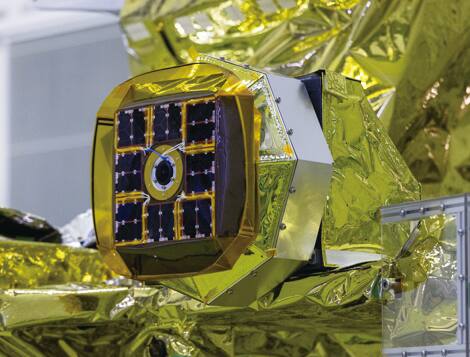 JAXA / Tokyo University of Agriculture and Technology / Chuo University.
The problem
Section titled “The problem”A rover carried by a pinpoint lander gets the mass and power left after the lander’s legs, propulsion and guidance. SLIM landed by a deliberate two-step tip-over onto a slope, and its leg arrangement was selected in 1000-case Monte Carlo sweeps in which success rates ran from 92.5 percent for a six-leg design down to 38.7 percent for a design with a single deck leg [2]. Guidance used crater-matching vision-based navigation and 50 m obstacle detection [3]. The landing ended with the lander resting about 90 degrees from its planned posture after one of two main engines lost most of its thrust [9]. A rover that must leave such a vehicle cannot count on a level deck and a ramp.
The surface it then faces is loose regolith, and the equatorial day-night swing runs from 120 to minus 130 degrees C, which restricts most lunar missions to one sunlit day [36]. Wheel behavior in that soil changes with gravity: in parabolic flight a cone index gradient measured in lunar gravity was about 4 times lower than in 1 g at unchanged density [31]. At 2.1 kg the rover also has little mass for a wheel base, a thermal system or a high-gain link, and the pre-launch briefing gave this scaling as the reason for hopping [11].
What has flown
Section titled “What has flown”Surveyor 6 (1967). The one propulsive hop flown on the Moon is the reference case for low-cost hopping in a 2019 JPL briefing: a 2.5 s firing lifted the spacecraft 4 m and moved it 2.5 m sideways [19]. Until the Hayabusa2 landers of 2018 it was the only successful hop on another body [19].
MINERVA (Hayabusa, 12 November 2005). The 591 g hexadecagonal rover hopped by spinning a torquer inside its body [15]. It was released, left the asteroid above escape velocity, survived about 18 hours and returned one image, of the Hayabusa solar paddle [15]. Its design maximum hop speed of 9 cm/s was never demonstrated in flight [16].
MASCOT (Hayabusa2, Ryugu, 2018). The lander left Hayabusa2 at 41 m altitude, fell for 5 min 51 s (pre-landing plans called for separation at about 60 m [22]), struck a shadowed boulder at 17.0 cm/s, bounced four more times over 18.64 m, and then worked for 17 h 14 min, including an uprighting maneuver, a 70 cm hop, a 3.6 cm mini-move and an 11.6 cm relocation [21]. One 25 mm brushless motor with a harmonic drive provided both hopping and self-righting [20]. Its hops were commanded from the ground, whereas LEV-1 chose its hop direction onboard [21], [12].
LEV-1 (SLIM, 20 January 2024 JST). LEV-1 was developed by ISAS/JAXA with the Tokyo University of Agriculture and Technology and Chuo University to demonstrate leapfrog locomotion on the lunar surface [9]. It is reported as the first robot to hop on the Moon [12], [7]. The ISAS account describes a deployer, LEV-M, that released both rovers at about 00:19:50 JST at the start of SLIM’s final free fall, and the first S-band signal reached Uchinoura and Usuda at 00:20:20.20 [8]. The vehicle repeated a cycle of attitude control on its single wheel, heading pointing, then a hop [8]. The hop count is six in the JAXA briefing five days after landing and seven in the later ISAS article [12], [13]. Hop direction was chosen onboard from camera imagery, with no command from Earth [11], [9]. Transmission lasted 1 hour 51 minutes from separation and ended at battery depletion [12]. Surface imagery from LEV-1 was not confirmed [7].
LEV-2 / SORA-Q (same mission). The 228 g companion is a transformable sphere of about 80 mm that cannot reach Earth directly and sends data to LEV-1 by Bluetooth [9], [14]. Photogrammetry on two returned images places a 0.13 m move and a rotation of about 180 degrees between them, and telemetry shows operation for at least about 108 minutes [5]. Its image of SLIM reached the ground through LEV-1, which showed the rover-to-rover link worked [4]. It originated in a JAXA Space Exploration Innovation Hub call answered by TOMY in 2016 [6].
What is being tried now
Section titled “What is being tried now”Ballistic hoppers for crewed exploration (proposed in 1968). A Stanford report designed and simulated a one-person hopper and a two-person Lunar Hopping Transporter that accelerate up a thrust leg, fly a parabola and brake on landing, with a simulated average traverse speed of 30 km/h for the larger vehicle [1]. No hardware was built.
Spring and flywheel hopping rovers (ground tested; flown on MINERVA and MINERVA-II). A JPL egg-shaped prototype stored 3.2 J in a spring charged by one motor and weighed 840 g [17]. A Caltech and JPL single-actuator successor reached an 80 cm vertical jump and a 30 to 60 cm leap in Earth gravity at 20 percent spring-to-takeoff efficiency, and a second generation with a six-bar nonlinear spring linkage reached an inferred 70 percent [18]. The internal-torquer mechanism flown on MINERVA was drop-tower tested at 490 m, with measured hop speeds of 28.5 to 69.0 mm/s [16].
Rocket-propelled hoppers for shadowed terrain (in development). The Intuitive Machines Micro-Nova, called S. P. Hopper on the IM-2 mission, is a 30 kg, 70 cm demonstration vehicle with a 60 kg variant quoted at a one-way range over 30 km [34]. The planned five-flight sequence included hops of 20 m, 90 m and 300 m [35]. IM-2 landed in March 2025 and the hopper was never released, so no hop result exists [34], [35].
Small-body landers and rovers (flown, and in preparation). MASCOT and MINERVA are the flown cases. Its descent was modeled with discrete element simulations of bouncing on regolith, 270 runs at 19 cm/s impact speed [24], and the landing-site rock was later compared with returned samples, with porosity of 0.50 and grain density of 2848 kg/m3 [23]. IDEFIX, the 23.47 kg CNES/DLR rover for Phobos, weighs about 0.1 N in Phobos gravity, caps its driving speed at 1 mm/s, and carries a nominal requirement of 100 m of traverse in 100 days [33]. Its WheelCams resolve about 100 micrometers per pixel to measure wheel-soil interaction [32]. Neither paper reports flight results.
Wheel design for light lunar rovers (ground tested, then flown on LEV-1). LEV-1’s roughly 300 mm wheel used a 90-degree-tilted octagonal grouser chosen with a resistive-force-theory model, validated in single-wheel tests at 54 N in Tohoku silica sand No.5 and in DEM simulation, and then compared with operation on the Moon [29]. Those tests ran in Earth gravity on a terrestrial sand [29]. In slope tests of a 35 kg rover in Toyoura sand, 12-grouser wheels cut slip ratio from 0.9 for grouserless wheels to 0.2 [30]. Granular scaling laws came within 8.5 percent on drawbar pull in parabolic flight, and the equal cone index gradient method overstated mobility [31].
Legged hoppers and walkers (simulation and bench only). A reaction-wheel bipedal hopper of 8.2 kg was simulated over a 7-hop sequence on synthetic cratered terrain, with 0.8 m hops and 15 to 20 degrees of pitch deviation [26]. A tethered 3-DOF hopping leg of 12.45 kg with a custom knee gearbox produced repetitive hopping, a step-up and a front flip on the bench [25]. A reinforcement-learning controller for the 15.65 kg Magnecko cut locomotion power from 19.2 W to 12.2 W in lunar gravity simulated by a constant-force spring offload [27]. A 13.5 kg derivative raised mean joint torque from 0.418 to 0.521 Nm when a granular foot-soil model replaced rigid contact in simulation [28]. None has flown.
The numbers
Section titled “The numbers”| Parameter | Value | Source |
|---|---|---|
| Mass | 2.1 kg | [7], [9] |
| Locomotion | hopping, with a single wheel for attitude control and heading | [8] |
| Power | solar cells with an internal battery | [8], [12] |
| Transmitter | 90 g; UHF and S-band | [11], [7] |
| Antenna | S-band patch antenna on the back of the body | [8] |
| Autonomy | full, with no commanding from Earth | [7], [12] |
| Direct-to-Earth range | about 380,000 km | [7] |
| One-way signal delay to Earth | about 1.3 s | [13] |
| Onboard computer temperature during activity | above 70 degrees C | [12] |
| Battery recharges from SLIM during cruise | 30 | [13] |
| Hops | 6 or 7 | [12], [13] |
| Transmission duration | 1 h 51 min from separation | [12] |
| Rover or lander | Mass | Hop or move data | Source |
|---|---|---|---|
| LEV-1 | 2.1 kg | no distance published | [9], [7] |
| LEV-2 | 228 g | 0.13 m and 180 degrees between two images | [14], [5] |
| MINERVA | 591 g | design maximum 9 cm/s, never flown at that speed | [15], [16] |
| MASCOT | about 9.8 kg | 70 cm hop, 3.6 cm mini-move, 11.6 cm relocation | [20], [21] |
| Surveyor 6 | spacecraft | 4 m high, 2.5 m sideways | [19] |
The beacon was charged 30 times through the SLIM multiband camera electronics over four months of cruise, and Earth-orbit operations in September 2023 were battery charging and UHF beacon transmissions for amateur radio operators [13], [11]. UHF downlink was opened to amateur radio operators, and ISAS describes the result as the first amateur radio station on the lunar surface [7], [8]. The lander, with no isotope heater, was recontacted after three lunar nights, while LEV-1 was not, and JAXA kept a reception watch in case a changing sun angle restored power [9], [7]. Reception was at the Usuda and Uchinoura stations [8], [12].
What is not established
Section titled “What is not established”No hop distance, height, heading accuracy, landing attitude or per-hop energy has been published for LEV-1, so its mobility cannot be compared numerically with MASCOT’s 70 cm hop [21]. The hop count is six in one source and seven in another [12], [13]. Whether LEV-1’s planned imaging failed to be taken or to be returned is not stated [7]. No thermal control design, processor, camera or data rate specification is public, and the peer reviewed flight record describes the rovers only qualitatively [9]. The JAXA releases carry no telemetry, and every mass figure traces to JAXA [7]. The wheel design is validated on Earth sand in Earth gravity, with lunar operation as the only flight check [29]. Hopper concepts for shadowed terrain and legged hoppers have no published lunar hop data in the held sources [34], [26], [27].
References
- Kaplan, M. H. and Seifert, H. S. (1968). Investigation of a Hopping Transporter Concept for Lunar Exploration
. Department of Aeronautics and Astronautics, Stanford University, SUDAAR No. 348. Source
BibTeX
@techreport{kaplan1968investigation, title = {Investigation of a Hopping Transporter Concept for Lunar Exploration}, author = {Kaplan, Marshall H. and Seifert, Howard S.}, number = {SUDAAR No. 348}, institution = {Department of Aeronautics and Astronautics, Stanford University}, year = {1968}, url = {https://ntrs.nasa.gov/citations/19680020292}, abstract = {Performance and dynamic characteristics determined for hopping transporter for lunar exploration} } - KAWANO, T., MARU, Y., OKUIZUMI, N., SAWAI, S. and NOHMI, M. (2020). Study of Leg Arrangement for Stable Touchdown during Two-Step Landing for SLIM
. Journal of Geophysical Research: Planets, 5. Source
BibTeX
@article{kawano2020study, title = {Study of Leg Arrangement for Stable Touchdown during Two-Step Landing for SLIM}, author = {KAWANO, Taro and MARU, Yusuke and OKUIZUMI, Nobukatsu and SAWAI, Shujiro and NOHMI, Masahiro}, journal = {Journal of Geophysical Research: Planets}, volume = {18}, number = {5}, pages = {222-230}, publisher = {Japan Society for Aeronautical and Space Sciences}, year = {2020}, doi = {10.2322/tastj.18.222} } - Ishida, T., Fukuda, S., Kariya, K., Kamata, H., Takadama, K., Kojima, H., Sawai, S. and Sakai, S. (2025). Vision-based navigation and obstacle detection flight results in SLIM lunar landing
. Acta Astronautica. Source
BibTeX
@article{ishida2025vision, title = {Vision-based navigation and obstacle detection flight results in SLIM lunar landing}, author = {Ishida, Takayuki and Fukuda, Seisuke and Kariya, Kazuki and Kamata, Hiroyuki and Takadama, Keiki and Kojima, Hirohisa and Sawai, Shujiro and Sakai, Shinichiro}, journal = {Acta Astronautica}, volume = {226}, pages = {772-781}, publisher = {Elsevier BV}, year = {2025}, doi = {10.1016/j.actaastro.2024.11.002}, abstract = {On January 20, 2024, Smart Lander for Investigating Moon (SLIM) landed on the Moon. Vision-Based Navigation (VBN) was used to estimate the position of the spacecraft accurately and autonomously during the descent phase, and it was successfully used in each of the seven regions. Obstacle detection was also performed 50 m above the lunar surface, successfully identifying safe points within the field of view of the navigation camera. As a result, SLIM was the first mission to realize pinpoint lunar landing technology with 100 m accuracy. This paper details the VBN operational concept and developed components, as well as the flight results of VBN in SLIM’s lunar landing operations. • SLIM successfully landed on the Moon, achieving the first pinpoint landing. • Vision-based navigation provided precise position information to the probe. • Obstacle detection successfully identified a safer site within the field of view. • The landing accuracy 50 m above the lunar surface was 3 to 4 m.} } - JAXA, TOMY Company, Sony Group Corporation and Doshisha University. (2024). Successful image capture and data transmission of the SLIM lander by the transformable lunar robot. jaxa.jp/press/2024/01/20240125-4_j.html
BibTeX
@misc{jaxa2024successful, title = {Successful image capture and data transmission of the SLIM lander by the transformable lunar robot}, author = {{JAXA} and {TOMY Company} and {Sony Group Corporation} and {Doshisha University}}, organization = {jaxa.jp}, year = {2024}, url = {https://www.jaxa.jp/press/2024/01/20240125-4_j.html} } - JAXA, TOMY Company, Sony Group Corporation and Doshisha University. (2026). Lunar demonstration results of the transformable lunar robot LEV-2 published in Science Robotics. jaxa.jp/press/2026/06/20260618-1_j.html
BibTeX
@misc{jaxa2026lunar, title = {Lunar demonstration results of the transformable lunar robot LEV-2 published in Science Robotics}, author = {{JAXA} and {TOMY Company} and {Sony Group Corporation} and {Doshisha University}}, organization = {jaxa.jp}, year = {2026}, url = {https://www.jaxa.jp/press/2026/06/20260618-1_j.html} } - (2026). JAXA Space Exploration Innovation Hub Center: The Transformable nano rover (Lunar Excursion Vehicle 2, SORA-Q). ihub-tansa.jaxa.jp/english/LEV2_en.html
BibTeX
@misc{jaxaihublev2, title = {JAXA Space Exploration Innovation Hub Center: The Transformable nano rover (Lunar Excursion Vehicle 2, SORA-Q)}, organization = {ihub-tansa.jaxa.jp}, year = {2026}, url = {https://www.ihub-tansa.jaxa.jp/english/LEV2_en.html} } - JAXA. (2024). Results and achievements of the Lunar Excursion Vehicle (LEV-1) on board the Smart Lander for Investigating Moon (SLIM). jaxa.jp/press/2024/01/20240125-2_j.html
BibTeX
@misc{jaxa2024results, title = {Results and achievements of the Lunar Excursion Vehicle (LEV-1) on board the Smart Lander for Investigating Moon (SLIM)}, author = {{JAXA}}, organization = {jaxa.jp}, year = {2024}, url = {https://www.jaxa.jp/press/2024/01/20240125-2_j.html} } - Otsuki, M. (2024). The companionable micro lunar exploration rovers LEV-1 and LEV-2
. ISAS News, 518. isas.jaxa.jp/feature/slim/slim_09.html
BibTeX
@misc{otsuki2024companionable, title = {The companionable micro lunar exploration rovers LEV-1 and LEV-2}, author = {Otsuki, Masatsugu}, journal = {ISAS News}, number = {518}, organization = {isas.jaxa.jp}, year = {2024}, url = {https://www.isas.jaxa.jp/feature/slim/slim_09.html} } - Sakai, S., Kushiki, K., Sawai, S., Fukuda, S., Miyazawa, Y., Ishida, T., Kariya, K., Ito, T., Ueda, S., Yokota, K., Kawano, T., Ohtake, M., Saiki, K., Nakauchi, Y., Michigami, K., Furukawa, K., Akizuki, Y., Kanaya, S., Kinjo, T., Goto, K., Sawada, K., Sugimoto, Y., Takeuchi, H., Tomiki, A., Toyota, H., Nagata, T., Nakatsuka, J., Maki, K., Mizuno, T., Shiratori, H., Nishino, M. N., Usami, N., Kikuchi, J., Hamori, H., Hirasawa, R., Shibasaki, Y. and Saito, H. (2025). Moon landing results of SLIM: A smart lander for investigating the Moon
. Acta Astronautica. Source
BibTeX
@article{sakai2025moon, title = {Moon landing results of SLIM: A smart lander for investigating the Moon}, author = {Sakai, Shinichiro and Kushiki, Kenichi and Sawai, Shujiro and Fukuda, Seisuke and Miyazawa, Yu and Ishida, Takayuki and Kariya, Kazuki and Ito, Takahiro and Ueda, Satoshi and Yokota, Kentaro and Kawano, Taro and Ohtake, Makiko and Saiki, Kazuto and Nakauchi, Yusuke and Michigami, Keisuke and Furukawa, Katsumi and Akizuki, Yuki and Kanaya, Shusaku and Kinjo, Tomihiro and Goto, Kenta and Sawada, Kenichiro and Sugimoto, Yoshihide and Takeuchi, Hiroshi and Tomiki, Atsushi and Toyota, Hiroyuki and Nagata, Taiichi and Nakatsuka, Junichi and Maki, Kenichiro and Mizuno, Takahide and Shiratori, Hirohide and Nishino, Masaki N. and Usami, Naoto and Kikuchi, Junji and Hamori, Hitoshi and Hirasawa, Ryo and Shibasaki, Yusuke and Saito, Hiroaki}, journal = {Acta Astronautica}, volume = {235}, pages = {47--54}, publisher = {Elsevier BV}, year = {2025}, doi = {10.1016/j.actaastro.2025.05.047}, abstract = {The Smart Lander for Investigating the Moon (SLIM), with a dry mass of about 200 kg, was launched by the H-IIA vehicle on September 7, 2023, and made a precision lunar landing on January 19, 2024 (Coordinated Universal Time). The landing precision was evaluated to be within ∼10 m at an altitude of approximately 50m from the Moon surface, far exceeding the target landing accuracy of 100 m and realizing the world’s first pinpoint landing, although a trouble occurred just before landing and one of the two main engines lost thrust. The two micro/nano rovers of the SLIM separated immediately before landing and successfully captured SLIM images in fully autonomous operation mode. The operation team also obtained spectroscopic observations of rocks from scientific instruments onboard the SLIM, which are expected to provide clues on the origin of the Moon. Although not designed to endure the harsh temperatures of the lunar day and night, the lander operated after three lunar nights, gathering various engineering data. This paper reports the results of the lunar landing operations of SLIM.} } - Yoshimitsu, T. (2023). LEV-1, the Ultra-Small Lunar Surface Exploration Rover Aboard SLIM. jaxa.jp/projects/files/youtube/ml_slim_lev1_lev2/jaxa_doc02_20231205.pdf
BibTeX
@misc{yoshimitsu2023lev1, title = {{LEV-1}, the Ultra-Small Lunar Surface Exploration Rover Aboard {SLIM}}, author = {Yoshimitsu, Tetsuo}, howpublished = {Presentation at the Japan Aerospace Exploration Agency, Institute of Space and Astronautical Science}, year = {2023}, url = {https://www.jaxa.jp/projects/files/youtube/ml_slim_lev1_lev2/jaxa_doc02_20231205.pdf} } - Yoshimitsu, T. (2024). LEV-1, the Ultra-Small Lunar Surface Exploration Rover Aboard SLIM: Flight Results. jaxa.jp/projects/files/youtube/ml_slim_lev1_lev2/jaxa_doc02_20240125.pdf
BibTeX
@misc{yoshimitsu2024lev1, title = {{LEV-1}, the Ultra-Small Lunar Surface Exploration Rover Aboard {SLIM}: Flight Results}, author = {Yoshimitsu, Tetsuo}, howpublished = {Presentation at the Japan Aerospace Exploration Agency, Institute of Space and Astronautical Science}, year = {2024}, url = {https://www.jaxa.jp/projects/files/youtube/ml_slim_lev1_lev2/jaxa_doc02_20240125.pdf} } - (2026). ISAS: The micro lunar exploration rovers LEV-1 and LEV-2. isas.jaxa.jp/feature/slim/slim_09.html
BibTeX
@misc{isasmicro,
  title = {ISAS: The micro lunar exploration rovers LEV-1 and LEV-2},
  organization = {isas.jaxa.jp},
  year = {2026},
  url = {https://www.isas.jaxa.jp/feature/slim/slim_09.html}
}
Further reading
- Sakai, S., Kushiki, K., Fukuda, S. and Sawai, S. (2026). Overview of the Small Lunar Lander SLIM and Its Lunar Landing Results . IEEJ Journal of Industry Applications. Source