TAGSAM
Program pages NASA: OSIRIS-REx
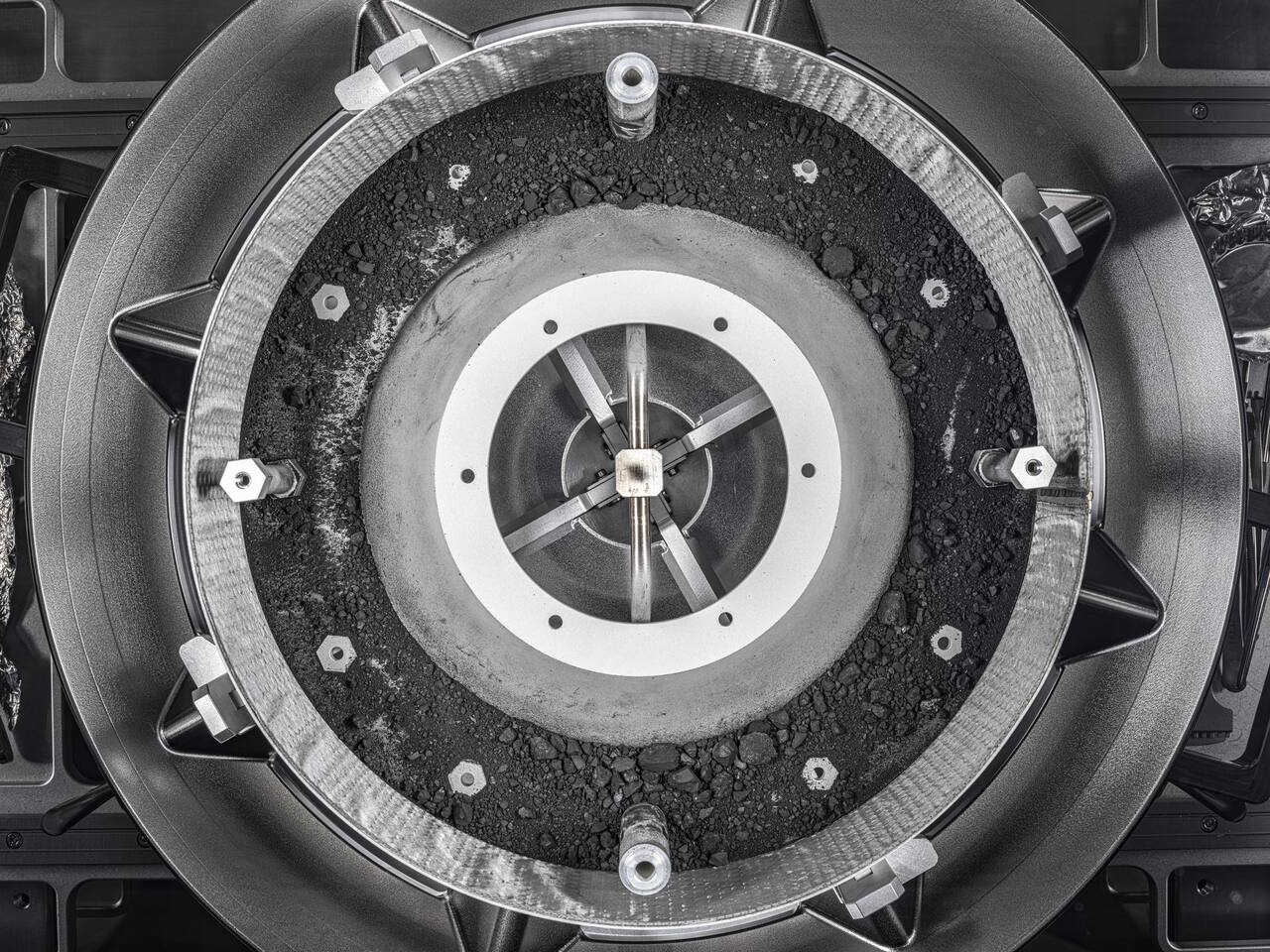 Erika Blumenfeld & Joseph Aebers. Public domain (NASA / US government work).
Overview
Section titled “Overview”A small-body sampler has to collect material from a surface where gravity is a millionth of Earth’s or less, so a tool cannot react a digging load against weight, and where grain cohesion exceeds grain weight over most of the relevant size range [5]. Anything that pushes into the surface pushes the spacecraft away from it. The surface itself was unknown at design time: Itokawa proved to be a boulder-covered rubble pile of density 1.9 g/cm3 that its discoverers called completely unexpected [13], Bennu carries more than 200 boulders larger than 10 m and a thermal inertia that models read as 0.5 to 5 cm particles [23], and Philae’s strength estimates for 67P were indirect inferences with no in-situ measurement behind them [16].
TAGSAM is the sampling mechanism carried by OSIRIS-REx. It is an articulated arm ending in an annular collection head that contacts the surface for a few seconds, releases nitrogen gas into the regolith beneath it, and captures the fluidized material in an internal reservoir [1].
Design space
Section titled “Design space”Four families of approach have been flown or built for small-body surfaces, and they differ in what they ask of the surface and of the spacecraft.
- Gas-driven touch and go (TAGSAM). Contact lasts seconds, no digging load is reacted, and the spacecraft retreats under thruster control. Flown once, on Bennu in October 2020 [1], [30].
- Projectile touch and go (Hayabusa, Hayabusa2). A sampler horn contacts the surface and a projectile is fired into it. Hayabusa’s own sampling sequence was not executed as planned [13]. Hayabusa2 touched down on Ryugu on 21 February and 11 July 2019, and dust from the touchdowns degraded its navigation camera sensitivity by about 15 percent [21]. Hayabusa2 was designed as a robotic sample return mission to asteroid 1999 JU3, later named Ryugu [11], [12].
- Anchored or damped landing (Philae, MASCOT). The vehicle touches down and relies on gear, harpoons or a thruster to stay. Philae’s harpoons and cold gas thruster did not fire and it bounced for about two hours [15], [14]. MASCOT bounced four times over 18.64 m before settling and then operated for 17 h 14 min [24].
- Microgravity penetrometry and sampler testing (laboratory and parabolic flight). Eight penetrometers in a parabolic flight campaign for the MMX Phobos sampler found tip shape changes the reaction force substantially [26]. This family has not flown.
The gas option was chosen for TAGSAM because a touch and go architecture does not have to hold attitude and position on a surface with negligible gravity [29]. Its cost is a dependence on the regolith mobilizing under gas, which could be tested only on simulants.
Mission heritage
Section titled “Mission heritage”Hayabusa carried MINERVA, a 591 g hopper tested on a 490 m drop tower, which never landed [22]. Hayabusa2’s pre-encounter regolith consensus expected Itokawa-like particles and a thermal inertia of 150 to 300, and the surface was boulders with no fine dust [20]. Each target contradicted the particle size distribution its sampler was designed against, which is why TAGSAM’s site selection rested on a sampleability score fitted after arrival [2]. Philae’s pre-landing documents describe a payload and timeline that the flown landing did not follow [28], [27].
Specifications
Section titled “Specifications”| Parameter | Value | Source |
|---|---|---|
| Arm extension from the spacecraft | 2.8 m | [1] |
| Wrist articulation | 15 deg in any direction, compliant U-joint | [1], [2] |
| Head height | about 7 cm | [2] |
| Head base plate diameter | 32 cm | [2] |
| Head opening diameter | 21 cm | [2] |
| Contact pad samplers | 24 pads of about 1.75 cm diameter, stainless steel Velcro loop, 57.42 cm2 total, encircling the base plate as a backup sampler and as a record of material exposed at the surface | [1], [2], [6] |
| Contact pad grain capture | up to 1 mm diameter | [1] |
| Bulk capture particle limit | about 2 cm | [1], [2] |
| Nitrogen bottles | 3, independently controlled, 3 possible attempts | [1], [2] |
| Gas release timing | 1 s after contact | [2] |
| Contact duration | up to 8 s on a soft surface | [29] |
| Head collection chamber capacity | at least 150 g | [7] |
| Demonstrated ground and parabolic collection | over 600 g | [1] |
Mission profile
Section titled “Mission profile”| Parameter | Value | Source |
|---|---|---|
| Host | OSIRIS-REx | [1] |
| Target | asteroid Bennu | [1] |
| Contact site | Nightingale, in the 20 m Hokioi crater | [2] |
| Contact date | 20 October 2020 | [30] |
| Sample return capsule landing | Utah Test and Training Range, 24 September 2023 | [2], [7] |
| Sample requirement | 60 g bulk plus 26 cm2 of fine-grained contact pad material | [1], [7] |
Mechanism
Section titled “Mechanism”The head is a simple annulus with a wire mesh filter screen around its outer circumference [1]. There is no digging tool and no closing jaw. Nitrogen injected into the interior of the annulus entrains fines and pebbles up to 2 cm [1] and, if the head is firmly seated, the only path for gas and entrained regolith is through the filter, where the material is retained. A compressible constant-force spring in the forearm buffers the contact dynamics [2].
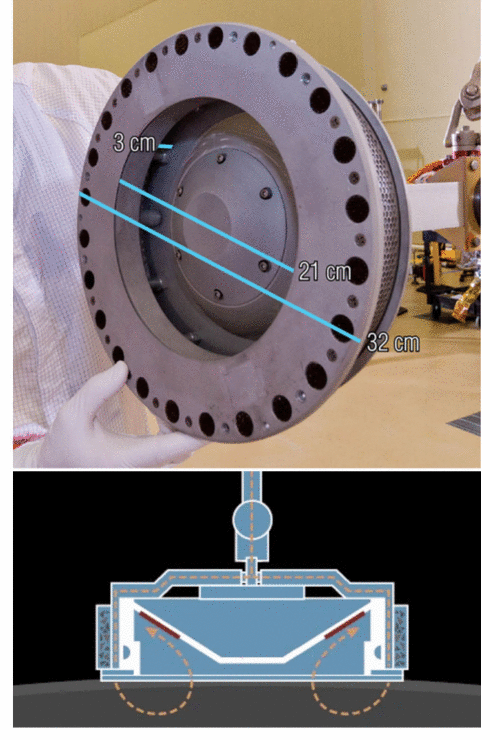
Cross-section of the collection head with its dimensions and gas path. Nitrogen enters through the central manifold and exits at the outer rim, so once the head is seated on the surface the only route out for gas and entrained regolith is through the filter, where the material is retained. Source: [2]. CC BY 4.0.
The architecture follows from the force scaling at asteroid gravity. Cohesion between grains exceeds their weight over most of the relevant particle size range, and gravity provides no useful normal force for a tool to react against [5]. Gas transfers momentum to the regolith without the spacecraft having to react a digging load, which is what makes collection possible without landing.
The 15 deg wrist compliance was allocated as a hard constraint on site selection: the mission requirement capped facet tilt at 14 deg, with the remaining 1 deg reserved for other error sources [2].
Descent and contact sequence
Section titled “Descent and contact sequence”| Event | Parameter |
|---|---|
| Departure orbit | 1 km |
| Checkpoint burn | Places the spacecraft on an intersecting trajectory at 16 cm/s approach |
| Checkpoint to Matchpoint | About 600 s |
| Matchpoint altitude | 55 m |
| Contact velocity target | 10 cm/s vertical, zero lateral to +/- 2 cm/s |
| Back-away burn | 0.7 m/s |
| Delivery requirement | Head within 25 m of the aim point at over 98 percent probability |
Source: [1].
Trajectory dispersion after the deorbit burn is too large for predefined Checkpoint and Matchpoint maneuvers, so the spacecraft state is updated onboard at Checkpoint and both burns are adjusted autonomously [1]. Two independent guidance methods were carried. LIDAR-guided TAG detects a range-threshold crossing and takes a range measurement at a fixed time to correct the maneuvers. Natural Feature Tracking renders features from an onboard shape model built in flight, using predicted camera pointing and Sun position, and correlates them against live imagery to produce a position and velocity update relative to the surface. During contact the reaction wheels and attitude control thrusters are enabled to damp imparted torques and keep any part of the spacecraft other than the head off the surface. The solar arrays are moved into a Y-wing configuration for sampling, to keep dust off the cells and increase ground clearance if the spacecraft rotates on contact.
A post-mission reassessment of the guidance chain against the flown Nightingale contact found the delivered accuracy consistent with preflight dispersion analysis, with the LIDAR range-trigger and Natural Feature Tracking updates each contributing separately identifiable corrections to the touchdown point [9]. Earlier operational experience with Natural Feature Tracking, gained during the approach and reconnaissance phases at Bennu, had already shown the technique tolerant of the shape model errors and lighting changes that a first flight of the method could not be fully bounded against on the ground [10].
What the contact measured
Section titled “What the contact measured”The touchdown is the only direct measurement of the geotechnical properties of a rubble pile near subsurface. The arm spring took no compression, so the load path from the head to the spacecraft inertial measurement unit was rigid and the 200 Hz accelerometer record is a force record, with the contact measurements below [3].
| Quantity | Measured value |
|---|---|
| Contact velocity | 10 cm/s, negligible lateral |
| Peak acceleration before gas release | 0.014 m/s2 |
| Peak contact force | 10 to 15 N |
| Depth at 1.2 s | 2 to 3 cm |
| Depth at end of the pre-gas interval | 5.95 to 6.91 cm in 0.605 to 0.705 s |
| Head tilt taken up by a 5 cm rock | about 7 deg |
| Disturbed area | 0.51 m2 against a 0.08 m2 footprint |
| Derived near-subsurface bulk density | 440 to 600 kg/m3 |
| Derived packing fraction | 0.2 to 0.45 |
| Derived compressive strength | 2 to 200 Pa |
| Derived bulk cohesion | 0.2 to 20 Pa |
No initial acceleration spike appeared, which is the signature of granular impact in the laboratory; the rise was gradual because contact was off-center against a 5 cm rock that tilted the head [3]. A 40 cm rock was levered upward and millimeter debris was lofted from its surface under weak forces, which itself argues for minimal cohesive bonding.
Interpretation runs through a modified granular intrusion force law with a quasi-static term F_pressure = 80 mu rho a^2 g |z| and an inertial term F_drag = 3.2 rho a^2 U^2 [4]. For weakly cohesive regolith the response splits on packing fraction: at or below about 0.5 the force stays under about 60 N and is drag dominated, while at or above 0.6 the force exceeds 60 N for friction angle above 20 deg and penetration stops within a few centimeters above 30 deg [3], [4]. The measured 10 to 15 N places Bennu firmly in the loose regime.
Site selection
Section titled “Site selection”Bennu was found to have no ponded deposits of particles small enough to sample, which is the surface type the mechanism had been designed against [2]. The mission requirement was a site with at least 80 percent probability of acquiring at least 60 g per attempt. Meeting it after arrival required a sampleability algorithm fitted to ground test results relating collection mass to observable surface properties.
Three map products drove the decision: a deliverability map giving navigation precision to a target point, a safety map identifying boulders that could endanger the spacecraft, and a sampleability map [2]. Particle mapping had to resolve grains at or below the 21 cm head opening, against an imaging requirement to cover more than 80 percent of the surface at better than 21 cm resolution. Reconnaissance flybys at 250 to 350 m produced pixel scales below 2 cm, and digital terrain models were built at 2 cm facet spacing, comparable to the 32 cm head diameter [2]. A sequence of TAG rehearsals was flown after site selection, each demonstrating one step of the collection sequence before the flight system was committed to the surface [7].
Contact itself was triggered by a compression indicator on the arm, with the guidance LIDAR taking the spacecraft to about 5 m before the final approach [7].
At the actual contact point, latitude 55.9 deg and longitude 41.8 deg, particle mapping found a minimum particle size of 7.65 mm and a size-frequency distribution power law slope of -2.09 +/- 0.008 over 521 particles within a 1.5 m radius [2]. Rock tilt efficiency was 0.434 because a rock larger than the 21 cm opening overlapped the sampling location. Predicted collection ranged from 32.4 g using resolved particles only under low-mobility scoring to 249.9 g including unresolved material under high-mobility scoring [2]. Imagery during the event showed the head flush with the surface with no effective tilt, which raises the tilt efficiency to 1.0 and the predictions to 258 g and 575 g.
The lesson recorded by the team is that the site choice depended on data that could only be obtained after arrival: Nightingale and Osprey diverged in their fraction of unresolved facets only as progressively finer imagery was analyzed, and an earlier decision on lower-resolution imagery could have selected a different site [2].
Sample mass measurement and stowage
Section titled “Sample mass measurement and stowage”Collected mass was determined from the change in spacecraft moment of inertia, with the arm extended along the spacecraft X axis and the measurement compared against an identical one made before contact [1]. SamCam then refocused through a diopter lens in its filter wheel to image the head and contact pads at a range of incidence and emission angles for visual verification. In parallel [1], the contact force profile was reconstructed from OCAMS, TAGCAMS and guidance telemetry, incorporating head motion and forearm pogo spring compression, and matched against an atlas of discrete element simulation outcomes calibrated on 1 g and microgravity low-velocity impact experiments. OCAMS itself is a three-camera suite built for this purpose: a wide-angle survey camera for site imaging, a map camera for the digital terrain models used to build the sampleability map, and the narrow-angle SamCam pointed down the arm to record the contact and stowage sequence [8].
Enough material entered the reservoir that the retaining flap jammed open and particles escaped, and stowage was advanced ahead of schedule [6]. The bulk sample collected was estimated from imaging at 250 plus or minus 101 g, against a mission requirement of at least 60 g [1], [6].
Return
Section titled “Return”| Event | Value | Source |
|---|---|---|
| Bennu departure | March 2021, 931 days after arrival | [7] |
| Capsule mass | 46 kg | [1] |
| Capsule dimensions | 81 cm diameter, 50 cm tall | [1] |
| Capsule release | 4 h before entry interface | [7] |
| Entry velocity | 12.2 km/s | [7] |
| Entry flight path angle | -8.2 deg | [7] |
| Kinetic energy removed by the aeroshell | over 99 percent | [7] |
| Sample temperature limit through entry | below 75 C | [7] |
| Drogue deployment | Mach 1.4 at about 30 to 33 km | [1], [7] |
| Main chute deployment | about 3 km | [1], [7] |
| Terminal descent speed | 4.6 m/s | [1] |
| Riser cutter trigger | 10 g switch at ground impact | [1] |
The capsule is a Stardust-derived blunt-nosed cone with a PICA heat shield [1], [7]. The Stardust aerogel grid was replaced by a capture ring that locks the TAGSAM head during stowage [1]. Two backshell vents allow depressurization on ascent and repressurization on descent.
Contamination control
Section titled “Contamination control”Sensitive surfaces were held to IEST-STD-CC1246D level 100A/2, and TAGSAM and capsule cleanliness was monitored so that no surface accumulated more than 180 ng/cm2 of total amino acids and hydrazine [1]. Over 300 material coupons and an extensive witness plate catalog were collected through assembly, test and launch operations and archived at NASA JSC, with further witness plates mounted on the mechanism and capsule to record in-flight contamination.
Curation and allocation
Section titled “Curation and allocation”The sample canister was purged with high-purity gaseous nitrogen inside a temporary ISO 7 cleanroom at the Utah Test and Training Range, then flown to Ellington Field and trucked to NASA JSC under a continuous nitrogen purge, planned for the day after recovery [6]. Disassembly and curation use four custom nitrogen gloveboxes in an ISO 5 cleanroom, certified in November 2021 and held at 22 C plus or minus 1 C: one for the capsule canister, one for disassembly of the TAGSAM head, one for the contact pads and one for the witness plates. The catalog was to be released in late March 2024, about six months after return, with up to 25 percent by mass allocated to the science team for early analysis [6].
The 24 contact pads are a distinct sample stream from the bulk reservoir: they were designed both as a backup should regolith fail to mobilize into the chamber and to capture material exposed at the surface for direct comparison against the spacecraft’s remote sensing, and they are removed and processed in their own glovebox [6].
Test fidelity
Section titled “Test fidelity”Sampler qualification depended on simulants and on parabolic aircraft. Low density simulants such as perlite reproduce the weight of Bennu particles but not their inertia, and each parabola gives 16 to 18 s [29]. NASA’s asteroid simulant figures of merit give a defensible way to state how much of a test survives a substitute material, and show the mineralogical figure of common lunar simulants is low, for example 0.35 for JSC-1A [17]. The 2015 simulant workshop that set the strategy for a family of asteroid simulants was a planning exercise that reported no measured properties [18]. Mechanical grain properties from returned Itokawa particles, 82 to 111 GPa reduced modulus, are grain scale and say nothing of bulk regolith strength [19]. On the modeling side, discrete element studies for Ryugu bounce ran 270 cases at an assumed gravity of 2.5e-4 m/s2 and 19 cm/s with no microgravity validation [25].
Technologies developed
Section titled “Technologies developed”Touch-and-go sampling with onboard hazard-relative guidance is now the reference approach for small-body sample return [1], [29]. The Natural Feature Tracking implementation, an onboard shape model correlated against live imagery to produce a surface-relative state update, was flown here for the first time on an asteroid approach and is the direct antecedent of terrain-relative navigation on later small-body missions [1]. The contact itself produced the granular force law calibration that any successor sampler will be sized against [3], [4].
What is not established
Section titled “What is not established”The density, cohesion and strength values from the Nightingale contact are model derived: only force, acceleration and penetration depth were observed, and the conversion assumes a 40 deg friction angle and a sphere-based force law [3]. The contact was off center against a 5 cm rock, so the clean impact signature is absent [3]. The force law used to interpret it is validated against terrestrial gravity impacts and extrapolated to microgravity [4]. The sampleability score is a fitted form, not a physical model, and it failed at the backup site where unresolved particles were the issue [2]. The 600 g test collection came from simulants chosen before Bennu was known to be a boulder field [1], [24]. The 250 plus or minus 101 g flown mass is an imaging estimate [6]. Van der Waals cohesion for asteroid regolith rests on lunar soil constants that were never verified for an asteroid [5]. Philae’s 1 kPa Agilkia strength rests on an assumed homogeneous soil and one reading of a 0.27 s gap in the seismic trace [15]. No gas-driven sampler other than TAGSAM has flown.
References
- Lauretta, D. S., Balram-Knutson, S., Beshore, E., Boynton, W. V., Drouet d'Aubigny, C., DellaGiustina, D. N., Enos, H. L., Gholish, D., Hergenrother, C. W., Howell, E., Johnson, C., Morton, E., Nolan, M. C., Rizk, B., Roper, H. L., Bartels, A., Bos, B. J., Dworkin, J. P., Highsmith, D., Lorenz, D. A., Lim, L., Mink, R., Moreau, M. C., Nuth, J., Reuter, D. C., Simon, A. A., Bierhaus, E. B., Bryan, B., Ballouz, R.-L., Barnouin, O. S., Binzel, R. P., Bottke, W., Hamilton, V. E., Walsh, K. J., Chesley, S. R., Christensen, P. R., Clark, B. E., Connolly, H. C. J., Crombie, M. K., Daly, M. G., Emery, J., McCoy, T., McMahon, J., Scheeres, D. J., Messenger, S. R., Nakamura-Messenger, K., Righter, K. and Sandford, S. (2017). OSIRIS-REx: Sample Return from Asteroid (101955) Bennu
. Space Science Reviews. Source
BibTeX
@article{lauretta2017osiris, title = {OSIRIS-REx: Sample Return from Asteroid (101955) Bennu}, author = {Lauretta, Dante S. and Balram-Knutson, S.S. and Beshore, E. and Boynton, William V. and Drouet d'Aubigny, C. and DellaGiustina, Daniella N. and Enos, Heather L. and Gholish, D.R. and Hergenrother, Carl W. and Howell, E.S. and Johnson, C.A. and Morton, E.T. and Nolan, Michael C. and Rizk, Bashar and Roper, Heather L. and Bartels, A.E. and Bos, Brent J. and Dworkin, Jason P. and Highsmith, D.E. and Lorenz, David A. and Lim, L.F. and Mink, R. and Moreau, Michael C. and Nuth, J.A. and Reuter, Dennis C. and Simon, Amy A. and Bierhaus, Edward B. and Bryan, B.H. and Ballouz, Ronald-Louis and Barnouin, Olivier S. and Binzel, Richard P. and Bottke, W.F. and Hamilton, Victoria E. and Walsh, Kevin J. and Chesley, Steven R. and Christensen, Philip R. and Clark, Beth E. and Connolly, H. C., Jr. and Crombie, M. Katherine and Daly, Michael G. and Emery, J.P. and McCoy, T.J. and McMahon, J.W. and Scheeres, Daniel J. and Messenger, Scott R. and Nakamura-Messenger, K. and Righter, K. and Sandford, S.A.}, journal = {Space Science Reviews}, volume = {212}, pages = {925--984}, year = {2017}, doi = {10.1007/s11214-017-0405-1} } - Walsh, K. J., Bierhaus, E. B., Lauretta, D. S., Nolan, M. C., Ballouz, R.-L., Bennett, C. A., Jawin, E. R., Barnouin, O. S., Berry, K., Burke, K. N., Brodbeck, B., Burns, R., Clark, B. C., Clark, B. E., Cambioni, S., Connolly, J. H. C., Daly, M. G., Delbo, M., DellaGiustina, D. N., Dworkin, J. P., Enos, H. L., Emery, J. P., Gay, P., Golish, D. R., Hamilton, V. E., Hoover, R., Lujan, M., McCoy, T., Mink, R. G., Moreau, M. C., Nolau, J., Padilla, J., Pajola, M., Polit, A. T., Robbins, S. J., Ryan, A. J., Selznick, S. H., Stewart, S. and Wolner, C. W. (2022). Assessing the Sampleability of Bennu's Surface for the OSIRIS-REx Asteroid Sample Return Mission
. Space Science Reviews, 20. Source
BibTeX
@article{walsh2022assessing, title = {Assessing the Sampleability of Bennu's Surface for the OSIRIS-REx Asteroid Sample Return Mission}, author = {Walsh, Kevin J. and Bierhaus, Edward B. and Lauretta, Dante S. and Nolan, Michael C. and Ballouz, Ronald-Louis and Bennett, Carina A. and Jawin, Erica R. and Barnouin, Olivier S. and Berry, Kevin and Burke, Keara N. and Brodbeck, Bella and Burns, Rich and Clark, Benton C. and Clark, Beth E. and Cambioni, Saverio and Connolly, Jr., Harold C. and Daly, Michael G. and Delbo, Marco and DellaGiustina, Daniella N. and Dworkin, Jason P. and Enos, Heather L. and Emery, Josh P. and Gay, Pamela and Golish, Dathon R. and Hamilton, Victoria E. and Hoover, Rachel and Lujan, Michael and McCoy, Timothy and Mink, Ronald G. and Moreau, Michael C. and Nolau, Jennifer and Padilla, Jacob and Pajola, Maurizio and Polit, Anjani T. and Robbins, Stuart J. and Ryan, Andrew J. and Selznick, Sanford H. and Stewart, Stephanie and Wolner, Catherine W.V.}, journal = {Space Science Reviews}, volume = {218}, number = {20}, pages = {20--20}, year = {2022}, doi = {10.1007/s11214-022-00887-2}, abstract = {Abstract NASA’s first asteroid sample return mission, OSIRIS-REx, collected a sample from the surface of near-Earth asteroid Bennu in October 2020 and will deliver it to Earth in September 2023. Selecting a sample collection site on Bennu’s surface was challenging due to the surprising lack of large ponded deposits of regolith particles exclusively fine enough ( $\leq2~\text{cm}$ ≤ 2 cm diameter) to be ingested by the spacecraft’s Touch-and-Go Sample Acquisition Mechanism (TAGSAM). Here we describe the Sampleability Map of Bennu, which was constructed to aid in the selection of candidate sampling sites and to estimate the probability of collecting sufficient sample. “Sampleability” is a numeric score that expresses the compatibility of a given area’s surface properties with the sampling mechanism. The algorithm that determines sampleability is a best fit functional form to an extensive suite of laboratory testing outcomes tracking the TAGSAM performance as a function of four observable properties of the target asteroid. The algorithm and testing were designed to measure and subsequently predict TAGSAM collection amounts as a function of the minimum particle size, maximum particle size, particle size frequency distribution, and the tilt of the TAGSAM head off the surface. The sampleability algorithm operated at two general scales, consistent with the resolution and coverage of data collected during the mission. The first scale was global and evaluated nearly the full surface. Due to Bennu’s unexpected boulder coverage and lack of ponded regolith deposits, the global sampleability efforts relied heavily on additional strategies to find and characterize regions of interest based on quantifying and avoiding areas heavily covered by material too large to be collected. The second scale was site-specific and used higher-resolution data to predict collected mass at a given contact location. The rigorous sampleability assessments gave the mission confidence to select the best possible sample collection site and directly enabled successful collection of hundreds of grams of material.} } - Walsh, K. J., Ballouz, R.-L., Jawin, E. R., Avdellidou, C., Barnouin, O. S., Bennett, C. A., Bierhaus, E. B., Bos, B. J., Cambioni, S., Connolly, J. H. C., Delbo, M., DellaGiustina, D. N., DeMartini, J., Emery, J. P., Golish, D. R., Haas, P. C., Hergenrother, C. W., Ma, H., Michel, P., Nolan, M. C., Olds, R., Rozitis, B., Richardson, D. C., Rizk, B., Ryan, A. J., Sánchez, P., Scheeres, D. J., Schwartz, S. R., Selznick, S. H., Zhang, Y. and Lauretta, D. S. (2022). Near-zero cohesion and loose packing of Bennu's near subsurface revealed by spacecraft contact
. Science Advances, 27. Source
BibTeX
@article{walsh2022near, title = {Near-zero cohesion and loose packing of Bennu's near subsurface revealed by spacecraft contact}, author = {Walsh, Kevin J. and Ballouz, Ronald-Louis and Jawin, Erica R. and Avdellidou, Chrysa and Barnouin, Olivier S. and Bennett, Carina A. and Bierhaus, Edward B. and Bos, Brent J. and Cambioni, Saverio and Connolly, Jr., Harold C. and Delbo, Marco and DellaGiustina, Daniella N. and DeMartini, Joseph and Emery, Joshua P. and Golish, Dathon R. and Haas, Patrick C. and Hergenrother, Carl W. and Ma, Huikang and Michel, Patrick and Nolan, Michael C. and Olds, Ryan and Rozitis, Benjamin and Richardson, Derek C. and Rizk, Bashar and Ryan, Andrew J. and Sánchez, Paul and Scheeres, Daniel J. and Schwartz, Stephen R. and Selznick, Sanford H. and Zhang, Yun and Lauretta, Dante S.}, journal = {Science Advances}, volume = {8}, number = {27}, pages = {eabm6229}, year = {2022}, doi = {10.1126/sciadv.abm6229}, abstract = {When the OSIRIS-REx spacecraft pressed its sample collection mechanism into the surface of Bennu, it provided a direct test of the poorly understood near-subsurface physical properties of rubble-pile asteroids, which consist of rock fragments at rest in microgravity. Here, we find that the forces measured by the spacecraft are best modeled as a granular bed with near-zero cohesion that is half as dense as the bulk asteroid. The low gravity of a small rubble-pile asteroid such as Bennu effectively weakens its near subsurface by not compressing the upper layers, thereby minimizing the influence of interparticle cohesion on surface geology. The underdensity and weak near subsurface should be global properties of Bennu and not localized to the contact point.} } - Ballouz, R.-L., Walsh, K. J., Sánchez, P., Holsapple, K., Michel, P., Scheeres, D. J., Zhang, Y., Richardson, D. C., Barnouin, O. S., Nolan, M. C., Bierhaus, E. B., Connolly, J. H., Schwartz, S. R., Çelik, O., Baba, M. and Lauretta, D. S. (2021). Modified granular impact force laws for the OSIRIS-REx touchdown on the surface of asteroid (101955) Bennu
. Monthly Notices of the Royal Astronomical Society. Source
BibTeX
@article{ballouz2021modified, title = {Modified granular impact force laws for the OSIRIS-REx touchdown on the surface of asteroid (101955) Bennu}, author = {Ballouz, Ronald-Louis and Walsh, Kevin J. and Sánchez, P. and Holsapple, K.A. and Michel, Patrick and Scheeres, Daniel J. and Zhang, Y. and Richardson, Derek C. and Barnouin, Olivier S. and Nolan, Michael C. and Bierhaus, Edward B. and Connolly, Jr., H.C. and Schwartz, Stephen R. and Çelik, O. and Baba, M. and Lauretta, Dante S.}, journal = {Monthly Notices of the Royal Astronomical Society}, volume = {507}, pages = {5087--5105}, year = {2021}, doi = {10.1002/essoar.10507246.1}, abstract = {ABSTRACT The OSIRIS-REx mission collected a sample from the surface of the asteroid (101955) Bennu in 2020 October. Here, we study the impact of the OSIRIS-REx Touch-and-Go Sampling Acquisition Mechanism (TAGSAM) interacting with the surface of an asteroid in the framework of granular physics. Traditional approaches to estimating the penetration depth of a projectile into a granular medium include force laws and scaling relationships formulated from laboratory experiments in terrestrial-gravity conditions. However, it is unclear that these formulations extend to the OSIRIS-REx scenario of a 1300-kg spacecraft interacting with regolith in a microgravity environment. We studied the TAGSAM interaction with Bennu through numerical simulations using two collisional codes, pkdgrav and gdc-i. We validated their accuracy by reproducing the results of laboratory impact experiments in terrestrial gravity. We then performed TAGSAM penetration simulations varying the following geotechnical properties of the regolith: packing fraction (P), bulk density, inter-particle cohesion (σc), and angle of friction (ϕ). We find that the outcome of a spacecraft-regolith impact has a non-linear dependence on packing fraction. Closely packed regolith (P ≳ 0.6) can effectively resist the penetration of TAGSAM if ϕ ≳ 28° and/or σc ≳ 50 Pa. For loosely packed regolith (P ≲ 0.5), the penetration depth is governed by a drag force that scales with impact velocity to the 4/3 power, consistent with energy conservation. We discuss the importance of low-speed impact studies for predicting and interpreting spacecraft–surface interactions. We show that these low-energy events also provide a framework for interpreting the burial depths of large boulders in asteroidal regolith.} } - Scheeres, D. J., Hartzell, C. M., Sánchez, P. and Swift, M. (2010). Scaling forces to asteroid surfaces: The role of cohesion
. Icarus. Source
BibTeX
@article{scheeres2010scaling, title = {Scaling forces to asteroid surfaces: The role of cohesion}, author = {Scheeres, Daniel J. and Hartzell, C. M. and Sánchez, Paul and Swift, M.}, journal = {Icarus}, volume = {210}, pages = {968--984}, year = {2010}, doi = {10.1016/j.icarus.2010.07.009} } - Righter, K., Lunning, N. G., Nakamura-Messenger, K., Snead, C. J., McQuillan, J., Calaway, M. J., Allums, K., Rodriguez, M., Funk, R. C., Harrington, R. S., Connelly, W., Cowden, T., Dworkin, J. P., Lorentson, C. C., Sandford, S. A., Bierhaus, E. B., Freund, S., Connolly, H. C. J. and Lauretta, D. S. (2023). Curation planning and facilities for asteroid Bennu samples returned by the OSIRIS-REx mission
. Meteoritics & Planetary Science, 4. Source
BibTeX
@article{righter2023curation, title = {Curation planning and facilities for asteroid Bennu samples returned by the OSIRIS-REx mission}, author = {Righter, K. and Lunning, N. G. and Nakamura-Messenger, K. and Snead, C. J. and McQuillan, J. and Calaway, Michael J. and Allums, Kimberly and Rodriguez, M. and Funk, R. C. and Harrington, R. S. and Connelly, W. and Cowden, T. and Dworkin, Jason P. and Lorentson, C. C. and Sandford, S. A. and Bierhaus, Edward B. and Freund, S. and Connolly, H. C., Jr. and Lauretta, Dante S.}, journal = {Meteoritics & Planetary Science}, volume = {58}, number = {4}, pages = {572--592}, year = {2023}, doi = {10.1111/maps.13973}, abstract = {Abstract NASA's OSIRIS‐REx spacecraft collected samples from carbonaceous near‐Earth asteroid (101955) Bennu on October 20, 2020, and will deliver them to the Earth on September 24, 2023. The samples will be processed at the NASA Johnson Space Center (JSC), where most of the sample collection will be subsequently curated in a new cleanroom suite. The spacecraft collected loose regolith two ways: in a bulk sample chamber capable of holding up to 2 kg, and on industrial Velcro “contact pads” intended to collect small particles at the surface. Included in the JSC collection will be the bulk sample, the contact pads, contamination‐monitoring witness plates, and supporting hardware. Planning for the curation of the samples and hardware started at the earliest phase of proposal development and continued in parallel with project development and execution. Because a major mission goal is characterization of organic compounds in the Bennu samples, extra effort was spent in the design stage to ensure a clean curation environment. Here, we describe the preparations to receive the sample, including the design, construction, outfitting, and monitoring of the cleanrooms at JSC; the planned recovery of the sample‐containing capsule when it lands on Earth; and the approach to characterizing and cataloging the samples. These curation efforts will result in the distribution of pristine Bennu samples from JSC to the OSIRIS‐REx science team, international partners, and the global scientific community for years to come.} } - Ajluni, T. M., Everett, D. F., Linn, T., Mink, R., Willcockson, W. and Wood, J. (2015). OSIRIS-REx, Returning the Asteroid Sample
. IEEE Aerospace Conference, 20150000809. Source
BibTeX
@inproceedings{ajluni2015osiris, title = {OSIRIS-REx, Returning the Asteroid Sample}, author = {Ajluni, Thomas M. and Everett, David F. and Linn, Timothy and Mink, Ronald and Willcockson, William and Wood, Joshua}, booktitle = {IEEE Aerospace Conference}, number = {20150000809}, pages = {1-15}, institution = {NASA}, year = {2015}, doi = {10.1109/aero.2015.7118988}, abstract = {This paper addresses the technical aspects of the sample return system for the upcoming Origins, Spectral Interpretation, Resource Identification, and Security-Regolith Explorer (OSIRIS-REx) asteroid sample return mission. The overall mission design and current implementation are presented as an overview to establish a context for the technical description of the reentry and landing segment of the mission.} } - Rizk, B., Drouet d'Aubigny, C., Golish, D. R., Fellows, C., Merrill, C., Smith, P., Walker, M. S., Hendershot, J. E., Hancock, J., Bailey, S. H., DellaGiustina, D. N., Lauretta, D. S., Tanner, R., Williams, M., Harshman, K., Fitzgibbon, M., Verts, W., Chen, J., Connors, T., Hamara, D., Dowd, A., Lowman, A., Dubin, M., Burt, R., Whiteley, M., Watson, M., McMahon, T., Ward, M., Booher, D., Read, M., Williams, B., Hunten, M., Little, E., Saltzman, T., Alfred, D., O'Dougherty, S., Walthall, M., Kenagy, K., Peterson, S., Crowther, B. G., Perry, M. L., See, C., Selznick, S. H., Sauve, C., Beiser, M., Black, W., Pfisterer, R. N., Lancaster, A., Oliver, S., Oquest, C., Crowley, D., Morgan, C., Castle, C., Dominguez, R. and Sullivan, M. (2018). OCAMS: The OSIRIS-REx Camera Suite
. Space Science Reviews, 1. Source
BibTeX
@article{rizk2018ocams, title = {OCAMS: The OSIRIS-REx Camera Suite}, author = {Rizk, Bashar and Drouet d'Aubigny, C. and Golish, Dathon R. and Fellows, C. and Merrill, C. and Smith, P. and Walker, M. S. and Hendershot, J. E. and Hancock, J. and Bailey, S. H. and DellaGiustina, Daniella N. and Lauretta, Dante S. and Tanner, R. and Williams, M. and Harshman, Karl and Fitzgibbon, Mike and Verts, W. and Chen, J. and Connors, T. and Hamara, D. and Dowd, A. and Lowman, Andrew and Dubin, M. and Burt, R. and Whiteley, M. and Watson, M. and McMahon, T. and Ward, M. and Booher, D. and Read, M. and Williams, B. and Hunten, M. and Little, E. and Saltzman, T. and Alfred, D. and O'Dougherty, S. and Walthall, M. and Kenagy, K. and Peterson, S. and Crowther, Blake G. and Perry, M. L. and See, C. and Selznick, Sanford H. and Sauve, C. and Beiser, M. and Black, W. and Pfisterer, R. N. and Lancaster, A. and Oliver, S. and Oquest, C. and Crowley, D. and Morgan, C. and Castle, C. and Dominguez, R. and Sullivan, M.}, journal = {Space Science Reviews}, volume = {214}, number = {1}, pages = {26}, year = {2018}, doi = {10.1007/s11214-017-0460-7}, abstract = {The OSIRIS-REx Camera Suite (OCAMS) will acquire images essential to collecting a sample from the surface of Bennu. During proximity operations, these images will document the presence of satellites and plumes, record spin state, enable an accurate model of the asteroid’s shape, and identify any surface hazards. They will confirm the presence of sampleable regolith on the surface, observe the sampling event itself, and image the sample head in order to verify its readiness to be stowed. They will document Bennu’s history as an example of early solar system material, as a microgravity body with a planetesimal size-scale, and as a carbonaceous object. OCAMS is fitted with three cameras. The MapCam will record color images of Bennu as a point source on approach to the asteroid in order to connect Bennu’s ground-based point-source observational record to later higher-resolution surface spectral imaging. The SamCam will document the sample site before, during, and after it is disturbed by the sample mechanism. The PolyCam, using its focus mechanism, will observe the sample site at sub-centimeter resolutions, revealing surface texture and morphology. While their imaging requirements divide naturally between the three cameras, they preserve a strong degree of functional overlap. OCAMS and the other spacecraft instruments will allow the OSIRIS-REx mission to collect a sample from a microgravity body on the same visit during which it was first optically acquired from long range, a useful capability as humanity reaches out to explore near-Earth, Main-Belt and Jupiter Trojan asteroids.} } - Berry, K., Getzandanner, K., Moreau, M., Antreasian, P., Polit, A., Nolan, M., Enos, H. and Lauretta, D. (2020). Revisiting OSIRIS-REx Touch-And-Go (TAG) Performance Given the Realities of Asteroid Bennu
. Annual AAS Guidance, Navigation and Control Conference, AAS 20-088. Source
BibTeX
@inproceedings{berry2020revisiting, title = {Revisiting OSIRIS-REx Touch-And-Go (TAG) Performance Given the Realities of Asteroid Bennu}, author = {Berry, Kevin and Getzandanner, Kenneth and Moreau, Michael and Antreasian, Peter and Polit, Alexander and Nolan, Michael and Enos, Heather and Lauretta, Dante}, booktitle = {Annual AAS Guidance, Navigation and Control Conference}, number = {AAS 20-088}, year = {2020}, url = {https://ntrs.nasa.gov/citations/20200000774}, abstract = {The Origins, Spectral Interpretation, Resource Identification, and Security–Regolith Explorer (OSIRIS-REx) mission is a NASA New Frontiers mission that launched in 2016 and rendezvoused with the near-Earth asteroid (101955) Bennu in late 2018. Upon arrival, the surface of Bennu was found to be much rockier than expected. The original Touch-and-Go (TAG) requirement for sample collection was to deliver the spacecraft to a site with a 25-meter radius; however, the largest hazard-free sites are no larger than 8 meters in radius. To accommodate the dearth of safe sample collection sites, the project reevaluated all aspects of flight system performance pertaining to TAG in order to account for the demonstrated performance of the spacecraft and navigation prediction accuracies. More-over, the project has base lined on board natural feature tracking instead of lidar for providing the on board navigation state update during the TAG sequence. This paper summarizes the improvements in error source estimation, enhancements in on board trajectory correction, and results of recent Monte Carlo simulation to en-able sample collection with the given constraints. TAG delivery and on board navigation performance are presented for the final four candidate TAG sites. } } - Lorenz, D. A., Olds, R., May, A., Mario, C., Perry, M. E., Palmer, E. E. and Daly, M. (2017). Lessons Learned from OSIRIS-REx Autonomous Navigation Using Natural Feature Tracking
. IEEE Aerospace Conference. Source
BibTeX
@inproceedings{lorenz2017lessons, title = {Lessons Learned from OSIRIS-REx Autonomous Navigation Using Natural Feature Tracking}, author = {Lorenz, David A. and Olds, Ryan and May, Alexander and Mario, Courtney and Perry, Mark E. and Palmer, Eric E. and Daly, Michael}, booktitle = {IEEE Aerospace Conference}, pages = {1-12}, address = {Big Sky, Montana}, year = {2017}, doi = {10.1109/aero.2017.7943684}, abstract = {The Origins, Spectral Interpretation, Resource Identification, Security-Regolith Explorer (Osiris-REx) spacecraft is scheduled to launch in September, 2016 to embark on an asteroid sample return mission. It is expected to rendezvous with the asteroid, Bennu, navigate to the surface, collect a sample (July 20), and return the sample to Earth (September 23). The original mission design called for using one of two Flash Lidar units to provide autonomous navigation to the surface. Following Preliminary design and initial development of the Lidars, reliability issues with the hardware and test program prompted the project to begin development of an alternative navigation technique to be used as a backup to the Lidar. At the critical design review, Natural Feature Tracking (NFT) was added to the mission. NFT is an onboard optical navigation system that compares observed images to a set of asteroid terrain models which are rendered in real-time from a catalog stored in memory on the flight computer. Onboard knowledge of the spacecraft state is then updated by a Kalman filter using the measured residuals between the rendered reference images and the actual observed images. The asteroid terrain models used by NFT are built from a shape model generated from observations collected during earlier phases of the mission and include both terrain shape and albedo information about the asteroid surface. As a result, the success of NFT is highly dependent on selecting a set of topographic features that can be both identified during descent as well as reliably rendered using the shape model data available. During development, the OSIRIS-REx team faced significant challenges in developing a process conducive to robust operation. This was especially true for terrain models to be used as the spacecraft gets close to the asteroid and higher fidelity models are required for reliable image correlation. This paper will present some of the challenges and lessons learned from the development of the NFT system which includes not just the flight hardware and software but the development of the terrain models used to generate the onboard rendered images.} } - Tsuda, Y., Yoshikawa, M., Abe, M., Minamino, H. and Nakazawa, S. (2013). System design of the Hayabusa 2—Asteroid sample return mission to 1999 JU3
. Acta Astronautica. Source
BibTeX
@article{tsuda2013system, title = {System design of the Hayabusa 2—Asteroid sample return mission to 1999 JU3}, author = {Tsuda, Yuichi and Yoshikawa, Makoto and Abe, Masanao and Minamino, Hiroyuki and Nakazawa, Satoru}, journal = {Acta Astronautica}, volume = {91}, pages = {356-362}, year = {2013}, doi = {10.1016/j.actaastro.2013.06.028} } - Tsuda, Y., Nakazawa, S., Kushiki, K., Yoshikawa, M., Kuninaka, H. and Watanabe, S. (2016). Flight status of robotic asteroid sample return mission Hayabusa2
. Acta Astronautica. Source
BibTeX
@article{tsuda2016flight, title = {Flight status of robotic asteroid sample return mission Hayabusa2}, author = {Tsuda, Yuichi and Nakazawa, Satoru and Kushiki, Kenichi and Yoshikawa, Makoto and Kuninaka, Hitoshi and Watanabe, Seiichiro}, journal = {Acta Astronautica}, volume = {127}, pages = {702-709}, publisher = {Elsevier BV}, year = {2016}, doi = {10.1016/j.actaastro.2016.01.027} } - Yoshikawa, M., Fujiwara, A. and Kawaguchi, J. (2007). The nature of asteroid Itokawa revealed by Hayabusa
. International Astronomical Union, Symposium 236. Source
BibTeX
@inproceedings{yoshikawa2007nature, title = {The nature of asteroid Itokawa revealed by Hayabusa}, author = {Yoshikawa, Makoto and Fujiwara, A. and Kawaguchi, J.}, booktitle = {International Astronomical Union, Symposium 236}, volume = {2}, pages = {401--408}, year = {2007}, doi = {10.1017/s174392130700350x}, abstract = {Abstract The spacecraft Hayabusa, which was launched in 2003, arrived at its destination, asteroid (25143) Itokawa in September 2005. The appearance of Itokawa, a small S-type near Earth asteroids, was totally unexpected. The surface is covered with a lot of boulders and there are only a few craters on it. It looks like a contact binary asteroid. The surface composition is quite similar to LL-chondrite. The estimated density is 1.9 ± 0.13 (g/cm 3 ), so the macro-porosity is about 40%. This means that Itokawa is a rubble pile object. In Itokawa, we may see such things that are very close to building blocks of asteroids. In this paper, we review the mission and the first scientific results.} } - Ulamec, S., Fantinati, C., Maibaum, M., Geurts, K., Biele, J., Jansen, S., Küchemann, O., Cozzoni, B., Finke, F., Lommatsch, V., Moussi-Soffys, A., Delmas, C. and O'Rourke, L. (2016). Rosetta Lander: Landing and Operations on Comet 67P/Churyumov-Gerasimenko
. Acta Astronautica. Source
BibTeX
@article{ulamec2016rosetta, title = {{Rosetta} Lander: Landing and Operations on Comet {67P/Churyumov-Gerasimenko}}, author = {Ulamec, Stephan and Fantinati, Cinzia and Maibaum, Michael and Geurts, Koen and Biele, Jens and Jansen, Sven and Küchemann, Oliver and Cozzoni, Barbara and Finke, Felix and Lommatsch, Valentina and Moussi-Soffys, Aurelie and Delmas, Cedric and O'Rourke, Laurence}, journal = {Acta Astronautica}, volume = {125}, pages = {80--91}, year = {2016}, doi = {10.1016/j.actaastro.2015.11.029}, abstract = {The Rosetta Lander Philae is part of the ESA Rosetta Mission which reached comet 67P/Churyumov–Gerasimenko after a 10 year cruise in August 2014. Since then, Rosetta has been studying both its nucleus and coma with instruments aboard the Orbiter. On November 12th, 2014 the Lander, Philae, was successfully delivered to the surface of the comet and operated for approximately 64 h after separation from the mother spacecraft. Since the active cold gas system aboard the Lander as well as the anchoring harpoons did not work, Philae bounced after the first touch-down at the planned landing site “Agilkia”. At the final landing site, “Abydos”, a modified First Scientific Sequence was performed. Due to the unexpectedly low illumination conditions and a lack of anchoring the sequence had to be adapted in order to minimize risk and maximize the scientific output. All ten instruments could be activated at least once, before Philae went into hibernation. In June 2015, the Lander contacted Rosetta again having survived successfully a long hibernation phase. This paper describes the Lander operations around separation, during descent and on the surface of the comet. We also address the partly successful attempts to re-establish contact with the Lander in June/July, when the internal temperature & power received were sufficient for Philae to become active again.} } - Biele, J., Ulamec, S., Maibaum, M., Roll, R., Witte, L., Jurado, E., Muñoz, P., Arnold, W., Auster, H.-U., Casas, C., Faber, C., Fantinati, C., Finke, F., Fischer, H.-H., Geurts, K., Güttler, C., Heinisch, P., Herique, A., Hviid, S., Kargl, G., Knapmeyer, M., Knollenberg, J., Kofman, W., Kömle, N., Kührt, E., Lommatsch, V., Mottola, S., Pardo de Santayana, R., Remetean, E., Scholten, F., Seidensticker, K. J., Sierks, H. and Spohn, T. (2015). The Landing(s) of Philae and Inferences about Comet Surface Mechanical Properties
. Science, 6247. Source
BibTeX
@article{biele2015landings, title = {The Landing(s) of {Philae} and Inferences about Comet Surface Mechanical Properties}, author = {Biele, Jens and Ulamec, Stephan and Maibaum, Michael and Roll, Reinhard and Witte, Lars and Jurado, Eric and Muñoz, Pablo and Arnold, Walter and Auster, Hans-Ulrich and Casas, Carlos and Faber, Claudia and Fantinati, Cinzia and Finke, Felix and Fischer, Hans-Herbert and Geurts, Koen and Güttler, Carsten and Heinisch, Philip and Herique, Alain and Hviid, Stubbe and Kargl, Günter and Knapmeyer, Martin and Knollenberg, Jörg and Kofman, Wlodek and Kömle, Norbert and Kührt, Ekkehard and Lommatsch, Valentina and Mottola, Stefano and Pardo de Santayana, Ramon and Remetean, Emile and Scholten, Frank and Seidensticker, Klaus J. and Sierks, Holger and Spohn, Tilman}, journal = {Science}, volume = {349}, number = {6247}, pages = {aaa9816}, year = {2015}, doi = {10.1126/science.aaa9816}, abstract = {The Philae lander, part of the Rosetta mission to investigate comet 67P/Churyumov-Gerasimenko, was delivered to the cometary surface in November 2014. Here we report the precise circumstances of the multiple landings of Philae, including the bouncing trajectory and rebound parameters, based on engineering data in conjunction with operational instrument data. These data also provide information on the mechanical properties (strength and layering) of the comet surface. The first touchdown site, Agilkia, appears to have a granular soft surface (with a compressive strength of 1 kilopascal) at least ~20 cm thick, possibly on top of a more rigid layer. The final landing site, Abydos, has a hard surface.} } - Biele, J., Ulamec, S., Richter, L., Knollenberg, J., Kührt, E. and Möhlmann, D. (2009). The putative mechanical strength of comet surface material applied to landing on a comet
. Acta Astronautica. Source
BibTeX
@article{biele2009putative, title = {The putative mechanical strength of comet surface material applied to landing on a comet}, author = {Biele, Jens and Ulamec, Stephan and Richter, Lutz and Knollenberg, Jörg and Kührt, Ekkehard and Möhlmann, Diedrich}, journal = {Acta Astronautica}, volume = {65}, pages = {1168-1178}, year = {2009}, doi = {10.1016/j.actaastro.2009.03.041} } - Metzger, P. T., Britt, D. T., Covey, S., Schultz, C., Cannon, K. M., Grossman, K. D., Mantovani, J. G. and Mueller, R. P. (2019). Measuring the fidelity of asteroid regolith and cobble simulants
. Icarus. Source
BibTeX
@article{metzger2019measuring, title = {Measuring the fidelity of asteroid regolith and cobble simulants}, author = {Metzger, Philip T. and Britt, Daniel T. and Covey, Stephen and Schultz, Cody and Cannon, Kevin M. and Grossman, Kevin D. and Mantovani, James G. and Mueller, Robert P.}, journal = {Icarus}, volume = {321}, pages = {632--646}, year = {2019}, doi = {10.1016/j.icarus.2018.12.019} } - Metzger, P. T., Britt, D. T., Covey, S. D. and Lewis, J. S. (2023). Results of the 2015 Workshop on Asteroid Simulants. arxiv.org/pdf/2306.03068
BibTeX
@misc{metzger2023results, title = {Results of the 2015 Workshop on Asteroid Simulants}, author = {Metzger, Philip T. and Britt, D. T. and Covey, S. D. and Lewis, John S.}, year = {2023}, url = {https://arxiv.org/pdf/2306.03068} } - Tanbakouei, S., Trigo-Rodríguez, J. M., Sort, J., Michel, P., Blum, J., Nakamura, T. and Williams, I. (2019). Mechanical properties of particles from the surface of asteroid 25143 Itokawa
. Astronomy & Astrophysics. Source
BibTeX
@article{tanbakouei2019mechanical, title = {Mechanical properties of particles from the surface of asteroid 25143 Itokawa}, author = {Tanbakouei, Safoura and Trigo-Rodríguez, Josep M. and Sort, Jordi and Michel, Patrick and Blum, Jürgen and Nakamura, Tomoki and Williams, Iwan}, journal = {Astronomy & Astrophysics}, volume = {629}, pages = {A119}, year = {2019}, doi = {10.1051/0004-6361/201935380}, abstract = {Aims. Asteroids have been exposed to impacts since their formation, and as a consequence their surfaces are covered by small particles, pebbles, and boulders. The Japanese JAXA/ISAS Hayabusa mission collected micron-sized particles from the regolith of asteroid 25143 Itokawa. The study in terrestrial laboratories of these particles provides a scientific opportunity as their physical properties can be compared with those characteristic of chondritic meteorites that are often considered proxies of the building materials of potentially hazardous asteroids (PHAs). Methods. Here we present the results from a study of the mechanical properties of three of these particles using a precise technique called nanoindentation. The derived results are compared with those obtained via a methodology similar to that used for the Chelyabinsk meteorite. Results. The reduced Young’s modulus values obtained for the Itokawa samples are higher than those measured for the Chelyabinsk chondrite, so these specific particles of asteroid regolith are more compacted than the minerals forming the particular LL chondrite associated with PHAs. This might be a natural consequence of particles surviving long exposure times on the surface of a (near-Earth asteroid) NEA. The Double Asteroid Redirection Test (DART) mission plans to excavate a crater in the surface of the (65803) Didymos satellite. Our results suggest that excavating a crater with a kinetic impactor in an area of significant fine-grained regolith will increase the momentum transfer. As this will facilitate the release of particles carrying target mass in the opposite direction to the movement of the projectile, there is no need to grind up the target during the mechanical excavation phase.} } - Wada, K., Grott, M., Michel, P., Walsh, K. J., Barucci, A. M., Biele, J., Blum, J., Ernst, C. M., Grundmann, J. T., Gundlach, B., Hagermann, A., Hamm, M., Jutzi, M., Kim, M.-J., Kührt, E., Le Corre, L., Libourel, G., Lichtenheldt, R., Maturilli, A., Messenger, S. R., Michikami, T., Miyamoto, H., Mottola, S., Nakamura, A. M., Müller, T., Nittler, L. R., Ogawa, K., Okada, T., Palomba, E., Sakatani, N., Schröder, S., Senshu, H., Takir, D. and Zolensky, M. E. (2018). Asteroid Ryugu Before the Hayabusa2 Encounter
. arXiv preprint. Source
BibTeX
@article{wada2018asteroid, title = {Asteroid Ryugu Before the Hayabusa2 Encounter}, author = {Wada, Koji and Grott, Matthias and Michel, Patrick and Walsh, Kevin J. and Barucci, Antonella M. and Biele, Jens and Blum, Jürgen and Ernst, Carolyn M. and Grundmann, Jan T. and Gundlach, Bastian and Hagermann, Axel and Hamm, Maximilian and Jutzi, Martin and Kim, Myung-Jin and Kührt, Ekkehard and Le Corre, Lucille and Libourel, Guy and Lichtenheldt, Roy and Maturilli, Alessandro and Messenger, Scott R. and Michikami, Tatsuhiro and Miyamoto, Hideaki and Mottola, Stefano and Nakamura, Akiko M. and Müller, Thomas and Nittler, Larry R. and Ogawa, Kazunori and Okada, Tatsuaki and Palomba, Ernesto and Sakatani, Naoya and Schröder, Stefan and Senshu, Hiroki and Takir, Driss and Zolensky, Michael E.}, journal = {arXiv preprint}, year = {2018}, doi = {10.7892/boris.122706}, abstract = {Asteroid (162173) Ryugu is the target object of Hayabusa2, an asteroid exploration and sample return mission led by Japan Aerospace Exploration Agency (JAXA). Ground-based observations indicate that Ryugu is a C-type near-Earth asteroid with a diameter of less than 1 km, but the knowledge of its detailed properties is very limited prior to Hayabusa2 observation. This paper summarizes our best understanding of the physical and dynamical properties of Ryugu based on ground-based remote sensing and theoretical modeling before the Hayabusa2’s arrival at the asteroid. This information is used to construct a design reference model of the asteroid that is used for the formulation of mission operation plans in advance of asteroid arrival. Particular attention is given to the surface properties of Ryugu that are relevant to sample acquisition. This reference model helps readers to appropriately interpret the data that will be directly obtained by Hayabusa2 and promotes scientific studies not only for Ryugu itself and other small bodies but also for the solar system evolution that small bodies shed light on.} } - Kouyama, T., Tatsumi, E., Yokota, Y., Yumoto, K., Yamada, M., Honda, R., Kameda, S., Suzuki, H., Sakatani, N., Hayakawa, M., Morota, T., Matsuoka, M., Cho, Y., Honda, C., Sawada, H., Yoshioka, K. and Sugita, S. (2021). Post-arrival calibration of Hayabusa2's optical navigation cameras (ONCs): Severe effects from touchdown events
. Icarus. Source
BibTeX
@article{kouyama2021post, title = {Post-arrival calibration of Hayabusa2's optical navigation cameras (ONCs): Severe effects from touchdown events}, author = {Kouyama, Toru and Tatsumi, Eri and Yokota, Yasuhiro and Yumoto, Koki and Yamada, Manabu and Honda, Rie and Kameda, Shingo and Suzuki, Hidehiko and Sakatani, Naoya and Hayakawa, Masahiko and Morota, Tomokatsu and Matsuoka, Moe and Cho, Yuichiro and Honda, Chikatoshi and Sawada, Hirotaka and Yoshioka, Kazuo and Sugita, Seiji}, journal = {Icarus}, volume = {360}, pages = {114353}, year = {2021}, doi = {10.1016/j.icarus.2021.114353} } - Kubota, T. and Yoshimitsu, T. (2007). Intelligent Unmanned Explorer for Deep Space Exploration
. International Conference on Intelligent Unmanned Systems. Source
BibTeX
@inproceedings{kubota2007intelligent, title = {Intelligent Unmanned Explorer for Deep Space Exploration}, author = {Kubota, Takashi and Yoshimitsu, Tetsuo}, booktitle = {International Conference on Intelligent Unmanned Systems}, year = {2007}, doi = {10.48550/arxiv.0804.4717}, abstract = {asteroids or comets have received remarkable attention in the world. In small body explorations, especially, detailed in-situ surface exploration by tiny rover is one of effective and fruitful means and is expected to make strong contributions towards scientific studies. JAXA ISAS is promoting MUSES C mission, which is the worlds first sample and return attempt to or from the near earth asteroid. Hayabusa spacecraft in MUSES C mission took the tiny rover, which was expected to perform the in-situ surface exploration by hopping. This paper describes the system design, mobility and intelligence of the developed unmanned explorer. This paper also presents the ground experimental results and the flight results.} } - DellaGiustina, D. N., Emery, J. P., Golish, D. R., Rozitis, B., Bennett, C. A., Burke, K. N., Ballouz, R.-L., Becker, K. J., Christensen, P. R., Drouet d'Aubigny, C. Y., Hamilton, V. E., Reuter, D. C., Rizk, B., Simon, A. A., Asphaug, E., Bandfield, J. L., Barnouin, O. S., Barucci, M. A., Bierhaus, E. B., Binzel, R. P., Bottke, W. F., Bowles, N. E., Campins, H., Clark, B. C., Clark, B. E., Connolly, J. H. C., Daly, M. G., de Leon, J., Delbo', M., Deshapriya, J. D. P., Elder, C. M., Fornasier, S., Hergenrother, C. W., Howell, E. S., Jawin, E. R., Kaplan, H. H., Kareta, T. R., Le Corre, L., Li, J.-Y., Licandro, J., Lim, L. F., Michel, P., Molaro, J., Nolan, M. C., Pajola, M., Popescu, M., Rizos Garcia, J. L., Ryan, A. J., Schwartz, S. R., Shultz, N., Siegler, M. A., Smith, P. H., Tatsumi, E., Thomas, C. A., Walsh, K. J., Wolner, C. W., Zou, X.-D., Lauretta, D. S. and The OSIRIS-REx Team. (2019). Properties of rubble-pile asteroid (101955) Bennu from OSIRIS-REx imaging and thermal analysis
. Nature Astronomy. Source
BibTeX
@article{dellagiustina2019properties, title = {Properties of rubble-pile asteroid (101955) Bennu from OSIRIS-REx imaging and thermal analysis}, author = {DellaGiustina, Daniella N. and Emery, J. P. and Golish, Dathon R. and Rozitis, Benjamin and Bennett, Carina A. and Burke, Keara N. and Ballouz, Ronald-Louis and Becker, Kris J. and Christensen, Philip R. and Drouet d'Aubigny, C. Y. and Hamilton, Victoria E. and Reuter, Dennis C. and Rizk, Bashar and Simon, Amy A. and Asphaug, Erik and Bandfield, Joshua L. and Barnouin, Olivier S. and Barucci, M. A. and Bierhaus, Edward B. and Binzel, Richard P. and Bottke, W. F. and Bowles, Neil E. and Campins, H. and Clark, Benton C. and Clark, Beth E. and Connolly, Jr., H. C. and Daly, Michael G. and de Leon, J. and Delbo', M. and Deshapriya, J. D. P. and Elder, Catherine M. and Fornasier, Sonia and Hergenrother, Carl W. and Howell, E. S. and Jawin, Erica R. and Kaplan, Hannah H. and Kareta, T. R. and Le Corre, Lucille and Li, J.-Y. and Licandro, J. and Lim, L. F. and Michel, Patrick and Molaro, Jamie and Nolan, Michael C. and Pajola, Maurizio and Popescu, M. and Rizos Garcia, J. L. and Ryan, Andrew J. and Schwartz, Stephen R. and Shultz, N. and Siegler, Matthew A. and Smith, Peter H. and Tatsumi, Eri and Thomas, C. A. and Walsh, Kevin J. and Wolner, Catherine W.V. and Zou, Xiao-Duan and Lauretta, Dante S. and {The OSIRIS-REx Team}}, journal = {Nature Astronomy}, volume = {3}, pages = {341--351}, year = {2019}, doi = {10.1038/s41550-019-0731-1} } - Ho, T.-M., Jaumann, R., Bibring, J.-P., Grott, M., Glaßmeier, K.-H., Moussi, A., Krause, C., Auster, U., Baturkin, V., Biele, J., Cordero, F., Cozzoni, B., Dudal, C., Fantinati, C., Grimm, C., Grundmann, J.-T., Hamm, M., Herčik, D., Kayal, K., Knollenberg, J., Küchemann, O., Ksenik, E., Lange, C., Lange, M., Lorda, L., Maibaum, M., Mimasu, Y., Cenac-Morthe, C., Okada, T., Otto, K., Pilorget, C., Reill, J., Saiki, T., Sasaki, K., Schlotterer, M., Schmitz, N., Schröder, S., Termtanasombat, N., Toth, N., Tsuda, Y., Ulamec, S., Wolff, F., Yoshimitsu, T. and Ziach, C. (2021). The MASCOT Lander Aboard Hayabusa2: The In-Situ Exploration of NEA (162173) Ryugu
. Planetary and Space Science. Source
BibTeX
@article{ho2021mascot, title = {The {MASCOT} Lander Aboard {Hayabusa2}: The In-Situ Exploration of {NEA} (162173) {Ryugu}}, author = {Ho, Tra-Mi and Jaumann, Ralf and Bibring, Jean-Pierre and Grott, Matthias and Glaßmeier, Karl-Heinz and Moussi, Aurelie and Krause, Christian and Auster, Ulrich and Baturkin, Volodymyr and Biele, Jens and Cordero, Federico and Cozzoni, Barbara and Dudal, Clement and Fantinati, Cinzia and Grimm, Christian and Grundmann, Jan-Thimo and Hamm, Maximilian and Herčik, David and Kayal, Kağan and Knollenberg, Jörg and Küchemann, Oliver and Ksenik, Eugen and Lange, Caroline and Lange, Michael and Lorda, Laurence and Maibaum, Michael and Mimasu, Yuya and Cenac-Morthe, Celine and Okada, Tatsuaki and Otto, Katharina and Pilorget, Cedric and Reill, Josef and Saiki, Takanao and Sasaki, Kaname and Schlotterer, Markus and Schmitz, Nicole and Schröder, Stefan and Termtanasombat, Nawarat and Toth, Nortbert and Tsuda, Yuichi and Ulamec, Stephan and Wolff, Friederike and Yoshimitsu, Tetsuo and Ziach, Christan}, journal = {Planetary and Space Science}, volume = {200}, pages = {105200}, year = {2021}, doi = {10.1016/j.pss.2021.105200} } - Thuillet, F., Michel, P., Maurel, C., Ballouz, R.-L., Zhang, Y., Richardson, D. C., Biele, J., Tatsumi, E. and Sugita, S. (2018). Numerical modeling of lander interaction with a low-gravity asteroid regolith surface
. Astronomy & Astrophysics. Source
BibTeX
@article{thuillet2018numerical, title = {Numerical modeling of lander interaction with a low-gravity asteroid regolith surface}, author = {Thuillet, Florian and Michel, Patrick and Maurel, Clara and Ballouz, Ronald-Louis and Zhang, Yun and Richardson, Derek C. and Biele, Jens and Tatsumi, Eri and Sugita, Seiji}, journal = {Astronomy & Astrophysics}, volume = {615}, pages = {A41}, publisher = {EDP Sciences}, year = {2018}, doi = {10.1051/0004-6361/201832779}, abstract = {Context. Landing on the surface of small bodies is particularly challenging, as the physical properties of the surface material are not well known and the mechanical response of this material in a low-gravity environment is not well understood. Aims. In order to improve our understanding of low-speed impact processes on granular media and their outcome in low-gravity environments, we consider the landing of the package MASCOT, to be released by the JAXA asteroid sample return mission Hayabusa2 on (162173) Ryugu in October 2018. Beyond addressing the theoretical aspects of the mechanical response of granular media in low gravity, this study also supports both engineering and scientific teams of Hayabusa2 in the search for the lander and in the determination of Ryugu’s surface properties. Methods. A campaign of hundreds of numerical simulations using the soft-sphere discrete element method implemented in the N -body code pkdgrav were performed to study the interaction between the lander and the low-gravity surface of the asteroid made of a granular medium representing the regolith. Assuming a broad range of regolith properties, and the lander’s trajectory and motion, we analyzed the outcomes of the landing (distance traveled by the lander, penetration depth, and shape of the traces left in the regolith surface) to determine the influence of the many parameters defining the properties of MASCOT and of the grains, and the ingoing motion of the lander. Results. We identify well-marked trends for the fate of the lander and the traces left in the granular material. Distances traveled by the lander are greater and penetrations are shallower for gravel-like media than for less frictional material. A similar trend is found for grazing impacts as opposed to vertical ones. Different regolith properties also generate different traces on the ground after the impact.} } - Smyth-Moore, A., Borg, J., Soria-Salinas, Á., Murdoch, N., Kato, H., Miyamoto, H., Usui, T., Kaufmann, E., Granvik, M. and Hagermann, A. (2025). Microgravity penetrometry flight campaign in support of MMX sampler science exploitation
. Progress in Earth and Planetary Science, 38. Source
BibTeX
@article{smythmoore2025microgravity, title = {Microgravity penetrometry flight campaign in support of MMX sampler science exploitation}, author = {Smyth-Moore, Alexander and Borg, Johan and Soria-Salinas, Álvaro and Murdoch, Naomi and Kato, Hiroki and Miyamoto, Hideaki and Usui, Tomohiro and Kaufmann, Erika and Granvik, Mikael and Hagermann, Axel}, journal = {Progress in Earth and Planetary Science}, volume = {12}, number = {38}, year = {2025}, doi = {10.1186/s40645-025-00704-8}, abstract = {Abstract Characterising the mechanical properties of minor bodies is essential for understanding their origin and evolution. Past missions such as Hayabusa2 have landed on asteroids to sample and discover what these bodies are made of. However, there has been conflicting evidence and reports into the physical properties of the granular surface material of these bodies. With future missions such as Japan Aerospace eXploration Agency’s Martian Moons eXploration mission landing on Phobos, the understanding and identification of these physical properties is crucial to maximising the scientific output from these missions. Penetrometry, the determination of the reaction force that an object experiences as it penetrates a surface, can help to understand the essential properties of regolith, such as grain size, porosity and cohesion. Results of penetrometry experiments are largely analysed based on empirical models, which presents us with a challenge if we want to apply them to understand granular materials on asteroid surfaces because gravity cannot be eliminated in the laboratory. Hence, it is essential to verify penetrometry as a method and validate penetrometry instrument designs in microgravity. For this purpose, we conducted a microgravity experiment onboard a parabolic flight campaign. Our experiment tested the use of penetrometry in asteroid-analogue environments by investigating samples with varying properties, such as grain size distribution and shape, and then compared to 1 g experiments to understand the role microgravity plays. The experiment provided a substantial database for future analysis. This paper will focus on the design of the experiment and the parabolic flight campaign in which the experiments were conducted. The design decisions and the variables adjusted during the experiment will be discussed, evaluating how these influenced the campaign and its outcomes. We will also provide a snapshot of preliminary results of the data captured during this experiment. For example, we show the effect of cohesion on penetrometer reaction force, with more cohesive materials providing larger reaction forces nearly of the same magnitude of their 1 g counterparts. We also show that penetrometer tip shapes provide different reaction forces and that flat tips provide the largest reaction force compared to the others. The influence of penetration velocity will be investigated further with the aid of theoretical models. Early indications from the results seen so far are promising for future analyses and will provide key information for the analysis of penetrometry data on future missions.} } - Geurts, K., Fantinati, C., Ulamec, S. and Willnecker, R. (2016). Rosetta Lander: On-Comet Operations Execution and Recovery after the Unexpected Landing
. SpaceOps Conference. Source
BibTeX
@inproceedings{geurts2016rosetta, title = {Rosetta Lander: On-Comet Operations Execution and Recovery after the Unexpected Landing}, author = {Geurts, Koen and Fantinati, Cinzia and Ulamec, Stephan and Willnecker, Rainer}, booktitle = {SpaceOps Conference}, publisher = {American Institute of Aeronautics and Astronautics}, year = {2016}, doi = {10.2514/6.2016-2509}, abstract = {Philae’s landing on comet 67P/Churyumov–Gerasimenko on 12 November 2014 was one of the main milestones of the European Rosetta mission. The nature of Philae’s mission, to land, operate and survive on comet 67P, required a high degree in autonomy of the on-board software and of the operations scheduling and execution concept. Philae’s baseline operations timeline consisted of predefined and validated blocks of instrument deployments and scientific measurements. These were supported by subsystem activities such as rotation and lifting of the main body relative to the landing gear to allow for specific instrument deployment or in order to cope with the unknown attitude after landing. The nominal descent was followed by an unforeseen rebound at touchdown, lifting Philae again from the comet surface to enter a two-hour phase of uncontrolled flight over the comet surface. Philae’s unknown final landing site, unfavorable attitude with respect to the local surface, bad illumination and lack of anchoring required a complete rescheduling of the baseline timeline. The autonomy offered by the system and the predefined contingency operations were exploited by the operations team to maximize output despite this undesirable state. Implementation of the rescheduling to allow a maximum scientific output, despite the limitations due to unknown communication windows, unknown orientation with respect to the comet surface, the associated risks of any mechanisms activation, the lack of sufficient solar power and limited battery lifetime, is described and elaborated.} } - Biele, J. and Ulamec, S. (2008). Capabilities of Philae, the Rosetta Lander
. Space Science Reviews. Source
BibTeX
@article{biele2008capabilities, title = {Capabilities of Philae, the Rosetta Lander}, author = {Biele, Jens and Ulamec, Stephan}, journal = {Space Science Reviews}, volume = {138}, pages = {275-289}, year = {2008}, doi = {10.1007/978-0-387-85455-7_18} } - Bierhaus, E. B., Clark, B. C., Harris, J. W., Payne, K. S., Dubisher, R. D., Wurts, D. W., Hund, R. A., Kuhns, R. M., Linn, T. M., Wood, J. L., May, A. J., Dworkin, J. P., Beshore, E., Lauretta, D. S. and the OSIRIS-REx Team. (2018). The OSIRIS-REx Spacecraft and the Touch-and-Go Sample Acquisition Mechanism (TAGSAM)
. Space Science Reviews, 7. Source
BibTeX
@article{bierhaus2018osiris, title = {The {OSIRIS-REx} Spacecraft and the Touch-and-Go Sample Acquisition Mechanism ({TAGSAM})}, author = {Bierhaus, Edward B. and Clark, Benton C. and Harris, J. W. and Payne, K. S. and Dubisher, R. D. and Wurts, D. W. and Hund, R. A. and Kuhns, R. M. and Linn, T. M. and Wood, J. L. and May, A. J. and Dworkin, Jason P. and Beshore, E. and Lauretta, Dante S. and {the OSIRIS-REx Team}}, journal = {Space Science Reviews}, volume = {214}, number = {7}, pages = {107}, year = {2018}, doi = {10.1007/s11214-018-0521-6}, abstract = {The Origins, Spectral-Interpretation, Resource-Identification, Security and Regolith-Explorer (OSIRIS-REx) spacecraft supports all aspects of the mission science objectives, from extensive remote sensing at the asteroid Bennu, to sample collection and return to Earth. In general, the success of planetary missions requires the collection, return, and analysis of data, which in turn depends on the successful operation of instruments and the host spacecraft. In the case of OSIRIS-REx, a sample-return mission, the spacecraft must also support the acquisition, safe stowage, and return of the sample. The target asteroid is Bennu, a B-class near-Earth asteroid roughly 500 m diameter. The Lockheed Martin-designed and developed OSIRIS-REx spacecraft draws significant heritage from previous missions and features the Touch-and-Go-Sample-Acquisition-Mechanism, or TAGSAM, to collect sample from the surface of Bennu. Lockheed Martin developed TAGSAM as a novel, simple way to collect samples on planetary bodies. During short contact with the asteroid surface, TAGSAM releases curation-grade nitrogen gas, mobilizing the surface regolith into a collection chamber. The contact surface of TAGSAM includes “contact pads”, which are present to collect surface grains that have been subject to space weathering. Extensive 1-g laboratory testing, “reduced-gravity” testing (via parabolic flights on an airplane), and analysis demonstrate that TAGSAM will collect asteroid material in nominal conditions, and a variety of off-nominal conditions, such as the presence of large obstacles under the TAGSAM sampling head, or failure in the sampling gas firing. TAGSAM, and the spacecraft support of the instruments, are central to the success of the mission.} } - (2023). NASA: OSIRIS-REx. science.nasa.gov/mission/osiris-rex
BibTeX
@misc{nasaosiris,
  title = {NASA: OSIRIS-REx},
  organization = {science.nasa.gov},
  year = {2023},
  url = {https://science.nasa.gov/mission/osiris-rex/}
}