Luna Robotic Sample Return
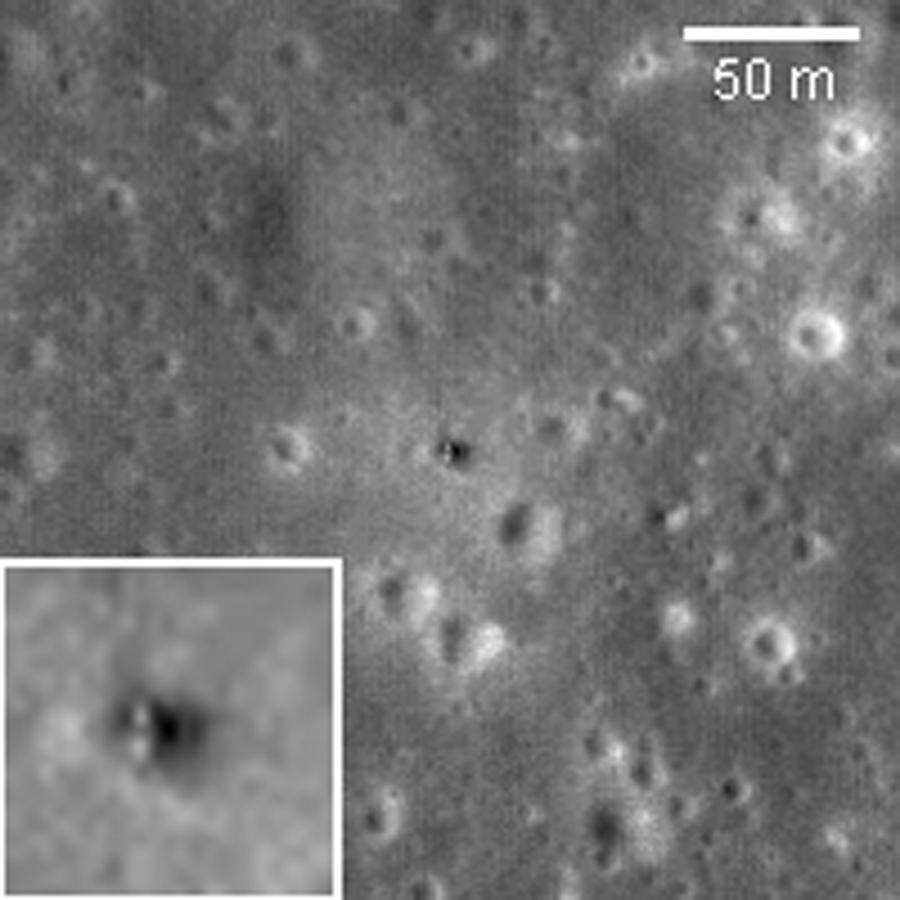 NASA/GSFC/Arizona State University. Public domain (NASA / US government work).
The problem
Section titled “The problem”A robotic sample return has to land on a surface it cannot inspect beforehand, acquire regolith with a mechanism no one can adjust by hand, seal the material, lift off and survive direct reentry. On the Moon the acquisition step is hard for specific reasons: vacuum, a large thermal swing, one-sixth gravity that limits the weight available on the bit, and soil whose density and strength rise steeply within the first meter [2][3].
The top 10 to 15 cm is loosened by micrometeorite gardening [2]. Bulk density runs from about 1.30 g/cm3 at the surface through 1.52 g/cm3 at 10 cm toward an asymptote of 1.92 g/cm3 [2][3]. The in situ mean is 1.50 g/cm3 over the top 15 cm and 1.66 g/cm3 over the top 60 cm [1], and Apollo relative density rises from 65 percent to 92 percent with depth [8]. Thermal and mechanical limits compound this: the diurnal surface swing reaches 374 K at the maximum and 92 K at the minimum, and a permanently shadowed polar crater averages about 40 K [3]. A fixed lander adds one more constraint: the sample site is whatever the arm or drill can reach.
What has flown
Section titled “What has flown”Luna 16 (1970). The first automatic return from another world drilled for 7 minutes to a stop at 35 cm and returned 101 g, with some soil lost during the return [10][11]. Luna 17 carried Lunokhod 1, whose penetrometer made 537 soil measurements over a 10.5 km route [10]; an earlier Apollo-era report counts 327 [7].
Luna 20 (1972). The same drill class reached 25 cm and returned 55 g [11]. Compacted Luna 16 and Luna 20 samples gave internal friction angles of 46 and 32 degrees in Coulomb box tests [5].
Luna 24 (1976). The deepest Soviet penetration: 200 cm of drilling and 170 g returned [11]. The returned core was about 160 cm long [6].
Apollo (1971 to 1972). The Apollo Lunar Surface Drill ran at 280 r/min with 37.8 Hz impact at up to 4.4 J, and Apollo 17 returned 305 cm of core and 110.5 kg [11]. Hand-hammered Apollo 15 to 17 core tubes reached a practical limit near 70 cm after about 50 blows [2]. The Apollo 15 heat flow auger reached 1.5 m against 3.0 m planned [3].
Chang’e-5 (2020). The mission returned 1.731 kg from a 200 cm drilling depth, and its sampling arm repeated positions to better than 1 mm [11]. Another account puts the recovered core at about 1 m against a goal of about 2 m, and records 12 scoops gathering about 1.5 kg [28]. The two figures describe different quantities and the sources do not reconcile them.
Chang’e-6 (2024). The first farside return brought back 1935.3 g [23]. A vision pipeline selected sample points from a binocular point cloud and estimated the sampler pose by point cloud registration [7]. The four-degree-of-freedom arm carried about 30 mm and 2 degrees of absolute error before correction, pose measurement reached 1.1 mm and 0.4 degrees, and scooping depth error was 3.8 mm [7]. The sampling arm reached a 2.8 m radius sector of 120 degrees [7]. The returned farside soil is strongly cohesive: static angle of repose 52.9 degrees, mean particle size 37.3 um [23]. The samples are characterized petrologically in [16].
Lunar PlanetVac. Not a return mission. A pneumatic sampler on the Blue Ghost lander captured 13 g of regolith at Mare Crisium [31]. A later account gives 6.5 cc collected in a five-second sequence with a 1 mm particle separation step [33].
OSIRIS-REx (2020, asteroid Bennu). A non-lunar comparison for gas-driven acquisition: the TAGSAM head carried a 150 g requirement, and ground testing collected as much as about 1.9 kg, with gas-driven collection improving mass by a factor of 4 to 5 over mechanical contact in one comparison [3].
What is being tried now
Section titled “What is being tried now”Rotary-percussive drilling for volatiles (flown to checkout, ground-tested). TRIDENT is a 1 m drill with a 25.4 mm bit, 2 J per blow and up to 972 blows per minute, built as flight units for PRIME-1 and VIPER [32]. The engineering unit drilled nearly 30 m over 337 bites in rock of 4 to 120 MPa below -100 C [32]. The reported flight result is a functional checkout of about 20 minutes that extended the deploy and feed stages to 35 and 100 cm [32]. At Haughton Crater a flight-design drill put 7.80 m of hole in the ground, 2.4 m of it in ice or ice-cemented breccia, and recovered from 5 fault states, but choked in an ice-cemented unit at about 0.26 cm/min [12]. In Antarctica 15 boreholes showed that drill telemetry alone identifies an ice-rock transition near 62 cm, and a percussive spring failed after 80 to 90 m of cumulative drilling [4]. A rover-mounted TRIDENT inside an automated Atacama life-search mission drilled to depth and delivered samples to instruments, and a drill string jammed near 72 to 73 cm in one hole [26].
Thermal and load modeling (ground only). A discrete element model calibrated at -130 C finds an average temperature rise of 2 to 4 C in cryogenic simulant, with 10 to 20 C more at the tool face in vacuum [10]. For auger drills of Chang’e-5 class in dense simulant, weight on bit falls from 72.1 N at 60 r/min to 7.8 N at 200 r/min at 85 mm/min penetration [24].
Pneumatic acquisition (flown once on the Moon). PlanetVac removes the drill reaction problem and has one reported lunar sampling event [31][33]. The Dual-Rasp concept pairs rasp cutters with closed pneumatic sample transfer for an Enceladus lander and was tested in parabolic flight [2].
Vision-guided scooping (flown on the Moon). The Chang’e-6 pipeline is described above [7].
Preserving in situ conditions (proposal and laboratory). All lunar coring to date is regular coring that loses volatiles, vacuum state, bedding and compactness. A proposed method with a polyborosiloxane self-healing seal film reached 99 percent healing efficiency in the laboratory [11].
Mars sample caching and return (flown on Mars, return not flown). The Mars 2020 coring drill takes cores 13 mm in diameter and 76 mm long [27]. Its percussion mechanism operates at 25 to 40 Hz and was life-tested beyond three times the nominal requirement, against a plan of 43 cores and 74 abrasions [8]. The sampling and caching subsystem can return 37 tubes [21]. Curiosity’s drill pressed its stabilizers on the rock with 300 N and drilled holes of 63.94 to 65.86 mm [1]. As of 21 March 2024, Perseverance had filled 21 rock core tubes, and the campaign report records no demonstrated performance for orbiting-sample detection, rendezvous or the transfer arm [18]. The sample transfer arm is a 7 degree-of-freedom, 2.2 m reach design that inserts up to 30 tubes, with 9.35 mm lateral absolute placement error at the orbiting sample container in analysis [11]. No Mars sample has been returned.
Autonomous sampling on ice (ground only). A JPL prototype for the Europa Lander concept ran 58 field tests at glacier sites [5].
The numbers
Section titled “The numbers”| Mission | Drill depth | Sample returned | Source |
|---|---|---|---|
| Luna 16 | 35 cm | 101 g | [10][11] |
| Luna 20 | 25 cm | 55 g | [11] |
| Luna 24 | 200 cm | 170 g, core about 160 cm | [11][6] |
| Apollo 17 | 305 cm | 110.5 kg | [11] |
| Chang’e-5 | 200 cm | 1.731 kg | [11] |
| Chang’e-6 | surface scoop | 1935.3 g | [23] |
| System | Status | Figures | Source |
|---|---|---|---|
| TRIDENT | flight checkout, ground-tested | 26.5 kg with avionics, 19.5 kg mechanism, 25.4 mm bit, 2 J per blow | [32][4] |
| Lunar PlanetVac | one lunar event | 13 g; 6.5 cc in 5 s | [31][33] |
| Rock Abrasion Tool | flown on Mars | 489 g, 10 W | [12][9] |
| DAME drill | field trial | 3.2 m, under 150 W, 5 of 6 fault types recovered | [9] |
| MARTE drill | field trial | 6.1 m | [9] |
Soil properties from the Soviet and Apollo programs:
- Soviet synthesis: porosity 0.8, modal bearing capacity 0.35 to 0.40 kg/cm2, cohesion 0.04 to 0.06 kg/cm2, friction angle 20 to 25 degrees [5].
- Lunokhod 1 cone penetrometer: 8.1 cm at 16.5 kgf on horizontal intercrater ground, 7.8 cm at 19 kgf on a crater rim, 20.5 cm at 23.5 kgf on a crater slope, 5.9 cm at 23 kgf on a stony section [4].
- Fitted depth model: total shear strength 7.4 kPa at 1 m, porosity 40 to 50 percent [2].
- Apollo logarithmic law: density 1.27 plus 0.121 ln(z+1) g/cm3 with z in cm [8].
- Intercrater friction angle and cohesion: 42 degrees and 0.52 kPa over 0 to 15 cm, 54 degrees and 3.0 kPa over 30 to 60 cm [1].
What is not established
Section titled “What is not established”- The LPI Luna 24 volume contains no drill description, load, power or retention record; it is geochemistry [6].
- Core length is about 160 cm in most contributions and about 191 cm total subsurface depth in one, and the volume does not reconcile them [6]. It also records a gabbro fragment broken up by drilling and an abundance spike at 149 cm attributed to breccia crushed into the core tube [6].
- Chang’e-5 recovered core length and drilling depth are reported as different figures that the sources do not reconcile [28][11].
- The Soviet soil values are quoted from a projected figure, with several depths interpreted from curve shape, and the Lunokhod and Apollo penetrometers sampled depths too different to compare directly [4].
- Shear strength below about 1 m is extrapolated from a fitted curve, the 3 m stable-wall figure is an analytical scaling, and the data come from equatorial and mid-latitude sites, not polar regolith [2].
- TRIDENT has reported no drilled hole on the Moon [32], and PlanetVac has one reported event [31][33].
- Mars sample return has no returned hardware, and orbiting-sample rendezvous and transfer arm performance are not reported [18].
References
Section titled “References”References
- Carrier, W. D. I., Olhoeft, G. R. and Mendell, W. (1991). Physical Properties of the Lunar Surface
. Lunar Sourcebook: A User's Guide to the Moon. Source
BibTeX
@incollection{carrier1991physical, title = {Physical Properties of the Lunar Surface}, author = {Carrier, W. David, III and Olhoeft, Gary R. and Mendell, Wendell}, editor = {Heiken, Grant H. and Vaniman, David T. and French, Bevan M.}, booktitle = {Lunar Sourcebook: A User's Guide to the Moon}, pages = {475--594}, publisher = {Cambridge University Press}, chapter = {9}, year = {1991}, url = {https://www.lpi.usra.edu/publications/books/lunar_sourcebook/pdf/Chapter09.pdf} } - Connolly, J. F. and Carrier, W. D. (2023). An Engineering Guide to Lunar Geotechnical Properties
. IEEE Aerospace Conference. Source
BibTeX
@inproceedings{connolly2023engineering, title = {An Engineering Guide to Lunar Geotechnical Properties}, author = {Connolly, John F. and Carrier, W. David}, booktitle = {IEEE Aerospace Conference}, pages = {1-9}, address = {Big Sky, Montana}, year = {2023}, doi = {10.1109/aero55745.2023.10115961}, abstract = {The renewed interest in returning human and robotic explorers to the lunar surface has identified a need for a renewed understanding of lunar geotechnical properties related to landing, exploration, excavation, and construction activities on the lunar surface. This paper summarizes measurements conducted during US and Russian/Soviet landed missions as well as experiments performed on returned samples to establish fundamental geotechnical properties such as particle size distribution, particle shape, bulk density, shear strength, cohesion and bearing strength. While many of these properties are well known, how they vary with increased lunar soil depth is less understood, and those properties that vary significantly as a function of depth are explored in additional detail. Selected examples discuss mechanical excavation forces, rocket exhaust erosion forces, and the preparation of launch/landing pad surfaces, with the goal of a better understanding of lunar soil geotechnical properties that apply to large-scale exploration of the lunar surface and dictate the design of future exploration systems.} } - Heiken, G. H., Vaniman, D. T. and French, B. M. (1991). Lunar Sourcebook: A User's Guide to the Moon
. Endeavour. Source
BibTeX
@book{heiken1991lunar, title = {Lunar Sourcebook: A User's Guide to the Moon}, author = {Heiken, Grant H. and Vaniman, David T. and French, Bevan M.}, journal = {Endeavour}, volume = {16}, pages = {96}, publisher = {Cambridge University Press}, year = {1991}, doi = {10.1016/0160-9327(92)90014-g} } - Johnson, S. W. and Carrier, W. D. I. (1972). Soil mechanics results of Luna 16 and Lunokhod 1: A preliminary report
. NASA, 19720007196. Source
BibTeX
@techreport{johnson1972soil, title = {Soil mechanics results of Luna 16 and Lunokhod 1: A preliminary report}, author = {Johnson, S. W. and Carrier, W. D., III}, number = {19720007196}, institution = {NASA}, year = {1972}, url = {https://ntrs.nasa.gov/citations/19720007196}, abstract = {The physical and mechanical properties of the lunar soil, as determined by Luna 16 and Lunokhod 1 experiments, are discussed. Data are included for interactions between vehicle wheels and the lunar soil, compressibility, resistance to penetration, and friction characteristics of the soil. The shear strength of the returned lunar soil for various bulk densities is also examined. Several potential spacecraft materials were tested in contact with lunar soil to determine their friction and wear characteristics.} } - Leonovich, A. K., Gromov, V. V., Dmitriyev, A. D., Penetrigov, V. N., Semyonov, P. S. and Shvarev, V. V. (1978). The main peculiarities of the processes of the deformation and destruction of lunar soil
. The Soviet-American Conference on Cosmochemistry of the Moon and Planets, 19780005029. Source
BibTeX
@inproceedings{leonovich1978main, title = {The main peculiarities of the processes of the deformation and destruction of lunar soil}, author = {Leonovich, A. K. and Gromov, V. V. and Dmitriyev, A. D. and Penetrigov, V. N. and Semyonov, P. S. and Shvarev, V. V.}, booktitle = {The Soviet-American Conference on Cosmochemistry of the Moon and Planets}, number = {19780005029}, institution = {NASA}, year = {1978}, url = {https://ntrs.nasa.gov/citations/19780005029}, abstract = {The main results of study of the physical and mechanical properties of lunar soil, obtained by laboratory study of samples returned from the moon by Luna 16 and Luna 20, as well as by operation of the self-propelled Lunokhod 1 and Lunokhod 2 on the surface of the moon, are analyzed in the report. All studies were carried out by single methods and by means of unified instruments, allowing a confident comparison of the results obtained. The investigations conducted allowed the following values of the main physical-mechanical properties of lunar soil to be determined: in the natural condition the solid density corresponds to the porosity of 0.8; the modal value of the carrying capacity is 0.4 kg/square cm; adhesion is 0.04 to 0.06 kg/square cm; and the internal angle of friction is 20 to 25 degree. The main mechanisms of deformation and destruction of the soil are analyzed in the report, and the relationships between the mechanical properties and physical parameters of the soil are presented.} } - Lunar and Planetary Institute. (1977). Papers presented to the Conference on Luna 24
. Lunar and Planetary Institute, NASA-CR-154527. Source
BibTeX
@techreport{lpi1977papers, title = {Papers presented to the Conference on Luna 24}, author = {Lunar and {Planetary Institute}}, number = {NASA-CR-154527}, institution = {Lunar and Planetary Institute}, year = {1977}, url = {https://ntrs.nasa.gov/citations/19780004019}, abstract = {Topics covered include: the regional geology, geochemistry, and geophysics of Mare Crisium and the Luna 24 landing site; the petrology, mineral chemistry, and cooling histories of lithic fragments, the chemistry, isotopic studies, and geochronology of Luna 24 samples; and regolith studies of soil samples. Subject and topical indexes are provided.} } - Mitchell, J. K., Houston, W. N., Scott, R. F., Costes, N. C., Carrier, W. D. and Bromwell, L. G. (1972). Mechanical properties of lunar soil: Density, porosity, cohesion, and angle of internal friction
. Lunar Science Conference. Source
BibTeX
@inproceedings{mitchell1972mechanical, title = {Mechanical properties of lunar soil: Density, porosity, cohesion, and angle of internal friction}, author = {Mitchell, James K. and Houston, William N. and Scott, Ronald F. and Costes, Nicholas C. and Carrier, W. D. and Bromwell, L. G.}, booktitle = {Lunar Science Conference}, volume = {3}, pages = {3235--3253}, publisher = {The M.I.T. Press}, year = {1972}, url = {https://articles.adsabs.harvard.edu/pdf/1972LPSC....3.3235M} } - Mitchell, J. K., Carrier, W. D. I., Costes, N. C., Houston, W. N., Scott, R. F. and Hovland, H. J. (1974). Apollo soil mechanics experiment S-200
. NASA, NASA-CR-134306. Source
BibTeX
@techreport{mitchell1974apollo, title = {Apollo soil mechanics experiment S-200}, author = {Mitchell, James K. and Carrier, W. D., III and Costes, Nicholas C. and Houston, William N. and Scott, Ronald F. and Hovland, H. John}, number = {NASA-CR-134306}, institution = {NASA}, year = {1974}, url = {https://ntrs.nasa.gov/citations/19740019219}, abstract = {The physical and mechanical properties of the unconsolidated lunar surface material samples that were obtained during the Apollo missions were studied. Sources of data useful for deduction of soil information, and methods used to obtained the data are indicated. A model for lunar soil behavior is described which considers soil characteristics, density and porosity, strength, compressibility, and trafficability parameters. Lunar history and processes are considered, and a comparison is made of lunar and terrestrial soil behavior. The impact of the findings on future exploration and development of the moon are discussed, and publications resulting from lunar research by the soil mechanics team members are listed.} } - Paulsen, G., Zacny, K., Chu, P., Mumm, E., Davis, K., Frader-Thompson, S., Petrich, K., Glaser, D., Bartlett, P., Cannon, H. and Glass, B. (2006). Robotic Drill Systems for Planetary Exploration
. SpaceOps Conference. Source
BibTeX
@inproceedings{paulsen2006robotic, title = {Robotic Drill Systems for Planetary Exploration}, author = {Paulsen, Gale and Zacny, Kris and Chu, Phil and Mumm, Erik and Davis, Kiel and Frader-Thompson, Seth and Petrich, Kyle and Glaser, David and Bartlett, Paul and Cannon, Howard and Glass, Brian}, booktitle = {SpaceOps Conference}, publisher = {American Institute of Aeronautics and Astronautics}, year = {2006}, doi = {10.2514/6.2006-7512} } - Siddiqi, A. A. (2018). Beyond Earth: A Chronicle of Deep Space Exploration, 1958-2016
. NASA, NASA SP-2018-4041. Source
BibTeX
@book{siddiqi2018beyond, title = {Beyond Earth: A Chronicle of Deep Space Exploration, 1958-2016}, author = {Siddiqi, Asif A.}, number = {NASA SP-2018-4041}, publisher = {NASA}, year = {2018}, url = {https://www.nasa.gov/wp-content/uploads/2018/09/beyond-earth-tagged.pdf} } - Xie, H., Liu, J., Li, C., Gao, M., Zhang, Z. and Yang, M. (2022). The novel idea and technical progress of lunar in-situ condition preserved coring
. Geomechanics and Geophysics for Geo-Energy and Geo-Resources. Source
BibTeX
@article{xie2022novel, title = {The novel idea and technical progress of lunar in-situ condition preserved coring}, author = {Xie, Heping and Liu, Jianfeng and Li, Cunbao and Gao, Mingzhong and Zhang, Zetian and Yang, Mingqing}, journal = {Geomechanics and Geophysics for Geo-Energy and Geo-Resources}, volume = {8}, pages = {46}, year = {2022}, doi = {10.1007/s40948-022-00350-0}, abstract = {Abstract The moon is rich in material resources, lunar-based sampling is the foundation for an in-depth understanding of lunar material resources endowment characteristics, exploring the evolution of lunar geological structure, and realizing lunar material resources exploitation. This paper briefly introduces the lunar sampling work represented by the Apollo program of the United States, the Luna program of the former Soviet Union, and China’s Chang’E-5 lunar exploration mission, a total of 10 times of successful coring were performed, with a maximum coring depth of 305 cm and a maximum sampling of 110.5 kg. It presents an in-depth analysis of the inadequacy of the existing lunar coring principles and technologies. This paper expounds on the critical strategic significance and scientific value of lunar in-situ condition preserved coring (ICP-Coring). Simultaneously, this paper firstly refines the scientific concept of lunar ICP-Coring in the field of deep space material resources exploitation as the "four preservations" coring (preservation of composition, vacuum storage, stratification/bedding, and compactness)—the "4 Ps" coring, puts forward the fundamental principles, conception, breakthrough theory, and critical core technology of the "4 Ps" lunar ICP-Coring. It explains the latest research progress, including core drilling machinery, film-forming mechanism while drilling, and a platform for fidelity coring testing and analysis under a simulated lunar environment. The research results provide theoretical and technical support for lunar ICP-Coring and resource exploration.} } - Zacny, K., Bar-Cohen, Y., Brennan, M., Briggs, G., Cooper, G., Davis, K., Dolgin, B., Glaser, D., Glass, B., Gorevan, S., Guerrero, J. and McKay, C. (2008). Drilling Systems for Extraterrestrial Subsurface Exploration
. Astrobiology. doi.org/10.1089/ast.2007.0179
BibTeX
@misc{zacny2008drilling,
  title = {Drilling Systems for Extraterrestrial Subsurface Exploration},
  author = {Zacny, Kris and Bar-Cohen, Yoseph and Brennan, Marc and Briggs, Gary and Cooper, Guy and Davis, Kenneth and Dolgin, Benjamin and Glaser, David and Glass, Brian and Gorevan, Stephen and Guerrero, Julio and McKay, Christopher},
  journal = {Astrobiology},
  volume = {8},
  pages = {665-706},
  year = {2008},
  doi = {10.1089/ast.2007.0179},
  abstract = {Drilling consists of 2 processes: breaking the formation with a bit and removing the drilled cuttings. In rotary drilling, rotational speed and weight on bit are used to control drilling, and the optimization of these parameters can markedly improve drilling performance. Although fluids are used for cuttings removal in terrestrial drilling, most planetary drilling systems conduct dry drilling with an auger. Chip removal via water-ice sublimation (when excavating water-ice-bound formations at pressure below the triple point of water) and pneumatic systems are also possible. Pneumatic systems use the gas or vaporization products of a high-density liquid brought from Earth, gas provided by an in situ compressor, or combustion products of a monopropellant. Drill bits can be divided into coring bits, which excavate an annular shaped hole, and full-faced bits. While cylindrical cores are generally superior as scientific samples, and coring drills have better performance characteristics, full-faced bits are simpler systems because the handling of a core requires a very complex robotic mechanism. The greatest constraints to extraterrestrial drilling are (1) the extreme environmental conditions, such as temperature, dust, and pressure; (2) the light-time communications delay, which necessitates highly autonomous systems; and (3) the mission and science constraints, such as mass and power budgets and the types of drilled samples needed for scientific analysis. A classification scheme based on drilling depth is proposed. Each of the 4 depth categories (surface drills, 1-meter class drills, 10-meter class drills, and deep drills) has distinct technological profiles and scientific ramifications.}
}