Rashid
Program pages MBRSC: Rashid Rover
 MBRSC.
Overview
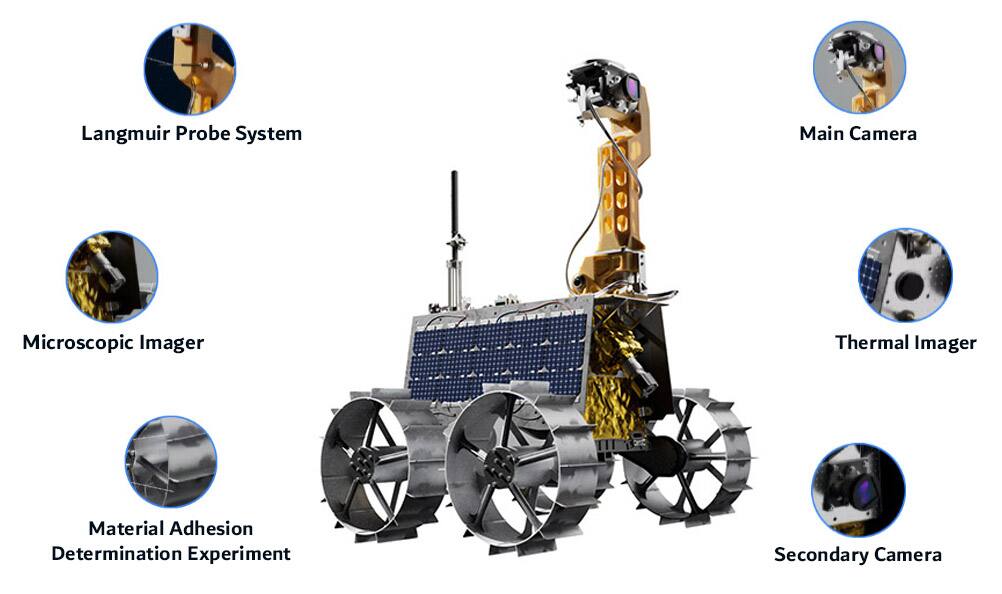
Section titled “Overview”Rashid-1 was a 10 kg four-wheeled micro-rover built by the Mohammed Bin Rashid Space Centre (MBRSC) as the first vehicle of the Emirates Lunar Mission, a program to fly a series of rovers named Rashid to different lunar sites with different science objectives [12]. It had to survive launch and a lander delivery, drive on loose regolith with grousered wheels, and return imagery and science data from a mid-latitude site, while the lander and a remote operator on Earth were the only support. It was carried on the ispace Hakuto-R Mission 1 lander and never reached the surface [8], so every statement about its surface performance is a ground measurement, a model or an orbital estimate, not flight data.
Lunar rover programs of this period have a mixed record: a 2024 survey counts nine lunar landers launched from 2019 to 2024, four of them failed [2]. Rashid-1 belongs to the failed group, and the cause lay in the lander’s descent software, not in the rover.
Specifications
Section titled “Specifications”| Parameter | Value |
|---|---|
| Mass | about 10 kg |
| Wheels | 4, grousered |
| Slope capability | 20 degrees |
| Rock height capability | 10 cm maximum |
| Cameras | 2 wide-field CASPEX cameras [10] |
| Power | solar panel at a fixed angle |
| Wheel radius, test wheel | 100 mm [7] |
MBRSC does not publish dimensions, drive speed, battery capacity or operating temperature range on its current pages [12].
Mission profile
Section titled “Mission profile”The lander launched on 11 December 2022 and began its descent at 00:40 Japan Standard Time on 26 April 2023 (25 April UTC) from about 100 km altitude, completed the planned deceleration and reached under 1 m/s in a vertical attitude [8]. At the scheduled landing time its own altitude estimate read zero while it was about 5 km above the surface, and it kept descending slowly until the propulsion system ran out of propellant and is believed to have free-fallen [8].
The root cause was software. Crossing a crater rim about 3 km in elevation made the sensed altitude jump, and a filter built to reject altitude measurements far from the propagated estimate, included to protect against sensor hardware faults, treated the sensor as faulty and intercepted all later measurements [8]. A landing site change made after the February 2021 critical design review was not carried through into the landing simulations, so the terrain along the navigation route was not represented [8]. The operator’s account is a press release with no filter threshold, sensor identification or telemetry. The second ispace attempt, in June 2025, failed by a different mechanism: a laser range finder that was slow to return measurements left the descent speed uncorrected, and the lander struck at 42 m/s, per trade press reporting of the operator’s statement [11].
Other lunar landings of the period
Section titled “Other lunar landings of the period”Two later landings show how the surface phase fares once a lander arrives. SLIM took 14 vision-based navigation fixes from orbit through the vertical descent, and comparison of its two 50 m hover images against the planned target gave a 3.4 m position error, against a 100 m requirement [20]. One of two main engines then lost most of its thrust, the lander drifted about 60 m east and came to rest tilted roughly 90 degrees from plan; the paper does not diagnose the cause [20]. The crater-matching navigation and obstacle detection behind that result are documented with Monte Carlo, hardware-in-the-loop and flight validation, though the authors flag the Monte Carlo accuracy as optimistic and the flight is a single sample [21]. The project lead’s review credits mass reduction measures: a ceramic main engine, thin film solar cells on the tank and crushable porous metal absorbers used with a deliberate two-step tip-over landing [22]. Intuitive Machines IM-2 touched down on 6 March 2025 about 250 m from its site, on its side in a crater at Mons Mouton, and was declared over the next day because the attitude and the cold left no expectation of recharging [23]. Chandrayaan-3 is the only one of these whose rover completed a traverse; ISRO’s specification page lists the lander’s laser and Ka-band altimeters, velocimeter and hazard detection camera, but gives no measured sensor performance [24]. Rashid-1 flew none of this: its lander carried it to an altitude of about 5 km and no further [8].
Landing site selection
Section titled “Landing site selection”The prime site was Atlas crater, with Sinus Iridum, Oceanus Procellarum and Lacus Somniorum as back-ups [3]. Candidate ellipses were screened with slope statistics from Kaguya Terrain Camera and LRO Narrow Angle Camera terrain models, Diviner rock abundance and Mini-RF circular polarization ratio [3]. The authors show the Kaguya slopes (6.7 to 8.0 degrees mean) are inflated by stereo noise against the NAC-scale values (1.9 to 4.8 degrees mean), so only the NAC figures are operative.
A companion study mapped 3,413 craters for regolith thickness and 32,012 boulders in the four 8 km ellipses [9]. Regolith thickness does not follow surface age: Atlas, at 3.8 Gyr, has the thinnest regolith at a 1.2 m median, and Sinus Iridum, at 3.4 Gyr, the thickest at 2.9 m. Boulder density does not track thickness either, and Atlas combines thin regolith with 144 boulders per square kilometer. Manual boulder counts agree with Diviner rock abundance at every site, which supports using the global map for hazard screening, while Mini-RF does not correlate with Diviner [9].
Crater-based thickness estimation rests on stochastic regolith production models. One such model adds the breccia lens to the ejecta blanket and, for a region near Apollo 15, gives 3.85 m, which matches the 4.4 m seismic value only after an added 0.5 m of exotic ejecta [5]. All of these are orbital inferences of geometry. None gives bearing strength or cohesion, and none was checked on the surface [3][9].
Surface strength is the quantity orbital screening cannot supply. Returned Chang’e-6 farside regolith has a static angle of repose of 52.9 degrees and a dynamic angle of 70.4 degrees from a 5 g sample, above every Chang’e-5 and Apollo simulant, with D60 of 48.4 micrometers and sphericity of 0.58 [26]. A single 5 g laboratory sample at 1 g does not carry over to a wheel, but it shows that soil at an unvisited site may be more cohesive than the simulants used to qualify wheels. Simulant cohesion is also not a material constant: direct shear of thirteen simulants and controls shows cohesion rising exponentially with bulk density, spanning 0.185 to 1.672 kPa for lunar simulants over the densities reachable in the apparatus [29]. An open database consolidating in situ, returned-sample and remote regolith property measurements notes that nearly all in situ data comes from equatorial and mid-latitude near-side sites, with essentially none from the poles [30].
Mobility
Section titled “Mobility”Terramechanics for Rashid-1 rests on single-wheel work at three institutions, none at lunar gravity.
The MBRSC-supported study ran a grousered wheel on a single-wheel rig in MBRSC regolith simulant at wheel speed 3 cm/s, one normal load and 1 g, at slip ratios of 0 to 0.75 [1]. Measured values:
| Slip ratio | Drawbar pull, measured | Normal force, measured | Sinkage, measured |
|---|---|---|---|
| 0.00 | 5.2 N | 62 N | 0.010 m |
| 0.25 | 10.10 N | 62.3 N | 0.0158 m |
| 0.50 | 16.77 N | 62.1 N | 0.0169 m |
| 0.75 | 24.1 N | 62.1 N | 0.0192 m |
Drawbar pull and sinkage rise with slip while normal force stays near 62 N; at zero slip only the grousers penetrate [1]. The model in that paper is a Reece-type pressure-sinkage relation with a sinusoidal grouser term. It does not establish predictive accuracy: with measured soil parameters it gave 6.2 N against 10.2 N measured at 0.25 slip, the parameters were then tuned by trial and error against that same case, and the agreement reported at the other slips includes the fitted point [1]. The fitted cohesion is zero, there are no repeat runs or error statistics, and the claim of improvement over a reference theoretical model has no comparison column in the paper [1]. The measured columns are usable; the model is not shown to predict.
A Tohoku study used a 100 mm radius grousered wheel of Rashid-1 style in Toyoura sand and FJS-1 simulant at the 24.5 N flight load, with a discrete element model calibrated against angle of repose only [7]. The model predicts that at lunar gravity (4.1 N load) traction coefficient and tractive efficiency are essentially unchanged while tractive force and resistive torque fall by about one sixth, so a 1 g test at the flight load is a fair stand-in for traction coefficient but not for absolute force. Toyoura sand underestimates traction coefficient by 15 to 20 percent and overestimates sinkage by 3 to 4 mm against the lunar simulant [7]. The lunar gravity figures are model output, the test wheel is closed with 20 mm grousers against the flight skeletonized wheel with 15 mm, and particles are scaled 10 to 13 times, which the authors identify as the likely cause of a diverging trend for FJS-1 at high slip. Grouser trace pitch depends only on geometry and slip, which makes a visual trace a candidate slip odometer.
The Tohoku single-wheel program is the larger part of the Rashid-1 wheel record. Four grouser patterns (parallel, slanted, V and offset V) were compared on the Tohoku single-wheel testbed in Toyoura sand, with slip ratio differing by under 10 percent between shapes and sinkage, torque and side force separating at high slip, then on a 15 degree slope with a 6.1 kg four-wheeled rover [13]. Rut profiles from a 1.18 kg scale model of the wheel at 25, 40 and 65 N and a fixed 20 percent slip were scanned by LiDAR and fitted with an inclined sine function, on a single soil and nine runs [15]. Tests of a different wheel up to 1.0 m/s, roughly a hundred times flown rover speeds, found that a slick wheel needs a slip ratio of 0.25 before drawbar pull becomes positive, against about 0.1 at 0.2 m/s; the discrete element model disagreed with the experiment on this trend [14]. This bears on any traction table taken at crawl speed.
Predicting lunar-gravity traction from 1 g tests is unresolved [17][18][34]. A discrete element study of a 150 mm grousered wheel in FJS-1 proposes an enhanced granular scaling law to predict slip, sinkage and power on slopes of plus or minus 10 degrees at lunar gravity from 1 g runs [17]. A comparison of scaling laws for straight-grousered and helical wheels in silica sand and BP-1 was re-evaluated in gravity-variant simulation at lunar gravity [18]. Both are model results with no hardware at lunar gravity, and the parabolic-flight experiments of [34] are the direct experimental test. Experimental reduced-gravity soil work points the same direction without involving wheels: magnetic levitation cone penetration in CUMT-1 simulant at 1/6 g gave resistance about 29.1 percent below 1 g at 40 percent relative density, with a strong dependence on density and a simulant that is 40 percent magnetite [31]. In a drop tower at 0.19 g, JSC-1A flowing through a hopper clogged where it flowed freely at 1 g, one run per gravity level, which the authors explain with the granular Bond number [28]. Cohesion relative to weight therefore changes with gravity, and a 1 g wheel test at the flight load does not reproduce it.
Wheels flown or proposed for the Moon show what the design space looks like. LEV-1’s single wheel uses a 90-degree-tilted octagonal grouser chosen by a resistive force theory model, validated in Tohoku silica sand and DEM, and its operation after the January 2024 SLIM landing is cited as confirmation [16]; the post-landing briefing reports six hops, confirmed by the change in sensed gravity across each hop [35]. LEV-2/SORA-Q, a 250 g sphere of about 8 cm, was field tested in silica sand at 1 g at roughly 21.6 to 24.4 mm/s with no lunar performance data [6]. Photogrammetry on two partly corrupted images puts its motion at about 0.13 m and 180 degrees of rotation [36]. A simulation study of a 137 kg six-wheel Yutu model in a continuum representation model finds that single-wheel results divided by six match full-rover per-wheel force on flat symmetric terrain, and it has not been compared with Yutu telemetry [19]. Chandrayaan-3’s Pragyan rover left no detectable continuous tracks at 25 cm orbital resolution, but its in-place 180 degree turns disturbed patches about 1 m across and eight were recovered by image differencing, correlated against commanded turn identifiers rather than independently [25]. Ground-only concepts include a variable grouser-height wheel (0 to 17.5 mm, 750 trials on a gantry with fixed load) [32] and the DLR SCOUT rimless wheel spokes, compared on five runs per condition on one rover [33].
Other lunar micro-rover programs bracket the design space. A NASA Glenn testbed of 20.4 kg with passive averaging-arm suspension sweeps wheel geometry, load and center of gravity; its results are pass or fail observations only, with no drawbar pull, slip or sinkage data [4].
Power, thermal, compute
Section titled “Power, thermal, compute”Solar panels are fixed at an angle chosen to maximize collection. No generation figure, battery capacity, thermal design values, processor or radiation approach is published for Rashid-1 in the sources held here [12].
Autonomy and communications
Section titled “Autonomy and communications”Rashid-1 was teleoperated. Two wide-field cameras supported driving and situational awareness, and no onboard autonomous navigation is published [12]. Two communications channels were planned: a primary link through the lander and a secondary, slower link independent of the lander that also served the planned lunar night recovery phase [12].
Payload and instruments
Section titled “Payload and instruments”| Instrument | Function |
|---|---|
| CAM-M microscopic imager | regolith particle size distribution and surface structure at microscopic scales |
| LNG Langmuir probe | electron density profile of the surface sheath through the lunar day |
| CAM-T thermal imager | low spatial resolution thermal imaging |
| MAD | adhesion and abrasion of materials against regolith |
| CAM-1 and CAM-2 | wide-angle imaging and navigation [10] |
The two CASPEX cameras have an 82 degree field of view per axis, 7.8 mm focal length at about f/8 and a CMV4000 detector, giving about 0.7 mrad per pixel, or 0.7 mm at 1 m [10]. Photon response non-uniformity is under 1.35 percent peak on the flight models and was left uncorrected. Lab testing found an optical ghost much larger than expected, clearly visible near the optical axis and non-linear in incidence angle, which could not be modeled and shipped uncorrected [10]. Image processing was exercised on the engineering model in a sand box, and the CNES CASPIP2 package built for it is expected to be reused for the MMX rover. The same CASPEX sensor is reused in the WheelCams of the IDEFIX Phobos rover, which are intended to return sinkage, slip and particle size data; nothing has flown, and the surface properties listed are objectives [27]. Intended science was lunar geology, surface alteration, solar wind interaction and materials suitability [12].
Technologies developed
Section titled “Technologies developed”The transferable results are ground characterizations: the single-wheel traction data for a sub-500 mm grousered wheel [1][7], the camera calibration chain including the unmodelable ghost [10], and the orbital landing-site screening workflow [3][9]. The Emirates Lunar Mission continues with Rashid 2, whose stated objectives are surface geological and thermal properties, electron sheath charging across the lunar day, and materials, mobility and terramechanics experiments, with no mass, wheel or lander published [12].
What is not established
Section titled “What is not established”Nothing about Rashid-1 was measured on the Moon. Traction values come from 1 g single-wheel rigs with non-flight wheels or simulants [1][7], and lunar gravity values are discrete element model output [7]. The wheel-terrain model of [1] is calibrated, not validated. Site terrain statistics are orbital inferences with no ground truth [3][9]. The Mission 1 root cause is the operator’s own statement without supporting data [8], and the Mission 2 account is secondary reporting [11]. Rashid 2 is described by objectives only [12]. No lunar-gravity wheel measurement exists for the Rashid wheel, and scaling methods from 1 g are checked only against other simulations [17][18]. The LEV-1, LEV-2 and Pragyan evidence is a few short surface episodes [25], and the SLIM and IM-2 accounts do not give failure causes [20][23].
References
- Abubakar, A., Alhammadi, R., Zweiri, Y. and Seneviratne, L. (2023). Advance Simulation Method for Wheel-Terrain Interactions of Space Rovers: A Case Study on the UAE Rashid Rover
. arXiv preprint arXiv:2308.12431. Source
BibTeX
@article{abubakar2023advance, title = {Advance Simulation Method for Wheel-Terrain Interactions of Space Rovers: A Case Study on the UAE Rashid Rover}, author = {Abubakar, Ahmad and Alhammadi, Ruqqayya and Zweiri, Yahya and Seneviratne, Lakmal}, journal = {arXiv preprint arXiv:2308.12431}, pages = {526-532}, year = {2023}, doi = {10.1109/icar58858.2023.10406669}, abstract = {A thorough analysis of wheel-terrain interaction is crucial to ensure the safe and efficient operation of space rovers on extraterrestrial surfaces like the Moon or Mars. This paper presents an approach for developing and experimentally validating a novel virtual simulation method for the wheel-terrain interaction of the UAE Rashid rover's wheel. Specifically, the method is developed based on the modified Reece tire model in conjunction with the Grouser effect as an additional factor. The proposed method aims to improve the fidelity and capability of current simulation methods for space rovers. It considers various factors, such as wheel properties, wheel slippage, loose soil properties, and interaction mechanics. Moreover, the developed simulation method was validated through sets of experiments on a Test-rig that simulated lunar soil conditions. These experiments were carried out with different slip ratios of 0.00, 0.25, 0.50, and 0.75, to test the behaviors acted on the rover's wheel by the lunar soil. The obtained results demonstrate that the proposed simulation method provides an accurate and realistic simulation of the wheel-terrain interaction behavior, achieving an overall prediction accuracy of 95.57%.} } - Chien, S. A., Visentin, G. and Basich, C. (2024). Exploring Beyond Earth using Space Robotics: Update
. Science Robotics. Source
BibTeX
@article{chien2024exploring, title = {Exploring Beyond Earth using Space Robotics: Update}, author = {Chien, Steve A. and Visentin, Gianfranco and Basich, Connor}, journal = {Science Robotics}, publisher = {JPL Open Repository}, year = {2024}, doi = {10.48577/jpl.2ezlhn}, abstract = {Robotic spacecraft enable exploration of our solar system, beyond our human presence. While spacecraft have explored every planet in the solar system, the frontiers of space robotics are at the cutting edge of landers, rovers, and now atmospheric explorers where robotic spacecraft must interact intimately with their environment to explore beyond the reach of flyby and orbital remote sensing.In 2017, we surveyed space robotics - telling the rich history of robotic explorers to the Moon, Mars, and beyond. In this article, we describe the tremendous growth in space robotics missions in the period 2017-2024 with many new entities participating in missions to the surface of the Moon, Mars, and beyond. We also describe the recent development of aerial missions to planets and moons as exemplified by the Ingenuity helicopter on Mars, the Dragonfly mission to Titan, and the planned Sample Recovery Helicopter to Mars. As with the 2017 survey, we seek to provide a big picture of developments and directions in space robotics. Additionally, we focus on sub orbital robotics - landers, rovers, and aerial vehicles, with associated challenges in sensing, manipulation, and mobility.} } - Flahaut, J., Els, S., Joulaud, M., Wöhler, C., Breton, S., Füri, E., Almaeeni, S. and Almarzooqi, H. (2024). Candidate Landing Sites for the Emirates Lunar Mission (ELM) Rashid-1 Rover
. Space Science Reviews. Source
BibTeX
@article{flahaut2024candidate, title = {Candidate Landing Sites for the {Emirates Lunar Mission} ({ELM}) {Rashid-1} Rover}, author = {Flahaut, Jessica and Els, Sebastian and Joulaud, Marine and Wöhler, C. and Breton, Sylvain and Füri, Evelyn and Almaeeni, Sara and Almarzooqi, Hamad}, journal = {Space Science Reviews}, volume = {220}, pages = {58}, year = {2024}, doi = {10.1007/s11214-024-01086-x} } - Gerdts, S., Breckenridge, J. and Johnson, K. (2022). Lunar Rover Optimization Platform for Wheel Traction Studies
. NASA Glenn Research Center, 20200003006. Source
BibTeX
@techreport{gerdts2022lunar, title = {Lunar Rover Optimization Platform for Wheel Traction Studies}, author = {Gerdts, Stephen and Breckenridge, John and Johnson, Kyle}, number = {20200003006}, institution = {NASA Glenn Research Center}, year = {2022}, doi = {10.26226/m.632b0aa4f30377bc3bafa246}, abstract = {Robotic mobility systems expand the reach of future scientific and exploration missions to celestial bodies. Understanding the traction performance of these systems is necessary knowledge that informs mission-level requirements, such as power budgets and navigation envelopes. This paper covers the design, development, and verification of the four wheeled Lunar Rover Optimization Platform (LROP). This mass optimized platform is targeted to emulate future medium class rovers weighing up to 90 kg. The LROP has the ability to conduct various wheel design experiments such as obstacle traversal, slope ascent, and drawbar pull over a wheel loading range of 4.5 to 22.7 kg. The platform also has the ability to shift its center of gravity (CG) laterally and longitudinally to explore the CG shift effects on mobility performance. This knowledge is valuable for future rover designers exploring different payload packaging solutions. In this paper results from obstacle traversal test with varying angle of attack (AOA) and longitudinal CG position are reported along with results from slope ascent testing which proved-out the LROPs capabilities.} } - Hirabayashi, M., Howl, B. A., Fassett, C. I., Soderblom, J. M., Minton, D. A. and Melosh, H. J. (2018). The role of breccia lenses in regolith generation from the formation of small, simple craters: Application to the Apollo 15 landing site
. Journal of Geophysical Research: Planets. Source
BibTeX
@article{hirabayashi2018breccia, title = {The role of breccia lenses in regolith generation from the formation of small, simple craters: Application to the Apollo 15 landing site}, author = {Hirabayashi, Masatoshi and Howl, B. A. and Fassett, Caleb I. and Soderblom, Jason M. and Minton, D. A. and Melosh, H. Jay}, journal = {Journal of Geophysical Research: Planets}, volume = {123}, pages = {527-543}, publisher = {American Geophysical Union (AGU)}, year = {2018}, doi = {10.1002/2017je005377}, abstract = {Abstract Impact cratering is likely a primary agent of regolith generation on airless bodies. Regolith production via impact cratering has long been a key topic of study since the Apollo era. The evolution of regolith due to impact cratering, however, is not well understood. A better formulation is needed to help quantify the formation mechanism and timescale of regolith evolution. Here we propose an analytically derived stochastic model that describes the evolution of regolith generated by small, simple craters. We account for ejecta blanketing as well as regolith infilling of the transient crater cavity. Our results show that the regolith infilling plays a key role in producing regolith. Our model demonstrates that because of the stochastic nature of impact cratering, the regolith thickness varies laterally, which is consistent with earlier work. We apply this analytical model to the regolith evolution at the Apollo 15 site. The regolith thickness is computed considering the observed crater size‐frequency distribution of small, simple lunar craters (< 381 m in radius for ejecta blanketing and <100 m in radius for the regolith infilling). Allowing for some amount of regolith coming from the outside of the area, our result is consistent with an empirical result from the Apollo 15 seismic experiment. Finally, we find that the timescale of regolith growth is longer than that of crater equilibrium, implying that even if crater equilibrium is observed on a cratered surface, it is likely that the regolith thickness is still evolving due to additional impact craters.} } - Hirano, D., Inazawa, M., Sutoh, M., Sawada, H., Kawai, Y., Nagata, M., Sakoda, G., Yoneda, Y. and Watanabe, K. (2024). Transformable Nano Rover for Space Exploration
. IEEE Robotics and Automation Letters, 4. Source
BibTeX
@article{hirano2024transformable, title = {Transformable Nano Rover for Space Exploration}, author = {Hirano, Daichi and Inazawa, Mariko and Sutoh, Masataku and Sawada, Hirotaka and Kawai, Yuta and Nagata, Masaharu and Sakoda, Gen and Yoneda, Yousuke and Watanabe, Kimitaka}, journal = {IEEE Robotics and Automation Letters}, volume = {9}, number = {4}, pages = {3139--3146}, year = {2024}, doi = {10.1109/lra.2024.3363529}, abstract = {This letter introduces a novel nano rover designed to transform its shape for efficient movement on lunar surfaces. The rover, resembling a compact ball, has a diameter of roughly 80 mm and a mass around 250 g. Its transformational mechanism allows for compactness during planetary transportation, with enhanced mobility achieved through the use of extendable wheels, a tail stabilizer, and cameras. To traverse soft terrains efficiently, the rover utilizes an eccentric wheel mechanism, offering two distinct movement modes based on wheel synchronization. This mechanism provides a locomotion velocity of 20 mm/s or more on a flat surface. Moreover, it features onboard image processing to detect spacecraft shielded by Multi-Layer Insulation (MLI) films, facilitating autonomous control and selective image transmission. This rover has been deployed in a real space mission, having been mounted on a lunar lander. This letter presents the design specifics of this transformable rover and results from field tests simulating lunar conditions. These tests affirmed the efficacy of the proposed motion mechanism and onboard image processing.} } - Hurrell, J., Takehana, K., Tanaka, T., Uno, K., Busoud, A. K. and Yoshida, K. (2025). Traction Performance Evaluation for a Rashid-1 Rover Wheel
. Space Science Reviews, 3. Source
BibTeX
@article{hurrell2025traction, title = {Traction Performance Evaluation for a Rashid-1 Rover Wheel}, author = {Hurrell, James and Takehana, Keisuke and Tanaka, Tomomi and Uno, Kentaro and Busoud, Amna Khalifa and Yoshida, Kazuya}, journal = {Space Science Reviews}, volume = {221}, number = {3}, pages = {37}, year = {2025}, doi = {10.1007/s11214-025-01164-8}, abstract = {Abstract Single-wheel experiments and discrete element method simulations of a micro-rover wheel modelled on the Rashid-1 rover designed for the Emirates lunar mission. The interaction of the wheel with Toyoura sand and FJS-1 lunar regolith simulant is studied. Slip conditions, traction coefficient and grouser pitch for single-wheel experiments are measured for a range of fixed slip values at the expected rover load of 24.5 N. The angle of repose is used to calibrate the simulation parameters with measured soil parameters. Single-wheel simulations are verified by comparison to experimental results. Lunar simulations can predict lunar gravity performance. Toyoura and FJS-1 results for traction coefficient and dynamic sinkage at 24.5 N in the 0–50% slip range show good agreement between experiment and simulation. 4.1 N lunar gravity matches the 24.5 N Earth gravity results for traction coefficient and tractive efficiency. There is a 1–2 mm difference in total sinkage. Tractive force and resistive torque reduce by 1/6 from Earth to lunar gravity for the same mass. The grouser pitch is unchanged with gravity variation. The angle of repose can independently determine parameters for use in single-wheel simulations. Experimental results validate the models for Toyoura sand and FJS-1. Wheel performance regarding traction coefficient and tractive efficiency under lunar gravity matches that under Earth gravity. Traction performance in tractive force and resistive torque is reduced by the ratio of Earth to lunar gravity, 1/6, for the same mass.} } - ispace, I. (2023). ispace Announces Results of the HAKUTO-R Mission 1 Lunar Landing. ispace-inc.com/news-en
BibTeX
@misc{ispace2023results, title = {ispace Announces Results of the HAKUTO-R Mission 1 Lunar Landing}, author = {{ispace, inc.}}, organization = {ispace-inc.com}, year = {2023}, url = {https://ispace-inc.com/news-en/?p=4691} } - Joulaud, M., Flahaut, J., Allemand, P., Füri, E., Wöhler, C., Breton, S. and Els, S. (2024). Investigation of the Regolith Thickness and Boulder Density at the Four Candidate Landing Sites of the Emirates Lunar Mission Rashid-1 Rover
. Space Science Reviews. Source
BibTeX
@article{joulaud2024investigation, title = {Investigation of the Regolith Thickness and Boulder Density at the Four Candidate Landing Sites of the {Emirates Lunar Mission} {Rashid-1} Rover}, author = {Joulaud, Marine and Flahaut, Jessica and Allemand, Pascal and Füri, Evelyn and Wöhler, C. and Breton, Sylvain and Els, Sebastian}, journal = {Space Science Reviews}, volume = {220}, pages = {80}, year = {2024}, doi = {10.1007/s11214-024-01101-1} } - Théret, N., Cucchetti, E., Robert, E., Virmontois, C., Millancourt, C., Douaglin, Q., Amsili, A. and Belloir, J.-M. (2024). Enhanced Image Processing for the CASPEX Cameras Onboard the Rashid-1 Rover
. Space Science Reviews. Source
BibTeX
@article{theret2024enhanced, title = {Enhanced Image Processing for the {CASPEX} Cameras Onboard the {Rashid-1} Rover}, author = {Théret, Nicolas and Cucchetti, Edoardo and Robert, Emilie and Virmontois, Cédric and Millancourt, Charles and Douaglin, Quentin and Amsili, Alice and Belloir, Jean-Marc}, journal = {Space Science Reviews}, volume = {220}, pages = {70}, year = {2024}, doi = {10.1007/s11214-024-01091-0} } - (2025). Universe Today: HAKUTO-R Mission 2's Crash was Caused by its Laser Range Finder. universetoday.com/articles/hakuto-r-mission-2s-crash-was-caused-by-it...
BibTeX
@misc{universetodayhakuto, title = {Universe Today: HAKUTO-R Mission 2's Crash was Caused by its Laser Range Finder}, organization = {universetoday.com}, year = {2025}, url = {https://www.universetoday.com/articles/hakuto-r-mission-2s-crash-was-caused-by-its-laser-range-finder} } - (2026). MBRSC: Rashid Rover. mbrsc.ae/rashid-rover
BibTeX
@misc{mbrscrashid,
  title = {MBRSC: Rashid Rover},
  organization = {mbrsc.ae},
  year = {2026},
  url = {https://www.mbrsc.ae/rashid-rover/}
}