CubeRover
Program pages Astrobotic: CubeRover
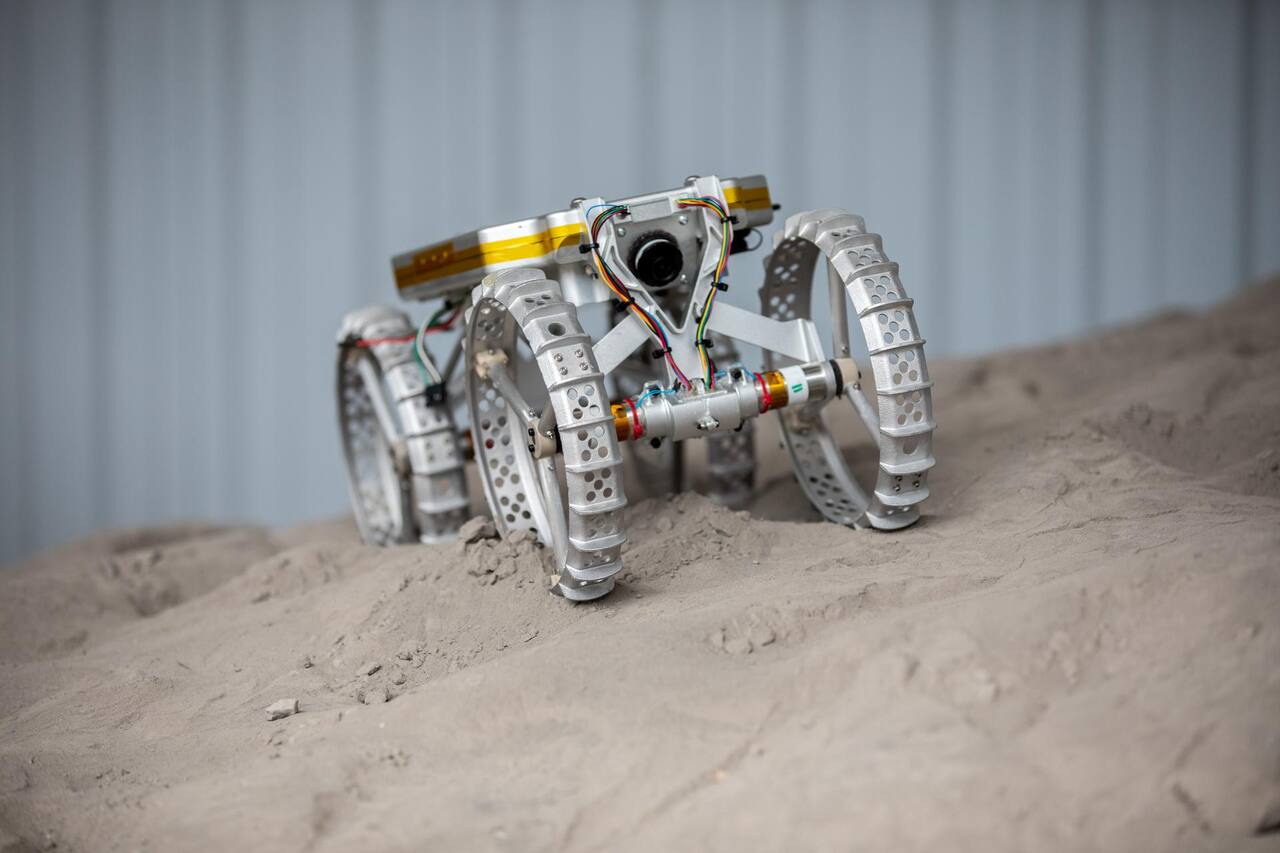 NASA/Glenn Benson. Public domain (NASA / US government work).
Overview
Section titled “Overview”A rover that rides as one payload among several on a commercial lander gives up most of what a flagship rover keeps in reserve: spare mass for redundant strings, a dedicated cruise stage, and a delivery contract priced by the mission. Astrobotic Technology of Pittsburgh made rover mobility the product. CubeRover applies the CubeSat unit convention to surface mobility: one U is a 10 x 10 x 10 cm payload volume carrying 1 kg, and the vehicle is offered in 2U, 4U and 6U sizes that share one structural, power, thermal, avionics and software design [2]. Delivery is sold as a service at 4.5 million US dollars per kilogram of payload, with 0.5 W of continuous power and 10 kbps per kilogram included [3].
No CubeRover has flown. The vendor’s own 2021 poster self-assessed the vehicle at TRL 4 to 5, with vibration, thermal vacuum and EMI testing still planned [2]. The vendor’s 2023 datasheet still states that no CubeRover has operated on the lunar surface [1]. The ground evidence is one set of regolith simulant mobility campaigns at NASA Kennedy [4], [5], and the performance figures in vendor material are specifications, not qualification results [1], [3].
Iris, the Carnegie Mellon student rover on Peregrine Mission One in January 2024, shares the lineage but is a separate vehicle [8]. Peregrine lost its landing capability when a helium pressure control valve failed and the oxidizer tank ruptured about 92 minutes after separation, so no surface operations were attempted [8].
Design space and where CubeRover sits
Section titled “Design space and where CubeRover sits”The small lunar rover class has converged on a few choices. The vendor offers 4.6 to 10.6 kg vehicles, solar powered, with teleoperated navigation [1], [3]; MoonRanger at 18 kg uses the same mass-limited approach [11]. A JPL survey of robotic and autonomous surface systems places small commercial rovers beside the CLPS manifest as one of several efforts to fly cheap, small mobility [7]. Earlier JPL micro-rover work, from Sojourner to nano-rovers, set the template for what a rover of this size can carry [26].
The flown or near-flown comparison points differ in what they have demonstrated:
- MoonRanger, an 18 kg four-wheeled Carnegie Mellon rover for polar prospecting, has a published thermal model giving a surface operating band of -10 to 35 degrees C and about one hour of roving in permanently shadowed regions, limited by the cold soak limits of its lasers and sun sensors; the paper is modeling only, with no thermal vacuum data [11].
- SORA-Q, the transformable nano rover from JAXA, TOMY, Sony and Doshisha University, was deployed from the SLIM lander [28].
- LEV-1, JAXA’s hopping rover, drove its single grouser wheel on the Moon after SLIM landed in January 2024, which is the only lunar surface wheel result for a rover in this size range in the held record [12].
- The three CADRE rovers, suitcase-sized and solar powered, shipped in February 2025 to Intuitive Machines for the IM-3 lander; the held source gives no results [25].
- ATHLETE sits at the other end of the wheel design spectrum. At 850 kg it can accept 20 to 45 kPa ground pressure because it can walk out of soft soil; the paper gives design values and no mobility measurements [10]. A rigid small rover has no such option.
Early lunar practice sets the baseline. Wheeled vehicles worked on Apollo and Luna soil when ground contact pressure stayed below about 7 to 10 kPa, and surface roughness rather than power capped speed [18]. The Apollo rover wire mesh wheel was sized with Bekker analysis to a 4.5 cm nominal deflection, and the analysis overpredicted the wheel: meeting the 25 degree climb requirement implied about 59.5 percent mean slip [29]. Single-wheel tests of the flight wheel in simulant found pull coefficient and efficiency insensitive to speed and wheel load, with soil strength the controlling variable, and gave Apollo slope limits of about 19 degrees in nominal soil and 23 degrees in firm soil; the tests were at 1 g in an air-filled bin [30]. The Apollo-era wheel test plan for the dual-mode rover specified load-deflection and soil tests before qualification but is a plan, not a set of results [19].
Wheel and terramechanics evidence
Section titled “Wheel and terramechanics evidence”The wheel is the subsystem that CubeRover has iterated, and the literature on small lunar wheels shows why. Semi-empirical wheel-soil theory descends from dimensionless analysis of pneumatic tire data on terrestrial soils, with soil strength measured by cone index [17]. The lunar numbers that feed any model are a friction angle near 49 degrees and cohesion near 1.6 kPa over the top 60 cm [23], within a simulant requirement envelope of cohesion 0.1 to 1 kPa and friction angle 30 to 50 degrees [22]. A review of Apollo experience concluded that the Bekker equations failed for small rovers in one sixth gravity [18].
Discrete element simulation of a 250 mm lugged wheel for a lunar micro rover found that reduced gravity weakens inter-particle friction, raises self-propelled slip to 26.3 percent on level lunar terrain, and leaves the selected wheel unable to climb 25 degrees; the lunar-gravity results have no reduced-gravity measurement behind them [9]. A continuum SPH model of a 137 kg six-wheel Yutu rover found that larger rim diameter and greater width both lower the slip needed to climb a slope, taller grousers help at a cost in torque, and doubling grouser count from 20 to 40 changes almost nothing; it is a preprint validated only against 1 g single-wheel data [15].
Small skid-steer rovers have a second problem that a slope test does not show: sinkage during point turns. Single-wheel tests in GRC-1 simulant found that wider, larger wheels turned best, that 45 degree diagonal grousers improved turning without added mass but raised sinkage by about 30 percent, and that drawbar pull did not change significantly [13]. A comparison of a 200 mm grouser wheel in Toyoura sand and FJS-1 simulant across slip ratios of 0 to 50 percent and loads of 5 to 70 N shows that the choice of test soil changes the result, and it used reduced vertical load, not reduced gravity [14]. Field data from a 21.63 kg rover in Tohoku silica sand showed that slip on a grousered wheel must be computed against an effective radius that includes grouser height, or driving appears as negative slip [16].
JAXA’s LEV-1 grouser shape was derived with resistive force theory, tested in silica sand and DEM, and confirmed qualitatively by about two hours of wheel-driven operation on the Moon after seven hops [12]. Commercial wheel development is also marketing-stage: a hyper-deformable wheel for the FLEX rover is described only by requirements, not measurements [24]. Against this background, Astrobotic’s 2021 announcement of a regolith lab holding about 19,000 kg of GRC-1 simulant, and of an outside group’s compliant wheels that “perform better than any wheels we have tested to date”, records a wheel set still under iteration; the claim has no metric or baseline behind it [6].
Excavation rovers at Kennedy share the bin and the soil. RASSOR 2.0, a 66 kg excavator, selected 17 inch wheels over tracks and smaller wheels in 1 g tilt table tests in BP-1 simulant at a single 25 degree angle with three attempts per configuration [20]. Its successor IPEx raised a common wheel, arm and drum actuator design to TRL 5 with a four-test qualification sequence that included dirty vacuum, all at 1 g [21]. CubeRover was driven alongside RASSOR to rehearse driving into and out of a dug trench [5].
Test campaigns
Section titled “Test campaigns”In December 2020, CubeRover ran more than 150 mobility tests with eleven sets of wheels in the 120 ton regolith bin of the Granular Mechanics and Regolith Operations laboratory at NASA Kennedy, under a 2 million dollar Tipping Point contract [5]. NASA’s account of the same days reports dune crossing, point turns and trench wall ascent and descent, with sensor, motor and power behavior observed in dust [4]. Drawbar pull, slope and point-turn data were collected [5]. Two of the eleven wheel sets exceeded expectations, and some sets climbed 30 degree slopes while others turned in deep regolith [5].
The 30 degree slope and 15 cm obstacle figures on the product page are stated for the product line [3]. The test report supports 30 degrees only for some wheel sets [5]. A further campaign on 30 June 2022 used the same bin with a stripped mobility chassis; no published results from it are held.
No values for drawbar pull, slip or dust ingress appear in either account, and the tests were at 1 g in a bin [4], [5]. A flight qualified CubeRover planned for 2022 was not delivered [4].
Specifications
Section titled “Specifications”All values are manufacturer figures. They disagree between documents.
| Parameter | 2U | 4U | 6U |
|---|---|---|---|
| Rover mass, 2023 datasheet | 4.6 kg | 8 kg | 10.6 kg |
| Rover mass, 2021 poster | 3 to 4 kg | 6 to 8 kg | 10 to 12 kg |
| Payload capacity | up to 2 kg | up to 4 kg | up to 6 kg |
| Guaranteed payload envelope | 20 x 10 x 10 cm | 20 x 20 x 10 cm | 30 x 20 x 10 cm |
| Additional internal volume | 2100 cm3 | 3900 cm3 | 5700 cm3 |
| Additional external volume | 910 cm3 | 1768 cm3 | 2625 cm3 |
| Payload energy allocation | 100 Wh+ | 150 Wh+ | 200 Wh+ |
Mass and envelope rows are from the datasheet [1] except the poster row [2].
| Parameter | Value | Source |
|---|---|---|
| Payload power bus | 28 V DC | [1] |
| Continuous payload power | 0.5 W per kg, 10 W peak | [2] |
| Payload thermal environment | -20 to +60 degrees C (datasheet), +10 to +30 degrees C (poster) | [1], [2] |
| Payload wired interface | RS-422 | [1] |
| Payload wireless | 802.11n WLAN | [1] |
| Payload data allocation | 10 kbps per kg | [1] |
| Payload data storage | 32 Gb or more | [1] |
| Nominal speed | 4 cm/s | [1] |
| Top speed | 10 cm/s | [3] |
| Slope and obstacle | 30 degrees, nearly 15 cm | [3] |
| Mission duration | 8 Earth days | [1] |
NASA’s account gives a rover mass around 9 pounds, which matches neither vendor figure [4].
Subsystems
Section titled “Subsystems”Mobility. Four independently actuated wheels, with dust covers and seals [3]. The poster credits the motors with flight qualification because they are used on the Perseverance rover and the batteries because they will fly on SLS; that is inherited heritage, not qualification of this vehicle [2]. No suspension is described in the held material.
Power. Solar. Array power and battery capacity are not published. The poster does not claim or deny lunar night survival, and the datasheet mission duration of 8 Earth days implies none [1], [2]. For comparison, NASA’s crewed Lunar Terrain Vehicle thermal work starts from a night of at least 85 hours [27].
Thermal. The chassis is wrapped in multi-layer insulation with a top-mounted radiator as the thermal ground [2]. No radiator area or vehicle temperature range is published.
Compute and navigation. A custom single board computer handles command and data handling, image processing, motor control and power, and front and rear 5 megapixel monocular sensors provide navigation [2]. Navigation is visual-inertial teleoperation with an automatic return to the last known good location on off-nominal conditions [3].
Communications. The link to the lander is 802.11n WiFi at 10 kbps per kilogram [1], [2]. No direct-to-Earth capability, radio part or link budget is stated.
What is not established
Section titled “What is not established”No CubeRover has flown, so every vehicle number is a vendor specification or a ground test result [1], [2]. Wheel and grouser geometry for the eleven wheel sets, and for the wheel the vendor intends to fly, are not published, and no test report gives drawbar pull, slip or sinkage values [5], [6]. The 30 degree and 15 cm capabilities are best-case wheel results generalized to the product [3], [5]. Vibration, thermal vacuum and EMI qualification were future work in 2021 and no result is held [2]. Mass, speed and thermal environment disagree between vendor documents of different years, and no peer-reviewed engineering description of the platform exists to arbitrate [1], [2], [3]. The reduced-gravity behavior of small grousered wheels rests on simulation and 1 g bench tests, and the one lunar surface wheel result, LEV-1, is a single hopping rover with qualitative confirmation [9], [12]. Thermal design, avionics and software are described only as shared across sizes. Power sizing and lunar night capability are not stated.
References
- Astrobotic Technology. (2023). CubeRover Surface Mobility: Elevate Your Mission Capabilities. nasa-techshowcase.seti.org/wp-content/uploads/2023/01/Astrobotic-Cube...
BibTeX
@misc{astrobotic2023cuberover, title = {CubeRover Surface Mobility: Elevate Your Mission Capabilities}, author = {{Astrobotic Technology}}, howpublished = {Presentation}, year = {2023}, url = {https://nasa-techshowcase.seti.org/wp-content/uploads/2023/01/Astrobotic-CubeRover.pdf} } - Horchler, A. D., Provenzano, M., Corpa de la Fuente, C., Arbuckle, T., Zimo, J., Quinn, K., Oikawa, T., Whitaker, T. and Kirkman, B. (2021). CubeRover for Mobility as a Service. lsic.jhuapl.edu/uploadedDocs/posters/444-Poster%20PDF_34-Provenzano.pdf
BibTeX
@misc{horchler2021cuberover, title = {{CubeRover} for Mobility as a Service}, author = {Horchler, Andrew D. and Provenzano, Michael and Corpa de la Fuente, Cedric and Arbuckle, Troy and Zimo, Joseph and Quinn, Kerry and Oikawa, Takuto and Whitaker, Taylor and Kirkman, Brandon}, howpublished = {Presentation at the Astrobotic Technology, Inc.}, type = {Lunar Surface Innovation Consortium poster}, year = {2021}, url = {https://lsic.jhuapl.edu/uploadedDocs/posters/444-Poster%20PDF_34-Provenzano.pdf} } - (2021). Astrobotic: CubeRover. astrobotic.com/lunar-delivery/rovers/cuberover
BibTeX
@misc{astroboticcuberover, title = {Astrobotic: CubeRover}, organization = {astrobotic.com}, year = {2021}, url = {https://www.astrobotic.com/lunar-delivery/rovers/cuberover/} } - (2020). NASA: Commercial CubeRover Test Shows How NASA Investments Mature Space Tech. nasa.gov/missions/artemis/clps/commercial-cuberover-test-shows-how-na...
BibTeX
@misc{nasacommercial, title = {NASA: Commercial CubeRover Test Shows How NASA Investments Mature Space Tech}, organization = {nasa.gov}, year = {2020}, url = {https://www.nasa.gov/missions/artemis/clps/commercial-cuberover-test-shows-how-nasa-investments-mature-space-tech/} } - (2020). Astrobotic: CubeRover Completes Successful Mobility Testing. astrobotic.com/astrobotics-cuberover-completes-successful-mobility-te...
BibTeX
@misc{astroboticcuberover2, title = {Astrobotic: CubeRover Completes Successful Mobility Testing}, organization = {astrobotic.com}, year = {2020}, url = {https://www.astrobotic.com/astrobotics-cuberover-completes-successful-mobility-testing/} } - Astrobotic Technology. (2021). Astrobotic Reveals New Lunar Regolith Lab for Rover Testing. astrobotic.com/astrobotic-reveals-new-lunar-regolith-lab-for-rover-te...
BibTeX
@misc{astrobotic2021reveals, title = {Astrobotic Reveals New Lunar Regolith Lab for Rover Testing}, author = {{Astrobotic Technology}}, organization = {astrobotic.com}, year = {2021}, url = {https://www.astrobotic.com/astrobotic-reveals-new-lunar-regolith-lab-for-rover-testing/} } - Nesnas, I. (2023). Robotics and Autonomy for Space Applications
. Root. doi.org/10.48577/jpl.oikho7
BibTeX
@misc{nesnas2023robotics, title = {Robotics and Autonomy for Space Applications}, author = {Nesnas, Issa}, journal = {Root}, year = {2023}, doi = {10.48577/jpl.oikho7}, abstract = {No abstract available.} } - Astrobotic Technology. (2024). Peregrine Mission 1 Post-Mission Report
. Astrobotic Technology. Source
BibTeX
@techreport{astrobotic2024peregrine, title = {Peregrine Mission 1 Post-Mission Report}, author = {{Astrobotic Technology}}, institution = {Astrobotic Technology}, month = {August}, year = {2024}, url = {https://www.astrobotic.com/wp-content/uploads/2024/08/PM1_Post-Mission-Report_2024-1.pdf} } - Nakashima, H., Fujii, H., Oida, A., Momozu, M., Kanamori, H., Aoki, S., Yokoyama, T., Shimizu, H., Miyasaka, J. and Ohdoi, K. (2010). Discrete Element Method Analysis of Single Wheel Performance for a Small Lunar Rover on Sloped Terrain
. Journal of Terramechanics, 5. Source
BibTeX
@article{nakashima2010discrete, title = {Discrete Element Method Analysis of Single Wheel Performance for a Small Lunar Rover on Sloped Terrain}, author = {Nakashima, H. and Fujii, H. and Oida, A. and Momozu, M. and Kanamori, H. and Aoki, S. and Yokoyama, T. and Shimizu, H. and Miyasaka, J. and Ohdoi, K.}, journal = {Journal of Terramechanics}, volume = {47}, number = {5}, pages = {307--321}, year = {2010}, doi = {10.1016/j.jterra.2010.04.001} } - Heverly, M. (2008). A wheel-on-limb rover for lunar operations
. JPL Open Repository. Source
BibTeX
@inproceedings{heverly2008wheel, title = {A wheel-on-limb rover for lunar operations}, author = {Heverly, Matthew}, publisher = {JPL Open Repository}, year = {2008}, url = {https://dataverse.jpl.nasa.gov/dataset.xhtml?persistentId=hdl:2014/41284} } - Fisch, P. R. M., Bitanga, J. M. and Whittaker, W. L. (2020). Thermal Modeling and Design of a Micro-Rover for Lunar Polar Exploration
. International Symposium on Artificial Intelligence, Robotics and Automation in Space. Source
BibTeX
@inproceedings{fisch2020thermal, title = {Thermal Modeling and Design of a Micro-Rover for Lunar Polar Exploration}, author = {Fisch, Paulo R. M. and Bitanga, Jasmine M. and Whittaker, William L.}, booktitle = {International Symposium on Artificial Intelligence, Robotics and Automation in Space}, year = {2020}, url = {https://www.hou.usra.edu/meetings/isairas2020fullpapers/pdf/5058.pdf} } - Otsuki, M., Yoshikawa, K., Maeda, T., Usami, N. and Yoshimitsu, T. (2025). Design of Wheel Grouser Geometry With Reduced Sinkage for LEV-1 Lunar Rover
. IEEE Robotics and Automation Letters, 6. Source
BibTeX
@article{otsuki2025design, title = {Design of Wheel Grouser Geometry With Reduced Sinkage for LEV-1 Lunar Rover}, author = {Otsuki, Masatsugu and Yoshikawa, Kent and Maeda, Takao and Usami, Naoto and Yoshimitsu, Tetsuo}, journal = {IEEE Robotics and Automation Letters}, volume = {10}, number = {6}, pages = {5633-5640}, publisher = {Institute of Electrical and Electronics Engineers (IEEE)}, year = {2025}, doi = {10.1109/lra.2025.3561571} } - Daca, A., Skonieczny, K. and Moreland, S. (2022). Diagonal grousers improve turning performance in skid-steer rovers
. Root. Source
BibTeX
@inproceedings{daca2022diagonal, title = {Diagonal grousers improve turning performance in skid-steer rovers}, author = {Daca, Adriana and Skonieczny, Krzysztof and Moreland, Scott}, journal = {Root}, publisher = {JPL Open Repository}, year = {2022}, doi = {10.48577/jpl.surpxs}, abstract = {Skid steering is a popular choice for planetary rover missions due to its simplicity, low cost, and low mass compared to explicit steering systems. Skid steer rovers’ wheels do not turn explicitly; vehicle turning is achieved by driving the left and right wheels at different velocities. To achieve a turn, the wheels must inherently experience a high amount of slip, which can lead to high sinkage. Furthermore, previous work has shown that sinkage can increase in reduced gravity environments. This work focuses on wheel design changes to reduce sinkage for a potential future lunar rover. The rover in question employs skid-steering, and prototype testing revealed significant sinkage during point turns (i.e. turn-in-place maneuvers). This was identified as a major issue since high sinkage leads to increased entrapment risk, decreased ground clearance, and increased power consumption. To investigate risk mitigation opportunities, seven additively manufactured wheels were tested in a single-wheel testbed capable of mimicking skid-steer maneuvers by setting a representative slip angle. To represent lunar gravity performance, the tests followed Granular Scaling Laws (a scaling method employing dimensionless numbers, recently validated against parabolic flight experiments and shown to predict wheel performance in lunar gravity with < 10% error). The seven wheel designs can be summarized as (1) current baseline: rigid 150 mm diameter, 30 mm wide wheel with 27x 8mm grousers, (2) wheel 1 with closed sides, (3) wheel 1 with closed sides and ‘side grousers’, (4) wheel 1 but 200 mm in diameter, (5) wheel 1 but 60 mm wide, (6) wheel 1 with 45 degree angled grousers, and (7) wheel 1 with a rounded profile. The metrics for turning performance evaluation were sinkage and tangent turning force coefficient. It was found that increasing the wheel size (width and/or diameter) had a positive effect on turning performance, but these changes would require mass/volume increases in an already mass/volume constrained application. Diagonal grousers also enhanced turning performance, and do not require mass or volume increases. While some of the other designs decreased sinkage, they had detrimental effects on the tangent turning force coefficient, and required an increase in mass and/or volume. Additional drawbar pull tests revealed that straight-driving performance was not significantly affected by the angled grousers. Next, the diagonal grouser wheel design will be tested on a full four-wheeled rover prototype to confirm these findings and determine if slope-climbing ability and obstacle-climbing ability are negatively impacted by this design.} } - Takehana, K., Kizaki, S., Tanaka, T., Uno, K. and Yoshida, K. (2025). Comparison of lunar rover wheel performance in soils with different cohesive properties
. Icarus. Source
BibTeX
@article{takehana2025comparison, title = {Comparison of lunar rover wheel performance in soils with different cohesive properties}, author = {Takehana, Keisuke and Kizaki, Shino and Tanaka, Tomomi and Uno, Kentaro and Yoshida, Kazuya}, journal = {Icarus}, volume = {117}, pages = {101011}, publisher = {Elsevier BV}, year = {2025}, doi = {10.1016/j.jterra.2024.101011} } - Zhou, L., Zhang, Y., Shi, J., Hu, W. and Negrut, D. (2025). An analysis of the Yutu lunar rover's mobility performance using a multibody dynamics framework and a physics-based terramechanics model
. Research Square preprint. Source
BibTeX
@article{zhou2025analysis, title = {An analysis of the Yutu lunar rover's mobility performance using a multibody dynamics framework and a physics-based terramechanics model}, author = {Zhou, Lebin and Zhang, Yuemin and Shi, Junwei and Hu, Wei and Negrut, Dan}, journal = {Research Square preprint}, year = {2025}, doi = {10.21203/rs.3.rs-6489552/v1}, abstract = {Abstract The interaction between wheels and soil has a significant impact on the dynamics of extraterrestrial vehicles in terrame-chanics applications. With very few exceptions, the mobility analysis of extraterrestrial rovers has been carried out using empirical terramechanics models originally established for military vehicle mobility analysis. This contribution employs a physics-based terramechanics model, the so called continuum representation model (CRM), which employs partial differential equations solved using the smoothed particle hydrodynamics (SPH) method. The resulting terramechanics model displays the speed of the simpler empirical models, yet produces results comparable in fidelity to those generated by the computationally costly discrete element method (DEM). We demonstrate the versatility of the CRM approach by simulating the single-wheel system of the Yutu lunar rover. Simulations were conducted to comparatively analyze the effects of particle size, slip control policy, and soil parameters on wheel performance. The accuracy of the single-wheel CRM results was assessed using “ground truth” DEM results. Subsequently, to gain a system-level understanding of the performance of the Yutu rover, the vehicle was modeled as a multibody system, and mobility simulations were run on de-formable CRM terrain. The performance of the full rover, as captured in tractive force, wheel torque, wheel sinkage, and traction vs. slope tests, was examined under various test conditions. Finally, we examine how various wheel features, e.g., its radius and grouser width/height/count, affect the mobility performance of the rover. All simulations were conducted using an open-source, publicly available simulator called Chrono. The scripts and models used to generate the results presented in this paper are available upon request to support reproducibility studies and further research.} } - Kern, J. M., Hurrell, J. M., Santra, S., Takehana, K., Uno, K. and Yoshida, K. (2025). Data-Driven Terramechanics Approach Towards a Realistic Real-Time Simulator for Lunar Rovers
. arXiv preprint. Source
BibTeX
@article{kern2026data, title = {Data-Driven Terramechanics Approach Towards a Realistic Real-Time Simulator for Lunar Rovers}, author = {Kern, Jakob M. and Hurrell, James M. and Santra, Shreya and Takehana, Keisuke and Uno, Kentaro and Yoshida, Kazuya}, journal = {arXiv preprint}, pages = {662-668}, year = {2025}, doi = {10.1109/isparo66239.2025.11436587}, abstract = {High-fidelity simulators for the lunar surface provide a digital environment for extensive testing of rover operations and mission planning. However, current simulators focus on either visual realism or physical accuracy, which limits their capability to replicate lunar conditions comprehensively. This work addresses that gap by combining high visual fidelity with realistic terrain interaction for a realistic representation of rovers on the lunar surface. Because direct simulation of wheel-soil interactions is computationally expensive, a data-driven approach was adopted, using regression models for slip and sinkage from data collected in both full-rover and single-wheel experiments and simulations. The resulting regression-based terramechanics model accurately reproduced steady-state and dynamic slip, as well as sinkage behavior, on flat terrain and slopes up to 20°, with validation against field test results. Additionally, improvements were made to enhance the realism of terrain deformation and wheel trace visualization. This method supports real-time applications that require physically plausible terrain response alongside high visual fidelity.} } - Freitag, D. R. (1965). Wheels on soft soils: an analysis of existing data
. U.S. Army Engineer Waterways Experiment Station, Technical Report No. 3-670. Source
BibTeX
@techreport{freitag1965wheels, title = {Wheels on soft soils: an analysis of existing data}, author = {Freitag, Dean R.}, number = {Technical Report No. 3-670}, institution = {U.S. Army Engineer Waterways Experiment Station}, year = {1965}, url = {https://erdc-library.erdc.dren.mil/handle/11681/4716} } - Kring, D. A. (2006). Lunar Mobility Review. lpi.usra.edu/science/kring/lunar_exploration/briefings/lunar_mobility...
BibTeX
@misc{kring2006lunar, title = {Lunar Mobility Review}, author = {Kring, David A.}, howpublished = {Presentation at the Lunar and Planetary Institute, Lunar Exploration Initiative}, year = {2006}, url = {https://www.lpi.usra.edu/science/kring/lunar_exploration/briefings/lunar_mobility_review.pdf} } - NASA. (1970). Design and Manufacture of Wheels for A Dual-Mode (Manned - Automatic) Lunar Surface Roving Vehicle. Volume 2: Proposed Test Plan
. NASA, NASA-CR-163200. Source
BibTeX
@techreport{nasa1970design, title = {Design and Manufacture of Wheels for A Dual-Mode (Manned - Automatic) Lunar Surface Roving Vehicle. Volume 2: Proposed Test Plan}, author = {{NASA}}, number = {NASA-CR-163200}, institution = {NASA}, year = {1970}, url = {https://ntrs.nasa.gov/citations/19800016718}, abstract = {A developmental test plan for the wheel and wheel drive assembly of the dual-mode (manned/automated) lunar surface roving vehicle is presented. The tests cover performance, as well as critical environmental characteristics. Insofar as practical, the environmental conditions imposed will be in the sequence expected during the hardware's life from storage through the lunar mission. Test procedures are described for static load deflection and endurance tests. Soft soil tests to determine mobility characteristics including drawbar-pull and thrust vs slip, and motion resistance for various wheel loads are also discussed. Test designs for both ambient and thermal vacuum conditions are described. Facility, transducer, and instrumentation requirements are outlined.} } - Mueller, R. P., Smith, J. D., Schuler, J. M., Nick, A. J., Gelino, N. J., Leucht, K. W., Townsend, I. I. and Dokos, A. G. (2016). Design of an Excavation Robot: Regolith Advanced Surface Systems Operations Robot (RASSOR) 2.0
. ASCE Earth and Space Conference, 20210011366. Source
BibTeX
@inproceedings{mueller2016design, title = {Design of an Excavation Robot: Regolith Advanced Surface Systems Operations Robot (RASSOR) 2.0}, author = {Mueller, Robert P. and Smith, Jonathan D. and Schuler, Jason M. and Nick, Andrew J. and Gelino, Nathan J. and Leucht, Kurt W. and Townsend, Ivan I. and Dokos, Adam G.}, booktitle = {ASCE Earth and Space Conference}, number = {20210011366}, pages = {163-174}, institution = {NASA}, year = {2016}, doi = {10.1061/9780784479971.018}, abstract = {To continue on a sustainable and flexible path, NASA needs to address the challenge of collecting and moving large amounts of regolith at the destination. Acquiring the water resources on Mars will require mining significant quantities of regolith, and this is not possible with the state-of-the-art low mass excavation systems. Low gravity environments (Mars = 3/8G) and launch mass restrictions limit the traction and the resulting reaction force of the vehicle, making current terrestrial techniques impractical. This project addressed this challenge by developing a completely new technology that can mine large quantities of regolith on Mars. Recent measurements by the “Curiosity” rover on Mars have found that the regolith contains ~2% water by weight globally, ~4% in Jezero Crater (Human Architecture Team’s reference landing site), and much more at the poles. RASSOR 2.0 is a planetary excavator, which has a mass of 66 kg, with a 0.38 kg vehicle mass per kilogram, per hour of excavation rate and power usage of 4 W per kg of regolith excavation rate. A single RASSOR 2.0 can excavate a minimum of 2.7 metric tons of regolith per day. This is accomplished by using counteracting excavation forces on two opposing digging implements called bucket drums and an autonomous mining control system. This work has addressed several major research areas outlined in the NASA Technology Area (TA) 04 Robotics and Autonomous Systems and TA 07 Human Destination Systems roadmaps. This project started at Technology Readiness Level (TRL) 4 as a low fidelity “proof of concept” prototype which has successfully demonstrated basic regolith simulant excavation functionality in a lab-scale gravity off load test. The foundational technology described here was awarded US patent number: US 9027265 for a “Zero horizontal reaction force excavator” on May 12, 2015.} } - Schuler, J. M., Smith, J. D., Nick, A. J., Buckles, B. C., Dyas, J. E., Ortega, V. V., Cloud, J. M., Dokos, A. G., Zhang, E. L., Wang, J. J., Baron, M. A., Muller, T. J., Clark, C. J. and Howe, M. W. (2024). ISRU Pilot Excavator (IPEx) Technology Readiness Level 5 Design Overview
. AIAA AVIATION Forum and ASCEND, 20240008162. Source
BibTeX
@inproceedings{schuler2024isru, title = {ISRU Pilot Excavator (IPEx) Technology Readiness Level 5 Design Overview}, author = {Schuler, Jason M. and Smith, Jonathan D. and Nick, Andrew J. and Buckles, Bradley C. and Dyas, Jeffrey E. and Ortega, Victoria V. and Cloud, Joseph M. and Dokos, Adam G. and Zhang, Elizabeth L. and Wang, Jerry J. and Baron, Michael A. and Muller, Thomas J. and Clark, Casey J. and Howe, Musashi W.}, booktitle = {AIAA AVIATION Forum and ASCEND}, number = {20240008162}, institution = {NASA}, year = {2024}, doi = {10.2514/6.2024-4890}, abstract = {This paper details the mechanical and mechatronic design of the Technology Readiness Level (TRL)-5 In-Situ Resource Utilization (ISRU) Pilot Excavator (IPEx). IPEx is a robotic excavator designed for a technology demonstration of regolith mining in the lunar south pole region. The novel design uses pairs of counter-acting excavation tools called bucket drums, that dig at the same time in opposing directions to reduce the reaction force needed, thereby enabling mining with a small, low-mass, robotic system. IPEx builds on the prior work of the Regolith Advanced Surface Systems Operations Robot (RASSOR), which is the TRL-4 implementation of this concept. The TRL-5 IPEx subsystems that are discussed in this paper include: Regolith Delivery Subsystem (RDS), Mobility Subsystem (MS), Cameras and Dust Mitigation Subsystem (CDMS), and Thermal Control Subsystem (TCS). Each subsystem is described in detail with rationale for design selections. Dust tolerance is a key feature for IPEx, and this paper details a thermal control system with an actuated radiator cover and phase change material as well as camera modules with removable electrodynamic dust shields (EDS). Additional components such as actuators, wheels, and bucket drums are discussed in detail. Due to their complexity, the avionics and software subsystems will be discussed in a separate publication.} } - Sibille, L., Carpenter, P., Schlagheck, R. and French, R. A. (2006). Lunar Regolith Simulant Materials: Recommendations for Standardization, Production, and Usage
. NASA Marshall Space Flight Center, NASA/TP-2006-214605. Source
BibTeX
@techreport{sibille2006development, title = {Lunar Regolith Simulant Materials: Recommendations for Standardization, Production, and Usage}, author = {Sibille, Laurent and Carpenter, Paul and Schlagheck, R. and French, R. A.}, number = {NASA/TP-2006-214605}, institution = {NASA Marshall Space Flight Center}, type = {NASA Technical Publication}, year = {2006}, url = {https://ntrs.nasa.gov/citations/20060051776}, abstract = {Experience gained during the Apollo program demonstrated the need for extensive testing of surface systems in relevant environments, including regolith materials similar to those encountered on the lunar surface. As NASA embarks on a return to the Moon, it is clear that the current lunar sample inventory is not only insufficient to support lunar surface technology and system development, but its scientific value is too great to be consumed by destructive studies. Every effort must be made to utilize standard simulant materials, which will allow developers to reduce the cost, development, and operational risks to surface systems. The Lunar Regolith Simulant Materials Workshop held in Huntsville, AL, on January 24 26, 2005, identified the need for widely accepted standard reference lunar simulant materials to perform research and development of technologies required for lunar operations. The workshop also established a need for a common, traceable, and repeatable process regarding the standardization, characterization, and distribution of lunar simulants. This document presents recommendations for the standardization, production and usage of lunar regolith simulant materials.} } - Heiken, G. H., Vaniman, D. T. and French, B. M. (1991). Lunar Sourcebook: A User's Guide to the Moon
. Endeavour. Source
BibTeX
@book{heiken1991lunar, title = {Lunar Sourcebook: A User's Guide to the Moon}, author = {Heiken, Grant H. and Vaniman, David T. and French, Bevan M.}, journal = {Endeavour}, volume = {16}, pages = {96}, publisher = {Cambridge University Press}, year = {1991}, doi = {10.1016/0160-9327(92)90014-g} } - (2026). Venturi Space: World premiere, Venturi's hyper-deformable lunar wheel. venturi.space/en/article/world-premiere-venturi-hyper-deformable-luna...
BibTeX
@misc{venturispaceworld, title = {Venturi Space: World premiere, Venturi's hyper-deformable lunar wheel}, organization = {venturi.space}, year = {2026}, url = {https://venturi.space/en/article/world-premiere-venturi-hyper-deformable-lunar-wheel/} } - (2025). NASA: CADRE mini rover team packed for lunar journey. nasa.gov/missions/tech-demonstration/cadre/nasas-mini-rover-team-is-p...
BibTeX
@misc{nasacadre, title = {NASA: CADRE mini rover team packed for lunar journey}, organization = {nasa.gov}, year = {2025}, url = {https://www.nasa.gov/missions/tech-demonstration/cadre/nasas-mini-rover-team-is-packed-for-lunar-journey/} } - Fiorini, P. (2000). Ground Mobility Systems for Planetary Exploration
. IEEE International Conference on Robotics and Automation. Source
BibTeX
@inproceedings{fiorini2000ground, title = {Ground Mobility Systems for Planetary Exploration}, author = {Fiorini, P.}, booktitle = {IEEE International Conference on Robotics and Automation}, volume = {1}, pages = {908-913}, year = {2000}, doi = {10.1109/robot.2000.844164}, abstract = {Surveys past and current designs of surface mobility systems for planetary exploration robots developed at JPL/Caltech. Wheeled rovers are discussed in some detail and compared to new designs, such as legged and hopping robots, which are emerging as viable alternatives to wheeled mobility for specific applications. The paper discusses the main features of mobility designs and summarizes some of the experimental results.} } - Hernandez, Z. Y., Wilcox, S. and Slusser, T. (2023). Designing a Lunar Terrain Vehicle: Thermal Challenges
. Thermal and Fluids Analysis Workshop. Source
BibTeX
@inproceedings{hernandez2023designing, title = {Designing a Lunar Terrain Vehicle: Thermal Challenges}, author = {Hernandez, Zaida Y. and Wilcox, Samuel and Slusser, Thomas}, booktitle = {Thermal and Fluids Analysis Workshop}, organization = {NASA Johnson Space Center}, year = {2023}, url = {https://ntrs.nasa.gov/citations/20230002802}, abstract = {The Lunar Terrain Vehicle (LTV) is an unpressurized rover that will be used to transport astronauts on the South Pole of the moon under the Artemis Program. The National Aeronautics and Space Administration (NASA) will be partnering with an American industry partner to develop the LTV. This paper discusses the thermal challenges faced when designing a crewed lunar vehicle concept and shares a concept that addresses these constraints. One of the most difficult aspects of the design is surviving the cold lunar night on the South Pole which includes permanently shadowed regions (PSR) that can have an extended lunar night duration of 125 hours. Other challenges are critical component temperature limits and programmatic constraints.} } - (2026). JAXA Space Exploration Innovation Hub Center: The Transformable nano rover (Lunar Excursion Vehicle 2, SORA-Q). ihub-tansa.jaxa.jp/english/LEV2_en.html
BibTeX
@misc{jaxaihublev2, title = {JAXA Space Exploration Innovation Hub Center: The Transformable nano rover (Lunar Excursion Vehicle 2, SORA-Q)}, organization = {ihub-tansa.jaxa.jp}, year = {2026}, url = {https://www.ihub-tansa.jaxa.jp/english/LEV2_en.html} } - Asnani, V., Delap, D. and Creager, C. (2009). The Development of Wheels for the Lunar Roving Vehicle
. Journal of Terramechanics, NASA/TM-2009-215798, 20100000019. Source
BibTeX
@article{asnani2009development, title = {The Development of Wheels for the Lunar Roving Vehicle}, author = {Asnani, Vivake and Delap, Damon and Creager, Colin}, journal = {Journal of Terramechanics}, volume = {46}, number = {NASA/TM-2009-215798, 20100000019}, pages = {89-103}, institution = {NASA Glenn Research Center}, year = {2009}, doi = {10.1016/j.jterra.2009.02.005}, abstract = {The Lunar Roving Vehicle (LRV) was developed for NASA s Apollo program so astronauts could cover a greater range on the lunar surface, carry more science instruments, and return more soil and rock samples than by foot. Because of the unique lunar environment, the creation of flexible wheels was the most challenging and time consuming aspect of the LRV development. Wheels developed for previous lunar systems were not sufficient for use with this manned vehicle; therefore, several new designs were created and tested. Based on criteria set by NASA, the choices were narrowed down to two: the wire mesh wheel developed by General Motors (GM), and the hoop spring wheel developed by the Bendix Corporation. Each of these underwent intensive mechanical, material, and terramechanical analyses, and in the end, the wire mesh wheel was chosen for the LRV. Though the wire mesh wheel was determined to be the best choice for its particular application, it may be insufficient towards achieving the objectives of future lunar missions that could require higher tractive capability, increased weight capacity, or extended life. Therefore lessons learned from the original LRV wheel development and suggestions for future Moon wheel projects are offered.} } - Melzer, K.-J. (1971). Performance of the Boeing LRV wheels in a lunar soil simulant. Report 2: Effects of speed, Wheel load, and soil
. U.S. Army Engineer Waterways Experiment Station, NASA-CR-129612. Source
BibTeX
@techreport{melzer1971performance,
  title = {Performance of the Boeing LRV wheels in a lunar soil simulant. Report 2: Effects of speed, Wheel load, and soil},
  author = {Melzer, Klaus-Jurgen},
  number = {NASA-CR-129612},
  institution = {U.S. Army Engineer Waterways Experiment Station},
  year = {1971},
  url = {https://ntrs.nasa.gov/citations/19730004536},
  abstract = {Two nearly identical Boeing-GM wire-mesh Lunar Roving Vehicle (LRV) wheels were laboratory tested in a lunar soil simulant to determine the influence of wheel speed and acceleration, wheel load, presence of a fender, travel direction, and soil strength on the wheel performance. Constant-slip and three types of programmed-slip tests were conducted with a single-wheel dynamometer system. Test results indicated that performance of single LRV wheels in terms of pull coefficient, power number, and efficiency were not influenced by wheel speed and acceleration, travel direction, the presence of a fender, or wheel load. Of these variables, only load influenced sinkage, which increased with increasing load. For a given slip, the pull coefficient and power number increased with increasing soil strength. However, for a given pull coefficient or slope, slip was less in firmer soil; thus, the power number decreased and efficiency increased with increasing soil strength.}
}