OSAM-1
Program pages NASA: On-orbit Servicing, Assembly, and Manufacturing 1
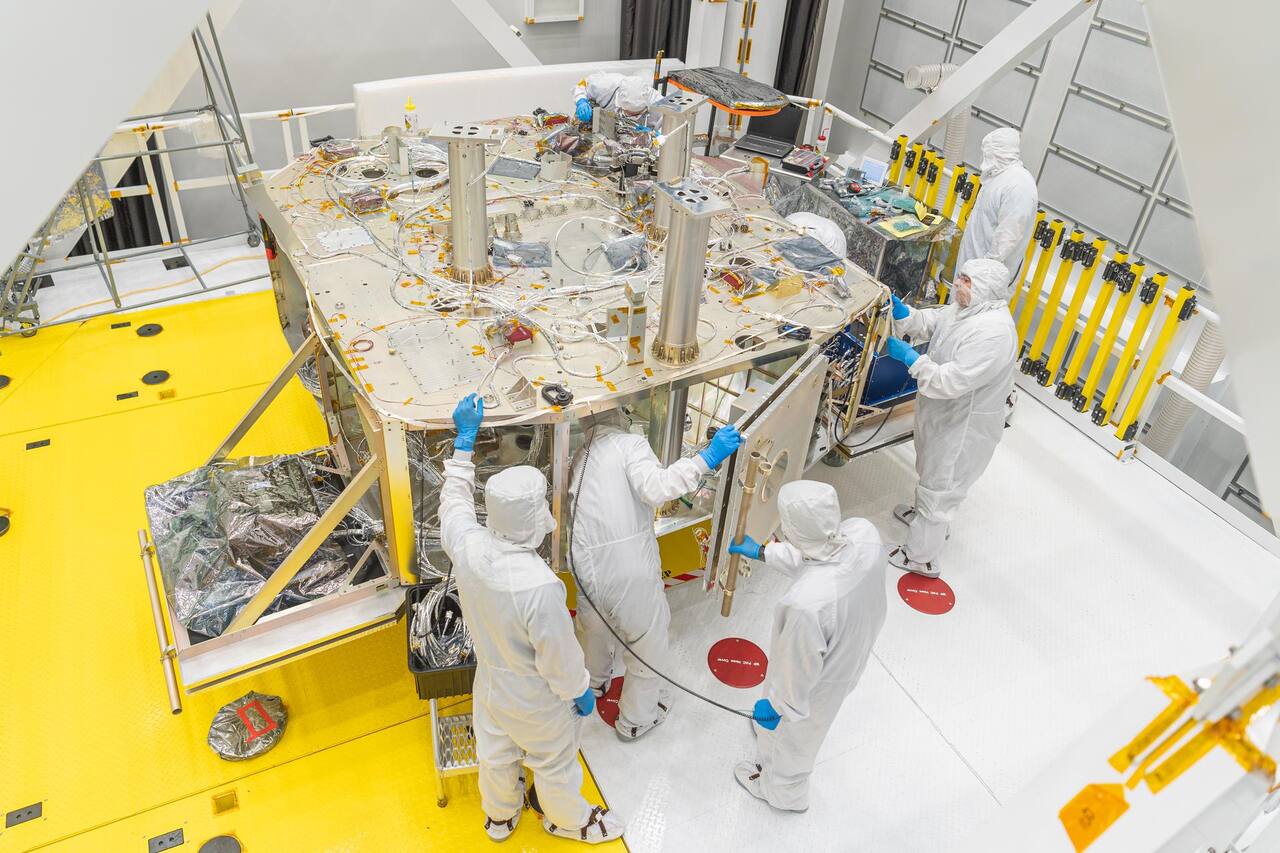 Michael Guinto. Public domain (NASA / US government work).
Overview
Section titled “Overview”OSAM-1 was a NASA technology demonstration mission intended to rendezvous with, refuel and relocate Landsat 7, and to demonstrate assembly of a communications antenna with a robotic arm [8]. It began in 2015 as Restore-L, the Robotic Servicing Demonstration Mission, within the Technology Demonstration Missions program of the Space Technology Mission Directorate, and was renamed OSAM-1 in April 2020 when the SPIDER payload was added. NASA discontinued it in March 2024 following an independent review board recommendation [8].
The mission was organized as a servicing spacecraft carrying two separate robotic payloads. The project was assigned to NASA GSFC; the spacecraft bus was procured from Maxar; SPIDER carried Maxar’s Dragonfly antenna assembly experiment, added in 2019 and 2020 under a NASA Tipping Point award; the client, Landsat 7, is operated by USGS [8]. The FY 2024 Consolidated Appropriations Act directed $227M toward assessing a descoped, 2026-launch version of the mission [31].
Specifications
Section titled “Specifications”| Parameter | Value | Source |
|---|---|---|
| Robotic arms | 3 total: 2 on the Servicing Payload, 1 on SPIDER | [6] |
| Servicing arm reach | 2.46 m, 7 DOF, six-axis force/torque sensor | [7] |
| SPIDER arm | 5 m, 7 DOF, MDA-provided dexterous end effector | [7] |
Mission profile
Section titled “Mission profile”| Parameter | Value | Source |
|---|---|---|
| Mission class | Category 1, Class C technology demonstration | [8] |
| Client | Landsat 7, non-cooperative, not designed for servicing | [7] |
| Propellant to be transferred | approx. 30 gal (114 l) of hydrazine | [1] |
| Antenna to be assembled | 3 m Ka-band reflector from 7 elements | [6] |
| Beam to be manufactured | 10 m carbon fiber composite | [7] |
| Started | 2015, as Restore-L | [8] |
| Discontinued | March 2024, on an independent review board recommendation | [8] |
| SIR | November 2023, at NASA GSFC | [8] |
| Cost at cancellation | $1400M spent, $2380M estimate at completion | [8] |
Design space and flight heritage
Section titled “Design space and flight heritage”A servicer has to close from tens of kilometers to contact with a satellite, make a mechanical connection between two free-flying bodies, and then do work through that connection, here moving hydrazine. Microgravity removes the support that ground manipulation relies on: every contact force moves the servicer, and a relative navigation fault cannot be recovered by stopping. The corpus holds work on each stage, and the flown record is narrower than the research record.
Rendezvous and docking has flown. ETS-VII made the first unmanned to unmanned autonomous docking in three experiment flights between July 1998 and October 1999, with 7 mm lateral error against a 25 mm requirement and a peak contact acceleration of 14 mm/s2; a recurring thruster anomaly was handled by rewriting onboard software [11]. DARPA framed Orbital Express as a standard for satellite-to-satellite servicing interfaces rather than a single demonstration [16]. Its 2007 flight tests used a servicer and client flown as a pair, with stationkeeping from 4 km to 10 cm, five day and night captures at solar beta angles from 3 to 48 degrees, three direct captures, two grapple and berth operations and a commanded abort at 10 m [13]. The three-arm capture mechanism was qualified with hardware-in-the-loop contact tests and more than 400 simulated capture cases [14]. The video guidance sensor held range standard deviation below 2.5 mm against a 12 mm specification, though ground testing stopped at 100 m against a 200 m requirement [15]. OSAM-1’s client was not designed for servicing [7], which is the step beyond this record.
Arm operation on orbit has flown in limited form. ETS-VII telemetry showed generalized Jacobian control holding hand orientation in the inertial frame while the base pitch rotated 0.6 deg from arm reaction, and that free drift at 550 km exceeds 1 deg within a few minutes, which bounds how long attitude control can be released during a capture [12]. DLR’s ROKVISS, a two-joint torque-controlled manipulator, has operated on the ISS Russian segment since February 2005, and the same group framed the TECSAS free-flyer capture mission as the next step [17]. A planned ISS payload would have exposed rendezvous sensors to real lighting and targets using the station arm [28].
Capture of a tumbling or non-cooperative target has been shown on the ground only. A Canadian Space Agency laboratory demonstration captured a free-flying tumbling mock satellite autonomously with a two-arm testbed [18], and a dual-arm method captures a spinning object by repeated impacts, which tolerates unknown target mass and inertia [25]. Momentum-dumping control after accidental contact [24] and its center-of-mass extension [30] address the base reaction problem with thrusters used only to extract accumulated momentum. None of these has a flight record in the corpus.
Commercial concepts split by interface. SMART-OLEV was designed to dock through the client’s apogee engine nozzle and take over attitude and orbit control [22], and an 18-month DLR study argued that on-orbit failure rates make robotic servicing of geostationary satellites commercially essential [21]. NASA’s capability catalog groups this work into robotic manipulation, rendezvous and capture, relocation, repair, refueling, and manufacturing and assembly [19]. The 2022 edition shares whole paragraphs with the 2021 and 2025 editions, so the three are one source rather than three [20].
Mobility
Section titled “Mobility”OSAM-1 had no surface mobility. The spacecraft held six degrees of freedom of vehicle control [1] and was to reach the Landsat 7 orbit through a phasing maneuver, with a nominal 32 day autonomous rendezvous and docking phase [4]. Unlike a free-floating base that lets contact torques dump into vehicle motion, an actively attitude-controlled servicer such as OSAM-1 fights every capture and hose-deployment disturbance with its own thrusters; ground research into the alternative, letting a servicer’s center of mass and angular momentum drift after contact and regulating them back with a cascade controller, has been demonstrated only in hardware-in-the-loop rigs, not flight [30].
Manipulation was the mission’s motion problem. Three robotic arms were to fly: two on the Servicing Payload and one on SPIDER [6]. The NASA Servicing Arm has a reach of 2.46 m in seven degrees of freedom and terminates in a six-axis force/torque sensor [7]. Its design leans heavily on the flight-qualified arm developed for DARPA’s SUMO and FREND programs in the mid-2000s, carrying over motion control, robotic software frameworks, flexible harnesses, the force-torque sensor, joint design and flight operations experience. FREND itself was a 1.8 m seven-degree-of-freedom arm driven by the MOOG Rikishi Electronics Unit, which drives up to nine separate robot joints [7]. That heritage sits inside a longer lineage of on-orbit servicing manipulators, from the Shuttle and station arms through Orbital Express, that a 2014 survey of the field catalogs by mission phase: target observation and approach, final approach, capture and post-capture stabilization [9]. SPIDER carried a lightweight 5 m arm of seven degrees of freedom with an MDA-provided dexterous end effector, known as Dragonfly during its ground demonstration phase under a NASA Tipping Point partnership [6].
Power and energy
Section titled “Power and energy”No figure for array output or battery capacity is published for the OSAM-1 spacecraft. In the flown configuration hydrazine and helium were supplied to the Servicing Payload propellant transfer subsystem across the spacecraft bus interface [2].
Thermal
Section titled “Thermal”Thermal design is published only at the level of the propellant path. The Hose Subassembly carries heaters and temperature sensors with EMI protection, a 28 VDC filter having been added after EMI testing in August 2017, and a thermal coating sized for full sun exposure with hydrazine inside the hose [1]. The Hose Management Assembly was qualified in thermal vacuum over 12 cold and hot cycles at qualification levels, followed immediately by 50 abrasion cycles, and separately over an additional 150 ambient cycles for more than 200 total. A one meter reference hose was tested in thermal vacuum after an ascent vent test and showed no change to the required thermal performance [2]. The Propellant Transfer Subsystem was required to keep both servicer and client propellant tanks within temperature constraints.
The precursor payloads set the thermal approach. The Robotic Refueling Mission Phase 1 payload used a cold biased design with a radiator on the back of the enclosure, multilayer insulation, and heaters sized for worst case cold [26]. For RRM3 cryogen transfer, autogenous pressurization with a heated capillary wick was tested using shuttle tile as the wick, in which liquid nitrogen wicks about 2 cm in one g [27].
Compute and avionics
Section titled “Compute and avionics”The avionics element is described in the technology portfolio as reconfigurable avionics and software built around the SpaceCube processor, with video distribution and storage [1]. The robot system comprised the NASA Servicing Arm, a Robot Electronics Unit and robot flight software. Pressure transducers in the Clamshell Subassembly hold a combined component and avionics measurement error below 3 percent [1].
Flight software was one of the elements the independent review board named as carrying substantial remaining technical risk, alongside the Kodiak lidar and the Servicing Payload build [8].
Autonomy
Section titled “Autonomy”Rendezvous and proximity operations used a relative navigation sensor suite spanning visible, infrared and lidar [1]. The client made the problem harder than a cooperative one: Landsat 7 has no fiducials for proximity operations, no grapple feature, and its fluid fill valves are closed out, each of which added complexity to the mission [7].
The division of autonomy was fixed by mission phase. Rendezvous, inspection and autonomous capture of a spacecraft not designed for servicing were Level 1 requirements met on board [8]; servicing was teleoperated from the ground [5]. Refuelling was to run from an onboard transfer script that calculates mass flow rate and totalizes transferred mass, stopping flow when a transfer duration, a totalized mass or a maximum pressure limit is reached, with a backup plan of discrete ground commands for conservative time durations and mass estimated on the ground while flow is stopped [1].
Hose deployment was a cooperative motion problem between the arm and the Propellant Transfer Subsystem. The arm and the roller-drive motor never operate simultaneously; motion alternates between the hose subassembly and the arm through predetermined trajectory waypoints, and no precision accuracy is required at a waypoint stop except for confirming hose deployment [1]. Deployed length is confirmed visually from ink marks on the conduit at 720 degree intervals, backed by position telemetry from the hose motor and by a situational awareness camera on the vision subsystem [1], [2].
Communications
Section titled “Communications”Near-continuous Ka-band access was a mission requirement, and TDRS availability in the launch timeframe was flagged as a potential problem because only TDRS 8, 10, 11, 12 and 13 remained and their operational state was uncertain [8].
The relative navigation sensor suite traces its scope to an earlier servicing anomaly. On Orbital Express in May 2007 a corrupted relative navigation filter produced an unplanned separation of up to about 6 km between the servicer and client, and operators had to fall back on ground radar at Haystack Observatory to relocate the two vehicles; DARPA’s recommendation afterward for near 4 pi steradian relative sensing is why OSAM-1 added the Kodiak lidar [8]. By November 2023 Kodiak was itself about 11 months behind schedule, with a commercial backup lidar that would not arrive until after nearly all spacecraft environmental testing was complete [8].
Payload and instruments
Section titled “Payload and instruments”The Servicing Payload carried two robotic systems, each arm terminating in an Advanced Tool Drive System with three rotary torque interfaces, electrical interfaces, actuators and two cameras for precision views [7]. Tools included a gripper, blanket cutter, wire cutter, cap removal tool and nozzle tool [1].
The Propellant Transfer Subsystem was split into six subassemblies across two assemblies [1]. The Propellant Transfer Assembly comprises the Hydrazine Transfer Subassembly and the Vent Thruster Subassembly; the Hose Management Assembly comprises the Roller-Drive, Hose, Clamshell and Box subassemblies.
| PTS element | Function and specification | Source |
|---|---|---|
| Hydrazine Transfer Subassembly | isolates bus hydrazine, measures flow rate and totalized mass, controls flow; maximum flow set by a cavitating venturi | [1] |
| Flow meter | one of two unique developments for OSAM-1, alongside the flexible hose; flight units showed the required flow rate accuracy across the required flow rate and viscosity ranges before and after environmental testing | [2] |
| Vent Thruster Subassembly | GPM flight-spare monopropellant thruster, series-redundant single-seat solenoid valves, vents GHe and N2H4/GHe mixtures | [1] |
| Hose Subassembly | approx. 4 m, annealed stainless convoluted inner hose, 100 percent radiographed, 5x operating pressure burst rating | [1] |
| Hose deployment rate | 0.2 or 0.5 cm/s via the roller drive | [1] |
| Hose qualification | verified to hundreds of allowable mechanical twist, torque and bend radius cycles; qualification and cleanliness certification completed June 2019 | [2] |
| Box Subassembly | deflects about 3.8 mm (0.15 in) under 3-sigma launch loads; vent holes control ascent depressurization | [1] |
| Leak detection | 1e-2 sccs GHe, an order of magnitude better than visual detection | [1] |
| Hypergol Refueling Tool | quick disconnect mating to a client fill and drain valve, hydrazine, extensible to other storable hypergols | [2] |
The published hose deployment rate changed between accounts: the 2020 description gives 0.2 or 0.5 cm/s [1], the FY 2024 description about 0.35 cm/s in flight and 0.5 cm/s on the ground [2].
SPIDER was to assemble seven elements into a functional 3 m communications antenna and demonstrate Ka-band transmission to a ground station [6]. MakerSat, a Tethers Unlimited payload, was to manufacture a 10 m carbon fiber composite beam on board; it was descoped from the mission in 2023 [7].
Modes of operation
Section titled “Modes of operation”Operations center staffing was planned against mission phases of set duration [4].
| Phase | Nominal duration |
|---|---|
| Launch, transit and checkout | 30 days |
| Autonomous rendezvous and docking | 32 days |
| Servicing | 30 days |
| Departure | 14 days |
| Assembly and manufacturing | 85 days |
| Decommissioning | not stated |
Source: [4].
Refuelling itself was sequenced against adiabatic compression risk. Initial Landsat 7 priming runs with the OSAM-1 hydrazine tanks at launch pressure, which is below nominal transfer pressure, and the servicer tanks are pressurized to nominal transfer pressure only after the manifold is wetted [1]. Before disconnect the transfer manifolds are vented and evacuated through the vent thruster to minimize the volume of hydrazine released.
Ground operations
Section titled “Ground operations”Servicing was teleoperated from the ground under a telemetry delay of several seconds, which the interface studies emulated with a fixed 5 second round-trip delay [5]. Operations were to run from a single large mission operations center of more than 50 console positions, with a backup center available to offload peak staffing [4].
Human factors analysis of the operations center set the console layout and the shift pattern. Shifts were planned at 12 hours on console with 12 hours off between them as the figure that allows commute and rest, with fatigue and sleep monitoring and a schedule that lets biological rhythms adapt [4]. Mission-time clocks were sized at about 16 feet wide for legibility across the room, control room lighting followed ISO 11064-6:2005, and keyboard height, distance and display position were required to be adjustable for operators doing extensive data entry.
Interface research targeted the latency problem directly. A virtual reality planning environment splits the task into an interactive planning phase, in which the operator builds a motion plan and previews it in a virtual environment, and a supervised execution phase, in which the plan runs and is watched in augmented virtuality with an early stop available [5]. In a nine-operator study against a baseline keyboard and mouse two-dimensional interface, a commercial head mounted display gave a lower NASA TLX workload, 2.39 against 3.21 with a p value of 0.070, and lower reported difficulty, 1.56 against 2.56 on a five-point scale, with no loss of performance: all nine operators completed the task under both interfaces. The earlier three-dimensional interface built on a da Vinci surgical console had worse outcomes and higher workload than that same baseline.
Ground test infrastructure was extensive. The Goddard Servicing Testbed carries a Landsat 7 mockup and was rebuilt around flight-like engineering test units of the Hose Management Assembly, latch valve, flow meter and clamshell subassembly, with software mimicking the flight controls; it returned to service in late 2023 for integrated concept of operations testing and operator training [2]. The Kennedy propellant transfer testbed is an end-to-end functional and volumetric simulator of the flight subsystem used for flow, pressure surge and evacuation and vent testing. Integration and test was to be conducted across an AutoCapture Testbed, a FlatSat Testbed and lidar vacuum testing at Marshall [8].
Hardware-in-the-loop rendezvous facilities fill the same role for proximity operations. DLR’s EPOS 2.0 reproduces the six degree of freedom relative motion of two spacecraft with two industrial robots, one on a 25 m rail, at 1.56 mm and 0.2 degrees accuracy at 3 sigma [23], with an admittance law that matches the robots’ impedance to the simulated satellites during contact [29]. The free-floating control work cited above used DLR’s OOS-Sim, in which a model drives an industrial arm, so the satellite dynamics match the controller’s assumptions exactly [30].
The Robotic Refueling Mission on the ISS was the operational precursor, running from 2011 to 2021 across three phases and using Canadarm2 and Dextre to work the tools [3]. RRM1 was a 550 lb payload of 33 by 43 by 55 in launched on STS-135 that transferred 1.7 liters of ethanol; RRM2 added five adapters actuated by the multi-function tool and demonstrated cutting lock wires, removing valve caps, mating electrical connectors and manipulating thermal blankets; RRM3 was a 700 lb module of 30 by 45 by 45 in launched on CRS-16 in December 2018 for cryogenic transfer. Each RRM tool carried two orthogonal cameras and ARToolKit fiducials with calibration patterns.
Technologies developed
Section titled “Technologies developed”The RRM sequence produced the tool designs that became the OSAM-1 adapters, at lower mass and storage volume, and matured the machine vision and fiducial approach used for on-orbit alignment [3]. Its operational lessons were explicit: high-fidelity ground hardware is what makes on-orbit operations succeed, ground troubleshooting keeps an operation from being terminated, machine vision fiducials should be metrologized as accurately as possible, scripted command groups reduce errors, procedures should carry expected task durations, and planned breakout points stop a delayed task from cascading through the timeline.
The Hypergol Refueling Tool is licensable through NASA’s Technology Transfer Program [7]. The turbine flow meter, flexible servicing hose, hypergol refueling tool and cooperative servicing valve are all listed as OSAM-1 technical developments feeding the wider in-space fluid transfer portfolio [2]. The Advanced Tool Drive System, the Hose Management Assembly and the Hypergol Refueling Tool are cataloged as concluded ISAM hardware developments rather than as lost work [7].
Cancellation
Section titled “Cancellation”The independent review board reported on 29 February 2024 [8]. Its cost analysis put the estimate at completion at $2380M against approximately $1400M already spent by November 2023, implying $980M to go, and put the 70 percent confidence launch readiness date at March 2028. Projected cost had risen from $1780M in 2020 with a September 2025 launch readiness to $2280M in November 2023 with July 2027 readiness, with no margin retained against that estimate [8]. Goddard head count was at or near 600 full-time equivalents in November 2023, 80 percent contract support, against a burn rate of $13M to $14M per month. Against an original forecast of no more than $750M and a 2020 launch, the project was seven to eight years late and $1500M over budget [8].
The board’s substantive finding was about the mission rather than the execution. Stakeholders across civil, defense and private sectors expect future national security spacecraft to be refuelled through prepared interfaces, so the industry had evolved past OSAM-1’s primary objective of refuelling a legacy vehicle through its fill and drain valves [8]. The board recorded that dexterous robotic servicing will be an important national capability and that completing OSAM-1 would have demonstrated key aspects of it, but recommended discontinuation on the grounds that the specific goal of delivering propellant to an aged Landsat 7 was not perceived as valuable against the cost to go.
MRV, developed through DARPA’s RSGS partnership with Northrop Grumman SpaceLogistics, uses the same FREND arm heritage and was to begin servicing unprepared GEO clients from 2026 [7]. Northrop Grumman’s own account names the RSGS arm the Flight Robotic Arm System 1, a seven-degree-of-freedom design from the Naval Research Laboratory exercised through its full range of motion in a ground trial called the Gauntlet before MRV’s 2026 launch [10].
What is not established
Section titled “What is not established”No hydrazine was ever flowed through the flight propellant transfer system and no on-orbit data exists; every flow, pressure drop and leak figure is a water or helium measurement scaled to hydrazine, and the underlying curves are not published [2]. The 2020 and FY 2024 accounts disagree on hose rate and leak detection, so neither is a final flight value [1], [2]. The review board’s report is a programmatic assessment with no subsystem test results, and its market judgments rest on a limited set of interviews [8].
Operator-interface evidence is thin. The virtual reality study had nine participants and one task, no difference reached p=0.05, and no communication latency was imposed [5]. The operations lessons are qualitative and camera specific [3], and the human factors report was advisory, with no workload data [4].
Servicing of a non-cooperative, non-prepared client by a free-flying arm is not demonstrated in flight anywhere in the cited record. The free-floating control results come from ground emulation with single runs and no thruster model [30].
References
Section titled “References”References
- Coll, G. T., Webster, G. K., Pankiewicz, O. K., Schlee, K. L., Aranyos, T. J., Nufer, B. M., Fothergill, J. B., Tamasy, G. J., Kandula, M., Felt, A. M. and Hicks, N. G. (2020). NASA's Exploration and In-Space Services (NExIS) Division OSAM-1 Propellant Transfer Subsystem Progress 2020
. AIAA Propulsion and Energy Forum, 20205004116. Source
BibTeX
@inproceedings{coll2020nasa, title = {NASA's Exploration and In-Space Services (NExIS) Division OSAM-1 Propellant Transfer Subsystem Progress 2020}, author = {Coll, Gregory T. and Webster, Graham K. and Pankiewicz, Oliver K. and Schlee, Keith L. and Aranyos, Thomas J. and Nufer, Brian M. and Fothergill, Jenna B. and Tamasy, Gabor J. and Kandula, Max and Felt, Amy M. and Hicks, Neil G.}, booktitle = {AIAA Propulsion and Energy Forum}, number = {20205004116}, institution = {NASA}, year = {2020}, doi = {10.2514/6.2020-3795}, abstract = {National Aeronautics and Space Administration (NASA)’s Exploration and In-Space Services (NExIS) Division of Goddard Space Flight Center has been developing technology for the On-orbit Servicing, Assembly and Manufacturing Mission 1 (OSAM-1) to robotically refuel heritage and new satellites on-orbit. OSAM-1, formerly known as Restore-L, successfully passed an important NASA milestone called Key Decision Point-C (KDP-C), receiving agency-level approval for its implementation. The decision point also establishes the mission’s official schedule and budget. The OSAM-1 spacecraft, Servicing Payload and the Space Infrastructure Dexterous Robot (SPIDER) payload will refuel a satellite in space, assemble a communications antenna and manufacture a beam. By demonstrating these capabilities, the mission is advancing never-before tested technologies for use in future missions (by NASA and other government organizations and private industry). The mission is funded by the Technology Demonstration Missions program within NASA’s Space Technology Mission Directorate. This paper covers a review of servicing extensibility and critical technologies that are being developed within NExIS with a focus on the fluid transfer refueling technology within the framework of the Propellant Transfer Subsystem (PTS). An overview of the planned initial technology demonstration servicing mission via the OSAM-1 Space Vehicle is provided as an extension of the technology development progress reported in 20181, and 20192. The general objectives, challenges, and key technologies are presented as an introduction to the context of the OSAM-1 mission, and a precursor to the OSAM-1 PTS specific development status. Development and progress of the Hose Management Assembly (HMA) and Propellant Transfer Assembly (PTA) are discussed. HMA risk reduction test results including those of thermal vacuum testing are presented. Important analytical results are discussed and progress of drawings and procedures developed for the fabrication and testing phase are shown. A summary of the PTS overall verification status and design activities prepared for the critical design peer review are presented. Procurement progress is shown with status on long, medium, and short term efforts to acquire the hardware required to support the mission objectives. Technology development, challenges, and testing status are discussed with particular regard to the OSAM-1 specific key assemblies including the PTA and HMA along with the overall integrated flight mockup of the spacecraft to client fluid transfer testing conducted in the servicing testbeds. The paper concludes with key milestones leading to the goal of on-orbit refueling to be demonstrated in 2024. The overall mission Launch Readiness Date (LRD) has been realigned to accommodate budget profiles and incorporation of additional on-orbit assembly and manufacturing demonstration efforts.} } - Webster, G. K., Knudtson, P. A., Aranyos, T. J., Nufer, B. M., Felt, A. M. and Jeanes, S. (2025). NASA's Exploration and In-Space Services (NExIS) Division OSAM-1 Propellant Transfer Subsystem Progress through FY 2024
. AIAA SCITECH Forum, 20240014245. Source
BibTeX
@inproceedings{webster2025nasa, title = {NASA's Exploration and In-Space Services (NExIS) Division OSAM-1 Propellant Transfer Subsystem Progress through FY 2024}, author = {Webster, Graham K. and Knudtson, Peter A. and Aranyos, Thomas J. and Nufer, Brian M. and Felt, Amy M. and Jeanes, Syrus}, booktitle = {AIAA SCITECH Forum}, number = {20240014245}, institution = {NASA}, address = {Orlando, Florida}, year = {2025}, doi = {10.2514/6.2025-0807}, abstract = {The National Aeronautics and Space Administration (NASA) Exploration and In-Space Services (NExIS) Division of Goddard Space Flight Center (GSFC) has been developing technology to robotically refuel both heritage and recently developed satellites on-orbit funded through NASA’s Space Technology Mission Directorate (STMD). The On-orbit Servicing, Assembly, and Manufacturing 1 (OSAM-1) mission, formerly known as Restore-L, developed a system to refuel a satellite in space and assemble a communications antenna. By demonstrating these capabilities, the mission would advance never-before tested technologies for use in future missions (by NASA, other government organizations, and private industries). The purpose of this paper is to capture the lessons learned from the hardware development of the OSAM-1 Propellant Transfer System (PTS) that are highly relevant for the ISAM community. This paper covers a review of in-space servicing extensibility and critical technologies that were being developed within NExIS, focusing on the fluid transfer refueling technology within the framework of the OSAM-1 PTS. An overview of the technology demonstration servicing mission via the OSAM-1 Space Vehicle is provided as an extension of the technology development progress reported in 2018, 2019 and 2020. The general objectives, challenges, and key technologies are presented as an introduction to the context of the OSAM-1 mission, and a precursor to the OSAM-1 PTS specific development status. Final assembly, qualification, and functional tests along with installation and acceptance testing of the Hose Management Assembly (HMA) and Propellant Transfer Assembly (PTA) are discussed. Technology development, challenges, lessons learned, along with installation and testing results are discussed, with particular focus on the OSAM-1 assemblies including the PTA and HMA. In addition, testing utilizing the integrated flight simulator test setups will be summarized. The OSAM-1 PTS made great strides in advancing in-space refueling technology; however, there are unfinished development efforts remaining. This paper concludes with a brief summary of the technology shortfalls (gaps) that remain in the key areas of in-space fluid transfer.} } - Tomlinson, Z., Gallagher, W., Cassidy, J., Roberts, B., Facciol, K. and Easley, J. (2021). Lessons for Future In-Space Telerobotic Servicing from Robotic Refueling Mission
. IEEE Aerospace Conference, 20210022255. Source
BibTeX
@inproceedings{tomlinson2021lessons, title = {Lessons for Future In-Space Telerobotic Servicing from Robotic Refueling Mission}, author = {Tomlinson, Zakiya and Gallagher, William and Cassidy, Justin and Roberts, Brian and Facciol, Kristen and Easley, Joseph}, booktitle = {IEEE Aerospace Conference}, number = {20210022255}, pages = {1-17}, institution = {NASA}, year = {2021}, doi = {10.1109/aero53065.2022.9843499}, abstract = {The Robotic Refueling Mission (RRM) was a multi-phased technology development effort by the National Aeronautics & Space Administration (NASA) and the Canadian Space Agency (CSA). The program leveraged the existing robotic systems and expertise of the International Space Station (ISS) program and the tool design and satellite servicing expertise of NASA's Exploration & In-space Services (NExIS) Projects Division at Goddard Space Flight Center (GSFC) to evaluate new hardware and techniques for on-orbit telerobotic servicing. Between 2011 and 2022, two external ISS payloads housed over a dozen robotic tools and adapters designed to service a variety of existing and novel satellite interfaces. Robot operators at NASA's Johnson Space Center (JSC) and CSA used the Special Purpose Dexterous Manipulator (SPDM) to retrieve and operate these tools for tasks such as cutting wires or multi-layer insulation blanketing, removing valve caps, mating electrical connectors, transferring fluids, and performing visual inspections inside a vehicle. Each phase of RRM involved years of preparation. Tool and interface designs were prototyped and evaluated using both NASA and Canadian ground robotic systems. Procedures were developed by GSFC engineers and vetted in partnership with JSC and CSA robot operators. GSFC engineers were trained to provide real-time support during on-orbit operations. These preparatory efforts and the successful on-orbit evaluations yielded an array of lessons for future in-space telerobotic missions. Designing robotic tools for the space environment requires special consideration of materials, indicators, and differences between ground and flight use cases and environments. When there is a limited window for on-orbit operations, devoting time and high-fidelity hardware to ground testing can be critical. Needs during potential troubleshooting are more essential to camera view quality, frame rate, and position requirements than nominal operations. Detailed hardware manuals, nominal and contingency procedures, along with clearly defined operations team roles and protocols are vital for efficiency. RRM also demonstrated how the ISS can be utilized to increase the technology readiness levels required for future missions and led to additional technology partnerships between NExIS and the ISS program. The lessons from RRM are currently being applied to designs, operations concepts, and ground test methodology for missions such as On-orbit Servicing, Assembly, and Manufacturing 1 (OSAM-1) and Mars Sample Return.} } - Null, C. H., Holbrook, J. B., Kaiser, M. K. and Novak, B. B. (2023). Human Factors Support for On-Orbit Servicing, Assembly and Manufacturing Mission 1 (OSAM-1)
. NASA, NASA/TM-20230004199. Source
BibTeX
@techreport{null2023human, title = {Human Factors Support for On-Orbit Servicing, Assembly and Manufacturing Mission 1 (OSAM-1)}, author = {Null, Cynthia H. and Holbrook, Jon B. and Kaiser, Mary K. and Novak, Bonnie B.}, number = {NASA/TM-20230004199}, institution = {NASA}, year = {2023}, url = {https://ntrs.nasa.gov/citations/20230004199}, abstract = {The NASA Engineering and Safety Center (NESC) Human Factors Technical Discipline Team was requested by the Satellite Servicing Projects Division at Goddard Space Flight Center to provide support in assessing the design of the On-Orbit Servicing, Assembly and Manufacturing Mission 1 (OSAM-1) Mission Operations Center in light of concerns about overcrowding and potential for distractions, as well as assistance in creating a Human-Machine Interface style guide for OSAM-1 user interface design. This report contains the outcome of the NESC assessment.} } - Pryor, W., Wang, L. J., Chatterjee, A., Vagvolgyi, B. P., Deguet, A., Leonard, S., Whitcomb, L. L. and Kazanzides, P. (2023). A Virtual Reality Planning Environment for High-Risk, High-Latency Teleoperation
. IEEE International Conference on Robotics and Automation, 20230007291. Source
BibTeX
@inproceedings{pryor2023virtual, title = {A Virtual Reality Planning Environment for High-Risk, High-Latency Teleoperation}, author = {Pryor, Will and Wang, Liam J. and Chatterjee, Arko and Vagvolgyi, Balazs P. and Deguet, Anton and Leonard, Simon and Whitcomb, Louis L. and Kazanzides, Peter}, booktitle = {IEEE International Conference on Robotics and Automation}, number = {20230007291}, pages = {11619--11625}, institution = {NASA}, year = {2023}, doi = {10.1109/icra48891.2023.10161029}, abstract = {Teleoperation of robots in space is challenging due to high latency and limited workspace visibility. Previously, the Interactive Planning and Supervised Execution (IPSE) and Augmented Virtuality systems were developed to reduce failure risk. These tools were visualized on a 3D da Vinci surgical console and operated using the da Vinci manipulators or visualized on conventional monitors and operated with a keyboard and mouse. Experimental studies indicated operator preference for the latter. In this work, we develop a 3D virtual reality (VR) interface for IPSE, implemented on a Meta Quest 2 head-mounted display (HMD), and evaluate it against the prior 2D, keyboard-and-mouse-based interface. The results demonstrate improved operator load with the 3D VR interface, with no decrease in task performance, while also providing cost and portability benefits compared to the conventional 2D interface.} } - Papadopoulos, E., Aghili, F., Ma, O. and Lampariello, R. (2021). Robotic Manipulation and Capture in Space: A Survey
. Frontiers in Robotics and AI. Source
BibTeX
@article{papadopoulos2021robotic, title = {Robotic Manipulation and Capture in Space: A Survey}, author = {Papadopoulos, Evangelos and Aghili, Farhad and Ma, Ou and Lampariello, Roberto}, journal = {Frontiers in Robotics and AI}, volume = {8}, pages = {686723}, year = {2021}, doi = {10.3389/frobt.2021.686723}, abstract = {Space exploration and exploitation depend on the development of on-orbit robotic capabilities for tasks such as servicing of satellites, removing of orbital debris, or construction and maintenance of orbital assets. Manipulation and capture of objects on-orbit are key enablers for these capabilities. This survey addresses fundamental aspects of manipulation and capture, such as the dynamics of space manipulator systems (SMS), i.e., satellites equipped with manipulators, the contact dynamics between manipulator grippers/payloads and targets, and the methods for identifying properties of SMSs and their targets. Also, it presents recent work of sensing pose and system states, of motion planning for capturing a target, and of feedback control methods for SMS during motion or interaction tasks. Finally, the paper reviews major ground testing testbeds for capture operations, and several notable missions and technologies developed for capture of targets on-orbit.} } - Mulvaney, J., Arney, D., Williams, C., Morel, J., Stockdale, C., Whitlock, C. and Balaji, V. (2025). In-Space Servicing, Assembly, and Manufacturing (ISAM) State of Play, 2025 Edition
. NASA, 20250008988. Source
BibTeX
@techreport{nasa2025space, title = {In-Space Servicing, Assembly, and Manufacturing (ISAM) State of Play, 2025 Edition}, author = {Mulvaney, John and Arney, Dale and Williams, Christina and Morel, Jose and Stockdale, Christopher and Whitlock, Christopher and Balaji, Vishruth}, number = {20250008988}, institution = {NASA}, year = {2025}, url = {https://ntrs.nasa.gov/citations/20250008988}, abstract = {The future of spaceflight will yield increasingly more ambitious missions to support civil, national security, and commercial space sectors. Achieving some of these missions will not be feasible by launching an integrated, fully functioning system on a single launch vehicle. Future science and human exploration missions will require payloads that are larger than any foreseeable launch vehicle fairing, national security missions will require persistent assets that are mobile and resilient, and commercial space missions will require cost-effective ways to update to the latest technology on orbit. In-space Servicing, Assembly, and Manufacturing (ISAM) can vastly expand the performance, availability, and lifetime of space systems compared to the traditional paradigm of launching an asset with no intent to ever interact with it again. ISAM capabilities foster an ecosystem that changes the space operations paradigm, creating the foundation for sustainable exploration and serving as a multiplier for other capabilities like space logistics, power generation, and reusability. Previous achievements in ISAM have enabled ambitious human and robotic space missions. The assembly, operation, and maintenance of NASA’s International Space Station (ISS); servicing missions to the Hubble Space Telescope (HST); and Northrop Grumman’s Mission Extension Vehicle (MEV) demonstrate the dramatic operational missions that can be achieved using ISAM capabilities. Many current and upcoming flight demonstrations are advancing areas that will enable the next generation of civil, national security, and commercial space missions. This document describes the current state of ISAM missions, activities, and technologiesto the best ability of the authors. Compiling and organizing the available ISAM capabilities will help mission designers incorporate ISAM technologies into their concepts, create the starting point for technology development plans and roadmaps, and provide technologists a survey of the field they are developing. This document divides the ISAM capabilities into 11 functional capability areas that describe the functions or activities that can be performed in space using ISAM.} } - OSAM-1 Independent Review Board. (2024). Final Report of the OSAM-1 Independent Review Board
. NASA. Source
BibTeX
@techreport{osam2024final, title = {Final Report of the OSAM-1 Independent Review Board}, author = {{OSAM-1 Independent Review Board}}, institution = {NASA}, year = {2024}, url = {https://www.nasa.gov/wp-content/uploads/2023/02/osam-1-irb-final-report-022729-cleared-redacted-20mar2024.pdf} } - Flores-Abad, A., Ma, O., Pham, K. and Ulrich, S. (2014). A review of space robotics technologies for on-orbit servicing
. Progress in Aerospace Sciences. Source
BibTeX
@article{floresabad2014review, title = {A review of space robotics technologies for on-orbit servicing}, author = {Flores-Abad, Angel and Ma, Ou and Pham, Khanh and Ulrich, Steve}, journal = {Progress in Aerospace Sciences}, volume = {68}, pages = {1-26}, publisher = {Elsevier BV}, year = {2014}, doi = {10.1016/j.paerosci.2014.03.002} } - (2026). Northrop Grumman: SpaceLogistics. northropgrumman.com/what-we-do/space/space-logistics-services
BibTeX
@misc{northropgrummanspacelogistics, title = {Northrop Grumman: SpaceLogistics}, organization = {northropgrumman.com}, year = {2026}, url = {https://www.northropgrumman.com/what-we-do/space/space-logistics-services} } - Kawano, I., Mokuno, M., Suzuki, T., Koyama, H. and Kunugi, M. (2002). Result of the ETS-VII Rendezvous Docking Experiment
. Journal of the Japan Society for Aeronautical and Space Sciences, 578. Source
BibTeX
@article{kawano2002result, title = {Result of the ETS-VII Rendezvous Docking Experiment}, author = {Kawano, Isao and Mokuno, Masaaki and Suzuki, Takashi and Koyama, Hiroshi and Kunugi, Masaaki}, journal = {Journal of the Japan Society for Aeronautical and Space Sciences}, volume = {50}, number = {578}, pages = {95--102}, year = {2002}, doi = {10.2322/jjsass.50.95}, abstract = {ETS–VII is a test satellite to perform in-orbit demonstration of autonomous rendezvous docking (RVD) technology, which will be necessary for advanced space activities in the early 21st century. ETS–VII performed three RVD experiment flights, and verified all technical items. ETS–VII demonstrated first autonomous RVD between unmanned vehicles, and remote piloted rendezvous flight position accuracy at docking was about 1cm, and acceleration was less than 1.5mG (low impact docking). In the second RVD experiment flight, ETS–VII detected attitude anomaly and executed disable abort for safety insurance. We present the results and evaluation of three RVD experiment flights in this paper.} } - Yoshida, K. (2003). Engineering Test Satellite VII Flight Experiments for Space Robot Dynamics and Control: Theories on Laboratory Test Beds Ten Years Ago, Now in Orbit
. The International Journal of Robotics Research, 5. Source
BibTeX
@article{yoshida2003engineering, title = {Engineering Test Satellite VII Flight Experiments for Space Robot Dynamics and Control: Theories on Laboratory Test Beds Ten Years Ago, Now in Orbit}, author = {Yoshida, Kazuya}, journal = {The International Journal of Robotics Research}, volume = {22}, number = {5}, pages = {321--335}, year = {2003}, doi = {10.1177/0278364903022005003}, abstract = {The Engineering Test Satellite VII (ETS-VII), an unmanned spacecraft equipped with a 2-m long, six-degree-of-freedom manipulator arm, was developed and launched by the National Space Development Agency of Japan (NASDA). ETS-VII has successfully carried out a variety of on-board experiments with its manipulator arm, and these key technologies are essential for an orbital free-flying robot. These results will provide a solid basis for future satellite servicing missions. This paper highlights manipulator control utilizing the concepts of the generalized Jacobian matrix and the reaction null-space. These concepts have been proposed and discussed for the past ten years using laboratory test beds, and their practical application has now been demonstrated in orbit.} } - Naasz, B., Zimpfer, D., Barrington, R. and Mulder, T. (2010). Flight Dynamics and GN&C for Spacecraft Servicing Missions
. AIAA/AAS Astrodynamics Specialist Conference, 20180000051. Source
BibTeX
@inproceedings{naasz2010flight, title = {Flight Dynamics and GN&C for Spacecraft Servicing Missions}, author = {Naasz, Bo and Zimpfer, Doug and Barrington, Ray and Mulder, Tom}, booktitle = {AIAA/AAS Astrodynamics Specialist Conference}, number = {20180000051}, institution = {NASA}, year = {2010}, doi = {10.2514/6.2010-8445}, abstract = {Future human exploration missions and commercial opportunities will be enabled through In-space assembly and satellite servicing. Several recent efforts have developed technologies and capabilities to support these exciting future missions, including advances in flight dynamics and Guidance, Navigation and Control. The Space Shuttle has demonstrated significant capabilities for crewed servicing of the Hubble Space Telescope (HST) and assembly of the International Space Station (ISS). Following the Columbia disaster NASA made significant progress in developing a robotic mission to service the HST. The DARPA Orbital Express mission demonstrated automated rendezvous and capture, In-space propellant transfer, and commodity replacement. This paper will provide a summary of the recent technology developments and lessons learned, and provide a focus for potential future missions.} } - Christiansen, S. and Nilson, T. (2008). Docking System Mechanism Utilized on Orbital Express Program
. Aerospace Mechanisms Symposium, NASA Marshall Space Flight Center. Source
BibTeX
@inproceedings{christiansen2008docking, title = {Docking System Mechanism Utilized on Orbital Express Program}, author = {Christiansen, Scott and Nilson, Troy}, booktitle = {Aerospace Mechanisms Symposium, NASA Marshall Space Flight Center}, year = {2008}, url = {https://www.esmats.eu/amspapers/pastpapers/pdfs/2008/christiansen.pdf} } - Pinson, R. M., Howard, R. T. and Heaton, A. F. (2008). Orbital Express Advanced Video Guidance Sensor: Ground Testing, Flight Results and Comparisons
. AIAA Guidance, Navigation, and Control Conference, 20080048264. Source
BibTeX
@inproceedings{pinson2008orbital, title = {Orbital Express Advanced Video Guidance Sensor: Ground Testing, Flight Results and Comparisons}, author = {Pinson, Robin M. and Howard, Richard T. and Heaton, Andrew F.}, booktitle = {AIAA Guidance, Navigation, and Control Conference}, number = {20080048264}, institution = {NASA}, year = {2008}, doi = {10.2514/6.2008-7318}, abstract = {Orbital Express (OE) was a successful mission demonstrating automated rendezvous and docking. The 2007 mission consisted of two spacecraft, the Autonomous Space Transport Robotic Operations (ASTRO) and the Next Generation Serviceable Satellite (NEXTSat) that were designed to work together and test a variety of service operations in orbit. The Advanced Video Guidance Sensor, AVGS, was included as one of the primary proximity navigation sensors on board the ASTRO. The AVGS was one of four sensors that provided relative position and attitude between the two vehicles. Marshall Space Flight Center was responsible for the AVGS software and testing (especially the extensive ground testing), flight operations support, and analyzing the flight data. This paper briefly describes the historical mission, the data taken on-orbit, the ground testing that occurred, and finally comparisons between flight data and ground test data for two different flight regimes.} } - Shoemaker, J., Wright, M. and Sivapiragasam, S. (2003). Orbital Express Space Operations Architecture Program
. Annual AIAA/USU Conference on Small Satellites, SSC03-IV-2. Source
BibTeX
@inproceedings{shoemaker2003orbital, title = {Orbital Express Space Operations Architecture Program}, author = {Shoemaker, James and Wright, Melissa and Sivapiragasam, Sanjivan}, booktitle = {Annual AIAA/USU Conference on Small Satellites}, number = {SSC03-IV-2}, year = {2003}, url = {https://digitalcommons.usu.edu/smallsat/2003/all2003/62/} } - Landzettel, K., Preusche, C., Albu-Schaffer, A., Reintsema, D., Rebele, B. and Hirzinger, G. (2006). Robotic On-Orbit Servicing - DLR's Experience and Perspective
. IEEE/RSJ International Conference on Intelligent Robots and Systems. Source
BibTeX
@inproceedings{landzettel2006robotic, title = {Robotic On-Orbit Servicing - DLR's Experience and Perspective}, author = {Landzettel, Klaus and Preusche, C. and Albu-Schaffer, Alin and Reintsema, D. and Rebele, Bernhard and Hirzinger, G.}, booktitle = {IEEE/RSJ International Conference on Intelligent Robots and Systems}, pages = {4587-4594}, publisher = {IEEE}, year = {2006}, doi = {10.1109/iros.2006.282164} } - Rekleitis, I., Martin, E., Rouleau, G., L'Archevêque, R., Parsa, K. and Dupuis, E. (2007). Autonomous capture of a tumbling satellite
. Journal of Field Robotics, 4. Source
BibTeX
@article{rekleitis2007autonomous, title = {Autonomous capture of a tumbling satellite}, author = {Rekleitis, Ioannis and Martin, Eric and Rouleau, Guy and L'Archevêque, Régent and Parsa, Kourosh and Dupuis, Eric}, journal = {Journal of Field Robotics}, volume = {24}, number = {4}, pages = {275-296}, publisher = {Wiley}, year = {2007}, doi = {10.1002/rob.20194}, abstract = {Abstract In this paper, we describe a framework for the autonomous capture and servicing of satellites. The work is based on laboratory experiments that illustrate the autonomy and remote‐operation aspects. The satellite‐capture problem is representative of most on‐orbit robotic manipulation tasks where the environment is known and structured, but it is dynamic since the satellite to be captured is in free flight. Bandwidth limitations and communication dropouts dominate the quality of the communication link. The satellite‐servicing scenario is implemented on a robotic test‐bed in laboratory settings. The communication aspects were validated in transatlantic tests. © 2007 Canadian Space Agency} } - Arney, D., Sutherland, R., Mulvaney, J., Steinkoenig, D., Stockdale, C. and Farley, M. (2021). On-orbit Servicing, Assembly, and Manufacturing (OSAM) State of Play, 2021 Edition
. NASA, 20210022660. Source
BibTeX
@techreport{arney2021orbit, title = {On-orbit Servicing, Assembly, and Manufacturing (OSAM) State of Play, 2021 Edition}, author = {Arney, Dale and Sutherland, Richard and Mulvaney, John and Steinkoenig, Devon and Stockdale, Christopher and Farley, Mason}, number = {20210022660}, institution = {NASA}, year = {2021}, url = {https://ntrs.nasa.gov/citations/20210022660}, abstract = {This document compiles and organizes the current state of OSAM missions, capabilities, and developments. Understanding where the set of capabilities currently stand will help mission designers incorporate OSAM technologies into their concepts, create the starting point for technology development plans and roadmaps, and provide technologists a survey of the field they are developing. The authors recognize that this capability is broad and that they are unlikely to have captured everything that has been or is being done in the area on the first attempt. As a result, a new version of the OSAM State of Play will be released periodically (perhaps annually).} } - Arney, D., Mulvaney, J., Williams, C., Sutherland, R. and Stockdale, C. (2022). In-Space Servicing, Assembly, and Manufacturing (ISAM) State of Play, 2022 Edition
. NASA, 20220010995. Source
BibTeX
@techreport{nasa2022space, title = {In-Space Servicing, Assembly, and Manufacturing (ISAM) State of Play, 2022 Edition}, author = {Arney, Dale and Mulvaney, John and Williams, Christina and Sutherland, Richard and Stockdale, Christopher}, number = {20220010995}, institution = {NASA}, year = {2022}, url = {https://ntrs.nasa.gov/citations/20220010995}, abstract = {The future of spaceflight will yield increasingly more ambitious missions to support civil, national security, and commercial space sectors. Achieving these ambitious missions is not feasible using the traditional paradigm of launching an integrated, fully functioning system on a single launch vehicle. For example, science and human exploration missions will desire payloads that are larger than any foreseeable launch vehicle fairing, national security missions will require persistent assets that are mobile and resilient, and commercial space missions will require cost-effective ways to update to the latest technology on orbit. In-space Servicing, Assembly, and Manufacturing (ISAM) can vastly expand the performance, availability, and lifetime of space systems compared to the traditional paradigm of launching an asset with no intent to ever touch it again. ISAM capabilities foster an ecosystem that changes the space operations paradigm, creating the foundation for sustainable exploration and serving as a multiplier for other capabilities like space logistics, power generation, and reusability. Previous achievements in ISAM have enabled ambitious human and robotic space missions. NASA’s International Space Station (ISS) operations and maintenance, servicing missions of the Hubble Space Telescope (HST), and Northrop Grumman’s Mission Extension Vehicle (MEV) demonstrate the dramatic operational missions that can be achieved using ISAM capabilities. Many current and upcoming flight demonstrations are advancing areas that will enable the next generation of civil, national security, and commercial space missions. This document describes the current state of ISAM missions, capabilities, and developments. Compiling and organizing the available ISAM capabilities will help mission designers incorporate ISAM technologies into their concepts, create the starting point for technology development plans and roadmaps, and provide technologists a survey of the field they are developing. This document divides the ISAM capabilities into 11 capability areas that describe the functions or activities that would be performed in space using ISAM. This version of the ISAM State of Play is part of a continuing journey to encourage the use of ISAM capabilities in space. Compiling and organizing the current state of ISAM provides a simple resource for those working in the ISAM ecosystem to ensure that the advancements being made build upon the investments of the past. The state of play is ever changing as new capabilities are developed, and this document will be periodically updated to ensure that it is relevant to those who need it in the future.} } - Ellery, A., Kreisel, J. and Sommer, B. (2008). The case for robotic on-orbit servicing of spacecraft: Spacecraft reliability is a myth
. Acta Astronautica, 5-6. Source
BibTeX
@article{ellery2008case, title = {The case for robotic on-orbit servicing of spacecraft: Spacecraft reliability is a myth}, author = {Ellery, Alex and Kreisel, Joerg and Sommer, Bernd}, journal = {Acta Astronautica}, volume = {63}, number = {5-6}, pages = {632-648}, publisher = {Elsevier BV}, year = {2008}, doi = {10.1016/j.actaastro.2008.01.042} } - Kaiser, C. G., Sjöberg, F., Delcura, J. M. and Eilertsen, B. (2008). SMART-OLEV—An orbital life extension vehicle for servicing commercial spacecrafts in GEO
. Acta Astronautica. Source
BibTeX
@article{kaiser2008smart, title = {SMART-OLEV—An orbital life extension vehicle for servicing commercial spacecrafts in GEO}, author = {Kaiser, Clemens G. and Sjöberg, Fredrik and Delcura, Juan Manuel and Eilertsen, Baard}, journal = {Acta Astronautica}, volume = {63}, pages = {400-410}, year = {2008}, doi = {10.1016/j.actaastro.2007.12.053} } - Benninghoff, H., Rems, F., Risse, E.-A. and Mietner, C. (2017). European Proximity Operations Simulator 2.0 (EPOS): A Robotic-Based Rendezvous and Docking Simulator
. Journal of Large-Scale Research Facilities. Source
BibTeX
@article{benninghoff2017epos, title = {European Proximity Operations Simulator 2.0 ({EPOS}): A Robotic-Based Rendezvous and Docking Simulator}, author = {Benninghoff, Heike and Rems, Florian and Risse, Eicke-Alexander and Mietner, Christian}, journal = {Journal of Large-Scale Research Facilities}, volume = {3}, pages = {A107}, year = {2017}, doi = {10.17815/jlsrf-3-155}, abstract = {The European Proximity Operations Simulator (EPOS) 2.0 located at the German Space Operations Center (GSOC) in Oberpfaffenhofen, Germany, is a robotic based test facility of the German Aerospace Center (DLR) used for simulation of rendezvous and docking (RvD) processes. Hardware such as rendezvous sensors (cameras, laser scanners) or docking tools, as well as software (e.g. for navigation and control) can be tested and verified. The facility consists of two robotic manipulators with each six degrees of freedom, a linear slide of 25m length on which one robot can be moved in the laboratory, and a computer-based monitoring and control system. EPOS 2.0 allows for real-time simulations of the rendezvous and docking process during the most critical phase (separation from 25m to 0m) of proximity and docking/berthing operations.} } - Giordano, A. M., Garofalo, G. and Albu-Schäffer, A. (2017). Momentum dumping for space robots
. IEEE Annual Conference on Decision and Control. Source
BibTeX
@inproceedings{giordano2017momentum, title = {Momentum dumping for space robots}, author = {Giordano, Alessandro M. and Garofalo, Gianluca and Albu-Schäffer, Alin}, booktitle = {IEEE Annual Conference on Decision and Control}, pages = {5243-5248}, publisher = {IEEE}, year = {2017}, doi = {10.1109/cdc.2017.8264434}, abstract = {During the robotic capture of a target object on orbit, accidental contacts may happen. During contacts, momentum is transferred to the system, causing a drift of the space robot in the inertial space. When no remediation is taken, the arm might converge to singularity or workspace limit within seconds, compromising the capture operation. This article presents a method to control the end-effector while simultaneously extracting any accumulated momentum in the system to cancel the drift. A feature of the method is that external actuators are only used for the momentum extraction and not to counterbalance the manipulator control forces. The control is validated with experiments using a Hardware-In-the-Loop (HIL) robotic simulator composed of a 7DOF (Degrees Of Freedom) arm mounted on a 6DOF moving base.} } - Nagaoka, K., Kameoka, R. and Yoshida, K. (2018). Repeated Impact-Based Capture of a Spinning Object by a Dual-Arm Space Robot
. Journal of Robotics and Mechatronics. Source
BibTeX
@article{nagaoka2018repeated, title = {Repeated Impact-Based Capture of a Spinning Object by a Dual-Arm Space Robot}, author = {Nagaoka, Kenji and Kameoka, Ryota and Yoshida, Kazuya}, journal = {Journal of Robotics and Mechatronics}, volume = {5}, pages = {115--115}, publisher = {Frontiers Media SA}, year = {2018}, doi = {10.3389/frobt.2018.00115}, abstract = {This paper presents detumbling and capture of space debris by a dual-arm space robot for active space debris removal missions. Space debris, such as a malfunctioning satellite or a rocket upper stage, often has uncontrolled tumbling motion. It also has uncertainties in its parameters, such as inertial characteristics or surface frictional roughness. These factors make the debris capture missions difficult to accomplish. To cope with such challenging missions, we propose a detumbling and capture control method for a dual-arm robot based on repeated impact capable of suppressing the debris motion by repeatedly utilizing an effect of a passive damping factor in the contact characteristics. In this paper, as the initial step of a study on the repeated impact-based capture method, we assume that the capture target is a rocket upper stage that can be simply modeled as a cylindrical body and mainly has angular velocity motion in its principle axis of inertia. A motion tracking control law of an end-effector of the robot arm is introduced to maintain the repeated impact. The proposed control method enables the robot to accomplish the detumbling and capture without precise estimation of the inertial characteristics and surface frictional roughness of the debris. The validity of the proposed method is presented by numerical simulations and planar microgravity experiments using an air-floating system. In particular, the experimental evaluation shows the fundamental feasibility of the proposed method, and thus, the result contributes to a practical application.} } - Gregory, T. H. and Newman, M. (2011). Thermal Design Considerations of the Robotic Refueling Mission (RRM)
. International Conference on Environmental Systems, 20110013452. Source
BibTeX
@inproceedings{gregory2011thermal, title = {Thermal Design Considerations of the Robotic Refueling Mission (RRM)}, author = {Gregory, Teri H. and Newman, Miles}, booktitle = {International Conference on Environmental Systems}, number = {20110013452}, institution = {NASA}, year = {2011}, doi = {10.2514/6.2011-5072}, abstract = {The Robotic Refueling Mission (RRM) is a flight demonstration of the tasks required to perform robotic refueling of orbiting spacecraft. RRM will be mounted to an ExPress Adapter Plate (ExPA) for launch and installed onto the International Space Station (ISS) Express Logistics Carrier 4 (ELC4). RRM operations will be conducted using the Special Purpose Dexterous Manipulator (SPDM) robotic arm on the ISS with the ORU/Tool Changeout Mechanism (OTCM) for grasping tools and completing the refueling demonstration tasks. This paper presents the thermal considerations and design of the RRM including the tools required for the tasks.} } - Boyle, R., DiPirro, M., Tuttle, J., Francis, J., Mustafi, S., Li, X., Barfknecht, P., DeLee, C. H. and McGuire, J. (2015). Cryogenic Autogenous Pressurization Testing for Robotic Refueling Mission 3, 20150016072. ntrs.nasa.gov/citations/20150016072
BibTeX
@misc{boyle2015cryogenic, title = {Cryogenic Autogenous Pressurization Testing for {Robotic Refueling Mission 3}}, author = {Boyle, Rob and DiPirro, M. and Tuttle, J. and Francis, John and Mustafi, Shuvo and Li, X. and Barfknecht, Pete and DeLee, C. H. and McGuire, Jill}, howpublished = {Presentation at the NASA Goddard Space Flight Center}, number = {20150016072}, year = {2015}, url = {https://ntrs.nasa.gov/citations/20150016072}, abstract = {A wick-heater system has been selected for use to pressurize the Source Dewar of the Robotic Refueling Mission Phase 3 on-orbit cryogen transfer experiment payload for the International Space Station. Experimental results of autogenous pressurization of liquid argon and liquid nitrogen using a prototype wick-heater system are presented. The wick-heater generates gas to increase the pressure in the tank while maintaining a low bulk fluid temperature. Pressurization experiments were performed in 2013 to characterize the performance of the wick heater. This paper describes the experimental setup, pressurization results, and analytical model correlations.} } - Naasz, B. J., Strube, M., Van Eepoel, J., Barbee, B. W. and Getzandanner, K. M. (2011). Satellite Servicing's Autonomous Rendezvous and Docking Testbed on the International Space Station
. Annual AAS Rocky Mountain Section Guidance and Control Conference, 20180000044. Source
BibTeX
@inproceedings{naasz2011satellite, title = {Satellite Servicing's Autonomous Rendezvous and Docking Testbed on the International Space Station}, author = {Naasz, Bo J. and Strube, Matthew and Van Eepoel, John and Barbee, Brent W. and Getzandanner, Kenneth M.}, booktitle = {Annual AAS Rocky Mountain Section Guidance and Control Conference}, number = {20180000044}, institution = {NASA}, address = {Breckenridge, CO}, year = {2011}, url = {https://ntrs.nasa.gov/citations/20180000044}, abstract = {The Space Servicing Capabilities Project (SSCP) at NASA's Goddard Space Flight Center (GSFC) has been tasked with developing systems for servicing space assets. Starting in 2009, the SSCP completed a study documenting potential customers and the business case for servicing, as well as defining several notional missions and required technologies. In 2010, SSCP moved to the implementation stage by completing several ground demonstrations and commencing development of two International Space Station (ISS) payloads-the Robotic Refueling Mission (RRM) and the Dextre Pointing Package (DPP)--to mitigate new technology risks for a robotic mission to service existing assets in geosynchronous orbit. This paper introduces the DPP, scheduled to fly in July of 2012 on the third operational SpaceX Dragon mission, and its Autonomous Rendezvous and Docking (AR&D) instruments. The combination of sensors and advanced avionics provide valuable on-orbit demonstrations of essential technologies for servicing existing vehicles, both cooperative and non-cooperative.} } - Ma, O., Flores-Abad, A. and Boge, T. (2012). Use of industrial robots for hardware-in-the-loop simulation of satellite rendezvous and docking
. Robotica, 1. Source
BibTeX
@article{ma2012use, title = {Use of industrial robots for hardware-in-the-loop simulation of satellite rendezvous and docking}, author = {Ma, Ou and Flores-Abad, Angel and Boge, Toralf}, journal = {Robotica}, volume = {81}, number = {1}, pages = {335-347}, publisher = {Elsevier BV}, year = {2012}, doi = {10.1016/j.actaastro.2012.08.003} } - Giordano, A. M., Calzolari, D. and Albu-Schäffer, A. (2018). Workspace fixation for free-floating space robot operations
. IEEE International Conference on Robotics and Automation. Source
BibTeX
@inproceedings{giordano2018workspace, title = {Workspace fixation for free-floating space robot operations}, author = {Giordano, Alessandro M. and Calzolari, Davide and Albu-Schäffer, Alin}, booktitle = {IEEE International Conference on Robotics and Automation}, pages = {889-896}, publisher = {IEEE}, year = {2018}, doi = {10.1109/icra.2018.8460478} } - (2023). NASA: On-orbit Servicing, Assembly, and Manufacturing 1. nasa.gov/mission/on-orbit-servicing-assembly-and-manufacturing-1
BibTeX
@misc{nasaorbit,
  title = {NASA: On-orbit Servicing, Assembly, and Manufacturing 1},
  organization = {nasa.gov},
  year = {2023},
  url = {https://www.nasa.gov/mission/on-orbit-servicing-assembly-and-manufacturing-1/}
}