Pragyan
Program pages ISRO: Chandrayaan-3 Details ISRO: Chandrayaan-3 Science Results
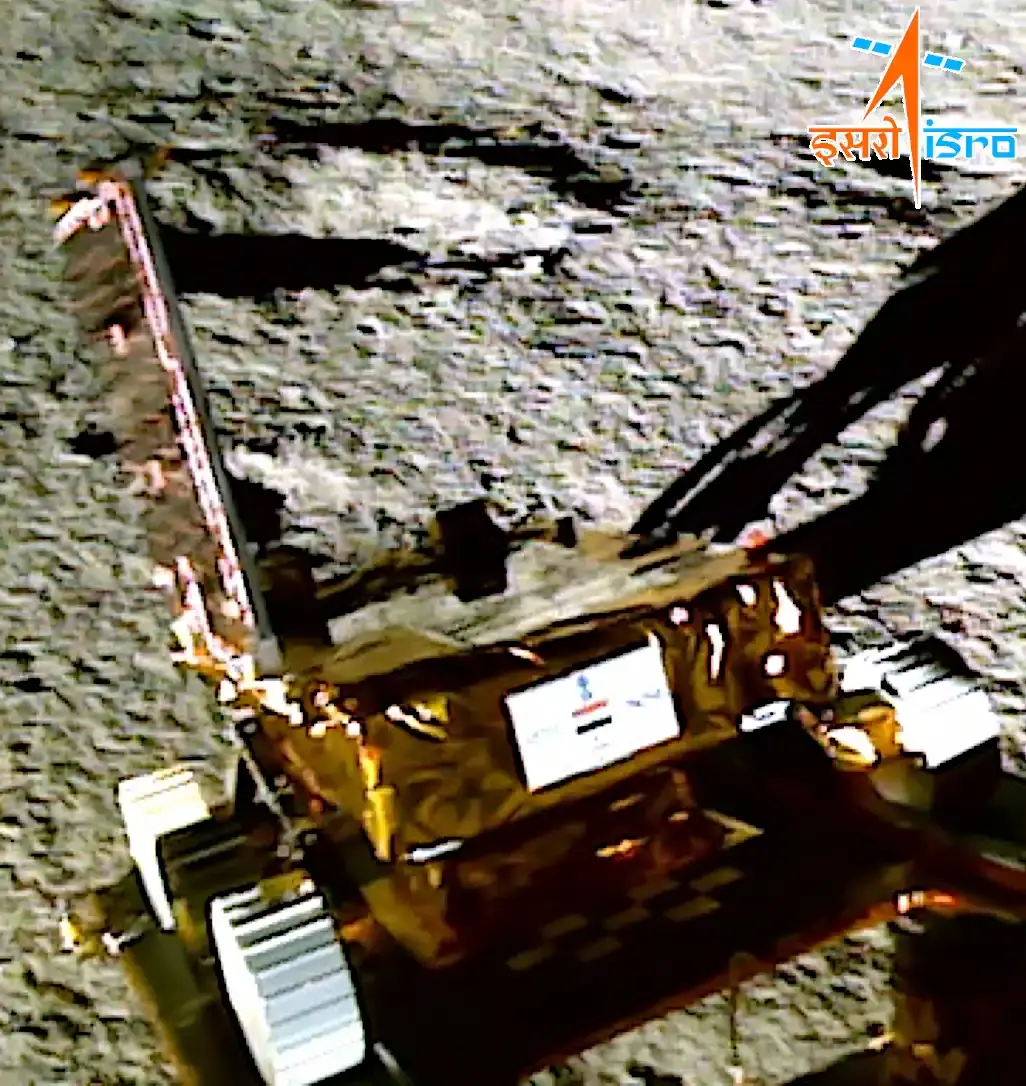 ISRO.
ISRO.
The problem
Section titled “The problem”A lunar rover has to move a few tens of kilograms over regolith whose strength is known from a small number of sites, on a power budget set by a panel the size of the chassis, with no battery recharge through night and no hand to free a stuck wheel. The recommended engineering properties of the lunar surface are a compilation of in situ Surveyor, Luna, Lunokhod and Apollo measurements, laboratory tests on returned samples and remote sensing, and its shear strengths are the output of an inversion, not direct measurements of cohesion and friction angle [3]. The wider synthesis draws almost entirely on six Apollo sites and three Luna sites within about 27 degrees of the equator [4], so the 69.4 S Chandrayaan-3 landing site lies outside the range the data cover. The Soviet cone penetrometer record from Lunokhod 1 was reduced to unit penetration resistance for four terrain units and compared with the Apollo 14 simple penetrometer [2]. Gravity changes it again: static cone penetration in CUMT-1 simulant on a magnetic-levitation rig cut average penetration resistance over the top 150 mm by 29.1 percent at 1/6 g and 40 percent relative density, and by 8.8 percent at 76 percent relative density [37].
Dust and temperature add to the soil uncertainty. Dust adhesion on lunar hardware is governed by electrostatic, charge-patch and van der Waals forces, and no direct lift-off force measurement for real lunar dust exists [14]. The coldest south polar surfaces measured from orbit reach 29 K in permanently shadowed craters [16]; the Chandrayaan-3 site is sunlit, and the rover was designed for one lunar day, not for night survival [23].
What has flown
Section titled “What has flown”Precedents on the Moon. Lunokhod 1 was a 756 kg, 2.2 m vehicle with eight independently driven 510 mm wheels, each with its own motor, brake and explosive jettison [1]. The Apollo lunar roving vehicle carried a woven wire-mesh wheel whose features each replaced an earlier failure [8]. Candidate lunar wheels had been compared in fine terrestrial sand at five strength levels before that selection, at 1 g and in air [9].
Precedents on Mars. Sojourner and the Mars Exploration Rovers use rocker-bogie linkages. The Sojourner design was chosen by solving the friction coefficient needed to climb an axle-high vertical wall, near 0.8 for six wheels and between 0.78 and 1.4 for four wheels depending on which end meets the wall [5]; the analysis tool was a quasi-static planar model built at JPL [7]. The Mars Exploration Rovers folded and latched the linkage for stowage, with six latches that all engaged on Mars [6]. Sojourner’s wheel dug 0.8 to 1.2 cm after seven revolutions in soft material, and was triboelectrically charged and picked up dust in ground tests [18]. Driving cost on the Mars Exploration Rovers was dominated by autonomy overhead: blind driving ran about 120 m per hour, hazard avoidance 10 to 35 m per hour, visual odometry 10 m per hour and both together 5 m per hour [11].
Other recent lunar landers and microrovers. SLIM landed on 19 January 2024 with a position error of 3.4 m on its first hover image against a 100 m requirement, then ended 60 m east of the target with a 90 degree attitude deviation after one main engine lost thrust, which left the solar cells facing west [33]. The SLIM project review [34] organizes the mission results around precision landing and lander mass reduction, the latter through a 500 N class ceramic combustion chamber and nozzle main engine and flexible thin film solar cells bonded to the exposed structure [34]. The vision-based navigation system on SLIM matched craters during descent and ran obstacle detection at 50 m altitude, and the flight telemetry of 19 to 20 January 2024 is reported alongside Monte Carlo and hardware-in-the-loop validation [35].
Pragyan on Chandrayaan-2 (2019). The first flight unit was a six-wheeled rover specified at 27 kg and 50 W with a 500 m design range, solar powered and able to communicate only with the lander [19]. Lander separation was on 2 September 2019 from a 100 km polar orbit; descent was reported as normal to an altitude of 2.1 km, after which communication was lost and the rover never reached the surface [22]. The 500 m range was never exercised [19].
Pragyan on Chandrayaan-3 (2023). The second unit, 26 kg and 50 W, was carried inside the Vikram lander on LVM3-M4, launched on 14 July 2023 [24], [21]. Vikram landed at 69.367621 S, 32.348126 E on 23 August 2023, and the rover was deployed down a primary and secondary ramp mechanism onto the surface on 24 August [23], [24]. The lander’s design response to the 2019 loss included four throttleable 800 N engines, a Laser Doppler Velocimeter, a Ka-band altimeter and a hazard detection and avoidance camera, while the rover configuration was carried over essentially unchanged [23]. Powered descent began at a 30 km altitude with the four 800 N engines and eight 58 N attitude thrusters [24]. A decoupled quaternion attitude law that separates thrust-axis roll from thrust pointing, proposed so that the hazard camera can be oriented, has been tested only in the authors’ simulator with a 150 degree commanded rotation [36].
Mobility is six grousered wheels; the published primitives are forward drive, reverse drive and in-place rotation about the rover center. Wheel centers are 680 mm apart front to rear and the outer wheel faces are 750 mm apart, so a rotation in place disturbs a circular patch about 1012 mm across [25]. Total distance driven was about 101 m, against the 500 m design range of the Chandrayaan-2 unit [19]. The rover was placed in sleep mode on 4 September 2023 ahead of lunar night, and attempts to re-establish communication around sunrise on 22 September did not succeed [24].
Science: LIBS confirmed sulfur and APXS detected minor elements in the first surface results [24]. APXS excites with alpha particles as well as X-rays, which raises sensitivity to low-Z elements by more than two orders of magnitude relative to X-ray-only excitation [29]. LIBS is a 1.1 kg instrument drawing 1.19 W in steady state and firing 3 to 4 mJ pulses at 205 mm standoff, an order of magnitude below the mass and power of standoff LIBS instruments flown on Mars [26].
Control was open-loop: numbered mobility commands (mobility-ids) were uplinked through the lander by ISRO through ISTRAC, Bengaluru, with the deep-space link at the Indian Deep Space Network [23], [24]. No onboard hazard detection or autonomous path selection is published for the rover; hazard detection and avoidance is attributed to the lander [23].
What is being tried now
Section titled “What is being tried now”Orbital reconstruction of rover traverses (applied to Pragyan, flown hardware). Rover tracks are not directly visible in Chandrayaan-2 Orbiter High Resolution Camera imagery at about 25 cm nadir resolution, but the in-place turn patches raise the local gray count by 15 to 20 counts in a difference image built from October 2021 and April 2024 acquisitions at 9.1 and 10.8 degrees solar elevation [25]. Eight in-place turn locations, carrying mobility-ids M-14 through M-34, were matched to the uplinked commands with positional accuracy within 1 m [25]. A 0.30 m per pixel digital elevation model of the site resolves the rover as a discrete feature 8.3 m from the lander [30]. This is a published result on flown hardware, made with Chandrayaan-2 orbiter imagery. LRO’s narrow angle camera, whose preflight calibration is documented, is the other orbital imager used for placing lunar surface assets [17].
Wheel and soil modeling (ground tests, not flown). A two-dimensional discrete element model selected an 18-lug, 250 mm wheel for a Japanese lunar micro rover concept and was validated on a sloped bed of FJS-1 simulant [10]. Scarab, a 280 kg four-wheel skid-steered prototype for polar cold traps, cut downhill slip from 37 percent to 15 percent with active body roll control in field tests on GRC-1 simulant [12], [13]. All of this is Earth-gravity work.
Terramechanics simulation for lunar wheels (ground, simulation). A multibody dynamics framework with a physics-based terramechanics model has been applied to analyze Yutu mobility performance [31]. A physics-based continuum model of the soil is offered as a faster alternative to semi-empirical wheel-soil models [32]. Both are simulation work; neither is validated against Pragyan telemetry.
Reduced-gravity testing (ground, parabolic flight and levitation). Two Falcon 20 parabolic campaigns found that granular scaling laws predicted lunar-gravity wheel performance within 8.5 percent mean squared percentage error on drawbar pull, against 44 percent for matching cone index gradient in a loosened 1 g soil; the GRC-1 simulant is weaker in lunar gravity than the Apollo in situ soil [40]. Each parabola gives 20 to 30 seconds, so runs are transient [40].
Wheel-soil sensing (designed, never flown). VIPER, a 450 kg four-wheeled rover canceled in 2024, was to measure wheel normal force with torque transducers in its suspension joints and sinkage with an encoder pattern on the wheel rim; the paper lists anticipated data products only [38]. Pragyan carries no such instrumentation in the published record.
Visual-inertial odometry for night driving (ground, field trials). A bird’s-eye-view feature-matching front end was tested on a half-scale prototype of the Endurance rover over five trajectories totaling under 550 m at 0.24 m/s, and lowered the minimum reliable image rate from 0.40 Hz to 0.25 Hz on one night trajectory, a 76.6 percent mean reduction across trajectories; one night run is simulated [39].
Layout tradespace (analysis and open toolkit, not flown). A tradespace analysis of sub-50 kg lunar rovers finds that rigid four-wheel layouts Pareto-dominate six-wheel rocker-bogie designs on smooth regolith, with six wheels entering the Pareto set only once an obstacle-navigation requirement is imposed [27]. Neither [27] nor the ISRO pages publish a Pragyan suspension analysis.
Onboard motion planning (ground and flight-software development). CRESCENT, the trajectory optimizer developed for JPL’s CADRE lunar rovers, runs a two-level planner onboard at 1 Hz and 5 Hz to execute directives from multi-agent autonomy without a per-move uplink [20]. Pragyan flew none of this.
Learned perception on Pragyan imagery (ground processing of flown data). A 2026 pipeline applies CLAHE-enhanced stereo, YOLOv11n object detection and a small neural network for distance estimation to Chandrayaan-3 NavCam stereo imagery, and reports a median depth error of 2.26 cm within 1 to 10 m against ISRO’s CAHV triangulation utility [28]. The reference is another algorithm, not a surveyed ground truth, and the detector was trained on Apollo imagery, not on Chandrayaan-3 images [28]. It has not run onboard.
Landing hazard detection (lander side). ALHAT-style lidar hazard detection was sized by Monte Carlo studies on synthetic terrain [15]; Chandrayaan-3 instead flew a hazard detection camera whose performance is not published [23].
The numbers
Section titled “The numbers”Specifications
Section titled “Specifications”| Parameter | Value | Source |
|---|---|---|
| Mass, Chandrayaan-3 unit | 26 kg | [23], [21] |
| Mass, Chandrayaan-2 unit | 27 kg | [19] |
| Dimensions | 917 x 750 x 397 mm | [21] |
| Wheels | six, grousered | [25] |
| Wheel center spacing, front to rear | 680 mm | [25] |
| Track width, outer wheel faces | 750 mm | [25] |
| In-place turn circle diameter | 1012 mm | [25] |
| Electrical generation | 50 W | [23], [21] |
| Power source | solar | [19] |
| Payload count | 2 | [21] |
| Communications | rover to lander only | [23] |
| Design range, Chandrayaan-2 unit | 500 m | [19] |
Mission profile
Section titled “Mission profile”| Parameter | Value | Source |
|---|---|---|
| Launch | LVM3-M4, 14 July 2023 | [24] |
| Landing | 23 August 2023 | [24] |
| Ramp-down onto the surface | 24 August 2023 | [24] |
| Landing site | 69.367621 S, 32.348126 E | [23] |
| Prime landing ellipse | 4 km x 2.4 km | [23] |
| Surface mission life | one lunar day, about 14 Earth days | [23], [21] |
| Distance driven | about 101 m | [25] |
| Sleep mode entered | 4 September 2023 | [24] |
| Recovery attempts ended | 22 September 2023 | [24] |
Vikram carried a mass of 1749.86 kg including the rover and generated 738 W at winter solstice [21]. The Chandrayaan-3 lander touchdown requirements are vertical velocity at or below 2 m/s, horizontal velocity at or below 0.5 m/s and slope at or below 12 degrees [23].
A 0.30 m per pixel digital elevation model covering 2.18 x 2.24 km around the lander gives a mean slope of 3.61 degrees with a standard deviation of 2.93 degrees and a 95th percentile of 9.25 degrees; within a 250 m buffer the mean falls to 3.10 degrees and the 95th percentile to 7.24 degrees, with 13.7 m of local relief [30].
Thermal and avionics
Section titled “Thermal and avionics”LIBS is qualified for an operating range of -20 to +55 degrees C and a storage range of -40 to +70 degrees C [26]. The APXS silicon drift detector must be held near -35 degrees C by an integral thermoelectric cooler with an active Peltier controller that maintains the setpoint for ambient temperatures below +30 degrees C and reaches a stable temperature about two minutes after switch-on; the detector is coupled to the metallic portion of the payload assembly and to a radiator plate [29]. A common rover FPGA-based electronics unit services the payloads: for APXS it generates the peak-detector control signals on an event trigger, reads the 12-bit serial ADC output and assembles packets of about 1 KB of X-ray events, and LIBS takes its telecommands over a 16-bit serial interface [29], [26].
Payload
Section titled “Payload”| Instrument | Function | Source |
|---|---|---|
| APXS | X-ray fluorescence elemental composition, excited by a 244Cm source emitting both X-rays and alpha particles | [29] |
| LIBS | Laser-induced plasma emission spectroscopy over 220 to 800 nm for Mg, Al, Si, K, Ca, Ti, Fe and volatiles | [26], [21] |
APXS uses a silicon drift detector of 30 square millimeters active area and 450 micrometer thickness behind an 8 micrometer beryllium window [29]. A deployment mechanism on the rover bottom chassis steers it from a stowed 0 degree position to a deployed 90 degree position; deployed, the detector stands about 55 mm above the surface and sees a circular field of view about 12 cm across. A calibration target plate on the chassis covers the stowed front face and gives in-flight gain and offset monitoring [29]. The source capsule has a 6 mm active diameter inside an 8 mm disc and a 10 mm encapsulation, shielded by a 2 mm gold cup inside a 1 mm stainless steel outer layer [29].
LIBS parameters, all from [26]:
| Parameter | Value |
|---|---|
| Laser | diode-pumped solid state, 1540 nm |
| Pulse energy | 3 to 4 mJ |
| Pulse duration | 7 ns |
| Beam diameter | 0.8 mm |
| Instrument to surface distance | 205 mm plus or minus 8 mm |
| Spot size at that distance | about 100 micrometers |
| Angular field of view | plus or minus 3 degrees |
| Focusing lens | N-BK7, 200 mm focal length |
| Collection optics | two-fold lens-mirror, 37 mm entrance pupil, optical gain 0.65 |
| Spectrograph | flat-field, f/2.2, aberration-corrected concave holographic grating |
| Slit | 50 micrometers by 500 micrometers |
| Detector | UV-enhanced linear CCD, 2048 pixels, 14 by 200 micrometers |
| Spectral range | 220 to 800 nm, resolution better than 1 nm |
| Mass | about 1.1 kg |
| Steady state power | 1.19 W |
| Peak power | 10.42 W for 20 shots at 5 Hz |
| Envelope | 180 x 150 x 80 mm |
| Structure | Mg-alloy base, Ti-alloy opto-mechanical mounts |
What is not established
Section titled “What is not established”No rated drive speed, gradeability, obstacle height, battery capacity, thermal design values for the rover, flight processor or radio link parameters are published for either rover unit [23], [21], [19]. The 500 m range belongs to the Chandrayaan-2 unit, whose lander was lost [19]; the 101 m driven by the Chandrayaan-3 unit was set by the single lunar day, not by a demonstrated mobility limit [25]. ISRO figures disagree across pages (rover 26 kg versus 27 kg, lander 1749.86 kg versus 1752 kg), and the 2.1 km altitude at which Chandrayaan-2 communication was lost has no published cause [22]. No wheel wear, dust or soil-strength measurement from the Pragyan wheels is published; the soil context comes from Earth-based tests, Mars measurements and Apollo and Luna data from other latitudes [3], [4], [18]. The APXS and LIBS composition results are reported by ISRO [24]; their uncertainties are not part of the sources read. Lander verification campaigns (helicopter cold test, tower-crane hot test, leg drop on simulant) are named without data [23].
References
- Kassel, S. (1971). Lunokhod-1 Soviet Lunar Surface Vehicle
. RAND Corporation, R-802-ARPA. Source
BibTeX
@techreport{kassel1971lunokhod, title = {Lunokhod-1 Soviet Lunar Surface Vehicle}, author = {Kassel, Simon}, number = {R-802-ARPA}, institution = {RAND Corporation}, year = {1971}, url = {https://www.rand.org/pubs/reports/R0802.html} } - Johnson, S. W. and Carrier, W. D. I. (1972). Soil mechanics results of Luna 16 and Lunokhod 1: A preliminary report
. NASA, 19720007196. Source
BibTeX
@techreport{johnson1972soil, title = {Soil mechanics results of Luna 16 and Lunokhod 1: A preliminary report}, author = {Johnson, S. W. and Carrier, W. D., III}, number = {19720007196}, institution = {NASA}, year = {1972}, url = {https://ntrs.nasa.gov/citations/19720007196}, abstract = {The physical and mechanical properties of the lunar soil, as determined by Luna 16 and Lunokhod 1 experiments, are discussed. Data are included for interactions between vehicle wheels and the lunar soil, compressibility, resistance to penetration, and friction characteristics of the soil. The shear strength of the returned lunar soil for various bulk densities is also examined. Several potential spacecraft materials were tested in contact with lunar soil to determine their friction and wear characteristics.} } - Carrier, W. D. I., Olhoeft, G. R. and Mendell, W. (1991). Physical Properties of the Lunar Surface
. Lunar Sourcebook: A User's Guide to the Moon. Source
BibTeX
@incollection{carrier1991physical, title = {Physical Properties of the Lunar Surface}, author = {Carrier, W. David, III and Olhoeft, Gary R. and Mendell, Wendell}, editor = {Heiken, Grant H. and Vaniman, David T. and French, Bevan M.}, booktitle = {Lunar Sourcebook: A User's Guide to the Moon}, pages = {475--594}, publisher = {Cambridge University Press}, chapter = {9}, year = {1991}, url = {https://www.lpi.usra.edu/publications/books/lunar_sourcebook/pdf/Chapter09.pdf} } - Heiken, G. H., Vaniman, D. T. and French, B. M. (1991). Lunar Sourcebook: A User's Guide to the Moon
. Endeavour. Source
BibTeX
@book{heiken1991lunar, title = {Lunar Sourcebook: A User's Guide to the Moon}, author = {Heiken, Grant H. and Vaniman, David T. and French, Bevan M.}, journal = {Endeavour}, volume = {16}, pages = {96}, publisher = {Cambridge University Press}, year = {1991}, doi = {10.1016/0160-9327(92)90014-g} } - Bickler, D. B. (1997). The Mars Rover Mobility System
. JPL Open Repository. Source
BibTeX
@inproceedings{bickler1997mars, title = {The Mars Rover Mobility System}, author = {Bickler, Donald B.}, publisher = {JPL Open Repository}, year = {1997}, url = {https://dataverse.jpl.nasa.gov/dataset.xhtml?persistentId=hdl:2014/18908} } - Harrington, B. D. and Voorhees, C. (2004). The challenges of designing the rocker-bogie suspension for the Mars Exploration Rover
. JPL Open Repository. Source
BibTeX
@inproceedings{harrington2004challenges, title = {The challenges of designing the rocker-bogie suspension for the Mars Exploration Rover}, author = {Harrington, Brian D. and Voorhees, Chris}, publisher = {JPL Open Repository}, year = {2004}, url = {https://dataverse.jpl.nasa.gov/dataset.xhtml?persistentId=hdl:2014/38435} } - Lindemann, R. A. (1990). Quasi-Static Mobility Analysis Tool for the Design of Lunar/Martian Rovers and Construction Vehicles
. IEEE Aerospace Conference. Source
BibTeX
@inproceedings{lindemann1990quasi, title = {Quasi-Static Mobility Analysis Tool for the Design of Lunar/Martian Rovers and Construction Vehicles}, author = {Lindemann, Randel A.}, booktitle = {IEEE Aerospace Conference}, volume = {1}, publisher = {SAE International}, year = {1990}, doi = {10.4271/901650}, abstract = {<div class="htmlview paragraph">An important characteristic of vehicles for roving or construction work on the Moon or Mars will be their obstacle-climbing and -crossing capability. These obstacles will include boulders, crater rims, lava fields, and crevasses with dimensions of interest on the order of 1 meter. Therefore, terrain traversing, or mobility performance, is a crucial parameter in the design of such extraterrestrial off-road vehicles. This paper document work performed under the Mars Rover Sample Return study to develop computer-based rover-mobility analysis tools. The computer software implemented is a two-dimensional (planar) model of a generic 6-wheel by 6-wheel drive vehicle. This software code can be used iteratively to analyze and optimize vehicle conceptual designs against a variety of independent articulation parameters.</div>} } - Asnani, V., Delap, D. and Creager, C. (2009). The Development of Wheels for the Lunar Roving Vehicle
. Journal of Terramechanics, NASA/TM-2009-215798, 20100000019. Source
BibTeX
@article{asnani2009development, title = {The Development of Wheels for the Lunar Roving Vehicle}, author = {Asnani, Vivake and Delap, Damon and Creager, Colin}, journal = {Journal of Terramechanics}, volume = {46}, number = {NASA/TM-2009-215798, 20100000019}, pages = {89-103}, institution = {NASA Glenn Research Center}, year = {2009}, doi = {10.1016/j.jterra.2009.02.005}, abstract = {The Lunar Roving Vehicle (LRV) was developed for NASA s Apollo program so astronauts could cover a greater range on the lunar surface, carry more science instruments, and return more soil and rock samples than by foot. Because of the unique lunar environment, the creation of flexible wheels was the most challenging and time consuming aspect of the LRV development. Wheels developed for previous lunar systems were not sufficient for use with this manned vehicle; therefore, several new designs were created and tested. Based on criteria set by NASA, the choices were narrowed down to two: the wire mesh wheel developed by General Motors (GM), and the hoop spring wheel developed by the Bendix Corporation. Each of these underwent intensive mechanical, material, and terramechanical analyses, and in the end, the wire mesh wheel was chosen for the LRV. Though the wire mesh wheel was determined to be the best choice for its particular application, it may be insufficient towards achieving the objectives of future lunar missions that could require higher tractive capability, increased weight capacity, or extended life. Therefore lessons learned from the original LRV wheel development and suggestions for future Moon wheel projects are offered.} } - Freitag, D. R., Green, A. J. and Melzer, K.-J. (1970). Performance Evaluation of Wheels for Lunar Vehicles (Summary Report)
. U.S. Army Engineer Waterways Experiment Station, Technical Report M-70-2. Source
BibTeX
@techreport{freitag1970performance, title = {Performance Evaluation of Wheels for Lunar Vehicles (Summary Report)}, author = {Freitag, Dean R. and Green, Andrew J. and Melzer, Klaus-Jurgen}, number = {Technical Report M-70-2}, institution = {U.S. Army Engineer Waterways Experiment Station}, year = {1970}, url = {https://ntrs.nasa.gov/citations/19700027358}, abstract = {Performance evaluation of lunar surface vehicle wheels in fine sand} } - Nakashima, H., Fujii, H., Oida, A., Momozu, M., Kanamori, H., Aoki, S., Yokoyama, T., Shimizu, H., Miyasaka, J. and Ohdoi, K. (2010). Discrete Element Method Analysis of Single Wheel Performance for a Small Lunar Rover on Sloped Terrain
. Journal of Terramechanics, 5. Source
BibTeX
@article{nakashima2010discrete, title = {Discrete Element Method Analysis of Single Wheel Performance for a Small Lunar Rover on Sloped Terrain}, author = {Nakashima, H. and Fujii, H. and Oida, A. and Momozu, M. and Kanamori, H. and Aoki, S. and Yokoyama, T. and Shimizu, H. and Miyasaka, J. and Ohdoi, K.}, journal = {Journal of Terramechanics}, volume = {47}, number = {5}, pages = {307--321}, year = {2010}, doi = {10.1016/j.jterra.2010.04.001} } - Maimone, M. W. (2009). Planetary Rover Systems: Sojourner to MSL, 20150011982. ntrs.nasa.gov/citations/20150011982
BibTeX
@misc{maimone2009planetary, title = {Planetary Rover Systems: {Sojourner} to {MSL}}, author = {Maimone, Mark W.}, howpublished = {Presentation at the Jet Propulsion Laboratory, California Institute of Technology}, number = {20150011982}, year = {2009}, url = {https://ntrs.nasa.gov/citations/20150011982}, abstract = {No abstract available} } - Bartlett, P., Wettergreen, D. and Whittaker, W. L. (2008). Design of the Scarab Rover for Mobility and Drilling in the Lunar Cold Traps
. International Symposium on Artificial Intelligence, Robotics and Automation in Space. Source
BibTeX
@inproceedings{bartlett2008design, title = {Design of the Scarab Rover for Mobility and Drilling in the Lunar Cold Traps}, author = {Bartlett, Paul and Wettergreen, David and Whittaker, William L.}, booktitle = {International Symposium on Artificial Intelligence, Robotics and Automation in Space}, address = {Los Angeles, California}, year = {2008}, url = {https://www.ri.cmu.edu/pub_files/2008/2/08isairas.scarab.bartlett.pdf} } - Wettergreen, D., Moreland, S., Skonieczny, K., Jonak, D., Kohanbash, D. and Teza, J. (2009). Design and Experimentation of a Rover Concept for Lunar Crater Resource Survey
. AIAA Aerospace Sciences Meeting including The New Horizons Forum and Aerospace Exposition. Source
BibTeX
@inproceedings{wettergreen2009design, title = {Design and Experimentation of a Rover Concept for Lunar Crater Resource Survey}, author = {Wettergreen, David and Moreland, Scott and Skonieczny, Krzysztof and Jonak, Dominic and Kohanbash, David and Teza, James}, booktitle = {AIAA Aerospace Sciences Meeting including The New Horizons Forum and Aerospace Exposition}, year = {2009}, doi = {10.2514/6.2009-1206}, abstract = {Scarab is a prospecting rover for lunar missions to survey resources, particularly water ice, in polar craters. It is designed for the deployment of a deep coring drill and for transport of soil analysis instruments. Its chassis can transform to stabilize the drill in contact with the ground and can also adjust to ascend and descent steep slopes of unconsolidated soil. Additional features include a compact body for better thermal regulation, laser scanners for dark navigation, and power system designed for a persistent, low-capacity source. Scarab was prototyped at the Robotics Institute, has undergone mobility testing in soils laboratories and field sites leading up to an integrated system test including the RESOLVE drill and instrument suite at the PISCES lunar analogue site on Mauna Kea in Hawaii} } - Walton, O. R. (2007). Adhesion of Lunar Dust
. NASA Glenn Research Center, NASA/TM-2007-214430, 20070020448. Source
BibTeX
@techreport{walton2007adhesion, title = {Adhesion of Lunar Dust}, author = {Walton, Otis R.}, number = {NASA/TM-2007-214430, 20070020448}, institution = {NASA Glenn Research Center}, year = {2007}, url = {https://ntrs.nasa.gov/citations/20070020448}, abstract = {This paper reviews the physical characteristics of lunar dust and the effects of various fundamental forces acting on dust particles on surfaces in a lunar environment. There are transport forces and adhesion forces after contact. Mechanical forces (i.e., from rover wheels, astronaut boots and rocket engine blast) and static electric effects (from UV photo-ionization and/or tribo-electric charging) are likely to be the major contributors to the transport of dust particles. If fine regolith particles are deposited on a surface, then surface energy-related (e.g., van der Walls) adhesion forces and static-electric-image forces are likely to be the strongest contributors to adhesion. Some measurement techniques are offered to quantify the strength of adhesion forces. And finally some dust removal techniques are discussed.} } - Johnson, A. E., Huertas, A., Werner, R. A. and Montgomery, J. F. (2008). Analysis of On-Board Hazard Detection and Avoidance for Safe Lunar Landing
. IEEE Aerospace Conference. Source
BibTeX
@inproceedings{johnson2008analysis, title = {Analysis of On-Board Hazard Detection and Avoidance for Safe Lunar Landing}, author = {Johnson, Andrew E. and Huertas, Andres and Werner, Robert A. and Montgomery, James F.}, booktitle = {IEEE Aerospace Conference}, pages = {1-9}, address = {Big Sky, Montana}, year = {2008}, doi = {10.1109/aero.2008.4526301}, abstract = {Landing hazard detection and avoidance technology is being pursued within NASA to improve landing safety and increase access to sites of interest on the lunar surface. The performance of a hazard detection and avoidance system depends on properties of the terrain, sensor performance, algorithm design, vehicle characteristics and the overall all guidance navigation and control architecture. This paper analyzes the size of the region that must be imaged, sensor performance parameters and the impact of trajectory angle on hazard detection performance. The analysis shows that vehicle hazard tolerance is the driving parameter for hazard detection system design.} } - Paige, D. A., Siegler, M. A., Zhang, J. A., Hayne, P. O., Foote, E. J., Bennett, K. A., Vasavada, A. R., Greenhagen, B. T., Schofield, J. T., McCleese, D. J., Foote, M. C., DeJong, E., Bills, B. G., Hartford, W., Murray, B. C., Allen, C. C., Snook, K., Soderblom, L. A., Calcutt, S., Taylor, F. W., Bowles, N. E., Bandfield, J. L., Elphic, R., Ghent, R., Glotch, T. D., Wyatt, M. B. and Lucey, P. G. (2010). Diviner Lunar Radiometer Observations of Cold Traps in the Moon's South Polar Region
. Science, 6003. Source
BibTeX
@article{paige2010diviner, title = {{Diviner} Lunar Radiometer Observations of Cold Traps in the {Moon}'s South Polar Region}, author = {Paige, David A. and Siegler, Matthew A. and Zhang, Jo Ann and Hayne, Paul O. and Foote, Emily J. and Bennett, Kristen A. and Vasavada, Ashwin R. and Greenhagen, Benjamin T. and Schofield, John T. and McCleese, Daniel J. and Foote, Marc C. and DeJong, Eric and Bills, Bruce G. and Hartford, Wayne and Murray, Bruce C. and Allen, Carlton C. and Snook, Kelly and Soderblom, Laurence A. and Calcutt, Simon and Taylor, Fredric W. and Bowles, Neil E. and Bandfield, Joshua L. and Elphic, Richard and Ghent, Rebecca and Glotch, Timothy D. and Wyatt, Michael B. and Lucey, Paul G.}, journal = {Science}, volume = {330}, number = {6003}, pages = {479--482}, year = {2010}, doi = {10.1126/science.1187726}, abstract = {Watering the Moon About a year ago, a spent upper stage of an Atlas rocket was deliberately crashed into a crater at the south pole of the Moon, ejecting a plume of debris, dust, and vapor. The goal of this event, the Lunar Crater Observation and Sensing Satellite (LCROSS) experiment, was to search for water and other volatiles in the soil of one of the coldest places on the Moon: the permanently shadowed region within the Cabeus crater. Using ultraviolet, visible, and near-infrared spectroscopy data from accompanying craft, Colaprete et al. (p. 463 ; see the news story by Kerr ; see the cover) found evidence for the presence of water and other volatiles within the ejecta cloud. Schultz et al. (p. 468 ) monitored the different stages of the impact and the resulting plume. Gladstone et al. (p. 472 ), using an ultraviolet spectrograph onboard the Lunar Reconnaissance Orbiter (LRO), detected H 2 , CO, Ca, Hg, and Mg in the impact plume, and Hayne et al. (p. 477 ) measured the thermal signature of the impact and discovered that it had heated a 30 to 200 square-meter region from ∼40 kelvin to at least 950 kelvin. Paige et al. (p. 479) mapped cryogenic zones predictive of volatile entrapment, and Mitrofanov et al. (p. 483 ) used LRO instruments to confirm that surface temperatures in the south polar region persist even in sunlight. In all, about 155 kilograms of water vapor was emitted during the impact; meanwhile, the LRO continues to orbit the Moon, sending back a stream of data to help us understand the evolution of its complex surface structures.} } - Robinson, M. S., Brylow, S. M., Tschimmel, M., Humm, D., Lawrence, S. J., Thomas, P. C., Denevi, B. W., Bowman-Cisneros, E., Zerr, J., Ravine, M. A., Caplinger, M. A., Ghaemi, F. T., Schaffner, J. A., Malin, M. C., Mahanti, P., Bartels, A., Anderson, J., Tran, T. N., Eliason, E. M., McEwen, A. S., Turtle, E. P., Jolliff, B. L. and Hiesinger, H. (2010). Lunar Reconnaissance Orbiter Camera (LROC) Instrument Overview
. Space Science Reviews, 1-4. Source
BibTeX
@article{robinson2010lunar, title = {Lunar Reconnaissance Orbiter Camera (LROC) Instrument Overview}, author = {Robinson, Mark S. and Brylow, S. M. and Tschimmel, M. and Humm, D. and Lawrence, Samuel J. and Thomas, Peter C. and Denevi, Brett W. and Bowman-Cisneros, E. and Zerr, J. and Ravine, Michael A. and Caplinger, Michael A. and Ghaemi, F. Tony and Schaffner, Jacob A. and Malin, Michal C. and Mahanti, P. and Bartels, A. and Anderson, J. and Tran, T. N. and Eliason, E. M. and McEwen, Alfred S. and Turtle, Elizabeth P. and Jolliff, B. L. and Hiesinger, H.}, journal = {Space Science Reviews}, volume = {150}, number = {1-4}, pages = {81-124}, year = {2010}, doi = {10.1007/978-1-4419-6391-8_6} } - Keith, T. G. and Siebert, M. W. (1998). Mars Pathfinder Wheel Abrasion Experiment Ground Test, and Mars Pathfinder Final Technical Report
. NASA Lewis Research Center and Jet Propulsion Laboratory. Source
BibTeX
@techreport{keith1998mars, title = {Mars Pathfinder Wheel Abrasion Experiment Ground Test, and Mars Pathfinder Final Technical Report}, author = {Keith, Theo G. and Siebert, Mark W.}, institution = {NASA Lewis Research Center and Jet Propulsion Laboratory}, year = {1998}, url = {https://ntrs.nasa.gov/citations/19990013984}, abstract = {The National Aeronautics and Space Administration (NASA) sent a mission to the martian surface, called Mars Pathfinder. The mission payload consisted of a lander and a rover. The primary purpose of the mission was demonstrating a novel entry, descent, and landing method that included a heat shield, a parachute, rockets, and a cocoon of giant air bags. Once on the surface, the spacecraft returned temperature measurements near the Martian surface, atmosphere pressure, wind speed measurements, and images from the lander and rover. The rover obtained 16 elemental measurements of rocks and soils, performed soil-mechanics, atmospheric sedimentation measurements, and soil abrasiveness measurements.} } - (2019). ISRO: Chandrayaan-2 Spacecraft. isro.gov.in/chandrayaan2-spacecraft
BibTeX
@misc{anon2019isro, title = {ISRO: Chandrayaan-2 Spacecraft}, organization = {isro.gov.in}, year = {2019}, url = {https://www.isro.gov.in/chandrayaan2-spacecraft} } - Cauligi, A., Albee, K., de la Croix, J.-P. and Brockers, R. (2025). CRESCENT: Collision-Free Highly-Constrained Trajectory Optimization for Driving on the Moon
. IEEE Transactions on Field Robotics. Source
BibTeX
@article{cauligi2025crescent, title = {CRESCENT: Collision-Free Highly-Constrained Trajectory Optimization for Driving on the Moon}, author = {Cauligi, Abhishek and Albee, Keenan and de la Croix, Jean-Pierre and Brockers, Roland}, journal = {IEEE Transactions on Field Robotics}, publisher = {JPL Open Repository}, year = {2025}, doi = {10.48577/jpl.m3hu8h}, abstract = {Rovers have been a mainstay of planetary exploration missions, significantly expanding ourknowledge in planetary science. However, past rover missions have involved significant human supervisionto oversee rover operations, a state-of-practice that scales poorly for the next generation of missions. Inthis work, we present the development of CRESCENT, a motion planning algorithm developed for theupcoming multi-agent CADRE Lunar rover mission. CRESCENT was designed to safely drive a miniaturerover platform in a highly cluttered unmapped Lunar environment, executing complex motion directivesfrom CADRE’s team-level autonomy while meeting far stricter dynamical and temporal constraints thanexisting on-board planetary rover planning algorithms are capable of satisfying. Our hierarchical approachformulates an efficient numerical trajectory optimization-based motion planning algorithm that makesuse of nonlinear optimization to solve the planning problem in real-time. We demonstrate the efficiencyof our proposed approach through extensive simulations and hardware testing in a representative Lunarenvironment. Following CADRE’s upcoming deployment on the Lunar surface, CRESCENT will be thefirst nonlinear optimization-based trajectory optimization approach used on another celestial body.} } - Indian Space Research Organisation. (2023). LVM3-M4/Chandrayaan-3 Mission Brochure. isro.gov.in/media_isro/pdf/Missions/LVM3/LVM3M4_Chandrayaan3_brochure...
BibTeX
@misc{indian2023lvm3m4chandrayaan3, title = {LVM3-M4/Chandrayaan-3 Mission Brochure}, author = {{Indian Space Research Organisation}}, organization = {isro.gov.in}, year = {2023}, url = {https://www.isro.gov.in/media_isro/pdf/Missions/LVM3/LVM3M4_Chandrayaan3_brochure.pdf} } - (2026). ISRO: Chandrayaan-2 Mission. isro.gov.in/Chandrayaan_2.html
BibTeX
@misc{isrochandrayaan2mission, title = {ISRO: Chandrayaan-2 Mission}, organization = {isro.gov.in}, year = {2026}, url = {https://www.isro.gov.in/Chandrayaan_2.html} } - (2026). ISRO: Chandrayaan-3 Details. isro.gov.in/Chandrayaan3_Details.html
BibTeX
@misc{isrochandrayaan3details, title = {ISRO: Chandrayaan-3 Details}, organization = {isro.gov.in}, year = {2026}, url = {https://www.isro.gov.in/Chandrayaan3_Details.html} } - (2026). ISRO: Chandrayaan-3 mission updates. isro.gov.in/Chandrayaan3.html
BibTeX
@misc{isrochandrayaan3updates, title = {ISRO: Chandrayaan-3 mission updates}, organization = {isro.gov.in}, year = {2026}, url = {https://www.isro.gov.in/Chandrayaan3.html} } - Iyer, K. V., Alurkar, M. S., Prashar, A. K., Suresh, K. and Amitabh. (2025). Path tracing of the Chandrayaan-3 Rover from OHRC images
. Current Science, 6. Source
BibTeX
@article{iyer2025path, title = {Path tracing of the Chandrayaan-3 Rover from OHRC images}, author = {Iyer, Kannan V. and Alurkar, Medha S. and Prashar, Ajay Kumar and Suresh, K. and Amitabh}, journal = {Current Science}, volume = {128}, number = {6}, pages = {558--561}, year = {2025}, doi = {10.18520/cs/v128/i6/558-561} } - Laxmiprasad, A. S., Raja, V. L. N. S., Menon, S., Goswami, A., Rao, M. V. H. and Lohar, K. A. (2020). Laser Induced Breakdown Spectroscope on Chandrayaan-2 Rover: A Miniaturized Mid-UV to Visible Active Spectrometer for Lunar Surface Chemistry Studies
. Current Science, 4. Source
BibTeX
@article{laxmiprasad2020laser, title = {Laser Induced Breakdown Spectroscope on Chandrayaan-2 Rover: A Miniaturized Mid-UV to Visible Active Spectrometer for Lunar Surface Chemistry Studies}, author = {Laxmiprasad, A. S. and Raja, V. L. N. Sridhar and Menon, Sudhakar and Goswami, Ashutosh and Rao, M. V. H. and Lohar, K. A.}, journal = {Current Science}, volume = {118}, number = {4}, pages = {573--581}, year = {2020}, doi = {10.18520/cs/v118/i4/573-581}, abstract = {Laser Induced Breakdown Spectroscope (LIBS) instrument flown in Chandrayaan-2 mission to the Moon, is one of the scientific instruments on the Pragyaan rover.It is primarily developed to carry out in situ investigations for the elemental composition study of lunar regolith and pebbles on the Moon surface in a previously unexplored high latitude area in the southern polar region.A pulsed laser source, a set of optical lenses and mirrors, an aberrationcorrected concave holographic grating and a linear detector, are the principal electro-optical accessories of the instrument.The developed LIBS is a lightweighted (~1.1 kg) and low power consuming (≤1.2 W) compact instrument.This paper presents the system engineering and development aspects of the LIBS instrument along with results from environmental tests.Performance evaluation of the instrument during endto-end testing is satisfactory and within desired specifications.Details on ground calibration techniques used to evaluate the instrument capability are also presented.} } - Reifschneider, J. (2026). RoverDevKit: An open, physics-grounded tradespace toolkit for conceptual design of lunar micro-rovers
. arXiv preprint. Source
BibTeX
@article{reifschneider2026roverdevkit, title = {RoverDevKit: An open, physics-grounded tradespace toolkit for conceptual design of lunar micro-rovers}, author = {Reifschneider, Jon}, journal = {arXiv preprint}, year = {2026}, doi = {10.48550/arxiv.2606.21755}, abstract = {Lunar micro-rovers under 50 kg are a rapidly growing vehicle class, yet open, benchmarked tools for running optimization across design trades remain scarce. Rover sizing is a highly coupled problem with a feedback loop specific to surface vehicles: a heavier rover sinks deeper into loose regolith, deeper sinkage costs more power, more power requires a larger array, and the array adds mass. We present RoverDevKit, a tradespace exploration toolkit with an open evaluator that couples a closed-form wheel-soil model with bottom-up mass, solar-power, thermal-survival, and traverse models. It is fast enough to serve as the fitness function of a multi-objective genetic algorithm (NSGA-II): one search of 3000 mission evaluations takes under a minute on a single laptop core. We use it to map the trades among distance traveled, vehicle mass, and slope capability on mare, polar, highland, and crater-rim missions. Across those missions the limiting factor changes: energy storage at high latitude, slope traction on loose highland regolith, and traverse range on mare and crater-rim terrain. The wheel-soil model matches measured single-wheel drawbar pull on two independent datasets to within the 20-30% error typically reported for this class of model, and the mass model predicts published 5-50 kg rover masses to 10.5% median absolute error. A check against five published in-class designs places them near the designs the optimizer selects. Re-running the search after applying that wheel-soil comparison error leaves these conclusions unchanged.} } - Relia, L., Singla, J. G., Amitabh and Dube, N. (2026). Deep Learning Aided Vision System for Planetary Rovers
. arXiv. Source
BibTeX
@article{relia2026deep, title = {Deep Learning Aided Vision System for Planetary Rovers}, author = {Relia, Lomash and Singla, Jai G. and Amitabh and Dube, Nitant}, journal = {arXiv}, year = {2026}, doi = {10.48550/arxiv.2603.26802}, abstract = {This study presents a vision system for planetary rovers, combining real-time perception with offline terrain reconstruction. The real-time module integrates CLAHE enhanced stereo imagery, YOLOv11n based object detection, and a neural network to estimate object distances. The offline module uses the Depth Anything V2 metric monocular depth estimation model to generate depth maps from captured images, which are fused into dense point clouds using Open3D. Real world distance estimates from the real time pipeline provide reliable metric context alongside the qualitative reconstructions. Evaluation on Chandrayaan 3 NavCam stereo imagery, benchmarked against a CAHV based utility, shows that the neural network achieves a median depth error of 2.26 cm within a 1 to 10 meter range. The object detection model maintains a balanced precision recall tradeoff on grayscale lunar scenes. This architecture offers a scalable, compute-efficient vision solution for autonomous planetary exploration.} } - Shanmugam, M., Vadawale, S. V., Patel, A. R., Mithun, N. P. S., Adalaja, H. K., Ladiya, T., Goyal, S. K., Tiwari, N. K., Singh, N., Kumar, S., Painkra, D. K., Hait, A. K., Patinge, A., Kumar, A., Basha, S., Subramanian, V. R., Venkatesh, R. G., Prashant, D. B., Navle, S., Acharya, Y. B., Murty, S. V. S. and Bhardwaj, A. (2014). Alpha Particle X-Ray Spectrometer (APXS) On-board Chandrayaan-2 Rover - Pragyan
. Advances in Space Research. Source
BibTeX
@article{shanmugam2014alpha, title = {Alpha Particle X-Ray Spectrometer (APXS) On-board Chandrayaan-2 Rover - Pragyan}, author = {Shanmugam, M. and Vadawale, S. V. and Patel, Arpit R. and Mithun, N. P. S. and Adalaja, Hitesh Kumar and Ladiya, Tinkal and Goyal, Shiv Kumar and Tiwari, Neeraj K. and Singh, Nishant and Kumar, Sushil and Painkra, Deepak Kumar and Hait, A. K. and Patinge, A. and Kumar, Abhishek and Basha, Saleem and Subramanian, Vivek R. and Venkatesh, R. G. and Prashant, D. B. and Navle, Sonal and Acharya, Y. B. and Murty, S. V. S. and Bhardwaj, Anil}, journal = {Advances in Space Research}, volume = {54}, pages = {1974-1984}, year = {2014}, doi = {10.1016/j.asr.2013.03.011} } - Tungathurthi, C. (2026). Geodetically Anchored 0.30 m Digital Elevation Model of the Chandrayaan-3 Vikram Landing Site from Chandrayaan-2 Orbital High Resolution Camera (OHRC) Stereo Imagery
. arXiv preprint arXiv:2602.14993. Source
BibTeX
@article{tungathurthi2026geodetically,
  title = {Geodetically Anchored 0.30 m Digital Elevation Model of the Chandrayaan-3 Vikram Landing Site from Chandrayaan-2 Orbital High Resolution Camera (OHRC) Stereo Imagery},
  author = {Tungathurthi, Chandra},
  journal = {arXiv preprint arXiv:2602.14993},
  year = {2026},
  doi = {10.48550/arxiv.2602.14993},
  abstract = {ISRO's terrain characterization and hazard mapping from Chandrayaan-2 Orbiter High Resolution Camera (OHRC) stereo imagery were central to the safe landing of Chandrayaan-3 - the first successful landing in the lunar south polar region. However, these elevation products were generated with a proprietary pipeline and have not been publicly released. We present a 0.30 m/pixel digital elevation model (DEM) of the Chandrayaan-3 Vikram landing site using a fully open workflow based on ISIS, the Ames Stereo Pipeline, and ALE, achieving sub-meter resolution comparable to mission-reported products. The reconstruction covers 2.18 x 2.24 km with 91.2% valid pixel coverage, 8.1 cm median triangulation error, and 40-50 cm relative vertical precision. The Vikram lander and Pragyan rover are individually resolved. Geodetic alignment to an LROC NAC stereo DEM achieves approximately 30 m horizontal accuracy; pixel-wise validation at 3 m resolution confirms negligible vertical bias (median dz = +0.28 m) and robust dispersion (NMAD = 2.88 m). Stable OHRC stereo convergence requires Community Sensor Model (CSM) camera models; the legacy ISIS camera model failed across two independent sites. At 0.30 m, these DEMs complement LROC NAC DTMs (approximately 1 m), resolving sub-meter hazards below the NAC detection threshold. Applied to the extensive OHRC south polar archive, this methodology provides independent capability for hazard mapping and landing site analysis for upcoming missions including Chandrayaan-4, LUPEX, and Artemis.}
}