YAOKI
Program pages Dymon: YAOKI Project
 Dymon Co., Ltd.
The problem
Section titled “The problem”A rover that rides to the surface in a commercial lander’s payload bay shares that lander’s power and radio link, has no ground crew to right it if it lands wrong, and is delivered at a price per kilogram that pushes it toward very low mass. Astrobotic advertised Peregrine delivery at about 1.2 million dollars per kilogram in 2019 [12]. A teleoperated vehicle that tips over cannot be recovered quickly, so YAOKI’s stated design aim is to survive an uncontrolled drop and keep working in either orientation.
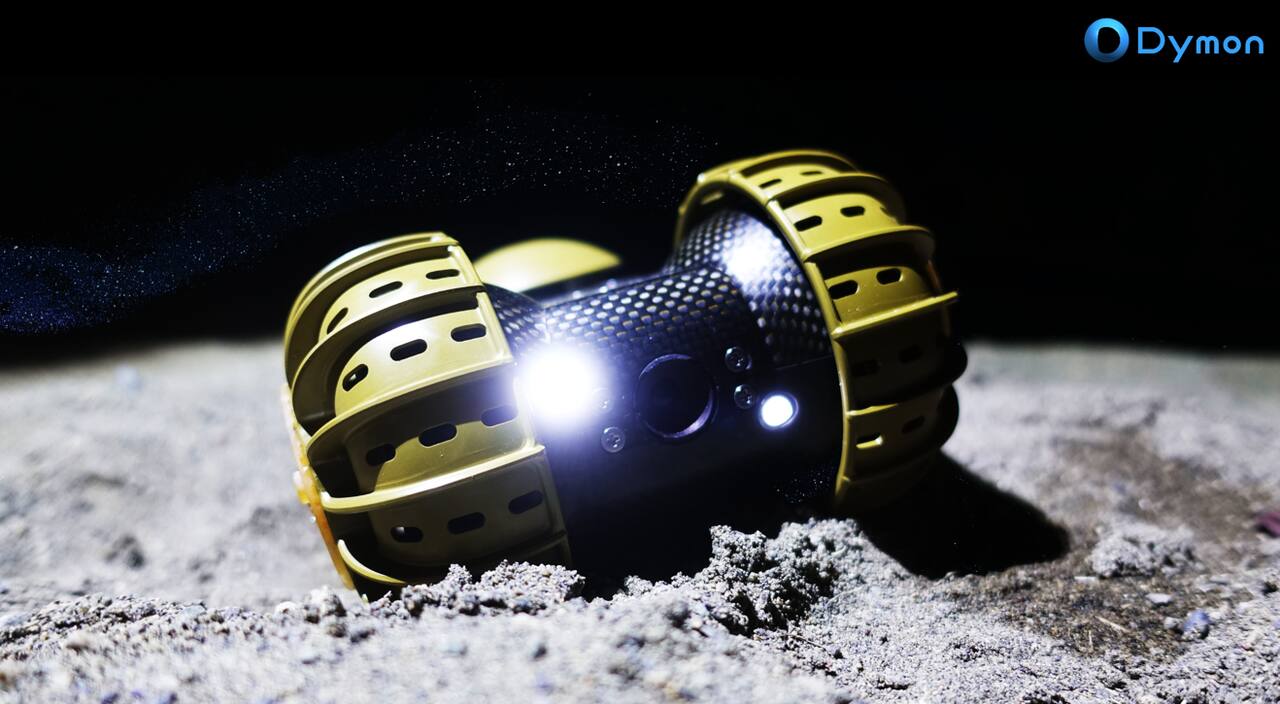
YAOKI is Dymon Co., Ltd.’s answer: a 498 g two-wheeled rover, 15 x 15 x 10 cm, with both wheels on a common axle either side of a central body, rated to withstand 100 G [10], [11]. The name comes from the proverb “Nanakorobi Yaoki”, to get up again however many times one falls [10]. It was carried on the Intuitive Machines IM-2 Nova-C lander, launched 26 February 2025 [1], and was not deployed because the lander came to rest on its side [2]. Nothing about its mobility has been demonstrated on the Moon.
The base rate for the class is unfavorable. A 2024 review counts nine lunar lander and rover missions launched from 2019 onward, four of them failed by that point [8]. The range of surface hazards a small vehicle faces, from soft soil to dust on thermal surfaces, is compared in that review with operating limits compiled from earlier vehicles: ground pressure below about 7 to 10 kPa and a slope capability around 25 degrees [9].
What has flown
Section titled “What has flown”YAOKI (IM-2, March 2025). Athena touched down on 6 March 2025 about 250 m from its target at Mons Mouton, on its side inside a crater [2]. Intuitive Machines did not expect it to recharge, given the sun direction, the panel orientation and the crater temperatures, and declared the mission concluded the next day. The lander’s inertial unit indicated it was on its side, but the company’s CEO would not accept the attitude determination without an image [2]. NASA’s PRIME-1 suite had several milestones accelerated before the batteries depleted, and the TRIDENT drill did not penetrate the surface in that orientation [5], [2]. YAOKI was not deployed. The PRIME-1 and YAOKI payloads were limited by the lander attitude, not by a fault of their own.
YAOKI’s earlier manifest. The rover was first manifested on Astrobotic’s Peregrine lander under an agreement announced 14 October 2019 for a 2021 flight [12]. Dymon stated eight years of development, base technology complete in 2018 and more than 100 tests passed, none documented [12]. Peregrine Mission One launched 8 January 2024 without it and was lost in cislunar space after a valve failure ruptured its oxidizer tank about 92 minutes after separation [6].
LEV-1 and LEV-2 (SLIM, January 2024). JAXA’s two nano rovers were released by the SLIM lander just before its touchdown on 20 January 2024 [14]. LEV-1 executed six hops, confirmed by the change in sensed gravity across each hop, with hop direction chosen autonomously from camera imagery, and transmitted directly to Earth on S band for 1 hour 51 minutes until battery depletion, with the onboard computer above 70 degrees C [14]. Its single wheel carries a 90-degree-tilted octagonal grouser selected with a resistive force theory model and single-wheel tests in silica sand, and the paper reports the choice confirmed by operation on the Moon [15]. LEV-2 (SORA-Q) is an 80 mm, 250 g ball that opens into two eccentric wheels [3]. It deployed itself, righted its attitude and drove away from the lander with no ground commands, imaging the lander and selecting frames onboard [13]. A rock common to its two returned images shows it moved about 0.13 m and rotated about 180 degrees, and telemetry shows at least about 108 minutes of operation [13]. LEV-2 is the one rover with an architecture comparable to YAOKI’s that has operated on the Moon.
The landers around them. SLIM landed with better than 10 m accuracy at about 200 kg landed mass, using crater-matching terrain relative navigation [16], [17]. HAKUTO-R Mission 1 failed on 26 April 2023 when its altitude estimate reached zero about 5 km above the surface [18]. Mission 2 struck the surface at 42 m/s in June 2025 after its laser range finder returned measurements too slowly for the descent speed to be corrected [19]. Both failures carried the payloads with them.
What is being tried now
Section titled “What is being tried now”Impact-tolerant, orientation-indifferent rovers. YAOKI (single axle, two wheels, never deployed) and LEV-2 (transformable sphere, flown) are the two vehicles in this family [12], [13]. Dymon’s own tests are not published. Mitsubishi Chemical supplied a cyanate ester CFRP body in place of aluminum, with polyamide-imide wheels chosen to survive drops from the deployer [11].
Small four-wheeled rovers. CMU’s MoonRanger carries no direct-to-Earth radio, so any traverse beyond lander Wi-Fi range must be autonomous [7]. ispace-EUROPE’s TENACIOUS and the Canadian Lunar Rover Mission are in the same class; the Canadian mission published its science payload and landing site down-selection after a June 2024 preliminary design review, with no mobility figures [31]. Neither has flown. JPL places this class within wider extreme-terrain mobility work [4], [8].
Wheel and grouser design on the ground. Single-wheel testbeds with discrete element models are the main tool. A Rashid-1 style grousered micro-rover wheel was reproduced at the flight load of 24.5 N, and extrapolation to lunar gravity left traction coefficient and tractive efficiency essentially unchanged while forces fell by about one sixth; Toyoura sand understated performance against FJS-1 by 15 to 20 percent in traction coefficient [20]. A single-wheel testbed run at up to 1.0 m/s, about a hundred times flown rover speeds, found that a slick wheel in Tohoku Silica Sand No. 5 needs a slip ratio of 0.25 before drawbar pull turns positive, against about 0.10 at 0.2 m/s [21]. For crawler mechanisms, a 45 degree lug alignment reduced slip against 60 and 90 degrees in a single-wheel rig [22]. A 20.4 kg four-wheeled testbed with passive suspension sweeps wheel geometry and center of gravity, but its results are scored pass or fail by observation [23]. Simulators now add deformable wheel traces from discrete element runs [24]. All of this is ground work at 1 g, and parabolic-flight data on a single wheel grades reduced-weight testing as overstating mobility, with drawbar pull to weight falling 20 percent or more [30].
Thermal and dust tolerance. Solar absorptivity can rise by as much as 50 percent at only 12 percent area dust coverage, and Apollo rover brush cleaning that passed at 1e-6 torr failed on the Moon [25]. Candidate lander and rover coatings are being screened for abrasion and adhesion: seven commercial ceramic and cermet coatings were tested against wear, simulant adhesion and thermal shock [26], and a simulant-bound Taber wheel produced a higher wear index than the standard wheel, 3.64 against 3.29 mg per 1000 cycles [27]. MoonRanger’s thermal model, entirely predicted, sets a surface operating band of -10 to 35 C and finds dark transit needs at least 9.5 W of lander heater power [28]. A wide-temperature lithium-ion battery for the CADRE lunar rovers went through qualification vibration and thermal vacuum [32]. YAOKI’s lens coating belongs to this family, with no published data [11].
Autonomous navigation. Dead reckoning on a lunar analog drifted about 5 percent of distance traveled in MoonRanger work [7]. Crater-based localization from lidar or stereo beat a 2 percent relative-navigation baseline in simulation, with particle filter error near 0.75 to 2 m, and moved from TRL 2 to TRL 4 without a result on real surface data [29]. A one-tonne rover carried cargo between a simulated lander and habitat by lidar teach and repeat over 18 taught segments in a Canadian analogue terrain [33], and resource-aware scheduling for the Endurance concept was tested in a Mars Yard with a physically swapped battery [34]. None has flown.
Communications. Through the lander. On IM-2 a Nokia 4G/LTE network demonstration planned lander to rover link ranges of 200 to 300 m and up to 2 km using Lunar Outpost’s MAPP rover as the mobile user [1]. YAOKI was not part of it, and its own band, data rate and range are not published [10].
The numbers
Section titled “The numbers”YAOKI specifications
Section titled “YAOKI specifications”| Parameter | Value | Source |
|---|---|---|
| Mass | 498 g | manufacturer [10], [11] |
| Dimensions | 15 x 15 x 10 cm | supplier [11] |
| Wheels | 2, on one common axle | manufacturer [12] |
| Impact tolerance | 100 G | manufacturer [10], [11] |
| Body material | CFRP with cyanate ester resin matrix, about 30 percent lighter than aluminum, fivefold safety factor, about 4 million yen lower transport cost per unit | supplier [11] |
| Wheel material | polyamide-imide | supplier [11] |
| Camera lens treatment | anti-soiling coating | supplier [11] |
| Self-righting | yes, operates either way up | manufacturer [10] |
IM-2 mission
Section titled “IM-2 mission”| Parameter | Value | Source |
|---|---|---|
| Lander | Intuitive Machines Nova-C, IM-2 | [1] |
| Launch | 26 February 2025 | [1] |
| Landing | 6 March 2025, Mons Mouton, about 250 m from target | [2] |
| Outcome | lander on its side, rover not deployed | [2] |
| Mission end | 7 March 2025 | [2] |
Flown micro rovers compared
Section titled “Flown micro rovers compared”| Vehicle | Date | Measured outcome | Source |
|---|---|---|---|
| YAOKI | March 2025 | not deployed | [2] |
| LEV-1 | 20 January 2024 | six hops, 1 h 51 min direct S-band link | [14] |
| LEV-2 | January 2024 | about 0.13 m moved, about 180 degrees turned, at least about 108 min | [13] |
What is not established
Section titled “What is not established”Drive speed, slope limit, obstacle capability, power source, battery capacity, radio band, data rate, processor and thermal margins have not been published by Dymon or any third party, and no peer-reviewed paper on the rover was located. Every YAOKI number traces to manufacturer and supplier material [10], [11], including the 100 G rating, which has no stated test standard, axis or duration, and the more than 100 tests, which have no stated types or results [12]. The mass, safety factor and cost savings for the CFRP body have no published baseline [11]. YAOKI was never deployed, so its mobility, thermal and communications claims have no flight validation, and its performance against the ground pressure and slope limits of prior lunar rovers [9] is unmeasured.
For the wider field, LEV-2’s lunar record rests on two images and one short episode, with no traverse distance or terrain-interaction data [13]. Lunar-gravity wheel performance is model output, not reduced-gravity measurement [20], and the simulants used on the ground differ from regolith [21]. Crater-based localization has no end-to-end result on real surface data [29], and thermal predictions for micro rovers are untested in thermal vacuum [28].
References
- Edwards, B., Wagner, R. S., Zemba, M., Klein, T. E., Maestro, L. and Dow, J. (2025). Envisioned Lunar Surface Communications Using 3GPP Cellular and Wi-Fi Technologies
. International Conference on Space Operations. Source
BibTeX
@inproceedings{edwards2025envisioned, title = {Envisioned Lunar Surface Communications Using 3GPP Cellular and Wi-Fi Technologies}, author = {Edwards, Bernard and Wagner, Raymond S. and Zemba, Michael and Klein, Thierry E. and Maestro, Luis and Dow, John}, booktitle = {International Conference on Space Operations}, year = {2025}, url = {https://ntrs.nasa.gov/citations/20250001947}, abstract = {Under NASA’s Artemis Program, NASA plans to collaborate with commercial and international partners to establish a long-term human and robotic presence on the Moon. Critical lunar infrastructure includes having a robust surface wireless communications and navigation network to be developed over time by many organizations, public and private. NASA’s Space Technology Mission Directorate (STMD) has envisioned a lunar surface future that includes the use of 3rd Generation Partnership Project (3GPP) cellular and 802.11 Wi-Fi technologies. NASA and Nokia Bell Labs are studying and validating the benefits and trade-offs of using 3GPP 4G and 5G technologies originally developed for use here on Earth, and how 3GPP technologies and 802.11 Wi-Fi technologies can be integrated to provide a robust and resilient end-to-end network architecture and solution design. Furthermore, as the 3GPP organization defines future 6G capabilities, NASA wants to understand how that could enhance lunar science and exploration missions and commercial endeavours to provide even more advanced, scalable and high-performance connectivity solutions. The vision is to provide human and robotic missions on the Moon with similar communications and navigation capabilities to what mobile users have on Earth, while adapting these technologies into space-hardened solutions that withstand the environmental and operational challenges of the lunar surface. STMD’s Tipping Point program seeks industry-developed space technologies that can both foster commercial space capabilities and benefit future NASA missions. Via Tipping Point, Nokia Bell Labs will demonstrate the use of 4G / LTE on the lunar surface on the Intuitive Machines IM-2 mission. This will be followed with a technology demonstration with astronauts on the Artemis III lunar landing. This paper provides an overview of NASA’s current and planned future work on using 3GPP and 802.11 Wi-Fi on the Moon.} } - (2026). Spaceflight Now: Intuitive Machines' IM-2 Moon mission ends with lander on its side. spaceflightnow.com/2025/03/07/intuitive-machines-im-2-mission-ends-wi...
BibTeX
@misc{spaceflightnowintuitive, title = {Spaceflight Now: Intuitive Machines' IM-2 Moon mission ends with lander on its side}, organization = {spaceflightnow.com}, year = {2026}, url = {https://spaceflightnow.com/2025/03/07/intuitive-machines-im-2-mission-ends-with-lander-on-its-side-on-the-moon/} } - Hirano, D., Inazawa, M., Sutoh, M., Sawada, H., Kawai, Y., Nagata, M., Sakoda, G., Yoneda, Y. and Watanabe, K. (2024). Transformable Nano Rover for Space Exploration
. IEEE Robotics and Automation Letters, 4. Source
BibTeX
@article{hirano2024transformable, title = {Transformable Nano Rover for Space Exploration}, author = {Hirano, Daichi and Inazawa, Mariko and Sutoh, Masataku and Sawada, Hirotaka and Kawai, Yuta and Nagata, Masaharu and Sakoda, Gen and Yoneda, Yousuke and Watanabe, Kimitaka}, journal = {IEEE Robotics and Automation Letters}, volume = {9}, number = {4}, pages = {3139--3146}, year = {2024}, doi = {10.1109/lra.2024.3363529}, abstract = {This letter introduces a novel nano rover designed to transform its shape for efficient movement on lunar surfaces. The rover, resembling a compact ball, has a diameter of roughly 80 mm and a mass around 250 g. Its transformational mechanism allows for compactness during planetary transportation, with enhanced mobility achieved through the use of extendable wheels, a tail stabilizer, and cameras. To traverse soft terrains efficiently, the rover utilizes an eccentric wheel mechanism, offering two distinct movement modes based on wheel synchronization. This mechanism provides a locomotion velocity of 20 mm/s or more on a flat surface. Moreover, it features onboard image processing to detect spacecraft shielded by Multi-Layer Insulation (MLI) films, facilitating autonomous control and selective image transmission. This rover has been deployed in a real space mission, having been mounted on a lunar lander. This letter presents the design specifics of this transformable rover and results from field tests simulating lunar conditions. These tests affirmed the efficacy of the proposed motion mechanism and onboard image processing.} } - Nesnas, I. (2023). Robotics and Autonomy for Space Applications
. Root. doi.org/10.48577/jpl.oikho7
BibTeX
@misc{nesnas2023robotics, title = {Robotics and Autonomy for Space Applications}, author = {Nesnas, Issa}, journal = {Root}, year = {2023}, doi = {10.48577/jpl.oikho7}, abstract = {No abstract available.} } - Zacny, K., Chu, P., Vendiola, V., Paulsen, G., Creekmore, J., Goldman, J., Kleinhenz, J., Smith, J. and Colaprete, A. (2025). TRIDENT Ice Mining Drill for Lunar Volatile Prospecting for PRIME-1 and VIPER Missions
. The Planetary Science Journal, 12. Source
BibTeX
@article{zacny2025trident, title = {{TRIDENT} Ice Mining Drill for Lunar Volatile Prospecting for {PRIME-1} and {VIPER} Missions}, author = {Zacny, Kris and Chu, Philip and Vendiola, Vincent and Paulsen, Gale and Creekmore, Justin and Goldman, Jason and Kleinhenz, Julie and Smith, James and Colaprete, Anthony}, journal = {The Planetary Science Journal}, volume = {6}, number = {12}, pages = {297}, year = {2025}, doi = {10.3847/psj/ae0b51}, abstract = {Abstract The Regolith and Ice Drill for Exploration of New Terrains (TRIDENT) is a 1 m class drill developed for capturing regolith and ice during the Volatiles Investigating Polar Exploration Rover (VIPER) and the Polar Resources Ice Mining Experiment (PRIME-1) lander missions to the south pole of the Moon. The drill employs decoupled rotation and percussion mechanisms to allow for three modes: rotation, percussion, and rotation–percussion, depending on operational goals and the material strength. TRIDENT can be operated in such a way that it can characterize subsurface material and deliver cuttings to the surface for characterization by other instruments. TRIDENT includes a drill-bit-integrated temperature sensor and an auger-integrated heater with a colocated temperature sensor 35 cm above the bit for thermal conductivity measurement. The heater can also be used in cases of ice adherence (freezing in) and to enhance the sublimation of ice from the cuttings pile. TRIDENT collects and delivers subsurface regolith onto the surface using a “bite” sampling approach: cuttings are captured in the auger flutes, the auger is retracted after drilling a 10 cm bite, and then 10 cm worth of cuttings are deposited onto the surface, forming a cuttings cone. This regolith cone is then analyzed by instruments Mass Spectrometer Observing Lunar Operations (MSOLO) and NIRVSS on the VIPER and MSOLO on the PRIME-1 missions. The drilling activity creates a seismic signal that can be detected on any associated inertial measurement unit that is turned on during the activity, which enables seismic science. TRIDENT represents two decades of technology development for planetary applications and could be deployed on any future missions to other solar system bodies. TRIDENT on the PRIME-1 mission has been successfully deployed in horizontal orientation (this orientation was due to the lander being in an off nominal landing orientation). All actuators, sensors, and heaters worked as designed. Even though the drill did not penetrate regolith, it was covered in regolith that fell onto the drill during the landing operation. VIPER is scheduled to launch to the Moon at the end of 2027 on Blue Origin’s Mk1 lander.} } - Astrobotic Technology. (2024). Peregrine Mission 1 Post-Mission Report
. Astrobotic Technology. Source
BibTeX
@techreport{astrobotic2024peregrine, title = {Peregrine Mission 1 Post-Mission Report}, author = {{Astrobotic Technology}}, institution = {Astrobotic Technology}, month = {August}, year = {2024}, url = {https://www.astrobotic.com/wp-content/uploads/2024/08/PM1_Post-Mission-Report_2024-1.pdf} } - Kumar, V., Sai, S. S., Vijayarangan, S., Wettergreen, D., Jones, H., Callaghan, P., Jamal, H. and Whittaker, W. L. (2020). Formulation of Micro-Rover Autonomy Software for Lunar Exploration
. International Symposium on Artificial Intelligence, Robotics and Automation in Space. Source
BibTeX
@inproceedings{kumar2020formulation, title = {Formulation of Micro-Rover Autonomy Software for Lunar Exploration}, author = {Kumar, Varsha and Sai, Shyam S. and Vijayarangan, Srinivas and Wettergreen, David and Jones, Heather and Callaghan, Patrick and Jamal, Haidar and Whittaker, William L.}, booktitle = {International Symposium on Artificial Intelligence, Robotics and Automation in Space}, year = {2020}, url = {https://www.hou.usra.edu/meetings/isairas2020fullpapers/pdf/5068.pdf} } - Chien, S. A., Visentin, G. and Basich, C. (2024). Exploring Beyond Earth using Space Robotics: Update
. Science Robotics. Source
BibTeX
@article{chien2024exploring, title = {Exploring Beyond Earth using Space Robotics: Update}, author = {Chien, Steve A. and Visentin, Gianfranco and Basich, Connor}, journal = {Science Robotics}, publisher = {JPL Open Repository}, year = {2024}, doi = {10.48577/jpl.2ezlhn}, abstract = {Robotic spacecraft enable exploration of our solar system, beyond our human presence. While spacecraft have explored every planet in the solar system, the frontiers of space robotics are at the cutting edge of landers, rovers, and now atmospheric explorers where robotic spacecraft must interact intimately with their environment to explore beyond the reach of flyby and orbital remote sensing.In 2017, we surveyed space robotics - telling the rich history of robotic explorers to the Moon, Mars, and beyond. In this article, we describe the tremendous growth in space robotics missions in the period 2017-2024 with many new entities participating in missions to the surface of the Moon, Mars, and beyond. We also describe the recent development of aerial missions to planets and moons as exemplified by the Ingenuity helicopter on Mars, the Dragonfly mission to Titan, and the planned Sample Recovery Helicopter to Mars. As with the 2017 survey, we seek to provide a big picture of developments and directions in space robotics. Additionally, we focus on sub orbital robotics - landers, rovers, and aerial vehicles, with associated challenges in sensing, manipulation, and mobility.} } - Kring, D. A. (2006). Lunar Mobility Review. lpi.usra.edu/science/kring/lunar_exploration/briefings/lunar_mobility...
BibTeX
@misc{kring2006lunar, title = {Lunar Mobility Review}, author = {Kring, David A.}, howpublished = {Presentation at the Lunar and Planetary Institute, Lunar Exploration Initiative}, year = {2006}, url = {https://www.lpi.usra.edu/science/kring/lunar_exploration/briefings/lunar_mobility_review.pdf} } - (2021). Dymon: YAOKI Project. dymon.co.jp/en/yaoki
BibTeX
@misc{dymonyaoki, title = {Dymon: YAOKI Project}, organization = {dymon.co.jp}, year = {2021}, url = {https://dymon.co.jp/en/yaoki/} } - (2026). Mitsubishi Chemical Group: The lunar rover YAOKI's exterior, crafted almost entirely by the Group. mcgc.com/english/kaiteki_solution_center/oursolution/10.html
BibTeX
@misc{mitsubishichemicalgrouplunar, title = {Mitsubishi Chemical Group: The lunar rover YAOKI's exterior, crafted almost entirely by the Group}, organization = {mcgc.com}, year = {2026}, url = {https://www.mcgc.com/english/kaiteki_solution_center/oursolution/10.html} } - (2019). Astrobotic and Dymon Announce Agreement to Bring the First Japanese Lunar Rover to the Moon. astrobotic.com/astrobotic-and-dymon-announce-agreement-to-bring-the-f...
BibTeX
@misc{astroboticanddymonannounceagreementtobringthefirstjapaneselunarrovertothemoonyaoki,
  title = {Astrobotic and Dymon Announce Agreement to Bring the First Japanese Lunar Rover to the Moon},
  organization = {astrobotic.com},
  year = {2019},
  url = {https://www.astrobotic.com/astrobotic-and-dymon-announce-agreement-to-bring-the-first-japanese-lunar-rover-to-the-moon/}
}