ETS-VII
Program pages JAXA: ETS-VII
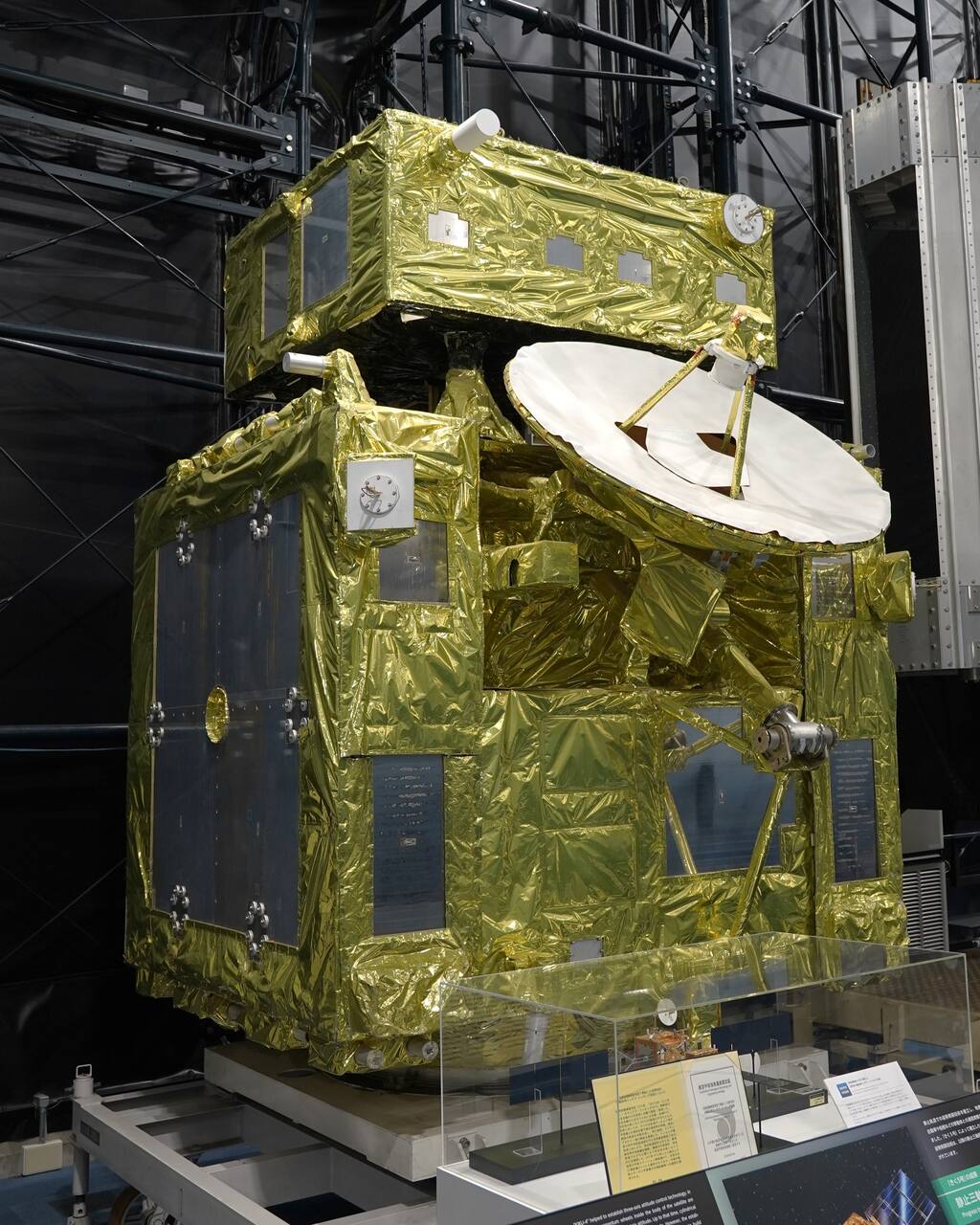 Terrestrelasso, via Wikimedia Commons. CC BY-SA.
The problem
Section titled “The problem”A manipulator on a free-flying satellite has to do two things a fixed-base arm does not. It has to move without upsetting the attitude of the vehicle that carries it, because arm motion exchanges momentum with the base, and it has to be commanded across a ground link whose delay and short passes limit how much an operator can do. Engineering Test Satellite VII was the Japanese mission built to test both, together with autonomous rendezvous and docking between two unmanned spacecraft. It launched on 28 November 1997 [2]. The program is described in full by its project lead in [4]. The chaser, Hikoboshi, carried a 2 m six-degree-of-freedom manipulator; the smaller target, Orihime, was released and recaptured [2].
The arm masses about 140 kg on a 2550 kg base [1], so arm motion produces measurable base attitude change and the attitude controller’s response feeds back into the arm. The two systems are coupled through the base and neither can be designed in isolation. Gravity gradient torque is not negligible on this scale: in free drift the base attitude drifts more than one degree over several minutes [1], and beyond one degree of pointing error the high-bandwidth link is lost, which bounds how long the vehicle can be left in free-floating mode during an arm operation. The ground side has its own limit: round-trip delay from the NASDA ground station through TDRS was 6 to 7 seconds [3], and work is bounded by pass length, not by arm speed. Three successive flight passes were used for the experiment set of 30 September 1999 [1], and the antenna experiment window was about 20 minutes per pass [7].
What has flown
Section titled “What has flown”ETS-VII
Section titled “ETS-VII”The mission ran from launch on 28 November 1997 to December 1999, against a planned end of May 1999 [1]. Surveys of space robotics treat it as the first free-flyer arm in orbit and the historical reference for free-floating manipulator dynamics [24].
| Parameter | Value | Source |
|---|---|---|
| Chaser mass | 2550 kg | [1] |
| Chaser inertia, Ixx / Iyy / Izz | 6200 / 3540 / 7090 kg m2 | [1] |
| Target mass | 500 kg | [1] |
| Manipulator | 2 m, 6 DOF | [1] |
| Arm mass | about 140 kg over six links | [1], [5] |
| Arm attachment point in base frame | (-0.79, -0.29, 1.00) m | [1] |
| Launch | 28 November 1997, H-II Launch Vehicle 6F from Tanegashima Space Center | [2], [15] |
| International designation | Hikoboshi 1997-074B, Orihime 1997-074E | [15] |
| Combined launch weight | 2,860 kg | [15] |
| Orbit | circular, 550 km altitude, 35 degrees inclination, period about 96 minutes | [1], [15] |
| Design life | 1.5 years | [15] |
| Rendezvous-docking experiments conducted | 3 | [15] |
| Ground link | NASDA ground stations via the TDRS data relay satellite | [15] |
The arm carries a multisensory gripper and an advanced robotic hand supplied by MITI [1], [5]. CCD cameras are carried at the shoulder and on the hand, and the hand carries force-torque sensing used for compliance and impedance control during contact tasks [6]. ETS-VII carried no joint torque sensors, so the mass and inertia of the base and of each link were identified from reaction wheel momentum and rate telemetry in existing flight data, not from a dedicated maneuver [14]. Link parameters are published in full [1]:
| Link | Length (m) | Mass (kg) | Izz (kg m2) |
|---|---|---|---|
| 1 | 0.35 (offset 0.28) | 35.0 | 1.69 |
| 2 | 0.87 | 22.5 | 3.75 |
| 3 | 0.63 | 21.9 | 2.53 |
| 4 | not stated | 16.5 | 0.072 |
| 5 | not stated | 26.0 | 0.13 |
| 6 (with end effector) | 0.53 | 18.5 | 0.26 |
Rendezvous and docking. Sensing is staged by range: GPS relative navigation from 500 m and beyond, rendezvous laser radar from 500 m to 2 m, and a proximity sensor from 2 m [2]. The vehicle holds at a 2 m virtual point for 15 minutes before the docking phase. Docking approach velocity is 1 cm/s, contact acceleration peaks at 14 mm/s2, and the low impact specification is below 1.5 mg, with measured control accuracy of 7 mm lateral against a 25 mm requirement and 0.2 degrees attitude against 1.9 degrees [2].
Three flight programs were run: FP1 on 7 July 1998 separated at 1.8 cm/s and redocked; FP2, begun on 7 August 1998, reached 12 km of separation, met a thruster pulse injection failure during final approach, and docked after recovery on 27 August 1998; and FP3, on 26 and 27 October 1999, included an R-bar approach initiated 9 km from the target and remote-piloted sequences from 2 m out to hold points at 6 m and 12 m [2]. Every approach was to a cooperative target carrying LED markers and a corner cube reflector, and only three docking events exist.
Free-floating control in flight. Generalized Jacobian resolved motion-rate control maps joint rates to inertial-frame hand motion including the base reaction, and was flown [1]. In flight, a 200 mm straight-line inertial path tracked at 10 mm/s held hand orientation at -22.8 degrees in the inertial frame while the base pitched 0.6 degrees under the reaction moment [1]. Reaction null-space and zero-reaction motion, which finds arm motions that produce zero net reaction on the base, was validated in flight [5], [14]. The velocity-level redundancy resolution that preceded it is analytical and contains no experiment or simulation [12]. With a six degree-of-freedom non-redundant arm the null space available is n minus 3, so three of the six joint freedoms remain for reactionless motion, and attitude variation during the final approach of a capture was held to 0.5 degrees peak to peak [1]. The same formulation applies to a manipulator on a flexible base, where the target is suppression of structural vibration rather than rigid-body attitude change [9]; its original formalization rests on one planar simulation and no hardware [13].
Manipulation experiments. Four categories were flown: ground teleoperation under large time delay, orbital replacement unit exchange, truss deployment and assembly, and antenna assembly [4]. Antenna reflector assembly was performed by teleoperation with vision and task-level sequencing [7]. The hand was evaluated against the ORU exchange and truss handling tasks [6]. Hand-camera images of task board markers gave about 1 mm positioning, and the connector’s own pinhole pattern improved that to about 0.25 mm [6]. Capture of the free-flying target started with the hand about 400 mm from the grapple fixture against a target drifting at 10 mm/s, with the controller switching mode when hand position error fell below 100 mm [1]. Mechanical compliance was added to the antenna assembly mechanism because software compliance cannot follow motions faster than the onboard control cycle, and arm speed was held to 2 mm/s [7]. The mechanism corrected ten deliberately offset cases of plus or minus 5 mm and plus or minus 1 degree with a force never above 8 N, and completed 40 disassembly and reassembly cycles over a year and a half with no mechanical degradation [7].
Teleoperation under delay. Motion commands were uploaded at 4 Hz in an isochronous stream [1]. DLR’s GETEX experiment used task-directed programming with a predictive three-dimensional graphics display, inherited from ROTEX, in which the operator commands a simulated arm on the ground and the flight arm follows [8], [22]. The Kyoto and NASDA experiment instead closed a direct bilateral coupling with kinesthetic force feedback across the 6 to 7 second delay [3], the harder case because the delay sits inside the force loop. A slope-tracing task and an 18 mm peg-in-hole insertion with 0.4 mm clearance were performed without visual feedback, at a hand speed limited to 2.0 mm/s [3].
Later flights
Section titled “Later flights”DARPA’s Orbital Express (launched 8 March 2007, ended July 2007) flew the ASTRO servicer and NextSat client through mated and unmated rendezvous and capture, hydrazine transfer, and battery and computer ORU exchange by robotic arm; the program lead reports 100 percent of mission criteria met, a contractor self-report of one flight with one cooperative client [19]. The flight capture system had a 3 cm/s design contact velocity, 6 in axial capture distance, plus or minus 2 in lateral and plus or minus 5 degrees angular misalignment, and the vendor sheet gives no qualification data [20].
DLR’s ROKVISS two-joint torque-controlled arm has operated on the ISS Russian Service Module since February 2005, with telepresence and automatic-mode experiments and in-flight friction identification; it has two joints and no free-flying base [21]. KONTUR-2 closed a bilateral loop between a joystick on the ISS and robots on the ground with a measured round trip delay of 20 to 30 ms over the S-band link, across 23 space sessions from August to December 2015 [23]. Both are one to two orders of magnitude below the ETS-VII delay, so neither tests the case ETS-VII tested. Free-flyers inside the ISS have a different role: Astrobee has logged more than 165 real-time operations and more than 90 Guest Science test sessions, but it carries no arm in the ETS-VII sense [33].
What is being tried now
Section titled “What is being tried now”Dynamic-coupling and selective decoupling control. Work on free-floating manipulators continues to use ETS-VII as the parameter set. A multi-axis selective decoupling framework nullifies base momentum transfer only along mission-critical axes, leaving more joint freedom than full reactionless control; it is simulation only, with three point-to-point reaches and a rigid model [26]. A coupling-informed trajectory optimization for a planar 3-link arm uses the singular values of the coupling matrix and a sliding-mode tracker, in two simulated cases [25]. Both are simulation-stage proposals; neither has flown or been tested on hardware.
Learning-based and hybrid control. A data-assisted port-Hamiltonian controller for a planar 2-DOF free-floating arm reduced tracking error by 77.5 percent against one baseline in a single simulated run [28]. A trajectory-optimization and reinforcement-learning hybrid controls a free-flying four-arm 27-DoF servicing robot, entirely in a rigid-body simulator [29]. A real-time hardware-in-the-loop simulation platform validates a robust joint-space controller for a free-floating dual-arm servicer, with the servicer properties taken from a design concept, not flown hardware [32]. All three are simulation or simulation-in-the-loop.
Using the arm for attitude. Propellant-free slew and detumble maneuvers driven by the manipulator’s own joints, with joint-limit and collision constraints, are planned by trajectory optimization with rigid-body dynamics only [27]. It extends the ETS-VII observation that arm motion moves the base into a design tool. It is a simulation result.
Capture of non-cooperative targets. A coordination controller for a free-flying manipulator and a minimum-time detumbling trajectory were demonstrated for interception on a fixed-base laboratory arm with a mockup moved by a second arm; the detumble is simulation only [30]. Capture of a spinning object by repeated deliberate impacts from a dual-arm robot, which does not need the target mass or inertia, was demonstrated on a planar air-bearing floor with a cylindrical target, external motion capture and a three-degree-of-freedom arm on each platform [31]. A combined impedance and PD controller for a two-arm free-floating manipulator capturing a tumbling target has been studied in a multibody co-simulation only [34]. Grasping a spinning target with a free-flying robot has been addressed by an offline database of optimal trajectories queried over a four-dimensional description of the target motion, with simulation results only [35]. After capture, an adaptive reactionless control with online momentum-based inertia identification handles the changed dynamics of an unknown tumbling target; the published result is simulation [36]. A 2024 survey of visual servoing for on-orbit servicing finds most validation is in simulation or software-in-the-loop, and reports no numeric performance figures [17].
Ground emulation. A 2024 survey lists the facilities used for such work: ESA ESTEC’s ORBIT flat floor, DLR’s EPOS 2.0 for non-cooperative tumbling targets, NASA’s 21.3 by 29.9 m air-bearing floor at Johnson and 13.4 by 26.2 m floor at Marshall, the Langley Rendezvous Docking Simulator, and a two-manipulator hardware-in-the-loop testbed at York University [16]. DLR’s OOS-SIM carries a simulated servicer and client on two KUKA KR120 robots driven by free-floating dynamics at 4 ms, with a common workspace of about 23.28 m3 [37], and the EPOS 2.0 simulator uses two six-axis robots, one on a 25 m linear slide, to test rendezvous sensors and docking tools over the final 25 m to 0 m [38]. Air-bearing floors emulate two dimensions, so out-of-plane torques are not reproduced [31].
Programs and catalogs. NASA’s 2025 ISAM state of play catalogs the Core Module Manipulator and Experimental Module Manipulator, with brief entries that cite no sources for their figures [18]. Flexible long-reach arms raise a related problem; input-shaping filters for such arms have been compared in simulation only, for a terrestrial tank-waste manipulator and not a spacecraft [11].
The numbers
Section titled “The numbers”| Quantity | Value | Source |
|---|---|---|
| Link delay, ETS-VII via TDRS | 6 to 7 s | [3] |
| Link delay, KONTUR-2 via ISS S-band | 20 to 30 ms | [23] |
| Docking lateral accuracy, measured vs required | 7 mm vs 25 mm | [2] |
| Docking attitude accuracy, measured vs required | 0.2 degrees vs 1.9 degrees | [2] |
| Docking approach velocity | 1 cm/s | [2] |
| Orbital Express capture design contact velocity | 3 cm/s | [20] |
| Base pitch under reaction, 200 mm path at 10 mm/s | 0.6 degrees | [1] |
| Attitude variation, capture final approach | 0.5 degrees peak to peak | [1] |
| Antenna assembly force, maximum | 8 N | [7] |
| Hand positioning, marker / connector pattern | about 1 mm / about 0.25 mm | [6] |
| Bilateral teleoperation hand speed limit | 2.0 mm/s | [3] |
What is not established
Section titled “What is not established”The bilateral teleoperation result rests on one to three runs per condition with three operators, and its authors claim only that direct bilateral control at 6 to 7 s is possible, not that it is practical; operation was slow and limited to planar or low-degree-of-freedom tasks with an off-the-shelf joystick [3]. The comparison with the earlier NASDA compliance-mode work used different target forces, 5 N against 25 N, so it is not like for like [3]. The antenna assembly force is reported only as an 8 N maximum, with no distribution across the 40 cycles and no split between arm and mechanism [7]. The flight experiments of the arm control methods are single trials with most values read from plots, and a fair reactionless against point-to-point comparison over the same path was not possible because joint limits blocked a continuous path [14]. The docking record has three events, all with a cooperative target [2], and Orbital Express is likewise one flight with one cooperative client [19]. The public mission page gives launch and orbit parameters without experiment data [15]. Capture of a tumbling or uncooperative target, impedance control of a free-flyer and learning-based control have no flight record from ETS-VII; the published support is simulation, a fixed-base laboratory arm or a planar ground testbed [29], [30], [31].
References
- Yoshida, K. (2003). Engineering Test Satellite VII Flight Experiments for Space Robot Dynamics and Control: Theories on Laboratory Test Beds Ten Years Ago, Now in Orbit
. The International Journal of Robotics Research, 5. Source
BibTeX
@article{yoshida2003engineering, title = {Engineering Test Satellite VII Flight Experiments for Space Robot Dynamics and Control: Theories on Laboratory Test Beds Ten Years Ago, Now in Orbit}, author = {Yoshida, Kazuya}, journal = {The International Journal of Robotics Research}, volume = {22}, number = {5}, pages = {321--335}, year = {2003}, doi = {10.1177/0278364903022005003}, abstract = {The Engineering Test Satellite VII (ETS-VII), an unmanned spacecraft equipped with a 2-m long, six-degree-of-freedom manipulator arm, was developed and launched by the National Space Development Agency of Japan (NASDA). ETS-VII has successfully carried out a variety of on-board experiments with its manipulator arm, and these key technologies are essential for an orbital free-flying robot. These results will provide a solid basis for future satellite servicing missions. This paper highlights manipulator control utilizing the concepts of the generalized Jacobian matrix and the reaction null-space. These concepts have been proposed and discussed for the past ten years using laboratory test beds, and their practical application has now been demonstrated in orbit.} } - Kawano, I., Mokuno, M., Suzuki, T., Koyama, H. and Kunugi, M. (2002). Result of the ETS-VII Rendezvous Docking Experiment
. Journal of the Japan Society for Aeronautical and Space Sciences, 578. Source
BibTeX
@article{kawano2002result, title = {Result of the ETS-VII Rendezvous Docking Experiment}, author = {Kawano, Isao and Mokuno, Masaaki and Suzuki, Takashi and Koyama, Hiroshi and Kunugi, Masaaki}, journal = {Journal of the Japan Society for Aeronautical and Space Sciences}, volume = {50}, number = {578}, pages = {95--102}, year = {2002}, doi = {10.2322/jjsass.50.95}, abstract = {ETS–VII is a test satellite to perform in-orbit demonstration of autonomous rendezvous docking (RVD) technology, which will be necessary for advanced space activities in the early 21st century. ETS–VII performed three RVD experiment flights, and verified all technical items. ETS–VII demonstrated first autonomous RVD between unmanned vehicles, and remote piloted rendezvous flight position accuracy at docking was about 1cm, and acceleration was less than 1.5mG (low impact docking). In the second RVD experiment flight, ETS–VII detected attitude anomaly and executed disable abort for safety insurance. We present the results and evaluation of three RVD experiment flights in this paper.} } - Imaida, T., Yokokohji, Y., Doi, T., Oda, M. and Yoshikawa, T. (2003). Ground-Space Teleoperation of a Robot Arm Mounted on Engineering Test Satellite No. VII by Direct Bilateral Coupling under a Long Time Delay Condition
. Journal of the Robotics Society of Japan, 3. Source
BibTeX
@article{imaida2003groundb, title = {Ground-Space Teleoperation of a Robot Arm Mounted on Engineering Test Satellite No. VII by Direct Bilateral Coupling under a Long Time Delay Condition}, author = {Imaida, Takashi and Yokokohji, Yasuyoshi and Doi, Toshitsugu and Oda, Mitsushige and Yoshikawa, Tsuneo}, journal = {Journal of the Robotics Society of Japan}, volume = {21}, number = {3}, pages = {309--320}, year = {2003}, doi = {10.7210/jrsj.21.309}, abstract = {A bilateral teleoperation experiment with Engineering Test Satellite No.VII (ETS-VII) was conducted on November 22, 1999. Round-trip time for communication between the NASDA ground station and ETS-VII was approximately six to seven seconds. We constructed a bilateral teleoperator that is stable even under such a long time delay. Several experiments, such as slope tracing task and peg-in-hole task, were carried out. Task performance was compared between bilateral mode and unilateral mode with force telemetry data visually displayed on a screen. All tasks were possible by bilateral control without any visual information. Experimental results showed that kinesthetic force feedback to the operator is helpful even under such long time delay and improves the performance of the task.} } - Oda, M. (1999). Mission of ETS-VII
. Journal of the Robotics Society of Japan, 8. Source
BibTeX
@article{oda1999space, title = {Mission of ETS-VII}, author = {Oda, Mitsushige}, journal = {Journal of the Robotics Society of Japan}, volume = {17}, number = {8}, pages = {1055--1061}, year = {1999}, doi = {10.7210/jrsj.17.1055} } - Yoshida, K., Hashizume, K. and Abiko, S. (2001). Zero Reaction Maneuver: Flight Validation with ETS-VII Space Robot and Extension to Kinematically Redundant Arm
. IEEE International Conference on Robotics and Automation. Source
BibTeX
@inproceedings{yoshida2001zero, title = {Zero Reaction Maneuver: Flight Validation with ETS-VII Space Robot and Extension to Kinematically Redundant Arm}, author = {Yoshida, Kazuya and Hashizume, Kenichi and Abiko, Satoko}, booktitle = {IEEE International Conference on Robotics and Automation}, volume = {1}, pages = {441--446}, year = {2001}, doi = {10.1109/robot.2001.932590}, abstract = {Presents the experimental results and post-flight analysis of reaction null-space based reactionless manipulation, or zero reaction maneuver (ZRM). The concept has been developed with an insight into the motion dynamics of free-flying multibody systems and its practical availability is clearly demonstrated with ETS-VII, a Japanese space robot. The ZRM is proven particularly useful for removing the velocity limit of manipulation due to the reaction constraint and the time loss due to waiting for the attitude recovery. The existence of the ZRM is very limited for a 6 DOF manipulator arm mounted on a free-flying base, but it is discussed how more operational freedom is obtained with a kinematically redundant arm.} } - Machida, K., Akita, K., Ohno, K., Moriya, M., Nishida, H. and Ohsawa, T. (1999). Space Experiment Evaluation of Advanced Robotic Hand System Boarded on ETS-VII
. Journal of Space Technology and Science, 2. Source
BibTeX
@article{machida1999space, title = {Space Experiment Evaluation of Advanced Robotic Hand System Boarded on ETS-VII}, author = {Machida, Kazuo and Akita, K. and Ohno, K. and Moriya, M. and Nishida, H. and Ohsawa, T.}, journal = {Journal of Space Technology and Science}, volume = {14}, number = {2}, pages = {21--30}, year = {1999}, doi = {10.11230/jsts.14.2_21} } - Kimura, S., Tsuchiya, S., Nagai, Y. and Morikawa, H. (1999). Antenna-Assembly Experiments Using ETS-VII
. Journal of Space Technology and Science, 2. Source
BibTeX
@article{kimura1999antenna, title = {Antenna-Assembly Experiments Using ETS-VII}, author = {Kimura, Shinichi and Tsuchiya, S. and Nagai, Y. and Morikawa, H.}, journal = {Journal of Space Technology and Science}, volume = {14}, number = {2}, pages = {15--20}, year = {1999}, doi = {10.11230/jsts.14.2_15} } - Landzettel, K., Brunner, B., Schreiber, G., Steinmetz, B.-M. and Hirzinger, G. (1999). The NASDA-DLR Joint Robotics Experiment GETEX
. Journal of the Robotics Society of Japan, 8. Source
BibTeX
@article{landzettel1999nasdab, title = {The NASDA-DLR Joint Robotics Experiment GETEX}, author = {Landzettel, Klaus and Brunner, Bernhard and Schreiber, Gerhard and Steinmetz, Bernhard-Michael and Hirzinger, Gerd}, journal = {Journal of the Robotics Society of Japan}, booktitle = {International Symposium on Artificial Intelligence, Robotics and Automation in Space}, volume = {17}, number = {8}, pages = {1086--1095}, year = {1999}, doi = {10.7210/jrsj.17.1086}, abstract = {This paper describes the GETEX (German ETS-VII EXperiments) joint robotics experiments, which has been conducted in April '99 at the first free-floating space robot on NASDA's ETS-VII satellite [1] . All the experiments have been performed and controlled from DLR's ground control system for space robotics applications which was connected to NASDA's ground station in Tsukuba. The telerobotic system combines sensor-based task-level teleprogramrning (as the basis for autonomy) with the features of teleoperation and shared autonomy. The hierarchical system structure is shown as well as the flexibility in programming and controlling each kind of space robotics application. This approach has led to a modular task-directed programming scheme, called Modular A & R Controller (MARCO), which provides a very flexible architecture to adapt the application-specific requirements to a given controlling scheme. A peg-in-hole experiment, using VR methods and the “vision & force” control scheme, by closing sensor control loops directly on-board (force) and via the ground control system (vision) is explained. During GETEX we conducted experiments with relevance to the behavior of ETS-VII in free motion mode in order to verify the existing dynamic models.} } - Nenchev, D. N., Yoshida, K., Vichitkulsawat, P. and Uchiyama, M. (1999). Reaction Null-Space Control of Flexible Structure Mounted Manipulator Systems
. IEEE Transactions on Robotics and Automation, 6. Source
BibTeX
@article{nenchev1999reaction, title = {Reaction Null-Space Control of Flexible Structure Mounted Manipulator Systems}, author = {Nenchev, Dragomir N. and Yoshida, Kazuya and Vichitkulsawat, P. and Uchiyama, Masaru}, journal = {IEEE Transactions on Robotics and Automation}, volume = {15}, number = {6}, pages = {1011--1023}, year = {1999}, doi = {10.1109/70.817666}, abstract = {A composite control law for end-effector path tracking with a flexible structure mounted manipulator system is proposed, such that no disturbances on the flexible base are induced. The control law is based on the reaction null-space concept introduced earlier to tackle dynamic interaction problems of free-floating robots, or moving base robots in general. The control law is called composite since it ensures base vibration suppression control as well, although independently of the reactionless motion control subtask. The requirement of task independence is essential to avoid the appearance of complex dynamics expressions in the control law, such as nonlinear velocity-dependent coupling terms and dependencies of inertias on the elastic coordinates. We present experimental data from computer simulations and the experimental test bed TREP developed at Tohoku university. The experimental data is shown to agree well with theory.} } - Kwon, D., Hwang, D.-H., Babcock, S. and Burks, B. (1994). Input Shaping Filter Methods for the Control of Structurally Flexible, Long-Reach Manipulators
. IEEE International Conference on Robotics and Automation. Source
BibTeX
@inproceedings{kwon1994input, title = {Input Shaping Filter Methods for the Control of Structurally Flexible, Long-Reach Manipulators}, author = {Kwon, Dong‐Soo and Hwang, Dong-Hwan and Babcock, S.M. and Burks, B.L.}, booktitle = {IEEE International Conference on Robotics and Automation}, volume = {1}, pages = {3259-3264}, year = {1994}, doi = {10.1109/robot.1994.351069}, abstract = {Within the Environmental Restoration and Waste Management Program of the US Department of Energy, the remediation of single-shell radioactive waste storage tanks is one of the areas that challenges state-of-the-art equipment and methods. Concepts that utilize long-reach manipulators are being seriously considered for this task. Due to high payload capacity and high length-to-cross-section ratio requirements, these long-reach manipulator systems are expected to exhibit significant structural flexibility. To avoid structural vibrations during operation, various types of shaping filter methods have been investigated. A robust notch filtering method and an impulse shaping method were used as simulation benchmarks. In addition to that, two very different approaches have been developed and compared. One new approach, referred to as a "feedforward simulation filter", uses imbedded simulation with complete knowledge of the system dynamics. The other approach, "fuzzy shaping method", employs a fuzzy logic method to modify the joint trajectory from the desired end-position trajectory without precise knowledge of the system dynamics.>} } - Nenchev, D. N., Umetani, Y. and Yoshida, K. (1992). Analysis of a redundant free-flying spacecraft/manipulator system
. IEEE Transactions on Robotics and Automation, 1. Source
BibTeX
@article{nenchev1992analysis, title = {Analysis of a redundant free-flying spacecraft/manipulator system}, author = {Nenchev, Dragomir N. and Umetani, Yoji and Yoshida, Kazuya}, journal = {IEEE Transactions on Robotics and Automation}, volume = {8}, number = {1}, pages = {1-6}, publisher = {Institute of Electrical and Electronics Engineers (IEEE)}, year = {1992}, doi = {10.1109/70.127234}, abstract = {An analysis of the momentum conservation equations of a redundant free-flying spacecraft/manipulator system acting in a zero-gravity environment is presented. In order to follow a predefined end-effector path, the inverse kinematics at velocity level is considered. The redundancy is solved alternatively in terms of pseudoinverses and null-space components of the manipulator inertia matrix, the manipulator Jacobian matrix, and the generalized Jacobian matrix. A general manipulation task is defined as end-effector continuous path tracking with simultaneous attitude control of the spacecraft. Three subtasks of the general task are considered. The case of manipulator motions that yield no spacecraft attitude disturbance is analyzed in more detail and a special 'fixed-attitude-restricted' (FAR) Jacobian is defined. Through singular-value decomposition of this Jacobian, corresponding FAR dexterity measures (FAR manipulability and FAR condition number) are derived.>} } - Nenchev, D. N., Yoshida, K. and Uchiyama, M. (1996). Reaction Null-Space Based Control of Flexible Structure Mounted Manipulator Systems
. IEEE Conference on Decision and Control. Source
BibTeX
@inproceedings{nenchev1996reaction, title = {Reaction Null-Space Based Control of Flexible Structure Mounted Manipulator Systems}, author = {Nenchev, Dragomir N. and Yoshida, Kazuya and Uchiyama, Masaru}, booktitle = {IEEE Conference on Decision and Control}, volume = {4}, pages = {4118-4123}, year = {1996}, doi = {10.1109/cdc.1996.577417}, abstract = {The control of a dexterous manipulator mounted on a flexible structure is discussed. Using a concept called reaction null space, the manipulator dynamics is totally decoupled from the base dynamics. As a consequence of the decoupling, feedback control gains can be determined in a straightforward manner. We examine the simultaneous performance of the following two tasks: (1) base vibration suppression and (2) end-point path tracking without base disturbance.} } - Yoshida, K., Nenchev, D. N., Hashizume, K., Abiko, S. and Oda, M. (2002). Flight Experiments of ETS-VII for Advanced Space Robot Control
. Journal of the Japan Society for Aeronautical and Space Sciences, 584. Source
BibTeX
@article{yoshida2002ets, title = {Flight Experiments of {ETS-VII} for Advanced Space Robot Control}, author = {Yoshida, Kazuya and Nenchev, Dragomir N. and Hashizume, Kenichi and Abiko, Satoko and Oda, Mitsushige}, journal = {Journal of the Japan Society for Aeronautical and Space Sciences}, volume = {50}, number = {584}, pages = {351--359}, year = {2002}, doi = {10.2322/jjsass.50.351}, abstract = {This paper presents the flight experiments on the dynamics and control of a space robotic arm mounted on ETS-VII (Engineering Test Satellite VII). The experiments were successfully carried out to evaluate the performance of (1) reaction null-space based reactionless manipulation, (2) generalized Jacobian based inertial manipulation, (3) offset command based feedforward attitude control, and (4) bi-directional approach of non-holonomic path planning. Inertia parameters of ETS-VII is identified based on the momentum equation and the effect of gravity gradient torque is also evaluated.} } - (2026). JAXA: ETS-VII. global.jaxa.jp/projects/sat/ets7
BibTeX
@misc{jaxaets,
  title = {JAXA: ETS-VII},
  organization = {global.jaxa.jp},
  year = {2026},
  url = {https://global.jaxa.jp/projects/sat/ets7/}
}
Further reading
- Yoshida, K. (2001). Space Robot Dynamics and Control: To Orbit, From Orbit, and Future . Robotics Research. Source