Int-Ball and Int-Ball2
Program pages JAXA: Int-Ball2 ROS/Gazebo simulator released
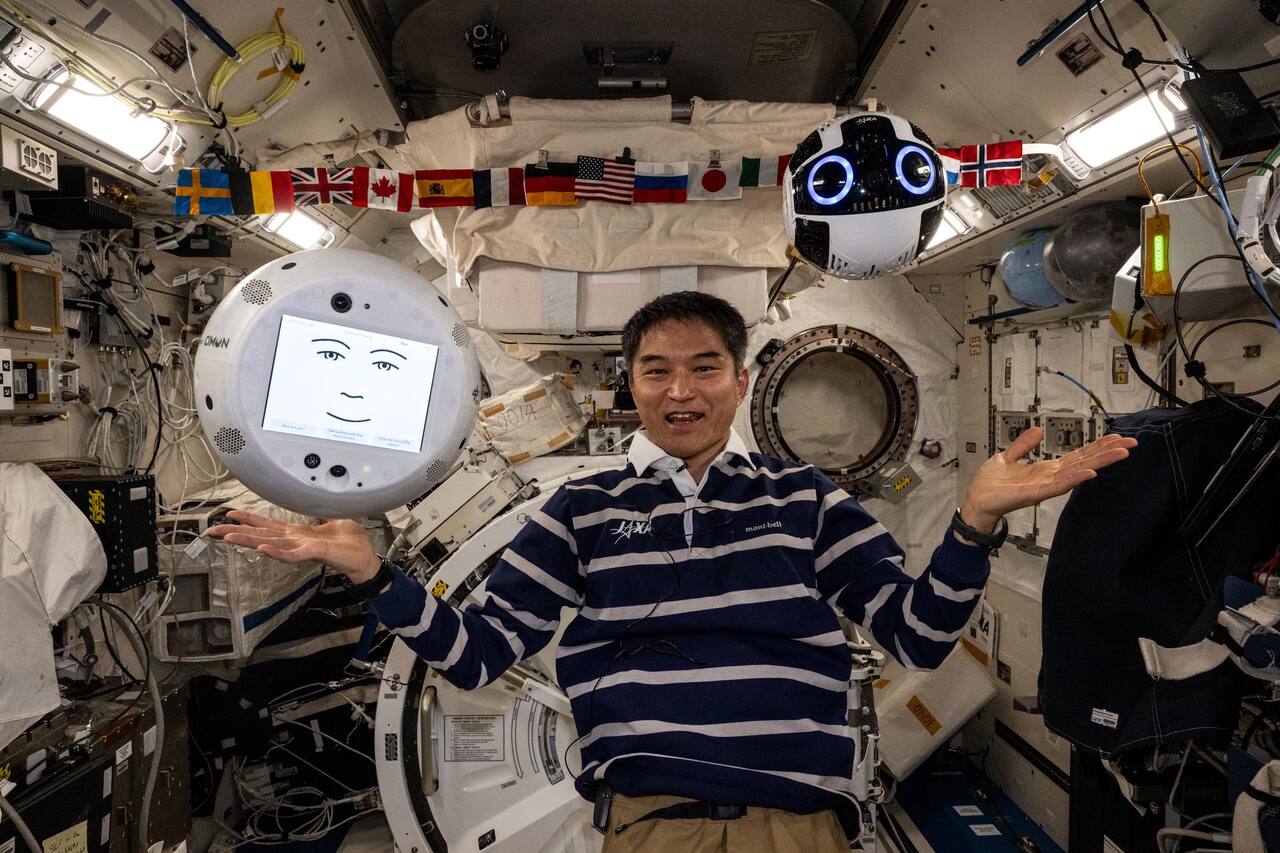 NASA. Public domain (NASA / US government work).
Overview
Section titled “Overview”Int-Ball is a family of free-flying camera robots operated inside the Japanese Experiment Module of the International Space Station. The first unit, formally the JEM Internal Ball Camera Robot, was developed and launched in 2017 as a technological demonstration and was tested on orbit in 2017 and 2018 [1]. Int-Ball2, formally the JEM Internal Ball Camera 2 System, launched in June 2023 and is in service. Its first on-orbit flight demonstration, including two docking attempts, flew on 17 October 2023, following ground verification by simulation, a hardware-in-the-loop rig and an air-bearing platform [24]. Int-Ball2 and CIMON-2 are, with Astrobee, the intra-vehicular free-flyers currently resident on the station [2].
The program exists to move imagery work off the crew. Astronauts spend more than 10 percent of their time on imagery tasks, and Int-Ball shifts camera setup and field-of-view adjustment to ground control [1]. Intra-vehicular helper robots therefore need to tolerate the cabin environment and recharge themselves, with the internal equipment and stowage adapted to robot handling, under limits on payload, speed and power [2].
Specifications
Section titled “Specifications”| Parameter | Int-Ball | Int-Ball2 |
|---|---|---|
| Shape and size | 15 cm sphere | 20 cm sphere |
| Mass | approx. 1 kg | approx. 3 kg |
| Mobility | 12 fans at about 3 mN each, 3 reaction wheels | 8 propelling fans at 60 to 163 mN each |
| Navigation | monocular camera, marker based | stereo visual-inertial SLAM |
| Imaging | approx. Full HD | approx. 4K, 1920x1080 at 30 fps and 4056x3040 at 15 fps |
| Processor | Armadillo-810 | Jetson TX2 |
| Software | Armadillo Base OS | Ubuntu with ROS |
| Power | Li-ion, USB charge by crew | Li-ion, automatic docking and recharge |
| Endurance on batteries | 2 h | 3 h |
| Data communication | WLAN | WLAN, UART to the docking station connected to a laptop |
| Payload interface | none | micro-USB and a side attachment |
Source: [1].
Reported Int-Ball2 mass differs between 3 kg [1] and 3.3 kg [2]. Both generations are spherical rather than blunt-edged, which is the design choice made across intra-vehicular free-flyers to limit the consequences of a collision with crew or cargo.
Mission profile
Section titled “Mission profile”| Parameter | Int-Ball | Int-Ball2 |
|---|---|---|
| Host | Japanese Experiment Module, ISS | same |
| Objective | technology demonstration of a remotely controlled camera | substitute crew work for imagery tasks |
| Launched | 2017 | June 2023 |
| Deployed | 2017 to 2019 | 2023 to present |
| Crew time addressed | imagery tasks, more than 10 percent of crew time | same |
Source: [1].
A JAXA crew-task analysis of the JEM found that sample and equipment swap consumed 22 percent of the studied crew time, logistics 10 percent and monitoring 8 percent [2].
Mobility
Section titled “Mobility”Int-Ball used 12 micro axial fans arranged around the sphere for translation and pose holding, together with three reaction wheels for attitude stabilization, which makes it the only intra-vehicular free-flyer to have flown reaction wheels [2]. Fan thrust is given as about 3 mN each [1] and as about 1 mN maximum per propeller [2]. That authority was insufficient against cabin ventilation: the propulsion struggled with airflow disturbances from ISS ventilation, particularly near ducts, and the robot was swept away in areas of heavy airflow.
Int-Ball2 replaced the 12 micro fans with eight larger propeller modules producing 60 to 163 mN each [24], about 0.15 N on the dominant X axis [2], and dropped the reaction wheels. The diameter grew from 15 cm to 20 cm to accommodate the change [24]. Fans and propellers are enclosed and covered so the robot is safe to handle [2].
Rotor polarity alternates clockwise and counter-clockwise so that under symmetric operation the blade drag torques cancel; uncompensated drag torque acts as a disturbance on attitude, and it is a distinct torque channel from the r x f thrust-induced torque [4].
Power and energy
Section titled “Power and energy”Both generations run on rechargeable lithium-ion batteries [1]. Int-Ball is charged over USB by the crew and runs for 2 hours on a charge; Int-Ball2 docks and recharges automatically and runs for 3 hours. Automatic docking uses AR markers on the docking station read by the robot’s cameras [2]. Automated charging was one of the functions validated during Int-Ball2 checkout, along with a low-battery return as an off-nominal transition [24]. No battery capacity in watt-hours is published for either generation. The move from consumables to rechargeable batteries was a lesson carried forward from AERCam [8], the Personal Satellite Assistant and SPHERES [9], and autonomous recharging is one of the capabilities identified as essential for any free-flyer tasked with maintaining an orbiting station [2].
Thermal
Section titled “Thermal”No thermal control design is published for either generation. Both operate in the pressurized cabin.
Compute and avionics
Section titled “Compute and avionics”Int-Ball carried three control boards: an Armadillo running the Int-Ball operating system, a Phenox dual-core ARM9 handling image recording and processing, and an all-in-one module performing high-precision state estimation and control [2]. The first two ran Linux and the third FreeRTOS, and the flight control and measurement cycle ran at 10 Hz [2]. The program-level summary describes the architecture as a single onboard processor, an Armadillo-810 under Armadillo Base OS, in contrast to Astrobee’s tiered three-processor avionics [1], [10].
Int-Ball2 runs a single Jetson TX2 under Ubuntu with ROS, and is built mainly from commercial off-the-shelf components [24]. The inertial measurement unit is from the Epson M-G370 series, with an angle random walk of 0.06 to 0.03 deg/sqrt(h) in a one inch square package of 10 g drawing 16 mA at 3.3 V [7]. Pose is estimated by fusing visual SLAM output with the IMU data.
Each Int-Ball2 flight software function is implemented as a ROS node, and a node can be enabled or disabled by settings alone without modifying existing source [3]. Internal interfaces for data output and function calls are unified as ROS topics, services and actions.
Autonomy
Section titled “Autonomy”Int-Ball navigated against two stereoscopic markers installed on the airlock and the portside of the JEM, read by an image navigation camera [2]. Pose in the JEM coordinate system came from fusing that camera information with the IMU and three ultrasonic distance sensors. The requirement that a marker stay in the field of view at all times was the limiting constraint, and markers could be obscured by crew or objects [1].
Int-Ball2 replaced marker tracking with stereo-camera visual SLAM fused with the IMU, taking features from the environment itself, though additional reference markers were nevertheless installed in the JEM during checkout for navigation assessment [1], [2].
Int-Ball has no explicitly stated obstacle detection method; it monitors for large impulse forces and triggers a quick response on collision [2]. Physical contact detection is IMU-based on both generations [1].
Int-Ball2’s relative pose estimate accumulates error. Post-flight analysis shows about 8 percent error encountered during flight, producing a localization shift on longer and more complex maneuvers [1]. The mitigation flown is path planning that produces better loop closures; adding absolute navigation references would reduce the error further. Astrobee’s factor-graph localizer, by comparison, is evaluated against on-orbit ground truth on twelve ISS activities, a level of quantified accuracy not yet published for Int-Ball2’s SLAM [12]. Safety is anchored in hardware rather than software, through a low-impact shell and limits on the propulsion, so that software can be updated without reopening the safety case. Future work is autonomous path planning over the V-SLAM maps for obstacle avoidance and tracking.
Communications
Section titled “Communications”Both generations use the station wireless LAN [1]. The first Int-Ball relied on the wireless link alone and lost communication during operations, which is why Int-Ball2 added a wired UART option available while docked; station Wi-Fi performance can still degrade real-time video. The UART link runs to the docking station, which is connected to a laptop. During a technology demonstration run on Int-Ball2 there is no real-time communication between the user software on orbit and a user on the ground; a demonstration needing it has to be coordinated with the Int-Ball2 base station [3].
Payload and instruments
Section titled “Payload and instruments”Int-Ball carried a front camera for the imagery product, a side monocular navigation camera, an IMU, ultrasonic sensors and a microphone [1]. The main monitoring camera was HD with continuous shooting, target tracking and image stabilization [2]. Int-Ball2 carries a front camera, a navigation stereo camera, an IMU and a microphone, and delivers approximately 4K imagery at 1920x1080 and 30 fps or 4056x3040 and 15 fps [24]. Neither generation carries a manipulator: of the free-flyers deployed on the ISS only Astrobee has an arm, and that is a perching arm rather than one used for object handling [2], [11]. NASA’s 2025 ISAM catalog classes space manipulators as long or short reach at an 8 m boundary and lists station-class arms such as the Tiangong Core Module Manipulator (7 DOF, 10 m), a category into which neither Int-Ball generation falls [22].
Int-Ball had no payload or extension interface [1]. Int-Ball2 adds a micro-USB port and a side attachment, and is offered as a technology demonstration platform: the flight software exposes its sensor data and actuator control interfaces so that a user can substitute their own navigation, such as a different visual SLAM or sensor fusion, and their own guidance and control, such as PID or visual feedback control [3]. The existing visual SLAM cannot be used if the navigation camera video is taken separately, in which case the user implements SLAM themselves.
Modes of operation
Section titled “Modes of operation”Crew interaction is deliberately minimal. The crew interface on both generations is a manual on/off switch plus eye LEDs that indicate the robot state and the imagery state [1]. Everything else is commanded from the ground. Teleoperation from the ground remains the fallback for fault detection and recovery on every intra-vehicular free-flyer regardless of the autonomy level reached [2].
User demonstration programs on Int-Ball2 run under Docker, virtually separated from the native environment [3]. They are uplinked by the operations controllers and started from the Ground Support Equipment, so programs can be added or replaced without affecting the existing flight software or the GSE. Program size is limited by the availability of the Int-Ball2 body and its SD card capacity.
The Int-Ball2 checkout validated power, communication, imagery, flight and automated charging, then exercised crew-interactive features and off-nominal transitions including the low-battery return [24]. Flight data were logged throughout. A user program can be linked to a subset of the existing flight software functions, and the scope of what the user implements is adjusted accordingly rather than being all or nothing [3].
Ground operations
Section titled “Ground operations”Int-Ball is operated by remote control from the ground with a simple user interface; Int-Ball2 uses a GUI [1]. Ground controllers plan Int-Ball2’s behavior and movement path in real time during operations, and a single command plus the check that it executed takes 1 to 3 minutes under the procedural rules, which limits real-time collaborative work with the crew. Although Int-Ball2 can capture 4K, operators use Full HD whenever the higher resolution is not needed, to hold down the downlink and ground handling effort [1]. Ground verification for Int-Ball was a granite table test with a ground model.
Int-Ball2 verification combined three methods [24]. Software simulation ran in ROS and Gazebo with a custom plugin for airflow, correlated against the hardware by feeding force-torque sensor measurements of the propulsion force back into the simulation. Hardware testing used two-dimensional granite floating tables, which cannot reproduce three-dimensional motion, so the two translational directions and one rotation were verified and the test repeated for each axis before launch. A hardware-in-the-loop simulator then verified the GNC system in three dimensions with flight hardware and software in the loop.
The Int-Ball2 simulator is published under Apache-2.0 as a ROS 1 Melodic and Gazebo 9 stack on Ubuntu 18.04, with the airflow plugin, sensor data acquisition and actuator control interfaces modeled and SLAM explicitly not simulated [6]. It ships with a simulated Ground Support Equipment GUI for user program deployment, telemetry reception and command transmission. JAXA released it publicly so that outside users can create, implement and verify their own programs before running them on the ISS [5].
Technologies developed
Section titled “Technologies developed”The generational step from Int-Ball to Int-Ball2 is the program’s main product, and every change traces to an on-orbit finding: fan thrust raised by more than an order of magnitude against cabin airflow, marker-based localization replaced by feature-based SLAM so that navigation no longer depends on installed infrastructure staying visible, and crew-dependent deployment and USB recharging replaced by a docking station the robot reaches itself [1]. The compact size drew favorable crew feedback, which the team reads as confirmation that being non-intrusive matters when working close to crew. The spherical form was retained for its tolerance of impact and its omni-directional movement, but Int-Ball2 marks its direction visually because the original sphere gave the ground no indication of which way the robot faced.
The Int-Ball2 platform has since been used as a simulation target outside JAXA. A reinforcement learning study of six-degree-of-freedom docking modeled the robot as a rigid body with eight thrusters and trained a PPO policy in Isaac Sim across 300 parallel environments under domain-randomized dynamics and bounded observation noise, with the propeller drag torque and polarity structure modeled explicitly and a docking success criterion of a relative position error below 2 cm [4]. The only on-orbit reinforcement learning control of an intra-vehicular free-flyer reported so far is on Astrobee: a PPO policy trained in Isaac Lab flew eight maneuvers in about 7 minutes on 27 May 2025, underperformed the baseline controller in final error in every test, and failed its first of two automated redock attempts [23].
Int-Ball2 has moved from technology demonstration to routine work. Since 2025 it has photographed crew maintenance of the Electrostatic Levitation Furnace and sample exchange for the Protein Crystal Growth experiment, and it performed a remote check of the JEM fire indicator, a task previously done annually by the crew [1]. In 2025 it exchanged data in real time with CIMON in the ICHIBAN activity, which was possible because both run ROS as their middleware. Hardware modularity was deliberately traded away to keep the body compact: replicable hardware is limited to the propeller modules. Commercial off-the-shelf components cut cost and development time, at the price that COTS specifications did not always match real performance and that material selection is constrained by non-flammability and other safety requirements. The batteries had to be developed specifically, because no small enough commercial unit satisfied the required safety controls.
Design space and where it sits
Section titled “Design space and where it sits”Intra-vehicular free-flyers on the station fall into three flown lines. SPHERES, developed from a laboratory formation-flight testbed whose prototype gave about 10 minutes of station keeping per propellant tank and at least 90 minutes of power [19], localized against fixed ultrasonic beacons that confined it to a 2 m cube and needed manual gas and battery swaps [13]. Int-Ball and Int-Ball2 are fan-propelled camera carriers with no manipulator. CIMON-2, launched on 5 December 2019 for the Columbus module, is a crew-facing assistant; its public record is a press release without performance figures [20]. Astrobee is the large research-and-operations platform with a perching arm, a 32 cm cube against Int-Ball’s 15 cm sphere [13].
The lines diverge on localization, which is where the Int-Ball2 evidence is thinnest. Astrobee began as an extended Kalman filter over a 62.5 Hz IMU and sparse-map, AR-tag and handrail measurements at roughly 2 to 5 Hz [16], and later work reports factor-graph and sequential localizers evaluated on ISS data [15]. Int-Ball2 uses stereo visual-inertial SLAM, flown and characterized on orbit by one paper [24]. Astrobee’s free-flight data have also been reused as instruments: a Wi-Fi survey found the free-space path-loss model inapplicable inside the modules and a 35 dB drop across a hatch [14], and image-based change detection ran on JEM survey images [21]. No equivalent survey products from Int-Ball2 are in the corpus. Autonomy architectures for inspection free-flyers around a future outpost are proposed and simulated only, with no hardware [17].
The environment these robots fly in is not weightless. Measured ISS vibratory acceleration at a 100 Hz cutoff is about 2.2 mg at the 95th percentile, and docking transients peak near 10 mg [18]. These disturbances act on a robot whose per-fan thrust is tens to hundreds of millinewtons.
What is not established
Section titled “What is not established”- No battery capacity, thermal design or fan acoustic data are published for either Int-Ball generation.
- Navigation error bounds from the flight demonstration are referenced to markers with their own error, so they bound rather than quantify onboard SLAM error [24].
- The learned docking policy is simulation only, with drag from a single-propeller characterization, no capture contact model and no comparison against the flight controller [4]; the one flown learned controller, on Astrobee, is a single 7-minute session without repeated trials [23].
- The published IMU figures are vendor datasheet values, not on-orbit measurements [7].
- The user manual and simulator release give no performance results from any outside demonstration [3], [5], [6].
- Int-Ball2 mass is reported as both 3 kg [1] and 3.3 kg [24], and no accuracy figure comparable to Astrobee’s ISS-ground-truth evaluation has been published for Int-Ball2 [12].
References
Section titled “References”References
- Yamaguchi, S. P., Mora Vargas, A., Eisenberg, T., Rogon, C., Yamamoto, T., Inoue, S., Kössl, C., Coltin, B., Smith, T. and Benavides, J. V. (2025). Free-Flying Crew Cooperative Robots on the ISS: A Joint Review of Astrobee, CIMON, and Int-Ball Operations
. International Conference on Space Robotics. Source
BibTeX
@inproceedings{yamaguchi2026free, title = {Free-Flying Crew Cooperative Robots on the ISS: A Joint Review of Astrobee, CIMON, and Int-Ball Operations}, author = {Yamaguchi, Seiko Piotr and Mora Vargas, Andres and Eisenberg, Till and Rogon, Christian and Yamamoto, Tatsuya and Inoue, Shona and Kössl, Christoph and Coltin, Brian and Smith, Trey and Benavides, Jose V.}, booktitle = {International Conference on Space Robotics}, pages = {402-409}, year = {2025}, doi = {10.1109/isparo66239.2025.11436992}, abstract = {Intra-vehicular free-flying robots are anticipated to support various work in human spaceflight while working side-by-side with astronauts. Such example of robots includes NASA’s Astrobee, DLR’s CIMON, and JAXA’s Int-Ball, which are deployed on the International Space Station. This paper presents the first joint analyses of these robot’s shared experiences, co-authored by their development and operation team members. Despite the different origins and design philosophies, the development and operations of these platforms encountered various convergences. Hence, this paper presents a detailed overview of these robots, presenting their objectives, design, and onboard operations. Hence, joint lessons learned across the lifecycle are presented, from design to on-orbit operations. These lessons learned are anticipated to serve for future development and research as design recommendations.} } - Turchetti, F., Ekal, M., Lii, N. Y. and Roa, M. A. (2024). Analysis of Intra-Vehicular Robotic Free-Flyers and Their Manipulation Capabilities
. International Astronautical Congress, IAC-24-A2.5.10. Source
BibTeX
@inproceedings{turchetti2024analysis, title = {Analysis of Intra-Vehicular Robotic Free-Flyers and Their Manipulation Capabilities}, author = {Turchetti, Federico and Ekal, Monica and Lii, Neal Y. and Roa, Maximo A.}, booktitle = {International Astronautical Congress}, number = {IAC-24-A2.5.10}, year = {2024}, url = {https://elib.dlr.de/208576/} } - Japan Aerospace Exploration Agency. (2024). Int-Ball2 Technology Demonstration User Programing Platform User's Manual
. JAXA Human Spaceflight Technology Center, JMX-2024020. Source
BibTeX
@techreport{jaxa2024intball2, title = {Int-Ball2 Technology Demonstration User Programing Platform User's Manual}, author = {{Japan Aerospace Exploration Agency}}, number = {JMX-2024020}, institution = {JAXA Human Spaceflight Technology Center}, year = {2024}, url = {https://github.com/jaxa/int-ball2_simulator} } - Arora, A., El-Hariry, M. and Olivares-Mendez, M. (2025). Reinforcement Learning Based 6-DoF Maneuvers for Microgravity Intravehicular Docking: A Simulation Study with Int-Ball2 in ISS-JEM
. arXiv. Source
BibTeX
@article{arora2025reinforcement, title = {Reinforcement Learning Based 6-DoF Maneuvers for Microgravity Intravehicular Docking: A Simulation Study with Int-Ball2 in ISS-JEM}, author = {Arora, Aman and El-Hariry, Matteo and Olivares-Mendez, Miguel}, journal = {arXiv}, year = {2025}, doi = {10.48550/arxiv.2512.13514}, abstract = {Autonomous free-flyers play a critical role in intravehicular tasks aboard the International Space Station (ISS), where their precise docking under sensing noise, small actuation mismatches, and environmental variability remains a nontrivial challenge. This work presents a reinforcement learning (RL) framework for six-degree-of-freedom (6-DoF) docking of JAXA's Int-Ball2 robot inside a high-fidelity Isaac Sim model of the Japanese Experiment Module (JEM). Using Proximal Policy Optimization (PPO), we train and evaluate controllers under domain-randomized dynamics and bounded observation noise, while explicitly modeling propeller drag-torque effects and polarity structure. This enables a controlled study of how Int-Ball2's propulsion physics influence RL-based docking performance in constrained microgravity interiors. The learned policy achieves stable and reliable docking across varied conditions and lays the groundwork for future extensions pertaining to Int-Ball2 in collision-aware navigation, safe RL, propulsion-accurate sim-to-real transfer, and vision-based end-to-end docking.} } - (2026). JAXA: Int-Ball2 ROS/Gazebo simulator released. humans-in-space.jaxa.jp/en/biz-lab/news/detail/004595.html
BibTeX
@misc{jaxaint, title = {JAXA: Int-Ball2 ROS/Gazebo simulator released}, organization = {humans-in-space.jaxa.jp}, year = {2026}, url = {https://humans-in-space.jaxa.jp/en/biz-lab/news/detail/004595.html} } - (2026). jaxa/int-ball2_simulator. github.com/jaxa/int-ball2_simulator
BibTeX
@misc{jaxaintball2simulatorint, title = {jaxa/int-ball2_simulator}, organization = {github.com}, year = {2026}, url = {https://github.com/jaxa/int-ball2_simulator} } - (2024). Epson IMU adopted by JAXA for Int-Ball2. azorobotics.com/News.aspx
BibTeX
@misc{epsonimuadoptedbyjaxaforintball2int, title = {Epson IMU adopted by JAXA for Int-Ball2}, organization = {azorobotics.com}, year = {2024}, url = {https://www.azorobotics.com/News.aspx?newsID=15123} } - Fredrickson, S. E., Abbott, L. W., Duran, S., Jochim, J. D., Studak, J. W., Wagenknecht, J. D. and Williams, N. M. (2003). Mini AERCam: Development of a Free-Flying Nanosatellite Inspection Robot
. Space. Source
BibTeX
@inproceedings{fredrickson2003mini, title = {Mini {AERCam}: Development of a Free-Flying Nanosatellite Inspection Robot}, author = {Fredrickson, Steven E. and Abbott, Larry W. and Duran, Steve and Jochim, J. David and Studak, J. William and Wagenknecht, Jennifer D. and Williams, Nichole M.}, booktitle = {Space}, volume = {5088}, pages = {97-111}, publisher = {SPIE}, year = {2003}, doi = {10.1117/12.498108}, abstract = {The Engineering Directorate of NASA Johnson Space Center has developed a nanosatellite-class free-flyer intended for future external inspection and remote viewing of human spaceflight activities, including International Space Station (ISS) operations. The Miniature Autonomous Extravehicular Robotic Camera (Mini AERCam) technology demonstration unit has been integrated into the approximate form and function of a flight system. The spherical Mini AERCam free flyer is 7.5 inches in diameter and weighs approximately 10 pounds, yet it incorporates significant additional capabilities compared to the 35 pound, 14 inch AERCam Sprint that flew as a Shuttle flight experiment in 1997. Mini AERCam hosts a full suite of miniaturized avionics, instrumentation, communications, navigation, imaging, power, and propulsion subsystems, including two digital video cameras and a high resolution still image camera. The vehicle is designed for either remotely piloted operations or supervised autonomous operations including automatic stationkeeping and point-to-point maneuvering. Free-flyer testing has been conducted on an air-bearing table and in a six degree-of-freedom closed-loop orbital simulation. The orbital simulation models the three-dimensional dynamics of the free-flyer in proximity to the ISS, and produces corresponding God's eye views and simulated free-flyer camera views. A high-fidelity simulation is achieved by directly interfacing to free-flyer thruster driver signals, emulating the MEMS gyro responses in hardware, and using the "truth" state to drive a GPS signal generator connected to the free-flyer GPS receiver.} } - Fong, T., Micire, M., Morse, T., Park, E., Provencher, C., To, V., Wheeler, D. W., Mittman, D., Torres, R. J. and Smith, E. (2013). Smart SPHERES: a Telerobotic Free-Flyer for Intravehicular Activities in Space
. AIAA SPACE Conference. Source
BibTeX
@inproceedings{fong2013smart, title = {Smart SPHERES: a Telerobotic Free-Flyer for Intravehicular Activities in Space}, author = {Fong, Terrence and Micire, Mark and Morse, Ted and Park, Eric and Provencher, Chris and To, Vinh and Wheeler, D. W. and Mittman, David and Torres, R. Jay and Smith, Ernest}, booktitle = {AIAA SPACE Conference}, publisher = {American Institute of Aeronautics and Astronautics}, address = {San Diego, California}, year = {2013}, doi = {10.2514/6.2013-5338}, abstract = {Smart SPHERES is a prototype free-flying space robot based on the SPHERES platform. Smart SPHERES can be remotely operated by astronauts inside a spacecraft, or by mission controllers on the ground. We developed Smart SPHERES to perform a variety of intravehicular activities (IVA), such as operations inside the International Space Station (ISS). These IVA tasks include environmental monitoring surveys (radiation, sound levels, etc.), inventory, and mobile camera work. In this paper, we first discuss the motivation for free-flying space robots. We then describe the development of the Smart SPHERES prototype, including avionics, software, and data communications. Finally, we present results of initial flight tests on-board the ISS.} } - Alexandrov, O., Barlow, J., Benavides, J., Bualat, M., Carlino, R., Coltin, B., Cortez, J., Daley, E., Feller, J., Flückiger, L., Fong, T., Fusco, J., Garcia Ruiz, R., Hamilton, K., Kanis, S., Katterhagen, A., Kim, Y., Love, J. F., McIntyre, M., McLachlan, B., Mora Vargas, A., Moratto, Z., Moreira, M., Morse, T., Orosco, H., Park, I.-W., Provencher, C., Sanchez, H., Sharif, K., Smith, E., Smith, T., Soussan, R., Symington, A., Talavera, R. O., To, V., Wheeler, D. and Yoo, J. (2026). Astrobee: Free-Flying Robots for the International Space Station
. IEEE Transactions on Field Robotics. Source
BibTeX
@article{alexandrov2026astrobee, title = {Astrobee: Free-Flying Robots for the International Space Station}, author = {Alexandrov, Oleg and Barlow, Jonathan and Benavides, Jose and Bualat, Maria and Carlino, Roberto and Coltin, Brian and Cortez, Jose and Daley, Earl and Feller, Jeffrey and Flückiger, Lorenzo and Fong, Terrence and Fusco, Jesse and Garcia Ruiz, Ruben and Hamilton, Kathryn and Kanis, Simeon and Katterhagen, Aric and Kim, Yunkyung and Love, John F. and McIntyre, Michael and McLachlan, Blair and Mora Vargas, Andres and Moratto, Zack and Moreira, Marina and Morse, Theodore and Orosco, Henry and Park, In-Won and Provencher, Christopher and Sanchez, Hugo and Sharif, Khaled and Smith, Ernest and Smith, Trey and Soussan, Ryan and Symington, Andrew and Talavera, Rafael Omar and To, Vinh and Wheeler, DW and Yoo, Jongwoon}, journal = {IEEE Transactions on Field Robotics}, year = {2026}, url = {https://ntrs.nasa.gov/citations/20260001396}, abstract = {The Astrobees are free-flying robots that operate inside the International Space Station (ISS) and were launched to the ISS in 2019. Since then they have successfully performed hundreds of activities in space supporting almost two dozen separate research projects. The robots were designed to overcome multiple challenges unique to the ISS environment, including safety, upgradeability and maintainability, limited mass and computation, and unique localization challenges from lack of gravity and a constantly changing environment. This article provides an overview of Astrobee, from hardware and software design to deployment results and activities.} } - Bualat, M., Barlow, J., Fong, T., Provencher, C., Smith, T. and Zuniga, A. (2015). Astrobee: Developing a Free Flying Robot for the International Space Station
. AIAA SPACE Conference, 20150018250. Source
BibTeX
@inproceedings{bualat2015astrobee, title = {Astrobee: Developing a Free Flying Robot for the International Space Station}, author = {Bualat, Maria and Barlow, Jonathan and Fong, Terrence and Provencher, Christopher and Smith, Trey and Zuniga, Allison}, booktitle = {AIAA SPACE Conference}, number = {20150018250}, institution = {NASA}, year = {2015}, doi = {10.2514/6.2015-4643}, abstract = {Astronaut time will always be in short supply, consumables (e.g., oxygen) will always be limited, and some work will not be feasible, or productive, for astronauts to do manually. Free flyers offer significant potential to perform a great variety of tasks, include routine, repetitive or simple but long-duration work, such as conducting environment surveys, taking sensor readings or monitoring crew activities. The "Astrobee" project is developing a new free flying robot system suitable for performing Intravehicular Activity (IVA) work on the International Space Station (ISS). This paper will describe the Astrobee project objectives, initial design, concept of operations, and key challenges.\n\n\n} } - Soussan, R., Kumar, V., Coltin, B. and Smith, T. (2022). AstroLoc: An Efficient and Robust Localizer for a Free-Flying Robot
. International Conference on Robotics and Automation. Source
BibTeX
@inproceedings{soussan2022astroloc, title = {AstroLoc: An Efficient and Robust Localizer for a Free-Flying Robot}, author = {Soussan, Ryan and Kumar, Varsha and Coltin, Brian and Smith, Trey}, booktitle = {International Conference on Robotics and Automation}, pages = {4106-4112}, year = {2022}, doi = {10.1109/icra46639.2022.9811919}, abstract = {We present AstroLoc, an efficient and robust monocular visual-inertial graph-based localization system used by the Astrobee free-flying robots onboard the International Space Station (ISS). We provide a novel localization system that limits the traditionally higher computation times for graph-based localization systems and enables the resource constrained Astrobee robots to benefit from their increased accuracy. We also introduce methods for handling cheirality issues for visual odometry and localization factors that further increase localization robustness. We evaluate the performance of AstroLoc on a dataset of ISS activities and show that it greatly improves pose, velocity, and IMU bias estimation accuracy while efficiently running in a limited computation environment. AstroLoc has improved the localization accuracy for the Astrobee robots on the ISS and has led to more successful and longer duration activities. While the AstroLoc system is tuned for the Astrobee robots, it can be configured for any resource constrained platform. The source code for AstroLoc is released to the public.} } - Bualat, M. G., Smith, T., Fong, T. W., Smith, E. E. and Wheeler, D. W. (2018). Astrobee: A New Tool for ISS Operations
. SpaceOps Conference. Source
BibTeX
@inproceedings{bualat2018astrobee, title = {Astrobee: A New Tool for ISS Operations}, author = {Bualat, Maria G. and Smith, Trey and Fong, Terrence W. and Smith, Ernest E. and Wheeler, D. W.}, booktitle = {SpaceOps Conference}, address = {Marseille, France}, year = {2018}, doi = {10.2514/6.2018-2517}, abstract = {The Astrobee} } - Yang, E., Hwu, S. U., Lansdowne, C., Boster, J. P. and deSilva, K. (2024). Wi-Fi Signal Survey of the International Space Station by Autonomous Free-Flying Robot
. IEEE International Conference on Wireless for Space and Extreme Environments, 20240014199. Source
BibTeX
@inproceedings{yang2024wi, title = {Wi-Fi Signal Survey of the International Space Station by Autonomous Free-Flying Robot}, author = {Yang, Everest and Hwu, Shian U. and Lansdowne, Chatwin and Boster, John P. and deSilva, Kanishka}, booktitle = {IEEE International Conference on Wireless for Space and Extreme Environments}, number = {20240014199}, pages = {238-243}, institution = {NASA}, year = {2024}, doi = {10.1109/wisee61249.2024.10850420}, abstract = {This paper analyzes Wi-Fi signal propagation inside pressurized modules of the International Space Station (ISS). Various flight datasets were collected by the Astrobee fleet of autonomous free-flying robots developed by the NASA Ames Research Center (ARC). The enclosed module spaces of the ISS pose unique challenges for Wi-Fi signal propagation, and understanding these challenges is crucial for optimizing connectivity in such environments. The survey data presented are valuable for optimizing wireless access point (WAP) locations and conditions. A computational method is developed to analyze the wireless communication system, RF coverage, and module compositions. The method is both rigorous and practical for assessing the ISS wireless system performance. The computational tools in this paper serve as a complementary approach to direct, on-orbit measurements, which is a complicated and expensive task. In some operational scenarios, ground measurements may be intractable due to the size of the spacecraft. Results from this research will aid future space missions and commercial spacecraft, providing insights into optimal WAP placements and robust wireless communication systems.} } - Soussan, R., Moreira, M., Coltin, B. and Smith, T. (2025). AstroLoc2: Fast Sequential Depth-Enhanced Localization for Free-flying Robots
. IEEE International Conference on Robotics and Automation. Source
BibTeX
@inproceedings{soussan2025astroloc2, title = {AstroLoc2: Fast Sequential Depth-Enhanced Localization for Free-flying Robots}, author = {Soussan, Ryan and Moreira, Marina and Coltin, Brian and Smith, Trey}, booktitle = {IEEE International Conference on Robotics and Automation}, pages = {14595-14602}, address = {Atlanta, Georgia}, year = {2025}, doi = {10.1109/icra55743.2025.11128673}, abstract = {We present AstroLoc2, a monocular and time-offlight (ToF) visual-inertial graph-based localizer used by the Astrobee free-flying robots on the International Space Station (ISS). AstroLoc2 sequentially performs odometry and absolute localization in a single process to decouple map noise from velocity and IMU bias estimation and run efficiently on resource constrained platforms. It improves monocular visual-inertial odometry robustness by adding ToF correspondence factors and uses adaptive map-matching to increase image registration reliability in dynamic environments while preserving fast matching in static ones. We evaluate the performance of AstroLoc2 on a public dataset of 10 ISS activities and show that it improves localization accuracy by 16 % and success rates by 5.5 % while maintaining a faster runtime than leading methods. AstroLoc2 has enabled the Astrobee robots to perform higher precision maneuvers in changing environments on the ISS. It can be configured for other limited computation platforms and we release the source code to the public.} } - Coltin, B., Fusco, J., Moratto, Z., Alexandrov, O. and Nakamura, R. (2016). Localization from Visual Landmarks on a Free-Flying Robot
. IEEE/RSJ International Conference on Intelligent Robots and Systems. Source
BibTeX
@inproceedings{coltin2016localization, title = {Localization from Visual Landmarks on a Free-Flying Robot}, author = {Coltin, Brian and Fusco, Jesse and Moratto, Zack and Alexandrov, Oleg and Nakamura, Robert}, booktitle = {IEEE/RSJ International Conference on Intelligent Robots and Systems}, pages = {4377-4382}, address = {Daejeon, Korea}, year = {2016}, doi = {10.1109/iros.2016.7759644}, abstract = {We present the localization approach for Astrobee, a new free-flying robot designed to navigate autonomously on the International Space Station (ISS). Astrobee will accommodate a variety of payloads and enable guest scientists to run experiments in zero-g, as well as assist astronauts and ground controllers. Astrobee will replace the SPHERES robots which currently operate on the ISS, whose use of fixed ultrasonic beacons for localization limits them to work in a 2 meter cube. Astrobee localizes with monocular vision and an IMU, without any environmental modifications. Visual features detected on a pre-built map, optical flow information, and IMU readings are all integrated into an extended Kalman filter (EKF) to estimate the robot pose. We introduce several modifications to the filter to make it more robust to noise, and extensively evaluate the localization algorithm.} } - Albee, K., Sternberg, D. C., Hansson, A., Schwartz, D., Majumdar, R. and Jia-Richards, O. (2025). Architecting Autonomy for Safe Microgravity Free-Flyer Inspection
. IEEE Aerospace Conference. Source
BibTeX
@inproceedings{albee2025architecting, title = {Architecting Autonomy for Safe Microgravity Free-Flyer Inspection}, author = {Albee, Keenan and Sternberg, David C. and Hansson, Alexander and Schwartz, David and Majumdar, Ritwik and Jia-Richards, Oliver}, booktitle = {IEEE Aerospace Conference}, publisher = {JPL Open Repository}, year = {2025}, doi = {10.48577/jpl.esh2bl} } - Jules, K., McPherson, K., Hrovat, K. and Kelly, E. (2004). Initial characterization of the microgravity environment of the international space station: increments 2 through 4
. Acta Astronautica, 20050193981. Source
BibTeX
@article{jules2004initial, title = {Initial characterization of the microgravity environment of the international space station: increments 2 through 4}, author = {Jules, Kenol and McPherson, Kevin and Hrovat, Kenneth and Kelly, Eric}, journal = {Acta Astronautica}, volume = {55}, number = {20050193981}, pages = {855-887}, institution = {NASA}, year = {2004}, doi = {10.1016/j.actaastro.2004.04.008}, abstract = {The primary objective of the International Space Station (ISS) is to provide a long-term quiescent environment for the conduct of scientific research for a variety of microgravity science disciplines. This paper reports to the microgravity scientific community the results of an initial characterization of the microgravity environment on the International Space Station for increments 2 through 4. During that period almost 70,000 hours of station operations and scientific experiments were conducted. 720 hours of crew research time were logged aboard the orbiting laboratory and over half a terabyte of acceleration data were recorded and much of that was analyzed. The results discussed in this paper cover both the quasi-steady and vibratory acceleration environment of the station during its first year of scientific operation. For the quasi-steady environment, results are presented and discussed for the following: the space station attitudes Torque Equilibrium Attitude and the X-Axis Perpendicular to the Orbital Plane; station docking attitude maneuvers; Space Shuttle joint operation with the station; cabin de-pressurizations and the station water dumps. For the vibratory environment, results are presented for the following: crew exercise, docking events, and the activation/de-activation of both station life support system hardware and experiment hardware. Finally, a grand summary of all the data collected aboard the station during the 1-year period is presented showing where the overall quasi-steady and vibratory acceleration magnitude levels fall over that period of time using a 95th percentile benchmark. Published by Elsevier Ltd.} } - Saenz-Otero, A. (2000). The SPHERES Satellite Formation Flight Testbed: Design and Initial Control. Source
BibTeX
@mastersthesis{saenzotero2000spheres, title = {The SPHERES Satellite Formation Flight Testbed: Design and Initial Control}, author = {Saenz-Otero, Alvar}, school = {Massachusetts Institute of Technology}, type = {M.Eng. thesis}, year = {2000}, url = {https://dspace.mit.edu/handle/1721.1/86730} } - (2026). DLR: CIMON-2 is on its way to the ISS. dlr.de/en/latest/news/2019/04/20191205_cimon2-on-its-way-to-the-iss
BibTeX
@misc{dlrcimon2, title = {DLR: CIMON-2 is on its way to the ISS}, organization = {dlr.de}, year = {2026}, url = {https://www.dlr.de/en/latest/news/2019/04/20191205_cimon2-on-its-way-to-the-iss} } - Dinkel, H., Di, J., Santos, J., Albee, K., Borges, P., Moreira, M., Alexandrov, O., Coltin, B. and Smith, T. (2023). Multi-Agent 3D Map Reconstruction and Change Detection in Microgravity with Free-Flying Robots
. International Astronautical Congress, IAC-23,D1,6,1,x78669. Source
BibTeX
@inproceedings{dinkel2023multi, title = {Multi-Agent 3D Map Reconstruction and Change Detection in Microgravity with Free-Flying Robots}, author = {Dinkel, Holly and Di, Julia and Santos, Jamie and Albee, Keenan and Borges, Paulo and Moreira, Marina and Alexandrov, Oleg and Coltin, Brian and Smith, Trey}, booktitle = {International Astronautical Congress}, number = {IAC-23,D1,6,1,x78669}, publisher = {JPL Open Repository}, year = {2023}, doi = {10.48577/jpl.lbsjso}, abstract = {Assistive free-flyer robots autonomously caring for future crewed outposts---such as NASA’s Astrobee robots on the International Space Station (ISS)---must be able to detect day-to-day interior changes to track inventory, detect and diagnose faults, and monitor the outpost status. This work presents a framework for multi-agent cooperative mapping and change detection to enable robotic maintenance of space outposts. One agent is used to reconstruct a 3D model of the environment from sequences of images and corresponding depth information. Another agent is used to scan the environment for inconsistencies against the 3D model. Change detection is validated using real image and pose data collected by Astrobee robots on Earth in a test environment and in space on the ISS. This work outlines the objectives, requirements, and algorithmic modules for the multi-agent reconstruction system, including recommendations for its use aboard future microgravity outposts.} } - Mulvaney, J., Arney, D., Williams, C., Morel, J., Stockdale, C., Whitlock, C. and Balaji, V. (2025). In-Space Servicing, Assembly, and Manufacturing (ISAM) State of Play, 2025 Edition
. NASA, 20250008988. Source
BibTeX
@techreport{nasa2025space, title = {In-Space Servicing, Assembly, and Manufacturing (ISAM) State of Play, 2025 Edition}, author = {Mulvaney, John and Arney, Dale and Williams, Christina and Morel, Jose and Stockdale, Christopher and Whitlock, Christopher and Balaji, Vishruth}, number = {20250008988}, institution = {NASA}, year = {2025}, url = {https://ntrs.nasa.gov/citations/20250008988}, abstract = {The future of spaceflight will yield increasingly more ambitious missions to support civil, national security, and commercial space sectors. Achieving some of these missions will not be feasible by launching an integrated, fully functioning system on a single launch vehicle. Future science and human exploration missions will require payloads that are larger than any foreseeable launch vehicle fairing, national security missions will require persistent assets that are mobile and resilient, and commercial space missions will require cost-effective ways to update to the latest technology on orbit. In-space Servicing, Assembly, and Manufacturing (ISAM) can vastly expand the performance, availability, and lifetime of space systems compared to the traditional paradigm of launching an asset with no intent to ever interact with it again. ISAM capabilities foster an ecosystem that changes the space operations paradigm, creating the foundation for sustainable exploration and serving as a multiplier for other capabilities like space logistics, power generation, and reusability. Previous achievements in ISAM have enabled ambitious human and robotic space missions. The assembly, operation, and maintenance of NASA’s International Space Station (ISS); servicing missions to the Hubble Space Telescope (HST); and Northrop Grumman’s Mission Extension Vehicle (MEV) demonstrate the dramatic operational missions that can be achieved using ISAM capabilities. Many current and upcoming flight demonstrations are advancing areas that will enable the next generation of civil, national security, and commercial space missions. This document describes the current state of ISAM missions, activities, and technologiesto the best ability of the authors. Compiling and organizing the available ISAM capabilities will help mission designers incorporate ISAM technologies into their concepts, create the starting point for technology development plans and roadmaps, and provide technologists a survey of the field they are developing. This document divides the ISAM capabilities into 11 functional capability areas that describe the functions or activities that can be performed in space using ISAM.} } - Chapin, S., Stewart, K., Leontie, R. and Henshaw, C. G. (2025). Autonomous Planning In-space Assembly Reinforcement-learning free-flYer (APIARY) International Space Station Astrobee Testing
. International Conference on Space Robotics. Source
BibTeX
@inproceedings{chapin2025bautonomous, title = {Autonomous Planning In-space Assembly Reinforcement-learning free-flYer (APIARY) International Space Station Astrobee Testing}, author = {Chapin, Samantha and Stewart, Kenneth and Leontie, Roxana and Henshaw, Carl Glen}, booktitle = {International Conference on Space Robotics}, pages = {418-424}, year = {2025}, doi = {10.1109/isparo66239.2025.11436341}, abstract = {The US Naval Research Laboratory’s (NRL’s) Autonomous Planning In-space Assembly Reinforcement-learning free-flYer (APIARY) experiment pioneers the use of reinforcement learning (RL) for control of free-flying robots in the zero-gravity (zero-G) environment of space. On Tuesday, May 27th 2025 the APIARY team conducted the first ever, to our knowledge, RL control of a free-flyer in space using the NASA Astrobee robot on-board the International Space Station (ISS). A robust 6-degrees of freedom (DOF) control policy was trained using an actor-critic Proximal Policy Optimization (PPO) network within the NVIDIA Isaac Lab simulation environment, randomizing over goal poses and mass distributions to enhance robustness. This paper details the simulation testing, ground testing, and flight validation of this experiment. This on-orbit demonstration validates the transformative potential of RL for improving robotic autonomy, enabling rapid development and deployment (in minutes to hours) of tailored behaviors for space exploration, logistics, and real-time mission needs.} } - Hirano, D., Mitani, S., Watanabe, K., Nishishita, T., Yamamoto, T. and Yamaguchi, S. P. (2025). Int-Ball2: On-Orbit Demonstration of Autonomous Intravehicular Flight and Docking for Image Capturing and Recharging
. IEEE Robotics & Automation Magazine, 3. Source
BibTeX
@article{hirano2025intball2,
  title = {{Int-Ball2}: On-Orbit Demonstration of Autonomous Intravehicular Flight and Docking for Image Capturing and Recharging},
  author = {Hirano, Daichi and Mitani, Shinji and Watanabe, Keisuke and Nishishita, Taisei and Yamamoto, Tatsuya and Yamaguchi, Seiko P.},
  journal = {IEEE Robotics & Automation Magazine},
  volume = {32},
  number = {3},
  pages = {76--87},
  year = {2025},
  doi = {10.1109/mra.2024.3505776},
  abstract = {This article presents the system architecture and the orbital demonstration results of the Int-Ball2, a free-flying camera robot developed by the Japan Aerospace Exploration Agency (JAXA). The purpose of the Int-Ball2 project is to assist astronauts and reduce their workload in the International Space Station (ISS). This robot is an upgrade from the first Int-Ball, enhancing the propulsion subsystem for greater maneuverability and adding a new docking station (DS) for autonomous battery recharging. This study performed comprehensive ground tests for autonomous maneuvering and docking, employing a combination of a fully software-based simulator, a hardware-in-the-loop (HIL) simulator, and a planar air-bearing facility. After a successful launch to the ISS, the Int-Ball2 demonstrated its ability to work in microgravity without relying on astronaut support. The results obtained from ground and orbital tests underscored the effectiveness of our system design and ground verification approach. Further, we present key technologies essential for the Int-Ball2’s successful implementation on board the ISS. We expect the insights from this project to be invaluable to future missions involving free-flying robots in microgravity.}
}