Spirit
Program pages NASA: Spirit
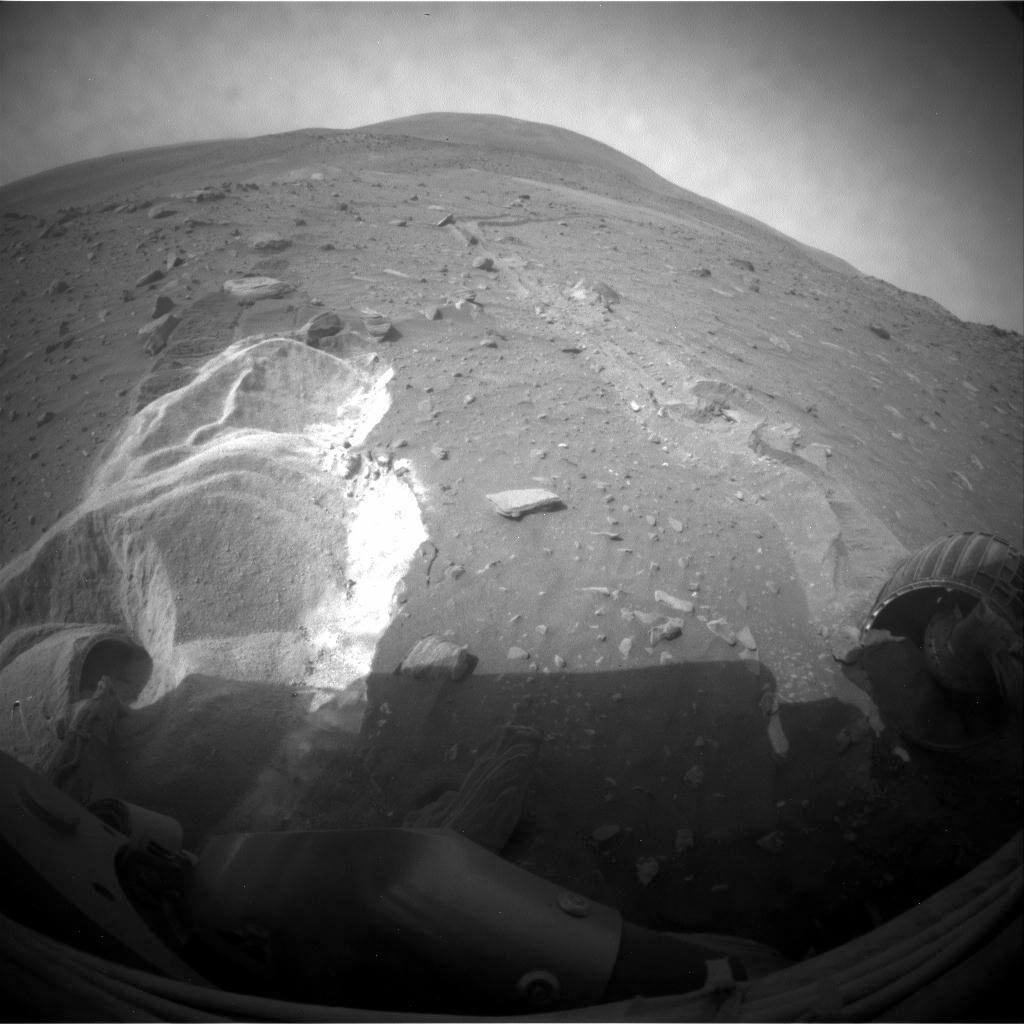 NASA/JPL-Caltech. Public domain (NASA / US government work).
The problem
Section titled “The problem”A Mars rover has to cross unknown terrain, place instruments on rock and soil, and survive on solar power, with a radiation-hardened flight computer, a link to Earth that is mostly relayed through orbiters, and no possibility of repair. Spirit, formally MER-A, was designed for 90 sols and 600 m of traverse [6]. The environment attacks that requirement three ways. Loose soil and slopes turn commanded distance into wheel slip. Dust settles on the solar array and sets the energy available each sol. Mechanisms age: every actuator has a qualified revolution count, and the mission is long enough to exceed it.
What has flown
Section titled “What has flown”Spirit (2004 to 2010). Spirit launched on 10 June 2003 and landed in Gusev crater in January 2004 after an airbag landing at over 80 km/h and 40 g [1]. It was last heard from on sol 2210 after driving 7730.50 m, more than 12 times the planned 600 m, and returned 21.57 GB, 52.8 percent of it science images [13]. The rover is a six-wheel rocker-bogie vehicle of 185 kg on 26 cm wheels [28], [11], powered by a 1.33 m2 triple-junction array [19] on a 20 MHz RAD6000 with 128 MB RAM and 256 MB flash [23]. Its design cost, with Opportunity through the 90-sol prime mission, was $820 million [5].
Mobility defined its history. The right front drive actuator drew nearly 1 A against a typical 0.4 A before it stalled on sol 779, and Spirit then drove backward for years with the wheel dragging; the loss cut effective thrust by an estimated 17 percent [15]. The dragged wheel trenched the soil and exposed light-toned sulfate-rich and silica-rich material at eight locations, including a Gertrude Weise patch near 90 percent SiO2, the highest silica then reported on Mars [11]. Later spectroscopy placed opaline silica at 65 to 92 wt percent SiO2 around Home Plate [26]. After the failure the maximum climbable slope was 12 degrees, which limited the northerly tilt reachable for winter [13]. Drive actuators on Spirit accumulated up to 18.747 million motor revolutions against a 10 million qualification, where the prime mission was expected to use 2.5 million [13]. The rover was embedded in soft sand near Home Plate from about March 2009, and on 26 January 2010 NASA redesignated it a stationary science platform after extraction attempts failed [2].
Power set the end. Energy production at Gusev fell from 900 W-h/sol at sol 1 to 434 in the first winter and 278 in the second, with dust factors of 0.71, 0.53 and 0.35 and northerly tilts of 13.5, 11.5 and 28.8 degrees across the three winters; a wind cleaning near sol 420 raised output from about 400 to over 700 W-h/sol [13]. The project’s assessment was that dust factor times tilt sets the life of a solar rover, and no telemetry exists from the fourth winter [13].
Opportunity (2004 to 2018). The twin drove 45,161.04 m over 5111 sols, with a longest single-sol drive of 219.89 m on sol 410, and ended when the 2018 planet-encircling dust event cut array output below what communication needs [14]. That storm reached a peak optical depth of 10.8 to 11.1 in eight sols, against 4.72 in twenty-one sols in 2007 [20]. Opportunity’s minimum dust factor was 0.43 against Spirit’s 0.25, because Meridiani cleaned more often than Gusev [19].
Flown autonomy. Visual odometry converged 97 percent of the time on Spirit and 95 percent (828 of 875) on Opportunity, measured slip ratios up to 125 percent on a slope above 25 degrees, and took nearly 3 minutes per step on the RAD6000 with steps limited to about 75 cm [10]. The autonomous targeting software AEGIS picks rock targets in navigation images and points the Pancam; it was uploaded to Opportunity in December 2009 and ran within the same 20 MHz, 128 MB budget [23]. Ground-derived slip tables held for pure upslope and cross-slope travel but failed on mixtures of bedrock and loose sand [10].
Communications and operations. Through September 2005, 93 percent of Spirit’s data went through Mars Odyssey, 4 percent through Mars Global Surveyor and 3 percent direct to Earth [1]. Relay passes averaged about 56 Mb per sol per rover through Odyssey [16]. The operations architecture ran two shifted teams on Mars local time with a tactical cycle each sol and a two-week strategic plan [6]. Mission clocks drifted to 21 minutes 5 seconds on Spirit by February 2010, which corrupts sun-based attitude [22]. By 2014 the team had cataloged each failure with its workaround; dust obscured about 80 percent of Spirit’s Mini-TES signal after the 2007 storm, and the pre-drive actuator heating setpoint was raised from -20 C to 0 C to recover lubricated actuators [15]. In 2011 plan persistence moved to cloud services after saving a 300-tuple plan took almost 8 s for a remote user [35].
Successor rovers. Curiosity’s wheels, with 0.75 mm skin against MER’s 3.52 mm, had four broken grousers by sol 3195 and 26,256 m [28]. The mechanism is the all-wheels-same-speed control mode meeting pointed rocks, which loads a leading wheel to as much as twice its static load [32], [40]. Curiosity used visual odometry on 87 percent of its drives and averaged 46 m/hr in full VO mode [27]. Perseverance’s ENav, helped by an FPGA for stereo, used autonomous navigation for 90 percent of 32.1 km through sol 1312 at an average 92 m/h, against 17.3 m/h for Curiosity [29].
What is being tried now
Section titled “What is being tried now”Faster onboard autonomy (flown). MER stereo took 24 to 30 s for a 256-pixel-wide map and visual odometry 160 s on the RAD6000; a Virtex 5 FPGA implementation ran a 1024-pixel-wide stereo map in 0.082 s and was tested on a prototype rover at 6.44 cm/s [24]. The FPGA approach is what Perseverance flew [29]. Curiosity’s thinking-while-driving change runs VO in parallel with motion and was measured against a 51.5 m/hr Mars Yard drive rate without it [27].
Onboard global localization (flown). Spirit’s position error accumulated with distance. Perseverance repurposed the Ingenuity base station processor to match post-drive orthomosaics to HiRISE, with mean error of 0.36 m on 264 panoramas, after a 3-sol drive had grown 32.92 m of position uncertainty with no global fix [30].
Slip prediction from environment (flown data, ground model). On Curiosity, adding thermal inertia to a slope-only model cut slip error from 22.0 to 16.8 percent RMS over 135 samples at nine sandy sites, where measured slip ranged from 15.4 to 83.4 percent [31]. A survey reports support vector machine classification of slip into low, moderate and high from proprioceptive data as the best of the algorithms compared [37]; the corpus holds no flight use of it.
Wheel-soil modeling (ground-tested). Cohesion and friction were first derived on Mars from Spirit and Opportunity wheel-trenching telemetry: friction angles of 30 to 37 degrees and cohesion of 0 to 2 kPa from seven trenches [25]. Resistive force theory and continuum plasticity were benchmarked against forced-slip wheel experiments including Mars Mojave Simulant and agreed with drawbar pull to about 25 percent [3]. Discrete element simulation of a MER spare wheel matched drawbar pull to 6.1 percent at slip 0.7 but not at slip 0 [18]. A stochastic response surface propagates soil uncertainty to a confidence ellipse and ran 246 s against 17,526 s for Monte Carlo on a 13.4 kg test rover [8]. None flew on Spirit.
Parked-rover safety (flown). Curiosity’s Slip Risk Assessment Process cleared 93.6 percent of 1258 evaluations, and half of the 58 no-go cases were a perched wheel [34].
Power (flown). InSight’s arrays lost 0.2 percent per sol to dust and sat at a dust factor near 0.25 after one Mars year, the Spirit minimum [33], [19]. Dust optical depth on Spirit’s calibration target peaked at 1.5, equivalent to about 29 micrometers [17].
The numbers
Section titled “The numbers”| Parameter | Value | Source |
|---|---|---|
| Planned surface life and traverse | 90 sols, 600 m | [6] |
| Wheel diameter | 26 cm | [11] |
| Mass | 185 kg | [28] |
| Solar array | 1.33 m2, triple junction | [19] |
| Flight computer | RAD6000, 20 MHz, 128 MB RAM, 256 MB flash | [23] |
| Last communication | sol 2210 | [13] |
| Odometry | 7730.50 m | [13] |
| Data returned | 21.57 GB | [13] |
| Single event upset warnings | 23 | [13] |
| Drive actuator revolutions, maximum | 18.747 million | [13] |
| Minimum dust factor | 0.25 | [19] |
| Data via Odyssey, to Sept 2005 | 93 percent | [1] |
| Microscopic Imager scale and depth of field | 30 micrometers per pixel, plus or minus 3 mm | [7] |
| Pancam, Navcam, Hazcam resolution | 0.28, 0.77, 2 mrad per pixel | [4] |
| Rock abrasion tool cut | 5 mm deep, 4.5 cm wide | [4] |
| Energy by winter | W-h/sol | Dust factor | Tilt |
|---|---|---|---|
| Sol 1 | 900 | ||
| Sol 90 | 600 | ||
| Winter 1 | 434 | 0.71 | 13.5 degrees |
| Winter 2 | 278 | 0.53 | 11.5 degrees |
| Winter 3 | 227 | 0.35 | 28.8 degrees |
All rows are from [13].
What is not established
Section titled “What is not established”Spirit’s loss is attributed to dust and tilt, not diagnosed, because no telemetry exists from the fourth winter [13]. The right front failure has a suspected cause, lubricant maldistribution, and no confirmed one [15]. The 17 percent thrust loss has no derivation in its source [15]. Wheel slippage in the Columbia Hills mission overview is described as excessive with no percentages [4]. The two silica figures, 90 percent at Gertrude Weise and 91 percent in an outreach deck, are from different sources and are not reconciled [11], [5]. Wheel-soil models disagree with measurement across the slip range, none ran onboard, and all tests cited are one-gravity tests on simulants [3], [18]. The soil-derived cohesion values rest on seven trenches [25]. Later-rover figures come from different vehicles, processors and terrain and bound what is possible without restating what Spirit did [29], [27].
References
- Taylor, J., Makovsky, A., Barbieri, A., Tung, R., Estabrook, P. and Thomas, A. G. (2005). Mars Exploration Rover Telecommunications
. Jet Propulsion Laboratory, California Institute of Technology, DESCANSO Design and Performance Summary Series, Article 10. Source
BibTeX
@techreport{taylor2005mars, title = {Mars Exploration Rover Telecommunications}, author = {Taylor, Jim and Makovsky, Andre and Barbieri, Andrea and Tung, Ramona and Estabrook, Polly and Thomas, A. Gail}, number = {DESCANSO Design and Performance Summary Series, Article 10}, institution = {Jet Propulsion Laboratory, California Institute of Technology}, year = {2005}, url = {https://dataverse.jpl.nasa.gov/dataset.xhtml?persistentId=hdl:2014/7616} } - Jet Propulsion Laboratory. (2010). Now a Stationary Research Platform, NASA's Mars Rover Spirit Starts a New Chapter in Red Planet Scientific Studies. prnewswire.com/news-releases/now-a-stationary-research-platform-nasas...
BibTeX
@misc{jpl2010now, title = {Now a Stationary Research Platform, NASA's Mars Rover Spirit Starts a New Chapter in Red Planet Scientific Studies}, author = {{Jet Propulsion Laboratory}}, year = {2010}, url = {https://www.prnewswire.com/news-releases/now-a-stationary-research-platform-nasas-mars-rover-spirit-starts-a-new-chapter-in-red-planet-scientific-studies-82698787.html} } - Agarwal, S., Senatore, C., Zhang, T., Kingsbury, M., Iagnemma, K., Goldman, D. I. and Kamrin, K. (2019). Modeling of the Interaction of Rigid Wheels with Dry Granular Media
. Journal of Terramechanics. Source
BibTeX
@article{agarwal2019modeling, title = {Modeling of the Interaction of Rigid Wheels with Dry Granular Media}, author = {Agarwal, Shashank and Senatore, Carmine and Zhang, Tingnan and Kingsbury, Mark and Iagnemma, Karl and Goldman, Daniel I. and Kamrin, Ken}, journal = {Journal of Terramechanics}, volume = {85}, pages = {1--14}, year = {2019}, doi = {10.1016/j.jterra.2019.06.001} } - Arvidson, R. E., Ruff, S. W., Morris, R. V., Ming, D. W., Crumpler, L. S., Yen, A. S., Squyres, S. W., Sullivan, R. J., Bell, J. F., Cabrol, N. A., Clark, B. C., Farrand, W. H., Gellert, R., Greenberger, R., Grant, J. A., Guinness, E. A., Herkenhoff, K. E., Hurowitz, J. A., Johnson, J. R., Klingelhöfer, G., Lewis, K. W., Li, R., McCoy, T. J., Moersch, J., McSween, H. Y., Murchie, S. L., Schmidt, M., Schröder, C., Wang, A., Wiseman, S., Madsen, M. B., Goetz, W. and McLennan, S. M. (2008). Spirit Mars Rover Mission to the Columbia Hills, Gusev Crater: Mission Overview and Selected Results from the Cumberland Ridge to Home Plate
. Journal of Geophysical Research: Planets. Source
BibTeX
@article{arvidson2008spirit, title = {{Spirit} {Mars} Rover Mission to the {Columbia Hills}, {Gusev} Crater: Mission Overview and Selected Results from the {Cumberland Ridge} to {Home Plate}}, author = {Arvidson, R. E. and Ruff, S. W. and Morris, R. V. and Ming, D. W. and Crumpler, L. S. and Yen, A. S. and Squyres, S. W. and Sullivan, R. J. and Bell, J. F. and Cabrol, N. A. and Clark, B. C. and Farrand, W. H. and Gellert, R. and Greenberger, R. and Grant, J. A. and Guinness, E. A. and Herkenhoff, K. E. and Hurowitz, J. A. and Johnson, J. R. and Klingelhöfer, G. and Lewis, K. W. and Li, R. and McCoy, T. J. and Moersch, J. and McSween, H. Y. and Murchie, S. L. and Schmidt, M. and Schröder, C. and Wang, A. and Wiseman, S. and Madsen, M. B. and Goetz, W. and McLennan, S. M.}, journal = {Journal of Geophysical Research: Planets}, volume = {113}, pages = {E12S33}, year = {2008}, doi = {10.1029/2008je003183}, abstract = {This paper summarizes the Spirit rover operations in the Columbia Hills of Gusev Crater from sols 513 to 1476 and provides an overview of selected findings that focus on synergistic use of the Athena Payload and comparisons to orbital data. Results include discovery of outcrops (Voltaire) on Husband Hill that are interpreted to be altered impact melt deposits that incorporated local materials during emplacement. Evidence for extensive volcanic activity and aqueous alteration in the Inner Basin is also detailed, including discovery and characterization of accretionary lapilli and formation of sulfate, silica, and hematite‐rich deposits. Use of Spirit's data to understand the range of spectral signatures observed over the Columbia Hills by the Mars Reconnaissance Orbiter's Compact Reconnaissance Imaging Spectrometer (CRISM) hyperspectral imager (0.4–4 μ m) is summarized. We show that CRISM spectra are controlled by the proportion of ferric‐rich dust to ferrous‐bearing igneous minerals exposed in ripples and other wind‐blown deposits. The evidence for aqueous alteration derived from Spirit's data is associated with outcrops that are too small to be detected from orbital observations or with materials exposed from the shallow subsurface during rover activities. Although orbital observations show many other locations on Mars with evidence for minerals formed or altered in an aqueous environment, Spirit's data imply that the older crust of Mars has been altered even more extensively than evident from orbital data. This result greatly increases the potential that the surface or shallow subsurface was once a habitable regime.} } - Cohen, B. (2008). Mars Exploration Rover Mission
. Leadership in Science and Technology: A Reference Handbook. doi.org/10.4135/9781412994231.n72
BibTeX
@misc{cohen2008mars, title = {Mars Exploration Rover Mission}, author = {Cohen, Barbara}, booktitle = {Leadership in Science and Technology: A Reference Handbook}, pages = {636-643}, year = {2008}, doi = {10.4135/9781412994231.n72}, abstract = {This viewgraph presentation reviews the Mars Exploration Rover Mission. The design of the Rover along with the Athena science payload is also described. Photographs of the Gusev Crater and Meridiani rocks are also shown.} } - Erickson, J. K., Adler, M., Crisp, J., Mishkin, A. and Welch, R. (2002). Mars Exploration Rover: Surface Operations
. International Astronautical Congress, The World Space Congress, IAC-02-Q.3.1.03. Source
BibTeX
@inproceedings{erickson2002mars, title = {Mars Exploration Rover: Surface Operations}, author = {Erickson, James K. and Adler, Mark and Crisp, J. and Mishkin, A. and Welch, R.}, booktitle = {International Astronautical Congress, The World Space Congress}, number = {IAC-02-Q.3.1.03}, institution = {NASA Jet Propulsion Laboratory}, address = {Houston, Texas}, year = {2002}, url = {https://dataverse.jpl.nasa.gov/dataset.xhtml?persistentId=hdl:2014/10519} } - Herkenhoff, K. E., Squyres, S. W., Bell, J. F., Maki, J. N., Arneson, H. M., Bertelsen, P., Brown, D. I., Collins, S. A., Dingizian, A., Elliott, S. T., Goetz, W. and Hagerott, E. C. (2003). Athena Microscopic Imager Investigation
. Journal of Geophysical Research: Planets, E12. Source
BibTeX
@article{herkenhoff2003athena, title = {{Athena} Microscopic Imager Investigation}, author = {Herkenhoff, K. E. and Squyres, Steven W. and Bell, J. F. and Maki, Justin N. and Arneson, H. M. and Bertelsen, P. and Brown, D. I. and Collins, S. A. and Dingizian, A. and Elliott, S. T. and Goetz, Walter and Hagerott, E. C.}, journal = {Journal of Geophysical Research: Planets}, volume = {108}, number = {E12}, pages = {8065}, year = {2003}, doi = {10.1029/2003je002076}, abstract = {The Athena science payload on the Mars Exploration Rovers (MER) includes the Microscopic Imager (MI). The MI is a fixed‐focus camera mounted on the end of an extendable instrument arm, the Instrument Deployment Device (IDD). The MI was designed to acquire images at a spatial resolution of 30 microns/pixel over a broad spectral range (400–700 nm). The MI uses the same electronics design as the other MER cameras but has optics that yield a field of view of 31 × 31 mm across a 1024 × 1024 pixel CCD image. The MI acquires images using only solar or skylight illumination of the target surface. A contact sensor is used to place the MI slightly closer to the target surface than its best focus distance (about 66 mm), allowing concave surfaces to be imaged in good focus. Coarse focusing (∼2 mm precision) is achieved by moving the IDD away from a rock target after the contact sensor has been activated. The MI optics are protected from the Martian environment by a retractable dust cover. The dust cover includes a Kapton window that is tinted orange to restrict the spectral bandpass to 500–700 nm, allowing color information to be obtained by taking images with the dust cover open and closed. MI data will be used to place other MER instrument data in context and to aid in petrologic and geologic interpretations of rocks and soils on Mars.} } - Ishigami, G., Kewlani, G. and Iagnemma, K. (2009). Predictable Mobility: A Statistical Approach for Planetary Surface Exploration Rovers in Deformable Terrain
. IEEE Robotics & Automation Magazine, 4. Source
BibTeX
@article{ishigami2009predictable, title = {Predictable Mobility: A Statistical Approach for Planetary Surface Exploration Rovers in Deformable Terrain}, author = {Ishigami, Genya and Kewlani, Gaurav and Iagnemma, Karl}, journal = {IEEE Robotics & Automation Magazine}, volume = {16}, number = {4}, pages = {61--70}, year = {2009}, doi = {10.1109/mra.2009.934823}, abstract = {In this article, a statistical mobility prediction for planetary surface exploration rovers has been described. This method explicitly considers uncertainty of the terrain physical parameters via SRSM and employs models of both vehicle dynamics and wheel-terrain interaction mechanics. The simulation results of mobility prediction using three different techniques, SMC, LHSMC, and SRSM, confirms that SRSM significantly improves the computational efficiency compared with those conventional methods. The usefulness and validity of the proposed method has been confirmed through experimental studies of the slope traversal scenario in two different terrains. The results show that the predicted motion path with confidence ellipses can be used as a probabilistic reachability metric of the rover position. Also, for the slope-traversal case, terrain parameter uncertainty has a larger influence on the lateral motion of the rover than on longitudinal motion. Future directions of this study will apply the proposed technique to the path-planning problem. Here, confidence ellipses will be used to define collision-free areas, which will provide useful criteria for generating safe trajectories.} } - Maimone, M., Cheng, Y. and Matthies, L. (2007). Two Years of Visual Odometry on the Mars Exploration Rovers
. Journal of Field Robotics, 3. Source
BibTeX
@article{maimone2007two, title = {Two Years of Visual Odometry on the Mars Exploration Rovers}, author = {Maimone, Mark and Cheng, Yang and Matthies, Larry}, journal = {Journal of Field Robotics}, volume = {24}, number = {3}, pages = {169--186}, institution = {NASA Jet Propulsion Laboratory}, year = {2007}, doi = {10.1002/rob.20184}, abstract = {Abstract NASA's two Mars Exploration Rovers (MER) have successfully demonstrated a robotic Visual Odometry capability on another world for the first time. This provides each rover with accurate knowledge of its position, allowing it to autonomously detect and compensate for any unforeseen slip encountered during a drive. It has enabled the rovers to drive safely and more effectively in highly sloped and sandy terrains and has resulted in increased mission science return by reducing the number of days required to drive into interesting areas. The MER Visual Odometry system comprises onboard software for comparing stereo pairs taken by the pointable mast‐mounted 45 deg FOV Navigation cameras (NAVCAMs). The system computes an update to the 6 degree of freedom rover pose ( x , y , z , roll, pitch, yaw) by tracking the motion of autonomously selected terrain features between two pairs of 256×256 stereo images. It has demonstrated good performance with high rates of successful convergence (97% on Spirit, 95% on Opportunity), successfully detected slip ratios as high as 125%, and measured changes as small as 2 mm, even while driving on slopes as high as 31 deg. Visual Odometry was used over 14% of the first 10.7 km driven by both rovers. During the first 2 years of operations, Visual Odometry evolved from an “extra credit” capability into a critical vehicle safety system. In this paper we describe our Visual Odometry algorithm, discuss several driving strategies that rely on it (including Slip Checks, Keep‐out Zones, and Wheel Dragging), and summarize its results from the first 2 years of operations on Mars. © 2006 Wiley Periodicals, Inc.} } - Wang, A., Bell, J. F., Li, R., Johnson, J. R., Farrand, W. H., Cloutis, E. A., Arvidson, R. E., Crumpler, L., Squyres, S. W., McLennan, S. M., Herkenhoff, K. E., Ruff, S. W., Knudson, A. T., Chen, W. and Greenberger, R. (2008). Light-toned salty soils and coexisting Si-rich species discovered by the Mars Exploration Rover Spirit in Columbia Hills
. Journal of Geophysical Research. Source
BibTeX
@article{wang2008light,
  title = {Light-toned salty soils and coexisting Si-rich species discovered by the Mars Exploration Rover Spirit in Columbia Hills},
  author = {Wang, Alian and Bell, J. F. and Li, Ron and Johnson, Jeffrey R. and Farrand, William H. and Cloutis, Edward A. and Arvidson, Raymond E. and Crumpler, Larry and Squyres, Steven W. and McLennan, Scott M. and Herkenhoff, K. E. and Ruff, Steven W. and Knudson, A. T. and Chen, Wei and Greenberger, R.},
  journal = {Journal of Geophysical Research},
  volume = {113},
  pages = {E12S40},
  year = {2008},
  doi = {10.1029/2008je003126},
  abstract = {Light‐toned soils were exposed, through serendipitous excavations by Spirit Rover wheels, at eight locations in the Columbia Hills. Their occurrences were grouped into four types on the basis of geomorphic settings. At three major exposures, the light‐toned soils are hydrous and sulfate‐rich. The spatial distributions of distinct types of salty soils vary substantially: with centimeter‐scaled heterogeneities at Paso Robles, Dead Sea, Shredded, and Champagne‐Penny, a well‐mixed nature for light‐toned soils occurring near and at the summit of Husband Hill, and relatively homogeneous distributions in the two layers at the Tyrone site. Aeolian, fumarolic, and hydrothermal fluid processes are suggested to be responsible for the deposition, transportation, and accumulation of these light‐toned soils. In addition, a change in Pancam spectra of Tyrone yellowish soils was observed after being exposed to current Martian surface conditions for 175 sols. This change is interpreted to be caused by the dehydration of ferric sulfates on the basis of laboratory simulations and suggests a relative humidity gradient beneath the surface. Si‐rich nodules and soils were observed near the major exposures of S‐rich soils. They possess a characteristic feature in Pancam visible near‐infrared (Vis‐NIR) spectra that may be diagnostic of hydrated species, and this spectral feature can be used to search for additional Si‐rich species. The exposures of hydrated salty soils within various geomorphic settings imply the potential existence of hydrous minerals in similar settings over a much wider area. Hydrous sulfates represent one of the candidates that may contribute the high level of water equivalent hydrogen in equatorial regions detected by the Neutron Spectrometer on Mars Odyssey.}
}
Further reading
- Landis, G. A., Kerslake, T. W., Jenkins, P. P. and Scheiman, D. A. (2004). Mars Solar Power . International Energy Conversion Engineering Conference. Source
- (2017). NASA: Spirit. science.nasa.gov/mission/mer-spirit