NASA GRC Glenn Extreme Environments Rig
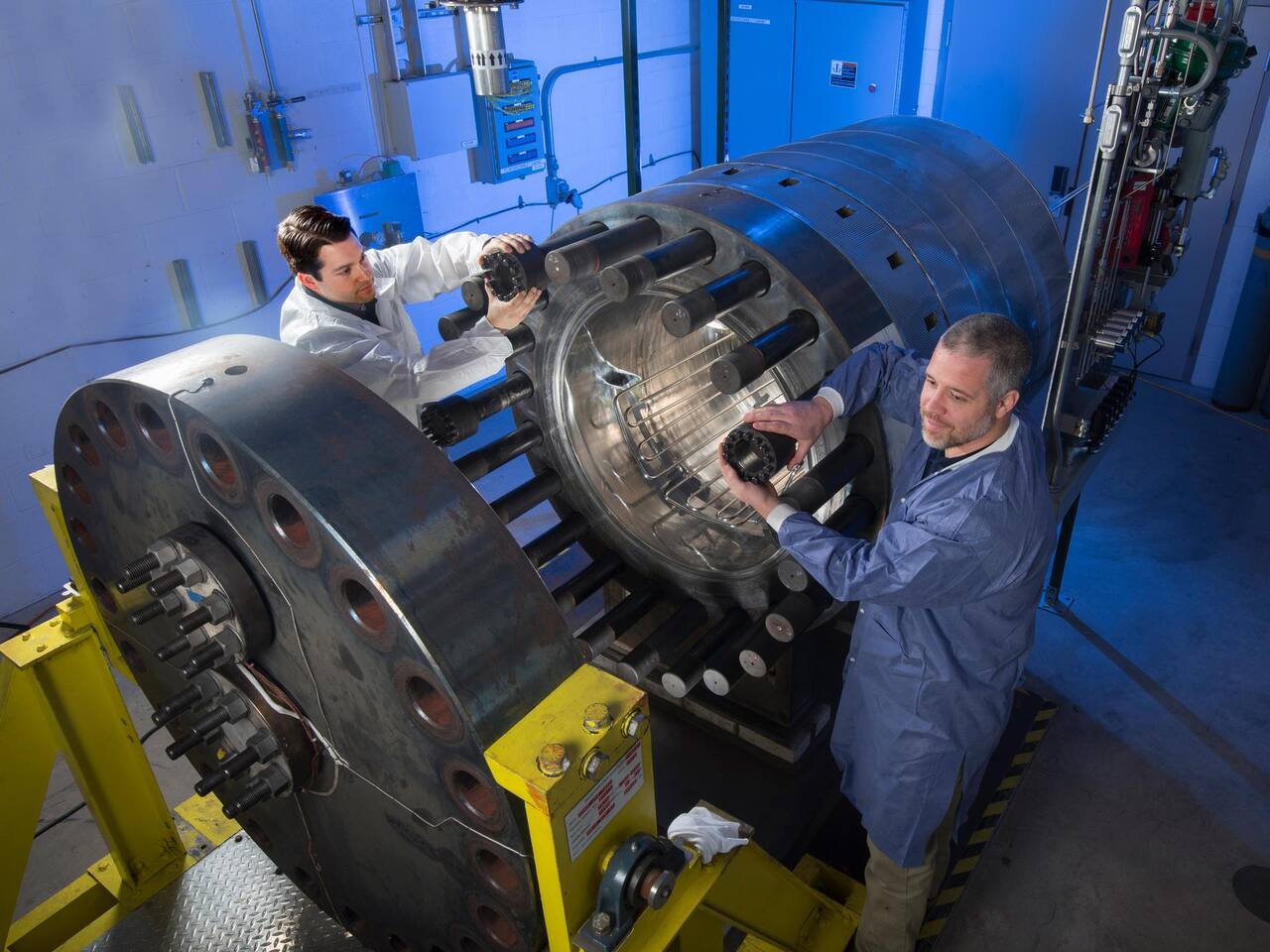
NASA. Public domain (NASA / US government work).
The Glenn Extreme Environments Rig is a 12 t, 800 L stainless steel pressure vessel that holds Venus surface temperature, pressure and gas chemistry indefinitely, with a nine stream mixing system that injects trace species at parts per billion [1]. It is the facility where NASA’s high temperature silicon carbide electronics, Venus sensors and candidate lander materials are exposed to the atmosphere they will have to survive, rather than to temperature alone [5]. GEER is the largest of several extreme-environment rigs at NASA Glenn, which also runs cryogenic chambers built to hold the hydrogen, hydrocarbon and nitrogen atmospheres of the outer planets and Titan; GEER is the one built for a hot, corrosive, high pressure atmosphere rather than a cold one [7].
Laboratory data
Section titled “Laboratory data”| Parameter | Value |
|---|---|
| Operator | NASA GRC; supported by the Planetary Science Division [1] |
| Location | Cleveland, Ohio, United States |
| Commissioned | November 2014; research operations from spring 2015 |
| Type | High pressure, high temperature reactive-atmosphere chamber |
| Floor area | Not published |
| Capabilities | GEER vessel, gas system, Mini GEER |
| Simulant or terrain | Not applicable; the chamber holds a gas mixture, not a bed |
| Instrumentation | In-line four-column gas chromatograph; on-site mass spectrometer |
| Ground truth | Gas chromatography and mass spectrometry during the run, independent of the charge |
| Fidelity limits | No solar flux, no wind loading, no dynamic descent profile |
| Access | Two-phase process; 4 to 8 weeks planning, 30 workdays minimum per test |
| Cited by | SiC JFET-R integrated circuits and packaging for Venus landers [3][4][6]; alloy and coating corrosion screening [8]; Venus lander concept studies [10] |
Access is a two-phase process. Phase I test planning requires a GEER Test Requirements Document, and the operator quotes 4 to 8 weeks to settle scope of work, cost estimate and test agreement; Phase II is execution [1]. Proposed articles go to a Material Review Board of scientists and GEER operations staff, which may reject materials liable to react hazardously with the vessel atmosphere. The minimum test process is 30 workdays, about six weeks, made up of 3 days bolt-up, 10 days leak check and purge, 4 days fill and heat-up, time at conditions per requirements, 10 days cool-down, plus sample loading and unloading [1]. All GEER test photographs are non-restricted and processed for public release unless the customer flags proprietary content, and no fee schedule is published. Over 20 tests had been conducted in the chamber by 2024 [1].
Capabilities
Section titled “Capabilities”GEER vessel
Section titled “GEER vessel”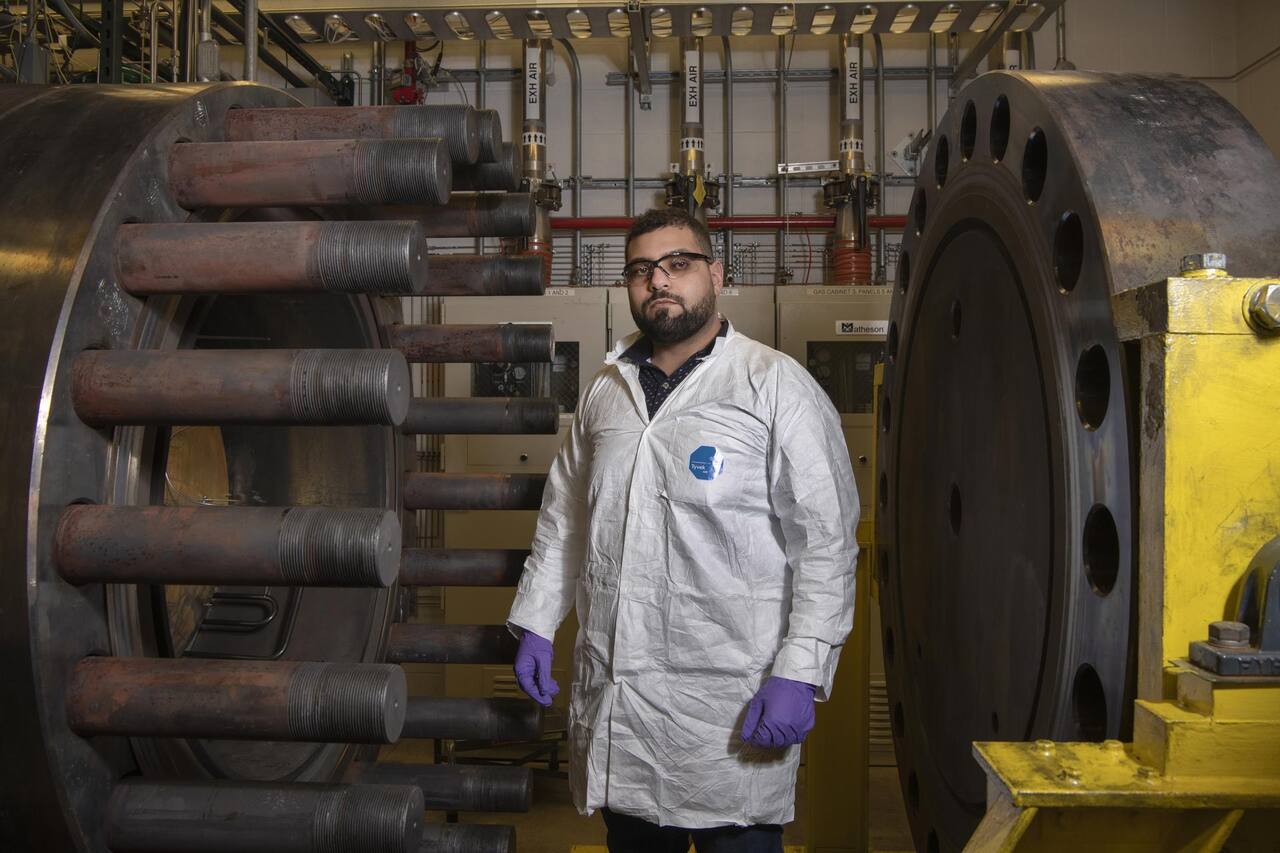
NASA/GRC/Bridget Caswell. Public domain (NASA / US government work).
| Parameter | Value |
|---|---|
| Working volume | 36 in diameter x 48 in deep (0.91 x 1.22 m), about 800 L [1] |
| Test article limits | Placement envelope 24 in diameter x 36 in; no article mass limit published |
| Vacuum | Rated upward to 1500 psig, about 103 bar |
| Temperature | Ambient to 1000 F (about 530 C); ramp 7 C/h [4] |
| Illumination | Provision for two 4 in optical ports at opposing ends [5] |
| Slope | Not applicable |
| Gravity offload | Not applicable |
| Instrumentation | Calibrated pressure and temperature data system; 48 feedthrough wires maximum [1] |
GEER is an ASME stamped pressure vessel of 304 stainless steel, 12 t, originally designed with the engineering limits of 1000 F and 1500 psi needed to reach Venus surface conditions with margin [1]. The bolted head withdraws on a carriage to open the full bore, so large articles go in through the main door while small hardware and materials go through the smaller ports [5]. The wall is 2 in thick, the bolted end 9.5 in and the welded end 6.75 in, and the interior is lined throughout with Inconel 625 to limit attack by the harsh gas mixtures; gas plumbing is 304 stainless except in the high temperature regions adjacent to the vessel, where it changes to Inconel 625 with Monel fittings. Nine flange ports cross the fixed and bolted heads, two of 4 in and seven of 3 in; four of the 3 in ports carry vessel hardware and instrumentation, leaving three 3 in and two 4 in ports free for customer feedthroughs [1].
Venus surface tests run at 460 +/- 5 C and 92 bar, held through a run by a re-boost pumping system, and uniformity across the 800 L volume is not published [4]. Thermal operation is slow by design: at 7 C per hour an article spends roughly 60 h transiting from ambient to Venus conditions, and a Venus-conditions test spends four days filling and heating and ten days cooling around whatever dwell the customer requires.
Fixturing determines what actually fits. A shelf gives a 36 x 25 in area at about 12 in height for many small articles; half-pipe supports of 3 in and 4 in diameter run to 42 in long; arch supports take large articles bottom-supported within the article envelope; and electrical feedthrough platforms carry small samples on alumina substrate [1]. Standard alumina crucibles run 200 x 100 x 25 mm down to 50 x 20 x 20 mm, with circular 45 x 45 mm and 25 x 30 mm [1]. Custom fixturing can be fabricated, and multiple fixtures may not fit in one test. Electrical feedthroughs are proven at plus or minus 24 VDC at low single-digit mA per wire, with a higher- capacity feedthrough demonstrating a stable 15 VDC at 1 A for three days at Venus surface conditions [4].
Gas system
Section titled “Gas system”| Parameter | Value |
|---|---|
| Working volume | Nine independent streams feeding the 800 L vessel [5] |
| Simulant or terrain | CO2, N2 and up to eight trace gases at parts per billion, ppm accuracy [1] |
| Instrumentation | Thermal mass flow controller per stream; in-line four-column gas chromatograph [5] |
The gas system is the part that distinguishes GEER from a furnace. A bank of cylinders feeds a mixing system delivering up to nine independent streams at controlled concentration, each metered by its own thermal mass flow controller from a bottle that may itself hold a premixed set of gases, so effectively any planetary atmosphere can be made up within the limits of the containing materials, and the composition can be adjusted while the test is running [5]. A boost pump recharges the chamber at pressure, and a scrubber, gas containment, programmable control and gas analytics complete the installation.
The Venus mixture published for the facility’s system test is 96.5 percent CO2 and 3.4 percent N2 with SO2 at 130 ppm, COS at 27 ppm, CO at 15 ppm, H2O at 30 ppm, HCl at 0.5 ppm, NO at 5.5 ppb and HF at 5 ppb [1].
Mini GEER
Section titled “Mini GEER”| Parameter | Value |
|---|---|
| Working volume | 5 in internal diameter x 12 in, about 4 L (unverified, see below) |
| Test article limits | Materials coupons and small components (unverified, see below) |
| Vacuum | Vacuum to 2706 psia (unverified, see below) |
| Temperature | Ambient to 950 F, about 510 C (unverified, see below) |
Mini GEER is the small-volume companion vessel, roughly 200 times smaller than GEER, used to screen materials and small components at Venus surface conditions without committing the 30 workday cycle a GEER run requires [1]. The 2024 users guide describes only the main vessel [1].
Why it exists
Section titled “Why it exists”GEER exists because of a specific gap. A 2012 Venus Exploration Analysis Group survey of laboratories able to reach Venus surface temperature and pressure with at least CO2 and N2 found nine facilities [5]. The largest was just over 1 ft3 of internal volume and only four exceeded 0.1 ft3; only seven reached both Venus surface temperature and pressure, the largest of those 0.5 ft3; only the JPL and Goddard chambers could handle more than CO2 and N2; and none could handle all the known Venus atmospheric species including HF, HCl, H2S and H2SO4. The survey’s conclusion was that as of March 2012 there was no operational capability for full-scale testing of instruments or spacecraft systems for the Venus surface [5]. GEER’s design targets followed directly: part per billion composition control, supporting infrastructure sized for a chamber at least 7 ft in diameter, an intent to simulate the changing composition and pressure and temperature growth of a parachute descent, and flexibility to reach complex compositions at cryogenic temperatures. The supporting plant was deliberately sized to serve multiple chambers or much larger ones than the vessel installed, which is the design provision Mini GEER now occupies.
The gap GEER closed is why a 2020 Glenn concurrent engineering study of a low-cost Venus orbiter and surface lander used GEER exposure results, rather than a materials handbook, to choose the surface probe’s structural alloys and coatings; the study’s cost cap depended on flying hardware whose survival in the real atmosphere had actually been measured rather than extrapolated from a furnace test [10]. The same demand for high-temperature electronics that can survive the Venus surface for a useful mission life is carried in the 2022 planetary science decadal survey as one of the technology gaps standing between current silicon electronics and long-duration Venus in-situ science [11].
Instrumentation
Section titled “Instrumentation”Facility instrumentation records chamber pressure and temperature through a calibrated data system. Atmosphere composition is tracked through the run by an in-line four-column gas chromatograph, with an on-site mass spectrometer available; a summary of gas analysis results is provided after each test on request [1].
Recording data from an active test article is the customer’s responsibility; GEER provides the feedthroughs and helps with setup, and a suite of post-test microanalysis covering SEM, EDS, XPS, Auger and Raman sits alongside the chamber with technical personnel [1]. That division has shaped the electronics campaigns run there, which bring their own instrumentation outside the vessel, measure through the wire count the feedthroughs allow, and reach their conclusions from post-test microscopy rather than from in-test telemetry [3].
What it does not reproduce
Section titled “What it does not reproduce”Chemistry drifts during a run. The atmosphere the article sees is not the atmosphere that was charged. GEER’s own in-line gas chromatograph exists because composition has to be measured through the run rather than assumed, and a gas analysis summary is issued after each test [1]. The Pt/HTCC package campaign is the clearest published instance: insulation resistance degraded heavily even in the nominally inert 90 bar nitrogen phase, which the investigators recorded as unanticipated, and post-test analysis found platinum sulfide formed on the bond pad from the sulfur-bearing gases [4].
No solar flux, no wind loading, no descent profile. The vessel has no illumination source, no means of producing flow across an article, and no published means of running a dynamic descent profile in pressure and temperature; the published process holds the chamber at a single set of conditions for the dwell [1].
Ramp rate is a test condition, not an artifact to be ignored. At 7 C per hour, an article spends roughly 60 hours transiting from ambient to 460 C [4]. That transit is where the SiC multi-chip board failed, at 107 C during heat-up, long before Venus conditions were reached [3].
Endurance testing at temperature is not done here. The thousands of hours of 500 C operation demonstrated for individual SiC JFET-R integrated circuits were run in room-air ovens, not in GEER, because a GEER cycle costs a minimum of 30 workdays [6]. GEER supplies the atmosphere; the ovens supply the hours. A device qualified for 10,000 hours at 500 C in air has not been shown to survive 10,000 hours in supercritical CO2 with SO2, OCS, HCl and HF present [6]. Radiation qualification of the same SiC JFET-R chips is a third, separate track again: total ionizing dose and single-event effect testing to over 7 Mrad(Si) was run at room temperature in a particle beam, not in GEER’s atmosphere or in a high temperature oven, because GEER holds atmospheric chemistry and temperature, not radiation [9]. A chip’s Venus qualification is assembled from three facilities, none of which alone demonstrates the whole environment.
Bare material coupons do not predict a packaged part. A structured coupon survey exposed plain steels, nickel alloys, gold, ceramic coatings and bulk ceramics to the Venus mixture at 92 bar and 467 C for 10, 42 and, for coated stainless, 21 days: alpha-Al2O3, Si3N4, SiC and fused quartz showed no detectable weight change at either duration, gold was unaffected, and the steels and nickel alloys all formed double-layered oxide-sulfide scales whose thickness ordered as 304 < 310 < 316 < 1018 among the steels and beta-NiAl < G30 < 625 among the nickel alloys [8]. That ranking is a materials selection tool, not a lifetime prediction: it says which bare alloy corrodes fastest under GEER conditions, not how a bonded, packaged, electrically active device behaves, which is what the Pt/HTCC and multi-chip board campaigns below test instead [8].
Operational findings. An independent NASA Engineering and Safety Center review in 2016 identified twelve findings, most minor [2]. Four bear on the vessel itself [2]:
- No procedure existed for documenting the operational history of the 304 stainless steel vessel, which the review recommended be recorded for creep assessment at recertification given prolonged operation at elevated temperature [2].
- The wet fire suppression system in the test cell could thermally shock the vessel if inadvertently activated.
- Corrosion under the vessel insulation was not in the inspection or maintenance plan, although API-571 treats it as a concern for insulated 304 stainless operating intermittently between 60 and 204 C [2].
- There was no means to visually monitor the test cell from the control room [3].
Campaigns run there
Section titled “Campaigns run there”SiC JFET-R single-chip ICs, 60 days, published 2018. Individual NASA Glenn IC Generation 10 silicon carbide junction field effect transistor circuits, under 200 transistors per chip, functioned for at least 60 days immersed in the chamber-simulated Venus surface environment without sheltering [3]. That result is what the multi-chip board work below sets out to scale up [3].
Pt/HTCC alumina package, 60 days, published 2018. A prototype platinum on high-temperature co-fired ceramic alumina package was run through three phases: Earth air, GEER nitrogen at 90 bar, and simulated Venus surface conditions, heated at 7 C/hour to 460 +/- 5 C for 60 Earth days [4]. Interconnect resistance changes seen in GEER nitrogen and in GEER Venus conditions were not reversible. Assembly 5’s insulation resistance entered the Venus phase at 45 kilohm, fell to a minimum of 721 ohm at 231 hours and had recovered only to 2.26 kilohm at 1459 hours, about 60 days; assembly 4 fell from 1.18 megohm to 19.8 kilohm across the same phase [4]. The degradation during the nominally inert 90 bar nitrogen phase was itself unanticipated [4]. Running an inert high-pressure phase before the reactive phase is what separated pressure and temperature effects from chemistry effects.
IC Generation 11 multi-chip lander board, 11 days, published 2023. A first attempt at a complete lander control and sensor digitization subsystem: an 11.5 x 11.5 cm ceramic circuit board with four interconnect layers carrying ten SiC JFET-R chips in nine ceramic packages, up to 706 transistors per chip, performing analogue to digital conversion of multiple sensor voltages into serial data [3]. The board ceased electrical operation at 107 C as the chamber heated up, well short of the 460 C, 9.4 MPa target. Post-test optical and SEM inspection found fatal dielectric cracks on one of the ten chips, in circuit-critical regions including a major power supply bus and the DAC subcircuit, correlated with dielectric hillock defects formed during deposition of the third SiO2 layer [3]. The suspected root cause was SiO2 deposition onto localized photoresist etch mask remnants, with the hypothesis that most of the cracking occurred during a 600 C die-attach air anneal rather than in the chamber. No package, board, wire bond or die-attach failure was found. The mitigation for Generation 12 is revised metal etch processing to eliminate photoresist residue and increased bond pad over-etch [3].
What the chamber is set against
Section titled “What the chamber is set against”The target environment. The conditions GEER reproduces come from a small set of measurements. The Venera 9 and 10 landers reported 730 to 740 K and 88 to 94 atm at the surface, with wind of 0.5 to 1 m/s one meter above it, from two point measurements on the illuminated side [15]. Sagan’s 1962 reanalysis had already inferred a surface near 660 K and a minimum of about 4.5 atm, with uncertainties of a factor of 3 or more, and concluded that surface exploration was a very difficult engineering problem [14]. The engineering reference today is Venus-GRAM, which rests on Pioneer Venus and Venera data from 0 to 250 km and an extrapolated thermosphere above, with atmosphere data unchanged since 2005 [12][13]. GEER’s set point is therefore a model of an environment known from a handful of probes, not a measured site.
Other Venus test routes. Chamber exposure is one of several. A static wind tunnel campaign on an 8.6 percent scale legged Venus lander measured force and moment coefficients in room-temperature air at Mach 0.15, with no CO2, pressure or temperature applied, so it addresses shape aerodynamics only [16]. A Venus aerobot concept tested its balloon in Earth air and measured sonde heat leak at 460 C but not in Venus gas composition [17]. Neither route exercises the corrosion and package chemistry that GEER exists to expose.
Electronics qualification elsewhere. The silicon carbide work run in GEER is one part of a larger qualification chain. The upscaling effort moved the 500 C JFET-R technology from about 200 toward 1000 transistors per chip, produced working analog to digital converters and read-only memory, and reported yield and lifetime lower than Generation 10, with no figure for the difference [18]. The Mars Science Laboratory motor drive assembly followed a different template: a flight assembly qualified over -143 to 125 C with a 3x thermal cycle margin and a 10-sample zero-failure criterion, cycled in air chambers rather than a Mars atmosphere [19]. For the lunar environment, the NESC cold electronics assessment sets a design envelope of -233 to +125 C and states that no existing standard covers it [20], a range that the 1982 environment criteria compilation sourced from a single Apollo 17 site over one lunation [21]. Radiation is a separate track again: guidance on single event effect testing, the Michigan State high-energy ion facility and the JPL Cobalt-60 irradiators each cover a different part of that envelope and none holds a reactive atmosphere [27][28][29].
Comparable simulation facilities. The Lunar Dust Adhesion Bell Jar at Glenn reproduces dust, vacuum and temperature for the lunar case and omits energetic radiation and reduced gravity [22]. CITADEL at JPL is a cryogenic ice and vacuum chamber for Europa lander sampling hardware, and its facility paper reports no measured performance [23]. Chamber B at Johnson Space Center is a human-rated thermal vacuum chamber, 7.6 m in diameter, with a 90 K shroud and no solar simulation [24]. The Mars Exploration Rover environmental campaign used the JPL Environmental Test Laboratory for dynamics and thermal vacuum, and its paper reports what was done rather than what was found [25]. The Cassini Integrated Test Laboratory is a hardware-in-the-loop testbed rather than an environmental chamber, and it had to be extended once the Saturn tour exposed conditions the original simulation could not produce [26]. None of these combines high pressure with a corrosive multi-species gas; GEER does.
Programmatic demand. The 2011 planetary science decadal survey set the cost constraints under which Venus and other missions were conceived, and it is a prioritization document, not a source of engineering data [30].
What is not established
Section titled “What is not established”The users guide is a capability document: it reports no measured temperature or pressure uniformity across the 800 L volume, no stability figures, and no dwell achieved on a specific campaign beyond the three day feedthrough demonstration [1]. The independent safety review covers the rig as commissioned in 2015, reports no test data or achieved composition accuracy, and does not verify that its findings were closed [2]. The Pt/HTCC package campaign used two articles in one run, and its insulation resistance is the package in parallel with the feedthrough wiring, so package and wiring cannot be separated. Its degradation mechanism is proposed, not demonstrated, and the suggested surface encapsulation was not tested [4]. The 60 day exposures in GEER are far short of the duration of any long-lived Venus lander mission [4]. Mini GEER figures are not covered by the current users guide and remain unverified [1].
References
- Beckley, B. W., Motil, C. A., Henry, I. M., Chi, I. S. and Sprouse, M. D. (2024). Glenn Extreme Environments Rig (GEER) Facility Users Guide
. Planetary Science Technology Symposium, 20240012869. Source
BibTeX
@inproceedings{beckley2024glenn, title = {Glenn Extreme Environments Rig (GEER) Facility Users Guide}, author = {Beckley, Blake W. and Motil, Craig A. and Henry, Ian M. and Chi, Ike S. and Sprouse, Mark D.}, booktitle = {Planetary Science Technology Symposium}, number = {20240012869}, institution = {NASA}, address = {Cleveland, OH}, year = {2024}, url = {https://ntrs.nasa.gov/citations/20240012869}, abstract = {The Glenn Extreme Environment Rig (GEER) is a large capacity pressure vessel capable of simulating high pressure and temperature conditions with a specified, custom mixture of gas. The chamber is certified for operation in physical and chemical conditions representative of the surface conditions of Venus. It can accommodate large scientific or engineering test articles while maintaining the specified conditions indefinitely. The user-configurable gas supply is capable of handling a mixture of up to nine independent streams for injection directly into the vessel. GEER is supported in part by NASA’s Planetary Science Division under the Science Mission Directorate and is available for use by the commercial, academic, and research communities. GEER was operationally commissioned in November of 2014. At that time, it successfully maintained the temperature, pressure, and chemistry of the Venus surface atmosphere. In the spring of 2015, GEER began operations for engineering and scientific research. Since then, over 20 tests have been successfully conducted in the chamber with a variety of atmospheric test conditions.} } - Jankovsky, R. S., Smiles, M. D., George, M. A., Ton, M. C. and Le, S. K. (2015). Glenn Extreme Environments Rig (GEER) Independent Review
. NASA, NASA/TM-2015-218809. Source
BibTeX
@techreport{jankovsky2015glenn, title = {Glenn Extreme Environments Rig (GEER) Independent Review}, author = {Jankovsky, Robert S. and Smiles, Michael D. and George, Mark A. and Ton, Mimi C. and Le, Son K.}, number = {NASA/TM-2015-218809}, institution = {NASA}, year = {2015}, url = {https://ntrs.nasa.gov/citations/20160000812}, abstract = {The Chief of the Space Science Project Office at Glenn Research Center (GRC) requested support from the NASA Engineering and Safety Center (NESC) to satisfy a request from the Science Mission Directorate (SMD) Associate Administrator and the Planetary Science Division Chief to obtain an independent review of the Glenn Extreme Environments Rig (GEER) and the operational controls in place for mitigating any hazard associated with its operation. This document contains the outcome of the NESC assessment. } } - Neudeck, P. G., Chen, L., Greer, L. C., Spry, D. J., Prokop, N. F., Lukco, D., Krasowski, M. J. and Hunter, G. W. (2024). Venus Surface Environmental Chamber Test of SiC JFET-R Multi-Chip Circuit Board
. Solid State Phenomena. Source
BibTeX
@article{neudeck2024venus, title = {Venus Surface Environmental Chamber Test of SiC JFET-R Multi-Chip Circuit Board}, author = {Neudeck, Philip G. and Chen, Liangyu and Greer, Lawrence C. and Spry, David J. and Prokop, Norman F. and Lukco, Dorothy and Krasowski, Michael J. and Hunter, Gary W.}, journal = {Solid State Phenomena}, volume = {358}, pages = {7--12}, year = {2024}, doi = {10.4028/p-u3mieo}, abstract = {This paper describes a first attempt to build and operate a multi-chip prototype lander control and sensor signal digitization electronics circuit board comprised of ten NASA Glenn IC Generation 11 SiC JFET-R IC chips in 460 °C, 9.4 MPa harsh Venus surface conditions. The lander circuit ceased electrical operation prematurely at 107 °C as the Venus chamber heated up. Microscopic post-test inspections indicate that only one of the ten SiC chips on the board failed. Most of circuit-damaging cracks observed on the failed chip corresponded to micron-scale irregularly-shaped dielectric film hillock defects. The study of these defects suggests minor processing changes to eliminate this suspected root failure cause.} } - Chen, L.-Y., Neudeck, P. G., Meredith, R. D., Lukco, D., Spry, D. J., Nakley, L. M., Phillips, K. G., Beheim, G. M. and Hunter, G. W. (2018). Sixty Earth-Days Test of a Prototype Pt/HTCC Alumina Package in Simulated Venus Environment
. Additional Conferences, 20180006758. Source
BibTeX
@inproceedings{chen2018sixty, title = {Sixty Earth-Days Test of a Prototype Pt/HTCC Alumina Package in Simulated Venus Environment}, author = {Chen, Liang-Yu and Neudeck, Philip G. and Meredith, Roger D. and Lukco, Dorothy and Spry, David J. and Nakley, Leah M. and Phillips, Kyle G. and Beheim, Glenn M. and Hunter, Gary W.}, booktitle = {Additional Conferences}, volume = {2018}, number = {20180006758}, pages = {000015-000021}, institution = {NASA}, address = {Albuquerque, New Mexico}, year = {2018}, doi = {10.4071/2380-4491-2018-hiten-0000015}, abstract = {Abstract This paper presents experimental results of a prototype high temperature co-fired ceramic (HTCC) package with Au/Pt metallization in a three-phase harsh environment test that culminated with 60-day demonstration in simulated Venus surface environment of 465 °C with corrosive atmosphere at 90 bar pressure. The prototype package is based on previously developed and reported HTCC package successfully tested with multiple analog and digital silicon carbide (SiC) high temperatures semiconductor integrated circuits (ICs) at NASA Glenn Research Center in 500 °C Earth air ambient for over ten thousands hours, and short-term tested at temperatures above 800 °C. The three-phase harsh environment test started with 48 hours in 465 °C Earth air, followed by 48 hours in 465 °C nitrogen at 90 bar pressure and 1400 hours in simulated Venus surface environment of 465 °C with corrosive atmosphere at 90 bar. Initial analytical results of the package materials and surfaces after exposure to Venus environment are discussed to assess the stability of the packaging materials in the tested environments. The test in simulated Venus environment was implemented in the NASA Glenn Extreme Environment Rig (GEER). The results of this study suggest that an effective encapsulation of areas of surface metallization and vicinities may help to improve electrical performance of a HTCC alumina packaging system in Venus environment.} } - Kremic, T., Vento, D., Lalli, N. and Palinski, T. (2014). Extreme Environment Simulation - Current and New Capabilities to Simulate Venus and Other Planetary Bodies
. IEEE Aerospace Conference, 20140013390. Source
BibTeX
@inproceedings{kremic2014extreme, title = {Extreme Environment Simulation - Current and New Capabilities to Simulate Venus and Other Planetary Bodies}, author = {Kremic, Tibor and Vento, Dan and Lalli, Nick and Palinski, Timothy}, booktitle = {IEEE Aerospace Conference}, number = {20140013390}, pages = {1-9}, institution = {NASA}, year = {2014}, doi = {10.1109/aero.2014.6836350}, abstract = {Science, technology, and planetary mission communities have a growing interest in components and systems that are capable of working in extreme (high) temperature and pressure conditions. Terrestrial applications range from scientific research, aerospace, defense, automotive systems, energy storage and power distribution, deep mining and others. As the target environments get increasingly extreme, capabilities to develop and test the sensors and systems designed to operate in such environments will be required. An application of particular importance to the planetary science community is the ability for a robotic lander to survive on the Venus surface where pressures are nearly 100 times that of Earth and temperatures approach 500C. The scientific importance and relevance of Venus missions are stated in the current Planetary Decadal Survey. Further, several missions to Venus were proposed in the most recent Discovery call. Despite this interest, the ability to accurately simulate Venus conditions at a scale that can test and validate instruments and spacecraft systems and accurately simulate the Venus atmosphere has been lacking. This paper discusses and compares the capabilities that are known to exist within and outside the United States to simulate the extreme environmental conditions found in terrestrial or planetary surfaces including the Venus atmosphere and surface. The paper then focuses on discussing the recent additional capability found in the NASA Glenn Extreme Environment Rig (GEER). The GEER, located at the NASA Glenn Research Center in Cleveland, Ohio, is designed to simulate not only the temperature and pressure extremes described, but can also accurately reproduce the atmospheric compositions of bodies in the solar system including those with acidic and hazardous elements. GEER capabilities and characteristics are described along with operational considerations relevant to potential users. The paper presents initial operating results and concludes with a sampling of investigations or tests that have been requested or expected.} } - Neudeck, P. G., Spry, D. J., Krasowski, M. J., Prokop, N. F., Beheim, G. M., Chen, L.-Y. and Chang, C. W. (2018). Yearlong 500 C Operational Demonstration of Up-scaled 4H-SiC JFET Integrated Circuits
. Additional Conferences. Source
BibTeX
@inproceedings{neudeck2018yearlong, title = {Yearlong 500 C Operational Demonstration of Up-scaled 4H-SiC JFET Integrated Circuits}, author = {Neudeck, Philip G. and Spry, David J. and Krasowski, Michael J. and Prokop, Norman F. and Beheim, Glenn M. and Chen, Liang-Yu and Chang, Carl W.}, booktitle = {Additional Conferences}, volume = {2018}, pages = {000071-000078}, year = {2018}, doi = {10.4071/2380-4491-2018-hiten-000071}, abstract = {Abstract This work describes recent progress in the design, processing, and testing of significantly up-scaled 500 °C durable 4H-SiC junction field effect transistor (JFET) integrated circuit (IC) technology with two-level interconnect undergoing development at NASA Glenn Research Center. For the first time, stable electrical operation of semiconductor ICs for over one year at 500 °C in air atmosphere is reported. These groundbreaking durability results were attained on two-level interconnect JFET demonstration ICs with 175 or more transistors on each chip. This corresponds to a more than 7-fold increase in 500 °C-durable circuit complexity from the 24 transistor ring oscillator ICs reported at HiTEC 2016 [1]. These results advance the technology foundation for realizing long-term durable 500 °C ICs with increased functional capability for combustion engine sensing and control, planetary exploration, deep-well drilling monitoring, and other harsh-environment applications.} } - Balcerski, J., Kremic, T., Arnett, L., Vento, D. and Nakley, L. (2016). Extreme Environments Capabilities at Glenn Research Center, 20170003303. ntrs.nasa.gov/citations/20170003303
BibTeX
@misc{balcerski2016extreme, title = {Extreme Environments Capabilities at Glenn Research Center}, author = {Balcerski, Jeffrey and Kremic, Tibor and Arnett, Lori and Vento, Dan and Nakley, Leah}, howpublished = {Presentation at the New Frontiers Technology June Workshop}, number = {20170003303}, address = {Washington, DC}, year = {2016}, url = {https://ntrs.nasa.gov/citations/20170003303}, abstract = {The NASA Glenn Research Center has several facilities that can provide testing for extreme evironments of interest to the New Frontiers community. This includes the Glenn Extreme Enivironments Rig (GEER) which can duplicate the atmospheric chemistry and conditions for the Venus surface or any other planet with a hot environment. GRC also has several cryogenic facilities which have the capability to run with hydrogen atmospheres, hydrocarbon atmosphere, CO2 based atmospheres or nitrogen atmospheres. The cryogenic facilities have the capability to emulate Titan lakes. } } - Costa, G. C. C., Jacobson, N. S., Lukco, D., Hunter, G. W., Nakley, L., Radoman-Shaw, B. G. and Harvey, R. P. (2017). Chemical and Microstructural Changes in Metallic and Ceramic Materials Exposed to Venusian Surface Conditions
. NASA, NASA/TM-2017-219437. Source
BibTeX
@techreport{costa2017chemical, title = {Chemical and Microstructural Changes in Metallic and Ceramic Materials Exposed to Venusian Surface Conditions}, author = {Costa, Gustavo C. C. and Jacobson, Nathan S. and Lukco, Dorothy and Hunter, Gary W. and Nakley, Leah and Radoman-Shaw, Brandon G. and Harvey, Ralph P.}, number = {NASA/TM-2017-219437}, institution = {NASA}, year = {2017}, url = {https://ntrs.nasa.gov/citations/20170006025}, abstract = {The chemical and microstructural behavior of steels (304, 310, 316, and 1018), nickel-based alloys (beta-NiAl, G30, and 625), gold, coatings (4YSZ, SilcoNert(TradeMark) 1040 (SilcoTek Co.), Dursan(TradeMark) (SilcoTek Co.), and porcelain), and bulk ceramics (alpha-Al2O3, fused quartz, beta-SiC, and alpha-Si3N4) were probed after exposure to supercritical fluid with temperature, pressure, and composition mimicking the Venus lower atmosphere. Exposures were carried out in the Glenn Extreme Environments Rig (GEER) chamber with the Venusian gas mixture (96.5% CO2, 3.5% N2, 30 ppm H2O, 150 ppm SO2, 28 ppm CO, 15 ppm OCS, 3 ppm H2S, 0.5 ppm HCl, and 5 ppb HF) at 92 bar (1330 psi) and 467 C (873 F) for durations of 10 and 42 days. An additional 21-day exposure was done to stainless steel uncoated and coated with SilcoNert(TradeMark) and Dursan(TradeMark). Samples were characterized before and after the experiment by gravimetric analysis, X-ray diffraction, X-ray photoelectron and Auger electron spectroscopies, and cross section electron microscopy analysis. All steels exposed for 10 and 42 days formed double-layered scales consisting mainly of metal (Cr, Fe, Ni) oxides and sulfides showing different chemistry, microstructure, and crystalline phases. The alloys G30 and 625 formed double-layered scales consisting mainly of nickel sulfides. After 10 days, the beta-NiAl exhibited no detectable scale, suggesting only a very thin film was formed. The 304 and 316 stainless steels coated with 4YSZ that were exposed for 10 and 42 days exhibited no significant oxidation. Steel 1018 coated with 4YSZ exhibited a corrosion scale of iron and/or chromium oxide formed at the base of the alloy. The 304 steel coated with porcelain did not exhibit corrosion, although the coating exhibited recession. SilcoNert(TradeMark) exposed for 10 and 42 days exhibited recession, although no oxidation was found to occur at the base of the alloy. Stainless steel 316 coated with Dursan(TradeMark) exhibited corrosion at the base of the alloy. All ceramics tested showed no clear evidence of reaction. The weight-gain-per-area performance of the materials exposed in the GEER for 10 and 42 days are reported from the lowest to the highest weight gain per area as follows: gold did not exhibit any weight change; nickel-based alloys: beta- NiAl < G30 < 625; steels: 304 < 310 < 316 < 1018; ceramics: considering the experimental uncertainties, no weight change was observed for all ceramics of this work (alpha-Al2O3, Si3N4, SiC, and amorphous SiO2).} } - Lauenstein, J.-M., Neudeck, P. G., Ryder, K. L., Wilcox, E. P., Chen, L., Carts, M. A., Wrbanek, S. Y. and Wrbanek, J. D. (2019). Room Temperature Radiation Testing of a 500 C Durable 4H-SiC JFET Integrated Circuit Technology
. IEEE Nuclear and Space Radiation Effects Conference. Source
BibTeX
@inproceedings{lauenstein2019room, title = {Room Temperature Radiation Testing of a 500 C Durable 4H-SiC JFET Integrated Circuit Technology}, author = {Lauenstein, Jean-Marie and Neudeck, Philip G. and Ryder, Kaitlyn L. and Wilcox, Edward P. and Chen, Liangyu and Carts, Martin A. and Wrbanek, Susan Y. and Wrbanek, John D.}, booktitle = {IEEE Nuclear and Space Radiation Effects Conference}, pages = {1-7}, year = {2019}, doi = {10.1109/redw.2019.8906528}, abstract = {Total ionizing dose (TID) and single-event effect (SEE) room-temperature radiation test results are presented for developmental prototype 4H-SiC junction field effect transistor (JFET) semiconductor integrated circuits (ICs) that have demonstrated prolonged operation in extremely high-temperature (500 °C) environments. The devices tested demonstrated over 7 Mrad(Si) TID tolerance and no destructive SEE susceptibility.} } - Hunter, G. W., Izenberg, N., Oleson, S. R., Newman, J. M., Gilmore, M., Jessup, K. L., Herrick, R., Balcerski, J., Colozza, A., Faller, B., Fincannon, J., Fittje, J., Gyekenyesi, J., Jones, R., Klefman, B., Landis, G., Martini, M., McCarty, S., Packard, T., Smith, D. and Turnbull, E. (2020). Compass Final Report: Venus Bridge Orbiter and Surface Study (V-BOSS)
. NASA Glenn Research Center, NASA/TP-2020-220152. Source
BibTeX
@techreport{hunter2020compass, title = {Compass Final Report: Venus Bridge Orbiter and Surface Study (V-BOSS)}, author = {Hunter, Gary W. and Izenberg, Noam and Oleson, Steven R. and Newman, J. M. and Gilmore, Martha and Jessup, Kandis Lea and Herrick, Robert and Balcerski, Jeffrey and Colozza, Anthony and Faller, Brent and Fincannon, James and Fittje, James and Gyekenyesi, John and Jones, Robert and Klefman, Brandon and Landis, Geoffrey and Martini, Michael and McCarty, Steven and Packard, Thomas and Smith, David and Turnbull, Elizabeth}, number = {NASA/TP-2020-220152}, institution = {NASA Glenn Research Center}, year = {2020}, url = {https://ntrs.nasa.gov/citations/20200013062}, abstract = {The Venus Bridge Orbiter and Surface Study (V-BOSS) Compass concurrent engineering design team study shows that new, high-priority Venus science can be achieved using a linked Orbiter + Surface Element (Lander) mission concept within a $200M cost cap with assumptions. This is feasible through optimizing investment in early technologies and platforms, such as the Long-Lived In-Situ Solar System Explorer (LLISSE), leveraging known and flight-ready technology, and the overall use of simple, small, robust systems in innovative approaches to Venus exploration. This architecture allows a range of science investigations through modification of Orbiter-Lander platforms in this study through choice of other instruments (often sensors), science themes, or operational modes. In particular, a fundamental strength of this approach is to provide science not available in other ways by using simplified architectures including rugged systems operable in-situ on the Venus surface. Such investigations would be pathfinders for more complex, and more expensive, future missions. Additionally, the results of this study can be used to further champion the need, value and return of early investment technology programs for the hard problem of in-situ investigations at Venus.} } - National Academies of Sciences, E. M. C. O. T. P. S. &. A. D. S. (2022). Origins, Worlds, and Life: A Decadal Strategy for Planetary Science and Astrobiology 2023-2032
. The National Academies Press, Washington, DC. Source
BibTeX
@techreport{nasem2022origins, title = {Origins, Worlds, and Life: A Decadal Strategy for Planetary Science and Astrobiology 2023-2032}, author = {{National Academies of Sciences, Engineering, Medicine, Committee on the Planetary Science & Astrobiology Decadal Survey}}, institution = {The National Academies Press, Washington, DC}, year = {2022}, doi = {10.17226/26522} } - Justh, H. L., Dwyer Cianciolo, A. M. and Hoffman, J. (2021). Venus Global Reference Atmospheric Model (Venus-GRAM): User Guide
. NASA Marshall Space Flight Center, NASA/TM-20210022168. Source
BibTeX
@techreport{justh2021venus, title = {Venus Global Reference Atmospheric Model (Venus-GRAM): User Guide}, author = {Justh, Hilary L. and Dwyer Cianciolo, Alicia M. and Hoffman, J.}, number = {NASA/TM-20210022168}, institution = {NASA Marshall Space Flight Center}, year = {2021}, url = {https://ntrs.nasa.gov/citations/20210022168}, abstract = {This Technical Memorandum (TM) presents the Venus Global Reference Atmospheric Model (Venus-GRAM) and the updated features of the GRAMs. Venus-GRAM is an engineering-oriented atmospheric model that estimates mean values and statistical variations of atmospheric properties for Venus. This TM summarizes the atmospheric data model in Venus-GRAM and provides a guide for the user to obtain, set up, and run the code in various configurations. Additional details regarding the Venus-GRAM input and output files and how to interpret Venus-GRAM results are also provided.} } - Justh, H. L., Dwyer Cianciolo, A. M., Aguirre, J. T., Diekmann, A., Hoffman, J. and Powell, R. W. (2021). Venus Global Reference Atmospheric Model (Venus-GRAM) Upgrades
. NASA Marshall Space Flight Center. Source
BibTeX
@techreport{nasa2021venus, title = {Venus Global Reference Atmospheric Model (Venus-GRAM) Upgrades}, author = {Justh, Hilary L. and Dwyer Cianciolo, Alicia M. and Aguirre, J. T. and Diekmann, A. and Hoffman, J. and Powell, Richard W.}, institution = {NASA Marshall Space Flight Center}, year = {2021}, url = {https://ntrs.nasa.gov/citations/20210021299}, abstract = {Introduction: The Venus Global Reference Atmospheric Model (Venus-GRAM) is one of the most widely used engineering models of Venus’ atmosphere. The Venus-GRAM upgrades are being developed by NASA Marshall Space Flight Center (MSFC) and NASA Langley Research Center (LaRC). This presentation will provide details regarding the upgrades that have been made to Venus-GRAM and the ongoing objectives, tasks, and milestones related to the GRAM upgrades funded by the NASA Science Mission Directorate (SMD). Venus-GRAM: Venus-GRAM is an engineering-oriented atmospheric model that estimates mean values and statistical variations of the atmospheric properties of Venus. Venus-GRAM provides mean values and variability for any point in the atmosphere as well as seasonal, geographic, and altitude variations. Venus-GRAM outputs include atmospheric density, temperature, pressure, winds, and chemical composition along a user-defined path. It is extensively used by the engineering community because of its ability to create realistic dispersions. GRAMs have been integrated into high fidelity flight dynamic simulations of launch, entry, descent and landing (EDL), aerobraking and aerocapture. GRAMs are currently available for Earth, Mars, Venus, Neptune, Titan, and Uranus. The lower atmosphere model in Venus-GRAM (up to 250 km) is based on the Venus International Reference Atmosphere (VIRA) [1]. The Venus-GRAM thermosphere (250 to 1000 km) is based on a MSFC-developed model [2] which assumes an isothermal temperature profile initialized using VIRA conditions at 250 km [3]. The VIRA version included in Venus-GRAM includes Pioneer Venus Orbiter and Probe data as well as Venera probe data, but it does not include a solid planet model or a high-resolution gravity model [4]. Venus-GRAM Upgrade Status: Code Modernization. Venus-GRAM has been rearchitected from Fortran to a common object-oriented C++ framework called the GRAM Suite. This new architecture creates a common GRAM library of data models and utilities. The first C++ release of the rearchitected Venus-GRAM is a straight conversion from the latest Fortran version. Model Upgrades. The focus of the model upgrade task is to improve the atmosphere models in the existing GRAMs and to establish a foundation for developing GRAMs for additional destinations. The GRAM ephemeris has been upgraded to the NASA Navigation and Ancillary Information Facility (NAIF) SPICE toolkit (version N0066). The calculation of the speed of sound has also been improved in the GRAMs. In FY20, the GRAM project established contracts to improve the model data within Venus-GRAM. Hampton University is developing an empirical global model for Venus. The University of Wisconsin is reanalyzing the Venus Express radio occultation observations and analyzing the Akatsuki thermal imaging data. Upgraded Venus-GRAM Release. GRAM Suite Version 1.3 will be released in September 2021 and will contain the rearchitected Venus-GRAM, including the common GRAM framework and planet–specific code. A User Guide and Programmer’s Manual are released with all GRAMs. Conclusions: GRAMs are frequently used toolsets and vital in assessing effects of atmospheres on interplanetary spacecraft during the program life cycle process. Releases of the GRAM Suite, upgrades of the existing planetary GRAMs, and development of new planetary GRAMs are ongoing. Venus-GRAM atmosphere model upgrades will be included in the next phase of GRAM tasks. References: [1] Kliore, A. J. et al. (1985) ASR, 5, 11, 1-304. [2] Justh, H. L. et al. (2006) AIAA/AAS Astrodynamics Specialist Conference & Exhibit, Abstract AIAA-2006-6394. [3] Guide to Reference and Standard Atmosphere Models, BSR/AIAA G-003-2010. [4] Limaye, S. S. (2012), LPSC VEXAG Townhall Meeting. Acknowledgments: The authors gratefully acknowledge support from the NASA SMD.} } - Sagan, C. (1962). Structure of the Lower Atmosphere of Venus
. Icarus. Source
BibTeX
@article{sagan1962structure, title = {Structure of the Lower Atmosphere of Venus}, author = {Sagan, Carl}, journal = {Icarus}, volume = {1}, pages = {151-169}, year = {1962}, doi = {10.1016/0019-1035(62)90015-5} } - Florensky, C. P., Ronca, L. B., Basilevsky, A. T., Burba, G. A., Nikolaeva, O. V., Pronin, A. A., Trakhtman, A. M., Volkov, V. P. and Zazetsky, V. V. (1977). The Surface of Venus as Revealed by Soviet Venera 9 and 10
. Geological Society of America Bulletin, 11. Source
BibTeX
@article{florensky1977surface, title = {The Surface of {Venus} as Revealed by {Soviet} {Venera} 9 and 10}, author = {Florensky, C. P. and Ronca, L. B. and Basilevsky, Alexander T. and Burba, G. A. and Nikolaeva, O. V. and Pronin, A. A. and Trakhtman, A. M. and Volkov, V. P. and Zazetsky, V. V.}, journal = {Geological Society of America Bulletin}, volume = {88}, number = {11}, pages = {1537--1545}, year = {1977}, doi = {10.1130/0016-7606(1977)88<1537:tsovar>2.0.co;2}, abstract = {Research Article| November 01, 1977 The surface of Venus as revealed by Soviet Venera 9 and 10 C. P. FLORENSKY; C. P. FLORENSKY 1V. I. Vernadsky Institute of Geochemistry and Analytical Chemistry, Academy of Sciences of the USSR, 47-a Vorobjovskoe Shosse, Moscow 117334, USSR Search for other works by this author on: GSW Google Scholar L. B. RONCA; L. B. RONCA 1V. I. Vernadsky Institute of Geochemistry and Analytical Chemistry, Academy of Sciences of the USSR, 47-a Vorobjovskoe Shosse, Moscow 117334, USSR Search for other works by this author on: GSW Google Scholar A. T. BASILEVSKY; A. T. BASILEVSKY 1V. I. Vernadsky Institute of Geochemistry and Analytical Chemistry, Academy of Sciences of the USSR, 47-a Vorobjovskoe Shosse, Moscow 117334, USSR Search for other works by this author on: GSW Google Scholar G. A. BURBA; G. A. BURBA 1V. I. Vernadsky Institute of Geochemistry and Analytical Chemistry, Academy of Sciences of the USSR, 47-a Vorobjovskoe Shosse, Moscow 117334, USSR Search for other works by this author on: GSW Google Scholar O. V. NIKOLAEVA; O. V. NIKOLAEVA 1V. I. Vernadsky Institute of Geochemistry and Analytical Chemistry, Academy of Sciences of the USSR, 47-a Vorobjovskoe Shosse, Moscow 117334, USSR Search for other works by this author on: GSW Google Scholar A. A. PRONIN; A. A. PRONIN 1V. I. Vernadsky Institute of Geochemistry and Analytical Chemistry, Academy of Sciences of the USSR, 47-a Vorobjovskoe Shosse, Moscow 117334, USSR Search for other works by this author on: GSW Google Scholar A. M. TRAKHTMAN; A. M. TRAKHTMAN 1V. I. Vernadsky Institute of Geochemistry and Analytical Chemistry, Academy of Sciences of the USSR, 47-a Vorobjovskoe Shosse, Moscow 117334, USSR Search for other works by this author on: GSW Google Scholar V. P. VOLKOV; V. P. VOLKOV 1V. I. Vernadsky Institute of Geochemistry and Analytical Chemistry, Academy of Sciences of the USSR, 47-a Vorobjovskoe Shosse, Moscow 117334, USSR Search for other works by this author on: GSW Google Scholar V. V. ZAZETSKY V. V. ZAZETSKY 1V. I. Vernadsky Institute of Geochemistry and Analytical Chemistry, Academy of Sciences of the USSR, 47-a Vorobjovskoe Shosse, Moscow 117334, USSR Search for other works by this author on: GSW Google Scholar Author and Article Information C. P. FLORENSKY 1V. I. Vernadsky Institute of Geochemistry and Analytical Chemistry, Academy of Sciences of the USSR, 47-a Vorobjovskoe Shosse, Moscow 117334, USSR L. B. RONCA 1V. I. Vernadsky Institute of Geochemistry and Analytical Chemistry, Academy of Sciences of the USSR, 47-a Vorobjovskoe Shosse, Moscow 117334, USSR A. T. BASILEVSKY 1V. I. Vernadsky Institute of Geochemistry and Analytical Chemistry, Academy of Sciences of the USSR, 47-a Vorobjovskoe Shosse, Moscow 117334, USSR G. A. BURBA 1V. I. Vernadsky Institute of Geochemistry and Analytical Chemistry, Academy of Sciences of the USSR, 47-a Vorobjovskoe Shosse, Moscow 117334, USSR O. V. NIKOLAEVA 1V. I. Vernadsky Institute of Geochemistry and Analytical Chemistry, Academy of Sciences of the USSR, 47-a Vorobjovskoe Shosse, Moscow 117334, USSR A. A. PRONIN 1V. I. Vernadsky Institute of Geochemistry and Analytical Chemistry, Academy of Sciences of the USSR, 47-a Vorobjovskoe Shosse, Moscow 117334, USSR A. M. TRAKHTMAN 1V. I. Vernadsky Institute of Geochemistry and Analytical Chemistry, Academy of Sciences of the USSR, 47-a Vorobjovskoe Shosse, Moscow 117334, USSR V. P. VOLKOV 1V. I. Vernadsky Institute of Geochemistry and Analytical Chemistry, Academy of Sciences of the USSR, 47-a Vorobjovskoe Shosse, Moscow 117334, USSR V. V. ZAZETSKY 1V. I. Vernadsky Institute of Geochemistry and Analytical Chemistry, Academy of Sciences of the USSR, 47-a Vorobjovskoe Shosse, Moscow 117334, USSR Publisher: Geological Society of America First Online: 01 Jun 2017 Online ISSN: 1943-2674 Print ISSN: 0016-7606 Geological Society of America GSA Bulletin (1977) 88 (11): 1537–1545. https://doi.org/10.1130/0016-7606(1977)88<1537:TSOVAR>2.0.CO;2 Article history First Online: 01 Jun 2017 Cite View This Citation Add to Citation Manager Share Icon Share Facebook Twitter LinkedIn MailTo Tools Icon Tools Get Permissions Search Site Citation C. P. FLORENSKY, L. B. RONCA, A. T. BASILEVSKY, G. A. BURBA, O. V. NIKOLAEVA, A. A. PRONIN, A. M. TRAKHTMAN, V. P. VOLKOV, V. V. ZAZETSKY; The surface of Venus as revealed by Soviet Venera 9 and 10. GSA Bulletin 1977;; 88 (11): 1537–1545. doi: https://doi.org/10.1130/0016-7606(1977)88<1537:TSOVAR>2.0.CO;2 Download citation file: Ris (Zotero) Refmanager EasyBib Bookends Mendeley Papers EndNote RefWorks BibTex toolbar search Search Dropdown Menu toolbar search search input Search input auto suggest filter your search All ContentBy SocietyGSA Bulletin Search Advanced Search Abstract The soft landers Venera 9 and 10 transmitted information to Earth about conditions on the surface of Venus. Temperature measurements in both locations ranged from 730° to 740°K, and pressure measurements ranged from 88 to 94 atm. Wind velocities were 0.5 to 1 m/sec. The radioactive content of material below the spacecraft was similar to that of Earth's basalt. The hardness of some of the formations was estimated to be comparable to Earth's hard rocks. The density of a hard formation was measured by Venera 10 to be 2.8 ± 0.1 g/cm3.Panoramic television cameras provided photographs of the landing areas. The types of computer enhancements to which the photographs were subjected are briefly discussed.Venera 9 landed on a slope composed of slabs and a fine-grained matrix; Venera 10 landed on a plain composed of scattered outcrops separated by a fine-grained matrix. Detailed descriptions of the landing areas are presented.The available chemical and dynamic information about the conditions at the surface of the planet indicates that the atmosphere has a high efficiency in lifting and transporting loose small particles but that very little ablation of hard material is to be expected.Assuming thermodynamic equilibrium between atmosphere and surface materials, solid-gas interaction may occur and produce some disintegration of hard rocks and (or) some lithification of loose material, respectively by the increase in volume of newly formed minerals and by the formation of films or crusts. A vertical thermal gradient and vertical movements of gases or rocks are necessary. It is concluded, however, that the scale of chemical changes may be limited.The photographs show that at least two types of geomorphic degradation occur. The slabs of Venera 9 appear to be mass wasting downhill, and the outcrops of Venera 10 show evidence of rounding of corners and smoothing of surfaces. The mass wasting is likely to be caused by gravity and perhaps activated by quakes or other geologic processes. The rounding and smoothing processes are probably due to some atmospheric action.Six possible origins of the slabs and outcrops are discussed: (1) surface lava extrusion, (2) igneous intrusion later exposed by erosion, (3) pyroclastic fall, (4) impact lithification, (5) sedimentary rock lithified at depth and later exposed by erosion, and (6) lithification (or metamorphism) of loose material by atmospheric action at the surface.A model of the surface geology of Venus is presented in which fine material is gently moved by Venusian winds. Hard material is occasionally formed at the surface, either by lithification through atmospheric processes or by volcanic falls. Removal of loose material by winds will cause some of the lithified units to stand out as positive relief features and be subjected to rounding of corners and smoothing of surfaces. If a slope exists, the lithified units will break into slabs and mass waste downhill. First Page Preview Close Modal You do not have access to this content, please speak to your institutional administrator if you feel you should have access.} } - Farrell, C. O., Merrifield, G. E. and Rabinovitch, J. (2017). Static Wind Tunnel Testing of a Legged Venus Lander
. AIAA Aerodynamic Decelerator Systems Technology Conference. Source
BibTeX
@inproceedings{farrell2017static, title = {Static Wind Tunnel Testing of a Legged Venus Lander}, author = {Farrell, Clara O. and Merrifield, Graham E. and Rabinovitch, Jason}, booktitle = {AIAA Aerodynamic Decelerator Systems Technology Conference}, publisher = {American Institute of Aeronautics and Astronautics}, year = {2017}, doi = {10.2514/6.2017-3726} } - Cutts, J., Kerzhanovich, V., Balaram, J., Campbell, B., Gershman, R., Greeley, R., Hall, J., Cameron, J., Klaasen, K. and Hansen, D. (1999). Venus Aerobot Multisonde Mission
. International Balloon Technology Conference. Source
BibTeX
@inproceedings{cutts1999bvenus, title = {Venus Aerobot Multisonde Mission}, author = {Cutts, J. and Kerzhanovich, V. and Balaram, J. and Campbell, B. and Gershman, R. and Greeley, R. and Hall, J. and Cameron, J. and Klaasen, K. and Hansen, D.}, booktitle = {International Balloon Technology Conference}, year = {1999}, doi = {10.2514/6.1999-3857}, abstract = {Robotic exploration of Venus presents many challenges because of the thick atmosphere and the high surface temperatures. The Venus Aerobot Multisonde mission concept addresses these challenges by using a robotic balloon or aerobot to deploy a number of short lifetime probes or sondes to acquire images of the surface. A Venus aerobot is not only a good platform for precision deployment of sondes but is very effective at recovering high rate data. This paper describes the Venus Aerobot Multisonde concept and discusses a proposal to NASA's Discovery program using the concept for a Venus Exploration of Volcanoes and Atmosphere (VEVA). The status of the balloon deployment and inflation, balloon envelope, communications, thermal control and sonde deployment technologies are also reviewed.} } - Neudeck, P. G., Spry, D. J., Krasowski, M. J., Chen, L., Greer, L. C., Chang, C. W., Lukco, D., Beheim, G. M. and Prokop, N. F. (2021). Upscaling of 500 C Durable SiC JFET-R Integrated Circuits
. International Conference and Exhibition on High Temperature Electronics. Source
BibTeX
@inproceedings{neudeck2021upscaling, title = {Upscaling of 500 C Durable SiC JFET-R Integrated Circuits}, author = {Neudeck, Philip G. and Spry, David J. and Krasowski, Michael J. and Chen, Liangyu and Greer, Lawrence C. and Chang, Carl W. and Lukco, Dorothy and Beheim, Glenn M. and Prokop, Norman F.}, booktitle = {International Conference and Exhibition on High Temperature Electronics}, volume = {2021}, pages = {000064-000068}, year = {2021}, doi = {10.4071/2380-4491.2021.hitec.000064}, abstract = {Abstract At HiTEC 2018, NASA Glenn Research Center reported the first demonstration of yearlong 500 °C operation of ceramic-packaged “Generation 10” ~200-transistor integrated circuits (ICs) based on two-level interconnect silicon carbide (4H-SiC) junction field effect transistors and resistors (JFET-R). This HiTEC 2021 submission updates on-going efforts at NASA Glenn spanning two subsequent prototype IC generations “11 and 12” to increase both complexity and durability of these ICs. Increased chip complexities of around 1000 transistors/chip for Gen. 11 and near 3000 transistors/chip for Gen. 12 are made possible by reductions in minimum layout feature sizes (including resistor width shrinkage from 6 μm to 2 μm) coupled with enlarged die size (from 3 × 3 mm to 5 × 5 mm). Gen. 11 ICs electrically tested to date include an 8-bit delta-sigma analog to digital converter (ADC) as well as upscaled random access memory (RAM) and nearly 1 kbit read only memory (ROM). However, Gen. 11 prototype ICs exhibited significantly lower yield and durability than Gen. 10 ICs. Development of revised processing is being investigated towards mitigating these issues in subsequent Gen. 12 fabrication run currently in progress.} } - Kolawa, E., Chen, Y., Mojarradi, M. M. and Tudryn Weber, C. (2013). A motor drive electronics assembly for Mars Curiosity Rover: an example of assembly qualification for extreme environments
. IEEE International Reliability Physics Symposium. Source
BibTeX
@inproceedings{kolawa2013motor, title = {A motor drive electronics assembly for Mars Curiosity Rover: an example of assembly qualification for extreme environments}, author = {Kolawa, Elizabeth and Chen, Yuan and Mojarradi, Mohammad M. and Tudryn Weber, Carissa}, booktitle = {IEEE International Reliability Physics Symposium}, pages = {2E.2.1-2E.2.9}, year = {2013}, doi = {10.1109/irps.2013.6531963}, abstract = {This paper describes the technology development and infusion of a motor drive electronics assembly for Mars Curiosity Rover under space extreme environments. The technology evaluation and qualification as well as space qualification of the assembly are described and summarized. Because of the uncertainty of the technologies operating under the extreme space environments and that a high level of reliability was required for this assembly application, both component and assembly board level qualifications were performed.} } - Jackson, G. L., Chen, Y., Some, R. R., Oeftering, R. C., Mojarradi, M. M., Brandon, E. J., Del Castillo, L. Y. and Yang-Scharlotta, J. (2025). Cold Electronics for Lunar Missions, Volume 1
. NASA Engineering and Safety Center, NASA/TM-20250008583, NESC-RP-23-01873. Source
BibTeX
@techreport{jackson2025cold, title = {Cold Electronics for Lunar Missions, Volume 1}, author = {Jackson, George L. and Chen, Yuan and Some, Raphael R. and Oeftering, Richard C. and Mojarradi, Mohammad M. and Brandon, Erik J. and Del Castillo, Linda Y. and Yang-Scharlotta, Jean}, number = {NASA/TM-20250008583, NESC-RP-23-01873}, institution = {NASA Engineering and Safety Center}, year = {2025}, url = {https://ntrs.nasa.gov/citations/20250008583}, abstract = {NASA’s goal of developing crewed and robotic lunar installations has created a need for cold capable electronic parts, subsystems, and systems that can operate in the lunar thermal environment (typically -233 degrees Celsius (°C) or below to +125 ℃ ambient). This assessment was commissioned to evaluate the state of cold capable electronic and packaging technologies, perform a gap analysis against the continuous use of these electronics with minimal or no thermal management on the lunar surface, provide NASA Engineering and Safety Center (NESC) guidance on the qualification of cold electronics, and to give NESC recommendations for the development and utilization of cold capable electronics. The assessment did not focus on the lunar radiation environment.} } - Smith, R. E. and West, G. S. (1983). Space and Planetary Environment Criteria Guidelines for Use in Space Vehicle Development, 1982 Revision (Volume 1)
. George C. Marshall Space Flight Center, NASA TM-82478. Source
BibTeX
@techreport{smith1983space, title = {Space and Planetary Environment Criteria Guidelines for Use in Space Vehicle Development, 1982 Revision (Volume 1)}, author = {Smith, Robert E. and West, George S.}, number = {NASA TM-82478}, institution = {George C. Marshall Space Flight Center}, year = {1983}, url = {https://ntrs.nasa.gov/citations/19830010545}, abstract = {Guidelines on space and planetary environment criteria for use in space vehicle development are provided. Information is incorporated in the disciplinary areas of atmospheric and ionospheric properties, radiation, geomagnetic field, astrodynamic constants, and meteoroids for the Earth's atmosphere above 90 km, interplanetary space, and the atmosphere and surfaces (when available) of the Moon and the planets (other than Earth) of this solar system. The Sun, Terrestrial Space, the Moon, Mercury, Venus, and Mars are covered.} } - Gaier, J. R. and Sechkar, E. A. (2007). Lunar Simulation in the Lunar Dust Adhesion Bell Jar
. AIAA Aerospace Sciences Meeting, NASA/TM-2007-214704. Source
BibTeX
@inproceedings{gaier2007lunar, title = {Lunar Simulation in the Lunar Dust Adhesion Bell Jar}, author = {Gaier, James R. and Sechkar, Edward A.}, booktitle = {AIAA Aerospace Sciences Meeting}, number = {NASA/TM-2007-214704}, institution = {NASA}, year = {2007}, doi = {10.2514/6.2007-963}, abstract = {The Lunar Dust Adhesion Bell Jar has been assembled at the NASA Glenn Research Center to provide a high fidelity lunar simulation facility to test the interactions of lunar dust and lunar dust simulant with candidate aerospace materials and coatings. It has a sophisticated design which enables it to treat dust in a way that will remove adsorbed gases and create a chemically reactive surface. It can simulate the vacuum, thermal, and radiation environments of the Moon, including proximate areas of illuminated heat and extremely cold shadow. It is expected to be a valuable tool in the development of dust repellant and cleaning technologies for lunar surface systems.} } - Adams, G., Green, T., Brinkman, A., Chamberlain-Simon, B., Neamati, D., Shiraishi, L., Kriechbaum, K., Roberts, E., Kim, D., Sercel, C., Berisford, D., Daimaru, T., Jasper, J. and Hand, K. (2020). CITADEL: an icy worlds simulation testbed
. ASCE Earth and Space Conference. Source
BibTeX
@inproceedings{adams2020citadel, title = {CITADEL: an icy worlds simulation testbed}, author = {Adams, Grayson and Green, Thomas and Brinkman, Alex and Chamberlain-Simon, Brendan and Neamati, Daniel and Shiraishi, Lori and Kriechbaum, Kristo and Roberts, Eric and Kim, David and Sercel, Chris and Berisford, Daniel and Daimaru, Taku and Jasper, Jay and Hand, Kevin}, booktitle = {ASCE Earth and Space Conference}, pages = {428-443}, publisher = {American Society of Civil Engineers}, year = {2020}, doi = {10.1061/9780784483374.042}, abstract = {Icy worlds present an exciting target for in-situ sample acquisition and analysis of surface samples for their potential to contain conditions necessary to support life. The unknown surface composition and topography of icy worlds present a challenging environment for which to develop effective sampling systems. Testing such sampling systems in a relevant environment is a critical part of validating and refining their design. We have developed the Cryogenic Ice Testing, Acquisition Development, and Excavation Laboratory (CITADEL) to enable sample acquisition and handling operations in an icy world or primitive body representative environment of <70 K and 10‑5 Pa. CITADEL provides the unique capability of multiple load locks which can be separated from the main chamber to rapidly exchange simulant samples without disturbing the main chamber environment. This allows the use of surface simulants created outside the chamber itself to test a wide range of compositions and morphologies, while drastically increasing chamber throughput. The chamber serves as a platform for testing a variety of surface simulants, sampling tools, and end-end sample handling systems. CITADEL is equipped with 6DOF reaction load sensing, motor telemetry, multiple video cameras, and other sensors. CITADEL allows for the investigation and discovery of unknown-unknowns when operating in this environment.} } - Montz, M. and Trevino, L. (2012). Chamber B Thermal/Vacuum Chamber: User Test Planning Guide
. NASA Johnson Space Center, 20120003246. Source
BibTeX
@techreport{montz2012chamber, title = {{Chamber B} Thermal/Vacuum Chamber: User Test Planning Guide}, author = {Montz, Michael and Trevino, Louis}, number = {20120003246}, institution = {NASA Johnson Space Center}, year = {2012}, url = {https://ntrs.nasa.gov/citations/20120003246}, abstract = {Test process, milestones and inputs are unknowns to first-time users of Chamber B. The User Test Planning Guide aids in establishing expectations for both NASA and non-NASA facility customers. The potential audience for this guide includes both internal and commercial spaceflight hardware/software developers. It is intended to assist their test engineering personnel in test planning and execution. Material covered includes a roadmap of the test process, roles and responsibilities of facility and user, major milestones, facility capabilities, and inputs required by the facility. Samples of deliverables, test article interfaces, and inputs necessary to define test scope, cost, and schedule are included as an appendix to the guide.} } - Fisher, T. C. and Van Velzer, P. L. (2004). Environmental test program for the Mars Exploration Rover Project
. International Symposium on Environmental Testing for Space Programs. Source
BibTeX
@inproceedings{fisher2004environmental, title = {Environmental test program for the Mars Exploration Rover Project}, author = {Fisher, Terry C. and Van Velzer, Paul L.}, booktitle = {International Symposium on Environmental Testing for Space Programs}, publisher = {JPL Open Repository}, year = {2004}, url = {https://dataverse.jpl.nasa.gov/dataset.xhtml?persistentId=hdl:2014/38001} } - Hernandez, J. C. and Badaruddin, K. S. (2007). Challenges of the Cassini test bed simulating the Saturnian environment
. AIAA Guidance, Navigation, and Control Conference. Source
BibTeX
@inproceedings{hernandez2007challenges, title = {Challenges of the Cassini test bed simulating the Saturnian environment}, author = {Hernandez, Juan C. and Badaruddin, Kareem S.}, booktitle = {AIAA Guidance, Navigation, and Control Conference}, publisher = {American Institute of Aeronautics and Astronautics}, year = {2007}, doi = {10.2514/6.2007-6344} } - Guertin, S. M. (2018). Guideline for Single-Event Effect (SEE) Testing of System on a Chip (SOC) Devices
. NASA, 20190002148. Source
BibTeX
@techreport{guertin2018guideline, title = {Guideline for Single-Event Effect (SEE) Testing of System on a Chip (SOC) Devices}, author = {Guertin, Steven M.}, number = {20190002148}, institution = {NASA}, year = {2018}, url = {https://ntrs.nasa.gov/citations/20190002148}, abstract = {The use of complex single and multicore processors with significant cache memory, on-chip peripherals, memory controllers, and high speed input/output (IO) that integrate many of the parts of a traditional computer system is becoming more common in space applications. Such devices are often referred to as system on a chip devices (SOCs), even though the term is used somewhat inaccurately due to the lack of analog and mixed signal subcircuits. These devices are complex combinations of single- or multi-core processors with memory controllers, high-speed input/output (IO), and other peripheral structures that formerly would have been handled by off-chip resources. In the past the processors were tested for single event effects (SEE) separately, and the peripherals were often put into custom application-specific integrated circuits (ASICs) along with other resources required by the user. Performance and cost pressures have pushed commercial devices to incorporate many of the functional blocks into a single chip, an SOC. The NASA Electronic Parts and Packaging Program (NEPP) has been examining ways to perform SEE radiation hardness assurance (RHA) testing of these processor-centric SOCs to achieve reasonable understanding of their performance in space missions.} } - Ladbury, R., Reed, R. A., Marshall, P. W., LaBel, K. A., Anantaraman, R., Fox, R., Sanderson, D. P., Stolz, A., Yurkon, J., Zeller, A. F. and Stetson, J. W. (2004). Performance of the High-Energy Single-Event Effects Test Facility (SEETF) at Michigan State University's National Superconducting Cyclotron Laboratory (NSCL)
. IEEE Transactions on Nuclear Science, 20040171458. Source
BibTeX
@article{ladbury2004performance, title = {Performance of the High-Energy Single-Event Effects Test Facility (SEETF) at Michigan State University's National Superconducting Cyclotron Laboratory (NSCL)}, author = {Ladbury, R. and Reed, R. A. and Marshall, Paul W. and LaBel, Kenneth A. and Anantaraman, R. and Fox, R. and Sanderson, D. P. and Stolz, A. and Yurkon, J. and Zeller, A. F. and Stetson, J. W.}, journal = {IEEE Transactions on Nuclear Science}, volume = {51}, number = {20040171458}, pages = {3664-3668}, institution = {NASA}, address = {Atlanta, Georgia}, year = {2004}, doi = {10.1109/tns.2004.839300}, abstract = {The performance of Michigan State University's Single-Event Effects Test Facility (SEETF) during its inaugural runs is evaluated. Beam profiles and other diagnostics are presented, and prospects for future development and testing are discussed.} } - Thorbourn, D. (2013). JPL Radiation Effects Facilities
. JPL Open Repository. Source
BibTeX
@inproceedings{thorbourn2013jpl, title = {JPL Radiation Effects Facilities}, author = {Thorbourn, Dennis}, booktitle = {JPL Open Repository}, year = {2013}, url = {https://dataverse.jpl.nasa.gov/dataset.xhtml?persistentId=hdl:2014/42836} } - National Research Council, C. O. T. P. S. D. S. (2011). Vision and Voyages for Planetary Science in the Decade 2013-2022
. The National Academies Press, Washington, DC. Source
BibTeX
@techreport{nrc2011vision,
  title = {Vision and Voyages for Planetary Science in the Decade 2013-2022},
  author = {{National Research Council, Committee on the Planetary Science Decadal Survey}},
  institution = {The National Academies Press, Washington, DC},
  year = {2011},
  doi = {10.17226/13117},
  abstract = {Research priorities were selected through a rigorous review that included input from five expert panels. The committee also sought extensive input from the planetary sciences community through town hall meetings and white papers. Recommendations are informed by NASA's own FY 2011 projected budget scenarios for 2013-2022. In addition, the committee hired a contractor to provide independent cost and technical analyses of select mission proposals. "Our recommendations are science-driven, and they offer a balanced mix of missions -- large, medium, and small -- that have the potential to greatly expand our knowledge of the solar system," said Steven W. Squyres, professor of astronomy at the Center for Radiophysics and Space Research, Cornell University, Ithaca, N.Y., and chair of the committee that wrote the report. "However, in these tough economic times, some difficult choices may have to be made. With that in mind, our priority missions were carefully selected based on their potential to yield the most scientific benefit per dollar spent."}
}