MINERVA
Program pages JAXA: Hayabusa
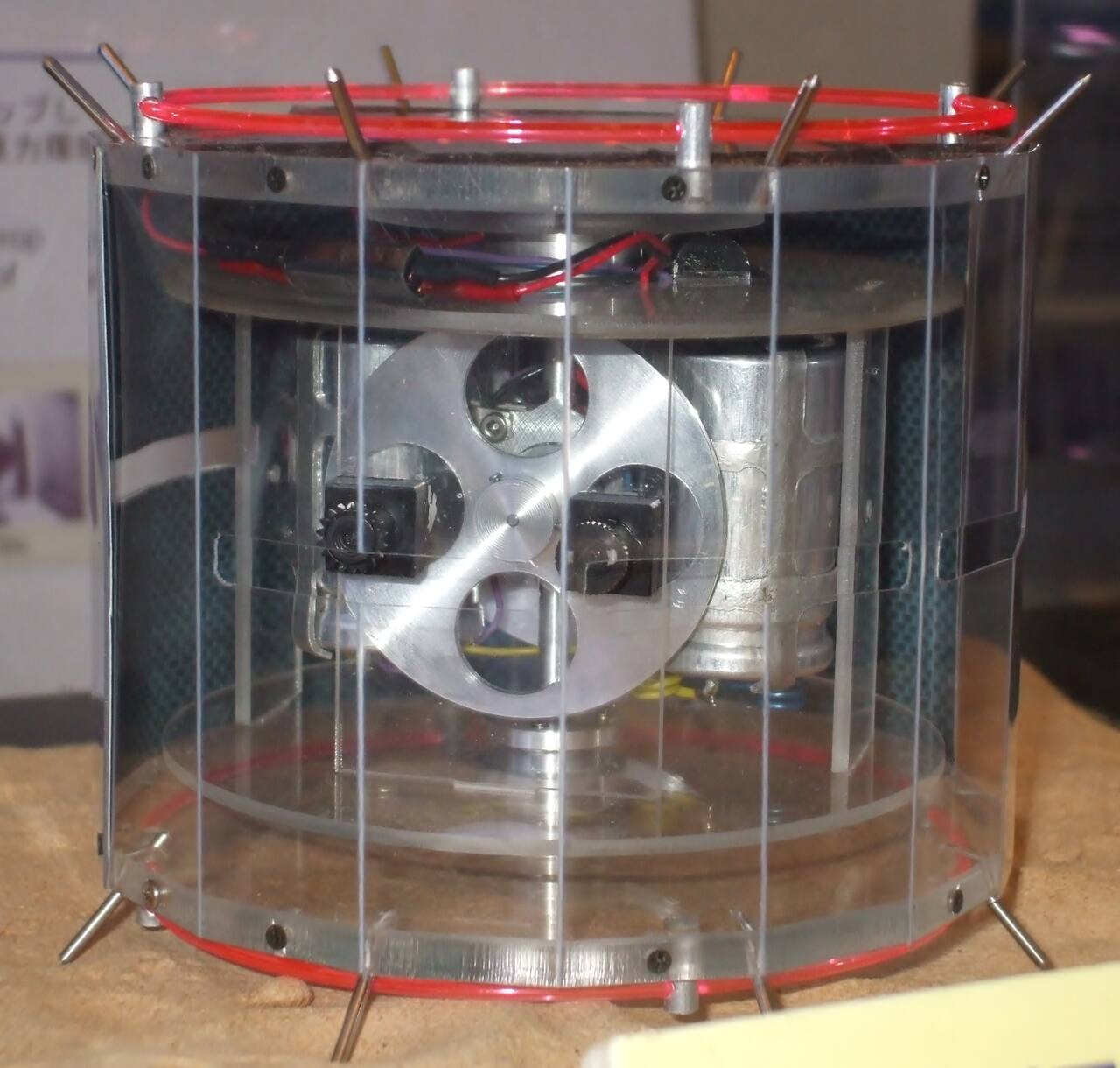 Norimaki, via Wikimedia Commons. CC-BY-3.0.
Overview
Section titled “Overview”MINERVA was the surface rover carried by the Hayabusa (MUSES-C) spacecraft to asteroid 25143 Itokawa [1]. It was the first asteroid exploration rover ever built and deployed [1]. Its objectives were to establish a mobile system in the microgravity environment of a small body, to demonstrate onboard autonomy, and to make the first planned scientific observations from an asteroid surface.
Specifications
Section titled “Specifications”| Parameter | Value |
|---|---|
| Body | Hexadecagonal cylinder, 120 mm diameter, 100 mm high |
| Mass | 591 g |
| Mobility | Hopping, 9 cm/s maximum |
| Power generation | Solar cells on every face, 2.2 W at 1 AU |
| Energy storage | Condenser, 4.6 V, 20 F |
| Processor | 32-bit CPU at 10 MHz, 10 MIPS |
| Memory | 512 kB ROM, 2 MB RAM, 2 MB flash ROM |
| Operating temperature range | -50 to +80 C |
| Communication | 9600 bps, maximum range 20 km |
| Payload | 3 CCD cameras, 6 sun sensors, 6 thermometers |
| Power, actuators | 2.6 W maximum |
| Power, communication | 1.8 W |
| Power, camera | 8 W |
| Power, onboard computer | 0.8 W |
Source: [1].
A rover for a small body has to move and sense where weight is near zero and where the host spacecraft, not the rover, decides whether it arrives. Itokawa’s surface acceleration is of order 1e-4 m/s2 [3], so wheels do not grip, and the release has to happen below the escape speed of about 20 cm/s [1]. The design space that followed has three branches: a rover that hops by reacting against its own body (MINERVA, MINERVA-II, MASCOT), a hopper that uses stored spring or propulsive energy (JPL microhoppers, Surveyor 6, proposed Phobos hoppers), and a sampling or landing spacecraft that treats the surface as a contact problem (Philae, Hayabusa, OSIRIS-REx). Only the first branch has operated on an asteroid surface. MINERVA is the first member of it and the only one that did not reach the ground.
Mission profile
Section titled “Mission profile”| Parameter | Value | Source |
|---|---|---|
| Host | Hayabusa (MUSES-C), 510 kg, core 1.0 x 1.1 x 1.6 m and 5.7 m across the deployed solar paddles | [1], [34] |
| Carrier launch | 9 May 2003, M-V-5 from Kagoshima Space Center, Uchinoura | [34] |
| Target | asteroid 25143 Itokawa, reached 12 September 2005 | [1], [34] |
| Carrier landings on Itokawa | two, in November 2005 | [34] |
| Release | 12 November 2005, during the second descent rehearsal | [2] |
| Outcome | released above the escape velocity of Itokawa; never reached the surface | [1] |
| Survival after release | about 18 hours, with autonomous functions working | [1], [12] |
| Data returned | one autonomously taken image, of part of the Hayabusa solar paddle, relayed through the spacecraft | [1], [12] |
Why hopping
Section titled “Why hopping”The argument is set out explicitly. Traction is friction, f = mu N, and for a wheeled vehicle the contact force is the weight, so f = mu m g [1]. At Itokawa’s surface acceleration of order 1e-4 m/s2 that product is negligible whatever the friction coefficient, and if commanded traction exceeds available friction the vehicle slips. A wheeled rover proposed as a MUSES-C payload could have driven at only 1.5 mm/s, and would have needed a hopping mechanism to cover tens of meters [1].
Adding an artificial pushing force F changes the scaling: f = mu (m g + F), and where F is much larger than m g this reduces to f = mu F, which is independent of the gravitational acceleration [1]. The upper bound on hop speed is the escape velocity of the body, about 20 cm/s at Itokawa against the 6e-5 to 9e-5 m/s2 surface acceleration that makes the weight term negligible in the first place [3].
The same relation is why cohesion, not weight, governs the surface material a hopper lands on. At 6e-5 to 9e-5 m/s2 on Itokawa, van der Waals attraction between grains exceeds their weight across the relevant particle size range [3], and Itokawa’s surface has minimum particle sizes of millimeters to centimeters with finer gravels migrating into geopotential lows.
Hopping mechanism
Section titled “Hopping mechanism”MINERVA hops by spinning an internal torquer and using the reaction on its body [1]. Unlike the contemporary JPL hopping rover, which charges a spring between hops and swings an off-axis camera mass through a one-way clutch to aim the next one [9], MINERVA has no moving part outside the body, which removes any requirement to consider asteroid dust in the mechanism. The torquer doubles as attitude control during the ballistic phase, and increases the contact force between body and surface, raising available friction and therefore achievable horizontal speed. Torque is adjustable because the DC motor is driven by pulse width modulation.
The mechanism was validated at the Japan Microgravity Center, which provides 10 s of microgravity in a capsule falling 490 m [1]. Five runs differing in PWM history were recorded on video at 1/30 s intervals, with the rover’s position and attitude recovered in each frame by least squares fitting of optical markers whose body-frame coordinates were known.
| Case | PWM duty | Voltage | Duration | Horizontal speed | Vertical speed | Hop speed | Direction |
|---|---|---|---|---|---|---|---|
| 1 | 100 percent | 4.53 V | continuous | 50.3 mm/s | 47.2 mm/s | 69.0 mm/s | 46.8 deg |
| 2 | 50 percent | 3.54 V | continuous | 38.7 mm/s | 32.6 mm/s | 50.6 mm/s | 49.9 deg |
| 3 | 25 percent | 4.80 V | continuous | 32.0 mm/s | 26.4 mm/s | 41.4 mm/s | 50.5 deg |
| 4 | 100 percent | 2.33 V | 0.5 s | 19.8 mm/s | 20.5 mm/s | 28.5 mm/s | 44.0 deg |
| 5 | 50 percent | 4.05 V | 0.5 s | 19.8 mm/s | 21.4 mm/s | 29.1 mm/s | 42.8 deg |
All values from [1]. The measured friction coefficient in these tests was approximately 1, the distance from the rover center to the contact point was 156.2 mm at an angle of 219.8 degrees, and gravity was set to zero in the matching simulation. Measured hop speeds of 28 to 69 mm/s sit below the 9 cm/s design maximum [1]. A drop tower reproduces the acceleration but not the target: restitution and ejecta behavior of a granular bed both change by an order of magnitude between 1e-2 g and below 1e-4 g [6].
The successor MINERVA-II rovers, which did reach a surface, use the same principle with a flywheel on the motor shaft and achieve about 10 cm/s for a 1 kg body [4].
Other hopping concepts
Section titled “Other hopping concepts”Ballistic hopping as a low-gravity transport mode was analyzed before any small-body mission existed. A 1968 Stanford study designed a one-person hopper and a two-person Lunar Hopping Transporter that accelerate along a thrust leg, lock it, fly a parabola and absorb the landing in the leg [19]. That work is an analysis and simulation, not hardware. The 1967 propulsive hop of Surveyor 6 is the one flown precedent for a spacecraft lifting off and landing again on another body, and a 2019 JPL briefing uses it to set escape velocity against ballistic range for fourteen bodies from comet 67P to Callisto [18].
Spring-powered designs are a separate family. JPL built three generations of hopping microrobot, the last storing jump energy in a six-bar linkage that shifts peak leg thrust away from lift-off; the results are Earth-gravity laboratory hops, and the authors report the hopper and a wheeled vehicle using about equal energy once obstacle avoidance is counted [21]. A 2015 JPL and JSC proposal for crewed Phobos exploration would put spring feet on ATHLETE-derived limbs and compare hop consumables against hydrazine traverses in simulation [20]. Neither has flown.
MINERVA differs from both in storing no energy: a motor spins up an internal torquer and the reaction throws the body, so hop speed is set by motor torque and the friction at the contact [1]. The same principle was carried by MASCOT, whose 25 mm brushless motor and harmonic drive swing an eccentric arm off the center of mass at a repeatable 3 Nm [13]. With no attitude sensing in flight, arm trajectories are optimized offline for three intensity levels and six resting orientations. Parabolic-flight validation gave 25 s of microgravity, too short to complete a self-righting maneuver [13].
On the Moon, the 2.1 kg LEV-1 separated from the SLIM lander during free fall on 20 January 2024 and made six hops, confirmed by the change in sensed gravity across each, with hop direction chosen onboard from camera images [17]. It transmitted directly to Earth on S band for 1 hour 51 minutes. The source is a nine-slide briefing: hop distance, height and heading accuracy are not given [17].
Autonomy
Section titled “Autonomy”Autonomy on MINERVA is built where inertial sensing is absent, which is the same design position MINERVA-II took thirteen years later on a rover that also could not localize itself [4].
The onboard control system is a three-layer hierarchy [1]. Independent controllers sit closest to the devices. An action layer commands actuators, sensors and the radio, at the granularity of “take the picture from camera A” or “rotate the motor with duty pulse X”, and these are the commands a ground operator addresses directly in teleoperation mode. A behavior layer composes those actions into autonomous sequences; the operational mode is read from a flash ROM area at boot and is normally switched by human command.
Image selection runs onboard. Pictures are compressed and evaluated by the CPU, images with the least information such as completely black frames are discarded immediately, and the rest are stored in flash ROM tagged with a priority proportional to their information content, so the highest priority data is transmitted first within the limited bandwidth [1]. MINERVA-II carried a developed form of the same filter, rejecting frames on the luminance histogram of a decimated channel against four thresholds settable from the ground [4].
Localization has no inertial reference. MINERVA cannot sense its attitude directly and carries no gyroscope, so onboard localization is an optional function [1]. The method used instead observes the Sun direction several times while the rover is stationary, in the evening after it stops and in the morning before it moves, using six photodetectors offset 90 degrees from one another so that at least three see the Sun simultaneously and their outputs give the solar direction. Rover attitude with respect to inertial space follows from those observations; the gravitational directions estimated during a hop, together with the times of sunset and sunrise, then give absolute position and attitude in the asteroid-fixed frame.
Thermal design
Section titled “Thermal design”An asteroid surface at 1 AU swings across the whole operating range of commercial parts in a single rotation [3], so thermal control here is a duty cycle problem rather than a radiator sizing problem.
Thermal control is autonomous and consists of shutting down. Onboard devices operate from -50 to +80 C, and outside that range the power supply to the CPU is suspended [12]. The devices are covered in multilayer insulation, and the rover’s heat capacity is small enough that device temperature tracks the surrounding asteroid temperature. Night on the asteroid falls below -100 C, but the insulation slows the drop so the rover wakes quickly at sunrise; toward noon the temperature may exceed +80 C and the rover suspends operation [12]. The onboard software also watches internal temperature and, as it approaches a threshold, suspends power-hungry actions and copies RAM contents to flash ROM so that data survives a sudden shutdown.
The condensers are the limiting component. They are undamaged by cold but degrade above +130 C, and after a couple of days on the surface, having been through a couple of overheated daytimes, they can no longer be used [12]. The CPU and radio still work on direct solar power after that, but hop performance degrades and the rover may not move.
Four of the pins protruding from the body to protect the solar panels double as thermal detectors that measure surface temperature [12]. The 80 C shutdown threshold was carried forward to MINERVA-II, where it was never triggered because Ryugu’s short rotation period keeps the surface below it despite a very low albedo [4].
Payload
Section titled “Payload”Three commercial CCD cameras sensitive at visible wavelengths are mounted on a turntable, so sight direction is set by rotating the table, and they view through windows at the centers of the side faces [12]. Focal length cannot be adjusted in flight, so two cameras are focused close and one far. All passed radiation level testing and were tuned for the hottest expected operating temperature.
Six photodetectors act as sun sensors, and six thermometers with four external pins measure surface temperature [12]. MINERVA-II reduced this to three or four cameras with photodiodes, thermometers, a gyro and an accelerometer, adding the inertial sensing MINERVA lacked [4].
Deployment and relay
Section titled “Deployment and relay”The relay architecture is forced by the link budget: a 591 g rover cannot close a link to Earth, so everything passes through the spacecraft, exactly as for the later MINERVA-II and MASCOT deliveries [4].
MINERVA was held during cruise by the Onboard Mounted Equipment, which also supplied it with power over a wired line [12]. At deployment the OME cover is jettisoned and the rover is pushed toward the surface. After deployment the OME acts as the relay between the rover and the spacecraft data recorder: telemetry is received through an antenna on the asteroid-facing side of the spacecraft, and commands from Earth are stored in the OME and transmitted when a link to the rover becomes available. The link is 9600 bps to a maximum range of 20 km [12].
The body it was aimed at
Section titled “The body it was aimed at”| Quantity | Value | Source |
|---|---|---|
| Principal axes | 535 x 294 x 209 m | |
| Mass | (3.51 +/- 0.105)e10 kg | |
| Volume | (1.84 +/- 0.092)e7 m3 | |
| Density | 1.90 +/- 0.13 g/cm3 | |
| Macroporosity | about 40 percent | [2], [3] |
| Surface acceleration | 6e-5 to 9e-5 m/s2, 6 to 9 micro-g | [3] |
Rows with no marker are from [2].
Itokawa is a rubble pile with no apparent monolithic component at the 100 m scale, decomposed into two ellipsoidal components resting on each other, and with tangential evidence for a non-homogeneous mass distribution [3]. The surface coefficient of restitution inferred from Hayabusa’s own landing altimetry and Doppler tracking is 0.84, high for unconsolidated gravel. Laboratory impacts into simulant below 1e-4 g give effective restitution of 0.15 +/- 0.04, an order of magnitude lower, which is the measure of how far a competent boulder field departs from a granular bed [6].
Returned Itokawa grains were later measured by nanoindentation: reduced Young modulus of 83.0 +/- 0.1 to 111.0 +/- 0.2 GPa on particles 131 and 149 micrometer across [5]. The material is competent silicate; the weakness of the surface is in the packing. Bulk cohesive strength for a regolith of Itokawa’s grain size is of order a few to tens of pascals [7], and simulant fidelity for this class of material is assessed against a figure of merit rather than any single property [8].
What flew after, and what it found
Section titled “What flew after, and what it found”JAXA’s Hayabusa2 was designed with a 600 kg wet mass to carry MASCOT and three MINERVA-II rovers to Ryugu [22]. Launch was in December 2014, and the 2015 status paper reports 9.8 mN per ion thruster and 56 m/s of delta-V from 511 h of ion engine operation by June 2015 [23]. Ryugu is smaller and lighter than Itokawa: equatorial radius 502 +/- 2 m, bulk density 1.19 +/- 0.02 g/cm3, porosity above 50 percent, boulders twice as dense on the surface as on Itokawa, and a modeled uniform internal cohesion near 4 Pa [24].
MASCOT separated at 41 m, fell for 5 min 51 s and first touched a shadowed boulder at 17.0 cm/s. It slid, bounced four more times over 18.64 m and settled 15 min 37 s later, then operated for 17 h 14 min through an uprighting maneuver, a 70 cm hop, a 3.6 cm mini-move and an 11.6 cm relocation [14]. The bounce record gives a total coefficient of restitution near 0.29, against the 0.6 assumed before landing, and an upper-limit Young’s modulus near 37 MPa [14]. That is an inversion of one trajectory over rugged terrain with an assumed constant restitution, and the authors call it a rough estimate. Discrete element simulations of the same lander on a granular bed at Ryugu gravity and 19 cm/s covered 270 runs and varied friction, bed depth and impact angle [16]. Stereo photogrammetry of MASCOT’s camera images located the lander at each of four measurement points and built a local terrain model about 25 by 25 cm, accurate to about 0.5 cm in the foreground [15].
What MASCOT saw changed the surface assumption. Close-up images showed rocks and boulders from decimeters to tens of meters with essentially no fine dust, contrary to the expected regolith cover [25]. The radiometer measured 205 K at night and 302 K at local noon on one boulder, giving a thermal inertia of 282 (+93/-35) J m-2 K-1 s-1/2, below the lowest meteorite measured [26]. Later reanalyses moved that figure to 256 +/- 34 and settled porosity near 0.50 [33]. Itokawa’s 0.84 restitution inferred from Hayabusa tracking [3] and Ryugu’s 0.29 from MASCOT [14] come from different bodies, methods and contact geometries, and are not a controlled comparison.
Two landers of the contact family give the strength side. Philae touched down on 67P in November 2014 with a failed harpoon and cold gas hold-down and rebounded across the surface, a triple-bounce landing documented in the mission review [32]. An inverse discrete element fit to its first rebound returned a regolith layer 0.272 +/- 0.062 m deep with 0.014 cm mean particle diameter at 1143 +/- 231 kg/m3, with porosity assumed at 0.75 and five parameters constrained by one observable [27]. Energy balance over three of its contacts gives a compressive strength upper limit near 800 Pa [28]. OSIRIS-REx pressed its sampler into Bennu at 10 cm/s, reached 5.95 to 6.91 cm depth under 10 to 15 N of resisting force, and the fit to discrete element runs gives 440 to 600 kg/m3 near-surface density and cohesion of roughly 0.2 to 20 Pa [29]. The force-law study behind that inversion finds packing fraction the controlling variable, and attributes the bouncing seen at Philae and at Hayabusa’s Itokawa touchdowns to the absence of the constant-force spring that OSIRIS-REx carried [30]. Theory ties the numbers together: van der Waals cohesion between fines gives a tensile strength that varies inversely with mean grain radius and is independent of body size [31], and cohesion in this range exceeds weight at Itokawa [3].
Operating mode sequence
Section titled “Operating mode sequence”MINERVA works only in daylight, on instantaneous solar power supplemented by the condensers, which cover a few minutes of activity when the arrays are shadowed [12]. Instantaneous array power alone is insufficient for motor rotation, image capture or communication; those require the condensers. Once the condensers have degraded, the machine survives as a camera and radio that cannot move.
Radiation
Section titled “Radiation”The commercial CPU and the cameras were qualified by radiation testing rather than by using radiation-hardened parts [12]. No dose figures are published. The interplanetary design environment for the two-and-a-half year cruise is the Badhwar-O’Neill galactic cosmic ray model [34].
What it established
Section titled “What it established”The MINERVA hopping mechanism, an internal torquer with no external moving part, is the design that MINERVA-II carried to Ryugu and used successfully [4]. The friction relation f = mu (m g + F) and its microgravity limit f = mu F is the argument that wheels are unusable at this gravity, and it is stated in the MINERVA design paper before any asteroid surface had been reached [1].
The failure was in delivery, not in the rover. Deployment above escape velocity is a spacecraft state problem at release, and at an escape velocity of order 20 cm/s the margin between a successful release and a lost one is small [1]. The published account attributes it to the relative velocity and position at deployment rather than to any rover fault, and the 18 hours of subsequent autonomous operation is the only flight validation the design received [1], [12]. MINERVA-II demonstrated the same architecture at a body of comparable gravity thirteen years later [4].
A margin failure of this kind is not unique to Hayabusa. Philae’s hold-down system, a pair of harpoons and a cold gas thruster meant to pin the lander to 67P at 1.01 m/s touchdown speed, failed on both counts, and the lander bounced for nearly two hours before its second contact [11]. In both cases a small body’s near-absent gravity narrows the difference between a nominal release or landing and a lost one to margins that ground testing on Earth cannot reproduce, and in both cases the fault lay in the delivery mechanism rather than the surface package it carried. Hayabusa itself delivered its Earth reentry capsule to within one sigma of the predicted parachute opening point after a targeting sequence in which better orbit determination did not translate into better maneuver execution, an asymmetry between the two error sources that recurs in the deployment problem MINERVA depended on [10].
What is not established
Section titled “What is not established”No MINERVA surface data exists: the only flight outputs are about 18 hours of post-release housekeeping and one image of the Hayabusa solar paddle [1], [12]. Hop speeds of 28 to 69 mm/s are drop-tower results in a rig that cannot reproduce a granular target, and hop direction cannot be controlled because it depends on an unknown surface friction coefficient [1], [6]. The thermal and condenser-degradation account is design intent and ground qualification, with no dose or temperature record from flight [12]. The release-velocity cause is stated in the published account only as relative velocity and position at deployment [1].
Surface-property numbers for small bodies come from other bodies and are inferred: MASCOT’s restitution and modulus rest on one trajectory [14], the Philae soil parameters on one rebound velocity [27], and the Bennu strengths on an assumed friction angle and force law [29]. Whether a MINERVA-class rover would have moved as designed on Itokawa’s boulder-and-gravel surface was not tested. Hopping on the Moon has been reported for one 2.1 kg robot without distances [17]; spring and propulsive small-body hoppers remain laboratory or simulation results [20], [21].
References
- Kubota, T. and Yoshimitsu, T. (2007). Intelligent Unmanned Explorer for Deep Space Exploration
. International Conference on Intelligent Unmanned Systems. Source
BibTeX
@inproceedings{kubota2007intelligent, title = {Intelligent Unmanned Explorer for Deep Space Exploration}, author = {Kubota, Takashi and Yoshimitsu, Tetsuo}, booktitle = {International Conference on Intelligent Unmanned Systems}, year = {2007}, doi = {10.48550/arxiv.0804.4717}, abstract = {asteroids or comets have received remarkable attention in the world. In small body explorations, especially, detailed in-situ surface exploration by tiny rover is one of effective and fruitful means and is expected to make strong contributions towards scientific studies. JAXA ISAS is promoting MUSES C mission, which is the worlds first sample and return attempt to or from the near earth asteroid. Hayabusa spacecraft in MUSES C mission took the tiny rover, which was expected to perform the in-situ surface exploration by hopping. This paper describes the system design, mobility and intelligence of the developed unmanned explorer. This paper also presents the ground experimental results and the flight results.} } - Yoshikawa, M., Fujiwara, A. and Kawaguchi, J. (2007). The nature of asteroid Itokawa revealed by Hayabusa
. International Astronomical Union, Symposium 236. Source
BibTeX
@inproceedings{yoshikawa2007nature, title = {The nature of asteroid Itokawa revealed by Hayabusa}, author = {Yoshikawa, Makoto and Fujiwara, A. and Kawaguchi, J.}, booktitle = {International Astronomical Union, Symposium 236}, volume = {2}, pages = {401--408}, year = {2007}, doi = {10.1017/s174392130700350x}, abstract = {Abstract The spacecraft Hayabusa, which was launched in 2003, arrived at its destination, asteroid (25143) Itokawa in September 2005. The appearance of Itokawa, a small S-type near Earth asteroids, was totally unexpected. The surface is covered with a lot of boulders and there are only a few craters on it. It looks like a contact binary asteroid. The surface composition is quite similar to LL-chondrite. The estimated density is 1.9 ± 0.13 (g/cm 3 ), so the macro-porosity is about 40%. This means that Itokawa is a rubble pile object. In Itokawa, we may see such things that are very close to building blocks of asteroids. In this paper, we review the mission and the first scientific results.} } - Scheeres, D. J., Hartzell, C. M., Sánchez, P. and Swift, M. (2010). Scaling forces to asteroid surfaces: The role of cohesion
. Icarus. Source
BibTeX
@article{scheeres2010scaling, title = {Scaling forces to asteroid surfaces: The role of cohesion}, author = {Scheeres, Daniel J. and Hartzell, C. M. and Sánchez, Paul and Swift, M.}, journal = {Icarus}, volume = {210}, pages = {968--984}, year = {2010}, doi = {10.1016/j.icarus.2010.07.009} } - Yoshimitsu, T. and Kubota, T. (2020). Engineering Challenges and Results by MINERVA-II Asteroid Surface Rovers
. Journal of the Robotics Society of Japan, 8. Source
BibTeX
@article{yoshimitsu2020engineering, title = {Engineering Challenges and Results by MINERVA-II Asteroid Surface Rovers}, author = {Yoshimitsu, Tetsuo and Kubota, Takashi}, journal = {Journal of the Robotics Society of Japan}, volume = {38}, number = {8}, pages = {754--761}, year = {2020}, doi = {10.7210/jrsj.38.754}, abstract = {Hayabusa2 is a Japanese asteroid explorer which aims to get some fragments from the C-type asteroid ``Ryugu'' and bring them back to the Earth. It was launched in December 2014 and arrived at the target asteroid at the end of June 2018 after 3.5 years' interplanetary cruise using an Ion engine propulsion system. The authors developed two tiny twin rovers for Hayabusa2 spacecraft. The objectives of the rovers were performing two technical experiments on the asteroid surface. They had hopping capability fitted for the microgravity environment of small planetary bodies, which was to be evaluated on the asteroid surface. The rovers had full autonomy to move to as many different places as possible and make some observations such as taking images and directly measuring the surface properties. The fully autonomous capability was to be demonstrated on the asteroid surface. The rovers were deployed onto the Northern hemisphere of the target asteroid on 04:06, 21 September 2018 (UTC) at the altitude of approximately 50 meters above the surface. Both rovers made autonomous surface explorations by hopping as planned, which were evidenced by the status and image data transmitted from the rovers. This was the World first surface mobile exploration on small planetary body in our Solar System attained by unmanned robot, as well as the first surface mobile exploration on extraterrestrial body in our country. This paper describes the technical aspects of MINERVA-II rovers, followed by some actual behaviors of the rovers on the asteroid surface which illustlated the great achievments of the two technical challenges by the rovers.} } - Tanbakouei, S., Trigo-Rodríguez, J. M., Sort, J., Michel, P., Blum, J., Nakamura, T. and Williams, I. (2019). Mechanical properties of particles from the surface of asteroid 25143 Itokawa
. Astronomy & Astrophysics. Source
BibTeX
@article{tanbakouei2019mechanical, title = {Mechanical properties of particles from the surface of asteroid 25143 Itokawa}, author = {Tanbakouei, Safoura and Trigo-Rodríguez, Josep M. and Sort, Jordi and Michel, Patrick and Blum, Jürgen and Nakamura, Tomoki and Williams, Iwan}, journal = {Astronomy & Astrophysics}, volume = {629}, pages = {A119}, year = {2019}, doi = {10.1051/0004-6361/201935380}, abstract = {Aims. Asteroids have been exposed to impacts since their formation, and as a consequence their surfaces are covered by small particles, pebbles, and boulders. The Japanese JAXA/ISAS Hayabusa mission collected micron-sized particles from the regolith of asteroid 25143 Itokawa. The study in terrestrial laboratories of these particles provides a scientific opportunity as their physical properties can be compared with those characteristic of chondritic meteorites that are often considered proxies of the building materials of potentially hazardous asteroids (PHAs). Methods. Here we present the results from a study of the mechanical properties of three of these particles using a precise technique called nanoindentation. The derived results are compared with those obtained via a methodology similar to that used for the Chelyabinsk meteorite. Results. The reduced Young’s modulus values obtained for the Itokawa samples are higher than those measured for the Chelyabinsk chondrite, so these specific particles of asteroid regolith are more compacted than the minerals forming the particular LL chondrite associated with PHAs. This might be a natural consequence of particles surviving long exposure times on the surface of a (near-Earth asteroid) NEA. The Double Asteroid Redirection Test (DART) mission plans to excavate a crater in the surface of the (65803) Didymos satellite. Our results suggest that excavating a crater with a kinetic impactor in an area of significant fine-grained regolith will increase the momentum transfer. As this will facilitate the release of particles carrying target mass in the opposite direction to the movement of the projectile, there is no need to grind up the target during the mechanical excavation phase.} } - Brisset, J., Colwell, J., Dove, A., Abukhalil, S., Cox, C. and Mohammed, N. (2018). Regolith behavior under asteroid-level gravity conditions: low-velocity impact experiments
. Progress in Earth and Planetary Science, 73. Source
BibTeX
@article{brisset2018regolith, title = {Regolith behavior under asteroid-level gravity conditions: low-velocity impact experiments}, author = {Brisset, Julie and Colwell, Joshua and Dove, Adrienne and Abukhalil, Sumayya and Cox, Christopher and Mohammed, Nadia}, journal = {Progress in Earth and Planetary Science}, volume = {5}, number = {73}, year = {2018}, doi = {10.1186/s40645-018-0222-5}, abstract = {The dusty regolith covering the surfaces of asteroids and planetary satellites differs in size, shape, and composition from terrestrial soil particles and is subject to environmental conditions very different from those found on Earth. This regolith evolves in a low ambient pressure and low-gravity environment. Its response to low-velocity impacts, such as those that may accompany human and robotic exploration activities, may be completely different than what is encountered on Earth. Experimental studies of the response of planetary regolith in the relevant environmental conditions are thus necessary to facilitate future Solar System exploration activities.We combined the results and provided new data analysis elements for a series of impact experiments into simulated planetary regolith in low-gravity conditions using two experimental setups and a range of microgravity platforms. The Physics of Regolith Impacts in Microgravity Experiment (PRIME) flew on several parabolic aircraft flights, enabling the recording of impacts into granular materials at speeds of ∼ 4–230 cm/s. The COLLisions Into Dust Experiment (COLLIDE) is conceptually close to the PRIME setup. It flew on the Space Shuttle in 1998 and 2001 and more recently on the Blue Origin New Shepard rocket, recording impacts into simulated regolith at speeds between 1 and 120 cm/s.Results of these experimental campaigns found that there is a significant change in the regolith behavior with the gravity environment. In a 10 −2g environment (with g being the gravity acceleration at the surface of the Earth), only embedding of the impactor was observed and ejecta production was produced for most impacts at > 20 cm/s. Once at microgravity levels (<10−4g), the lowest impact energies also produced impactor rebound. In these microgravity conditions, ejecta started to be produced for impacts at > 10 cm/s. The measured ejecta speeds were somewhat lower than the ones measured at reduced-gravity levels, but the ejected masses were higher. In general, the mean ejecta velocity shows a power-law dependence on the impact energy with an index of ∼ 0.5. When projectile rebound occurred, we observed that its coefficients of restitution on the bed of regolith simulant decrease by a factor of 10 with increasing impact speeds from ∼ 5 up to 100 cm/s. We could also observe an increased cohesion between the JSC-1 grains compared to the quartz sand targets.} } - Scheeres, D. J. and Sánchez, P. (2018). Implications of cohesive strength in asteroid interiors and surfaces and its measurement
. Progress in Earth and Planetary Science, 25. Source
BibTeX
@article{scheeres2018implications, title = {Implications of cohesive strength in asteroid interiors and surfaces and its measurement}, author = {Scheeres, Daniel J. and Sánchez, Paul}, journal = {Progress in Earth and Planetary Science}, volume = {5}, number = {25}, year = {2018}, doi = {10.1186/s40645-018-0182-9}, abstract = {Recent observations and theory have indicated that rubble pile asteroids may have a small, but finite, level of tensile strength, allowing them to spin above their spin deformation limit as defined in Holsapple (Icarus 205:430–442, 2010). In Sánchez and Scheeres (Meteorit Planet Sci 49:788–811, 2014), a theory for how such strength could be present in rubble pile asteroids was presented, relying on weak van der Waals forces between fine particulate material in asteroid regolith and in their interiors. The implications of this theory are evaluated and related to the surface strength of regolith and global strength of a rubble pile body. Proposed techniques to measure the strength of regolith using cratering theory are reviewed, as are constraints placed on the global strength of rubble pile asteroids from astronomical observations. Specific examples applied to the Hayabusa2 cratering experiment at its target asteroid are given.} } - Metzger, P. T., Britt, D. T., Covey, S., Schultz, C., Cannon, K. M., Grossman, K. D., Mantovani, J. G. and Mueller, R. P. (2019). Measuring the fidelity of asteroid regolith and cobble simulants
. Icarus. Source
BibTeX
@article{metzger2019measuring, title = {Measuring the fidelity of asteroid regolith and cobble simulants}, author = {Metzger, Philip T. and Britt, Daniel T. and Covey, Stephen and Schultz, Cody and Cannon, Kevin M. and Grossman, Kevin D. and Mantovani, James G. and Mueller, Robert P.}, journal = {Icarus}, volume = {321}, pages = {632--646}, year = {2019}, doi = {10.1016/j.icarus.2018.12.019} } - Fiorini, P., Hayati, S., Heverly, M. and Gensler, J. (1999). A Hopping Robot for Planetary Exploration
. IEEE Aerospace Conference. Source
BibTeX
@inproceedings{fiorini1999hopping, title = {A Hopping Robot for Planetary Exploration}, author = {Fiorini, Paolo and Hayati, Samad and Heverly, Matt and Gensler, Jeff}, booktitle = {IEEE Aerospace Conference}, pages = {153-158 vol.2}, organization = {Jet Propulsion Laboratory, California Institute of Technology}, year = {1999}, doi = {10.1109/aero.1999.793156}, abstract = {This paper presents the design and some preliminary analysis of a hopping robot for planetary exploration. The goal of this project is to explore a different mobility paradigm which may present advantages over conventional wheel and leg locomotion. The approach is to achieve mobility by hopping and perform science and imaging via rolling. The device is currently equipped with a single video camera representing the science sensor suite. The hopper is equipped with a simple microprocessor and wireless modem so that it can receive sequences of commands and autonomously execute them, making it suitable for exploration of distant planets, comets and asteroids. One important feature of this hopper is that it uses a single motor for hopping in a specified direction as well as pointing the camera via rolling.} } - Haw, R. J., Bhaskaran, S., Strauss, W., Sklyanskiy, E., Graat, E. J., Smith, J. J., Menom, P., Ardalan, S., Ballard, C. G., Williams, P., Kawaguchi, J., Makoto, Y. and Ohnishi, T. (2011). Hayabusa : navigation challenges for Earth return
. Journal of Geophysical Research: Planets. Source
BibTeX
@article{haw2011hayabusa, title = {Hayabusa : navigation challenges for Earth return}, author = {Haw, Robert J. and Bhaskaran, S. and Strauss, William and Sklyanskiy, Evgeniy and Graat, Eric J and Smith, J. J. and Menom, P. and Ardalan, S. and Ballard, Christopher G. and Williams, P. and Kawaguchi, J. and Makoto, Y. and Ohnishi, T.}, journal = {Journal of Geophysical Research: Planets}, publisher = {JPL Open Repository}, year = {2011}, url = {https://dataverse.jpl.nasa.gov/dataset.xhtml?persistentId=hdl:2014/43827} } - Biele, J., Ulamec, S., Maibaum, M., Roll, R., Witte, L., Jurado, E., Muñoz, P., Arnold, W., Auster, H.-U., Casas, C., Faber, C., Fantinati, C., Finke, F., Fischer, H.-H., Geurts, K., Güttler, C., Heinisch, P., Herique, A., Hviid, S., Kargl, G., Knapmeyer, M., Knollenberg, J., Kofman, W., Kömle, N., Kührt, E., Lommatsch, V., Mottola, S., Pardo de Santayana, R., Remetean, E., Scholten, F., Seidensticker, K. J., Sierks, H. and Spohn, T. (2015). The Landing(s) of Philae and Inferences about Comet Surface Mechanical Properties
. Science, 6247. Source
BibTeX
@article{biele2015landings, title = {The Landing(s) of {Philae} and Inferences about Comet Surface Mechanical Properties}, author = {Biele, Jens and Ulamec, Stephan and Maibaum, Michael and Roll, Reinhard and Witte, Lars and Jurado, Eric and Muñoz, Pablo and Arnold, Walter and Auster, Hans-Ulrich and Casas, Carlos and Faber, Claudia and Fantinati, Cinzia and Finke, Felix and Fischer, Hans-Herbert and Geurts, Koen and Güttler, Carsten and Heinisch, Philip and Herique, Alain and Hviid, Stubbe and Kargl, Günter and Knapmeyer, Martin and Knollenberg, Jörg and Kofman, Wlodek and Kömle, Norbert and Kührt, Ekkehard and Lommatsch, Valentina and Mottola, Stefano and Pardo de Santayana, Ramon and Remetean, Emile and Scholten, Frank and Seidensticker, Klaus J. and Sierks, Holger and Spohn, Tilman}, journal = {Science}, volume = {349}, number = {6247}, pages = {aaa9816}, year = {2015}, doi = {10.1126/science.aaa9816}, abstract = {The Philae lander, part of the Rosetta mission to investigate comet 67P/Churyumov-Gerasimenko, was delivered to the cometary surface in November 2014. Here we report the precise circumstances of the multiple landings of Philae, including the bouncing trajectory and rebound parameters, based on engineering data in conjunction with operational instrument data. These data also provide information on the mechanical properties (strength and layering) of the comet surface. The first touchdown site, Agilkia, appears to have a granular soft surface (with a compressive strength of 1 kilopascal) at least ~20 cm thick, possibly on top of a more rigid layer. The final landing site, Abydos, has a hard surface.} } - Yoshimitsu, T., Kubota, T. and Nakatani, I. (2006). Operation of MINERVA rover in Hayabusa Asteroid Mission
. International Astronautical Congress. Source
BibTeX
@inproceedings{yoshimitsu2006operation, title = {Operation of MINERVA rover in Hayabusa Asteroid Mission}, author = {Yoshimitsu, Tetsuo and Kubota, Takashi and Nakatani, Ichiro}, booktitle = {International Astronautical Congress}, year = {2006}, doi = {10.2514/6.iac-06-a3.5.01} } - Ho, T.-M., Baturkin, V., Grimm, C., Grundmann, J. T., Hobbie, C., Ksenik, E., Lange, C., Sasaki, K., Schlotterer, M., Talapina, M., Termtanasombat, N., Wejmo, E., Witte, L., Wrasmann, M., Wübbels, G., Rößler, J., Ziach, C., Findlay, R., Biele, J., Krause, C., Ulamec, S., Lange, M., Mierheim, O., Lichtenheldt, R., Maier, M., Reill, J., Sedlmayr, H.-J., Bousquet, P., Bellion, A., Bompis, O., Cenac-Morthe, C., Deleuze, M., Fredon, S., Jurado, E., Canalias, E., Jaumann, R., Bibring, J.-P., Glassmeier, K. H., Hercik, D., Grott, M., Celotti, L., Cordero, F., Hendrikse, J. and Okada, T. (2017). MASCOT: The Mobile Asteroid Surface Scout Onboard the Hayabusa2 Mission
. Space Science Reviews, 1-4. Source
BibTeX
@article{ho2017mascot, title = {{MASCOT}: The Mobile Asteroid Surface Scout Onboard the {Hayabusa2} Mission}, author = {Ho, Tra-Mi and Baturkin, Volodymyr and Grimm, Christian and Grundmann, Jan Thimo and Hobbie, Catherin and Ksenik, Eugen and Lange, Caroline and Sasaki, Kaname and Schlotterer, Markus and Talapina, Maria and Termtanasombat, Nawarat and Wejmo, Elisabet and Witte, Lars and Wrasmann, Michael and Wübbels, Guido and Rößler, Johannes and Ziach, Christian and Findlay, Ross and Biele, Jens and Krause, Christian and Ulamec, Stephan and Lange, Michael and Mierheim, Olaf and Lichtenheldt, Roy and Maier, Maximilian and Reill, Josef and Sedlmayr, Hans-Jürgen and Bousquet, Pierre and Bellion, Anthony and Bompis, Olivier and Cenac-Morthe, Celine and Deleuze, Muriel and Fredon, Stephane and Jurado, Eric and Canalias, Elisabet and Jaumann, Ralf and Bibring, Jean-Pierre and Glassmeier, Karl Heinz and Hercik, David and Grott, Matthias and Celotti, Luca and Cordero, Federico and Hendrikse, Jeffrey and Okada, Tatsuaki}, journal = {Space Science Reviews}, volume = {208}, number = {1-4}, pages = {339--374}, year = {2017}, doi = {10.1007/s11214-016-0251-6} } - Ho, T.-M., Jaumann, R., Bibring, J.-P., Grott, M., Glaßmeier, K.-H., Moussi, A., Krause, C., Auster, U., Baturkin, V., Biele, J., Cordero, F., Cozzoni, B., Dudal, C., Fantinati, C., Grimm, C., Grundmann, J.-T., Hamm, M., Herčik, D., Kayal, K., Knollenberg, J., Küchemann, O., Ksenik, E., Lange, C., Lange, M., Lorda, L., Maibaum, M., Mimasu, Y., Cenac-Morthe, C., Okada, T., Otto, K., Pilorget, C., Reill, J., Saiki, T., Sasaki, K., Schlotterer, M., Schmitz, N., Schröder, S., Termtanasombat, N., Toth, N., Tsuda, Y., Ulamec, S., Wolff, F., Yoshimitsu, T. and Ziach, C. (2021). The MASCOT Lander Aboard Hayabusa2: The In-Situ Exploration of NEA (162173) Ryugu
. Planetary and Space Science. Source
BibTeX
@article{ho2021mascot, title = {The {MASCOT} Lander Aboard {Hayabusa2}: The In-Situ Exploration of {NEA} (162173) {Ryugu}}, author = {Ho, Tra-Mi and Jaumann, Ralf and Bibring, Jean-Pierre and Grott, Matthias and Glaßmeier, Karl-Heinz and Moussi, Aurelie and Krause, Christian and Auster, Ulrich and Baturkin, Volodymyr and Biele, Jens and Cordero, Federico and Cozzoni, Barbara and Dudal, Clement and Fantinati, Cinzia and Grimm, Christian and Grundmann, Jan-Thimo and Hamm, Maximilian and Herčik, David and Kayal, Kağan and Knollenberg, Jörg and Küchemann, Oliver and Ksenik, Eugen and Lange, Caroline and Lange, Michael and Lorda, Laurence and Maibaum, Michael and Mimasu, Yuya and Cenac-Morthe, Celine and Okada, Tatsuaki and Otto, Katharina and Pilorget, Cedric and Reill, Josef and Saiki, Takanao and Sasaki, Kaname and Schlotterer, Markus and Schmitz, Nicole and Schröder, Stefan and Termtanasombat, Nawarat and Toth, Nortbert and Tsuda, Yuichi and Ulamec, Stephan and Wolff, Friederike and Yoshimitsu, Tetsuo and Ziach, Christan}, journal = {Planetary and Space Science}, volume = {200}, pages = {105200}, year = {2021}, doi = {10.1016/j.pss.2021.105200} } - Scholten, F., Preusker, F., Elgner, S., Matz, K.-D., Jaumann, R., Hamm, M., Schröder, S. E., Koncz, A., Schmitz, N., Trauthan, F., Grott, M., Biele, J., Ho, T.-M., Kameda, S. and Sugita, S. (2019). The Hayabusa2 lander MASCOT on the surface of asteroid (162173) Ryugu - Stereo-photogrammetric analysis of MASCam image data
. Astronomy & Astrophysics. Source
BibTeX
@article{scholten2019hayabusa2, title = {The Hayabusa2 lander MASCOT on the surface of asteroid (162173) Ryugu - Stereo-photogrammetric analysis of MASCam image data}, author = {Scholten, Frank and Preusker, Frank and Elgner, S. and Matz, K.-D. and Jaumann, Ralf and Hamm, Maximilian and Schröder, Stefan E. and Koncz, A. and Schmitz, Nicole and Trauthan, F. and Grott, Matthias and Biele, Jens and Ho, Tra-Mi and Kameda, Shingo and Sugita, Seiji}, journal = {Astronomy & Astrophysics}, volume = {632}, pages = {L5}, publisher = {EDP Sciences}, year = {2019}, doi = {10.1051/0004-6361/201936760}, abstract = {After its release and a descent and bouncing phase, the Hayabusa2 lander MASCOT came to a final rest and MASCOT’s camera MASCam acquired a set of images of the surface of Ryugu. With MASCam’s instantaneous field of view of about 1 mrad, the images provide pixel scales from 0.2 to 0.5 mm pixel −1 in the foreground and up to 1 cm pixel −1 for surface parts in the background. Using a stereo-photogrammetric analysis of the MASCam images taken from slightly different positions due to commanded and unintentional movements of the MASCOT lander, we were able to determine the orientation for the different measurement positions. Furthermore, we derived a 3D surface model of MASCOT’s vicinity. Although the conditions for 3D stereo processing were poor due to very small stereo angles, the derived 3D model has about 0.5 cm accuracy in the foreground at 20 cm distance and about 1.5 cm at a distance of 40–50 cm.} } - Thuillet, F., Michel, P., Maurel, C., Ballouz, R.-L., Zhang, Y., Richardson, D. C., Biele, J., Tatsumi, E. and Sugita, S. (2018). Numerical modeling of lander interaction with a low-gravity asteroid regolith surface
. Astronomy & Astrophysics. Source
BibTeX
@article{thuillet2018numerical, title = {Numerical modeling of lander interaction with a low-gravity asteroid regolith surface}, author = {Thuillet, Florian and Michel, Patrick and Maurel, Clara and Ballouz, Ronald-Louis and Zhang, Yun and Richardson, Derek C. and Biele, Jens and Tatsumi, Eri and Sugita, Seiji}, journal = {Astronomy & Astrophysics}, volume = {615}, pages = {A41}, publisher = {EDP Sciences}, year = {2018}, doi = {10.1051/0004-6361/201832779}, abstract = {Context. Landing on the surface of small bodies is particularly challenging, as the physical properties of the surface material are not well known and the mechanical response of this material in a low-gravity environment is not well understood. Aims. In order to improve our understanding of low-speed impact processes on granular media and their outcome in low-gravity environments, we consider the landing of the package MASCOT, to be released by the JAXA asteroid sample return mission Hayabusa2 on (162173) Ryugu in October 2018. Beyond addressing the theoretical aspects of the mechanical response of granular media in low gravity, this study also supports both engineering and scientific teams of Hayabusa2 in the search for the lander and in the determination of Ryugu’s surface properties. Methods. A campaign of hundreds of numerical simulations using the soft-sphere discrete element method implemented in the N -body code pkdgrav were performed to study the interaction between the lander and the low-gravity surface of the asteroid made of a granular medium representing the regolith. Assuming a broad range of regolith properties, and the lander’s trajectory and motion, we analyzed the outcomes of the landing (distance traveled by the lander, penetration depth, and shape of the traces left in the regolith surface) to determine the influence of the many parameters defining the properties of MASCOT and of the grains, and the ingoing motion of the lander. Results. We identify well-marked trends for the fate of the lander and the traces left in the granular material. Distances traveled by the lander are greater and penetrations are shallower for gravel-like media than for less frictional material. A similar trend is found for grazing impacts as opposed to vertical ones. Different regolith properties also generate different traces on the ground after the impact.} } - Yoshimitsu, T. (2024). LEV-1, the Ultra-Small Lunar Surface Exploration Rover Aboard SLIM: Flight Results. jaxa.jp/projects/files/youtube/ml_slim_lev1_lev2/jaxa_doc02_20240125.pdf
BibTeX
@misc{yoshimitsu2024lev1, title = {{LEV-1}, the Ultra-Small Lunar Surface Exploration Rover Aboard {SLIM}: Flight Results}, author = {Yoshimitsu, Tetsuo}, howpublished = {Presentation at the Japan Aerospace Exploration Agency, Institute of Space and Astronautical Science}, year = {2024}, url = {https://www.jaxa.jp/projects/files/youtube/ml_slim_lev1_lev2/jaxa_doc02_20240125.pdf} } - Romer, N., Chmielewski, A., Barba, N. and Fulmer, N. (2019). Lessons from Surveyor 6: Hopping Spacecraft for Low-Cost Surface Mobility on Small Bodies. dataverse.jpl.nasa.gov/dataset.xhtml
BibTeX
@misc{romer2019surveyor, title = {Lessons from {Surveyor} 6: Hopping Spacecraft for Low-Cost Surface Mobility on Small Bodies}, author = {Romer, Niko and Chmielewski, Art and Barba, Nathan and Fulmer, Nathan}, howpublished = {Presentation at the IEEE Aerospace Conference}, year = {2019}, url = {https://dataverse.jpl.nasa.gov/dataset.xhtml?persistentId=hdl:2014/52195} } - Kaplan, M. H. and Seifert, H. S. (1968). Investigation of a Hopping Transporter Concept for Lunar Exploration
. Department of Aeronautics and Astronautics, Stanford University, SUDAAR No. 348. Source
BibTeX
@techreport{kaplan1968investigation, title = {Investigation of a Hopping Transporter Concept for Lunar Exploration}, author = {Kaplan, Marshall H. and Seifert, Howard S.}, number = {SUDAAR No. 348}, institution = {Department of Aeronautics and Astronautics, Stanford University}, year = {1968}, url = {https://ntrs.nasa.gov/citations/19680020292}, abstract = {Performance and dynamic characteristics determined for hopping transporter for lunar exploration} } - Howe, A. S., Gernhardt, M. L., Lee, D. E., Crues, E. Z., Dexter, D. E., Abercromby, A. F., Chappell, S. P. and Nguyen, H. T. (2015). Small body hopper mobility concepts
. AIAA SPACE Conference. Source
BibTeX
@inproceedings{howe2015small, title = {Small body hopper mobility concepts}, author = {Howe, A. Scott and Gernhardt, Michael L. and Lee, Dave E. and Crues, E. Zack and Dexter, Dan E. and Abercromby, Andrew F.J. and Chappell, Steve P. and Nguyen, Hung T.}, booktitle = {AIAA SPACE Conference}, publisher = {American Institute of Aeronautics and Astronautics}, address = {Pasadena, California}, year = {2015}, doi = {10.2514/6.2015-4566}, abstract = {A propellant-saving hopper mobility system was studied that could help facilitate the exploration of small bodies such as Phobos for long-duration human missions. The NASA Evolvable Mars Campaign (EMC) has proposed a mission to the moons of Mars as a transitional step for eventual Mars surface exploration. While a Mars transit habitat would be parked in High-Mars Orbit (HMO), crew members would visit the surface of Phobos multiple times for up to 14 days duration (up to 50 days at a time with logistics support). This paper describes a small body surface mobility concept that is capable of transporting a small, two-person Pressurized Exploration Vehicle (PEV) cabin to various sites of interest in the low-gravity environment. Using stored kinetic energy between bounces, a propellant-saving hopper mobility system can release the energy to vector the vehicle away from the surface in a specified direction. Alternatively, the stored energy can be retained for later use while the vehicle is stationary in respect to the surface. The hopper actuation was modeled using a variety of launch velocities, and the hopper mobility was evaluated using NASA Exploration Systems Simulations (NExSyS) for transit between surface sites of interest. A hopper system with linear electromagnetic motors and mechanical spring actuators coupled with Control Moment Gyroscope (CMG) for attitude control will use renewable electrical power, resulting in a significant propellant savings.} } - Schell, S., Tretten, A., Burdick, J., Fuller, S. B. and Fiorini, P. (2001). Hopper on wheels: evolving the hopping robot concept
. International Conference on Advanced Robotics. Source
BibTeX
@inproceedings{schell2001hopper, title = {Hopper on wheels: evolving the hopping robot concept}, author = {Schell, S. and Tretten, A. and Burdick, J. and Fuller, S. B. and Fiorini, Paolo}, booktitle = {International Conference on Advanced Robotics}, publisher = {JPL Open Repository}, year = {2001}, url = {https://dataverse.jpl.nasa.gov/dataset.xhtml?persistentId=hdl:2014/16567} } - Tsuda, Y., Yoshikawa, M., Abe, M., Minamino, H. and Nakazawa, S. (2013). System design of the Hayabusa 2—Asteroid sample return mission to 1999 JU3
. Acta Astronautica. Source
BibTeX
@article{tsuda2013system, title = {System design of the Hayabusa 2—Asteroid sample return mission to 1999 JU3}, author = {Tsuda, Yuichi and Yoshikawa, Makoto and Abe, Masanao and Minamino, Hiroyuki and Nakazawa, Satoru}, journal = {Acta Astronautica}, volume = {91}, pages = {356-362}, year = {2013}, doi = {10.1016/j.actaastro.2013.06.028} } - Tsuda, Y., Nakazawa, S., Kushiki, K., Yoshikawa, M., Kuninaka, H. and Watanabe, S. (2016). Flight status of robotic asteroid sample return mission Hayabusa2
. Acta Astronautica. Source
BibTeX
@article{tsuda2016flight, title = {Flight status of robotic asteroid sample return mission Hayabusa2}, author = {Tsuda, Yuichi and Nakazawa, Satoru and Kushiki, Kenichi and Yoshikawa, Makoto and Kuninaka, Hitoshi and Watanabe, Seiichiro}, journal = {Acta Astronautica}, volume = {127}, pages = {702-709}, publisher = {Elsevier BV}, year = {2016}, doi = {10.1016/j.actaastro.2016.01.027} } - Watanabe, S., Hirabayashi, M., Hirata, N., Hirata, N., Noguchi, R., Shimaki, Y., Ikeda, H., Tatsumi, E., Yoshikawa, M., Kikuchi, S., Yabuta, H., Nakamura, T., Tachibana, S., Ishihara, Y., Morota, T., Kitazato, K., Sakatani, N., Matsumoto, K., Wada, K., Senshu, H., Honda, C., Michikami, T., Takeuchi, H., Kouyama, T., Honda, R., Kameda, S., Fuse, T., Miyamoto, H., Komatsu, G., Sugita, S., Okada, T., Namiki, N., Arakawa, M., Ishiguro, M., Abe, M., Gaskell, R., Palmer, E. E., Barnouin, O. S., Michel, P., French, A. S., McMahon, J. W., Scheeres, D. J., Abell, P. A., Yamamoto, Y., Tanaka, S., Shirai, K., Matsuoka, M., Yamada, M., Yokota, Y., Suzuki, H., Yoshioka, K., Cho, Y., Tanaka, S., Nishikawa, N., Sugiyama, T., Kikuchi, H., Hemmi, R., Yamaguchi, T., Ogawa, N., Ono, G., Mimasu, Y., Yoshikawa, K., Takahashi, T., Takei, Y., Fujii, A., Hirose, C., Iwata, T., Hayakawa, M., Hosoda, S., Mori, O., Sawada, H., Shimada, T., Soldini, S., Yano, H., Tsukizaki, R., Ozaki, M., Iijima, Y., Ogawa, K., Fujimoto, M., Ho, T.-M., Moussi, A., Jaumann, R., Bibring, J.-P., Krause, C., Terui, F., Saiki, T., Nakazawa, S. and Tsuda, Y. (2019). Hayabusa2 Arrives at the Carbonaceous Asteroid 162173 Ryugu: A Spinning Top-Shaped Rubble Pile
. Science, 6437. Source
BibTeX
@article{watanabe2019hayabusa2, title = {{Hayabusa2} Arrives at the Carbonaceous Asteroid 162173 {Ryugu}: A Spinning Top-Shaped Rubble Pile}, author = {Watanabe, Seiichiro and Hirabayashi, Masatoshi and Hirata, N. and Hirata, Na. and Noguchi, R. and Shimaki, Yuri and Ikeda, H. and Tatsumi, Eri and Yoshikawa, Makoto and Kikuchi, S. and Yabuta, Hikaru and Nakamura, Tomoki and Tachibana, S. and Ishihara, Y. and Morota, Tomokatsu and Kitazato, Kohei and Sakatani, Naoya and Matsumoto, Koji and Wada, Koji and Senshu, Hiroki and Honda, Chikatoshi and Michikami, Tatsuhiro and Takeuchi, Hiroshi and Kouyama, Toru and Honda, Rie and Kameda, Shingo and Fuse, T. and Miyamoto, Hideaki and Komatsu, G. and Sugita, Seiji and Okada, Tatsuaki and Namiki, N. and Arakawa, Masahiko and Ishiguro, M. and Abe, M. and Gaskell, R. and Palmer, Eric E. and Barnouin, Olivier S. and Michel, Patrick and French, A. S. and McMahon, J. W. and Scheeres, Daniel J. and Abell, Paul A. and Yamamoto, Y. and Tanaka, Satoshi and Shirai, Kei and Matsuoka, Moe and Yamada, Manabu and Yokota, Yasuhiro and Suzuki, Hidehiko and Yoshioka, Kazuo and Cho, Yuichiro and Tanaka, Satoshi and Nishikawa, N. and Sugiyama, T. and Kikuchi, Hiroshi and Hemmi, Ryodo and Yamaguchi, T. and Ogawa, Naoko and Ono, Go and Mimasu, Yuya and Yoshikawa, Kent and Takahashi, T. and Takei, Y. and Fujii, A. and Hirose, C. and Iwata, Tsutomu and Hayakawa, Masahiko and Hosoda, S. and Mori, O. and Sawada, Hirotaka and Shimada, T. and Soldini, S. and Yano, Hajime and Tsukizaki, R. and Ozaki, Mitsuhiro and Iijima, Y. and Ogawa, Kazunori and Fujimoto, Masaki and Ho, Tra-Mi and Moussi, Aurelie and Jaumann, Ralf and Bibring, Jean-Pierre and Krause, Christian and Terui, Fuyuto and Saiki, Takanao and Nakazawa, Satoru and Tsuda, Yuichi}, journal = {Science}, volume = {364}, number = {6437}, pages = {268--272}, year = {2019}, doi = {10.1126/science.aav8032}, abstract = {Hayabusa2 at the asteroid Ryugu Asteroids fall to Earth in the form of meteorites, but these provide little information about their origins. The Japanese mission Hayabusa2 is designed to collect samples directly from the surface of an asteroid and return them to Earth for laboratory analysis. Three papers in this issue describe the Hayabusa2 team's study of the near-Earth carbonaceous asteroid 162173 Ryugu, at which the spacecraft arrived in June 2018 (see the Perspective by Wurm). Watanabe et al. measured the asteroid's mass, shape, and density, showing that it is a “rubble pile” of loose rocks, formed into a spinning-top shape during a prior period of rapid spin. They also identified suitable landing sites for sample collection. Kitazato et al. used near-infrared spectroscopy to find ubiquitous hydrated minerals on the surface and compared Ryugu with known types of carbonaceous meteorite. Sugita et al. describe Ryugu's geological features and surface colors and combined results from all three papers to constrain the asteroid's formation process. Ryugu probably formed by reaccumulation of rubble ejected by impact from a larger asteroid. These results provide necessary context to understand the samples collected by Hayabusa2, which are expected to arrive on Earth in December 2020. Science , this issue p. 268 , p. 272 , p. 252 ; see also p. 230} } - Jaumann, R., Schmitz, N., Ho, T.-M., Schröder, S. E., Otto, K. A., Stephan, K., Elgner, S., Krohn, K., Preusker, F., Scholten, F., Biele, J., Ulamec, S., Krause, C., Sugita, S., Matz, K.-D., Roatsch, T., Parekh, R., Mottola, S., Grott, M., Michel, P., Trauthan, F., Koncz, A., Michaelis, H., Lange, C., Grundmann, J. T., Maibaum, M., Sasaki, K., Wolff, F., Reill, J., Moussi-Soffys, A., Lorda, L., Neumann, W., Vincent, J.-B., Wagner, R. S., Bibring, J.-P., Kameda, S., Yano, H., Watanabe, S., Yoshikawa, M., Tsuda, Y., Okada, T., Yoshimitsu, T., Mimasu, Y., Saiki, T., Yabuta, H., Rauer, H., Honda, R., Morota, T., Yokota, Y. and Kouyama, T. (2019). Images from the Surface of Asteroid Ryugu Show Rocks Similar to Carbonaceous Chondrite Meteorites
. Science, 6455. Source
BibTeX
@article{jaumann2019images, title = {Images from the Surface of Asteroid {Ryugu} Show Rocks Similar to Carbonaceous Chondrite Meteorites}, author = {Jaumann, Ralf and Schmitz, Nicole and Ho, Tra-Mi and Schröder, Stefan E. and Otto, Katharina A. and Stephan, K. and Elgner, S. and Krohn, K. and Preusker, Frank and Scholten, Frank and Biele, Jens and Ulamec, Stephan and Krause, Christian and Sugita, Seiji and Matz, K.-D. and Roatsch, T. and Parekh, Rutu and Mottola, Stefano and Grott, Matthias and Michel, Patrick and Trauthan, F. and Koncz, A. and Michaelis, H. and Lange, Caroline and Grundmann, J. T. and Maibaum, Michael and Sasaki, Kaname and Wolff, Friederike and Reill, Josef and Moussi-Soffys, Aurelie and Lorda, Laurence and Neumann, W. and Vincent, Jean-Baptiste and Wagner, Raymond S. and Bibring, Jean-Pierre and Kameda, Shingo and Yano, Hajime and Watanabe, Seiichiro and Yoshikawa, Makoto and Tsuda, Yuichi and Okada, Tatsuaki and Yoshimitsu, Tetsuo and Mimasu, Yuya and Saiki, Takanao and Yabuta, Hikaru and Rauer, Heike and Honda, Rie and Morota, Tomokatsu and Yokota, Yasuhiro and Kouyama, Toru}, journal = {Science}, volume = {365}, number = {6455}, pages = {817--820}, year = {2019}, doi = {10.1126/science.aaw8627}, abstract = {Landing on the surface of Ryugu In October 2018, the Hayabusa2 spacecraft dropped the Mobile Asteroid Surface Scout (MASCOT) lander onto the surface of the asteroid (162173) Ryugu. Jaumann et al. analyzed images taken by the MASCOT camera during its descent and when resting on the surface. Colored light-emitting diodes were used to illuminate the lander's surroundings at night and produce color images. Ryugu's surface is dominated by two types of rock, but there is no evidence for fine-grained dust. Millimeter-sized inclusions in the rocks are similar to those present in carbonaceous chondrite meteorites. MASCOT operated for 17 hours on the surface before its nonrechargeable batteries ran out. Science , this issue p. 817} } - Grott, M., Knollenberg, J., Hamm, M., Ogawa, K., Jaumann, R., Otto, K. A., Delbo, M., Michel, P., Biele, J., Neumann, W., Knapmeyer, M., Kührt, E., Senshu, H., Okada, T., Helbert, J., Maturilli, A., Müller, N., Hagermann, A., Sakatani, N., Tanaka, S., Arai, T., Mottola, S., Tachibana, S., Pelivan, I., Drube, L., Vincent, J.-B., Yano, H., Pilorget, C., Matz, K. D., Schmitz, N., Koncz, A., Schröder, S. E., Trauthan, F., Schlotterer, M., Krause, C., Ho, T.-M. and Moussi-Soffys, A. (2019). Low Thermal Conductivity Boulder with High Porosity Identified on C-Type Asteroid (162173) Ryugu
. Nature Astronomy, 11. Source
BibTeX
@article{grott2019low, title = {Low Thermal Conductivity Boulder with High Porosity Identified on {C}-Type Asteroid (162173) {Ryugu}}, author = {Grott, Matthias and Knollenberg, J. and Hamm, Maximilian and Ogawa, Kazunori and Jaumann, Ralf and Otto, Katharina A. and Delbo, Marco and Michel, Patrick and Biele, Jens and Neumann, W. and Knapmeyer, Martin and Kührt, Ekkehard and Senshu, Hiroki and Okada, Tatsuaki and Helbert, J. and Maturilli, Alessandro and Müller, Nils and Hagermann, Axel and Sakatani, Naoya and Tanaka, Satoshi and Arai, Takehiko and Mottola, Stefano and Tachibana, S. and Pelivan, I. and Drube, L. and Vincent, Jean-Baptiste and Yano, Hajime and Pilorget, C. and Matz, K. D. and Schmitz, Nicole and Koncz, A. and Schröder, Stefan E. and Trauthan, F. and Schlotterer, Markus and Krause, Christian and Ho, Tra-Mi and Moussi-Soffys, Aurelie}, journal = {Nature Astronomy}, volume = {3}, number = {11}, pages = {971--976}, year = {2019}, doi = {10.1038/s41550-019-0832-x} } - Wu, Y., Küppers, M., Grieger, B. and Shang, H. (2019). Characterization of the Agilkia Region through Discrete-Element Simulation of Philae's Rebound
. Astronomy & Astrophysics. Source
BibTeX
@article{wu2019characterization, title = {Characterization of the {Agilkia} Region through Discrete-Element Simulation of {Philae}'s Rebound}, author = {Wu, Yuhui and Küppers, Michael and Grieger, Björn and Shang, Huibin}, journal = {Astronomy & Astrophysics}, volume = {630}, pages = {A14}, year = {2019}, doi = {10.1051/0004-6361/201834843}, abstract = {Context. The cold gas system and anchoring harpoons that were designed to hold Philae down after it landed on the Agilkia region of comet 67P/Churyumov-Gerasimenko (67P) failed. This caused the lander to move on a complex trajectory that comprised multiple impacts and rebounds. The motion of Philae was mainly dominated by the gravitational environment and the physical properties of the surface on Agilkia. This allows us to determine the physical properties of the surface layer by high-fidelity discrete-element simulations of Philae’s rebounds. Aims. We explore the surface physical properties of the Agilkia region on comet 67P by minimizing the difference in Philae’s rebound status between observational data and simulations based on the assumption of a granular-boulder hybrid surface material. Methods. We first developed an efficient gravity model to accurately approximate the high-resolution polyhedral shape of the comet. This allowed us to run many simulations for the landing trajectory. We developed a complete dynamical model of the motion of Philae, including a mechanical model of the lander and the hybrid surface model. This focused in particular on the interaction of discrete elements in Philae and the granular regolith layer with a boulder added on top of it. We used mixed discrete optimization to determine the input physical variables on Agilkia to fit the rebound observational data (Philae’s rebound velocity). Results. The discrete-element simulation constrained by Philae’s rebound velocity implies that Philae first impacted on a boulder and scratched it with the landing gear. After this, its three soles interacted with the granular regolith, which consists of particles with a mean diameter of 0.014 ± 0.004 cm. The thickness of the region interaction is estimated to be 0.272 ± 0.062 m with a corresponding density of 1443 ± 231 kg m −3 . The Young modulus for each particle is estimated to be 10 8 Pa. Based on a porosity of 0.75, the friction of the surface of particles is derived to be moderate, with a friction coefficient of about 0.6.} } - Heinisch, P., Auster, H.-U., Gundlach, B., Blum, J., Güttler, C., Tubiana, C., Sierks, H., Hilchenbach, M., Biele, J., Richter, I. and Glassmeier, K. H. (2019). Compressive Strength of Comet 67P/Churyumov-Gerasimenko Derived from Philae Surface Contacts
. Astronomy & Astrophysics. Source
BibTeX
@article{heinisch2019compressive, title = {Compressive Strength of Comet {67P/Churyumov-Gerasimenko} Derived from {Philae} Surface Contacts}, author = {Heinisch, Philip and Auster, Hans-Ulrich and Gundlach, Bastian and Blum, J. and Güttler, Carsten and Tubiana, Cecilia and Sierks, Holger and Hilchenbach, M. and Biele, Jens and Richter, Ingo and Glassmeier, K. H.}, journal = {Astronomy & Astrophysics}, volume = {630}, pages = {A2}, year = {2019}, doi = {10.1051/0004-6361/201833889}, abstract = {Context. The landing and rebound of the Philae lander, which was part of the ESA Rosetta mission, enabled us to study the mechanical properties of the surface of comet 67P/Churyumov-Gerasimenko, because we could use Philae as an impact probe. Aims. The aim is to approximate the descent and rebound trajectory of the Philae lander and use this information to derive the compressive strength of the surface material from the different surface contacts and scratches created during the final touchdown. Combined with laboratory measurements, this can give an insight into what comets are made of and how they formed. Methods. We combined observations from the ROMAP magnetometer on board Philae with observations made by the Rosetta spacecraft, particularly by the OSIRIS camera system and the RPC-MAG magnetometer. Additionally, ballistic trajectory and collision modeling was performed. These results are placed in context using laboratory measurements of the compressibility of different materials. Results. It was possible to reconstruct possible trajectories of Philae and determine that a pressure of ~100 Pa is enough to compress the surface material up to a depth of ~20 cm. Considering all errors, the derived compressive strength shows little dependence on location, with an overall upper limit for the surface compressive strength of ~800 Pa.} } - Walsh, K. J., Ballouz, R.-L., Jawin, E. R., Avdellidou, C., Barnouin, O. S., Bennett, C. A., Bierhaus, E. B., Bos, B. J., Cambioni, S., Connolly, J. H. C., Delbo, M., DellaGiustina, D. N., DeMartini, J., Emery, J. P., Golish, D. R., Haas, P. C., Hergenrother, C. W., Ma, H., Michel, P., Nolan, M. C., Olds, R., Rozitis, B., Richardson, D. C., Rizk, B., Ryan, A. J., Sánchez, P., Scheeres, D. J., Schwartz, S. R., Selznick, S. H., Zhang, Y. and Lauretta, D. S. (2022). Near-zero cohesion and loose packing of Bennu's near subsurface revealed by spacecraft contact
. Science Advances, 27. Source
BibTeX
@article{walsh2022near, title = {Near-zero cohesion and loose packing of Bennu's near subsurface revealed by spacecraft contact}, author = {Walsh, Kevin J. and Ballouz, Ronald-Louis and Jawin, Erica R. and Avdellidou, Chrysa and Barnouin, Olivier S. and Bennett, Carina A. and Bierhaus, Edward B. and Bos, Brent J. and Cambioni, Saverio and Connolly, Jr., Harold C. and Delbo, Marco and DellaGiustina, Daniella N. and DeMartini, Joseph and Emery, Joshua P. and Golish, Dathon R. and Haas, Patrick C. and Hergenrother, Carl W. and Ma, Huikang and Michel, Patrick and Nolan, Michael C. and Olds, Ryan and Rozitis, Benjamin and Richardson, Derek C. and Rizk, Bashar and Ryan, Andrew J. and Sánchez, Paul and Scheeres, Daniel J. and Schwartz, Stephen R. and Selznick, Sanford H. and Zhang, Yun and Lauretta, Dante S.}, journal = {Science Advances}, volume = {8}, number = {27}, pages = {eabm6229}, year = {2022}, doi = {10.1126/sciadv.abm6229}, abstract = {When the OSIRIS-REx spacecraft pressed its sample collection mechanism into the surface of Bennu, it provided a direct test of the poorly understood near-subsurface physical properties of rubble-pile asteroids, which consist of rock fragments at rest in microgravity. Here, we find that the forces measured by the spacecraft are best modeled as a granular bed with near-zero cohesion that is half as dense as the bulk asteroid. The low gravity of a small rubble-pile asteroid such as Bennu effectively weakens its near subsurface by not compressing the upper layers, thereby minimizing the influence of interparticle cohesion on surface geology. The underdensity and weak near subsurface should be global properties of Bennu and not localized to the contact point.} } - Ballouz, R.-L., Walsh, K. J., Sánchez, P., Holsapple, K., Michel, P., Scheeres, D. J., Zhang, Y., Richardson, D. C., Barnouin, O. S., Nolan, M. C., Bierhaus, E. B., Connolly, J. H., Schwartz, S. R., Çelik, O., Baba, M. and Lauretta, D. S. (2021). Modified granular impact force laws for the OSIRIS-REx touchdown on the surface of asteroid (101955) Bennu
. Monthly Notices of the Royal Astronomical Society. Source
BibTeX
@article{ballouz2021modified, title = {Modified granular impact force laws for the OSIRIS-REx touchdown on the surface of asteroid (101955) Bennu}, author = {Ballouz, Ronald-Louis and Walsh, Kevin J. and Sánchez, P. and Holsapple, K.A. and Michel, Patrick and Scheeres, Daniel J. and Zhang, Y. and Richardson, Derek C. and Barnouin, Olivier S. and Nolan, Michael C. and Bierhaus, Edward B. and Connolly, Jr., H.C. and Schwartz, Stephen R. and Çelik, O. and Baba, M. and Lauretta, Dante S.}, journal = {Monthly Notices of the Royal Astronomical Society}, volume = {507}, pages = {5087--5105}, year = {2021}, doi = {10.1002/essoar.10507246.1}, abstract = {ABSTRACT The OSIRIS-REx mission collected a sample from the surface of the asteroid (101955) Bennu in 2020 October. Here, we study the impact of the OSIRIS-REx Touch-and-Go Sampling Acquisition Mechanism (TAGSAM) interacting with the surface of an asteroid in the framework of granular physics. Traditional approaches to estimating the penetration depth of a projectile into a granular medium include force laws and scaling relationships formulated from laboratory experiments in terrestrial-gravity conditions. However, it is unclear that these formulations extend to the OSIRIS-REx scenario of a 1300-kg spacecraft interacting with regolith in a microgravity environment. We studied the TAGSAM interaction with Bennu through numerical simulations using two collisional codes, pkdgrav and gdc-i. We validated their accuracy by reproducing the results of laboratory impact experiments in terrestrial gravity. We then performed TAGSAM penetration simulations varying the following geotechnical properties of the regolith: packing fraction (P), bulk density, inter-particle cohesion (σc), and angle of friction (ϕ). We find that the outcome of a spacecraft-regolith impact has a non-linear dependence on packing fraction. Closely packed regolith (P ≳ 0.6) can effectively resist the penetration of TAGSAM if ϕ ≳ 28° and/or σc ≳ 50 Pa. For loosely packed regolith (P ≲ 0.5), the penetration depth is governed by a drag force that scales with impact velocity to the 4/3 power, consistent with energy conservation. We discuss the importance of low-speed impact studies for predicting and interpreting spacecraft–surface interactions. We show that these low-energy events also provide a framework for interpreting the burial depths of large boulders in asteroidal regolith.} } - Sánchez, P. and Scheeres, D. J. (2014). The Strength of Regolith and Rubble Pile Asteroids
. Meteoritics & Planetary Science. Source
BibTeX
@article{sanchez2014strength, title = {The Strength of Regolith and Rubble Pile Asteroids}, author = {Sánchez, P. and Scheeres, Daniel J.}, journal = {Meteoritics & Planetary Science}, volume = {49}, pages = {788-811}, year = {2014}, doi = {10.1111/maps.12293}, abstract = {Abstract We explore the hypothesis that, due to small van der Waals forces between constituent grains, small rubble pile asteroids have a small but nonzero cohesive strength. The nature of this model predicts that the cohesive strength should be constant independent of asteroid size, which creates a scale dependence with relative strength increasing as size decreases. This model counters classical theory that rubble pile asteroids should behave as scale‐independent cohesionless collections of rocks. We explore a simple model for asteroid strength that is based on these weak forces, validate it through granular mechanics simulations and comparisons with properties of lunar regolith, and then explore its implications and ability to explain and predict observed properties of small asteroids in the NEA and Main Belt populations, and in particular of asteroid 2008 TC 3 . One conclusion is that the population of rapidly rotating asteroids could consist of both distributions of smaller grains (i.e., rubble piles) and of monolithic boulders.} } - Boehnhardt, H., Bibring, J.-P., Apathy, I., Auster, H.-U., Ercoli Finzi, A., Goesmann, F., Klingelhöfer, G., Knapmeyer, M., Kofman, W., Krüger, H., Mottola, S., Schmidt, W., Seidensticker, K. J., Spohn, T. and Wright, I. P. (2017). The Philae lander mission and science overview
. Philosophical Transactions of the Royal Society A. Source
BibTeX
@article{boehnhardt2017philae, title = {The Philae lander mission and science overview}, author = {Boehnhardt, H. and Bibring, Jean-Pierre and Apathy, I. and Auster, Hans-Ulrich and Ercoli Finzi, A. and Goesmann, Fred and Klingelhöfer, G. and Knapmeyer, Martin and Kofman, Wlodek and Krüger, H. and Mottola, Stefano and Schmidt, Walter and Seidensticker, Klaus J. and Spohn, Tilman and Wright, Ian P.}, journal = {Philosophical Transactions of the Royal Society A}, volume = {375}, pages = {20160248}, year = {2017}, doi = {10.1098/rsta.2016.0248}, abstract = {The Philae lander accomplished the first soft landing and the first scientific experiments of a human-made spacecraft on the surface of a comet. Planned, expected and unexpected activities and events happened during the descent, the touch-downs, the hopping across and the stay and operations on the surface. The key results were obtained during 12–14 November 2014, at 3 AU from the Sun, during the 63 h long period of the descent and of the first science sequence on the surface. Thereafter, Philae went into hibernation, waking up again in late April 2015 with subsequent communication periods with Earth (via the orbiter), too short to enable new scientific activities. The science return of the mission comes from eight of the 10 instruments on-board and focuses on morphological, thermal, mechanical and electrical properties of the surface as well as on the surface composition. It allows a first characterization of the local environment of the touch-down and landing sites. Unique conclusions on the organics in the cometary material, the nucleus interior, the comet formation and evolution became available through measurements of the Philae lander in the context of the Rosetta mission. This article is part of the themed issue ‘Cometary science after Rosetta’.} } - Otto, K., Ho, T.-M., Ulamec, S., Bibring, J.-P., Biele, J., Grott, M., Hamm, M., Hercik, D., Jaumann, R., Sato, M., Schröder, S. E., Tanaka, S., Auster, U., Kitazato, K., Knollenberg, J., Moussi, A., Nakamura, T., Okada, T., Pilorget, C., Schmitz, N., Sugita, S., Wada, K. and Yabuta, H. (2023). MASCOT's in situ analysis of asteroid Ryugu in the context of regolith samples and remote sensing data returned by Hayabusa2
. Earth, Planets and Space. Source
BibTeX
@article{otto2023mascot, title = {MASCOT's in situ analysis of asteroid Ryugu in the context of regolith samples and remote sensing data returned by Hayabusa2}, author = {Otto, Katharina and Ho, Tra-Mi and Ulamec, Stephan and Bibring, Jean-Pierre and Biele, Jens and Grott, Matthias and Hamm, Maximilian and Hercik, David and Jaumann, Ralf and Sato, Masahiko and Schröder, Stefan E. and Tanaka, Satoshi and Auster, Ulrich and Kitazato, Kohei and Knollenberg, Jörg and Moussi, Aurelie and Nakamura, Tomoki and Okada, Tatsuaki and Pilorget, Cedric and Schmitz, Nicole and Sugita, Seiji and Wada, Koji and Yabuta, Hikaru}, journal = {Earth, Planets and Space}, volume = {75}, pages = {51}, year = {2023}, doi = {10.1186/s40623-023-01805-8}, abstract = {Abstract The Hayabusa2 mission provided a unique data set of asteroid Ryugu that covers a wide range of spatial scale from the orbiter remote sensing instruments to the returned samples. The MASCOT lander that was delivered onto the surface of Ryugu aimed to provide context for these data sets by producing in situ data collected by a camera (MasCam), a radiometer (MARA), a magnetometer (MasMag) and a spectrometer (MicrOmega). In this work, we evaluate the success of MASCOT as an integrated lander to bridge the gap between orbiter and returned sample analysis. We find that MASCOT’s measurements and derivatives thereof, including the rock morphology, colour in the visible wavelengths, possible meteorite analogue, density, and porosity of the rock at the landing site are in good agreement with those of the orbiter and the returned samples. However, it also provides information on the spatial scale (sub-millimetres to centimetres) at which some physical properties such as the thermal inertia and reflectance undergo scale-dependent changes. Some of the in situ observations such as the presence of clast/inclusions in rocks and the absence of fine particles at the landing site was uniquely identified by MASCOT. Thus, we conclude that the delivery of an in situ instrument like MASCOT provides a valuable data set that complements and provides context for remote sensing and returned sample analyses. Graphical Abstract} } - (2026). JAXA: Hayabusa. isas.jaxa.jp/en/missions/spacecraft/past/hayabusa.html
BibTeX
@misc{jaxahayabusa,
  title = {JAXA: Hayabusa},
  organization = {isas.jaxa.jp},
  year = {2026},
  url = {https://www.isas.jaxa.jp/en/missions/spacecraft/past/hayabusa.html}
}