NASA JPL MarsYard and Planetary Robotics Laboratory
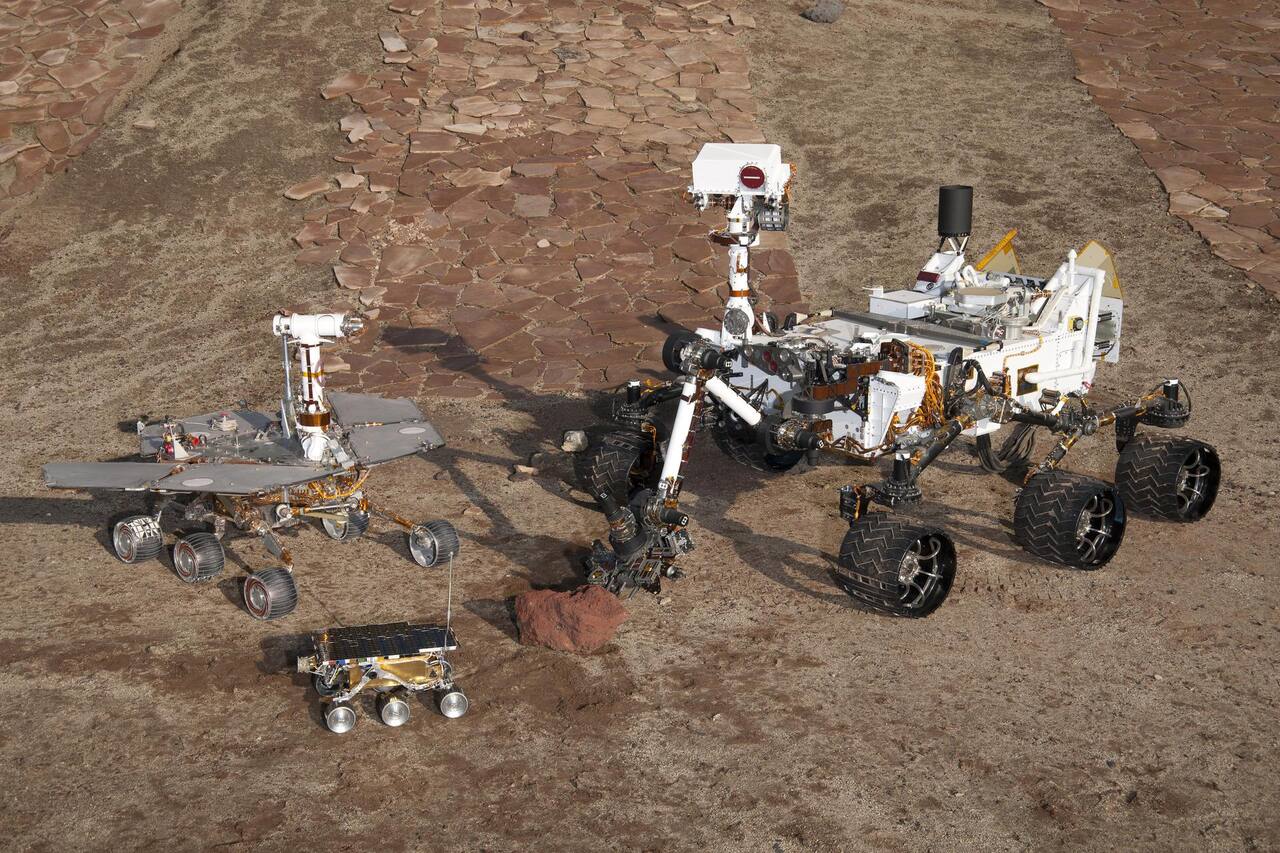
NASA/JPL-Caltech. Public domain (NASA / US government work).
The JPL Robotics section runs two connected terrain venues in Pasadena: the MarsYard, a 66 x 36 m outdoor field where full-scale rover twins drive, climb, sample and get stuck under Earth atmosphere and Earth gravity on seven slopes variable in both angle and cohesion [1], and the indoor Planetary Robotics Laboratory, 3000 sq ft of prototyping and test floor half of which holds two large sand pits [2]. The MarsYard is the third yard of that name, roughly six times the area of its predecessor.
The same flight programs use these venues in sequence with the JPL space simulator chambers, which hold Mars pressure, Mars temperature and simulated solar flux but cannot drive. Neither venue reproduces the other’s environment, and the gap between them is where several documented surprises have lived.
A rover test venue has to supply three things a flight vehicle will meet on another body: terrain with representative slope, cohesion and rock distribution, a ground truth independent of the rover’s own sensors, and a vehicle whose mass and mechanics stand in for the flight article. The outdoor yard is the one choice that gives tens of meters of continuous drive at the cost of Earth gravity, daylight and ambient weather. The flown programs converged on pairing it with a Mars-weight surrogate (Scarecrow) and a full avionics twin (the vehicle system testbed) rather than trying to make the yard itself more Mars-like [5][6]. The sections below cover the yard, the indoor laboratory, what each does not reproduce, and the research and flight-software work that has used the yard as its field stage.
Laboratory data
Section titled “Laboratory data”| Parameter | Value |
|---|---|
| Operator | NASA JPL, Section 347, with flight projects [1] |
| Location | Pasadena, California, United States |
| Commissioned | Present outdoor yard is the third iteration, MarsYard III |
| Type | Outdoor analogue terrain field and indoor prototyping laboratory [1][2] |
| Floor area | Yard 66 x 36 m, over 2000 m2 of terrain; PRL 3000 sq ft |
| Capabilities | MarsYard III, PRL sand pits |
| Simulant or terrain | Beach sand, decomposed granite, brick dust, volcanic cinders; basalt rocks [1] |
| Instrumentation | Total stations and 3D tracking [4]; no permanent motion capture published [1] |
| Ground truth | Total station and 3D tracking position, independent of rover odometry [4] |
| Fidelity limits | Sand results not repeatable enough to report quantitatively [3]. See below |
| Access | Not published |
| Cited by | Curiosity [3][4], Perseverance [5] |
Capabilities
Section titled “Capabilities”MarsYard III
Section titled “MarsYard III”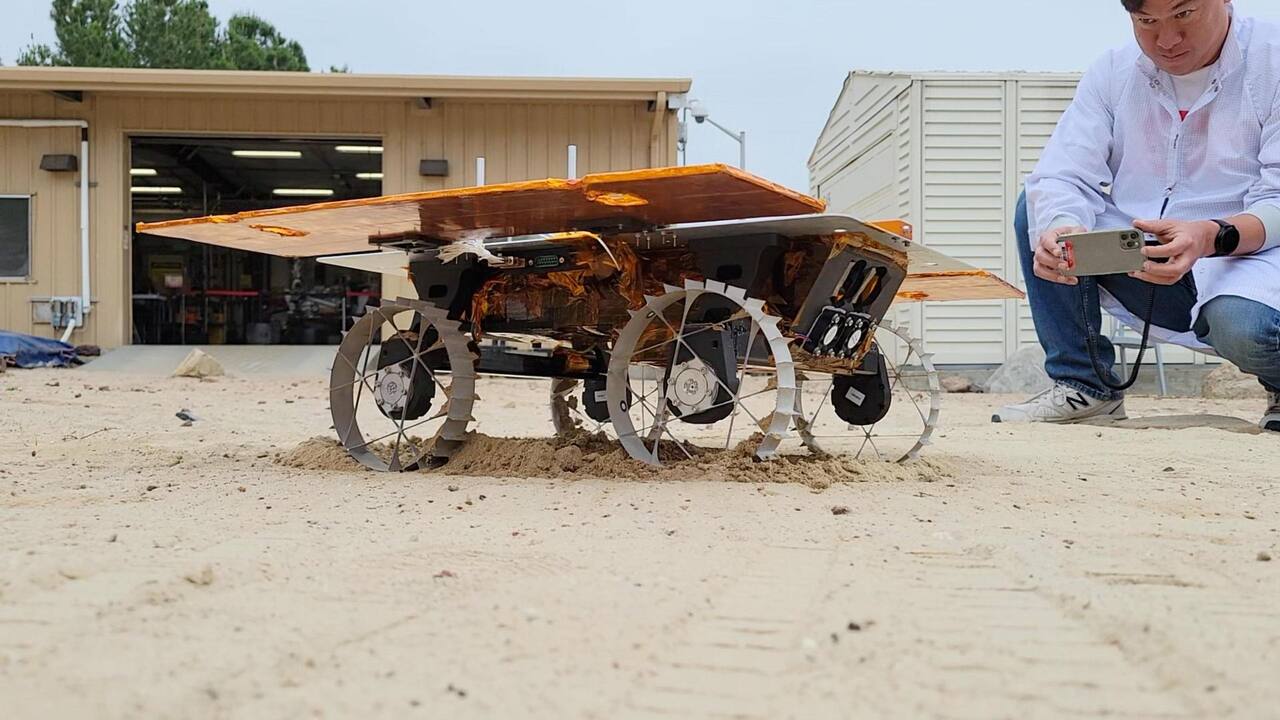
NASA/JPL-Caltech. Public domain (NASA / US government work).
| Parameter | Value |
|---|---|
| Working volume | 66 x 36 m site, over 2000 m2 of test terrain [1] |
| Test article limits | Articles to date up to the 900 kg-class rover testbeds [1][5] |
| Vacuum | Not applicable. Outdoors at ambient pressure |
| Temperature | Not controlled. Testing stops above about 32 C ambient [4] |
| Illumination | Not published. Terrestrial daylight, no solar simulator |
| Simulant or terrain | Beach sand, decomposed granite, brick dust, volcanic cinders [1] |
| Slope | Seven slopes, variable angle and cohesion; 15, 18 and 30 degrees cited [1][3][4] |
| Gravity offload | No offload rig; Scarecrow used instead, about 3/8 mass [5] |
| Instrumentation | Total stations and 3D tracking [4] |
The yard was built with geologists and engineers to mimic terrains on Mars, the Moon and beyond. A robot garage houses the Curiosity and Perseverance vehicle system testbeds side by side, and a visitor platform overlooks the area [1]. The soil is not a compositional simulant: beach sand, decomposed granite, brick dust and volcanic cinders, chosen for mechanical behavior and color. Rocks are basalt in several textures and colors, fine grained and vesicular, in red and black, placed to a size distribution matched to Mars, with the explicit caveat that the large rocks are not Mars-like in composition, being less dense but easier to move for testing. Bricks and trenches are added for specialized work, and the yard is sculpted into a representative terrain per task rather than held in a fixed configuration. Named features in the published campaigns include a north slope with gravel and flagstone surfaces, a flat sand box, a sand slope and a slip-differential hill [3][4]. No tonnage, relative density target or preparation procedure is published, and the individual slope angles and cohesion settings are not published either.
Campaigns cite 15 degree, 18 degree and 30 degree slopes, the last being the maximum grade traversable by the MSL rover [3][4]. Mars weight is approximated not by an offload rig but by the Scarecrow test rover, whose lighter chassis puts its mass at approximately 3/8 that of the flight rover so that its Earth weight matches the flight rover’s Mars weight [5].
The temperature limit is operational rather than nominal. Curiosity was designed for Gale Crater at -94 to 0 C; the yard routinely exceeds 32 C in summer, past the point where the vehicle system testbed’s Earth-only cooling system can hold the vehicle in a safe operating range, at which point outdoor testing stops and the testbed moves into the garage [5]. The Mars 2020 testbed carries a gaseous nitrogen cooling system added specifically to permit operation through Pasadena summers [5].
Planetary Robotics Laboratory sand pits
Section titled “Planetary Robotics Laboratory sand pits”| Parameter | Value |
|---|---|
| Working volume | Two large sand pits within 1500 sq ft; pit dimensions not published |
| Temperature | Not controlled |
| Simulant or terrain | Loose rocky soil and steep cliffs, simulated indoors; products not published |
| Slope | Steep-terrain descent supported; angles not published |
Source: [2].
The laboratory is described by its operator as a facility for rapid prototyping of advanced robotic systems and for developing the algorithms that control them, covering design, fabrication and testing of wheeled and limbed mobility and of manipulation. It holds 1500 sq ft of assembly, integration and test floor for mechanical and electronic subsystems, and a further 1500 sq ft containing the two sand pits, with workstations in both areas [2]. Two lander-mounted manipulators kinematically equivalent to the Mars Polar Lander four degree of freedom arm live there, as do 3 and 4 degree of freedom arms fitted to the rovers. A self-contained field trailer associated with the laboratory supports remote field operations with satellite communications back to the lab, used extensively for Mars Exploration Rover operations rehearsals [2].
This section is thin because the source is thin. The operator’s page is the only description found, and it gives no pit dimensions, no soil product, no depth, no instrumentation and no slope range.
Instrumentation
Section titled “Instrumentation”In the yard the measurement problem is position rather than temperature. Mobility commands used in regression testing have been verified against total stations and 3D tracking hardware to confirm they meet accuracy requirements, so subsequent campaigns can compare telemetered rover position against planned values as sufficient analysis [4]. Slip is computed as distance traversed against distance commanded over a 10 m drive step, the longest single straight drive step MSL permits [3]. No permanent motion capture array is published for either venue.
Site support for the yard is the garage and the visitor platform [1]; the indoor laboratory carries UNIX, Linux and Windows workstations for software development and testing in both of its halves [2].
What it does not reproduce
Section titled “What it does not reproduce”Repeatable sand. The clearest published limit. In the 2018 rimmed wheel campaign, quantitative sand results were excluded from the paper because of concerns about consistency, with, in the operators’ words, “significant variability in all test metrics between individual trials of all configurations” [3]. Earlier slip testing for MSL and for Mars 2020 had already shown that the soil preparation needed for consistent, repeatable sand trials is intensive and that performance and consistency depend strongly on temperature and moisture content; that preparation was out of scope for the campaign [3]. Moisture content is a Pasadena weather variable with no Martian counterpart.
Gravity. Neither venue offloads. The Scarecrow rover exists to close part of that gap: it carries none of the flight instruments or key avionics, but its lighter chassis brings its weight to approximately 3/8 of the flight rover’s, matching what the flight rover weighs on Mars, which is why certain terrain performance verification activities can be at least partially run on it [5]. The same document states that without sufficient fidelity in avionics, instrumentation and weight distribution, Scarecrow falls short as a venue for full verification and validation of mission requirements [5].
Sinkage has no flight comparison. Rimmed wheels increased Scarecrow’s sinkage by 1 to 2 cm against full wheels, but there is no flight metric to compare it against because Curiosity has no way to measure wheel sinkage [3].
Mars pressure and temperature. Neither the yard nor the sand pits hold either. That work goes to the space simulator chambers, which in turn cannot drive a rover.
The testbed is not the rover. Beyond cooling and heaters, the vehicle system testbed uses umbilical cabling in place of the radioisotope generator and the flight radio, does not carry all the flight platinum resistance thermometers, and adds fuses to protect the batteries from ground power supply surges [5]. The umbilical is itself an operational hazard: a test buddy is assigned to keep the testbed from dragging its power and telemetry cable across the yard and to press the panic button [4].
Campaigns run there
Section titled “Campaigns run there”MSL rimmed wheel campaign, first two months of 2018. Scarecrow was run in baseline, two-rimmed and three-rimmed wheel configurations to establish whether Curiosity could continue operating after deliberately shedding the inner two thirds of a damaged wheel [3]. Straight 10 m drives up and down 18 degree gravel and flagstone slopes on the north slope showed the only statistically resolvable slip increase was 2.95 percent for the three-rim configuration driving uphill on stone, against a mobility fault protection threshold that does not respond below that level [3]. Average drive motor current differences across all six motors in all cases were under 0.1 A and unbiased. Rimmed wheels caused a consistent drift off course, more pronounced on gravel, with all three-rim gravel trials ending outside the positive one-sigma bound of the baseline. Arm activities were simulated on 18 and 30 degree slopes at four cardinal headings by moving a 40 kg weight 1.5 m forward of the center of mass by hand, applying a 300 N upward force with a fish scale to represent drill preload, and running a 1.1 g, 60 Hz vibration motor on the deck for 30 seconds to represent sample ingestion shake [3].
MSL R13 flight software regression, July and August 2022. Mobility regression for a software update six years in the making, run on the vehicle system testbed [4]. Test shifts ran 8 to 9 hours and averaged 62.41 m of driving, over twice Curiosity’s typical sol [4]. The campaign comprised 94 test cases after redlines: 10 redlined for redundancy, 2 redlined as impossible in the testbed configuration, and 3 retested. The traction control algorithm was exercised on a 15 degree hill with half the wheels on loose sand and half on firm gravel, where slip without traction control rose from 8.2 percent at the first drive step to 38.4 percent by the fourth, and the rover yawed noticeably off target; with traction control enabled slip was reduced and heading held [4]. Test procedure was transcribed by script from the procedure document into activity reports and into Rover Markup Language command files, which removed commanding transcription error across four primary test conductors [4].
Mars 2020 vehicle system testbed operations, 2020 onward. The Perseverance twin is used to train the operations team on anomaly handling before landing, to dry-run first-time activities with flight-like kinematics, and to shadow the rover during milestone events such as the first drive and the first coring activity [5]. The Ingenuity helicopter watchdog timer fix, which had interrupted the transition from preflight to flight mode during the first rotor spin, was tested on the testbed before being sequenced on Mars. Sampling subsystem work on the testbed established that the rover could apply the 50 N preload needed to drill while on a slope, which had not been validated before because drilling operations had previously been confined to a fixed-tilt hexapod [5].
Earlier laboratory programs. The FIDO rover for Mars technology development and mission rehearsals, the SRR rovers for sample return, robot work crews and steep-terrain descent, and the LEMUR limbed robots for walking and manipulation were all developed in the Planetary Robotics Laboratory [2].
Use beyond the flight twins
Section titled “Use beyond the flight twins”Mobility characterization. Before landing, the MSL project ran Mars-weight slip-versus-slope testing with the Scarecrow rover, a 340 kg vehicle that weighs on Earth what Curiosity weighs on Mars [6]. On smooth flagstone bedrock the maximum traversable slope was 22 degrees; on artificial cohesionless sand slopes slip was moderate at 10 degrees and the rover embedded at 17 degrees. The soil is native JPL parking-lot soil and flagstone, not a simulant, and its properties varied with weather without tight control, so the values are specific to those materials [6]. An earlier yard of 20 x 20 m, designed as an analog to the Viking lander sites, hosted slip compensation work on the Rocky 8 research rover, which held visual odometry error under 1.5 percent of distance traveled on a 29 m field traverse with a total station as ground truth [7].
Autonomy and perception. The yard is the standard field stage for navigation research before flight. An active mast planner improved visual odometry position error by 20.8 to 82.7 percent over a fixed mast on eight of ten Mars Yard runs, with the fixed mast failing on two more; the authors warn the gains are environment dependent [8]. A closed-form clearance checker for articulated rovers was exercised on Scarecrow over a 42 day qualitative campaign in which the yard could not be held constant and each run took 20 to 30 minutes at 0.04 m/s [9]. Perseverance’s flown autonomous navigation was verified against Monte Carlo simulation and Mars Yard scenarios scored pass or fail, not as calibrated traction coefficients [12]. Earlier, the FIDO rover in the yard supplied navigation imagery for an onboard dust devil detector in a multi-asset science-alert demonstration [15], and a 7-sol walkabout run by MSL scientists evaluated the Pathogen onboard planner [16]. The PUFFER foldable rover program ran autonomous mapping trials in the yard [17], and CADRE multi-agent autonomy work used monocular imagery collected there [19]. A digital twin study describes the yard as built to physically simulate Mars terrain [18], and a mission-autonomy review describes it as a 66 x 36 m outdoor site [20].
Lunar-analog configurations. For the CADRE three-rover lunar demonstration, the yard was reconfigured with rocks over 0.05 m every 1 to 2 m and over 10 craters up to 1 m; 15 experiments totaling about 25 hours, indoors and in the yard, explored 2724 m2, with night tests lit by a flood light rather than low-sun lunar illumination [10]. A half-scale Endurance rover concept drove 4.1 km in 5.2 hours (0.8 km per hour average) on a 200-waypoint route on 2 October 2025 under the MEXEC autonomy framework, with the battery swapped by hand instead of recharged [11]. CADRE flew to the Moon later; Endurance remains a mission concept [10][11].
Software test venues. Mars 2020 flight software also runs in the Surface System Development Environment on commercial avionics, built because the flight-like testbeds ran three shifts a day, seven days a week and were still short of verification demand. The Mars Yard stays the highest-fidelity mobility venue in that hierarchy [14][5].
Comparable venues
Section titled “Comparable venues”The ESA Automation and Planetary Robotics Lab at ESTEC is an indoor bed of 8 x 8 m [13] of sand, gravel and rocks with a small crater, boulder field, dune and gravel slope, instrumented with infrared motion tracking cameras. No simulant, grain size, bearing strength or slope angle is published [13]. It trades the yard’s 66 m drive length [1] for indoor repeatability and a motion tracking array the JPL yard does not publish. Neither is a reduced-gravity or vacuum venue; those are covered under space simulator chambers.
What is not established
Section titled “What is not established”No grain size distribution, bulk density, cohesion, friction angle, or preparation procedure is published for the yard soil, for the individual slopes, or for the laboratory sand pits [1][2]. Operator figures conflict: 66 x 36 m is 2376 m2 against “over 2000 m2” [1]. Soil moisture and temperature changed results in sand testing, and one campaign excluded its quantitative sand data [3]. Surrogate results (Scarecrow, the testbed) transfer as differences between configurations, not as absolute Curiosity or Perseverance values [3][6]. The Mars rock size-frequency distribution the yard matches is not cited by the operator [1]. This page cites 20 works against a family minimum of 30: the corpus does not hold more on the yard, because the held, curated sources are research papers that mention it as a field site and the yard’s own characterization is not among them.
References
- NASA Jet Propulsion Laboratory. (2026). The MarsYard III. www-robotics.jpl.nasa.gov/how-we-do-it/facilities/marsyard-iii
BibTeX
@misc{jplmarsyard, title = {The MarsYard III}, author = {{NASA Jet Propulsion Laboratory}}, organization = {www-robotics.jpl.nasa.gov}, year = {2026}, url = {https://www-robotics.jpl.nasa.gov/how-we-do-it/facilities/marsyard-iii/} } - NASA Jet Propulsion Laboratory. (2026). The Planetary Robotics Laboratory. robotics.jpl.nasa.gov/how-we-do-it/facilities/the-planetary-robotics-...
BibTeX
@misc{jplprl, title = {The Planetary Robotics Laboratory}, author = {{NASA Jet Propulsion Laboratory}}, organization = {robotics.jpl.nasa.gov}, year = {2026}, url = {https://robotics.jpl.nasa.gov/how-we-do-it/facilities/the-planetary-robotics-laboratory/} } - Graser, E., McGill, S. M., Rankin, A. and Bielawiec, A. (2020). Rimmed Wheel Performance on the Mars Science Laboratory Scarecrow Rover
. IEEE Aerospace Conference, 20220000759. Source
BibTeX
@inproceedings{graser2020rimmed, title = {Rimmed Wheel Performance on the Mars Science Laboratory Scarecrow Rover}, author = {Graser, Evan and McGill, Sean M. and Rankin, Arturo and Bielawiec, Alex}, booktitle = {IEEE Aerospace Conference}, number = {20220000759}, pages = {1-12}, institution = {NASA}, year = {2020}, doi = {10.1109/aero47225.2020.9172666}, abstract = {The Mars Science Laboratory (MSL) Curiosity rover experienced increasing wheel damage beginning in October 2013. While the wheels were designed to operate with considerable damage, the rate at which damage was occurring was unexpected and raised concerns regarding wheel life expectancy. As of Sol 2555 (10-14-19), there are two broken grousers on the left middle wheel, and one broken grouser on the right middle wheel. One possible scenario, albeit remote, is that enough grousers break on a wheel such that unconstrained portions of the wheel could contact the cable running from the rover motor controller assembly to the wheel's drive actuator. If the cable to a drive actuator is damaged, that wheel may no longer respond to commands. To make progress towards a navigation goal position, that wheel would need to be dragged. To mitigate the risk of damaging a cable running to a wheels drive actuator, the unconstrained portion of a wheel could be strategically shed by performing driving maneuvers on an immovable rock. What would remain after wheel shedding is a rimmed wheel (the outer 1/3 of the wheel). We studied the feasibility of remotely commanding the rover to perform the shed maneuver on one of its front wheels. To inform whether or not to shed the wheels, we tested the performance of driving on one or more rimmed wheels in flight. This led to a two-month test campaign in the Jet Propulsion Laboratory (JPL) Mars Yard using the Scarecrow testbed rover. Driving and steering performance was characterized on a variety of terrain types and slopes in a worst-case rimmed wheeled configuration. Test results indicate that if wheel shedding could be successfully executed in flight, Curiosity could continue to drive indefinitely on rimmed wheels.} } - Rollins, P. J., Wang, F., Graser, E., Franz, B. and Rink, K. (2023). Mars Science Laboratory R13 Mobility Regression Testing
. IEEE Aerospace Conference. Source
BibTeX
@inproceedings{rollins2023mars, title = {Mars Science Laboratory R13 Mobility Regression Testing}, author = {Rollins, P. J. and Wang, Freddy and Graser, Evan and Franz, Brian and Rink, Kim}, booktitle = {IEEE Aerospace Conference}, pages = {1-9}, year = {2023}, doi = {10.48577/jpl.3giv8f}, abstract = {Now in its 10th year of Operation on Mars, NASA’sCuriosity Rover is preparing to undergo a software update, onethat has been six years in the making. In order to qualify thisupdate for use on Mars, the flight software first needs to be runthrough a regression test campaign here on Earth. This paperdetails the regression testing efforts of the Mobility team as theyevaluated the performance of the rover’s driving capabilitiesunder this new Flight Software Upgrade - known as R13. Thistest campaign was conducted to ensure that all of the rover’smobility capabilities behave as expected, especially to check theparts that are “untouched” by R13 have not regressed inperformance, hence the term regression testing. Of 75 mobilitycommands, Curiosity has 18 commands that initiate motion andeach has a number of arguments and options that cancompletely change the rover’s traverse behavior. This leads to avast and complex problem space that is impossible toexhaustively explore, necessitating a regression test campaignthat targets key subsets of commands and arguments in orderto create the confidence needed to approve R13 for flight. Toconduct this testing, the Mobility Team spent 10 days in the JetPropulsion Laboratory’s (JPL) Mars Yard commanding theVehicle System Test Bed (VSTB) – Curiosity’s Earthboundtwin. The nominal performance for 11 of Curiosity’s motioninducingcommands was evaluated in addition to the FaultProtection behavior for 29 off-nominal cases that could occur inrelation to mobility activities. The off-nominal testing requiredcommanding the rover in a way that the Operations Team neverintentionally would on Mars, purposefully stalling motors,shutting down the rover mid-drive, and exceeding limits that arehopefully never reached in flight. The Mobility team’s 10 shifts,the most of any subsystem, created two significant challengesconsisting of staffing and data management. Unlike most otherspacecraft testbeds that spend their days in clean rooms,Curiosity’s drives around the Mars Yard and requires at leasttwo testers to operate. One of which commands the rover, andthe other who moves the umbilical cable that provides powerand communication between the command station and vehicle –a physically demanding task in the Southern California summerheat – leading to the often addition of a third tester to lightenthe load. After testing concluded, data from the tests wasanalyzed to confirm that the rover behaved as expected, and ifnot, what further testing or documentation would be requiredto proceed with approval for R13. Finally, the Mobility Teampresented their test results to the regression review board andthe test campaign was approved, bringing R13 one step closer torunning on Mars.} } - Matthes, C., Stumbo, M. and Foley, J. (2021). How to Build a Rover: An Overview of the Mars 2020 Mission's Vehicle System Testbed
. IEEE Aerospace Conference. Source
BibTeX
@inproceedings{matthes2021how, title = {How to Build a Rover: An Overview of the Mars 2020 Mission's Vehicle System Testbed}, author = {Matthes, Christopher and Stumbo, Matthew and Foley, Justin}, booktitle = {IEEE Aerospace Conference}, pages = {1-12}, year = {2021}, doi = {10.1109/aero53065.2022.9843658}, abstract = {While NASA's Mars rover Perseverance continues to make groundbreaking achievements on the Red Planet, its twin is hard at work here on Earth. The Operational Perseverance Twin for the Integration of Mechanisms and Instruments Sent to Mars, or OPTIMISM, is the Mars 2020 Vehicle System Testbed (VSTB) rover operated by NASA Jet Propulsion Laboratory (JPL) in Pasadena, California. OPTIMISM's home is the JPL Mars Yard; an outdoor field with red soil that simulates the terrain encountered by Perseverance. The VSTB is a full-scale engineering model of the flight rover, serving a number of functions to ensure mission operations can continue smoothly and on schedule. The VSTB possesses instrumentation, computers, mechanisms, cameras, and a Mobility subsystem that are nearly identical to its extraterrestrial twin. Its high fidelity allows the rover to be a highly effective tool to fully test system functionality and performance prior to commanding the flight rover. The early stages of building OPTIMISM began a few months prior to Perseverance departing JPL for Cape Canaveral, FL in early 2020. Electrical integration of the flight system avionics, and compatibility checkouts of the electrical ground support equipment ensured that the foundation of the electrical system was operational and in place. Next, the internal harnessing was installed and compatibility checks of the rover instrumentation and mechanisms were performed to confirm the system was prepared for full buildup. Finally, mechanical assembly of the rover chassis with its external components completed the integration of the system before it was moved to the Mars Yard for its initial phase of testing to perform verification & validation (V&V) of the Mobility subsystem requirements. By the time Perseverance landed at Jezero Crater in February 2021, the first phase of VSTB operations was underway. Surface guidance, navigation, and control (SGNC) testing for the Mobility subsystem ensured functionality and performance requirements were met for various capabilities such as visual odometry (VO), mapping, and automatic navigation (AutoNav). Subsequent integration of the robotic arm (RA) onto the VSTB enabled the V&V campaign for surface sampling operations (SSO) to commence. As the mission's engineering operations (EO) have gotten underway, the VSTB has been utilized for an array of purposes including troubleshooting software anomalies, and performing dry-runs for first time activities (FTAs) prior to sending the commands to Perseverance. OPTIMISM will continue to serve mission critical functions as long as Perseverance is roving the Red Planet.} } - Heverly, M., Matthews, J., Lin, J., Fuller, D., Maimone, M., Biesiadecki, J. and Leichty, J. (2013). Traverse Performance Characterization for the Mars Science Laboratory Rover
. Journal of Field Robotics. Source
BibTeX
@article{heverly2013traverse, title = {Traverse Performance Characterization for the Mars Science Laboratory Rover}, author = {Heverly, Matt and Matthews, Jaret and Lin, Justin and Fuller, Dan and Maimone, Mark and Biesiadecki, Jeffrey and Leichty, John}, journal = {Journal of Field Robotics}, volume = {30}, pages = {835-846}, year = {2013}, doi = {10.1002/rob.21481}, abstract = {It is anticipated that the Mars Science Laboratory rover, named Curiosity, will traverse 10–20 km on the surface of Mars during its primary mission. In preparation for this traverse, Earth‐based tests were performed using Mars weight vehicles. These vehicles were driven over Mars analog bedrock, cohesive soil, and cohesionless sand at various slopes. Vehicle slip was characterized on each of these terrains versus slope for direct upslope driving. Results show that slopes up to 22 degrees are traversable on smooth bedrock and that slopes up to 28 degrees are traversable on some cohesive soils. In cohesionless sand, results show a sharp transition between moderate slip on 10 degree slopes and vehicle embedding at 17 degrees. For cohesionless sand, data are also presented showing the relationship between vehicle slip and wheel sinkage. Side by side testing of the Mars Exploration Rover test vehicle and the Mars Science Laboratory test vehicle show how increased wheel diameter leads to better slope climbing ability in sand for vehicles with nearly identical ground pressure. Lastly, preliminary data from Curiosity's initial driving on Mars are presented and compared to the Earth‐based testing, showing good agreement for the driving done during the first 250 Martian days.} } - Helmick, D. M., Roumeliotis, S. I., Cheng, Y., Clouse, D. S., Bajracharya, M. and Matthies, L. H. (2005). Slip compensation for a Mars Rover
. IEEE/RSJ International Conference on Intelligent Robots and Systems. Source
BibTeX
@inproceedings{helmick2005slip, title = {Slip compensation for a Mars Rover}, author = {Helmick, Daniel M. and Roumeliotis, Stergios I. and Cheng, Yang and Clouse, Daniel S. and Bajracharya, Max and Matthies, Larry H.}, booktitle = {IEEE/RSJ International Conference on Intelligent Robots and Systems}, pages = {2806-2813}, publisher = {IEEE}, year = {2005}, doi = {10.1109/iros.2005.1545178}, abstract = {A system that enables continuous slip compensation for a Mars rover has been designed, implemented, and field-tested. This system is composed of several components that allow the rover to accurately and continuously follow a designated path, compensate for slippage, and reach intended goals in high-slip environments. These components include: visual odometry, vehicle kinematics, a Kalman filter pose estimator, and a slip compensation/path follower. Visual odometry tracks distinctive scene features in stereo imagery to estimate rover motion between successively acquired stereo image pairs. The vehicle kinematics for a rocker-bogie suspension system estimates motion by measuring wheel rates, and rocker, bogie, and steering angles. The Kalman filter merges data from an inertial measurement unit (IMU) and visual odometry. This merged estimate is then compared to the kinematic estimate to determine how much slippage has occurred, taking into account estimate uncertainties. If slippage has occurred then a slip vector is calculated by differencing the current Kalman filter estimate from the kinematic estimate. This slip vector is then used to determine the necessary wheel velocities and steering angles to compensate for slip and follow the desired path.} } - Strader, J., Otsu, K. and Agha-mohammadi, A.-A. (2020). Perception-aware Mast Motion Planning for Planetary Exploration Rovers
. Journal of Field Robotics. Source
BibTeX
@article{strader2020perception, title = {Perception-aware Mast Motion Planning for Planetary Exploration Rovers}, author = {Strader, Jared and Otsu, Kyohei and Agha-mohammadi, Ali-akbar}, journal = {Journal of Field Robotics}, publisher = {JPL Open Repository}, year = {2020}, doi = {10.48577/jpl.m5qniq}, abstract = {Highly accurate real-time localization is of fundamental importance for the safety and ef- ciency of planetary rovers exploring the surface of Mars. Mars rover operations rely on vision-based systems to avoid hazards as well as plan safe routes. However, vision-based systems operate on the assumption that sucient visual texture is visible in the scene. This poses a challenge for vision-based navigation on Mars where regions lacking visual texture are prevalent. To overcome this, we make use of the ability of the rover to actively steer the visual sensor to improve fault tolerance and maximize the perception performance. This paper answers the questions of where and when to look by presenting a method for predict- ing the sensor trajectory that maximizes the localization performance of the rover. This is accomplished by an online assessment of possible trajectories using synthetic, future camera views created from previous observations of the scene. The proposed trajectories are quan- tied and chosen based on the expected localization performance. In this work, we validate the proposed method in eld experiments at the Jet Propulsion Laboratory (JPL) Mars Yard. Furthermore, multiple performance metrics are identied and evaluated for reducing the overall runtime of the algorithm. We show how actively steering the perception system increases the localization accuracy compared to traditional fixed-sensor configurations.} } - Otsu, K., Matheron, G., Ghosh, S., Toupet, O. and Ono, M. (2020). Fast Approximate Clearance Evaluation for Rovers with Articulated Suspension Systems
. Journal of Field Robotics, 5. Source
BibTeX
@article{otsu2020fast, title = {Fast Approximate Clearance Evaluation for Rovers with Articulated Suspension Systems}, author = {Otsu, Kyohei and Matheron, Guillaume and Ghosh, Sourish and Toupet, Olivier and Ono, Masahiro}, journal = {Journal of Field Robotics}, volume = {37}, number = {5}, pages = {768--785}, year = {2020}, doi = {10.1002/rob.21892}, abstract = {Abstract We present a light‐weight body‐terrain clearance evaluation algorithm for the automated path planning of NASA's Mars 2020 rover. Extraterrestrial path planning is challenging due to the combination of terrain roughness and severe limitation in computational resources. Path planning on cluttered and/or uneven terrains requires repeated safety checks on all the candidate paths at a small interval. Predicting the future rover state requires simulating the vehicle settling on the terrain, which involves an inverse‐kinematics problem with iterative nonlinear optimization under geometric constraints. However, such expensive computation is intractable for slow spacecraft computers, such as RAD750, which is used by the Curiosity Mars rover and upcoming Mars 2020 rover. We propose the approximate clearance evaluation (ACE) algorithm, which obtains conservative bounds on vehicle clearance, attitude, and suspension angles without iterative computation. It obtains those bounds by estimating the lowest and highest heights that each wheel may reach given the underlying terrain, and calculating the worst‐case vehicle configuration associated with those extreme wheel heights. The bounds are guaranteed to be conservative, hence ensuring vehicle safety during autonomous navigation. ACE is planned to be used as part of the new onboard path planner of the Mars 2020 rover. This paper describes the algorithm in detail and validates our claim of conservatism and fast computation through experiments.} } - Nayak, S., Lim, G., Rossi, F., Otte, M. and de la Croix, J.-P. (2024). Multi-Robot Exploration for the CADRE Mission
. Autonomous Robots. Source
BibTeX
@article{nayak2024multirobot, title = {Multi-Robot Exploration for the CADRE Mission}, author = {Nayak, Sharan and Lim, Grace and Rossi, Federico and Otte, Michael and de la Croix, Jean-Pierre}, journal = {Autonomous Robots}, volume = {49}, year = {2024}, doi = {10.1007/s10514-025-10199-3} } - Ingham, M., Rouquette, N., Ardito, S., Bandyopadhyay, S., Hasnain, Z., Hasseler, T., Huffman, B., Patterson, K., Rabideau, G. and Vaquero, T. S. (2026). Autonomous Onboard Planning, Execution and Resource Management for the Endurance Lunar Rover
. AIAA SCITECH Forum. Source
BibTeX
@inproceedings{ingham2026autonomous, title = {Autonomous Onboard Planning, Execution and Resource Management for the Endurance Lunar Rover}, author = {Ingham, Michel and Rouquette, Nicolas and Ardito, Steven and Bandyopadhyay, Saptarshi and Hasnain, Zaki and Hasseler, Tristan and Huffman, Bennett and Patterson, Katharine and Rabideau, Gregg and Vaquero, Tiago Stegun}, booktitle = {AIAA SCITECH Forum}, year = {2026}, doi = {10.48577/jpl.gy1l0y}, abstract = {The Endurance mission concept requires a lunar rover to drive roughly 2500 kilometers, maintaining a high rate of traverse on the order of 100 kilometers per lunar day. The long distance and high traverse rate of this proposed rover mission will require a system with unprecedented levels of onboard autonomy. Specifically, it will require onboard reasoning capabilities to provide management of critical state and resources, including power/energy and thermal state. To achieve the ambitious mission objectives, anomalies related to the system or the environment state will have to be overcome quickly, with limited ground-in-the-loop interruptions. In this paper, we review the architecture and implementation of system-level autonomy software that will enable the required responsive behavior, with particular focus on flexible execution functions provided by an onboard activity planning and execution capability called MEXEC (Multi-mission EXECutive). We introduce a new set of scenarios for the FY2025 field test campaign, in which our system-level autonomy software has been augmented with behavioral software providing power and thermal management functions. Finally, we present results from testing the new integrated autonomy capabilities, both in simulation and in field tests.} } - Toupet, O., Ono, M., del Sesto, T., Maimone, M. and McHenry, M. (2026). Enhanced Autonomous Navigation on the Perseverance Mars Rover
. IEEE Transactions on Field Robotics. Source
BibTeX
@article{toupet2026enhanced, title = {Enhanced Autonomous Navigation on the Perseverance Mars Rover}, author = {Toupet, Olivier and Ono, Masahiro and del Sesto, Tyler and Maimone, Mark and McHenry, Michael}, journal = {IEEE Transactions on Field Robotics}, volume = {3}, pages = {83--124}, year = {2026}, doi = {10.1109/tfr.2025.3636366}, abstract = {This paper presentsEnhanced Autonomous Navigation, orENav, the autonomous driving algorithm of NASA’s Mars roverPerseverance. A unique challenge for the autonomous driving ofPerseveranceis to meet strict safety and performance requirements in a highly uncertain environment with only a single-core CPU with extremely limited computing resources. ENav overcame this challenge with a novel two-stage path selection approach that balances the path optimality and computational efficiency, combined with a unique collision checking algorithm that conservatively approximates computationally expensive kinematic settling (Otsu et al., 2020). In addition, ENav provides robustness against slip by expanding the bounding boxes for wheels used by the collision check. These new features, together with FPGA-accelerated vision processing, enabledPerseveranceto autonomously drive on substantially more rock-dense terrains and increased the average daily driving distance by an order of magnitude compared to its predecessors, theCuriosity, Spirit, andOpportunityrovers. Perseverance has set several new records for autonomous driving on Mars, breaking those previously held by the Opportunity rover. As of the 1312th Martian day since landing, or 28 October 2024 on the Earth calendar, ∼90% of the 32.1 km of driving has used ENav to evaluate the terrain. This paper provides detailed documentation of the ENav algorithm, as well as its implementation, testing, deployment, and driving results on Mars.} } - (2026). ESA: Mars on Earth. esa.int/Enabling_Support/Space_Engineering_Technology/Mars_on_Earth
BibTeX
@misc{esamarsonearth, title = {ESA: Mars on Earth}, organization = {esa.int}, year = {2026}, url = {https://www.esa.int/Enabling_Support/Space_Engineering_Technology/Mars_on_Earth} } - Brooks, S., Litwin, T., Biesiadecki, J., Abcouwer, N., Del Sesto, T., McHenry, M., Myint, S., Twu, P. and Wai, D. (2022). Testing Mars 2020 Flight Software and Hardware in the Surface System Development Environment
. IEEE Aerospace Conference. Source
BibTeX
@inproceedings{brooks2022testing, title = {Testing Mars 2020 Flight Software and Hardware in the Surface System Development Environment}, author = {Brooks, Sawyer and Litwin, Todd and Biesiadecki, Jeffrey and Abcouwer, Neil and Del Sesto, Tyler and McHenry, Michael and Myint, Steven and Twu, Philip and Wai, Dennis}, booktitle = {IEEE Aerospace Conference}, pages = {1-13}, address = {Big Sky, Montana}, year = {2022}, doi = {10.1109/aero53065.2022.9843794}, abstract = {The Mars 2020 (M2020) Perseverance Rover is NASA's most advanced planetary rover mission to date. It includes a novel Sample Caching Subsystem (SCS) which will collect rock cores for possible future return to Earth, as well as an improved mobility system with enhanced autonomous navigation which will enable it to traverse faster and farther than prior rovers. The development of both systems required extensive flight software and flight hardware testing. To support this testing, we developed the Surface System Development Environment (SSDEV) and used it for a wide variety of testing. SSDEV is a bundled subset of M2020 Flight Software which runs on commercially available Linux computers and can be combined with multiple backend options for simulation and hardware control. The SSDEV architecture enabled our teams to perform much more testing of flight software and flight hardware than would have otherwise been possible. As a secondary benefit, the SSDEV-based test campaigns also helped our teams enter the operations phase of the mission with greater readiness of operations products and tools. In this paper, we summarize the motivation for SSDEV, provide an overview of the SSDEV architecture, list several examples of how SSDEV was used, and summarize lessons learned. SSDEV is not a substitute for integrated testing with flight-like avionics, but it enabled substantially more testing than would have otherwise been possible and also provided some unique benefits. We recommend architectures like SSDEV to future projects that need to perform extensive hardware and software testing using a limited set of flight-like avionics.} } - Estlin, T., Chien, S., Castano, R., Gaines, D., de Granville, C., Doubleday, J., Anderson, R. C., Knight, R., Bornstein, B., Rabideau, G. and Tang, B. (2010). Coordinating multiple spacecraft assets for joint science campaigns
. SpaceOps Conference. Source
BibTeX
@inproceedings{estlin2010coordinating, title = {Coordinating multiple spacecraft assets for joint science campaigns}, author = {Estlin, Tara and Chien, Steve and Castano, Rebecca and Gaines, Daniel and de Granville, Charles and Doubleday, Josh and Anderson, Robert C. and Knight, Russell and Bornstein, Benjamin and Rabideau, Gregg and Tang, Benyang}, booktitle = {SpaceOps Conference}, publisher = {JPL Open Repository}, year = {2010}, url = {https://dataverse.jpl.nasa.gov/dataset.xhtml?persistentId=hdl:2014/45066} } - Russino, J. A., Gaines, D., Schaffer, S. and Wong, V. (2019). Pathogen: using campaign intent to guide onboard planning for a self-reliant rover. ntrs.nasa.gov/citations/20210012179
BibTeX
@misc{russino2019pathogen, title = {Pathogen: using campaign intent to guide onboard planning for a self-reliant rover}, author = {Russino, Joseph A. and Gaines, Daniel and Schaffer, Steve and Wong, Vincent}, year = {2019}, url = {https://ntrs.nasa.gov/citations/20210012179}, abstract = {UNKNOWN} } - de la Croix, J.-P. and Karras, J. (2019). Pop-Up, Flat-Folding Explorer Rovers: Meet PUFFER—NASA's Origami Rover. Source
BibTeX
@technical_report{delacroix2019puffer, title = {Pop-Up, Flat-Folding Explorer Rovers: Meet PUFFER—NASA's Origami Rover}, author = {de la Croix, Jean-Pierre and Karras, Jaakko}, year = {2019}, url = {https://dataverse.jpl.nasa.gov/dataset.xhtml?persistentId=hdl:2014/52071} } - O'Keefe, X., McCutchan, K., Muniz, A., Burns, J. and Szafir, D. (2025). Practice Makes Perfect: A Study of Digital Twin Technology for Assembly and Problem-solving using Lunar Surface Telerobotics
. Advances in Space Research. Source
BibTeX
@article{okeefe2025practice, title = {Practice Makes Perfect: A Study of Digital Twin Technology for Assembly and Problem-solving using Lunar Surface Telerobotics}, author = {O'Keefe, Xavier and McCutchan, Katy and Muniz, Alexis and Burns, Jack and Szafir, Daniel}, journal = {Advances in Space Research}, volume = {76}, pages = {1550-1562}, year = {2025}, doi = {10.1016/j.asr.2025.05.048} } - Rossi, F., Vaquero, T., de la Croix, J.-P. and Saboia, M. (2024). CADRE: Multi-Agent Autonomy for Space Exploration
. Root. doi.org/10.48577/jpl.kjcy50
BibTeX
@misc{rossi2024cooperative, title = {{CADRE}: Multi-Agent Autonomy for Space Exploration}, author = {Rossi, Federico and Vaquero, Tiago and de la Croix, Jean-Pierre and Saboia, Maira}, journal = {Root}, organization = {JPL Open Repository}, year = {2024}, doi = {10.48577/jpl.kjcy50}, abstract = {No abstract available.} } - Georgiev, N., Gildner, M., Ambrose, E., Pailevanian, T., Archanian, A., Melikyan, H., Tosi, L. P., Loret de Mola Lemu, D., Paton, M., Thakker, R. and Ono, M. (2024). To Boldly Go Where No Robots Have Gone Before - Part 2: The Versatile Mobility of the EELS Robot for Robustly Exploring Unknown Environments
. AIAA SciTech. Source
BibTeX
@inproceedings{georgiev2024boldly,
  title = {To Boldly Go Where No Robots Have Gone Before - Part 2: The Versatile Mobility of the EELS Robot for Robustly Exploring Unknown Environments},
  author = {Georgiev, Nikola and Gildner, Matthew and Ambrose, Eric and Pailevanian, Torkom and Archanian, Avak and Melikyan, Hovhannes and Tosi, Luis Phillipe and Loret de Mola Lemu, Daniel and Paton, Michael and Thakker, Rohan and Ono, Masahiro},
  booktitle = {AIAA SciTech},
  publisher = {JPL Open Repository},
  year = {2024},
  doi = {10.2514/6.2024-1965},
  abstract = {JPL has developed a snake-like robot concept called Exobiology Extant Life Surveyor (EELS) that applies a highly versatile mobility architecture and intelligent risk-aware autonomy towards exploration of unknown and uncertain environments in the solar system, such as the vents of Enceladus. The first instantiation of the EELS robot concept is called EELS 1.0, a modular snake-like robot with shape control through high degree of freedom articulation and screw-based active skin propulsion. This paper outlines the design of the EELS system and provides preliminary results of surface mobility experiments using the hardware system and autonomy software in laboratory and field settings. Through these experiments aspects of the hardware design's versatility were demonstrated through successful short traverses through terrains with varied topography and material properties. Implementation challenges related to the unique hardware architecture and their resolutions are outlined. Limitations of the EELS hardware system and avenues for further development are also discussed.}
}