ADRAS-J
Program pages Astroscale: ADRAS-J Mission
 Astroscale.
Overview
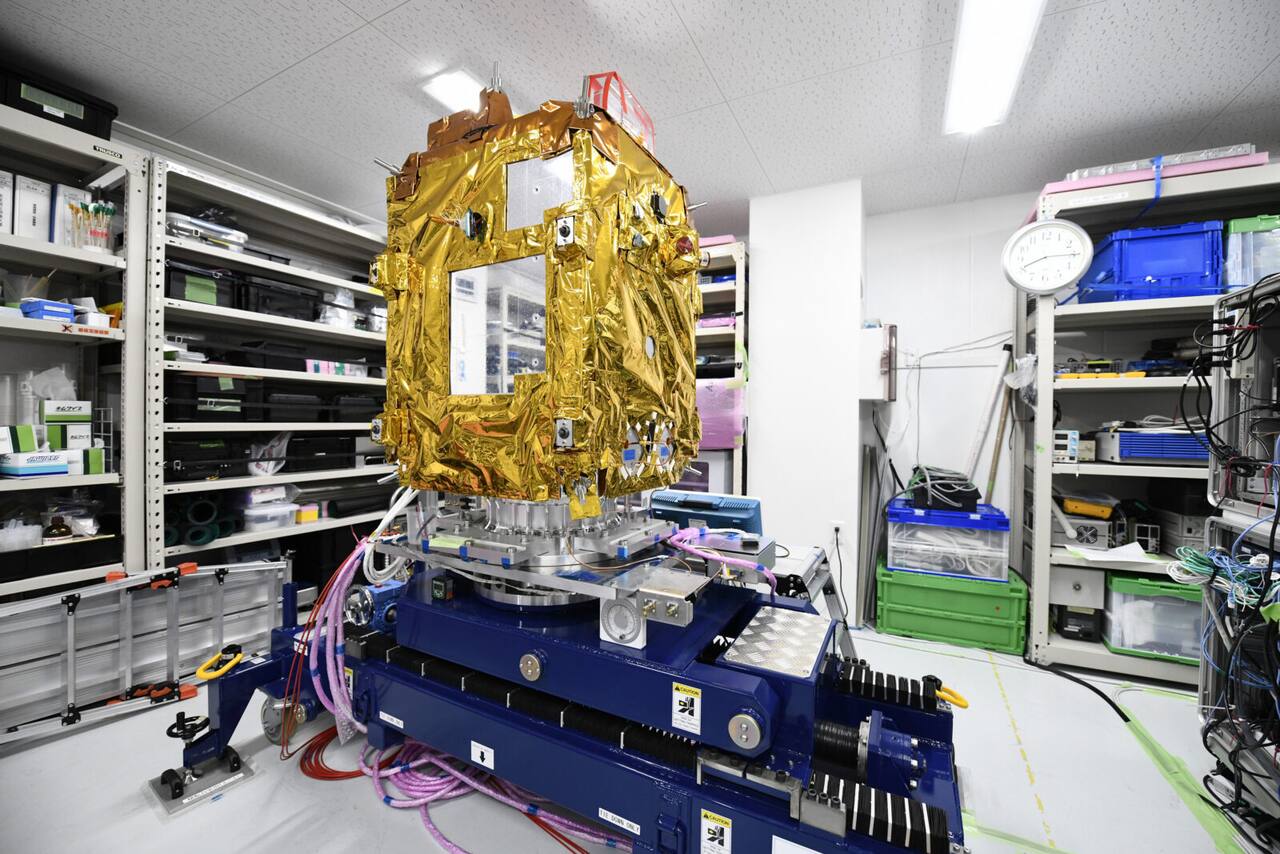
Section titled “Overview”ADRAS-J is a debris inspection spacecraft built by Astroscale Japan for Phase I of JAXA’s Commercial Removal of Debris Demonstration project (CRD2) [6], [21]. Its task was to rendezvous with a large, uncontrolled rocket stage, hold position relative to it, and characterize its condition and motion by imaging. The target has no navigation aid, no grapple fixture and no GPS receiver, so relative navigation had to come from onboard sensing of the object itself [6].
A cooperative client carries markers, a docking interface or a transponder, and a servicer can be designed around them. An unprepared client has none of these and its rotation state is not known in advance. The servicer therefore needs onboard authority to abort an approach [3], [6].
The spacecraft has a mass of 150 kg and was released by a Rocket Lab Electron from Launch Complex 1 in New Zealand on 18 February 2024, into an orbit of about 600 km [2].
Design space for debris approach
Section titled “Design space for debris approach”Three families of approach to a non-cooperative client appear in the corpus, and they differ mainly in what has flown.
Inspection without contact is what ADRAS-J flew: angles-only navigation at long range, model-based relative navigation closer in, a fixed-point hold and a fly-around, with no capture hardware [6], [21]. It is the first rung of a ladder in which each step is reversible.
Capture demonstration against a cooperative client is what Astroscale’s earlier ELSA-d flew in low Earth orbit. A 175 kg servicer and a 17 kg client with a ferromagnetic docking plate and fiducial pattern were launched in March 2021 to run capture, tumbling-client capture and lose-and-recapture demonstrations, with no servicer-client communication during the demonstrations [7]. A propulsion anomaly in January 2022 disabled four of the servicer’s eight 1 N thrusters and stopped the planned 25 January capture [9]. Before that attempt was abandoned the servicer held 30 m separation for more than seven hours under autonomous station keeping [8]. It later closed from 1700 km to about 159 m of the client on 7 April 2022, handing navigation from the ground to the onboard system [9]. The client was a purpose-built target, which ADRAS-J’s was not [6].
Capture of an existing object has not flown. ADRIOS ClearSpace-1 retargeted from the VESPA adapter to PROBA-1 (94 kg, under 1 cubic meter, no appendages) and plans angles-only far-range navigation, a fly-around down to 50 to 100 m, and hops from a formation-keeping point at about 150 m to a final approach point, with capture fully autonomous [12]. Launch was expected at the end of 2028, so every performance statement there is design intent [12]. The close-proximity chain for the earlier ClearSpace-1 target was validated in simulation and on a hardware-in-the-loop bench with a target mockup, with abort maneuvers leaving the servicer on passively safe drifting trajectories [11]. Net, harpoon, robotic arm and dry-adhesive capture methods are surveyed in a 2025 review, which reports that most have never flown and that its net capture results are simulation only [13].
Angles-only far-range navigation to a passive client has a flight precedent. In the ARGON experiment on PRISMA in April 2012, ground-in-the-loop image processing and batch orbit determination took the Mango servicer from 30 km to a 3 km hold point relative to the noncooperative Tango in about four days, using 1 m/s of delta-v [15]. Eight of ten orbit determination runs held the relative semimajor axis error to 3 m and the mean along-track error to 400 m, about 1 percent of separation, against GPS reference [15]. The processing ran on the ground after each orbit, not onboard in real time [16]. The close-range chain was exercised on the EPOS 2.0 robotic testbed, which closed from 20 to 3 m with monocular pose estimation [16].
Capture of a tumbling client has been tested on the ground only. A laboratory run with two manipulators, one driving a satellite mockup and one carrying a capture hand, converged an extended Kalman filter on pose, velocities and inertia parameters in 85 s and planned a 36.5 s interception, with no microgravity dynamics in the loop [19]. The DLR OOS-SIM facility reproduces servicer-client contact dynamics with two industrial robots in a 23.28 cubic meter common workspace, with a hardware-in-the-loop position error of 0.005 m against its own offline simulation and no flight comparison [20]. A CNES review written in 2012 identified non-cooperative tumbling-target rendezvous and capture as the undemonstrated functions of active debris removal [18]. A 2016 review of capture and removal methods states that no debris had been removed as of 2015 and groups targets into four non-cooperativeness categories mapped to candidate capture methods [17].
Onboard avoidance planning is a separate research line. A two-stage temporal planner that schedules routine observation tasks around debris avoidance, with an orbital transfer assumed as the avoidance decision, was evaluated in six simulated scenarios only, with no flight or hardware test [14].
The ADRAS-J sequence follows the same staging by navigation method, starting from angles-only far-range navigation [6], [12].
Mission profile
Section titled “Mission profile”| Event | Date | Source |
|---|---|---|
| Launch on Electron from Launch Complex 1, New Zealand | 2024-02-18 | [2] |
| Angles-only navigation phase started | 2024-04-09 | [21] |
| Fixed-point observation at about 50 m | 2024-05-23 | [21] |
| Fly-around observations | 2024-07-15 and 2024-07-16 | [4], [21] |
| First final approach attempt, about 20 m | 2024-07-17 | [21] |
| Third fly-around observation | 2024-08-13 | [21] |
| Approach to about 15 m, terminated by autonomous abort | 2024-11-30 | [3], [21] |
| De-orbit operations; CRD2 Phase I complete | 2026-03-25 | [21] |
The target is a Japanese H-IIA upper stage launched in 2009, about 11 m long, 4 m in diameter and about 3 t [4], [6]. Its orbit is 533 by 597 km at 98.20 degrees inclination [5]. CRD2 Phase II assigns docking with the same upper stage and removal from orbit to a subsequent mission [6].
Specifications
Section titled “Specifications”| Parameter | Value | Source |
|---|---|---|
| Mass | 150 kg | [2] |
| Thrusters | 12, 1 N each | [5] |
| Propellant | ammonium dinitramide monopropellant | [5] |
| Relative navigation modes | angles-only navigation, model matching navigation | [21] |
| Collision avoidance | onboard, with autonomous abort authority | [3] |
The spacecraft carries no manipulator. Capture hardware belongs to the Phase II vehicle, for which the Payload Attach Fitting on the target is the planned capture point [3].
Approach and inspection sequence
Section titled “Approach and inspection sequence”Operations were staged by navigation method more than by distance. Absolute navigation brought the spacecraft near the target, relative navigation with onboard instruments detected and closed on it, and diagnosis and fly-around followed [6]. Angles-only navigation, which uses bearing measurements alone before the target resolves in the sensor, began at a range of several hundred kilometers and handed over to model matching navigation, which fits sensor returns against a model of the object [21]. The company names the algorithm but publishes no sensor specification or navigation accuracy [21].
The fly-around observations of 15 and 16 July 2024 held a controlled fixed-point relative position of approximately 50 m while imaging the stage from varying angles and lighting [4]. The operator reports that its fault detection, isolation and recovery function had already aborted the first fly-around observation attempt in July [3]. Three successful fly-arounds are reported in all [21].
The 15 m approach
Section titled “The 15 m approach”On 30 November 2024 the spacecraft closed from a 50 m hold point along a straight-line approach to approximately 15 m below the Payload Attach Fitting, matching relative speed, distance and attitude [3]. The onboard collision avoidance system then triggered an autonomous abort in response to an unexpected relative attitude of the upper stage, and the spacecraft departed as designed without reaching the Capture Initiation Point [3]. The anomaly was on the target, which is the hazard an unprepared client presents. The operator had not described its nature when it published [3].
Sensing and image products
Section titled “Sensing and image products”The company lists no sensor performance figures for ADRAS-J [21]. A catalog entry lists the payload as a space debris monitor [5].
The released fly-around video has been used outside the mission. A monocular pipeline of background segmentation, structure from motion and neural implicit surface reconstruction registered all 419 extracted frames, with 16,505 sparse points, a mean reprojection error of 0.410 px and a recovered focal length of 2396.08 px [1]. No CAD model of the stage is public, so the reconstruction is judged only qualitatively and its geometric accuracy is unknown [1].
Pose and motion estimation of an unknown spinning target from stereo imagery has a flown precedent on the ISS. A factor-graph method estimated an unknown SPHERES target’s pose, velocity, center of mass and inertia from ISS data, with position agreeing with the ultrasound metrology to 1.59 cm along the range axis [10]. It ran offline on the ground with the inspector held stationary [10].
Autonomy
Section titled “Autonomy”Operations combined onboard functions with ground control [6]. The abort on 30 November 2024 was commanded by the spacecraft, not from the ground [3]. For comparison, ELSA-d handed navigation from ground to onboard control only in April 2022 [9].
Propulsion and power
Section titled “Propulsion and power”Twelve 1 N thrusters on ammonium dinitramide monopropellant provide translation and attitude control [5]. Solar wings supply power. No power or energy storage figures are published in any source held.
Communications
Section titled “Communications”No band or data rate is given in any source held. The mission released inspection imagery as video [1].
What is not established
Section titled “What is not established”Every ADRAS-J performance figure traces to the operator or to a catalog entry copying it: the 15 m and 50 m ranges are approximate and self-reported, with no position-keeping accuracy, dispersion or telemetry [3], [4], [21]. The cause of the November 2024 attitude anomaly is not described in any source held, nor is the target’s tumble state [3], [4]. Sensor specifications and relative navigation accuracy are unpublished [21]. The reconstruction results from the released video carry no ground truth [1]. Capture of an unprepared object has not flown, and the ClearSpace-1, net-capture and avoidance-planning results are simulation or design intent [11], [12], [13], [14]. The ELSA-d anomaly cause is also unexplained [8], [9].
References
- Gopu, B. P. R., Quinn, P., Nehma, G. M., Tiwari, M., Ueckermann, M., Hinckley, D. and McKenna, C. (2026). From Images2Mesh: A 3D Surface Reconstruction Pipeline for Non-Cooperative Space Objects
. arXiv preprint arXiv:2605.00147. Source
BibTeX
@article{gopu2026images, title = {From Images2Mesh: A 3D Surface Reconstruction Pipeline for Non-Cooperative Space Objects}, author = {Gopu, Bala Prenith Reddy and Quinn, Patrick and Nehma, George M. and Tiwari, Madhur and Ueckermann, Matt and Hinckley, David and McKenna, Christopher}, journal = {arXiv preprint arXiv:2605.00147}, year = {2026}, doi = {10.48550/arxiv.2605.00147}, abstract = {On-orbit inspection imagery is crucial as it enables characterization of non-cooperative resident space objects, providing the geometry and structural condition essential for active debris removal and on-orbit servicing mission planning. However, most existing neural implicit surface reconstruction methods have been confined to synthetic or hardware-in-the-loop data with known camera poses and controlled illumination. In this work, we present a pipeline for neural implicit surface reconstruction of non-cooperative space objects from monocular inspection imagery. We demonstrate it on publicly released ISS inspection footage from the STS-119 mission and publicly released on-orbit inspection footage of an H-IIA rocket upper stage. We find that segmentation-based background removal is essential for successful camera pose estimation from real on-orbit footage, where background variation between frames caused direct processing to fail entirely. We further incorporate photometric correction of per-frame exposure variations and analyze its behavior across datasets, finding that performance in shadowed regions varies with the illumination characteristics of the input footage.} } - Foust, J. (2024). Electron launches Astroscale inspection satellite. spacenews.com/electron-launches-astroscale-inspection-satellite
BibTeX
@misc{foust2024electron, title = {Electron launches Astroscale inspection satellite}, author = {Foust, Jeff}, organization = {SpaceNews}, year = {2024}, url = {https://spacenews.com/electron-launches-astroscale-inspection-satellite/} } - Astroscale. (2024). Astroscale's ADRAS-J Achieves Historic 15-Meter Approach to Space Debris. astroscale.com/en/news/astroscales-adras-j-achieves-historic-15-meter...
BibTeX
@misc{astroscale2024astroscale, title = {Astroscale's ADRAS-J Achieves Historic 15-Meter Approach to Space Debris}, author = {{Astroscale}}, year = {2024}, url = {https://www.astroscale.com/en/news/astroscales-adras-j-achieves-historic-15-meter-approach-to-space-debris} } - Astroscale. (2024). Astroscale's ADRAS-J Continues to Make History: Successfully Demonstrates Fly-Around Observations of Space Debris. astroscale.com/en/news/astroscales-adras-j-continues-to-make-history-...
BibTeX
@misc{astroscale2024astroscaleb, title = {Astroscale's ADRAS-J Continues to Make History: Successfully Demonstrates Fly-Around Observations of Space Debris}, author = {{Astroscale}}, year = {2024}, url = {https://www.astroscale.com/en/news/astroscales-adras-j-continues-to-make-history-successfully-demonstrates-fly-around-observations-of-space-debris} } - Krebs, G. D. (2026). ADRAS-J. space.skyrocket.de/doc_sdat/adras-j.htm
BibTeX
@misc{krebsadrasj, title = {ADRAS-J}, author = {Krebs, Gunter D.}, organization = {Gunter's Space Page}, year = {2026}, url = {https://space.skyrocket.de/doc_sdat/adras-j.htm} } - Via Satellite. (2023). Astroscale Hopes ADRAS-J Mission Will Lay the Groundwork for Commercial Debris Removal. satellitetoday.com/sustainability/2023/09/28/astroscale-hopes-adras-j...
BibTeX
@misc{via2023astroscale, title = {Astroscale Hopes ADRAS-J Mission Will Lay the Groundwork for Commercial Debris Removal}, author = {{Via Satellite}}, year = {2023}, url = {https://www.satellitetoday.com/sustainability/2023/09/28/astroscale-hopes-adras-j-mission-will-lay-the-groundwork-for-commercial-debris-removal/} } - Fujii, G., Iizuka, S., Belle, C. and Muktoyuk, M. (2021). The World's First Commercial Debris Removal Demonstration Mission
. Annual Small Satellite Conference, SSC21-II-09. Source
BibTeX
@inproceedings{fujii2021world, title = {The World's First Commercial Debris Removal Demonstration Mission}, author = {Fujii, Gene and Iizuka, Seita and Belle, Carolyn and Muktoyuk, Mark}, booktitle = {Annual Small Satellite Conference}, number = {SSC21-II-09}, year = {2021}, url = {https://digitalcommons.usu.edu/smallsat/2021/all2021/145/} } - Astroscale. (2022). Astroscale's ELSA-d Mission Successfully Completes Complex Rendezvous Operation. astroscale.com/en/news/astroscales-elsa-d-mission-successfully-comple...
BibTeX
@misc{astroscale2022astroscale, title = {Astroscale's ELSA-d Mission Successfully Completes Complex Rendezvous Operation}, author = {{Astroscale}}, year = {2022}, url = {https://www.astroscale.com/en/news/astroscales-elsa-d-mission-successfully-completes-complex-rendezvous-operation} } - Rainbow, J. (2022). Astroscale Debris-Removal Demo Makes Close Approach Despite Thruster Issues. spacenews.com/astroscale-debris-removal-demo-makes-close-approach-des...
BibTeX
@misc{spacenews2022astroscale, title = {{Astroscale} Debris-Removal Demo Makes Close Approach Despite Thruster Issues}, author = {Rainbow, Jason}, organization = {SpaceNews}, year = {2022}, url = {https://spacenews.com/astroscale-debris-removal-demo-makes-close-approach-despite-thruster-issues/} } - Tweddle, B. E. (2013). Computer Vision-Based Localization and Mapping of an Unknown, Uncooperative and Spinning Target for Spacecraft Proximity Operations. Source
BibTeX
@phdthesis{tweddle2013computer, title = {Computer Vision-Based Localization and Mapping of an Unknown, Uncooperative and Spinning Target for Spacecraft Proximity Operations}, author = {Tweddle, Brent E.}, school = {Massachusetts Institute of Technology}, type = {Ph.D. thesis}, year = {2013}, url = {https://dspace.mit.edu/handle/1721.1/85693} } - Vasconcelos, J., Gaggi, S., Amaral, T., Bakouche, C., Cotuna, A. and Friaças, A. (2025). Close-Proximity Operations Design, Analysis, and Validation for Non-Cooperative Targets with an Application to the ClearSpace-1 Mission
. Aerospace, 1. Source
BibTeX
@article{vasconcelos2025close, title = {Close-Proximity Operations Design, Analysis, and Validation for Non-Cooperative Targets with an Application to the ClearSpace-1 Mission}, author = {Vasconcelos, José and Gaggi, Serena and Amaral, Tiago and Bakouche, Charles and Cotuna, Adina and Friaças, Ana}, journal = {Aerospace}, volume = {12}, number = {1}, pages = {67}, year = {2025}, doi = {10.3390/aerospace12010067}, abstract = {This paper addresses the design, analysis, and validation of safe close-proximity operations around uncooperative targets, with an application to the ClearSpace-1 (CS-1) mission. It is focused on the areas of Guidance, Navigation, and Control (GNC), and Mission Analysis, due to their criticality for the success and safety of this kind of operation. The relevance of the concepts, of the GNC solutions, and their validation is demonstrated for the case study of CS-1, a reference mission for the rendezvous, capture, and de-orbiting of an uncooperative target (i.e., the VESPA payload adapter). It is shown how the design approach can be adopted for the Concept of Operations of CS-1, covering the definition of keep-out zones, corridors, and GO/NO GO criteria, for assessing the passive safety of trajectories, and for the incorporation of active safety strategies. The analysis is adopted for functional chains such as the Navigation and Control, and the combination of a prototyping and a high-fidelity simulator is adopted for directed Model-in-the-Loop Monte-Carlo campaigns. The outcomes are intended to support the industry in the development of Close-Proximity Operations similar to that of CS-1. These can be adopted in a wide variety of missions, including Active Debris Removal and In-Orbit Servicing. In particular, the adopted concepts are a key contribution to the standardization of Close-Proximity Operations for non-cooperative rendezvous missions, and act towards a sustainable and safe commercial application.} } - Woicke, S., Jipp, J., Steimle, C., Pokrupa, N. and Metrailler, L. (2025). ADRIOS ClearSpace-1: In orbit demonstration of the removal of a non-cooperative spacecraft
. European Conference on Space Debris. Source
BibTeX
@inproceedings{woicke2025adrios, title = {ADRIOS ClearSpace-1: In orbit demonstration of the removal of a non-cooperative spacecraft}, author = {Woicke, Svenja and Jipp, Jimmy and Steimle, Christian and Pokrupa, Nils and Metrailler, Lionel}, booktitle = {European Conference on Space Debris}, organization = {ESA Space Debris Office}, year = {2025}, url = {https://conference.sdo.esoc.esa.int/proceedings/sdc9/paper/104} } - Bigdeli, M., Srivastava, R. and Scaraggi, M. (2025). Mechanics of Space Debris Removal: A Review
. Aerospace, 4. Source
BibTeX
@article{bigdeli2025mechanics, title = {Mechanics of Space Debris Removal: A Review}, author = {Bigdeli, Mohammad and Srivastava, Rajat and Scaraggi, Michele}, journal = {Aerospace}, volume = {12}, number = {4}, pages = {277}, year = {2025}, doi = {10.3390/aerospace12040277}, abstract = {The growing population of space debris poses a critical risk to space operations, requiring urgent removal strategies. Numerous scientific investigations have focused on debris capture mechanisms in Earth’s orbits, including contact and contact-less capturing methods. However, the known debris population exhibits a multiscale distribution with broad statistics concerning size, shape, etc., making any general-purpose removal approach challenging. This review examines the mechanics of debris detection, capture, and mitigation, analyzing contact-based and contactless removal techniques. Special focus is given to net capturing methods and their mechanical limitations.We also aim to provide comprehensive discussion, beginning with an overview of current debris statistics followed by detection and removal methods, by analyzing key mechanical parameters relevant to removal. Therefore, we delve into the key parameters essential for the engineering of novel debris removal technologies. Finally, we discuss the preventive measures, regulative frameworks and future research directions.} } - Xingwen, C., Tong, W., Jianbin, Q. and Jianbo, F. (2024). Mission Planning on Autonomous Avoidance for Spacecraft Confronting Orbital Debris
. IEEE Transactions on Aerospace and Electronic Systems. Source
BibTeX
@article{xingwen2024mission, title = {Mission Planning on Autonomous Avoidance for Spacecraft Confronting Orbital Debris}, author = {Xingwen, Chen and Tong, Wang and Jianbin, Qiu and Jianbo, Feng}, journal = {IEEE Transactions on Aerospace and Electronic Systems}, volume = {61}, pages = {4115-4126}, year = {2024}, doi = {10.1109/taes.2024.3496415}, abstract = {This article investigates the mission planning problem for spacecraft confronting orbital debris to achieve autonomous avoidance. First, combined with the avoidance requirements, a closed-loop framework of autonomous avoidance for orbital debris is proposed. Under the established model of mission planning, a two-stage planning is proposed to coordinate the conflict between routine tasks and debris avoidance. During the planning for expansion, the temporal constraints for duration actions are handled by the ordering choices. Meanwhile, dynamic resource variables satisfying instantaneous numerical change and continuous linear change are reasoned in the execution of actions. Linear programming can solve the bounds of variables in each state, which is used to check the consistency of the interactive constraints on duration and resource. Then, the temporal relaxed planning graph heuristics is rationally developed to guide the plan toward the goal. Finally, the simulation demonstrates that the proposed mission planning strategy can effectively achieve the autonomous debris avoidance of the spacecraft.} } - D’Amico, S., Ardaens, J.-S., Gaias, G., Benninghoff, H., Schlepp, B. and Jørgensen, J. L. (2013). Noncooperative Rendezvous Using Angles-Only Optical Navigation: System Design and Flight Results
. Journal of Guidance, Control, and Dynamics. Source
BibTeX
@article{damico2013noncooperative, title = {Noncooperative Rendezvous Using Angles-Only Optical Navigation: System Design and Flight Results}, author = {D’Amico, S. and Ardaens, J.-S. and Gaias, G. and Benninghoff, H. and Schlepp, B. and Jørgensen, J. L.}, journal = {Journal of Guidance, Control, and Dynamics}, volume = {36}, pages = {1576-1595}, year = {2013}, doi = {10.2514/1.59236}, abstract = {This paper presents system design and on-orbit results from the Advanced Rendezvous Demonstration using Global Positioning System and Optical Navigation (ARGON). ARGON has been conducted during the extended phase of the Prototype Research Instruments and Space Mission Technology Advancement (PRISMA) mission in April 2012. It represents one of the first rendezvous technology experiments using line of sight measurements from optical navigation and was motivated by the new generation of on-orbit-servicing and debris-removal missions which are discussed at national and international level. Its primary goal was to demonstrate the capability of an active servicer spacecraft to safely approach and rendezvous a non-cooperative passive client using angles-only optical navigation in a ground-in-the-loop fashion. To this end, a dedicated flight dynamics system has been developed for routine processing of the camera images collected on-board, for estimation of the relative orbit of the servicer with respect to the client vehicle, for maneuver planning and commanding. Despite the inherent difficulty to estimate the actual range to target through angles-only measurements and the constraints affecting the communication between ground-station and servicer, ARGON demonstrated an efficient and safe rendezvous from 30 km to the final hold point at 3 km mean separation selected before experiment start. This was possible due to the achieved relative navigation accuracy in combination with a guidance strategy based on the relative eccentricity/inclination vector separation method. As shown in the paper, the availability of independent and precise navigation information from carrier-phase differential Global Positioning System techniques gave the possibility to properly evaluate the achieved performance and cross-compare different relative navigation sensors after the conclusion of the technology demonstration.} } - Benninghoff, H., Boge, T. and Rems, F. (2014). Autonomous Navigation for On-Orbit Servicing
. Künstliche Intelligenz. Source
BibTeX
@article{benninghoff2014autonomous, title = {Autonomous Navigation for On-Orbit Servicing}, author = {Benninghoff, Heike and Boge, Toralf and Rems, Florian}, journal = {Künstliche Intelligenz}, volume = {28}, pages = {77-83}, year = {2014}, doi = {10.1007/s13218-014-0297-0} } - Shan, M., Guo, J. and Gill, E. (2016). Review and comparison of active space debris capturing and removal methods
. Progress in Aerospace Sciences. Source
BibTeX
@article{shan2016review, title = {Review and comparison of active space debris capturing and removal methods}, author = {Shan, Minghe and Guo, Jian and Gill, Eberhard}, journal = {Progress in Aerospace Sciences}, volume = {80}, pages = {18-32}, year = {2016}, doi = {10.1016/j.paerosci.2015.11.001} } - Bonnal, C., Ruault, J.-M. and Desjean, M.-C. (2013). Active debris removal: Recent progress and current trends
. Acta Astronautica. Source
BibTeX
@article{bonnal2013active, title = {Active debris removal: Recent progress and current trends}, author = {Bonnal, Christophe and Ruault, Jean-Marc and Desjean, Marie-Christine}, journal = {Acta Astronautica}, volume = {85}, pages = {51-60}, year = {2013}, doi = {10.1016/j.actaastro.2012.11.009} } - Aghili, F. (2012). A Prediction and Motion-Planning Scheme for Visually Guided Robotic Capturing of Free-Floating Tumbling Objects With Uncertain Dynamics
. IEEE Transactions on Robotics. Source
BibTeX
@article{aghili2012prediction, title = {A Prediction and Motion-Planning Scheme for Visually Guided Robotic Capturing of Free-Floating Tumbling Objects With Uncertain Dynamics}, author = {Aghili, Farhad}, journal = {IEEE Transactions on Robotics}, volume = {28}, pages = {634-649}, year = {2012}, doi = {10.1109/tro.2011.2179581}, abstract = {Visually guided robotic capturing of a moving object often requires long-term prediction of the object motion not only for a smooth capture but because visual feedback may not be continually available, e.g., due to vision obstruction by the robotic arm, as well. This paper presents a combined prediction and motion-planning scheme for robotic capturing of a drifting and tumbling object with unknown dynamics using visual feedback. A Kalman filter estimates the states and a set of dynamics parameters of the object needed for long-term prediction of the motion from noisy measurements of a vision system. Subsequently, the estimated states, parameters, and predicted motion trajectories are used to plan the trajectory of the robot's end-effector to intercept a grapple fixture on the object with zero relative velocity (to avoid impact) in an optimal way. The optimal trajectory minimizes a cost function, which is a weighted linear sum of travel time, distance, cosine of a line-of-sight angle (object alignment for robotic grasping), and a penalty function acting as a constraint on acceleration magnitude. Experiments are presented to demonstrate the robot-motion planning scheme for autonomous grasping of a tumbling satellite. Two robotics manipulators are employed: One arm drifts and tumbles the mockup of a satellite, and the other arm that is equipped with a robotic hand tries to capture a grapple fixture on the satellite using the visual guidance system.} } - Artigas, J., De Stefano, M., Rackl, W., Lampariello, R., Brunner, B., Bertleff, W., Burger, R., Porges, O., Giordano, A., Borst, C. and Albu-Schaeffer, A. (2015). The OOS-SIM: An on-ground simulation facility for on-orbit servicing robotic operations
. IEEE International Conference on Robotics and Automation. Source
BibTeX
@inproceedings{artigas2015oos, title = {The OOS-SIM: An on-ground simulation facility for on-orbit servicing robotic operations}, author = {Artigas, Jordi and De Stefano, Marco and Rackl, Wolfgang and Lampariello, Roberto and Brunner, Bernhard and Bertleff, Wieland and Burger, Robert and Porges, Oliver and Giordano, Alessandro and Borst, Christoph and Albu-Schaeffer, Alin}, booktitle = {IEEE International Conference on Robotics and Automation}, pages = {2854-2860}, year = {2015}, doi = {10.1109/icra.2015.7139588}, abstract = {On-orbit servicing involves a new class of space missions in which a servicer spacecraft is launched into the orbit of a target spacecraft, the client. The servicer navigates to the client with the intention of manipulating it, using a robotic arm. Within this framework, this work presents a new robotic experimental facility which was recently built at the DLR to support the development and experimental validation of such orbital servicing robots. The facility allows reproducing a close-proximity scenario under realistic three-dimensional orbital dynamics conditions. Its salient features are described here, to include a fully actuated macro-micro system with multiple sensing capabilities, and analyses on its performance including the amount of space environment volume that can be simulated.} } - (2026). Astroscale: ADRAS-J Mission. astroscale.com/en/missions/adras-j
BibTeX
@misc{astroscaleadras,
  title = {Astroscale: ADRAS-J Mission},
  organization = {astroscale.com},
  year = {2026},
  url = {https://www.astroscale.com/en/missions/adras-j}
}