Astrobee
Program pages NASA: Astrobee
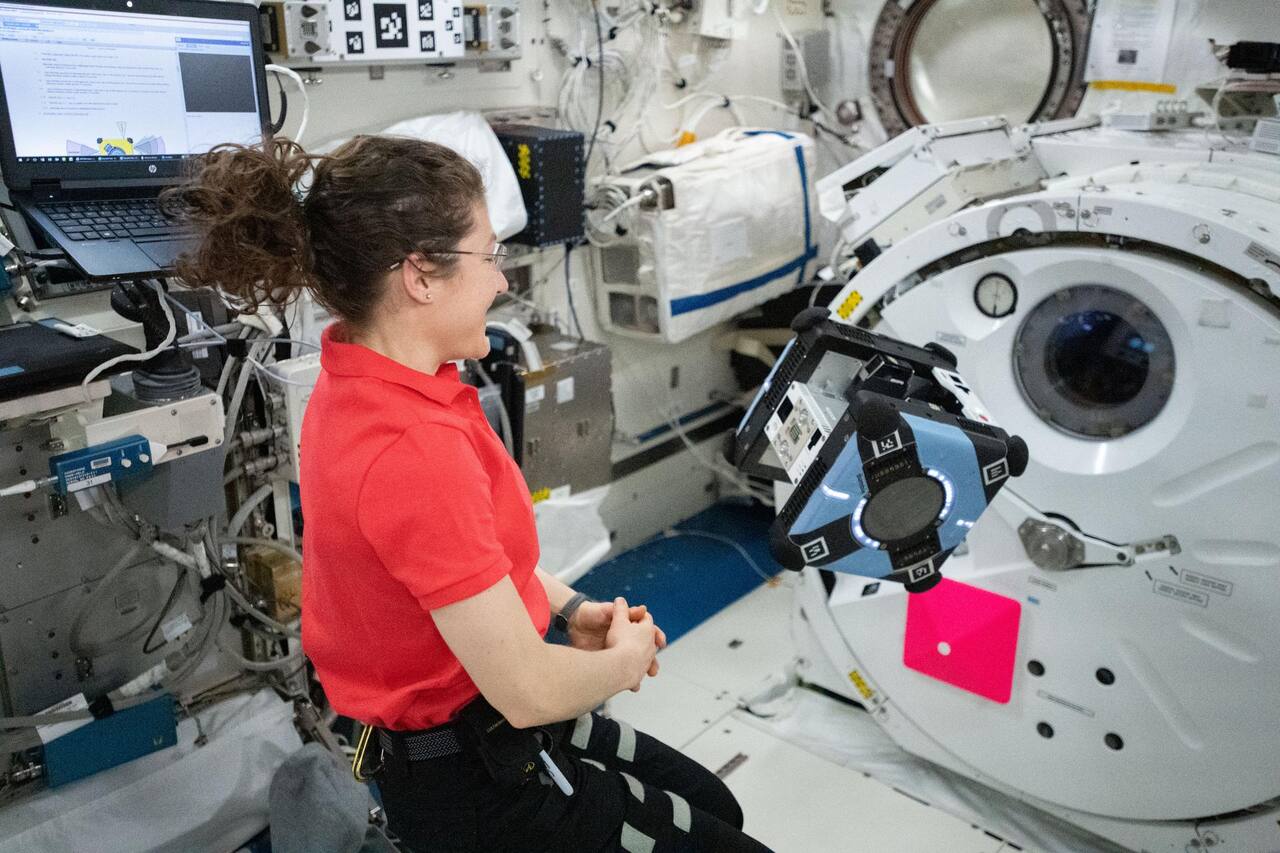 Christina Koch. Public domain (NASA / US government work).
Overview
Section titled “Overview”Astrobee is a fleet of three free-flying robots operating inside the pressurized volume of the International Space Station: Honey, Bumble and Queen [4], [13]. A free-flyer in a crewed cabin has to move in six degrees of freedom without a floor, localize against an interior that crew rearrange, avoid harming people and windows, and run for days without a person servicing it. Each requirement is harder in a cabin than outside it: exhaust and reaction mass are a contamination and safety problem, radio-frequency beacons are a certification problem, and every collision is a collision with something a crew member cares about [1]. Astrobee replaced SPHERES as the station’s intravehicular free-flyer facility. The design is modular and upgradeable, with propulsion by electric fan rather than stored propellant, built-in cameras, and a perching arm for grasping handrails.
Lineage and the design space
Section titled “Lineage and the design space”Intravehicular free-flyers have been built in several propulsion and navigation families, and the ones that flew in the cabin converged on the last.
The Personal Satellite Assistant set out the mission role of a free-flying intravehicular monitor and an autonomy framework built on planners from Deep Space One’s Remote Agent; only its first two prototype models were operational [12]. It never flew.
SPHERES flew cold-gas thrusters and localized against ultrasonic beacons. Its thesis-era hardware gave roughly 10 minutes of continuous station keeping per tank and 2 cm laboratory metrology precision [14]. Measured thrust at the flight maximum regulator setting was 0.1783 N against 0.2480 N predicted, and opening six thrusters at once cut each thruster’s thrust by more than 30 percent because the regulator could not hold pressure [15]. On the station, SPHERES flew formation-acquisition searches in March 2007, where multipath reflection of the ultrasound off module walls delayed relative estimator convergence to about 45 to 55 s [16]. Work on reconfigurable control found that pooling the ultrasound receivers of two attached satellites made the position estimate worse in hardware, not better [17]. SPHERES was useful as control research but kept the consumable and beacon constraints.
AERCam was the external-inspection branch: the Mini AERCam, a 7.5 in cold-gas sphere with GPS and MEMS-gyro relative navigation and twelve thrusters [18], with a CLIPS expert-system command sequencer and a trajectory-safety manager [19]. It targeted free flight outside the station and does not share Astrobee’s cabin constraints.
Smart SPHERES added a smartphone to a SPHERES satellite as a ground-commanded camera payload. In the 12 December 2012 survey of the Kibo module every ground command executed across two loss-of-signal periods, but two runs ended when the cold-gas propellant ran out and one ended when the satellite hit the ceiling hard enough to break its position estimate [9]. Astrobee’s charter absorbed those failure modes: propellant that is cabin air and a battery that recharges at a dock, and collision tolerance built into the mechanical design rather than into operational caution [11], [1].
Astrobee, JAXA’s Int-Ball2 and DLR/Airbus’s CIMON are the free-flyers operating in the station now. A joint review by members of all three teams finds that what separates platforms that fly often from those needing crew setup at every session is operational autonomy through a docking station: Astrobee and Int-Ball2 dock and recharge unattended, while SPHERES, the first Int-Ball and CIMON do not [10]. Int-Ball2 completed its first on-orbit demonstration of autonomous intravehicular flight on 17 October 2023, with vSLAM navigation and a magnetic docking station [25]. Communication redundancy also mattered in practice, including two Astrobee dock Ethernet failures recovered over Wi-Fi, and localization in a changing station interior is a shared failure mode across all three programs [10].
Specifications
Section titled “Specifications”| Parameter | Value | Source |
|---|---|---|
| Envelope | 12.5 in cube (about 30 cm) | [2], [1] |
| Mass | about 10 kg | [3] |
| Design life | 5 years | [2] |
| Maximum velocity | 0.5 m/s | [3] |
| Localization accuracy | 1 cm | [3] |
| Payload bays | 4, two on top and two on the bottom; up to 3 usable at once by guest science | [4] |
| Payload bay port | 14.4 VDC nominal battery power and USB 2.0 | [4] |
| Perching arm degrees of freedom | 3, two joints plus gripper | [3] |
Mission profile
Section titled “Mission profile”| Parameter | Value |
|---|---|
| Dock commissioned | 11 February 2019, 164 sessions to 2025 |
| Bumble commissioned | 30 April 2019, 135 sessions to 2025 |
| Honey commissioned | 30 October 2019, 59 sessions to 2025 |
| Perching arms commissioned | 4 February 2021, 23 sessions to 2025 |
| Queen commissioned | 20 September 2021, 21 sessions to 2025 |
| On-orbit real-time operations through 2025 | more than 165, of which more than 90 were guest science test sessions |
| Console support | more than 1200 hours, about 220 of them involving crew |
| Operating volume | Japanese Experiment Module, Node 2, US Laboratory |
Source: [4], and [3] for the operating volume.
Queen and Bumble operated independently in separate modules on 7 April 2022 [13]. Hardware problems over the period were few: one on Honey (a corrupted SD card), one on Queen and two on the dock, with Honey and Queen each returned to Earth once [4]. In summer 2025 NASA selected the commercial company Arkisys to continue operating the platform [4], [13].
Propulsion
Section titled “Propulsion”Propulsion is electric and uses cabin air rather than stored propellant, which removes both resupply and any exhaust product that would contaminate the atmosphere. Because reaction mass is free in a pressurized cabin, the design minimizes exhaust velocity to maximize thrust power efficiency: roughly 0.1 psi plenum pressure and 11 m/s exhaust, against SPHERES cold gas at 25 psi and 250 m/s [1]. Two propulsion modules, right and left, each contain one centrifugal impeller feeding a single plenum that discharges through six variable-area nozzles, twelve in total [2].
The fan and nozzle sizing came from a trade over fan RPM and nozzle open area. For the higher-performing fans there is a significant benefit from increasing the area up to about 5 in2 (32 cm2) and little beyond it, so the largest nozzles targeted that value, an order of magnitude larger than in the initial concept drawings, and the final open area after occlusion by the flapper mechanism was 3.7 in2 (24 cm2) [4]. Requirements driving the trade were 0.6 N maximum thrust on at least one axis and a 65 dBA acoustic limit at maximum thrust, set by crew habitability [4].
| Parameter | Value |
|---|---|
| Impellers | 2, one per module |
| Nozzles | 12, 6 per module |
| Maximum thrust per nozzle | 0.3 N |
| Maximum total thrust | 3.6 N |
| Nozzle exit velocity | 11 m/s |
| Nozzle discharge coefficient | 0.9 |
| Flapper travel | 64 deg |
| Flapper backlash | 1.8 deg |
| Nozzle servo | MKS DS95 |
Source: [2].
Each nozzle exit area is set by a pair of gear-synchronized flappers driven by a hobby-grade radio-control servo. Modulating twelve exit areas against two constant-speed impellers gives holonomic control: force in any direction plus torque about any axis. Development outcomes recorded for reuse include abandoning 3D printed flight nozzles for machined aluminum after vendor part quality problems [2]. The aft impeller intake produces a net disturbance force of less than 5 percent of propulsion thrust [4]. Total thrust of 3.6 N against a 10 kg vehicle gives a maximum acceleration near 0.36 m/s2, which is orders of magnitude above the milli-g disturbance levels the station structure sees [7]. Those levels depend on frequency and crew activity: a sensor filtered to 5 Hz read 0.06 mg during crew sleep against 0.20 mg awake, and docking transients reach roughly 10 mg [30].
Localization and navigation
Section titled “Localization and navigation”Localization is six-degree-of-freedom and vision-based, matching wall texture features against a prior sparse feature map, with no beacons or added infrastructure in the module [1]. Visual odometry allows continued navigation through regions where mapped features are absent [3]. Position accuracy is about 1 cm in the design documents [3]; the flight evaluation below measures larger errors.
Six cameras are carried [4]: NavCam for mapping and localization, SciCam, a 13 MP forward-facing RGB imager used to stream video of crew activities [1], and HazCam, SpeedCam, PerchCam and DockCam for obstacle detection, velocity estimation, arm operations and docking respectively [1], [3]. HazCam and PerchCam are time-of-flight depth sensors with a 224 by 171 pixel format [4].
The localizer has passed through three generations. The original estimator was an extended Kalman filter fusing a 62.5 Hz IMU with three vision sources at roughly 2 to 5 Hz: sparse-map landmarks, AR tags for docking and depth-image handrail detections for perching [21]. Ground tests against overhead-camera truth gave position RMSE from about 5 cm on a slow circle to 16.5 cm on a fast combined motion, and one map built in a busy lab remained usable for three months [21].
AstroLoc replaced it with a factor-graph localizer that folds visual odometry in as combined factors and marginalizes over a sliding window to hold runtime down, cutting average localization time from 1.13 s to 0.21 s against a baseline factor-graph implementation [8]. On 12 real ISS activities scored against mapping-derived ground truth, localization-mode position RMSE was 0.0491 m for AstroLoc against 0.0948 m for the previous localizer, and in visual-odometry-only mode AstroLoc had no lost events against two for the previous localizer and for the baseline [4]. Fewer map-building activities were then needed on orbit, about 40 percent fewer activities and 30 percent fewer images per activity [4].
AstroLoc2 decouples odometry from absolute localization into a loosely coupled sequential pipeline so that noise in the ISS map no longer degrades velocity and IMU bias estimates. On a public dataset of 10 ISS activities it reduced absolute trajectory error RMSE by 16 percent against AstroLoc, and it runs 41 and 87 percent faster than DSO and ORB-SLAM3 while being less accurate than both [23]. Whether AstroLoc2 has been uploaded to the station is not stated in the sources read.
Perching requires its own perception. A handrail detector using a single time-of-flight sensor and a three-stage geometric filter (gap distance, cross point, side width) rejects cables and clutter before line fitting and 6-DOF pose estimation [22].
Obstacle mapping is implemented with an octree occupancy map fed by HazCam depth, but it is not used during ISS operations, because of its computational cost, the slow speed of Astrobee relative to astronauts, and operational checks that clear paths before motion [4].
Compute
Section titled “Compute”Flight computing is split across three processor boards by real-time requirement [1], [20]:
| Board | Role |
|---|---|
| Low-Level Processor | hard real-time motion control |
| Mid-Level Processor | core flight software, navigation, obstacle detection |
| High-Level Processor | payload interface and guest science code |
Guest science code runs on the high-level processor, isolated from the control loop, so a visiting researcher cannot destabilize the vehicle [1]. A single core of the flight computer is about ten times slower than a laptop-class Intel i9 core, which is the constraint behind the runtime emphasis in the localizer work [4].
Perching arm
Section titled “Perching arm”A stowable arm mounted in a payload bay grips a handrail so the robot can shut down propulsion and hold station at low power [3]. While perched the arm joints double as a pan and tilt unit for the forward-facing cameras, the SciCam among them [3]. The flight arm has three actuated degrees of freedom, two joints plus the gripper, and stows completely inside the top aft payload bay. The gripper is under-actuated and compliant, closed passively by torsional springs in the finger joints and opened by a single motor reeling two tendons, so it holds a handrail through a long perch without drawing power [4]. Bench validation of the arm gave a mean handrail detachment force of 6.43 N over five pull trials, inside a 4.45 to 22.2 N band chosen so that crew cannot dislodge a perched robot by bumping it but can pull it free deliberately [6]. The end-effector module is swappable on orbit so that a guest scientist can fit a different gripper or add arm degrees of freedom [6].
Docking
Section titled “Docking”The dock is 85 by 38 by 28 cm and provides two berths [3]. Alignment is visual, against fiducial markers on the dock, and a mechanical funnel and spring-loaded pogo pins accommodate about 1 cm of residual error [4]. Retention is magnetic: the requirement was that the magnets release under an astronaut pull above 22 N and hold under incidental contact below 4.5 N, so the robot’s own thrust cannot overcome them [4]. Self-docking to recharge is what permits multi-day operation with no crew involvement.
Safety
Section titled “Safety”Safety is argued by being light, slow and soft. The vehicle mass is about 10 kg and the maximum operating speed set by ISS geometry is about 2.1 m/s [4]. The over-speed cutoff is 50 cm/s, chosen so that bumper impact peak force stays below the 556 N maximum astronaut pushoff force that the ISS window scratch panes are verified to tolerate. Analysis backed by bumper testing puts the worst-case impact on a window below 2700 N, enough to risk the scratch pane but not a pressure pane [4]. That figure is analysis and ground test, not flight experience.
Communications
Section titled “Communications”While flying, Astrobees link to the station local area network over the ISS Wi-Fi network, and when docked they communicate over wired Ethernet through the dock, which raises bandwidth and serves as a backup link [4]. Payloads have used both the 2.4 GHz and 5 GHz bands [5]. A free-flyer is itself a usable instrument for characterizing that network: the Wi-Fi survey of the US Laboratory, Node 2 and the JEM found that the free-space inverse-square path-loss model does not apply inside the modules, with a fitted exponent of 0.084 along the module axis, 35 dB of attenuation through a hatch, and more than 20 dB of loss when the payload antenna sat orthogonal to the access point antenna [5].
Ground testing
Section titled “Ground testing”The Granite Lab at NASA Ames supports propulsion and motion-control tests on a 1.2 by 1.2 m granite table, with Astrobee on a three-degree-of-freedom air bearing (x, y, yaw) fed by liquid CO2 cartridges lasting about 15 minutes [4]. The air bearing mass cannot be modeled precisely because the cartridge mass changes as the CO2 is consumed. The lab carries a high-fidelity dock unit, handrail mockups and backdrop posters of the ISS interior, and has been mapped with the flight sparse-mapping software [4]. It is a one-g simulation with three planar degrees of freedom, so pitch and roll need re-mounting the robot on its side.
Operations
Section titled “Operations”Astrobee runs experiment sessions, environmental surveys and guest payloads on the standardized bays [4]. Nearly 80 percent of console time across the first six years needed no crew at all, and 17 investigators on 22 projects had been supported by May 2025, with over 2.0 TB of guest science data transferred [4]. Each payload bay carries a blind-mate connector supplying 14.4 V nominal battery power and USB 2.0 data, engaged by two tool-free quarter-turn fasteners, and up to three payloads can be hosted at once [1]. Investigators develop against a simulator and then run on flight hardware.
Guest science has used the platform for several kinds of work. Astrobee survey images from the Granite Lab and from the JEM were used in a two-robot change-detection scheme, where one robot builds the 3D model and another later scans for inconsistencies; on the ISS, unmodified surveys recovered objects such as a laptop and lights from batches of about seven NavCam images [24]. Astrobee has also served as a testbed for learned control: a Lie-group-symmetry reinforcement learning method for trajectory tracking was tested on a particle, an Astrobee and a quadrotor [28].
Research beyond the flown system
Section titled “Research beyond the flown system”Several lines build on the free-flyer class without having flown on a station free-flyer.
- Safe inspection autonomy: an architecture for a small free-flyer inspecting an orbital outpost, using operator-specified inspection points, keep-in corridors, keep-out zones and a model predictive contouring controller, evaluated in MuJoCo against approximate Lunar Gateway geometry. Four simultaneous thruster failures drive the vehicle into the station in simulation [26].
- Learning-based docking: a reinforcement learning policy for Int-Ball2 docking in a model of the Kibo module reached 97.2 percent stable docking over more than 900 attempts per ablation when propeller drag torque and spin polarity were modeled, against 65.6 percent for a thrust-only baseline [27]. This is simulation only.
- Control barrier functions: a modular safety layer for a 13-DoF free-flying servicer capturing a tumbling target, enforcing approach corridors, collision zones and actuator bounds [29]. This is simulation only.
What is not established
Section titled “What is not established”Pre-flight design numbers do not match as-flown hardware and should not be read as performance data: an early platform description gives mass as about 6 kg and a hardware thrust limit of 0.72 N with a 0.5 m/s overspeed cutoff, against the roughly 10 kg, 0.6 N and 50 cm/s cutoff the bumper testing later justified [1], [4]. The 1 cm localization accuracy in the design documents is not supported by the flight evaluation, whose best mean position error is 4.9 cm [3], [4]. Three gaps remain in the operations record: localization error is measured against the authors’ own offline mapping pipeline rather than an independent metrology system, so the absolute error floor is not established; on-orbit station-keeping and pointing accuracy are described only qualitatively; and flight duration is stated inconsistently, 2.5 to 3 hours on one page against roughly 2 hours on four batteries elsewhere [4]. Bumper impact loads and the worst-case window force are analysis and ground test, not flight experience [4]. The comparison of the three ISS free-flyers rests on a review written by members of those teams, not on an independent evaluation [10].
References
- Smith, T., Barlow, J., Bualat, M., Fong, T., Provencher, C., Sanchez, H. and Smith, E. (2016). Astrobee: A New Platform for Free-Flying Robotics on the International Space Station
. International Symposium on Artificial Intelligence, Robotics and Automation in Space. Source
BibTeX
@inproceedings{smith2016astrobee, title = {Astrobee: A New Platform for Free-Flying Robotics on the International Space Station}, author = {Smith, Trey and Barlow, Jonathan and Bualat, Maria and Fong, Terrence and Provencher, Christopher and Sanchez, Hugo and Smith, Ernest}, booktitle = {International Symposium on Artificial Intelligence, Robotics and Automation in Space}, address = {Beijing, China}, year = {2016}, url = {https://ntrs.nasa.gov/citations/20160007769}, abstract = {The Astrobees are next-generation free-flying robots that will operate in the interior of the International Space Station (ISS). Their primary purpose is to provide a flexible platform for research on zero-g freeflying robotics, with the ability to carry a wide variety of future research payloads and guest science software. They will also serve utility functions: as free-flying cameras to record video of astronaut activities, and as mobile sensor platforms to conduct surveys of the ISS. The Astrobee system includes two robots, a docking station, and a ground data system (GDS). It is developed by the Human Exploration Telerobotics 2 (HET-2) Project, which began in Oct. 2014, and will deliver the Astrobees for launch to ISS in 2017. This paper covers selected aspects of the Astrobee design, focusing on capabilities relevant to potential users of the platform.} } - Daley, E. (2020). Astrobee Free-Flyer Nozzle Mechanism Summary
. Aerospace Mechanisms Symposium, 20200010325. Source
BibTeX
@inproceedings{daley2020astrobee, title = {Astrobee Free-Flyer Nozzle Mechanism Summary}, author = {Daley, Earl}, booktitle = {Aerospace Mechanisms Symposium}, number = {20200010325}, institution = {NASA}, address = {Houston, TX}, year = {2020}, url = {https://ntrs.nasa.gov/citations/20200010325}, abstract = {The paper summary details the function, design, and lessons learned during the development of the Astrobee Free-Flyer nozzle. The Astrobee Free-Flyer is a free flying robot used aboard the International Space Station (ISS).} } - Bualat, M. G., Smith, T., Fong, T. W., Smith, E. E. and Wheeler, D. W. (2018). Astrobee: A New Tool for ISS Operations
. SpaceOps Conference. Source
BibTeX
@inproceedings{bualat2018astrobee, title = {Astrobee: A New Tool for ISS Operations}, author = {Bualat, Maria G. and Smith, Trey and Fong, Terrence W. and Smith, Ernest E. and Wheeler, D. W.}, booktitle = {SpaceOps Conference}, address = {Marseille, France}, year = {2018}, doi = {10.2514/6.2018-2517}, abstract = {The Astrobee} } - Alexandrov, O., Barlow, J., Benavides, J., Bualat, M., Carlino, R., Coltin, B., Cortez, J., Daley, E., Feller, J., Flückiger, L., Fong, T., Fusco, J., Garcia Ruiz, R., Hamilton, K., Kanis, S., Katterhagen, A., Kim, Y., Love, J. F., McIntyre, M., McLachlan, B., Mora Vargas, A., Moratto, Z., Moreira, M., Morse, T., Orosco, H., Park, I.-W., Provencher, C., Sanchez, H., Sharif, K., Smith, E., Smith, T., Soussan, R., Symington, A., Talavera, R. O., To, V., Wheeler, D. and Yoo, J. (2026). Astrobee: Free-Flying Robots for the International Space Station
. IEEE Transactions on Field Robotics. Source
BibTeX
@article{alexandrov2026astrobee, title = {Astrobee: Free-Flying Robots for the International Space Station}, author = {Alexandrov, Oleg and Barlow, Jonathan and Benavides, Jose and Bualat, Maria and Carlino, Roberto and Coltin, Brian and Cortez, Jose and Daley, Earl and Feller, Jeffrey and Flückiger, Lorenzo and Fong, Terrence and Fusco, Jesse and Garcia Ruiz, Ruben and Hamilton, Kathryn and Kanis, Simeon and Katterhagen, Aric and Kim, Yunkyung and Love, John F. and McIntyre, Michael and McLachlan, Blair and Mora Vargas, Andres and Moratto, Zack and Moreira, Marina and Morse, Theodore and Orosco, Henry and Park, In-Won and Provencher, Christopher and Sanchez, Hugo and Sharif, Khaled and Smith, Ernest and Smith, Trey and Soussan, Ryan and Symington, Andrew and Talavera, Rafael Omar and To, Vinh and Wheeler, DW and Yoo, Jongwoon}, journal = {IEEE Transactions on Field Robotics}, year = {2026}, url = {https://ntrs.nasa.gov/citations/20260001396}, abstract = {The Astrobees are free-flying robots that operate inside the International Space Station (ISS) and were launched to the ISS in 2019. Since then they have successfully performed hundreds of activities in space supporting almost two dozen separate research projects. The robots were designed to overcome multiple challenges unique to the ISS environment, including safety, upgradeability and maintainability, limited mass and computation, and unique localization challenges from lack of gravity and a constantly changing environment. This article provides an overview of Astrobee, from hardware and software design to deployment results and activities.} } - Yang, E., Hwu, S. U., Lansdowne, C., Boster, J. P. and deSilva, K. (2024). Wi-Fi Signal Survey of the International Space Station by Autonomous Free-Flying Robot
. IEEE International Conference on Wireless for Space and Extreme Environments, 20240014199. Source
BibTeX
@inproceedings{yang2024wi, title = {Wi-Fi Signal Survey of the International Space Station by Autonomous Free-Flying Robot}, author = {Yang, Everest and Hwu, Shian U. and Lansdowne, Chatwin and Boster, John P. and deSilva, Kanishka}, booktitle = {IEEE International Conference on Wireless for Space and Extreme Environments}, number = {20240014199}, pages = {238-243}, institution = {NASA}, year = {2024}, doi = {10.1109/wisee61249.2024.10850420}, abstract = {This paper analyzes Wi-Fi signal propagation inside pressurized modules of the International Space Station (ISS). Various flight datasets were collected by the Astrobee fleet of autonomous free-flying robots developed by the NASA Ames Research Center (ARC). The enclosed module spaces of the ISS pose unique challenges for Wi-Fi signal propagation, and understanding these challenges is crucial for optimizing connectivity in such environments. The survey data presented are valuable for optimizing wireless access point (WAP) locations and conditions. A computational method is developed to analyze the wireless communication system, RF coverage, and module compositions. The method is both rigorous and practical for assessing the ISS wireless system performance. The computational tools in this paper serve as a complementary approach to direct, on-orbit measurements, which is a complicated and expensive task. In some operational scenarios, ground measurements may be intractable due to the size of the spacecraft. Results from this research will aid future space missions and commercial spacecraft, providing insights into optimal WAP placements and robust wireless communication systems.} } - Park, I.-W., Smith, T., Sanchez, H., Wong, S. W., Piacenza, P. and Ciocarlie, M. (2017). Developing a 3-DOF Compliant Perching Arm for a Free-Flying Robot on the International Space Station
. IEEE International Conference on Advanced Intelligent Mechatronics. Source
BibTeX
@inproceedings{park2017developing, title = {Developing a 3-DOF Compliant Perching Arm for a Free-Flying Robot on the International Space Station}, author = {Park, In-Won and Smith, Trey and Sanchez, Hugo and Wong, Sze Wun and Piacenza, Pedro and Ciocarlie, Matei}, booktitle = {IEEE International Conference on Advanced Intelligent Mechatronics}, pages = {1135-1141}, year = {2017}, doi = {10.1109/aim.2017.8014171}, abstract = {This paper presents the design and control of the 3-DOF compliant perching arm for the free-flying Astrobee robots that will operate inside the International Space Station (ISS). The robots are intended to serve as a flexible platform for future guest scientists to use for zero-gravity robotics research—thus, the arm is designed to support manipulation research. It provides a 1-DOF underactuated tendon-driven gripper capable of enveloping a range of objects of different shapes and sizes. Co-located RGB camera and LIDAR sensors provide perception. The Astrobee robots will be capable of grasping each other in flight, to simulate orbital capture scenarios. The arm's end-effector module is swappable on-orbit, allowing guest scientists to add upgraded grippers, or even additional arm degrees of freedom. The design of the arm balances research capabilities with Astrobee's operational need to perch on ISS handrails to reduce power consumption. Basic arm functioning and grip strength were evaluated using an integrated Astrobee prototype riding on a low-friction air bearing.} } - McPherson, K., Kelly, E. and Keller, J. (2009). Acceleration Environment of the International Space Station
. AIAA Aerospace Sciences Meeting including The New Horizons Forum and Aerospace Exposition, 20120012936. Source
BibTeX
@inproceedings{mcpherson2009acceleration, title = {Acceleration Environment of the International Space Station}, author = {McPherson, Kevin and Kelly, Eric and Keller, Jennifer}, booktitle = {AIAA Aerospace Sciences Meeting including The New Horizons Forum and Aerospace Exposition}, number = {20120012936}, institution = {NASA}, year = {2009}, doi = {10.2514/6.2009-957}, abstract = {Measurement of the microgravity acceleration environment on the International Space Station has been accomplished by two accelerometer systems since 2001. The Microgravity Acceleration Measurement System records the quasi-steady microgravity environment, including the influences of aerodynamic drag, vehicle rotation, and venting effects. Measurement of the vibratory/transient regime, comprised of vehicle, crew, and equipment disturbances, has been accomplished by the Space Acceleration Measurement System-II. Until the arrival of the Columbus Orbital Facility and the Japanese Experiment Module, the location of these sensors, and therefore, the measurement of the microgravity acceleration environment, has been limited to within the United States Laboratory. Japanese Aerospace Exploration Agency has developed a vibratory acceleration measurement system called the Microgravity Measurement Apparatus which will be deployed within the Japanese Experiment Module to make distributed measurements of the Japanese Experiment Module's vibratory acceleration environment. Two Space Acceleration Measurement System sensors from the United States Laboratory will be re-deployed to support vibratory acceleration data measurement within the Columbus Orbital Facility. The additional measurement opportunities resulting from the arrival of these new laboratories allows Principal Investigators with facilities located in these International Space Station research laboratories to obtain microgravity acceleration data in support of their sensitive experiments. The Principal Investigator Microgravity Services project, at NASA Glenn Research Center, in Cleveland, Ohio, has supported acceleration measurement systems and the microgravity scientific community through the processing, characterization, distribution, and archival of the microgravity acceleration data obtained from the International Space Station acceleration measurement systems. This paper summarizes the PIMS capabilities available to the International Space Station scientific community, introduces plans for extending microgravity analysis results to the newly arrived scientific laboratories, and provides summary information for known microgravity environment disturbers.} } - Soussan, R., Kumar, V., Coltin, B. and Smith, T. (2022). AstroLoc: An Efficient and Robust Localizer for a Free-Flying Robot
. International Conference on Robotics and Automation. Source
BibTeX
@inproceedings{soussan2022astroloc, title = {AstroLoc: An Efficient and Robust Localizer for a Free-Flying Robot}, author = {Soussan, Ryan and Kumar, Varsha and Coltin, Brian and Smith, Trey}, booktitle = {International Conference on Robotics and Automation}, pages = {4106-4112}, year = {2022}, doi = {10.1109/icra46639.2022.9811919}, abstract = {We present AstroLoc, an efficient and robust monocular visual-inertial graph-based localization system used by the Astrobee free-flying robots onboard the International Space Station (ISS). We provide a novel localization system that limits the traditionally higher computation times for graph-based localization systems and enables the resource constrained Astrobee robots to benefit from their increased accuracy. We also introduce methods for handling cheirality issues for visual odometry and localization factors that further increase localization robustness. We evaluate the performance of AstroLoc on a dataset of ISS activities and show that it greatly improves pose, velocity, and IMU bias estimation accuracy while efficiently running in a limited computation environment. AstroLoc has improved the localization accuracy for the Astrobee robots on the ISS and has led to more successful and longer duration activities. While the AstroLoc system is tuned for the Astrobee robots, it can be configured for any resource constrained platform. The source code for AstroLoc is released to the public.} } - Fong, T., Micire, M., Morse, T., Park, E., Provencher, C., To, V., Wheeler, D. W., Mittman, D., Torres, R. J. and Smith, E. (2013). Smart SPHERES: a Telerobotic Free-Flyer for Intravehicular Activities in Space
. AIAA SPACE Conference. Source
BibTeX
@inproceedings{fong2013smart, title = {Smart SPHERES: a Telerobotic Free-Flyer for Intravehicular Activities in Space}, author = {Fong, Terrence and Micire, Mark and Morse, Ted and Park, Eric and Provencher, Chris and To, Vinh and Wheeler, D. W. and Mittman, David and Torres, R. Jay and Smith, Ernest}, booktitle = {AIAA SPACE Conference}, publisher = {American Institute of Aeronautics and Astronautics}, address = {San Diego, California}, year = {2013}, doi = {10.2514/6.2013-5338}, abstract = {Smart SPHERES is a prototype free-flying space robot based on the SPHERES platform. Smart SPHERES can be remotely operated by astronauts inside a spacecraft, or by mission controllers on the ground. We developed Smart SPHERES to perform a variety of intravehicular activities (IVA), such as operations inside the International Space Station (ISS). These IVA tasks include environmental monitoring surveys (radiation, sound levels, etc.), inventory, and mobile camera work. In this paper, we first discuss the motivation for free-flying space robots. We then describe the development of the Smart SPHERES prototype, including avionics, software, and data communications. Finally, we present results of initial flight tests on-board the ISS.} } - Yamaguchi, S. P., Mora Vargas, A., Eisenberg, T., Rogon, C., Yamamoto, T., Inoue, S., Kössl, C., Coltin, B., Smith, T. and Benavides, J. V. (2025). Free-Flying Crew Cooperative Robots on the ISS: A Joint Review of Astrobee, CIMON, and Int-Ball Operations
. International Conference on Space Robotics. Source
BibTeX
@inproceedings{yamaguchi2026free, title = {Free-Flying Crew Cooperative Robots on the ISS: A Joint Review of Astrobee, CIMON, and Int-Ball Operations}, author = {Yamaguchi, Seiko Piotr and Mora Vargas, Andres and Eisenberg, Till and Rogon, Christian and Yamamoto, Tatsuya and Inoue, Shona and Kössl, Christoph and Coltin, Brian and Smith, Trey and Benavides, Jose V.}, booktitle = {International Conference on Space Robotics}, pages = {402-409}, year = {2025}, doi = {10.1109/isparo66239.2025.11436992}, abstract = {Intra-vehicular free-flying robots are anticipated to support various work in human spaceflight while working side-by-side with astronauts. Such example of robots includes NASA’s Astrobee, DLR’s CIMON, and JAXA’s Int-Ball, which are deployed on the International Space Station. This paper presents the first joint analyses of these robot’s shared experiences, co-authored by their development and operation team members. Despite the different origins and design philosophies, the development and operations of these platforms encountered various convergences. Hence, this paper presents a detailed overview of these robots, presenting their objectives, design, and onboard operations. Hence, joint lessons learned across the lifecycle are presented, from design to on-orbit operations. These lessons learned are anticipated to serve for future development and research as design recommendations.} } - Bualat, M., Barlow, J., Fong, T., Provencher, C., Smith, T. and Zuniga, A. (2015). Astrobee: Developing a Free Flying Robot for the International Space Station
. AIAA SPACE Conference, 20150018250. Source
BibTeX
@inproceedings{bualat2015astrobee, title = {Astrobee: Developing a Free Flying Robot for the International Space Station}, author = {Bualat, Maria and Barlow, Jonathan and Fong, Terrence and Provencher, Christopher and Smith, Trey and Zuniga, Allison}, booktitle = {AIAA SPACE Conference}, number = {20150018250}, institution = {NASA}, year = {2015}, doi = {10.2514/6.2015-4643}, abstract = {Astronaut time will always be in short supply, consumables (e.g., oxygen) will always be limited, and some work will not be feasible, or productive, for astronauts to do manually. Free flyers offer significant potential to perform a great variety of tasks, include routine, repetitive or simple but long-duration work, such as conducting environment surveys, taking sensor readings or monitoring crew activities. The "Astrobee" project is developing a new free flying robot system suitable for performing Intravehicular Activity (IVA) work on the International Space Station (ISS). This paper will describe the Astrobee project objectives, initial design, concept of operations, and key challenges.\n\n\n} } - Dorais, G. A. and Gawdiak, Y. (2003). The Personal Satellite Assistant: An Internal Spacecraft Autonomous Mobile Monitor
. IEEE Aerospace Conference. Source
BibTeX
@inproceedings{dorais2003personal, title = {The Personal Satellite Assistant: An Internal Spacecraft Autonomous Mobile Monitor}, author = {Dorais, Gregory A. and Gawdiak, Y.}, booktitle = {IEEE Aerospace Conference}, volume = {1}, pages = {1-348}, year = {2003}, doi = {10.1109/aero.2003.1235064}, abstract = {This paper presents an overview of the research and development effort at the NASA Ames Research Center to create an internal spacecraft autonomous mobile monitor capable of performing intra-vehicular sensing activities by autonomously navigating onboard the International Space Station. We describe the capabilities, mission roles, rationale, high-level functional requirements, and design challenges for an autonomous mobile monitor. The rapid prototyping design methodology used, in which five prototypes of increasing fidelity are designed, is described as well as the status of these prototypes, of which two are operational and being tested, and one is actively being designed. The physical test facilities used to perform ground testing are briefly described, including a micro-gravity test facility that permits a prototype to propel itself in 3 dimensions with 6 degrees-of-freedom as if it were in a micro-gravity environment. We also describe an overview of the autonomy framework and its components including the software simulators used in the development process. Sample mission test scenarios are also described. The paper concludes with a discussion of future and related work followed by the summary.} } - (2023). NASA: Astrobee. nasa.gov/astrobee
BibTeX
@misc{nasaastrobee, title = {NASA: Astrobee}, organization = {nasa.gov}, year = {2023}, url = {https://www.nasa.gov/astrobee} } - Saenz-Otero, A. (2000). The SPHERES Satellite Formation Flight Testbed: Design and Initial Control. Source
BibTeX
@mastersthesis{saenzotero2000spheres, title = {The SPHERES Satellite Formation Flight Testbed: Design and Initial Control}, author = {Saenz-Otero, Alvar}, school = {Massachusetts Institute of Technology}, type = {M.Eng. thesis}, year = {2000}, url = {https://dspace.mit.edu/handle/1721.1/86730} } - Chen, A. (2002). Propulsion System Characterization for the SPHERES Formation Flight and Docking Testbed. Source
BibTeX
@mastersthesis{chen2002propulsion, title = {Propulsion System Characterization for the SPHERES Formation Flight and Docking Testbed}, author = {Chen, Allen}, school = {Massachusetts Institute of Technology}, type = {S.M. thesis}, year = {2002}, url = {https://dspace.mit.edu/handle/1721.1/16736} } - Mandy, C. P., Sakamoto, H., Saenz-Otero, A. and Miller, D. W. (2007). Implementation of Satellite Formation Flight Algorithms Using SPHERES Aboard the International Space Station
. AIAA Guidance, Navigation, and Control Conference, 20080012634. Source
BibTeX
@inproceedings{mandy2007implementation, title = {Implementation of Satellite Formation Flight Algorithms Using SPHERES Aboard the International Space Station}, author = {Mandy, Christophe P. and Sakamoto, Hiraku and Saenz-Otero, Alvar and Miller, David W.}, booktitle = {AIAA Guidance, Navigation, and Control Conference}, number = {20080012634}, institution = {NASA}, year = {2007}, url = {https://ntrs.nasa.gov/citations/20080012634}, abstract = {The MIT's Space Systems Laboratory developed the Synchronized Position Hold Engage and Reorient Experimental Satellites (SPHERES) as a risk-tolerant spaceborne facility to develop and mature control, estimation, and autonomy algorithms for distributed satellite systems for applications such as satellite formation flight. Tests performed study interferometric mission-type formation flight maneuvers in deep space. These tests consist of having the satellites trace a coordinated trajectory under tight control that would allow simulated apertures to constructively interfere observed light and measure the resulting increase in angular resolution. This paper focuses on formation initialization (establishment of a formation using limited field of view relative sensors), formation coordination (synchronization of the different satellite s motion) and fuel-balancing among the different satellites.} } - Mohan, S., Saenz-Otero, A., Nolet, S., Miller, D. W. and Sell, S. (2009). SPHERES Reconfigurable Framework and Control System Design for Autonomous Assembly
. AIAA Guidance, Navigation, and Control Conference. Source
BibTeX
@inproceedings{mohan2009spheres, title = {SPHERES Reconfigurable Framework and Control System Design for Autonomous Assembly}, author = {Mohan, Swati and Saenz-Otero, Alvar and Nolet, Simon and Miller, David W. and Sell, Steven}, booktitle = {AIAA Guidance, Navigation, and Control Conference}, year = {2009}, doi = {10.2514/6.2009-5978}, abstract = {Reconfigurable control system design is a key component for enabling autonomous on-orbit assembly. Current research on reconfigurable control systems focuses on adapting to failures. However, for assembly scenarios, the reconfiguration is necessitated by changing mass and stiffness properties. This paper provides a brief description of existing reconfigurable control system technology and develops a framework to incorporate reconfiguration into an existing baseline system to account for mass property variations. The reconfigurable control system framework has been developed and implemented using the SPHERES (Synchronized Position Hold Engage Reorient Experimental Satellites) testbed as the baseline system. The framework highlights the elements that need to be updated, introduces a variable p that captures the configuration, and details the updates necessary in the key algorithms to calculate the model on-line using p. Results are presented from the implementation on the SPHERES, focusing on the reconfigurable estimator. Plans are presented for an integrated assembly test that demonstrates the maintenance of stability, fuel efficiency, and accuracy throughout configuration changes that occur during assembly.} } - Fredrickson, S. E., Abbott, L. W., Duran, S., Jochim, J. D., Studak, J. W., Wagenknecht, J. D. and Williams, N. M. (2003). Mini AERCam: Development of a Free-Flying Nanosatellite Inspection Robot
. Space. Source
BibTeX
@inproceedings{fredrickson2003mini, title = {Mini {AERCam}: Development of a Free-Flying Nanosatellite Inspection Robot}, author = {Fredrickson, Steven E. and Abbott, Larry W. and Duran, Steve and Jochim, J. David and Studak, J. William and Wagenknecht, Jennifer D. and Williams, Nichole M.}, booktitle = {Space}, volume = {5088}, pages = {97-111}, publisher = {SPIE}, year = {2003}, doi = {10.1117/12.498108}, abstract = {The Engineering Directorate of NASA Johnson Space Center has developed a nanosatellite-class free-flyer intended for future external inspection and remote viewing of human spaceflight activities, including International Space Station (ISS) operations. The Miniature Autonomous Extravehicular Robotic Camera (Mini AERCam) technology demonstration unit has been integrated into the approximate form and function of a flight system. The spherical Mini AERCam free flyer is 7.5 inches in diameter and weighs approximately 10 pounds, yet it incorporates significant additional capabilities compared to the 35 pound, 14 inch AERCam Sprint that flew as a Shuttle flight experiment in 1997. Mini AERCam hosts a full suite of miniaturized avionics, instrumentation, communications, navigation, imaging, power, and propulsion subsystems, including two digital video cameras and a high resolution still image camera. The vehicle is designed for either remotely piloted operations or supervised autonomous operations including automatic stationkeeping and point-to-point maneuvering. Free-flyer testing has been conducted on an air-bearing table and in a six degree-of-freedom closed-loop orbital simulation. The orbital simulation models the three-dimensional dynamics of the free-flyer in proximity to the ISS, and produces corresponding God's eye views and simulated free-flyer camera views. A high-fidelity simulation is achieved by directly interfacing to free-flyer thruster driver signals, emulating the MEMS gyro responses in hardware, and using the "truth" state to drive a GPS signal generator connected to the free-flyer GPS receiver.} } - Fredrickson, S., Duran, S., Braun, A., Straube, T. and Mitchell, J. (2006). AERCam Autonomy: Intelligent Software Architecture for Robotic Free Flying Nanosatellite Inspection Vehicles
. Space. Source
BibTeX
@inproceedings{fredrickson2006aercam, title = {AERCam Autonomy: Intelligent Software Architecture for Robotic Free Flying Nanosatellite Inspection Vehicles}, author = {Fredrickson, Steven and Duran, Steve and Braun, Angela and Straube, Timothy and Mitchell, Jennifer}, booktitle = {Space}, year = {2006}, doi = {10.2514/6.2006-7392}, abstract = {The NASA Johnson Space Center has developed a nanosatellite-class Free Flyer intended for future external inspection and remote viewing of human spacecraft.The Miniature Autonomous Extravehicular Robotic Camera (Mini AERCam) technology demonstration unit has been integrated into the approximate form and function of a flight system.The spherical Mini AERCam Free Flyer is 7.5 inches in diameter and weighs approximately 10 pounds, yet it incorporates significant additional capabilities compared to the 35-pound, 14inch diameter AERCam Sprint that flew as a Shuttle flight experiment in 1997.Mini AERCam hosts a full suite of miniaturized avionics, instrumentation, communications, navigation, power, propulsion, and imaging subsystems, including digital video cameras and a high resolution still image camera.The vehicle is designed for either remotely piloted operations or supervised autonomous operations, including automatic stationkeeping, pointto-point maneuvering, and waypoint tracking.The Mini AERCam Free Flyer is accompanied by a sophisticated control station for command and control, as well as a docking system for automated deployment, docking, and recharge at a parent spacecraft.Free Flyer functional testing has been conducted successfully on both an airbearing table and in a six-degree-of-freedom closed-loop orbital simulation with avionics hardware in the loop.Mini AERCam aims to provide beneficial on-orbit views that cannot be obtained from fixed cameras, cameras on robotic manipulators, or cameras carried by crewmembers during extravehicular activities (EVA's).On Shuttle or International Space Station (ISS), for example, Mini AERCam could support external robotic operations by supplying orthogonal views to the intravehicular activity (IVA) robotic operator, supply views of EVA operations to IVA and/or ground crews monitoring the EVA, and carry out independent visual inspections of areas of interest around the spacecraft.To enable these future benefits with minimal impact on IVA operators and ground controllers, the Mini AERCam system architecture incorporates intelligent systems attributes that support various autonomous capabilities.1) A robust command sequencer enables task-level command scripting.Command scripting is employed for operations such as automatic inspection scans over a region of interest, and operator-hands-off automated docking.2) A system manager built on the same expert-system software as the command sequencer provides detection and smartresponse capability for potential system-level anomalies, like loss of communications between the Free Flyer and control station.3) An AERCam dynamics manager provides nominal and off-nominal management of guidance, navigation, and control (GN&C) functions.It is employed for safe trajectory monitoring, contingency maneuvering, and related roles.This paper will describe these architectural components of Mini AERCam autonomy, as well as the interaction of these elements with a human operator during supervised autonomous control.} } - Yoo, J., Park, I.-W., To, V., Lum, J. Q. H. and Smith, T. (2015). Avionics and perching systems of free-flying robots for the International Space Station
. AIAA Guidance, Navigation, and Control Conference. Source
BibTeX
@inproceedings{yoo2015avionics, title = {Avionics and perching systems of free-flying robots for the International Space Station}, author = {Yoo, Jongwoon and Park, In-Won and To, Vinh and Lum, Jason Q. H. and Smith, Trey}, booktitle = {AIAA Guidance, Navigation, and Control Conference}, publisher = {IEEE}, year = {2015}, doi = {10.1109/syseng.2015.7302756}, abstract = {This paper introduces NASA's new free-flying robot, Astrobee, especially focusing on its avionics and perching subsystems. Astrobee is a cube-shaped autonomous robot designed for various missions on the International Space Station (ISS). Its major goal is to offload routine and repetitive work from the ISS crews and assist their science activities. Astrobee is also designed for scientists to use it as a micro-gravity robotics research platform. It can host various science equipment and software, allowing scientists to conduct their experiments using Astrobees on the ISS. The robot has a small compliant, detachable arm with a griper so that it can perch on the ISS wall to support long duration tasks. This arm will grasp ISS handrails to hold its position without using propulsion or navigation subsystems to minimize power consumption. Due to its special missions and operating environment, Astrobee has a set of unique design requirements. This paper gives an overview of Astrobee and the details of its avionics and perching subsystems with distinctive design challenges. We also present the trade studies that we have conducted to decide the critical hardware and software components for the avionics.} } - Coltin, B., Fusco, J., Moratto, Z., Alexandrov, O. and Nakamura, R. (2016). Localization from Visual Landmarks on a Free-Flying Robot
. IEEE/RSJ International Conference on Intelligent Robots and Systems. Source
BibTeX
@inproceedings{coltin2016localization, title = {Localization from Visual Landmarks on a Free-Flying Robot}, author = {Coltin, Brian and Fusco, Jesse and Moratto, Zack and Alexandrov, Oleg and Nakamura, Robert}, booktitle = {IEEE/RSJ International Conference on Intelligent Robots and Systems}, pages = {4377-4382}, address = {Daejeon, Korea}, year = {2016}, doi = {10.1109/iros.2016.7759644}, abstract = {We present the localization approach for Astrobee, a new free-flying robot designed to navigate autonomously on the International Space Station (ISS). Astrobee will accommodate a variety of payloads and enable guest scientists to run experiments in zero-g, as well as assist astronauts and ground controllers. Astrobee will replace the SPHERES robots which currently operate on the ISS, whose use of fixed ultrasonic beacons for localization limits them to work in a 2 meter cube. Astrobee localizes with monocular vision and an IMU, without any environmental modifications. Visual features detected on a pre-built map, optical flow information, and IMU readings are all integrated into an extended Kalman filter (EKF) to estimate the robot pose. We introduce several modifications to the filter to make it more robust to noise, and extensively evaluate the localization algorithm.} } - Lee, D.-H., Coltin, B., Morse, T., Park, I.-W., Flückiger, L. and Smith, T. (2018). Handrail detection and pose estimation for a free-flying robot
. Journal of Geophysical Research: Planets, 1. Source
BibTeX
@article{lee2018handrail, title = {Handrail detection and pose estimation for a free-flying robot}, author = {Lee, Dong-Hyun and Coltin, Brian and Morse, Theodore and Park, In-Won and Flückiger, Lorenzo and Smith, Trey}, journal = {Journal of Geophysical Research: Planets}, volume = {15}, number = {1}, publisher = {SAGE Publications}, year = {2018}, doi = {10.1177/1729881417753691}, abstract = {We present a handrail detection and pose estimation algorithm for the free-flying Astrobee robots that will operate inside the International Space Station. The Astrobee will be equipped with a single time-of-flight depth sensor and a compliant perching arm to grab the International Space Station handrails. Autonomous perching enables a free-flying robot to minimize power consumption by holding its position without using propulsion. Astrobee is a small robot with many competing demands on its computing, power, and volume resources. Therefore, for perching, we were limited to using a single compact sensor and a lightweight detection algorithm. Moreover, the handrails on the International Space Station are surrounded by various instruments and cables, and the lighting conditions change significantly depending on the light sources, time, and robot location. The proposed algorithm uses a time-of-flight depth sensor for handrail perception under varying lighting conditions and utilizes the geometric characteristics of the handrails for robust detection and pose estimation. We demonstrate the robustness and accuracy of the algorithm in various environment scenarios.} } - Soussan, R., Moreira, M., Coltin, B. and Smith, T. (2025). AstroLoc2: Fast Sequential Depth-Enhanced Localization for Free-flying Robots
. IEEE International Conference on Robotics and Automation. Source
BibTeX
@inproceedings{soussan2025astroloc2, title = {AstroLoc2: Fast Sequential Depth-Enhanced Localization for Free-flying Robots}, author = {Soussan, Ryan and Moreira, Marina and Coltin, Brian and Smith, Trey}, booktitle = {IEEE International Conference on Robotics and Automation}, pages = {14595-14602}, address = {Atlanta, Georgia}, year = {2025}, doi = {10.1109/icra55743.2025.11128673}, abstract = {We present AstroLoc2, a monocular and time-offlight (ToF) visual-inertial graph-based localizer used by the Astrobee free-flying robots on the International Space Station (ISS). AstroLoc2 sequentially performs odometry and absolute localization in a single process to decouple map noise from velocity and IMU bias estimation and run efficiently on resource constrained platforms. It improves monocular visual-inertial odometry robustness by adding ToF correspondence factors and uses adaptive map-matching to increase image registration reliability in dynamic environments while preserving fast matching in static ones. We evaluate the performance of AstroLoc2 on a public dataset of 10 ISS activities and show that it improves localization accuracy by 16 % and success rates by 5.5 % while maintaining a faster runtime than leading methods. AstroLoc2 has enabled the Astrobee robots to perform higher precision maneuvers in changing environments on the ISS. It can be configured for other limited computation platforms and we release the source code to the public.} } - Dinkel, H., Di, J., Santos, J., Albee, K., Borges, P., Moreira, M., Alexandrov, O., Coltin, B. and Smith, T. (2023). Multi-Agent 3D Map Reconstruction and Change Detection in Microgravity with Free-Flying Robots
. International Astronautical Congress, IAC-23,D1,6,1,x78669. Source
BibTeX
@inproceedings{dinkel2023multi, title = {Multi-Agent 3D Map Reconstruction and Change Detection in Microgravity with Free-Flying Robots}, author = {Dinkel, Holly and Di, Julia and Santos, Jamie and Albee, Keenan and Borges, Paulo and Moreira, Marina and Alexandrov, Oleg and Coltin, Brian and Smith, Trey}, booktitle = {International Astronautical Congress}, number = {IAC-23,D1,6,1,x78669}, publisher = {JPL Open Repository}, year = {2023}, doi = {10.48577/jpl.lbsjso}, abstract = {Assistive free-flyer robots autonomously caring for future crewed outposts---such as NASA’s Astrobee robots on the International Space Station (ISS)---must be able to detect day-to-day interior changes to track inventory, detect and diagnose faults, and monitor the outpost status. This work presents a framework for multi-agent cooperative mapping and change detection to enable robotic maintenance of space outposts. One agent is used to reconstruct a 3D model of the environment from sequences of images and corresponding depth information. Another agent is used to scan the environment for inconsistencies against the 3D model. Change detection is validated using real image and pose data collected by Astrobee robots on Earth in a test environment and in space on the ISS. This work outlines the objectives, requirements, and algorithmic modules for the multi-agent reconstruction system, including recommendations for its use aboard future microgravity outposts.} } - Hirano, D., Mitani, S., Watanabe, K., Nishishita, T., Yamamoto, T. and Yamaguchi, S. P. (2025). Int-Ball2: On-Orbit Demonstration of Autonomous Intravehicular Flight and Docking for Image Capturing and Recharging
. IEEE Robotics & Automation Magazine, 3. Source
BibTeX
@article{hirano2025intball2, title = {{Int-Ball2}: On-Orbit Demonstration of Autonomous Intravehicular Flight and Docking for Image Capturing and Recharging}, author = {Hirano, Daichi and Mitani, Shinji and Watanabe, Keisuke and Nishishita, Taisei and Yamamoto, Tatsuya and Yamaguchi, Seiko P.}, journal = {IEEE Robotics & Automation Magazine}, volume = {32}, number = {3}, pages = {76--87}, year = {2025}, doi = {10.1109/mra.2024.3505776}, abstract = {This article presents the system architecture and the orbital demonstration results of the Int-Ball2, a free-flying camera robot developed by the Japan Aerospace Exploration Agency (JAXA). The purpose of the Int-Ball2 project is to assist astronauts and reduce their workload in the International Space Station (ISS). This robot is an upgrade from the first Int-Ball, enhancing the propulsion subsystem for greater maneuverability and adding a new docking station (DS) for autonomous battery recharging. This study performed comprehensive ground tests for autonomous maneuvering and docking, employing a combination of a fully software-based simulator, a hardware-in-the-loop (HIL) simulator, and a planar air-bearing facility. After a successful launch to the ISS, the Int-Ball2 demonstrated its ability to work in microgravity without relying on astronaut support. The results obtained from ground and orbital tests underscored the effectiveness of our system design and ground verification approach. Further, we present key technologies essential for the Int-Ball2’s successful implementation on board the ISS. We expect the insights from this project to be invaluable to future missions involving free-flying robots in microgravity.} } - Albee, K., Sternberg, D. C., Hansson, A., Schwartz, D., Majumdar, R. and Jia-Richards, O. (2025). Architecting Autonomy for Safe Microgravity Free-Flyer Inspection
. IEEE Aerospace Conference. Source
BibTeX
@inproceedings{albee2025architecting, title = {Architecting Autonomy for Safe Microgravity Free-Flyer Inspection}, author = {Albee, Keenan and Sternberg, David C. and Hansson, Alexander and Schwartz, David and Majumdar, Ritwik and Jia-Richards, Oliver}, booktitle = {IEEE Aerospace Conference}, publisher = {JPL Open Repository}, year = {2025}, doi = {10.48577/jpl.esh2bl} } - Arora, A., El-Hariry, M. and Olivares-Mendez, M. (2025). Reinforcement Learning Based 6-DoF Maneuvers for Microgravity Intravehicular Docking: A Simulation Study with Int-Ball2 in ISS-JEM
. arXiv. Source
BibTeX
@article{arora2025reinforcement, title = {Reinforcement Learning Based 6-DoF Maneuvers for Microgravity Intravehicular Docking: A Simulation Study with Int-Ball2 in ISS-JEM}, author = {Arora, Aman and El-Hariry, Matteo and Olivares-Mendez, Miguel}, journal = {arXiv}, year = {2025}, doi = {10.48550/arxiv.2512.13514}, abstract = {Autonomous free-flyers play a critical role in intravehicular tasks aboard the International Space Station (ISS), where their precise docking under sensing noise, small actuation mismatches, and environmental variability remains a nontrivial challenge. This work presents a reinforcement learning (RL) framework for six-degree-of-freedom (6-DoF) docking of JAXA's Int-Ball2 robot inside a high-fidelity Isaac Sim model of the Japanese Experiment Module (JEM). Using Proximal Policy Optimization (PPO), we train and evaluate controllers under domain-randomized dynamics and bounded observation noise, while explicitly modeling propeller drag-torque effects and polarity structure. This enables a controlled study of how Int-Ball2's propulsion physics influence RL-based docking performance in constrained microgravity interiors. The learned policy achieves stable and reliable docking across varied conditions and lays the groundwork for future extensions pertaining to Int-Ball2 in collision-aware navigation, safe RL, propulsion-accurate sim-to-real transfer, and vision-based end-to-end docking.} } - Welde, J., Rao, N., Kunapuli, P., Jayaraman, D. and Kumar, V. (2024). Leveraging Symmetry to Accelerate Learning of Trajectory Tracking Controllers for Free-Flying Robotic Systems
. IEEE International Conference on Robotics and Automation. Source
BibTeX
@inproceedings{welde2024leveraging, title = {Leveraging Symmetry to Accelerate Learning of Trajectory Tracking Controllers for Free-Flying Robotic Systems}, author = {Welde, Jake and Rao, Nishanth and Kunapuli, Pratik and Jayaraman, Dinesh and Kumar, Vijay}, booktitle = {IEEE International Conference on Robotics and Automation}, pages = {15121-15127}, year = {2024}, doi = {10.1109/icra55743.2025.11127455}, abstract = {Tracking controllers enable robotic systems to accurately follow planned reference trajectories. In particular, reinforcement learning (RL) has shown promise in the synthesis of controllers for systems with complex dynamics and modest online compute budgets. However, the poor sample efficiency of RL and the challenges of reward design make training slow and sometimes unstable, especially for high-dimensional systems. In this work, we leverage the inherent Lie group symmetries of robotic systems with a floating base to mitigate these challenges when learning tracking controllers. We model a general tracking problem as a Markov decision process (MDP) that captures the evolution of both the physical and reference states. Next, we prove that symmetry in the underlying dynamics and running costs leads to an MDP homomorphism, a mapping that allows a policy trained on a lower-dimensional “quotient” MDP to be lifted to an optimal tracking controller for the original system. We compare this symmetry-informed approach to an unstructured baseline, using Proximal Policy Optimization (PPO) to learn tracking controllers for three systems: the Particle (a forced point mass), the Astrobee (a fully-actuated space robot), and the Quadrotor (an underactuated system). Results show that a symmetry-aware approach both accelerates training and reduces tracking error at convergence.} } - Meinert, A., Stadler, P., Baldauf, N. and Turnwald, A. (2026). Control Barrier Functions for Safe Free-Flying Robotic Spacecraft Operations in Tumbling Target Capture. arxiv.org/abs/2609.25905v1
BibTeX
@misc{meinert2026control, title = {Control Barrier Functions for Safe Free-Flying Robotic Spacecraft Operations in Tumbling Target Capture}, author = {Meinert, Alexander and Stadler, Peter and Baldauf, Niklas and Turnwald, Alen}, year = {2026}, url = {https://arxiv.org/abs/2609.25905v1} } - Jules, K., McPherson, K., Hrovat, K. and Kelly, E. (2004). Initial characterization of the microgravity environment of the international space station: increments 2 through 4
. Acta Astronautica, 20050193981. Source
BibTeX
@article{jules2004initial,
  title = {Initial characterization of the microgravity environment of the international space station: increments 2 through 4},
  author = {Jules, Kenol and McPherson, Kevin and Hrovat, Kenneth and Kelly, Eric},
  journal = {Acta Astronautica},
  volume = {55},
  number = {20050193981},
  pages = {855-887},
  institution = {NASA},
  year = {2004},
  doi = {10.1016/j.actaastro.2004.04.008},
  abstract = {The primary objective of the International Space Station (ISS) is to provide a long-term quiescent environment for the conduct of scientific research for a variety of microgravity science disciplines. This paper reports to the microgravity scientific community the results of an initial characterization of the microgravity environment on the International Space Station for increments 2 through 4. During that period almost 70,000 hours of station operations and scientific experiments were conducted. 720 hours of crew research time were logged aboard the orbiting laboratory and over half a terabyte of acceleration data were recorded and much of that was analyzed. The results discussed in this paper cover both the quasi-steady and vibratory acceleration environment of the station during its first year of scientific operation. For the quasi-steady environment, results are presented and discussed for the following: the space station attitudes Torque Equilibrium Attitude and the X-Axis Perpendicular to the Orbital Plane; station docking attitude maneuvers; Space Shuttle joint operation with the station; cabin de-pressurizations and the station water dumps. For the vibratory environment, results are presented for the following: crew exercise, docking events, and the activation/de-activation of both station life support system hardware and experiment hardware. Finally, a grand summary of all the data collected aboard the station during the 1-year period is presented showing where the overall quasi-steady and vibratory acceleration magnitude levels fall over that period of time using a 95th percentile benchmark. Published by Elsevier Ltd.}
}