Huygens
Program pages ESA Science Portal: Cassini-Huygens
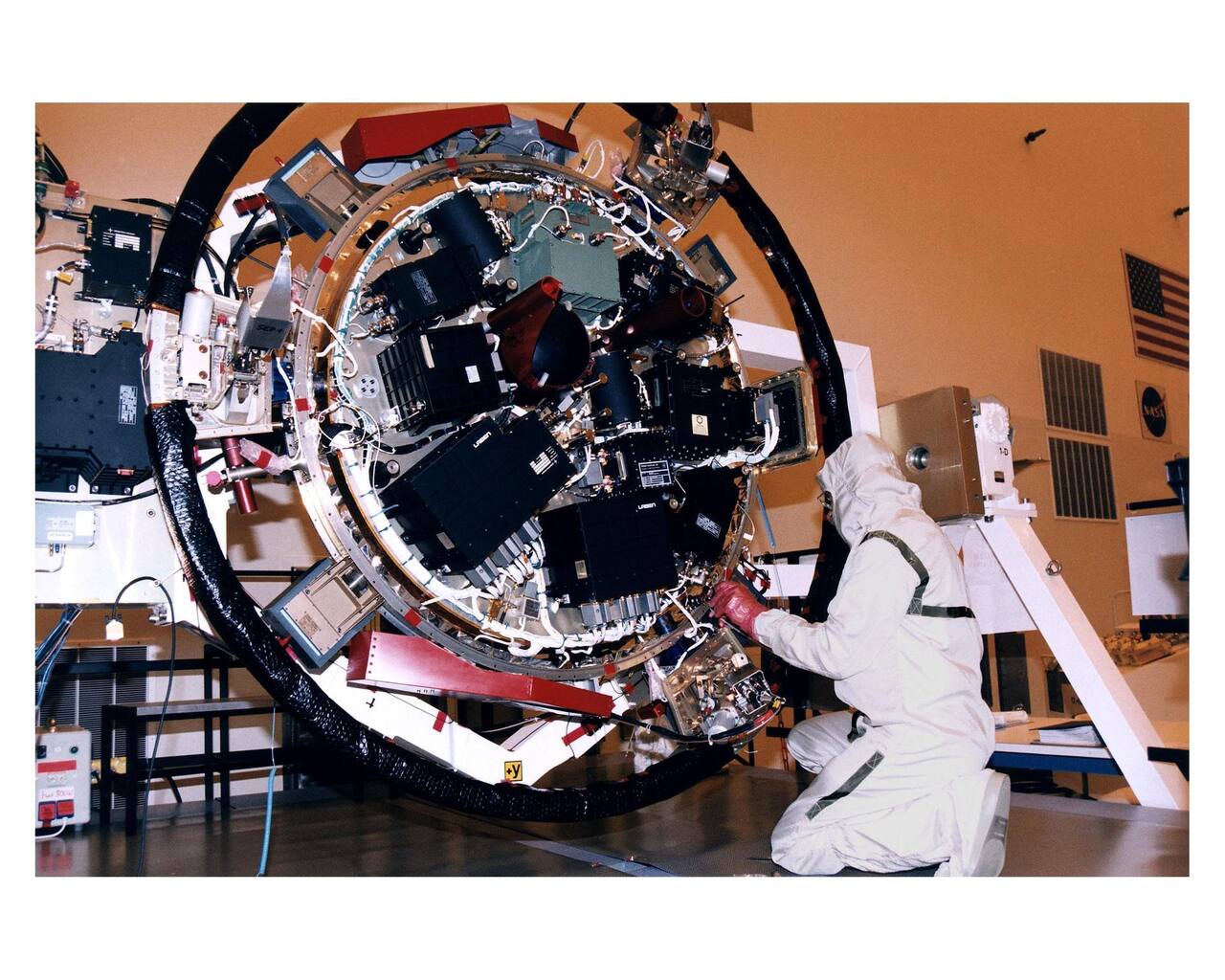 NASA. Public domain (NASA / US government work).
Overview
Section titled “Overview”Huygens was the European Space Agency’s atmospheric entry probe for Titan, carried to Saturn on NASA’s Cassini orbiter [3]. It remains the only spacecraft to have landed anywhere in the outer solar system and the only source of surface imagery from beyond the asteroid belt.
Specifications
Section titled “Specifications”| Parameter | Value | Source |
|---|---|---|
| Probe mass | 318 kg | |
| Front shield mass | 79 kg | |
| Back cover mass | about 16 kg, with a Prosial coating | |
| Probe support equipment left on the orbiter | 30 kg | |
| Instruments | 6, on a single platform inside a sealed, insulated shell | |
| Front shield sizing | heat flux of order 1 MW/m2 | |
| Parachutes | 3 disk-gap-band, deployed in sequence | [2], [8] |
| Parachute deployment trigger | sensed deceleration falling through 10 m/s2, then a 6.375 s timer to mortar fire | [8] |
Rows with no marker are from [2].
Mission profile
Section titled “Mission profile”| Parameter | Value | Source |
|---|---|---|
| Carrier | Cassini orbiter | |
| Release from Cassini | 25 December 2004 | |
| Entry | 14 January 2005, at 1270 km altitude and about 6 km/s | [3], [2], [8] |
| Deceleration to Mach 1.5 at about 160 km | roughly three minutes | [2] |
| Descent duration | about two and a half hours | |
| Surface transmission after touchdown | 70 minutes, ending when Cassini set below Titan’s horizon |
Rows with no marker are from [3].
Post-impact survival was explicitly not a design driver. The mission would have been counted a success with no data returned after touchdown, and the descent stack was sized for descent, not for landing [3]. That the probe survived and returned 70 minutes of surface data is a margin outcome rather than a designed capability.
Mobility
Section titled “Mobility”Huygens had no surface mobility. Its only controlled motion was descent rate, set by sequential parachute staging, and its passive dynamics after impact.
Entry was ballistic and unguided, into the atmosphere at 1270 km altitude at about 6 km/s, with the front shield sized for a heat flux on the order of 1 MW/m2 [8]. Deceleration to Mach 1.5 at about 160 km altitude took roughly three minutes. Parachute deployment was triggered by sensed acceleration: a g-trigger fired when deceleration fell through 10 m/s2, starting a 6.375 s timer, after which a mortar fired the pilot parachute through a breakout patch in the back cover [8]. Everything after that ran on a descent timer.
Three disk-gap-band parachutes were used in sequence [2], [8]:
| Stage | Diameter | Geometric porosity | Role |
|---|---|---|---|
| Pilot | 2.59 m | 13.1 percent | Extract back cover and pull out main |
| Main | 8.30 m | 22.4 percent | Slow through the stratosphere, about 15 minutes |
| Stabilizer | 3.03 m | 22.4 percent | Complete the descent within the battery lifetime |
Deployment timings relative to mortar fire were main deploy at 2.5 s, main inflation at 4.9 s, heat shield jettison at 32.5 s once the probe had slowed to about Mach 0.6, main release and stabilizer deploy at 900 s, and stabilizer inflation at 903.4 s [8]. The staging logic is the interesting part: the main parachute is too large to carry all the way down, because the descent would then outlast the batteries, and it is too small to be the only chute, because the probe must be pulled clear of the back cover first. Cutting to a smaller stabilizer chute at 15 minutes is a direct trade of descent-phase science time against total energy [8].
The stabilizer held terminal velocity at 4.5 m/s at impact, with a horizontal speed of about 1 m/s [11]. On contact the 200 kg probe dug a hole about 12 cm deep, producing a peak vertical deceleration of 120 m/s2, then bounced clear of the hole with a 0.4 s zero-g interval, slid 30 to 40 cm southward, and wobbled back and forth five times, with sensor evidence of motion up to about 10 s after impact. Reconstruction of the slide gives a total friction coefficient of 0.4, although this cannot be attributed to the surface alone because protruding structures, including the penetrometer standing 5.5 cm proud of the foredome, ploughed a 2 to 3 cm deep trench during the slide [11].
Descent dynamics were also a wind measurement. Doppler tracking and probe tilt together show large-scale wind shear up to about 5 m/s/km, within the pre-flight prediction of less than twice the Brunt-Vaisala frequency, and small-scale fluctuations of about 0.2 m/s below 4 km altitude, with a turbulent dissipation rate at 500 m of 16 cm2/s3 [4].
Power and energy
Section titled “Power and energy”Huygens ran entirely on primary batteries, because a solar array is useless at Titan and no radioisotope power source was carried. Five batteries, each of two modules of thirteen lithium sulfur dioxide cells of 7.6 A-h in series, fed a regulated 28 V main bus [2]. Nominal operational power was 300 W with a peak of 400 W. The capacity requirement was set from orbiter separation through to at least 30 minutes after landing.
This is the constraint that shapes the whole mission. Total mission duration is fixed at manufacture and cannot be extended, so the descent profile, the parachute staging, the instrument duty cycles and the surface phase all draw on the same fixed store. It is also why the coast between release from Cassini and entry is spent almost entirely dormant.
Thermal
Section titled “Thermal”Two distinct thermal regimes were designed for [2]. During the seven-year cruise and the 22-day coast after release, multi-layer insulation covered all external surfaces, 35 radioisotope heater units of about 1 W each supplied continuous heat, and a 0.17 m2 white-painted aluminum sheet acted as a controlled heat leak of about 8 W to prevent overheating.
During descent the problem inverts, the probe having to retain heat against a 94 K atmosphere at 1.5 bar, a far more aggressive convective environment than vacuum [2]: the internal walls were lined with lightweight open-cell Basotect foam, the shell was gas-tight apart from a single 6 cm2 pressure equalization hole in the top platform, and the seals were designed to minimize atmospheric influx. The front shield carried AQ60 tiles, a felt of silica fibers in phenolic resin, on a CFRP honeycomb structure, with Prosial, hollow silica spheres in a silicone elastomer, sprayed on the rear face for further insulation.
Compute and avionics
Section titled “Compute and avionics”Command and data management was fully dual redundant: two identical Command and Data Management Units running simultaneously, a triply redundant Mission Timer Unit, two mechanical g-switches as backup to the timer unit, a Central Acceleration Sensor Unit with redundant accelerometers, and two radar altimeter proximity sensors [2]. The Probe Onboard Software was written in Ada in a hierarchical modular design synchronized at 8 Hz, held in non-volatile EEPROM so that in-flight patches could be applied at power-up rather than by modifying RAM. Given a seven-year cruise with no possibility of interactive debugging, patchability without a live RAM write was the correct architecture.
Autonomy
Section titled “Autonomy”Huygens was fully autonomous in the sense that no command could reach it during the mission and no ground intervention was possible at any point. Cassini was over an hour of light time from Earth, and Huygens itself carried no receiver capable of accepting a descent command. The entire sequence was determined before release by the mission timer unit setting, with the parachute chain triggered by an acceleration threshold and then by elapsed time [8]. Fault response was therefore structural rather than algorithmic: redundant computers, redundant timers, mechanical g-switch backups to the electronic trigger, and two independent telemetry chains.
Communications
Section titled “Communications”There was no direct-to-Earth link. All data went to Cassini over an S-band relay, and the mission ended when the orbiter passed below Titan’s horizon [3]. Two hot-redundant S-band transmitters fed two circularly polarized probe antennas, Cassini received on its high gain antenna, and the Doppler Wind Experiment depended on a transmitter ultra-stable oscillator on the probe and a receiver ultra-stable oscillator on the orbiter, both implemented on Channel A only [2]. The two chains carried the same telemetry at two different RF frequencies, Channel A at 2040 MHz and Channel B at 2090 MHz, at a constant 8 kbit/s each, with Chain B delayed by about 6 seconds so that a transient link dropout while the probe swung under its parachute would not lose data outright [9].
Channel A was never received. A sequencing error left the 2040 MHz receiver on Cassini switched off, so although Huygens transmitted on Channel A throughout, nothing was recorded [9]. Because the two chains carried redundant telemetry, no measurement type was lost entirely, but only half of what was transmitted came back, including roughly half the descent images, and the orbiter-based Doppler Wind Experiment was lost outright because its oscillator pair existed only on the missing channel.
The experiment was recovered from the ground. A network of radio telescopes had been organized, in part by the Joint Institute for VLBI in Europe, to track the probe’s carrier directly for astrometry, with up to 17 antennas linked including five in Australia [9]. Parkes and Green Bank recorded the Channel A carrier from Earth, and those recordings salvaged the wind profile that Cassini failed to capture.
Two design lessons follow, and they are of opposite character. The redundancy architecture worked exactly as intended: a complete loss of one of two channels degraded the return rather than destroying it. The single-point failure was not in the hardware at all but in the command sequence that configured the receiving end, which was outside the redundancy scheme entirely.
Payload and instruments
Section titled “Payload and instruments”Six instruments on one platform [2]:
- HASI, the Huygens Atmospheric Structure Instrument. Physical profile of the atmosphere: accelerometers for the entry deceleration profile, and pressure, temperature and electrical property sensors during descent. Its accelerometer record is what reconstructs the impact and bounce [11].
- GCMS, the Gas Chromatograph Mass Spectrometer. Chemical composition of the atmosphere through descent and of the vapor above the surface after landing.
- ACP, the Aerosol Collector and Pyrolyser. Collected haze particles at two altitude ranges and heated them, feeding the products to GCMS, so that the composition of the aerosols themselves could be separated from the ambient gas.
- DISR, the Descent Imager/Spectral Radiometer. Imaging and spectrometry during descent and on the surface, with high, medium and low resolution imagers, upward and downward looking spectrometers, violet photometers and a surface science lamp. It produced the only surface imagery ever returned from the outer solar system, showing a drainage network terminating at a dark plain, and post-landing images of rounded decimetre-scale cobbles [10].
- DWE, the Doppler Wind Experiment. Zonal wind profile from the Doppler shift of the probe carrier, using the ultra-stable oscillator pair.
- SSP, the Surface Science Package. A cluster of sensors for the state and composition of the surface, including a penetrometer, a density sensor consisting of a small float on a strain gauge, two radially oriented tilt sensors using a conductive fluid slug in a vial, and acoustic and thermal sensors [2].
The SSP penetrometer produced the mission’s most quoted mechanical result and is worth stating precisely. It recorded a short, high force spike, corresponding to a bearing strength of about 500 kPa over an area of 1 to 2 cm2, followed by much lower resistance; the bulk deceleration of the 205 kg probe at about 18 g implies a peak force near 36 kN over of order 1 m2, that is about 50 kPa [11]. A thin, locally stiff layer over a much weaker substrate is the natural reading, and independent analysis of the same event infers a roughly 7 mm layer with mechanical properties similar to terrestrial snow. The dynamics constrain the material further: a viscous or plastic mud would have absorbed the impact with no rebound, so the surface must have had an elastic component, consistent with damp granular material. A transient dust cloud raised by the probe’s turbulent wake is visible in DISR spectra for the first four seconds after impact, with optical properties matching Titan’s atmospheric aerosols, which implies both a loose surface layer and the absence of strong surface wind.
Modes of operation
Section titled “Modes of operation”The probe was dormant through the seven-year cruise and through the 22-day coast after release from Cassini, waking on a preset mission timer [2]. Operating phases were then entry, when only HASI accelerometry ran; descent under main parachute, the highest data rate science phase; descent under stabilizer; and the surface phase, in which DISR switched to a surface mode using its lamp and the SSP and GCMS sampled the ground [2]. There was no safe mode in the usual sense, because there was no possibility of recovery and no communications path for a recovery command; the redundant timer chain simply continued.
Ground operations
Section titled “Ground operations”There were no ground operations during the mission. Everything after release was determined by the sequence loaded before separation, and by the corresponding sequence loaded on Cassini to configure the probe receivers, which is where the failure occurred [9]. Ground activity consisted of pre-release verification, the parallel Earth-based radio telescope campaign coordinated across Australia, China, Japan, the United States and Europe, and post-flight reconstruction. Much of what is now known about the landing came from that reconstruction, combining HASI, SSP and DISR records years after the event [11].
The mission’s most consequential ground operations episode predates arrival by five years: an in-flight test of the relay link in 2000 revealed that the Cassini receiver bandwidth could not accommodate the Doppler shift expected at the planned relay geometry, which forced a redesign of the Cassini trajectory and probe delivery to reduce relative velocity [9].
Technologies developed
Section titled “Technologies developed”The entry system is the most durable legacy. Huygens established the aerothermodynamic and parachute design case for Titan entry and is being used directly as the validation case for Dragonfly: the Huygens flight data set is the only in-atmosphere ground truth available, and Dragonfly’s atmosphere, gravity, parachute inflation and multi-body dynamics models are verified by re-flying the Huygens descent in simulation [8], [7].
Second, the descent data set is the environmental specification for every subsequent Titan mission. The wind profile, shear and turbulence statistics derived from Huygens are what later vehicles are designed against [4], the boundary layer structure and near-surface wind profile add a second, independent derivation from the same descent [13], and the surface mechanical properties from SSP constrain landing gear and sampling design.
Third, and negatively, the Channel A loss is a standard case study in the distinction between a redundant system and a redundant operation. Both probe transmit chains worked. The failure was in a ground-authored command sequence for the receiving spacecraft, a single item outside the redundancy boundary that the redundancy analysis did not cover.
References
Section titled “References”References
- European Space Agency. (2019). Cassini-Huygens Science Portal: Huygens Probe Engineering. sci.esa.int/web/cassini-huygens/-/33006-engineering
BibTeX
@misc{esa2019cassini, title = {Cassini-Huygens Science Portal: Huygens Probe Engineering}, author = {{European Space Agency}}, year = {2019}, url = {https://sci.esa.int/web/cassini-huygens/-/33006-engineering} } - Lebreton, J.-P., Witasse, O., Sollazzo, C., Blancquaert, T., Couzin, P., Schipper, A.-M., Jones, J. B. and Matson, D. L. (2005). An overview of the descent and landing of the Huygens probe on Titan
. Nature. Source
BibTeX
@article{lebreton2005overview, title = {An overview of the descent and landing of the Huygens probe on Titan}, author = {Lebreton, Jean-Pierre and Witasse, Olivier and Sollazzo, C. and Blancquaert, Thierry and Couzin, P. and Schipper, Anne-Marie and Jones, J. B. and Matson, D. L.}, journal = {Nature}, volume = {438}, pages = {758-764}, year = {2005}, doi = {10.1038/nature04347} } - Lorenz, R. D. (2017). Wind Shear and Turbulence on Titan: Huygens Analysis
. Icarus. Source
BibTeX
@article{lorenz2017wind, title = {Wind Shear and Turbulence on Titan: Huygens Analysis}, author = {Lorenz, Ralph D.}, journal = {Icarus}, volume = {295}, pages = {119--124}, year = {2017}, doi = {10.1016/j.icarus.2017.06.010} } - Pensado, A. R., Robb, C., Winski, R., Williams, J., Belair, M. W. and Lorenz, R. D. (2025). Assessing Huygens Probe Entry, Descent, and Landing at Titan Simulation using Dragonfly Atmosphere Model
. AIAA SCITECH Forum. Source
BibTeX
@inproceedings{pensado2025assessing, title = {Assessing Huygens Probe Entry, Descent, and Landing at Titan Simulation using Dragonfly Atmosphere Model}, author = {Pensado, Alejandro R. and Robb, Caleb and Winski, Richard and Williams, James and Belair, Michael W. and Lorenz, Ralph D.}, booktitle = {AIAA SCITECH Forum}, year = {2025}, doi = {10.2514/6.2025-2238}, abstract = {Dragonfly is a New Frontiers Program mission that will deliver a rotorcraft to Saturn’s moon, Titan. This mission follows Huygens as the previous mission that successfully landed a vehicle on Titan. A flight mechanics simulation of Dragonfly’s Entry, Descent, and Landing sequence has been developed using the Program to Optimize Simulated Trajectories II. The simulation incorporates several subsystem models, including aerodynamics, gravity, and mass properties, to fully capture the multi-body six degree of freedom dynamics. Among all the subsystem models that inform the Entry, Descent, and Landing dynamics, the atmosphere model of Titan is a critical component. The atmosphere model characterizes the density, temperature, pressure, and winds that the entry vehicle experiences during the descent. This impacts several aspects of the descent such as the peak heating, aerodynamics, parachute release conditions, the dynamics of the vehicle and parachutes, and the landing ellipse. In the course of developing Dragonfly, an updated model of the Titan atmosphere has been created corresponding to Dragonfly’s arrival in the mid-2030s, approximately one Titan year after the Huygens mission successfully landed a probe on Titan. This work leverages previous work done to investigate Huygens EDL sequence to assess the atmosphere model developed for Dragonfly. This is done by utilizing the updated Titan atmosphere model, the Dragonfly atmosphere model, within the Huygens POST2-based flight simulation with the goal of characterizing the differences between the atmospheric models and assessing how the Dragonfly atmosphere model impacts Huygens entry dynamics.} } - Robb, C., Pensado, A. R., Winski, R. G., Williams, J. W. and Manwell, M. (2026). Huygens Probe Entry, Descent, and Landing Dynamics Assessment Using a Multi-Body Parachute Model
. AIAA SCITECH Forum. Source
BibTeX
@inproceedings{robb2026huygens, title = {Huygens Probe Entry, Descent, and Landing Dynamics Assessment Using a Multi-Body Parachute Model}, author = {Robb, Caleb and Pensado, Alejandro R. and Winski, Richard G. and Williams, James W. and Manwell, Michael}, booktitle = {AIAA SCITECH Forum}, year = {2026}, doi = {10.2514/6.2026-1956}, abstract = {The Dragonfly project is a New Frontiers Program mission that is slated to launch in 2028 and deliver a rotorcraft to Titan, Saturn’s largest moon. With the launch date approaching, there is an increased focus on the validation and verification of models that are used by the trajectory simulations. One of the models that contributes the most to the uncertainty of the entry, descent, and landing simulation is the atmosphere. Since Huygens is the only mission that has collected in-situ measurements during a descent, a current plan for the validation of the atmosphere model centers around reconciling that flight data with the current atmosphere model used by the Dragonfly flight mechanics team. To complete this, a 6 degree-of-freedom, multi-body simulation has been created using the Program to Optimize Simulated Trajectories 2 (POST2), the prime simulation tool for Dragonfly Entry and Descent, to predict the dynamics of Huygens using the reconciled models. The dynamics predicted by the simulation are then compared to flight data where possible and the previous analysis that was published by the authors last year. Current results show agreement to the available flight data, with an emphasis placed on the metrics that were flagged in the last analysis. The reconciliation is set to continue as areas of concern will be reported and inspected by the model developer.} } - Sarkissian, J. M. (2012). Dishing up the Data: A Decade of Space Missions
. arXiv preprint. Source
BibTeX
@article{sarkissian2012dishing, title = {Dishing up the Data: A Decade of Space Missions}, author = {Sarkissian, John M.}, journal = {arXiv preprint}, year = {2012}, url = {https://arxiv.org/abs/1210.0980} } - Schröder, S. E. and Keller, H. U. (2008). The Reflectance Spectrum of Titan's Surface at the Huygens Landing Site Determined by the Descent Imager/Spectral Radiometer
. Planetary and Space Science. Source
BibTeX
@article{schroder2008reflectance, title = {The Reflectance Spectrum of Titan's Surface at the Huygens Landing Site Determined by the Descent Imager/Spectral Radiometer}, author = {Schröder, Stefan E. and Keller, Horst Uwe}, journal = {Planetary and Space Science}, volume = {56}, pages = {1246--1256}, year = {2008}, doi = {10.1016/j.pss.2007.10.011} } - Schröder, S. E., Karkoschka, E. and Lorenz, R. D. (2012). Bouncing on Titan: Motion of the Huygens Probe in the Seconds After Landing
. Planetary and Space Science, 1. Source
BibTeX
@article{schroder2012bouncing, title = {Bouncing on Titan: Motion of the Huygens Probe in the Seconds After Landing}, author = {Schröder, Stefan E. and Karkoschka, Erich and Lorenz, Ralph D.}, journal = {Planetary and Space Science}, volume = {73}, number = {1}, pages = {327--340}, year = {2012}, doi = {10.1016/j.pss.2012.08.007} } - Tokano, T., Ferri, F., Colombatti, G., Mäkinen, T. and Fulchignoni, M. (2006). Titan's planetary boundary layer structure at the Huygens landing site
. Journal of Geophysical Research: Atmospheres. Source
BibTeX
@article{tokano2006titan,
  title = {Titan's planetary boundary layer structure at the Huygens landing site},
  author = {Tokano, Tetsuya and Ferri, F. and Colombatti, Giacomo and Mäkinen, Teemu and Fulchignoni, M.},
  journal = {Journal of Geophysical Research: Atmospheres},
  volume = {111},
  year = {2006},
  doi = {10.1029/2006je002704},
  abstract = {Huygens Atmospheric Structure Instrument (HASI) for the first time performed an in situ measurement of the thermal structure in Titan's atmosphere with a vertical resolution sufficient to analyze the planetary boundary layer (PBL). The vertical potential temperature profile reveals the presence of a weakly convective PBL, with a surface layer thickness of 10 m and an outer layer with a depth of 300 m. With a mean eddy diffusivity of only ∼7.4 × 10 −3 m 2 s −1 , the turbulence in the PBL is weak. The turbulent heat flux in the surface layer was upward but tiny (∼0.02 W m −2 ), indicating that the ground surface was marginally warmer than the air. The surface heat flux is too small to cause a diurnal variation of the PBL except in the lowest few meters, so the observed profile may be a nearly steady state feature within this season at the landing site. In the surface layer the mean wind speed is likely to be less than 0.1 m s −1 . Given the tiny surface heat flux, the buoyant production of turbulence is very weak. The PBL structure reveals that the weather condition at the time and place of the Huygens landing resembles a calm, overcast day on Earth but is clearly different from the PBL typical for the polar night.}
}
Further reading
- Asmar, S. W. (2012). Communicating by doppler : detecting spacecraft dynamics during critical maneuvers . International Conference on Space Operations. Source
- Mischna, M. (2025). The Science of Entry, Descent, and Landing in the Venus, Jupiter, and Saturn Systems . Oxford Research Encyclopedia of Planetary Science. Source
- Justh, H. L. and Hoffman, J. (2020). Titan Global Reference Atmospheric Model (Titan-GRAM): User Guide . NASA Marshall Space Flight Center. Source
- Siddiqi, A. A. (2018). Beyond Earth: A Chronicle of Deep Space Exploration, 1958-2016 . NASA. Source
- (2026). ESA Science Portal: Cassini-Huygens. sci.esa.int/web/cassini-huygens