Venus Surface Environment
The Venus surface is about 460 C at about 90 bar of supercritical carbon dioxide with a sulfuric acid aerosol above it [1], which admits two design responses: a sealed, thermally isolated volume with a fixed lifetime, or electronics that operate at ambient temperature. The first has flown. The second has been demonstrated only in ground chambers, on single chips for up to 60 days and on one multi-chip board that failed [3][10][12]. Other extreme environments in the corpus (Titan, Europa) are covered at the end of the page, where the evidence is mostly models and concepts rather than hardware tests.
Evidence from the surface
Section titled “Evidence from the surface”The in-situ record is two point measurements from Venera 9 and 10 [13]. Panoramas and instruments there gave 730 to 740 K, 88 to 94 atm, wind of 0.5 to 1 m/s at 1 m above the surface, and hard rock rather than deep regolith, with a gamma densitometer reading of 2.8 plus or minus 0.1 g/cm3 [13]. The landers carried floodlights because natural illumination was expected to be low, and daylight overwhelmed them. Both landings were on the illuminated side at similar low elevations, so night and highland conditions are not constrained by these data [14].
Venus surface conditions
Section titled “Venus surface conditions”| Quantity | Value | Source |
|---|---|---|
| Surface temperature | about 460 C | [10] |
| Test reference condition | 465 C at 90 bar | [10] |
| Surface pressure | about 90 bar | [10] |
| Atmospheric density | 65 kg/m3 | [6] |
| Surface wind speed | 0.3 to 1.3 m/s, average 0.6 m/s | [6] |
| Diurnal cycle | 116 days; night exceeds 50 Earth days | [6] |
Atmospheric density of 65 kg/m3 is about 50 times Earth sea level air, so a 0.6 m/s wind carries useful force despite the low speed [6]. A Savonius rotor produces 3.18 W at the average wind speed. Solar cells have been tested at Venus temperature but work for only half the diurnal cycle, and the night side of that cycle exceeds 50 Earth days [6].
The chemistry is the part that is usually understated. The gas load used to reproduce Venus surface conditions on the ground is carbon dioxide with nitrogen and a set of trace species that attack materials:
| Species | Fraction in the ground simulation mixture |
|---|---|
| CO2 | 96.5 percent |
| N2 | 3.4 percent |
| SO2 | 130 ppm |
| COS | 27 ppm |
| CO | 15 ppm |
| H2O | 30 ppm |
| HCl | 0.5 ppm |
| NO | 5.5 ppb |
| HF | 5 ppb |
All values from [8]. At 460 C, common engineering materials including aluminum are unusable [6].
The recorded lifetime of the sealed-vessel approach
Section titled “The recorded lifetime of the sealed-vessel approach”Nine of the fourteen Soviet Venera and Vega landers reached the Venus surface, and those nine survived between 23 and 127 minutes before their electronics failed [6]. For a pre-chilled, insulated pressure vessel, lifetime is set by insulation mass and initial internal temperature. There is no repairable failure in that record; the vessel reaches ambient temperature and the electronics stop.
Venera 9 and 10 show the strategy at its best [14]. The lander was pre-cooled to between -8 and +10 C before separation, descended slowly through the cloud layer and fast through the hot lower atmosphere to limit soak time, and after 53 and 65 minutes on the surface had not exceeded 60 C internally with instruments working; the missions ended when the radio window closed, not on a thermal failure [14].
Reference atmosphere model
Section titled “Reference atmosphere model”Venus-GRAM is the engineering model. Its lower atmosphere, to 250 km, is the Venus International Reference Atmosphere; its thermosphere from 250 to 1000 km is an MSFC model assuming an isothermal profile initialized from VIRA conditions at 250 km [1].
Known limits of that model matter as much as its contents. The VIRA version included holds Pioneer Venus Orbiter and Probe data plus Venera probe data, but carries no solid planet model and no high resolution gravity model [1]. Venus density varies little over the solar cycle, so that effect is not represented in the VIRA data or in Venus-GRAM at all [1]. Mean zonal wind is taken from VIRA only up to 80 km; above that height the decrease in mean wind and the perturbation magnitudes are parameterized from published models rather than measured.
The 2021 rebuild replaced the custom ephemeris engine with the NAIF SPICE library, converted the code to a C++ framework, and dropped the constant ratio of specific heats that had overestimated the speed of sound by as much as 10 percent [1].
Ground simulation
Section titled “Ground simulation”The Glenn Extreme Environment Rig is the facility the endurance numbers below come from. It was operationally commissioned in November 2014 and has run more than 20 tests since spring 2015 [9]. The NASA Engineering and Safety Center review at the end of commissioning gives a 0.79 m3 vessel with a maximum allowable working pressure of 10.47 MPa at 538 C, commissioned at a Venus surface point of 470 C and 9.24 MPa in a nine species atmosphere [17]. A Glenn briefing reports over 90 days of cumulative operation at Venus conditions and lists an interior probe, an optical window and co-located mass spectrometer, gas chromatograph and FTIR as upgrades in progress, not demonstrated capabilities [16]. The safety review reports no test data and rests on a single day on site [17].
| Parameter | Value | Source |
|---|---|---|
| Vessel | 304 stainless steel, 3 ft internal diameter by 4 ft long, about 800 L | [8], [9] |
| Maximum rated conditions | 103 bar at about 530 C | [9] |
| Gas streams | 9, each handling pure or mixed gases | [8], [9] |
| Fill and heat-up | 4 working days | [9] |
| Cool-down | 10 working days | [9] |
| Chemistry verification | In-line gas chromatograph, with an on-site mass spectrometer available | [9] |
Reproducing temperature and pressure alone is not sufficient to qualify parts for a prolonged surface mission; the atmospheric chemistry has to be reproduced too [2]. That finding is what makes a facility with nine independently controlled gas streams necessary rather than an oven and a pressure vessel.
Customer interface limits set what can be tested. Proven feedthroughs carry plus or minus 24 VDC at single digit milliamps per wire, a higher capacity feedthrough has been shown only at 15 VDC and 1 A for 3 days, and up to 48 wires have run in one test; a test occupies at least 30 workdays, about six weeks [9]. Only three of seven 3 inch ports and both 4 inch ports are available to a customer [9].
Materials
Section titled “Materials”Bulk materials were exposed in the rig at 92 bar and 467 C in a nine component Venus gas mixture for 10 and 42 days [15]. Gold and four bulk ceramics (alumina, fused quartz, SiC and Si3N4) showed no measurable change, while the steels and the nickel alloys G30 and 625 grew double-layered oxide and sulfide scales. The longest exposure, 42 days, is short against a long-duration mission [15].
A 60 Earth-day package test in the same rig shows that passing materials do not guarantee a passing assembly [10]. A high temperature co-fired ceramic alumina package with co-fired platinum was exposed for 48 h in 465 C air, 48 h in 465 C nitrogen at 90 bar and 1400 h at 460 C and 92 bar in simulated Venus gas. The material system was stable and both packaged SiC circuits ran throughout, but insulation resistance fell from 384 MOhm to 448 kOhm in nitrogen alone, and reached a minimum of 721 Ohm under Venus conditions [10]. Post-test analysis found a platinum sulfide layer on the gold-coated bond pads. The test used two articles in one campaign, and the reported resistance includes the feedthrough wiring in parallel.
High temperature electronics
Section titled “High temperature electronics”The alternative to a sealed vessel is a wide bandgap semiconductor operating at ambient Venus temperature. The flight-relevant technology is the 4H-SiC junction field effect transistor integrated circuit [2].
| Generation | Transistors | Function | Gate length | Die | I/O pads | Source |
|---|---|---|---|---|---|---|
| 10 | 195 | 16-bit RAM | 6 um | 3 x 3 mm | 32 | [4], [3] |
| 10 | 175 | divide-by-2/4 clock | 6 um | 3 x 3 mm | 32 | [4], [3] |
| 11 | about 1000 | 120-bit RAM | 6 um | 4.65 x 4.65 mm | - | [3] |
| 12 | about 3000 | in fabrication | 3 um | 5 x 5 mm | - | [3] |
Generation 11 shrank the resistor width from 6 um to 3 um and demonstrated an 8-bit delta-sigma analog-to-digital converter and a 998-bit read-only memory at 500 C, but it yielded and endured worse than Generation 10: no Generation 11 RAM chip had all 120 bits working even at 25 C, and the chips reached about 1000 hours above 460 C rather than the year Generation 10 achieved [3].
Measured endurance
Section titled “Measured endurance”| Device | Continuous operation at 500 C in air | Source |
|---|---|---|
| RAM #2 | 10,100 h, 421 days | [4] |
| Clock #2 | 10,500 h | [4] |
| Clock #3A and #3B | 9677 h each | [4] |
| RAM #1 | 1525 h | [4] |
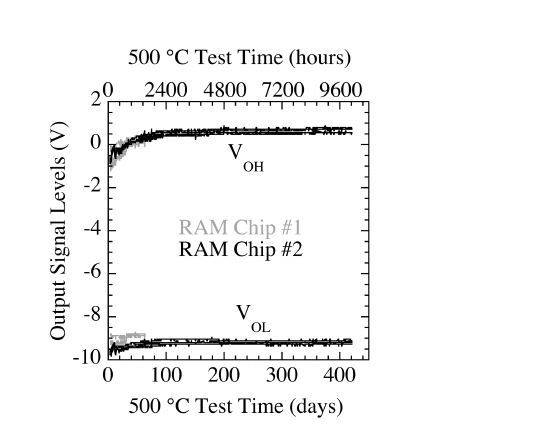
Source: [4]. Public domain (NASA).
Parameters stabilize 100 to 200 h after first power-on and then drift by under 5 percent for the remainder of the test [4]. Supplies are +25 V and -25 V, with logic high near 0 V and logic low near -10 V. Power at 500 C is 194 mW for the 16-bit RAM, split 116 mW from the positive rail and 78 mW from the negative, and 298 mW for the clock chip, split 185 mW and 113 mW.
The demonstrated temperature range runs from -190 C to a short-duration record of 961 C [4]. Endurance above 500 C is much shorter: at 700 C an MF NOR logic gate ran 142 h and ring oscillator integrated circuits ran under 15 h [5].
What limits it
Section titled “What limits it”The failure mechanism is not the semiconductor. At 500 C it is thermal-stress cracking of the SiO2 / Si3N4 / SiO2 passivation stack, which admits oxygen and oxidizes the TaSi2 metallization at the cracks; at 700 C the cracking is more extensive and propagates through the Metal 1 interconnect [5]. The passivation stack is 1 um TEOS LPCVD SiO2, 67 nm Si3N4 and 1 um TEOS LPCVD SiO2 [4]. Bond pads use a TaSi2/Pt/Ir/Pt stack capped with 1 um of electron-beam gold, with the same stack on the die backside. Packaging is high temperature co-fired ceramic composite with 32 I/O pins [5]. Process anneals are 1360 C in nitrogen for 100 h for dopant activation and 10 h in 96 percent N2 / 4 percent H2 at 500 C after processing [4].
Radiation tolerance is incidental but useful: room temperature testing took individual JFETs to over 7 Mrad(Si) total ionizing dose, and found single event upsets and transients only above a silicon linear energy transfer of about 9.6 MeV-cm2/mg [11]. For an interplanetary cruise the design environment remains the Badhwar-O’Neill galactic cosmic ray model [7].
Demonstrated operation in Venus conditions
Section titled “Demonstrated operation in Venus conditions”All entries below are ground chamber results. No SiC electronics has flown to Venus.
| Item | Duration in GEER | Source |
|---|---|---|
| Packaged SiC divide-by-2/4 clock IC, 465 C at 90 bar | 60 days | [10] |
| SO2 chemical microsensor platform | 60 days | [2] |
| Upscaled SiC integrated circuits | 60 days | [2] |
A sensor platform built on this technology is targeted at 60 Earth days or longer on the surface [2]. Power is a sodium sulfur battery, a chemistry with terrestrial history that was space qualified on STS-87 in November 1997 and has been operated at 460 C and 92 bar, assumed at 120 Wh/kg for design study purposes. Communications are planned around 10 MHz, demonstrated in 2019, rising to about 100 MHz [2]. None of this requires cooling or environmental sheltering.
A ten chip Generation 11 SiC board built as a lander sensor digitizer was run unsheltered in the rig at 460 C and 9.4 MPa for 11 days [12]. It stopped operating at 107 C during heat-up and produced no serial data, while a separate Generation 10 16-bit RAM functioned throughout. Only one of the ten chips had failed, traced to dielectric hillock defects from the wafer process, so the limiting factor at that maturity was process defect density rather than the device technology [12].
Other extreme environments
Section titled “Other extreme environments”Titan combines a 5.4 kg/m3, 94 K atmosphere with 1.35 m/s2 gravity, which drives the Dragonfly rotorcraft concept toward radioisotope power and a trickle-charged battery [19]. That source is a Phase A concept description with no rotor test at Titan conditions [19]. Titan-GRAM is the engineering atmosphere model for entry and vehicle design, and its quantities trace to Voyager-era radio science and spectral retrievals, with Cassini and Huygens data used only for secondary latitude corrections [21].
For Venus aerial platforms, a JPL aerobot telerobotics program described a phase-change balloon that oscillates about its condensation altitude and drifts with the zonal winds [18]. That paper states needs and planned experiments and reports no measured quantity [18].
For Europa, radiation dominates. Europa Clipper parts were total-dose tested to 300 krad(Si), and the project derived its enhanced low dose rate sensitivity test rate of about 45 mrad(Si)/s from the mission dose profile rather than using the 10 mrad(Si)/s default, because the default would take a year at that dose [20]. Samples of five per condition support screening, not statistical qualification [20].
What is not established
Section titled “What is not established”No Venus surface electronics exposure in the corpus exceeds 60 days, and the one multi-chip board test failed [10][12]. The reference atmosphere rests on Pioneer Venus and Venera data unchanged since 2005, with the profile above 250 km extrapolated [1]. The surface record is two illuminated-side landings [13][14]. The package insulation degradation is attributed to impurity reactions and surface deposition without demonstration, and the proposed surface encapsulation fix was not tested [10]. The facility documents are capability statements, with no reported chamber uniformity or stability figures [9]. Titan and Venus aerial platform entries are concepts or models without hardware tests at the stated conditions [18][19][21].
References
- Justh, H. L., Dwyer Cianciolo, A. M. and Hoffman, J. (2021). Venus Global Reference Atmospheric Model (Venus-GRAM): User Guide
. NASA Marshall Space Flight Center, NASA/TM-20210022168. Source
BibTeX
@techreport{justh2021venus, title = {Venus Global Reference Atmospheric Model (Venus-GRAM): User Guide}, author = {Justh, Hilary L. and Dwyer Cianciolo, Alicia M. and Hoffman, J.}, number = {NASA/TM-20210022168}, institution = {NASA Marshall Space Flight Center}, year = {2021}, url = {https://ntrs.nasa.gov/citations/20210022168}, abstract = {This Technical Memorandum (TM) presents the Venus Global Reference Atmospheric Model (Venus-GRAM) and the updated features of the GRAMs. Venus-GRAM is an engineering-oriented atmospheric model that estimates mean values and statistical variations of atmospheric properties for Venus. This TM summarizes the atmospheric data model in Venus-GRAM and provides a guide for the user to obtain, set up, and run the code in various configurations. Additional details regarding the Venus-GRAM input and output files and how to interpret Venus-GRAM results are also provided.} } - Hunter, G. W., Izenberg, N., Oleson, S. R., Newman, J. M., Gilmore, M., Jessup, K. L., Herrick, R., Balcerski, J., Colozza, A., Faller, B., Fincannon, J., Fittje, J., Gyekenyesi, J., Jones, R., Klefman, B., Landis, G., Martini, M., McCarty, S., Packard, T., Smith, D. and Turnbull, E. (2020). Compass Final Report: Venus Bridge Orbiter and Surface Study (V-BOSS)
. NASA Glenn Research Center, NASA/TP-2020-220152. Source
BibTeX
@techreport{hunter2020compass, title = {Compass Final Report: Venus Bridge Orbiter and Surface Study (V-BOSS)}, author = {Hunter, Gary W. and Izenberg, Noam and Oleson, Steven R. and Newman, J. M. and Gilmore, Martha and Jessup, Kandis Lea and Herrick, Robert and Balcerski, Jeffrey and Colozza, Anthony and Faller, Brent and Fincannon, James and Fittje, James and Gyekenyesi, John and Jones, Robert and Klefman, Brandon and Landis, Geoffrey and Martini, Michael and McCarty, Steven and Packard, Thomas and Smith, David and Turnbull, Elizabeth}, number = {NASA/TP-2020-220152}, institution = {NASA Glenn Research Center}, year = {2020}, url = {https://ntrs.nasa.gov/citations/20200013062}, abstract = {The Venus Bridge Orbiter and Surface Study (V-BOSS) Compass concurrent engineering design team study shows that new, high-priority Venus science can be achieved using a linked Orbiter + Surface Element (Lander) mission concept within a $200M cost cap with assumptions. This is feasible through optimizing investment in early technologies and platforms, such as the Long-Lived In-Situ Solar System Explorer (LLISSE), leveraging known and flight-ready technology, and the overall use of simple, small, robust systems in innovative approaches to Venus exploration. This architecture allows a range of science investigations through modification of Orbiter-Lander platforms in this study through choice of other instruments (often sensors), science themes, or operational modes. In particular, a fundamental strength of this approach is to provide science not available in other ways by using simplified architectures including rugged systems operable in-situ on the Venus surface. Such investigations would be pathfinders for more complex, and more expensive, future missions. Additionally, the results of this study can be used to further champion the need, value and return of early investment technology programs for the hard problem of in-situ investigations at Venus.} } - Neudeck, P. G., Spry, D. J., Krasowski, M. J., Chen, L., Greer, L. C., Chang, C. W., Lukco, D., Beheim, G. M. and Prokop, N. F. (2021). Upscaling of 500 C Durable SiC JFET-R Integrated Circuits
. International Conference and Exhibition on High Temperature Electronics. Source
BibTeX
@inproceedings{neudeck2021upscaling, title = {Upscaling of 500 C Durable SiC JFET-R Integrated Circuits}, author = {Neudeck, Philip G. and Spry, David J. and Krasowski, Michael J. and Chen, Liangyu and Greer, Lawrence C. and Chang, Carl W. and Lukco, Dorothy and Beheim, Glenn M. and Prokop, Norman F.}, booktitle = {International Conference and Exhibition on High Temperature Electronics}, volume = {2021}, pages = {000064-000068}, year = {2021}, doi = {10.4071/2380-4491.2021.hitec.000064}, abstract = {Abstract At HiTEC 2018, NASA Glenn Research Center reported the first demonstration of yearlong 500 °C operation of ceramic-packaged “Generation 10” ~200-transistor integrated circuits (ICs) based on two-level interconnect silicon carbide (4H-SiC) junction field effect transistors and resistors (JFET-R). This HiTEC 2021 submission updates on-going efforts at NASA Glenn spanning two subsequent prototype IC generations “11 and 12” to increase both complexity and durability of these ICs. Increased chip complexities of around 1000 transistors/chip for Gen. 11 and near 3000 transistors/chip for Gen. 12 are made possible by reductions in minimum layout feature sizes (including resistor width shrinkage from 6 μm to 2 μm) coupled with enlarged die size (from 3 × 3 mm to 5 × 5 mm). Gen. 11 ICs electrically tested to date include an 8-bit delta-sigma analog to digital converter (ADC) as well as upscaled random access memory (RAM) and nearly 1 kbit read only memory (ROM). However, Gen. 11 prototype ICs exhibited significantly lower yield and durability than Gen. 10 ICs. Development of revised processing is being investigated towards mitigating these issues in subsequent Gen. 12 fabrication run currently in progress.} } - Neudeck, P. G., Spry, D. J., Krasowski, M. J., Prokop, N. F., Beheim, G. M., Chen, L.-Y. and Chang, C. W. (2018). Yearlong 500 C Operational Demonstration of Up-scaled 4H-SiC JFET Integrated Circuits
. Additional Conferences. Source
BibTeX
@inproceedings{neudeck2018yearlong, title = {Yearlong 500 C Operational Demonstration of Up-scaled 4H-SiC JFET Integrated Circuits}, author = {Neudeck, Philip G. and Spry, David J. and Krasowski, Michael J. and Prokop, Norman F. and Beheim, Glenn M. and Chen, Liang-Yu and Chang, Carl W.}, booktitle = {Additional Conferences}, volume = {2018}, pages = {000071-000078}, year = {2018}, doi = {10.4071/2380-4491-2018-hiten-000071}, abstract = {Abstract This work describes recent progress in the design, processing, and testing of significantly up-scaled 500 °C durable 4H-SiC junction field effect transistor (JFET) integrated circuit (IC) technology with two-level interconnect undergoing development at NASA Glenn Research Center. For the first time, stable electrical operation of semiconductor ICs for over one year at 500 °C in air atmosphere is reported. These groundbreaking durability results were attained on two-level interconnect JFET demonstration ICs with 175 or more transistors on each chip. This corresponds to a more than 7-fold increase in 500 °C-durable circuit complexity from the 24 transistor ring oscillator ICs reported at HiTEC 2016 [1]. These results advance the technology foundation for realizing long-term durable 500 °C ICs with increased functional capability for combustion engine sensing and control, planetary exploration, deep-well drilling monitoring, and other harsh-environment applications.} } - Neudeck, P. G., Spry, D. J., Chen, L., Lukco, D., Chang, C. W. and Beheim, G. M. (2017). Experimentally Observed Electrical Durability of 4H-SiC JFET ICs Operating from 500 C to 700 C
. Materials Science Forum. Source
BibTeX
@inproceedings{neudeck2017experimentally, title = {Experimentally Observed Electrical Durability of 4H-SiC JFET ICs Operating from 500 C to 700 C}, author = {Neudeck, Philip G. and Spry, David J. and Chen, Liangyu and Lukco, Dorothy and Chang, Carl W. and Beheim, Glenn M.}, booktitle = {Materials Science Forum}, volume = {897}, pages = {567-570}, year = {2017}, doi = {10.4028/www.scientific.net/msf.897.567}, abstract = {Prolonged 500 °C to 700 °C electrical testing data from 4H-SiC junction field effect transistor (JFET) integrated circuits (ICs) are combined with post-testing microscopic studies in order to gain more comprehensive understanding of the durability limits of the present version of NASA Glenn's extreme temperature microelectronics technology. The results of this study support the hypothesis that T ≥ 500 °C durability-limiting IC failure initiates with thermal stress-related crack formation where dielectric passivation layers overcoat micron-scale vertical features including patterned metal traces.} } - Sauder, J., Hilgemann, E., Johnson, M., Parness, A., Bienstock, B., Hall, J., Kawata, J. and Stack, K. (2017). Automaton Rover for Extreme Environments
. NASA Jet Propulsion Laboratory, 20170002798. Source
BibTeX
@techreport{sauder2017automaton, title = {Automaton Rover for Extreme Environments}, author = {Sauder, Jonathan and Hilgemann, Evan and Johnson, Michael and Parness, Aaron and Bienstock, Bernie and Hall, Jeffery and Kawata, Jessie and Stack, Kathryn}, number = {20170002798}, institution = {NASA Jet Propulsion Laboratory}, year = {2017}, url = {https://ntrs.nasa.gov/citations/20170002798}, abstract = {Almost 2,300 years ago the ancient Greeks built the Antikythera automaton. This purely mechanical computer accurately predicted past and future astronomical events long before electronics existed1. Automata have been credibly used for hundreds of years as computers, art pieces, and clocks. However, in the past several decades automata have become less popular as the capabilities of electronics increased, leaving them an unexplored solution for robotic spacecraft. The Automaton Rover for Extreme Environments (AREE) proposes an exciting paradigm shift from electronics to a fully mechanical system, enabling longitudinal exploration of the most extreme environments within the solar system. } } - O'Neill, P. M., Golge, S. and Slaba, T. C. (2015). Badhwar-O'Neill 2014 Galactic Cosmic Ray Flux Model Description
. NASA. Source
BibTeX
@techreport{nasa2014implementing, title = {Badhwar-O'Neill 2014 Galactic Cosmic Ray Flux Model Description}, author = {O'Neill, P. M. and Golge, S. and Slaba, T. C.}, institution = {NASA}, year = {2015}, url = {https://ntrs.nasa.gov/citations/20150003026}, abstract = {For the analysis of radiation risks to astronauts and planning exploratory space missions, accurate energy spectrum of galactic cosmic radiation (GCR) is necessary. Characterization of the ionizing radiation environment is challenging because the interplanetary plasma and radiation fields are modulated by solar disturbances and the radiation doses received by astronauts in interplanetary space are likewise influenced. A model of the Badhwar‐O'Neill 2011 (BO11) GCR environment, which is represented by GCR deceleration potential theta, has been derived by utilizing all of the GCR measurements from balloons, satellites, and the newer NASA Advanced Composition Explorer (ACE). In the BO11 model, the solar modulation level is derived from the mean international sunspot numbers with time‐delay, which has been calibrated with actual flight instrument measurements to produce better GCR flux data fit during solar minima. GCR fluxes provided by the BO11 model were compared with various spacecraft measurements at 1 AU, and further comparisons were made for the tissue equivalent proportional counters measurements at low Earth orbits using the high‐charge and energy transport (HZETRN) code and various GCR models. For the comparison of the absorbed dose and dose equivalent calculations with the measurements by Radiation Assessment Detector (RAD) at Gale crater on Mars, the intensities and energies of GCR entering the heliosphere were calculated by using the BO11 model, which accounts for time‐dependent attenuation of the local interstellar spectrum of each element. The BO11 model, which has emphasized for the last 24 solar minima, showed in relatively good agreement with the RAD data for the first 200 sols, but it was resulted in to be less well during near the solar maximum of solar cycle 24 due to subtleties in the changing heliospheric conditions. By performing the error analysis of the BO11 model and the optimization in reducing overall uncertainty, the resultant BO13 model corrects the fit at solar maxima as well as being accurate at solar minima. The BO13 model is implemented to the NASA Space Cancer Risk model for the assessment of radiation risks. Overall cumulative probability distribution of solar modulation parameters represents the percentile rank of the average interplanetary GCR environment, and the probabilistic radiation risks can be assessed for various levels of GCR environment to support mission design and operational planning for future manned space exploration missions.} } - Kremic, T., Vento, D., Lalli, N. and Palinski, T. (2014). Extreme Environment Simulation - Current and New Capabilities to Simulate Venus and Other Planetary Bodies
. IEEE Aerospace Conference, 20140013390. Source
BibTeX
@inproceedings{kremic2014extreme, title = {Extreme Environment Simulation - Current and New Capabilities to Simulate Venus and Other Planetary Bodies}, author = {Kremic, Tibor and Vento, Dan and Lalli, Nick and Palinski, Timothy}, booktitle = {IEEE Aerospace Conference}, number = {20140013390}, pages = {1-9}, institution = {NASA}, year = {2014}, doi = {10.1109/aero.2014.6836350}, abstract = {Science, technology, and planetary mission communities have a growing interest in components and systems that are capable of working in extreme (high) temperature and pressure conditions. Terrestrial applications range from scientific research, aerospace, defense, automotive systems, energy storage and power distribution, deep mining and others. As the target environments get increasingly extreme, capabilities to develop and test the sensors and systems designed to operate in such environments will be required. An application of particular importance to the planetary science community is the ability for a robotic lander to survive on the Venus surface where pressures are nearly 100 times that of Earth and temperatures approach 500C. The scientific importance and relevance of Venus missions are stated in the current Planetary Decadal Survey. Further, several missions to Venus were proposed in the most recent Discovery call. Despite this interest, the ability to accurately simulate Venus conditions at a scale that can test and validate instruments and spacecraft systems and accurately simulate the Venus atmosphere has been lacking. This paper discusses and compares the capabilities that are known to exist within and outside the United States to simulate the extreme environmental conditions found in terrestrial or planetary surfaces including the Venus atmosphere and surface. The paper then focuses on discussing the recent additional capability found in the NASA Glenn Extreme Environment Rig (GEER). The GEER, located at the NASA Glenn Research Center in Cleveland, Ohio, is designed to simulate not only the temperature and pressure extremes described, but can also accurately reproduce the atmospheric compositions of bodies in the solar system including those with acidic and hazardous elements. GEER capabilities and characteristics are described along with operational considerations relevant to potential users. The paper presents initial operating results and concludes with a sampling of investigations or tests that have been requested or expected.} } - Beckley, B. W., Motil, C. A., Henry, I. M., Chi, I. S. and Sprouse, M. D. (2024). Glenn Extreme Environments Rig (GEER) Facility Users Guide
. Planetary Science Technology Symposium, 20240012869. Source
BibTeX
@inproceedings{beckley2024glenn, title = {Glenn Extreme Environments Rig (GEER) Facility Users Guide}, author = {Beckley, Blake W. and Motil, Craig A. and Henry, Ian M. and Chi, Ike S. and Sprouse, Mark D.}, booktitle = {Planetary Science Technology Symposium}, number = {20240012869}, institution = {NASA}, address = {Cleveland, OH}, year = {2024}, url = {https://ntrs.nasa.gov/citations/20240012869}, abstract = {The Glenn Extreme Environment Rig (GEER) is a large capacity pressure vessel capable of simulating high pressure and temperature conditions with a specified, custom mixture of gas. The chamber is certified for operation in physical and chemical conditions representative of the surface conditions of Venus. It can accommodate large scientific or engineering test articles while maintaining the specified conditions indefinitely. The user-configurable gas supply is capable of handling a mixture of up to nine independent streams for injection directly into the vessel. GEER is supported in part by NASA’s Planetary Science Division under the Science Mission Directorate and is available for use by the commercial, academic, and research communities. GEER was operationally commissioned in November of 2014. At that time, it successfully maintained the temperature, pressure, and chemistry of the Venus surface atmosphere. In the spring of 2015, GEER began operations for engineering and scientific research. Since then, over 20 tests have been successfully conducted in the chamber with a variety of atmospheric test conditions.} } - Chen, L.-Y., Neudeck, P. G., Meredith, R. D., Lukco, D., Spry, D. J., Nakley, L. M., Phillips, K. G., Beheim, G. M. and Hunter, G. W. (2018). Sixty Earth-Days Test of a Prototype Pt/HTCC Alumina Package in Simulated Venus Environment
. Additional Conferences, 20180006758. Source
BibTeX
@inproceedings{chen2018sixty, title = {Sixty Earth-Days Test of a Prototype Pt/HTCC Alumina Package in Simulated Venus Environment}, author = {Chen, Liang-Yu and Neudeck, Philip G. and Meredith, Roger D. and Lukco, Dorothy and Spry, David J. and Nakley, Leah M. and Phillips, Kyle G. and Beheim, Glenn M. and Hunter, Gary W.}, booktitle = {Additional Conferences}, volume = {2018}, number = {20180006758}, pages = {000015-000021}, institution = {NASA}, address = {Albuquerque, New Mexico}, year = {2018}, doi = {10.4071/2380-4491-2018-hiten-0000015}, abstract = {Abstract This paper presents experimental results of a prototype high temperature co-fired ceramic (HTCC) package with Au/Pt metallization in a three-phase harsh environment test that culminated with 60-day demonstration in simulated Venus surface environment of 465 °C with corrosive atmosphere at 90 bar pressure. The prototype package is based on previously developed and reported HTCC package successfully tested with multiple analog and digital silicon carbide (SiC) high temperatures semiconductor integrated circuits (ICs) at NASA Glenn Research Center in 500 °C Earth air ambient for over ten thousands hours, and short-term tested at temperatures above 800 °C. The three-phase harsh environment test started with 48 hours in 465 °C Earth air, followed by 48 hours in 465 °C nitrogen at 90 bar pressure and 1400 hours in simulated Venus surface environment of 465 °C with corrosive atmosphere at 90 bar. Initial analytical results of the package materials and surfaces after exposure to Venus environment are discussed to assess the stability of the packaging materials in the tested environments. The test in simulated Venus environment was implemented in the NASA Glenn Extreme Environment Rig (GEER). The results of this study suggest that an effective encapsulation of areas of surface metallization and vicinities may help to improve electrical performance of a HTCC alumina packaging system in Venus environment.} } - Lauenstein, J.-M., Neudeck, P. G., Ryder, K. L., Wilcox, E. P., Chen, L., Carts, M. A., Wrbanek, S. Y. and Wrbanek, J. D. (2019). Room Temperature Radiation Testing of a 500 C Durable 4H-SiC JFET Integrated Circuit Technology
. IEEE Nuclear and Space Radiation Effects Conference. Source
BibTeX
@inproceedings{lauenstein2019room, title = {Room Temperature Radiation Testing of a 500 C Durable 4H-SiC JFET Integrated Circuit Technology}, author = {Lauenstein, Jean-Marie and Neudeck, Philip G. and Ryder, Kaitlyn L. and Wilcox, Edward P. and Chen, Liangyu and Carts, Martin A. and Wrbanek, Susan Y. and Wrbanek, John D.}, booktitle = {IEEE Nuclear and Space Radiation Effects Conference}, pages = {1-7}, year = {2019}, doi = {10.1109/redw.2019.8906528}, abstract = {Total ionizing dose (TID) and single-event effect (SEE) room-temperature radiation test results are presented for developmental prototype 4H-SiC junction field effect transistor (JFET) semiconductor integrated circuits (ICs) that have demonstrated prolonged operation in extremely high-temperature (500 °C) environments. The devices tested demonstrated over 7 Mrad(Si) TID tolerance and no destructive SEE susceptibility.} } - Neudeck, P. G., Chen, L., Greer, L. C., Spry, D. J., Prokop, N. F., Lukco, D., Krasowski, M. J. and Hunter, G. W. (2024). Venus Surface Environmental Chamber Test of SiC JFET-R Multi-Chip Circuit Board
. Solid State Phenomena. Source
BibTeX
@article{neudeck2024venus, title = {Venus Surface Environmental Chamber Test of SiC JFET-R Multi-Chip Circuit Board}, author = {Neudeck, Philip G. and Chen, Liangyu and Greer, Lawrence C. and Spry, David J. and Prokop, Norman F. and Lukco, Dorothy and Krasowski, Michael J. and Hunter, Gary W.}, journal = {Solid State Phenomena}, volume = {358}, pages = {7--12}, year = {2024}, doi = {10.4028/p-u3mieo}, abstract = {This paper describes a first attempt to build and operate a multi-chip prototype lander control and sensor signal digitization electronics circuit board comprised of ten NASA Glenn IC Generation 11 SiC JFET-R IC chips in 460 °C, 9.4 MPa harsh Venus surface conditions. The lander circuit ceased electrical operation prematurely at 107 °C as the Venus chamber heated up. Microscopic post-test inspections indicate that only one of the ten SiC chips on the board failed. Most of circuit-damaging cracks observed on the failed chip corresponded to micron-scale irregularly-shaped dielectric film hillock defects. The study of these defects suggests minor processing changes to eliminate this suspected root failure cause.} } - Florensky, C. P., Ronca, L. B., Basilevsky, A. T., Burba, G. A., Nikolaeva, O. V., Pronin, A. A., Trakhtman, A. M., Volkov, V. P. and Zazetsky, V. V. (1977). The Surface of Venus as Revealed by Soviet Venera 9 and 10
. Geological Society of America Bulletin, 11. Source
BibTeX
@article{florensky1977surface, title = {The Surface of {Venus} as Revealed by {Soviet} {Venera} 9 and 10}, author = {Florensky, C. P. and Ronca, L. B. and Basilevsky, Alexander T. and Burba, G. A. and Nikolaeva, O. V. and Pronin, A. A. and Trakhtman, A. M. and Volkov, V. P. and Zazetsky, V. V.}, journal = {Geological Society of America Bulletin}, volume = {88}, number = {11}, pages = {1537--1545}, year = {1977}, doi = {10.1130/0016-7606(1977)88<1537:tsovar>2.0.co;2}, abstract = {Research Article| November 01, 1977 The surface of Venus as revealed by Soviet Venera 9 and 10 C. P. FLORENSKY; C. P. FLORENSKY 1V. I. Vernadsky Institute of Geochemistry and Analytical Chemistry, Academy of Sciences of the USSR, 47-a Vorobjovskoe Shosse, Moscow 117334, USSR Search for other works by this author on: GSW Google Scholar L. B. RONCA; L. B. RONCA 1V. I. Vernadsky Institute of Geochemistry and Analytical Chemistry, Academy of Sciences of the USSR, 47-a Vorobjovskoe Shosse, Moscow 117334, USSR Search for other works by this author on: GSW Google Scholar A. T. BASILEVSKY; A. T. BASILEVSKY 1V. I. Vernadsky Institute of Geochemistry and Analytical Chemistry, Academy of Sciences of the USSR, 47-a Vorobjovskoe Shosse, Moscow 117334, USSR Search for other works by this author on: GSW Google Scholar G. A. BURBA; G. A. BURBA 1V. I. Vernadsky Institute of Geochemistry and Analytical Chemistry, Academy of Sciences of the USSR, 47-a Vorobjovskoe Shosse, Moscow 117334, USSR Search for other works by this author on: GSW Google Scholar O. V. NIKOLAEVA; O. V. NIKOLAEVA 1V. I. Vernadsky Institute of Geochemistry and Analytical Chemistry, Academy of Sciences of the USSR, 47-a Vorobjovskoe Shosse, Moscow 117334, USSR Search for other works by this author on: GSW Google Scholar A. A. PRONIN; A. A. PRONIN 1V. I. Vernadsky Institute of Geochemistry and Analytical Chemistry, Academy of Sciences of the USSR, 47-a Vorobjovskoe Shosse, Moscow 117334, USSR Search for other works by this author on: GSW Google Scholar A. M. TRAKHTMAN; A. M. TRAKHTMAN 1V. I. Vernadsky Institute of Geochemistry and Analytical Chemistry, Academy of Sciences of the USSR, 47-a Vorobjovskoe Shosse, Moscow 117334, USSR Search for other works by this author on: GSW Google Scholar V. P. VOLKOV; V. P. VOLKOV 1V. I. Vernadsky Institute of Geochemistry and Analytical Chemistry, Academy of Sciences of the USSR, 47-a Vorobjovskoe Shosse, Moscow 117334, USSR Search for other works by this author on: GSW Google Scholar V. V. ZAZETSKY V. V. ZAZETSKY 1V. I. Vernadsky Institute of Geochemistry and Analytical Chemistry, Academy of Sciences of the USSR, 47-a Vorobjovskoe Shosse, Moscow 117334, USSR Search for other works by this author on: GSW Google Scholar Author and Article Information C. P. FLORENSKY 1V. I. Vernadsky Institute of Geochemistry and Analytical Chemistry, Academy of Sciences of the USSR, 47-a Vorobjovskoe Shosse, Moscow 117334, USSR L. B. RONCA 1V. I. Vernadsky Institute of Geochemistry and Analytical Chemistry, Academy of Sciences of the USSR, 47-a Vorobjovskoe Shosse, Moscow 117334, USSR A. T. BASILEVSKY 1V. I. Vernadsky Institute of Geochemistry and Analytical Chemistry, Academy of Sciences of the USSR, 47-a Vorobjovskoe Shosse, Moscow 117334, USSR G. A. BURBA 1V. I. Vernadsky Institute of Geochemistry and Analytical Chemistry, Academy of Sciences of the USSR, 47-a Vorobjovskoe Shosse, Moscow 117334, USSR O. V. NIKOLAEVA 1V. I. Vernadsky Institute of Geochemistry and Analytical Chemistry, Academy of Sciences of the USSR, 47-a Vorobjovskoe Shosse, Moscow 117334, USSR A. A. PRONIN 1V. I. Vernadsky Institute of Geochemistry and Analytical Chemistry, Academy of Sciences of the USSR, 47-a Vorobjovskoe Shosse, Moscow 117334, USSR A. M. TRAKHTMAN 1V. I. Vernadsky Institute of Geochemistry and Analytical Chemistry, Academy of Sciences of the USSR, 47-a Vorobjovskoe Shosse, Moscow 117334, USSR V. P. VOLKOV 1V. I. Vernadsky Institute of Geochemistry and Analytical Chemistry, Academy of Sciences of the USSR, 47-a Vorobjovskoe Shosse, Moscow 117334, USSR V. V. ZAZETSKY 1V. I. Vernadsky Institute of Geochemistry and Analytical Chemistry, Academy of Sciences of the USSR, 47-a Vorobjovskoe Shosse, Moscow 117334, USSR Publisher: Geological Society of America First Online: 01 Jun 2017 Online ISSN: 1943-2674 Print ISSN: 0016-7606 Geological Society of America GSA Bulletin (1977) 88 (11): 1537–1545. https://doi.org/10.1130/0016-7606(1977)88<1537:TSOVAR>2.0.CO;2 Article history First Online: 01 Jun 2017 Cite View This Citation Add to Citation Manager Share Icon Share Facebook Twitter LinkedIn MailTo Tools Icon Tools Get Permissions Search Site Citation C. P. FLORENSKY, L. B. RONCA, A. T. BASILEVSKY, G. A. BURBA, O. V. NIKOLAEVA, A. A. PRONIN, A. M. TRAKHTMAN, V. P. VOLKOV, V. V. ZAZETSKY; The surface of Venus as revealed by Soviet Venera 9 and 10. GSA Bulletin 1977;; 88 (11): 1537–1545. doi: https://doi.org/10.1130/0016-7606(1977)88<1537:TSOVAR>2.0.CO;2 Download citation file: Ris (Zotero) Refmanager EasyBib Bookends Mendeley Papers EndNote RefWorks BibTex toolbar search Search Dropdown Menu toolbar search search input Search input auto suggest filter your search All ContentBy SocietyGSA Bulletin Search Advanced Search Abstract The soft landers Venera 9 and 10 transmitted information to Earth about conditions on the surface of Venus. Temperature measurements in both locations ranged from 730° to 740°K, and pressure measurements ranged from 88 to 94 atm. Wind velocities were 0.5 to 1 m/sec. The radioactive content of material below the spacecraft was similar to that of Earth's basalt. The hardness of some of the formations was estimated to be comparable to Earth's hard rocks. The density of a hard formation was measured by Venera 10 to be 2.8 ± 0.1 g/cm3.Panoramic television cameras provided photographs of the landing areas. The types of computer enhancements to which the photographs were subjected are briefly discussed.Venera 9 landed on a slope composed of slabs and a fine-grained matrix; Venera 10 landed on a plain composed of scattered outcrops separated by a fine-grained matrix. Detailed descriptions of the landing areas are presented.The available chemical and dynamic information about the conditions at the surface of the planet indicates that the atmosphere has a high efficiency in lifting and transporting loose small particles but that very little ablation of hard material is to be expected.Assuming thermodynamic equilibrium between atmosphere and surface materials, solid-gas interaction may occur and produce some disintegration of hard rocks and (or) some lithification of loose material, respectively by the increase in volume of newly formed minerals and by the formation of films or crusts. A vertical thermal gradient and vertical movements of gases or rocks are necessary. It is concluded, however, that the scale of chemical changes may be limited.The photographs show that at least two types of geomorphic degradation occur. The slabs of Venera 9 appear to be mass wasting downhill, and the outcrops of Venera 10 show evidence of rounding of corners and smoothing of surfaces. The mass wasting is likely to be caused by gravity and perhaps activated by quakes or other geologic processes. The rounding and smoothing processes are probably due to some atmospheric action.Six possible origins of the slabs and outcrops are discussed: (1) surface lava extrusion, (2) igneous intrusion later exposed by erosion, (3) pyroclastic fall, (4) impact lithification, (5) sedimentary rock lithified at depth and later exposed by erosion, and (6) lithification (or metamorphism) of loose material by atmospheric action at the surface.A model of the surface geology of Venus is presented in which fine material is gently moved by Venusian winds. Hard material is occasionally formed at the surface, either by lithification through atmospheric processes or by volcanic falls. Removal of loose material by winds will cause some of the lithified units to stand out as positive relief features and be subjected to rounding of corners and smoothing of surfaces. If a slope exists, the lithified units will break into slabs and mass waste downhill. First Page Preview Close Modal You do not have access to this content, please speak to your institutional administrator if you feel you should have access.} } - Keldysh, M. V. (1977). Venus Exploration with the Venera 9 and Venera 10 Spacecraft
. Icarus, 4. Source
BibTeX
@article{keldysh1977venus, title = {{Venus} Exploration with the {Venera} 9 and {Venera} 10 Spacecraft}, author = {Keldysh, M. V.}, journal = {Icarus}, volume = {30}, number = {4}, pages = {605--625}, year = {1977}, doi = {10.1016/0019-1035(77)90085-9} } - Costa, G. C. C., Jacobson, N. S., Lukco, D., Hunter, G. W., Nakley, L., Radoman-Shaw, B. G. and Harvey, R. P. (2017). Chemical and Microstructural Changes in Metallic and Ceramic Materials Exposed to Venusian Surface Conditions
. NASA, NASA/TM-2017-219437. Source
BibTeX
@techreport{costa2017chemical, title = {Chemical and Microstructural Changes in Metallic and Ceramic Materials Exposed to Venusian Surface Conditions}, author = {Costa, Gustavo C. C. and Jacobson, Nathan S. and Lukco, Dorothy and Hunter, Gary W. and Nakley, Leah and Radoman-Shaw, Brandon G. and Harvey, Ralph P.}, number = {NASA/TM-2017-219437}, institution = {NASA}, year = {2017}, url = {https://ntrs.nasa.gov/citations/20170006025}, abstract = {The chemical and microstructural behavior of steels (304, 310, 316, and 1018), nickel-based alloys (beta-NiAl, G30, and 625), gold, coatings (4YSZ, SilcoNert(TradeMark) 1040 (SilcoTek Co.), Dursan(TradeMark) (SilcoTek Co.), and porcelain), and bulk ceramics (alpha-Al2O3, fused quartz, beta-SiC, and alpha-Si3N4) were probed after exposure to supercritical fluid with temperature, pressure, and composition mimicking the Venus lower atmosphere. Exposures were carried out in the Glenn Extreme Environments Rig (GEER) chamber with the Venusian gas mixture (96.5% CO2, 3.5% N2, 30 ppm H2O, 150 ppm SO2, 28 ppm CO, 15 ppm OCS, 3 ppm H2S, 0.5 ppm HCl, and 5 ppb HF) at 92 bar (1330 psi) and 467 C (873 F) for durations of 10 and 42 days. An additional 21-day exposure was done to stainless steel uncoated and coated with SilcoNert(TradeMark) and Dursan(TradeMark). Samples were characterized before and after the experiment by gravimetric analysis, X-ray diffraction, X-ray photoelectron and Auger electron spectroscopies, and cross section electron microscopy analysis. All steels exposed for 10 and 42 days formed double-layered scales consisting mainly of metal (Cr, Fe, Ni) oxides and sulfides showing different chemistry, microstructure, and crystalline phases. The alloys G30 and 625 formed double-layered scales consisting mainly of nickel sulfides. After 10 days, the beta-NiAl exhibited no detectable scale, suggesting only a very thin film was formed. The 304 and 316 stainless steels coated with 4YSZ that were exposed for 10 and 42 days exhibited no significant oxidation. Steel 1018 coated with 4YSZ exhibited a corrosion scale of iron and/or chromium oxide formed at the base of the alloy. The 304 steel coated with porcelain did not exhibit corrosion, although the coating exhibited recession. SilcoNert(TradeMark) exposed for 10 and 42 days exhibited recession, although no oxidation was found to occur at the base of the alloy. Stainless steel 316 coated with Dursan(TradeMark) exhibited corrosion at the base of the alloy. All ceramics tested showed no clear evidence of reaction. The weight-gain-per-area performance of the materials exposed in the GEER for 10 and 42 days are reported from the lowest to the highest weight gain per area as follows: gold did not exhibit any weight change; nickel-based alloys: beta- NiAl < G30 < 625; steels: 304 < 310 < 316 < 1018; ceramics: considering the experimental uncertainties, no weight change was observed for all ceramics of this work (alpha-Al2O3, Si3N4, SiC, and amorphous SiO2).} } - Balcerski, J., Kremic, T., Arnett, L., Vento, D. and Nakley, L. (2016). Extreme Environments Capabilities at Glenn Research Center, 20170003303. ntrs.nasa.gov/citations/20170003303
BibTeX
@misc{balcerski2016extreme, title = {Extreme Environments Capabilities at Glenn Research Center}, author = {Balcerski, Jeffrey and Kremic, Tibor and Arnett, Lori and Vento, Dan and Nakley, Leah}, howpublished = {Presentation at the New Frontiers Technology June Workshop}, number = {20170003303}, address = {Washington, DC}, year = {2016}, url = {https://ntrs.nasa.gov/citations/20170003303}, abstract = {The NASA Glenn Research Center has several facilities that can provide testing for extreme evironments of interest to the New Frontiers community. This includes the Glenn Extreme Enivironments Rig (GEER) which can duplicate the atmospheric chemistry and conditions for the Venus surface or any other planet with a hot environment. GRC also has several cryogenic facilities which have the capability to run with hydrogen atmospheres, hydrocarbon atmosphere, CO2 based atmospheres or nitrogen atmospheres. The cryogenic facilities have the capability to emulate Titan lakes. } } - Jankovsky, R. S., Smiles, M. D., George, M. A., Ton, M. C. and Le, S. K. (2015). Glenn Extreme Environments Rig (GEER) Independent Review
. NASA, NASA/TM-2015-218809. Source
BibTeX
@techreport{jankovsky2015glenn, title = {Glenn Extreme Environments Rig (GEER) Independent Review}, author = {Jankovsky, Robert S. and Smiles, Michael D. and George, Mark A. and Ton, Mimi C. and Le, Son K.}, number = {NASA/TM-2015-218809}, institution = {NASA}, year = {2015}, url = {https://ntrs.nasa.gov/citations/20160000812}, abstract = {The Chief of the Space Science Project Office at Glenn Research Center (GRC) requested support from the NASA Engineering and Safety Center (NESC) to satisfy a request from the Science Mission Directorate (SMD) Associate Administrator and the Planetary Science Division Chief to obtain an independent review of the Glenn Extreme Environments Rig (GEER) and the operational controls in place for mitigating any hazard associated with its operation. This document contains the outcome of the NESC assessment. } } - Balaram, J., Cameron, J. M., Cutts, J. W. and Nock, K. T. (1997). Autonomous Mobility, Navigation, and Control for Venus Aerobots
. JPL Open Repository. Source
BibTeX
@inproceedings{balaram1997autonomous, title = {Autonomous Mobility, Navigation, and Control for Venus Aerobots}, author = {Balaram, J. and Cameron, Jonathan M. and Cutts, James W. and Nock, Kerry T.}, publisher = {JPL Open Repository}, year = {1997}, url = {https://dataverse.jpl.nasa.gov/dataset.xhtml?persistentId=hdl:2014/22393} } - Lorenz, R. D., Turtle, E. P., Barnes, J. W., Trainer, M. G., Adams, D. S., Hibbard, K. E., Sheldon, C. Z., Zacny, K., Peplowski, P. N., Lawrence, D. J., Ravine, M. A., McGee, T. G., Sotzen, K. S., MacKenzie, S. M., Langelaan, J. W., Schmitz, S., Wolfarth, L. S. and Bedini, P. D. (2018). Dragonfly: A Rotorcraft Lander Concept for Scientific Exploration at Titan
. Johns Hopkins APL Technical Digest, 3. Source
BibTeX
@article{lorenz2018dragonfly, title = {Dragonfly: A Rotorcraft Lander Concept for Scientific Exploration at Titan}, author = {Lorenz, Ralph D. and Turtle, Elizabeth P. and Barnes, Jason W. and Trainer, Melissa G. and Adams, Douglas S. and Hibbard, Kenneth E. and Sheldon, Colin Z. and Zacny, Kris and Peplowski, Patrick N. and Lawrence, David J. and Ravine, Michael A. and McGee, Timothy G. and Sotzen, Kristin S. and MacKenzie, Shannon M. and Langelaan, Jack W. and Schmitz, Sven and Wolfarth, Larry S. and Bedini, Peter D.}, journal = {Johns Hopkins APL Technical Digest}, volume = {34}, number = {3}, pages = {374--387}, year = {2018}, url = {https://dragonfly.jhuapl.edu/News-and-Resources/docs/34_03-Lorenz.pdf} } - Bozovich, A. N., Rax, B. G., Davila, J., Nguyen, D., Kenna, A. J., Zajac, S. A., McClure, S. S., Thomas, J. L., Scheick, L. Z., Stanford, K. W. and Gevargiz, P. (2018). Compendium of Total Ionizing Dose (TID) Test Results for the Europa Clipper Mission
. IEEE Nuclear and Space Radiation Effects Conference. Source
BibTeX
@inproceedings{bozovich2018compendium, title = {Compendium of Total Ionizing Dose (TID) Test Results for the Europa Clipper Mission}, author = {Bozovich, Amanda N. and Rax, Bernard G. and Davila, Joe and Nguyen, Duc and Kenna, Aaron J. and Zajac, Stephanie A. and McClure, Steven S. and Thomas, Jason L. and Scheick, Leif Z. and Stanford, Kelly W. and Gevargiz, Patrick}, booktitle = {IEEE Nuclear and Space Radiation Effects Conference}, pages = {1-11}, publisher = {IEEE}, year = {2018}, doi = {10.1109/nsrec.2018.8584267}, abstract = {This paper reports recent total ionizing dose (TID) test results post 300 kRad(Si) for a variety of common part types evaluated for use on NASA/JPL's Europa Clipper mission.} } - Justh, H. L. and Hoffman, J. (2020). Titan Global Reference Atmospheric Model (Titan-GRAM): User Guide
. NASA Marshall Space Flight Center. Source
BibTeX
@techreport{nasa2020titan,
  title = {Titan Global Reference Atmospheric Model (Titan-GRAM): User Guide},
  author = {Justh, Hilary L. and Hoffman, J.},
  institution = {NASA Marshall Space Flight Center},
  year = {2020},
  url = {https://ntrs.nasa.gov/citations/20205006805},
  abstract = {This Technical Memorandum summarizes the atmospheric data model in Titan-GRAM and provides a guide for the user to obtain, set up, and run the code in various configurations. Section 2 describes the input atmospheric data files and how they are used in Titan-GRAM. Section 3 explains the process to obtain the Titan-GRAM code and data files and how to set up and run the program. Appendices A through E provide additional details regarding the Titan-GRAM input and output files. Appendix F provides a history of Titan-GRAM revisions.}
}