FEDOR / Skybot F-850
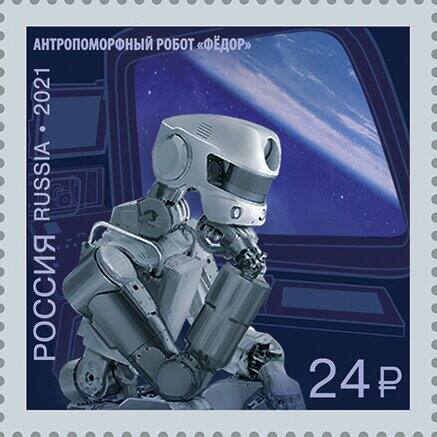 Post of Russia (Pochta Rossii) issue; public domain in Russia per the Wikimedia Commons file page.
Overview
Section titled “Overview”FEDOR, from Final Experimental Demonstration Object Research, is an anthropomorphic robot built by NPO Android Technics of Magnitogorsk. Modified for flight it received the call sign Skybot F-850 and flew to the ISS aboard the uncrewed Soyuz MS-14 as the first stage of the Roscosmos space experiment Ispytatel (Tester), which ran from 22 August to 7 September 2019 [1].
The robot itself predates the mission. It was developed under the project “Development of technology for creating a combined control system for robotic complexes”, code name Spasatel (Rescuer), for collaborative control using fine manipulator motor skills, movement through typical urban development, obstacle negotiation and vehicle driving [1]. The ISS experiment asked whether such a machine could be integrated into a crewed spacecraft at all, whether it would survive the flight environment, and what happens to teleoperation when the operator is himself weightless.
Specifications
Section titled “Specifications”| Parameter | Value | Source |
|---|---|---|
| Height | 184 cm | |
| Shoulder width, ground robot | 52 cm | |
| Shoulder width, space version | 48 cm | |
| Mass, ground robot | 160 kg | |
| Mass, space version | 105 kg | |
| Degrees of freedom | 48 | [3] |
| Servo drives | 48 | |
| Manipulator payload | 10 kg each | [3] |
| Power plant rating, ground robot | 13.5 kW | |
| Spacecraft electrical interface, space version | up to 250 W average, 400 W briefly | [3] |
| Autonomous endurance on internal battery | 1 h | |
| Design life | up to five launches to orbit | [3] |
Rows with no marker are from [2].
Mission profile
Section titled “Mission profile”| Parameter | Value | Source |
|---|---|---|
| Launch vehicle and spacecraft | uncrewed Soyuz MS-14 | |
| Experiment | Roscosmos space experiment Ispytatel, first stage | |
| Duration | 22 August to 7 September 2019, 16 days on orbit | |
| Required operating time in flight | up to 5 h | [3] |
| Required operating time after landing | not less than 30 min | [3] |
Rows with no marker are from [1].
Mobility
Section titled “Mobility”The flight configuration carries 48 degrees of mobility, distributed as 6 in each support module, 7 in each manipulator, 6 in each gripper, 7 in the body module and 3 in the head module [3]. Each manipulator lifts 10 kg. Geometric parameters match those of an adult human closely enough that the robot can be seated in a Cheget-type couch and held by the seat restraint system or by a purpose-built fixation system. The class of tasks the design targets is inspection, installation and servicing of equipment, and assisting cosmonauts during extravehicular activity.
The robot walks and drives on the ground. Published capabilities include opening a door, working with a drill and other tools, sitting in and driving a car and a quad bike autonomously, negotiating a slalom maze and climbing steps [2]. None of this was exercised on orbit: for the whole of the ISS phase the robot was rigidly fixed in the MIM-2 module and moved only its arms [1].
Later development iterations changed the kinematics substantially. A technological mock-up described in 2023 has 22 degrees of mobility excluding grippers, 8 per manipulator and 6 per gripper, on a structure of hull module, support modules, head module, communication system module, energy supply system, navigation system, stabilization and dynamic equilibrium system, sensor system and onboard computer [5]. Those figures describe the successor design, not the robot that flew.
Power and energy
Section titled “Power and energy”The ground robot’s power plant is rated at 13.5 kW, with dual supply, through a cable or from a built-in accumulator [2]. For the space mission two built-in batteries from the Orlan spacesuit were used, and endurance in autonomous mode is one hour [2]. That rating is the robot’s own installed capacity and is not what the spacecraft delivers: the electrical interface between Soyuz MS-14 and the robot was budgeted at up to 250 W on average with brief maxima to 400 W [3].
Thermal
Section titled “Thermal”The robot is fitted with a heating system for important units, to protect against rapid cooling at low temperatures [2]. One of the stated objectives of the space experiment program was to study the heat release modes of the robotic system at its different stages [3]. No results from that study are published, and no radiator or coolant loop is described.
Compute and avionics
Section titled “Compute and avionics”The system as flown comprises three elements: the anthropomorphic robot, a copying-type master device with a virtual reality helmet, and a controlling onboard laptop, an HP ZBook, running the control software [1].
Onboard instrumentation includes an inertial MEMS module and a system for recording the loads on the robot’s links and modules [1], [3]. Communication during the Soyuz phase ran through the spacecraft’s radio equipment, and a space communications headset was installed on the head module as part of the flight modification.
Actuation in the later design uses brushed DC motors chosen for small size at high specific performance, with planetary motor-reducers and belt drives in the manipulators [5]. The gripper actuating link groups use a Maxon Motor brushed motor driving a ball screw pair, with position read by an AS 5045 sensor and control by NPO Android Technics controllers. That drive reduces 4.4:1, feeds at up to 90.9 mm/s, and produces 64 N continuous and 176 N intermittent force [5].
Autonomy
Section titled “Autonomy”FEDOR is a teleoperated machine with an autonomous mode, not an autonomous machine. The operating mode of interest for the experiment was copying control, in which the operator wears an exoskeleton master device and the robot reproduces his motion [1]. The rationale given is that copying control is most effective in situations of uncertainty, where the goal and the activity algorithm have to be adapted flexibly to changing external conditions, which is what a human is adapted to [1], [4].
The control technology set developed for the family covers fine motor control, reading and transmitting operator motion to form commands, force-moment feedback, operator immersion with augmented reality, gesture control, copying control, specialized instrument manipulation, filtering and holding modes, local navigation, dynamic gait balancing, autonomous control in a non-deterministic environment, leader-follower modes, and sensor-based control with feedback [6].
Force-moment sensors are fitted in the gripper modules and on the first links of the manipulator modules, to give the operator load information during copying control [5]. The control loop is framed as operator to robot to environment, with force-moment interaction closing it. The exoskeleton master device that closes this loop, called ZUCT, is a lever system with a structural scheme matching the human body; encoders on its joints register operator motion and generate the robot’s control signals, and active drives in the device return the robot’s own force sensor readings to the operator as proportional loads on his body [7]. Before the flight the ground robot completed 52 test operations under this control scheme, 26 of them worked through the exoskeleton across every manipulator degree of freedom, and the design team judged copying control the most rational mode available on that evidence [7].
Compared to other flown teleoperated humanoids
Section titled “Compared to other flown teleoperated humanoids”FEDOR is not the first humanoid built to work in space, and its design premise differs from the one NASA settled on for Robonaut. Robonaut was built to avoid a robot-specific worksite: rather than requiring its own approach corridors and interfaces the way the Space Station’s dedicated manipulator does, it fits the same corridors, uses a subset of the EVA tool set, and can respond to an EVA emergency far faster than the hours of prebreathe an astronaut needs [8]. That is a design argument about infrastructure, not the task-uncertainty argument FEDOR’s own program makes for copying control, where session length rather than task type is the ergonomic limit the ground program measured [4]. Robonaut 1 reached 47 degrees of freedom across two seven degree of freedom arms, two five-fingered hands and a three degree of freedom waist, sized to the torque needed to remove and install an orbital replacement unit, up to 20 lbf and 30 in lbf, and by 2001 had demonstrated a climbing traverse on a Space Station module mockup while mating a connector at each end [8], [9]. Robonaut 2, delivered to the ISS in 2011, moved to series elastic actuation with custom torsion springs at each upper-arm joint for fine torque sensing without giving up payload, and closes a 10 kHz torque loop in embedded motor drivers under a central kinematics and safety controller [10]. FEDOR’s own actuation is simpler: brushed DC motors with planetary reducers and belt drives, and a gripper drive using a ball screw pair read by a position sensor rather than joint-level torque sensing [5].
The teleoperation link is the sharper contrast. DLR’s KONTUR-2 and METERON SUPVIS Justin missions flew nine astronauts and cosmonauts commanding ground robots from the ISS between 2015 and 2018 [11], at each extreme of coupling: a 2-DOF force-feedback joystick making the ground robot an avatar of the crew member, and a tablet making it a supervised coworker. High-coupling telepresence over KONTUR-2’s point-to-point link, 20 to 30 ms round trip and about 10 minutes of contact per orbit, was judged tiring enough to limit useful sessions to 20 to 30 minutes [11]. FEDOR’s copying sessions, run through the Soyuz and ISS radio equipment rather than a dedicated telepresence link, averaged about one hour per operator in ground rehearsal [4], and the session structure driving crew time in flight came from that ground figure rather than from a link budget. None of the design lineage behind FEDOR traces to the JPL humanoid program that argued, in the mid-2000s, for humanoids as partners in lunar and planetary base construction and laid out a decades-long capability roadmap against Project Constellation [12]; nor to the broader orbital-manipulator and rover tradition a general space robotics survey places it against, in which free-floating dynamics and wheel-terrain mechanics rather than anthropomorphic form are the shared mathematics [13]. FEDOR is a Roscosmos line with its own precedent, the Rescuer program’s copying-control research, tested on a task set of building-relevant motor skills and vehicle driving rather than EVA support, and the KONTUR-2 comparison is where that difference of aim shows up most directly in the numbers [11].
Families of space telerobotic control, and where FEDOR sits
Section titled “Families of space telerobotic control, and where FEDOR sits”Three control families have reached the ISS, and FEDOR belongs to the first. Copying control, FEDOR’s mode, maps operator body motion onto the robot joint by joint. It flew with a cosmonaut operator on the station in 2019 [1]. Force-feedback telepresence closes a bilateral loop with haptic reflection. DLR’s KONTUR-2 flew a 2-DOF joystick in the Russian Segment and teleoperated four ground robots, including the Justin humanoid in two-operator mode, in 23 sessions between August and December 2015 [14]. Supervised autonomy lets the operator issue task-level commands and leaves execution to the robot. DLR’s METERON SUPVIS Justin flew it with astronauts commanding Rollin’ Justin from a tablet in 2017 and 2018 [18]. Only the first two put a human motion or force signal in the loop, and only FEDOR placed the humanoid in the same module as its operator.
The link budgets differ by an order of magnitude. KONTUR-2 reused the ROKVISS S-band link, which is asymmetric at 256 kbit/s up and 4 Mbit/s down, so a minimized CCSDS subset was needed to raise application uplink from 128 to 192 kbit/s and carry a 1 kHz haptic loop [15]. Measured round trip delay on that link was 20 to 30 ms, against 65 ms on the Star City to Oberpfaffenhofen internet training link [14]. SUPVIS Justin was designed around about 800 to 850 ms round trip via TDRS with direct-link passes of about 10 minutes and dropouts up to 5 minutes, which task-level commands tolerate and haptic telepresence does not [19]. The planning figure in the earlier abstract was 2 Mbit/s at 2 to 10 s [20]. FEDOR’s operator sat in the same station as the robot, so no comparable link figure exists for it, as noted under Communications.
Qualification of the operator-side hardware is better documented for KONTUR-2 than for FEDOR’s master device. The joystick design used brushless motors to avoid brush debris in cabin air, a 23 to 29 V input from the 28 V Russian Segment bus, galvanic isolation, a nine-sensor temperature control with a half-force state, and a redundant boot path with integrity checks against radiation-corrupted memory [16]. Its thermal model predicted a 34.6 C base plate after 30 minutes against a 40 C touch limit [17]. The FEDOR program lists the same classes of test, vibration, electromagnetic compatibility and autonomous power, without published thermal or test data [3].
Interface results also differ in kind. The METERON sessions were completed by astronauts without traditional operator training, from a command set filtered to what the robot’s own world model deemed feasible, with no task times or workload instruments reported [18]. The pre-flight program ran over 150 ground runs, including a Columbus mockup 35 km from the Solex site with 800 ms injected delay [19][21]. KONTUR-2 reported that positional accuracy degraded in microgravity relative to ground sessions, partly recovered with added joystick damping, stated qualitatively [14]. FEDOR’s counterpart finding is the restraint requirement for the weightless operator [1]. A 2012 JPL report extended Robonaut 2 teleoperation to markerless finger tracking over a simulated delay, a laboratory result with no flight use [22].
The closest flown comparison for an operator wearing a head-mounted display is Robonaut 2 [25]. After more than two years of stationary operation on the ISS it performed task board and air flow meter work, and in April 2013 a crew member teleoperated it on orbit from a tracker vest and VR helmet [25]. It arrived in February 2011 as a fixed-base upper body on a stanchion, with climbing legs planned to follow [26], and the leg version is a roughly 300 kg robot whose model-based controller has to move it precisely [30]. That session differs from FEDOR’s in the direction of the link: the operator and robot shared the station in both cases, but Robonaut 2 was never the sole occupant of a crew vehicle. ESA’s METERON Analog-1 took the haptic case farthest from Earth orbit: an astronaut drove a rover and its arm from the ISS through a seven-DOF haptic station with delay compensation in November 2019, and the same operations concept was repeated at Mount Etna in 2022 [27]. DLR’s Rollin’ Justin, the ground robot of SUPVIS Justin, carries a 43-DOF upper body on a 199 kg wheeled base that draws about 600 W [28]. The levels-of-automation scale that the supervised-autonomy side of this literature uses was set out for undersea teleoperators in 1978, as a choice of which party holds each decision function [29].
Two bodies of work sit beside the humanoids. Reviews of on-orbit servicing treat free-floating manipulator dynamics, capture and stabilization as the core problems [23], and a survey of infrastructure construction treats robotics as one of five areas of the build-out [24]. Neither addresses anthropomorphic form, and both place the humanoid as one option among several for station and surface work.
Communications
Section titled “Communications”Voice and data during the Soyuz MS-14 phase ran through the spacecraft’s radio equipment, and the voice channel with the built-in space communications headset was qualified on a flight Soyuz MS before launch [1], [3]. No band allocation, data rate or latency figure has been published for the teleoperation link.
Payload and instruments
Section titled “Payload and instruments”The robot carried no science payload. Its instrumentation exists to record its own flight environment and to support control: an inertial MEMS module logging linear accelerations, angular rates and magnetic field induction on three mutually perpendicular axes in the global frame; cameras and microphones writing video and audio to non-volatile memory; and the link and module load recording system [1], [3].
On orbit it worked with the crew’s own hand tools rather than with dedicated robotic tools, which was the point: the operations tested were the ones cosmonauts perform when repairing and replacing equipment aboard the Russian segment [1].
Modes of operation
Section titled “Modes of operation”Two modes were exercised. During ascent aboard Soyuz MS-14 the robot ran autonomously, executing a fixed program: reporting the stages of ascent and the recorded overloads, and writing video, audio and inertial data to non-volatile memory [1]. On the station it ran under copying control from a cosmonaut. The environment the autonomous mode had to ride out was specified in advance as overloads of 5 g nominally and up to 16 g on atmospheric entry, impact loads on landing, cosmic radiation, acoustic loads, electromagnetic interference from spacecraft equipment, and the atmospheric factors of a pressurized compartment [3].
The ascent record is the most complete engineering result the experiment produced, because the robot instrumented its own launch. Five phases appear in the axial acceleration data, with Z along the vehicle longitudinal axis [1]:
| Phase | Maximum Z acceleration |
|---|---|
| On the launch pad | 1 g |
| Launch and first stage | 3.89 g |
| Second stage | 2.53 g, with increased body vibration |
| Third stage | 2.98 g |
| Orbital coast | 0 |
Accelerations measured by the robot’s own inertial module differ only slightly from those recorded by the spacecraft’s sensors [1], which is the validation that matters given that the robot carries its own load recording system for exactly this purpose [3]; the spikes in the record come from vibration of the robot’s body, because not all of its joints were fixed for launch and those joints had zero stiffness and transmitted vibration into the structure.
Ground operations
Section titled “Ground operations”The flight article was reworked so it could be stowed in the descent module, given a space communications headset on the head module, and revised in its control system and individual components [1]. Qualification then covered fitting the robot into a purpose-built flight frame in the production shop; fitting on the Soyuz MS trainer mock-up; loading and unloading in a flight Soyuz MS descent module with stowage and fixation in the frame; the voice channel with the headset on a flight vehicle; vibration resistance; electromagnetic compatibility; a fire safety expert review; a sanitary and epidemiological expert review; a functionality check; and a check of operation from the autonomous power source. The link and module load recording system exists to close the loop on exactly these load cases [3].
Crew preparation was shaped by the fact that Soyuz MS-14 flew uncrewed. A. A. Skvortsov was trained as both operator 1, controlling the robot remotely, and operator 2, interacting with it directly, because A. N. Ovchinin was already aboard the ISS [1]. Skvortsov trained on a prototype at the Cosmonaut Training Centre, with the flight-standard system at RSC Energia, and with the flight master device and virtual robot models at Baikonur. The master device’s control glove was remade to the anthropometry of his hands.
Total crew time for the experiment was 57 hours 30 minutes: 28 hours from Ovchinin, commander of ISS-59/60, and 29 hours 30 minutes from Skvortsov, flight engineer 7 [1]. Ground ergonomics work had put average continuous operator sessions at about one hour, which is the unit the on-orbit sessions were built from [4].
On orbit the two cosmonauts moved the system from the descent module to MIM-2 and back [1]. All planned sessions were completed: remote control for typical flight operations, meaning work with onboard tools and a simulated wiping of station panel surfaces; a video greeting to Earth; and voice dialog between the cosmonauts and the robot. Video, audio, camera stills, video from both ISS and robot cameras, and telemetry from all flight phases were returned.
The ergonomics program behind the operator interface was run on the ground with more than 30 participants, cosmonauts and qualified instructors, wearing the master device, a VR display helmet and medical state monitoring sensors [4]. Average continuous work in the virtual environment was about one hour per operator. The study did not confirm published claims of adverse visual, proprioceptive, vestibular or muscular reactions that would prevent task execution. The sense of presence was rated positive but lower than expected, attributed to the absence of haptic feedback, geometric distortions, deficiencies in the VR helmet and insufficient modeling of physical conditions.
Technologies developed
Section titled “Technologies developed”The experiment’s findings are published as a numbered list, and three of them are load-bearing.
Copying control survives weightlessness. During the teleoperation scenarios the robot was rigidly fixed in MIM-2, no change in its dynamic characteristics was observed in weightlessness, and the system sustained copying control with dynamic parameters remaining normal [1]. The cosmonaut’s ability to drive it remotely in copying mode using the exoskeleton and virtual reality helmet, while himself in an unsupported environment, was confirmed. The qualifier is the useful part: to make control stable it was found advisable to provide special means of restraining the operating cosmonaut, since an unrestrained operator pushes himself away from the motion he is trying to command.
The structure survives the ride, against a design intent of up to five launches to orbit [3]. The system retained functionality under the external factors of ascent and descent, and autonomous tests after return confirmed serviceability and structural reliability [1]. Over the 16-day flight no noticeable influence of cosmic radiation or electromagnetic effects on the system’s functioning was detected.
The voice interface worked. The dialog experiment demonstrated the usability of a voice interface for intravehicular activity aboard an orbital station [1], one of the several command modalities the program has developed alongside gesture control, augmented-reality immersion and leader-follower operation [6].
Against these, the program’s own conclusion is that active use of anthropomorphic robots aboard orbital stations will require modification of the robot’s systems and possibly of the station infrastructure [1]. Further development is aimed at supporting cosmonauts in open space and in a prospective habitation system including a visited lunar orbital station and a planetary base, by raising functionality and autonomy through artificial intelligence.
What is not established
Section titled “What is not established”The record is one uncrewed Soyuz flight with the robot fixed in one module and moving only its arms [1]. Walking, driving and tool use are ground results [2]. The planned first stage specified operating durations of 3 hours prelaunch, up to 5 hours in flight and at least 30 minutes after landing [3], and the published flight account does not separate the post-landing phase from the rest. No heat-release result, link latency, or telemetry bandwidth has been published, and the ascent acceleration record is the only quantitative engineering result.
The ground ergonomics findings give no operator counts, rating distributions or control quality metrics, and most were taken on a virtual 3D model, not the physical robot and not in microgravity [4]. The 2023 kinematics, gripper load case and 2.4 kg dynamic limit are derivations for a successor design with no test data [5][6]. The avatar case in the survey literature is argued without a latency analysis [2]. No published account of later FEDOR flight stages was available.
References
Section titled “References”References
- Permyakov, A. F., Dudorov, E. A., Sokhin, I. G. and Shponko, A. A. (2020). Preparing and Performing a Space Experiment with Use of the Anthropomorphic Robot FEDOR
. University News. North-Caucasian Region. Technical Sciences Series, 3. Source
BibTeX
@article{permyakov2020preparing, title = {Preparing and Performing a Space Experiment with Use of the Anthropomorphic Robot FEDOR}, author = {Permyakov, A. F. and Dudorov, E. A. and Sokhin, I. G. and Shponko, A. A.}, journal = {University News. North-Caucasian Region. Technical Sciences Series}, number = {3}, pages = {64--72}, year = {2020}, doi = {10.17213/1560-3644-2020-3-64-72} } - Klyushnikov, V. Y. (2020). Robot Avatar: A Means of Human Telepresence in Space
. Aerospace Sphere Journal, 1. Source
BibTeX
@article{klyushnikov2020robot, title = {Robot Avatar: A Means of Human Telepresence in Space}, author = {Klyushnikov, Valery Y.}, journal = {Aerospace Sphere Journal}, volume = {102}, number = {1}, pages = {60--69}, year = {2020}, doi = {10.30981/2587-7992-2020-102-1-60-69}, abstract = {АННОТАЦИЯ I В статье проведен анализ перспектив создания и практического использования технологии роботов-аватаров, предназначенных для исследования, освоения и использования космоса.Определен возможный облик аватара и системы сопряжения робота-аватара с человеком-оператором.} } - Bogdanov, A. A., Kutlubaev, I. M. and Permyakov, A. F. (2017). Space Experiment with an Anthropomorphic Robot
. Reshetnev Readings. Source
BibTeX
@inproceedings{bogdanov2017space, title = {Space Experiment with an Anthropomorphic Robot}, author = {Bogdanov, A. A. and Kutlubaev, I. M. and Permyakov, A. F.}, booktitle = {Reshetnev Readings}, year = {2017}, url = {https://cyberleninka.ru/article/n/kosmicheskiy-eksperiment-s-antropomorfnym-robotom} } - Dudorov, E. A., Sokhin, I. G., Bogdanov, A. A. and Kolbasin, B. G. (2021). Ergonomic Support for the Development of Anthropomorphic Robotic Systems for Space Purposes
. Higher Educational Institutions. Маchine Building, 1(730). Source
BibTeX
@article{dudorov2021ergonomic, title = {Ergonomic Support for the Development of Anthropomorphic Robotic Systems for Space Purposes}, author = {Dudorov, E. A. and Sokhin, I. G. and Bogdanov, A. A. and Kolbasin, B. G.}, journal = {Higher Educational Institutions. Маchine Building}, number = {1(730)}, pages = {16--26}, year = {2021}, doi = {10.18698/0536-1044-2021-1-16-26}, abstract = {Advanced projects of exploration and use of the Moon and other planets of the Solar system involve extensive use of robotic systems for space purposes and, in particular, anthropomorphic robot assistants for space expedition crews. The challenges of effective organization of interaction between the cosmonauts and robot assistants are of particular importance. The article examines the main ergonomic problems that arise in the development and use of collaborative robots, the content of the process of ergonomic support for their development and the methodological approach to its implementation. The results of the experimental research are also presented.} } - Dudorov, E. A. (2023). Methodology for Force Calculation of the Actuating Link Group of an Anthropomorphic Robot
. Bratsk State University, 2. Source
BibTeX
@article{dudorov2023methodology, title = {Methodology for Force Calculation of the Actuating Link Group of an Anthropomorphic Robot}, author = {Dudorov, E. A.}, journal = {Bratsk State University}, number = {2}, pages = {14--22}, year = {2023}, doi = {10.18324/2077-5415-2023-2-14-22} } - Dudorov, E. A. (2023). Technology of the Anthropomorphic Robotic Complex Control System
. Izvestiya Vysshikh Uchebnykh Zavedeniy. Mashinostroenie, 12(765). Source
BibTeX
@article{dudorov2023technology, title = {Technology of the Anthropomorphic Robotic Complex Control System}, author = {Dudorov, E. A.}, journal = {Izvestiya Vysshikh Uchebnykh Zavedeniy. Mashinostroenie}, number = {12(765)}, pages = {49--62}, year = {2023}, url = {https://cyberleninka.ru/article/n/tehnologii-sistemy-upravleniya-antropomorfnymi-robototehnicheskimi-platformami} } - Bogdanov, A., Dudorov, E., Permyakov, A., Pronin, A. and Kutlubaev, I. (2019). Control System of a Manipulator of the Anthropomorphic Robot FEDOR
. International Conference on Developments in eSystems Engineering. Source
BibTeX
@inproceedings{bogdanov2019control, title = {Control System of a Manipulator of the Anthropomorphic Robot FEDOR}, author = {Bogdanov, Aleksej and Dudorov, Evgenij and Permyakov, Aleksandr and Pronin, Aleksandr and Kutlubaev, Ildar}, booktitle = {International Conference on Developments in eSystems Engineering}, pages = {449-453}, publisher = {IEEE}, year = {2019}, doi = {10.1109/dese.2019.00088}, abstract = {The creation of technical objects which can replace a human when working in an unfriendly environment is an urgent problem. It is most rational to use anthropomorphic robots (AR) in these conditions. Due to the practical kinematics of the human body and the robot, it is able to use the appropriate infrastructure fully. The functioning of the AR in a non-deterministic environment determines the need to control and monitor the actions performed directly by an operator. Whereby it is necessary to solve two problems: the generation of control signals and evaluation of their working off by the AR. Due to the significant number of degrees of freedom of the AR, it is possible to do with the use of a set up copying-type device (ZUCT). The ZUCT is based on a lever system with a structural scheme identical to the human body. It allows to register through encoders movements in joints correctly and to provide generation of AR control signals. The AR is equipped with force sensors for solving the second problem. The loads registered with the use thereof are transmitted to the ZUCT equipped with a system of active drives. It allows to create loads on the body parts of the operator proportional to the loads in the kinematic pairs of the AR. The effectiveness of the developed control system was determined during the working off by the AR “FEDOR" control operations. Their full and unconditional execution with a satisfactory speed allows to claim that the copying control mode is the most rational today. Further improvement of this type of control system is possible due to reducing the weight of the set up device. The submissions reflected the major aspects taken when designing the control AM using ZUCT. For the first time, on the basis of fully implemented technical solutions, the overall, mass parameters of exoskeletons, specifications of the main used units are defined and presented. The feasibility of force-moment feedback allowing the operator to control the interaction of AR links with external objects is confirmed. The complete set of sensors and actuators used in the creation of ZUCT confirms, on the basis of the experimental studies, their sufficiency and the possibility of their use in the creation of new variants of control systems.} } - Ambrose, R. O. and Diftler, M. A. (2001). Robonaut: A Robotic Astronaut Assistant
. International Symposium on Artificial Intelligence, Robotics and Automation in Space, 20100033240. Source
BibTeX
@inproceedings{ambrose2001robonaut, title = {Robonaut: A Robotic Astronaut Assistant}, author = {Ambrose, Robert O. and Diftler, Myron A.}, booktitle = {International Symposium on Artificial Intelligence, Robotics and Automation in Space}, number = {20100033240}, institution = {NASA}, address = {Montreal}, year = {2001}, url = {https://ntrs.nasa.gov/citations/20100033240}, abstract = {NASA's latest anthropomorphic robot, Robonaut, has reached a milestone in its capability. This highly dexterous robot, designed to assist astronauts in space, is now performing complex tasks at the Johnson Space Center that could previously only be carried out by humans. With 43 degrees of freedom, Robonaut is the first humanoid built for space and incorporates technology advances in dexterous hands, modular manipulators, lightweight materials, and telepresence control systems. Robonaut is human size, has a three degree of freedom (DOF) articulated waist, and two, seven DOF arms, giving it an impressive work space for interacting with its environment. Its two, five fingered hands allow manipulation of a wide range of tools. A pan/tilt head with multiple stereo camera systems provides data for both teleoperators and computer vision systems.} } - Bluethmann, W., Ambrose, R., Diftler, M., Askew, S., Huber, E., Goza, M., Rehnmark, F., Lovchik, C. and Magruder, D. (2003). Robonaut: a robot designed to work with humans in space
. Autonomous Robots, 20040087729. Source
BibTeX
@article{bluethmann2003robonaut, title = {Robonaut: a robot designed to work with humans in space}, author = {Bluethmann, William and Ambrose, Robert and Diftler, Myron and Askew, Scott and Huber, Eric and Goza, Michael and Rehnmark, Fredrik and Lovchik, Chris and Magruder, Darby}, journal = {Autonomous Robots}, volume = {14}, number = {20040087729}, pages = {179-197}, institution = {NASA}, year = {2003}, doi = {10.1023/a:1022231703061}, abstract = {The Robotics Technology Branch at the NASA Johnson Space Center is developing robotic systems to assist astronauts in space. One such system, Robonaut, is a humanoid robot with the dexterity approaching that of a suited astronaut. Robonaut currently has two dexterous arms and hands, a three degree-of-freedom articulating waist, and a two degree-of-freedom neck used as a camera and sensor platform. In contrast to other space manipulator systems, Robonaut is designed to work within existing corridors and use the same tools as space walking astronauts. Robonaut is envisioned as working with astronauts, both autonomously and by teleoperation, performing a variety of tasks including, routine maintenance, setting up and breaking down worksites, assisting crew members while outside of spacecraft, and serving in a rapid response capacity.} } - Diftler, M. A., Radford, N. A., Mehling, J. S., Abdallah, M. E., Bridgwater, L. B., Sanders, A. M., Askew, R. S., Linn, D. M., Yamokoski, J. D., Permenter, F. A. and Hargrave, B. K. (2010). Robonaut 2 - The First Humanoid Robot in Space
. IEEE International Conference on Robotics and Automation, 20100040493. Source
BibTeX
@inproceedings{diftler2010robonaut, title = {Robonaut 2 - The First Humanoid Robot in Space}, author = {Diftler, Myron A. and Radford, N. A. and Mehling, J. S. and Abdallah, M. E. and Bridgwater, L. B. and Sanders, A. M. and Askew, R. S. and Linn, D. M. and Yamokoski, J. D. and Permenter, F. A. and Hargrave, B. K.}, booktitle = {IEEE International Conference on Robotics and Automation}, number = {20100040493}, pages = {2178-2183}, institution = {NASA}, year = {2010}, doi = {10.1109/icra.2011.5979830}, abstract = {NASA and General Motors have developed the second generation Robonaut, Robonaut 2 or R2, and it is scheduled to arrive on the International Space Station in early 2011 and undergo initial testing by mid-year. This state of the art, dexterous, anthropomorphic robotic torso has significant technical improvements over its predecessor making it a far more valuable tool for astronauts. Upgrades include: increased force sensing, greater range of motion, higher bandwidth, and improved dexterity. R2's integrated mechatronic design results in a more compact and robust distributed control system with a fraction of the wiring of the original Robonaut. Modularity is prevalent throughout the hardware and software along with innovative and layered approaches for sensing and control. The most important aspects of the Robonaut philosophy are clearly present in this latest model's ability to allow comfortable human interaction and in its design to perform significant work using the same hardware and interfaces used by people. The following describes the mechanisms, integrated electronics, control strategies, and user interface that make R2 a promising addition to the Space Station and other environments where humanoid robots can assist people.} } - Lii, N. Y., Riecke, C., Leidner, D., Schätzle, S., Schmaus, P., Weber, B., Krueger, T., Stelzer, M., Wedler, A. and Grunwald, G. (2018). The Robot as an Avatar or Co-worker? An Investigation of the Different Teleoperation Modalities through the KONTUR-2 and METERON SUPVIS Justin Space Telerobotic Missions
. International Astronautical Congress, IAC-18-B3.6-A5.3.5x47302. Source
BibTeX
@inproceedings{lii2018robot, title = {The Robot as an Avatar or Co-worker? An Investigation of the Different Teleoperation Modalities through the KONTUR-2 and METERON SUPVIS Justin Space Telerobotic Missions}, author = {Lii, Neal Y. and Riecke, Cornelia and Leidner, Daniel and Schätzle, Simon and Schmaus, Peter and Weber, Bernhard and Krueger, Thomas and Stelzer, Martin and Wedler, Armin and Grunwald, Gerhard}, booktitle = {International Astronautical Congress}, number = {IAC-18-B3.6-A5.3.5x47302}, year = {2018}, url = {https://elib.dlr.de/133023/} } - Stoica, A., Keymeulen, D., Csaszar, A., Gan, Q., Hidalgo, T., Moore, J., Newton, J., Sandoval, S. and Xu, J. (2005). Humanoids for lunar and planetary surface operations
. IEEE-RAS International Conference on Humanoid Robots. Source
BibTeX
@inproceedings{stoica2005humanoids, title = {Humanoids for lunar and planetary surface operations}, author = {Stoica, Adrian and Keymeulen, Didier and Csaszar, Ambrus and Gan, Quan and Hidalgo, Timothy and Moore, Jeff and Newton, Jason and Sandoval, Steven and Xu, Jiajing}, booktitle = {IEEE-RAS International Conference on Humanoid Robots}, pages = {345}, publisher = {IEEE}, year = {2005}, doi = {10.1109/ichr.2005.1573591}, abstract = {This paper presents a vision of humanoid robots as human's key partners in future space exploration, in particular for construction, maintenance/repair and operation of lunar/planetary habitats, bases and settlements. It integrates this vision with the recent plans for human and robotic exploration, aligning a set of milestones for operational capability of humanoids with the schedule and phases of human space flight system development program for the next decades. These milestones relate to a set of incremental challenges, for the solving of which new humanoid technologies are needed. A system of systems integrative approach that would lead to readiness of cooperating humanoid crews is sketched. Robot fostering, training/education techniques, and improved cognitive/sensory/motor development techniques are considered essential elements for achieving intelligent humanoids. A pilot project in this direction is outlined.} } - Yoshida, K., Wilcox, B., Hirzinger, G. and Lampariello, R. (2016). Space Robotics
. Springer Handbook of Robotics. Source
BibTeX
@incollection{yoshida2016space, title = {Space Robotics}, author = {Yoshida, Kazuya and Wilcox, Brian and Hirzinger, Gerd and Lampariello, Roberto}, booktitle = {Springer Handbook of Robotics}, series = {Springer Handbooks}, pages = {1423-1462}, publisher = {Springer International Publishing}, year = {2016}, doi = {10.1007/978-3-319-32552-1_55} } - Artigas, J., Riecke, C., Weber, B., Stelzer, M., Balachandran, R., Schaetzle, S., Bayer, R., Steinmetz, B.-M., Vogel, J., Brunner, B., Albu-Schäffer, A., Guk, M., Zaborovskyi, V., Kondratiev, A., Muliukha, V., Silinenko, A. and Shmakov, O. (2016). Force-Feedback Teleoperation of On-Ground Robots from the International Space Station in the Frame of the KONTUR-2 Experiment
. International Symposium on Artificial Intelligence, Robotics and Automation in Space. Source
BibTeX
@inproceedings{artigas2016force, title = {Force-Feedback Teleoperation of On-Ground Robots from the International Space Station in the Frame of the KONTUR-2 Experiment}, author = {Artigas, Jordi and Riecke, Cornelia and Weber, Bernhard and Stelzer, Martin and Balachandran, Ribin and Schaetzle, Simon and Bayer, Ralph and Steinmetz, Bernhard-Michael and Vogel, Jörg and Brunner, Bernhard and Albu-Schäffer, Alin and Guk, M. and Zaborovskyi, V. and Kondratiev, A. and Muliukha, V. and Silinenko, A. and Shmakov, O.}, booktitle = {International Symposium on Artificial Intelligence, Robotics and Automation in Space}, pages = {1166-1173}, year = {2016}, doi = {10.1109/icra.2016.7487246}, abstract = {This paper presents a new robot controller for space telerobotics missions specially designed to meet the requirements of KONTUR-2, a German & Russian telerobotics mission that addressed scientific and technological questions for future planetary explorations. In KONTUR-2, Earth and ISS have been used as a test-bed to evaluate and demonstrate a new technology for real-time telemanipulation from space. During the August 2015' experiments campaign, a cosmonaut teleoperated a robot manipulator located in Germany, using a force-feedback joystick from the Russian segment of the International Space Station (ISS). The focus of the paper is on the design and performance of the bilateral controller between ISS joystick and Earth robot. The controller is based on a 4-Channels architecture in which stability is guaranteed through passivity and the Time Delay Power Network (TDPN) concept. We show how the proposed approach successfully fulfills mission requirements, specially those related to system operation through space links and internet channels, involving time delays and data losses of different nature.} } - Stelzer, M., Birkenkampf, P., Brunner, B., Steinmetz, B.-M., Vogel, J. and Kühne, S. (2017). Software Architecture and Design of the Kontur-2 Mission
. IEEE Aerospace Conference. Source
BibTeX
@inproceedings{stelzer2017software, title = {Software Architecture and Design of the Kontur-2 Mission}, author = {Stelzer, Martin and Birkenkampf, Peter and Brunner, Bernhard and Steinmetz, Bernhard-Michael and Vogel, Jörg and Kühne, Stefan}, booktitle = {IEEE Aerospace Conference}, pages = {1-17}, year = {2017}, doi = {10.1109/aero.2017.7943816}, abstract = {This paper describes the software architecture and design of the space segment, communication and ground segment software of the Kontur-2 project, which aimed to study the feasibility of planetary exploration through telepresence. The main research objectives in Kontur-2 were the development and in-flight verification of a space qualified two degree of freedom (DoF) force-feedback joystick (RJo) inside the Zvezda Service Module of the International Space Station (ISS), the implementation of telepresence technologies, and the study of human performance when controlling a force feedback joystick in microgravity. The project was conducted from 2012 to 2015 by a consortium consisting of the German Aerospace Center (DLR), the Russian Federal Space Agency (ROSCOSMOS), The Russian State Scientific Center for Robotics and Technical Cybernetics (RTC), S. P. Korolev Rocket and Space Corporation Energia (RSC “Energia”) and the Yuri A. Gagarin State Scientific Research-and-Testing Cosmonaut Training Center (GCTC). DLR conducted two sets of experiments in which a cosmonaut on board the ISS used RJo to perform different tasks with robots located on-ground. The first was conducted with a 2-DoF robot equipped with a camera system, a task board and torque sensors that allowed the cosmonaut to perceive reactive forces caused by contacts with the environment. For the second set of experiments a humanoid robot was utilized to perform a tele-handshake, as well as a cooperative task between the cosmonaut on ISS and colleagues at RTC in St. Petersburg. To realize these experiments, the consortium developed onboard and on-ground software which are described in this paper. The space segment software consists of the control software for RJo and user interfaces on a laptop to guide the cosmonaut efficiently through the experiments. A state machine was designed for these user interfaces to capture state changes during the experiment execution. This way only relevant contextual information is provided to the cosmonaut. On RJo, a component framework has been deployed combining a data-centric architecture with a CCSDS Space Packet interface. Additionally, the communication software has been designed to support a direct multi-channel connection between ground control and ISS using the S-band radio equipment of the consortium. During contact to ISS, the ground operators used the ground segment software at DLR for experiment support, supervision, maintenance and data logging. The visual feedback from the camera system required by the cosmonaut to perform the experiments was provided by a low-latency video stream through a communication channel with very restricted bandwidth. 23 experiment sessions were carried out in 2015 utilizing the Kontur-2 software, which helped to validate telepresence technologies and study human factors for space applications.} } - Riecke, C., Artigas, J., Balachandran, R., Bayer, R., Beyer, A., Brunner, B., Buchner, H., Gumpert, T., Gruber, R., Hacker, F., Landzettel, K., Plank, G., Schätzle, S., Sedlmayr, H.-J., Seitz, N., Steinmetz, B.-M., Stelzer, M., Vogel, J., Weber, B., Willberg, B. and Albu-Schäffer, A. (2016). KONTUR-2 Mission: The DLR Force Feedback Joystick for Space Telemanipulation from the ISS
. International Symposium on Artificial Intelligence, Robotics and Automation in Space. Source
BibTeX
@inproceedings{riecke2016kontur, title = {KONTUR-2 Mission: The DLR Force Feedback Joystick for Space Telemanipulation from the ISS}, author = {Riecke, Cornelia and Artigas, Jordi and Balachandran, Ribin and Bayer, Ralph and Beyer, Alexander and Brunner, Bernhard and Buchner, Hans and Gumpert, Thomas and Gruber, Robin and Hacker, Franz and Landzettel, Klaus and Plank, Georg and Schätzle, Simon and Sedlmayr, Hans-Jürgen and Seitz, Nikolaus and Steinmetz, Bernhard-Michael and Stelzer, Martin and Vogel, Jörg and Weber, Bernhard and Willberg, Bertram and Albu-Schäffer, Alin}, booktitle = {International Symposium on Artificial Intelligence, Robotics and Automation in Space}, year = {2016}, url = {https://elib.dlr.de/105449/} } - Bayer, R. (2015). The Thermal Design of the KONTUR-2 Force Feedback Joystick. elib.dlr.de/112503
BibTeX
@misc{bayer2015thermal, title = {The Thermal Design of the KONTUR-2 Force Feedback Joystick}, author = {Bayer, Ralph}, howpublished = {Presentation at the European Space Mechanisms and Tribology Symposium}, year = {2015}, url = {https://elib.dlr.de/112503/} } - Schmaus, P., Leidner, D., Bayer, R., Pleintinger, B., Krüger, T. and Lii, N. Y. (2019). Continued Advances in Supervised Autonomy User Interface Design for METERON SUPVIS Justin
. IEEE Aerospace Conference. Source
BibTeX
@inproceedings{schmaus2019continued, title = {Continued Advances in Supervised Autonomy User Interface Design for METERON SUPVIS Justin}, author = {Schmaus, Peter and Leidner, Daniel and Bayer, Ralph and Pleintinger, Benedikt and Krüger, Thomas and Lii, Neal Y.}, booktitle = {IEEE Aerospace Conference}, pages = {1-11}, address = {Big Sky, Montana}, year = {2019}, doi = {10.1109/aero.2019.8741885}, abstract = {The exploration of the universe remains a challenging endeavor, constantly pushing the limits of technology. Of special interest is the investigation of the other planets of our solar system such as Mars, which has been examined by various tele-operated and (semi-) autonomous satellites and landers. But an important milestone that is needed for a deeper understanding of the planet is still missing: A crewed landing. In order to send humans to such a remote location, an infrastructure for the landing crew including an energy supply, a habitat, and a return vehicle needs to be provided on the surface of the planet. The construction and maintenance of these structures is envisioned to be done by semiautonomous robots that are commanded from orbiting spacecrafts. The teleoperation of such ground-based robots poses high demands on the capabilities of the system including robot autonomy, orbiter-robot communication, and human-robot interface design. The METERON SVPVIS Justin space telerobotics experiment suite has been initiated by the German Aerospace Center (DLR) together with the European Space Agency (ESA) to investigate the requirements for such a system and evaluate an approach. During the experiment sessions, astronauts onboard the International Space Station (ISS) command DLR's humanoid service robot Rollin' Justin on Earth to execute complex surveillance, service, and repair tasks in a simulated Martian solar farm. The robot uses its local intelligence to support the astronaut operator upon task completion allowing a simple intuitive command interface and lowering the requirements on the communication link. This work gives an overview of the developed robotic system, communication link, and tablet computer user interface (UI). In particular the tight coupling between the autonomy system of the robot and the UI, that allows the intuitive robot commanding including action parameterization, is described in detail. The first space-ground experiment sessions of METERON SUPVIS Justin were conducted in August 2017, and March 2018 by four astronauts in total. During the first session, three astronauts demonstrated the operational readiness of our system by commanding Rollin' Justin to perform surveillance and inspection tasks. The astronauts were even able to successfully command the robot in scenarios, which were not trained prior to their spaceflight. This was possible, because our astronaut-robot collaboration concept efficiently guides the operator towards task completion. We used this property in the second experiment session to evaluate our system in even more complex scenarios. While in the first session it was sufficient for the astronaut to select the correct commands, the operator was now required to manually parameterize some of the commands to optimize the task outcome. By that, the robot has been successfully commanded to perform complex maintenance and adjustment tasks in the simulated Martian solar farm. In this work, we evaluate the preliminary results of the space-ground experiments and discuss the feedback we received from the astronauts and its impact on future space telerobotics UI design.} } - Lii, N. Y., Leidner, D., Birkenkampf, P., Pleintinger, B., Bayer, R. and Krueger, T. (2017). Toward Scalable Intuitive Teleoperation of Robots for Space Deployment with the METERON SUPVIS Justin Experiment
. Symposium on Advanced Space Technologies in Robotics and Automation. Source
BibTeX
@inproceedings{lii2017scalable, title = {Toward Scalable Intuitive Teleoperation of Robots for Space Deployment with the METERON SUPVIS Justin Experiment}, author = {Lii, Neal Y. and Leidner, Daniel and Birkenkampf, Peter and Pleintinger, Benedikt and Bayer, Ralph and Krueger, Thomas}, booktitle = {Symposium on Advanced Space Technologies in Robotics and Automation}, year = {2017}, url = {https://elib.dlr.de/113125/} } - Lii, N. Y., Leidner, D., Schiele, A., Birkenkampf, P., Pleintinger, B. and Bayer, R. (2015). Command Robots from Orbit with Supervised Autonomy
. SAE Technical Paper Series. Source
BibTeX
@inproceedings{lii2015command, title = {Command Robots from Orbit with Supervised Autonomy}, author = {Lii, Neal Y. and Leidner, Daniel and Schiele, André and Birkenkampf, Peter and Pleintinger, Benedikt and Bayer, Ralph}, booktitle = {SAE Technical Paper Series}, pages = {53-54}, publisher = {ACM}, year = {2015}, doi = {10.1145/2701973.2702022}, abstract = {The on-going work at German Aerospace Center (DLR) and European Space Agency (ESA) on the Meteron Supvis-Justin space telerobotic experiment utilizing supervised autonomy is presented. The Supvis-Justin experiment will employ a tablet UI for an astronaut on the International Space Station (ISS) to communicate task level commands to a service robot. The goal is to explore the viability of supervised autonomy for space telerobotics. For its validation, survey, navigation, inspection, and maintenance tasks will be commanded to DLR's service robot, Rollin' Justin, to be performed in a simulated extraterrestrial environment constructed at DLR. The experiment is currently slated for late 2015-2016.} } - Lii, N. Y., Leidner, D., Schiele, A., Birkenkampf, P., Pleintinger, B. and Bayer, R. (2015). Simulating an Extraterrestrial Environment for Robotic Space Exploration: The METERON SUPVIS-Justin Telerobotic Experiment and the SOLEX Proving Ground
. Symposium on Advanced Space Technologies in Robotics and Automation. Source
BibTeX
@inproceedings{lii2015simulating, title = {Simulating an Extraterrestrial Environment for Robotic Space Exploration: The METERON SUPVIS-Justin Telerobotic Experiment and the SOLEX Proving Ground}, author = {Lii, Neal Y. and Leidner, Daniel and Schiele, André and Birkenkampf, Peter and Pleintinger, Benedikt and Bayer, Ralph}, booktitle = {Symposium on Advanced Space Technologies in Robotics and Automation}, year = {2015}, url = {https://elib.dlr.de/98352/} } - Champoux, R. G. (2012). Teleoperation of robonaut using finger tracking
. Smart Structures and Materials Symposium. Source
BibTeX
@inproceedings{champoux2012teleoperation, title = {Teleoperation of robonaut using finger tracking}, author = {Champoux, Rachel G.}, booktitle = {Smart Structures and Materials Symposium}, publisher = {JPL Open Repository}, year = {2012}, url = {https://dataverse.jpl.nasa.gov/dataset.xhtml?persistentId=hdl:2014/43142} } - Flores-Abad, A., Ma, O., Pham, K. and Ulrich, S. (2014). A review of space robotics technologies for on-orbit servicing
. Progress in Aerospace Sciences. Source
BibTeX
@article{floresabad2014review, title = {A review of space robotics technologies for on-orbit servicing}, author = {Flores-Abad, Angel and Ma, Ou and Pham, Khanh and Ulrich, Steve}, journal = {Progress in Aerospace Sciences}, volume = {68}, pages = {1-26}, publisher = {Elsevier BV}, year = {2014}, doi = {10.1016/j.paerosci.2014.03.002} } - Howe, A. S. and Colombano, S. P. (2010). The challenge of space infrastructure construction
. AIAA SPACE Conference. Source
BibTeX
@inproceedings{howe2010challenge, title = {The challenge of space infrastructure construction}, author = {Howe, A. Scott and Colombano, Silvano P.}, booktitle = {AIAA SPACE Conference}, year = {2010}, doi = {10.2514/6.2010-8619}, abstract = {This paper reviews the range of technologies that will contribute to the construction of space infrastructure that will both enable and, in some cases, provide the motivation for space exploration. Five parts are addressed: Managing complexity, robotics based construction, materials acquisition, manufacturing, and self-sustaining systems.} } - Ahlstrom, T. D., Diftler, M. E., Berka, R. B., Badger, J. M., Yayathi, S., Curtis, A. W. and Joyce, C. A. (2013). Robonaut 2 on the International Space Station: Status Update and Preparations for IVA Mobility
. AIAA SPACE Conference. Source
BibTeX
@inproceedings{ahlstrom2013robonaut, title = {Robonaut 2 on the International Space Station: Status Update and Preparations for IVA Mobility}, author = {Ahlstrom, Thomas D. and Diftler, Myron E. and Berka, Reginald B. and Badger, Julia M. and Yayathi, Sandeep and Curtis, Andrew W. and Joyce, Charles A.}, booktitle = {AIAA SPACE Conference}, address = {San Diego, California}, year = {2013}, doi = {10.2514/6.2013-5340}, abstract = {Robotics engineers, ground controllers and International Space Station (ISS) crew have been running successful experiments using Robonaut 2 (R2) on-board the ISS for more than a year. This humanoid upper body robot continues to expand its list of achievements and its capabilities to safely demonstrate maintenance and servicing tasks while working alongside human crewmembers. The next phase of the ISS R2 project will transition from a stationary Intra Vehicular Activity (IVA) upper body using a power/data umbilical, to an IVA mobile system with legs for repositioning, a battery backpack power supply, and wireless communications. These upgrades will enable the R2 team to evaluate hardware performance and to develop additional control algorithms and control verification techniques with R2 inside the ISS in preparation for the Extra Vehicular Activity (EVA) phase of R2 operations. As R2 becomes more capable in assisting with maintenance tasks, with minimal supervision, including repositioning itself to different work sites, the ISS crew will be burdened with fewer maintenance chores, leaving them more time to conduct other activities. R2's developers at the Johnson Space Center (JSC) are preparing the R2 IVA mobility hardware and software upgrades for delivery to the ISS in late 2013. This paper summarizes R2 ISS achievements to date, briefly describes the R2 IVA mobility upgrades, and discusses the R2 IVA mobility objectives and plans.} } - Diftler, M. A., Greene, B. D., Joyce, C., De La Pena, N., Noblitt, A. and Ambrose, R. (2011). Robonaut 2 - Initial Activities On-Board the ISS
. IEEE Aerospace Conference, 20110023640. Source
BibTeX
@inproceedings{diftler2011robonaut, title = {Robonaut 2 - Initial Activities On-Board the ISS}, author = {Diftler, Myron A. and Greene, B. D. and Joyce, Charles and De La Pena, Noe and Noblitt, Alan and Ambrose, Robert}, booktitle = {IEEE Aerospace Conference}, number = {20110023640}, institution = {NASA}, address = {Big Sky, Montana}, year = {2011}, url = {https://ntrs.nasa.gov/citations/20110023640}, abstract = {Robonaut 2, or R2, arrived on the International Space Station in February 2011 and is currently undergoing testing in preparation for it to become, initially, an Intra-Vehicular Activity (IVA) tool and then evolve into a system that can perform Extra-Vehicular Activities (EVA). After the completion of a series of system level checks to ensure that the robot traveled well on-board the Space Shuttle Atlantis, ground control personnel will remotely control the robot to perform free space tasks that will help characterize the differences between earth and zero-g control. For approximately one year, the fixed base R2 will perform a variety of experiments using a reconfigurable task board that was launched with the robot. While working side-by-side with human astronauts, Robonaut 2 will actuate switches, use standard tools, and manipulate Space Station interfaces, soft goods and cables. The results of these experiments will demonstrate the wide range of tasks a dexterous humanoid can perform in space and they will help refine the methodologies used to control dexterous robots both in space and here on earth. After the trial period that will evaluate R2 while on a fixed stanchion in the US Laboratory module, NASA plans to launch climbing legs that when attached to the current on-orbit R2 upper body will give the robot the ability to traverse through the Space Station and start assisting crew with general IVA maintenance activities. Multiple control modes will be evaluated in this extra-ordinary ISS test environment to prepare the robot for use during EVAs. Ground Controllers will remotely supervise the robot as it executes semi-autonomous scripts for climbing through the Space Station and interacting with IVA interfaces. IVA crew will locally supervise the robot using the same scripts and also teleoperate the robot to simulate scenarios with the robot working alone or as an assistant during space walks.} } - Carey, W., Krueger, T., Wormnes, K., Grenouilleau, J., Ferreira, E., Nergaard, K., van der Hulst, F., den Exter, E. and Gerdes, L. (2022). METERON Analog-1: A Touch Remote
. International Astronautical Congress, IAC-22-A3.2B.4. Source
BibTeX
@inproceedings{carey2022meteron, title = {METERON Analog-1: A Touch Remote}, author = {Carey, William and Krueger, Thomas and Wormnes, Kjetil and Grenouilleau, Jessica and Ferreira, Edmundo and Nergaard, Kim and van der Hulst, Frank and den Exter, Emiel and Gerdes, Levin}, booktitle = {International Astronautical Congress}, number = {IAC-22-A3.2B.4}, year = {2022}, url = {https://elib.dlr.de/190115/} } - Fuchs, M., Borst, C., Robuffo Giordano, P., Baumann, A., Kraemer, E., Langwald, J., Gruber, R., Seitz, N., Plank, G., Kunze, K., Burger, R., Schmidt, F., Wimboeck, T. and Hirzinger, G. (2009). Rollin' Justin: Design Considerations and Realization of a Mobile Platform for a Humanoid Upper Body
. IEEE International Conference on Robotics and Automation. Source
BibTeX
@inproceedings{fuchs2009rollin, title = {Rollin' Justin: Design Considerations and Realization of a Mobile Platform for a Humanoid Upper Body}, author = {Fuchs, M. and Borst, Ch. and Robuffo Giordano, P. and Baumann, A. and Kraemer, E. and Langwald, J. and Gruber, Robin and Seitz, Nikolaus and Plank, Georg and Kunze, K. and Burger, R. and Schmidt, F. and Wimboeck, T. and Hirzinger, G.}, booktitle = {IEEE International Conference on Robotics and Automation}, pages = {4131-4137}, year = {2009}, doi = {10.1109/robot.2009.5152464}, abstract = {Research on humanoid robots for use in servicing tasks, e.g. fetching and delivery, attracts steadily more interest. With Rollin' Justin a mobile robotic system and research platform is presented that allows the implementation and demonstration of sophisticated control algorithms and dexterous manipulation. Important problems of service robotics such as mobile manipulation and strategies for using the increased workspace and redundancy in manipulation task can be studied in detail. This paper gives an overview of the design considerations for a mobile platform and their realizations to transform the formerly table-mounted humanoid upper body system Justin into Rollin' Justin, a fully self-sustaining mobile research platform.} } - Sheridan, T. B. and Verplank, W. L. (1978). Human and Computer Control of Undersea Teleoperators
. Man-Machine Systems Laboratory, Department of Mechanical Engineering, Massachusetts Institute of Technology, DTIC AD-A057655. Source
BibTeX
@techreport{sheridan1978human, title = {Human and Computer Control of Undersea Teleoperators}, author = {Sheridan, Thomas B. and Verplank, William L.}, number = {DTIC AD-A057655}, institution = {Man-Machine Systems Laboratory, Department of Mechanical Engineering, Massachusetts Institute of Technology}, year = {1978}, doi = {10.21236/ada057655}, abstract = {This is a review of factors pertaining to man-machine interaction in remote control of undersea vehicles, especially their manipulators and sensors. Emphasis is placed on human operator control of such teleoperator systems as a function of degree of automation, sensor-control integration and task demands for underwater search, object recovery and manipulation. Models of operator- computer performance are considered, particularly with respect to human supervisory control of semiautonomous systems. Sections of the report discuss: teleoperated submersible vehicles or work platforms; undersea tasks and how they can be analyzed; relative roles of human and computer or other control elements; control hardware (sensors, communication, propulsion, manipulation, control station) and how it affects the human controller; control software for computer- aided manipulation, including a review of various languages and algorithms presently available; human operator performance in manipulator control (a review of what we now know); present and prospective theoretical models of supervisory control; and finally, the needs for research in this area.} } - Badger, J. M., Hulse, A. M., Taylor, R. C., Curtis, A. W., Gooding, D. R. and Thackston, A. (2014). Model-based Robotic Dynamic Motion Control for the Robonaut 2 Humanoid Robot
. IEEE-RAS International Conference on Humanoid Robots, 20140000410. Source
BibTeX
@inproceedings{badger2014model,
  title = {Model-based Robotic Dynamic Motion Control for the Robonaut 2 Humanoid Robot},
  author = {Badger, Julia M. and Hulse, Aaron M. and Taylor, Ross C. and Curtis, Andrew W. and Gooding, Dustin R. and Thackston, Allison},
  booktitle = {IEEE-RAS International Conference on Humanoid Robots},
  number = {20140000410},
  pages = {62-67},
  institution = {NASA},
  year = {2014},
  doi = {10.1109/humanoids.2013.7029956},
  abstract = {Robonaut 2 (R2), an upper-body dexterous humanoid robot, has been undergoing experimental trials on board the International Space Station (ISS) for more than a year. R2 will soon be upgraded with two climbing appendages, or legs, as well as a new integrated model-based control system. This control system satisfies two important requirements; first, that the robot can allow humans to enter its workspace during operation and second, that the robot can move its large inertia with enough precision to attach to handrails and seat track while climbing around the ISS. This is achieved by a novel control architecture that features a joint-level embedded impedance control law which is tightly interfaced with a kinematic and dynamic coordinated control system that resides on centralized processors. This paper presents the integrated control algorithm as well as several test results that illustrate R2's safety features and performance.}
}