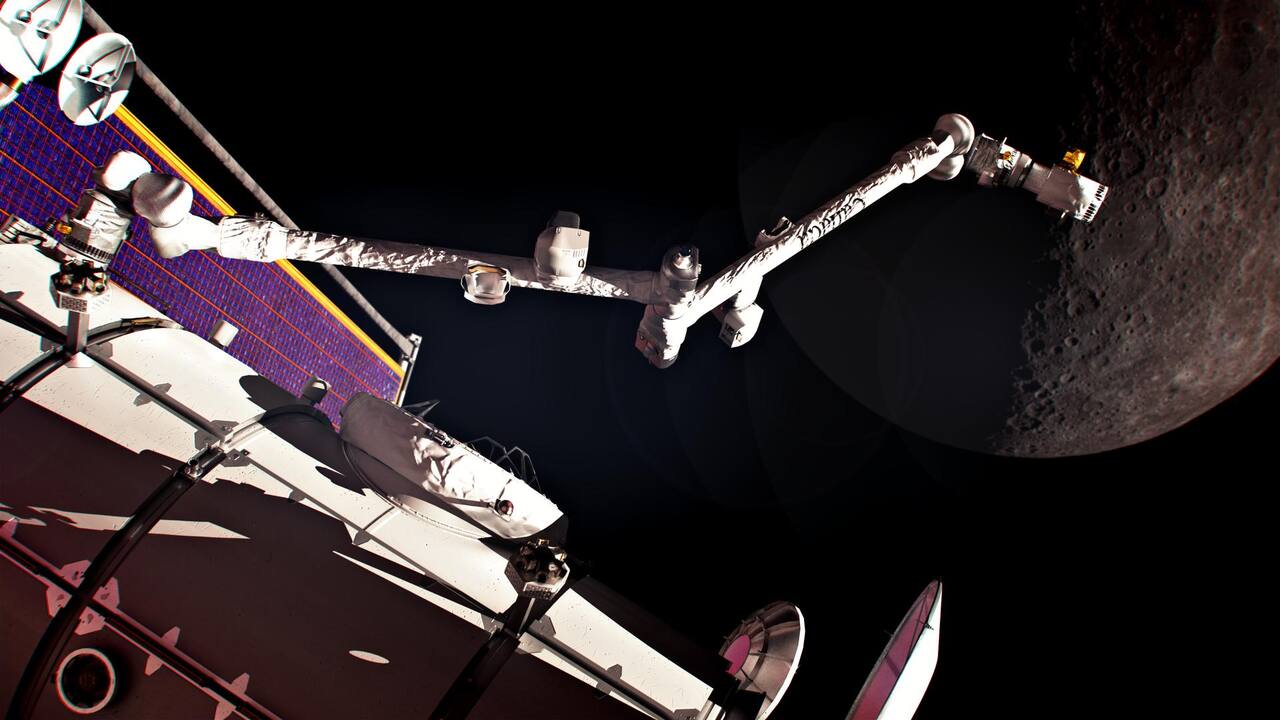
 NASA/Alberto Bertolin, Bradley Reynolds. Public domain (NASA / US government work).
The problem
Section titled “The problem”Gateway is a lunar-orbit station that is uncrewed for long periods and about 400,000 km from Earth, where the link is limited and delayed [6]. The arm that services it cannot rely on an on-board operator, as Canadarm2 does on the ISS, or on continuous ground supervision [4]. Canadarm3 is therefore specified as a goal-driven autonomous system able to maintain itself and make decisions with minimal human intervention [6].
The task list is broad: catching visiting spacecraft, relocating Gateway modules, maintaining, repairing and inspecting the station, assisting spacewalks and enabling science in lunar orbit [4]. Gateway has no truss and no mobile base, so the arm must also move itself. Canadarm3 is a system, not one arm: an eXploration Large Arm, an eXploration Dexterous Arm, specialized tools, a tool and orbital replacement unit caddy, ground control systems and AI-based control and mission planning software [4]. MDA Space in Brampton, Ontario holds the contract [8]. Delivery is stated as no earlier than 2029 [4], and the NASA ISAM catalog records a first use in 2028 [1].
What has flown
Section titled “What has flown”No Canadarm3 hardware has flown. The flown references are the arms it descends from and the free flyers that have run autonomy on orbit.
Shuttle arm and Canadarm2. The Shuttle arm (Canadarm) first deployed in 1981 [6] and was flown by Shuttle crew; it is 15 m long, 410 kg and 6 degrees of freedom [5]. Canadarm2 has serviced the ISS since 2001, is 17 m long, 1497 kg and 7 degrees of freedom, with 270 degrees of rotation in each direction per joint, and is controlled from the ground or by ISS crew [5], [26]. The NASA catalog gives Canadarm2 a reach of 17.6 m against the CSA 17 m [1], [5]. Canadarm2 needs the Mobile Base System and Mobile Transporter to traverse the truss [5].
Dextre. The Special Purpose Dexterous Manipulator is a 15 degree of freedom, two-armed system with a three-step orbital replacement unit exchange sequence [11]. The pre-launch paper argues that ground-commanded maintenance cuts crew time on external work; it reports no on-orbit performance and was written before commissioning [11]. This is the heritage for the dexterous arm.
JEMRMS. The Japanese Kibo arm pairs a 10 m, 780 kg main arm with a 2.2 m, 190 kg small fine arm; the figures are specification values, not measured loads [25].
Free flyers with autonomy. Astrobee has completed more than 165 real-time on-orbit operations and 90 guest science sessions through May 2025 [16]. Int-Ball2 made its first on-orbit flight on 17 October 2023 [18]. On 27 May 2025 a reinforcement-learned controller flew on the Astrobee Bumble in a session of about 7 minutes and 8 maneuvers, reported as the first learned control of a free flyer on the ISS [19]. The ISS intravehicular free flyers are compared in one joint review [17]. These are free-flying robots, not manipulators, so they inform software autonomy practice, not arm dynamics.
What is being tried now
Section titled “What is being tried now”The published work on the problems Canadarm3 has to solve sits in six families. None has flown on an arm with Canadarm3’s configuration.
Walking base and kinematics. Canadarm3 walks end over end between Gateway interfaces, with identical anchoring hands at both ends of the large arm [5], [4]. A free-flying arm has no privileged base, and any link can serve as the base body [12]; the Virtual Manipulator maps a spacecraft-mounted arm to a fixed-base equivalent [13]. Both are analysis with no hardware [12], [13]. For seven-joint station arms, a screw theory inverse kinematics solver for the Chinese space station Wentian arm fixes joint pairs and solves in closed form or by Newton iteration; it is numerical only [24]. No kinematic solver for Canadarm3 has been published.
Base disturbance and free-floating control. Selective decoupling of base momentum along mission-critical axes [33], dynamic-coupling-informed trajectory optimization [32] and real-time hardware-in-the-loop validation of a dual-arm controller [35] are all simulation. A control strategy that repositions the servicer’s center of mass with an external electric-propulsion module is likewise verified only in a multibody simulation [36]. These apply when the base moves; an anchored Gateway arm only approximates that case during berthing of large modules.
Capture of non-cooperative targets. A hierarchical fault-tolerant visual servoing architecture captured a tumbling satellite mockup in four hardware-in-the-loop runs, with a mean position error of 2.4 cm against a 4 cm capture envelope [20]. A controller for a chaser with a robotic arm and sloshing fuel was compared with a reference controller in simulation only [22]. A survey classifies visual servoing methods for servicing arms by recognition, approach and contact phase [21]. These are ground tests and simulations; the surveys of manipulation and capture cover the same ground [2], [3].
Dual-arm, multi-arm and assembly planning. A task-space constrained planner for a tightly coupled dual-arm manipulator [34], a nonlinear predictive handover controller for two arms [31], trajectory optimization for a four-arm walking robot on a target surface [30] and a collision avoidance formulation for autonomous on-orbit assembly [29] are all simulation. The assembly case is closest to Canadarm3’s module relocation task.
Learning and autonomy. Deep reinforcement learning for trajectory planning of teleoperated manipulators under communication delay compares mapping, prediction and state augmentation across four simulated environments [23]. Causal-curiosity reinforcement learning for object classification by a planetary manipulator was tested on a single simulated cube [37]. A lander-manipulator testbed at JPL runs autonomy experiments with a 7 degree of freedom arm on a Stewart platform [38]. An autonomy architecture for a free-flying inspector near an outpost uses keep-in corridors and keep-out zones and is simulation-only [39]. None of these is a Canadarm3 result.
Operations and communications. A DTN gateway on the ISS Ku-band path measured 15 Mbps effective downlink in ground-equivalent tests; flight deployment was in 2016 and the figure is a reference, not a Gateway design [15]. A 2005 overview of autonomous rendezvous, capture and assembly treated every demonstration it named as a plan [14]. Broader reviews of servicing history and architecture [27], the Artemis program plan [28] and the NASA state of play series [9], [10], [1] set the programmatic frame; the three state-of-play editions share verbatim text and count as one catalog.
The numbers
Section titled “The numbers”Specifications
Section titled “Specifications”| Parameter | Value | Source |
|---|---|---|
| eXploration Large Arm reach | 8.5 m | [5], [1] |
| eXploration Dexterous Arm reach | 3 m | [1] |
| Degrees of freedom, each arm | 7 (3 shoulder, 1 elbow, 3 wrist) | [5], [1] |
| Mass, large arm | 715 kg, estimated | [5] |
| Boom exterior diameter | 0.23 m, carbon fiber composite | [5] |
| Joint rotation | about 360 deg per joint | [5] |
| Unloaded tip speed | 0.10 m/s | [5] |
| Loaded tip speed | not yet set | [5] |
| Cameras | 4 color 4K, at the boom swivels and hands | [5] |
| Sensing | force-moment sensors, collision avoidance, 3D Vision Sensor | [5] |
| Control | autonomous, with ground or Gateway override | [5] |
Comparison with the earlier Canadarms
Section titled “Comparison with the earlier Canadarms”| Parameter | Canadarm | Canadarm2 | Canadarm3 | Source |
|---|---|---|---|---|
| Length | 15 m | 17 m | 8.5 m | [5] |
| Mass | 410 kg | 1497 kg | 715 kg estimated | [5] |
| Diameter | 33 cm | 35 cm | 23 cm | [5] |
| Degrees of freedom | 6 | 7 | 7 | [5] |
| Joint rotation | elbow limited to 160 deg | 270 deg each direction | about 360 deg per joint | [5] |
| Unloaded tip speed | 60 cm/s | 37 cm/s | 10 cm/s | [5] |
| Loaded tip speed | 6 cm/s | 2 to 15 cm/s | to be determined | [5] |
| Cameras | 2 | 4 color | 4 color 4K | [5] |
| Control | Shuttle crew | ground or ISS crew | autonomous, with ground or Gateway override | [5] |
| Repair | on Earth | in space, replaceable sections | self-detaching sections repaired inside Gateway | [5], [2] |
| Operator | United States | Canada and United States | Canada | [5] |
The CSA table gives four 4K color cameras [5]; a review of the Canadarm series gives six [2]. The NASA catalog separates long reach and short reach manipulators at 8 m, which puts the large arm on the long side and the dexterous arm on the short side [9], [1].
Contract history
Section titled “Contract history”| Item | Value | Source |
|---|---|---|
| Phase A, system definition | complete | [7] |
| Phases B and C, 26 July 2021 | $35.3 million, Gateway External Robotics Interfaces design | [7] |
| Phases C and D, 27 June 2024 | $1 billion, final design plus construction, assembly, integration and test | [8] |
| Phase C and D period of performance | to March 2030 | [8] |
| Canadian supply chain | more than 200 companies | [8] |
The 2024 award covers the flight system: large arm, dexterous arm, specialized tools and ground segment, with commissioning support and training for on-orbit operations [8]. The Gateway External Robotics Interfaces supply power, data and video at the anchoring hands and were planned for delivery ahead of the arms [7], [4].
What is not established
Section titled “What is not established”No Canadarm3 performance value is as-built or measured. The 715 kg mass is marked an estimate and the loaded tip speed is to be determined [5]. The CSA and MDA sources are public-affairs pages without test data, drawings or requirement documents [4], [6], [8].
Nothing published covers power draw, thermal design, processor and radiation approach, communications rates, tool inventory, safing modes, positioning accuracy, flexibility of the shorter and thinner boom, or the autonomy architecture. The AI-based control and mission planning software is named as a deliverable but no architecture has been released [6]. Autonomous capture of an uncooperative target remains an open research problem in the surveys [3].
The 2028 first use in the ISAM catalog does not match the CSA date of no earlier than 2029 [1], [4]. The 2021 release tied delivery of the external interfaces to the 2024 HALO and PPE launch dates [7], and the 2020 Artemis plan carried the same dates [28]; neither held. The CSA has announced an intention to repurpose Canadarm3 investments toward the next phase of lunar exploration [4], and the consequence for the Gateway-hosted configuration is not stated in any published source.
References
Section titled “References”References
- Mulvaney, J., Arney, D., Williams, C., Morel, J., Stockdale, C., Whitlock, C. and Balaji, V. (2025). In-Space Servicing, Assembly, and Manufacturing (ISAM) State of Play, 2025 Edition
. NASA, 20250008988. Source
BibTeX
@techreport{nasa2025space, title = {In-Space Servicing, Assembly, and Manufacturing (ISAM) State of Play, 2025 Edition}, author = {Mulvaney, John and Arney, Dale and Williams, Christina and Morel, Jose and Stockdale, Christopher and Whitlock, Christopher and Balaji, Vishruth}, number = {20250008988}, institution = {NASA}, year = {2025}, url = {https://ntrs.nasa.gov/citations/20250008988}, abstract = {The future of spaceflight will yield increasingly more ambitious missions to support civil, national security, and commercial space sectors. Achieving some of these missions will not be feasible by launching an integrated, fully functioning system on a single launch vehicle. Future science and human exploration missions will require payloads that are larger than any foreseeable launch vehicle fairing, national security missions will require persistent assets that are mobile and resilient, and commercial space missions will require cost-effective ways to update to the latest technology on orbit. In-space Servicing, Assembly, and Manufacturing (ISAM) can vastly expand the performance, availability, and lifetime of space systems compared to the traditional paradigm of launching an asset with no intent to ever interact with it again. ISAM capabilities foster an ecosystem that changes the space operations paradigm, creating the foundation for sustainable exploration and serving as a multiplier for other capabilities like space logistics, power generation, and reusability. Previous achievements in ISAM have enabled ambitious human and robotic space missions. The assembly, operation, and maintenance of NASA’s International Space Station (ISS); servicing missions to the Hubble Space Telescope (HST); and Northrop Grumman’s Mission Extension Vehicle (MEV) demonstrate the dramatic operational missions that can be achieved using ISAM capabilities. Many current and upcoming flight demonstrations are advancing areas that will enable the next generation of civil, national security, and commercial space missions. This document describes the current state of ISAM missions, activities, and technologiesto the best ability of the authors. Compiling and organizing the available ISAM capabilities will help mission designers incorporate ISAM technologies into their concepts, create the starting point for technology development plans and roadmaps, and provide technologists a survey of the field they are developing. This document divides the ISAM capabilities into 11 functional capability areas that describe the functions or activities that can be performed in space using ISAM.} } - Won, D., So, B.-R. and Kim, H.-D. (2022). A Survey of Space Robotic Manipulator
. Journal of Space Technology and Applications, 4. Source
BibTeX
@article{won2022survey, title = {A Survey of Space Robotic Manipulator}, author = {Won, Daehee and So, Byung-Rok and Kim, Hae-Dong}, journal = {Journal of Space Technology and Applications}, volume = {2}, number = {4}, pages = {257--267}, year = {2022}, doi = {10.52912/jsta.2022.2.4.257}, abstract = {In the 1970s, space robotics was used to attach a robotic manipulator to the first planetary exploration satellite of the Soviet Union. Since then, it has been developed to use various on-orbit services such as space debris removal, parts replacement/repairing, refueling, orbit changing, and construction of a space station in Earth orbit. In planetary exploration projects such as the Moon and Mars, various space robotic manipulators are being designed and developed to be used in the collection of samples and building bases on Mars. Recently, the use of various space robotic manipulators to perform missions in the Earth orbit or on the planet has been increasing. Countries with state-of-the-art space technology plan and implement new space-related projects. In this article, we would like to introduce the technology development trends and functions of space robot manipulators that have been used in various space challenge projects in advanced space technology countries.} } - Papadopoulos, E., Aghili, F., Ma, O. and Lampariello, R. (2021). Robotic Manipulation and Capture in Space: A Survey
. Frontiers in Robotics and AI. Source
BibTeX
@article{papadopoulos2021robotic, title = {Robotic Manipulation and Capture in Space: A Survey}, author = {Papadopoulos, Evangelos and Aghili, Farhad and Ma, Ou and Lampariello, Roberto}, journal = {Frontiers in Robotics and AI}, volume = {8}, pages = {686723}, year = {2021}, doi = {10.3389/frobt.2021.686723}, abstract = {Space exploration and exploitation depend on the development of on-orbit robotic capabilities for tasks such as servicing of satellites, removing of orbital debris, or construction and maintenance of orbital assets. Manipulation and capture of objects on-orbit are key enablers for these capabilities. This survey addresses fundamental aspects of manipulation and capture, such as the dynamics of space manipulator systems (SMS), i.e., satellites equipped with manipulators, the contact dynamics between manipulator grippers/payloads and targets, and the methods for identifying properties of SMSs and their targets. Also, it presents recent work of sensing pose and system states, of motion planning for capturing a target, and of feedback control methods for SMS during motion or interaction tasks. Finally, the paper reviews major ground testing testbeds for capture operations, and several notable missions and technologies developed for capture of targets on-orbit.} } - (2020). CSA: About Canadarm3. asc-csa.gc.ca/eng/canadarm3/about.asp
BibTeX
@misc{csaabout, title = {CSA: About Canadarm3}, organization = {asc-csa.gc.ca}, year = {2020}, url = {https://www.asc-csa.gc.ca/eng/canadarm3/about.asp} } - (2026). CSA: Comparative table of Canadarm, Canadarm2 and Canadarm3. asc-csa.gc.ca/eng/iss/canadarm2/canadarm-canadarm2-canadarm3-comparat...
BibTeX
@misc{csacomparative, title = {CSA: Comparative table of Canadarm, Canadarm2 and Canadarm3}, organization = {asc-csa.gc.ca}, year = {2026}, url = {https://www.asc-csa.gc.ca/eng/iss/canadarm2/canadarm-canadarm2-canadarm3-comparative-table.asp} } - (2026). MDA Space: Canadarm3. mda.space/canadarm3
BibTeX
@misc{mdaspacecanadarm3, title = {MDA Space: Canadarm3}, organization = {mda.space}, year = {2026}, url = {https://mda.space/canadarm3} } - (2026). MDA Space: MDA awarded next contract for flagship Canadarm3 program. mda.space/article/mda-awarded-next-contract-for-flagship-canadarm3-pr...
BibTeX
@misc{mdaspacemda, title = {MDA Space: MDA awarded next contract for flagship Canadarm3 program}, organization = {mda.space}, year = {2026}, url = {https://mda.space/article/mda-awarded-next-contract-for-flagship-canadarm3-program/} } - (2026). MDA Space: $1B contract to design and deliver the Canadarm3 flight system. mda.space/article/mda-space-awarded-1b-contract-to-design-and-deliver...
BibTeX
@misc{mdaspace1b,
  title = {MDA Space: $1B contract to design and deliver the Canadarm3 flight system},
  organization = {mda.space},
  year = {2026},
  url = {https://mda.space/article/mda-space-awarded-1b-contract-to-design-and-deliver-canadarm3-flight-system}
}