LISTER
Program pages Firefly Aerospace: Blue Ghost Mission 1
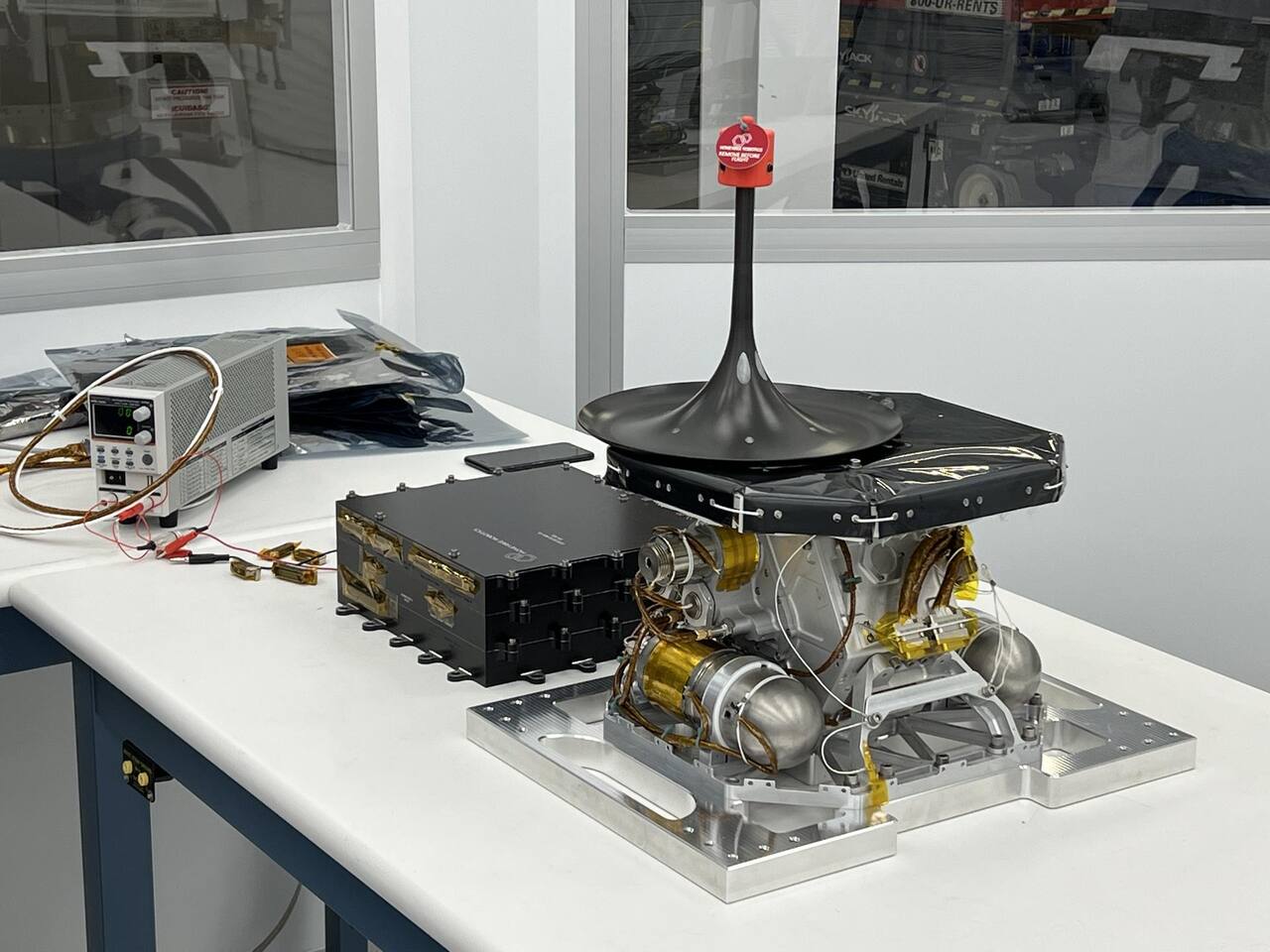 NASA/Firefly Aerospace. Public domain (NASA / US government work).
Overview
Section titled “Overview”A lunar heat flow measurement needs the temperature gradient and the thermal conductivity of the regolith at depths below the layer that follows the diurnal and annual insolation cycles. LISTER is a pneumatic drill and heat flow probe built by Honeybee Robotics for a Texas Tech University investigation, flown as one of ten NASA payloads on Firefly Aerospace’s Blue Ghost Mission 1 to Mare Crisium [18], [16], [20]. It measures regolith temperature and thermal conductivity at a series of depths, and heat flow is the product of the gradient and the conductivity over the interval penetrated [16].
The environment makes this hard in three ways. A landed spacecraft offers little weight on bit, so a drill cannot lean on the ground [5]. Regolith strength and rock content below the surface were known only from a few Apollo cores, and the authors of the LISTER qualification campaign state that the size and frequency of rocks in the real subsurface cannot be predicted from available data [19], [3]. And the instrument must be inserted into undisturbed material, because drilling that compacts the soil around a probe biases the conductivity it reads [2].
Design space
Section titled “Design space”Lunar subsurface access has taken seven forms, which differ in what has flown.
Hand-emplaced probes. Before the Blue Ghost flight, the only in-situ lunar heat flow measurements came from the Apollo 15 and 17 heat flow experiments [2], in which crews drilled holes by hand and lowered probe strings. Langseth and colleagues revised the values by analyzing the annual temperature wave recorded over years: conductivity of 0.9 to 1.3e-2 W/m/K, 30 to 50 percent below the short-term heater values, and heat flow of 2.1 microW/cm2 at Hadley Rille and 1.6 at Taurus-Littrow, with an uncertainty of plus or minus 15 percent, and the discrepancy grew with depth because drilling had compacted the regolith around the stem [2]. Apollo 17 also returned drill-stem samples used for bulk density and soil mechanics [1]. The reference regolith numbers used in design, such as 1.50 g/cm3 in the top 15 cm rising to 1.66 g/cm3 over the top 60 cm, derive from those returned samples at equatorial sites [3]. A 2026 compilation of lunar geotechnical data finds bulk density spanning roughly 0.8 to 2.3 g/cm3 and most in-situ values from near-side equatorial and mid-latitude sites, with essentially none from the poles [24]. Flown: Apollo 15 and 17 only.
Rotary and rotary-percussive drills. Rotary, rotary-percussive and coring drills have flown on Apollo, Luna and Chang’e-5, with sampled depths of 25 to 305 cm [13]. A survey by the Honeybee and JPL team classifies planetary drills into surface, 1 m class, 10 m class and deep drills and compiles performance across built prototypes, from the proponents’ own test programs [4]. A bench comparison in 45 MPa limestone at ambient conditions found rotary-percussive drilling at about 1000 J/cc against about 5000 J/cc for rotary alone, and 130 cm/hr against 9 cm/hr at 40 lbs weight on bit, which is the argument for percussion under low weight on bit [5]. The benefit shrinks at larger scale: a 76 cm bucket drawn through compacted BP-1 simulant showed an average load reduction of 19.2 percent from percussion, with two conditions worse than without [7]. A load model for lunar sampling augers finds that bulldozing and cutting, not screw conveyance, dominate the measured load [11]. These are 1 g laboratory results in simulant. Flown: Apollo, Luna and Chang’e-5 hardware; the models and bench data are not flight data.
Piezoelectric percussive drills. The JPL Auto-Gopher line reached 7.52 m in a gypsum quarry in a field test of a 65 kg drill drawing under 500 W [8]. The preceding development status reports a 3.9 m, about 70 kg design, a simulated peak bit-rock force of 22.1 kN, and two transducers that performed differently, with an unexplained loss of mechanical Q [9]. Tested on Earth only; no unit has flown.
Rotary-percussive drills for polar volatiles. The TRIDENT 1 m rotary-percussive drill, the design carried by VIPER, was run in Antarctica in 2026 on an engineering unit of 19.5 kg with a 300 W percussor delivering 2 J per blow at up to 972 blows per minute; fifteen boreholes were drilled, telemetry alone identified an ice-rock transition near 62 cm and a frozen boundary at 20 cm, and the cam-spring percussive head broke after two days of field use [25]. The paper is not peer reviewed in the held version, and Antarctic ice and till are not lunar regolith [25]. TRIDENT on the PRIME-1 lander was deployed in a horizontal orientation after an off-nominal landing, all actuators, sensors and heaters worked as designed, and the drill did not penetrate regolith [22]. Flown: PRIME-1 hardware operated on the Moon without drilling regolith; no lunar drilling result exists.
Cryogenic and volatile-preserving drilling. Where the target is icy regolith, drilling is judged by what it does to the sample. Drilling ice-bound simulant at -85 C, a specific energy of 151 MJ/m3 correlated with a compressive strength near 50 MPa, against 42.6 MPa measured directly [6]. In a thermal vacuum chamber at 1e-5 Torr, a one meter class auger in frozen simulant held the bit at -70 to -60 C, and four clean samples lost an average of 30 percent of their water, mostly in handling [10]. A discrete element thermal model calibrated at -130 C and -120 C puts the sampled-region temperature rise at 2 to 4 C on average, with the vacuum case a model extrapolation [12]. A proposed coring concept would wrap the core in a self-healing sealing film to preserve in-situ conditions; its film was characterized at -20 C on a bench and the integrated system has not been tested [13]. None of this has flown.
Surface excavation. Bucket-drum excavators address bulk regolith at the surface, not instrument emplacement at depth. RASSOR 2.0 is a 66 kg vehicle whose counter-rotating drums cancel the horizontal reaction force, so it can excavate without traction in low gravity; it was tested in simulant at 1 g with no vacuum, thermal or dust testing [21]. Its successor, the IPEx excavator, was taken to TRL 5 by a four-test qualification sequence covering characterization, thermal characterization, accelerated life and dirty-vacuum operation; the arm actuator survived 1,402,223 input revolutions against a 337,000 revolution requirement [27]. Both are ground-tested; neither has flown.
Pneumatic excavation. LISTER spools a stainless steel tube off a reel and yields it straight as it leaves, forming a stiff boom. Nitrogen fed through the tube leaves a nozzle at the leading end and blows regolith out of the hole as the boom advances [18], [19]. The hole is typically 6 cm across or wider against a 6.4 mm tube [16]. The design has no rotating or percussive element, so the loads the rotary literature models do not apply. Its own limit is the lift capacity of a gas jet against clasts. Flown: Blue Ghost Mission 1 [18]. The same lander carried Lunar PlanetVac, a pneumatic sampler that captured 13 g of Mare Crisium regolith, 5 g of it rocklets about 2 mm across, in one event with the sampling head not touching the surface; the figure is the builder’s own, from a meeting abstract [26].
The flown options converged on a boom because the measurement needs a probe in undisturbed regolith, a small instrument mass and low power, and little weight on bit. LISTER’s requirements were a mass under 15 kg and average power of 33 W quiescent and 88 W while drilling [19].
Specifications
Section titled “Specifications”| Parameter | Value | Source |
|---|---|---|
| Mechanism mass | under 9 kg, against a 15 kg instrument allocation | [19] |
| Mechanism envelope | 32 x 33 x 43 cm | [19] |
| Coiled tubing | stainless steel, 6.4 mm diameter | [18], [19] |
| Excavated hole diameter | typically 6 cm or larger | [16] |
| Needle sensor | 28 mm long, 2.8 mm diameter, platinum resistance thermometers | [17], [19] |
| Average power, quiescent | 33 W | [19] |
| Average power, drilling | 88 W | [19] |
| Heat flux accuracy requirement | 10 percent | [19] |
| Depth requirement | at least three measurements between 1 and 2 m | [19] |
| Design depth | 2 m threshold, 3 m objective | [17], [19] |
| Working gas | nitrogen | [18] |
Mission profile
Section titled “Mission profile”| Parameter | Value | Source |
|---|---|---|
| Operations start | two Earth days after landing | [18] |
| Depth after two further days | 0.96 m, seven measurement depths | [18] |
| Progress slowed | at 0.94 m | [18] |
| Operations suspended | spacecraft heating under the midday Sun | [18] |
| Operations resumed | seven Earth days later | [18] |
| Final depth | 0.98 m, one additional measurement set | [18] |
| Depths measured | 8 | [17] |
| Endogenic heat flow, early result | 13 to 14 mW/m2 | [18] |
The preflight plan called for measurements at 0.2, 0.5, 1.0, 1.5, 2.0, 2.5 and 3.0 m, with descent between depths expected to take a few tens of seconds unless rocks too large to be blown out were encountered [16]. That is what stopped the drill. Below 0.94 m, downward progress slowed as clasts and pebbles too large or heavy to be lofted accumulated in the bottom of the hole; the obstruction is inferred from the penetration rate rather than observed [18].
Ground test against flight
Section titled “Ground test against flight”The instrument was qualified in a vacuum chamber against simulant beds whose rock content was set to about 33 percent by volume, so that rock encounters would be frequent rather than avoided by luck [19]. The authors chose 1 g testing with real rocks as the conservative case. Simulant choice bears on any such result: the 2005 NASA simulant workshop argued from Apollo hardware problems, including tools that could not penetrate beyond tens of centimeters, that surface hardware needs traceable standard regolith materials for testing [14]. Gravity is a second gap: parabolic-flight wheel tests in the same simulant at lunar gravity and 1 g found the cone index gradient about four times lower in lunar gravity at unchanged density, and soil loosened in 1 g to match it overestimated drawbar pull and underestimated sinkage, so 1 g results do not transfer directly [15]. A 2026 magnetic-levitation cone penetration study in a magnetite-bearing simulant measured a smaller effect: penetration resistance at 1/6 g was 29.1 percent below 1 g at 40 percent relative density and 8.8 percent below at 76 percent, and the authors expect the lunar reduction to be smaller still because regolith reaches about 92 percent relative density by 60 cm [23]. The two measure different quantities in different simulants, so the gravity effect on soil strength at depth remains disputed [15], [23]. That work concerns wheels, not drills, and no equivalent measurement for pneumatic excavation is held.
| Condition | Depth reached | Source |
|---|---|---|
| Fines-only simulant, vacuum chamber, 1 g | 2.2 m | [19] |
| Rocky simulant, about 33 percent rocks by volume, vacuum chamber, 1 g | 1.35 m | [19] |
| Mare Crisium regolith | 0.98 m | [18] |
The flight result falls below the rocky ground case as well as the fines-only case, and below the 2 m threshold requirement [18], [19].
Approach
Section titled “Approach”At each target depth the gas jet stops and the needle sensor is pushed into unexcavated regolith at the bottom of the hole, so the material it measures has not been disturbed by the excavation that reached it [18]. The sequence at each depth takes two hours: an hour of passive equilibration, 30 minutes of constant-power heating, and 30 minutes of cooling [17]. Equilibrium temperature comes from extrapolating the equilibration trend to infinite time; conductivity comes from fitting a finite-element heat transfer model to the heating and cooling curve [17].
A rock small enough to move is handled by dithering, which was tested in the laboratory and shown to aid penetration [19].
Mobility
Section titled “Mobility”None beyond the boom’s own advance.
Power and energy
Section titled “Power and energy”Average power is a requirement rather than a measurement: 33 W quiescent and 88 W during drilling [19]. Neither the gas quantity carried nor the energy consumed per meter is published.
Thermal
Section titled “Thermal”The mechanism is mounted to a downward-facing lander surface [19]. Spacecraft heating at midday suspended science operations for seven Earth days [18].
The measurement is defeated by thermal noise near the surface, and the 2 m threshold depth was set to escape the diurnal and annual insolation waves [19]. A model driven by site ephemeris and Diviner surface temperature history places the depth below which the annual fluctuation falls under 0.1 K at 0.6 m [18]. That is what makes a heat flow value recoverable from measurements that stopped at 0.98 m [18].
Compute and avionics
Section titled “Compute and avionics”Not published. Platinum resistance thermometers in the needle sensor are the only electronics described.
Autonomy
Section titled “Autonomy”None. The drill descends one depth at a time under ground control.
Communications
Section titled “Communications”Through the lander.
Payload and instruments
Section titled “Payload and instruments”The needle sensor is the instrument: a 28 mm long, 2.8 mm diameter probe carrying platinum resistance thermometers at the leading end of the tube [17], [19].
Modes of operation
Section titled “Modes of operation”Excavation, with gas flowing and the boom advancing; measurement, with the gas off and the probe pressed into undisturbed bottom-hole regolith; and dithering, used to displace small rocks [18], [19]. The suspension across the lunar midday was a response to spacecraft thermal conditions rather than a designed mode [18].
Ground operations
Section titled “Ground operations”Run by the LISTER surface operation team under a preflight plan that sets the depth sequence [16].
Technologies developed
Section titled “Technologies developed”LISTER became the first robotically operated device to actively excavate lunar regolith and the first to take science measurements in situ at multiple subsurface depths on the Moon [18]. The technique’s advantage is the absence of a rotating cutting element; its demonstrated limit is that it moves only what the gas jet can lift, so a bed of coarse clasts ends the hole.
The measurement result is an early endogenic heat flow of 13 to 14 mW per square meter at Mare Crisium, obtained by inverting eight depth measurements against a thermal model [18]. The authors describe it as preliminary, with a fuller inversion and an uncertainty estimate outstanding [18].
What is not established
Section titled “What is not established”The heat flow number is early: the fuller inversion and uncertainty estimate are outstanding, and it comes from one site, one deployment, one lander [18]. The final depth of 0.98 m falls inside the band the 2 m threshold was set to escape, so separating endogenic heat flow from insolation transients rests on the site thermal model rather than on measurement below the thermal skin depth [18], [17]. The obstruction that stopped the drill is inferred from the slowing penetration rate, not observed or identified by composition [18]. One measurement is flagged as a probe probably not fully embedded, and that judgment is not quantified [17]. The qualification campaign used simulant at 1 g, and its authors state that rock encounters in the real subsurface cannot be predicted from available data [19]. No energy per meter, gas consumption or per-depth conductivity values are published in the held sources. The comparison with other drill families rests on bench and field tests at ambient conditions in simulant or rock, with single runs and no flight data outside Apollo, Luna and Chang’e-5 [4], [5], [11].
References
Section titled “References”References
- (1973). Apollo 17 Preliminary Science Report
. NASA. Source
BibTeX
@techreport{nasa1973apollo, title = {Apollo 17 Preliminary Science Report}, author = {}, institution = {NASA}, year = {1973}, url = {https://ntrs.nasa.gov/api/citations/19740010315/downloads/19740010315.pdf} } - Langseth, M. G., Keihm, S. J. and Peters, K. (1976). Revised lunar heat-flow values
. Lunar Science Conference. Source
BibTeX
@inproceedings{langseth1976revised, title = {Revised lunar heat-flow values}, author = {Langseth, Marcus G. and Keihm, Stephen J. and Peters, Kenneth}, booktitle = {Lunar Science Conference}, pages = {3143--3171}, year = {1976}, url = {https://ntrs.nasa.gov/citations/19770051977}, abstract = {The 3.5- and 2-year subsurface temperature histories at the Apollo 15 and 17 heat-flow sites have been analyzed, and the results yield significantly lower thermal conductivity determinations than the results of previous short-term experiments. The thermal conductivity determined by probes at a depth of about 150 cm and 250 cm lies in the range 0.9-1.3 times 10 to the -4th W/cm K. On the basis of measurements of variations of surface thorium abundance and inferred crustal thicknesses, the average global heat flux is estimated to be about 1.8 microwatts/sq cm. This requires a uranium concentration of 46 ppb.} } - Heiken, G. H., Vaniman, D. T. and French, B. M. (1991). Lunar Sourcebook: A User's Guide to the Moon
. Endeavour. Source
BibTeX
@book{heiken1991lunar, title = {Lunar Sourcebook: A User's Guide to the Moon}, author = {Heiken, Grant H. and Vaniman, David T. and French, Bevan M.}, journal = {Endeavour}, volume = {16}, pages = {96}, publisher = {Cambridge University Press}, year = {1991}, doi = {10.1016/0160-9327(92)90014-g} } - Zacny, K., Bar-Cohen, Y., Brennan, M., Briggs, G., Cooper, G., Davis, K., Dolgin, B., Glaser, D., Glass, B., Gorevan, S., Guerrero, J. and McKay, C. (2008). Drilling Systems for Extraterrestrial Subsurface Exploration
. Astrobiology. doi.org/10.1089/ast.2007.0179
BibTeX
@misc{zacny2008drilling, title = {Drilling Systems for Extraterrestrial Subsurface Exploration}, author = {Zacny, Kris and Bar-Cohen, Yoseph and Brennan, Marc and Briggs, Gary and Cooper, Guy and Davis, Kenneth and Dolgin, Benjamin and Glaser, David and Glass, Brian and Gorevan, Stephen and Guerrero, Julio and McKay, Christopher}, journal = {Astrobiology}, volume = {8}, pages = {665-706}, year = {2008}, doi = {10.1089/ast.2007.0179}, abstract = {Drilling consists of 2 processes: breaking the formation with a bit and removing the drilled cuttings. In rotary drilling, rotational speed and weight on bit are used to control drilling, and the optimization of these parameters can markedly improve drilling performance. Although fluids are used for cuttings removal in terrestrial drilling, most planetary drilling systems conduct dry drilling with an auger. Chip removal via water-ice sublimation (when excavating water-ice-bound formations at pressure below the triple point of water) and pneumatic systems are also possible. Pneumatic systems use the gas or vaporization products of a high-density liquid brought from Earth, gas provided by an in situ compressor, or combustion products of a monopropellant. Drill bits can be divided into coring bits, which excavate an annular shaped hole, and full-faced bits. While cylindrical cores are generally superior as scientific samples, and coring drills have better performance characteristics, full-faced bits are simpler systems because the handling of a core requires a very complex robotic mechanism. The greatest constraints to extraterrestrial drilling are (1) the extreme environmental conditions, such as temperature, dust, and pressure; (2) the light-time communications delay, which necessitates highly autonomous systems; and (3) the mission and science constraints, such as mass and power budgets and the types of drilled samples needed for scientific analysis. A classification scheme based on drilling depth is proposed. Each of the 4 depth categories (surface drills, 1-meter class drills, 10-meter class drills, and deep drills) has distinct technological profiles and scientific ramifications.} } - Zacny, K., Paulsen, G. and Szczesiak, M. (2011). Challenges and methods of drilling on the Moon and Mars
. IEEE Aerospace Conference. Source
BibTeX
@inproceedings{zacny2011challenges, title = {Challenges and methods of drilling on the Moon and Mars}, author = {Zacny, Kris and Paulsen, Gale and Szczesiak, Mateusz}, booktitle = {IEEE Aerospace Conference}, pages = {1-9}, publisher = {IEEE}, year = {2011}, doi = {10.1109/aero.2011.5747261}, abstract = {There are many reasons for penetrating below the surface of an extraterrestrial body. One of these reasons include obtaining core or powder samples that have been preserved and unaltered for millions of years. Another reason is to provide subsurface access for in-situ scientific instruments such as heat flow probes and neutron spectrometers. However, there are a number of challenges associated with penetrating extraterrestrial bodies. These include specific mission requirements (depth, size of a sample, acceptable level of contamination), mission constraints (mass, power, volume, communication delay) and environmental constraints (temperature, atmospheric pressure or vacuum, dust, geological uncertainty). Having such a large number of variables leads to diverse approaches. This paper specifically outlines challenges associated with drilling on the Moon or Mars. It also reports test results with rotary and rotary-percussive drilling methods and how these two different approaches compare in respect to power, energy and Weight on Bit. The results have shown that although heavier and more power hungry, a rotary-percussive drill can significantly increase the overall drilling efficiency and reduce WOB requirements when compared to a rotary drilling method.} } - Zacny, K., Glaser, D., Bartlett, P., Davis, K. and Gorevan, S. (2007). Drilling Results in Ice-Bound Simulated Lunar Regolith
. ASCE Earth and Space Conference. Source
BibTeX
@inproceedings{zacny2007drilling, title = {Drilling Results in Ice-Bound Simulated Lunar Regolith}, author = {Zacny, Kris and Glaser, David and Bartlett, Paul and Davis, Kiel and Gorevan, Stephan}, booktitle = {ASCE Earth and Space Conference}, volume = {880}, pages = {838-845}, publisher = {AIP}, year = {2007}, doi = {10.1063/1.2437524}, abstract = {Reaching the cold traps at the lunar poles and directly sensing the subsurface regolith is a primary goal of lunar exploration, especially as a means of prospecting for future In Situ Resource Utilization (ISRU) efforts. The Construction and Resource Utilization Explorer project (CRUX) addressed technology development associated with a modular, drilling‐based payload to achieve this goal. As part of the development of a lunar drill capable of reaching a depth of two meters, a preliminary drilling study was performed using custom designed drill bits and augers in simulated ice‐bound lunar regolith. Lunar regolith is known to be very abrasive, but the mechanical properties and “drillability” of the purported ice‐bound material in the lunar cold traps is unknown. Preliminary drilling experiments were performed in the frozen samples, to determine the effectiveness of the drilling hardware and to point the way towards optimized drilling strategies. Additionally, a preliminary experiment was performed to demonstrate the utility of converting drilling energy per volume (Specific Energy) to the Unconfmed Compressive Strength (UCS) of the simulated frozen regolith. The results showed that the drilling hardware was capable of penetrating into the samples and that this was most effectively done at slow rotational speeds (< 60 RPM) and with a low axial force (weight‐on‐bit). The results also indicate that the specific energy of drilling is correlated to the UCS of the material tested.} } - Mueller, R., Smith, J. D., Schuler, J., Nick, A. and Lippitt, T. (2013). Reducing Extra-Terrestrial Excavation Forces with Percussion
. IEEE Aerospace Conference, 20120017917. Source
BibTeX
@inproceedings{mueller2013reducing, title = {Reducing Extra-Terrestrial Excavation Forces with Percussion}, author = {Mueller, Robert and Smith, Jonathan Drew and Schuler, Jason and Nick, Andrew and Lippitt, Thomas}, booktitle = {IEEE Aerospace Conference}, number = {20120017917}, pages = {1-11}, institution = {NASA Kennedy Space Center}, year = {2013}, doi = {10.1109/aero.2013.6497139}, abstract = {High launch costs and mission requirements drive the need for low mass excavators with mobility platforms, which in turn have little traction and excavation reaction capacity in low gravity environments. This presents the need for precursor and long term future missions with low mass robotic mining technology to perform In-Situ Resource Utilization (ISRU) tasks. This paper discusses a series of experiments that investigate the effectiveness of a percussive digging device to reduce excavation loads and thereby the mass of the excavator itself. A percussive mechanism and 30" wide pivoting bucket were attached to a test stand simulating a basic backhoe with a percussion direction tangent to the direction of movement. Impact energies from 13.6J to 30.5J and frequencies from 0 to 700 beats per minute (BPM) were investigated. A reduction in excavation force of as much as 50% was achieved in this experimental investigation.} } - BarCohen, Y., Sherrit, S., Badescu, M., Lee, H. J., Bao, X. and Chang, Z. (2019). Drilling mechanisms using piezoelectric actuators. dataverse.jpl.nasa.gov/dataset.xhtml
BibTeX
@misc{barcohen2019drilling, title = {Drilling mechanisms using piezoelectric actuators}, author = {BarCohen, Yoseph and Sherrit, Stewart and Badescu, Mircea and Lee, Hyeong Jae and Bao, Xiaoqi and Chang, Zensheu}, howpublished = {Presentation at the Engineering Mechanics Institute Conference}, year = {2019}, url = {https://dataverse.jpl.nasa.gov/dataset.xhtml?persistentId=hdl:2014/50758} } - Badescu, M., Bar-Cohen, Y., Sherrit, S., Jackson, S., Metz, B., Simonini, A., Bao, X., Zacny, K., Mellerowicz, B., Kim, D. and Paulsen, G. L. (2018). Auto-Gopher-II - A wireline rotary-hammer ultrasonic drill that operates autonomously
. Sensors and Smart Structures Technologies for Civil, Mechanical, and Aerospace Systems. Source
BibTeX
@inproceedings{badescu2018auto, title = {Auto-Gopher-II - A wireline rotary-hammer ultrasonic drill that operates autonomously}, author = {Badescu, Mircea and Bar-Cohen, Yoseph and Sherrit, Stewart and Jackson, Shannon and Metz, Brandon and Simonini, Alan and Bao, Xiaoqi and Zacny, Kris and Mellerowicz, Bolek and Kim, Daniel and Paulsen, Gale L.}, booktitle = {Sensors and Smart Structures Technologies for Civil, Mechanical, and Aerospace Systems}, pages = {107}, publisher = {SPIE}, year = {2018}, doi = {10.1117/12.2294560}, abstract = {An important challenge of exploring the solar system is the ability to penetrate at great depths the subsurface of planetary bodies for sample collection. The requirements of the drilling system are minimal mass, volume and energy consumption. To address this challenge, a deep drill, called the Auto-Gopher II, is currently being developed as a joint effort between JPL’s NDEAA laboratory and Honeybee Robotics Corp. The Auto-Gopher II is a wireline rotaryhammer drill that combines breaking formations by hammering using a piezoelectric actuator and removing the cuttings by rotating a fluted bit. The hammering is produced by the Ultrasonic/Sonic Drill/Corer (USDC) mechanism that has been developed by the JPL team as an adaptable tool for many drilling and coring applications. The USDC uses an intermediate free-flying mass to convert high frequency vibrations of a piezoelectric transducer horn tip into sonic hammering of the drill bit. The USDC concept was used in a previous task to develop an Ultrasonic/Sonic Ice Gopher and then integrated into a rotary hammer device to develop the Auto-Gopher-I. The lessons learned from these developments are being integrated into the development of the Auto-Gopher-II, an autonomous deep wireline drill with integrated cuttings and sample management and drive electronics. In this paper the latest development will be reviewed including the piezoelectric actuator, cuttings removal and retention flutes and drive electronics.} } - Kleinhenz, J. E., Paulsen, G., Zacny, K. and Smith, J. (2015). Impact of Drilling Operations on Lunar Volatiles Capture: Thermal Vacuum Tests
. Glenn Research Center, 20150011440. Source
BibTeX
@techreport{kleinhenz2015impact, title = {Impact of Drilling Operations on Lunar Volatiles Capture: Thermal Vacuum Tests}, author = {Kleinhenz, Julie E. and Paulsen, Gale and Zacny, Kris and Smith, Jim}, number = {20150011440}, institution = {Glenn Research Center}, year = {2015}, doi = {10.2514/6.2015-1177}, abstract = {In Situ Resource Utilization (ISRU) enables future planetary exploration by using local resources to supply mission consumables. This idea of 'living off the land' has the potential to reduce mission cost and risk. On the moon, water has been identified as a potential resource (for life support or propellant) at the lunar poles, where it exists as ice in the subsurface. However, the depth and content of this resource has yet to be confirmed on the ground; only remote detection data exists. The upcoming Resource Prospector mission (RP) will 'ground-truth' the water using a rover, drill, and the RESOLVE science package. As the 2020 planned mission date nears, component level hardware is being tested in relevant lunar conditions (thermal vacuum). In August 2014 a series of drilling tests were performed using the Honeybee Robotics Lunar Prospecting Drill inside a 'dirty' thermal vacuum chamber at the NASA Glenn Research Center. The drill used a unique auger design to capture and retain the lunar regolith simulant. The goal of these tests was to investigate volatiles (water) loss during drilling and sample transfer to a sample crucible in order to validate this regolith sampling method. Twelve soil samples were captured over the course of two tests at pressures of 10(exp-5) Torr and ambient temperatures between -80C to -20C. Each sample was obtained from a depth of 40 cm to 50 cm within a cryogenically frozen bed of NU-LHT-3M lunar regolith simulant doped with 5 wt% water. Upon acquisition, each sample was transferred and hermetically sealed inside a crucible. The samples were later baked out to determine water wt% and in turn volatile loss by following ASTM standard practices. Of the twelve tests, four sealed properly and lost an average of 30% of their available water during drilling and transfer. The variability in the results correlated well with ambient temperature (lower the temperature lower volatiles loss) and the trend agreed with the sublimation rates for the same temperature. Moisture retention also correlated with quantity of sample: a larger amount of material resulted in less water loss. The drilling process took an average of 10 minutes to capture and transfer each sample. The drilling power was approximately 20 Watt with a Weight on Bit of approximately 30 N. The bit temperature indicated little heat input into formation during the drilling process.} } - Quan, Q.-Q., Chen, C.-B., Deng, Z.-Q., Tang, J.-Y. and Tang, D.-W. (2018). On Modeling Drilling Load in Lunar Regolith Simulant
. Chinese Journal of Mechanical Engineering. Source
BibTeX
@article{quan2018modeling, title = {On Modeling Drilling Load in Lunar Regolith Simulant}, author = {Quan, Qi-Quan and Chen, Chong-Bin and Deng, Zong-Quan and Tang, Jun-Yue and Tang, De-Wei}, journal = {Chinese Journal of Mechanical Engineering}, volume = {31}, pages = {20}, year = {2018}, doi = {10.1186/s10033-018-0207-8}, abstract = {Drilling and coring, as effective ways to obtain lunar regolith along the longitudinal direction, are widely applied in the lunar sampling field. Conventionally, modeling of drill-soil interaction was divided into soil cutting and screw conveyance processes, ignoring the differences in soil mechanical properties between them. To improve the modeling accuracy, a hypothesis that divides the drill-soil interaction into four parts: cuttings screw conveyance, cuttings extruding, cuttings bulldozing, and in situ simulant cutting, is proposed to establish a novel model based on the passive earth pressure theory. An iterative numerical calculation method is developed to predict the drilling loads. A drilling and coring testbed is developed to conduct experimental tests. Drilling experiments indicate that the drilling loads calculated by the proposed model match well the experimental results. The proposed research provides the instructions to adopt a suitable drilling strategy to match the rotary and penetrating motions, to increase the safety and reliability of drilling control in lunar sampling missions.} } - Cui, J., Chen, B., Liu, S., Zhao, D. and Zhang, W. (2023). Thermal Simulations of Drilling of Cryogenic Lunar Soils Containing Water Ice
. Aerospace, 6. Source
BibTeX
@article{cui2023thermal, title = {Thermal Simulations of Drilling of Cryogenic Lunar Soils Containing Water Ice}, author = {Cui, Jinsheng and Chen, Baoxian and Liu, Sibo and Zhao, Deming and Zhang, Weiwei}, journal = {Aerospace}, volume = {10}, number = {6}, pages = {510}, publisher = {MDPI AG}, year = {2023}, doi = {10.3390/aerospace10060510}, abstract = {Water ice is an important water source in lunar polar soil. Drilling and sampling lunar polar soil are important engineering tasks of lunar exploration. In view of the influence of temperature rise on the quality of samples obtained by drilling, the heat transfer and temperature rise in drilled ice-containing lunar soil were investigated. In this study, a thermal simulation model for drilling lunar soil was established based on the discrete element method (DEM). Simulations of the drilling temperature of lunar soil containing ice at 3–5% were performed assuming normal pressure and low temperature. After validating the feasibility and accuracy of the simulation method, the temperatures of the drilling tools and lunar soil were analyzed. Furthermore, drilling in a vacuum was simulated as well, and the results indicated that ice sublimation was negligible for reasonable drilling procedures in the current study.} } - Xie, H., Liu, J., Li, C., Gao, M., Zhang, Z. and Yang, M. (2022). The novel idea and technical progress of lunar in-situ condition preserved coring
. Geomechanics and Geophysics for Geo-Energy and Geo-Resources. Source
BibTeX
@article{xie2022novel, title = {The novel idea and technical progress of lunar in-situ condition preserved coring}, author = {Xie, Heping and Liu, Jianfeng and Li, Cunbao and Gao, Mingzhong and Zhang, Zetian and Yang, Mingqing}, journal = {Geomechanics and Geophysics for Geo-Energy and Geo-Resources}, volume = {8}, pages = {46}, year = {2022}, doi = {10.1007/s40948-022-00350-0}, abstract = {Abstract The moon is rich in material resources, lunar-based sampling is the foundation for an in-depth understanding of lunar material resources endowment characteristics, exploring the evolution of lunar geological structure, and realizing lunar material resources exploitation. This paper briefly introduces the lunar sampling work represented by the Apollo program of the United States, the Luna program of the former Soviet Union, and China’s Chang’E-5 lunar exploration mission, a total of 10 times of successful coring were performed, with a maximum coring depth of 305 cm and a maximum sampling of 110.5 kg. It presents an in-depth analysis of the inadequacy of the existing lunar coring principles and technologies. This paper expounds on the critical strategic significance and scientific value of lunar in-situ condition preserved coring (ICP-Coring). Simultaneously, this paper firstly refines the scientific concept of lunar ICP-Coring in the field of deep space material resources exploitation as the "four preservations" coring (preservation of composition, vacuum storage, stratification/bedding, and compactness)—the "4 Ps" coring, puts forward the fundamental principles, conception, breakthrough theory, and critical core technology of the "4 Ps" lunar ICP-Coring. It explains the latest research progress, including core drilling machinery, film-forming mechanism while drilling, and a platform for fidelity coring testing and analysis under a simulated lunar environment. The research results provide theoretical and technical support for lunar ICP-Coring and resource exploration.} } - Sibille, L., Carpenter, P., Schlagheck, R. and French, R. A. (2006). Lunar Regolith Simulant Materials: Recommendations for Standardization, Production, and Usage
. NASA Marshall Space Flight Center, NASA/TP-2006-214605. Source
BibTeX
@techreport{sibille2006development, title = {Lunar Regolith Simulant Materials: Recommendations for Standardization, Production, and Usage}, author = {Sibille, Laurent and Carpenter, Paul and Schlagheck, R. and French, R. A.}, number = {NASA/TP-2006-214605}, institution = {NASA Marshall Space Flight Center}, type = {NASA Technical Publication}, year = {2006}, url = {https://ntrs.nasa.gov/citations/20060051776}, abstract = {Experience gained during the Apollo program demonstrated the need for extensive testing of surface systems in relevant environments, including regolith materials similar to those encountered on the lunar surface. As NASA embarks on a return to the Moon, it is clear that the current lunar sample inventory is not only insufficient to support lunar surface technology and system development, but its scientific value is too great to be consumed by destructive studies. Every effort must be made to utilize standard simulant materials, which will allow developers to reduce the cost, development, and operational risks to surface systems. The Lunar Regolith Simulant Materials Workshop held in Huntsville, AL, on January 24 26, 2005, identified the need for widely accepted standard reference lunar simulant materials to perform research and development of technologies required for lunar operations. The workshop also established a need for a common, traceable, and repeatable process regarding the standardization, characterization, and distribution of lunar simulants. This document presents recommendations for the standardization, production and usage of lunar regolith simulant materials.} } - Daca, A. (2023). Predicting Planetary Rover Mobility in Reduced Gravity Using 1-g Experiments
. Unpublished. Source
BibTeX
@phdthesis{daca2023predicting, title = {Predicting Planetary Rover Mobility in Reduced Gravity Using 1-g Experiments}, author = {Daca, Adriana}, journal = {Unpublished}, school = {Concordia University}, address = {Montreal, Quebec, Canada}, type = {PhD thesis}, month = {February}, year = {2023}, doi = {10.13140/rg.2.2.12718.28485}, abstract = {Traversing granular regolith, especially in reduced gravity environments, remains a potential challenge for wheeled rovers. Mitigating hazards for planetary rovers requires testing in representative environments, but direct Earth-based testing fails to account for the effect of reduced gravity on the soil itself. Here, experimental apparatus and techniques for reduced-gravity flight testing are used to systematically evaluate three existing Earth-based testing methods and develop guidelines for their use and interpretation: (i) reduced-weight testing, (ii) matching soil testing instrument response through soil simulant design, and (iii) granular scaling laws (GSL). \nExperimentation campaigns flying reduced-gravity parabolas, with soil and wheel both in lunar-g, have shown reductions in net traction of 20% or more and increases in sinkage of up to 40% compared to Earth-based testing methods (i) and (ii). Scaled-wheel testing, according to GSL (method iii) has shown better agreement with reduced-g tests (less than 10% error) and also tends to err on the side of conservative predictions. \nLimitations of GSL are investigated including a recently proposed cohesion constraint (that the wheel radius ratio must be the inverse of the gravity ratio) and the effects of wheel size and aspect ratio on GSL’s accuracy. It was found that the cohesion constraint can most likely be ignored for mildly cohesive soils such as lunar regolith. Limits on wheel sizes and aspect ratio variation are also proposed. \nThe application of GSL to planetary rover testing is demonstrated through two studies undertaken in collaboration with NASA’s Jet Propulsion Laboratory. One study compares wheel designs for a skid-steer lunar rover in single-wheel tests scaled by GSL, demonstrating that diagonal grousers improve turning performance without requiring larger wheels. The second study involves application of GSL to the design of two reconfigurable test platforms for evaluating steep-terrain mobility performance. \nAnother aspect of rover mobility testing—normal force control in single-wheel testbeds—is also investigated. An improved method for single-wheel testing, using a 4-bar mechanism, essentially eliminates normal force oscillations from frictional vertical sliders. \nFinally, guidelines for conducting and interpreting 1-g mobility tests for lunar rovers are presented, and potential avenues for future research are outlined.} } - Nagihara, S., Sanasarian, L., Ngo, P. and Zacny, K. (2024). Surface Operation Plan for the Heat Flow Measurement on the Blue Ghost Mission to Mare Crisium
. Annual Meeting of the Lunar Exploration Analysis Group, 5016. Source
BibTeX
@inproceedings{nagihara2024surface, title = {Surface Operation Plan for the Heat Flow Measurement on the Blue Ghost Mission to Mare Crisium}, author = {Nagihara, S. and Sanasarian, L. and Ngo, P. and Zacny, K.}, booktitle = {Annual Meeting of the Lunar Exploration Analysis Group}, number = {5016}, year = {2024}, url = {https://www.hou.usra.edu/meetings/leag2024/pdf/5016.pdf} } - Nagihara, S., Zacny, K., Ngo, P., Sanasarian, L., Misra, R., Grott, M., Knollenberg, J., Smrekar, S. E., Siegler, M. A. and Neal, C. R. (2025). Early Findings from the First Robotic In-Situ Measurements of Subsurface Temperature and Thermal Conductivity Down to 1-m Depth on the Blue Ghost Mission to Mare Crisium
. Annual Meeting of the Lunar Exploration Analysis Group, 5038. Source
BibTeX
@inproceedings{nagihara2025early, title = {Early Findings from the First Robotic In-Situ Measurements of Subsurface Temperature and Thermal Conductivity Down to 1-m Depth on the Blue Ghost Mission to Mare Crisium}, author = {Nagihara, S. and Zacny, K. and Ngo, P. and Sanasarian, L. and Misra, R. and Grott, Matthias and Knollenberg, J. and Smrekar, S. E. and Siegler, Matthew A. and Neal, C. R.}, booktitle = {Annual Meeting of the Lunar Exploration Analysis Group}, number = {5038}, year = {2025}, url = {https://www.hou.usra.edu/meetings/leag2025/pdf/5038.pdf} } - Nagihara, S., Zacny, K., Ngo, P., Sanasarian, L., Misra, R., Grott, M., Knollenberg, J., Smrekar, S., Siegler, M. and Neal, C. (2026). LISTER Deployment on Blue Ghost Mission One to Mare Crisium of the Moon
. Lunar and Planetary Science Conference, 1351. Source
BibTeX
@inproceedings{nagihara2026lister, title = {LISTER Deployment on Blue Ghost Mission One to Mare Crisium of the Moon}, author = {Nagihara, S. and Zacny, K. and Ngo, P. and Sanasarian, L. and Misra, R. and Grott, Matthias and Knollenberg, J. and Smrekar, Susan and Siegler, M. and Neal, C.}, booktitle = {Lunar and Planetary Science Conference}, number = {1351}, year = {2026}, url = {https://www.hou.usra.edu/meetings/lpsc2026/pdf/1351.pdf} } - Ngo, P., Sanigepalli, V., Zasadzien, M., Castle, C., Wang, A., Heidt, N., Shmavonian, A., Chow, P., Dearing, S., Becerra, J., McCormick, M., Thomas, L., Morrison, P., Zacny, K. and Nagihara, S. (2022). Engineering and Test Development of Heat Flow Probe and Pneumatic Drill for Lunar Lander Mission to Mare Crisium
. Lunar and Planetary Science Conference, 2587. Source
BibTeX
@inproceedings{ngo2022pneumatic, title = {Engineering and Test Development of Heat Flow Probe and Pneumatic Drill for Lunar Lander Mission to Mare Crisium}, author = {Ngo, P. and Sanigepalli, V. and Zasadzien, M. and Castle, C. and Wang, A. and Heidt, N. and Shmavonian, A. and Chow, Paul and Dearing, S. and Becerra, J. and McCormick, M. and Thomas, L. and Morrison, P. and Zacny, K. and Nagihara, S.}, booktitle = {Lunar and Planetary Science Conference}, number = {2587}, year = {2022}, url = {https://www.hou.usra.edu/meetings/lpsc2022/pdf/2587.pdf} } - (2026). Firefly Aerospace: Blue Ghost Mission 1. fireflyspace.com/missions/blue-ghost-mission-1
BibTeX
@misc{fireflyaerospaceblue,
  title = {Firefly Aerospace: Blue Ghost Mission 1},
  organization = {fireflyspace.com},
  year = {2026},
  url = {https://fireflyspace.com/missions/blue-ghost-mission-1/}
}