University of Central Florida Exolith Lab
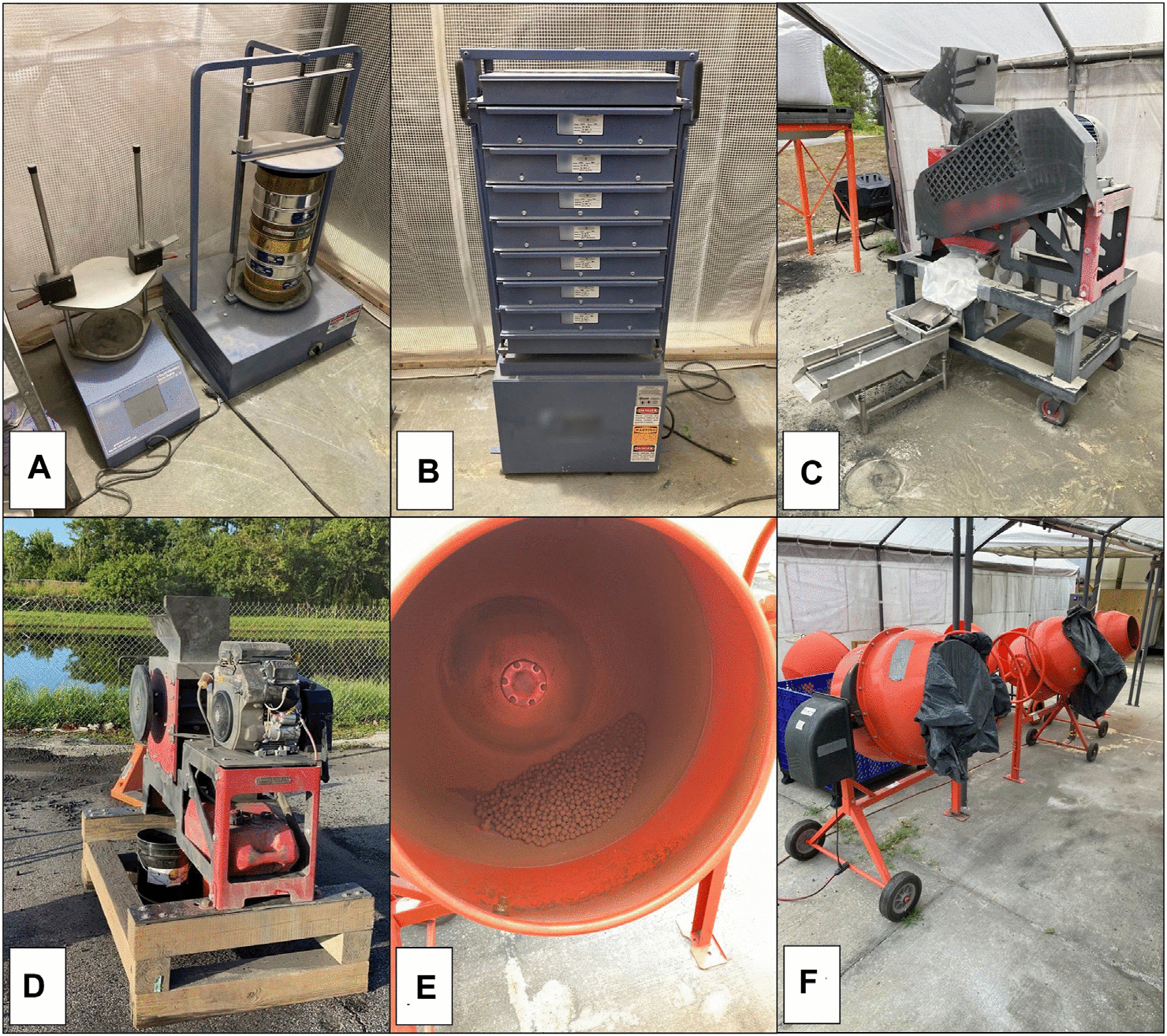
Source: [2]. CC BY 4.0.
The Exolith Lab in Orlando, Florida is a regolith research and space hardware testing facility managed by the Florida Space Institute at the University of Central Florida, operating within the Center for Lunar and Asteroid Surface Science, a NASA SSERVI node [1]. Its output is material rather than test time: it develops, produces and characterizes lunar, Martian and asteroid regolith simulants, publishing recipes, production methods and characterization data so that other groups can reproduce the material [3]. Standard simulants are produced in bulk and are available for purchase and shipment [4].
The environment makes this hard because no returned or in-situ regolith is available in the quantities hardware tests consume, and terrestrial rock differs from regolith in composition, grain shape and surface state. Testing against a manufactured lunar soil analog is not new; Boeing ran the Apollo-era lunar roving vehicle wheels through a simulant before any lab published a reproducible recipe [11]. The 2005 MSFC workshop argued from Apollo failures (rover slip and sinkage, tools unable to penetrate beyond tens of centimeters, seal failures, suit abrasion) for a root and derivative scheme: a few compositional end members plus derivatives made by adding agglutinates, glass, nanophase iron and size fractions [12]. Exolith follows that scheme and adds open, purchasable standards.
No simulant described here has flown. All of them are ground materials used in laboratories, soil bins and test beds, so every fidelity statement below is a comparison against Apollo, Curiosity or other returned or in-situ data, not a flight result.
Laboratory data
Section titled “Laboratory data”| Parameter | Value |
|---|---|
| Operator | University of Central Florida, Florida Space Institute, within CLASS, a NASA SSERVI node [1] |
| Location | Orlando, Florida, United States |
| Commissioned | Not published. MGS-1 production capacity under construction 2019 |
| Type | Simulant production plant and characterization laboratory, not a test chamber [1][3] |
| Floor area | Not published |
| Capabilities | Production, characterization, shear box |
| Simulant or terrain | LHS-1, LMS-1, LHS-1D, LMS-1D, MGS-1, MGS-1C, MGS-1S, JEZ-1, CI-1 [1] |
| Instrumentation | Fused bead XRF, XRD with corundum standard, CILAS 1190 particle size analyzer [2] |
| Ground truth | Composition referenced to Apollo samples and to Curiosity XRD of Rocknest [3] |
| Fidelity limits | Terrestrial feedstock: Mg and Al enriched, Fe poor; no trace elements [2]. See below |
| Access | Standard simulants offered in bulk for purchase and shipment; retail listing published [4] |
| Cited by | regolith-simulants |
Where Exolith sits among simulant programs
Section titled “Where Exolith sits among simulant programs”Simulants fall into a few families by how they are specified. Each answers a different question, and none is best for every use: the NASA user’s guide states that no single simulant is best and that none reproduces every aspect of lunar regolith [15].
Composition-matched mineral blends. The Exolith lunar products and MGS-1 belong here. Fidelity is scored by Figure of Merit methods that compare composition, size distribution, shape and density against a reference vector [13]. Scored against Apollo 16 core material, no simulant in the 2010 guide exceeded 0.65 on composition (NU-LHT-1M 0.65, JSC-1A 0.35, JSC-1 0.33), and the guide measured no mechanical property [14]. The 2024 revision scores fourteen commercial and NASA simulants and adds shear strength against a Carrier-derived reference [15]. A review by lunar soil scientists argued that most older simulants were built without adequate input from the people who study lunar soil [20].
Quarry and industrial products. BP-1 is made from the silt-sized washing waste of a road aggregate quarry on the Black Point basalt flow; it is cheap and high volume, but its alkali content rules it out where composition matters [28]. NUW-LHT-5M is an industrial-scale highlands simulant from Stillwater norite and anorthosite, olivine and synthetic high-calcium glass, with a property sheet measured across about a dozen labs, though mostly on a 20 kg pilot batch rather than the production run [26].
Facility-scale bulk simulants. ESA’s LUNA facility at the European Astronaut Centre holds about 20 tons of EAC-1 in a 750 m2 mare area, with a fine highland dust chamber [22]. EAC-1A is a crushed basanite needing 600 to 1000 tonnes for a 660 m2 testbed, with cohesion of 0.38 kPa at 1.95 g/cm3, and its authors note it lacks agglutinates, nanophase iron and space-weathered grain surfaces [21]. Abrasivity differs between the LUNA testbeds, so wear results do not transfer between them [22]. At NASA Glenn, GRC-3b-DST adds a dust suppressant to a 22 ton batch and gains real cohesion, but at 5 to 11 kPa it is an order of magnitude more cohesive than the 0.1 to 1 kPa quoted for lunar soil [23]. The Colorado School of Mines selected CSM-LHT-T-30 for a 110 metric ton lunar surface simulator after ASTM testing showed that matching the average size distribution is not enough, because simulants within one standard deviation of it still differ in shear strength and compressibility [24].
Modular size-fraction systems. The TUBS-M, TUBS-T and TUBS-I system is characterized for eight separate grain size fractions from a few microns to 2 mm, so users can recombine fractions; all fractions densify quickly under small stress, and cohesion is strongly stress dependent [25].
Martian simulants. Mojave Mars Simulant is crushed Saddleback Basalt, characterized against JSC Mars-1 and Viking, Pathfinder and MER soils [16]. JSC-Rocknest builds on it, adding sodium perchlorate, pyrite, ferric sulfate and iron oxides to match the 1 to 3 wt% low temperature water release of Rocknest; about 800 kg were produced, and the authors report that the MMS batches they received differ from the published mineralogy [27]. The ExoMars testbed simulants ES-1 to ES-3 are commercial UK materials chosen for traction testing; measured cohesion and friction angle missed the ExoMars specification, for example ES-1 compacted at 3.9 kPa cohesion against a 0.5 to 2.0 kPa target [17]. Mojave, Eifelsand and MSS-D were tested for InSight, with dry poured specimens of the sieved fraction below 2 mm only [30]. MGS-1 differs from these in being a mineral recipe from Curiosity CheMin data [3], and the Martian ground truth for strength is itself indirect: Mohr-Coulomb values for Gusev and Meridiani came from rover wheel trenching and scuffing telemetry, not a shear test [18].
Asteroid simulants. The 2015 workshop that set requirements for asteroid simulants was a planning exercise with no composition or strength data [19]. Scheeres and coauthors show that van der Waals cohesion dominates grain weight at asteroid gravity, so asteroid regolith behaves as a cohesive powder rather than a cohesionless sand [29]. Bennu’s near subsurface, read from the OSIRIS-REx sampler contact, is 440 to 600 kg/m3, 37 to 50 percent below the asteroid bulk density, a model-derived value [32]. The Exolith asteroid line and its fidelity score are covered below [9].
Capabilities
Section titled “Capabilities”Production line
Section titled “Production line”| Parameter | Value |
|---|---|
| Working volume | Batch, not chamber-limited. High-volume production equipment, standard simulants offered in bulk [4] |
| Test article limits | MGS-1 capacity tens to hundreds of kilograms at publication [3] |
| Vacuum | Not applicable. Ambient pressure |
| Temperature | Process only: 1000 C graphite fusion; 900 C loss on ignition; 140 C bake [2][5] |
| Illumination | Not applicable |
| Simulant or terrain | Anorthosite, glass-rich basalt, pyroxenite, olivine, ilmenite feedstocks |
| Slope | Not applicable |
| Gravity offload | Not applicable |
| Instrumentation | Jaw crusher, hammer mill, ball mills, ASTM sieve shakers, cement mixers |
Simulant design is stated as a constrained maximization of fidelity against cost, safety and material availability, with mineralogy and particle geometry as the tuned parameters [2]. Mineralogy of the target body is estimated first from returned samples and remote sensing; terrestrial rocks and minerals with well characterized sources are then found that either arrive pre-processed to a grain size range or are crushed in house. Feedstocks are bought in bulk to avoid downtime and raise consistency, and where possible the lab uses materials already established in other simulants: Merriam crater basalt, as used in JSC-1, and Greenspar anorthosite.
Size reduction is percussive. A hammer mill and a jaw crusher produce irregular, jagged grains resembling space-weathered regolith, and ASTM standard sieves with sieve shakers size sort the output. Ball mills reduce material below about 50 micrometers; the dust grades LHS-1D and LMS-1D are made by ball milling the parent LHS-1 and LMS-1, and constituents are combined to within less than 0.5 wt% difference between production runs and mixed in cement mixers [2]. The LHS-1 product description states the design intent: polymineralic grains in proportions referenced to returned Apollo regolith, not a single terrestrial lithology [4].
The Martian line uses a different route to grain structure. Plagioclase, pyroxene, olivine, basaltic glass, magnetite and hematite are combined with water and sodium metasilicate pentahydrate in a 100:20:2 ratio by weight, fused into polymineralic cobbles, and ground to a power law size distribution [3]. Most MGS-1 prototypes were ground to below 6.3 mm. The prototype has a grain density of 2.72 g/cm3, a loose bulk density of 1.23 g/cm3, and a reflectance that matches Rocknest Mastcam data between 400 and 1100 nm, which JSC Mars-1, MMS-1 and MMS-2 do not [3].
Characterization
Section titled “Characterization”| Parameter | Value |
|---|---|
| Working volume | Sample scale |
| Instrumentation | Thermo ARL Perform’X XRF; PIXcel3D XRD; CILAS 1190 particle size analyzer |
| Simulant or terrain | Every constituent and every mixed product |
Bulk elemental composition is measured by fused bead XRF at the Hamilton Analytical Laboratory, Hamilton College, using a low dilution graphite fusion with a 2:1 flux to powder ratio [2]. Mineral phases are measured by XRD over 2 theta from 5 to 90 degrees, samples ball milled and spiked with 10 to 15 percent corundum as an internal standard for amorphous content. Particle size is measured on a CILAS 1190 over 0.04 to 2500 micrometers, with three independent samples per simulant and 2 sigma confidence intervals [2]. An earlier lab briefing reported modal mineralogy and XRF oxide chemistry for LHS-1 and LMS-1 by the same methods [7].
Measured D50 is 59.79 micrometers for LHS-1, 72.27 for LMS-1, 9.74 for LHS-1D, 5.92 for LMS-1D, 49.30 for MGS-1, 15.50 for MGS-1C, 63.13 for MGS-1S and 46.92 for JEZ-1 [2]. LHS-1 is 74.4 wt% anorthosite, 24.7 wt% glass-rich basalt, 0.4 wt% ilmenite, 0.3 wt% pyroxenite and 0.2 wt% olivine; LMS-1 is 32.8 wt% pyroxenite, 32.0 wt% glass-rich basalt, 19.8 wt% anorthosite, 11.1 wt% olivine and 4.3 wt% ilmenite [2]. MGS-1C and MGS-1S are multi-modal because the added weathered and altered phases occupy a distinct 2 to 11 micrometer fraction.
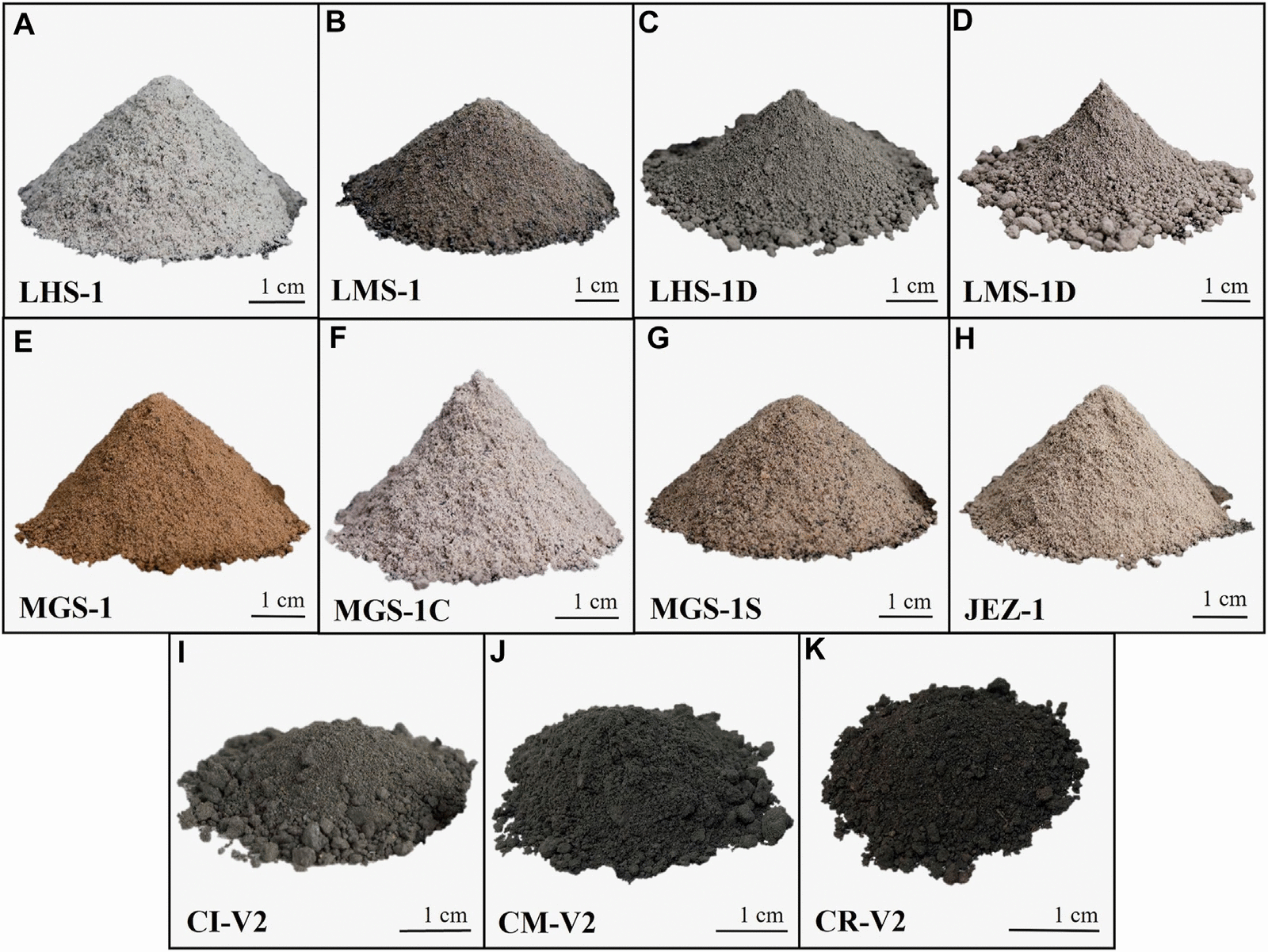
Source: [2]. CC BY 4.0.
Direct shear box
Section titled “Direct shear box”| Parameter | Value |
|---|---|
| Working volume | Shearing surface 10.17 x 10.17 cm, depth 6 cm |
| Test article limits | Normal stress range of interest 0.097 to 0.68 kPa |
| Temperature | Samples baked 24 h at 140 C and transferred hot where adsorbed water is the variable |
| Instrumentation | Actuonix L16-R servo under Arduino control; HP-500 force gauge, 0.01 N |
Source: [5].
A custom polycarbonate direct shear box built at UCF is used because the normal stress range of interest is not reachable with commercial geotechnical apparatus. The lower half of the box rides a rail driven by the linear servo against the force gauge, normal stress is applied by calibrated aluminum sheets, and density is set by sprinkling to an uncompressed state and then vibrating at 20 to 40 Hz in pulses [5].
Product line and pricing
Section titled “Product line and pricing”The standard line is LHS-1 lunar highlands, LMS-1 lunar mare, LHS-1D and LMS-1D dust grades below 25 micrometers, LHS-1-25A with 25 wt% sintered anorthosite-iron agglutinates, MGS-1 Mars global basaltic, MGS-1C clay-enhanced, MGS-1S sulfate-enhanced, JEZ-1 Jezero crater and CI-1 carbonaceous asteroid, with Phobos and CR simulants made on request [1]. The Phobos line, PCA-1 for the captured-asteroid origin hypothesis and PGI-1 for the giant-impact hypothesis, was characterized separately, each mixed to a different candidate parent composition [8]. LHS-1 lists at 45 USD per kilogram in the 1 kg retail size [4]; a 2020 snapshot priced LHS-1 and LMS-1 at 25 to 30 USD per kilogram and the sub-25-micrometer dust grades at 55 to 60 USD per kilogram, with bulk quantities to tens of tons available [7]. No bulk price list is published.
What it does not reproduce
Section titled “What it does not reproduce”The material is made of terrestrial rock. The lab’s characterization paper states that the exact composition of planetary regolith cannot be recreated from it, because terrestrial feedstocks are generally enriched in Mg and Al and carry less Fe, and the differences have to be quantified by the user [2]. The lab’s public accounting draws the same line: major mineralogy, bulk major element chemistry with the stated Mg, Na and K excess and Fe and Ca deficiency, particle size distribution and total water release are targeted, while particle shape, trace elements and isotopes, and reactivity toward an atmosphere are not attempted [6]. The trace element profile is that of a terrestrial material, so the lab states that a simulant should never be correlated to planetary regolith in trace element analyses [2].
Mineral substitution is the second limit. For the asteroid simulants the Fe-rich cronstedtite and tochilinite of the target material are not commercially available, so Mg-rich, non-asbestiform serpentines are used with iron powder for the Fe budget, which the lab calls the best constrained approximation that stays safe, available and affordable [2]. A Figure of Merit analysis against the Orgueil CI meteorite finds the mineralogical component of fidelity the most degraded by the swap, so a test sensitive to mineralogy recovers less value than one sensitive to grain size or cobble strength [9].
Feedstock drift is acknowledged but not quantified. Source location, supplier and equipment change over time and alter chemical composition, particle shape, size distribution and grain density. The lab states that quantitative analysis of variation through time is not performed, and that the material and source used in a given simulant can only be recovered by contacting the lab with the purchase date. The switch to Merriam crater basalt was a recent change when the 2023 paper was written [2]. The same issue affects other programs: JSC-Rocknest’s authors found their MMS batches differed from the published mineralogy [27].
Measurement of the delivered product has limits. XRD patterns are best obtained from uniform particle size, and Exolith simulants span at least four orders of magnitude in size, which lowers peak intensity and complicates phase identification. The asteroid cobbles are bound with a water-soluble agent and are weak, so published asteroid size distributions describe only the loose powder forms [2].
The Martian standard is bounded by what is known about Mars. Geotechnical properties of Martian regolith are poorly constrained relative to returned lunar regolith, particle shape was not controlled in the MGS-1 prototypes, and the Martian size distribution is poorly known, with clay-sized fraction estimates from about 1 vol% below 4 micrometers at the Phoenix site to 15 to 25 wt% of typical soils [3]. No geotechnical property of MGS-1 was measured in the defining paper, so its suitability for drilling and geotechnical hardware tests rests on the synthesis method. The prototype is also more hydrated than Mars, at 3.4 percent relative mass lost below 300 C against 2.0 wt% total evolved water in Rocknest [3]. Crystalline nitrate and perchlorate salts used in some early agricultural prototypes are excluded from the root standard.
Adsorbed terrestrial water changes the mechanics. Removing roughly 0.4 wt% of adsorbed water from LHS-1D, by baking 24 hours at 140 C and shearing hot, changed cohesion non-monotonically with density and normal stress: at midrange densities that water raised cohesion by about 15 percent, while above about 0.4 kPa normal stress intrinsic shear strength dominated [5]. The material is synthesized and stored in the terrestrial atmosphere, so adsorbed water is present unless a user drives it off.
Gravity is a further unmeasured variable. A hopper filled with JSC-1A flowed freely at 1 g but jammed and stayed clogged at 0.19 g in the ZARM drop tower, and a discrete element model attributes the switch to the granular Bond number, the ratio of cohesive force to weight [31]. That was one run per gravity level and not an Exolith material, and no held source reports Exolith products under reduced gravity or vacuum.
A geotechnical properties database drawing on mission reports and simulant papers, including Exolith’s own, finds bulk density, friction angle and cohesion values from this lab inside the spread already measured across other lunar simulants and returned regolith, not marking out a distinct range [10].
Campaigns run there
Section titled “Campaigns run there”MGS-1 standard definition, 2019. The Rocknest windblown soil at Gale crater was the reference [3]. Its crystalline phases, constrained by Curiosity XRD, were reproduced mineral by mineral, with the amorphous component fitted by least squares from basaltic glass, ferric sulfate, ferrihydrite and iron carbonate. The paper rejects matching bulk chemistry with arbitrary compounds and recommends against MMS-1 and MMS-2 on the grounds of missing documentation and discrepancies against the original Mojave Mars Simulant [3].
Constituent and product characterization, 2020 to 2023. The full standard line was characterized by fused bead XRF, XRD with corundum internal standard and CILAS 1190 particle size analysis, and published with the production methods [2].
Cohesion and shear strength survey, 2024. Direct shear to ASTM D3080 was run on thirteen materials, including the Exolith lunar and Martian lines [5]. Cohesion rises exponentially with bulk density, and the growth constant rises linearly with the full width at half maximum of the size distribution. Lunar simulant cohesion spans 0.185 to 1.672 kPa over bulk densities of 1.32 to 1.97 g/cm3 [5], and Martian simulant cohesion spans 0.179 to 1.406 kPa over 1.03 to 1.86 g/cm3. Internal friction angle did not vary monotonically with density: MGS-1C peaks near 29 degrees at 1.14 g/cm3 and falls to about 25 degrees at 1.35 g/cm3, while MGS-1S rises from about 34 degrees at 1.31 g/cm3 to near 53 degrees at 1.83 g/cm3 [5]. Adding 25 wt% agglutinates to LHS-1 raises cohesion at a given density but lowers peak cohesion by about 10 percent. The authors record that all of it applies to terrestrial atmosphere and gravity at normal stresses below 0.68 kPa, and that vacuum chamber repeats were under way [5].
What is not established
Section titled “What is not established”No held source reports hardware qualification campaigns run on Exolith products, so the page cannot say which flight or ground programs have used them. Fidelity is established for composition and size distribution against Apollo and Rocknest references [2][3], and for cohesion and friction angle only at 1 g, in air, below 0.68 kPa normal stress, a range far lighter than a wheel or excavation tool [5]. The fitted cross-material shear models have weak fits, with R2 of 0.225 and 0.328 for the equations predicting the fit constants and 0.652 for the friction angle polynomial [5]. Behavior in vacuum, reduced gravity and under electrostatic charging is untested in the held record, as is lot-to-lot variation through time [2]. Wheel testing in lunar simulant at the ISRU Pilot Excavator program used BP-1 at Earth gravity, so wheel results on Exolith materials are not available from these sources [33].
References
Section titled “References”References
- (2026). The Exolith Lab. sciences.ucf.edu/class/exolithlab
BibTeX
@misc{ucfexolithlab, title = {The Exolith Lab}, organization = {Center for Lunar and Asteroid Surface Science, University of Central Florida}, year = {2026}, url = {https://sciences.ucf.edu/class/exolithlab/} } - Long-Fox, J. M. and Britt, D. T. (2023). Characterization of Planetary Regolith Simulants for the Research and Development of Space Resource Technologies
. Frontiers in Space Technologies. Source
BibTeX
@article{longfox2023characterization, title = {Characterization of Planetary Regolith Simulants for the Research and Development of Space Resource Technologies}, author = {Long-Fox, Jared M. and Britt, Daniel T.}, journal = {Frontiers in Space Technologies}, volume = {4}, pages = {1255535}, year = {2023}, doi = {10.3389/frspt.2023.1255535}, abstract = {Human planetary exploration and colonization efforts are reliant on the ability to safely interact with planetary surfaces and to leverage local regolith as a resource. The high-cost and risk-intensive nature of establishing planetary infrastructure and resource utilization facilities necessitates risk reduction through laboratory-based research and development of space resource acquisition, processing, and extraction technologies using appropriate, well-characterized, mineral-based regolith simulants. Such simulants enable the planetary exploration and resource utilization communities to test large-scale technologies and methodologies for a relatively low cost as an alternative to scarce and expensive returned samples. The fidelity of a regolith simulant for any application is, in part, determined by the mineralogical composition and particle size distribution. The importance of composition is well established for in situ resource utilization studies sensitive to geochemical properties but tends to be ignored in studies concerned with physical properties. Neglecting to consider mineralogy reduces the fidelity of a simulant since each mineral species has its own unique grain density, preferred grain geometry, and intergranular forces, all of which affect the physical properties of the simulant (e.g., shear strength, bearing strength, bulk density, thermal and electrical properties, magnetic properties). Traditionally, regolith simulants have been limited in quantity and availability; Exolith Lab remedies these problems by designing simulants in a constrained maximization approach to fidelity relative to cost, material availability, and safety. Exolith Lab simulants are designed to approximate the mineralogy and particle size ranges of the planetary regolith being simulated, with composition constrained by remote sensing observations and/or returned sample analyses. With facilities and equipment capable of high-volume simulant production, Exolith Lab offers standard simulants in bulk that are readily available for purchase and shipment. This work reviews the production methods, equipment, and materials used to create Exolith Lab simulants, provides compositional data, particle size data, and applications for each standard lunar, Martian, and asteroid simulant that Exolith Lab offers.} } - Cannon, K. M., Britt, D. T., Smith, T. M., Fritsche, R. F. and Batcheldor, D. (2019). Mars Global Simulant MGS-1: A Rocknest-based Open Standard for Basaltic Martian Regolith Simulants
. Icarus. Source
BibTeX
@article{cannon2019mars, title = {Mars Global Simulant MGS-1: A Rocknest-based Open Standard for Basaltic Martian Regolith Simulants}, author = {Cannon, Kevin M. and Britt, Daniel T. and Smith, Trent M. and Fritsche, Ralph F. and Batcheldor, Daniel}, journal = {Icarus}, volume = {317}, pages = {470--478}, year = {2019}, doi = {10.1016/j.icarus.2018.08.019} } - (2026). Exolith Lab: Lunar Highlands (LHS-1) High-Fidelity Moon Dirt Simulant. exolithsimulants.com/products/lhs-1-lunar-highlands-simulant
BibTeX
@misc{exolithlhs1product, title = {Exolith Lab: Lunar Highlands (LHS-1) High-Fidelity Moon Dirt Simulant}, organization = {exolithsimulants.com}, year = {2026}, url = {https://exolithsimulants.com/products/lhs-1-lunar-highlands-simulant} } - Dotson, B., Sanchez Valencia, D., Millwater, C., Easter, P. B., Long-Fox, J., Britt, D. and Metzger, P. (2024). Cohesion and Shear Strength of Compacted Lunar and Martian Regolith Simulants
. Icarus. Source
BibTeX
@article{dotson2024cohesion, title = {Cohesion and Shear Strength of Compacted Lunar and Martian Regolith Simulants}, author = {Dotson, Brandon and Sanchez Valencia, D. and Millwater, C. and Easter, Parks B. and Long-Fox, J. and Britt, D. and Metzger, P.}, journal = {Icarus}, volume = {411}, pages = {115943}, year = {2024}, doi = {10.1016/j.icarus.2024.115943} } - Exolith Lab. (2018). What Is Simulated?. sciences.ucf.edu/class/wp-content/uploads/sites/23/2018/10/WhatIsSimu...
BibTeX
@misc{exolith2018what, title = {What Is Simulated?}, author = {{Exolith Lab}}, organization = {Center for Lunar and Asteroid Surface Science, University of Central Florida}, year = {2018}, url = {https://sciences.ucf.edu/class/wp-content/uploads/sites/23/2018/10/WhatIsSimulated.pdf} } - Landsman, Z. and Britt, D. (2020). Simulated Regolith at the CLASS Exolith Lab. lsic.jhuapl.edu/uploadedDocs/focus-files/637-DM%20Presentation%20-%20...
BibTeX
@misc{landsman2020simulated, title = {Simulated Regolith at the {CLASS Exolith Lab}}, author = {Landsman, Zoe and Britt, Daniel}, howpublished = {Presentation at the University of Central Florida}, type = {Presentation to the Lunar Surface Innovation Consortium Dust Mitigation Focus Group}, year = {2020}, url = {https://lsic.jhuapl.edu/uploadedDocs/focus-files/637-DM%20Presentation%20-%20Exolith.pdf} } - Landsman, Z. A., Schultz, C. D., Britt, D. T., Peppin, M., Kobrick, R. L., Metzger, P. T. and Orlovskaya, N. (2021). Phobos regolith simulants PGI-1 and PCA-1
. Advances in Space Research, 10. Source
BibTeX
@article{landsman2021phobos, title = {Phobos regolith simulants PGI-1 and PCA-1}, author = {Landsman, Zoe A. and Schultz, Cody D. and Britt, Daniel T. and Peppin, Makayla and Kobrick, Ryan L. and Metzger, Philip T. and Orlovskaya, Nina}, journal = {Advances in Space Research}, volume = {67}, number = {10}, pages = {3308-3327}, publisher = {Elsevier BV}, year = {2021}, doi = {10.1016/j.asr.2021.01.024} } - Metzger, P. T., Britt, D. T., Covey, S., Schultz, C., Cannon, K. M., Grossman, K. D., Mantovani, J. G. and Mueller, R. P. (2019). Measuring the fidelity of asteroid regolith and cobble simulants
. Icarus. Source
BibTeX
@article{metzger2019measuring, title = {Measuring the fidelity of asteroid regolith and cobble simulants}, author = {Metzger, Philip T. and Britt, Daniel T. and Covey, Stephen and Schultz, Cody and Cannon, Kevin M. and Grossman, Kevin D. and Mantovani, James G. and Mueller, Robert P.}, journal = {Icarus}, volume = {321}, pages = {632--646}, year = {2019}, doi = {10.1016/j.icarus.2018.12.019} } - Gasteiner, L. and Murdoch, N. (2026). An Open Database of Lunar Regolith and Simulants Properties
. arXiv preprint arXiv:2602.03829. Source
BibTeX
@article{gasteiner2026open, title = {An Open Database of Lunar Regolith and Simulants Properties}, author = {Gasteiner, Léonie and Murdoch, Naomi}, journal = {arXiv preprint arXiv:2602.03829}, year = {2026}, doi = {10.1002/nag.70432}, abstract = {ABSTRACT Lunar regolith, the layer of unconsolidated material covering the Moon's surface, is central to the science and technology developed for the Moon, notably related to in‐situ science investigations, resource utilization, surface infrastructure, and mobility systems. However, data on lunar soil properties remain fragmented across decades of mission reports, often in formats that are difficult to access or interpret. We present a newly compiled database of lunar regolith physical and geotechnical properties, including data collected by direct in‐situ measurements from crewed missions, estimates inferred from surface interactions on the Moon and using remote sensing, as well as laboratory analyses of samples returned to Earth. The data collected include, among others, the angle of internal friction and cohesion (both Mohr‐Coulomb model parameters), bulk density, and static bearing capacity, extracted from Luna and Apollo‐era historical mission documentation all the way to contemporary Lunar programs. The dataset specifies the type and location of the tests from which each value was obtained. Our database also includes parameters for some lunar regolith simulants, providing a direct link between mission data and laboratory studies. In addition to centralizing this information, we developed a user interface that facilitates data retrieval, filtering, and visualization. This interface enables users to generate customized plots for comparative analysis. Developed in an open‐science perspective, it is designed to evolve in response to the community's needs. The database and its associated tools significantly enhance the accessibility and usability of lunar regolith and simulants data for scientific and engineering research.} } - Green, A. J. and Melzer, K.-J. (1971). Performance of Boeing LRV wheels in a lunar soil simulant. Report 1: Effect of wheel design and soil
. U.S. Army Engineer Waterways Experiment Station, Technical Report M-71-10, Report 1. Source
BibTeX
@techreport{green1971performance, title = {Performance of Boeing LRV wheels in a lunar soil simulant. Report 1: Effect of wheel design and soil}, author = {Green, Andrew J. and Melzer, Klaus-Jurgen}, number = {Technical Report M-71-10, Report 1}, institution = {U.S. Army Engineer Waterways Experiment Station}, year = {1971}, url = {https://erdc-library.erdc.dren.mil/handle/11681/29961} } - Sibille, L., Carpenter, P., Schlagheck, R. and French, R. A. (2006). Lunar Regolith Simulant Materials: Recommendations for Standardization, Production, and Usage
. NASA Marshall Space Flight Center, NASA/TP-2006-214605. Source
BibTeX
@techreport{sibille2006development, title = {Lunar Regolith Simulant Materials: Recommendations for Standardization, Production, and Usage}, author = {Sibille, Laurent and Carpenter, Paul and Schlagheck, R. and French, R. A.}, number = {NASA/TP-2006-214605}, institution = {NASA Marshall Space Flight Center}, type = {NASA Technical Publication}, year = {2006}, url = {https://ntrs.nasa.gov/citations/20060051776}, abstract = {Experience gained during the Apollo program demonstrated the need for extensive testing of surface systems in relevant environments, including regolith materials similar to those encountered on the lunar surface. As NASA embarks on a return to the Moon, it is clear that the current lunar sample inventory is not only insufficient to support lunar surface technology and system development, but its scientific value is too great to be consumed by destructive studies. Every effort must be made to utilize standard simulant materials, which will allow developers to reduce the cost, development, and operational risks to surface systems. The Lunar Regolith Simulant Materials Workshop held in Huntsville, AL, on January 24 26, 2005, identified the need for widely accepted standard reference lunar simulant materials to perform research and development of technologies required for lunar operations. The workshop also established a need for a common, traceable, and repeatable process regarding the standardization, characterization, and distribution of lunar simulants. This document presents recommendations for the standardization, production and usage of lunar regolith simulant materials.} } - Rickman, D., Hoelzer, H., Carpenter, P., Sibille, L., Howard, R. and Owens, C. (2007). A Quantitative Method for Evaluating Regolith Simulants
. AIP Conference. Source
BibTeX
@inproceedings{rickman2007quantitative, title = {A Quantitative Method for Evaluating Regolith Simulants}, author = {Rickman, Doug and Hoelzer, Hans and Carpenter, Paul and Sibille, Laurent and Howard, Rick and Owens, Charles}, booktitle = {AIP Conference}, volume = {880}, pages = {957-963}, publisher = {AIP}, year = {2007}, doi = {10.1063/1.2437539}, abstract = {Views Icon Views Article contents Figures & tables Video Audio Supplementary Data Peer Review Share Icon Share Twitter Facebook Reddit LinkedIn Tools Icon Tools Reprints and Permissions Cite Icon Cite Search Site Citation Doug Rickman, Hans Hoelzer, Paul Carpenter, Laurent Sibille, Rick Howard, Charles Owens; A Quantitative Method for Evaluating Regolith Simulants. AIP Conf. Proc. 30 January 2007; 880 (1): 957–963. https://doi.org/10.1063/1.2437539 Download citation file: Ris (Zotero) Reference Manager EasyBib Bookends Mendeley Papers EndNote RefWorks BibTex toolbar search Search Dropdown Menu toolbar search search input Search input auto suggest filter your search All ContentAIP Publishing PortfolioAIP Conference Proceedings Search Advanced Search |Citation Search} } - Schrader, C. M., Rickman, D. L., McLemore, C. A. and Fikes, J. C. (2010). Lunar Regolith Simulant User's Guide
. NASA Marshall Space Flight Center, NASA/TM-2010-216446. Source
BibTeX
@techreport{schrader2010lunar, title = {Lunar Regolith Simulant User's Guide}, author = {Schrader, C. M. and Rickman, Douglas L. and McLemore, Carole A. and Fikes, John C.}, number = {NASA/TM-2010-216446}, institution = {NASA Marshall Space Flight Center}, year = {2010}, url = {https://ntrs.nasa.gov/citations/20100038451}, abstract = {Based on primary characteristics, currently or recently available lunar regolith simulants are discussed from the perspective of potential experimental uses. The characteristics used are inherent properties of the material rather than their responses to behavioral (geomechanical, physiochemical, etc.) tests. We define these inherent or primary properties to be particle composition, particle size distribution, particle shape distribution, and bulk density. Comparable information about lunar materials is also provided. It is strongly emphasized that anyone considering either choosing or using a simulant should contact one of the members of the simulant program listed at the end of this document.} } - Slabic, A., Gruener, J. E., Kovtun, R. N., Rickman, D. L., Sibille, L., Oravec, H. A., Edmunson, J. and Keprta, S. (2024). Lunar Regolith Simulant User's Guide, Revision A
. NASA, NASA/TM-20240011783. Source
BibTeX
@techreport{slabic2024lunar, title = {Lunar Regolith Simulant User's Guide, Revision A}, author = {Slabic, Ane and Gruener, John E. and Kovtun, Rostislav N. and Rickman, Douglas L. and Sibille, Laurent and Oravec, Heather A. and Edmunson, Jennifer and Keprta, Sean}, number = {NASA/TM-20240011783}, institution = {NASA}, year = {2024}, url = {https://ntrs.nasa.gov/citations/20240011783}, abstract = {This guide is titled Lunar Regolith Simulant User's Guide, Rev A, and two points need to be made about the title. First, is the use of the term "regolith". During the Apollo Program, the term "soil" was used for taking a sample of the loose material on the surface, and then cataloging that sample in the lunar curation database as a "soil sample". By the 1980s, the term "regolith" gained favor by lunar scientists. In the Lunar Sourcebook (Heiken et al., 1991), regolith is defined as "a general term for the layer or mantle of fragmental and unconsolidated rock material, whether residual or transported and of highly varied character, that nearly everywhere forms the surface of the land and overlies or covers bedrock". Regolith is a terrestrial term that seems to go back to 1897, according to a recent paper by Huggett (2023). Huggett summed up his paper by writing, "soil and regolith are one in the same". "Regolith" will mostly be used throughout this guide, as it tends to separate in one's mind the unique nature of the Moon's surface when compared to the inherent bias humans have in their mind when they hear and use the word "soil". When referring to Apollo samples, "soil" is used for historical context and in some places the simple term "lunar simulant" is also used. Secondly, Rev A is used in the title because NASA released its first Lunar Regolith Simulant User's Guide in 2010, near the end of NASA's Constellation Program (Schrader et al., 2010). This guide follows in the pattern of that first guide and will be updated on a periodic basis as new simulants are created, characterized and used, and as new information emerges about the Moon's regolith due to new lunar exploration missions, both robotic and human.} } - Peters, G. H., Abbey, W., Bearman, G. H., Mungas, G. S., Smith, J. A., Anderson, R. C., Douglas, S. and Beegle, L. W. (2008). Mojave Mars simulant—Characterization of a new geologic Mars analog
. Icarus, 2. Source
BibTeX
@article{peters2008mojave, title = {Mojave Mars simulant—Characterization of a new geologic Mars analog}, author = {Peters, G. H. and Abbey, W. and Bearman, G. H. and Mungas, G. S. and Smith, J. A. and Anderson, R. C. and Douglas, S. and Beegle, L. W.}, journal = {Icarus}, volume = {197}, number = {2}, pages = {470-479}, year = {2008}, doi = {10.1016/j.icarus.2008.05.004} } - Brunskill, C., Patel, N., Gouache, T. P., Scott, G. P., Saaj, C. M., Matthews, M. and Cui, L. (2011). Characterisation of Martian Soil Simulants for the ExoMars Rover Testbed
. Journal of Terramechanics, 6. Source
BibTeX
@article{brunskill2011characterisation, title = {Characterisation of {Martian} Soil Simulants for the {ExoMars} Rover Testbed}, author = {Brunskill, Christopher and Patel, Nildeep and Gouache, Thibault P. and Scott, Gregory P. and Saaj, Chakravarthini M. and Matthews, Marcus and Cui, Lei}, journal = {Journal of Terramechanics}, volume = {48}, number = {6}, pages = {419--438}, year = {2011}, doi = {10.1016/j.jterra.2011.10.001} } - Sullivan, R., Anderson, R., Biesiadecki, J., Bond, T. and Stewart, H. (2011). Cohesions, friction angles, and other physical properties of Martian regolith from Mars Exploration Rover wheel trenches and wheel scuffs
. Journal of Geophysical Research. Source
BibTeX
@article{sullivan2011cohesions, title = {Cohesions, friction angles, and other physical properties of Martian regolith from Mars Exploration Rover wheel trenches and wheel scuffs}, author = {Sullivan, R. and Anderson, R. and Biesiadecki, J. and Bond, T. and Stewart, H.}, journal = {Journal of Geophysical Research}, volume = {116}, pages = {E02006}, publisher = {American Geophysical Union (AGU)}, year = {2011}, doi = {10.1029/2010je003625}, abstract = {[1] The Mars Exploration Rovers Spirit and Opportunity investigated the physical properties of Martian regolith in 7 wheel trenches and 20 wheel scuffs distributed along traverses at Gusev crater and Meridiani Planum. Specialized wheel-trenching sequences allowed analysis of wheel motor and suspension telemetry to determine regolith friction angle ϕ and cohesion c at trench sites. Friction angles were 30°–37°, and cohesions were 0–2 kPa. Simpler wheel-scuff maneuvers were analyzed for cohesion by assuming the range of ϕ determined from trenches; cohesions in wheel-scuffed regoliths were from 0 to 11 kPa. Regolith ϕ and c can be related to regolith origins. Grain sorting, compaction, shape, size, and angularity influence ϕ. Impact cratering and aeolian processes have affected grain angularity and sorting of Martian regolith at both Mars Exploration Rover (MER) landing sites and contend in opposing ways to determine grain characteristics in the regolith. Friction angles are consistent with dry, rigid, nonplaty grains with particle size frequencies dominated by very fine sand (as seen by the Microscopic Imager or MI) with at least some grain rounding (unresolved by MI), reflecting physical weathering from aeolian saltation. Friction angle results from MER trenches therefore indicate that regolith states are between fully mature aeolian materials and impact debris. MI and color Pancam views show trench tailings and trench floors are redder, brighter, and have more intermixed extremely fine (unresolved) grains than regolith closer to the surface disturbed and exposed only by rolling tracks.} } - Metzger, P. T., Britt, D. T., Covey, S. D. and Lewis, J. S. (2023). Results of the 2015 Workshop on Asteroid Simulants. arxiv.org/pdf/2306.03068
BibTeX
@misc{metzger2023results, title = {Results of the 2015 Workshop on Asteroid Simulants}, author = {Metzger, Philip T. and Britt, D. T. and Covey, S. D. and Lewis, John S.}, year = {2023}, url = {https://arxiv.org/pdf/2306.03068} } - Taylor, L. A., Pieters, C. M. and Britt, D. (2016). Evaluations of Lunar Regolith Simulants
. Planetary and Space Science. Source
BibTeX
@article{taylor2016evaluations, title = {Evaluations of Lunar Regolith Simulants}, author = {Taylor, Lawrence A. and Pieters, Carle M. and Britt, Danial}, journal = {Planetary and Space Science}, volume = {126}, pages = {1-7}, publisher = {Elsevier BV}, year = {2016}, doi = {10.1016/j.pss.2016.04.005} } - Engelschiøn, V. S., Eriksson, S. R., Cowley, A., Fateri, M., Meurisse, A., Kueppers, U. and Sperl, M. (2020). EAC-1A: A novel large-volume lunar regolith simulant
. Scientific Reports. Source
BibTeX
@article{engelschion2020eac1a, title = {EAC-1A: A novel large-volume lunar regolith simulant}, author = {Engelschiøn, V. S. and Eriksson, S. R. and Cowley, Aidan and Fateri, M. and Meurisse, A. and Kueppers, U. and Sperl, M.}, journal = {Scientific Reports}, volume = {10}, pages = {5473--5473}, year = {2020}, doi = {10.1038/s41598-020-62312-4}, abstract = {Abstract The European Astronaut Centre (EAC) is currently constructing the European Lunar Exploration Laboratory (LUNA), a large training and operations facility to be located adjacent to EAC at the DLR (German Aerospace Centre) campus in Cologne, Germany. With an estimated representative lunar testbed area of approximately 660 m 2 , a large volume of lunar regolith simulant material is needed for this purpose. In this study, a basanitic sandy silt from a quarry located in the Siebengebirge Volcanic Field is evaluated as a large-volume source of material. The focus of this project has been to conduct a physical and chemical characterisation of the fine-grained material to be used in LUNA; the European Astronaut Centre lunar regolith simulant 1 (EAC-1 A). The physical characterisation tests undertaken include sphericity, density measurements, cohesion and static angle of repose, with mineralogical investigations via petrographical analysis with optical microscope and SEM, XRF, XRD and DSC measurements. The results of the EAC-1A tests are compared to published data on existing widely used lunar regolith simulants, namely JSC-1A, JSC-2A, NU-LHT-3M, DNA and FJS-1.} } - Zemeny, A., Sardisco, L., Quinteros, S., Mikesell, T. D., Pirrie, D., Rose, L., Cowley, A. and Manick, K. (2024). The LUNA Analog Facility testbeds (ESA, EAC): contemporary characterization work of highland and mare lunar regolith simulants
. Frontiers in Space Technologies. Source
BibTeX
@article{zemeny2024luna, title = {The {LUNA} Analog Facility testbeds ({ESA}, {EAC}): contemporary characterization work of highland and mare lunar regolith simulants}, author = {Zemeny, Aliz and Sardisco, Lorenzo and Quinteros, Susana and Mikesell, T. Dylan and Pirrie, Duncan and Rose, Laura and Cowley, Aidan and Manick, Kaushik}, journal = {Frontiers in Space Technologies}, volume = {5}, pages = {1510635}, year = {2024}, doi = {10.3389/frspt.2024.1510635}, abstract = {The Luna Analog Facility, a joint ESA-DLR endeavour, consists of three components and spans an area of 1,000 m 2 , providing testbeds of simulated lunar environments. The main sections within the facility are a large area filled with lunar mare regolith simulant resembling mare regions and a smaller, individual “Dust Chamber”. The latter replicates highland conditions and contains approximately 20 tons of material, specifically simulating the fine-particle lunar regolith portion up to 250 µm. The Dust Chamber serves as a platform for testing various technologies, such as mechanical tools, robotic operations, in-situ resource utilization activities, and astronaut attire, as well as different procedures including rover and astronaut tasks. This work represents the geotechnical, geochemical and mineralogical characterization of the Lumina Sustainable Materials Ltd. 2023 batch highland simulants, from which Lunar250 is intended for use in the Luna Dust Chamber. Additionally, this work provides new results for ESA’s mare simulant, EAC-1. We provide data on particle size distribution, particle shape, abrasivity, density, water content, major and trace element geochemistry and modal mineralogy. As the simulants in the Luna Facility will be constantly overseen, this work organized by the Vulcan Facility (ESA) intends to support the monitoring of the geotechnical property variations of the simulants over time. Ultimately, we analysed several properties with different tools to emphasize how different methods and instruments affect the variability and reliability of the results.} } - Gerdts, S., Moreland, S. and Marteau, E. (2025). GRC-3b-DST, a Geotechnical Simulant for Cohesive Mars and Moon Mobility and Excavation Testing With Reduced Respirable Silica
. NASA, NASA/TM-20250006761. Source
BibTeX
@techreport{gerdts2025grc, title = {GRC-3b-DST, a Geotechnical Simulant for Cohesive Mars and Moon Mobility and Excavation Testing With Reduced Respirable Silica}, author = {Gerdts, Stephen and Moreland, Scott and Marteau, Eloise}, number = {NASA/TM-20250006761}, institution = {NASA}, year = {2025}, doi = {10.64631/puln8817}, abstract = {This study presents the development and evaluation of a modified version of the GRC-3b lunar soil simulant designed to address both geotechnical performance and operator safety in terrestrial mobility and excavation testing. While GRC-3b is widely used due to its cost-effectiveness and similarity to extraterrestrial regolith, its fine silica content poses significant health risks during handling. To mitigate this, a dust-suppressing additive was introduced, producing GRC-3b-DST. The modified simulant maintained the original particle size distribution and classification as a well-graded silty sand but exhibited increased cohesion and a lower minimum density, enhancing its ability to replicate compacted regolith conditions. Laboratory testing, including modified Proctor compaction, simple shear tests, and cone penetrometer correlations, confirmed that the geotechnical properties of GRC-3b-DST are consistent and predictable, making it suitable for high-fidelity terrain simulations. Safety testing using OSHA-compliant air sampling showed respirable silica concentrations remained well below permissible exposure limits during soil preparation, indicating a significant reduction in airborne hazards. These findings suggest that GRC-3b-DST offers a safer, more versatile alternative for use in large-scale test environments where repeatable geomechanical properties and minimized health risks are essential.} } - Jehn, M., Just, G. H., Sargeant, H. M., Long-Fox, J. and Britt, D. T. (2025). Implications of Lunar Simulant Geotechnical Properties on Testbed Experimentation and Engineering Analysis
. Space and Planetary Resources. Source
BibTeX
@article{jehn2025implications, title = {Implications of Lunar Simulant Geotechnical Properties on Testbed Experimentation and Engineering Analysis}, author = {Jehn, Marcus and Just, Gabriele H. and Sargeant, Hannah M. and Long-Fox, Jared and Britt, Daniel T.}, journal = {Space and Planetary Resources}, volume = {1}, pages = {5}, year = {2025}, doi = {10.1007/s44461-025-00002-7}, abstract = {Understanding the mechanical behavior of lunar regolith simulants is crucial for progressing engineering analysis in surface infrastructure design and testbed evaluation. This study provides a detailed geotechnical characterization of the Colorado School of Mines Lunar Highlands Type-Testbed simulants, including a new highland-type lunar simulant integrated into the Mines Lunar Surface Simulator testbed. It includes the determination of key geotechnical properties such as particle size distribution, density, compressibility, cohesion, friction angle, and particle shape, using standardized ASTM testing procedures. Key findings show that while particle size distribution similarities exist among the simulants and actual lunar regolith, there are significant differences in density-dependent mechanical behaviors such as shear strength, compressibility, and deformation responses. These results emphasize the complexity of simulant fidelity and its impact on testbed experiments when simulating mid-Technology Readiness Level environments. Additionally, we emphasize the importance of density-specific testing for evaluating both geotechnical properties and simulant performance. This work presents the first comprehensive publication of the full geotechnical profile of Colorado School of Mines highland simulants and highlights the importance of using multiple parameters beyond just particle size distribution to evaluate simulant fidelity. Future research will concentrate on characterizing testbed variability and assessing properties across different density states to improve the application of lunar simulants in engineering analysis and testbed experimentation.} } - Windisch, L., Linke, S., Jütte, M., Baasch, J., Kwade, A., Stoll, E. and Schilde, C. (2022). Geotechnical and Shear Behavior of Novel Lunar Regolith Simulants TUBS-M, TUBS-T, and TUBS-I
. Materials, 23. Source
BibTeX
@article{windisch2022geotechnical, title = {Geotechnical and Shear Behavior of Novel Lunar Regolith Simulants {TUBS-M}, {TUBS-T}, and {TUBS-I}}, author = {Windisch, Lisa and Linke, Stefan and Jütte, Magnus and Baasch, Julian and Kwade, Arno and Stoll, Enrico and Schilde, Carsten}, journal = {Materials}, volume = {15}, number = {23}, pages = {8561}, year = {2022}, doi = {10.3390/ma15238561}, abstract = {The return to the Moon is an important short-term goal of NASA and other international space agencies. To minimize mission risks, technologies, such as rovers or regolith processing systems, must be developed and tested on Earth using lunar regolith simulants that closely resemble the properties of real lunar soil. So far, no singular lunar simulant can cover the multitude of use cases that lunar regolith involves, and most available materials are poorly characterized. To overcome this major gap, a unique modular system for flexible adaptable novel lunar regolith simulants was developed and chemically characterized in earlier works. To supplement this, the present study provides comprehensive investigations regarding geotechnical properties of the three base regolith simulant systems: TUBS-M, TUBS-T, and TUBS-I. To evaluate the engineering and flow properties of these heterogeneous materials under various conditions, shear tests, particle size analyses, scanning electron microscope observations, and density investigations were conducted. It was shown that small grains <25 µm (lunar dust) are highly compressive and cohesive even at low external stress. They are particularly important as a large amount of fine dust is present in lunar regolith and simulants (x50 = 76.7 to 96.0 µm). Further, ring shear and densification tests revealed correlations with damage mechanisms caused by local stress peaks for grains in the mm range. In addition, an explanation for the occurrence of considerable differences in the literature-based data for particle sizes was established by comparing various measurement procedures. The present study shows detailed geotechnical investigations of novel lunar regolith simulants, which can be used for the development of equipment for future lunar exploration missions and in situ resource utilization under realistic conditions. The results also provide evidence about possible correlations and causes of known soil-induced mission risks that so far have mostly been described phenomenologically.} } - Rickman, D. L., Archer, P. D., Kovtun, R. N., Barmatz, M., Creedon, M., Dotson, B., Donaldson Hanna, K., Long-fox, J. M., Millwater, C., Effinger, M. R., Hutcheon, R. M., Kim, Y.-R., Partridge, A., Whittington, A., Shulman, H. and Wilkerson, R. P. (2024). Characterization of NUW-LHT-5m, A Lunar Highland Simulant
. NASA, 20240007991. Source
BibTeX
@techreport{rickman2024characterization, title = {Characterization of NUW-LHT-5m, A Lunar Highland Simulant}, author = {Rickman, Douglas L. and Archer, Paul Douglas and Kovtun, Rostislav Nikolayevich and Barmatz, Martin and Creedon, Matthew and Dotson, Brandon and Donaldson Hanna, Kerri and Long-fox, Jared Michael and Millwater, Catherine and Effinger, Michael R. and Hutcheon, Ronald M. and Kim, Yong-Rak and Partridge, Austin and Whittington, Alan and Shulman, Holly and Wilkerson, Ryan P.}, number = {20240007991}, institution = {NASA}, year = {2024}, url = {https://ntrs.nasa.gov/citations/20240007991}, abstract = {A new simulant of the lunar highlands regolith, NUW-LHT-5M, was designed by NASA and manufactured by Washington Mills. The simulant was based on Apollo 16 data and is a member of the NU-LHT-series. NASA’s Marshall Space Flight Center and Johnson Space Center have already purchased 3 metric tons of the simulant for advanced engineering work. In support of engineering uses of the simulant, we provided measurements of the simulant including: mineral abundance and composition, liberation, X-ray fluorescence (XRF), ferrous iron, carbon, sulfur, 60 element inductively coupled plasma (ICP), loss on ignition, particle size, both 2D and 3D particle shape, specific surface area, shear, cohesion, internal friction, helium pycnometry, minimum index density, tap density, magnetic susceptibility, cryogenic and high temperature permittivity, visible and near-infrared (VNIR) and middle infra-red spectroscopy (MIR), differential scanning calorimetry (DSC), viscosity, thermal diffusivity, thermal conductivity, thermal gravimetric analysis (TGA), evolved gas analysis (EGA), and spark sintering. For the crystalline components the design of the simulant called for two rocks from the Stillwater Complex, Montana: 17.6 wt% norite, 37.7% anorthosite, and 4.7 wt% olivine from an unspecified commercial source. The other 40% of the simulant was a high calcium (An100), vesicular glass that Washington Mills made specifically for the simulant. Fabrication and quality control processes for both the glass and the simulant are described. Importantly, most of the graphs and tables presented herein provide values for both the new simulant and data for the older NASA mare simulant, JSC-1A. Finally, we discussed the current limitations of NUW-LT-5M and most other lunar regolith simulants to replicate the lunar material.} } - Clark, J. V., Archer, P. D., Gruener, J. E., Ming, D. W., Tu, V. M., Niles, P. B. and Mertzman, S. A. (2020). JSC-Rocknest: A large-scale Mojave Mars Simulant (MMS) based soil simulant for in-situ resource utilization water-extraction studies
. Icarus. Source
BibTeX
@article{clark2020jsc, title = {JSC-Rocknest: A large-scale Mojave Mars Simulant (MMS) based soil simulant for in-situ resource utilization water-extraction studies}, author = {Clark, J. V. and Archer, P. D. and Gruener, John E. and Ming, D. W. and Tu, V. M. and Niles, P. B. and Mertzman, S. A.}, journal = {Icarus}, volume = {351}, pages = {113936}, year = {2020}, doi = {10.1016/j.icarus.2020.113936}, abstract = {The Johnson Space Center-Rocknest (JSC-RN) simulant was developed in response to a need by NASA's Advanced Exploration Systems (AES) In-Situ Resource Utilization (ISRU) project for a simulant to be used in component and system testing for water extraction from Mars regolith. JSC-RN was designed to be chemically and mineralogically similar to material from the aeolian sand shadow named Rocknest in Gale Crater, particularly the 1–3 wt% low temperature (<450 °C) water release as measured by the Sample Analysis at Mars (SAM) instrument on the Curiosity rover. Sodium perchlorate, goethite, pyrite, ferric sulfate, regular and high capacity granular ferric oxide, and forsterite were added to a Mojave Mars Simulant (MMS) base in order to match the mineralogy, evolved gases, and elemental chemistry of Rocknest. Mineral and rock components were sent to the United States Geological Survey (USGS) in Denver for mixing. Approximately 800 kg of JSC-RN were sent back to NASA in 5 gal buckets, which were subsampled and characterized. All samples of the USGS-produced simulants had similar evolved gas profiles as a small prototype batch of JSC-RN made in JSC laboratories, with the exception of HCl, and were similar in terms of mineralogy and total chemistry. Also, all JSC-RN subsamples were homogenous and had similar mineralogy, total chemistry, and low-temperature evolved gas profiles as the Rocknest aeolian sand shadow examined with Curiosity's instrument suite on Mars. In particular, the low temperature water releases were similar and the amount of water evolved from JSC-RN at <450 °C was similar to the water content of Rocknest based on SAM water peak integrations. Overall, JSC-RN is ideally suited for ISRU studies of water extraction of global martian soil due to its excellent agreement with measured properties of martian soils and its proven feasibility for large-scale production.} } - Stoeser, D. B., Rickman, D. L. and Wilson, S. A. (2010). Preliminary Geological Findings on the BP-1 Simulant
. NASA, NASA/TM-2010-216444. Source
BibTeX
@techreport{stoeser2010preliminary, title = {Preliminary Geological Findings on the BP-1 Simulant}, author = {Stoeser, D. B. and Rickman, Douglas L. and Wilson, Sharon A.}, number = {NASA/TM-2010-216444}, institution = {NASA}, year = {2010}, url = {https://ntrs.nasa.gov/citations/20100036344}, abstract = {A waste material from an aggregate producing quarry has been used to make an inexpensive lunar simulant called BP-1. The feedstock is the Black Point lava flow in northern Arizona. Although this is part of the San Francisco volcanic field, which is also the source of the JSC-1 series feedstock, BP-1 and JSC-1 are distinct. Chemically, the Black Point flow is an amygdaloidal nepheline-bearing basalt. The amygdules are filled with secondary minerals containing opaline silica, calcium carbonate, and ferric iron minerals. X-ray diffraction (XRD) detected approximately 3% quartz, which is in line with tests done by the Kennedy Space Center Industrial Hygiene Office. Users of this material should use appropriate protective equipment. XRD also showed the presence of significant halite and some bassanite. Both are interpreted to be evaporative residues due to recycling of wash water at the quarry. The size distribution of BP-1 may be superior to some other simulants for some applications.} } - Scheeres, D. J., Hartzell, C. M., Sánchez, P. and Swift, M. (2010). Scaling forces to asteroid surfaces: The role of cohesion
. Icarus. Source
BibTeX
@article{scheeres2010scaling, title = {Scaling forces to asteroid surfaces: The role of cohesion}, author = {Scheeres, Daniel J. and Hartzell, C. M. and Sánchez, Paul and Swift, M.}, journal = {Icarus}, volume = {210}, pages = {968--984}, year = {2010}, doi = {10.1016/j.icarus.2010.07.009} } - Delage, P., Karakostas, F., Dhemaied, A., Belmokhtar, M., Lognonné, P., Golombek, M., De Laure, E. and Hurst, K. (2017). An Investigation of the Mechanical Properties of Some Martian Regolith Simulants with Respect to the Surface Properties at the InSight Mission Landing Site
. Space Science Reviews. Source
BibTeX
@article{delage2017investigation, title = {An Investigation of the Mechanical Properties of Some Martian Regolith Simulants with Respect to the Surface Properties at the InSight Mission Landing Site}, author = {Delage, Pierre and Karakostas, Foivos and Dhemaied, Amine and Belmokhtar, Malik and Lognonné, Philippe and Golombek, Matt and De Laure, Emmanuel and Hurst, Ken}, journal = {Space Science Reviews}, volume = {211}, pages = {191-213}, year = {2017}, doi = {10.1007/s11214-017-0339-7} } - Madden, I. P., Muruganandam, S., Missaoui, A., Gries, O., Kollmer, J., D'Angelo, O. and Sinha-Ray, S. (2025). Behaviors of Lunar Regolith Simulants Under Varying Gravitational Conditions
. npj Microgravity. Source
BibTeX
@article{madden2025behaviors, title = {Behaviors of Lunar Regolith Simulants Under Varying Gravitational Conditions}, author = {Madden, Ian P. and Muruganandam, Sathyashri and Missaoui, Amine and Gries, Oliver and Kollmer, Jonathan and D'Angelo, Olfa and Sinha-Ray, Suman}, journal = {npj Microgravity}, volume = {11}, pages = {88}, year = {2025}, doi = {10.1038/s41526-025-00501-z}, abstract = {Abstract Understanding the behavior of regolith in varying gravity conditions, is critical for space exploration and future missions. In this work, the gravity-driven hopper flow of lunar regolith simulant in different gravitational accelerations (terrestrial, lunar) is first observed experimentally. Numerical simulations (DEM) are then developed to understand the role which cohesive interparticle forces play in such gravity-driven flow, using the theoretical framework of granular Bond number. Qualitative comparison between a terrestrial experiment and numerical simulation validated this framework. Following that, we numerically studied the dynamic behavior under varying gravitational conditions (from terrestrial to lunar to asteroid gravitational accelerations). We find that this behavior is extremely sensitive to the interplay of the gravity conditions and the attractive/cohesive forces among particles. The numerical and experimental results show that the complex interaction of these forces can drastically change the dynamics of the material producing effects relevant for variable gravity applications.} } - Walsh, K. J., Ballouz, R.-L., Jawin, E. R., Avdellidou, C., Barnouin, O. S., Bennett, C. A., Bierhaus, E. B., Bos, B. J., Cambioni, S., Connolly, J. H. C., Delbo, M., DellaGiustina, D. N., DeMartini, J., Emery, J. P., Golish, D. R., Haas, P. C., Hergenrother, C. W., Ma, H., Michel, P., Nolan, M. C., Olds, R., Rozitis, B., Richardson, D. C., Rizk, B., Ryan, A. J., Sánchez, P., Scheeres, D. J., Schwartz, S. R., Selznick, S. H., Zhang, Y. and Lauretta, D. S. (2022). Near-zero cohesion and loose packing of Bennu's near subsurface revealed by spacecraft contact
. Science Advances, 27. Source
BibTeX
@article{walsh2022near, title = {Near-zero cohesion and loose packing of Bennu's near subsurface revealed by spacecraft contact}, author = {Walsh, Kevin J. and Ballouz, Ronald-Louis and Jawin, Erica R. and Avdellidou, Chrysa and Barnouin, Olivier S. and Bennett, Carina A. and Bierhaus, Edward B. and Bos, Brent J. and Cambioni, Saverio and Connolly, Jr., Harold C. and Delbo, Marco and DellaGiustina, Daniella N. and DeMartini, Joseph and Emery, Joshua P. and Golish, Dathon R. and Haas, Patrick C. and Hergenrother, Carl W. and Ma, Huikang and Michel, Patrick and Nolan, Michael C. and Olds, Ryan and Rozitis, Benjamin and Richardson, Derek C. and Rizk, Bashar and Ryan, Andrew J. and Sánchez, Paul and Scheeres, Daniel J. and Schwartz, Stephen R. and Selznick, Sanford H. and Zhang, Yun and Lauretta, Dante S.}, journal = {Science Advances}, volume = {8}, number = {27}, pages = {eabm6229}, year = {2022}, doi = {10.1126/sciadv.abm6229}, abstract = {When the OSIRIS-REx spacecraft pressed its sample collection mechanism into the surface of Bennu, it provided a direct test of the poorly understood near-subsurface physical properties of rubble-pile asteroids, which consist of rock fragments at rest in microgravity. Here, we find that the forces measured by the spacecraft are best modeled as a granular bed with near-zero cohesion that is half as dense as the bulk asteroid. The low gravity of a small rubble-pile asteroid such as Bennu effectively weakens its near subsurface by not compressing the upper layers, thereby minimizing the influence of interparticle cohesion on surface geology. The underdensity and weak near subsurface should be global properties of Bennu and not localized to the contact point.} } - Zhang, L., Schuler, J., Dokos, A., Xu, Y., Bell, E. and Muller, T. (2024). ISRU Pilot Excavator Wheel Testing in Lunar Regolith Simulant
. ASCE Earth and Space Conference, 20240001016. Source
BibTeX
@inproceedings{zhang2024isru,
  title = {ISRU Pilot Excavator Wheel Testing in Lunar Regolith Simulant},
  author = {Zhang, Liz and Schuler, Jason and Dokos, Adam and Xu, Yinan and Bell, Evan and Muller, Thomas},
  booktitle = {ASCE Earth and Space Conference},
  number = {20240001016},
  pages = {173-187},
  institution = {NASA},
  year = {2024},
  doi = {10.1061/9780784485736.016},
  abstract = {The ISRU Pilot Excavator (IPEx), is a robotic excavator funded by NASA’s Space Technology Mission Directorate (STMD). The Concept of Operations for IPEx involves the robot driving on the lunar surface up to 70 km at a speed of up to 30 cm/s. As such, it is critical to the mission’s success to optimize the design of the wheels for performance in lunar conditions, specifically in lunar regolith. To achieve this, an array of tests was completed to observe the effects of various wheel design choices on the driving performance of the wheels in lunar regolith simulant. In order to facilitate testing, we designed a 12 in. dia. configurable wheel to allow for interchangeability between various wheel formations. Two types of wheel parts were designed to be swapped: cleats, which form the tread of the wheel; and grousers, which protrude from the treads. The test variables that we considered were as follows: square versus round wheel shape, solid versus perforated cleats, cleat spacing, grouser height, and grouser spacing. By combining different settings of each of these test variables, 10 discrete wheel designs were created and tested. The configurable test wheels were mounted on the Regolith Advanced Surface Systems Operations Robot (RASSOR) developed at NASA’s Kennedy Space Center. In our experiments, the robot was driven at a controlled speed across a prepared surface of BP-1 lunar regolith simulant. Four types of tests were conducted: circle driving, straight driving, slope driving, and drawbar pull. The driving tests were chosen to mimic a variety of conditions in which IPEx may be expected to operate, and the drawbar pull test was chosen to provide a standard of comparison with existing wheel design literature. The circle and straight driving tests were each performed at different levels: for the circle driving test, the robot was driven at a constant linear speed and three different angular speeds, while for the straight driving test, the robot was driven at three different linear speeds. The data collected from these tests included the power usage from each of the wheels, measurements of the tread patterns left in the regolith surface, and the amount of slip the wheels experienced, which was calculated using data from an OptiTrack motion capture system. From the results of these experiments, we found that certain test variables were more significant than others in determining performance for each type of test, and no single wheel design clearly outperformed the others in all areas. The details of our findings will be discussed further in this paper. These data will be utilized to inform the design of the wheels for IPEx and can provide a basis for the design of wheels for future lunar terrain vehicles.}
}