Colmena
Program pages LINX UNAM: Proyecto Colmena
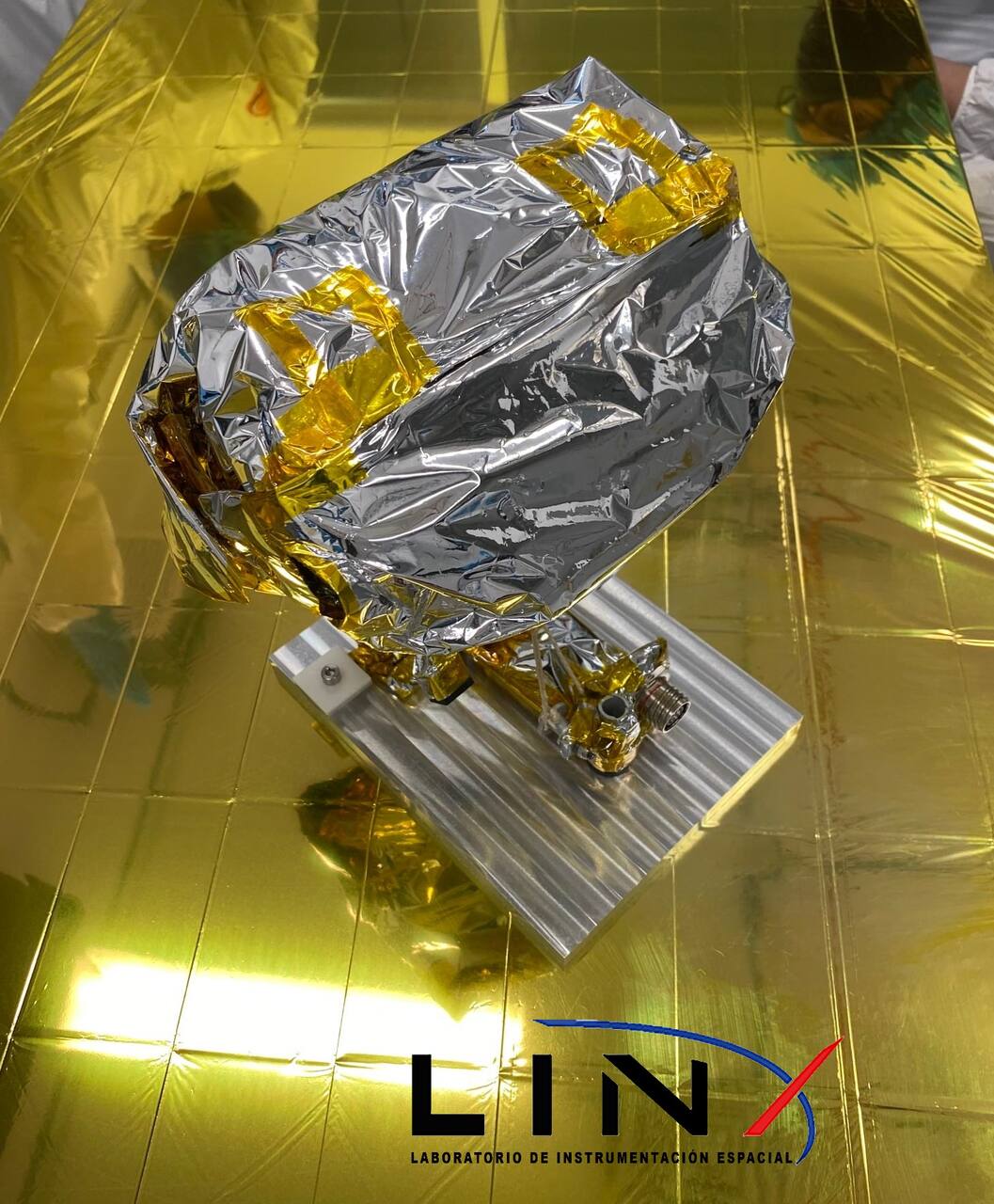 LINX, Instituto de Ciencias Nucleares, UNAM. Used with attribution on the rights holder’s terms.
The problem
Section titled “The problem”Colmena is a swarm of five micro-rovers built by the Laboratory of Space Instrumentation (LINX) at the Institute of Nuclear Sciences of the National Autonomous University of Mexico, flown as an integrated payload on Astrobotic’s Peregrine Mission One [8]. The project’s stated end is mineral prospection: lunar surface resources are scattered over large areas, so the work is to be spread across many small, simple units that survey individually and act collectively [13]. Median regolith depth is 2.5 to 6.1 m across mare regions and 6.7 to 8.7 m across highland regions by crater morphology [4], and radar inversion gives about 5 m for mare and more than 10 m for highland terrain [6].
A rover of this class has to survive and work in conditions set by the surface and by a gram-scale mass budget. The regolith surface is at under 8e-9 torr, and dust adheres to metals at 0.01 to 0.1 N/cm2 [7]. The top 15 cm has a bulk density of 1.50 g/cm3 [5], with cohesion of 0.1 to 1.0 kN/m2 controlled by porosity [10]. Sub-micron grains are charged by ultraviolet photons; photoelectric yield measured on single returned grains falls by about an order of magnitude below roughly 1 micrometer radius and is asymptotic above a few micrometers [1]. The science case places the rovers inside the lofted charged layer [8]. At under 5 g of compressive force per wheel, the ground may behave as a fluid-like medium rather than the locked solid a heavy rover compresses [8]. At 608 g for the whole payload, no conventional radiation shielding was affordable, and the design had to survive standby from -180 to 150 C and operation from 0 to 120 C [8].
For scale, the Apollo lunar roving vehicle was 210 kg with 490 kg of payload capacity and covered 28 km at Hadley Rille on Apollo 15 [35]. A 1992 projection of rovers of about 5 kg built from micromachined sensors and VLSI computers had no hardware behind it [9].
What has flown
Section titled “What has flown”Colmena-1, January 2024. Peregrine launched on 8 January 2024 on a Vulcan [2]. A helium pressure control valve lost seal capability, most likely through vibration-loosened threads in a joint internal to the valve, and let helium flow into the oxidizer tank until it ruptured about 92 minutes after separation, ruling out a landing [2]. The lander operated for ten days and fourteen hours in cislunar space before a controlled reentry over the South Pacific on 18 January [2]. Colmena was never deployed. Its payload was turned on in cruise, which it was not designed for, and every operational mode, telecommunications, thermal telemetry and single event resilience were exercised [8]. The project reports 75 percent of technical objectives met with no per-objective breakdown, so every objective that needed contact with the surface is among the missing quarter [8]. No temperatures, dose figures or upset counts are published [8].
Iris, January 2024. Carnegie Mellon’s Iris rover shared Peregrine and, with the landing ruled out, was never placed on a surface [2].
SLIM, LEV-1 and LEV-2, January 2024. SLIM landed on 19 January 2024; fourteen vision-based navigation fixes were taken down to the vertical descent, and the first 50 m hover image placed the lander 3.4 m from the planned target against a 100 m requirement [23]. Japan’s 2.1 kg LEV-1 was deployed just before touchdown and completed seven autonomous hops, received on a direct-to-Earth S-band link at Usuda and Uchinoura [21]. It ran about two hours on the surface [24]. LEV-2, a roughly 8 cm sphere, righted itself, drove away from the lander, selected images onboard and transmitted them, with a confirmed minimum of about 108 minutes of operation [22]. Two image data sets from LEV-2 reached Earth through LEV-1, which exercised a rover-to-rover link on the surface [21]. The displacement between LEV-2’s two returned images was about 0.13 m, derived photogrammetrically from one rock [22]. LEV-1’s single wheel carries a 90 degree tilted octagonal grouser chosen with a resistive force theory model; the draw-bar-pull and sinkage numbers behind that choice are Earth-gravity tests in terrestrial silica sand [24].
Colmena-1 has no surface result of its own. The surface evidence for micro-rover operation, and for one rover relaying through another, is the LEV pair.
What is being tried now
Section titled “What is being tried now”Deployment by catapult (ground tested, flight payload built). The rovers ride in a bucket under a removable shroud on the arms of a catapult in the deployment module, which stays bolted to the lander deck. The catapult is armed during integration and released by a cutting system after separate arm and trigger commands from the ground [8]. It throws the rovers 10 to 15 m, clear of the lander’s shadow and of regolith disturbed by the descent thrusters, and it randomizes their distribution [8]. The disturbed-regolith hazard is documented from Apollo 12: Surveyor 3, 155 m from the Lunar Module, carried 103.1 pits per cm2 on a returned camera shroud coupon [14]. The price of random placement is that landing attitude is unknown, so each rover is reversible about its mid-plane, with two wheels, four skates and solar panels on both faces [8]. The catapult has not fired on the Moon.
Dusty plasma science from a swarm (proposal, partly simulated). The rovers carry magnetic field sensors from 1 Hz to 100 kHz, accelerometers, magnetometers, temperature sensors and an electromagnetic plasma probing subsystem, and exchange signals among themselves so that attenuation measures the charged layer [8]. Dusty-plasma coupling to the rovers is simulated, not measured [8]. Lofting is supported by laboratory work: insulating grains hop at about 0.6 m/s under ultraviolet or plasma exposure, equivalent to 0.11 m in lunar gravity [12]. A theoretical model puts the near-surface levitated dust density near 1e3 per cm3 [11].
Micro-rover autonomy (ground tested and simulated). For the MoonRanger micro-rover, the lack of a radio link to Earth outside lander Wi-Fi range forced onboard autonomy, and dead reckoning from IMU and wheel encoders alone drifted about 5 percent in field data at an analog site [17]. MoonRanger’s thermal management is described as four behaviors: 13 thermistors, steering to trade sun heating against power, computer power throttling and resistive heaters, with no thresholds published [16]. Coverage path planning for lunar micro-rovers has been simulated on an Apollo 14 elevation model and field tested with the 7 kg CLOVER rover, reaching 80 percent coverage with a 0.41 m mean localization error on a 5 by 5 m grid [18]. No navigation method for Colmena’s rovers is published, and none was exercised [8].
Swarm coordination (ground testbeds and simulation). A Markov-chain guidance law has been simulated with 1000 notional agents and demonstrated physically only with a handful of ground robots on a 9-cell grid [3]. NASA Ames’ Troupe testbed runs 4 to 10 ground rovers for autonomous mapping, on commercial radio-control chassis with no mapping accuracy reported [19]. Spacebit’s Asagumo was manifested on Peregrine [20]. No swarm of surface robots has operated cooperatively on the Moon.
Thermal design at micro-rover scale (ground modeled). The Canadian Lunar Rover Mission, as originally proposed, set a 30 kg rover and a 1 hour operating target inside shadowed regions, a design target since superseded [25]. Colmena’s 0 to 120 C range is a requirement, not a result [8].
Dust mitigation (laboratory, one ISS flight). Dust degrades thermal control surfaces sharply: solar absorptivity may rise by as much as 50 percent at 12 percent area coverage [31]. Brushing restored white paint absorptance to emittance ratio from 0.65 dusted to 0.30 after 20 strokes in a bell jar with simulant, and bench brushing results did not transfer to that environment [15]. Passive protection on VIPER is a 42-layer outer barrier over each mobility module with labyrinth, felt and spring-energized PTFE seals, tested at ambient pressure [29]. A weighted trade study ranks a spring-loaded Teflon shaft seal first at 21.5 against 19.5 for the next, a subjective score and not a leak rate [32]. Active removal: electrodynamic dust shields recovered at least 90 percent of solar panel output within two minutes in vacuum and cleared particles up to 450 micrometers in parabolic flights at lunar gravity [26]. Twelve panels flew on MISSE-11 on the ISS, two energized at 4 kV and 10 Hz, and no dust removal was measured on orbit; the panels showed current spikes of unknown cause [27]. An electrostatic traveling-wave cleaner reached 90 percent cleaning of simulant at 800 V in vacuum, 98 percent with ultrasonic vibration, and was also tested on Apollo 11 soil [30]. For wear, a 4 minute exposure to simulant at 105 m/s cut visible transmittance of specimens from 86 to 29 percent [33], and a single 10 mg shot at about 360 m/s roughened surfaces by a factor of 8 [34]. A survey of abrasion work found most tests run at room conditions rather than in vacuum and at temperature [28]. No dust-removal or sealing device is published for the 56 g Colmena rover [8].
Colmena follow-on missions (plans). Colmena-2, planned for 2028 [8], is to deploy at least three prospection rover prototypes with a positioning system, beyond-the-horizon navigation and one night of hibernation. Colmena-3, planned for 2031, adds sample collection and transport and survival across several diurnal cycles [8].
The numbers
Section titled “The numbers”| Parameter | Value |
|---|---|
| Rovers | 5, identical |
| Rover mass | about 56 g each, 280 g total |
| Rover envelope | approximately 12 x 12 x 4 cm, torus about 1 cm thick |
| Wheels | 2, plus four skates |
| Deployment module mass | 328 g |
| Payload total mass | 608 g |
| Standby temperature range | -180 to 150 C |
| Operating temperature range | 0 to 120 C |
| Radiation survival requirement | 120 days in cislunar space outside the magnetopause |
| Catapult range | 10 to 15 m |
| Compressive force per wheel | under 5 g |
| Launch | 8 January 2024, Vulcan [2] |
| Time to tank rupture after separation | about 92 minutes [2] |
| Duration operated | 10 days 14 hours [2] |
| Technical objectives met | 75 percent, project accounting |
Rows without a marker are from [8]; the launch and anomaly rows are from [2]. Speed, drive torque, battery capacity, generation, processor and radio parameters are not published [8].
| Small lunar rover, January 2024 | Outcome | Source |
|---|---|---|
| Colmena-1 (five rovers, 56 g each) | Powered in cruise, never deployed | [8] |
| Iris | Aboard Peregrine, never placed on a surface | [2] |
| LEV-1 (2.1 kg) | Seven hops, about two hours on the surface | [21][24] |
| LEV-2 (about 8 cm sphere) | Imaged from the surface, relayed through LEV-1, 108 minutes minimum | [21][22] |
What is not established
Section titled “What is not established”No Colmena rover reached the surface, so deployment by catapult, landing orientation, traction at under 5 g per wheel, the fluid-like upper dust layer and every plasma measurement remain unmet and untested [8]. The 75 percent figure is the project’s own accounting with no per-objective breakdown [8]. The cruise operation was improvised, and no temperatures, dose figures or upset counts are published from it [8]. The surface layer scale quoted for the target is cited context rather than a result [8]. The root cause of the lander loss is stated as most likely, the flight valve was never recovered, and the report is the operator’s own [2]. The photoelectric yield, lofting and dusty-plasma literature behind the science case comes from laboratory work on returned grains or simulants and from theory [1][11][12], and no in-place measurement of the layer exists. The dust mitigation results above are ground tests with simulants, and the one flight, MISSE-11, was in low Earth orbit, not on the Moon [27]. The LEV-2 displacement figure rests on two images [22]. Colmena-2 and Colmena-3 dates are the project’s plans [8]. The project page is the team’s own and is not independently verified [13].
References
Section titled “References”References
- Abbas, M. M., Tankosic, D., Craven, P. D., Spann, J. F., LeClair, A. and West, E. A. (2007). Lunar Dust Charging by Photoelectric Emissions
. Planetary and Space Science, 20070014798. Source
BibTeX
@article{abbas2007lunar, title = {Lunar Dust Charging by Photoelectric Emissions}, author = {Abbas, M. M. and Tankosic, D. and Craven, Paul D. and Spann, J. F. and LeClair, A. and West, E. A.}, journal = {Planetary and Space Science}, volume = {55}, number = {20070014798}, pages = {953-965}, institution = {NASA}, year = {2007}, doi = {10.1016/j.pss.2006.12.007}, abstract = {The lunar surface is covered with a thick layer of sub-micron/micron size dust grains formed by meteoritic impact over billions of years. The fine dust grains are levitated and transported on the lunar surface, as indicated by the transient dust clouds observed over the lunar horizon during the Apollo 17 mission. Theoretical models suggest that the dust grains on the lunar surface are charged by the solar UV radiation as well as the solar wind. Even without any physical activity, the dust grains are levitated by electrostatic fields and transported away from the surface in the near vacuum environment of the Moon. The current dust charging and levitation models, however, do not fully explain the observed phenomena. Since the abundance of dust on the Moon s surface with its observed adhesive characteristics has the potential of severe impact on human habitat and operations and lifetime of a variety of equipment, it is necessary to investigate the charging properties and the lunar dust phenomena in order to develop appropriate mitigating strategies. Photoelectric emission induced by the solar UV radiation with photon energies higher than the work function of the grain materials is recognized to be the dominant process for charging of the lunar dust, and requires measurements of the photoelectric yields to determine the charging and equilibrium potentials of individual dust grains. In this paper, we present the first laboratory measurements of the photoelectric efficiencies and yields of individual sub-micron/micron size dust grains selected from sample returns of Apollo 17, and Luna 24 missions, as well as similar size dust grains from the JSC-1 simulants. The measurements were made on a laboratory facility based on an electrodynamic balance that permits a variety of experiments to be conducted on individual sub-micron/micron size dust grains in simulated space environments. The photoelectric emission measurements indicate grain size dependence with the yield increasing by an order of magnitude for grains of sub-micron to several micron size radii, at which it reaches asymptotic values. The yield for large size grains is found to be more than an order of magnitude higher than the bulk measurements on lunar fines reported in the literature.} } - Astrobotic Technology. (2024). Peregrine Mission 1 Post-Mission Report
. Astrobotic Technology. Source
BibTeX
@techreport{astrobotic2024peregrine, title = {Peregrine Mission 1 Post-Mission Report}, author = {{Astrobotic Technology}}, institution = {Astrobotic Technology}, month = {August}, year = {2024}, url = {https://www.astrobotic.com/wp-content/uploads/2024/08/PM1_Post-Mission-Report_2024-1.pdf} } - Bandyopadhyay, S. (2018). Interesting Applications of Swarm Robotics in Space. ntrs.nasa.gov/citations/20210016543
BibTeX
@misc{bandyopadhyay2018interesting, title = {Interesting Applications of Swarm Robotics in Space}, author = {Bandyopadhyay, Saptarshi}, year = {2018}, url = {https://ntrs.nasa.gov/citations/20210016543}, abstract = {UNKNOWN} } - Bart, G. D., Nickerson, R. D., Lawder, M. T. and Melosh, H. J. (2011). Global survey of lunar regolith depths from LROC images
. Icarus. Source
BibTeX
@article{bart2011global, title = {Global survey of lunar regolith depths from LROC images}, author = {Bart, Gwendolyn D. and Nickerson, Ryan D. and Lawder, Matthew T. and Melosh, H. J.}, journal = {Icarus}, volume = {215}, pages = {485-490}, year = {2011}, doi = {10.1016/j.icarus.2011.07.017} } - Colwell, J. E., Batiste, S., Horányi, M., Robertson, S. and Sture, S. (2007). Lunar surface: Dust dynamics and regolith mechanics
. Reviews of Geophysics. Source
BibTeX
@article{colwell2007lunar, title = {Lunar surface: Dust dynamics and regolith mechanics}, author = {Colwell, J. E. and Batiste, S. and Horányi, Mihály and Robertson, Scott and Sture, Stein}, journal = {Reviews of Geophysics}, volume = {45}, pages = {RG2006}, publisher = {American Geophysical Union (AGU)}, year = {2007}, doi = {10.1029/2005rg000184}, abstract = {The lunar surface is characterized by a collisionally evolved regolith resulting from meteoroid bombardment. This lunar soil consists of highly angular particles in a broad, approximately power law size distribution, with impact‐generated glasses. The regolith becomes densified and difficult to excavate when subjected to lunar quakes or, eventually, manned and unmanned activity on the surface. Solar radiation and the solar wind produce a plasma sheath near the lunar surface. Lunar grains acquire charge in this environment and can exhibit unusual behavior, including levitation and transport across the surface because of electric fields in the plasma sheath. The fine component of the lunar regolith contributes to the operational and health hazards posed to planned lunar expeditions. In this paper we discuss the mechanical response of the regolith to anticipated exploration activities and review the plasma environment near the lunar surface and the observations, models, and dynamics of charged lunar dust.} } - Fa, W. and Wieczorek, M. A. (2012). Regolith thickness over the lunar nearside: Results from Earth-based 70-cm Arecibo radar observations
. Icarus, 2. Source
BibTeX
@article{fa2012regolith, title = {Regolith thickness over the lunar nearside: Results from Earth-based 70-cm Arecibo radar observations}, author = {Fa, Wenzhe and Wieczorek, Mark A.}, journal = {Icarus}, volume = {218}, number = {2}, pages = {771--787}, publisher = {Elsevier BV}, year = {2012}, doi = {10.1016/j.icarus.2012.01.010} } - Katzan, C. M. and Edwards, J. L. (1991). Lunar Dust Transport and Potential Interactions with Power System Components
. NASA Lewis Research Center, NASA CR-4404. Source
BibTeX
@techreport{katzan1991lunar, title = {Lunar Dust Transport and Potential Interactions with Power System Components}, author = {Katzan, Cynthia M. and Edwards, Jonathan L.}, number = {NASA CR-4404}, institution = {NASA Lewis Research Center}, year = {1991}, doi = {10.2172/10181067}, abstract = {The lunar surface is covered by a thick blanket of fine dust. This dust may be readily suspended from the surface and transported by a variety of mechanisms. As a consequence, lunar dust can accumulate on sensitive power components, such as photovoltaic arrays and radiator surfaces, reducing their performance. In addition to natural mechanisms, human activities on the Moon will disturb significant amounts of lunar dust. Of all the mechanisms identified, the most serious is rocket launch and landing. The return of components from the Surveyor 3 provided a rare opportunity to observe the effects of the nearby landing of the Apollo 12 Lunar Module. The evidence proved that significant dust accumulation occurred on the Surveyor at a distance of 155 m. From available information on particle suspension and transport mechanisms, a series of models was developed to predict dust accumulation as a function of distance from the lunar module. The accumulation distribution was extrapolated to a future Lunar Lander scenario. These models indicate that accumulation is expected to be substantial even as far as 2 km from the landing site. Estimates of the performance penalties associated with lunar dust coverage and photovoltaic arrays are presented. Because of the lunar dust adhesive and cohesive properties, the most practical dust defensive strategy appears to be the protection of sensitive components from the arrival of lunar dust by location, orientation, or barriers.} } - Medina-Tanco, G. (2024). Validation of the lunar mission Colmena-1 in deep space
. International Astronautical Congress, IAC-24-A3,2B,5,x91388. Source
BibTeX
@inproceedings{medina2024validation, title = {Validation of the lunar mission Colmena-1 in deep space}, author = {Medina-Tanco, Gustavo}, booktitle = {International Astronautical Congress}, number = {IAC-24-A3,2B,5,x91388}, pages = {170-174}, year = {2024}, doi = {10.52202/078357-0023} } - Mettler, E. and Hadaegh, F. (1992). Micro-Guidance and Control Synthesis: New Components, Architectures, and Capabilities
. JPL Open Repository. Source
BibTeX
@inproceedings{mettler1992micro, title = {Micro-Guidance and Control Synthesis: New Components, Architectures, and Capabilities}, author = {Mettler, E. and Hadaegh, F.}, publisher = {JPL Open Repository}, year = {1992}, url = {https://dataverse.jpl.nasa.gov/dataset.xhtml?persistentId=hdl:2014/35463} } - Mitchell, J. K., Carrier, W. D. I., Houston, W. N., Scott, R. F., Bromwell, L. G., Durgunoglu, H. T., Hovland, H. J., Treadwell, D. D. and Costes, N. C. (1972). Soil mechanics
. NASA, NASA SP-315. Source
BibTeX
@techreport{mitchell1972soilb, title = {Soil mechanics}, author = {Mitchell, James K. and Carrier, W. D., III and Houston, William N. and Scott, Ronald F. and Bromwell, L. G. and Durgunoglu, H. T. and Hovland, H. John and Treadwell, D. D. and Costes, Nicholas C.}, number = {NASA SP-315}, pages = {xi-xii}, institution = {NASA}, year = {1972}, doi = {10.1017/cbo9780511815553.002}, abstract = {This book teaches the principles of soil mechanics to undergraduates, along with other properties of engineering materials, to which the students are exposed simultaneously. Using the critical state method of soil mechanics to study the mechanical behavior of soils requires the student to consider density alongside effective stresses, permitting the unification of deformation and strength characteristics. This unification aids the understanding of soil mechanics. This book explores a one-dimensional theme for the presentation of many of the key concepts of soil mechanics - density, stress, stiffness, strength, and fluid flow - and includes a chapter on the analysis of one-dimensional consolidation, which fits nicely with the theme of the book. It also presents some theoretical analyses of soil-structure interaction, which can be analyzed using essentially one-dimensional governing equations. Examples are given at the end of most chapters, and suggestions for laboratory exercises or demonstrations are given.} } - Popel, S. I., Zelenyi, L. M., Golub', A. P. and Dubinskii, A. Y. (2018). Lunar dust and dusty plasmas: Recent developments, advances, and unsolved problems
. Planetary and Space Science. Source
BibTeX
@article{popel2018lunar, title = {Lunar dust and dusty plasmas: Recent developments, advances, and unsolved problems}, author = {Popel, S. I. and Zelenyi, L. M. and Golub', A. P. and Dubinskii, A. Yu.}, journal = {Planetary and Space Science}, volume = {156}, pages = {71-84}, year = {2018}, doi = {10.1016/j.pss.2018.02.010} } - Wang, X., Schwan, J., Hsu, H.-W., Grün, E. and Horányi, M. (2016). Dust charging and transport on airless planetary bodies
. Geophysical Research Letters. Source
BibTeX
@article{wang2016dust, title = {Dust charging and transport on airless planetary bodies}, author = {Wang, Xu and Schwan, J. and Hsu, Hsiang-Wen and Grün, E. and Horányi, M.}, journal = {Geophysical Research Letters}, volume = {43}, pages = {6103-6110}, year = {2016}, doi = {10.1002/2016gl069491}, abstract = {Abstract We report on laboratory experiments to shed light on dust charging and transport that have been suggested to explain a variety of unusual phenomena on the surfaces of airless planetary bodies. We have recorded micron‐sized insulating dust particles jumping to several centimeters high with an initial speed of ~0.6 m/s under ultraviolet illumination or exposure to plasmas, resulting in an equivalent height of ~0.11 m on the lunar surface that is comparable to the height of the so‐called lunar horizon glow. Lofted large aggregates and surface mobilization are related to many space observations. We experimentally show that the emission and re‐absorption of photoelectron and/or secondary electron at the walls of microcavities formed between neighboring dust particles below the surface are responsible for generating unexpectedly large negative charges and intense particle‐particle repulsive forces to mobilize and lift off dust particles.} } - (2026). LINX UNAM: Proyecto Colmena. linx.nucleares.unam.mx/COLMENA-1.html
BibTeX
@misc{linxunamproyecto,
  title = {LINX UNAM: Proyecto Colmena},
  organization = {linx.nucleares.unam.mx},
  year = {2026},
  url = {https://linx.nucleares.unam.mx/COLMENA-1.html}
}