MAPP
Program pages Lunar Outpost: MAPP Lunar Outpost: Lunar Voyage 1 Update
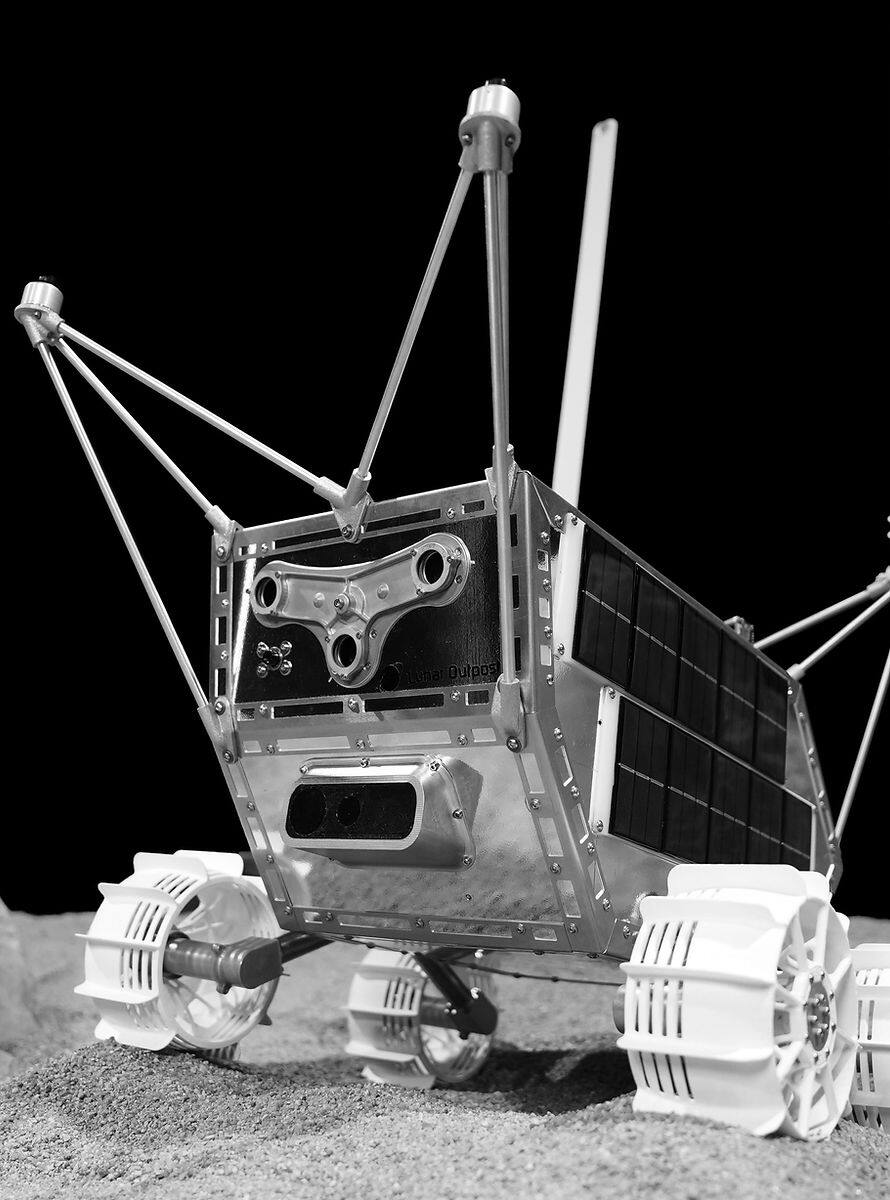 Lunar Outpost.
The problem
Section titled “The problem”A small polar rover has to survive transit and a landing it does not control, deploy from its lander, and then operate on a surface that is cold, dusty and poorly lit. Electronics must stay inside temperature limits when the sun is near the horizon. NASA’s engineering review sets the lunar design envelope at -233 to +125 degrees C and states that no existing qualification standard covers it [34]. The rover must drive on regolith that no rover has traversed at the south pole, with orbital maps as the only terrain knowledge; the VIPER landing-site work near Mons Mouton is built entirely from orbital data, with no surface measurement of the ground [40]. Dust is the standing mechanical constraint: in ambient-air tests, four lunar and Martian simulants gave friction coefficients of 0.2 to 0.4 against a lip seal and produced measurable abrasive wear [35]. Finally, data return is usually the lander’s link, which at this scale is a few megabits for the whole mission [10].
MAPP, the Mobile Autonomous Prospecting Platform, is Lunar Outpost’s answer, a small four-wheeled rover sold as a mobility service in which customers buy payload bays, power and data on a flight [9].
What has flown
Section titled “What has flown”MAPP flew once, as Lunar Voyage 1 on the Intuitive Machines IM-2 Nova-C lander, launched 26 February 2025 [13]. Nova-C landed on 6 March 2025 about 250 m from its intended site, on its side inside a crater at Mons Mouton [13]. The MAPP garage was wedged upside down beneath the lander, which prevented deployment [10]. Intuitive Machines did not expect the lander to recharge, given sun direction, solar panel orientation and crater temperatures, and declared the mission concluded on 7 March 2025 [13]. The cause of the landing attitude is not given in the trade-press account [13].
The manufacturer reports that during the mission it received 57,574 telemetry data points, downlinked multiple images and sent 268 commands, inside a total lander-provided downlink allocation of 6 Mb [10]. It states that returned MAPP data shows the rover survived the landing and would have driven. The Talon hold-down and deployment system, patent pending, restrained the rover through launch and landing impact [10]. The Fault Tolerant Flight Computer performed vehicle management through a Van Allen belt transit and operations in shadow. The Autonomous Thermal Control System is reported to have held rover and payload temperatures inside design ranges, per the same account. Operations ran from Lunar Outpost’s own mission control on the Stargate software, reported at 99.998 percent uptime [10], and the stereo navigation camera imaging was compressed onboard to fit the narrow allocation. Every TRL 9 designation in that account is self-assigned; no temperature, power, dose or subsystem data are published [10].
The Nokia Bell Labs 4G/LTE Lunar Surface Communications System flew on the same lander: a Network in a Box on Nova-C with dual-redundant base transceiver station and evolved packet core, and a custom LTE device module and antennas on MAPP as the mobile user [1]. The planned demonstration was a rover link at 200 to 300 m and up to 2 km from the lander [1]. The paper predates the flight, and no measured link performance is cited here. The Micro-Nova hopper on the lander was named S. P. Hopper for this flight and carried a second device module [4].
Other IM-2 payloads show the cost of the tipped attitude. PRIME-1’s TRIDENT drill, designed to reach about 0.91 m, could not reach the ground, and MSolo received no sample [6], [13], [14].
What is being tried now
Section titled “What is being tried now”Cellular surface networking. Flown once, on this mission, without a published result. NASA’s 3GPP Cellular Working Group recommended baselining 3GPP for planetary surface communications, and an Artemis III demonstration objective targets 45 minutes of 720p video per one-hour window at 2 km from an Axiom suit [1]. This is the only family here with a flight attempt; the Artemis III figures are targets.
MAPP derivatives and customer rovers. A MAPP-derived chassis carries the Lunar Vertex payload for Reiner Gamma, a vector magnetometer array and a multispectral microscope [2], [3]. It is a ground-tested flight article awaiting a landing. Under NASA’s Lunar Surface Technology Research program, Lunar Outpost, the Colorado School of Mines, Michigan Technological University and Bechtel are developing ASPECT, an autonomous landing-pad construction system that draws on MAPP mobility, dust and thermal work [5]. It is in development. The larger Outpost Digger System ran a 15-day durability demonstration for the Break the Ice Lunar Challenge [8]; the Colorado School of Mines mare-simulant test bed has been used to test MAPP hardware among others [7]. NASA’s IPEx excavator has a documented TRL 5 design and qualification campaign [29], and its autonomy was tested in a 39.6 by 21.3 m light-tight tent with stadium lights standing in for the polar sun, including a five-day continuous mission demonstration [32]. Both are ground results at 1 g in air.
Other small and mid-size lunar rovers. JAXA’s LEV-1 flew on SLIM and made six hops confirmed by sensed gravity change, the first hopping locomotion on the Moon; no hop distance or height was published [16], and the SLIM landing results are reviewed in [15]. Colmena-1 carried five 12 cm micro-rovers on Peregrine Mission One, but the lander never reached the surface, so no mobility objective was exercised [33]. Canada’s lunar rover has passed preliminary design review, with no mobility figures published [25]. JPL’s CADRE delivery was a management retrospective on COTS-based rovers for IM-3 [21], and its CRESCENT planner uses a 5.12 m global horizon at 1 Hz and a 0.64 m local horizon at 5 Hz, validated in simulation and on an Earth Mars Yard [22].
Long-range autonomy. The Endurance concept would traverse about 2000 km across South Pole-Aitken basin and collect up to 100 kg of samples at 12 sites [23]. Its MEXEC executive coordinates mobility and telecom [24]. In a Mars Yard run with simulated power and thermal signals, a rover drove 4.192 km in 392 minutes with four interventions; the simulation tables were accelerated by a factor of 10 [41]. A one-tonne rover ran Lidar Teach and Repeat cargo transport at the CSA Analogue Terrain over two weeks, on sand, snow and ice rather than regolith [38]. All of this is ground or proposal level.
Navigation without GPS. ShadowNav localizes in total darkness from a stereo camera and floodlight by matching crater-rim range discontinuities to an orbital map, tested at Earth analog craters; it gives 2D position only [18]. Illumination-invariant matching for polar terrain-relative navigation has been evaluated on rendered imagery, where sun elevations of a few degrees change the appearance of terrain hour to hour [19], [20]. These are ground and simulation results; none is stated to be part of MAPP’s navigation software.
Planning for shadowed terrain. Chance-constrained mission-level planning for a solar-powered rover in permanently shadowed regions has been demonstrated only in Monte Carlo simulation on synthetic orbital maps [17].
Resource prospecting payloads. The TRIDENT drill built for PRIME-1 and VIPER has never drilled lunar regolith: the PRIME-1 activation exercised mechanisms horizontally with the drill buried in landing ejecta [14]. By contrast, LISTER reached depth on Blue Ghost Mission One in March 2025 and returned a preliminary heat flow value [36], and PlanetVac collected 13 g of regolith on the same lander [37]. VIPER’s mobility dust protection used a 42-layer outer barrier with graded seals, tested at ambient pressure only [27]; its system thermal vacuum test setup is described in [28], and its rationale as an Artemis precursor in [26].
Mobility prediction on the ground. Dedicated work asks whether 1 g experiments predict reduced-gravity mobility, using parabolic flight single-wheel data [31]. Single-wheel tests of a flight-model grouser wheel compared Toyoura sand with FJS-1 lunar simulant on Earth at reduced vertical load, which is not reduced gravity [39]. NASA has issued consolidated best practices for testing rover mobility systems and tires [30]. No lunar-gravity mobility measurement exists for MAPP.
The numbers
Section titled “The numbers”| Parameter | Value | Source |
|---|---|---|
| Vehicle mass, flight article | 10 kg | [11] |
| Top speed | 10 cm/s | [11] |
| Locomotion | four driven wheels | [11] |
| Lander | Intuitive Machines Nova-C, IM-2 | [1] |
| Launch | 26 February 2025 | [13] |
| Landing | 6 March 2025, about 10:30 MT | [10] |
| Landing site | Mons Mouton, 250 m from target | [13] |
| Lunar transit operations | 132.2 hours | [10] |
| Lunar orbit operations | 77.1 hours | [10] |
| Surface operations in shadow | 2.7 hours | [10] |
| Downlink allocation, transit and surface | 6 Mb | [10] |
| Telemetry points / commands | 57,574 / 268 | [10] |
| Planned lander-rover link ranges | 200 to 300 m; up to 2 km | [1] |
| Outcome | lander on its side, rover never deployed | [13] |
| Payload | Provider | Function | Source |
|---|---|---|---|
| 4G/LTE device module and antennas | Nokia Bell Labs | mobile node of the lunar cellular network | [1] |
| Azure Kinect depth camera | NASA Ames and MIT | depth imaging of the surface | [10] |
| AstroAnt | MIT Media Lab | magnetic-wheeled robot with a thermopile monitoring radiator temperature | [12] |
| Regolith collection mechanism | Lunar Outpost | sample acquisition under a NASA space resources contract | [10] |
| Neutron spectrometer | not stated | hydrogen signature prospecting | [10] |
Subsystems reported by the manufacturer: two computers (a Fault Tolerant Flight Computer with FPGA, processor, memory and motor controllers, and a separate navigation and payload computer), stereo navigation cameras with onboard compression, a dust mitigation lens cover, and an AstroAnt garage [10]. The rover has no direct-to-Earth link in this configuration and communicates through the lander [1].
What is not established
Section titled “What is not established”No mobility, navigation or autonomy function of MAPP was exercised on the lunar surface, because the rover never left its garage [10], [13]. The statement that it would have driven, and every TRL 9 designation, rest on the manufacturer’s own telemetry from a few hours in a wedged, shadowed position under a tipped lander [10]. The product page carries no numbers [9].
Mass and top speed are quoted by a payload customer without a source, and the several-kilometer traverse range is an intention [11]. No full paper gives bus mass budget, payload capacity, array power, battery capacity, terramechanics, slope limit or design drive range. The Nokia link ranges are plan figures from a paper written before the outcome was known [1]. No night or thermal-cycling result exists for MAPP. The thermal performance claimed for MAPP was not tested against them on the surface.
References
- Edwards, B., Wagner, R. S., Zemba, M., Klein, T. E., Maestro, L. and Dow, J. (2025). Envisioned Lunar Surface Communications Using 3GPP Cellular and Wi-Fi Technologies
. International Conference on Space Operations. Source
BibTeX
@inproceedings{edwards2025envisioned, title = {Envisioned Lunar Surface Communications Using 3GPP Cellular and Wi-Fi Technologies}, author = {Edwards, Bernard and Wagner, Raymond S. and Zemba, Michael and Klein, Thierry E. and Maestro, Luis and Dow, John}, booktitle = {International Conference on Space Operations}, year = {2025}, url = {https://ntrs.nasa.gov/citations/20250001947}, abstract = {Under NASA’s Artemis Program, NASA plans to collaborate with commercial and international partners to establish a long-term human and robotic presence on the Moon. Critical lunar infrastructure includes having a robust surface wireless communications and navigation network to be developed over time by many organizations, public and private. NASA’s Space Technology Mission Directorate (STMD) has envisioned a lunar surface future that includes the use of 3rd Generation Partnership Project (3GPP) cellular and 802.11 Wi-Fi technologies. NASA and Nokia Bell Labs are studying and validating the benefits and trade-offs of using 3GPP 4G and 5G technologies originally developed for use here on Earth, and how 3GPP technologies and 802.11 Wi-Fi technologies can be integrated to provide a robust and resilient end-to-end network architecture and solution design. Furthermore, as the 3GPP organization defines future 6G capabilities, NASA wants to understand how that could enhance lunar science and exploration missions and commercial endeavours to provide even more advanced, scalable and high-performance connectivity solutions. The vision is to provide human and robotic missions on the Moon with similar communications and navigation capabilities to what mobile users have on Earth, while adapting these technologies into space-hardened solutions that withstand the environmental and operational challenges of the lunar surface. STMD’s Tipping Point program seeks industry-developed space technologies that can both foster commercial space capabilities and benefit future NASA missions. Via Tipping Point, Nokia Bell Labs will demonstrate the use of 4G / LTE on the lunar surface on the Intuitive Machines IM-2 mission. This will be followed with a technology demonstration with astronauts on the Artemis III lunar landing. This paper provides an overview of NASA’s current and planned future work on using 3GPP and 802.11 Wi-Fi on the Moon.} } - Blewett, D. T., Halekas, J., Ho, G. C., Greenhagen, B. T., Anderson, B. J., Vines, S. K., Regoli, L., Jahn, J.-M., Kollmann, P., Denevi, B. W., Meyer, H. M., Klima, R. L., Cahill, J. T., Hood, L. L., Tikoo, S., Zou, X.-D., Wieczorek, M., Lemelin, M., Fatemi, S., Cox, A. L., Cooper, S. A. and Ames, W. F. (2022). Lunar Vertex: PRISM Exploration of Reiner Gamma
. Lunar and Planetary Science Conference, 1131. Source
BibTeX
@inproceedings{blewett2022lunarvertex, title = {Lunar Vertex: PRISM Exploration of Reiner Gamma}, author = {Blewett, David T. and Halekas, Jasper and Ho, George C. and Greenhagen, Benjamin T. and Anderson, Brian J. and Vines, Sarah K. and Regoli, Leonardo and Jahn, Jörg-Micha and Kollmann, Peter and Denevi, Brett W. and Meyer, Heather M. and Klima, Rachel L. and Cahill, Joshua T. and Hood, Lon L. and Tikoo, Sonia and Zou, Xiao-Duan and Wieczorek, Mark and Lemelin, Myriam and Fatemi, Shahab and Cox, Ann L. and Cooper, Scott A. and Ames, William F.}, booktitle = {Lunar and Planetary Science Conference}, number = {1131}, year = {2022}, url = {https://www.hou.usra.edu/meetings/lpsc2022/pdf/1131.pdf} } - Blewett, D. T., Halekas, J., Kollmann, P., Greenhagen, B. T., Denevi, B. W., Meyer, H. M., Klima, R. L., Vines, S. K., Waller, C. D., Cahill, J. T., Anderson, B. J., Regoli, L., Ames, W. F., Cooper, S. A., Cox, A. L., Ho, G. C., Jahn, J.-M., Hood, L. L., Tikoo, S., Zou, X.-D., Wieczorek, M., Lemelin, M., Fatemi, S. and Cloutis, E. A. (2025). The Lunar Vertex PRISM Payload: Updates and Plans
. Lunar and Planetary Science Conference, 1233. Source
BibTeX
@inproceedings{blewett2025prism, title = {The Lunar Vertex PRISM Payload: Updates and Plans}, author = {Blewett, David T. and Halekas, Jasper and Kollmann, Peter and Greenhagen, Benjamin T. and Denevi, Brett W. and Meyer, Heather M. and Klima, Rachel L. and Vines, Sarah K. and Waller, C. Dany and Cahill, Joshua T. and Anderson, Brian J. and Regoli, Leonardo and Ames, William F. and Cooper, Scott A. and Cox, Ann L. and Ho, George C. and Jahn, Jörg-Micha and Hood, Lon L. and Tikoo, Sonia and Zou, Xiao-Duan and Wieczorek, Mark and Lemelin, Myriam and Fatemi, Shahab and Cloutis, Edward A.}, booktitle = {Lunar and Planetary Science Conference}, number = {1233}, year = {2025}, url = {https://www.hou.usra.edu/meetings/lpsc2025/pdf/1233.pdf} } - Martin, T. D., Atwell, M. J., Oelke, M. L., Crain, T. P., Robinson, M. S., Wagner, R. V., Speyerer, E. J., Estes, N. M., Grott, M., Hamm, M. and Knollenberg, J. (2022). S. P. Hopper: First In-Situ Exploration of Lunar Polar Terrain
. Lunar and Planetary Science Conference, 2007. Source
BibTeX
@inproceedings{martin2022hopper, title = {S. P. Hopper: First In-Situ Exploration of Lunar Polar Terrain}, author = {Martin, T. D. and Atwell, M. J. and Oelke, M. L. and Crain, T. P. and Robinson, Mark S. and Wagner, R. V. and Speyerer, E. J. and Estes, N. M. and Grott, Matthias and Hamm, Maximilian and Knollenberg, J.}, booktitle = {Lunar and Planetary Science Conference}, number = {2007}, year = {2022}, url = {https://www.hou.usra.edu/meetings/lpsc2022/pdf/2007.pdf} } - Rusch, E. (2026). Mines, Lunar Outpost Developing Technology for Autonomous Lunar Excavation and Construction. minesnewsroom.com/news/mines-lunar-outpost-developing-technology-auto...
BibTeX
@misc{minesaspect2021, title = {Mines, Lunar Outpost Developing Technology for Autonomous Lunar Excavation and Construction}, author = {Rusch, Emilie}, organization = {Colorado School of Mines Newsroom}, year = {2026}, url = {https://www.minesnewsroom.com/news/mines-lunar-outpost-developing-technology-autonomous-lunar-excavation-and-construction} } - (2022). NASA: Polar Resources Ice Mining Experiment-1 (PRIME-1). nasa.gov/mission/polar-resources-ice-mining-experiment-1-prime-1
BibTeX
@misc{nasapolar, title = {NASA: Polar Resources Ice Mining Experiment-1 (PRIME-1)}, organization = {nasa.gov}, year = {2022}, url = {https://www.nasa.gov/mission/polar-resources-ice-mining-experiment-1-prime-1/} } - Rusch, E. and Ramirez, M. (2019). Lunar Test Bed a Playground for Emerging Space Technology. minesnewsroom.com/news/lunar-test-bed-playground-emerging-space-techn...
BibTeX
@misc{rusch2019lunar, title = {Lunar Test Bed a Playground for Emerging Space Technology}, author = {Rusch, Emilie and Ramirez, Mark}, organization = {Colorado School of Mines Newsroom}, year = {2019}, url = {https://www.minesnewsroom.com/news/lunar-test-bed-playground-emerging-space-technology} } - Rusch, E. (2023). Mines, Lunar Outpost Test Lunar Excavation Rover in 15-Day Durability Demonstration. minesnewsroom.com/news/mines-lunar-outpost-test-lunar-excavation-rove...
BibTeX
@misc{rusch2023mines, title = {Mines, Lunar Outpost Test Lunar Excavation Rover in 15-Day Durability Demonstration}, author = {Rusch, Emilie}, organization = {Colorado School of Mines Newsroom}, year = {2023}, url = {https://www.minesnewsroom.com/news/mines-lunar-outpost-test-lunar-excavation-rover-15-day-durability-demonstration} } - (2026). Lunar Outpost: MAPP. lunaroutpost.com/mapp
BibTeX
@misc{lunaroutpostmapp, title = {Lunar Outpost: MAPP}, organization = {lunaroutpost.com}, year = {2026}, url = {https://www.lunaroutpost.com/mapp} } - (2025). Lunar Outpost: Lunar Voyage 1 Update. lunaroutpost.com/post/lunar-voyage-1-update
BibTeX
@misc{lunaroutpostlunar, title = {Lunar Outpost: Lunar Voyage 1 Update}, organization = {lunaroutpost.com}, year = {2025}, url = {https://www.lunaroutpost.com/post/lunar-voyage-1-update} } - (2026). MIT Media Lab To The Moon To Stay: Lunar Outpost MAPP rover. tothemoon.mit.edu/lunar-outpost-mapp-rover
BibTeX
@misc{mitmedialabtothemoontostaylunar, title = {MIT Media Lab To The Moon To Stay: Lunar Outpost MAPP rover}, organization = {tothemoon.mit.edu}, year = {2026}, url = {https://www.tothemoon.mit.edu/lunar-outpost-mapp-rover} } - (2026). MIT To The Moon To Stay: AstroAnt Payload. tothemoon.mit.edu/astroant
BibTeX
@misc{mittothemoontostayastroant, title = {MIT To The Moon To Stay: AstroAnt Payload}, organization = {tothemoon.mit.edu}, year = {2026}, url = {https://www.tothemoon.mit.edu/astroant} } - (2026). Spaceflight Now: Intuitive Machines' IM-2 Moon mission ends with lander on its side. spaceflightnow.com/2025/03/07/intuitive-machines-im-2-mission-ends-wi...
BibTeX
@misc{spaceflightnowintuitive,
  title = {Spaceflight Now: Intuitive Machines' IM-2 Moon mission ends with lander on its side},
  organization = {spaceflightnow.com},
  year = {2026},
  url = {https://spaceflightnow.com/2025/03/07/intuitive-machines-im-2-mission-ends-with-lander-on-its-side-on-the-moon/}
}