Small Body Surface Environment
The surface of an asteroid or comet nucleus is an unconfined granular pile at accelerations between 1e-2 and 1e-5 m/s2 [2], where cohesion and van der Waals attraction between grains exceed weight and escape velocity is of the order of a mechanism’s own tip speed. What follows sets out the gravitational regime, the force hierarchy that replaces weight as the dominant term in regolith mechanics, the measured bearing strength and packing state of the near subsurface, the low-gravity impact and ejecta regime, the thermal field, and the ionizing radiation environment.
Gravitational regime
Section titled “Gravitational regime”Surface acceleration on small bodies spans 1e-2 to 1e-5 m/s2 [2]. A body of 1 km radius and 2000 kg/m3 bulk density produces about 5e-4 m/s2, roughly 50 micro-g [1].
| Body | Surface acceleration | Source |
|---|---|---|
| Eros (18 km) | 0.2 to 0.6 milli-g | [1] |
| Itokawa (0.18 km) | 6 to 9 micro-g | [1] |
| 1999 KW4 primary | 30 micro-g down to near zero at the equator | [1] |
Bennu is 492 m in diameter with a bulk density of 1190 kg/m3 [5]. Its escape velocity is 20 cm/s and its equatorial rotational surface velocity is 10 cm/s at a rotation period of about 4.3 h [6]. Departure speed for material lifted from the surface is therefore of the same order as the tip speed of a slow-moving mechanism.
Lithostatic pressure inside a spherical body of 2000 kg/m3 follows P(R) = 5.6e-4 R^2 (1 - R^2) Pa, so interior pressures reach the kilopascal level only for radii above about 1300 m [1]. Below that, the material is effectively unconfined at every depth.
Rotation sets the second limit. A cohesionless body of 2000 kg/m3 disrupts at a spin period near 2.3 h [1]. The observed spin barrier is not absolute. Asteroids above about 300 m diameter are not seen rotating faster than 2.0 h, but (60716) 2000 GD65, diameter 2.3 +0.6/-0.7 km, completes a rotation in 1.9529 h [17]. At a bulk density of 2000 kg/m3 a cohesive stress of 150 to 450 Pa is required to hold it together, of the same order as lunar regolith, and the same analysis gives about 100 Pa for the smaller fast rotator (335433) 2005 UW163.
The force hierarchy at milli-g and below
Section titled “The force hierarchy at milli-g and below”Weight is not the dominant force on a small grain at these accelerations. The van der Waals attraction between two contacting grains is F_c = 3.6e-2 S^2 r newtons, where r is grain radius in meters and S is a surface cleanliness factor that tends to 1 on an airless body and falls to about 0.1 in a terrestrial atmosphere [1]. The underlying constants are a Hamaker constant of 4.3e-20 J and an interparticle separation of 1.5e-10 m, both taken from lunar regolith.
The grain radius at which cohesion equals weight (bond number of unity) moves by three orders of magnitude across the gravity range:
| Gravity | Grain radius at unity bond number | Comparable body | Source |
|---|---|---|---|
| 1 g | 6.5e-4 m | Earth | [1] |
| 0.1 g | 2e-3 m | Moon | [1] |
| 0.01 g | 6.5e-3 m | Vesta | [1] |
| 1 milli-g | 2e-2 m | Eros | [1] |
| 0.1 milli-g | 6.5e-2 m | Toutatis | [1] |
| 1 micro-g | 6.5e-1 m | Itokawa | [1] |
At 1 micro-g a half-meter boulder is held to its neighbors as firmly as a 0.65 mm sand grain is held on Earth [1]. Expressed as bond number, a 1 mm grain has a value of 20 at 1 milli-g and 2e6 at 1 micro-g [2].
Two further forces enter at the extremes of grain size. Solar radiation pressure reaches unity bond number at about 100 micrometer grain radius in microgravity, and equals cohesion at about 100 micrometer [1]. Electrostatic force at the terminator field strength of 1e5 V/m equals cohesion at about 0.3 m grain radius, while under nominal photoemission the crossover falls to nanometer grains. Gravity is therefore the weakest of the four terms over most of the particle size range that a mechanism has to handle.
Bulk cohesive strength of an assemblage follows sigma_c = 3e-4 / d Pa with d the mean grain diameter in meters: 300 Pa at 1 micrometer, 30 Pa at 10 micrometer and 3 Pa at 100 micrometer [2]. Strengths inferred from body-scale observation are of the same order: at least 60 to 85 Pa for 1950 DA, 50 to 100 Pa for 2013 P/R3, and about 25 Pa for 2008 TC3.
Measured bearing strength of the near subsurface
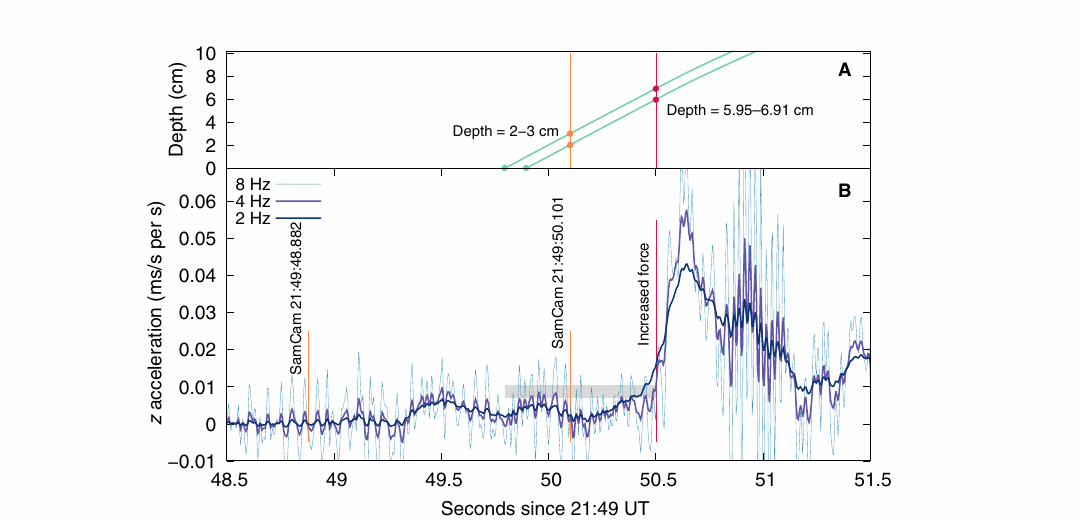
Section titled “Measured bearing strength of the near subsurface”The OSIRIS-REx contact with Bennu on 20 October 2020 is the only direct measurement of near-subsurface geotechnical properties on a rubble pile: contact was at 10 cm/s with a 32 cm diameter annular head, the arm spring took no compression, and the spacecraft inertial measurement unit sampled acceleration at 200 Hz through a rigid load path [3].
| Quantity | Measured value | Source |
|---|---|---|
| Contact velocity | 10 cm/s | [3] |
| Peak acceleration | 0.014 m/s2 | [3] |
| Peak contact force before gas release | 10 to 15 N | [3] |
| Penetration at 1.2 s after contact | 2 to 3 cm | [3] |
| Penetration at end of pre-gas interval | 5.95 to 6.91 cm in 0.605 to 0.705 s | [3] |
| Head tilt taken up by a 5 cm rock | about 7 deg | [3] |
| Disturbed surface area | 0.51 m2 against a 0.08 m2 footprint | [3] |
| Inferred bulk density, upper 6 to 7 cm | 440 to 600 kg/m3 | [3] |
| Inferred packing fraction | 0.2 to 0.45 | [3] |
| Inferred compressive strength | 2 to 200 Pa | [3] |
| Inferred bulk cohesion | 0.2 to 20 Pa | [3] |
The measured near-subsurface density is 37 to 50 percent below the bulk density of the asteroid, and the packing fraction is about half the random close packing that a gravity-dominated deposit would reach [3]. Cohesion at the sampling site is orders of magnitude below the value of up to 4000 Pa measured on the Moon. Independent limits agree: the excavated region produced by the gas release requires material below 1 Pa, the Bralgah crater ejecta blanket implies effective strength at or below 2 Pa, and the Hayabusa2 impact experiment on Ryugu gave an effective surface strength below 1.3 Pa [3].
Source: [3], CC BY 4.0.
The transition is set by packing fraction rather than by cohesion alone. For weakly cohesive regolith below about 10 Pa, a packing fraction at or below 0.5 keeps contact force under about 60 N and makes the response drag dominated, while a packing fraction at or above 0.6 pushes force above 60 N for friction angle at or above 20 deg and stops penetration within the first few centimeters for friction angle at or above 30 deg [3]. The same threshold appears in the fitted force law: closely packed regolith resists intrusion once friction angle reaches 28 deg or cohesion reaches 50 Pa, whereas in loose packing the depth is set by an inertial term [4].
The intrusion force law fitted to the touchdown separates a quasi-static and an inertial term, F_pressure = 80 mu rho a^2 g |z| with mu = tan(phi), and F_drag = 3.2 rho a^2 U^2 [4]. For a design case of a 1 m boulder striking cohesionless regolith of 2.2 g/cm3 at friction angle 40 deg and packing fraction 0.5, arriving at 20 cm/s, the predicted burial depth is 0.15 m. Cratering strength at the Bennu surface is below 100 Pa, and the Ryugu subsurface below 1 m depth is about 100 Pa.
Anchoring and reaction budgets follow directly. A 10 to 15 N contact force produced a 0.014 m/s2 acceleration on the spacecraft [3]; any tool that must react more than a few newtons against such a surface either drives itself off the body or plunges through the loose upper layer.
Low-gravity impact, penetration and ejecta
Section titled “Low-gravity impact, penetration and ejecta”Parabolic flight and suborbital campaigns bracket the regime. The PRIME experiment covered impact speeds of 4 to 230 cm/s and COLLIDE covered 1 to 120 cm/s, into targets of 75 to 250 micrometer grains [7].
| Condition | Result | Source |
|---|---|---|
| About 1e-2 g | Ejecta only above 20 cm/s impact speed, otherwise the projectile embeds | [7] |
| Below 1e-4 g | Ejecta above 10 cm/s, and the projectile can rebound | [7] |
| Coefficient of restitution, 1e-2 g | 0.43 +/- 0.14 | [7] |
| Coefficient of restitution, below 1e-4 g | 0.15 +/- 0.04 | [7] |
| Quartz sand / JSC-1 restitution | 0.38 +/- 0.15 / 0.45 +/- 0.16 | [7] |
| Restitution across 5 to 100 cm/s | Falls by about a factor of 10 | [7] |
| Ejecta velocity scaling | Impact energy to the power 0.50 | [7] |
Restitution of the Itokawa surface inferred from the Hayabusa landing was 0.84 [1], an order of magnitude above the microgravity laboratory value, which is the measure of how far a competent boulder field departs from a granular bed.
Penetrometry under parabolic flight covers the quasi-static end of the same problem. Penetration velocities of 3 to 35 mm/s over about 22 s of microgravity per parabola gave 42 mm of penetration at 3 mm/s, at Froude numbers of 0.18 to 1.8 [9]. Flat tips produce the largest reaction force, above conical and hemispherical tips, and cohesive targets give reaction forces of nearly the same magnitude as their 1 g counterparts, which means low gravity does not relieve the tool loads when the material is cohesive. Drop towers give shorter windows: 1.8 m of fall yields 0.49 s at 0.16 g and 0.48 s at 0.14 g, and a 0.9 m tower yields 0.28 s of microgravity [8].
Sampler simulation reproduces the same sensitivity. Smoothed particle hydrodynamics models of a brush sampler used bulk modulus 3.33 MPa, shear modulus 370 kPa, bulk density 1.5 g/cm3, internal friction angles of 20, 42 and 60 deg and cohesion of 0, 0.5 and 1 kPa, run at both 9.81 m/s2 and the Phobos value of 5.7e-3 m/s2 with motor speeds of 100 to 500 rpm [10]. Discrete element sampling simulations at 10 cm/s contact into regolith of 1600 kg/m3 bulk density, 36 percent porosity and 0.8 to 1.2 cm grains showed collected mass falling sharply between strengths of 50, 150 and 300 Pa [2].
Self-generated particle environment
Section titled “Self-generated particle environment”Bennu ejects particles from its own surface without external cause. Ejection speeds run from 0.05 to more than 3 m/s at ejection energies of 8 to 270 mJ [6]. The 6 January 2019 event yielded 124 photometrically measured particles from under 1 cm to 8 cm in size, and the 19 January event gave speeds of 0.06 to 1.3 m/s. Surface-relative ejection speeds cluster at 10 to 25 cm/s, and particles that fail to escape enter temporary orbits at 15 to 20 cm/s. A vehicle operating close to such a body is inside a sparse population of centimeter debris moving at speeds comparable to its own approach velocity.
Thermal environment
Section titled “Thermal environment”Thermal inertia is the governing surface thermal parameter and is low.
| Surface | Thermal inertia (J/m2/K/s^0.5) | Source |
|---|---|---|
| Bennu, pre-launch disk average | 310 +/- 70 | [5] |
| Bennu, global average on arrival | 350 +/- 20 | [5], [19] |
| Bennu, variation over a full rotation | below 10 | [19] |
| Bedrock reference value | 1500 | [19] |
| Ryugu, global average | 225 +/- 45 | [11] |
| Ryugu, thermal infrared imager estimate | 200 +/- 7 | [11] |
| MASCOT landing site, regional average | 181 +/- 102 | [11] |
| MASCOT landing site, individual rock | 180 (+65 / -40) | [11] |
Thermal inertia does not predict particle size on this surface. The simplified models that translate thermal inertia into a characteristic particle size, assuming particles smaller than the diurnal skin depth give a lower value than bedrock at 1500 J/m2/K/s^0.5, predict a Bennu surface dominated by 0.5 to 5 cm particles [19]. The surface is instead dominated by boulders above 1 m, with about 200 boulders larger than 10 m and the largest exceeding 30 m, distributed evenly enough that thermal inertia varies by under 10 J/m2/K/s^0.5 across a rotation. Bennu’s geometric albedo is 4.4 +/- 0.2 percent at 550 nm [19]. Candidate reconciliations are low boulder thermal inertia, dust coating the boulders, a mixture of particulate regolith and boulders, or high boulder porosity. Micrometer-scale particles are present despite the expectation that small airless bodies carry coarser regolith.
A thin dust layer decouples the observed thermal signature from the substrate. A layer of 10 to 100 micrometer thickness with a thermal inertia of 25 J/m2/K/s^0.5 changes the apparent thermal inertia of the surface by more than 20 percent, and on Ryugu the diurnal skin depth masked by such a layer is about 10 mm [12]. A worked case gives a sand-like layer of 58 mm at 216 J/m2/K/s^0.5 over a substrate at 700 J/m2/K/s^0.5. The thermal conductivity of a Ryugu boulder is about 0.1 W/m/K, which is an insulator: heat rejected into the surface by a landed vehicle does not conduct away [12].
Comet nuclei swing much harder. Diurnal temperature change on 67P at perihelion reaches about 230 K, with variations of order 100 K away from perihelion [13]. Seasonal thermal stress reaches tens of MPa and penetrates about 0.25 m, which is enough to fracture the near-surface layer when thermal inertia is at or above 50 J/m2/K/s^0.5. Published strengths for the hard layer are a 10 to 50 cm thickness, Young modulus at or above 7 MPa with an upper limit of 980 MPa, and compressive strength anywhere from 70 kPa to 9 MPa [13]. The lower layer is far weaker, with tensile strength from hundreds of kPa down to about 1 kPa [13]. An anchoring design has to hold in either.
The same forcing acts at grain scale on asteroids. Modeled microstructures on airless surfaces reach peak tensile stresses of order 100 MPa, controlled by the coefficient of thermal expansion and Young modulus of the constituent minerals and amplified at grain boundaries [14]. Thermal fatigue is therefore a regolith production mechanism and a reason to expect fresh fracture surfaces rather than rounded clasts.
Evidence by body and by method
Section titled “Evidence by body and by method”Five families of evidence constrain the surface, and they differ in what has flown. Remote thermophysical inference (thermal inertia, radar, photometry) has been applied to every body discussed here. Contact dynamics from a spacecraft or lander touching down (OSIRIS-REx at Bennu [3], Philae at 67P [20]) have flown and give the only direct strength numbers. Deliberate impact (the Hayabusa2 Small Carry-on Impactor at Ryugu) and boulder-track geometry (Didymos) give strength from crater and track size. Laboratory and drop-tower work, numerical discrete element and smoothed particle models, and simulant development are ground-based and extrapolate to the regime. Phobos has no in-situ measurement, so its numbers below are reference models.
Comet 67P (Philae, flown 2014). Treating Philae as an impact probe, energy balance over three of its four surface contacts gives compressive strength from 8 +/- 7 Pa in the lander’s scratch marks to 399 +/- 393 Pa at the collision, with an upper limit near 800 Pa [20]. The second touchdown site was a crevice between boulders, where the lander stamped a 0.246 +/- 0.049 m deep impression into ice, bounding the compressive strength of that ice below 12 Pa and the boulder interior porosity at 75 +/- 7 percent [21]. A discrete element inversion of the first touchdown at Agilkia fits a 0.272 +/- 0.062 m regolith layer of 1143 +/- 231 kg/m3 at an assumed porosity of 0.75 [26]. These values sit three orders of magnitude below the multi-megapascal strength the penetrometer met at one location [13], which is the contradiction the sintered-layer model addresses [13]. The mission architecture of comet encounters before and after Rosetta is reviewed in [34].
Ryugu (Hayabusa2 and MASCOT, flown 2018 to 2019). MASCOT’s radiometer measured a thermal inertia of 282 (+93/-35) J/m2/K/s^0.5 on one boulder with a field of view of about 10 cm, a temperature range of 205 K to 302 K, a porosity of 28 to 55 percent and a tensile strength of 200 to 280 kPa, an order of magnitude below meteorite samples [22]. Successive reanalyses settle on a porosity of 0.50 +/- 0.02 and a grain density of 2848 +/- 152 kg/m3, and the lander found no fine particles at its landing site [29]. The Small Carry-on Impactor made a 14.5 m crater; smoothed particle hydrodynamics reproduces it at a cohesion near 0.05 Pa with an upper bound of 0.5 Pa, and the observations cannot separate 0.0 Pa from 0.2 Pa [25]. The MINERVA-II hopping rovers (1.15 kg, 18 cm by 7 cm) were deployed on 21 September 2018 and hopped autonomously; Rover 1A returned 609 images over 113 asteroid days [30]. Hop speed was predicted near 10 cm/s against an escape velocity of about 35 cm/s, and hop distance was never measured [30]. The pre-landing MASCOT bounce simulations ran 270 and over 480 cases at an assumed surface gravity of 2.5e-4 m/s2 and 19 cm/s impact speed, using assumed regolith properties [27], [28].
Bennu regolith production. Thermal emission spectra of 97 usable footprints of about 40 m show that fitted rock thermal inertia correlates with the fraction of fine regolith (Spearman R = 0.56 +/- 0.06) [24]. The authors read this as fine regolith being scarce where rock is porous, because impact energy goes to pore collapse and thermal fatigue is slower at 40 percent porosity than at 20 percent [24].
Didymos (DART imagery). Nine suspected boulder tracks averaging 8.9 +/- 1.5 m wide and 51.6 +/- 13.3 m long give a mean bearing capacity of 70 N/m2, a mode of 17 N/m2 and a 95 percent interval of 7 to 190 N/m2 [23]. Cohesion dominates the result, followed by friction angle, while surface gravity and density barely matter [23].
Phobos (no in-situ data yet). The reference model for the Martian Moons eXploration landing and rover adopts a surface bulk density of 1600 +/- 300 kg/m3, friction angle of 30 to 50 deg, cohesion of 50 to 700 N/m2, particle compressive strength of 1 to 50 MPa, macroscopic porosity of 40 to 70 percent, and a three-layer structure [31]. Two mineralogical simulants, PCA-1 and PGI-1, have a mean grain size of 30 to 40 micrometers, finer than the roughly 1.1 mm inferred from thermal inertia [32]. The IDEFIX rover stereo camera pair is specified for about 1 mm terrain sampling over the first meter and has been calibrated on the ground only [33].
Individual grain stiffness
Section titled “Individual grain stiffness”Nanoindentation of returned Itokawa grains gives reduced Young modulus of 83.0 +/- 0.1 and 86.0 +/- 0.04 GPa on one 131 micrometer particle at 5 and 10 mN load, and 111.0 +/- 0.2 and 101.0 +/- 0.05 GPa on a 149 micrometer particle [15]. Individual grains are therefore competent silicate; the weakness of a small-body surface is entirely in the packing, not in the material.
Surface roughness and site selection
Section titled “Surface roughness and site selection”Bennu and Ryugu both proved rougher on arrival than the pre-encounter models used for design. Bennu’s disk-averaged thermal inertia measured before launch, 310 +/- 70, was consistent with the 350 +/- 20 found on arrival [5], yet the surface carried no smooth deposit at the scale the sampler had been sized for. Sampleability had to be re-derived in flight from particle size-frequency distributions and rock tilt efficiency mapped facet by facet across candidate regions of interest. Bennu, unlike Eros and Itokawa, has no extensive ponded fine deposits, and spectral and thermal data indicate minimal dust coverage at the surface [3].
Radiation
Section titled “Radiation”Small bodies have no magnetic field and no atmosphere. A vehicle on the surface sees the unattenuated interplanetary galactic cosmic ray and solar energetic particle environment over the sky not occluded by the body, with the body itself providing the only shielding mass. The design environment is the Badhwar-O’Neill galactic cosmic ray model, whose 2014 revision derives the solar modulation parameter from time-delayed sunspot number and improves the fit to measured ion spectra below 4 GeV/n over the 2011 version [18]. No measured surface radiation dataset from an asteroid or comet nucleus has been published; the environment is taken from interplanetary models rather than from in-situ measurement.
Simulants and ground test
Section titled “Simulants and ground test”Asteroid simulant fidelity is assessed against a figure of merit rather than against a single property, because a simulant that matches bulk density can still fail on grain shape, strength and porosity [16]. Fine simulant measured at ambient pressure gives a Young modulus of 0.258 MPa and a shear yield stress of 3499 Pa [8]. Reduced-gravity mechanical testing is limited by the available free-fall window, which caps the achievable strain rate and the number of parameter points in a campaign [8], [9].
What is not established
Section titled “What is not established”Strength and density come from a small number of contacts: one touchdown at Bennu, a few Philae contacts, one boulder on Ryugu, one crater [3], [20], [22], [25]. Most Philae and Didymos values are upper limits or wide distributions, and the Didymos tracks are unconfirmed pending Hera imagery [20], [23]. Force-law and bounce simulations are validated only in terrestrial gravity or not at all in the loose, microgravity regime [4], [26], [27], [28]. The Bennu result that thermal inertia does not predict particle size [19] and the porosity inference from rock thermal inertia [24] both rest on assumed conductivity relations. Reduced-gravity instruments report method, not data [8]. Phobos surface mechanics are expert estimates spanning one to two orders of magnitude [31]. No in-situ radiation measurement exists at a small body surface [18].
References
- Scheeres, D. J., Hartzell, C. M., Sánchez, P. and Swift, M. (2010). Scaling forces to asteroid surfaces: The role of cohesion
. Icarus. Source
BibTeX
@article{scheeres2010scaling, title = {Scaling forces to asteroid surfaces: The role of cohesion}, author = {Scheeres, Daniel J. and Hartzell, C. M. and Sánchez, Paul and Swift, M.}, journal = {Icarus}, volume = {210}, pages = {968--984}, year = {2010}, doi = {10.1016/j.icarus.2010.07.009} } - Scheeres, D. J. and Sánchez, P. (2018). Implications of cohesive strength in asteroid interiors and surfaces and its measurement
. Progress in Earth and Planetary Science, 25. Source
BibTeX
@article{scheeres2018implications, title = {Implications of cohesive strength in asteroid interiors and surfaces and its measurement}, author = {Scheeres, Daniel J. and Sánchez, Paul}, journal = {Progress in Earth and Planetary Science}, volume = {5}, number = {25}, year = {2018}, doi = {10.1186/s40645-018-0182-9}, abstract = {Recent observations and theory have indicated that rubble pile asteroids may have a small, but finite, level of tensile strength, allowing them to spin above their spin deformation limit as defined in Holsapple (Icarus 205:430–442, 2010). In Sánchez and Scheeres (Meteorit Planet Sci 49:788–811, 2014), a theory for how such strength could be present in rubble pile asteroids was presented, relying on weak van der Waals forces between fine particulate material in asteroid regolith and in their interiors. The implications of this theory are evaluated and related to the surface strength of regolith and global strength of a rubble pile body. Proposed techniques to measure the strength of regolith using cratering theory are reviewed, as are constraints placed on the global strength of rubble pile asteroids from astronomical observations. Specific examples applied to the Hayabusa2 cratering experiment at its target asteroid are given.} } - Walsh, K. J., Ballouz, R.-L., Jawin, E. R., Avdellidou, C., Barnouin, O. S., Bennett, C. A., Bierhaus, E. B., Bos, B. J., Cambioni, S., Connolly, J. H. C., Delbo, M., DellaGiustina, D. N., DeMartini, J., Emery, J. P., Golish, D. R., Haas, P. C., Hergenrother, C. W., Ma, H., Michel, P., Nolan, M. C., Olds, R., Rozitis, B., Richardson, D. C., Rizk, B., Ryan, A. J., Sánchez, P., Scheeres, D. J., Schwartz, S. R., Selznick, S. H., Zhang, Y. and Lauretta, D. S. (2022). Near-zero cohesion and loose packing of Bennu's near subsurface revealed by spacecraft contact
. Science Advances, 27. Source
BibTeX
@article{walsh2022near, title = {Near-zero cohesion and loose packing of Bennu's near subsurface revealed by spacecraft contact}, author = {Walsh, Kevin J. and Ballouz, Ronald-Louis and Jawin, Erica R. and Avdellidou, Chrysa and Barnouin, Olivier S. and Bennett, Carina A. and Bierhaus, Edward B. and Bos, Brent J. and Cambioni, Saverio and Connolly, Jr., Harold C. and Delbo, Marco and DellaGiustina, Daniella N. and DeMartini, Joseph and Emery, Joshua P. and Golish, Dathon R. and Haas, Patrick C. and Hergenrother, Carl W. and Ma, Huikang and Michel, Patrick and Nolan, Michael C. and Olds, Ryan and Rozitis, Benjamin and Richardson, Derek C. and Rizk, Bashar and Ryan, Andrew J. and Sánchez, Paul and Scheeres, Daniel J. and Schwartz, Stephen R. and Selznick, Sanford H. and Zhang, Yun and Lauretta, Dante S.}, journal = {Science Advances}, volume = {8}, number = {27}, pages = {eabm6229}, year = {2022}, doi = {10.1126/sciadv.abm6229}, abstract = {When the OSIRIS-REx spacecraft pressed its sample collection mechanism into the surface of Bennu, it provided a direct test of the poorly understood near-subsurface physical properties of rubble-pile asteroids, which consist of rock fragments at rest in microgravity. Here, we find that the forces measured by the spacecraft are best modeled as a granular bed with near-zero cohesion that is half as dense as the bulk asteroid. The low gravity of a small rubble-pile asteroid such as Bennu effectively weakens its near subsurface by not compressing the upper layers, thereby minimizing the influence of interparticle cohesion on surface geology. The underdensity and weak near subsurface should be global properties of Bennu and not localized to the contact point.} } - Ballouz, R.-L., Walsh, K. J., Sánchez, P., Holsapple, K., Michel, P., Scheeres, D. J., Zhang, Y., Richardson, D. C., Barnouin, O. S., Nolan, M. C., Bierhaus, E. B., Connolly, J. H., Schwartz, S. R., Çelik, O., Baba, M. and Lauretta, D. S. (2021). Modified granular impact force laws for the OSIRIS-REx touchdown on the surface of asteroid (101955) Bennu
. Monthly Notices of the Royal Astronomical Society. Source
BibTeX
@article{ballouz2021modified, title = {Modified granular impact force laws for the OSIRIS-REx touchdown on the surface of asteroid (101955) Bennu}, author = {Ballouz, Ronald-Louis and Walsh, Kevin J. and Sánchez, P. and Holsapple, K.A. and Michel, Patrick and Scheeres, Daniel J. and Zhang, Y. and Richardson, Derek C. and Barnouin, Olivier S. and Nolan, Michael C. and Bierhaus, Edward B. and Connolly, Jr., H.C. and Schwartz, Stephen R. and Çelik, O. and Baba, M. and Lauretta, Dante S.}, journal = {Monthly Notices of the Royal Astronomical Society}, volume = {507}, pages = {5087--5105}, year = {2021}, doi = {10.1002/essoar.10507246.1}, abstract = {ABSTRACT The OSIRIS-REx mission collected a sample from the surface of the asteroid (101955) Bennu in 2020 October. Here, we study the impact of the OSIRIS-REx Touch-and-Go Sampling Acquisition Mechanism (TAGSAM) interacting with the surface of an asteroid in the framework of granular physics. Traditional approaches to estimating the penetration depth of a projectile into a granular medium include force laws and scaling relationships formulated from laboratory experiments in terrestrial-gravity conditions. However, it is unclear that these formulations extend to the OSIRIS-REx scenario of a 1300-kg spacecraft interacting with regolith in a microgravity environment. We studied the TAGSAM interaction with Bennu through numerical simulations using two collisional codes, pkdgrav and gdc-i. We validated their accuracy by reproducing the results of laboratory impact experiments in terrestrial gravity. We then performed TAGSAM penetration simulations varying the following geotechnical properties of the regolith: packing fraction (P), bulk density, inter-particle cohesion (σc), and angle of friction (ϕ). We find that the outcome of a spacecraft-regolith impact has a non-linear dependence on packing fraction. Closely packed regolith (P ≳ 0.6) can effectively resist the penetration of TAGSAM if ϕ ≳ 28° and/or σc ≳ 50 Pa. For loosely packed regolith (P ≲ 0.5), the penetration depth is governed by a drag force that scales with impact velocity to the 4/3 power, consistent with energy conservation. We discuss the importance of low-speed impact studies for predicting and interpreting spacecraft–surface interactions. We show that these low-energy events also provide a framework for interpreting the burial depths of large boulders in asteroidal regolith.} } - Walsh, K. J., Bierhaus, E. B., Lauretta, D. S., Nolan, M. C., Ballouz, R.-L., Bennett, C. A., Jawin, E. R., Barnouin, O. S., Berry, K., Burke, K. N., Brodbeck, B., Burns, R., Clark, B. C., Clark, B. E., Cambioni, S., Connolly, J. H. C., Daly, M. G., Delbo, M., DellaGiustina, D. N., Dworkin, J. P., Enos, H. L., Emery, J. P., Gay, P., Golish, D. R., Hamilton, V. E., Hoover, R., Lujan, M., McCoy, T., Mink, R. G., Moreau, M. C., Nolau, J., Padilla, J., Pajola, M., Polit, A. T., Robbins, S. J., Ryan, A. J., Selznick, S. H., Stewart, S. and Wolner, C. W. (2022). Assessing the Sampleability of Bennu's Surface for the OSIRIS-REx Asteroid Sample Return Mission
. Space Science Reviews, 20. Source
BibTeX
@article{walsh2022assessing, title = {Assessing the Sampleability of Bennu's Surface for the OSIRIS-REx Asteroid Sample Return Mission}, author = {Walsh, Kevin J. and Bierhaus, Edward B. and Lauretta, Dante S. and Nolan, Michael C. and Ballouz, Ronald-Louis and Bennett, Carina A. and Jawin, Erica R. and Barnouin, Olivier S. and Berry, Kevin and Burke, Keara N. and Brodbeck, Bella and Burns, Rich and Clark, Benton C. and Clark, Beth E. and Cambioni, Saverio and Connolly, Jr., Harold C. and Daly, Michael G. and Delbo, Marco and DellaGiustina, Daniella N. and Dworkin, Jason P. and Enos, Heather L. and Emery, Josh P. and Gay, Pamela and Golish, Dathon R. and Hamilton, Victoria E. and Hoover, Rachel and Lujan, Michael and McCoy, Timothy and Mink, Ronald G. and Moreau, Michael C. and Nolau, Jennifer and Padilla, Jacob and Pajola, Maurizio and Polit, Anjani T. and Robbins, Stuart J. and Ryan, Andrew J. and Selznick, Sanford H. and Stewart, Stephanie and Wolner, Catherine W.V.}, journal = {Space Science Reviews}, volume = {218}, number = {20}, pages = {20--20}, year = {2022}, doi = {10.1007/s11214-022-00887-2}, abstract = {Abstract NASA’s first asteroid sample return mission, OSIRIS-REx, collected a sample from the surface of near-Earth asteroid Bennu in October 2020 and will deliver it to Earth in September 2023. Selecting a sample collection site on Bennu’s surface was challenging due to the surprising lack of large ponded deposits of regolith particles exclusively fine enough ( $\leq2~\text{cm}$ ≤ 2 cm diameter) to be ingested by the spacecraft’s Touch-and-Go Sample Acquisition Mechanism (TAGSAM). Here we describe the Sampleability Map of Bennu, which was constructed to aid in the selection of candidate sampling sites and to estimate the probability of collecting sufficient sample. “Sampleability” is a numeric score that expresses the compatibility of a given area’s surface properties with the sampling mechanism. The algorithm that determines sampleability is a best fit functional form to an extensive suite of laboratory testing outcomes tracking the TAGSAM performance as a function of four observable properties of the target asteroid. The algorithm and testing were designed to measure and subsequently predict TAGSAM collection amounts as a function of the minimum particle size, maximum particle size, particle size frequency distribution, and the tilt of the TAGSAM head off the surface. The sampleability algorithm operated at two general scales, consistent with the resolution and coverage of data collected during the mission. The first scale was global and evaluated nearly the full surface. Due to Bennu’s unexpected boulder coverage and lack of ponded regolith deposits, the global sampleability efforts relied heavily on additional strategies to find and characterize regions of interest based on quantifying and avoiding areas heavily covered by material too large to be collected. The second scale was site-specific and used higher-resolution data to predict collected mass at a given contact location. The rigorous sampleability assessments gave the mission confidence to select the best possible sample collection site and directly enabled successful collection of hundreds of grams of material.} } - Lauretta, D. S., Hergenrother, C. W., Chesley, S. R., Leonard, J. M., Pelgrift, J. Y., Adam, C. D., Al Asad, M., Antreasian, P. G., Ballouz, R.-L., Becker, K. J., Bennett, C. A., Bos, B. J., Bottke, W. F., Brozović, M., Campins, H., Connolly, J. H. C., Daly, M. G., Davis, A. B., de León, J., DellaGiustina, D. N., Drouet d'Aubigny, C. Y., Dworkin, J. P., Emery, J. P., Farnocchia, D., Glavin, D. P., Golish, D. R., Hartzell, C. M., Jacobson, R. A., Jawin, E. R., Jenniskens, P., Kidd, J. J. N., Lessac-Chenen, E. J., Li, J.-Y., Libourel, G., Licandro, J., Liounis, A. J., Maleszewski, C. K., Manzoni, C., May, B., McCarthy, L. K., McMahon, J. W., Michel, P., Molaro, J. L., Moreau, M. C., Nelson, D. S., Owen, J. W. M., Rizk, B., Roper, H. L., Rozitis, B., Sahr, E. M., Scheeres, D. J., Seabrook, J. A., Selznick, S. H., Takahashi, Y., Thuillet, F., Tricarico, P., Vokrouhlický, D. and Wolner, C. W. (2019). Episodes of particle ejection from the surface of the active asteroid (101955) Bennu
. Science, eaay3544. Source
BibTeX
@article{lauretta2019episodes, title = {Episodes of particle ejection from the surface of the active asteroid (101955) Bennu}, author = {Lauretta, Dante S. and Hergenrother, Carl W. and Chesley, Steven R. and Leonard, Jason M. and Pelgrift, John Y. and Adam, Coralie D. and Al Asad, M. and Antreasian, Peter G. and Ballouz, Ronald-Louis and Becker, Kris J. and Bennett, Carina A. and Bos, Brent J. and Bottke, W. F. and Brozović, M. and Campins, H. and Connolly, Jr., H. C. and Daly, Michael G. and Davis, A. B. and de León, J. and DellaGiustina, Daniella N. and Drouet d'Aubigny, C. Y. and Dworkin, Jason P. and Emery, J. P. and Farnocchia, Davide and Glavin, Daniel P. and Golish, Dathon R. and Hartzell, C. M. and Jacobson, R. A. and Jawin, Erica R. and Jenniskens, P. and Kidd, Jr., J. N. and Lessac-Chenen, E. J. and Li, J.-Y. and Libourel, Guy and Licandro, J. and Liounis, Andrew J. and Maleszewski, C. K. and Manzoni, C. and May, B. and McCarthy, L. K. and McMahon, J. W. and Michel, Patrick and Molaro, J. L. and Moreau, Michael C. and Nelson, Derek S. and Owen, Jr., W. M. and Rizk, Bashar and Roper, Heather L. and Rozitis, Benjamin and Sahr, E. M. and Scheeres, Daniel J. and Seabrook, J. A. and Selznick, Sanford H. and Takahashi, Y. and Thuillet, Florian and Tricarico, P. and Vokrouhlický, D. and Wolner, Catherine W.V.}, journal = {Science}, volume = {366}, number = {eaay3544}, year = {2019}, doi = {10.1126/science.aay3544}, abstract = {Bennu ejects material from its surface Most asteroids appear inert, but remote observations show that a small number experience mass loss from their surfaces. Lauretta and Hergenrother et al. describe close-range observations of mass loss on the near-Earth asteroid Bennu (see the Perspective by Agarwal). Shortly after arriving at Bennu, navigation cameras on the OSIRIS-REx (Origins, Spectral Interpretation, Resource Identification, and Security—Regolith Explorer) spacecraft detected objects 1 to 10 centimeters in diameter moving above the surface. Analysis of the objects' trajectories showed that they originated in discrete ejection events from otherwise unremarkable locations on Bennu. Some objects remained in orbit for several days, whereas others escaped into interplanetary space. The authors suggest multiple plausible mechanisms that could underlie this activity. Science , this issue p. eaay3544 ; see also p. 1192} } - Brisset, J., Colwell, J., Dove, A., Abukhalil, S., Cox, C. and Mohammed, N. (2018). Regolith behavior under asteroid-level gravity conditions: low-velocity impact experiments
. Progress in Earth and Planetary Science, 73. Source
BibTeX
@article{brisset2018regolith, title = {Regolith behavior under asteroid-level gravity conditions: low-velocity impact experiments}, author = {Brisset, Julie and Colwell, Joshua and Dove, Adrienne and Abukhalil, Sumayya and Cox, Christopher and Mohammed, Nadia}, journal = {Progress in Earth and Planetary Science}, volume = {5}, number = {73}, year = {2018}, doi = {10.1186/s40645-018-0222-5}, abstract = {The dusty regolith covering the surfaces of asteroids and planetary satellites differs in size, shape, and composition from terrestrial soil particles and is subject to environmental conditions very different from those found on Earth. This regolith evolves in a low ambient pressure and low-gravity environment. Its response to low-velocity impacts, such as those that may accompany human and robotic exploration activities, may be completely different than what is encountered on Earth. Experimental studies of the response of planetary regolith in the relevant environmental conditions are thus necessary to facilitate future Solar System exploration activities.We combined the results and provided new data analysis elements for a series of impact experiments into simulated planetary regolith in low-gravity conditions using two experimental setups and a range of microgravity platforms. The Physics of Regolith Impacts in Microgravity Experiment (PRIME) flew on several parabolic aircraft flights, enabling the recording of impacts into granular materials at speeds of ∼ 4–230 cm/s. The COLLisions Into Dust Experiment (COLLIDE) is conceptually close to the PRIME setup. It flew on the Space Shuttle in 1998 and 2001 and more recently on the Blue Origin New Shepard rocket, recording impacts into simulated regolith at speeds between 1 and 120 cm/s.Results of these experimental campaigns found that there is a significant change in the regolith behavior with the gravity environment. In a 10 −2g environment (with g being the gravity acceleration at the surface of the Earth), only embedding of the impactor was observed and ejecta production was produced for most impacts at > 20 cm/s. Once at microgravity levels (<10−4g), the lowest impact energies also produced impactor rebound. In these microgravity conditions, ejecta started to be produced for impacts at > 10 cm/s. The measured ejecta speeds were somewhat lower than the ones measured at reduced-gravity levels, but the ejected masses were higher. In general, the mean ejecta velocity shows a power-law dependence on the impact energy with an index of ∼ 0.5. When projectile rebound occurred, we observed that its coefficients of restitution on the bed of regolith simulant decrease by a factor of 10 with increasing impact speeds from ∼ 5 up to 100 cm/s. We could also observe an increased cohesion between the JSC-1 grains compared to the quartz sand targets.} } - Duffey, C., Lea, M. and Brisset, J. (2025). Measuring regolith strength in reduced gravity environments in the laboratory
. Review of Scientific Instruments. Source
BibTeX
@article{duffey2025measuring, title = {Measuring regolith strength in reduced gravity environments in the laboratory}, author = {Duffey, C. and Lea, M. and Brisset, Julie}, journal = {Review of Scientific Instruments}, volume = {96}, year = {2025}, doi = {10.1063/5.0249495}, abstract = {This paper presents the design and development of a Shear and Compression Cell (SCC) for measuring the mechanical properties of granular materials in low-gravity environments. This research is motivated by the increasing interest in planetary exploration missions that involve surface interactions, such as those to asteroids and moons. The SCC is designed to measure key mechanical properties, including Young’s modulus, angle of internal friction, bulk cohesion, and tensile strength, under both reduced gravity and microgravity conditions. Using a drop tower with interchangeable configurations, we can simulate the gravitational environments of celestial bodies such as the Moon and Titan. The SCC, coupled with the drop tower, provides a valuable tool for understanding the behavior of regolith materials and their implications for future space exploration missions.} } - Smyth-Moore, A., Borg, J., Soria-Salinas, Á., Murdoch, N., Kato, H., Miyamoto, H., Usui, T., Kaufmann, E., Granvik, M. and Hagermann, A. (2025). Microgravity penetrometry flight campaign in support of MMX sampler science exploitation
. Progress in Earth and Planetary Science, 38. Source
BibTeX
@article{smythmoore2025microgravity, title = {Microgravity penetrometry flight campaign in support of MMX sampler science exploitation}, author = {Smyth-Moore, Alexander and Borg, Johan and Soria-Salinas, Álvaro and Murdoch, Naomi and Kato, Hiroki and Miyamoto, Hideaki and Usui, Tomohiro and Kaufmann, Erika and Granvik, Mikael and Hagermann, Axel}, journal = {Progress in Earth and Planetary Science}, volume = {12}, number = {38}, year = {2025}, doi = {10.1186/s40645-025-00704-8}, abstract = {Abstract Characterising the mechanical properties of minor bodies is essential for understanding their origin and evolution. Past missions such as Hayabusa2 have landed on asteroids to sample and discover what these bodies are made of. However, there has been conflicting evidence and reports into the physical properties of the granular surface material of these bodies. With future missions such as Japan Aerospace eXploration Agency’s Martian Moons eXploration mission landing on Phobos, the understanding and identification of these physical properties is crucial to maximising the scientific output from these missions. Penetrometry, the determination of the reaction force that an object experiences as it penetrates a surface, can help to understand the essential properties of regolith, such as grain size, porosity and cohesion. Results of penetrometry experiments are largely analysed based on empirical models, which presents us with a challenge if we want to apply them to understand granular materials on asteroid surfaces because gravity cannot be eliminated in the laboratory. Hence, it is essential to verify penetrometry as a method and validate penetrometry instrument designs in microgravity. For this purpose, we conducted a microgravity experiment onboard a parabolic flight campaign. Our experiment tested the use of penetrometry in asteroid-analogue environments by investigating samples with varying properties, such as grain size distribution and shape, and then compared to 1 g experiments to understand the role microgravity plays. The experiment provided a substantial database for future analysis. This paper will focus on the design of the experiment and the parabolic flight campaign in which the experiments were conducted. The design decisions and the variables adjusted during the experiment will be discussed, evaluating how these influenced the campaign and its outcomes. We will also provide a snapshot of preliminary results of the data captured during this experiment. For example, we show the effect of cohesion on penetrometer reaction force, with more cohesive materials providing larger reaction forces nearly of the same magnitude of their 1 g counterparts. We also show that penetrometer tip shapes provide different reaction forces and that flat tips provide the largest reaction force compared to the others. The influence of penetration velocity will be investigated further with the aid of theoretical models. Early indications from the results seen so far are promising for future analyses and will provide key information for the analysis of penetrometry data on future missions.} } - Schäfer, C. M., Scherrer, S., Buchwald, R., Maindl, T. I., Speith, R. and Kley, W. (2017). Numerical simulations of regolith sampling processes
. Planetary and Space Science. Source
BibTeX
@article{schafer2017numerical, title = {Numerical simulations of regolith sampling processes}, author = {Schäfer, Christoph M. and Scherrer, Samuel and Buchwald, Robert and Maindl, Thomas I. and Speith, Roland and Kley, Wilhelm}, journal = {Planetary and Space Science}, volume = {141}, pages = {35--44}, year = {2017}, doi = {10.1016/j.pss.2017.04.015} } - Schröder, S., Sakatani, N., Honda, R., Tatsumi, E., Yokota, Y., Domingue, D., Cho, Y., Kameda, S., Kitazato, K., Kouyama, T., Matsuoka, M., Miura, A., Morota, T., Okada, T., Sawada, H., Senshu, H., Shimaki, Y., Sugita, S., Tanaka, S., Yabuta, H., Yamada, M., Grott, M., Hamm, M., Ho, T.-M., Jaumann, R., Mottola, S., Otto, K., Schmitz, N. and Scholten, F. (2022). Characterization of the MASCOT landing area by Hayabusa2
. Astronomy & Astrophysics. Source
BibTeX
@article{schroder2022characterization, title = {Characterization of the MASCOT landing area by Hayabusa2}, author = {Schröder, Stefan and Sakatani, Naoya and Honda, Rie and Tatsumi, Eri and Yokota, Yasuhiro and Domingue, Deborah and Cho, Yuichiro and Kameda, Shingo and Kitazato, Kohei and Kouyama, Toru and Matsuoka, Moe and Miura, Akira and Morota, Tomokatsu and Okada, Tatsuaki and Sawada, Hirotaka and Senshu, Hiroki and Shimaki, Yuri and Sugita, Seiji and Tanaka, Satoshi and Yabuta, Hikaru and Yamada, Manabu and Grott, Matthias and Hamm, Maximilian and Ho, Tra-Mi and Jaumann, Ralf and Mottola, Stefano and Otto, Katharina and Schmitz, Nicole and Scholten, Frank}, journal = {Astronomy & Astrophysics}, volume = {666}, pages = {A164}, year = {2022}, doi = {10.1051/0004-6361/202244059}, abstract = {Context. After landing on C-type asteroid Ryugu, MASCOT imaged brightly colored, submillimeter-sized inclusions in a small rock. Hayabusa2 successfully returned a sample of small particles from the surface of Ryugu, but none of these appear to harbor such inclusions. The samples are considered representative of Ryugu. Aims. To understand the apparent discrepancy between MASCOT observations and Ryugu samples, we assess whether the MASCOT landing site, and the rock by implication, is perhaps atypical for Ryugu. Methods. We analyzed observations of the MASCOT landing area acquired by three instruments on board Hayabusa2: a camera (ONC), a near-infrared spectrometer (NIRS3), and a thermal infrared imager. We compared the landing area properties thus retrieved with those of the average Ryugu surface. Results. We selected several areas and landforms in the landing area for analysis: a small crater, a collection of smooth rocks, and the landing site itself. The crater is relatively blue and the rocks are relatively red. The spectral and thermophysical properties of the landing site are very close to those of the average Ryugu surface. The spectral properties of the MASCOT rock are probably close to average, but its thermal inertia may be somewhat higher. Conclusions. The MASCOT rock can also be considered representative of Ryugu. Some of the submillimeter-sized particles in the returned samples stand out because of their atypical spectral properties. Such particles may be present as inclusions in the MASCOT rock.} } - Biele, J., Kührt, E., Senshu, H., Sakatani, N., Ogawa, K., Hamm, M., Grott, M., Okada, T. and Arai, T. (2019). Effects of dust layers on thermal emission from airless bodies
. Progress in Earth and Planetary Science, 73. Source
BibTeX
@article{biele2019effects, title = {Effects of dust layers on thermal emission from airless bodies}, author = {Biele, Jens and Kührt, Ekkehard and Senshu, Hiroki and Sakatani, Naoya and Ogawa, Kazunori and Hamm, Maximilian and Grott, Matthias and Okada, Tatsuaki and Arai, Takehiko}, journal = {Progress in Earth and Planetary Science}, volume = {6}, number = {73}, pages = {48--48}, year = {2019}, doi = {10.1186/s40645-019-0291-0}, abstract = {We have investigated the influence of thin thermally opaque dust layers on the thermal emission of rocks and regolith and determined the thermal response of these dust-covered surfaces to diurnal insolation cycles. Results are computed for Hayabusa2’s target asteroid (162173) Ryugu, which was observed by thermal infrared instruments on the orbiter and in situ. We show that even a very thin (10..100 μm) fine-grained porous dust layer with thermal inertia of 25 J m−2 K−1 s−1/2 can have a significant influence on surface temperatures and alter the apparent thermal inertia of the underlying material derived under the simplified assumption of a homogenous half space by more than 20%. The masking of the underlying material is complete at about 1 diurnal skin depth, corresponding to ~ 10 mm on Ryugu. Between 0.1 and 1 diurnal skin depths, we find a thermal lag smaller than what would be predicted for a surface consisting of dust only. If a dust cover were present on Ryugu, this should be clearly visible in the data returned by the orbiter’s thermal infrared imager (TIR) and the MASCOT lander’s radiometer (MARA), which observed a single boulder at the landing site. However, this appears not to be the case, and dust seems to play a minor role in the thermal emission from the asteroid.} } - Attree, N., Groussin, O., Jorda, L., Rodionov, S., Auger, A.-T., Thomas, N., Brouet, Y., Poch, O., Kührt, E., Knapmeyer, M., Preusker, F., Scholten, F., Knollenberg, J., Hviid, S. and Hartogh, P. (2018). Thermal fracturing on comets: Applications to 67P/Churyumov-Gerasimenko
. Astronomy & Astrophysics. Source
BibTeX
@article{attree2018thermal, title = {Thermal fracturing on comets: Applications to 67P/Churyumov-Gerasimenko}, author = {Attree, N. and Groussin, Olivier and Jorda, Laurent and Rodionov, S. and Auger, A-T. and Thomas, N. and Brouet, Y. and Poch, O. and Kührt, Ekkehard and Knapmeyer, Martin and Preusker, Frank and Scholten, Frank and Knollenberg, J. and Hviid, Stubbe and Hartogh, Paul}, journal = {Astronomy & Astrophysics}, volume = {610}, pages = {A76}, year = {2018}, doi = {10.1051/0004-6361/201731937}, abstract = {We simulate the stresses induced by temperature changes in a putative hard layer near the surface of comet 67P/Churyumov-Gerasimenko with a thermo-viscoelastic model. Such a layer could be formed by the recondensation or sintering of water ice (and dust grains), as suggested by laboratory experiments and computer simulations, and would explain the high compressive strength encountered by experiments on board the Philae lander. Changes in temperature from seasonal insolation variation penetrate into the comet’s surface to depths controlled by the thermal inertia, causing the material to expand and contract. Modelling this with a Maxwellian viscoelastic response on a spherical nucleus, we show that a hard, icy layer with similar properties to Martian permafrost will experience high stresses: up to tens of MPa, which exceed its material strength (a few MPa), down to depths of centimetres to a metre. The stress distribution with latitude is confirmed qualitatively when taking into account the comet’s complex shape but neglecting thermal inertia. Stress is found to be comparable to the material strength everywhere for sufficient thermal inertia (≳50 J m −2 K −1 s −1∕2 ) and ice content (≳45% at the equator). In this case, stresses penetrate to a typical depth of ~0.25 m, consistent with the detection of metre-scale thermal contraction crack polygons all over the comet. Thermal fracturing may be an important erosion process on cometary surfaces which breaks down material and weakens cliffs.} } - Molaro, J. L., Byrne, S. and Langer, S. A. (2015). Grain-scale thermoelastic stresses and spatiotemporal temperature gradients on airless bodies, implications for rock breakdown
. Journal of Geophysical Research: Planets. Source
BibTeX
@article{molaro2015grain, title = {Grain-scale thermoelastic stresses and spatiotemporal temperature gradients on airless bodies, implications for rock breakdown}, author = {Molaro, J. L. and Byrne, S. and Langer, S. A.}, journal = {Journal of Geophysical Research: Planets}, volume = {120}, pages = {255--277}, year = {2015}, doi = {10.1002/2014je004729}, abstract = {Abstract Thermomechanical processes such as fatigue and shock have been suggested to cause and contribute to rock breakdown on Earth, and on other planetary bodies, particularly airless bodies in the inner solar system. In this study, we modeled grain‐scale stresses induced by diurnal temperature variations on simple microstructures made of pyroxene and plagioclase on various solar system bodies. We found that a heterogeneous microstructure on the Moon experiences peak tensile stresses on the order of 100 MPa. The stresses induced are controlled by the coefficient of thermal expansion and Young's modulus of the mineral constituents, and the average stress within the microstructure is determined by relative volume of each mineral. Amplification of stresses occurs at surface‐parallel boundaries between adjacent mineral grains and at the tips of pore spaces. We also found that microscopic spatial and temporal surface temperature gradients do not correlate with high stresses, making them inappropriate proxies for investigating microcrack propagation. Although these results provide very strong evidence for the significance of thermomechanical processes on airless bodies, more work is needed to quantify crack propagation and rock breakdown rates.} } - Tanbakouei, S., Trigo-Rodríguez, J. M., Sort, J., Michel, P., Blum, J., Nakamura, T. and Williams, I. (2019). Mechanical properties of particles from the surface of asteroid 25143 Itokawa
. Astronomy & Astrophysics. Source
BibTeX
@article{tanbakouei2019mechanical, title = {Mechanical properties of particles from the surface of asteroid 25143 Itokawa}, author = {Tanbakouei, Safoura and Trigo-Rodríguez, Josep M. and Sort, Jordi and Michel, Patrick and Blum, Jürgen and Nakamura, Tomoki and Williams, Iwan}, journal = {Astronomy & Astrophysics}, volume = {629}, pages = {A119}, year = {2019}, doi = {10.1051/0004-6361/201935380}, abstract = {Aims. Asteroids have been exposed to impacts since their formation, and as a consequence their surfaces are covered by small particles, pebbles, and boulders. The Japanese JAXA/ISAS Hayabusa mission collected micron-sized particles from the regolith of asteroid 25143 Itokawa. The study in terrestrial laboratories of these particles provides a scientific opportunity as their physical properties can be compared with those characteristic of chondritic meteorites that are often considered proxies of the building materials of potentially hazardous asteroids (PHAs). Methods. Here we present the results from a study of the mechanical properties of three of these particles using a precise technique called nanoindentation. The derived results are compared with those obtained via a methodology similar to that used for the Chelyabinsk meteorite. Results. The reduced Young’s modulus values obtained for the Itokawa samples are higher than those measured for the Chelyabinsk chondrite, so these specific particles of asteroid regolith are more compacted than the minerals forming the particular LL chondrite associated with PHAs. This might be a natural consequence of particles surviving long exposure times on the surface of a (near-Earth asteroid) NEA. The Double Asteroid Redirection Test (DART) mission plans to excavate a crater in the surface of the (65803) Didymos satellite. Our results suggest that excavating a crater with a kinetic impactor in an area of significant fine-grained regolith will increase the momentum transfer. As this will facilitate the release of particles carrying target mass in the opposite direction to the movement of the projectile, there is no need to grind up the target during the mechanical excavation phase.} } - Metzger, P. T., Britt, D. T., Covey, S., Schultz, C., Cannon, K. M., Grossman, K. D., Mantovani, J. G. and Mueller, R. P. (2019). Measuring the fidelity of asteroid regolith and cobble simulants
. Icarus. Source
BibTeX
@article{metzger2019measuring, title = {Measuring the fidelity of asteroid regolith and cobble simulants}, author = {Metzger, Philip T. and Britt, Daniel T. and Covey, Stephen and Schultz, Cody and Cannon, Kevin M. and Grossman, Kevin D. and Mantovani, James G. and Mueller, Robert P.}, journal = {Icarus}, volume = {321}, pages = {632--646}, year = {2019}, doi = {10.1016/j.icarus.2018.12.019} } - Polishook, D., Moskovitz, N., Thirouin, A., Bosh, A., Levine, S., Zuluaga, C., Tegler, S. J. and Aharonson, O. (2016). A 2 km-size asteroid challenging the rubble-pile spin barrier: A case for cohesion
. Icarus. Source
BibTeX
@article{polishook2016asteroid, title = {A 2 km-size asteroid challenging the rubble-pile spin barrier: A case for cohesion}, author = {Polishook, D. and Moskovitz, N. and Thirouin, A. and Bosh, A. and Levine, S. and Zuluaga, C. and Tegler, S. J. and Aharonson, Oded}, journal = {Icarus}, volume = {267}, pages = {243--254}, year = {2016}, doi = {10.1016/j.icarus.2015.12.031} } - O'Neill, P. M., Golge, S. and Slaba, T. C. (2015). Badhwar-O'Neill 2014 Galactic Cosmic Ray Flux Model Description
. NASA. Source
BibTeX
@techreport{nasa2014implementing, title = {Badhwar-O'Neill 2014 Galactic Cosmic Ray Flux Model Description}, author = {O'Neill, P. M. and Golge, S. and Slaba, T. C.}, institution = {NASA}, year = {2015}, url = {https://ntrs.nasa.gov/citations/20150003026}, abstract = {For the analysis of radiation risks to astronauts and planning exploratory space missions, accurate energy spectrum of galactic cosmic radiation (GCR) is necessary. Characterization of the ionizing radiation environment is challenging because the interplanetary plasma and radiation fields are modulated by solar disturbances and the radiation doses received by astronauts in interplanetary space are likewise influenced. A model of the Badhwar‐O'Neill 2011 (BO11) GCR environment, which is represented by GCR deceleration potential theta, has been derived by utilizing all of the GCR measurements from balloons, satellites, and the newer NASA Advanced Composition Explorer (ACE). In the BO11 model, the solar modulation level is derived from the mean international sunspot numbers with time‐delay, which has been calibrated with actual flight instrument measurements to produce better GCR flux data fit during solar minima. GCR fluxes provided by the BO11 model were compared with various spacecraft measurements at 1 AU, and further comparisons were made for the tissue equivalent proportional counters measurements at low Earth orbits using the high‐charge and energy transport (HZETRN) code and various GCR models. For the comparison of the absorbed dose and dose equivalent calculations with the measurements by Radiation Assessment Detector (RAD) at Gale crater on Mars, the intensities and energies of GCR entering the heliosphere were calculated by using the BO11 model, which accounts for time‐dependent attenuation of the local interstellar spectrum of each element. The BO11 model, which has emphasized for the last 24 solar minima, showed in relatively good agreement with the RAD data for the first 200 sols, but it was resulted in to be less well during near the solar maximum of solar cycle 24 due to subtleties in the changing heliospheric conditions. By performing the error analysis of the BO11 model and the optimization in reducing overall uncertainty, the resultant BO13 model corrects the fit at solar maxima as well as being accurate at solar minima. The BO13 model is implemented to the NASA Space Cancer Risk model for the assessment of radiation risks. Overall cumulative probability distribution of solar modulation parameters represents the percentile rank of the average interplanetary GCR environment, and the probabilistic radiation risks can be assessed for various levels of GCR environment to support mission design and operational planning for future manned space exploration missions.} } - DellaGiustina, D. N., Emery, J. P., Golish, D. R., Rozitis, B., Bennett, C. A., Burke, K. N., Ballouz, R.-L., Becker, K. J., Christensen, P. R., Drouet d'Aubigny, C. Y., Hamilton, V. E., Reuter, D. C., Rizk, B., Simon, A. A., Asphaug, E., Bandfield, J. L., Barnouin, O. S., Barucci, M. A., Bierhaus, E. B., Binzel, R. P., Bottke, W. F., Bowles, N. E., Campins, H., Clark, B. C., Clark, B. E., Connolly, J. H. C., Daly, M. G., de Leon, J., Delbo', M., Deshapriya, J. D. P., Elder, C. M., Fornasier, S., Hergenrother, C. W., Howell, E. S., Jawin, E. R., Kaplan, H. H., Kareta, T. R., Le Corre, L., Li, J.-Y., Licandro, J., Lim, L. F., Michel, P., Molaro, J., Nolan, M. C., Pajola, M., Popescu, M., Rizos Garcia, J. L., Ryan, A. J., Schwartz, S. R., Shultz, N., Siegler, M. A., Smith, P. H., Tatsumi, E., Thomas, C. A., Walsh, K. J., Wolner, C. W., Zou, X.-D., Lauretta, D. S. and The OSIRIS-REx Team. (2019). Properties of rubble-pile asteroid (101955) Bennu from OSIRIS-REx imaging and thermal analysis
. Nature Astronomy. Source
BibTeX
@article{dellagiustina2019properties, title = {Properties of rubble-pile asteroid (101955) Bennu from OSIRIS-REx imaging and thermal analysis}, author = {DellaGiustina, Daniella N. and Emery, J. P. and Golish, Dathon R. and Rozitis, Benjamin and Bennett, Carina A. and Burke, Keara N. and Ballouz, Ronald-Louis and Becker, Kris J. and Christensen, Philip R. and Drouet d'Aubigny, C. Y. and Hamilton, Victoria E. and Reuter, Dennis C. and Rizk, Bashar and Simon, Amy A. and Asphaug, Erik and Bandfield, Joshua L. and Barnouin, Olivier S. and Barucci, M. A. and Bierhaus, Edward B. and Binzel, Richard P. and Bottke, W. F. and Bowles, Neil E. and Campins, H. and Clark, Benton C. and Clark, Beth E. and Connolly, Jr., H. C. and Daly, Michael G. and de Leon, J. and Delbo', M. and Deshapriya, J. D. P. and Elder, Catherine M. and Fornasier, Sonia and Hergenrother, Carl W. and Howell, E. S. and Jawin, Erica R. and Kaplan, Hannah H. and Kareta, T. R. and Le Corre, Lucille and Li, J.-Y. and Licandro, J. and Lim, L. F. and Michel, Patrick and Molaro, Jamie and Nolan, Michael C. and Pajola, Maurizio and Popescu, M. and Rizos Garcia, J. L. and Ryan, Andrew J. and Schwartz, Stephen R. and Shultz, N. and Siegler, Matthew A. and Smith, Peter H. and Tatsumi, Eri and Thomas, C. A. and Walsh, Kevin J. and Wolner, Catherine W.V. and Zou, Xiao-Duan and Lauretta, Dante S. and {The OSIRIS-REx Team}}, journal = {Nature Astronomy}, volume = {3}, pages = {341--351}, year = {2019}, doi = {10.1038/s41550-019-0731-1} } - Heinisch, P., Auster, H.-U., Gundlach, B., Blum, J., Güttler, C., Tubiana, C., Sierks, H., Hilchenbach, M., Biele, J., Richter, I. and Glassmeier, K. H. (2019). Compressive Strength of Comet 67P/Churyumov-Gerasimenko Derived from Philae Surface Contacts
. Astronomy & Astrophysics. Source
BibTeX
@article{heinisch2019compressive, title = {Compressive Strength of Comet {67P/Churyumov-Gerasimenko} Derived from {Philae} Surface Contacts}, author = {Heinisch, Philip and Auster, Hans-Ulrich and Gundlach, Bastian and Blum, J. and Güttler, Carsten and Tubiana, Cecilia and Sierks, Holger and Hilchenbach, M. and Biele, Jens and Richter, Ingo and Glassmeier, K. H.}, journal = {Astronomy & Astrophysics}, volume = {630}, pages = {A2}, year = {2019}, doi = {10.1051/0004-6361/201833889}, abstract = {Context. The landing and rebound of the Philae lander, which was part of the ESA Rosetta mission, enabled us to study the mechanical properties of the surface of comet 67P/Churyumov-Gerasimenko, because we could use Philae as an impact probe. Aims. The aim is to approximate the descent and rebound trajectory of the Philae lander and use this information to derive the compressive strength of the surface material from the different surface contacts and scratches created during the final touchdown. Combined with laboratory measurements, this can give an insight into what comets are made of and how they formed. Methods. We combined observations from the ROMAP magnetometer on board Philae with observations made by the Rosetta spacecraft, particularly by the OSIRIS camera system and the RPC-MAG magnetometer. Additionally, ballistic trajectory and collision modeling was performed. These results are placed in context using laboratory measurements of the compressibility of different materials. Results. It was possible to reconstruct possible trajectories of Philae and determine that a pressure of ~100 Pa is enough to compress the surface material up to a depth of ~20 cm. Considering all errors, the derived compressive strength shows little dependence on location, with an overall upper limit for the surface compressive strength of ~800 Pa.} } - O'Rourke, L., Heinisch, P., Blum, J., Fornasier, S., Filacchione, G., Van Hoang, H., Ciarniello, M., Raponi, A., Gundlach, B., Blasco, R. A., Grieger, B., Glassmeier, K.-H., Küppers, M., Rotundi, A., Groussin, O., Bockelée-Morvan, D., Auster, H.-U., Oklay, N., Paar, G., Perucha, M. D. P. C., Kovacs, G., Jorda, L., Vincent, J.-B., Capaccioni, F., Biver, N., Parker, J. W., Tubiana, C. and Sierks, H. (2020). The Philae Lander Reveals Low-Strength Primitive Ice inside Cometary Boulders
. Nature, 7831. Source
BibTeX
@article{orourke2020philae, title = {The {Philae} Lander Reveals Low-Strength Primitive Ice inside Cometary Boulders}, author = {O'Rourke, Laurence and Heinisch, Philip and Blum, Jürgen and Fornasier, Sonia and Filacchione, Gianrico and Van Hoang, Hong and Ciarniello, Mauro and Raponi, Andrea and Gundlach, Bastian and Blasco, Rafael Andrés and Grieger, Björn and Glassmeier, Karl-Heinz and Küppers, Michael and Rotundi, Alessandra and Groussin, Olivier and Bockelée-Morvan, Dominique and Auster, Hans-Ulrich and Oklay, Nilda and Paar, Gerhard and Perucha, Maria del Pilar Caballo and Kovacs, Gabor and Jorda, Laurent and Vincent, Jean-Baptiste and Capaccioni, Fabrizio and Biver, Nicolas and Parker, Joel Wm. and Tubiana, Cecilia and Sierks, Holger}, journal = {Nature}, volume = {586}, number = {7831}, pages = {697--701}, year = {2020}, doi = {10.1038/s41586-020-2834-3} } - Grott, M., Knollenberg, J., Hamm, M., Ogawa, K., Jaumann, R., Otto, K. A., Delbo, M., Michel, P., Biele, J., Neumann, W., Knapmeyer, M., Kührt, E., Senshu, H., Okada, T., Helbert, J., Maturilli, A., Müller, N., Hagermann, A., Sakatani, N., Tanaka, S., Arai, T., Mottola, S., Tachibana, S., Pelivan, I., Drube, L., Vincent, J.-B., Yano, H., Pilorget, C., Matz, K. D., Schmitz, N., Koncz, A., Schröder, S. E., Trauthan, F., Schlotterer, M., Krause, C., Ho, T.-M. and Moussi-Soffys, A. (2019). Low Thermal Conductivity Boulder with High Porosity Identified on C-Type Asteroid (162173) Ryugu
. Nature Astronomy, 11. Source
BibTeX
@article{grott2019low, title = {Low Thermal Conductivity Boulder with High Porosity Identified on {C}-Type Asteroid (162173) {Ryugu}}, author = {Grott, Matthias and Knollenberg, J. and Hamm, Maximilian and Ogawa, Kazunori and Jaumann, Ralf and Otto, Katharina A. and Delbo, Marco and Michel, Patrick and Biele, Jens and Neumann, W. and Knapmeyer, Martin and Kührt, Ekkehard and Senshu, Hiroki and Okada, Tatsuaki and Helbert, J. and Maturilli, Alessandro and Müller, Nils and Hagermann, Axel and Sakatani, Naoya and Tanaka, Satoshi and Arai, Takehiko and Mottola, Stefano and Tachibana, S. and Pelivan, I. and Drube, L. and Vincent, Jean-Baptiste and Yano, Hajime and Pilorget, C. and Matz, K. D. and Schmitz, Nicole and Koncz, A. and Schröder, Stefan E. and Trauthan, F. and Schlotterer, Markus and Krause, Christian and Ho, Tra-Mi and Moussi-Soffys, Aurelie}, journal = {Nature Astronomy}, volume = {3}, number = {11}, pages = {971--976}, year = {2019}, doi = {10.1038/s41550-019-0832-x} } - Bigot, J., Lombardo, P., Murdoch, N., Scheeres, D. J., Vivet, D., Zhang, Y., Sunshine, J., Vincent, J.-B., Barnouin, O. S., Ernst, C. M., Daly, R. T., Sunday, C., Michel, P., Campo-Bagatin, A., Lucchetti, A., Pajola, M., Rivkin, A. S. and Chabot, N. L. (2024). The Bearing Capacity of Asteroid (65803) Didymos Estimated from Boulder Tracks
. Nature Communications. Source
BibTeX
@article{bigot2024bearing, title = {The Bearing Capacity of Asteroid (65803) Didymos Estimated from Boulder Tracks}, author = {Bigot, J. and Lombardo, P. and Murdoch, Naomi and Scheeres, Daniel J. and Vivet, Damien and Zhang, Y. and Sunshine, J. and Vincent, Jean-Baptiste and Barnouin, Olivier S. and Ernst, Carolyn M. and Daly, R. Terik and Sunday, Cecily and Michel, Patrick and Campo-Bagatin, A. and Lucchetti, Alice and Pajola, Maurizio and Rivkin, A. S. and Chabot, N. L.}, journal = {Nature Communications}, volume = {15}, pages = {6045}, year = {2024}, doi = {10.1038/s41467-024-50149-8}, abstract = {Abstract The bearing capacity - the ability of a surface to support applied loads - is an important parameter for understanding and predicting the response of a surface. Previous work has inferred the bearing capacity and trafficability of specific regions of the Moon using orbital imagery and measurements of the boulder tracks visible on its surface. Here, we estimate the bearing capacity of the surface of an asteroid for the first time using DART/DRACO images of suspected boulder tracks on the surface of asteroid (65803) Didymos. Given the extremely low surface gravity environment, special attention is paid to the underlying assumptions of the geotechnical approach. The detailed analysis of the boulder tracks indicates that the boulders move from high to low gravitational potential, and provides constraints on whether the boulders may have ended their surface motion by entering a ballistic phase. From the 9 tracks identified with sufficient resolution to estimate their dimensions, we find an average boulder track width and length of 8.9 $$\pm$$ ± 1.5 m and 51.6 $$\pm$$ ± 13.3 m, respectively. From the track widths, the mean bearing capacity of Didymos is estimated to be 70 N/m 2 , implying that every 1 m 2 of Didymos’ surface at the track location can support only ~70 N of force before experiencing general shear failure. This value is at least 3 orders of magnitude less than the bearing capacity of dry sand on Earth, or lunar regolith.} } - Cambioni, S., Delbo, M., Poggiali, G., Avdellidou, C., Ryan, A. J., Deshapriya, J. D. P., Asphaug, E., Ballouz, R.-L., Barucci, M. A., Bennett, C. A., Bottke, W. F., Brucato, J. R., Burke, K. N., Cloutis, E., DellaGiustina, D. N., Emery, J. P., Rozitis, B., Walsh, K. J. and Lauretta, D. S. (2021). Fine-Regolith Production on Asteroids Controlled by Rock Porosity
. Nature, 7879. Source
BibTeX
@article{cambioni2021fine, title = {Fine-Regolith Production on Asteroids Controlled by Rock Porosity}, author = {Cambioni, Saverio and Delbo, Marco and Poggiali, G. and Avdellidou, Chrysa and Ryan, Andrew J. and Deshapriya, J. D. P. and Asphaug, Erik and Ballouz, Ronald-Louis and Barucci, M. A. and Bennett, Carina A. and Bottke, W. F. and Brucato, John Robert and Burke, Keara N. and Cloutis, E. and DellaGiustina, Daniella N. and Emery, J. P. and Rozitis, Benjamin and Walsh, Kevin J. and Lauretta, Dante S.}, journal = {Nature}, volume = {598}, number = {7879}, pages = {49--52}, year = {2021}, doi = {10.1038/s41586-021-03816-5} } - Jutzi, M., Raducan, S. D., Zhang, Y., Michel, P. and Arakawa, M. (2022). Constraining surface properties of asteroid (162173) Ryugu from numerical simulations of Hayabusa2 mission impact experiment
. Nature Communications. Source
BibTeX
@article{jutzi2022constraining, title = {Constraining surface properties of asteroid (162173) Ryugu from numerical simulations of Hayabusa2 mission impact experiment}, author = {Jutzi, Martin and Raducan, Sabina D. and Zhang, Yun and Michel, Patrick and Arakawa, Masahiko}, journal = {Nature Communications}, volume = {13}, pages = {7134--7134}, year = {2022}, doi = {10.1038/s41467-022-34540-x}, abstract = {Abstract The Hayabusa2 mission impact experiment on asteroid Ryugu created an unexpectedly large crater. The associated regime of low-gravity, low-strength cratering remained largely unexplored so far, because these impact conditions cannot be re-created in laboratory experiments on Earth. Here we show that the target cohesion may be very low and the impact probably occurred in the transitional cratering regime, between strength and gravity. For such conditions, our numerical simulations are able to reproduce the outcome of the impact on Ryugu, including the effects of boulders originally located near the impact point. Consistent with most recent analysis of Ryugu and Bennu, cratering scaling-laws derived from our results suggest that surfaces of small asteroids must be very young. However, our results also show that the cratering efficiency can be strongly affected by the presence of a very small amount of cohesion. Consequently, the varying ages of different geological surface units on Ryugu may be due to the influence of cohesion.} } - Wu, Y., Küppers, M., Grieger, B. and Shang, H. (2019). Characterization of the Agilkia Region through Discrete-Element Simulation of Philae's Rebound
. Astronomy & Astrophysics. Source
BibTeX
@article{wu2019characterization, title = {Characterization of the {Agilkia} Region through Discrete-Element Simulation of {Philae}'s Rebound}, author = {Wu, Yuhui and Küppers, Michael and Grieger, Björn and Shang, Huibin}, journal = {Astronomy & Astrophysics}, volume = {630}, pages = {A14}, year = {2019}, doi = {10.1051/0004-6361/201834843}, abstract = {Context. The cold gas system and anchoring harpoons that were designed to hold Philae down after it landed on the Agilkia region of comet 67P/Churyumov-Gerasimenko (67P) failed. This caused the lander to move on a complex trajectory that comprised multiple impacts and rebounds. The motion of Philae was mainly dominated by the gravitational environment and the physical properties of the surface on Agilkia. This allows us to determine the physical properties of the surface layer by high-fidelity discrete-element simulations of Philae’s rebounds. Aims. We explore the surface physical properties of the Agilkia region on comet 67P by minimizing the difference in Philae’s rebound status between observational data and simulations based on the assumption of a granular-boulder hybrid surface material. Methods. We first developed an efficient gravity model to accurately approximate the high-resolution polyhedral shape of the comet. This allowed us to run many simulations for the landing trajectory. We developed a complete dynamical model of the motion of Philae, including a mechanical model of the lander and the hybrid surface model. This focused in particular on the interaction of discrete elements in Philae and the granular regolith layer with a boulder added on top of it. We used mixed discrete optimization to determine the input physical variables on Agilkia to fit the rebound observational data (Philae’s rebound velocity). Results. The discrete-element simulation constrained by Philae’s rebound velocity implies that Philae first impacted on a boulder and scratched it with the landing gear. After this, its three soles interacted with the granular regolith, which consists of particles with a mean diameter of 0.014 ± 0.004 cm. The thickness of the region interaction is estimated to be 0.272 ± 0.062 m with a corresponding density of 1443 ± 231 kg m −3 . The Young modulus for each particle is estimated to be 10 8 Pa. Based on a porosity of 0.75, the friction of the surface of particles is derived to be moderate, with a friction coefficient of about 0.6.} } - Thuillet, F., Michel, P., Maurel, C., Ballouz, R.-L., Zhang, Y., Richardson, D. C., Biele, J., Tatsumi, E. and Sugita, S. (2018). Numerical modeling of lander interaction with a low-gravity asteroid regolith surface
. Astronomy & Astrophysics. Source
BibTeX
@article{thuillet2018numerical, title = {Numerical modeling of lander interaction with a low-gravity asteroid regolith surface}, author = {Thuillet, Florian and Michel, Patrick and Maurel, Clara and Ballouz, Ronald-Louis and Zhang, Yun and Richardson, Derek C. and Biele, Jens and Tatsumi, Eri and Sugita, Seiji}, journal = {Astronomy & Astrophysics}, volume = {615}, pages = {A41}, publisher = {EDP Sciences}, year = {2018}, doi = {10.1051/0004-6361/201832779}, abstract = {Context. Landing on the surface of small bodies is particularly challenging, as the physical properties of the surface material are not well known and the mechanical response of this material in a low-gravity environment is not well understood. Aims. In order to improve our understanding of low-speed impact processes on granular media and their outcome in low-gravity environments, we consider the landing of the package MASCOT, to be released by the JAXA asteroid sample return mission Hayabusa2 on (162173) Ryugu in October 2018. Beyond addressing the theoretical aspects of the mechanical response of granular media in low gravity, this study also supports both engineering and scientific teams of Hayabusa2 in the search for the lander and in the determination of Ryugu’s surface properties. Methods. A campaign of hundreds of numerical simulations using the soft-sphere discrete element method implemented in the N -body code pkdgrav were performed to study the interaction between the lander and the low-gravity surface of the asteroid made of a granular medium representing the regolith. Assuming a broad range of regolith properties, and the lander’s trajectory and motion, we analyzed the outcomes of the landing (distance traveled by the lander, penetration depth, and shape of the traces left in the regolith surface) to determine the influence of the many parameters defining the properties of MASCOT and of the grains, and the ingoing motion of the lander. Results. We identify well-marked trends for the fate of the lander and the traces left in the granular material. Distances traveled by the lander are greater and penetrations are shallower for gravel-like media than for less frictional material. A similar trend is found for grazing impacts as opposed to vertical ones. Different regolith properties also generate different traces on the ground after the impact.} } - Maurel, C., Michel, P., Biele, J., Ballouz, R.-L. and Thuillet, F. (2018). Numerical simulations of the contact between the lander MASCOT and a regolith-covered surface
. Advances in Space Research, 8. Source
BibTeX
@article{maurel2018numerical, title = {Numerical simulations of the contact between the lander MASCOT and a regolith-covered surface}, author = {Maurel, Clara and Michel, Patrick and Biele, Jens and Ballouz, Ronald-Louis and Thuillet, Florian}, journal = {Advances in Space Research}, volume = {62}, number = {8}, pages = {2099-2124}, publisher = {Elsevier BV}, year = {2018}, doi = {10.1016/j.asr.2017.05.029} } - Otto, K., Ho, T.-M., Ulamec, S., Bibring, J.-P., Biele, J., Grott, M., Hamm, M., Hercik, D., Jaumann, R., Sato, M., Schröder, S. E., Tanaka, S., Auster, U., Kitazato, K., Knollenberg, J., Moussi, A., Nakamura, T., Okada, T., Pilorget, C., Schmitz, N., Sugita, S., Wada, K. and Yabuta, H. (2023). MASCOT's in situ analysis of asteroid Ryugu in the context of regolith samples and remote sensing data returned by Hayabusa2
. Earth, Planets and Space. Source
BibTeX
@article{otto2023mascot, title = {MASCOT's in situ analysis of asteroid Ryugu in the context of regolith samples and remote sensing data returned by Hayabusa2}, author = {Otto, Katharina and Ho, Tra-Mi and Ulamec, Stephan and Bibring, Jean-Pierre and Biele, Jens and Grott, Matthias and Hamm, Maximilian and Hercik, David and Jaumann, Ralf and Sato, Masahiko and Schröder, Stefan E. and Tanaka, Satoshi and Auster, Ulrich and Kitazato, Kohei and Knollenberg, Jörg and Moussi, Aurelie and Nakamura, Tomoki and Okada, Tatsuaki and Pilorget, Cedric and Schmitz, Nicole and Sugita, Seiji and Wada, Koji and Yabuta, Hikaru}, journal = {Earth, Planets and Space}, volume = {75}, pages = {51}, year = {2023}, doi = {10.1186/s40623-023-01805-8}, abstract = {Abstract The Hayabusa2 mission provided a unique data set of asteroid Ryugu that covers a wide range of spatial scale from the orbiter remote sensing instruments to the returned samples. The MASCOT lander that was delivered onto the surface of Ryugu aimed to provide context for these data sets by producing in situ data collected by a camera (MasCam), a radiometer (MARA), a magnetometer (MasMag) and a spectrometer (MicrOmega). In this work, we evaluate the success of MASCOT as an integrated lander to bridge the gap between orbiter and returned sample analysis. We find that MASCOT’s measurements and derivatives thereof, including the rock morphology, colour in the visible wavelengths, possible meteorite analogue, density, and porosity of the rock at the landing site are in good agreement with those of the orbiter and the returned samples. However, it also provides information on the spatial scale (sub-millimetres to centimetres) at which some physical properties such as the thermal inertia and reflectance undergo scale-dependent changes. Some of the in situ observations such as the presence of clast/inclusions in rocks and the absence of fine particles at the landing site was uniquely identified by MASCOT. Thus, we conclude that the delivery of an in situ instrument like MASCOT provides a valuable data set that complements and provides context for remote sensing and returned sample analyses. Graphical Abstract} } - Yoshimitsu, T. and Kubota, T. (2020). Engineering Challenges and Results by MINERVA-II Asteroid Surface Rovers
. Journal of the Robotics Society of Japan, 8. Source
BibTeX
@article{yoshimitsu2020engineering, title = {Engineering Challenges and Results by MINERVA-II Asteroid Surface Rovers}, author = {Yoshimitsu, Tetsuo and Kubota, Takashi}, journal = {Journal of the Robotics Society of Japan}, volume = {38}, number = {8}, pages = {754--761}, year = {2020}, doi = {10.7210/jrsj.38.754}, abstract = {Hayabusa2 is a Japanese asteroid explorer which aims to get some fragments from the C-type asteroid ``Ryugu'' and bring them back to the Earth. It was launched in December 2014 and arrived at the target asteroid at the end of June 2018 after 3.5 years' interplanetary cruise using an Ion engine propulsion system. The authors developed two tiny twin rovers for Hayabusa2 spacecraft. The objectives of the rovers were performing two technical experiments on the asteroid surface. They had hopping capability fitted for the microgravity environment of small planetary bodies, which was to be evaluated on the asteroid surface. The rovers had full autonomy to move to as many different places as possible and make some observations such as taking images and directly measuring the surface properties. The fully autonomous capability was to be demonstrated on the asteroid surface. The rovers were deployed onto the Northern hemisphere of the target asteroid on 04:06, 21 September 2018 (UTC) at the altitude of approximately 50 meters above the surface. Both rovers made autonomous surface explorations by hopping as planned, which were evidenced by the status and image data transmitted from the rovers. This was the World first surface mobile exploration on small planetary body in our Solar System attained by unmanned robot, as well as the first surface mobile exploration on extraterrestrial body in our country. This paper describes the technical aspects of MINERVA-II rovers, followed by some actual behaviors of the rovers on the asteroid surface which illustlated the great achievments of the two technical challenges by the rovers.} } - Miyamoto, H., Niihara, T., Wada, K., Ogawa, K., Senshu, H., Michel, P., Kikuchi, H., Hemmi, R., Nakamura, T., Nakamura, A. M., Hirata, N., Sasaki, S., Asphaug, E., Britt, D. T., Abell, P. A., Ballouz, R.-L., Banouin, O. S., Baresi, N., Barucci, M. A., Biele, J., Grott, M., Hino, H., Hong, P. K., Imada, T., Kameda, S., Kobayashi, M., Libourel, G., Mogi, K., Murdoch, N., Nishio, Y., Okamoto, S., Ota, Y., Otsuki, M., Otto, K. A., Sakatani, N., Shimizu, Y., Takemura, T., Terada, N., Tsukamoto, M., Usui, T. and Willner, K. (2021). Surface environment of Phobos and Phobos simulant UTPS
. Earth, Planets and Space, 214. Source
BibTeX
@article{miyamoto2021surface, title = {Surface environment of Phobos and Phobos simulant UTPS}, author = {Miyamoto, Hideaki and Niihara, Takafumi and Wada, Koji and Ogawa, Kazunori and Senshu, Hiroki and Michel, Patrick and Kikuchi, Hiroshi and Hemmi, Ryodo and Nakamura, Tomoki and Nakamura, Akiko M. and Hirata, Naoyuki and Sasaki, Sho and Asphaug, Erik and Britt, Daniel T. and Abell, Paul A. and Ballouz, Ronald-Louis and Banouin, Olivier S. and Baresi, Nicola and Barucci, Maria A. and Biele, Jens and Grott, Matthias and Hino, Hideitsu and Hong, Peng K. and Imada, Takane and Kameda, Shingo and Kobayashi, Makito and Libourel, Guy and Mogi, Katsuro and Murdoch, Naomi and Nishio, Yuki and Okamoto, Shogo and Ota, Yuichiro and Otsuki, Masatsugu and Otto, Katharina A. and Sakatani, Naoya and Shimizu, Yuta and Takemura, Tomohiro and Terada, Naoki and Tsukamoto, Masafumi and Usui, Tomohiro and Willner, Konrad}, journal = {Earth, Planets and Space}, volume = {73}, number = {214}, year = {2021}, doi = {10.1186/s40623-021-01406-3}, abstract = {Abstract The Martian Moons eXploration (MMX) mission will study the Martian moons Phobos and Deimos, Mars, and their environments. The mission scenario includes both landing on the surface of Phobos to collect samples and deploying a small rover for in situ observations. Engineering safeties and scientific planning for these operations require appropriate evaluations of the surface environment of Phobos. Thus, the mission team organized the Landing Operation Working Team (LOWT) and Surface Science and Geology Sub-Science Team (SSG-SST), whose view of the Phobos environment is summarized in this paper. While orbital and large-scale characteristics of Phobos are relatively well known, characteristics of the surface regolith, including the particle size-distributions, the packing density, and the mechanical properties, are difficult to constrain. Therefore, we developed several types of simulated soil materials (simulant), such as UTPS-TB (University of Tokyo Phobos Simulant, Tagish Lake based), UTPS-IB (Impact-hypothesis based), and UTPS-S (Simpler version) for engineering and scientific evaluation experiments.} } - Landsman, Z. A., Schultz, C. D., Britt, D. T., Peppin, M., Kobrick, R. L., Metzger, P. T. and Orlovskaya, N. (2021). Phobos regolith simulants PGI-1 and PCA-1
. Advances in Space Research, 10. Source
BibTeX
@article{landsman2021phobos, title = {Phobos regolith simulants PGI-1 and PCA-1}, author = {Landsman, Zoe A. and Schultz, Cody D. and Britt, Daniel T. and Peppin, Makayla and Kobrick, Ryan L. and Metzger, Philip T. and Orlovskaya, Nina}, journal = {Advances in Space Research}, volume = {67}, number = {10}, pages = {3308-3327}, publisher = {Elsevier BV}, year = {2021}, doi = {10.1016/j.asr.2021.01.024} } - Vernazza, P., Jorda, L., Tardivel, S., Baroukh, J., Groussin, O., Pimorin, C., Poulain, A., Chabaud, P.-Y., Robert, E., Bertrand, J., Lalucaa, V., Remetean, E., Théret, N., Virmontois, C., Murdoch, N., Le Mouélic, S., Beck, P., Rüsch, O., Flahaut, J., Charnoz, S., Lasue, J., Barucci, M.-A., Doressoundiram, A., Michel, P. and Ulamec, S. (2025). Surface science on Phobos with the navigation cameras of the MMX IDEFIX rover
. Progress in Earth and Planetary Science, 46. Source
BibTeX
@article{vernazza2025surface, title = {Surface science on Phobos with the navigation cameras of the MMX IDEFIX rover}, author = {Vernazza, Pierre and Jorda, Laurent and Tardivel, Simon and Baroukh, Julien and Groussin, Olivier and Pimorin, Celia and Poulain, Axel and Chabaud, Pierre-Yves and Robert, Emilie and Bertrand, Jean and Lalucaa, Valerian and Remetean, Emile and Théret, Nicolas and Virmontois, Cedric and Murdoch, Naomi and Le Mouélic, Stéphane and Beck, Pierre and Rüsch, Ottaviano and Flahaut, Jessica and Charnoz, Sebastien and Lasue, Jeremie and Barucci, Maria-Antonietta and Doressoundiram, Alain and Michel, Patrick and Ulamec, Stephan}, journal = {Progress in Earth and Planetary Science}, volume = {12}, number = {46}, year = {2025}, doi = {10.1186/s40645-025-00708-4}, abstract = {Abstract A CNES/DLR rover called IDEFIX will be deployed on the surface of Phobos in late 2028 or early 2029 as part of JAXA’s Martian Moons eXploration (MMX) mission. The goal of the rover is to travel across the surface of Phobos for at least 100 days, with autonomous guidance provided by the navigation cameras (a stereo pair). By taking stereoscopic images of the area around IDEFIX up to the horizon (resolution of a few millimeters at 1 m), the navigation cameras aim to provide answers to a number of scientific questions, such as the origin of the color dichotomy, the nature of space weathering processes, and the extent of dust transport and exogenous contamination on Phobos. Here we present the IDEFIX navigation cameras, including their ground calibrations, and the science questions they are intended to address. We also present the architecture of the data processing pipeline being developed at the Laboratoire d’Astrophysique de Marseille to address the science objectives of the navigation cameras.} } - Snodgrass, C., Feaga, L., Jones, G. H., Kueppers, M. and Tubiana, C. (2024). Past and Future Comet Missions
. arXiv preprint. Source
BibTeX
@article{snodgrass2024past,
  title = {Past and Future Comet Missions},
  author = {Snodgrass, Colin and Feaga, L. and Jones, Geraint H. and Kueppers, Michael and Tubiana, Cecilia},
  journal = {arXiv preprint},
  volume = {2208.08476},
  year = {2024},
  doi = {10.48550/arxiv.2208.08476},
  abstract = {We review the history of spacecraft encounters with comets, concentrating on those that took place in the recent past, since the publication of the Comets II book. This includes the flyby missions Stardust and Deep Impact, and their respective extended missions, the Rosetta rendezvous mission, and serendipitous encounters. While results from all of these missions can be found throughout this book, this chapter focuses on the questions that motivated each mission, the technologies that were required to answer these questions, and where each mission opened new areas to investigate. There remain a large number of questions that will require future technologies and space missions to answer; we also describe planned next steps and routes forward that may be pursued by missions that have yet to be selected, and eventually lead to cryogenic sample return of nucleus ices for laboratory study.}
}