Perseverance
Program pages NASA: Perseverance
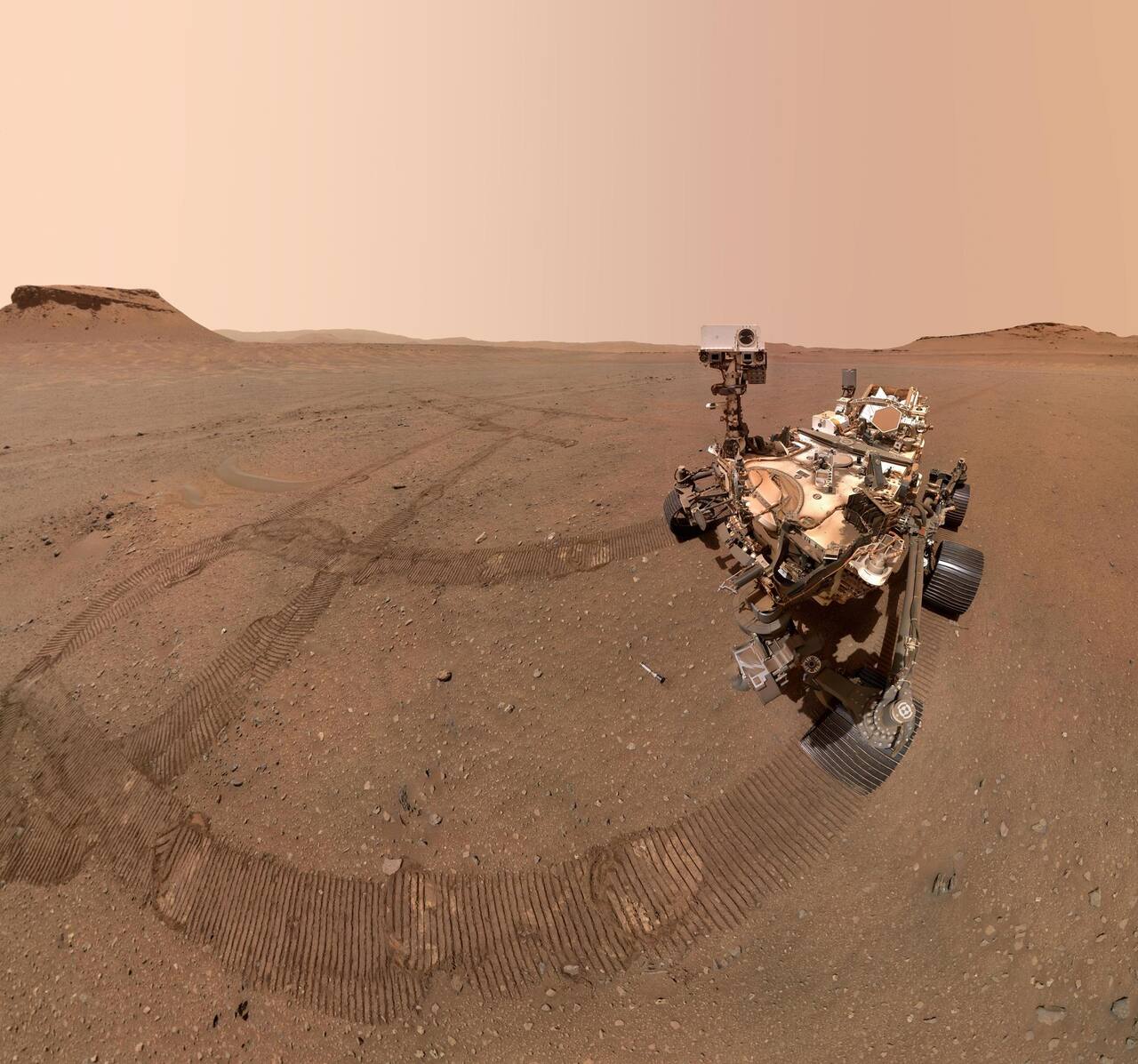 NASA/JPL-Caltech/MSSS. Public domain (NASA / US government work).
The problem
Section titled “The problem”A Mars sampling rover has to land within reach of terrain worth sampling, drive across rock-dense ground on a single radiation-hardened processor, abrade and core rock without contaminating it, seal the cores against leakage, and do all of it from a ground team that sees each sol’s results only after a relay pass. Chassis, mobility system and sky crane landing architecture are inherited from Curiosity; payload, avionics and entry sensing were reworked.
What has flown
Section titled “What has flown”Perseverance landed in Jezero crater on 18 February 2021 [23]. Terrain-relative navigation made its first operational use on a planetary landing: the Lander Vision System reduced a 3.2 km initial horizontal position error to under 40 m within 10 s, and touchdown fell less than 5 m from the target against a 60 m requirement [34]. The pre-launch budget predicted about 45 m of error and the post-landing re-run gave 8.53 m [32].
On the surface, Enhanced Autonomous Navigation raised the average autonomous drive rate from Curiosity’s 17.3 m/h to about 92 m/h, and about 90 percent of 32.1 km driven by sol 1312 used it [33]. In the first 210 sols the longest autonomous drive was 167 m on sol 200, against the earlier 109 m record held by Opportunity [35]. Surface commissioning was allocated 111 sols [29], and 27 sample tubes were sealed between sols 109 and 1088 across the crater floor, fan front, upper fan and margin campaigns [37].
What is being tried now
Section titled “What is being tried now”Each item below is stated with its flight status.
- Onboard global localization for long drives. Flown: the first onboard global localization on a Mars rover matches post-drive stereo orthomosaics against a HiRISE orbital map on a Snapdragon co-processor repurposed from Ingenuity’s base station, enabling longer and more precise drives [38].
- Onboard scheduling. Ground-tested: the Copilot scheduler is the ground counterpart of an intended onboard scheduler, with a 60 s runtime estimate not measured on flight hardware [4].
- Sample depot storage. Design estimate only: the pre-landing mission overview puts depot tube temperature near 28 C, assuming no thermal coupling between sample and tube or tube and lander [36]. No tube has returned to Earth.
Overview
Section titled “Overview”Specifications
Section titled “Specifications”| Parameter | Value |
|---|---|
| Mass | 1025 kg |
| Length | approximately 3 m |
| Wheel diameter | 52.5 cm |
| Distance advanced per wheel revolution | 1.65 m |
| Maximum wheel speed | 4.2 cm/s, approximately 150 m/h |
| Arm | 5 joints, 2.1 m |
| Power source | MMRTG, approximately 110 W at launch, approximately 45 kg |
Values from [6].
Mission profile
Section titled “Mission profile”| Parameter | Value | Source |
|---|---|---|
| Landing | 18 February 2021, Jezero crater | [23], [27] |
| Landing point | about 2 km from the western delta front | [23] |
| Jezero crater diameter | 45 km, on the western edge of Isidis Planitia | [27] |
| Traverse through the crater floor campaign | more than 5 km, seven abrasion patches | [23] |
| Distance driven as of October 2024 | more than 30 km | [27] |
| Samples collected | 24 rock and regolith samples and one atmospheric sample | [27] |
| Sample depot | ten tubes deposited at Three Forks | [27] |
Commissioning ran on a fixed schedule: cruise to surface flight software transition on sols 5 to 8, Remote Sensing Mast deployment on sol 2, robotic arm deployment on sol 12, first drive on sol 14 [23]. Ingenuity was deployed over sols 36 to 43 and flew its technology demonstration campaign over sols 44 to 73 [23].
Mobility
Section titled “Mobility”The suspension is the Curiosity rocker-bogie with six driven and four steered wheels. The wheels were redesigned against Curiosity’s damage record: 52.5 cm diameter aluminum with curved titanium spokes and cleats, one revolution advancing the rover 1.65 m [6]. The skin is thicker and the grousers more numerous and less aggressive than Curiosity’s, spreading the load an embedded rock applies over more material.
| Drive rate | Value | Source |
|---|---|---|
| Maximum wheel speed | 4.2 cm/s, approx 150 m/h | [6] |
| Top speed, flat hard ground | approx 152 m/h | [3] |
| Curiosity autonomous rate, stop-to-compute | 15 to 18 m/h | |
| Perseverance autonomous rate, computing while driving | approx 110 m/h |
The gap between the two autonomous rates is a compute architecture result, not an actuator one: the actuators are the same class as Curiosity’s and the maximum commanded wheel speed differs by only a few percent [3], [6].
Power and energy
Section titled “Power and energy”An MMRTG of the same class as Curiosity’s supplies approximately 110 W at launch, declining a few percent per year, buffered by two lithium-ion rechargeable batteries; the generator masses approximately 45 kg [6].
Awake and idle load exceeds MMRTG output, so battery state of charge rises only while the rover sleeps [4]. Every plan interleaves sleep with activity, and the ground scheduler enforces a minimum state of charge below which the predicted energy value may not fall; an activity that would violate it is not scheduled. Actuator preheats are scheduled as explicit setup activities preceding the activity they enable, and are themselves energy consumers. Sampling activities carry a prerequisite abrasion whose added time and power must be budgeted before the proximity science it enables [23].
Thermal
Section titled “Thermal”Perseverance uses the Curiosity thermal architecture: a pumped fluid loop through the warm electronics box that distributes MMRTG waste heat and rejects excess, with electrical heaters on components outside the box. No Perseverance plate temperature requirements distinct from Curiosity’s are on record. One flight thermal figure is on record from the sampling chain: tubes are sealed at approximately 40 C [2]. Sealing temperature is one of the three parameters that govern the leak rate achieved, alongside tube wall thickness and diametric tooth interference.
Compute and avionics
Section titled “Compute and avionics”| Element | Specification | Source |
|---|---|---|
| Main computer | BAE RAD750, PowerPC 750, up to 200 MHz | [6] |
| Main memory | 256 MB DRAM, 2 GB flash, 256 kB EEPROM | |
| Redundancy | two, one prime one backup | |
| Vision Compute Element | separate RAD750 plus Computer Vision Accelerator Card | [3] |
| Accelerator | FPGA implementing the image processing pipeline in hardware | |
| Stereo correlation and visual odometry, 1280 x 960 | seconds on the VCE, approximately one minute on the main computer |
The Vision Compute Element processes navigation imagery independently of the main computer, so the main computer continues to run the drive while imagery from the previous step is still being reduced [3]. The same VCE ran the Lander Vision System during entry, descent and landing and was converted to full-time surface navigation afterwards. Curiosity’s single 133 MHz RAD750 takes 47 s per visual odometry stereo pair including data product writing, which bounds its drive rate to the stop-and-compute figure above [3].
Autonomy
Section titled “Autonomy”Terrain-relative navigation was added to entry, descent and landing. During parachute descent the Lander Vision System images the ground, matches those images against an onboard map built from orbital reconnaissance, estimates position relative to a hazard map, and commands the descent stage to divert to a safe point [3]. The image matching completes within the available seconds because the FPGA accelerator performs it. Landing site selection therefore moves from a pre-launch judgment about ellipse-scale terrain to an in-flight decision at hazard scale, which is what made the broken terrain near the Jezero delta front an admissible target [23].
The entry, descent and landing flight software runs a 38-mode state machine at 64 Hz, inherited from Curiosity with the descent IMU dynamic range raised to 1875 deg/s and the range trigger and terrain-relative navigation added [28]. Powered approach lasted 29.7 s against Curiosity’s 21.7 s because of the larger divert the terrain-relative navigation commanded [28]. The 60 m landing accuracy requirement was allocated mostly to target error, much of it orbital map co-registration; the pre-launch budget predicted about 45 m, the post-landing re-run gave 8.53 m, and imagery measured a 5 m actual offset [32]. The re-run used landing-day conditions, so its agreement with the measured offset is a consistency check, and the descent fell near the center of the operational envelope [32].
Surface autonomy is the ENav algorithm, which performs orientation-sensitive hazard assessment rather than treating the rover as a point or a disc [3]. Evaluating clearance against vehicle orientation over each candidate patch is a substantially larger computation than an orientation-free check, and is affordable only on the accelerator. Orientation matters because the rocker-bogie determines wheel contact angles, and it is the contact angle distribution across the six 52.5 cm wheels that decides whether a given rock is climbed or driven into [6].
Communications
Section titled “Communications”| Link | Rate |
|---|---|
| X-band DTE, 34 m DSN antenna | 160 bps or better |
| X-band DFE, 34 m DSN antenna | 500 bps or better |
| X-band DTE, favorable geometry | 800 bps or better |
| X-band DFE, favorable geometry | 3000 bps or better |
| UHF rover to orbiter | up to 2 Mbps |
Link rates from [6].
Relay planning precomputes data volume predicts for every overflight and rate combination. LDPC channel coding was commissioned on the network in 2021: four MAVEN demonstration overflights returned 70 percent more data than convolutional coding predicts, and one Perseverance-MAVEN overflight returned 2340.2 Mbit, above Curiosity’s 1739.3 Mbit record [30]. The gain is measured against predicted rather than paired convolutional passes, over 27 overflights [30]. Bulk return is by UHF relay through the Mars Relay Network of MRO, Odyssey, MAVEN and the ESA Trace Gas Orbiter [6]. Channel plans, coding and Proximity-1 configuration for Mars 2020 are not published in the open literature.
Payload and instruments
Section titled “Payload and instruments”The 2.1 m five-joint arm carries a turret with the rotary-percussive corer, PIXL, SHERLOC with its WATSON imager, and the gaseous Dust Removal Tool [6], [23]. Turret instruments are placed within a few cm of the natural or abraded surface. Mast instruments are Mastcam-Z and SuperCam. MEDA provides meteorology and RIMFAX ground-penetrating radar.
| Instrument | Key parameters | Source |
|---|---|---|
| SuperCam mast unit | 6.11 kg, 383 x 201 x 163 mm, 27 W peak | [16] |
| SuperCam body unit | 4.44 kg, 221 x 157 x 205 mm, 43 W peak with thermo-electric coolers, 12 W idle | |
| SuperCam total | 10.80 kg, 70 W | |
| SuperCam LIBS laser | 1064 nm, up to 14 mJ, more than 10 MW/mm2; requirement above 12 mJ across -30 to +10 C | [16][25] |
| SuperCam Raman laser energy | above 9 mJ over -30 to +10 C | [25] |
| SuperCam microphone | 100 Hz to 10 kHz, sampled at 25 kHz or 100 kHz | |
| SuperCam mast unit operating range | -30 to +10 C | |
| SuperCam Raman | same laser frequency doubled to 532 nm, time-gated detection | [16] |
| SuperCam footprint | 1.5 mm close in, approx 5 mm diameter at 7 m standoff | |
| SuperCam transmission spectrometer | 535 to 853 nm at 12 cm⁻¹ FWHM, Raman shift 105 to 7070 cm⁻¹ | |
| SHERLOC laser | 248.6 nm pulsed neon-copper, at least 9 µJ per pulse, 80 Hz, 40 µs pulses, peak power under approximately 200 mW | [10] |
| SHERLOC mass | 9.73 kg total: 6.83 kg turret assembly, 2.90 kg body assembly, 0.44 kg calibration target | |
| SHERLOC turret survival heating | 128.8 W peak; decontamination 80.4 W | |
| SHERLOC spot / working distance | approx 100 µm / approx 48 mm | |
| SHERLOC map | up to 7 x 7 mm at better than 100 µm per pixel, under 10 min | |
| Mastcam-Z zoom | 4:1, 26 to 110 mm focal length | [8] |
| Mastcam-Z field of view | 25.6 x 19.2 deg to 6.2 x 4.6 deg | |
| Mastcam-Z pixel scale | 283 to 67.4 µrad/pixel | |
| Mastcam-Z detector / baseline | 1648 x 1214 CCD / 24.4 cm stereo baseline, 2.3 deg toe-in | |
| Mastcam-Z closest focus | 0.5 m at 26 to 50 mm, 1.0 m at 50 to 110 mm | |
| Mastcam-Z mass / heater draw | 1.38 kg per camera head, 1.47 kg camera plate / up to 72 W | |
| MEDA air temperature | 150 to 300 K, ±1 K, 0.1 K resolution | [20] |
| MEDA pressure | 1 to 1400 Pa, ±20 Pa over 400 to 1200 Pa | |
| MEDA wind | 0.5 to 30 m/s expected at Jezero, 15 deg direction resolution |
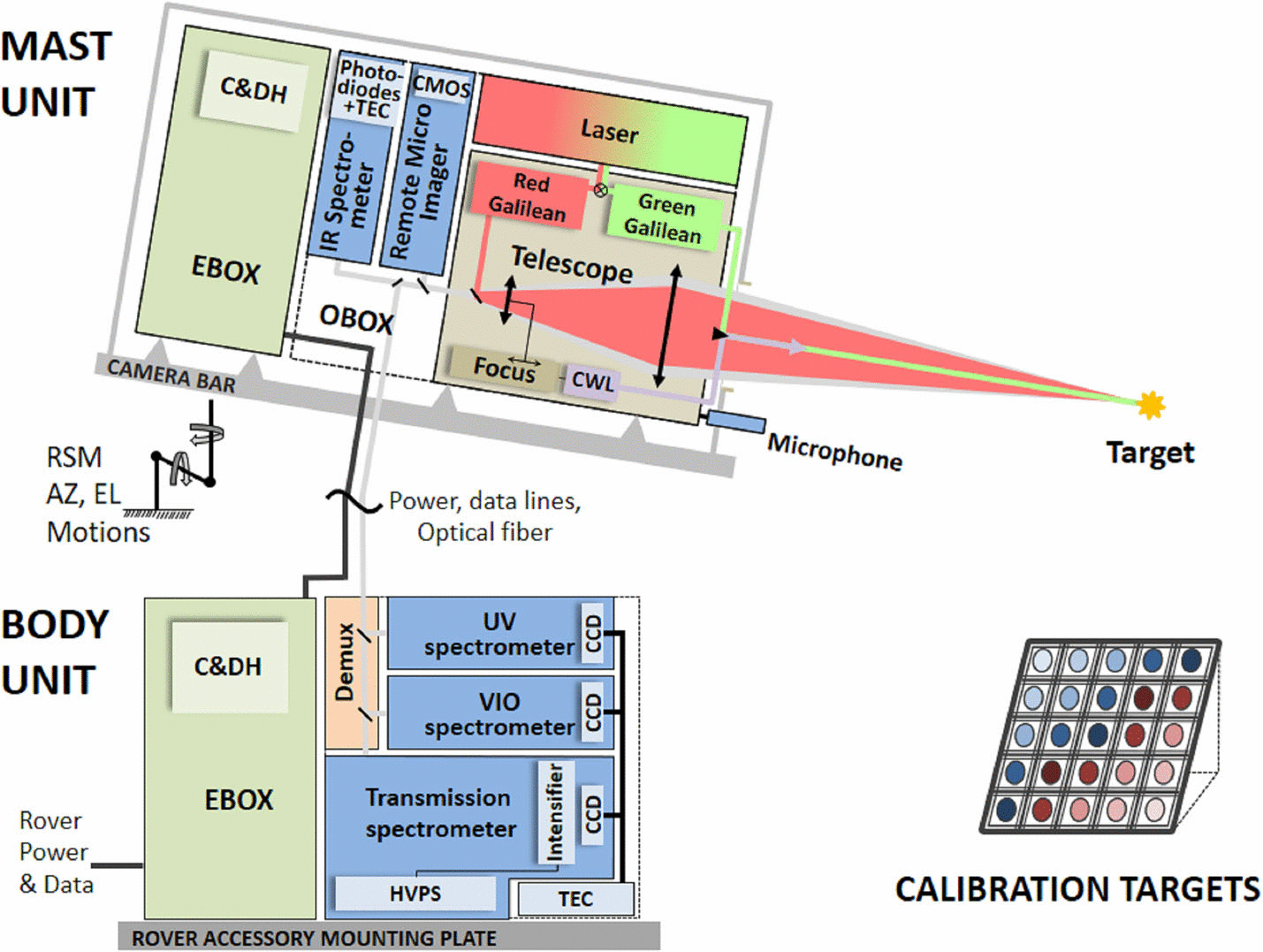
SuperCam block diagram. The mast unit carries the laser, telescope, focus mechanism, infrared spectrometer, Remote Micro-Imager and microphone; one optical fiber plus power and data lines runs down the mast to the body unit, where a demultiplexer splits returned light between the ultraviolet and violet reflection spectrometers and the intensified transmission spectrometer used for Raman. The split keeps the cooled detectors inside the warm electronics box and leaves only optics and laser at mast temperature. Source: [16]. CC BY 4.0.
SuperCam occupies almost exactly the ChemCam volume and mass, and its optical demultiplexer and ultraviolet and violet reflection spectrometers are nearly identical to ChemCam’s; the third reflection spectrometer was replaced by a time-gated intensified transmission spectrometer to enable Raman [16], [25]. Two mass-driven changes distinguish it: the thermo-electric coolers were designed in from the start rather than added late, giving a lighter cooling system, and the body unit spectrometers are titanium rather than beryllium. The telescope carries a periscope mirror that directs Raman laser light to the sample. SuperCam’s body unit sits next to the Remote Sensing Mast side of the rover to minimize the length of the optical fiber carrying signal from the mast unit, inside an instrument and electronics bay of 1181 x 1106 mm [16].
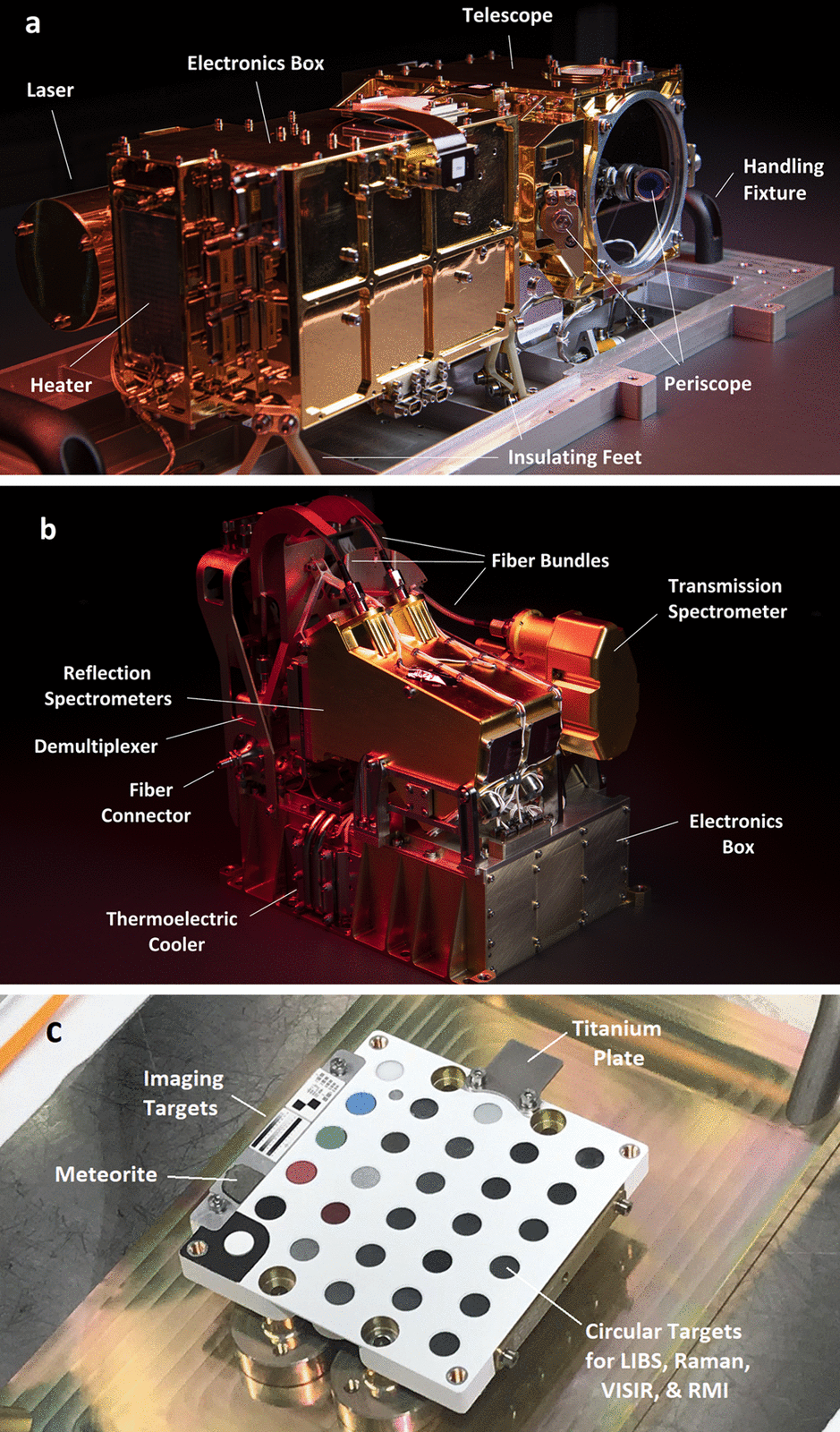
SuperCam flight hardware. (a) Mast unit: laser with its heater at left, electronics box, and the telescope carrying the periscope mirror that directs the frequency-doubled Raman beam; the unit stands on insulating feet to limit conduction into the mast. (b) Body unit: fiber bundles enter through the demultiplexer to the reflection spectrometers and the transmission spectrometer, with the thermo-electric cooler finned block at lower left. (c) Calibration target assembly. Source: [16]. CC BY 4.0.
SHERLOC scans with an internal mirror rather than moving the arm, which removes sub-millimeter arm positioning from the mapping loop [10]. Laser peak power is held under approximately 200 mW to avoid photochemically altering the organics being measured, which is why the design uses 40 µs pulses at 80 Hz rather than fewer, harder pulses. WATSON is a copy of the MSL MAHLI camera reused on shared SHERLOC infrastructure, so its 1600 x 1200 detector, 2.1 cm to infinity working distance and 365 nm ultraviolet illumination carry over unchanged [10].
Mastcam-Z adds zoom, focus and filter wheel mechanisms to each camera head [8]. The 24.4 cm baseline and 2.3 deg toe-in are fixed, so ranging performance varies with focal length across the 4:1 zoom range, and closest focus moves from 0.5 m at the wide end to 1.0 m above 50 mm. Heater draw to bring the camera heads above their operating limits reaches 72 W, which makes imaging an energy-scheduled activity like any actuated one [4].
MOXIE occupied a slot in the rover body and demonstrated in situ resource utilization. It draws Martian atmosphere through a HEPA dust filter, compresses it with a scroll pump, heats it to 800 C, and passes it over a nickel-based catalyzed cathode in a solid oxide electrolysis stack, where CO2 decomposes and a scandia-stabilized zirconia electrolyte passes oxygen ions to the anode [1]. The reference operating point is 55 g/h of atmospheric intake producing 6 g/h of oxygen at better than 98 percent purity [23]. The 800 C operating temperature is the compromise between electrolysis efficiency and damage to temperature-sensitive materials. The binding constraint is coking: at insufficient mass flow for a given current, carbon deposits on the cathode, raising cell resistance by reducing active area and potentially fracturing it, so each run is planned to stay inside a safe voltage zone bounded by the two Nernst potentials. Measured oxygen purity exceeded the 99.6 percent recommended for propellant and breathing use, with the residual impurity traced to CO2 crossover driven by the cathode-to-anode pressure differential [1]. The MOXIE chassis measures 23.9 by 23.9 by 30.9 cm, and being carried inside a rover imposed the volume, thermal and power limits that constrained the design [1]. A system scaled several hundred times, at 2 to 3 kg/h, would supply the approximately 31 t of oxygen in the 50 t propellant load of a six-person Mars ascent vehicle.
Sampling and caching
Section titled “Sampling and caching”The sampling chain is three cooperating mechanisms [2]. The external five-joint arm presses the corer against the rock. Inside the rover body the Adaptive Caching Assembly holds the tube inventory, and a small internal Sample Handling Arm moves tubes between the bit carousel, the inspection stations, the sealing station and storage [23]. The corer houses either an abrasion bit or a coring bit, exchanged from the bit carousel by the handling arm.
| Parameter | Value | Source |
|---|---|---|
| Abrasion patch | 2 to 16 mm deep, 45 mm diameter | [23] |
| Dust-cleared area after gDRT gas puff | 40 mm diameter | |
| Rock core | 13 mm diameter, up to 76 mm long | |
| Sample tubes carried | 43: 38 for rock or regolith, 5 witness tubes | [2] |
| Tube material | Ti-6Al-4V | |
| Tube coatings | white alumina externally, titanium nitride internally | |
| Tube internal volume | approx 12.5 cm3 | |
| Sealing temperature | approx 40 C | |
| Proximity science standoff | a few cm from the natural or abraded surface | [23] |
Witness tubes differ from sample tubes only in their interior contents and are used to characterize contamination [2]. The external alumina coating limits solar heating and the internal titanium nitride limits adsorption of organic contaminants. A tube is loaded into a coring bit before drilling so that core, tailings and headspace gas are captured directly in the tube; the handling arm then advances it through volume assessment with a probe and imaging by CacheCam before sealing [23].
The seal is a mechanically activated plug: a ram drives a ferrule into a gold-coated titanium seal cup, expanding a sealing tooth into the tube wall and holding it there by plastic deformation [2]. Leak-tightness is governed by tube wall thickness, sealing temperature and diametric tooth interference, the measure of contact between tooth and wall. The mission requirement was verified only as better than the 1e-10 scc/s detection limit of conventional helium leak detection [2]. Static-mode mass spectrometry on six flight-like tubes later measured room-temperature helium leak rates from 8.8e-17 to 4.6e-14 scc/s, below the 1e-13 scc/s at which gas ingress or egress becomes negligible over the intended storage and transit interval [2]. Filled tubes have been deposited at a surface depot, so the cache is recoverable independently of the rover’s continued health.
Sampling is executed against a prescribed sol path spanning eleven continuous sols [23]. The rover acquires survey images to select the abrasion and coring target, abrades, clears dust with the gDRT, takes proximity and remote science on the abraded patch to document the rock, and then takes two cores in succession from unabraded portions of the same rock.
Arm commissioning over the first 98 sols matched ground calibration: joint resolver angles on sol 11 agreed with pre-launch values within 5 mrad, the arm needed no post-landing recalibration against its under 5 mm Earth accuracy, and docking to the bit carousel at 300 N preload succeeded on the first attempt [31]. The PIXL context camera model, descoped from ground calibration, left a 20 to 30 pixel absolute error that could not be separated between arm and hexapod [31].
Modes of operation
Section titled “Modes of operation”The sol is built as an explicit sequence of awake and asleep intervals, because the battery recharges only while the rover sleeps [4]. Each activity declares its unit resources, such as the arm, so that two activities claiming the same resource cannot overlap; its energy and data volume consumption; its peak energy rate; and non-depletable resources such as available sequence engines and peak power. An activity is generally preceded by preheat activities and followed by a return to sleep. The ground scheduler solves against this model, and the same core scheduling logic was intended for an eventual onboard scheduler operating under tighter CPU limits.
Sampling imposes its own mode structure: an eleven-sol prescribed path in which the observations documenting each pair of cores are made in a fixed order, so the plan for any one sol in the sequence is constrained by what the preceding sols established [23].
Drive modes follow the Curiosity pattern of directed and autonomous navigation with onboard fault protection, with ENav replacing the earlier hazard evaluation [3]. No open source enumerates Perseverance safe mode entry conditions in the detail available for Curiosity, so they are not restated here.
Ground operations
Section titled “Ground operations”Perseverance is operated from JPL on a five-stage cycle implemented in COCPIT and Playbook [5].
| Stage | Function |
|---|---|
| Parcel development | defines and validates reusable activity definitions |
| Strategic planning | look-ahead plan over approximately five sols including communication passes |
| Campaign implementation | plan fragment templates against timing constraints, heating and resource assessment |
| Tactical uplink | plans the next sol against latest downlink, verifies constraints, generates sequences |
| Tactical downlink | monitors the executing plan and analyzes returned data |
Decisional data is the subset of returned data that the next tactical planning cycle depends on. A plan cannot be built until its decisional data has arrived, so the tools display when each activity’s data contribution becomes available on Earth and aggregate expected data volume by criticality, both at plan level and at a given time within the plan [5]. Relay pass timing constrains the planning cycle as directly as the rover’s own schedule does.
Scheduling is automated. Copilot places activities against the resource model above [4]. When the scheduler fails to place an activity the cause is a conflict among constraints rather than anything visible in the output, so Crosscheck was built to present the generated schedule visually and analyze which constraints prevented placement and how they would have to change. The team is distributed rather than co-located and the tooling was built for concurrent remote collaboration on a shared plan [5].
Drilling and coring approval is a separate gate, and the crater floor campaign record gives its scale: more than 5 km driven and seven abrasion patches produced before the first sampling campaign concluded [23].
Surface commissioning was budgeted at 111 sols [29]. Ingenuity deployment over sols 36 to 43 and a 30-sol demonstration followed [23]. The helicopter technology demonstration used 7 of its 10 sols of margin early on a flight software timing bug that delayed the first Ingenuity flight to sol 58, and the first drive was a 5 m mobility demonstration [29]. Early planning was deliberately simple and slow while the team moved off pre-canned sequences into a real tactical cycle [29].
Technologies developed
Section titled “Technologies developed”Terrain-relative navigation moved landing site selection from a pre-launch judgment about ellipse-scale terrain to an in-flight decision at hazard scale [3]. Hardware-accelerated onboard vision demonstrated that a dedicated co-processor, rather than a faster general-purpose radiation-hardened processor, is the practical route to real-time perception under flight computing constraints: the same actuators driven with the same maximum wheel speed produce roughly six times the autonomous traverse rate [6]. The sample tube hermetic seal established a verified leak rate floor for planetary sample containment, at 8.8e-17 to 4.6e-14 scc/s helium, three orders of magnitude below what conventional helium leak detection could confirm [2]. MOXIE established that solid oxide electrolysis of the Martian atmosphere works at flight scale across seasonal and diurnal variation in atmospheric density, and that its operating envelope is bounded by carbon deposition rather than by the electrochemistry [1].
What is not established
Section titled “What is not established”No sampled tube has returned to Earth, so the leak rates above are ground measurements on flight-like tubes and not on flight tubes [2]. The 60 s onboard scheduler runtime is a conservative estimate and not a measurement on the flight computer [4]. The Mastcam-Z calibration and monitoring program was a plan when published, with no radiation qualification level for the detector [8]. The commissioning record covers 111 sols and gives no productivity figure for the nominal mission [29]. The terrain-relative navigation accuracy rests on one landing near the center of the envelope [32].
References
- Hoffman, J. A., Hecht, M. H., Rapp, D., Hartvigsen, J. J., SooHoo, J. G., Aboobaker, A. M., McClean, J. B., Liu, A. M., Hinterman, E. D., Nasr, M., Hariharan, S., Horn, K. J., Meyen, F. E., Okkels, H., Steen, P., Elangovan, S., Graves, C. R., Khopkar, P., Madsen, M. B., Voecks, G. E., Smith, P. H., Skafte, T. L., Poirier, J. and Bergman, T. (2022). Mars Oxygen ISRU Experiment (MOXIE): Preparing for Human Mars Exploration
. Science Advances, 35. Source
BibTeX
@article{hoffman2022mars, title = {Mars Oxygen ISRU Experiment (MOXIE): Preparing for Human Mars Exploration}, author = {Hoffman, Jeffrey A. and Hecht, Michael H. and Rapp, Donald and Hartvigsen, Joseph J. and SooHoo, Jason G. and Aboobaker, Asad M. and McClean, John B. and Liu, Andrew M. and Hinterman, Eric D. and Nasr, Maya and Hariharan, Shravan and Horn, Kyle J. and Meyen, Forrest E. and Okkels, Henrik and Steen, Peter and Elangovan, S. and Graves, Christopher R. and Khopkar, Piyush and Madsen, Morten Bo and Voecks, Gerald E. and Smith, Peter H. and Skafte, Theis L. and Poirier, Jose and Bergman, Tim}, journal = {Science Advances}, volume = {8}, number = {35}, pages = {eabp8636}, year = {2022}, doi = {10.1126/sciadv.abp8636}, abstract = {MOXIE [Mars Oxygen In Situ Resource Utilization (ISRU) Experiment] is the first demonstration of ISRU on another planet, producing oxygen by solid oxide electrolysis of carbon dioxide in the martian atmosphere. A scaled-up MOXIE would contribute to sustainable human exploration of Mars by producing on-site the tens of tons of oxygen required for a rocket to transport astronauts off the surface of Mars, instead of having to launch hundreds of tons of material from Earth’s surface to transport the required oxygen to Mars. MOXIE has produced oxygen seven times between landing in February 2021 and the end of 2021 and will continue to demonstrate oxygen production during night and day throughout all martian seasons. This paper reviews what MOXIE has accomplished and the implications for larger-scale oxygen-producing systems.} } - Osterhout, J. T., Farley, K. A., Wadhwa, M., Treffkorn, J. and Kulczycki, E. (2024). Helium Leak Rate Measurements of Flight-like Mars 2020 Sample Tubes
. Astrobiology, 1. Source
BibTeX
@article{osterhout2024helium, title = {Helium Leak Rate Measurements of Flight-like Mars 2020 Sample Tubes}, author = {Osterhout, Jeffrey T. and Farley, Kenneth A. and Wadhwa, Meenakshi and Treffkorn, Jonathan and Kulczycki, Eric}, journal = {Astrobiology}, volume = {24}, number = {1}, pages = {36--43}, year = {2024}, doi = {10.1089/ast.2023.0002}, abstract = {The sample tubes on board NASA's Perseverance rover are designed to contain rocks, regolith, and atmospheric gases and are hermetically sealed on the surface of Mars to minimize sample loss, alteration, and contamination. Following a robust testing program during mission development, it was determined that the helium (He) leak rates of flight-like sample tubes sealed under a range of conditions were typically no greater than ∼10 −10 standard cubic centimeters per second (scc/s); leak rates below this value could not be measured since this is the detection limit of commercially available He leak detectors. This limit was adequate to meet mission requirements. However, some scientific objectives could be compromised by sample tube leak rates even below 10 −10 scc/s, thus motivating a more sensitive technique for establishing leak rates. This study investigated He leak rates on six flight-like sample tubes using a static mode mass spectrometer. Room temperature He leak rates of the six sample tubes ranged from ∼8.8 × 10 −17 to ∼4.6 × 10 −14 scc/s. One sample tube was analyzed at eight different temperatures, ranging from -51°C to +42°C, and yielded He leak rates correlated with temperature that varied from ∼1.7 × 10 −15 to ∼1.4 × 10 −13 scc/s, respectively. Our results confirm and extend previous findings demonstrating that the Mars 2020 sample tube seals are likely to be very leak-tight, with leak rates <10 −13 scc/s. These leak rates are sufficiently low that the impact of gas egress or ingress is expected to be negligible.} } - Jet Propulsion Laboratory Robotics. (2021). Mars 2020 Rover: Mobility. www-robotics.jpl.nasa.gov/what-we-do/flight-projects/mars-2020-rover/...
BibTeX
@misc{jpl2021mars, title = {Mars 2020 Rover: Mobility}, author = {{Jet Propulsion Laboratory Robotics}}, year = {2021}, url = {https://www-robotics.jpl.nasa.gov/what-we-do/flight-projects/mars-2020-rover/m2020mobility/} } - Agrawal, J., Yelamanchili, A. and Chien, S. (2020). Using Explainable Scheduling for the Mars 2020 Rover Mission
. arXiv preprint. Source
BibTeX
@article{agrawal2020explainable, title = {Using Explainable Scheduling for the Mars 2020 Rover Mission}, author = {Agrawal, Jagriti and Yelamanchili, Amruta and Chien, Steve}, journal = {arXiv preprint}, year = {2020}, doi = {10.48550/arxiv.2011.08733}, abstract = {Understanding the reasoning behind the behavior of an automated scheduling system is essential to ensure that it will be trusted and consequently used to its full capabilities in critical applications. In cases where a scheduler schedules activities in an invalid location, it is usually easy for the user to infer the missing constraint by inspecting the schedule with the invalid activity to determine the missing constraint. If a scheduler fails to schedule activities because constraints could not be satisfied, determining the cause can be more challenging. In such cases it is important to understand which constraints caused the activities to fail to be scheduled and how to alter constraints to achieve the desired schedule. In this paper, we describe such a scheduling system for NASA's Mars 2020 Perseverance Rover, as well as Crosscheck, an explainable scheduling tool that explains the scheduler behavior. The scheduling system and Crosscheck are the baseline for operational use to schedule activities for the Mars 2020 rover. As we describe, the scheduler generates a schedule given a set of activities and their constraints and Crosscheck: (1) provides a visual representation of the generated schedule; (2) analyzes and explains why activities failed to schedule given the constraints provided; and (3) provides guidance on potential constraint relaxations to enable the activities to schedule in future scheduler runs.} } - Deliz, I., Connell, A., Joswig, C., Kanefsky, B. and Marquez, J. (2022). COCPIT: Collaborative Activity Planning Software for Mars Perseverance Rover
. IEEE Aerospace Conference, 20220003012. Source
BibTeX
@inproceedings{deliz2022cocpit, title = {{COCPIT}: Collaborative Activity Planning Software for {Mars} {Perseverance} Rover}, author = {Deliz, Ivy and Connell, Andrea and Joswig, Chet and Kanefsky, Bob and Marquez, Jessica}, booktitle = {IEEE Aerospace Conference}, number = {20220003012}, pages = {1-13}, institution = {NASA}, address = {Big Sky, Montana}, year = {2022}, doi = {10.1109/aero53065.2022.9843397}, abstract = {Since landing on the Martian surface, the Perseverance rover has relied on a distributed team to generate commands for exploring its new environment each sol (Martian day). The team uses a complex suite of software tools to accomplish this challenging task in time for the next window of opportunity to send commands to the rover. A key piece of this software ecosystem is COCPIT (Component-based Campaign Planning, Implementation, and Tactical). COCPIT is part of the next generation of planning and scheduling software tools developed by NASA's Jet Propulsion Laboratory in partnership with NASA's Ames Research Center. COCPIT is a web-based application that allows users to collaboratively view and update the Perseverance rover's activity plans, continuously verify that the plan satisfies constraints, assign targets for directing scientific instruments, document science intent, and model power and data resources. Mars Surface Operations requires diverse expertise from team members within the Engineering, Science, Robotic, and Instrument Operations groups, distributed across North America and Europe. In order to improve efficiency and reduce risk, all teams are able to review and edit their activities simultaneously and see the effects on the plan in its entirety. As part of the Ground Data System (GDS) tool suite, COCPIT is responsible for the activity plan. It provides specialized views that allow operators to understand where there may be room for additional observations, see whether any planning constraints are being violated, and confirm that energy usage and data generation are within the defined limits. It contains details such as which filters a camera will use for a given observation, what the resolution of the images should be, where to store the data onboard, and how long the observation is expected to take. It predicts when specific data will be downlinked from the rover to a passing orbiter, so that the team knows when to expect that data on Earth for evaluation in future planning. Ultimately the information from the COCPIT plan is translated to sequences that will be bundled and radiated to Perseverance for execution. The COCPIT tool is used throughout all planning phases.} } - NASA Science. (2021). Mars 2020 Perseverance Rover: Rover Components. science.nasa.gov/mission/mars-2020-perseverance/rover-components
BibTeX
@misc{nasa2021mars, title = {Mars 2020 Perseverance Rover: Rover Components}, author = {{NASA Science}}, year = {2021}, url = {https://science.nasa.gov/mission/mars-2020-perseverance/rover-components/} } - Bell, I. J., Maki, J. N., Mehall, G. L., Ravine, M. A., Caplinger, M. A., Bailey, Z., Brylow, S., Schaffner, J. A., Kinch, K. M., Madsen, M., Winhold, A. G., Hayes, A. G., Corlies, P., Tate, C., Barrington, M., Cisneros, E., Jensen, E., Paris, K., Crawford, K., Rojas, C., Mehall, L., Joseph, J., Proton, J., Cluff, N., Deen, R. G., Betts, B., Cloutis, E., Coates, A. J., Colaprete, A., Edgett, K. S., Ehlmann, B. L., Fagents, S. A., Grotzinger, J. P., Hardgrove, C., Herkenhoff, K., Horgan, B., Jaumann, R., Johnson, J. R., Lemmon, M., Paar, G., Caballo-Perucha, M., Gupta, S., Traxler, C., Preusker, F., Rice, M. S., Robinson, M. S., Schmitz, N., Sullivan, R. and Wolff, M. (2021). The Mars 2020 Perseverance Rover Mast Camera Zoom (Mastcam-Z) Multispectral, Stereoscopic Imaging Investigation
. Space Science Reviews, 24. Source
BibTeX
@article{bell2021mars, title = {The Mars 2020 Perseverance Rover Mast Camera Zoom (Mastcam-Z) Multispectral, Stereoscopic Imaging Investigation}, author = {Bell, III, J.F. and Maki, Justin N. and Mehall, Greg L. and Ravine, Michael A. and Caplinger, Michael A. and Bailey, Z.J. and Brylow, S. and Schaffner, Jacob A. and Kinch, Kjartan M. and Madsen, M.B. and Winhold, Andrew G. and Hayes, Alexander G. and Corlies, Paul and Tate, C. and Barrington, Megan and Cisneros, Ernest and Jensen, E. and Paris, Kristen and Crawford, Kelsie and Rojas, Corrine and Mehall, Laura and Joseph, Jonathan and Proton, J.B. and Cluff, Nathan and Deen, Robert G. and Betts, B. and Cloutis, E. and Coates, Andrew J. and Colaprete, Anthony and Edgett, Kenneth S. and Ehlmann, Bethany L. and Fagents, Sarah A. and Grotzinger, John P. and Hardgrove, Craig and Herkenhoff, K.E. and Horgan, B. and Jaumann, Ralf and Johnson, Jeffrey R. and Lemmon, M. and Paar, Gerhard and Caballo-Perucha, M. and Gupta, Sanjeev and Traxler, Christoph and Preusker, Frank and Rice, Melissa S. and Robinson, Mark S. and Schmitz, Nicole and Sullivan, R. and Wolff, M.J.}, journal = {Space Science Reviews}, volume = {217}, number = {24}, pages = {24--24}, year = {2021}, doi = {10.1007/s11214-020-00755-x}, abstract = {Abstract Mastcam-Z is a multispectral, stereoscopic imaging investigation on the Mars 2020 mission’s Perseverance rover. Mastcam-Z consists of a pair of focusable, 4:1 zoomable cameras that provide broadband red/green/blue and narrowband 400-1000 nm color imaging with fields of view from 25.6° × 19.2° (26 mm focal length at 283 μrad/pixel) to 6.2° × 4.6° (110 mm focal length at 67.4 μrad/pixel). The cameras can resolve (≥ 5 pixels) ∼0.7 mm features at 2 m and ∼3.3 cm features at 100 m distance. Mastcam-Z shares significant heritage with the Mastcam instruments on the Mars Science Laboratory Curiosity rover. Each Mastcam-Z camera consists of zoom, focus, and filter wheel mechanisms and a 1648 × 1214 pixel charge-coupled device detector and electronics. The two Mastcam-Z cameras are mounted with a 24.4 cm stereo baseline and 2.3° total toe-in on a camera plate ∼2 m above the surface on the rover’s Remote Sensing Mast, which provides azimuth and elevation actuation. A separate digital electronics assembly inside the rover provides power, data processing and storage, and the interface to the rover computer. Primary and secondary Mastcam-Z calibration targets mounted on the rover top deck enable tactical reflectance calibration. Mastcam-Z multispectral, stereo, and panoramic images will be used to provide detailed morphology, topography, and geologic context along the rover’s traverse; constrain mineralogic, photometric, and physical properties of surface materials; monitor and characterize atmospheric and astronomical phenomena; and document the rover’s sample extraction and caching locations. Mastcam-Z images will also provide key engineering information to support sample selection and other rover driving and tool/instrument operations decisions.} } - Bhartia, R., Beegle, L. W., DeFlores, L., Abbey, W., Razzell Hollis, J., Uckert, K., Monacelli, B., Edgett, K. S., Kennedy, M. R., Sylvia, M., Aldrich, D., Anderson, M., Asher, S. A., Bailey, Z., Boyd, K., Burton, A. S., Caffrey, M., Calaway, M. J., Calvet, R., Cameron, B., Caplinger, M. A., Carrier, B. L., Chen, N., Chen, A., Clark, M. J., Clegg, S., Conrad, P. G., Cooper, M., Davis, K. N., Ehlmann, B., Facto, L., Fries, M. D., Garrison, D. H., Gasway, D., Ghaemi, F. T., Graff, T. G., Hand, K. P., Harris, C., Hein, J. D., Heinz, N., Herzog, H., Hochberg, E., Houck, A., Hug, W. F., Jensen, E. H., Kah, L. C., Kennedy, J., Krylo, R., Lam, J., Lindeman, M., McGlown, J., Michel, J., Miller, E., Mills, Z., Minitti, M. E., Mok, F., Moore, J., Nealson, K. H., Nelson, A., Newell, R., Nixon, B. E., Nordman, D. A., Nuding, D., Orellana, S., Pauken, M., Peterson, G., Pollock, R., Quinn, H., Quinto, C., Ravine, M. A., Reid, R. D., Riendeau, J., Ross, A. J., Sackos, J., Schaffner, J. A., Schwochert, M., Shelton, M. O., Simon, R., Smith, C. L., Sobron, P., Steadman, K., Steele, A., Thiessen, D., Tran, V. D., Tsai, T., Tuite, M., Tung, E., Wehbe, R., Weinberg, R., Weiner, R. H., Wiens, R. C., Williford, K., Wollonciej, C., Wu, Y.-H., Yingst, R. A. and Zan, J. (2021). Perseverance's Scanning Habitable Environments with Raman and Luminescence for Organics and Chemicals (SHERLOC) Investigation
. Space Science Reviews, 58. Source
BibTeX
@article{bhartia2021perseverance, title = {Perseverance's Scanning Habitable Environments with Raman and Luminescence for Organics and Chemicals (SHERLOC) Investigation}, author = {Bhartia, Rohit and Beegle, Luther W. and DeFlores, Lauren and Abbey, William and Razzell Hollis, Joseph and Uckert, Kyle and Monacelli, Brian and Edgett, Kenneth S. and Kennedy, Megan R. and Sylvia, Margarite and Aldrich, David and Anderson, Mark and Asher, Sanford A. and Bailey, Zachary and Boyd, Kerry and Burton, Aaron S. and Caffrey, Michael and Calaway, Michael J. and Calvet, Robert and Cameron, Bruce and Caplinger, Michael A. and Carrier, Brandi L. and Chen, Nataly and Chen, Amy and Clark, Matthew J. and Clegg, Samuel and Conrad, Pamela G. and Cooper, Moogega and Davis, Kristine N. and Ehlmann, Bethany and Facto, Linda and Fries, Marc D. and Garrison, Dan H. and Gasway, Denine and Ghaemi, F. Tony and Graff, Trevor G. and Hand, Kevin P. and Harris, Cathleen and Hein, Jeffrey D. and Heinz, Nicholas and Herzog, Harrison and Hochberg, Eric and Houck, Andrew and Hug, William F. and Jensen, Elsa H. and Kah, Linda C. and Kennedy, John and Krylo, Robert and Lam, Johnathan and Lindeman, Mark and McGlown, Justin and Michel, John and Miller, Ed and Mills, Zachary and Minitti, Michelle E. and Mok, Fai and Moore, James and Nealson, Kenneth H. and Nelson, Anthony and Newell, Raymond and Nixon, Brian E. and Nordman, Daniel A. and Nuding, Danielle and Orellana, Sonny and Pauken, Michael and Peterson, Glen and Pollock, Randy and Quinn, Heather and Quinto, Claire and Ravine, Michael A. and Reid, Ray D. and Riendeau, Joe and Ross, Amy J. and Sackos, Joshua and Schaffner, Jacob A. and Schwochert, Mark and Shelton, Molly O and Simon, Rufus and Smith, Caroline L. and Sobron, Pablo and Steadman, Kimberly and Steele, Andrew and Thiessen, Dave and Tran, Vinh D. and Tsai, Tony and Tuite, Michael and Tung, Eric and Wehbe, Rami and Weinberg, Rachel and Weiner, Ryan H. and Wiens, Roger C. and Williford, Kenneth and Wollonciej, Chris and Wu, Yen-Hung and Yingst, R. Aileen and Zan, Jason}, journal = {Space Science Reviews}, volume = {217}, number = {58}, year = {2021}, doi = {10.1007/s11214-021-00812-z}, abstract = {Abstract The Scanning Habitable Environments with Raman and Luminescence for Organics and Chemicals (SHERLOC) is a robotic arm-mounted instrument on NASA’s Perseverance rover. SHERLOC has two primary boresights. The Spectroscopy boresight generates spatially resolved chemical maps using fluorescence and Raman spectroscopy coupled to microscopic images (10.1 μm/pixel). The second boresight is a Wide Angle Topographic Sensor for Operations and eNgineering (WATSON); a copy of the Mars Science Laboratory (MSL) Mars Hand Lens Imager (MAHLI) that obtains color images from microscopic scales (∼13 μm/pixel) to infinity. SHERLOC Spectroscopy focuses a 40 μs pulsed deep UV neon-copper laser (248.6 nm), to a ∼100 μm spot on a target at a working distance of ∼48 mm. Fluorescence emissions from organics, and Raman scattered photons from organics and minerals, are spectrally resolved with a single diffractive grating spectrograph with a spectral range of 250 to ∼370 nm. Because the fluorescence and Raman regions are naturally separated with deep UV excitation (<250 nm), the Raman region ∼ 800 – 4000 cm −1 (250 to 273 nm) and the fluorescence region (274 to ∼370 nm) are acquired simultaneously without time gating or additional mechanisms. SHERLOC science begins by using an Autofocus Context Imager (ACI) to obtain target focus and acquire 10.1 μm/pixel greyscale images. Chemical maps of organic and mineral signatures are acquired by the orchestration of an internal scanning mirror that moves the focused laser spot across discrete points on the target surface where spectra are captured on the spectrometer detector. ACI images and chemical maps (< 100 μm/mapping pixel) will enable the first Mars in situ view of the spatial distribution and interaction between organics, minerals, and chemicals important to the assessment of potential biogenicity (containing CHNOPS). Single robotic arm placement chemical maps can cover areas up to 7x7 mm in area and, with the < 10 min acquisition time per map, larger mosaics are possible with arm movements. This microscopic view of the organic geochemistry of a target at the Perseverance field site, when combined with the other instruments, such as Mastcam-Z, PIXL, and SuperCam, will enable unprecedented analysis of geological materials for both scientific research and determination of which samples to collect and cache for Mars sample return.} } - Maurice, S., Wiens, R. C., Bernardi, P., Caïs, P., Robinson, S. H., Nelson, T., Gasnault, O., Reess, J.-M., Deleuze, M., Rull, F., Manrique, J. A., Abbaki, S., Anderson, R. B., André, Y., Angel, S., Arana, G., Battault, T., Beck, P., Benzerara, K., Bernard, S., Berthias, J.-P., Beyssac, O., Bonafous, M., Bousquet, B., Boutillier, M., Cadu, A., Castro, K., Chapron, F., Chide, B., Clark, K., Clavé, E., Clegg, S., Cloutis, E., Collin, C., Cordoba, E. C., Cousin, A., Dameury, J.-C., D'Anna, W., Daydou, Y., Debus, A., Deflores, L., Dehouck, E., Delapp, D., De Los Santos, G., Donny, C., Doressoundiram, A., Dromart, G., Dubois, B., Dufour, A., Dupieux, M., Egan, M., Ervin, J., Fabre, C., Fau, A., Fischer, W., Forni, O., Fouchet, T., Frydenvang, J., Gauffre, S., Gauthier, M., Gharakanian, V., Gilard, O., Gontijo, I., Gonzalez, R., Granena, D., Grotzinger, J., Hassen-Khodja, R., Heim, M., Hello, Y., Hervet, G., Humeau, O., Jacob, X., Jacquinod, S., Johnson, J. R., Kouach, D., Lacombe, G., Lanza, N., Lapauw, L., Laserna, J., Lasue, J., Le Deit, L., Le Mouélic, S., Le Comte, E., Lee, Q.-M., Legett, I. C., Leveille, R., Lewin, E., Leyrat, C., Lopez-Reyes, G., Lorenz, R., Lucero, B., Madariaga, J. M., Madsen, S., Madsen, M., Mangold, N., Manni, F., Mariscal, J.-F., Martinez-Frias, J., Mathieu, K., Mathon, R., McCabe, K. P., McConnochie, T., McLennan, S. M., Mekki, J., Melikechi, N., Meslin, P.-Y., Micheau, Y., Michel, Y., Michel, J. M., Mimoun, D., Misra, A., Montagnac, G., Montaron, C., Montmessin, F., Moros, J., Mousset, V., Morizet, Y., Murdoch, N., Newell, R. T., Newsom, H., Nguyen Tuong, N., Ollila, A. M., Orttner, G., Oudda, L., Pares, L., Parisot, J., Parot, Y., Pérez, R., Pheav, D., Picot, L., Pilleri, P., Pilorget, C., Pinet, P., Pont, G., Poulet, F., Quantin-Nataf, C., Quertier, B., Rambaud, D., Rapin, W., Romano, P., Roucayrol, L., Royer, C., Ruellan, M., Sandoval, B., Sautter, V., Schoppers, M. J., Schröder, S., Seran, H.-C., Sharma, S. K., Sobron, P., Sodki, M., Sournac, A., Sridhar, V., Standarovsky, D., Storms, S., Striebig, N., Tatat, M., Toplis, M., Torre-Fdez, I., Toulemont, N., Velasco, C., Veneranda, M., Venhaus, D., Virmontois, C., Viso, M., Willis, P. and Wong, K. (2021). The SuperCam Instrument Suite on the Mars 2020 Rover: Science Objectives and Mast-Unit Description
. Space Science Reviews, 47. Source
BibTeX
@article{maurice2021supercam, title = {The SuperCam Instrument Suite on the Mars 2020 Rover: Science Objectives and Mast-Unit Description}, author = {Maurice, Sylvestre and Wiens, Roger C. and Bernardi, Pernelle and Caïs, Phillippe and Robinson, Scott H. and Nelson, Tony and Gasnault, Olivier and Reess, Jean-Michel and Deleuze, Muriel and Rull, Fernando and Manrique, Jose Antonio and Abbaki, Sadok and Anderson, Ryan B. and André, Yves and Angel, S.M. and Arana, Gorka and Battault, T. and Beck, Pierre and Benzerara, Karim and Bernard, Sylvain and Berthias, J.-P. and Beyssac, Olivier and Bonafous, Marion and Bousquet, Bruno and Boutillier, M. and Cadu, A. and Castro, Kepa and Chapron, Frédéric and Chide, Baptiste and Clark, K. and Clavé, Elise and Clegg, S. and Cloutis, E. and Collin, Claude and Cordoba, Elizabeth C. and Cousin, A. and Dameury, J.-C. and D'Anna, W. and Daydou, Yves and Debus, Andre and Deflores, Lauren and Dehouck, Erwin and Delapp, Dorothea and De Los Santos, Greg and Donny, C. and Doressoundiram, Alain and Dromart, Gilles and Dubois, Bruno and Dufour, A. and Dupieux, M. and Egan, Miles and Ervin, Joan and Fabre, C. and Fau, Amaury and Fischer, Woodward and Forni, Olivier and Fouchet, Thierry and Frydenvang, Jens and Gauffre, S. and Gauthier, M. and Gharakanian, V. and Gilard, Olivier and Gontijo, Ivair and Gonzalez, R. and Granena, D. and Grotzinger, J. and Hassen-Khodja, Rafik and Heim, M. and Hello, Y. and Hervet, G. and Humeau, Olivier and Jacob, Xavier and Jacquinod, Sophie and Johnson, Jeffrey R. and Kouach, Driss and Lacombe, G. and Lanza, Nina and Lapauw, Laurent and Laserna, Javier and Lasue, J. and Le Deit, Laetitia and Le Mouélic, Stéphane and Le Comte, E. and Lee, Qiu-Mei and Legett, IV, C. and Leveille, Richard and Lewin, Eric and Leyrat, C. and Lopez-Reyes, Guillermo and Lorenz, R. and Lucero, Briana and Madariaga, Juan Manuel and Madsen, Soren and Madsen, M. and Mangold, N. and Manni, F. and Mariscal, J.-F. and Martinez-Frias, Jesus and Mathieu, K. and Mathon, R. and McCabe, Kevin P. and McConnochie, T. and McLennan, Scott M. and Mekki, J. and Melikechi, Noureddine and Meslin, Pierre-Yves and Micheau, Y. and Michel, Y. and Michel, John M. and Mimoun, David and Misra, A. and Montagnac, Gilles and Montaron, Christophe and Montmessin, Franck and Moros, J. and Mousset, V. and Morizet, Y. and Murdoch, Naomi and Newell, Raymond T. and Newsom, Horton and Nguyen Tuong, N. and Ollila, Ann M. and Orttner, G. and Oudda, L. and Pares, Laurent and Parisot, Jérôme and Parot, Yann and Pérez, René and Pheav, D. and Picot, L. and Pilleri, Paolo and Pilorget, C. and Pinet, P. and Pont, Gabriel and Poulet, F. and Quantin-Nataf, Cathy and Quertier, Benjamin and Rambaud, D. and Rapin, William and Romano, P. and Roucayrol, L. and Royer, C. and Ruellan, M. and Sandoval, B.F. and Sautter, Violaine and Schoppers, Marcel J. and Schröder, S. and Seran, H.-C. and Sharma, Shiv K. and Sobron, Pablo and Sodki, M. and Sournac, A. and Sridhar, Vishnu and Standarovsky, D. and Storms, Steven and Striebig, Nicolas and Tatat, M. and Toplis, M. and Torre-Fdez, Imanol and Toulemont, N. and Velasco, C. and Veneranda, Marco and Venhaus, Dawn and Virmontois, C. and Viso, M. and Willis, P. and Wong, K.W.}, journal = {Space Science Reviews}, volume = {217}, number = {47}, year = {2021}, doi = {10.1007/s11214-021-00807-w}, abstract = {Abstract On the NASA 2020 rover mission to Jezero crater, the remote determination of the texture, mineralogy and chemistry of rocks is essential to quickly and thoroughly characterize an area and to optimize the selection of samples for return to Earth. As part of the Perseverance payload, SuperCam is a suite of five techniques that provide critical and complementary observations via Laser-Induced Breakdown Spectroscopy (LIBS), Time-Resolved Raman and Luminescence (TRR/L), visible and near-infrared spectroscopy (VISIR), high-resolution color imaging (RMI), and acoustic recording (MIC). SuperCam operates at remote distances, primarily 2–7 m, while providing data at sub-mm to mm scales. We report on SuperCam’s science objectives in the context of the Mars 2020 mission goals and ways the different techniques can address these questions. The instrument is made up of three separate subsystems: the Mast Unit is designed and built in France; the Body Unit is provided by the United States; the calibration target holder is contributed by Spain, and the targets themselves by the entire science team. This publication focuses on the design, development, and tests of the Mast Unit; companion papers describe the other units. The goal of this work is to provide an understanding of the technical choices made, the constraints that were imposed, and ultimately the validated performance of the flight model as it leaves Earth, and it will serve as the foundation for Mars operations and future processing of the data.} } - Rodriguez-Manfredi, J., de la Torre Juárez, M., Alonso, A., Apéstigue, V., Arruego, I., Atienza, T., Banfield, D., Boland, J., Carrera, M., Castañer, L., Ceballos, J., Chen-Chen, H., Cobos, A., Conrad, P. G., Cordoba, E. C., del Río-Gaztelurrutia, T., de Vicente-Retortillo, A., Domínguez-Pumar, M., Espejo, S., Fairen, A. G., Fernández-Palma, A., Ferrándiz, R., Ferri, F., Fischer, E., García-Manchado, A., García-Villadangos, M., Genzer, M., Giménez, S., Gómez-Elvira, J., Gómez, F., Guzewich, S. D., Harri, A.-M., Hernández, C., Hieta, M., Hueso, R., Jaakonaho, I., Jiménez, J., Jiménez, V., Larman, A., Leiter, R., Lepinette, A., Lemmon, M. T., López, G., Madsen, S., Mäkinen, T., Marín, M., Martín-Soler, J., Martínez, G., Molina, A., Mora-Sotomayor, L., Moreno-Álvarez, J., Navarro, S., Newman, C. E., Ortega, C., Parrondo, M., Peinado, V., Peña, A., Pérez-Grande, I., Pérez-Hoyos, S., Pla-García, J., Polkko, J., Postigo, M., Prieto-Ballesteros, O., Rafkin, S., Ramos, M., Richardson, M. I., Romeral, J., Romero, C., Runyon, K., Saiz-Lopez, A., Sánchez-Lavega, A., Sard, I., Schofield, J. T., Sebastian, E., Smith, M. D., Sullivan, R. J., Tamppari, L. K., Thompson, A. D., Toledo, D., Torrero, F., Torres, J., Urquí, R., Velasco, T., Viúdez-Moreiras, D., Zurita, S. and The MEDA team. (2021). The Mars Environmental Dynamics Analyzer, MEDA. A Suite of Environmental Sensors for the Mars 2020 Mission
. Space Science Reviews, 48. Source
BibTeX
@article{rodriguezmanfredi2021mars, title = {The Mars Environmental Dynamics Analyzer, MEDA. A Suite of Environmental Sensors for the Mars 2020 Mission}, author = {Rodriguez-Manfredi, J.A. and de la Torre Juárez, Manuel and Alonso, A. and Apéstigue, V. and Arruego, I. and Atienza, T. and Banfield, Don and Boland, J. and Carrera, M.A. and Castañer, L. and Ceballos, J. and Chen-Chen, H. and Cobos, A. and Conrad, Pamela G. and Cordoba, Elizabeth C. and del Río-Gaztelurrutia, T. and de Vicente-Retortillo, A. and Domínguez-Pumar, M. and Espejo, S. and Fairen, Alberto G. and Fernández-Palma, A. and Ferrándiz, Ricardo and Ferri, Francesca and Fischer, Erik and García-Manchado, A. and García-Villadangos, M. and Genzer, Maria and Giménez, S. and Gómez-Elvira, Javier and Gómez, F. and Guzewich, Scott D. and Harri, Ari-Matti and Hernández, C.D. and Hieta, M. and Hueso, Ricardo and Jaakonaho, I. and Jiménez, J.J. and Jiménez, V. and Larman, A. and Leiter, R. and Lepinette, A. and Lemmon, Mark T. and López, G. and Madsen, S.N. and Mäkinen, Teemu and Marín, M. and Martín-Soler, Javier and Martínez, G. and Molina, Antonio and Mora-Sotomayor, Luis and Moreno-Álvarez, J.F. and Navarro, Sara and Newman, Claire E. and Ortega, C. and Parrondo, M.C. and Peinado, V. and Peña, A. and Pérez-Grande, Isabel and Pérez-Hoyos, S. and Pla-García, Jorge and Polkko, Jouni and Postigo, M. and Prieto-Ballesteros, Olga and Rafkin, S.C.R. and Ramos, Miguel and Richardson, Mark I. and Romeral, J. and Romero, C. and Runyon, K.D. and Saiz-Lopez, A. and Sánchez-Lavega, Agustin and Sard, I. and Schofield, John T. and Sebastian, E. and Smith, Michael D. and Sullivan, Robert J. and Tamppari, Leslie K. and Thompson, Arthur D. and Toledo, D. and Torrero, F. and Torres, Josefina and Urquí, R. and Velasco, T. and Viúdez-Moreiras, Daniel and Zurita, S. and {The MEDA team}}, journal = {Space Science Reviews}, volume = {217}, number = {48}, pages = {48--48}, year = {2021}, doi = {10.1007/s11214-021-00816-9}, abstract = {Abstract NASA’s Mars 2020 (M2020) rover mission includes a suite of sensors to monitor current environmental conditions near the surface of Mars and to constrain bulk aerosol properties from changes in atmospheric radiation at the surface. The Mars Environmental Dynamics Analyzer (MEDA) consists of a set of meteorological sensors including wind sensor, a barometer, a relative humidity sensor, a set of 5 thermocouples to measure atmospheric temperature at ∼1.5 m and ∼0.5 m above the surface, a set of thermopiles to characterize the thermal IR brightness temperatures of the surface and the lower atmosphere. MEDA adds a radiation and dust sensor to monitor the optical atmospheric properties that can be used to infer bulk aerosol physical properties such as particle size distribution, non-sphericity, and concentration. The MEDA package and its scientific purpose are described in this document as well as how it responded to the calibration tests and how it helps prepare for the human exploration of Mars. A comparison is also presented to previous environmental monitoring payloads landed on Mars on the Viking, Pathfinder, Phoenix, MSL, and InSight spacecraft.} } - Sun, V. Z., Hand, K. P., Stack, K. M., Farley, K. A., Simon, J. I., Newman, C., Sharma, S., Liu, Y., Wiens, R. C., Williams, A. J., Tosca, N., Alwmark, S., Beyssac, O., Brown, A., Calef, F., Cardarelli, E. L., Clavé, E., Cohen, B., Corpolongo, A., Czaja, A. D., Del Sesto, T., Fairen, A., Fornaro, T., Fouchet, T., Garczynski, B., Gupta, S., Herd, C. D. K., Hickman-Lewis, K., Horgan, B., Johnson, J., Kinch, K., Kizovski, T., Kronyak, R., Lange, R., Mandon, L., Milkovich, S., Moeller, R., Núñez, J., Paar, G., Pyrzak, G., Quantin-Nataf, C., Shuster, D. L., Siljestrom, S., Steele, A., Tice, M., Toupet, O., Udry, A., Vaughan, A. and Wogsland, B. (2023). Overview and Results From the Mars 2020 Perseverance Rover's First Science Campaign on the Jezero Crater Floor
. Journal of Geophysical Research: Planets. Source
BibTeX
@article{sun2023overview, title = {Overview and Results From the Mars 2020 Perseverance Rover's First Science Campaign on the Jezero Crater Floor}, author = {Sun, Vivian Z. and Hand, Kevin P. and Stack, Kathryn M. and Farley, Ken A. and Simon, Justin I. and Newman, Claire and Sharma, Sunanda and Liu, Yang and Wiens, Roger C. and Williams, Amy J. and Tosca, Nicholas and Alwmark, Sanna and Beyssac, Olivier and Brown, Adrian and Calef, Fred and Cardarelli, Emily L. and Clavé, Elise and Cohen, Barbara and Corpolongo, Andrea and Czaja, Andrew D. and Del Sesto, Tyler and Fairen, Alberto and Fornaro, Teresa and Fouchet, Thierry and Garczynski, Brad and Gupta, Sanjeev and Herd, Chris D. K. and Hickman-Lewis, Keyron and Horgan, Briony and Johnson, Jeffrey and Kinch, Kjartan and Kizovski, Tanya and Kronyak, Rachel and Lange, Robert and Mandon, Lucia and Milkovich, Sarah and Moeller, Robert and Núñez, Jorge and Paar, Gerhard and Pyrzak, Guy and Quantin-Nataf, Cathy and Shuster, David L. and Siljestrom, Sandra and Steele, Andrew and Tice, Michael and Toupet, Olivier and Udry, Arya and Vaughan, Alicia and Wogsland, Brittan}, journal = {Journal of Geophysical Research: Planets}, volume = {128}, year = {2023}, doi = {10.1029/2022je007613}, abstract = {Abstract The Mars 2020 Perseverance rover landed in Jezero crater on 18 February 2021. After a 100‐sol period of commissioning and the Ingenuity Helicopter technology demonstration, Perseverance began its first science campaign to explore the enigmatic Jezero crater floor, whose igneous or sedimentary origins have been much debated in the scientific community. This paper describes the campaign plan developed to explore the crater floor's Máaz and Séítah formations and summarizes the results of the campaign between sols 100–379. By the end of the campaign, Perseverance had traversed more than 5 km, created seven abrasion patches, and sealed nine samples and a witness tube. Analysis of remote and proximity science observations show that the Máaz and Séítah formations are igneous in origin and composed of five and two geologic members, respectively. The Séítah formation represents the olivine‐rich cumulate formed from differentiation of a slowly cooling melt or magma body, and the Máaz formation likely represents a separate series of lava flows emplaced after Séítah. The Máaz and Séítah rocks also preserve evidence of multiple episodes of aqueous alteration in secondary minerals like carbonate, Fe/Mg phyllosilicates, sulfates, and perchlorate, and surficial coatings. Post‐emplacement processes tilted the rocks near the Máaz‐Séítah contact and substantial erosion modified the crater floor rocks to their present‐day expressions. Results from this crater floor campaign, including those obtained upon return of the collected samples, will help to build the geologic history of events that occurred in Jezero crater and provide time constraints on the formation of the Jezero delta.} } - Wiens, R. C., Maurice, S., Robinson, S. H., Nelson, A. E., Cais, P., Bernardi, P., Newell, R. T., Clegg, S., Sharma, S. K., Storms, S., Deming, J., Beckman, D., Ollila, A. M., Gasnault, O., Anderson, R. B., André, Y., Angel, S. M., Arana, G., Auden, E., Beck, P., Becker, J., Benzerara, K., Bernard, S., Beyssac, O., Borges, L., Bousquet, B., Boyd, K., Caffrey, M., Carlson, J., Castro, K., Celis, J., Chide, B., Clark, K., Cloutis, E., Cordoba, E. C., Cousin, A., Dale, M., Deflores, L., Delapp, D., Deleuze, M., Dirmyer, M., Donny, C., Dromart, G., Duran, M. G., Egan, M., Ervin, J., Fabre, C., Fau, A., Fischer, W., Forni, O., Fouchet, T., Fresquez, R., Frydenvang, J., Gasway, D., Gontijo, I., Grotzinger, J., Jacob, X., Jacquinod, S., Johnson, J. R., Klisiewicz, R. A., Lake, J., Lanza, N., Laserna, J., Lasue, J., Le Mouélic, S., Legett, I. C., Leveille, R., Lewin, E., Lopez-Reyes, G., Lorenz, R., Lorigny, E., Love, S. P., Lucero, B., Madariaga, J. M., Madsen, M., Madsen, S., Mangold, N., Manrique, J. A., Martinez, J., Martinez-Frias, J., McCabe, K. P., McConnochie, T. H., McGlown, J. M., McLennan, S. M., Melikechi, N., Meslin, P.-Y., Michel, J. M., Mimoun, D., Misra, A., Montagnac, G., Montmessin, F., Mousset, V., Murdoch, N., Newsom, H., Ott, L. A., Ousnamer, Z. R., Pares, L., Parot, Y., Pawluczyk, R., Peterson, C. G., Pilleri, P., Pinet, P., Pont, G., Poulet, F., Provost, C., Quertier, B., Quinn, H., Rapin, W., Reess, J.-M., Regan, A. H., Reyes-Newell, A. L., Romano, P. J., Royer, C., Rull, F., Sandoval, B., Sarrao, J. H., Sautter, V., Schoppers, M. J., Schröder, S., Seitz, D., Shepherd, T., Sobron, P., Dubois, B., Sridhar, V., Toplis, M. J., Torre-Fdez, I., Trettel, I. A., Underwood, M., Valdez, A., Valdez, J., Venhaus, D. and Willis, P. (2021). The SuperCam Instrument Suite on the NASA Mars 2020 Rover: Body Unit and Combined System Tests
. Space Science Reviews, 4. Source
BibTeX
@article{wiens2021supercam, title = {The SuperCam Instrument Suite on the NASA Mars 2020 Rover: Body Unit and Combined System Tests}, author = {Wiens, Roger C. and Maurice, Sylvestre and Robinson, Scott H. and Nelson, Anthony E. and Cais, Philippe and Bernardi, Pernelle and Newell, Raymond T. and Clegg, Sam and Sharma, Shiv K. and Storms, Steven and Deming, Jonathan and Beckman, Darrel and Ollila, Ann M. and Gasnault, Olivier and Anderson, Ryan B. and André, Yves and Angel, S. Michael and Arana, Gorka and Auden, Elizabeth and Beck, Pierre and Becker, Joseph and Benzerara, Karim and Bernard, Sylvain and Beyssac, Olivier and Borges, Louis and Bousquet, Bruno and Boyd, Kerry and Caffrey, Michael and Carlson, Jeffrey and Castro, Kepa and Celis, Jorden and Chide, Baptiste and Clark, Kevin and Cloutis, Edward and Cordoba, Elizabeth C. and Cousin, Agnes and Dale, Magdalena and Deflores, Lauren and Delapp, Dorothea and Deleuze, Muriel and Dirmyer, Matthew and Donny, Christophe and Dromart, Gilles and Duran, M. George and Egan, Miles and Ervin, Joan and Fabre, Cecile and Fau, Amaury and Fischer, Woodward and Forni, Olivier and Fouchet, Thierry and Fresquez, Reuben and Frydenvang, Jens and Gasway, Denine and Gontijo, Ivair and Grotzinger, John and Jacob, Xavier and Jacquinod, Sophie and Johnson, Jeffrey R. and Klisiewicz, Roberta A. and Lake, James and Lanza, Nina and Laserna, Javier and Lasue, Jeremie and Le Mouélic, Stéphane and Legett, IV, Carey and Leveille, Richard and Lewin, Eric and Lopez-Reyes, Guillermo and Lorenz, Ralph and Lorigny, Eric and Love, Steven P. and Lucero, Briana and Madariaga, Juan Manuel and Madsen, Morten and Madsen, Soren and Mangold, Nicolas and Manrique, Jose Antonio and Martinez, J.P. and Martinez-Frias, Jesus and McCabe, Kevin P. and McConnochie, Timothy H. and McGlown, Justin M. and McLennan, Scott M. and Melikechi, Noureddine and Meslin, Pierre-Yves and Michel, John M. and Mimoun, David and Misra, Anupam and Montagnac, Gilles and Montmessin, Franck and Mousset, Valerie and Murdoch, Naomi and Newsom, Horton and Ott, Logan A. and Ousnamer, Zachary R. and Pares, Laurent and Parot, Yann and Pawluczyk, Rafal and Peterson, C. Glen and Pilleri, Paolo and Pinet, Patrick and Pont, Gabriel and Poulet, Francois and Provost, Cheryl and Quertier, Benjamin and Quinn, Heather and Rapin, William and Reess, Jean-Michel and Regan, Amy H. and Reyes-Newell, Adriana L. and Romano, Philip J. and Royer, Clement and Rull, Fernando and Sandoval, Benigno and Sarrao, Joseph H. and Sautter, Violaine and Schoppers, Marcel J. and Schröder, Susanne and Seitz, Daniel and Shepherd, Terra and Sobron, Pablo and Dubois, Bruno and Sridhar, Vishnu and Toplis, Michael J. and Torre-Fdez, Imanol and Trettel, Ian A. and Underwood, Mark and Valdez, Andres and Valdez, Jacob and Venhaus, Dawn and Willis, Peter}, journal = {Space Science Reviews}, volume = {217}, number = {4}, pages = {4--4}, year = {2021}, doi = {10.1007/s11214-020-00777-5}, abstract = {Abstract The SuperCam instrument suite provides the Mars 2020 rover, Perseverance, with a number of versatile remote-sensing techniques that can be used at long distance as well as within the robotic-arm workspace. These include laser-induced breakdown spectroscopy (LIBS), remote time-resolved Raman and luminescence spectroscopies, and visible and infrared (VISIR; separately referred to as VIS and IR) reflectance spectroscopy. A remote micro-imager (RMI) provides high-resolution color context imaging, and a microphone can be used as a stand-alone tool for environmental studies or to determine physical properties of rocks and soils from shock waves of laser-produced plasmas. SuperCam is built in three parts: The mast unit (MU), consisting of the laser, telescope, RMI, IR spectrometer, and associated electronics, is described in a companion paper. The on-board calibration targets are described in another companion paper. Here we describe SuperCam’s body unit (BU) and testing of the integrated instrument. The BU, mounted inside the rover body, receives light from the MU via a 5.8 m optical fiber. The light is split into three wavelength bands by a demultiplexer, and is routed via fiber bundles to three optical spectrometers, two of which (UV and violet; 245–340 and 385–465 nm) are crossed Czerny-Turner reflection spectrometers, nearly identical to their counterparts on ChemCam. The third is a high-efficiency transmission spectrometer containing an optical intensifier capable of gating exposures to 100 ns or longer, with variable delay times relative to the laser pulse. This spectrometer covers 535–853 nm ( $105\text{--}7070~\text{cm}^{-1}$ 105 – 7070 cm − 1 Raman shift relative to the 532 nm green laser beam) with $12~\text{cm}^{-1}$ 12 cm − 1 full-width at half-maximum peak resolution in the Raman fingerprint region. The BU electronics boards interface with the rover and control the instrument, returning data to the rover. Thermal systems maintain a warm temperature during cruise to Mars to avoid contamination on the optics, and cool the detectors during operations on Mars. Results obtained with the integrated instrument demonstrate its capabilities for LIBS, for which a library of 332 standards was developed. Examples of Raman and VISIR spectroscopy are shown, demonstrating clear mineral identification with both techniques. Luminescence spectra demonstrate the utility of having both spectral and temporal dimensions. Finally, RMI and microphone tests on the rover demonstrate the capabilities of these subsystems as well.} } - (2017). NASA: Perseverance. science.nasa.gov/mission/mars-2020-perseverance
BibTeX
@misc{nasaperseverance,
  title = {NASA: Perseverance},
  organization = {science.nasa.gov},
  year = {2017},
  url = {https://science.nasa.gov/mission/mars-2020-perseverance/}
}
Further reading
- Barletta, A. (2020). Design and Development of a Robust Chuck Mechanism for the Mars2020 Coring Drill . JPL Open Repository. Source
- Bell, J. F., Maki, J. N., Alwmark, S., Ehlmann, B. L., Fagents, S. A., Grotzinger, J. P., Gupta, S., Hayes, A., Herkenhoff, K. E., Horgan, B. H. N., Johnson, J. R., Kinch, K. B., Lemmon, M. T., Madsen, M. B., Núñez, J. I., Paar, G., Rice, M., Rice, J. W., Schmitz, N., Sullivan, R., Vaughan, A., Wolff, M. J., Bechtold, A., Bosak, T., Duflot, L. E., Fairén, A. G., Garczynski, B., Jaumann, R., Merusi, M., Million, C., Ravanis, E., Shuster, D. L., Simon, J., St. Clair, M., Tate, C., Walter, S., Weiss, B., Bailey, A. M., Bertrand, T., Beyssac, O., Brown, A. J., Caballo-Perucha, P., Caplinger, M. A., Caudill, C. M., Cary, F., Cisneros, E., Cloutis, E. A., Cluff, N., Corlies, P., Crawford, K., Curtis, S., Deen, R., Dixon, D., Donaldson, C., Barrington, M., Ficht, M., Fleron, S., Hansen, M., Harker, D., Howson, R., Huggett, J., Jacob, S., Jensen, E., Jensen, O. B., Jodhpurkar, M., Joseph, J., Juarez, C., Kah, L. C., Kanine, O., Kristensen, J., Kubacki, T., Lapo, K., Magee, A., Maimone, M., Mehall, G. L., Mehall, L., Mollerup, J., Viúdez-Moreiras, D., Paris, K., Powell, K. E., Preusker, F., Proton, J., Rojas, C., Sallurday, D., Saxton, K., Scheller, E., Seeger, C. H., Starr, M., Stein, N., Turenne, N., Van Beek, J., Winhold, A. G. and Yingling, R. (2022). Geological, multispectral, and meteorological imaging results from the Mars 2020 Perseverance rover in Jezero crater . Science Advances. Source
- Chu, L. E., Brown, K. M. and Kriechbaum, K. (2017). Mars 2020 Sampling and Caching Subsystem Environmental Development Testing and Preliminary Results. doi.org/10.1109/aero.2017.7943564
- Corpolongo, A., Jakubek, R. S., Burton, A. S., Brown, A. J., Yanchilina, A., Czaja, A. D., Steele, A., Wogsland, B. V., Lee, C., Flannery, D., Baker, D., Cloutis, E. A., Cardarelli, E., Scheller, E. L., Berger, E. L., McCubbin, F. M., Razzell Hollis, J., Hickman-Lewis, K., Steadman, K., Uckert, K., DeFlores, L., Kah, L., Beegle, L. W., Fries, M., Minitti, M., Haney, N. C., Conrad, P., Morris, R. V., Bhartia, R., Roppel, R., Siljeström, S., Asher, S. A., Bykov, S. V., Sharma, S., Shkolyar, S., Fornaro, T. and Abbey, W. (2023). SHERLOC Raman Mineral Class Detections of the Mars 2020 Crater Floor Campaign . Journal of Geophysical Research: Planets. Source
- Fries, M., Lee, C., Bhartia, R., Razzell Hollis, J., Beegle, L. W., Uckert, K., Graff, T. G. and Abbey, W. (2022). The SHERLOC Calibration Target on the Mars 2020 Perseverance Rover: Design, Operations, Outreach, and Future Human Exploration Functions . Space Science Reviews. Source
- Hayes, A. G., Corlies, P., Tate, C., Barrington, M., Bell, J. F., Maki, J. N., Caplinger, M., Ravine, M., Kinch, K. M., Herkenhoff, K., Horgan, B., Johnson, J., Lemmon, M., Paar, G., Rice, M. S., Jensen, E., Kubacki, T. M., Cloutis, E., Deen, R., Ehlmann, B. L., Lakdawalla, E., Sullivan, R., Winhold, A. G., Parkinson, A., Bailey, Z., van Beek, J., Caballo-Perucha, P., Cisneros, E., Dixon, D., Donaldson, C., Jensen, O. B., Kuik, J., Lapo, K., Magee, A., Merusi, M., Mollerup, J., Scudder, N., Seeger, C. H., Stanish, E., Starr, M., Thompson, M., Turenne, N. and Winchell, K. (2021). Pre-Flight Calibration of the Mars 2020 Rover Mastcam Zoom (Mastcam-Z) Multispectral, Stereoscopic Imager . Space Science Reviews. Source
- Kinch, K. M., Madsen, M. B., Bell III, J. F., Maki, J. N., Bailey, Z. J., Hayes, A. G., Jensen, O. B., Merusi, M., Bernt, M. H., Sørensen, A. N., Hilverda, M., Cloutis, E., Applin, D., Mateo-Marti, E., Manrique, J. A., Lopez-Reyes, G., Bello-Arufe, A., Ehlmann, B. L., Buz, J., Pommerol, A., Thomas, N., Affolter, L., Herkenhoff, K. E., Johnson, J. R., Rice, M., Corlies, P., Tate, C., Caplinger, M. A., Jensen, E., Kubacki, T., Cisneros, E., Paris, K. and Winhold, A. G. (2020). Radiometric Calibration Targets for the Mastcam-Z Camera on the Mars 2020 Rover Mission . Space Science Reviews. Source
- Novak, K. S., Kempenaar, J. G., Redmond, M., Daimaru, T. and Lee, C.-J. (2019). Thermal design of the sample handling assembly in the sampling and caching subsystem on the Mars 2020 rover . JPL Open Repository. Source
- Pla-García, J., Rafkin, S. C. R., Martinez, G. M., Vicente-Retortillo, Á., Newman, C. E., Savijärvi, H., de la Torre, M., Rodriguez-Manfredi, J. A., Gómez, F., Molina, A., Viúdez-Moreiras, D. and Harri, A.-M. (2020). Meteorological Predictions for Mars 2020 Perseverance Rover Landing Site at Jezero Crater . Space Science Reviews. Source
- Robinson, M. L. (2020). Architecting the Sampling and Caching System of the Mars 2020 Perseverance Rover . NASA. Source
- Silverman, M. and Lin, J. (2020). Mars 2020 Rover Adaptive Caching Assembly: Caching Martian Samples for Potential Earth Return . JPL Open Repository. Source
- Stack, K. M., Williams, N. R., Calef, F. I., Sun, V. Z., Williford, K. H., Farley, K. A., Eide, S., Flannery, D., Hughes, C., Jacob, S. R., Kah, L. C., Meyen, F., Molina, A., Quantin Nataf, C., Rice, M., Russell, P., Scheller, E., Seeger, C. H., Abbey, W. J., Adler, J. B., Amundsen, H., Anderson, R. B., Angel, S. M., Arana, G., Atkins, J., Barrington, M., Berger, T., Borden, R., Boring, B., Brown, A., Carrier, B. L., Conrad, P., Dypvik, H., Fagents, S. A., Gallegos, Z. E., Garczynski, B., Golder, K., Gomez, F., Goreva, Y., Gupta, S., Hamran, S.-E., Hicks, T., Hinterman, E. D., Horgan, B. N., Hurowitz, J., Johnson, J. R., Lasue, J., Kronyak, R. E., Liu, Y., Madariaga, J. M., Mangold, N., McClean, J., Miklusicak, N., Nunes, D., Rojas, C., Runyon, K., Schmitz, N., Scudder, N., Shaver, E., SooHoo, J., Spaulding, R., Stanish, E., Tamppari, L. K., Tice, M. M., Turenne, N., Willis, P. A. and Yingst, R. A. (2020). Photogeologic Map of the Perseverance Rover Field Site in Jezero Crater Constructed by the Mars 2020 Science Team . Space Science Reviews. Source
- Vicente-Retortillo, Á., Martínez, G. M., Renno, N., Newman, C. E., Ordonez-Etxeberria, I., Lemmon, M. T., Richardson, M. I., Hueso, R. and Sánchez-Lavega, A. (2018). Seasonal Deposition and Lifting of Dust on Mars as Observed by the Curiosity Rover . Scientific Reports. Source
- Williams, J. (2021). Verifying Mars 2020 Sampling and Caching Robotic Functions with Position Budgeting Process and Tool . IEEE Aerospace Conference. Source