Rosalind Franklin
Program pages ESA: ExoMars Rover Rosalind Franklin ESA: The ExoMars drill unit ESA: Rover sample handling
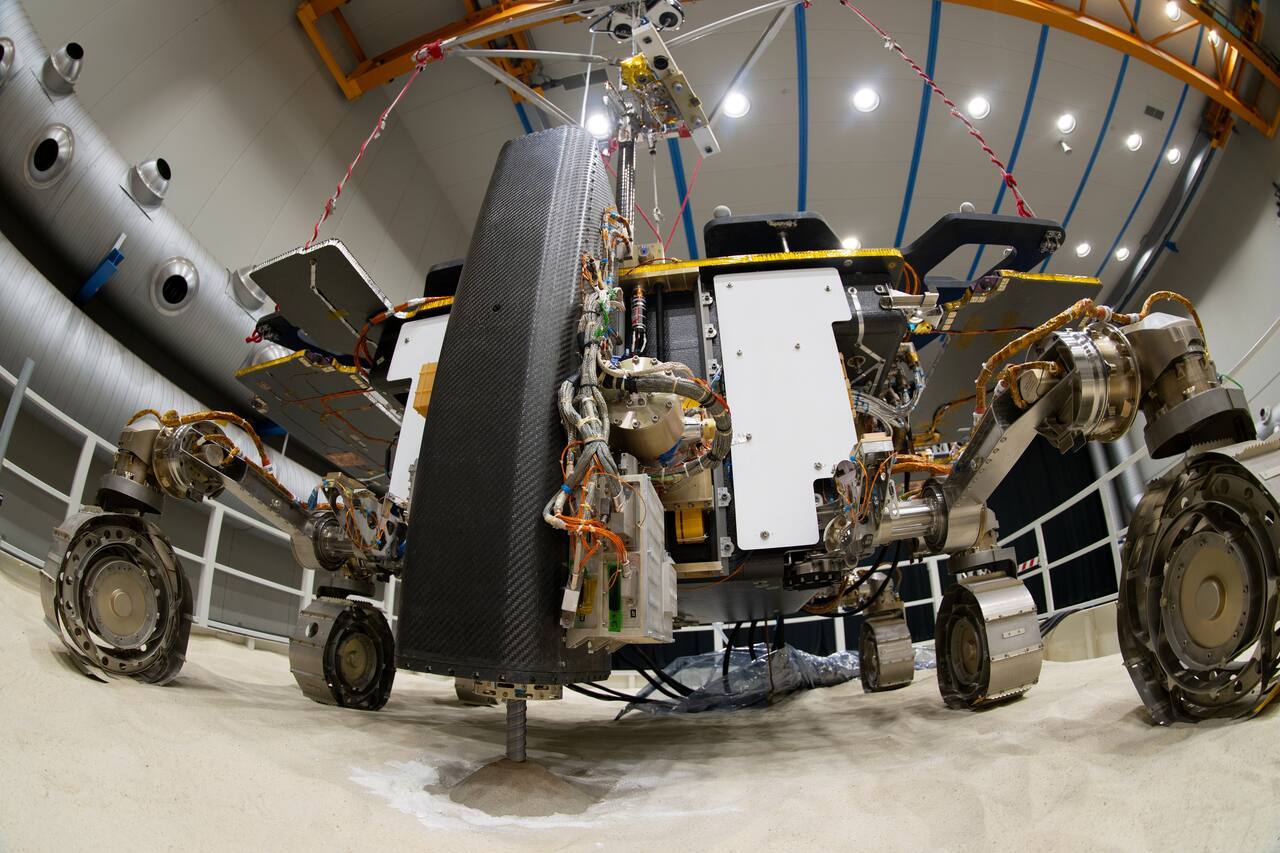 ESA/S. Corvaja.
The problem
Section titled “The problem”Rosalind Franklin is the ESA ExoMars rover, a solar-powered six-wheeled vehicle that carries a 2 m rotary drill and an internal analytical laboratory [13], [11]. It has to drive between sampling sites, acquire cores from depths of 0 to 2 m and deliver them, crushed, to onboard spectrometers and a mass spectrometer without exposing the material to the ambient environment [14], [15]. Mass is about 310 kg, of which 26 kg is instrument payload, a figure that excludes the drill and the sample processing mechanisms [13].
The environment sets four constraints. Lander accommodation capped the wheels at 28.5 cm diameter and 12.0 cm width, so traction on loose soil has to come from wheel compliance and gait rather than size [11]. Communication is two Trace Gas Orbiter relay passes per sol, so autonomy level is set by link availability [13]. Organic and volatile content has to survive acquisition, which puts thermal limits on the drill and on the crusher [11]. The vehicle also has to keep its sample path clean: the laboratory path is sealed at positive pressure until opened on Mars [15].
The rover has not been to Mars. Launch was suspended in 2022 when cooperation with Roscosmos ended and the Russian descent module was lost to the program [6]. ESA is building a European entry, descent and landing module reusing the qualified onboard computer, the radar Doppler altimeter and the parachute system, with NASA providing the launch service, elements of the landing propulsion and radioisotope heater units [6]. The 2004 Phase A concept run by an MDA-led team was a 240 kg rover with a different chassis and is not the flown configuration [2].
What has flown
Section titled “What has flown”Nothing of the rover itself has flown. The evidence is flight heritage of related hardware and software, and ground testing of Rosalind Franklin hardware and testbeds. Every item below is a different vehicle unless stated.
Schiaparelli, 2016. The ExoMars EDL demonstrator launched with the Trace Gas Orbiter in March 2016 and did not survive descent, so the landing was never verified in flight and arrival timing was checked against predicted rise time instead [17]. Its DREAMS package returned no surface data [7].
MER navigation, 2004 onward. The Field D* global planner was uploaded to the Mars Exploration Rovers in summer 2006 and checked out five times on Opportunity, the first on sol 1014 [24]. The rover’s PanCam descends from the MER Pancam, a stereo multispectral imager flown on Spirit and Opportunity [3].
Curiosity mobility, 2012 onward. Over 21,318.5 m and 738 attempted drives in seven years, visual odometry converged in 99.55 percent of attempts, with feature-poor sandy terrain as the dominant failure [25]. Curiosity’s wheel skin began cracking about 14 months into the mission; by sol 3195 and 26,256 m, four grousers were broken [21]. Traction control, a proprioceptive wheel-speed algorithm, reduced the resultant load on leading front wheels by 19 percent on average in ground tests [22]. Shedding the unconstrained inner wheel section and driving on the rim was tested on the Scarecrow rover, where the only statistically significant slip increase was 2.95 percent [23]. Thermal inertia from the rover ground temperature sensor cut slip prediction error on sand from 22.0 to 16.8 percent over 135 flight measurements [26].
Perseverance, 2021 onward. The ENav algorithm has flown on Perseverance since 2021, with FPGA-accelerated stereo, wheel-slip bounding-box expansion and verification in Monte Carlo simulation and the JPL Mars Yard [29]. It averaged 92 m/h through sol 1312, against 17.3 m/h for Curiosity [29]. Mars 2020 flight software is also tested in SSDEV, which runs it against commercial avionics so that testing is not limited by scarce flight-like testbeds [28]. During the Jezero rim ascent, wheel slip exceeded 94 percent on a 20 degree slope and the drive was abandoned [30].
Rosalind Franklin’s flexible, independently steered and deployed wheels carry loads along a different path from the Curiosity wheels, and no test of this wheel on sharp outcrop has been published.
What is being tried now
Section titled “What is being tried now”Wheel-walking. A coordinated gait drives the wheel motors and the deployment joints together, so each wheel train is advanced by the knee joint while the wheel turns [1]. Tests reported for the ExoMars configuration showed better dynamic stability during egress, better traction on loose soil and increased gradeability [11]. Status: ground tests and simulation only. A 2005 simulation of the earlier chassis gave 25 degrees climbed with wheel-walking against 18 with normal driving, and 23 against 16 on a mixed drift-cloddy soil [2]. A 2019 simulation on the ExoTeR testbed found normal driving always draws less current, and wheel-walking wins on energy per distance only on terrains with flat slip ratio of about 0.47 or more and rolling resistance coefficient of about 0.21 or more [1].
Locomotion mode selection and slip estimation. Wheel odometry cannot give slip during wheel-walking because the wheels do not roll continuously; an estimator that commands a wheel speed increment and reads wheel train acceleration was proposed and tested in simulation [1]. Slip prediction from Curiosity flight data adds thermal inertia as an input to a slope-only model [28]. Neither approach has been run on Rosalind Franklin.
Rover testbeds. ESA’s ExoTeR (2008 to 2010) and MaRTA (2017 to 2019) are built from commercial parts and are not flight representative; their wheel-walking results are reported only qualitatively, as encouraging or reduced slip [16]. Six force-torque sensors mounted above the MaRTA wheels were field-tested at Bardenas Reales at 1 to 5 cm/s. Drawbar pull could not be read from them because vibration swamped the signal, though terrain classification reached 95.6 percent against 85.8 percent for the chassis IMU, and the authors recommend motor current sensing for slip detection [8].
Soil and gravity for testbeds. The three testbed simulants ES-1, ES-2 and ES-3 were characterized by direct shear and pressure sinkage, and the compacted state of ES-1 reached 1.21 g/cm3 against a 1300 kg/m3 specification minimum, with instantaneous friction angles of 29.5 to 32.3 degrees against a 16 to 24 degree specification [18]. On gravity, parabolic-flight data showed that testing at lunar weight on Earth overstates mobility, with drawbar pull to weight of an ExoMars flexible wheel in ES-2 falling 20 percent on average in lunar gravity at equal load [20]. Granular scaling laws predicted lunar-gravity wheel performance from 1 g tests with a drawbar-pull error of 8.5 percent, against 44 percent for matching cone index [31].
Onboard navigation compute. FPGA stereo and visual odometry co-processors were prototyped on the Athena rover for continuous driving, with a 1024-pixel stereo map in 0.082 s against 24 to 30 s for 256-pixel stereo on the MER RAD6000 [27]. Rosalind Franklin’s onboard navigation design is not published to that depth: ground control designates targets from compressed stereo imagery, and the rover computes its own solution over the resulting digital terrain maps, using inclinometers, gyroscopes and Sun sensors for attitude and heading [13].
Operations rehearsal. The Atacama ExoMars-like field trial of February 2019 drove a rover emulator through a compressed reference surface mission; two cores were analyzed with a portable Raman demonstrator in the field and a Raman simulator in the laboratory [12].
The numbers
Section titled “The numbers”| Parameter | Value | Source |
|---|---|---|
| Locomotion formula | 6 x 6 x 6 + 6 (supported, driven, steered, deployed) | [11] |
| Suspension | triple bogie, no central differential | [11] |
| Steering modes | point turn, double Ackermann, crab | [11] |
| Wheel | 28.5 cm diameter without grousers, 12.0 cm wide, flexible, grousered | [11] |
| Average ground pressure | about 10 kPa | [11] |
| Drill | rotary, no percussion, 0 to 2 m depth, rock up to 150 MPa | [11], [14] |
| Core sample | about 3 cm long by 1 cm diameter | [14] |
| Crushed particle size | few to about 500 um, median 250 um | [15] |
| Nominal surface lifetime | 218 sols, 6 experiment cycles, about 1.5 km | [11] |
| Assumed traverse and drilling rate | about 100 m per sol, 50 cm per sol | [11] |
| Earliest launch, landing | October 2028, 2030 | [6] |
| Landing site | Oxia Planum, Noachian Fe/Mg phyllosilicates under a dark resistant unit | [10] |
| Link | two TGO passes per sol | [13] |
The reference surface mission is a contractual object: ESA specified that industry deliver a rover able to execute it within the nominal mission duration, with demonstration by simulation and test [13]. It begins with egress and a 10 sol commissioning phase, then a move of about 60 m out of the descent engine contamination zone before the drill and laboratory drawer open, and a drill blank run precedes any biosignature search [11]. An experiment cycle runs seven sols and takes two samples, one surface and one from 1.5 m; a vertical survey drills in 50 cm increments to reach depths of 0, 50, 100, 150 and 200 cm [11]. The drill requirement set counts 7 experiment cycles and at least 2 vertical surveys to 2 m, a minimum of 17 samples [14]. TGO session local time drifts about 30 minutes earlier per sol for three sols and then jumps about 2 hours forward [11].
Payload, from mast to laboratory drawer:
| Instrument | Function | Key parameters | Source |
|---|---|---|---|
| PanCam | multispectral stereo panoramic and high-resolution imaging | two wide-angle cameras, 38.3 degree field of view, 11-position filter wheels, 150 mm stereo baseline; high resolution camera 4.8 degree field of view | [5] |
| ISEM | mast IR point spectrometer, coaligned with the PanCam high-resolution camera | records IR spectra of reflected solar light | [11] |
| WISDOM | ground-penetrating radar for drill site selection | step-frequency, 0.5 to 3.0 GHz, 3 to 10 m depth range depending on regolith dielectric properties, vertical resolution to 3 cm | [4] |
| ADRON | neutron detector for subsurface hydrogen | supports drill site selection | [11] |
| CLUPI | close-up imager on the drill box | focus from 10 cm to infinity, 7 um per pixel at 10 cm, 932 g, under 15 W, 2652 by 1768 pixel sensor | [19] |
| Ma_MISS | IR spectrometer integrated in the drill tool | images the borehole wall as drilling proceeds | [11] |
| MicrOmega | near-IR hyperspectral microscope on crushed sample | 250 x 256 pixels by 320 spectral steps, 0.95 to 3.65 um, 20 um per pixel | [11] |
| RLS | Raman spectrometer on crushed sample | 532 nm excitation, 50 um spot, about 150 to 3800 cm-1 shift | [11] |
| MOMA | mass spectrometry of organics, two modes | 11.5 kg without margin; 32 single-use ovens; pyrolysis to 850 C; 266 nm UV laser; gas chromatograph 1.6 kg | [9] |
MOMA runs either as gas chromatography mass spectrometry, with powder dosed into a single-use oven, or as laser desorption mass spectrometry on powder in the refillable container, and ovens are conserved where laser desorption can answer the question [9]. MicrOmega cube analysis on the rover computer selects grain targets for the two spectrometers without a ground cycle [11].
The drill tool is about 70 cm long, with three 50 cm extension rods that route Ma_MISS signals through every joint, and a backup tool without the spectrometer [14]. Sample transfer passes through a door in the front panel to the sealed laboratory drawer, where a jaw crusher and two piezovibrated dosing stations feed the refillable container or an oven [15]. A jammed drill string can be released by counter rotation, and an emergency ejection unit is the last resort, after which no further samples can be delivered [14]. In Mars chamber tests through ice-lens columns of 0 to 35 percent water content, continuous cutting raised temperature about 20 C, and a variable cutting law cut that to 5 C or less [11].
What is not established
Section titled “What is not established”No flight data exist: the rover has not launched, and the figures above come from design descriptions, requirements, chamber tests or simulation [11]. The 25 and 18 degree slope figures come from a 2004 simulation of an earlier chassis that the authors state is not validated against a full-rover test [2]. The wheel-walking switching thresholds were derived on a reduced-scale testbed in simulation with synthetic terrains and do not transfer to named Martian soils [1]. Launch date, landing module and mass budget were set before the 2022 suspension and are being re-baselined [6]. CLUPI figures are pre-flight design values [19]. The Curiosity wheel loads and slip results are for a different rover and wheel [23], [28]. The only EDL flight data of the program are Schiaparelli’s, which do not cover a landing [17]. Array area, peak generation, battery capacity, processor and memory for the rover are not published [13].
References
- Azkarate, M., Gerdes, L., Perez-del-Pulgar, C. J. and Zwick, M. (2019). Choosing the Best Locomotion Mode in Reconfigurable Rovers
. Electronics, 7. Source
BibTeX
@article{azkarate2019choosing, title = {Choosing the Best Locomotion Mode in Reconfigurable Rovers}, author = {Azkarate, Martin and Gerdes, Levin and Perez-del-Pulgar, Carlos J. and Zwick, Manuel}, journal = {Electronics}, volume = {8}, number = {7}, pages = {818}, year = {2019}, doi = {10.3390/electronics8070818}, abstract = {The use of autonomous rovers for planetary exploration is crucial to traverse long distances and perform new discoveries on other planets. One of the most important issues is related to the interaction between the rover wheel and terrain, which would help to save energy and even avoid getting entrapped. The use of reconfigurable rovers with different locomotion modes has demonstrated improvement of traction and energy consumption. Therefore, the objective of this paper is to determine the best locomotion mode during the rover traverse, based on simple parameters, which would be obtained from propioceptive sensors. For this purpose, interaction of different terrains have been modelled and analysed with the ExoTeR, a scale prototype rover of the European ExoMars 2020 mission. This rover is able to perform, among others, the wheel walking locomotion mode, which has been demonstrated to improve traction in different situations. Currently, it is difficult to decide the instant time the rover has to switch from this locomotion mode to another. This paper also proposes a novel method to estimate the slip ratio, useful for deciding the best locomotion mode. Finally, results are obtained from an immersive simulation environment. It shows how each locomotion mode is suitable for different terrains and slopes and the proposed method is able to estimate the slip ratio.} } - Bauer, R., Leung, W. and Barfoot, T. (2005). Development of a Dynamic Simulation Tool for the ExoMars Rover
. International Symposium on Artificial Intelligence, Robotics and Automation in Space. Source
BibTeX
@inproceedings{bauer2005development, title = {Development of a Dynamic Simulation Tool for the ExoMars Rover}, author = {Bauer, Robert and Leung, William and Barfoot, Timothy}, booktitle = {International Symposium on Artificial Intelligence, Robotics and Automation in Space}, year = {2005}, url = {http://asrl.utias.utoronto.ca/~tdb/bib/bauer_isairas05.pdf} } - Bell III, J. F., Squyres, S. W., Herkenhoff, K. E., Maki, J. N., Arneson, H. M., Brown, D., Collins, S. A., Dingizian, A., Elliot, S. T., Hagerott, E. C., Hayes, A. G., Johnson, M. J., Johnson, J. R., Joseph, J., Kinch, K., Lemmon, M. T., Morris, R. V., Scherr, L., Schwochert, M., Shepard, M. K., Smith, G. H., Sohl-Dickstein, J. N., Sullivan, R. J., Sullivan, W. T. and Wadsworth, M. (2003). Mars Exploration Rover Athena Panoramic Camera (Pancam) investigation
. Journal of Geophysical Research, E12. Source
BibTeX
@article{bell2003mars, title = {Mars Exploration Rover Athena Panoramic Camera (Pancam) investigation}, author = {Bell III, J. F. and Squyres, Steven W. and Herkenhoff, K. E. and Maki, Justin N. and Arneson, H. M. and Brown, David and Collins, S. A. and Dingizian, A. and Elliot, S. T. and Hagerott, E. C. and Hayes, Alexander G. and Johnson, M. J. and Johnson, Jeffrey R. and Joseph, Jonathan and Kinch, K. and Lemmon, Mark T. and Morris, Richard V. and Scherr, L. and Schwochert, Mark and Shepard, Michael K. and Smith, G. H. and Sohl-Dickstein, J. N. and Sullivan, Robert J. and Sullivan, W. T. and Wadsworth, M.}, journal = {Journal of Geophysical Research}, volume = {108}, number = {E12}, pages = {8063}, year = {2003}, doi = {10.1029/2003je002070}, abstract = {The Panoramic Camera (Pancam) investigation is part of the Athena science payload launched to Mars in 2003 on NASA's twin Mars Exploration Rover (MER) missions. The scientific goals of the Pancam investigation are to assess the high‐resolution morphology, topography, and geologic context of each MER landing site, to obtain color images to constrain the mineralogic, photometric, and physical properties of surface materials, and to determine dust and aerosol opacity and physical properties from direct imaging of the Sun and sky. Pancam also provides mission support measurements for the rovers, including Sun‐finding for rover navigation, hazard identification and digital terrain modeling to help guide long‐term rover traverse decisions, high‐resolution imaging to help guide the selection of in situ sampling targets, and acquisition of education and public outreach products. The Pancam optical, mechanical, and electronics design were optimized to achieve these science and mission support goals. Pancam is a multispectral, stereoscopic, panoramic imaging system consisting of two digital cameras mounted on a mast 1.5 m above the Martian surface. The mast allows Pancam to image the full 360° in azimuth and ±90° in elevation. Each Pancam camera utilizes a 1024 × 1024 active imaging area frame transfer CCD detector array. The Pancam optics have an effective focal length of 43 mm and a focal ratio of f /20, yielding an instantaneous field of view of 0.27 mrad/pixel and a field of view of 16° × 16°. Each rover's two Pancam “eyes” are separated by 30 cm and have a 1° toe‐in to provide adequate stereo parallax. Each eye also includes a small eight position filter wheel to allow surface mineralogic studies, multispectral sky imaging, and direct Sun imaging in the 400–1100 nm wavelength region. Pancam was designed and calibrated to operate within specifications on Mars at temperatures from −55° to +5°C. An onboard calibration target and fiducial marks provide the capability to validate the radiometric and geometric calibration on Mars.} } - Ciarletti, V., Clifford, S., Plettemeier, D., Le Gall, A., Hervé, Y., Dorizon, S., Quantin-Nataf, C., Benedix, W.-S., Schwenzer, S., Pettinelli, E., Heggy, E., Herique, A., Berthelier, J.-J., Kofman, W., Vago, J. L., Hamran, S.-E. and the WISDOM Team. (2017). The WISDOM Radar: Unveiling the Subsurface Beneath the ExoMars Rover and Identifying the Best Locations for Drilling
. Astrobiology, 6-7. Source
BibTeX
@article{ciarletti2017wisdom, title = {The WISDOM Radar: Unveiling the Subsurface Beneath the ExoMars Rover and Identifying the Best Locations for Drilling}, author = {Ciarletti, Valérie and Clifford, Stephen and Plettemeier, Dirk and Le Gall, Alice and Hervé, Yann and Dorizon, Sophie and Quantin-Nataf, Cathy and Benedix, Wolf-Stefan and Schwenzer, Susanne and Pettinelli, Elena and Heggy, Essam and Herique, Alain and Berthelier, Jean-Jacques and Kofman, Wlodek and Vago, Jorge L. and Hamran, Svein-Erik and {the WISDOM Team}}, journal = {Astrobiology}, volume = {17}, number = {6-7}, pages = {565--584}, year = {2017}, doi = {10.1089/ast.2016.1532}, abstract = {The search for evidence of past or present life on Mars is the principal objective of the 2020 ESA-Roscosmos ExoMars Rover mission. If such evidence is to be found anywhere, it will most likely be in the subsurface, where organic molecules are shielded from the destructive effects of ionizing radiation and atmospheric oxidants. For this reason, the ExoMars Rover mission has been optimized to investigate the subsurface to identify, understand, and sample those locations where conditions for the preservation of evidence of past life are most likely to be found. The Water Ice Subsurface Deposit Observation on Mars (WISDOM) ground-penetrating radar has been designed to provide information about the nature of the shallow subsurface over depth ranging from 3 to 10 m (with a vertical resolution of up to 3 cm), depending on the dielectric properties of the regolith. This depth range is critical to understanding the geologic evolution stratigraphy and distribution and state of subsurface H2O, which provide important clues in the search for life and the identification of optimal drilling sites for investigation and sampling by the Rover's 2-m drill. WISDOM will help ensure the safety and success of drilling operations by identification of potential hazards that might interfere with retrieval of subsurface samples. Key Words: Ground penetrating radar—Martian shallow subsurface—ExoMars. Astrobiology 17, 565–584.} } - Coates, A. J., Jaumann, R., Griffiths, A. D., Leff, C., Schmitz, N., Josset, J.-L., Paar, G., Gunn, M., Hauber, E., Cousins, C., Cross, R., Grindrod, P. M., Bridges, J. C., Balme, M., Gupta, S., Crawford, I. A., Irwin, P., Stabbins, R., Tirsch, D., Vago, J. L., Theodorou, T., Caballo-Perucha, M., Osinski, G. and the PanCam Team. (2017). The PanCam Instrument for the ExoMars Rover
. Astrobiology, 6-7. Source
BibTeX
@article{coates2017pancam, title = {The PanCam Instrument for the ExoMars Rover}, author = {Coates, Andrew J. and Jaumann, Ralf and Griffiths, Andrew D. and Leff, C.E. and Schmitz, Nicole and Josset, Jean-Luc and Paar, Gerhard and Gunn, Matthew and Hauber, Ernst and Cousins, C.R. and Cross, R.E. and Grindrod, Peter M. and Bridges, John C. and Balme, M. and Gupta, Sanjeev and Crawford, Ian A. and Irwin, P. and Stabbins, R. and Tirsch, D. and Vago, Jorge L. and Theodorou, T. and Caballo-Perucha, M. and Osinski, G.R. and {the PanCam Team}}, journal = {Astrobiology}, volume = {17}, number = {6-7}, pages = {511--541}, year = {2017}, doi = {10.1089/ast.2016.1548}, abstract = {The scientific objectives of the ExoMars rover are designed to answer several key questions in the search for life on Mars. In particular, the unique subsurface drill will address some of these, such as the possible existence and stability of subsurface organics. PanCam will establish the surface geological and morphological context for the mission, working in collaboration with other context instruments. Here, we describe the PanCam scientific objectives in geology, atmospheric science, and 3-D vision. We discuss the design of PanCam, which includes a stereo pair of Wide Angle Cameras (WACs), each of which has an 11-position filter wheel and a High Resolution Camera (HRC) for high-resolution investigations of rock texture at a distance. The cameras and electronics are housed in an optical bench that provides the mechanical interface to the rover mast and a planetary protection barrier. The electronic interface is via the PanCam Interface Unit (PIU), and power conditioning is via a DC-DC converter. PanCam also includes a calibration target mounted on the rover deck for radiometric calibration, fiducial markers for geometric calibration, and a rover inspection mirror. Key Words: Mars—ExoMars—Instrumentation—Geology—Atmosphere—Exobiology—Context. Astrobiology 17, 511–541.} } - European Space Agency. (2024). FAQ: The 'rebirth' of ESA's ExoMars Rosalind Franklin mission. esa.int/Science_Exploration/Human_and_Robotic_Exploration/Exploration...
BibTeX
@misc{esa2024faq, title = {FAQ: The 'rebirth' of ESA's ExoMars Rosalind Franklin mission}, author = {{European Space Agency}}, year = {2024}, url = {https://www.esa.int/Science_Exploration/Human_and_Robotic_Exploration/Exploration/ExoMars/FAQ_The_rebirth_of_ESA_s_ExoMars_Rosalind_Franklin_mission} } - Esposito, F., Debei, S., Bettanini, C., Molfese, C., Arruego Rodríguez, I., Colombatti, G., Harri, A.-M., Montmessin, F., Wilson, C., Aboudan, A., Schipani, P., Marty, L., Álvarez, F. J., Apestigue, V., Bellucci, G., Berthelier, J.-J., Brucato, J. R., Calcutt, S. B., Chiodini, S., Cortecchia, F., Cozzolino, F., Cucciarrè, F., Deniskina, N., Déprez, G., Di Achille, G., Ferri, F., Forget, F., Franzese, G., Friso, E., Genzer, M., Hassen-Kodja, R., Haukka, H., Hieta, M., Jiménez, J. J., Josset, J.-L., Kahanpää, H., Karatekin, O., Landis, G., Lapauw, L., Lorenz, R., Martinez-Oter, J., Mennella, V., Möhlmann, D., Moirin, D., Molinaro, R., Nikkanen, T., Palomba, E., Patel, M. R., Pommereau, J.-P., Popa, C. I., Rafkin, S., Rannou, P., Renno, N. O., Rivas, J., Schmidt, W., Segato, E., Silvestro, S., Spiga, A., Toledo, D., Trautner, R., Valero, F., Vázquez, L., Vivat, F., Witasse, O., Yela, M., Mugnuolo, R., Marchetti, E. and Pirrotta, S. (2018). The DREAMS Experiment Onboard the Schiaparelli Module of the ExoMars 2016 Mission: Design, Performances and Expected Results
. Space Science Reviews. Source
BibTeX
@article{esposito2018dreams, title = {The {DREAMS} Experiment Onboard the {Schiaparelli} Module of the {ExoMars} 2016 Mission: Design, Performances and Expected Results}, author = {Esposito, Francesca and Debei, S. and Bettanini, C. and Molfese, C. and Arruego Rodríguez, I. and Colombatti, G. and Harri, Ari-Matti and Montmessin, Franck and Wilson, Colin and Aboudan, A. and Schipani, P. and Marty, L. and Álvarez, F. J. and Apestigue, V. and Bellucci, Giancarlo and Berthelier, Jean-Jacques and Brucato, John Robert and Calcutt, S. B. and Chiodini, S. and Cortecchia, F. and Cozzolino, F. and Cucciarrè, F. and Deniskina, N. and Déprez, G. and Di Achille, G. and Ferri, Francesca and Forget, Francois and Franzese, G. and Friso, E. and Genzer, Maria and Hassen-Kodja, R. and Haukka, Harri and Hieta, M. and Jiménez, J. J. and Josset, Jean-Luc and Kahanpää, H. and Karatekin, O. and Landis, Geoffrey and Lapauw, Laurent and Lorenz, R. and Martinez-Oter, J. and Mennella, V. and Möhlmann, D. and Moirin, D. and Molinaro, R. and Nikkanen, T. and Palomba, Ernesto and Patel, M. R. and Pommereau, J.-P. and Popa, C. I. and Rafkin, S. and Rannou, Pascal and Renno, N. O. and Rivas, J. and Schmidt, Walter and Segato, E. and Silvestro, S. and Spiga, Aymeric and Toledo, D. and Trautner, Roland and Valero, F. and Vázquez, L. and Vivat, F. and Witasse, Olivier and Yela, M. and Mugnuolo, R. and Marchetti, E. and Pirrotta, S.}, journal = {Space Science Reviews}, volume = {214}, year = {2018}, doi = {10.1007/s11214-018-0535-0} } - Gerdes, L., Pérez del Pulgar, C., Castilla Arquillo, R. and Azkarate, M. (2025). Field Assessment of Force Torque Sensors for Planetary Rover Navigation
. Journal of Intelligent and Robotic Systems. Source
BibTeX
@article{gerdes2025field, title = {Field Assessment of Force Torque Sensors for Planetary Rover Navigation}, author = {Gerdes, Levin and Pérez del Pulgar, Carlos and Castilla Arquillo, Raúl and Azkarate, Martin}, journal = {Journal of Intelligent and Robotic Systems}, volume = {111}, year = {2025}, doi = {10.1007/s10846-025-02324-2}, abstract = {Abstract Proprioceptive sensors on planetary rovers serve for state estimation and for understanding terrain and locomotion performance. While inertial measurement units (IMUs) are widely used to this effect, force-torque sensors are less explored for planetary navigation despite their potential to directly measure interaction forces and provide insights into traction performance. This paper presents an evaluation of the performance and use cases of force-torque sensors based on data collected from a six-wheeled rover during tests over varying terrains, speeds, and slopes. We discuss challenges, such as sensor signal reliability and terrain response accuracy, and identify opportunities regarding the use of these sensors. The data is openly accessible and includes force-torque measurements from each of the six-wheel assemblies as well as IMU data from within the rover chassis. This paper aims to inform the design of future studies and rover upgrades, particularly in sensor integration and control algorithms, to improve navigation capabilities.} } - Goesmann, F., Brinckerhoff, W. B., Raulin, F., Goetz, W., Danell, R. M., Getty, S. A., Siljeström, S., Mißbach, H., Steininger, H., Arevalo, J. R. D., Buch, A., Freissinet, C., Grubisic, A., Meierhenrich, U. J., Pinnick, V. T., Stalport, F., Szopa, C., Vago, J. L., Lindner, R., Schulte, M. D., Brucato, J. R., Glavin, D. P., Grand, N., Li, X., van Amerom, F. H. W. and the MOMA Science Team. (2017). The Mars Organic Molecule Analyzer (MOMA) Instrument: Characterization of Organic Material in Martian Sediments
. Astrobiology, 6-7. Source
BibTeX
@article{goesmann2017mars, title = {The Mars Organic Molecule Analyzer (MOMA) Instrument: Characterization of Organic Material in Martian Sediments}, author = {Goesmann, Fred and Brinckerhoff, William B. and Raulin, François and Goetz, Walter and Danell, Ryan M. and Getty, Stephanie A. and Siljeström, Sandra and Mißbach, Helge and Steininger, Harald and Arevalo, Jr., Ricardo D. and Buch, Arnaud and Freissinet, Caroline and Grubisic, Andrej and Meierhenrich, Uwe J. and Pinnick, Veronica T. and Stalport, Fabien and Szopa, Cyril and Vago, Jorge L. and Lindner, Robert and Schulte, Mitchell D. and Brucato, John Robert and Glavin, Daniel P. and Grand, Noel and Li, Xiang and van Amerom, Friso H. W. and {the MOMA Science Team}}, journal = {Astrobiology}, volume = {17}, number = {6-7}, pages = {655--685}, year = {2017}, doi = {10.1089/ast.2016.1551}, abstract = {The Mars Organic Molecule Analyzer (MOMA) instrument onboard the ESA/Roscosmos ExoMars rover (to launch in July, 2020) will analyze volatile and refractory organic compounds in martian surface and subsurface sediments. In this study, we describe the design, current status of development, and analytical capabilities of the instrument. Data acquired on preliminary MOMA flight-like hardware and experimental setups are also presented, illustrating their contribution to the overall science return of the mission. Key Words: Mars—Mass spectrometry—Life detection—Planetary instrumentation. Astrobiology 17, 655–685. 1. Introduction: The Mars Organic Molecule Analyzer (MOMA) Investigation 2. Science Goals 3. Objectives and Requirements 4. Instrument Top-Level Description 5. Instrument Development 5.1. Team organization 5.2. Instrument integration flow 5.3. Instrument verification 5.4. Achieved milestones and deliveries 6. Instrument Subsystems 6.1. Oven and tapping station subsystems 6.1.1. Derivatization 6.1.1.1. MTBSTFA 6.1.1.2. DMF-DMA 6.1.2. Thermochemolysis 6.1.3. Wet chemistry: storage and release of chemical agents 6.2. Gas chromatograph subsystem 6.2.1. Design requirements 6.2.2. Design overview 6.2.2.1. General architecture 6.2.2.2. Injection system 6.2.2.3. Separation of volatiles 6.2.2.4. Detection of volatiles 6.2.2.5. Gas handling system 6.2.2.6. GCMS coupling campaigns 6.3. Laser subsystem 6.3.1. Design requirements 6.3.2. Laser architecture 6.3.3. Verification data 6.4. Mass spectrometer subsystem 6.4.1. Design requirements 6.4.2. Analyzer architecture 6.4.2.1. Linear Ion Trap assembly 6.4.2.2. Detection channels 6.4.2.3. Electron Ionization Source 6.4.2.4. Fast-actuating aperture valve 6.4.2.5. Micropirani pressure sensor 6.4.2.6. Wide-Range Pump 6.4.3. Temperature control 6.4.4. Driving electronics 7. Operation of MOMA on the Surface of Mars 7.1. Expected measurement scenarios 7.2. Sequenced operational modes 7.3. Synergy with other instruments 7.3.1. Data interpretation 7.4. LDMS operations on Mars and test experiments on LDMS prototype system 7.5. Test experiments on GCMS prototype system: a case study 7.5.1. Sample and setup 7.5.2. Methods 7.5.2.1. Stepwise pyrolysis 7.5.2.2. Derivatization/thermochemolysis 7.5.2.3. GCMS parameters 7.5.3. Results and discussion 7.5.3.1. Pyrolysis 7.5.3.2. Derivatization and thermochemolysis 8. Discussion 9. Summary Acknowledgments Author Disclosure Statement References Abbreviations Used} } - Quantin-Nataf, C., Carter, J., Mandon, L., Thollot, P., Balme, M., Volat, M., Pan, L., Loizeau, D., Millot, C., Breton, S., Dehouck, E., Fawdon, P., Gupta, S., Davis, J., Grindrod, P. M., Pacifici, A., Bultel, B., Allemand, P., Ody, A., Lozach, L. and Broyer, J. (2021). Oxia Planum: The Landing Site for the ExoMars "Rosalind Franklin" Rover Mission: Geological Context and Prelanding Interpretation
. Astrobiology, 3. Source
BibTeX
@article{quantinnataf2021oxia, title = {Oxia Planum: The Landing Site for the ExoMars "Rosalind Franklin" Rover Mission: Geological Context and Prelanding Interpretation}, author = {Quantin-Nataf, Cathy and Carter, John and Mandon, Lucia and Thollot, Patrick and Balme, Matthew and Volat, Matthieu and Pan, Lu and Loizeau, Damien and Millot, Cédric and Breton, Sylvain and Dehouck, Erwin and Fawdon, Peter and Gupta, Sanjeev and Davis, Joel and Grindrod, Peter M. and Pacifici, Andrea and Bultel, Benjamin and Allemand, Pascal and Ody, Anouck and Lozach, Loic and Broyer, Jordan}, journal = {Astrobiology}, volume = {21}, number = {3}, pages = {345--366}, year = {2021}, doi = {10.1089/ast.2019.2191}, abstract = {The European Space Agency (ESA) and Roscosmos ExoMars mission will launch the “Rosalind Franklin” rover in 2022 for a landing on Mars in 2023.The goals of the mission are to search for signs of past and present life on Mars, investigate the water/geochemical environment as a function of depth in the shallow subsurface, and characterize the surface environment. To meet these scientific objectives while minimizing the risk for landing, a 5-year-long landing site selection process was conducted by ESA, during which eight candidate sites were down selected to one: Oxia Planum. Oxia Planum is a 200 km-wide low-relief terrain characterized by hydrous clay-bearing bedrock units located at the southwest margin of Arabia Terra. This region exhibits Noachian-aged terrains. We show in this study that the selected landing site has recorded at least two distinct aqueous environments, both of which occurred during the Noachian: (1) a first phase that led to the deposition and alteration of ∼100 m of layered clay-rich deposits and (2) a second phase of a fluviodeltaic system that postdates the widespread clay-rich layered unit. Rounded isolated buttes that overlie the clay-bearing unit may also be related to aqueous processes. Our study also details the formation of an unaltered mafic-rich dark resistant unit likely of Amazonian age that caps the other units and possibly originated from volcanism. Oxia Planum shows evidence for intense erosion from morphology (inverted features) and crater statistics. Due to these erosional processes, two types of Noachian sedimentary rocks are currently exposed. We also expect rocks at the surface to have been exposed to cosmic bombardment only recently, minimizing organic matter damage.} } - Vago, J. L., Westall, F., Coates, A. J., Jaumann, R., Korablev, O., Ciarletti, V., Mitrofanov, I., Josset, J.-L., De Sanctis, M. C., Bibring, J.-P., Rull, F., Goesmann, F., Steininger, H., Goetz, W., Brinckerhoff, W., Szopa, C., Raulin, F., Edwards, H. G. M., Whyte, L. G., Fairen, A. G., Bibring, J.-P., Bridges, J., Hauber, E., Ori, G. G., Werner, S., Loizeau, D., Kuzmin, R. O., Williams, R. M. E., Flahaut, J., Forget, F., Rodionov, D., Svedhem, H., Sefton-Nash, E., Kminek, G., Lorenzoni, L., Joudrier, L., Mikhailov, V., Zashchirinskiy, A., Alexashkin, S., Calantropio, F., Merlo, A., Poulakis, P., Witasse, O., Bayle, O., Bayon, S., Meierhenrich, U., Carter, J., Garcia-Ruiz, J. M., Baglioni, P., Haldemann, A., Ball, A. J., Debus, A., Lindner, R., Haessig, F., Monteiro, D., Trautner, R., Voland, C., Rebeyre, P., Goulty, D., Didot, F., Durrant, S., Zekri, E., Koschny, D., Toni, A., Visentin, G., Zwick, M., van Winnendael, M., Azkarate, M. and Carreau, C. (2017). Habitability on Early Mars and the Search for Biosignatures with the ExoMars Rover
. Astrobiology, 6-7. Source
BibTeX
@article{vago2017habitability, title = {Habitability on Early Mars and the Search for Biosignatures with the ExoMars Rover}, author = {Vago, Jorge L. and Westall, Frances and Coates, Andrew J. and Jaumann, Ralf and Korablev, Oleg and Ciarletti, Valerie and Mitrofanov, Igor and Josset, Jean-Luc and De Sanctis, Maria Cristina and Bibring, Jean-Pierre and Rull, Fernando and Goesmann, Fred and Steininger, Harald and Goetz, Walter and Brinckerhoff, William and Szopa, Cyril and Raulin, Francois and Edwards, Howell G. M. and Whyte, Lyle G. and Fairen, Alberto G. and Bibring, Jean-Pierre and Bridges, John and Hauber, Ernst and Ori, Gian Gabriele and Werner, Stephanie and Loizeau, Damien and Kuzmin, Ruslan O. and Williams, Rebecca M. E. and Flahaut, Jessica and Forget, Francois and Rodionov, Daniel and Svedhem, Hakan and Sefton-Nash, Elliot and Kminek, Gerhard and Lorenzoni, Leila and Joudrier, Luc and Mikhailov, Viktor and Zashchirinskiy, Alexander and Alexashkin, Sergei and Calantropio, Fabio and Merlo, Andrea and Poulakis, Pantelis and Witasse, Olivier and Bayle, Olivier and Bayon, Silvia and Meierhenrich, Uwe and Carter, John and Garcia-Ruiz, Juan Manuel and Baglioni, Pietro and Haldemann, Albert and Ball, Andrew J. and Debus, Andre and Lindner, Robert and Haessig, Frederic and Monteiro, David and Trautner, Roland and Voland, Christoph and Rebeyre, Pierre and Goulty, Duncan and Didot, Frederic and Durrant, Stephen and Zekri, Eric and Koschny, Detlef and Toni, Andrea and Visentin, Gianfranco and Zwick, Martin and van Winnendael, Michel and Azkarate, Miguel and Carreau, Christophe}, journal = {Astrobiology}, volume = {17}, number = {6-7}, pages = {471--510}, year = {2017}, doi = {10.1089/ast.2016.1533}, abstract = {The second ExoMars mission will be launched in 2020 to target an ancient location interpreted to have strong potential for past habitability and for preserving physical and chemical biosignatures (as well as abiotic/prebiotic organics). The mission will deliver a lander with instruments for atmospheric and geophysical investigations and a rover tasked with searching for signs of extinct life. The ExoMars rover will be equipped with a drill to collect material from outcrops and at depth down to 2 m. This subsurface sampling capability will provide the best chance yet to gain access to chemical biosignatures. Using the powerful Pasteur payload instruments, the ExoMars science team will conduct a holistic search for traces of life and seek corroborating geological context information. Key Words: Biosignatures—ExoMars—Landing sites—Mars rover—Search for life. Astrobiology 17, 471–510. Table of Contents 1. Article Organization 2. Introduction 2.1. ExoMars origin 2.2. A difficult adolescence 2.3. Joint program 3. Early Mars as an Exobiology Target 3.1. A first window of opportunity for life 3.2. Separate ways 3.2.1. Young Earth 3.2.2. Young Mars 3.2.3. Young Venus 3.3. Lessons for ExoMars: when and where? 4. Biosignatures: Which and How Reliable? 4.1. Morphological biosignatures 4.2. Chemical biosignatures 4.2.1. Isomerism selectivity 4.2.2. Molecular weight fingerprints 4.2.3. Bulk isotopic fractionation 4.3. Importance of geological context for boosting biosignature confidence 4.4. Life's decision points 4.5. Examples using the ExoMars biosignature score 4.5.1. Kitty's Gap, N.W. Australia 4.5.2. Josefsdal Chert, Barberton, South Africa 4.5.3. Martian Meteorite ALH84001 4.5.4. Yellowknife Bay, Mars 5. The Martian Environment and the Need for Subsurface Exploration 5.1. Results from previous missions 5.2. Degradation of organic matter 5.3. Access to molecular biosignatures 6. The ExoMars Rover and Its Pasteur Payload 6.1. From panoramic to molecular scale through nested investigations 6.2. Pasteur payload instruments 6.2.1. Panoramic camera system 6.2.2. IR spectrometer 6.2.3. Shallow ground-penetrating radar 6.2.4. Subsurface neutron detector 6.2.5. Close-up imager 6.2.6. Drill IR spectrometer 6.2.7. Subsurface drill 6.2.8. Sample preparation and distribution system 6.2.9. MicrOmega 6.2.10. Raman laser spectrometer 6.2.11. Mars organic molecule analyzer 6.3. The reference surface mission 7. A Suitable Landing Site 7.1. Scientific constraints 7.2. Engineering constraints 7.3. Planetary protection constraints 7.4. Possible locations for landing 7.4.1. Oxia Planum (18.159°N, 335.666°E; −3 km MOLA) 7.4.2. Mawrth Vallis (22.160°N, 342.050°E; −2 km MOLA) 8. Conclusions Acknowledgments Author Disclosure Statement References Abbreviations Used} } - Veneranda, M., Lopez-Reyes, G., Saiz, J., Manrique-Martinez, J. A., Sanz-Arranz, A., Medina, J., Moral, A., Seoane, L., Ibarmia, S. and Rull, F. (2021). ExoFiT Trial at the Atacama Desert (Chile): Raman Detection of Biomarkers by Representative Prototypes of the ExoMars/Raman Laser Spectrometer
. Scientific Reports. Source
BibTeX
@article{veneranda2021exofit, title = {ExoFiT Trial at the Atacama Desert (Chile): Raman Detection of Biomarkers by Representative Prototypes of the ExoMars/Raman Laser Spectrometer}, author = {Veneranda, Marco and Lopez-Reyes, Guillermo and Saiz, Jesus and Manrique-Martinez, Jose Antonio and Sanz-Arranz, Aurelio and Medina, Jesús and Moral, Andoni and Seoane, Laura and Ibarmia, Sergio and Rull, Fernando}, journal = {Scientific Reports}, volume = {11}, pages = {1730}, year = {2021}, doi = {10.1038/s41598-021-81014-z}, abstract = {Abstract In this work, the analytical research performed by the Raman Laser Spectrometer (RLS) team during the ExoFiT trial is presented. During this test, an emulator of the Rosalind Franklin rover was remotely operated at the Atacama Desert in a Mars-like sequence of scientific operations that ended with the collection and the analysis of two drilled cores. The in-situ Raman characterization of the samples was performed through a portable technology demonstrator of RLS (RAD1 system). The results were later complemented in the laboratory using a bench top RLS operation simulator and a X-Ray diffractometer (XRD). By simulating the operational and analytical constraints of the ExoMars mission, the two RLS representative instruments effectively disclosed the mineralogical composition of the drilled cores (k-feldspar, plagioclase, quartz, muscovite and rutile as main components), reaching the detection of minor phases (e.g., additional phyllosilicate and calcite) whose concentration was below the detection limit of XRD. Furthermore, Raman systems detected many organic functional groups (–C≡N, –NH 2 and C–(NO 2 )), suggesting the presence of nitrogen-fixing microorganisms in the samples. The Raman detection of organic material in the subsurface of a Martian analogue site presenting representative environmental conditions (high UV radiation, extreme aridity), supports the idea that the RLS could play a key role in the fulfilment of the ExoMars main mission objective: to search for signs of life on Mars.} } - (2026). ESA: ExoMars Rover Rosalind Franklin. exploration.esa.int/web/mars/-/45084-exomars-rover
BibTeX
@misc{esaexomars, title = {ESA: ExoMars Rover Rosalind Franklin}, organization = {exploration.esa.int}, year = {2026}, url = {https://exploration.esa.int/web/mars/-/45084-exomars-rover} } - (2026). ESA: The ExoMars drill unit. exploration.esa.int/web/mars/-/43611-rover-drill
BibTeX
@misc{esaexomars2, title = {ESA: The ExoMars drill unit}, organization = {exploration.esa.int}, year = {2026}, url = {https://exploration.esa.int/web/mars/-/43611-rover-drill} } - (2026). ESA: Rover sample handling. exploration.esa.int/web/mars/-/43612-rover-sample-handling
BibTeX
@misc{esarover,
  title = {ESA: Rover sample handling},
  organization = {exploration.esa.int},
  year = {2026},
  url = {https://exploration.esa.int/web/mars/-/43612-rover-sample-handling}
}