Philae
Program pages ESA: Rosetta
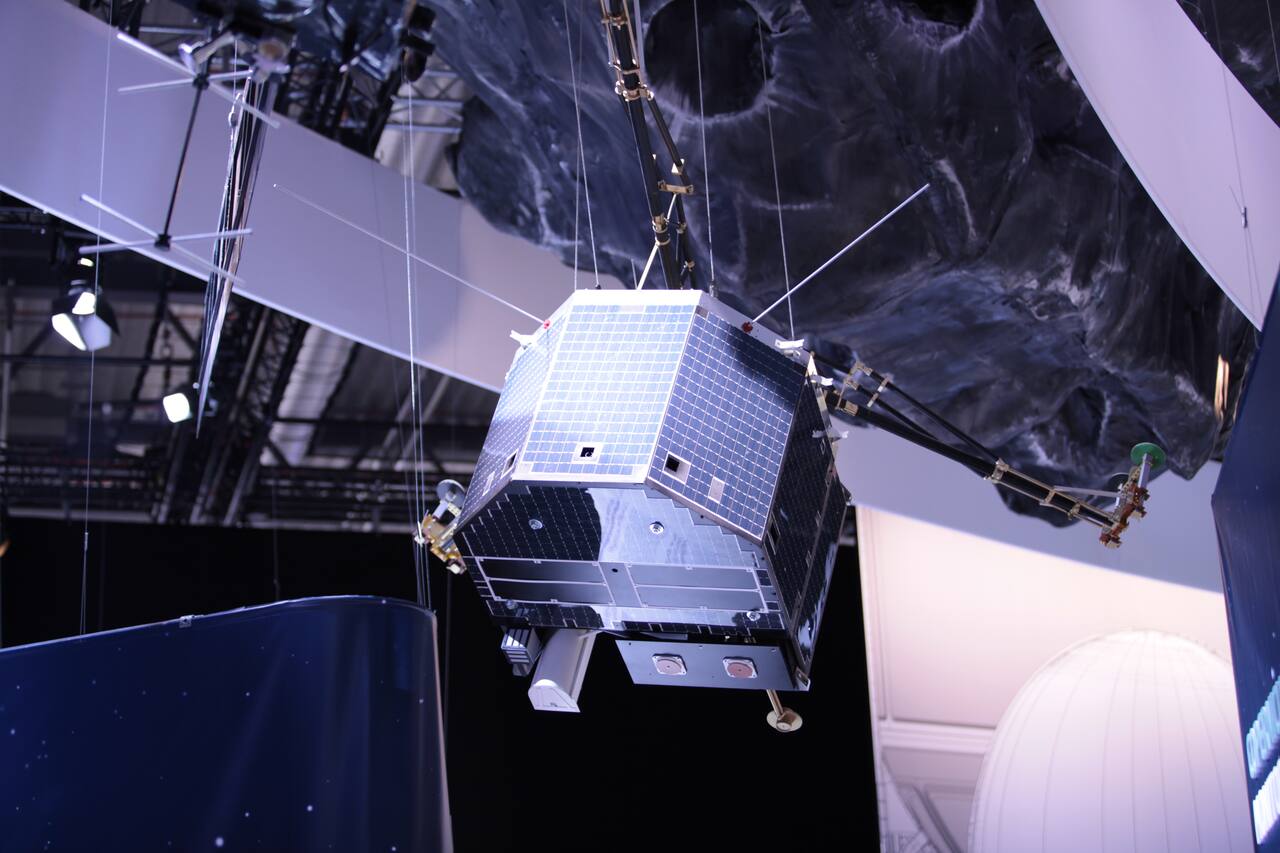 DLR German Aerospace Center. Creative Commons attribution license.
The problem
Section titled “The problem”A lander on a comet nucleus has to arrive on a body whose surface strength and gravity are poorly known beforehand, stay on it, and operate from whatever attitude it ends in. Gravity is a fraction of a milli-g, so weight gives neither traction nor a reaction force for a drill. Cohesion between grains dominates weight over a wide size range: the Bond number reaches unity at a grain radius of about 2 cm at 1 milli-g and about 65 cm at 1 micro-g [6]. The lander cannot press a tool into such a surface with its own weight, so anchoring has to be active, and the landing sequence has to tolerate a surface that is either a thin soft layer over hard material or a hard crust.
Power and communication add constraints. The only link to Earth is a relay through the orbiter, the lander is solar powered, and illumination depends on the final attitude and local shadowing, which the descent cannot control once the lander has separated [19].
What has flown
Section titled “What has flown”Philae. Philae was the lander of Rosetta and the first spacecraft to land on a comet nucleus. A consortium led by DLR with CNES, ASI and the Max Planck Institute for Solar System Research provided it, and the orbiter delivered it to 67P/Churyumov-Gerasimenko on 12 November 2014 [21]. Lander mass was 97.6 kg, 111 kg including the units left on the orbiter, with 27 kg of instruments across 10 experiments [1]. Separation was at 20.5 km, followed by a seven-hour ballistic descent [19]. Separation velocity from the spring system was 0.1874 m/s [1].
The three hold-down systems did not work. The cold gas thruster on the top plate did not fire, the harpoons did not fire, and the ice screws in each foot could not engage because the lander was already rebounding [19]. The lander touched down at Agilkia at 15:34 UTC at 1.01 m/s with a damper stroke of 42.6 mm, rebounded at 0.325 m/s, and reached its final rest at Abydos at 17:31 UTC after about two hours [8]. A second contact had occurred in a crevice between two boulders, identified only after the fact [12]. The rest attitude was in a shaded rocky wedge. The primary battery supported 56 h 28 min of science, then the lander went into hibernation [19]. It woke in late April 2015, and contact in June and July 2015 was too short to command new science [1]. Operations then had to recover from the unplanned landing by rescheduling the First Science Sequence in near real time [23]. ESOC flight operations carried out the separation and touchdown [22].
MASCOT. MASCOT, carried by Hayabusa2, took the opposite approach and made no attempt to anchor. The pre-landing design was a 9.8 kg lander with four instruments totaling about 3 kg, a primary battery giving roughly 16 hours on the surface, no attitude control in free fall, and a single eccentric-arm mechanism for self-righting and mobility [29].
OSIRIS-REx touch-and-go. OSIRIS-REx sampled Bennu without landing: the gas-driven TAGSAM touch-and-go sampler avoids holding attitude and position on a surface with negligible gravity, because contact is brief and the spacecraft retreats [32]. Bennu had no hazard-free patch larger than 8 m radius against a 25 m delivery requirement, so the team replaced lidar with natural feature tracking as the prime onboard guidance update and added a patch that compares the predicted touchdown covariance with an onboard hazard map at 5 m altitude and waves off if the contact is unsafe [30].
What is being tried now
Section titled “What is being tried now”Better ground-truth of the Philae landing. Rebound and touchdown have been reconstructed in several ways. Attitude was recovered from solar panel power fitted to a seven degree of freedom model [4]. A discrete-element simulation of the Agilkia rebound was used to characterize the soil [20]. A damper-trace model gave the compressive strength at the first touchdown [21]. Close-up ROLIS images fixed the Abydos surroundings [5]. These are all post-flight analyses of one event.
Ground testing of touchdown. Before flight, touchdown dynamics were qualified on a pendulum (1996 to 2002) and retested in spring 2013 on a robot-suspended gravity offload rig, where the suspension itself, 4080 N/m against 242 N/m for the pendulum, perturbed the measurement [25]. The offload rig produced an acceleration peak from the suspension hitting its end stop, which must be removed before the data feeds simulation [26]. The landing preparation process, with five candidate sites and a Monte Carlo landing success estimate, is documented in [24], and the on-comet operations plan, including the First Science Sequence, in [13]. Science activity sequences were built with a constraint-programming scheduler that handles energy, mass-memory and co-activity limits [35]. Before landing, a soil-mechanics model put typical foot penetration at up to 20 cm [34].
Sampling by contact without landing. Multi-body simulation of touch-and-go sampling for a 2200 kg comet sample return bus swept drop velocity, slope, surface stiffness and arm length [31]. OSIRIS-REx flew the concept at an asteroid [30], [32]. Nothing equivalent has flown at a comet.
Passive and hopping landers. The MASCOT design, built on the lessons of Philae, is compared with Philae and other small-body lander concepts [27]. It has flown once.
Explaining the surface strength. Two groups of models try to reconcile the MUPUS lower bound with the low strengths measured elsewhere [12], [18]. Sintering simulations show that a hardened layer at least a meter thick forms beneath the dust only when grains are tens of microns in radius or smaller [28]. Thermo-viscoelastic modeling finds the layer would crack seasonally [7]. Both are models with an assumed layer.
Site and environment context. Landing site flight dynamics analyses supported selection and post-landing operations [11]. CONSERT radar sounding during descent was simulated before flight [33]. Coma and nucleus context comes from sublimating icy aggregates seen by OSIRIS [9], OSIRIS constraints on the origin of the comet [14], the 16O/18O ratio of coma water [15], perihelion activity seen from the ground [16], and a survey of past and future comet missions [3].
The numbers
Section titled “The numbers”Specifications
Section titled “Specifications”| Parameter | Value |
|---|---|
| Lander mass | 97.6 kg, 111 kg including the units left on Rosetta [1] |
| Instrument complement mass | 27 kg over 10 experiments [1] |
| Body dimensions | about 0.7 x 0.7 x 0.9 m, foot spacing about 2.3 m [1] |
| Separation velocity | 0.1874 m/s [1] |
| Landing gear absorbable energy | 60 J [1] |
| Nucleus surface reachable by soft landing | 40 percent [19] |
| First Science Sequence | 56 h 28 min on primary battery [19] |
| Total returned data | 13.88 Mbyte across ten instruments [19] |
Hold-down systems
Section titled “Hold-down systems”| System | Design function | Outcome |
|---|---|---|
| Landing gear tripod with generator | Convert vertical kinetic energy to electrical energy | Dampers took over 90 percent of the touchdown kinetic energy by one reconstruction [4]; another puts 50 to 80 percent of the 49.5 J impact energy into the soil [8] |
| Active Descent System | Cold gas thruster fired at touchdown to push into the ground | Did not fire [19] |
| Two harpoons with cords | Fired into the surface, then tensioned | Did not fire; ROMAP showed no ignition current [19] |
| Ice screws in each foot | Engage after hold-down | Never engaged; lander already rebounding [19] |
Surface compressive strength
Section titled “Surface compressive strength”Five estimates exist and they span more than five orders of magnitude [10], [12].
| Source | Site | Compressive strength | Nature of the value |
|---|---|---|---|
| Footprint and CASSE trace [8] | Agilkia | order 1 kPa | Homogeneous soil assumed |
| Footprint geometry [2] | Agilkia | 15.6 kPa | Upper limit; harder buried layer |
| Energy balance of three contacts [10] | Upper lobe | 8 +/- 7 Pa to 399 +/- 393 Pa | Upper limits |
| Boulder interior impression, 0.246 m deep [12] | Second touchdown site | below 12 Pa | Upper limit; porosity 75 +/- 7 percent |
| MUPUS hammer, no net penetration beyond 27 mm [18] | Abydos | about 2 MPa | Lower bound |
Overhang strengths from OSIRIS shape and imaging are 30 to 150 Pa compressive with an upper limit of 1500 Pa, against a bulk density of 470 kg/m3 [2]. The MUPUS bound applies to whatever the tip struck at one site, and the hammer fired at about a quarter of design rate [18]. The pre-landing instrument paper gave 2 MPa and 32 cm depth as design targets, not results [17].
Thermal and electrical environment at Abydos
Section titled “Thermal and electrical environment at Abydos”| Quantity | Value |
|---|---|
| Diurnal surface temperature | 90 to 130 K [1] |
| Thermal inertia | 85 J/m2/K/s^0.5 [1] |
| Thermal conductivity | 0.02 to 0.06 W/m/K [1] |
| Bulk porosity of the surface layer | 40 to 55 percent [1] |
| Relative permittivity, first meter | 2.45 [1] |
Touchdown and attitude
Section titled “Touchdown and attitude”| Quantity | Value |
|---|---|
| Touchdown speed at Agilkia | 1.01 m/s [8] |
| Damper stroke | 42.6 mm [8] |
| Rebound speed | 0.325 m/s [8] |
| Descent spin | 0.01216 to 0.01224 rad/s [4] |
| Angular velocity after first touchdown | at least 0.1816 rad/s [4] |
| Antenna visibility cone | 120 degrees [4] |
Payload
Section titled “Payload”| Instrument | Measurement | Operating time | Data returned |
|---|---|---|---|
| APXS | Elemental composition | 6 h 51 min | 0.063 Mbyte |
| CIVA | Panoramic and microscopic imaging | 1 h 50 min | 2.338 Mbyte |
| CONSERT | Interior structure by radio transmission | 16 h 41 min | 2.630 Mbyte |
| COSAC | Molecular composition and chirality | 2 h 08 min | 0.277 Mbyte |
| MUPUS | Density, porosity, thermal properties | 37 h 20 min | 0.347 Mbyte |
| PTOLEMY | Isotopic composition | 1 h 09 min | 0.102 Mbyte |
| ROLIS | Descent and down-looking imaging | 1 h 44 min | 3.878 Mbyte |
| ROMAP | Magnetic field and plasma | 32 h 33 min | 1.268 Mbyte |
| SD2 | Drill sample acquisition | 2 h 48 min | 0.045 Mbyte |
| SESAME | Electrical and acoustic sounding, dust impacts | 15 h 17 min | 2.930 Mbyte |
Values are from [19]. ROLIS has a 1024 x 1024 pixel detector over a 57.7 degree field, nominally focused at 30 cm [5].
What is not established
Section titled “What is not established”The harpoon failure has no confirmed cause; the pyrotechnic storage explanation rests on one ground spare [19]. The Abydos location was not imaged by the lander and the second touchdown site was identified only afterward [12]. Every strength value except the MUPUS bound is an upper limit, and the MUPUS bound is a single-point lower bound, so no value characterizes the bulk surface [10], [18]. The layer proposed to reconcile them is assumed in the models, not derived [7]. The attitude history after the first collision is not recoverable from the available data, since only 17 usable measurements remain [4]. The touch-and-go and passive-lander approaches have been flown at asteroids, not a comet [30], [29].
References
- Boehnhardt, H., Bibring, J.-P., Apathy, I., Auster, H.-U., Ercoli Finzi, A., Goesmann, F., Klingelhöfer, G., Knapmeyer, M., Kofman, W., Krüger, H., Mottola, S., Schmidt, W., Seidensticker, K. J., Spohn, T. and Wright, I. P. (2017). The Philae lander mission and science overview
. Philosophical Transactions of the Royal Society A. Source
BibTeX
@article{boehnhardt2017philae, title = {The Philae lander mission and science overview}, author = {Boehnhardt, H. and Bibring, Jean-Pierre and Apathy, I. and Auster, Hans-Ulrich and Ercoli Finzi, A. and Goesmann, Fred and Klingelhöfer, G. and Knapmeyer, Martin and Kofman, Wlodek and Krüger, H. and Mottola, Stefano and Schmidt, Walter and Seidensticker, Klaus J. and Spohn, Tilman and Wright, Ian P.}, journal = {Philosophical Transactions of the Royal Society A}, volume = {375}, pages = {20160248}, year = {2017}, doi = {10.1098/rsta.2016.0248}, abstract = {The Philae lander accomplished the first soft landing and the first scientific experiments of a human-made spacecraft on the surface of a comet. Planned, expected and unexpected activities and events happened during the descent, the touch-downs, the hopping across and the stay and operations on the surface. The key results were obtained during 12–14 November 2014, at 3 AU from the Sun, during the 63 h long period of the descent and of the first science sequence on the surface. Thereafter, Philae went into hibernation, waking up again in late April 2015 with subsequent communication periods with Earth (via the orbiter), too short to enable new scientific activities. The science return of the mission comes from eight of the 10 instruments on-board and focuses on morphological, thermal, mechanical and electrical properties of the surface as well as on the surface composition. It allows a first characterization of the local environment of the touch-down and landing sites. Unique conclusions on the organics in the cometary material, the nucleus interior, the comet formation and evolution became available through measurements of the Philae lander in the context of the Rosetta mission. This article is part of the themed issue ‘Cometary science after Rosetta’.} } - Groussin, O., Jorda, L., Auger, A.-T., Kührt, E., Gaskell, R., Capanna, C., Scholten, F., Preusker, F., Lamy, P., Hviid, S., Knollenberg, J., Keller, U., Huettig, C., Sierks, H., Barbieri, C., Rodrigo, R., Koschny, D., Rickman, H., A'Hearn, M. F., Agarwal, J., Barucci, M. A., Bertaux, J.-L., Bertini, I., Boudreault, S., Cremonese, G., Da Deppo, V., Davidsson, B., Debei, S., De Cecco, M., El-Maarry, M. R., Fornasier, S., Fulle, M., Gutiérrez, P. J., Güttler, C., Ip, W.-H., Kramm, J.-R., Küppers, M., Lazzarin, M., Lara, L. M., Lopez Moreno, J. J., Marchi, S., Marzari, F., Massironi, M., Michalik, H., Naletto, G., Oklay, N., Pommerol, A., Pajola, M., Thomas, N., Toth, I., Tubiana, C. and Vincent, J.-B. (2015). Gravitational slopes, geomorphology, and material strengths of the nucleus of comet 67P/Churyumov-Gerasimenko from OSIRIS observations
. Astronomy & Astrophysics. Source
BibTeX
@article{groussin2015gravitational, title = {Gravitational slopes, geomorphology, and material strengths of the nucleus of comet 67P/Churyumov-Gerasimenko from OSIRIS observations}, author = {Groussin, Olivier and Jorda, Laurent and Auger, A.-T. and Kührt, Ekkehard and Gaskell, R. and Capanna, C. and Scholten, Frank and Preusker, Frank and Lamy, P. and Hviid, Stubbe and Knollenberg, J. and Keller, U. and Huettig, C. and Sierks, Holger and Barbieri, C. and Rodrigo, R. and Koschny, Detlef and Rickman, H. and A'Hearn, M. F. and Agarwal, J. and Barucci, M. A. and Bertaux, J.-L. and Bertini, I. and Boudreault, S. and Cremonese, Gabriele and Da Deppo, V. and Davidsson, B. and Debei, S. and De Cecco, M. and El-Maarry, Mohammed R. and Fornasier, Sonia and Fulle, M. and Gutiérrez, P. J. and Güttler, Carsten and Ip, Wing-Huen and Kramm, J.-R. and Küppers, Michael and Lazzarin, M. and Lara, L. M. and Lopez Moreno, J. J. and Marchi, S. and Marzari, F. and Massironi, M. and Michalik, H. and Naletto, G. and Oklay, Nilda and Pommerol, A. and Pajola, Maurizio and Thomas, N. and Toth, I. and Tubiana, Cecilia and Vincent, Jean-Baptiste}, journal = {Astronomy & Astrophysics}, volume = {583}, pages = {A32}, year = {2015}, doi = {10.1051/0004-6361/201526379}, abstract = {Aims. We study the link between gravitational slopes and the surface morphology on the nucleus of comet 67P/Churyumov-Gerasimenko and provide constraints on the mechanical properties of the cometary material (tensile, shear, and compressive strengths).} } - Snodgrass, C., Feaga, L., Jones, G. H., Kueppers, M. and Tubiana, C. (2024). Past and Future Comet Missions
. arXiv preprint. Source
BibTeX
@article{snodgrass2024past, title = {Past and Future Comet Missions}, author = {Snodgrass, Colin and Feaga, L. and Jones, Geraint H. and Kueppers, Michael and Tubiana, Cecilia}, journal = {arXiv preprint}, volume = {2208.08476}, year = {2024}, doi = {10.48550/arxiv.2208.08476}, abstract = {We review the history of spacecraft encounters with comets, concentrating on those that took place in the recent past, since the publication of the Comets II book. This includes the flyby missions Stardust and Deep Impact, and their respective extended missions, the Rosetta rendezvous mission, and serendipitous encounters. While results from all of these missions can be found throughout this book, this chapter focuses on the questions that motivated each mission, the technologies that were required to answer these questions, and where each mission opened new areas to investigate. There remain a large number of questions that will require future technologies and space missions to answer; we also describe planned next steps and routes forward that may be pursued by missions that have yet to be selected, and eventually lead to cryogenic sample return of nucleus ices for laboratory study.} } - Baranyai, T., Balázs, A. and Várkonyi, P. L. (2016). Partial reconstruction of the rotational motion of Philae spacecraft during its landing on comet 67P/Churyumov-Gerasimenko
. arXiv preprint. Source
BibTeX
@article{baranyai2016partial, title = {Partial reconstruction of the rotational motion of Philae spacecraft during its landing on comet 67P/Churyumov-Gerasimenko}, author = {Baranyai, Tamás and Balázs, András and Várkonyi, Péter L.}, journal = {arXiv preprint}, year = {2016}, doi = {10.48550/arxiv.1604.04414}, abstract = {This paper presents a partial reconstruction of the rotational dynamics of the Philae spacecraft upon landing on comet 67P/Churyumov-Gerasimenko as part of ESA's Rosetta mission. We analyze the motion and the events triggered by the failure to fix the spacecraft to the comet surface at the time of the first touchdown. Dynamic trajectories obtained by numerical simulation of a 7 degree-of-freedom mechanical model of the spacecraft are fitted to directions of incoming solar radiation inferred from in-situ measurements of the electric power provided by the solar panels. The results include a lower bound of the angular velocity of the lander immediately after its first touchdown. Our study also gives insight into the effect of the programmed turn-off of the stabilizing gyroscope after touchdown; the important dynamical consequences of a small collision during Philae's journey; and the probability that a similar landing scenario harms the operability of this type of spacecraft.} } - Schröder, S. E., Mottola, S., Arnold, G., Grothues, H.-G., Jaumann, R., Keller, H. U., Michaelis, H., Bibring, J.-P., Pelivan, I., Koncz, A., Otto, K., Remetean, E., Souvannavong, F. and Dolives, B. (2017). Close-up images of the final Philae landing site on comet 67P/Churyumov-Gerasimenko acquired by the ROLIS camera
. Icarus. Source
BibTeX
@article{schroder2017close, title = {Close-up images of the final Philae landing site on comet 67P/Churyumov-Gerasimenko acquired by the ROLIS camera}, author = {Schröder, Stefan E. and Mottola, Stefano and Arnold, G. and Grothues, H.-G. and Jaumann, Ralf and Keller, Horst Uwe and Michaelis, H. and Bibring, Jean-Pierre and Pelivan, I. and Koncz, A. and Otto, K. and Remetean, Emile and Souvannavong, F. and Dolives, Benoit}, journal = {Icarus}, volume = {285}, pages = {263-274}, year = {2017}, doi = {10.1016/j.icarus.2016.12.009} } - Scheeres, D. J., Hartzell, C. M., Sánchez, P. and Swift, M. (2010). Scaling forces to asteroid surfaces: The role of cohesion
. Icarus. Source
BibTeX
@article{scheeres2010scaling, title = {Scaling forces to asteroid surfaces: The role of cohesion}, author = {Scheeres, Daniel J. and Hartzell, C. M. and Sánchez, Paul and Swift, M.}, journal = {Icarus}, volume = {210}, pages = {968--984}, year = {2010}, doi = {10.1016/j.icarus.2010.07.009} } - Attree, N., Groussin, O., Jorda, L., Rodionov, S., Auger, A.-T., Thomas, N., Brouet, Y., Poch, O., Kührt, E., Knapmeyer, M., Preusker, F., Scholten, F., Knollenberg, J., Hviid, S. and Hartogh, P. (2018). Thermal fracturing on comets: Applications to 67P/Churyumov-Gerasimenko
. Astronomy & Astrophysics. Source
BibTeX
@article{attree2018thermal, title = {Thermal fracturing on comets: Applications to 67P/Churyumov-Gerasimenko}, author = {Attree, N. and Groussin, Olivier and Jorda, Laurent and Rodionov, S. and Auger, A-T. and Thomas, N. and Brouet, Y. and Poch, O. and Kührt, Ekkehard and Knapmeyer, Martin and Preusker, Frank and Scholten, Frank and Knollenberg, J. and Hviid, Stubbe and Hartogh, Paul}, journal = {Astronomy & Astrophysics}, volume = {610}, pages = {A76}, year = {2018}, doi = {10.1051/0004-6361/201731937}, abstract = {We simulate the stresses induced by temperature changes in a putative hard layer near the surface of comet 67P/Churyumov-Gerasimenko with a thermo-viscoelastic model. Such a layer could be formed by the recondensation or sintering of water ice (and dust grains), as suggested by laboratory experiments and computer simulations, and would explain the high compressive strength encountered by experiments on board the Philae lander. Changes in temperature from seasonal insolation variation penetrate into the comet’s surface to depths controlled by the thermal inertia, causing the material to expand and contract. Modelling this with a Maxwellian viscoelastic response on a spherical nucleus, we show that a hard, icy layer with similar properties to Martian permafrost will experience high stresses: up to tens of MPa, which exceed its material strength (a few MPa), down to depths of centimetres to a metre. The stress distribution with latitude is confirmed qualitatively when taking into account the comet’s complex shape but neglecting thermal inertia. Stress is found to be comparable to the material strength everywhere for sufficient thermal inertia (≳50 J m −2 K −1 s −1∕2 ) and ice content (≳45% at the equator). In this case, stresses penetrate to a typical depth of ~0.25 m, consistent with the detection of metre-scale thermal contraction crack polygons all over the comet. Thermal fracturing may be an important erosion process on cometary surfaces which breaks down material and weakens cliffs.} } - Biele, J., Ulamec, S., Maibaum, M., Roll, R., Witte, L., Jurado, E., Muñoz, P., Arnold, W., Auster, H.-U., Casas, C., Faber, C., Fantinati, C., Finke, F., Fischer, H.-H., Geurts, K., Güttler, C., Heinisch, P., Herique, A., Hviid, S., Kargl, G., Knapmeyer, M., Knollenberg, J., Kofman, W., Kömle, N., Kührt, E., Lommatsch, V., Mottola, S., Pardo de Santayana, R., Remetean, E., Scholten, F., Seidensticker, K. J., Sierks, H. and Spohn, T. (2015). The Landing(s) of Philae and Inferences about Comet Surface Mechanical Properties
. Science, 6247. Source
BibTeX
@article{biele2015landings, title = {The Landing(s) of {Philae} and Inferences about Comet Surface Mechanical Properties}, author = {Biele, Jens and Ulamec, Stephan and Maibaum, Michael and Roll, Reinhard and Witte, Lars and Jurado, Eric and Muñoz, Pablo and Arnold, Walter and Auster, Hans-Ulrich and Casas, Carlos and Faber, Claudia and Fantinati, Cinzia and Finke, Felix and Fischer, Hans-Herbert and Geurts, Koen and Güttler, Carsten and Heinisch, Philip and Herique, Alain and Hviid, Stubbe and Kargl, Günter and Knapmeyer, Martin and Knollenberg, Jörg and Kofman, Wlodek and Kömle, Norbert and Kührt, Ekkehard and Lommatsch, Valentina and Mottola, Stefano and Pardo de Santayana, Ramon and Remetean, Emile and Scholten, Frank and Seidensticker, Klaus J. and Sierks, Holger and Spohn, Tilman}, journal = {Science}, volume = {349}, number = {6247}, pages = {aaa9816}, year = {2015}, doi = {10.1126/science.aaa9816}, abstract = {The Philae lander, part of the Rosetta mission to investigate comet 67P/Churyumov-Gerasimenko, was delivered to the cometary surface in November 2014. Here we report the precise circumstances of the multiple landings of Philae, including the bouncing trajectory and rebound parameters, based on engineering data in conjunction with operational instrument data. These data also provide information on the mechanical properties (strength and layering) of the comet surface. The first touchdown site, Agilkia, appears to have a granular soft surface (with a compressive strength of 1 kilopascal) at least ~20 cm thick, possibly on top of a more rigid layer. The final landing site, Abydos, has a hard surface.} } - Gicquel, A., Vincent, J.-B., Agarwal, J., A'Hearn, M. F., Bertini, I., Bodewits, D., Sierks, H., Lin, Z.-Y., Barbieri, C., Lamy, P. L., Rodrigo, R., Koschny, D., Rickman, H., Keller, H. U., Barucci, M. A., Bertaux, J.-L., Besse, S., Cremonese, G., Da Deppo, V., Davidsson, B., Debei, S., Deller, J., De Cecco, M., Frattin, E., El-Maarry, M. R., Fornasier, S., Fulle, M., Groussin, O., Gutierrez, P. J., Gutierrez-Marquez, P., Guettler, C., Hoefner, S., Hofmann, M., Hu, X., Hviid, S. F., Ip, W.-H., Jorda, L., Knollenberg, J., Kovacs, G., Kramm, J.-R., Kuehrt, E., Kueppers, M., Lara, L. M., Lazzarin, M., Moreno, J. J. L., Lowry, S., Marzari, F., Masoumzadeh, N., Massironi, M., Moreno, F., Mottola, S., Naletto, G., Oklay, N., Pajola, M., Pommerol, A., Preusker, F., Scholten, F., Shi, X., Thomas, N., Toth, I. and Tubiana, C. (2016). Sublimation of icy aggregates in the coma of comet 67P/Churyumov-Gerasimenko detected with the OSIRIS cameras onboard Rosetta
. arXiv preprint. Source
BibTeX
@article{gicquel2016sublimation, title = {Sublimation of icy aggregates in the coma of comet 67P/Churyumov-Gerasimenko detected with the OSIRIS cameras onboard Rosetta}, author = {Gicquel, A. and Vincent, Jean-Baptiste and Agarwal, J. and A'Hearn, M. F. and Bertini, I. and Bodewits, D. and Sierks, Holger and Lin, Z.-Y. and Barbieri, C. and Lamy, P. L. and Rodrigo, R. and Koschny, Detlef and Rickman, H. and Keller, Horst Uwe and Barucci, M. A. and Bertaux, J.-L. and Besse, S. and Cremonese, Gabriele and Da Deppo, V. and Davidsson, B. and Debei, S. and Deller, J. and De Cecco, M. and Frattin, E. and El-Maarry, Mohammed R. and Fornasier, Sonia and Fulle, M. and Groussin, Olivier and Gutierrez, P. J. and Gutierrez-Marquez, P. and Guettler, C. and Hoefner, S. and Hofmann, M. and Hu, Xiangyun and Hviid, S. F. and Ip, Wing-Huen and Jorda, Laurent and Knollenberg, J. and Kovacs, Gabor and Kramm, J.-R. and Kuehrt, E. and Kueppers, Michael and Lara, L. M. and Lazzarin, M. and Moreno, J. J. Lopez and Lowry, S. and Marzari, F. and Masoumzadeh, N. and Massironi, M. and Moreno, Francisco and Mottola, Stefano and Naletto, G. and Oklay, Nilda and Pajola, Maurizio and Pommerol, A. and Preusker, Frank and Scholten, Frank and Shi, X. and Thomas, N. and Toth, I. and Tubiana, Cecilia}, journal = {arXiv preprint}, year = {2016}, doi = {10.48550/arxiv.1608.08774}, abstract = {Beginning in March 2014, the OSIRIS (Optical, Spectroscopic, and Infrared Remote Imaging System) cameras began capturing images of the nucleus and coma (gas and dust) of comet 67P/Churyumov-Gerasimenko using both the wide angle camera (WAC) and the narrow angle camera (NAC). The many observations taken since July of 2014 have been used to study the morphology, location, and temporal variation of the comet's dust jets. We analyzed the dust monitoring observations shortly after the southern vernal equinox on May 30 and 31, 2015 with the WAC at the heliocentric distance Rh = 1.53 AU, where it is possible to observe that the jet rotates with the nucleus. We found that the decline of brightness as a function of the distance of the jet is much steeper than the background coma, which is a first indication of sublimation. We adapted a model of sublimation of icy aggregates and studied the effect as a function of the physical properties of the aggregates (composition and size). The major finding of this article was that through the sublimation of the aggregates of dirty grains (radius a between 5 microm and 50 microm) we were able to completely reproduce the radial brightness profile of a jet beyond 4 km from the nucleus. To reproduce the data we needed to inject a number of aggregates between 8.5 x $10^{13}$ and 8.5 x $10^{10}$ for a = 5 microm and 50 microm respectively, or an initial mass of $H_2O$ ice around 22kg.} } - Heinisch, P., Auster, H.-U., Gundlach, B., Blum, J., Güttler, C., Tubiana, C., Sierks, H., Hilchenbach, M., Biele, J., Richter, I. and Glassmeier, K. H. (2019). Compressive Strength of Comet 67P/Churyumov-Gerasimenko Derived from Philae Surface Contacts
. Astronomy & Astrophysics. Source
BibTeX
@article{heinisch2019compressive, title = {Compressive Strength of Comet {67P/Churyumov-Gerasimenko} Derived from {Philae} Surface Contacts}, author = {Heinisch, Philip and Auster, Hans-Ulrich and Gundlach, Bastian and Blum, J. and Güttler, Carsten and Tubiana, Cecilia and Sierks, Holger and Hilchenbach, M. and Biele, Jens and Richter, Ingo and Glassmeier, K. H.}, journal = {Astronomy & Astrophysics}, volume = {630}, pages = {A2}, year = {2019}, doi = {10.1051/0004-6361/201833889}, abstract = {Context. The landing and rebound of the Philae lander, which was part of the ESA Rosetta mission, enabled us to study the mechanical properties of the surface of comet 67P/Churyumov-Gerasimenko, because we could use Philae as an impact probe. Aims. The aim is to approximate the descent and rebound trajectory of the Philae lander and use this information to derive the compressive strength of the surface material from the different surface contacts and scratches created during the final touchdown. Combined with laboratory measurements, this can give an insight into what comets are made of and how they formed. Methods. We combined observations from the ROMAP magnetometer on board Philae with observations made by the Rosetta spacecraft, particularly by the OSIRIS camera system and the RPC-MAG magnetometer. Additionally, ballistic trajectory and collision modeling was performed. These results are placed in context using laboratory measurements of the compressibility of different materials. Results. It was possible to reconstruct possible trajectories of Philae and determine that a pressure of ~100 Pa is enough to compress the surface material up to a depth of ~20 cm. Considering all errors, the derived compressive strength shows little dependence on location, with an overall upper limit for the surface compressive strength of ~800 Pa.} } - Jurado, E., Martin, T., Canalias, E., Blazquez, A., Garmier, R., Ceolin, T., Gaudon, P., Delmas, C., Biele, J., Ulamec, S., Remetean, E., Torres, A., Laurent-Varin, J., Dolives, B., Herique, A., Rogez, Y., Kofman, W., Jorda, L., Zakharov, V., Crifo, J.-F., Rodionov, A., Heinish, P. and Vincent, J.-B. (2016). Rosetta Lander Philae: Flight Dynamics Analyses for Landing Site Selection and Post-Landing Operations
. Acta Astronautica. Source
BibTeX
@article{jurado2016rosetta, title = {{Rosetta} Lander {Philae}: Flight Dynamics Analyses for Landing Site Selection and Post-Landing Operations}, author = {Jurado, Eric and Martin, Thierry and Canalias, Elisabet and Blazquez, Alejandro and Garmier, Romain and Ceolin, Thierry and Gaudon, Philippe and Delmas, Cedric and Biele, Jens and Ulamec, Stephan and Remetean, Emile and Torres, Alex and Laurent-Varin, Julien and Dolives, Benoit and Herique, Alain and Rogez, Yves and Kofman, Wlodek and Jorda, Laurent and Zakharov, Vladimir and Crifo, Jean-François and Rodionov, Alexander and Heinish, P. and Vincent, Jean-Baptiste}, journal = {Acta Astronautica}, volume = {125}, pages = {65--79}, year = {2016}, doi = {10.1016/j.actaastro.2016.03.030}, abstract = {On the 12th of November 2014, The Rosetta Lander Philae became the first spacecraft to softly land on a comet nucleus . Due to the double failure of the cold gas hold-down thruster and the anchoring harpoons that should have fixed Philae to the surface, it spent approximately two hours bouncing over the comet surface to finally come at rest one km away from its target site. Nevertheless it was operated during the 57 h of its First Science Sequence. The FSS, performed with the two batteries , should have been followed by the Long Term Science Sequence but Philae was in a place not well illuminated and fell into hibernation. Yet, thanks to reducing distance to the Sun and to seasonal effect, it woke up at end of April and on 13th of June it contacted Rosetta again. To achieve this successful landing, an intense preparation work had been carried out mainly between August and November 2014 to select the targeted landing site and define the final landing trajectory. After the landing, the data collected during on-comet operations have been used to assess the final position and orientation of Philae, and to prepare the wake-up. This paper addresses the Flight Dynamics studies done in the scope of this landing preparation from Lander side, in close cooperation with the team at ESA, responsible for Rosetta, as well as for the reconstruction of the bouncing trajectory and orientation of the Lander after touchdown.} } - O'Rourke, L., Heinisch, P., Blum, J., Fornasier, S., Filacchione, G., Van Hoang, H., Ciarniello, M., Raponi, A., Gundlach, B., Blasco, R. A., Grieger, B., Glassmeier, K.-H., Küppers, M., Rotundi, A., Groussin, O., Bockelée-Morvan, D., Auster, H.-U., Oklay, N., Paar, G., Perucha, M. D. P. C., Kovacs, G., Jorda, L., Vincent, J.-B., Capaccioni, F., Biver, N., Parker, J. W., Tubiana, C. and Sierks, H. (2020). The Philae Lander Reveals Low-Strength Primitive Ice inside Cometary Boulders
. Nature, 7831. Source
BibTeX
@article{orourke2020philae, title = {The {Philae} Lander Reveals Low-Strength Primitive Ice inside Cometary Boulders}, author = {O'Rourke, Laurence and Heinisch, Philip and Blum, Jürgen and Fornasier, Sonia and Filacchione, Gianrico and Van Hoang, Hong and Ciarniello, Mauro and Raponi, Andrea and Gundlach, Bastian and Blasco, Rafael Andrés and Grieger, Björn and Glassmeier, Karl-Heinz and Küppers, Michael and Rotundi, Alessandra and Groussin, Olivier and Bockelée-Morvan, Dominique and Auster, Hans-Ulrich and Oklay, Nilda and Paar, Gerhard and Perucha, Maria del Pilar Caballo and Kovacs, Gabor and Jorda, Laurent and Vincent, Jean-Baptiste and Capaccioni, Fabrizio and Biver, Nicolas and Parker, Joel Wm. and Tubiana, Cecilia and Sierks, Holger}, journal = {Nature}, volume = {586}, number = {7831}, pages = {697--701}, year = {2020}, doi = {10.1038/s41586-020-2834-3} } - Remetean, E., Dolives, B., Souvannavong, F., Germa, T., Ginestet, J., Torres, A. and Mousset, T. (2015). Philae locating and science support by robotic vision techniques
. Acta Astronautica. [no online locator recorded]
BibTeX
@article{remetean2015philae, title = {Philae locating and science support by robotic vision techniques}, author = {Remetean, E. and Dolives, B. and Souvannavong, F. and Germa, T. and Ginestet, J.B. and Torres, A. and Mousset, T.}, journal = {Acta Astronautica}, year = {2015} } - Rickman, H., Marchi, S., A'Hearn, M. F., Barbieri, C., El-Maarry, M. R., Güttler, C., Ip, W.-H., Keller, H. U., Lamy, P., Marzari, F., Massironi, M., Naletto, G., Pajola, M., Sierks, H. and OSIRIS Team. (2015). Comet 67P/Churyumov-Gerasimenko: Constraints on its origin from OSIRIS observations
. arXiv preprint. Source
BibTeX
@article{rickman2015comet, title = {Comet 67P/Churyumov-Gerasimenko: Constraints on its origin from OSIRIS observations}, author = {Rickman, H. and Marchi, S. and A'Hearn, M. F. and Barbieri, C. and El-Maarry, Mohammed R. and Güttler, Carsten and Ip, Wing-Huen and Keller, Horst Uwe and Lamy, P. and Marzari, F. and Massironi, M. and Naletto, G. and Pajola, Maurizio and Sierks, Holger and {OSIRIS Team}}, journal = {arXiv preprint}, year = {2015}, doi = {10.7892/boris.81702}, abstract = {Context. One of the main aims of the ESA Rosetta mission is to study the origin of the solar system by exploring comet 67P/Churyumov-Gerasimenko at close range. Aims. In this paper we discuss the origin and evolution of comet 67P/Churyumov-Gerasimenko in relation to that of comets in general and in the framework of current solar system formation models. Methods. We use data from the OSIRIS scientific cameras as basic constraints. In particular, we discuss the overall bi-lobate shape and the presence of key geological features, such as layers and fractures. We also treat the problem of collisional evolution of comet nuclei by a particle-in-a-box calculation for an estimate of the probability of survival for 67P/Churyumov-Gerasimenko during the early epochs of the solar system. Results. We argue that the two lobes of the 67P/Churyumov-Gerasimenko nucleus are derived from two distinct objects that have formed a contact binary via a gentle merger. The lobes are separate bodies, though sufficiently similar to have formed in the same environment. An estimate of the collisional rate in the primordial, trans-planetary disk shows that most comets of similar size to 67P/Churyumov-Gerasimenko are likely collisional fragments, although survival of primordial planetesimals cannot be excluded. Conclusions. A collisional origin of the contact binary is suggested, and the low bulk density of the aggregate and abundance of volatile species show that a very gentle merger must have occurred. We thus consider two main scenarios: the primordial accretion of planetesimals, and the re-accretion of fragments after an energetic impact onto a larger parent body. We point to the primordial signatures exhibited by 67P/Churyumov-Gerasimenko and other comet nuclei as critical tests of the collisional evolution.} } - Schroeder, I. R. H. G., Altwegg, K., Balsiger, H., Berthelier, J.-J., De Keyser, J., Fiethe, B., Fuselier, S. A., Gasc, S., Gombosi, T. I., Rubin, M., Sémon, T., Tzou, C.-Y., Wampfler, S. F. and Wurz, P. (2018). The $^16$O/$^18$O ratio in Water in the Coma of Comet 67P / Churyumov-Gerasimenko measured with the Rosetta / ROSINA Double-Focusing Mass Spectrometer
. arXiv preprint. Source
BibTeX
@article{schroeder2018o, title = {The $^{16}$O/$^{18}$O ratio in Water in the Coma of Comet 67P / Churyumov-Gerasimenko measured with the Rosetta / ROSINA Double-Focusing Mass Spectrometer}, author = {Schroeder, Isaac R. H. G. and Altwegg, Kathrin and Balsiger, Hans and Berthelier, Jean-Jacques and De Keyser, Johan and Fiethe, Björn and Fuselier, Stephen A. and Gasc, Sébastien and Gombosi, Tamas I. and Rubin, Martin and Sémon, Thierry and Tzou, Chia-Yu and Wampfler, Susanne F. and Wurz, Peter}, journal = {arXiv preprint}, year = {2018}, doi = {10.48550/arxiv.1809.03798}, abstract = {The European Space Agency (ESA) spacecraft Rosetta accompanied the Jupiter-family comet (JFC) 67P / Churyumov-Gerasimenko for over two years along its trajectory through the inner solar system. Between 2014 and 2016, it performed almost continuous in-situ measurements of the comet's gaseous atmosphere in close proximity to its nucleus. In this study, the $^{16}$O/$^{18}$O ratio of H$_2$O in the coma of 67P / Churyumov-Gerasimenko, as measured by the ROSINA DFMS mass spectrometer on board Rosetta, was determined from the ratio of H${_2}^{16}$O / H${_2}^{18}$O and $^{16}$OH / $^{18}$OH. The value of 445 $\pm$ 35 represents an $\sim$ 11% enrichment of $^{18}$O compared with the terrestrial ratio of 498.7 $\pm$ 0.1. This cometary value is consistent with the comet containing primordial water, in accordance with leading self-shielding models. These models predict primordial water to be between 5% to 20% enriched in heavier oxygen isotopes compared to terrestrial water. Addendum: The $^{16}$O/$^{17}$O ratio of H$_2$O in the coma of 67P / Churyumov-Gerasimenko.} } - Snodgrass, C., Opitom, C., de Val-Borro, M., Jehin, E., Manfroid, J., Lister, T., Marchant, J., Jones, G. H., Fitzsimmons, A., Steele, I. A., Smith, R. J., Jermak, H., Granzer, T., Meech, K. J., Rousselot, P. and Levasseur-Regourd, A.-C. (2016). The perihelion activity of comet 67P/Churyumov-Gerasimenko as seen by robotic telescopes
. arXiv preprint. Source
BibTeX
@article{snodgrass2016perihelion, title = {The perihelion activity of comet 67P/Churyumov-Gerasimenko as seen by robotic telescopes}, author = {Snodgrass, Colin and Opitom, Cyrielle and de Val-Borro, Miguel and Jehin, Emmanuel and Manfroid, Jean and Lister, Tim and Marchant, Jon and Jones, Geraint H. and Fitzsimmons, Alan and Steele, Iain A. and Smith, Robert J. and Jermak, Helen and Granzer, Thomas and Meech, Karen J. and Rousselot, Philippe and Levasseur-Regourd, Anny-Chantal}, journal = {arXiv preprint}, year = {2016}, url = {https://arxiv.org/abs/1610.06407} } - Spohn, T., Seiferlin, K., Hagermann, A., Knollenberg, J., Ball, A. J., Banaszkiewicz, M., Benkhoff, J. and Gadomski, S. (2007). Mupus – A Thermal and Mechanical Properties Probe for the Rosetta Lander Philae
. Space Science Reviews. Source
BibTeX
@article{spohn2007mupus, title = {Mupus – A Thermal and Mechanical Properties Probe for the Rosetta Lander Philae}, author = {Spohn, Tilman and Seiferlin, K. and Hagermann, A. and Knollenberg, J. and Ball, Andrew J. and Banaszkiewicz, M. and Benkhoff, J. and Gadomski, S.}, journal = {Space Science Reviews}, volume = {128}, pages = {339-362}, year = {2007}, doi = {10.1007/s11214-006-9081-2} } - Spohn, T., Knollenberg, J., Ball, A. J., Banaszkiewicz, M., Benkhoff, J., Grott, M., Grygorczuk, J., Hüttig, C., Hagermann, A., Kargl, G., Kaufmann, E., Kömle, N., Kührt, E., Kossacki, K. J., Marczewski, W., Pelivan, I., Schrödter, R. and Seiferlin, K. (2015). Thermal and Mechanical Properties of the Near-Surface Layers of Comet 67P/Churyumov-Gerasimenko
. Science, 6247. Source
BibTeX
@article{spohn2015thermal, title = {Thermal and Mechanical Properties of the Near-Surface Layers of Comet {67P/Churyumov-Gerasimenko}}, author = {Spohn, Tilman and Knollenberg, J. and Ball, Andrew J. and Banaszkiewicz, Marek and Benkhoff, J. and Grott, Matthias and Grygorczuk, Jerzy and Hüttig, C. and Hagermann, Axel and Kargl, Günter and Kaufmann, Erika and Kömle, Norbert and Kührt, Ekkehard and Kossacki, Konrad J. and Marczewski, W. and Pelivan, I. and Schrödter, R. and Seiferlin, K.}, journal = {Science}, volume = {349}, number = {6247}, pages = {aab0464}, year = {2015}, doi = {10.1126/science.aab0464}, abstract = {Thermal and mechanical material properties determine comet evolution and even solar system formation because comets are considered remnant volatile-rich planetesimals. Using data from the Multipurpose Sensors for Surface and Sub-Surface Science (MUPUS) instrument package gathered at the Philae landing site Abydos on comet 67P/Churyumov-Gerasimenko, we found the diurnal temperature to vary between 90 and 130 K. The surface emissivity was 0.97, and the local thermal inertia was 85 ± 35 J m −2 K −1 s -1/2 . The MUPUS thermal probe did not fully penetrate the near-surface layers, suggesting a local resistance of the ground to penetration of >4 megapascals, equivalent to >2 megapascal uniaxial compressive strength. A sintered near-surface microporous dust-ice layer with a porosity of 30 to 65% is consistent with the data.} } - Ulamec, S., Fantinati, C., Maibaum, M., Geurts, K., Biele, J., Jansen, S., Küchemann, O., Cozzoni, B., Finke, F., Lommatsch, V., Moussi-Soffys, A., Delmas, C. and O'Rourke, L. (2016). Rosetta Lander: Landing and Operations on Comet 67P/Churyumov-Gerasimenko
. Acta Astronautica. Source
BibTeX
@article{ulamec2016rosetta, title = {{Rosetta} Lander: Landing and Operations on Comet {67P/Churyumov-Gerasimenko}}, author = {Ulamec, Stephan and Fantinati, Cinzia and Maibaum, Michael and Geurts, Koen and Biele, Jens and Jansen, Sven and Küchemann, Oliver and Cozzoni, Barbara and Finke, Felix and Lommatsch, Valentina and Moussi-Soffys, Aurelie and Delmas, Cedric and O'Rourke, Laurence}, journal = {Acta Astronautica}, volume = {125}, pages = {80--91}, year = {2016}, doi = {10.1016/j.actaastro.2015.11.029}, abstract = {The Rosetta Lander Philae is part of the ESA Rosetta Mission which reached comet 67P/Churyumov–Gerasimenko after a 10 year cruise in August 2014. Since then, Rosetta has been studying both its nucleus and coma with instruments aboard the Orbiter. On November 12th, 2014 the Lander, Philae, was successfully delivered to the surface of the comet and operated for approximately 64 h after separation from the mother spacecraft. Since the active cold gas system aboard the Lander as well as the anchoring harpoons did not work, Philae bounced after the first touch-down at the planned landing site “Agilkia”. At the final landing site, “Abydos”, a modified First Scientific Sequence was performed. Due to the unexpectedly low illumination conditions and a lack of anchoring the sequence had to be adapted in order to minimize risk and maximize the scientific output. All ten instruments could be activated at least once, before Philae went into hibernation. In June 2015, the Lander contacted Rosetta again having survived successfully a long hibernation phase. This paper describes the Lander operations around separation, during descent and on the surface of the comet. We also address the partly successful attempts to re-establish contact with the Lander in June/July, when the internal temperature & power received were sufficient for Philae to become active again.} } - Wu, Y., Küppers, M., Grieger, B. and Shang, H. (2019). Characterization of the Agilkia Region through Discrete-Element Simulation of Philae's Rebound
. Astronomy & Astrophysics. Source
BibTeX
@article{wu2019characterization, title = {Characterization of the {Agilkia} Region through Discrete-Element Simulation of {Philae}'s Rebound}, author = {Wu, Yuhui and Küppers, Michael and Grieger, Björn and Shang, Huibin}, journal = {Astronomy & Astrophysics}, volume = {630}, pages = {A14}, year = {2019}, doi = {10.1051/0004-6361/201834843}, abstract = {Context. The cold gas system and anchoring harpoons that were designed to hold Philae down after it landed on the Agilkia region of comet 67P/Churyumov-Gerasimenko (67P) failed. This caused the lander to move on a complex trajectory that comprised multiple impacts and rebounds. The motion of Philae was mainly dominated by the gravitational environment and the physical properties of the surface on Agilkia. This allows us to determine the physical properties of the surface layer by high-fidelity discrete-element simulations of Philae’s rebounds. Aims. We explore the surface physical properties of the Agilkia region on comet 67P by minimizing the difference in Philae’s rebound status between observational data and simulations based on the assumption of a granular-boulder hybrid surface material. Methods. We first developed an efficient gravity model to accurately approximate the high-resolution polyhedral shape of the comet. This allowed us to run many simulations for the landing trajectory. We developed a complete dynamical model of the motion of Philae, including a mechanical model of the lander and the hybrid surface model. This focused in particular on the interaction of discrete elements in Philae and the granular regolith layer with a boulder added on top of it. We used mixed discrete optimization to determine the input physical variables on Agilkia to fit the rebound observational data (Philae’s rebound velocity). Results. The discrete-element simulation constrained by Philae’s rebound velocity implies that Philae first impacted on a boulder and scratched it with the landing gear. After this, its three soles interacted with the granular regolith, which consists of particles with a mean diameter of 0.014 ± 0.004 cm. The thickness of the region interaction is estimated to be 0.272 ± 0.062 m with a corresponding density of 1443 ± 231 kg m −3 . The Young modulus for each particle is estimated to be 10 8 Pa. Based on a porosity of 0.75, the friction of the surface of particles is derived to be moderate, with a friction coefficient of about 0.6.} } - (2026). ESA: Rosetta. esa.int/Science_Exploration/Space_Science/Rosetta
BibTeX
@misc{esarosetta,
  title = {ESA: Rosetta},
  organization = {esa.int},
  year = {2026},
  url = {https://www.esa.int/Science_Exploration/Space_Science/Rosetta}
}