Galileo Probe
Program pages NASA: Galileo
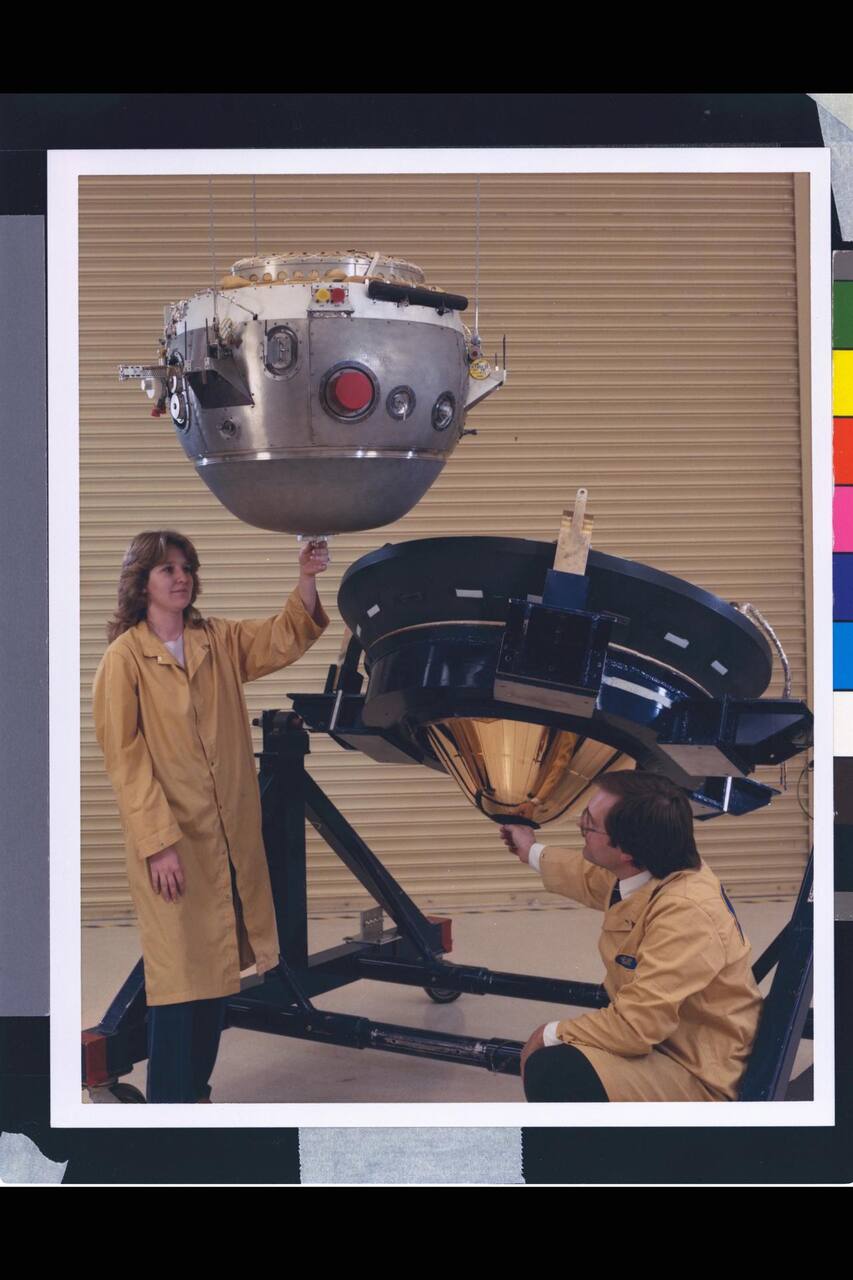 JPL. Public domain (NASA / US government work).
Overview
Section titled “Overview”A giant planet probe has to survive the highest entry speeds and heating of any planetary mission, descend through an atmosphere of unknown deep structure, and return data over a link that cannot be tracked from Earth. The Galileo probe is the only vehicle to have done this. It separated from the Galileo orbiter, coasted to Jupiter and entered on 7 December 1995 at 47.4 km/s, the highest entry speed any spacecraft has flown [1]. It returned an atmospheric profile from the top of the atmosphere down through the cloud decks, and it carried an instrumented heat shield whose in-flight recession was measured, which remains the only such dataset from a giant planet entry. The entry, descent and relay sequence it flew is still the reference case cited in general treatments of giant-planet entry-descent-landing science [9].
Specifications
Section titled “Specifications”| Parameter | Value | Source |
|---|---|---|
| Diameter and height | 1.27 m by 0.91 m | [19] |
| Mass at entry | 337 +/- 4.0 kg [1]; 339 kg on the NASA program page [19] | [19] |
| Mass after entry | 248.1 +/- 8.7 kg | [1] |
| Spin rate | 10.5 rpm | [1] |
Mission profile
Section titled “Mission profile”| Parameter | Value | Source |
|---|---|---|
| Carrier | Galileo orbiter, launched 18 October 1989 from NASA KSC on Atlantis, STS-34 | [1], [19] |
| Probe release from the orbiter | 12 July 1995 | [19] |
| Entry date | 7 December 1995 | |
| Entry velocity | 47.4 km/s [1], 47.6 km/s on the NASA program page [19]; the highest any spacecraft has flown | [19] |
| Entry flight path angle | 84 +/- 1 degrees | |
| Angle of attack at entry | 10 degrees | |
| Peak heating rate | about 30 kW/cm2 | |
| Total heat load | about 300 kJ/cm2 | |
| Peak deceleration | 250 g | |
| Velocity at 450 km altitude | 47.406 km/s | |
| Velocity at 50 km altitude | 0.833 km/s | |
| Time between those points | 111.02 s |
Rows with no marker are from [1]. Secondary accounts differ on several of these values. The NASA chronicle dates probe release to 13 July 1995 and gives a maximum deceleration of 228 g and a transmitter failure 61.4 minutes after entry at 22.7 atmospheres [12]; the navigation record gives an entry speed of 47.6 km/s [14]. The sources do not reconcile these differences; the table keeps the reconstruction values.
Navigation and delivery
Section titled “Navigation and delivery”The entry flight path angle at 450 km above the 1-bar level was constrained to -8.6 +/- 1.4 degrees atmosphere-relative with 99 percent probability [14]. The delivery error was 0.15 degrees, and the reconstructed angle was accurate to 0.10 degrees against a 0.15 degree requirement. The orbiter was deflected away from the probe trajectory by a 61 m/s maneuver on 27 July 1995 and relayed the descent data to Earth, since the probe could not be tracked directly [14].
Architecture
Section titled “Architecture”The probe divides into a descent vehicle and an aeroshell [2]. The descent vehicle carries every science instrument and every support subsystem, telecommunications, power, control and thermal, into the atmosphere under parachute. The aeroshell, comprising a forward heat shield and an aft backshell, protects the descent vehicle through cruise, coast and entry. Both the pilot and main parachutes are disk-gap-band canopies, the same family characterized in wind-tunnel wake testing behind Viking-type aeroshells for other planetary entry vehicles [10]. On Galileo that structure had a 22.2 cm nose radius and a 44.86 degree cone half angle [1].
The aeroshell has five functions, all five as listed by [2]:
| Function | Requirement |
|---|---|
| Aerodynamic stability | Remain stable through hypersonic and supersonic entry into an H2-He atmosphere while spin-stabilized about the symmetry axis |
| Thermal protection | Protect the descent vehicle from entry heating and thermomechanical load |
| Structural | Carry the deceleration load from the descent vehicle through hypersonic entry |
| Transition | Provide a stable transition from supersonic entry to subsonic descent |
| Separation | Release heat shield and backshell from the descent vehicle on a g-switch with timer backup |
The deceleration the third of those functions has to carry was 250 g on Galileo [1].
Some of the probe system stays behind. The release and separation mechanism and the probe telemetry receiver remain on the carrier spacecraft [2]. The probe is entirely self sufficient once released: batteries support coast, wake-up, health checks, entry and descent, and provide autonomous thermal control during coast. A coast timer loaded before release issues the wake-up that starts the entry power-on sequence, initial warm-up, instrument and subsystem health checks and pre-entry calibrations.
Thermal protection system
Section titled “Thermal protection system”The heat shield is the part of the probe with no substitute in the record, the one entry system component every ice giant probe study still has to size against [3].
| Element | Material | Source |
|---|---|---|
| Forebody nose cap | Chopped-molded carbon phenolic | [1], [3] |
| Forebody frustum | Tape-wrapped carbon phenolic | [1], [3] |
| Aft heat shield | Phenolic nylon | [1] |
| Geometry | Value |
|---|---|
| Forebody thickness at centreline | 14.6 cm |
| Minimum thickness at front of frustum | 5.1 cm |
| Nose radius | 22.2 cm |
| Cone half angle | 44.86 degrees |
Source: [1].
Recession was measured in flight by an array of ablation detectors. Total recession was 4.45 +/- 0.25 cm at the nose, fell to a minimum of 2.74 +/- 0.15 cm at mid-frustum, then rose again toward the base, at a maximum recession rate of 0.4 cm/s [1]. Of the 337 kg entry mass, 79.0 +/- 4.0 kg was lost to forebody ablation, 1.5 +/- 0.5 kg to pyrolysis and 8.4 +/- 4.2 kg from the aft shield.
The measured shape does not match the design prediction. The mid-frustum minimum is the disagreement, and it is the reason the experiment was flown at all [1]. The entry environment was underpredicted and the design thickness was barely adequate, so a future ice giant probe should be designed with more margin rather than to the Galileo precedent [3].
The manufacturing base is also gone. The carbon phenolic thermal protection system used on Galileo and Pioneer Venus is no longer available, having lost its manufacturing processes, and NASA developed the Heatshield for Extreme Entry Environment Technology as the replacement rather than attempting to revive it [2], [3]. HEEET is a 3-D woven ablator and is about 50 percent more mass efficient than the heritage carbon phenolic system [2].
Entry environment
Section titled “Entry environment”The atmosphere the probe met was not the one it was designed against. Nominal entry assumed 89 percent H2 and 11 percent He for a molecular weight of 2.22; the measured helium mole fraction was 13.6 +/- 0.3 percent, giving 2.35 [1].
| Altitude | Pressure | Temperature |
|---|---|---|
| 450 km | 7.21e-8 bar | 527.8 K |
| 250 km | 1.60e-5 bar | 163.2 K |
| 100 km | 7.00e-3 bar | 160.6 K |
| 50 km | 7.51e-2 bar | 112.4 K |
Source: [1].
Before any spacecraft reached Jupiter, the planet’s radiation and atmosphere were bounded from Earth-based and flyby data alone, in design criteria such as the 1971 NASA monograph that set the encounter environment probe designers worked against [7]; the accompanying radiation design levels required hardening estimates for the electronics of any thermoelectrically powered outer-planet spacecraft [8].
That reconstruction, from the Atmospheric Structure Instrument, is what Jupiter-GRAM is built on, and the model still carries neither composition nor winds [5]. Titan-GRAM and Neptune-GRAM by contrast represent variability as a min-average-max density envelope because measurement uncertainty at those bodies is comparable to real variability [6].
Payload
Section titled “Payload”The instrument set is the reference design for every giant planet probe proposed since [2]:
| Instrument | Measurement |
|---|---|
| Atmospheric Structure Instrument | Temperature, pressure and density vertical structure |
| Mass spectrometer | Composition, high molecular mass organics, isotopic composition |
| Helium Abundance Detector | Helium abundance from atmospheric refractive index |
| Doppler Wind Experiment | Zonal wind speed and direction against altitude |
| Nephelometer | Cloud structure, solid and liquid particles |
| Net Flux Radiometer | Thermal and solar energy flux |
Source: [2].
A seventh instrument was engineering rather than science: the Analog Resistance Ablation Detector array in the heat shield, which is what produced the recession record above [1].
The Helium Abundance Detector works by measuring refractive index over the 2 to 10 bar pressure range [2]. Because the jovian atmosphere is more than 99.5 percent H2 and He, that refractive index is a direct measure of the He/H2 ratio. Galileo used a Jamin-Mascart interferometer, chosen for a simple and compact design at high accuracy, with one beam through a reference gas and one through the atmosphere.
The Doppler Wind Experiment uses the probe-to-carrier radio link itself, on the assumption that a probe in terminal descent under parachute moves with the wind [2]. Both ends carry an ultrastable oscillator. Recovering wind requires accurate reconstruction of the probe location at the start of descent, from measured accelerations during entry, and of the descent speed against time, from Atmospheric Structure Instrument pressure and temperature; expected link frequencies are then differenced against measured ones and the residuals inverted. The measurement also captures probe motion from turbulence, aerodynamic buffeting, convection and waves.
Communications
Section titled “Communications”The probe telecommunication system is transmit only, with two redundant channels transmitting orthogonal polarizations at slightly offset frequencies for isolation, driven by an ultrastable oscillator so the link frequency is stable enough for radio science [2]. The mission ended when that link was lost at 22 bar [4]. Because the descent-phase link began only after entry deceleration and heating had passed, Galileo avoided the plasma blackout that can sever a UHF or X-band entry link near peak heating on other vehicles [11].
Frequency selection is set by atmospheric microwave opacity rather than by link budget convenience. Opacity from trace absorbers such as H2O, NH3, H2S and PH3 rises roughly as the square of frequency, which drives the choice as low as practical, often UHF [2]. At Jupiter the lowest practical frequency is L-band, because below that the synchrotron radiation environment is too intense. The choice then propagates into transmit antenna type, size, gain and beamwidth, and into pointing requirements for the receiving antenna on the carrier.
The atmosphere below the cloud tops remains largely unknown in thermal, compositional and dynamical structure, so a difference between the model atmosphere and the real one degrades relay performance directly and has to be carried in the frequency choice [2]. The Galileo reconstruction is the only in-situ constraint available for that model [1].
Relay geometry is a mission design constraint, not a detail. At a giant planet the probe mission competes with orbit insertion: insertion is most propellant efficient close to the planet, but that trajectory combined with a shallow probe entry angle that keeps heating and inertial loads low yields an impractically short relay window [2]. Delivering the probe to an aim point about 180 degrees from the orbiter’s, at a small cost in orbiter delta-v, allows a moderate entry angle and a relay window of up to 2 hours.
Results and their limits
Section titled “Results and their limits”The probe descended into a 5 micrometer hot spot near the boundary between the Equatorial Zone and the North Equatorial Belt, a meteorologically anomalous site [4]. Water was subsolar and still increasing at 22 bar, where the radio signal was lost. Nitrogen and sulfur were about 3 times solar at about 10 bar [4].
The consequence, general to giant-planet entry science, is that a single entry does not characterize a planet [9]. Juno microwave radiometry of the equatorial zone later gave water at 2.5e3 ppm, 2.7 +/- 1.7 times protosolar, against a probe mass spectrometer estimate at the lower limit of its range, 566 +/- 216 ppm against a signal-derived 700 +/- 100 ppm [4]. Any model of Jupiter’s envelope enrichment built on the probe value alone rests on one location.
The mass spectrometer measured composition over the descent, down to 21.1 bar [18]. It returned a 4He/H2 mixing ratio of 0.157 +/- 0.030, CH4/H2 of 2.1e-3 +/- 0.4e-3, 13C/12C of 0.0108 +/- 0.0005, D/H of 2.6e-5 +/- 0.7e-5 and H2S of 7.7e-5 +/- 0.5e-5, with H2O at 5.6e-5 +/- 2.5e-5 and only upper limits of 3e-5 for neon and 2.3e-3 for ammonia [18]. H2O and H2S rose with depth through the descent, which is why the water value is a lower bound on the deep abundance.
The elemental ratios the probe did establish are the anchor for successor payloads: He/H 7.85e-2 +/- 0.16e-2, C/H 1.19e-3 +/- 0.29e-3, N/H 3.32e-4 +/- 1.27e-4, O/H 2.45e-4 +/- 0.80e-4, S/H 4.45e-5 +/- 1.05e-5 and Ar/H 9.10e-6 +/- 1.80e-6 [2].
Computing
Section titled “Computing”The probe flight computer was a dual microprocessor system whose function was largely confined to sequencing, with an architecture similar to the Mariner, Viking and Voyager systems. The probe mission was managed by NASA Ames Research Center and the entry probe was assembled by Hughes [13]. The orbiter, by contrast, was a distributed multi-computer system whose software was judged more complex than Apollo’s because of the number of intercommunicating machines [13].
Other entry probes and what has not flown
Section titled “Other entry probes and what has not flown”The design lineage is Pioneer Venus: the Galileo entry probe was based on the large probe of the Pioneer Venus multiprobe [12]. The only other atmospheric entry probe to descend through a thick outer-solar-system atmosphere is Huygens, which entered Titan at about 6 km/s, deployed its main parachute at 155 km altitude and landed at 5 m/s on a 93.7 K, 1470 mbar surface [16]. Its descent winds were rebuilt from Earth-based Doppler tracking of the probe signal after the on-board wind experiment data were lost, giving a zonal profile from about 140 km to the surface [20]. Its entry speed is an order of magnitude below Galileo’s, so it validates the descent and relay sequence and not the heat shield. Dragonfly’s entry team later reran the Huygens descent in a six degree of freedom simulation to validate its Titan atmosphere model [17].
Probes to Saturn, Uranus and Neptune have been proposed and none has flown. The 2011 decadal survey ranked a Uranus orbiter with a small atmospheric probe as a flagship priority, and its cost evaluation found that much of the mission risk could be retired by preparing for probe entry [15]. Its cost figures are pre-decisional and the mission was not flown as described [15]. Sizing for those entries still starts from the Galileo heat shield record [3].
What is being tried now
Section titled “What is being tried now”Titan entry, descent and landing (flight in preparation). Dragonfly is the next outer-solar-system entry system to fly. Its concept of operations has a 4.5 m aeroshell entering at 7.41 km/s at -46.8 degrees, peak deceleration limited to 11 g, an 8.25 m disk-gap-band drogue, about 100 minutes of drogue descent, and a 16.67 m ringslot main parachute deployed at 5 km pressure altitude [28]. Every value is a design or simulation output made before integration and test [28]. The rotorcraft concept itself rests on analysis of a 5.4 kg/m3, 94 K atmosphere, with no hardware test at Titan conditions [31]. The modeling chain is validated against Huygens: the 2025 overview covers the trajectory tools, atmosphere models and Monte Carlo margins [29], and a multi-body parachute model reproduces Huygens flight accelerations at pilot and main deployment and at heat shield jettison, attributing nadir angle excursions to zonal wind profile slope changes rather than to the parachute model [27]. The Huygens design record lists the three-parachute control chain and a 1995 balloon drop test of the deployment sequence, but is written in the future tense and omits flight outcomes [25]. Huygens Doppler and tilt data bound the Titan wind environment: the strongest large-scale shear was about 5 m/s/km, below the 16 m/s/km preflight limit, from one descent at one location and season [26].
Engineering atmosphere models (ground, in use). The NASA Global Reference Atmospheric Model family supplies entry designers with density, temperature and pressure profiles. Titan-GRAM and Neptune-GRAM trace to Voyager-era radio science and spectrometer retrievals [23], [22]. Uranus-GRAM is built from three Voyager 2 papers, has no wind model because Uranus winds are unknown, and does not capture seasonal variation of the Voyager-era profiles [21]. Jupiter is the only one of these bodies with an in-situ constraint, and it is the Galileo probe [5].
Ice giant navigation and aerocapture (simulation only). A covariance analysis of onboard optical navigation using satellites as beacons gives Uranus tour position knowledge of 5 to 100 km 1-sigma and Neptune 1 to 20 km, but only if current satellite ephemeris uncertainty improves by a factor of 100; at present uncertainties the scenarios are not navigable autonomously [24]. A Uranus aerocapture study with Monte Carlo navigation reports onboard optical navigation delivering entry flight path angle to 0.013 degrees 3-sigma against 0.020 degrees for a ground-based schedule, in simulation of a concept that does not exist, and aerocapture has not been demonstrated at any body [30]. The Galileo entry angle accuracy of 0.10 degrees [14] is the flown comparison.
Heat shields (ground development). HEEET replaces the lost carbon phenolic process and is about 50 percent more mass efficient [2], with the Galileo recession margin as the design lesson [3].
Technologies developed
Section titled “Technologies developed”The probe established the entry, descent and deployment sequence that every proposed giant planet probe still uses: coast timer wake-up, hypersonic entry on a spin-stabilized aeroshell, pilot chute above the tropopause pulling the main chute, heat shield release, and relay to a carrier spacecraft under parachute [2]. It established that a carbon phenolic heat shield can survive a 47.4 km/s entry, and simultaneously that the margin was thinner than intended [1], [3].
It also produced the only in-flight ablation dataset at these conditions [1].
What is not established
Section titled “What is not established”The helium and elemental ratios, the winds and the cloud structure come from one descent at one site, a meteorologically anomalous hot spot, and the probe’s data end at 22 bar [4]. Water at depth, and the global enrichment of the envelope, are not constrained by the probe, and the Juno retrieval that addresses them covers one latitude band and is conditional on a model with parameters the data do not constrain [4]. The two probe-era ammonia estimates differ by about a factor of two and the sources do not resolve which is correct [4]. Jupiter-GRAM has no wind, perturbation or constituent model because the probe data do not support one [5]. Entry speed, release date and peak deceleration differ between the reconstruction, the mission page and the NASA chronicle, and the sources do not settle the difference [1], [19], [12]. No ice giant probe has flown, so the carbon phenolic margin lesson has not been tested against a second entry [3], [15].
References
- Milos, F. S. (1997). Galileo Probe Heat Shield Ablation Experiment
. Journal of Spacecraft and Rockets, 6. Source
BibTeX
@article{milos1997galileo, title = {Galileo Probe Heat Shield Ablation Experiment}, author = {Milos, Frank S.}, journal = {Journal of Spacecraft and Rockets}, volume = {34}, number = {6}, pages = {705--713}, year = {1997}, doi = {10.2514/2.3293}, abstract = {Covers advancements in spacecraft and tactical and strategic missile systems, including subsystem design and application, mission design and analysis, materials and structures, developments in space sciences, space processing and manufacturing, space operations, and applications of space technologies to other fields.} } - Mousis, O., Atkinson, D. H., Ambrosi, R., Atreya, S., Banfield, D., Barabash, S., Blanc, M., Cavalié, T., Coustenis, A., Deleuil, M., Durry, G., Ferri, F., Fletcher, L., Fouchet, T., Guillot, T., Hartogh, P., Hofstadter, M., Hueso, R., Lebreton, J.-P., Mandt, K. E., Rannou, P., Rauer, H., Renard, J.-B., Sánchez-Lavega, A., Sayanagi, K., Simon, A., Spilker, T., Venkatapathy, E., Waite, J. H. and Wurz, P. (2019). In Situ Exploration of the Giant Planets
. arXiv preprint. Source
BibTeX
@article{mousis2019situ, title = {In Situ Exploration of the Giant Planets}, author = {Mousis, Olivier and Atkinson, David H. and Ambrosi, Richard and Atreya, Sushil and Banfield, Don and Barabash, Stas and Blanc, Michel and Cavalié, Thibault and Coustenis, Athena and Deleuil, Magali and Durry, Georges and Ferri, Francesca and Fletcher, Leigh and Fouchet, Thierry and Guillot, Tristan and Hartogh, Paul and Hofstadter, Mark and Hueso, Ricardo and Lebreton, Jean-Pierre and Mandt, Kathleen E. and Rannou, Pascal and Rauer, Heike and Renard, Jean-Baptiste and Sánchez-Lavega, Agustin and Sayanagi, Kunio and Simon, Amy and Spilker, Thomas and Venkatapathy, Ethiraj and Waite, J. Hunter and Wurz, Peter}, journal = {arXiv preprint}, volume = {1908.00917}, year = {2019}, doi = {10.48550/arxiv.1908.00917} } - Venkatapathy, E., Ellerby, D., Gage, P., Prabhu, D. and Wercinski, P. (2019). Challenges and Opportunities For Ensuring Entry System Technology Readiness For Ice Giants Probe Missions. ntrs.nasa.gov/citations/20190027647
BibTeX
@misc{venkatapathy2019challenges, title = {Challenges and Opportunities For Ensuring Entry System Technology Readiness For Ice Giants Probe Missions}, author = {Venkatapathy, Ethiraj and Ellerby, Don and Gage, Peter and Prabhu, Dinesh and Wercinski, Paul}, howpublished = {Presentation at the Ice Giant Systems Workshop}, year = {2019}, url = {https://ntrs.nasa.gov/citations/20190027647}, abstract = {The Ice Giants represent a distinct class of planets within our solar system, and appear to be similar to most exoplanets that have been detected thus far. Exploring Ice Giants in our Solar System would allow us to better understand their formation and evolution processes, and thus help establish scientific links to exoplanets. In situ exploration using probes similar to Galileo, along with an orbiter or a relay spacecraft, will require entry followed by deployment of the descent probe containing science instruments into Uranus or Neptune atmosphere. The challenge is not in the deployment of the probe, but in the atmospheric entry prior to deployment. The entry system has to have a capable, robust and efficient ablative thermal protection system (TPS) designed to protect the descent probe from the thermal and mechanical entry loads. Although entries into Ice Giants may not be as demanding as the Galileo entry at Jupiter, the entry environments will be more severe than environments for Mars, Sample Return missions, and Venus, and will therefore require robust TPS. While Galileo Probe’s success, nearly 25 years ago, should give us confidence, the recession data from the Galileo entry informs us that the entry environment was under predicted and the design thickness was barely adequate. The lesson learned from Galileo probe for future Ice Giant missions will require us to be cautious and demand a more robust design. The TPS technology used on Galileo entry system no longer exists due to atrophy of manufacturing processes. Instead of attempting to revive Galileo-legacy TPS technology, NASA invested in a new and innovative TPS called HEEET (Heat-shield for Extreme Entry Environment Technology). HEEET has been matured, and is now ready to support future missions not only to the Ice Giants but also for Venus, high-speed sample return, and Saturn probe missions. This lead talk, intended for the technology section of the workshop, will cover entry, descent, and deployment (EDD), with an emphasis on entry. A brief history of the TPS challenges for extreme entry missions will be given along with a quick overview of the concept of operations for EDD. The development and maturation of HEEET system capability will be described. Data gathered in ground-test facilities in the US will be highlighted to show that the technology is mature and ready for Ice Giant missions. All thermal protection systems carry some risk as a result of ground test limitations and Ice Giant missions present some unique challenges. These challenges are not only technical, but also due to limitations in the currently established manufacturing and integration. In addition, the concerns that arise due to potential for atrophy for future Ice Giant mission a decade or more from now will be analyzed. Plausible avenues for mitigation will be presented. There are two companion planned presentations by Dr. Prabhu and Dr. Hwang will dive deeper in the challenges and opportunities. This intended talk will set the stage for their presentations.} } - Li, C., Ingersoll, A., Bolton, S., Levin, S., Janssen, M., Atreya, S., Lunine, J., Steffes, P., Brown, S., Guillot, T., Allison, M., Arballo, J., Bellotti, A., Adumitroaie, V., Gulkis, S., Hodges, A., Li, L., Misra, S., Orton, G., Oyafuso, F., Santos-Costa, D., Waite, H. and Zhang, Z. (2020). The water abundance in Jupiter's equatorial zone
. Nature Astronomy. Source
BibTeX
@article{li2020water, title = {The water abundance in Jupiter's equatorial zone}, author = {Li, Cheng and Ingersoll, Andrew and Bolton, Scott and Levin, Steven and Janssen, Michael and Atreya, Sushil and Lunine, Jonathan and Steffes, Paul and Brown, Shannon and Guillot, Tristan and Allison, Michael and Arballo, John and Bellotti, Amadeo and Adumitroaie, Virgil and Gulkis, Samuel and Hodges, Amoree and Li, Liming and Misra, Sidharth and Orton, Glenn and Oyafuso, Fabiano and Santos-Costa, Daniel and Waite, Hunter and Zhang, Zhimeng}, journal = {Nature Astronomy}, volume = {4}, pages = {609--616}, year = {2020}, doi = {10.1038/s41550-020-1009-3} } - Justh, H. L., Dwyer Cianciolo, A. M. and Hoffman, J. (2021). Jupiter Global Reference Atmospheric Model (Jupiter-GRAM): User Guide
. NASA Marshall Space Flight Center, NASA/TM-20210022058. Source
BibTeX
@techreport{justh2021jupiter, title = {Jupiter Global Reference Atmospheric Model (Jupiter-GRAM): User Guide}, author = {Justh, Hilary L. and Dwyer Cianciolo, Alicia M. and Hoffman, James}, number = {NASA/TM-20210022058}, institution = {NASA Marshall Space Flight Center}, year = {2021}, url = {https://ntrs.nasa.gov/citations/20210022058}, abstract = {This Technical Memorandum (TM) presents the Jupiter Global Reference Atmospheric Model (Jupiter-GRAM) and the updated features of the GRAMs. Jupiter-GRAM is an engineering-oriented atmospheric model that estimates mean values of atmospheric properties for Jupiter. This TM summarizes the atmospheric data model in Jupiter-GRAM and provides a guide for the user to obtain, set up, and run the code in various configurations. Additional details regarding the Jupiter-GRAM input and output files and how to interpret Jupiter-GRAM results are also provided.} } - Justus, C. G., Duvall, A. and Keller, V. W. (2003). Engineering-Level Model Atmospheres for Titan and Neptune
. AIAA/ASME/SAE/ASEE Joint Propulsion Conference & Exhibit, 20030066242. Source
BibTeX
@inproceedings{justus2003engineering, title = {Engineering-Level Model Atmospheres for Titan and Neptune}, author = {Justus, C. G. and Duvall, Aleta and Keller, Vernon W.}, booktitle = {AIAA/ASME/SAE/ASEE Joint Propulsion Conference & Exhibit}, number = {20030066242}, institution = {NASA Marshall Space Flight Center}, year = {2003}, doi = {10.2514/6.2003-4803}, abstract = {Engineering-level atmospheric models for Titan and Neptune have been developed for use in NASA s systems analysis studies of aerocapture applications in missions to the outer planets. Analogous to highly successful Global Reference Atmospheric Models for Earth (GRAM, Justus et al., 2000) and Mars (Mars-GRAM, Justus and Johnson, 2001, Justus et al., 2002) the new models are called Titan-GRAM and Neptune-GRAM. Like GRAM and Mars-GRAM, an important feature of Titan-GRAM and Neptune-GRAM is their ability to simulate quasi-random perturbations for Monte- Carlo analyses in developing guidance, navigation and control algorithms, and for thermal systems design.} } - Divine, N. (1971). The Planet Jupiter (1970)
. National Aeronautics and Space Administration, NASA SP-8069. Source
BibTeX
@techreport{divine1971planet, title = {The Planet Jupiter (1970)}, author = {Divine, Neil}, number = {NASA SP-8069}, institution = {National Aeronautics and Space Administration}, type = {NASA Space Vehicle Design Criteria (Environment) monograph}, year = {1971}, url = {https://ntrs.nasa.gov/citations/19720010259}, abstract = {Data obtained through 1970, some materials published during the first half of 1971, and conclusions of the Jupiter Radiation Belt Workshop held in July 1971 are presented. All the information on Jupiter was derived from data obtained at angular and spectral resolutions possible with Earth-based instrumentation or with sensors on aircraft, rockets, and balloons. The observations were made primarily in the visible, near visible, infrared, and radio portions of the electromagnetic spectrum. The information was assessed for the potential effects of the Jovian environment on spacecraft performance. The assessment was done independently for the three types of missions under consideration and formulated for overall spacecraft as well as for subsystem design.} } - Barengoltz, J. B. (1972). Jupiter Radiation Test Levels and Their Expected Impact on an Encounter Mission
. National Symposium on Natural and Manmade Radiation in Space. Source
BibTeX
@inproceedings{barengoltz1972jupiter, title = {Jupiter Radiation Test Levels and Their Expected Impact on an Encounter Mission}, author = {Barengoltz, J. B.}, booktitle = {National Symposium on Natural and Manmade Radiation in Space}, year = {1972}, url = {https://ntrs.nasa.gov/citations/19720010056}, abstract = {The upper limit, of electron and proton fluences for a thermoelectric outer planet spacecraft mission in a near-Jupiter environment, for use as radiation design restraints, were extracted from a model of the Jovian trapped radiation belts. Considerations of radiation effects in semiconductor devices were employed to construct simplified radiation test levels based on the design restraints. Corresponding levels, based on the nominal belt models, are one to three orders of magnitude smaller. In terms of expected radiation-induced degradation in semiconductor devices, an encounter with an environment as severe as the design restraints would require hardening the system in order to guarantee high reliability. On the other hand, the nominal levels would only necessitate care in the selection of components and the avoidance of certain semiconductor components.} } - Mischna, M. (2025). The Science of Entry, Descent, and Landing in the Venus, Jupiter, and Saturn Systems
. Oxford Research Encyclopedia of Planetary Science. Source
BibTeX
@inproceedings{mischna2025science, title = {The Science of Entry, Descent, and Landing in the Venus, Jupiter, and Saturn Systems}, author = {Mischna, Michael}, booktitle = {Oxford Research Encyclopedia of Planetary Science}, publisher = {JPL Open Repository}, year = {2025}, doi = {10.48577/jpl.plm2tj} } - Sengupta, A., Roeder, J., Kelsch, R., Wernet, M., Machalick, W., Reuter, J. and Witkowski, A. (2008). Supersonic disk gap band parachute performance in the wake of a Viking-type aeroshell from Mach 2 to 2.5
. Journal of Electric Propulsion. Source
BibTeX
@article{sengupta2008supersonic, title = {Supersonic disk gap band parachute performance in the wake of a Viking-type aeroshell from Mach 2 to 2.5}, author = {Sengupta, Anita and Roeder, James and Kelsch, Richard and Wernet, Mark and Machalick, Walt and Reuter, James and Witkowski, Al}, journal = {Journal of Electric Propulsion}, publisher = {JPL Open Repository}, year = {2008}, url = {https://dataverse.jpl.nasa.gov/dataset.xhtml?persistentId=hdl:2014/45367} } - Morabito, D. D. and Edquist, K. (2005). Communications blackout predictions for atmospheric entry of Mars Science Laboratory
. IEEE Aerospace Conference. Source
BibTeX
@inproceedings{morabito2005communications, title = {Communications blackout predictions for atmospheric entry of Mars Science Laboratory}, author = {Morabito, David D. and Edquist, Karl}, booktitle = {IEEE Aerospace Conference}, pages = {489-500}, publisher = {IEEE}, year = {2005}, doi = {10.1109/aero.2005.1559339}, abstract = {The Mars Science Laboratory (MSL) is expected to be a long-range, long-duration science laboratory rover on the Martian surface. MSL will provide a significant milestone that paves the way for future landed missions to Mars. NASA is studying options to launch MSL as early as 2009. There are three elements to the spacecraft; carrier (cruise stage), entry vehicle, and rover. The rover has a UHF proximity link as the primary path for EDL communications and may have an X-band direct-to-Earth link as a back-up. Given the importance of collecting critical event telemetry data during atmospheric entry, it is important to understand the ability of a signal link to be maintained, especially during the period near peak convective heating. The received telemetry during entry (or played back later) allows for the performance of the entry-descent-landing technologies to be assessed. These technologies include guided entry for precision landing, a new sky-crane landing system and powered descent. MSL will undergo an entry profile that may result in a potential communications blackout caused by ionized particles for short periods near peak heating. The vehicle will use UHF and possibly X-band during the entry phase. The purpose of this report is to quantify or bound the likelihood of any such blackout at UHF frequencies (401 MHz) and X-band frequencies (8.4 GHz). Two entry trajectory scenarios were evaluated: a stressful entry trajectory to quantify an upper-bound for any possible blackout period, and a nominal trajectory to quantify likelihood of blackout for such cases.} } - Siddiqi, A. A. (2018). Beyond Earth: A Chronicle of Deep Space Exploration, 1958-2016
. NASA, NASA SP-2018-4041. Source
BibTeX
@book{siddiqi2018beyond, title = {Beyond Earth: A Chronicle of Deep Space Exploration, 1958-2016}, author = {Siddiqi, Asif A.}, number = {NASA SP-2018-4041}, publisher = {NASA}, year = {2018}, url = {https://www.nasa.gov/wp-content/uploads/2018/09/beyond-earth-tagged.pdf} } - Tomayko, J. E. (1988). Computers in Spaceflight: The NASA Experience
. NASA, NASA-CR-182505. Source
BibTeX
@techreport{tomayko1988computers, title = {Computers in Spaceflight: The {NASA} Experience}, author = {Tomayko, James E.}, number = {NASA-CR-182505}, institution = {NASA}, year = {1988}, url = {https://ntrs.nasa.gov/citations/19880069935}, abstract = {This book examines the computer systems used in actual spaceflight or in close support of it. Computer systems used in administration and in aeronautical and other research not directly related to spaceflight are ignored. Each chapter deals with either a specific program, such as Gemini or Apollo onboard computers, or a closely related set of systems, such as launch processing or mission control.. A glossary of computer terms is included.} } - Wood, L. J. (2008). The Evolution of Deep Space Navigation: 1989-1999. dataverse.jpl.nasa.gov/api/access/datafile/14299
BibTeX
@misc{namewood2008evolution, title = {The Evolution of Deep Space Navigation: 1989-1999}, author = {Wood, Lincoln J.}, year = {2008}, url = {https://dataverse.jpl.nasa.gov/api/access/datafile/14299} } - National Research Council, C. O. T. P. S. D. S. (2011). Vision and Voyages for Planetary Science in the Decade 2013-2022
. The National Academies Press, Washington, DC. Source
BibTeX
@techreport{nrc2011vision, title = {Vision and Voyages for Planetary Science in the Decade 2013-2022}, author = {{National Research Council, Committee on the Planetary Science Decadal Survey}}, institution = {The National Academies Press, Washington, DC}, year = {2011}, doi = {10.17226/13117}, abstract = {Research priorities were selected through a rigorous review that included input from five expert panels. The committee also sought extensive input from the planetary sciences community through town hall meetings and white papers. Recommendations are informed by NASA's own FY 2011 projected budget scenarios for 2013-2022. In addition, the committee hired a contractor to provide independent cost and technical analyses of select mission proposals. "Our recommendations are science-driven, and they offer a balanced mix of missions -- large, medium, and small -- that have the potential to greatly expand our knowledge of the solar system," said Steven W. Squyres, professor of astronomy at the Center for Radiophysics and Space Research, Cornell University, Ithaca, N.Y., and chair of the committee that wrote the report. "However, in these tough economic times, some difficult choices may have to be made. With that in mind, our priority missions were carefully selected based on their potential to yield the most scientific benefit per dollar spent."} } - Lebreton, J.-P., Witasse, O., Sollazzo, C., Blancquaert, T., Couzin, P., Schipper, A.-M., Jones, J. B. and Matson, D. L. (2005). An overview of the descent and landing of the Huygens probe on Titan
. Nature. Source
BibTeX
@article{lebreton2005overview, title = {An overview of the descent and landing of the Huygens probe on Titan}, author = {Lebreton, Jean-Pierre and Witasse, Olivier and Sollazzo, C. and Blancquaert, Thierry and Couzin, P. and Schipper, Anne-Marie and Jones, J. B. and Matson, D. L.}, journal = {Nature}, volume = {438}, pages = {758-764}, year = {2005}, doi = {10.1038/nature04347} } - Pensado, A. R., Robb, C., Winski, R., Williams, J., Belair, M. W. and Lorenz, R. D. (2025). Assessing Huygens Probe Entry, Descent, and Landing at Titan Simulation using Dragonfly Atmosphere Model
. AIAA SCITECH Forum. Source
BibTeX
@inproceedings{pensado2025assessing, title = {Assessing Huygens Probe Entry, Descent, and Landing at Titan Simulation using Dragonfly Atmosphere Model}, author = {Pensado, Alejandro R. and Robb, Caleb and Winski, Richard and Williams, James and Belair, Michael W. and Lorenz, Ralph D.}, booktitle = {AIAA SCITECH Forum}, year = {2025}, doi = {10.2514/6.2025-2238}, abstract = {Dragonfly is a New Frontiers Program mission that will deliver a rotorcraft to Saturn’s moon, Titan. This mission follows Huygens as the previous mission that successfully landed a vehicle on Titan. A flight mechanics simulation of Dragonfly’s Entry, Descent, and Landing sequence has been developed using the Program to Optimize Simulated Trajectories II. The simulation incorporates several subsystem models, including aerodynamics, gravity, and mass properties, to fully capture the multi-body six degree of freedom dynamics. Among all the subsystem models that inform the Entry, Descent, and Landing dynamics, the atmosphere model of Titan is a critical component. The atmosphere model characterizes the density, temperature, pressure, and winds that the entry vehicle experiences during the descent. This impacts several aspects of the descent such as the peak heating, aerodynamics, parachute release conditions, the dynamics of the vehicle and parachutes, and the landing ellipse. In the course of developing Dragonfly, an updated model of the Titan atmosphere has been created corresponding to Dragonfly’s arrival in the mid-2030s, approximately one Titan year after the Huygens mission successfully landed a probe on Titan. This work leverages previous work done to investigate Huygens EDL sequence to assess the atmosphere model developed for Dragonfly. This is done by utilizing the updated Titan atmosphere model, the Dragonfly atmosphere model, within the Huygens POST2-based flight simulation with the goal of characterizing the differences between the atmospheric models and assessing how the Dragonfly atmosphere model impacts Huygens entry dynamics.} } - Niemann, H. B., Atreya, S. K., Carignan, G. R., Donahue, T. M., Haberman, J. A., Harpold, D. N., Hartle, R. E., Hunten, D. M., Kasprzak, W. T., Mahaffy, P. R., Owen, T. C. and Way, S. H. (1998). The composition of the Jovian atmosphere as determined by the Galileo probe mass spectrometer
. Journal of Geophysical Research: Planets. Source
BibTeX
@article{niemann1998composition, title = {The composition of the Jovian atmosphere as determined by the Galileo probe mass spectrometer}, author = {Niemann, H. B. and Atreya, S. K. and Carignan, G. R. and Donahue, T. M. and Haberman, J. A. and Harpold, D. N. and Hartle, R. E. and Hunten, D. M. and Kasprzak, W. T. and Mahaffy, P. R. and Owen, T. C. and Way, S. H.}, journal = {Journal of Geophysical Research: Planets}, volume = {103}, pages = {22831-22845}, year = {1998}, doi = {10.1029/98je01050}, abstract = {The Galileo probe mass spectrometer determined the composition of the Jovian atmosphere for species with masses between 2 and 150 amu from 0.5 to 21.1 bars. This paper presents the results of analysis of some of the constituents detected: H 2 , He, Ne, Ar, Kr, Xe, CH 4 , NH 3 , H 2 O, H 2 S, C 2 and C 3 nonmethane hydrocarbons, and possibly PH 3 and Cl. 4 He/H 2 in the Jovian atmosphere was measured to be 0.157±0.030. 13 C/ 12 C was found to be 0.0108±0.0005, and D/H and 3 He/ 4 He were measured. Ne was depleted, ≤0.13 times solar, Ar ≤1.7 solar, Kr ≤5 solar, and Xe ≤5 solar. CH 4 has a constant mixing ratio of (2.1±0.4) × 10 −3 ( 12 C, 2.9 solar), where the mixing ratio is relative to H 2 . Upper limits to the H 2 O mixing ratio rose from 8 × 10 −7 at pressures <3.8 bars to (5.6±2.5) × 10 −5 ( 16 O, 0.033±0.015 solar) at 11.7 bars and, provisionally, about an order of magnitude larger at 18.7 bars. The mixing ratio of H 2 S was <10 −6 at pressures less than 3.8 bars but rose from about 0.7 × 10 −5 at 8.7 bars to about 7.7 × 10 −5 ( 32 S, 2.5 solar) above 15 bars. Only very large upper limits to the NH 3 mixing ratio have been set at present. If PH 3 and Cl were present, their mixing ratios also increased with pressure. Species were detected at mass peaks appropriate for C 2 and C 3 hydrocarbons. It is not yet clear which of these were atmospheric constituents and which were instrumentally generated. These measurements imply (1) fractionation of 4 He, (2) a local, altitude‐dependent depletion of condensables, probably because the probe entered the descending arm of a circulation cell, (3) that icy planetesimals made significant contributions to the volatile inventory, and (4) a moderate decrease in D/H but no detectable change in (D + 3 He)/H in this part of the galaxy during the past 4.6 Gyr.} } - (2023). NASA: Galileo. science.nasa.gov/mission/galileo
BibTeX
@misc{nasagalileo,
  title = {NASA: Galileo},
  organization = {science.nasa.gov},
  year = {2023},
  url = {https://science.nasa.gov/mission/galileo/}
}