MoonRanger
Program pages Carnegie Mellon Robotics Institute: MoonRanger
 Carnegie Mellon University Robotics Institute.
Overview
Section titled “Overview”MoonRanger is an autonomous lunar micro-rover built by Carnegie Mellon University with Astrobotic Technology and NASA ARC, to search for water ice at the lunar south pole [1]. Development and flight were funded under NASA Lunar Surface Instrument and Technology Payload contract 80MSFC20C0008. It was manifested on the Masten XL-1 lander for a 2022 CLPS delivery [2]; that lander did not fly.
The defining constraint is that the mass budget excludes a radio capable of reaching Earth [22]. MoonRanger communicates with its lander over WiFi and must therefore drive autonomously whenever it is outside lander range, without supervision, without the option of stopping to wait for an operator, and without radioisotope heating, so the whole mission fits inside one lunar daylight period [2].
Specifications
Section titled “Specifications”| Parameter | Value | Source |
|---|---|---|
| Chassis shell size | 46 x 43 x 10 cm (18 x 17 x 4 inches) | project log [8] |
| Chassis shell mass | 820 g | project log [8] |
| Drive configuration | four-wheel skid steer, fixed wheels, no suspension | project log [11] |
| Solar-electric generation | 0 to 70 W | project log [19] |
| Internal temperature band to be held | -10 to +35 degrees C | project log [6] |
| Lowest structural mode | 107 Hz | project log [21] |
| WiFi range demonstrated | 160 m | project log [18] |
| Central computer | NVIDIA Jetson TX2i, quad core, 8 GB RAM | [2] |
| Peripheral computer | ISIS embedded processor, real-time OS | [2] |
| Instrument | NASA Ames Neutron Spectrometer System | [1], [16] |
Mission profile
Section titled “Mission profile”| Parameter | Value | Source |
|---|---|---|
| Lander | Masten XL-1 | [1], [2] |
| Program | NASA CLPS, payload under LSITP 80MSFC20C0008 | [1] |
| Planned landing | December 2022, lunar south pole | [1], [2] |
| Planned surface duration | one lunar daylight period, about 8 Earth days | [2] |
| Transit duration assumed | 6 to 9 days | [3] |
| Surface duration assumed for radiation | less than 15 days | [3] |
| Van Allen belt transit | 3 to 4 hours, avionics powered down | [3] |
The vehicle passed a NASA key decision point and entered final production in July 2021, with a system integration review scheduled for February 2022 [16]. Masten XL-1 did not fly and no replacement lander assignment is published.
Mobility
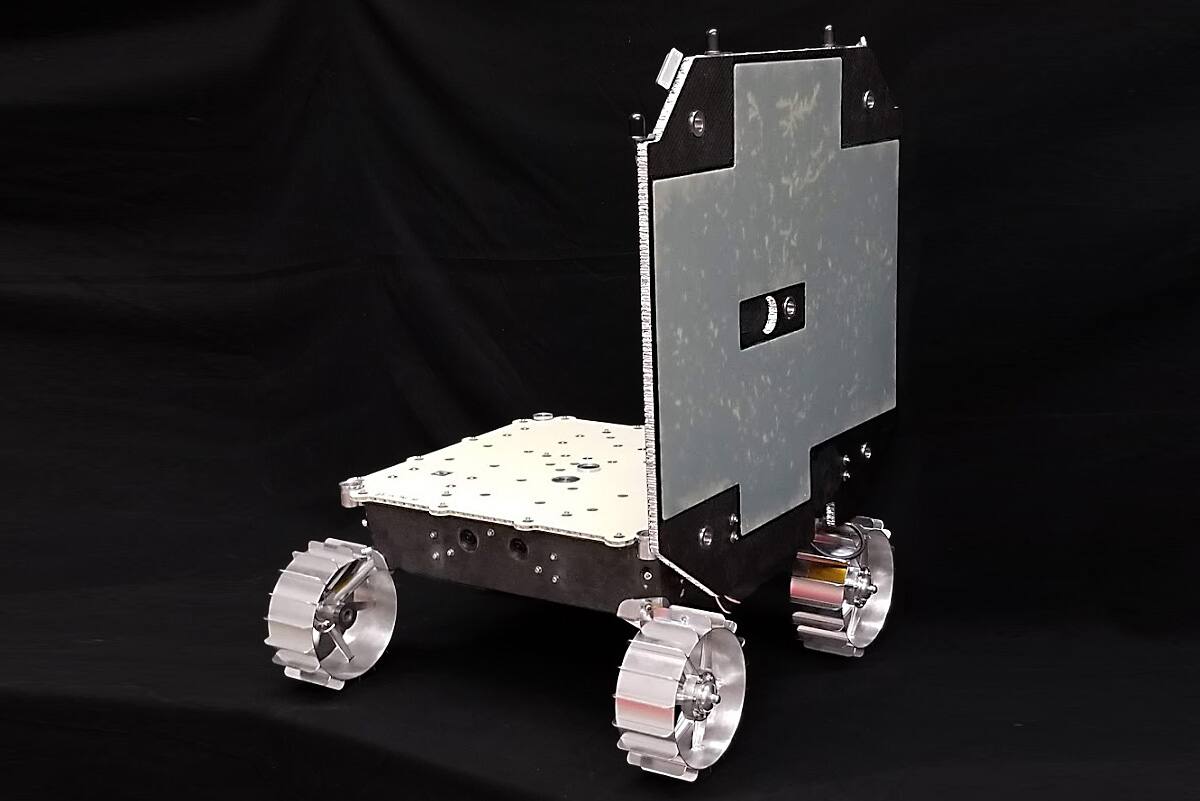
Section titled “Mobility”Four driven wheels, skid steered, with no suspension and no steering actuators [11]. Over a single lunar daylight period the traverse is kilometer-scale at a slow nominal drive speed, which is the design point for the autonomy [2].
The consequence of no suspension is captured in the project’s own terramechanics work as mean free path, the straight-line distance a vehicle can achieve half the time before being impeded by probabilistically generated terrain: a suspensionless micro-rover has a much shorter mean free path than a suspended four-wheel-drive vehicle of larger size in the same terrain [11].
Wheel module structural qualification used roving hammer tests to find natural frequencies, because launch survival requires the lowest mode above 100 Hz, achievable only by being stiff and light [21]. The first mode of the older wheel module was 127 Hz by hammer test against 135 Hz by shaker test, and the newer module with a 60 mm wide wheel measured 142 Hz. Whole-chassis response frequencies were 107, 119 and 170 Hz, agreeing in mode shape with Ansys analysis [21].
Structure
Section titled “Structure”The chassis is a carbon fiber monocoque shell, laid up in six layers from 46 pieces of prepreg, 46 by 43 by 10 cm, weighing 820 g [8]. The mold is machined from a 91 kg solid aluminum billet reduced to an 18 kg open-topped shallow box, and the chassis walls are drafted outward at 5 degrees so the part releases from the mold after cure [4]. A radiator with tailored optical finishes, a deployable solar panel and four wheel modules complete the mechanical design [1].
Internal packaging is standardized: a single structure mounts up to ten printed circuit boards in two stacks of five plus two batteries, and every board conforms to a PC104-like form factor used for mounting, thermal regulation and radiation protection [13], [5].
Power and energy
Section titled “Power and energy”A single-sided solar panel that stows for cislunar transit and deploys vertically on command once on the surface [1]. Generation varies from zero to 70 W across the polar illumination cycle. The project logs put incident solar flux at the Moon at 1350 W per square meter [19], [9]; the logs give no source for it. Battery capacity is not published; two batteries are carried in the board stack structure [13]. Power distribution is switched in groups, each controlled by an automotive-grade smart switch, either a TPS1H200 or an FPF2124 [7].
Thermal
Section titled “Thermal”The project log states that shadowed regions at the south pole reach -210 degrees C while illuminated solar panels reach +70 degrees C [6]; the log gives no source for these environment values. The project’s own requirement is the interior band: -10 to +35 degrees C for the batteries and electronics to function [6]. Polar surface temperatures range from 50 K to 200 K, that is -223 to -73 degrees C [1], a span of about 250 degrees across the polar cycle [19].
Control is both passive and active. Passive elements are multi-layer insulation, vapor deposited aluminum tape inside the chassis, low-absorptivity high-emissivity finishes on the solar panel and radiator, and low-conductivity PEEK interfaces between motors and wheels to cut conduction into the regolith [1]. The insulation blanket is pre-sewn around a 3D-printed MoonRanger mannequin, with four sleeves that wrap the wheel struts [22]. Active control reads 13 thermistors placed near computers, batteries, boards, cameras and motors, and acts at device level when a component is out of band; the TX2i can be commanded to several power levels corresponding to several performance levels, so compute throughput is a thermal actuator [19].
One occultation is expected during the mission, lasting about 24 hours, when a distant hilltop partially blocks sunlight; the thermal case is analyzed separately for it [20].
Thermal vacuum testing is done in house because measured interface conductance takes precedence over analysis, and because frequent small component tests are cheaper before integration than after [17]. The chamber is a 76 cm diameter by 76 cm deep stainless steel vessel [14]. Roughing to 5E-2 Torr takes about 20 minutes on an Alcatel 2004A rotary pump at 3.2 cfm, and a further 10 minutes on an Alcatel 5081 turbopump at 80 l/s reaches 5E-4 Torr, at which convection is negligible and there is 1,500,000 times less air than at atmosphere. The test plate reaches 160 degrees C under a 40 W internal xenon lamp, resistive spot heaters simulate electronics dissipation, and liquid nitrogen at -190 degrees C circulates through a cold plate [14]. A liquid nitrogen cryoshroud of bent 5052 aluminum was added in house to reach below -150 degrees C [14].
Compute and avionics
Section titled “Compute and avionics”Two computers share the work. The NVIDIA Jetson TX2i central computer, quad core with 8 GB of RAM, runs a Linux operating system and hosts the autonomy software and image processing [2]. The ISIS peripheral computer runs a real-time operating system and handles motor control, peripheral reads, science instrument data capture, drive command execution, board commanding and lander communication. The 8 GB quad core machine, while far beyond previous planetary rover compute, is still less capable than a laptop [2]. Commercial off the shelf parts including the TX2 and MIPI cameras were selected against NASA GSFC-STD-8001 guidance and then tested, because most are not space rated [3].
Motor control is a custom board per actuator built around the TI UC1625-SP space-rated brushless DC gate driver, prototyped against its terrestrial equivalent the UC2625, with an onboard MSP430 microcontroller running closed-loop PID speed control and a hardware-level overcurrent shutoff protecting the gearhead during high-torque maneuvers [15]. There are five control modules.
Radiation
Section titled “Radiation”Radiation viability rests on component selection, shielding, short mission duration, testing, error correction and monitoring [3]. Power management, primary and watchdog computers, accelerometer and intelligent battery were selected for radiation tolerance, prior test data or space heritage, and shielding covers critical parts without heritage and boards developed in house [3]. The mission is short enough that total dose is low: 6 to 9 days in transit and under 15 days on the surface, with the highest dose rate in the 3 to 4 hour Van Allen belt transit during which avionics are powered down.
| Result | Value |
|---|---|
| Computer, cameras, interface board tested powered | 4 krad, no adverse effect |
| Expected mission dose, unpowered transit | under 0.5 krad |
| Expected mission dose, powered surface | under 0.5 krad |
| Central computer, independent test at JHU APL, unpowered | 45 krad TID survived |
| Central computer, independent test, powered | 10 krad TID survived |
| Central computer, proton SEE | 90 percent or better survival, average 4 resets in a flux equivalent to a 6 month lunar mission |
Radiation test results from [3].
The central computer has built-in error correction, and load current is monitored to detect latch-up and trigger a reset for recovery [3]. The MSP430 used throughout the avionics has flight heritage on BasicLEO, RAX-1, RAX-2 and LMRSat, and its ferroelectric program memory is immune to radiation effects.
Autonomy
Section titled “Autonomy”Autonomy is a requirement, not a feature. Micro-rovers of this class cannot be isotope-heated, so they cannot survive the night and must complete their goals in one daylight period; their size, mass and power preclude an Earth-facing radio, so they can only exchange data near the lander and cannot be supervised or teleoperated from Earth [2].
Perception combines stereo imaging with dot matrix projection so that the rover can drive in shadowed, well-lit and partially illuminated terrain [9], [10]. Stereo images produce point clouds, which are converted to surface models used to detect and avoid obstacles.
The autonomy software splits across the two computers, with the navigation pipeline handling perception, pose estimation and planning, and execution nodes handling executive control, data management and transfer, health monitoring and telemetry [2]. The global planner runs in ground software rather than onboard. The software architecture was migrated from the Robot Operating System to NASA’s core Flight System framework during development [22].
Localization is developed and tested on Morphin, a surrogate rover carrying a STIM300 IMU whose accelerations are double integrated [12]. Perception development uses a dedicated testbed lit to lunar polar conditions. The log contrasts 1350 W per square meter on the Moon with 1120 at the Earth’s surface and notes that the lunar spectrum retains full infrared the atmosphere removes [9]; the log gives no source for either figure. The testbed itself is the project’s own: an Arrimax cinematic daylight fixture rated 18 kW aimed onto the scene, with blackout curtains against diffuse return [9]. Its irradiance at the terrain surface was not measured. The second lighting case is the rover’s own lamps in permanently shadowed terrain, which the log puts at 1 W per square meter with no source or geometry given; under it the scene is almost entirely black to the eye, and motion blur at 50 ms exposure is characterized against it from the team’s own image pairs [10]. The lunar sun sits about 4 degrees above the horizon at the pole [6], so illumination is close to horizontal.
Communications
Section titled “Communications”No direct-to-Earth radio [22]. The rover talks to the lander over WiFi, using a custom board built around the CC3200 WiFi chip [18], [5]. The WiFi board connects to the onboard computer over RS422 and to the lander over WiFi. Bench testing covered inspection, continuity, smoke and power draw while transferring 50,000 WiFi messages [18]. Range testing demonstrated 160 m with a 30 percent drop from short-range peak performance, twice the 80 m the lander guarantees [18]. A second WiFi chip on the TX2i carries most of the direct-to-lander traffic.
The link asymmetry drives the operations concept. Rover-to-lander WiFi bandwidth moves a whole trek’s data in a few hours, where the same data would take days to reach Earth, so the lander provides store and forward: the rover dumps to the lander on contact and starts the next trek while the lander downlinks independently [2]. Data products go out in a fixed priority order, current telemetry first, then science data, then the telemetry log, then terrain models, then compressed images, with raw images only on request because they cannot all be downlinked inside the mission.
Payload and instruments
Section titled “Payload and instruments”The Neutron Spectrometer System, developed by NASA ARC, measures changes in the leakage flux of low-energy neutrons from the regolith; increases and decreases in that flux indicate hydrogen abundance and depth to about 1 m below the surface [16]. The depth is an instrument property from the vendor press release, not a MoonRanger measurement. The instrument is the thermally limiting component of the vehicle, mounted directly outside the chassis and the first to need heater power in shadow [1]. MoonRanger also carries a stereo camera system and a sun sensor.
Modes of operation
Section titled “Modes of operation”The solar panel is stowed through cislunar transit and deployed on command on the surface [1]. Avionics are powered down through the Van Allen belt transit [3].
Ground operations
Section titled “Ground operations”Software runs in three places: the lander relays commands and forwards data, the ground control station analyses data, plans and commands, and the rover executes autonomous treks and returns data on contact [2]. Ground-to-rover traffic goes through a separate lander control station and includes autonomy commands carrying waypoints, teleoperation commands carrying drive arcs, detailed status queries, global map uplinks, and requests for specific data products held on the lander; each message must be addressed to one of the two rover computers. A ground data request pauses store-and-forward until explicitly resumed.
Technologies developed
Section titled “Technologies developed”Three results are separable from the vehicle. First, the radiation approach for a commercial-off-the-shelf compute stack on a short mission: dose budget from mission duration, powered-down belt transit, in-house testing to four times mission TID, independent proton and cobalt-60 testing of the central computer, and latch-up detection by load current monitoring [3]. Second, perception for polar lighting: stereo plus dot matrix projection for terrain with simultaneous deep shadow and direct sun, developed against a testbed lit by an 18 kW HMI fixture and against rover-lamp illumination the project puts at 1 W per square meter [9], [10]. Neither lighting level was measured at the terrain surface. Third, the store-and-forward operations model with a fixed data product priority order, which is what makes kilometer-scale communication-denied treks compatible with a lander-limited downlink [2].
What is not established
Section titled “What is not established”MoonRanger has not flown: the Masten XL-1 lander did not launch and no replacement delivery is published. Every performance figure is a design value, a model prediction or a ground test result. The thermal limits in [1], including 9.5 W of lander heater power in transit and about one hour of roving in permanently shadowed terrain, come from simulation without thermal vacuum validation. The project logs cite no sources for their environment figures, and the illumination testbed’s flux at the terrain is unmeasured. Battery capacity, achieved autonomous traverse distance and Neutron Spectrometer System sensitivity on this vehicle are not published.
References
- Fisch, P. R. M., Bitanga, J. M. and Whittaker, W. L. (2020). Thermal Modeling and Design of a Micro-Rover for Lunar Polar Exploration
. International Symposium on Artificial Intelligence, Robotics and Automation in Space. Source
BibTeX
@inproceedings{fisch2020thermal, title = {Thermal Modeling and Design of a Micro-Rover for Lunar Polar Exploration}, author = {Fisch, Paulo R. M. and Bitanga, Jasmine M. and Whittaker, William L.}, booktitle = {International Symposium on Artificial Intelligence, Robotics and Automation in Space}, year = {2020}, url = {https://www.hou.usra.edu/meetings/isairas2020fullpapers/pdf/5058.pdf} } - Kumar, V., Sai, S. S., Vijayarangan, S., Wettergreen, D., Jones, H., Callaghan, P., Jamal, H. and Whittaker, W. L. (2020). Formulation of Micro-Rover Autonomy Software for Lunar Exploration
. International Symposium on Artificial Intelligence, Robotics and Automation in Space. Source
BibTeX
@inproceedings{kumar2020formulation, title = {Formulation of Micro-Rover Autonomy Software for Lunar Exploration}, author = {Kumar, Varsha and Sai, Shyam S. and Vijayarangan, Srinivas and Wettergreen, David and Jones, Heather and Callaghan, Patrick and Jamal, Haidar and Whittaker, William L.}, booktitle = {International Symposium on Artificial Intelligence, Robotics and Automation in Space}, year = {2020}, url = {https://www.hou.usra.edu/meetings/isairas2020fullpapers/pdf/5068.pdf} } - Whittaker, C. (2021). MR-AVI-0068 Radiation Survival Summary, Revision A
. Carnegie Mellon University, MoonRanger Project. Source
BibTeX
@techreport{whittaker2021radiation, title = {MR-AVI-0068 Radiation Survival Summary, Revision A}, author = {Whittaker, Chuck}, institution = {Carnegie Mellon University, MoonRanger Project}, month = {May}, year = {2021}, url = {https://labs.ri.cmu.edu/moonranger/wp-content/uploads/sites/24/2021/07/MR-AVI-0068_Radiation-Survival-Summary.pdf} } - (2021). Carnegie Mellon Robotics Institute: MoonRanger. labs.ri.cmu.edu/moonranger
BibTeX
@misc{carnegiemellonroboticsinstitutemoonranger, title = {Carnegie Mellon Robotics Institute: MoonRanger}, organization = {labs.ri.cmu.edu}, year = {2021}, url = {https://labs.ri.cmu.edu/moonranger/} } - (2022). MoonRanger project log: Terramule Build. labs.ri.cmu.edu/moonranger/terramule-build
BibTeX
@misc{moonrangerprojectlogterramule, title = {MoonRanger project log: Terramule Build}, organization = {labs.ri.cmu.edu}, year = {2022}, url = {https://labs.ri.cmu.edu/moonranger/terramule-build/} } - (2022). MoonRanger project log: Chassis Shell Fabrication. labs.ri.cmu.edu/moonranger/chassis-shell-fabrication
BibTeX
@misc{moonrangerprojectlogchassis, title = {MoonRanger project log: Chassis Shell Fabrication}, organization = {labs.ri.cmu.edu}, year = {2022}, url = {https://labs.ri.cmu.edu/moonranger/chassis-shell-fabrication/} } - (2021). MoonRanger project log: Roving Hammer Testing. labs.ri.cmu.edu/moonranger/roving-hammer-testing
BibTeX
@misc{moonrangerprojectlogroving, title = {MoonRanger project log: Roving Hammer Testing}, organization = {labs.ri.cmu.edu}, year = {2021}, url = {https://labs.ri.cmu.edu/moonranger/roving-hammer-testing/} } - (2022). MoonRanger project log: Active Thermal Management. labs.ri.cmu.edu/moonranger/active-thermal-management
BibTeX
@misc{moonrangerprojectlogactive, title = {MoonRanger project log: Active Thermal Management}, organization = {labs.ri.cmu.edu}, year = {2022}, url = {https://labs.ri.cmu.edu/moonranger/active-thermal-management/} } - (2022). MoonRanger project log: Thermal Considerations of Polar Roving. labs.ri.cmu.edu/moonranger/instruments-environment-protections-and-te...
BibTeX
@misc{moonrangerprojectlogthermal, title = {MoonRanger project log: Thermal Considerations of Polar Roving}, organization = {labs.ri.cmu.edu}, year = {2022}, url = {https://labs.ri.cmu.edu/moonranger/instruments-environment-protections-and-testing/} } - (2022). MoonRanger project log: Thermal Vacuum Testing. labs.ri.cmu.edu/moonranger/thermal-vacuum-testing
BibTeX
@misc{moonrangerprojectlogthermal2, title = {MoonRanger project log: Thermal Vacuum Testing}, organization = {labs.ri.cmu.edu}, year = {2022}, url = {https://labs.ri.cmu.edu/moonranger/thermal-vacuum-testing/} } - (2022). MoonRanger project log: Vacuum Chamber. labs.ri.cmu.edu/moonranger/vacuum-chamber
BibTeX
@misc{moonrangerprojectlogvacuum, title = {MoonRanger project log: Vacuum Chamber}, organization = {labs.ri.cmu.edu}, year = {2022}, url = {https://labs.ri.cmu.edu/moonranger/vacuum-chamber/} } - (2022). MoonRanger project log: Testing MoonRanger's Wireless Communication. labs.ri.cmu.edu/moonranger/testing-moonrangers-wireless-communication
BibTeX
@misc{moonrangerprojectlogtesting, title = {MoonRanger project log: Testing MoonRanger's Wireless Communication}, organization = {labs.ri.cmu.edu}, year = {2022}, url = {https://labs.ri.cmu.edu/moonranger/testing-moonrangers-wireless-communication/} } - (2021). MoonRanger project log: Prototype of Motor Controller PCB. labs.ri.cmu.edu/moonranger/prototype-of-motor-controller-pcb
BibTeX
@misc{moonrangerprojectlogprototype, title = {MoonRanger project log: Prototype of Motor Controller PCB}, organization = {labs.ri.cmu.edu}, year = {2021}, url = {https://labs.ri.cmu.edu/moonranger/prototype-of-motor-controller-pcb/} } - (2022). MoonRanger project log: Mounting of Electronic Boards. labs.ri.cmu.edu/moonranger/mounting-of-electronic-boards
BibTeX
@misc{moonrangerprojectlogmounting, title = {MoonRanger project log: Mounting of Electronic Boards}, organization = {labs.ri.cmu.edu}, year = {2022}, url = {https://labs.ri.cmu.edu/moonranger/mounting-of-electronic-boards/} } - (2022). MoonRanger project log: Power Switching PCB. labs.ri.cmu.edu/moonranger/power-switching-pcb
BibTeX
@misc{moonrangerprojectlogpower, title = {MoonRanger project log: Power Switching PCB}, organization = {labs.ri.cmu.edu}, year = {2022}, url = {https://labs.ri.cmu.edu/moonranger/power-switching-pcb/} } - (2022). MoonRanger project log: Wi-Fi Board. labs.ri.cmu.edu/moonranger/wi-fi-board
BibTeX
@misc{moonrangerprojectlogwi, title = {MoonRanger project log: Wi-Fi Board}, organization = {labs.ri.cmu.edu}, year = {2022}, url = {https://labs.ri.cmu.edu/moonranger/wi-fi-board/} } - (2022). MoonRanger project log: Localizing MoonRanger. labs.ri.cmu.edu/moonranger/localizing-moonranger
BibTeX
@misc{moonrangerprojectloglocalizing, title = {MoonRanger project log: Localizing MoonRanger}, organization = {labs.ri.cmu.edu}, year = {2022}, url = {https://labs.ri.cmu.edu/moonranger/localizing-moonranger/} } - (2021). MoonRanger project log: Perception Testbed and Lighting. labs.ri.cmu.edu/moonranger/perception-testbed-and-lighting
BibTeX
@misc{moonrangerprojectlogperception, title = {MoonRanger project log: Perception Testbed and Lighting}, organization = {labs.ri.cmu.edu}, year = {2021}, url = {https://labs.ri.cmu.edu/moonranger/perception-testbed-and-lighting/} } - (2022). MoonRanger project log: Binary Lighting and Motion Blur. labs.ri.cmu.edu/moonranger/binary-lighting-and-motion-blur
BibTeX
@misc{moonrangerprojectlogbinary, title = {MoonRanger project log: Binary Lighting and Motion Blur}, organization = {labs.ri.cmu.edu}, year = {2022}, url = {https://labs.ri.cmu.edu/moonranger/binary-lighting-and-motion-blur/} } - (2022). MoonRanger project log: Thermal Safety during Occultation. labs.ri.cmu.edu/moonranger/thermal-safety-during-occultation
BibTeX
@misc{moonrangerprojectlogthermal3, title = {MoonRanger project log: Thermal Safety during Occultation}, organization = {labs.ri.cmu.edu}, year = {2022}, url = {https://labs.ri.cmu.edu/moonranger/thermal-safety-during-occultation/} } - (2022). MoonRanger project log: Between a Moon Rock and a Hard Place. labs.ri.cmu.edu/moonranger/between-a-moon-rock-and-a-hard-place
BibTeX
@misc{moonrangerprojectlogbetween, title = {MoonRanger project log: Between a Moon Rock and a Hard Place}, organization = {labs.ri.cmu.edu}, year = {2022}, url = {https://labs.ri.cmu.edu/moonranger/between-a-moon-rock-and-a-hard-place/} } - (2021). Astrobotic: Astrobotic's MoonRanger Moves into Final Production. astrobotic.com/astrobotics-moonranger-moves-into-final-production
BibTeX
@misc{astroboticastrobotics,
  title = {Astrobotic: Astrobotic's MoonRanger Moves into Final Production},
  organization = {astrobotic.com},
  year = {2021},
  url = {https://www.astrobotic.com/astrobotics-moonranger-moves-into-final-production/}
}