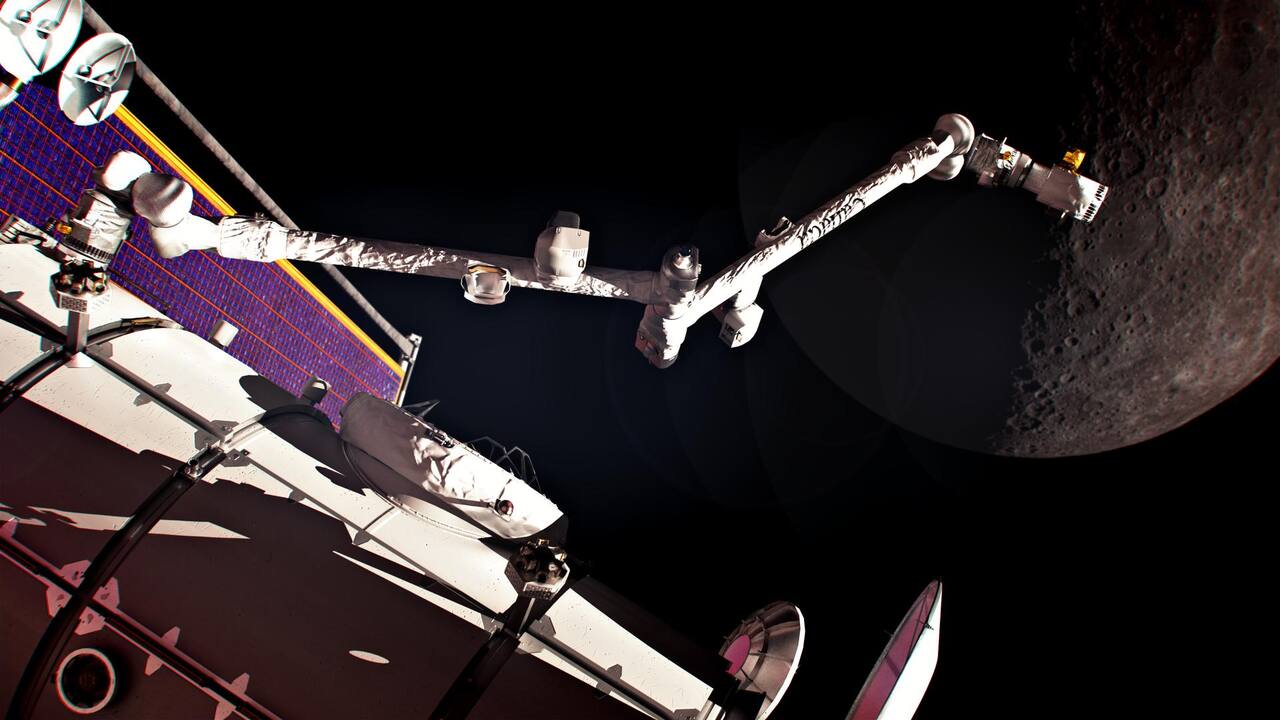
 NASA/Alberto Bertolin, Bradley Reynolds. Public domain (NASA / US government work).
Overview
Section titled “Overview”Canadarm3 is the Canadian Space Agency contribution to the Lunar Gateway, a robotic system rather than a single arm. It comprises an eXploration Large Arm, an eXploration Dexterous Arm, specialized tools, a tool and orbital replacement unit caddy, ground control systems, and AI-based control and mission planning software [4]. MDA Space in Brampton, Ontario holds the contract. Delivery is stated as no earlier than 2029 and the system is in development; the ISAM catalog records both arms as in development with a scheduled first use in 2028 [1].
The design driver is the communication geometry. Gateway operates about 400,000 km from Earth, where the link is limited and delayed enough that continuous ground supervision is not available, so Canadarm3 is specified as a goal-driven autonomous system able to maintain itself and make decisions with minimal human intervention [6]. Gateway is also uncrewed for long periods, which removes the on-board operator that Canadarm2 relies on.
Specifications
Section titled “Specifications”| Parameter | Value | Source |
|---|---|---|
| eXploration Large Arm reach | 8.5 m | [5], [1] |
| eXploration Dexterous Arm reach | 3 m | [1] |
| Degrees of freedom, each arm | 7 (3 shoulder, 1 elbow, 3 wrist) | [5], [1] |
| Mass, large arm | 715 kg, estimated | |
| Boom exterior diameter | 0.23 m, carbon fiber composite | |
| Joint rotation | about 360 deg per joint | |
| Unloaded tip speed | 0.10 m/s | |
| Loaded tip speed | not yet set | |
| Cameras | 4 color 4K, at the boom swivels and hands | |
| Sensing | force-moment sensors, collision avoidance, 3D Vision Sensor | |
| Control | autonomous, with ground or Gateway override |
Rows with no marker are from [5].
Comparison with the earlier Canadarms
Section titled “Comparison with the earlier Canadarms”| Parameter | Canadarm | Canadarm2 | Canadarm3 | Source |
|---|---|---|---|---|
| Length | 15 m | 17 m | 8.5 m | [5], [2] |
| Mass | 410 kg | 1497 kg | 715 kg estimated | [5], [2] |
| Diameter | 33 cm | 35 cm | 23 cm | |
| Degrees of freedom | 6 (2 shoulder, 1 elbow, 3 wrist) | 7 (3 shoulder, 1 elbow, 3 wrist) | 7 (3 shoulder, 1 elbow, 3 wrist) | [5], [2] |
| Joint rotation | elbow limited to 160 deg | 270 deg each direction, 540 deg total | about 360 deg per joint | |
| Unloaded tip speed | 60 cm/s | 37 cm/s | 10 cm/s | |
| Loaded tip speed | 6 cm/s | 2 to 15 cm/s | to be determined | |
| Structure | 16 layers carbon fiber epoxy | 19 layers carbon fiber thermoplastic | carbon fiber composite | |
| Sensing | none | force-moment sensors, collision avoidance | force-moment sensors, collision avoidance, 3D Vision Sensor | |
| Cameras | 2 | 4 color | 4 color 4K | |
| Control | Shuttle crew | ground or ISS crew | autonomous, with ground or Gateway override | |
| Repair | on Earth | in space, replaceable sections | self-detaching sections repaired inside Gateway | [5], [2] |
| Operator | United States | Canada and United States | Canada |
Rows with no marker are from [5].
Sources differ on camera count: the CSA comparative table gives four 4K color cameras on the boom swivels and hands [5], while a review of the Canadarm series gives six 4K cameras [2].
Mission profile
Section titled “Mission profile”| Parameter | Value | Source |
|---|---|---|
| Host | Lunar Gateway | [4] |
| Distance from Earth at which the system operates | about 400,000 km | [6] |
| Delivery | no earlier than 2029, subject to the Gateway schedule | [4] |
| First use in the ISAM catalog | 2028 | [1] |
| Phase A, system definition | complete | [7] |
| Phases B and C contract, 26 July 2021 | $35.3 million, Gateway External Robotics Interfaces preliminary and detailed design | [7] |
| Phases C and D contract, 27 June 2024 | $1 billion, final design plus construction, assembly, integration and test | [8] |
| Phase C and D period of performance | to March 2030 | [8] |
| Canadian supply chain | more than 200 companies | [8] |
The 2024 award supersedes the phase description in the 2021 release: MDA Space is now contracted for the flight system itself, comprising the large arm, the dexterous arm, specialized tools and the ground segment, together with commissioning support from Brampton and training for on-orbit operations [8]. The program was valued at more than $1 billion in total in the 2021 release [7], a figure the 2024 contract alone now matches [8].
Mobility
Section titled “Mobility”Canadarm3 has no fixed end. Like Canadarm2 it walks end over end, but where Canadarm2 requires the Mobile Base System and Mobile Transporter to traverse the ISS truss, Canadarm3 covers the full length of Gateway by walking alone [5]. Each arm end attaches to specially designed interfaces on the Gateway exterior, and the anchoring hands plug into those interfaces to take power, data and video [4].
The two arms divide the work by scale. The eXploration Large Arm has a reach of 8.5 m in seven degrees of freedom, terminating in a low profile end effector with latches and umbilicals, and is used for berthing modules and inspecting Gateway [1]. The eXploration Dexterous Arm has a reach of 3 m in seven degrees of freedom with a dexterous end effector and umbilical, and handles orbital replacement unit and payload replacement, handling and inspection in the way Dextre does on the ISS. Both are scheduled for first use in 2028 in that catalog, against a CSA delivery date of no earlier than 2029 [4].
Unloaded tip speed is 10 cm/s, against 37 cm/s for Canadarm2 and 60 cm/s for the Shuttle arm [5]. The loaded figure has not been set. Joint rotation is about 360 degrees per joint, where Canadarm2 joints travel 270 degrees in each direction, and the arm is 23 cm in diameter against 35 cm for Canadarm2, and 715 kg against 1497 kg [5].
Power and energy
Section titled “Power and energy”Power reaches the arm through the Gateway External Robotics Interfaces, the same anchoring points that carry data and video [4]. No power draw, bus voltage or energy figure has been published for either arm.
Thermal
Section titled “Thermal”No thermal design information has been published for Canadarm3.
Compute and avionics
Section titled “Compute and avionics”No processor, radiation tolerance approach or data handling specification has been published. The AI-based control and mission planning software is named as a deliverable alongside the hardware and the ground segment [6], but no architecture has been released. Onboard autonomy for capture of an uncooperative target remains an open research problem across the field rather than a solved one carried into flight [3].
Autonomy
Section titled “Autonomy”Canadarm3 is the first space manipulator specified to run without continuous supervision. Control is autonomous, with override available from the ground or from Gateway crew [5], and tasks can be commanded by robotics flight controllers in Canada, by crew on board, or by Gateway’s own autonomous system [4]. Some tasks are performed autonomously with no human intervention at all.
The sensing that supports this is a step beyond Canadarm2. Both arms carry force-moment sensors and collision avoidance, as Canadarm2 does, plus a 3D Vision Sensor that Canadarm2 does not have [5]. Four 4K color cameras are mounted at the boom swivels and the hands, against Canadarm2’s four standard color cameras at the elbow sides and hands.
Self-maintenance is part of the autonomy specification rather than a separate capability. The system is designed to maintain itself in space and swap out its own parts [4], with sections that detach themselves so they can be repaired inside Gateway [5], [2]. Canadarm2 by comparison has replaceable sections but requires an external operation to change them [5].
Communications
Section titled “Communications”Power, data and video all pass through the Gateway External Robotics Interfaces at the anchoring hands [4]. No band allocation or data rate has been published. The operational constraint that shapes the design is the 400,000 km distance to Earth and the limited, delayed link it produces [6].
Payload and instruments
Section titled “Payload and instruments”The system delivers specialized tools for maintenance and science tasks together with a tool and orbital replacement unit caddy [6], [4]. The arms catch visiting spacecraft, relocate Gateway modules, maintain, repair and inspect the station, assist astronauts during spacewalks, and enable science in lunar orbit [4]. No instrument list or tool inventory has been published.
Modes of operation
Section titled “Modes of operation”Three command paths are defined: robotics flight controllers in Canada, crew on board Gateway, and Gateway’s autonomous system [4]. Autonomous operation is the baseline with ground and crew override retained [5]. Safing, hibernation and fault response modes are not described in any published source.
Ground operations
Section titled “Ground operations”Ground control systems are a delivered element of the Canadarm3 system rather than an adaptation of existing infrastructure [4]. Robotics flight controllers operate from Canada. Canadarm2 by contrast is controlled from the ground or by ISS crew, and the SRMS only by Shuttle crew [2]. No planning cycle, tooling or latency figure has been published.
Technologies developed
Section titled “Technologies developed”The Gateway External Robotics Interfaces were planned for delivery ahead of the arms themselves [7].
The lineage is continuous in supplier and discontinuous in operating concept. MDA built Canadarm2 and Canadarm3 under contract to CSA, and its former subsidiary Spar Aerospace built the Shuttle Remote Manipulator System (SRMS) [2]. What changes at Canadarm3 is who decides: the SRMS was flown by Shuttle astronauts, Canadarm2 by ground operators or ISS crew, and Canadarm3 by itself [5], [2]. Space manipulator surveys place Canadarm3 alongside the other current programs moving toward autonomous capture and servicing of targets that were not prepared for it [3].
References
Section titled “References”References
- Mulvaney, J., Arney, D., Williams, C., Morel, J., Stockdale, C., Whitlock, C. and Balaji, V. (2025). In-Space Servicing, Assembly, and Manufacturing (ISAM) State of Play, 2025 Edition. NASA, 20250008988. Source
BibTeX
@techreport{nasa2025space, title = {In-Space Servicing, Assembly, and Manufacturing (ISAM) State of Play, 2025 Edition}, author = {Mulvaney, John and Arney, Dale and Williams, Christina and Morel, Jose and Stockdale, Christopher and Whitlock, Christopher and Balaji, Vishruth}, year = {2025}, institution = {NASA}, number = {20250008988}, url = {https://ntrs.nasa.gov/citations/20250008988} } - Won, D., So, B.-R. and Kim, H.-D. (2022). A Survey of Space Robotic Manipulator. Journal of Space Technology and Applications, 4. Source
BibTeX
@article{won2022survey, title = {A Survey of Space Robotic Manipulator}, author = {Won, Daehee and So, Byung-Rok and Kim, Hae-Dong}, year = {2022}, journal = {Journal of Space Technology and Applications}, volume = {2}, number = {4}, pages = {257--267}, doi = {10.52912/jsta.2022.2.4.257}, url = {https://doi.org/10.52912/jsta.2022.2.4.257} } - Papadopoulos, E., Aghili, F., Ma, O. and Lampariello, R. (2021). Robotic Manipulation and Capture in Space: A Survey. Frontiers in Robotics and AI. Source
BibTeX
@article{papadopoulos2021robotic, title = {Robotic Manipulation and Capture in Space: A Survey}, author = {Papadopoulos, Evangelos and Aghili, Farhad and Ma, Ou and Lampariello, Roberto}, year = {2021}, journal = {Frontiers in Robotics and AI}, volume = {8}, pages = {686723}, doi = {10.3389/frobt.2021.686723}, url = {https://doi.org/10.3389/frobt.2021.686723} } - (2026). CSA: About Canadarm3. asc-csa.gc.ca/eng/canadarm3/about.asp (accessed 2026-09-02)
archived copy
BibTeX
@misc{csaabout, title = {CSA: About Canadarm3}, howpublished = {\url{https://www.asc-csa.gc.ca/eng/canadarm3/about.asp}}, organization = {asc-csa.gc.ca}, year = {2026}, urldate = {2026-09-02} } - (2026). CSA: Comparative table of Canadarm, Canadarm2 and Canadarm3. asc-csa.gc.ca/eng/iss/canadarm2/canadarm-canadarm2-canadarm3-comparat... (accessed 2026-09-02)
archived copy
BibTeX
@misc{csacomparative, title = {CSA: Comparative table of Canadarm, Canadarm2 and Canadarm3}, howpublished = {\url{https://www.asc-csa.gc.ca/eng/iss/canadarm2/canadarm-canadarm2-canadarm3-comparative-table.asp}}, organization = {asc-csa.gc.ca}, year = {2026}, urldate = {2026-09-02} } - (2026). MDA Space: Canadarm3. mda.space/canadarm3 (accessed 2026-09-02)
archived copy
BibTeX
@misc{mdaspacecanadarm3, title = {MDA Space: Canadarm3}, howpublished = {\url{https://mda.space/canadarm3}}, organization = {mda.space}, year = {2026}, urldate = {2026-09-02} } - (2026). MDA Space: MDA awarded next contract for flagship Canadarm3 program. mda.space/article/mda-awarded-next-contract-for-flagship-canadarm3-pr... (accessed 2026-09-02)
archived copy
BibTeX
@misc{mdaspacemda, title = {MDA Space: MDA awarded next contract for flagship Canadarm3 program}, howpublished = {\url{https://mda.space/article/mda-awarded-next-contract-for-flagship-canadarm3-program/}}, organization = {mda.space}, year = {2026}, urldate = {2026-09-02} } - (2026). MDA Space: $1B contract to design and deliver the Canadarm3 flight system. mda.space/article/mda-space-awarded-1b-contract-to-design-and-deliver... (accessed 2026-09-02)
archived copy
BibTeX
@misc{mdaspace1b,
  title = {MDA Space: $1B contract to design and deliver the Canadarm3 flight system},
  howpublished = {\url{https://mda.space/article/mda-space-awarded-1b-contract-to-design-and-deliver-canadarm3-flight-system}},
  organization = {mda.space},
  year = {2026},
  urldate = {2026-09-02}
}
Further reading
- NASA. (2020). Cross-Program Design Specification for Natural Environments (DSNE), Revision G. NASA Marshall Space Flight Center. Source
- Lear, D. M., Hoffman, K. D., Hyde, J. L. and Collins, C. M. (2019). Bumper: A Tool for Analyzing Spacecraft Micrometeoroid and Orbital Debris Risk. NASA. Source
- O'Neill, P. M., Golge, S. and Slaba, T. C. (2014). Implementing the Badhwar-O'Neill Galactic Cosmic Ray Model for Spacecraft Analysis. NASA. Source